Chapter V
Reading edition
PORTO BELLO AND PANAMA
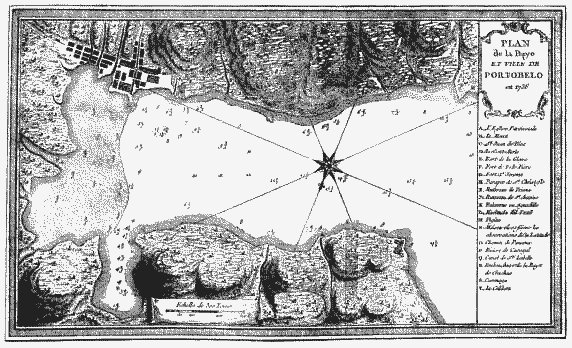
On returning to the ships from the sack of Puerto Principe, Morgan unfolded to his men his scheme of striking at the very heart of Spanish power in the Indies by capturing Porto Bello. The Frenchmen among his followers, it seems, wholly refused to join him in this larger design, full of danger as it was; so Morgan sailed away with only the English freebooters, some 400 in number, for the coasts of Darien. Exquemelin has left us a narrative of this exploit which is more circumstantial than any other we possess, and agrees so closely with what we know from other sources that we must accept the author's statement that he was an eye-witness. He relates the whole story, moreover, in so entertaining and picturesque a manner that he deserves quotation.
"Being thus posted under the walls of the castle, Captain Morgan commanded the sentry, whom they had taken prisoner, to speak to those that were within, charging them to surrender, and deliver themselves up to his discretion; otherwise they should be all cut in pieces, without giving quarter to any one. But they would hearken to none of these threats, beginning instantly to fire; which gave notice unto the city, and this was suddenly alarmed. Yet, notwithstanding, although the Governor and soldiers of the said castle made as great resistance as could be performed, they were constrained to surrender unto the Pirates. These no sooner had taken the castle, than they resolved to be as good as their words, in putting the Spaniards to the sword, thereby to strike a terror into the rest of the city. Hereupon, having shut up all the soldiers and officers as prisoners into one room, they instantly set fire to the powder (whereof they found great quantity), and blew up the whole castle into the air, with all the Spaniards that were within. This being done, they pursued the course of their victory, falling upon the city, which as yet was not in order to receive them. Many of the inhabitants cast their precious jewels and moneys into wells and cisterns or hid them in other places underground, to excuse, as much as were possible, their being totally robbed. One party of the Pirates being assigned to this purpose, ran immediately to the cloisters, and took as many religious men and women as they could find. The Governor of the city not being able to rally the citizens, through the huge confusion of the town, retired unto one of the castles remaining, and from thence began to fire incessantly at the Pirates. But these were not in the least negligent either to assault him or defend themselves with all the courage imaginable. Thus it was observed that, amidst the horror of the assault, they made very few shot in vain. For aiming with great dexterity at the mouths of the guns, the Spaniards were certain to lose one or two men every time they charged each gun anew.
"The assault of this castle where the Governor was continued very furious on both sides, from break of day until noon. Yea, about this time of the day the case was very dubious which party should conquer or be conquered. At last the Pirates, perceiving they had lost many men and as yet advanced but little towards the gaining either this or the other castles remaining, thought to make use of fireballs, which they threw with their hands, designing, if possible, to burn the doors of the castle. But going about to put this in execution, the Spaniards from the walls let fall great quantity of stones and earthen pots full of powder and other combustible matter, which forced them to desist from that attempt. Captain Morgan, seeing this generous defence made by the Spaniards, began to despair of the whole success of the enterprise. Hereupon many faint and calm meditations came into his mind; neither could he determine which way to turn himself in that straitness of affairs. Being involved in these thoughts, he was suddenly animated to continue the assault, by seeing the English colours put forth at one of the lesser castles, then entered by his men, of whom he presently after spied a troop that came to meet him proclaiming victory with loud shouts of joy. This instantly put him upon new resolutions of making new efforts to take the rest of the castles that stood out against him; especially seeing the chief citizens were fled unto them, and had conveyed thither great part of their riches, with all the plate belonging to the churches, and other things dedicated to divine service.
"To this effect, therefore, he ordered ten or twelve ladders to be made, in all possible haste, so broad that three or four men at once might ascend by them. These being finished, he commanded all the religious men and women whom he had taken prisoners to fix them against the walls of the castle. Thus much he had beforehand threatened the Governor to perform, in case he delivered not the castle. But his answer was: 'He would never surrender himself alive.' Captain Morgan was much persuaded that the Governor would not employ his utmost forces, seeing religious women and ecclesiastical persons exposed in the front of the soldiers to the greatest dangers. Thus the ladders, as I have said, were put into the hands of religious persons of both sexes; and these were forced, at the head of the companies, to raise and apply them to the walls. But Captain Morgan was deceived in his judgment of this design. For the Governor, who acted like a brave and courageous soldier, refused not, in performance of his duty, to use his utmost endeavours to destroy whosoever came near the walls. The religious men and women ceased not to cry unto him and beg of him by all the Saints of Heaven he would deliver the castle, and hereby spare both his and their own lives. But nothing could prevail with the obstinacy and fierceness that had possessed the Governor's mind. Thus many of the religious men and nuns were killed before they could fix the ladders. Which at last being done, though with great loss of the said religious people, the Pirates mounted them in great numbers, and with no less valour; having fireballs in their hands, and earthen pots full of powder. All which things, being now at the top of the walls, they kindled and cast in among the Spaniards.
"This effort of the Pirates was very great, insomuch as the Spaniards could no longer resist nor defend the castle, which was now entered. Hereupon they all threw down their arms, and craved quarter for their lives. Only the Governor of the city would admit or crave no mercy; but rather killed many of the Pirates with his own hands, and not a few of his own soldiers, because they did not stand to their arms. And although the Pirates asked him if he would have quarter, yet he constantly answered: 'By no means; I had rather die as a valiant soldier, than be hanged as a coward.' They endeavoured as much as they could to take him prisoner. But he defended himself so obstinately that they were forced to kill him; notwithstanding all the cries and tears of his own wife and daughter, who begged of him upon their knees he would demand quarter and save his life. When the Pirates had possessed themselves of the castle, which was about night, they enclosed therein all the prisoners they had taken, placing the women and men by themselves, with some guards upon them. All the wounded were put into a certain apartment by itself, to the intent their own complaints might be the cure of their diseases; for no other was afforded them.
"Hereupon they prepared for a departure, carrying on board their ships all the pillage they had gotten. But, before all, they provided the fleet with sufficient victuals for the voyage. While these things were getting ready, Captain Morgan sent an injunction unto the prisoners, that they should pay him a ransom for the city, or else he would by fire consume it to ashes, and blow up all the castles into the air. Withal, he commanded them to send speedily two persons to seek and procure the sum he demanded, which amounted to one hundred thousand pieces of eight. Unto this effect, two men were sent to the President of Panama, who gave him an account of all these tragedies. The President, having now a body of men in readiness, set forth immediately towards Porto Bello, to encounter the Pirates before their retreat. But these people, hearing of his coming, instead of flying away, went out to meet him at a narrow passage through which of necessity he ought to pass. Here they placed an hundred men very well armed; the which, at the first encounter, put to flight a good party of those of Panama. This accident obliged the President to retire for that time, as not being yet in a posture of strength to proceed any farther. Presently after this rencounter he sent a message unto Captain Morgan to tell him: 'That in case he departed not suddenly with all his forces from Porto Bello, he ought to expect no quarter for himself nor his companions, when he should take them, as he hoped soon to do.' Captain Morgan, who feared not his threats knowing he had a secure retreat in his ships which were nigh at hand, made him answer: 'He would not deliver the castles, before he had received the contribution money he had demanded. Which in case it were not paid down, he would certainly burn the whole city, and then leave it, demolishing beforehand the castles and killing the prisoners.'
The fort or castle of San Lorenzo, which stood on a hill commanding the river Chagre, seems to have been built of double rows of wooden palisades, the space between being filled with earth; and it was protected by a ditch 12 feet deep and by several smaller batteries nearer the water's edge. Lieutenant-Colonel Bradley, who, according to Exquemelin, had been on these coasts before with Captain Mansfield, landed near the fort on the 27th of December. He and his men fought in the trenches from early afternoon till eight o'clock next morning, when they stormed and carried the place. The buccaneers suffered severely, losing about 150 in killed and wounded, including Bradley himself who died ten days later. Exquemelin gives a very vivid account of the action. The buccaneers, he writes, "came to anchor in a small port, at the distance of a league more or less from the castle. The next morning very early they went on shore, and marched through the woods, to attack the castle on that side. This march continued until two o'clock, afternoon, by reason of the difficulties of the way, and its mire and dirt. And although their guides served them exactly, notwithstanding they came so nigh the castle at first that they lost many of their men with the shot from the guns, they being in an open place where nothing could cover nor defend them. This much perplexed the Pirates ..." (but) "at last after many doubts and disputes among themselves they resolved to hazard the assault and their lives after a most desperate manner. Thus they advanced towards the castle, with their swords in one hand and fireballs in the other. The Spaniards defended themselves very briskly, ceasing not to fire at them with their great guns and muskets continually crying withal: 'Come on, ye English dogs, enemies to God and our King; let your other companions that are behind come on too, ye shall not go to Panama this bout.' After the Pirates had made some trial to climb up the walls, they were forced to retreat, which they accordingly did, resting themselves until night. This being done, they returned to the assault, to try if by the help of their fireballs they could overcome and pull down the pales before the wall. This they attempted to do, and while they were about it there happened a very remarkable accident, which gave them the opportunity of the victory. One of the Pirates was wounded with an arrow in his back, which pierced his body to the other side. This he instantly pulled out with great valour at the side of his breast; then taking a little cotton that he had about him, he wound it about the said arrow, and putting it into his musket, he shot it back into the castle. But the cotton being kindled by the powder, occasioned two or three houses that were within the castle, being thatched with palm-leaves, to take fire, which the Spaniards perceived not so soon as was necessary. For this fire meeting with a parcel of powder, blew it up and thereby caused great ruin, and no less consternation to the Spaniards, who were not able to account for this accident, not having seen the beginning thereof.
"Thus the Pirates perceiving the good effect of the arrow and the beginning of the misfortune of the Spaniards, were infinitely gladdened thereat. And while they were busied in extinguishing the fire, which caused great confusion in the whole castle, having not sufficient water wherewithal to do it, the Pirates made use of this opportunity, setting fire likewise to the palisades. Thus the fire was seen at the same time in several parts about the castle, which gave them huge advantage against the Spaniards. For many breaches were made at once by the fire among the pales, great heaps of earth falling down into the ditch. Upon these the Pirates climbed up, and got over into the castle, notwithstanding that some Spaniards, who were not busied about the fire, cast down upon them many flaming pots, full of combustible matter and odious smells, which occasioned the loss of many of the English.
"The Spaniards, notwithstanding the great resistance they made, could not hinder the palisades from being entirely burnt before midnight. Meanwhile the Pirates ceased not to persist in their intention of taking the castle. Unto which effect, although the fire was great, they would creep upon the ground, as nigh unto it as they could, and shoot amidst the flames, against the Spaniards they could perceive on the other side, and thus cause many to fall dead from the walls. When day was come, they observed all the moveable earth that lay between the pales to be fallen into the ditch in huge quantity. So that now those within the castle did in a manner lie equally exposed to them without, as had been on the contrary before. Whereupon the Pirates continued shooting very furiously against them, and killed great numbers of Spaniards. For the Governor had given them orders not to retire from those posts which corresponded to the heaps of earth fallen into the ditch, and caused the artillery to be transported unto the breaches.
"Notwithstanding, the fire within the castle still continued, and now the Pirates from abroad used what means they could to hinder its progress, by shooting incessantly against it. One party of the Pirates was employed only to this purpose, and another commanded to watch all the motions of the Spaniards, and take all opportunities against them. About noon the English happened to gain a breach, which the Governor himself defended with twenty-five soldiers. Here was performed a very courageous and warlike resistance by the Spaniards, both with muskets, pikes, stones and swords. Yet notwithstanding, through all these arms the Pirates forced and fought their way, till at last they gained the castle. The Spaniards who remained alive cast themselves down from the castle into the sea, choosing rather to die precipitated by their own selves (few or none surviving the fall) than to ask any quarter for their lives. The Governor himself retreated unto the corps du garde, before which were placed two pieces of cannon. Here he intended still to defend himself, neither would he demand any quarter. But at last he was killed with a musket shot, which pierced his skull into the brain.
"The next morning, being the third day of their journey, they all went ashore, excepting those above-mentioned who were to keep the boats. Unto these Captain Morgan gave very strict orders, under great penalties, that no man, upon any pretext whatsoever, should dare to leave the boats and go ashore. This he did, fearing lest they should be surprised and cut off by an ambuscade of Spaniards, that might chance to lie thereabouts in the neighbouring woods, which appeared so thick as to seem almost impenetrable. Having this morning begun their march, they found the ways so dirty and irksome, that Captain Morgan thought it more convenient to transport some of the men in canoes (though it could not be done without great labour) to a place farther up the river, called Cedro Bueno. Thus they re-embarked, and the canoes returned for the rest that were left behind. So that about night they found themselves all together at the said place. The Pirates were extremely desirous to meet any Spaniards, or Indians, hoping to fill their bellies with what provisions they should take from them. For now they were reduced almost to the very extremity of hunger.
"After they had feasted themselves with those pieces of leather, they quitted the place, and marched farther on, till they came about night to another post called Torna Munni. Here they found another ambuscade, but as barren and desert as the former. They searched the neighbouring woods, but could not find the least thing to eat. The Spaniards having been so provident as not to leave behind them anywhere the least crumb of sustenance, whereby the Pirates were now brought to the extremity aforementioned. Here again he was happy, that had reserved since noon any small piece of leather whereof to make his supper, drinking after it a good draught of water for his greatest comfort. Some persons who never were out of their mothers' kitchens may ask how these Pirates could eat, swallow and digest those pieces of leather, so hard and dry. Unto whom I only answer: That could they once experiment what hunger, or rather famine, is, they would certainly find the manner, by their own necessity, as the Pirates did. For these first took the leather, and sliced it in pieces. Then did they beat it between two stones and rub it, often dipping it in the water of the river, to render it by these means supple and tender. Lastly they scraped off the hair, and roasted or broiled it upon the fire. And being thus cooked they cut it into small morsels, and eat it, helping it down with frequent gulps of water, which by good fortune they had nigh at hand.
"They continued their march the fifth day, and about noon came unto a place called Barbacoa. Here likewise they found traces of another ambuscade, but the place totally as unprovided as the two precedent were. At a small distance were to be seen several plantations, which they searched very narrowly, but could not find any person, animal or other thing that was capable of relieving their extreme and ravenous hunger. Finally, having ranged up and down and searched a long time, they found a certain grotto which seemed to be but lately hewn out of a rock, in which they found two sacks of meal, wheat and like things, with two great jars of wine, and certain fruits called Platanos. Captain Morgan, knowing that some of his men were now, through hunger, reduced almost to the extremity of their lives, and fearing lest the major part should be brought into the same condition, caused all that was found to be distributed amongst them who were in greatest necessity. Having refreshed themselves with these victuals, they began to march anew with greater courage than ever. Such as could not well go for weakness were put into the canoes, and those commanded to land that were in them before. Thus they prosecuted their journey till late at night, at which time they came unto a plantation where they took up their rest. But without eating anything at all; for the Spaniards, as before, had swept away all manner of provisions, leaving not behind them the least signs of victuals.
"On the sixth day they continued their march, part of them by land through the woods, and part by water in the canoes. Howbeit they were constrained to rest themselves very frequently by the way, both for the ruggedness thereof and the extreme weakness they were under. Unto this they endeavoured to occur, by eating some leaves of trees and green herbs, or grass, such as they could pick, for such was the miserable condition they were in. This day, at noon, they arrived at a plantation, where they found a barn full of maize. Immediately they beat down the doors, and fell to eating of it dry, as much as they could devour. Afterwards they distributed great quantity, giving to every man a good allowance thereof. Being thus provided they prosecuted their journey, which having continued for the space of an hour or thereabouts, they met with an ambuscade of Indians. This they no sooner had discovered, but they threw away their maize, with the sudden hopes they conceived of finding all things in abundance. But after all this haste, they found themselves much deceived, they meeting neither Indians nor victuals, nor anything else of what they had imagined. They saw notwithstanding on the other side of the river a troop of a hundred Indians more or less, who all escaped away through the agility of their feet. Some few Pirates there were who leapt into the river, the sooner to reach the shore to see if they could take any of the said Indians prisoners. But all was in vain; for being much more nimble on their feet than the Pirates they easily baffled their endeavours. Neither did they only baffle them, but killed also two or three of the Pirates with their arrows, shooting at them at a distance, and crying: 'Ha! perros, a la savana, a la savana. Ha! ye dogs, go to the plain, go to the plain.'
"This day they could advance no further, by reason they were necessitated to pass the river hereabouts to continue their march on the other side. Hereupon they took up their repose for that night. Howbeit their sleep was not heavy nor profound, for great murmurings were heard that night in the camp, many complaining of Captain Morgan and his conduct in that enterprise, and being desirous to return home. On the contrary, others would rather die there than go back one step from what they had undertaken. But others who had greater courage than any of these two parties did laugh and joke at all their discourses. In the meanwhile they had a guide who much comforted them, saying: 'It would not now be long before they met with people, from whom they should reap some considerable advantage.'
"At length they arrived there in great haste, all sweating and panting, but found no person in the town, nor anything that was eatable wherewith to refresh themselves, unless it were good fires to warm themselves, which they wanted not. For the Spaniards before their departure, had every one set fire to his own house, excepting only the storehouses and stables belonging to the King.
"They had not left behind them any beast whatsoever, either alive or dead. This occasioned much confusion in their minds, they not finding the least thing to lay hold on, unless it were some few cats and dogs, which they immediately killed and devoured with great appetite. At last in the King's stables they found by good fortune fifteen or sixteen jars of Peru wine, and a leather sack full of bread. But no sooner had they begun to drink of the said wine when they fell sick, almost every man. This sudden disaster made them think that the wine was poisoned, which caused a new consternation in the whole camp, as judging themselves now to be irrecoverably lost. But the true reason was, their huge want of sustenance in that whole voyage, and the manifold sorts of trash which they had eaten upon that occasion. Their sickness was so great that day as caused them to remain there till the next morning, without being able to prosecute their journey as they used to do, in the afternoon. This village is seated in the latitude in 9 degrees and 2 minutes, northern latitude, being distant from the river of Chagre twenty-six Spanish leagues, and eight from Panama. Moreover, this is the last place unto which boats or canoes can come; for which reason they built here store-houses, wherein to keep all sorts of merchandise, which from hence to and from Panama are transported upon the backs of mules.
"Here therefore Captain Morgan was constrained to leave his canoes and land all his men, though never so weak in their bodies. But lest the canoes should be surprised, or take up too many men for their defence, he resolved to send them all back to the place where the boats were, excepting one, which he caused to be hidden, to the intent it might serve to carry intelligence according to the exigency of affairs. Many of the Spaniards and Indians belonging to this village were fled to the plantations thereabouts. Hereupon Captain Morgan gave express orders that none should dare to go out of the village, except in whole companies of a hundred together. The occasion hereof was his fear lest the enemy should take an advantage upon his men, by any sudden assault. Notwithstanding, one party of English soldiers stickled not to contravene these commands, being thereunto tempted with the desire of finding victuals. But these were soon glad to fly into the town again, being assaulted with great fury by some Spaniards and Indians, who snatched up one of the Pirates, and carried him away prisoner. Thus the vigilance and care of Captain Morgan was not sufficient to prevent every accident that might happen.
"On the eighth day, in the morning, Captain Morgan sent two hundred men before the body of his army, to discover the way to Panama, and see if they had laid any ambuscades therein. Especially considering that the places by which they were to pass were very fit for that purpose, the paths being so narrow that only ten or twelve persons could march in a file, and oftentimes not so many. Having marched about the space of ten hours, they came unto a place called Quebrada Obscura. Here, all on a sudden, three or four thousand arrows were shot at them, without being able to perceive from whence they came, or who shot them. The place, from whence it was presumed they were shot was a high rocky mountain, excavated from one side to the other, wherein was a grotto that went through it, only capable of admitting one horse, or other beast laden. This multitude of arrows caused a huge alarm among the Pirates, especially because they could not discover the place from whence they were discharged. At last, seeing no more arrows to appear, they marched a little farther, and entered into a wood. Here they perceived some Indians to fly as fast as they could possible before them, to take the advantage of another post, and thence observe the march of the Pirates. There remained, notwithstanding one troop of Indians upon the place, with full design to fight and defend themselves. This combat they performed with huge courage, till such time as their captain fell to the ground wounded, who although he was now in despair of life, yet his valour being greater than his strength, would demand no quarter, but, endeavouring to raise himself, with undaunted mind laid hold of his azagaya, or javelin, and struck at one of the Pirates. But before he could second the blow, he was shot to death with a pistol. This was also the fate of many of his companions, who like good and courageous soldiers lost their lives with their captain, for the defence of their country.
"At this place there was a wood and on each side thereof a mountain. The Indians had possessed themselves of the one, and the Pirates took possession of the other that was opposite unto it. Captain Morgan was persuaded that in the wood the Spaniards had placed an ambuscade, as lying so conveniently for that purpose. Hereupon he sent before two hundred men to search it. The Spaniards and Indians, perceiving the Pirates to descend the mountain, did so too, as if they designed to attack them. But being got into the wood, out of sight of the Pirates, they disappeared, and were seen no more, leaving the passage open unto them.
"About night there fell a great rain, which caused the Pirates to march the faster and seek everywhere for houses wherein to preserve their arms from being wet. But the Indians had set fire to every one thereabouts, and transported all their cattle unto remote places, to the end that the Pirates, finding neither houses nor victuals, might be constrained to return homewards. Notwithstanding, after diligent search, they found a few little huts belonging to shepherds, but in them nothing to eat. These not being capable of holding many men, they placed in them out of every company a small number, who kept the arms of the rest of the army. Those who remained in the open field endured much hardship that night, the rain not ceasing to fall until the morning.
"The next morning, about break of day, being the ninth of this tedious journey, Captain Morgan continued his march while the fresh air of the morning lasted. For the clouds then hanging as yet over their heads were much more favourable unto them than the scorching rays of the sun, by reason the way was now more difficult and laborious than all the precedent. After two hours' march, they discovered a troop of about twenty Spaniards. who observed the motions of the Pirates. They endeavoured to catch some of them, but could lay hold on none, they suddenly disappearing, and absconding themselves in caves among the rocks, totally unknown to the Pirates. At last they came to a high mountain, which, when they ascended, they discovered from the top thereof the South Sea. This happy sight, as if it were the end of their labours, caused infinite joy among the Pirates. From hence they could descry also one ship and six boats, which were set forth from Panama, and sailed towards the islands of Tavoga and Tavogilla. Having descended this mountain, they came unto a vale, in which they found great quantity of cattle, whereof they killed good store. Here while some were employed in killing and flaying of cows, horses, bulls and chiefly asses, of which there was greatest number, others busied themselves in kindling of fires and getting wood wherewith to roast them. Thus cutting the flesh of these animals into convenient pieces, or gobbets, they threw them into the fire and, half carbonadoed or roasted, they devoured them with incredible haste and appetite. For such was their hunger that they more resembled cannibals than Europeans at this banquet, the blood many times running down from their beards to the middle of their bodies.
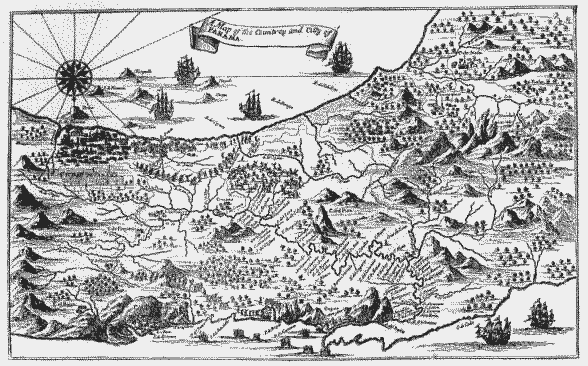
"Having satisfied their hunger with these delicious meats, Captain Morgan ordered them to continue the march. Here again he sent before the main body fifty men, with intent to take some prisoners, if possibly they could. For he seemed now to be much concerned that in nine days' time he could not meet one person who might inform him of the condition and forces of the Spaniards. About evening they discovered a troop of two hundred Spaniards, more or less, who hallooed unto the Pirates, but these could not understand what they said. A little while after they came the first time within sight of the highest steeple of Panama. This steeple they no sooner had discovered but they began to show signs of extreme joy, casting up their hats into the air, leaping for mirth, and shouting, even just as if they had already obtained the victory and entire accomplishment of their designs. All their trumpets were sounded and every drum beaten, in token of this universal acclamation and huge alacrity of their minds. Thus they pitched their camp for that night with general content of the whole army, waiting with impatience for the morning, at which time they intended to attack the city. This evening there appeared fifty horse who came out of the city, hearing the noise of the drums and trumpets of the Pirates, to observe, as it was thought, their motions. They came almost within musket-shot of the army, being preceded by a trumpet that sounded marvellously well. Those on horseback hallooed aloud unto the Pirates, and threatened them, saying, 'Perros! nos veremos,' that is, 'Ye dogs! we shall meet ye.' Having made this menace they returned to the city, excepting only seven or eight horsemen who remained hovering thereabouts, to watch what motions the Pirates made. Immediately after, the city began to fire and ceased not to play with their biggest guns all night long against the camp, but with little or no harm unto the Pirates, whom they could not conveniently reach. About this time also the two hundred Spaniards whom the Pirates had seen in the afternoon appeared again within sight, making resemblance as if they would block up the passages, to the intent no Pirates might escape the hands of their forces. But the Pirates, who were now in a manner besieged, instead of conceiving any fear of their blockades, as soon as they had placed sentries about their camp, began every one to open their satchels, and without any preparation of napkins or plates, fell to eating very heartily the remaining pieces of bulls' and horses' flesh which they had reserved since noon. This being done, they laid themselves down to sleep upon the grass with great repose and huge satisfaction, expecting only with impatience for the dawnings of the next day.
"On the tenth day, betimes in the morning, they put all their men in convenient order, and with drums and trumpets sounding, continued their march directly towards the city. But one of the guides desired Captain Morgan not to take the common highway that led thither, fearing lest they should find in it much resistance and many ambuscades. He presently took his advice, and chose another way that went through the wood, although very irksome and difficult. Thus the Spaniards, perceiving the Pirates had taken another way, which they scarce had thought on or believed, were compelled to leave their stops and batteries, and come out to meet them. The Governor of Panama put his forces in order, consisting of two squadrons, four regiments of foot, and a huge number of wild bulls, which were driven by a great number of Indians, with some negroes and others to help them.
"Notwithstanding the Pirates found in the ports of the islands of Tavoga and Tavogilla several boats that were laden with many sorts of very good merchandise; all which they took and brought unto Panama; where being arrived, they made an exact relation of all that had passed while they were abroad to Captain Morgan. The prisoners confirmed what the Pirates had said, adding thereto, that they undoubtedly knew whereabouts the said galleon might be at that present, but that it was very probable they had been relieved before now from other places. These relations stirred up Captain Morgan anew to send forth all the boats that were in the port of Panama, with design to seek and pursue the said galleon till they could find her. The boats aforesaid being in all four, set sail from Panama, and having spent eight days in cruising to and fro, and searching several ports and creeks, they lost all their hopes of finding what they so earnestly sought for. Hereupon they resolved to return unto the isles of Tavoga and Tavogilla. Here they found a reasonable good ship, that was newly come from Payta, being laden with cloth, soap, sugar and biscuit, with twenty thousand pieces of eight in ready money. This vessel they instantly seized, not finding the least resistance from any person within her. Nigh unto the said ship was also a boat whereof in like manner they possessed themselves. Upon the boat they laded great part of the merchandises they had found in the ship, together with some slaves they had taken in the said islands. With this purchase they returned to Panama, something better satisfied of their voyage, yet withal much discontented they could not meet with the galleon....
"Captain Morgan used to send forth daily parties of two hundred men, to make inroads into all the fields and country thereabouts, and when one party came back, another consisting of two hundred more was ready to go forth. By this means they gathered in a short time huge quantity of riches, and no lesser number of prisoners. These being brought into the city, were presently put unto the most exquisite tortures imaginable, to make them confess both other people's goods and their own. Here it happened, that one poor and miserable wretch was found in the house of a gentleman of great quality, who had put on, amidst that confusion of things, a pair of taffety breeches belonging to his master with a little silver key hanging at the strings thereof. This being perceived by the Pirates they immediately asked him where was the cabinet of the said key? His answer was: he knew not what was become of it, but only that finding those breeches in his master's house, he had made bold to wear them. Not being able to extort any other confession out of him, they first put him upon the rack, wherewith they inhumanly disjointed his arms. After this they twisted a cord about his forehead, which they wrung so hard, that his eyes appeared as big as eggs, and were ready to fall out of his skull. But neither with these torments could they obtain any positive answer to their demands. Whereupon they soon after hung him up, giving him infinite blows and stripes, while he was under that intolerable pain and posture of body. Afterwards they cut off his nose and ears, and singed his face with burning straw, till he could speak nor lament his misery no longer. Then losing all hopes of hearing any confession from his mouth, they commanded a negro to run him through with a lance, which put an end to his life and a period to their cruel and inhuman tortures. After this execrable manner did many others of those miserable prisoners finish their days, the common sport and recreation of these Pirates being these and other tragedies not inferior to these.
"Captain Morgan having now been at Panama the full space of three weeks, commanded all things to be put in order for his departure. Unto this effect he gave orders to every company of his men, to seek out for so many beasts of carriage as might suffice to convey the whole spoil of the city unto the river where his canoes lay. About this time a great rumour was spread in the city, of a considerable number of Pirates who intended to leave Captain Morgan; and that, by taking a ship which was in the port, they determined to go and rob upon the South Sea till they had got as much as they thought fit, and then return homewards by the way of the East Indies into Europe. For which purpose they had already gathered great quantity of provisions which they had hidden in private places, with sufficient store of powder, bullets and all other sorts of ammunition; likewise some great guns belonging to the town, muskets and other things, wherewith they designed not only to equip the said vessel but also to fortify themselves and raise batteries in some island or other, which might serve them for a place of refuge.