Chapter III
Reading edition
THE CONQUEST OF JAMAICA
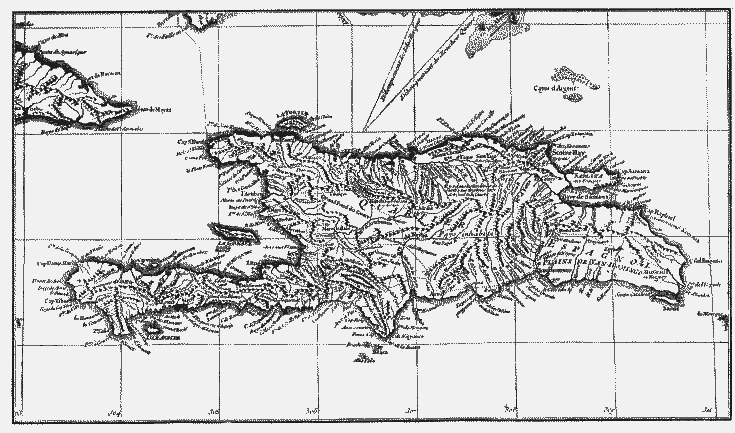
The settlement of the Windward and Leeward Islands and the conquest of Jamaica had given a new impetus to contraband trade. The commercial nations were setting up shop, as it were, at the very doors of the Spanish Indies. The French and English Antilles, condemned by the Navigation Laws to confine themselves to agriculture and a passive trade with the home country, had no recourse but to traffic with their Spanish neighbours. Factors of the Assiento established at Cartagena, Porto Bello and Vera Cruz every year supplied European merchants with detailed news of the nature and quantity of the goods which might be imported with advantage; while the buccaneers, by dominating the whole Caribbean Sea, hindered frequent communication between Spain and her colonies. It is not surprising, therefore, that the commerce of Seville, which had hitherto held its own, decreased with surprising rapidity, that the sailings of the galleons and the Flota were separated by several years, and that the fairs of Porto Bello and Vera Cruz were almost deserted. To put an effective restraint, moreover, upon this contraband trade was impossible on either side. The West Indian dependencies were situated far from the centre of authority, while the home governments generally had their hands too full of other matters to adequately control their subjects in America. The Spanish viceroys, meanwhile, and the governors in the West Indian Islands, connived at a practice which lined their own pockets with the gold of bribery, and at the same time contributed to the public interest and prosperity of their respective colonies. It was this illicit commerce with Spanish America which Charles II., by negotiation at Madrid and by instructions to his governors in the West Indies, tried to get within his own control. At the Spanish court, Fanshaw, Sandwich and Godolphin in turn were instructed to sue for a free trade with the Colonies. The Assiento of negroes was at this time held by two Genoese named Grillo and Lomelin, and with them the English ambassadors several times entered into negotiation for the privilege of supplying blacks from the English islands. By the treaty of 1670 the English colonies in America were for the first time formally recognised by the Spanish Crown. Freedom of commerce, however, was as far as ever from realisation, and after this date Charles seems to have given up hope of ever obtaining it through diplomatic channels.