Volume 5 — THE QUEEN OF THE SERPENTS.[507] (continued 2)
Richard Francis Burton translation
Now when it was the Five Hundred and Fourth Night,
She said, It hath reached me, O auspicious King, that Janshah read this much upon the tablet and found, at the end of the inscription, “Then thou wilt come to a great river, whose current is so swift that it blindeth the eyes. Now this river drieth up every Sabbath,[542] and on the opposite bank lies a city wholly inhabited by Jews, who the faith of Mohammed refuse; there is not a Moslem among the band nor is there other than this city in the land. Better therefore lord it over the apes, for so long as thou shalt tarry amongst them they will be victorious over the Ghuls. And know also that he who wrote this tablet was the lord Solomon, son of David (on both be peace!).” When Janshah read these words, he wept sore and repeated them to his men. Then they mounted again and, surrounded by the army of the apes who were rejoicing in their victory, returned to the castle. Here Janshah abode, Sultaning over them, for a year and a half. And at the end of this time, he one day commanded the ape-army to mount and go forth a-hunting with him, and they rode out into the wolds and wilds, and fared on from place to place, till they approached the Wady of Emmets, which Janshah knew by the description of it upon the alabaster tablet. Here he bade them dismount and they all abode there, eating and drinking a space of 337ten days, after which Janshah took his men apart one night and said, “I purpose we flee through the Valley of Emmets and make for the town of the Jews; it may be Allah will deliver us from these apes and we will go God’s ways.” They replied, “We hear and we obey:” so he waited till some little of the night was spent, then, donning his armour and girding his sword and dagger and such like weapons, and his men doing likewise, they set out and fared on westwards till morning. When the apes awoke and missed Janshah and his men, they knew that they had fled. So they mounted and pursued them, some taking the eastern pass and others that which led to the Wady of Emmets, nor was it long before the apes came in sight of the fugitives, as they were about to enter the valley, and hastened after them. When Janshah and his men saw them, they fled into the Emmet-valley; but the apes soon overtook them and would have slain them, when behold, there rose out of the earth a multitude of ants like swarming locusts, as big as dogs, and charged home upon the apes. They devoured many of their foes, and these also slew many of the ants; but help came to the emmets: now an ant would go up to an ape and smite him and cut him in twain, whilst ten apes could hardly master one ant and bear him away and tear him in sunder. The sore battle lasted till the evening but the emmets were victorious. In the gloaming Janshah and his men took to flight and fled along the sole of the Wady——And Shahrazad perceived the dawn of day and ceased saying her permitted say.
Now when it was the Five Hundred and Fifth Night,
She said, It hath reached me, O auspicious King, that in the gloaming Janshah and his men took to flight and fled along the sole of the Wady till the morning. With the break of day, the apes were up and at them, which when the Prince saw, he shouted to his men, “Smite with your swords.” So they bared their blades and laid on load right and left, till there ran at them an ape, with tusks like an elephant, and smote one of the Mamelukes and cut him in sunder. Then the apes redoubled upon Janshah and he fled with his followers into the lower levels of the valley, where he saw a vast river and by its side a mighty many of ants. When the emmets espied Janshah they pushed on and surrounded him, and one of the slaves fell to smiting them with 338his sword and cutting them in twain; whereupon the whole host set upon him and slew him. At this pass, behold, up came the apes from over the mountain and fell in numbers upon Janshah; but he tore off his clothes and, plunging into the river, with his remaining servant, struck out for the middle of the stream. Presently, he caught sight of a tree on the other bank; so he swam up to it and laying hold of one of its branches, hung to it and swung himself ashore, but as for the last Mameluke the current carried him away and dashed him to pieces against the mountain. Thereupon Janshah fell to wringing his clothes and spreading them in the sun to dry, what while there befel a fierce fight between the apes and the ants, until the apes gave up the pursuit and returned to their own land. Meanwhile, Janshah, who abode alone on the river-bank, could do naught but shed tears till nightfall, when he took refuge in a cavern and there passed the dark hours, in great fear and feeling desolate for the loss of his slaves. At daybreak awaking from his sleep he set out again and fared on nights and days, eating of the herbs of the earth, till he came to the mountain which burnt like fire, and thence he made the river which dried up every Sabbath. Now it was a mighty stream and on the opposite bank stood a great city, which was the capital of the Jews mentioned in the tablet. Here he abode till the next Sabbath, when the river dried up and he walked over to the other side and entered the Jew city, but saw none in the streets. So he wandered about till he came to the door of a homestead, which he opened and entering, espied within the people of the house sitting in silence and speaking not a syllable. Quoth he, “I am a stranger and anhungered;” and they signed to him, as to say, “Eat and drink, but speak not.”[543] So he ate and drank and slept that night and, when morning dawned, the master of the house greeted him and bade him welcome and asked him, “Whence comest thou and whither art thou bound?” At these words Janshah wept sore and told him all that had befallen him and how his father was King of Kabul; whereat the Jew marvelled and said, “Never heard we of that city, but we have heard from the merchants of the caravans that in that direction lieth a land called Al-Yaman.” “How far is that land from this 339place?” asked Janshah, and the Jew answered, “The Cafilah merchants pretend that it is a two years and three months’ march from their land hither.” Quoth Janshah, “And when doth the caravan come?” Quoth the Jew, “Next year ‘twill come.”——And Shahrazad perceived the dawn of day and ceased to say her permitted say.
Now when it was the Five Hundred and Sixth Night,
She said, It hath reached me, O auspicious King, that when the Jew was questioned anent the coming of the caravan, he replied, “Next year ‘twill come.” At these words the Prince wept sore and fell a-sorrowing for himself and his Mamelukes; and lamenting his separation from his mother and father and all which had befallen him in his wanderings. Then said the Jew, “O young man, do not weep, but sojourn with us till the caravan shall come, when we will send thee with it to thine own country.” So he tarried with the Jew two whole months and every day he went out walking in the streets for his solace and diversion. Now it chanced one day, whilst he paced about the main thoroughfares, as of wont, and was bending his steps right and left, he heard a crier crying aloud and saying, “Who will earn a thousand gold pieces and a slave-girl of surpassing beauty and loveliness by working for me between morning and noontide?” But no one answered him and Janshah said in his mind, “Were not this work dangerous and difficult, he would not offer a thousand dinars and a fair girl for half a day’s labour.” Then he accosted the crier and said, “I will do the work;” so the man carried him to a lofty mansion where they found one who was a Jew and a merchant, seated on an ebony chair, to whom quoth the crier, standing respectfully before him, “O merchant, I have cried every day these three months, and none hath answered, save this young man.” Hearing his speech the Jew welcomed Janshah, led him into a magnificent sitting-room and signalled to bring food. So the servants spread the table and set thereon all manner meats, of which the merchant and Janshah ate, and washed their hands. Then wine was served up and they drank; after which the Jew rose and bringing Janshah a purse of a thousand dinars and a slave-girl of rare beauty, said to him, “Take maid and money to thy hire.” Janshah took them and seated the girl by his side when the trader resumed, “To-morrow 340to the work!”; and so saying he withdrew and Janshah slept with the damsel that night. As soon as it was morning, the merchant bade his slaves clothe him in a costly suit of silk whenas he came out of the Hammam-bath. So they did as he bade them and brought him back to the house, whereupon the merchant called for harp and lute and wine and they drank and played and made merry till the half of the night was past, when the Jew retired to his Harim and Janshah lay with his slave-girl till the dawn. Then he went to the bath and on his return, the merchant came to him and said, “Now I wish thee to do the work for me.” “I hear and obey,” replied Janshah. So the merchant bade his slaves bring two she-mules and set Janshah on one, mounting the other himself. Then they rode forth from the city and fared on from morn till noon, when they made a lofty mountain, to whose height was no limit. Here the Jew dismounted, ordering Janshah to do the same; and when he obeyed the merchant gave him a knife and a cord, saying, “I desire that thou slaughter this mule.” So Janshah tucked up his sleeves and skirts and going up to the mule, bound her legs with the cord, then threw her and cut her throat; after which he skinned her and lopped off her head and legs and she became a mere heap of flesh. Then said the Jew, “Slit open the mule’s belly and enter it and I will sew it up on thee. There must thou abide awhile and whatsoever thou seest in her belly, acquaint me therewith.” So Janshah slit the mule’s belly and crept into it, whereupon the merchant sewed it up on him and withdrew to a distance,——And Shahrazad perceived the dawn of day and ceased saying her permitted say.
Now when it was the Five Hundred and Seventh Night,
She said, It hath reached me, O auspicious King, that the merchant sewed up the mule’s belly on Janshah and, withdrawing to a distance, hid himself in the skirts of the mountain. After a while a huge bird swooped down on the dead mule and snatching it up, flew up with it to the top of the mountain, where it set down the quarry and would have eaten it; but Janshah, feeling the bird begin to feed, slit the mule’s belly and came forth. When the bird saw him, it took fright at him and flew right away; whereupon he stood up and looking right and left, saw nothing but the carcasses of dead men, mummied by the sun, and exclaimed, 341“There is no Majesty and there is no Might save in Allah, the Glorious, the Great!” Then he looked down the precipice and espied the merchant standing at the mountain-foot, looking for him. As soon as the Jew caught sight of him, he called out to him, “Throw me down of the stones which are about thee, that I may direct thee to a way whereby thou mayst descend.” So Janshah threw him down some two hundred of the stones, which were all rubies,[544] chrysolites and other gems of price; after which he called out to him, saying, “Show me the way down and I will throw thee as many more.” But the Jew gathered up the stones and, binding them on the back of the mule, went his way without answering a word and left Janshah alone on the mountain-top. When the Prince found himself deserted, he began to weep and implore help of Heaven, and thus he abode three days; after 342which he rose and fared on over the mountainous ground two month’s space, feeding upon hill-herbs; and he ceased not faring till he came to its skirts and espied afar off a Wady full of fruitful trees and birds harmonious singing the praises of Allah, the One, the Victorious. At this sight he joyed with great joy and stayed not his steps till, after an hour or so, he came to a ravine in the rocks, through which the rain-torrents fell into the valley. He made his way down the cleft till he reached the Wady which he had seen from the mountain-top and walked on therein, gazing right and left, nor ceased so doing until he came in sight of a great castle, towering high in air. As he drew near the gates he saw an old man of comely aspect and face shining with light standing thereat with a staff of carnelian in his hand, and going up to him, saluted him. The Shaykh returned his salam and bade him welcome, saying, “Sit down, O my son.” So he sat down at the door of the castle and the old man said to him, “How camest thou to this land, untrodden by son of Adam before thee, and whither art thou bound?” When Janshah heard his words he wept bitterly at the thought of all the hardships he had suffered and his tears choked his speech. Quoth the Shaykh, “O my son, leave weeping; for indeed thou makest my heart ache.” So saying, he rose and set somewhat of food before him and said to him, “Eat.” He ate and praised Allah Almighty; after which the old man besought him saying, “O my son, I would have thee tell me thy tale and acquaint me with thine adventures.” So Janshah related to him all that had befallen him, from first to last, whereat the Shaykh marvelled with exceeding marvel. Then said the Prince, “Prithee inform me who is the lord of this valley and to whom doth this great castle belong?” Answered the old man, “Know, O my son, this valley and all that is therein and this castle with all it containeth belong to the lord Solomon, son of David (on both be peace!). As for me, my name is Shaykh Nasr,[545] King of the Birds; for thou must know that the lord Solomon committed this castle to my charge,”——And Shahrazad perceived the dawn of day and ceased to say her permitted say.
343
Now when it was the Five Hundred and Eighth Night,
She said, It hath reached me, O auspicious King, that Shaykh Nasr pursued, “Thou must know that the lord Solomon committed this castle to my charge and taught me the language of birds and made me ruler over all the fowls which be in the world; wherefore each and every come hither once in the twelvemonth, and I pass them in review: then they depart; and this is why I dwell here.” When Janshah heard this, he wept sore and said to the Shaykh, “O my father, how shall I do to get back to my native land?” Replied the old man, “Know, O my son, that thou art near to the mountain Kaf, and there is no departing for thee from this place till the birds come, when I will give thee in charge to one of them, and he will bear thee to thy native country. Meanwhile tarry with me here and eat and drink and divert thyself with viewing the apartments of this castle.” So Janshah abode with Shaykh Nasr, taking his pleasure in the Wady and eating of its fruits and laughing and making merry with the old man, and leading a right joyous life till the day appointed for the birds to pay their annual visit to their Governor. Thereupon the Shaykh said to him, “O Janshah, take the keys of the castle and solace thyself with exploring all its apartments and viewing whatever be therein, but as regards such a room, beware and again beware of opening its door; and if thou gainsay me and open it and enter therethrough nevermore shalt thou know fair fortune.” He repeated this charge again and again with much instance; then he went forth to meet the birds, which came up, kind by kind, and kissed his hands. Such was his case; but as regards Janshah, he went round about the castle, opening the various doors and viewing the apartments into which they led, till he came to the room which Shaykh Nasr had warned him not to open or enter. He looked at the door and its fashion pleased him, for it had on it a padlock of gold, and he said to himself, “This room must be goodlier than all the others; would Heaven I wist what is within it, that Shaykh Nasr should forbid me to open its door! There is no help but that I enter and see what is in this apartment; for whatso is decreed unto the creature perforce he must fulfil.” So he put out his hand and unlocked the door and entering, found himself before a great basin; and 344hard by it stood a little pavilion, builded all of gold and silver and crystal, with lattice-windows of jacinth. The floor was paved with green beryl and balass rubies and emeralds and other jewels, set in the ground-work mosaic-fashion, and in the midmost of the pavilion was a jetting fountain in a golden basin, full of water and girt about with figures of beasts and birds, cunningly wrought of gold and silver and casting water from their mouths. When the zephyr blew on them, it entered their ears and therewith the figures sang out with birdlike song, each in its own tongue. Beside the fountain was a great open saloon with a high daïs whereon stood a vast throne of carnelian, inlaid with pearls and jewels, over which was spread a tent of green silk fifty cubits in width and embroidered with gems fit for seal-rings and purfled with precious metals. Within this tent was a closet containing the carpet of the lord Solomon (on whom be peace!); and the pavilion was compassed about with a vast garden full of fruit-trees and streams; while near the palace were beds of roses and basil and eglantine and all manner sweet-smelling herbs and flowers. And the trees bore on the same boughs fruits fresh and dry and the branches swayed gracefully to the wooing of the wind. All this was in that one apartment and Janshah wondered thereat till he was weary of wonderment; and he set out to solace himself in the palace and the garden and to divert himself with the quaint and curious things they contained. And first looking at the basin he saw that the gravels of its bed were gems and jewels and noble metals; and many other strange things were in that apartment.——And Shahrazad perceived the dawn of day and ceased saying her permitted say.
Now when it was the Five Hundred and Ninth Night,
She said, It hath reached me, O auspicious King, that Janshah saw many strange things and admirable in that apartment. Then he entered the pavilion and mounting the throne, fell asleep under the tent set up thereover. He slept for a time and, presently awaking, walked forth and sat down on a stool before the door. As he sat, marvelling at the goodliness of that place, there flew up from mid-sky three birds, in dove-form but big as eagles, and lighted on the brink of the basin, where they sported awhile. 345Then they put off their feathers and became three maidens,[546] as they were moons, that had not their like in the whole world. They plunged into the basin and swam about and disported themselves and laughed, while Janshah marvelled at their beauty and loveliness and the grace and symmetry of their shapes. Presently, they came up out of the water and began walking about and taking their solace in the garden; and Janshah seeing them land was like to lose his wits. He rose and followed them, and when he overtook them, he saluted them and they returned his salam; after which quoth he, “Who are ye, O illustrious Princesses, and whence come ye?” Replied the youngest damsel, “We are from the invisible world of Almighty Allah and we come hither to divert ourselves.” He marvelled at their beauty and said to the youngest, “Have ruth on me and deign kindness to me and take pity on my case and on all that hath befallen me in my life.” Rejoined she, “Leave this talk and wend thy ways”; whereat the tears streamed from his eyes, and he sighed heavily and repeated these couplets:—
She shone out in the garden in garments all of green, ✿ With open vest and collars and flowing hair beseen:
“What is thy name?” I asked her, and she replied, “I’m she ✿ Who roasts the hearts of lovers on coals of love and teen.”
Of passion and its anguish to her I made my moan; ✿ “Upon a rock,” she answered, “thy plaints are wasted clean.”
“Even if thy heart,” I told her, “be rock in very deed, ✿ Yet hath God made fair water well from the rock, I ween.”[547]
When the maidens heard his verses, they laughed and played and sang and made merry. Then he brought them somewhat of fruit, and they ate and drank and slept with him till the morning, when they donned their feather-suits, and resuming dove shape flew off and went their way. But as he saw them disappearing from sight, his reason well-nigh fled with them, and he gave a great cry and fell down in a fainting fit and lay a-swooning all that day. While 346he was in this case Shaykh Nasr returned from the Parliament of the Fowls and sought for Janshah, that he might send him with them to his native land, but found him not and knew that he had entered the forbidden room. Now he had already said to the birds, “With me is a young man, a mere youth, whom destiny brought hither from a distant land; and I desire of you that ye take him up and carry him to his own country.” And all answered, “We hear and we obey.” So he ceased not searching for Janshah till he came to the forbidden door and seeing it open he entered and found the Prince lying a-swoon under a tree. He fetched scented waters and sprinkled them on his face, whereupon he revived and turned——And Shahrazad perceived the dawn of day and ceased to say her permitted say.
Now when it was the Five Hundred and Tenth Night,
She said, It hath reached me, O auspicious King, that when Shaykh Nasr saw Janshah lying a-swoon under the tree he fetched him somewhat of scented waters and sprinkled them on his face. Thereupon he revived and turned right and left, but seeing none by him save the Shaykh, sighed heavily and repeated these couplets:—
“Like fullest moon she shines on happiest night, ✿ Soft-sided fair, with slender shape bedight.
Her eye-babes charm the world with gramarye; ✿ Her lips remind of rose and ruby light.
Her jetty locks make night upon her hips; ✿ Ware, lovers, ware ye of that curl’s despight!
Yea, soft her sides are, but in love her heart ✿ Out-hardens flint, surpasses syenite:
And bows of eyebrows shower glancey shafts ✿ Despite the distance never fail to smite.
Then, ah, her beauty! all the fair it passes; ✿ Nor any rival her who see the light.”
When Shaykh Nasr heard these verses, he said, “O my son, did I not warn thee not to open that door and enter that room? But now, O my son, tell me what thou sawest therein and acquaint me with all that betided thee.” So Janshah related to him all that had passed between him and the three maidens, and Shaykh Nasr, who sat listening in silence said, “Know, O my son, that 347these three maidens are of the daughters of the Jann and come hither every year for a day, to divert themselves and make merry until mid-afternoon, when they return to their own country.” Janshah asked, “And where is their country?”; and the old man answered, “By Allah, O my son, I wot not:” presently adding, “but now take heart and put away this love from thee and come with me, that I may send thee to thine own land with the birds.” When Janshah heard this, he gave a great cry and fell down in a trance; and presently he came to himself, and said, “O my father, indeed I care not to return to my native land: all I want is to foregather with these maidens and know, O my father, that I will never again name my people, though I die before thee.” Then he wept and cried, “Enough for me that I look upon the face of her I love, although it be only once in the year!” And he sighed deeply and repeated these couplets:—
Would Heaven the Phantom[548] spared the friend at night ✿ And would this love for man were ever dight!
Were not my heart a-fire for love of you, ✿ Tears ne’er had stained my cheeks nor dimmed my sight.
By night and day, I bid my heart to bear ✿ Its griefs, while fires of love my body blight.
Then he fell at Shaykh Nasr’s feet and kissed them and wept sore, crying, “Have pity on me, so Allah take pity on thee and aid me in my strait so Allah aid thee!” Replied the old man, “By Allah, O my son, I know nothing of these maidens nor where may be their country; but, O my son, if thy heart be indeed set on one of them, tarry with me till this time next year for they will assuredly reappear; and, when the day of their coming draweth near, hide thyself under a tree in the garden. As soon as they have alighted and doffed their feather-robes and plunged into the lake and are swimming about at a distance from their clothes, seize the vest of her whom thy soul desireth. When they see thee, they will come a-bank and she, whose coat thou hast taken, will accost thee and say to thee with the sweetest of speech and the most witching of smiles, “Give me my dress, O my brother, that I may don it and veil my nakedness withal.” But if thou yield to her prayer and 348give her back the vest thou wilt never win thy wish: nay, she will don it and fly away to her folk and thou wilt nevermore see her again. Now when thou hast gained the vest, clap it under thine armpit and hold it fast, till I return from the Parliament of the Fowls, when I will make accord between thee and her and send thee back to thy native land, and the maiden with thee. And this, O my son, is all I can do for thee, nothing more.”——And Shahrazad perceived the dawn of day and ceased saying her permitted say.
Now when it was the Five Hundred and Eleventh Night,
She said, It hath reached me, O auspicious King, that quoth Shaykh Nasr to Janshah, “Hold fast the feather-robe of her thy soul desireth and give it not back to her till I return from the Parliament of the Fowls. And this, O my son, is all I can do for thee, nothing more.” When Janshah heard this, his heart was solaced and he abode with Shaykh Nasr yet another year, counting the days as they passed until the day of the coming of the birds. And when at last the appointed time arrived the old man said to him, “Do as I enjoined thee and charged thee with the maidens in the matter of the feather-dress, for I go to meet the birds;” and Janshah replied, “I hear and I obey, O my father.” Then the Shaykh departed whilst the Prince walked into the garden and hid himself under a tree, where none could see him. Here he abode a first day and a second and a third, but the maidens came not; whereat he was sore troubled and wept and sighed from a heart hard tried; and he ceased not weeping and wailing till he fainted away. When he came to himself, he fell to looking now at the basin and now at the welkin, and anon at the earth and anon at the open country, whilst his heart grieved for stress of love-longing. As he was in this case, behold, the three doves appeared in the firmament, eagle-sized as before, and flew till they reached the garden and lighted down beside the basin. They turned right and left; but saw no one, man or Jann; so they doffed their feather-suits and became three maidens. Then they plunged into the basin and swam about, laughing and frolicking; and all were mother-naked and fair as bars of virgin silver. Quoth the eldest, “O my sister, I fear lest there be some one lying ambushed for us in the pavilion.” 349Answered the second, “O sister, since the days of King Solomon, none hath entered the pavilion, be he man or Jann;” and the youngest added, laughing, “By Allah, O my sisters, if there be any hidden there, he will assuredly take none but me.” Then they continued sporting and laughing and Janshah’s heart kept fluttering for stress of passion: but he hid behind the tree so that he saw without being seen. Presently they swam out to the middle of the basin leaving their clothes on the bank. Hereupon he sprang to his feet, and running like the darting leven to the basin’s brink, snatched up the feather-vest of the youngest damsel, her on whom his heart was set and whose name was Shamsah the Sun-maiden. At this the girls turned and seeing him, were affrighted and veiled their shame from him in the water. Then they swam near shore and looking on his favour saw that he was bright faced as the moon on the night of fullness and asked him, “Who art thou and how camest thou hither and why hast thou taken the clothes of the lady Shamsah?”; and he answered, “Come hither to me and I will tell you my tale.” Quoth Shamsah, “What deed is this, and why hast thou taken my clothes, rather than those of my sisters?” Quoth he, “O light of mine eyes, come forth of the water, and I will recount thee my case and acquaint thee why I chose thee out.” Quoth she, “O my lord and coolth of my eyes and fruit of my heart, give me my clothes, that I may put them on and cover my nakedness withal; then will I come forth to thee.” But he replied, “O Princess of beautiful ones, how can I give thee back thy clothes and slay myself for love-longing? Verily, I will not give them to thee, till Shaykh Nasr, the king of the birds, shall return.” Quoth she, “If thou wilt not give me my clothes withdraw a little apart from us, that my sisters may land and dress themselves and lend me somewhat wherewithal to cover my shame.” “I hear and obey,” answered he, and walked away from them into the pavilion, whereupon the three Princesses came out and the two elder, donning their dress, gave Shamsah somewhat thereof, not enough to fly withal, and she put it on and came forth of the water, and stood before him, as she were the rising full-moon or a browsing gazelle. Then Shamsah entered the pavilion, where Janshah was still sitting on the throne; so she saluted him and taking seat near him, said, “O fair of face, thou hast undone thyself and me; but tell us thy adventures that we may ken how it is with thee.” At these words he wept till he drenched his 350dress with his tears; and when she saw that he was distracted for love of her, she rose and taking him by the hand, made him sit by her side and wiped away the drops with her sleeve; and said she, “O fair of face, leave this weeping and tell us thy tale.” So he related to her all that had befallen him and described to her all he had seen,——And Shahrazad perceived the dawn of day and ceased to say her permitted say.
Now when it was the Five Hundred and Twelfth Night,
She continued, It hath reached me, O auspicious King, that the lady Shamsah said to Janshah, “Tell us thy tale;” so he related to her all that had befallen him; and, after she had lent attentive ear she sighed and said, “O my lord, since thou art so fondly in love with me, give me my dress, that I may fly to my folk, I and my sisters, and tell them what affection thou hast conceived for me, and after I will come back to thee and carry thee to thine own country.” When he heard this, he wept sore and replied, “Is it lawful to thee before Allah to slay me wrongfully?” She asked, “O my lord, why should I do such wrongous deed?”; and he answered, “If I give thee thy gear thou wilt fly away from me, and I shall die forthright.” Princess Shamsah laughed at this and so did her sisters; then said she to him, “Be of good cheer and keep thine eyes cool and clear, for I must needs marry thee.” So saying, she bent down to him and embraced him and pressing him to her breast kissed him between the eyes and on his cheeks. They clipped and clasped each other awhile, after which they drew apart and sat down on the throne. Then the eldest Princess went out into the garden and, plucking somewhat of fruits and flowers, brought them into the pavilion; and they ate and drank and laughed and sported and made merry. Now Janshah was singular in beauty and loveliness and slender shape and symmetry and grace, and the Princess Shamsah said to him, “O my beloved, by Allah, I love thee with exceeding love and will never leave thee!” When he heard her words, his breast broadened and he laughed for joy till he showed his teeth; and they abode thus awhile in mirth and gladness and frolic. And when they were at the height of their pleasure and joyance, behold, Shaykh Nasr returned from the Parliament of the Fowls and came in to them; whereupon they all rose to him and saluted 351him and kissed his hands. He gave them welcome and bade them be seated. So they sat down and he said to Princess Shamsah, “Verily this youth loveth thee with exceeding love; Allah upon thee, deal kindly with him, for he is of the great ones of mankind and of the sons of the kings, and his father ruleth over the land of Kabul and his reign compasseth a mighty empire.” Quoth she, “I hear and I obey thy behest”; and, kissing the Shaykh’s hands, stood before him in respect. Quoth he, “If thou say sooth, swear to me by Allah that thou wilt never betray him, what while thou abidest in the bonds of life.” So she swore a great oath that she would never betray Janshah, but would assuredly marry him, and added, “Know, O Shaykh Nasr, that I never will forsake him.” The Shaykh believed in her oath and said to Janshah, “Thanks be to Allah, who hath made you arrive at this understanding!” Hereupon the Prince rejoiced with exceeding joy, and he and Shamsah abode three months with Shaykh Nasr, feasting and toying and making merry.——And Shahrazad perceived the dawn of day and ceased saying her permitted say.
Now when it was the Five Hundred and Thirteenth Night,
She said, It hath reached me, O auspicious King, that, Janshah and the lady Shamsah abode three months with Shaykh Nasr, feasting and toying and making merry. And at the end of that time she said to Janshah, “I wish to go with thee to thy motherland, where thou shalt marry me and we will abide there.” “To hear is to obey,” answered he and took counsel with Shaykh Nasr, who said to him, “Go thou home, I commend her to thy care.” Then said she, “O Shaykh Nasr, bid him render me my feather-suit.” So the Shaykh bade Janshah give it to her, and he went straightways into the pavilion and brought it out for her. Thereupon she donned it and said to him, “Mount my back and shut thine eyes and stop thine ears, so thou mayst not hear the roar of the revolving sphere; and keep fast hold of my feathers, lest thou fall off.” He did as she bade him and, as she stretched her wings to fly, Shaykh Nasr said, “Wait a while till I describe to thee the land Kabul, lest you twain miss your way.” So she delayed till he had said his say and had bidden them farewell, commending the Prince to her care. She took leave of her sisters and bade them return to her folk and tell them what had befallen her with Janshah; then, rising into the air without stay or delay she flew 352off, like the wafts of the wind or the lamping leven. Her sisters also took flight and returning home delivered her message to their people. And she stayed not her course from the forenoon till the hour of mid-afternoon prayer (Janshah being still on her back), when she espied afar off a Wady abounding in trees and streams and she said to Janshah, “I am thinking to alight in this valley, that we may solace ourselves amongst its trees and herbage and here rest for the night.” Quoth he, “Do what seemeth meet to thee!” So she swooped down from the lift and alighted in the Wady, when Janshah dismounted and kissing her between the eyes,[549] sat with her awhile on the bank of a river there; then they rose and wandered about the valley, taking their pleasure therein and eating of the fruits of the trees, until nightfall, when they lay down under a tree and slept till the morning dawned. As soon as it was day, the Princess arose and, bidding Janshah mount, flew on with him till noon, when she perceived by the appearance of the buildings which Shaykh Nasr had described to her, that they were nearing the city Kabul. So she swooped down from the welkin and alighted in a wide plain, a blooming champaign, wherein were gazelles straying and springs playing and rivers flowing and ripe fruits growing. So Janshah dismounted and kissed her between the eyes; and she asked him, “O my beloved and coolth of mine eyes, knowest thou how many days’ journey we have come since yesterday?”; and he answered, “No,” when she said, “We have come thirty months’ journey.” Quoth he, “Praised be Allah for safety!” Then they sat down side by side and ate and drank and toyed and laughed. And whilst they were thus pleasantly engaged, behold, there came up to them two of the King’s Mamelukes of those who had been of the Prince’s company; one of them was he whom he had left with the horses, when he embarked in the fishing-boat and the other had been of his escort in the chase. As soon as they saw Janshah, both knew him and saluted him; then said they, “With thy leave, we will go to thy sire and bear him the glad tidings of thy coming.” Replied the Prince, “Go ye to my father and acquaint him with my case, and fetch us tents, for we will tarry here seven days to rest ourselves till he make ready his retinue to meet us, that we may enter in stateliest state.”——And Shahrazad perceived the dawn of day and ceased to say her permitted say.
353
Now when it was the Five Hundred and Fourteenth Night,
She continued, It hath reached me, O auspicious King, that Janshah said to the two Mamelukes, “Go ye to my sire and acquaint him with my case and fetch us tents, for we will abide here seven days to rest ourselves, till he make ready his retinue to meet us, that we may enter in the stateliest state.” So the officers hastened back to King Teghmus and said to him, “Good news, O King of the age!” Asked he, “What good tidings bring ye: is my son Janshah come back?”; and they answered, “Yes, thy son Janshah hath returned from his strangerhood and is now near at hand in the Kirání mead.” Now when the King heard this, he joyed with great joy and fell down in a swoon for excess of gladness; then, coming to himself, he bade his Wazir give each of the Mamelukes a splendid suit of honour and a sum of money. The minister replied, “I hear and obey,” and forthright did his bidding and said to them, “Take this in turn for the good tidings ye bring, whether ye lie or say sooth.” They replied, “Indeed we lie not, for but now we sat with him and saluted him and kissed his hands and he bade us fetch him tents, for that he would sojourn in the meadow seven days, till such time as the Wazirs and Emirs and Grandees should come out to meet him.” Quoth the King, “How is it with my son?” and quoth they, “He hath with him a Houri, as he had brought her out of Paradise.” At this, King Teghmus bade beat the kettledrums and sound the trumpets for gladness, and despatched messengers to announce the good news to Janshah’s mother and to the wives of the Emirs and Wazirs and Lords of the realm: so the criers spread themselves about the city and acquainted the people with the coming of Prince Janshah. Then the King made ready, and, setting out for the Kirani meadow with his horsemen and footmen, came upon Janshah who was sitting at rest with the lady Shamsah beside him and, behold, all suddenly drew in sight. The Prince rose to his feet and walked forward to meet them; and the troops knew him and dismounted, to salute him and kiss his hands: after which he set out preceded by the men in single file till he came to his sire, who, at sight of his son threw himself from his horse’s back and clasped him to his bosom and wept flooding tears of joy. Then they took horse again with the retinue riding to the right and left and fared forward till they came to the river-banks; when the troops alighted and pitched 354their tents and pavilions and standards to the blare of trump and the piping of fife and the dub-a-dub of drum and tom-tom. Moreover the King bade the tent-pitchers set up a pavilion of red silk for the Princess Shamsah, who put off her scanty raiment of feathers for fine robes and, entering the pavilion, there took seat. And as she sat in her beauty, behold, the King and his son Janshah came in to her, and when she saw Teghmus, she rose and kissed ground before him. The King sat down and seating Janshah on his right hand and Princess Shamsah on his left, bade her welcome and said to his son, “Tell me all that hath befallen thee in this thy long strangerhood.” So Janshah related to him the whole of his adventures from first to last, whereat he marvelled with exceeding marvel and turning to the Princess, said, “Laud to Allah for that He hath caused thee to reunite me with my son! ‘Verily this is of His exceeding bounty!’”[550]——And Shahrazad perceived the dawn of day and ceased saying her permitted say.
Now when it was the Five Hundred and Fifteenth Night,
She pursued, It hath reached me, O auspicious King, that King Teghmus said to the lady Shamsah, “Laud to Allah for that He hath caused thee to reunite me with my son! ‘Verily this is of His exceeding bounty.’ And now I would have thee ask of me what thou wilt, that I may do it in thine honour.” Quoth she, “I ask of thee that thou build me a palace in the midst of a flower-garden, with water running under it.” And the King answered, “I hear and obey.” And behold, up came Janshah’s mother, attended by all the wives of the Wazirs and Emirs and nobles and city notables. When her son had sight of her, he rose and leaving the tent, went forth to meet her and they embraced a long while, whilst the Queen wept for excess of joy and with tears trickling from her eyes repeated the following verses:—
Joy so o’ercometh me, for stress of joy ✿ In that which gladdeneth me I fain shed tears:—
Tears are become your nature, O my eyes, ✿ Who weep for joyance as for griefs and fears.
And they complained to each other of all their hearts had suffered from the long separation. Then the King departed to his pavilion 355and Janshah carried his mother to his own tent, where they sat talking till there came up some of the lady Shamsah’s attendants who said, “The Princess is now walking hither in order to salute thee.” When the Queen heard this, she rose and going to meet Shamsah, saluted her and seated her awhile by her side. Presently the Queen and her retinue of noble women, the spouses of the Emirs and Grandees, returned with Princess Shamsah to the tent occupied by her daughter-in-law and sat there. Meanwhile, King Teghmus gave great largesse to his levies and lieges and rejoiced in his son with exceeding joy, and they tarried there ten days, feasting and merry-making and living a most joyous life. At the end of this time, the King commanded a march and they all returned to the capital, so he took horse surrounded by all the troops with the Wazirs and Chamberlains to his right and left: nor ceased they faring till they entered the city, which was decorated after the goodliest fashion; for the folk had adorned the houses with precious stuffs and jewellery and spread costly brocades under the hoofs of the horses. The drums beat for glad tidings and the Grandees of the kingdom rejoiced and brought rich gifts and the lookers on were filled with amazement. Furthermore, they fed the mendicants and Fakirs and held high festival for the space of ten days, and the lady Shamsah joyed with exceeding joy whenas she saw this. Then King Teghmus summoned architects and builders and men of art and bade them build a palace in that garden. So they straightway proceeded to do his bidding; and, when Janshah knew of his sire’s command, he caused the artificers to fetch a block of white marble and carve it and hollow it in the semblance of a chest; which being done, he took the feather-vest of Princess Shamsah wherewith she had flown with him through the air: then, sealing the cover with melted lead, he ordered them to bury the box in the foundations and build over it the arches whereon the palace was to rest. They did as he bade them, nor was it long before the palace was finished: then they furnished it and it was a magnificent edifice, standing in the midst of the garden, with streams flowing under its walls.[551] Upon this the King caused Janshah’s wedding to be celebrated with the greatest splendour and they brought the bride to the 356castle in state procession and went their ways. When the lady Shamsah entered, she smelt the scent of her feather-gear——And Shahrazad perceived the dawn of day and ceased to say her permitted say.
Now when it was the Five Hundred and Sixteenth Night,
She said, It hath reached me, O auspicious King, that when the lady Shamsah entered the new palace, she smelt the scent of her flying feather-gear and knew where it was and determined to take it. So she waited till midnight, when Janshah was drowned in sleep; then she rose and going straight to the place where the marble-coffer was buried under the arches she hollowed the ground alongside till she came upon it; when she removed the lead wherewith it was soldered and, taking out the feather-suit, put it on. Then she flew high in air and perching on the pinnacle of the palace, cried out to those who were therein, saying, “I pray you fetch me Janshah, that I may bid him farewell.” So they told him and he came out and, seeing her on the terrace-roof of the palace, clad in her feather-raiment, asked her, “Why hast thou done this deed?”; and she answered “O my beloved and coolth of mine eyes and fruit of my heart, by Allah, I love thee passing dear and I rejoice with exceeding joy in that I have restored thee to thy friends and country and thou hast seen thy mother and father. And now, if thou love me as I love thee, come to me at Takní, the Castle of Jewels.” So saying, she flew away forthright to find her family and friends, and Janshah fell down fainting, being well-nigh dead for despair. They carried the news to King Teghmus, who mounted at once and riding to the palace, found his son lying senseless on the ground; whereat he wept knowing that the swoon was caused by the loss of his love, and sprinkled rose-water on his face.[552] When the Prince came to himself and saw his sire sitting at his head, he wept at the thought of losing his wife and the King asked what had befallen him. So he replied, “Know, O my father, that the lady Shamsah is of the daughters of the Jann and she hath done such and such” 357(telling him all that had happened); and the King said, “O my son, be not troubled and thus concerned, for I will assemble all the merchants and wayfarers in the land and enquire of them anent that castle. If we can find out where it is, we will journey thither and demand the Princess Shamsah of her people; and we hope in Allah the Almighty that He will give her back to thee and thou shalt consummate thy marriage.” Then he went out and, calling his four Wazirs without stay or delay, bade them assemble all the merchants and voyagers in the city and question them of Takni, the Castle of Jewels, adding, “Whoso knoweth it and can guide us thither, I will surely give him fifty thousand gold pieces.” The Wazirs accordingly went forth at once and did as the King bade them, but neither trader nor traveller could give them news of Takni, the Castle of Jewels; so they returned and told the King. Thereupon he bade bring beautiful slave-girls and concubines and singers and players upon instruments of music, whose like are not found but with the Kings: and sent them to Janshah, so haply they might divert him from the love of the lady Shamsah. Moreover, he despatched couriers and spies to all the lands and islands and climes, to enquire for Takni, the Castle of Jewels, and they made quest for it two months long, but none could give them news thereof. So they returned and told the King, whereupon he wept bitter tears and going in to his son found Janshah sitting amidst the concubines and singers and players on harp and zither and so forth, not one of whom could console him for the lady Shamsah. Quoth Teghmus, “O my son, I can find none who knoweth this Castle of Jewels; but I will bring thee a fairer than she.” When Janshah heard this, his eyes ran over with tears and he recited these two couplets:—
Patience hath fled, but passion fareth not; ✿ And all my frame with pine is fever-hot:
When will the days my lot with Shamsah join? ✿ Lo, all my bones with passion-lowe go rot!
Now there was a deadly feud between King Teghmus and a certain King of Hind, by name Kafíd, who had great plenty of troops and warriors and champions; and under his hand were a thousand puissant chieftains, each ruling over a thousand tribes whereof every one could muster four thousand cavaliers. He reigned over a thousand cities each guarded by a thousand forts 358and he had four Wazirs and under him ruled Emirs, Princes and Sovereigns; and indeed he was a King of great might and prowess whose armies filled the whole earth. Now King Teghmus had made war upon him and ravaged his reign and slain his men and of his treasures had made gain. But when it came to King Kafid’s knowledge that King Teghmus was occupied with the love of his son, so that he neglected the affairs of the state and his troops were grown few and weak by reason of his care and concern for his son’s state, he summoned his Wazirs and Emirs and said to them, “Ye all know that whilom King Teghmus invaded our dominions and plundered our possessions and slew my father and brethren, nor indeed is there one of you, but he hath harried his lands and carried off his goods and made prize of his wives and slain some kinsmen of his. Now I have heard this day that he is absorbed in the love of his son Janshah, and that his troops are grown few and weak; and this is the time to take our blood-revenge on him. So make ready for the march and don ye your harness of battle; and let nothing stay or delay you, and we will go to him and fall upon him and slay him and his son, and possess ourselves of his reign.”——And Shahrazad perceived the dawn of day and ceased saying her permitted say.
Now when it was the Five Hundred and Seventeenth Night,
She continued, It hath reached me, O auspicious King, that Kafid, King of Hind, commanded his troops and armies to mount and make for the dominions of King Teghmus, saying, “Get ye ready for the march and don ye your harness of war; and let nothing stay or delay you; so we will go to him and fall upon him and slay him and his son and possess ourselves of his reign.” They all answered with one voice, saying, “We hear and obey,” and fell at once to equipping themselves and levying troops; and they ceased not their preparations for three months and, when all was in readiness, they beat the drums and sounded the trumps and flew the flags and banners: then King Kafid set out at the head of his host and they fared on till they reached the frontiers of the land of Kabul, the dominions of King Teghmus, where they began to harry the land and do havoc among the folk, slaughtering the old and taking the young prisoners. When the news reached King Teghmus, he was wroth with exceeding wrath 359and assembling his Grandees and officers of state, said to them, “Know that Kafid hath come to our land and hath entered the realm we command and is resolved to fight us hand to hand; and he leadeth troops and champions and warriors, whose number none knoweth save Allah Almighty; what deme deem ye?” Replied they, “O King of the age, let us go out to him and give him battle and drive him forth of our country; and thus deem we.” So he bade them prepare for battle and brought forth to them hauberks and cuirasses and helmets and swords and all manner of warlike gear, such as lay low warriors and do to death the champions of mankind. So the troops and braves and champions flocked together and they set up the standards and beat the drums and sounded the trumpets and clashed the cymbals and piped on the pipes; and King Teghmus marched out at the head of his army, to meet the hosts of Hind. And when he drew near the foe, he called a halt, and encamping with his host in the Zahrán Valley,[553] hard by the frontier of Kabul despatched to King Kafid by messenger the following letter:—“Know that what thou hast done is of the doings of the villain rabble and wert thou indeed a King, the son of a King, thou hadst not done thus, nor hadst thou invaded my kingdom and slain my subjects and plundered their property and wrought unright upon them. Knowest thou not that all this is the fashion of a tyrant? Verily, had I known that thou durst harry my dominions, I had come to thee before thy coming and had prevented thee this long while since. Yet, even now, if thou wilt retire and leave mischief between us and thee, well and good; but if thou return not, meet me in the listed field and measure thyself with me in cut and thrust.” Lastly he sealed his letter and committed to an officer of his army and sent with him spies to spy him out news. The messenger fared forth with the missive and, drawing near the enemy’s camp, he descried a multitude of tents of silk and satin, with pennons of blue sendal, and amongst them a great pavilion of red satin, surrounded by a host of guards. He ceased not to advance till he made this tent and found on asking that it was that of King Kafid whom he saw seated on a chair set with jewels, in the midst of his Wazirs and Emirs and Grandees. So he brought out the letter and straightway there came up to him a company of 360guards, who took it from him and carried it to the King; and Kafid read it and wrote a reply to this purport:—“After the usual invocations, We let King Teghmus know that we mean to take our blood-revenge on thee and wash out our stain and waste thy reign and rend the curtain in twain and slay the old men and enslave the young men. But to-morrow, come thou forth to combat in the open plain, and to show thee thrust and fight will I deign.” Then he sealed the letter and delivered it to the messenger, who carried it to King Teghmus——And Shahrazad perceived the dawn of day and ceased to say her permitted say.
Now when it was the Five Hundred and Eighteenth Night,
She said, It hath reached me, O auspicious King, that King Kafid delivered the answering letter to the messenger who carried it to King Teghmus and delivered it, after kissing the ground between his hands. Then he reported all that he had seen, saying, “O King of the age, I espied warriors and horsemen and footmen beyond count nor can I assist thee to the amount.” When Teghmus read the reply and comprehended its contents, he was with furious rage enraged and bade his Wazir Ayn Zar take horse and fall upon the army of Kafid with a thousand cavaliers, in the middle watch of the night when they would easily ride home and slay all before them. Ayn Zar replied, “I hear and I obey,” and at once went forth to do his bidding. Now King Kafid had a Wazir, Ghatrafán[554] by name, whom he bade take five thousand horse and attack the host of King Teghmus in like manner. So Ghatrafan did his bidding and set out on his enterprise marching till midnight. Thus the two parties met halfway and the Wazir Ghatrafan fell upon the Wazir Ayn Zar. Then man cried out against man and there befel sore battle between them till break of day, when Kafid’s men were routed and fled back to their King in confusion. As Kafid saw this, he was wroth beyond measure and said to the fugitives, “Woe to you! What hath befallen you, that ye have lost your captains?” and they replied, “O King of the age, as the Wazir Ghatrafan rode forth to fall upon King Teghmus, there appeared to us halfway and when night was half over, the Wazir Ayn Zar, with cavaliers and champions, and we met on the slopes 361of Wady Zahran; but ere we were ware we found ourselves in the enemy’s midst, eye meeting eye; and we fought a fierce fight with them from midnight till morning, many on either side being slain. Then the Wazir and his men fell to shouting and smiting the elephants on the face till they took fright at their furious blows, and turning tail to flee, trampled down the horsemen, whilst none could see other for the clouds of dust. The blood ran like a rain-torrent and had we not fled, we had all been cut off to the last man.” When King Kafid heard this, he exclaimed, “May the sun not bless you and may he be wroth with you and sore be his wrath!” Meanwhile Ayn Zar, the Wazir, returned to King Teghmus and told him what had happened. The King gave him joy of his safety and rejoiced greatly and bade beat the drums and sound the trumpets, in honour of the victory; after which he called the roll of his troops and behold, two hundred of his stoutest champions had fallen. Then King Kafid marched his army into the field and drew them out ordered for battle in fifteen lines of ten thousand horse each, under the command of three hundred captains, mounted on elephants and chosen from amongst the doughtiest of his warriors and his champions. So he set up his standards and banners and beat the drums and blew the trumpets whilst the braves sallied forth, offering battle. As for King Teghmus, he drew out his troops line after line and lo! there were ten of ten thousand horse each, and with him were an hundred champions, riding on his right hand and on his left. Then fared forward to the fight each renowned knight, and the hosts clashed together in their might, whilst the earth for all its wideness was straitened because of the multitude of the cavaliers and ears were deafened by drums and cymbals beating and pipes and hautboys sounding and trumpets blaring and by the thunder of horse-tramp and the shouting of men. The dust arched in canopy over their heads and they fought a sore fight from the first of the day till the fall of darkness, when they separated and each army drew off to its own camp.——And Shahrazad perceived the dawn of day and ceased saying her permitted say.
Now when it was the Five Hundred and Nineteenth Night,
She said, It hath reached me, O auspicious King, that each army drew off to its own camp. Then King Kafid called the roll of his 362troops and, finding that he had lost five thousand men, raged with great rage; and King Teghmus mustered his men and seeing that of them were slain three thousand riders, the bravest of his braves, was wroth with exceeding wrath. On the morrow King Kafid again pushed into the plain and did duty as before, while each man strave his best to snatch victory for himself; and Kafid cried out to his men, saying, “Is there any of you will sally forth into the field and open us the chapter of fray and fight?” And behold came out from the ranks a warrior named Barkayk, a mighty man of war who, when he reached the King, alighted from his elephant and kissing the earth before him, sought of him leave to challenge the foe to combat singular. Then he mounted his elephant and driving into mid-field, cried out, “Who is for duello, who is for derring-do, who is for knightly devoir?” When King Teghmus heard this, he said to his troops, “Which of you will do single battle with this sworder?” And behold, a cavalier came out from the ranks, mounted on a charger, mighty of make, and driving up to the King kissed the earth before him and craved his permission to engage Barkayk. Then he mounted again and charged at Barkayk, who said to him, “Who art thou and what art thou called, that thou makest mock of me by coming out against me and challenging me, alone?” “My name is Ghazanfar[555] son of Kamkhíl,” replied the Kabul champion; and the other, “I have heard tell of thee in my own country; so up and do battle between the ranks of the braves!” Hearing these words Ghazanfar drew a mace of iron from under his thigh and Barkayk took his good sword in hand, and they laid on load till Barkayk smote Ghazanfar on the head with his blade, but the morion turned the blow and no hurt befel him therefrom; whereupon Ghazanfar, in his turn, dealt Barkayk so terrible a stroke on the head with his mace, that he levelled him down to his elephant’s back and slew him. With this out sallied another and crying to Ghazanfar, “Who be thou that thou shouldst slay my brother?”; hurled a javelin at him with such force that it pierced his thigh and nailed his coat of mail to his flesh. Then Ghazanfar, feeling his hurt, hent his sword in hand and smote at Barkayk’s brother and cut him in sunder, and he fell to the earth, wallowing in his life-blood; whilst the challenger of Kabul galloped back to King Teghmus. Now when Kafid saw the death of his champions, he cried out to his troops, saying, 363“Down with you to the plain and strike with might and main!” as also did King Teghmus, and the two armies fought the fiercest of fights. Horse neighed against horse and man cried out upon man and brands were bared, whilst the drums beat and the trumpets blared; and horseman charged upon horseman and every brave of renown pushed forward, whilst the faint-heart fled from the lunge of lance and men heard nought but slogan-cry and the clash and clang of armoury. Slain were the warriors that were slain[556] and they stayed not from the mellay till the decline of the sun in the heavenly dome, when the Kings drew off their armies and returned each to its own camp.[557] Then King Teghmus took tally of his men and found that he had lost five thousand, and four standards had been broken to bits, whereat he was sore an-angered; whilst King Kafid in like manner counted his troops and found that he had lost six hundred, the bravest of his braves, and nine standards were wanting to the full tale. The two armies ceased joining battle and rested on their arms three days’ space, after which Kafid wrote a letter and sent it by messenger to a King called Fákun al-Kalb (with whom he claimed kinship by the spindle side): and this kinsman forthwith mustered his men and marched to meet the King of Hind.——And Shahrazad perceived the dawn of day and ceased to say her permitted say.
Now when it was the Five Hundred and Twentieth Night,
She said, It hath reached me, O auspicious King, that King Fakun mustered his men and marched to meet the King of Hind: and whileas King Teghmus was sitting at his pleasance, there came one in to him and said, “I see from afar a cloud of dust spireing high in air and overspreading the lift.” So he commanded a company to fare forth and learn the meaning of this; and, crying, “To hear is to obey,” they sallied out and presently returned and said to him, “O King, when we drew near the cloud of dust, the wind rent it and it lifted and showed seven standards and under each standard three thousand horse, making for King Kafid’s camp.” 364Then King Fakun joined himself to the King of Hind and saluting him, asked, “How is it with thee, and what be this war in which thou warrest?”; and Kafid answered, “Knowest thou not that King Teghmus is my enemy and the murtherer of my father and brothers? Wherefore I am come forth to do battle with him and take my blood-wreak on him.” Quoth Fakun, “The blessing of the sun be upon thee!”; and the King of Hind carried King Fakun al-Kalb to his tent and rejoiced in him with exceeding joy. Such was the case of the two hostile Kings; but as regards King Janshah, he abode two months shut up in his palace, without seeing his father or allowing one of the damsels in his service to come in to him; at the end of which time he grew troubled and restless and said to his attendants, “What aileth my father that he cometh not to visit me?” They told him that he had gone forth to do battle with King Kafid, whereupon quoth Janshah, “Bring me my steed, that I may go to my sire.” They replied, “We hear and obey,” and brought his horse; but he said in himself, “I am taken up with the thought of myself and my love and I deem well to mount and ride for the city of the Jews, where haply Allah shall grant me the boon to meet the merchant who hired me for the ruby-business and may be he will deal with me as he dealt before, for none knoweth whence good cometh.” So he took with him a thousand horse and set out, the folk saying, “At last Janshah hath fared forth to join his father in the field, and to fight by his side;” and they stinted not pushing on till dusk, when they halted for the night in a vast meadow. As soon as he knew that all his men were asleep, the Prince rose privily and girding his waist, mounted his horse and rode away intending to make Baghdad, because he had heard from the Jews that a caravan came thence to their city once in every two years and he made up his mind to journey thither with the next Cafilah. When his men awoke and missed the Prince and his horse, they mounted and sought him right and left but, finding no trace of him, rejoined his father and told him what his son had done; whereat he was wroth beyond measure and cast the crown from his head, whilst the sparks were like to fly from his mouth, and he said “There is no Majesty and there is no Might but in Allah! Verily I have lost my son, and the enemy is still before me.” But his Wazirs and vassals said to him, “Patience, O King of the age! Patience bringeth weal in wake.” Meanwhile Janshah, parted 365from his lover and pained for his father, was in sore sorrow and dismay, with heart seared and eyes tear-bleared and unable to sleep night or day. But when his father heard the loss his host had endured, he declined battle, and fled before King Kafid; and, retiring to his city, closed the gates and strengthened the walls. Thereupon King Kafid followed him and sat down before the town, offering battle seven nights and eight days, after which he withdrew to his tents, to tend his wounded while the citizens defended themselves as they best could, fortifying the place and setting up mangonels and other engines on the walls. Such was the condition of the two Kings, and war raged between them for a space of seven years.——And Shahrazad perceived the dawn of day and ceased saying her permitted say.
Now when it was the Five Hundred and Twenty-first Night,
She said, It hath reached me, O auspicious King, that Kings Teghmus and Kafid continued in this condition for seven years; but, as regards Janshah, he rode through wild and wold and whenever he came to a town he asked anent Takni, the Castle of Jewels, but none knew of it and all answered, “Of a truth we never heard of such place, not even by name.” At last he happened to enquire concerning the city of the Jews from a merchant who told him that it was situate in the extreme Orient, adding, “A caravan will start this very month for the city of Mizrakán in Hind; whither do thou accompany us and we will fare on to Khorasan and thence to the city of Shima’ún and Khwárazm, from which latter place the City of the Jews is distant a year and three months’ journey.” So Janshah waited till the departure of the caravan, when he joined himself thereto and journeyed, till he reached the city of Mizrakan whence, after vainly asking for Takni, the Castle of Jewels, he set out and enduring on the way great hardships and perils galore and the extreme of hunger and thirst, he arrived at the town of Shima’un. Here he made enquiry for the City of the Jews, and they directed him to the road thither. So he fared forth and journeyed days and nights till he came to the place where he had given the apes the slip, and continued his journey thence to the river, on the opposite bank of which stood the City of the Jews. He sat down on the shore and waited till the Sabbath came round and the river dried 366up by decree of Allah Almighty, when he crossed over to the opposite bank and, entering the city, betook himself to the house wherein he had lodged on his former journey. The Jew and his family saluted him and rejoiced in his return and, setting meat and drink before him, asked, “Where hast thou been during thine absence?”; and he answered, “In the kingdom of Almighty Allah!”[558] He lay with them that night and on the morrow he went out to solace himself with a walk about the city and presently heard a crier crying aloud and saying, “O folk, who will earn a thousand gold pieces and a fair slave-girl and do half a day’s work for us?” So Janshah went up to him and said, “I will do this work.”[559] Quoth the crier, “Follow me,” and carrying him to the house of the Jew merchant, where he had been aforetime, said, “This young man will do thy need.” The merchant not recognising him gave him welcome and carried him into the Harim, where he set meat and drink before him, and he ate and drank. Then he brought him the money and formally made over to him the handsome slave-girl with whom he lay that night. As soon as morning dawned, he took the dinars and the damsel and, committing them to his Jew host with whom he had lodged aforetime, returned to the merchant, who mounted and rode out with him, till they came to the foot of the tall and towering mountain, where the merchant, bringing out a knife and cords, said to Janshah, “Throw the mare.” So he threw her and bound her four legs with the cords and slaughtered her and cut off her head and four limbs and slit her belly, as ordered by the Jew; whereupon quoth he, “Enter her belly, till I sew it up on thee; and whatsoever thou seest therein, tell me of it, for this is the work whose wage thou hast taken.” So Janshah entered the mare’s belly and the merchant sewed it up on him; then, withdrawing to a fair distance, hid himself. And after an hour a great bird swooped down from the lift and, snatching up the carcass in his pounces soared high toward the sky. Then he perched upon the mountain-peak and would have eaten the prey, but Janshah sensing his intent took out his knife and slit the mare’s belly and came forth. The bird was scared at his sight and flew away, and Janshah went up to a place whence he could see below, and looking down, espied the merchant standing at the foot of the mountain, as he 367were a sparrow. So he cried out to him, “What is thy will, O merchant?” Replied the Jew, “Throw me down of the stones that lie about thee, that I may direct thee in the way down.” Quoth Janshah, “Thou art he who didst with me thus and thus five years ago, and through thee I suffered hunger and thirst and sore toil and much trouble; and now thou hast brought me hither once more and thinkest to destroy me. By Allah, I will not throw thee aught!” So saying, he turned from him and set out for where lived Shaykh Nasr, the King of the Birds.——And Shahrazad perceived the dawn of day and ceased to say her permitted say.
Now when it was the Five Hundred and Twenty-second Night,
She said, It hath reached me, O auspicious King, that Janshah took the way for where lived Shaykh Nasr, the King of the Birds. And he ceased not faring on many days and nights, tearful-eyed and heavy-hearted; eating, when he was anhungered, of the growth of the ground and drinking, when he thirsted, of its streams, till he came in sight of the Castle of the lord Solomon and saw Shaykh Nasr sitting at the gate. So he hastened up to him and kissed his hands; and the Shaykh saluted him and bade him welcome and said to him, “O my son, what aileth thee that thou returnest to this place, after I sent thee home with the Princess Shamsah, cool of eyes and broad of breast?” Janshah wept and told him all that had befallen him and how she had flown away from him, saying, “An thou love me, come to me in Takni, the Castle of Jewels;” at which the old man marvelled and said, “By Allah, O my son, I know it not, nor, by the virtue of our lord Solomon, have I ever in my life heard its name!” Quoth Janshah, “What shall I do? I am dying of love and longing.” Quoth Shaykh Nasr, “Take patience until the coming of the birds, when we will enquire at them of Takni, the Castle of Jewels; haply one of them shall wot thereof.” So Janshah’s heart was comforted and, entering the Palace, he went straight to the chamber which gave upon the Lake in which he had seen the three maidens. After this he abode with Shaykh Nasr for a while and, one day as he was sitting with him, the Shaykh said, “O my son, rejoice for the time of the birds’ coming draweth nigh.” Janshah gladdened to hear the news; and after a few days the birds began to come and 368Shaykh Nasr said to him, “O my son, learn these names[560] and address thyself with me to meet the birds.” Presently, the fowls came flying up and saluted Shaykh Nasr, kind after kind, and he asked them of Takni, the Castle of Jewels, but they all made answer, “Never heard we of such a place.” At these words Janshah wept and lamented till he swooned away; whereupon Shaykh Nasr called a huge volatile and said to him, “Carry this youth to the land of Kabul,” and described to him the country and the way thither. Then he set Janshah on the bird’s back, saying, “Be careful to sit straight and beware of leaning to either side, else thou wilt be torn to pieces in the air; and stop thine ears from the wind, lest thou be dazed by the noise of the revolving sphere and the roaring of the seas.” Janshah resolved to do his bidding and the bird took flight high in sky and flew with him a day and a night, till he set him down by the King of the Beasts, whose name was Sháh Badrí, and said to his rider, “We have gone astray from the way directed by Shaykh Nasr.” And he would have taken him up again and flown on with him; but Janshah said, “Go thy ways and leave me here; till I die on this spot or I find Takni, the Castle of Jewels, I will not return to my country.” So the fowl left him with Shah Badri, King of the Beasts and flew away. The King thereupon said to him, “O my son, who art thou and whence comest thou with yonder great bird?” So Janshah told him his story from beginning to end, whereat Shah Badri marvelled and said, “By the virtue of the lord Solomon, I know not of this castle; but if any one of the beasts my subjects know it, we will reward him bountifully and send thee by him thither.” Hereat Janshah wept bitterly but presently he took patience and abode with Shah Badri, and after a short time the King of the Beasts said to him, “O my son, take these tablets and commit to memory that which is therein; and when the beasts come, we will question them of the Castle of Jewels.”——And Shahrazad perceived the dawn of day and ceased saying her permitted say.
Now when it was the Five Hundred and Twenty-third Night,
She continued, It hath reached me, O auspicious King, that the King of the Beasts said to Janshah, “Commit to memory what is 369in these tablets; and whenas the beasts come, we will ask them anent that castle.” He did as the King bade him, and before long, up came the beasts, kind after kind, and saluted Shah Badri, who questioned them of Takni, the Castle of Jewels; but they all replied, “We know not this castle, nor ever heard we of it.” At this Janshah wept and lamented for that he had not gone with the bird that brought him from Shaykh Nasr’s castle; but Shah Badri said to him, “Grieve not, O my son, for I have a brother, King Shimákh hight, who is older than I; he was once a prisoner to King Solomon, for that he rebelled against him; nor is there among the Jinn one elder than he and Shaykh Nasr. Belike he knoweth of this castle; at any rate he ruleth over all the Jinn in this country side.” So saying he set Janshah on the back of a beast and gave him a letter to his brother, commending him to his care. The beast set off with the Prince forthwith and fared on days and nights, till it came to King Shimakh’s abiding place. And when it caught sight of the King it stood still afar off; whereupon Janshah alighted and walked on, till he found himself in the presence. Then he kissed hands and presented his brother’s letter. The King read the missive and, having mastered the meaning, welcomed the Prince, saying, “By Allah, O my son, in all my born days I never saw nor heard of this castle!” adding (as Janshah burst into tears), “but tell me thy story and who and whence thou art and whither thou art bound.” So Janshah related to him his history from beginning to end, at which Shimakh marvelled and said, “O my son, I do not believe that even the lord Solomon ever saw this castle or heard thereof; but O my son,[561] I know a monk in the mountains, who is exceeding old and whom all birds and beasts and Jann obey; for he ceased not his conjurations against the Kings of the Jann, till they submitted themselves to him in their own despite, by reason of the might of his oaths and his magic; and now all the birds and the beasts are his servants. I myself once rebelled against King Solomon and he sent against me this monk, the only being who could overcome me with his craft and his conjurations and his gramarye; then he imprisoned me, and since that time I have been his vassal. He hath travelled in all countries and quarters and knoweth all ways and regions and places and castles and cities; nor do I think there is any 370place hidden from his ken. So needs must I send thee to him, haply he may direct thee to the Castle of Jewels; and, if he cannot do this, none can; for all things obey him, birds and beasts and the very mountains and come at his beck and call, by reason of his skill in magic. Moreover, by the might of his egromancy he hath made a staff, in three pieces, and this he planteth in the earth and conjureth over it; whereupon flesh and blood issue from the first piece, sweet milk from the second and wheat and barley from the third; then he withdraweth the staff and returneth to his place which is hight the Hermitage of Diamonds. And this magical monk is a cunning inventor and artificer of all manner strange works; and he is a crafty warlock full of guiles and wiles, an arch-deceiver of wondrous wickedness, who hath mastered every kind of magic and witchcraft. His name is Yaghmús and to him I must needs send thee on the back of a big bird with four wings”——And Shahrazad perceived the dawn of day and ceased to say her permitted say.
Now when it was the Five Hundred and Twenty-fourth Night,
She pursued, It hath reached me, O auspicious King, that Shimakh said to Janshah, “I must needs send thee to the monk Yaghmus on the back of a big bird with four wings, each measuring thirty Háshimi[562] cubits in length; and it hath feet like those of an elephant, but it flieth only twice a year.” And there was with King Shimakh an officer, by name Timshún, who used every day to carry off two Bactrian[563] camels from the land of Irak and cut them up for the bird that it might eat them. So King Shimakh bade the fowl take up Janshah and bear him to the cell of the hermit Yaghmus; and it rose into the air and flew on days and nights, till it came to the Mountain of the Citadels and the Hermitage of Diamonds; where Janshah alighted and going up to the hermitage, found Yaghmus the Monk at his devotions. So he entered the chapel and, kissing the ground stood respectfully before the hermit. When Yaghmus saw him, he said, “Welcome, O my son, O parted from thy home and garred ferforth to roam! Tell me the cause 371of thy coming hither.” So Janshah wept and acquainted him with all that had befallen him from beginning to end and that he was in quest of the Castle of Jewels. The Monk marvelled greatly at his story and said, “By Allah, O my son, never in my life heard I of this castle, nor ever saw I one who had heard of it or had seen it, for all I was alive in the days of Noah, Allah’s Prophet (on whom be peace!),[564] and I have ruled the birds and beasts and Jinn ever since his time; nor do I believe that Solomon David-son himself knew of it. But wait till the birds and beasts and chiefs of the Jann come to do their homage to me and I will question them of it; peradventure, some one of them may be able to give us news of it and Allah Almighty shall make all things easy to thee.” So Janshah homed with the hermit, until the day of the assembly, when all the birds and beasts and Jann came to swear fealty; and Yaghmus and his guest questioned them anent Takni, the Castle of Jewels; but they all replied, “We never saw or heard of such a place.” At this, Janshah fell a-weeping and lamenting and humbled himself before the Most High; but, as he was thus engaged, behold, there flew down from the heights of air another bird, big of bulk and black of blee, which had tarried behind the rest, and kissed the hermit’s hands. Yaghmus asked it of Takni, the Castle of Jewels, and it answered, saying, “O Monk, when I and my brothers were small chicks we abode behind the Mountain Kaf on a hill of crystal, in the midst of a great desert; and our father and mother used to set out for it every morning and in the evening come back with our food. They went out early one day, and were absent from us a se’nnight and hunger was sore upon us; but on the eighth day they returned, both weeping, and we asked them the reason of their absence. Quoth they:—A Marid swooped down on us and carried us off in his claws to Takni, the Castle of Jewels, and brought us before King Shahlán, who would have slain us; but we told him that we had left behind us a brood of fledgelings; so he spared our lives and let us go. And were my parents yet in the bonds of life they would give thee news of the castle.” When Janshah heard this, he wept bitter tears and said to the hermit, “Prithee bid the bird carry me to his father and mother’s nest on the 372crystal hill, behind the Mountain Kaf.” So the hermit said, “O bird, I desire thee to obey this youth in whatsoever he may command thee.” “I hear and obey thy bidding,” replied the fowl; and, taking Janshah on its back, flew with him days and nights without ceasing till it set him down on the Hill of Crystal and there alighted. And having delayed there a resting while, it again set him on its back and flew off and ceased not flying for two whole days till it reached the spot where the nest was.——And Shahrazad perceived the dawn of day and ceased saying her permitted say.
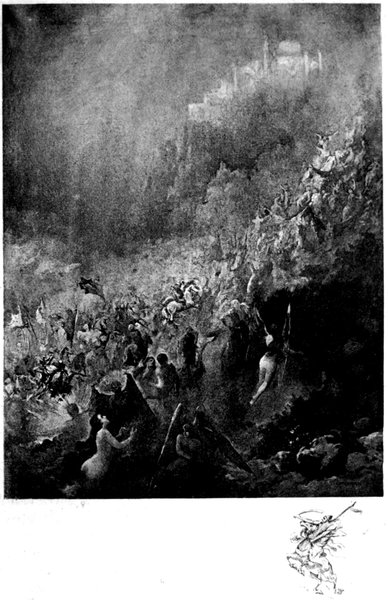
Now when it was the Five Hundred and Twenty-fifth Night,
She said, It hath reached me, O auspicious King, that the fowl ceased not flying with Janshah two full days; till it reached the spot where the nest was, and set him down there and said, “O Janshah, this is where our nest was.” He wept sore and replied, “I pray thee bear me farther on to where thy parents used to forage for food.” The bird consented; so it took him up again and flew on with him seven nights and eight days, till it set him down on the top of a high hill Karmús hight and left him there saying, “I know of no land behind this hill.” Then it flew away and Janshah sat down on the hill-top and fell asleep. When he awoke, he saw a something gleaming afar off as it were lightning and filling the firmament with its flashings; and he wondered what this sheen could be without wotting that it was the Castle he sought. So he descended the mountain and made towards the light, which came from Takni, the Castle of Jewels, distant two months’ journey from Karmús, the hill whereon he had alit and its foundations were fashioned of red rubies and its buildings of yellow gold. Moreover, it had a thousand turrets builded of precious metals, and stones of price studded and set in the minerals brought from the Main of Murks, and on this account it was named the Castle of Jewels, Takni. It was a vast great castle and the name of its king was King Shahlan, the father of the lady Shamsah and her sisters. Such was the case with Janshah; but as regards Princess Shamsah, when she fled from Janshah, she made straight for the Castle of Jewels and told her father and mother all that had passed between the Prince and herself; how he had wandered the world and seen its marvels and wonders 373and how fondly he loved her and how dearly she loved him. Quoth they, “Thou hast not dealt righteously with him, as Allah would have thee deal.” Moreover King Shahlan repeated the story to his guards and officers of the Marids of the Jinn and bade them bring him every mortal they should see. For the lady Shamsah had said to her parents, “Janshah loveth me with passionate love and forsure he will follow me; for when flying from his father’s roof I cried to him:—An thou love me, seek me at Takni, the Castle of Jewels!” Now when Janshah beheld that sheen and shine, he made straight for it wishing to find out what it might be. And as chance would have it, Shamsah had that very day despatched a Marid on an occasion in the direction of the hill Karmus, and on his way thither he caught sight of a man, a mortal; so he hastened up to him and saluted him. Janshah was terrified at his sight, but returned his salam, and the Marid asked, “What is thy name?” and he answered, “My name is Janshah, and I have fallen madly in love with a Jinniyah known as Princess Shamsah, who captivated me by her beauty and loveliness; but despite my dear love she fled from the palace wherein I placed her and behold, I am here in quest of her.” Herewith he wept with bitter weeping. The Marid looked at him and his heart burned with pity on hearing the sad tale, and he said, “Weep not, for surely thou art come to thy desire. Know that she loveth thee fondly and hath told her parents of thy love for her, and all in yonder castle love thee for her sake; so be of good cheer and keep thine eyes cool of tear.” Then he took him on his shoulders and made off with him to the Castle of Jewels, Takni. Thereupon the bearers of fair tidings hastened to report his coming and when the news reached Shamsah and her father and mother, they all rejoiced with exceeding joy, and King Shahlan took horse and rode out, commanding all his guards and Ifrits and Marids honourably to meet the Prince.——And Shahrazad perceived the dawn of day and ceased to say her permitted say.