Volume 5 — THE QUEEN OF THE SERPENTS.[507]
Richard Francis Burton translation
THE QUEEN OF THE SERPENTS.[507]
There was once, in days of yore and in ages and times long gone before, a Grecian sage called Daniel, who had disciples and scholars; and the wise men of Greece were obedient to his bidding and relied upon his learning. Withal had Allah denied him a man-child. One night, as he lay musing and weeping over the lack of a son who might inherit his lore, he bethought him that Allah (extolled and exalted be He!) heareth the prayer of those who resort to Him and that there is no doorkeeper at the door of His bounties and that He favoureth whom He will without compt and sendeth no supplicant empty away; nay He filleth their hands with favours and benefits. So he besought the Almighty, the Bountiful, to vouchsafe him a son to succeed him, and to endow him abundantly with His beneficence. Then he returned home and carnally knew his wife who conceived by him the same night.——And Shahrazad perceived the dawn of day and ceased saying her permitted say.
Now when it was the Four Hundred and Eighty-third Night,
She said, It hath reached me, O auspicious King, that the Grecian sage returned home and knew his wife who conceived by him the same night. A few days after this he took ship for a certain place, but the ship was wrecked and he saved himself on one of her planks, while only five leaves remained to him of all the books he had. When he returned home, he laid the five leaves in a box and locking it, gave the key to his wife (who then showed big with child), and said to her, “Know that my decease is at hand and that the time draweth nigh for my translation from this abode temporal to the home which is eternal. Now thou art with child and after my death wilt haply bear a son: if this be so, name him Hásib Karím al-Dín[508] and rear him with the best of rearing. When the boy shall grow up and shall say to thee:—What inheritance 298did my father leave me? give him these five leaves, which when he shall have read and understood, he will be the most learned man of his time.” Then he farewelled her and heaving one sigh, departed the world and all that is therein—the mercy of Allah the Most Highest be upon Him! His family and friends wept over him and washed him and bore him forth in great state and buried him; after which they wended their ways home. But few days passed ere his widow bare a handsome boy and named him Hasib Karim al-Din, as her husband charged her; and immediately after his birth she summoned the astrologers, who calculated his ascendants and drawing his horoscope, said to her, “Know, O woman! that this birth will live many a year; but that will be after a great peril in the early part of his life, wherefrom an he escape, he will be given the knowledge of all the exact sciences.” So saying they went their ways. She suckled him two years,[509] then weaned him, and when he was five years old, she placed him in a school to learn his book, but he would read nothing. So she took him from school and set him to learn a trade; but he would not master any craft and there came no work from his hands. The mother wept over this and the folk said to her, “Marry him: haply he will take heart for his wife and learn him a trade.” So she sought out a girl and married him to her; but, despite marriage and the lapse of time, he remained idle as before, and would do nothing. One day, some neighbours of hers, who were woodcutters, came to her and said, “Buy thy son an ass and cords and an axe and let him go with us to the mountain and we will all of us cut wood for fuel. The price of the wood shall be his and ours, and he shall provide thee and his wife with his share.” When she heard this, she joyed with exceeding joy and bought her son an ass and cords and hatchet; then, carrying him to the woodcutters, delivered him into their hands and solemnly committed him to their care. Said they, “Have no concern for the boy, our Lord 299will provide him: he is the son of our Shaykh.” So they carried him to the mountain, where they cut firewood and loaded their asses therewith; then returned to the city and, selling what they had cut, spent the monies on their families. This they did on the next day and the third and ceased not for some time, till it chanced one day, a violent storm of rain broke over them, and they took refuge in a great cave till the downfall should pass away. Now Hasib Karim al-Din went apart from the rest into a corner of the cavern and sitting down, fell to smiting the floor with his axe. Presently he noted that the ground sounded hollow under the hatchet; so he dug there awhile and came to a round flagstone with a ring in it. When he saw this, he was glad and called his comrades the woodcutters,——And Shahrazad perceived the dawn of day and ceased to say her permitted say.
Now when it was the Four Hundred and Eighty-fourth Night,
She said, It hath reached me, O auspicious King, that when Hasib Karim al-Din saw the flagstone with the ring, he was glad and called his comrades the woodcutters, who came to him and, finding it was fact, soon pulled up the stone and discovered under it a trap-door, which, being opened, showed a cistern full of bees’ honey.[510] Then said they to one another, “This is a large store and we have nothing for it but to return to the city and fetch vessels wherein to carry away the honey, and sell it and divide the price, whilst one of us stands by the cistern, to guard it from outsiders.” Quoth Hasib, “I will stay and keep watch over it till you bring your pots and pans.” So they left him on guard there and, repairing to the city, fetched vessels, which they filled with honey and loading their asses therewith, carried them to the streets and sold the contents. They returned on the morrow and thus they did several days in succession, sleeping in the town by night and drawing off the stuff by day, whilst Hasib abode on guard by it till but little remained, when they said one to other, “It was Hasib Karim al-Din found the honey, and to-morrow he will come down to the city and complain against us and claim the price of it, saying, ‘Twas I found it; nor is there escape for us but that we 300let him down into the cistern, to bale out the rest of the honey, and leave him there; so will he die of hunger, and none shall know of him.” They all fell in with this plot as they were making for the place; and, when they reached it, one said to him, “O Hasib, go down into the pit and bale out for us the rest of the honey.” So he went down and passed up to them what remained of the honey, after which he said to them, “Draw me up, for there is nothing left.” They made him no answer; but, loading their asses, went off to the city and left him alone in the cistern. Thereupon he fell to weeping and crying, “There is no Majesty and there is no Might save in Allah, the Glorious, the Great!” Such was his case; but as regards his comrades, when they reached the city and sold the honey, they repaired to Hasib’s mother, weeping, and said to her, “May thy head outlive thy son Hasib!” She asked, “What brought about his death?” and they answered, “We were cutting wood on the mountain-top, when there fell on us a heavy downfall of rain and we took shelter from it in a cavern; and suddenly thy son’s ass broke loose and fled into the valley, and he ran after it, to turn it back, when there came out upon them a great wolf, who tore thy son in pieces and ravined the ass.” When the mother heard this, she beat her face and strewed dust on her head and fell to mourning for her son; and she kept life and soul together only by the meat and drink which they brought her every day. As for the woodcutters they opened them shops and became merchants and spent their lives in eating and drinking and laughing and frolicking. Meanwhile Hasib Karim al-Din, who ceased not to weep and call for help, sat down upon the cistern-edge when behold, a great scorpion fell down on him; so he rose and killed it. Then he took thought and said, “The cistern was full of honey; how came this scorpion here?” Accordingly he got up and examined the well right and left, till he found a crevice from which the scorpion had fallen and saw the light of day shining through it. So he took out his woodman’s knife and enlarged the hole, till it was big as a window, when he crept through it and, after walking for some time, came to a vast gallery, which led him to a huge door of black iron bearing a padlock of silver wherein was a key of gold. He stole up to the door and, looking through the chink, saw a great light shining within; so he took the key and, opening the door, went on for some time, till he came to a large artificial lake, wherein he caught sight of something that shimmered like silver. He walked up to it and at last he saw, 301hard by a hillock of green jasper and on the hill-top, a golden throne studded with all manner gems,——And Shahrazad perceived the dawn of day and ceased saying her permitted say.
Now when it was the Four Hundred and Eighty-fifth Night,
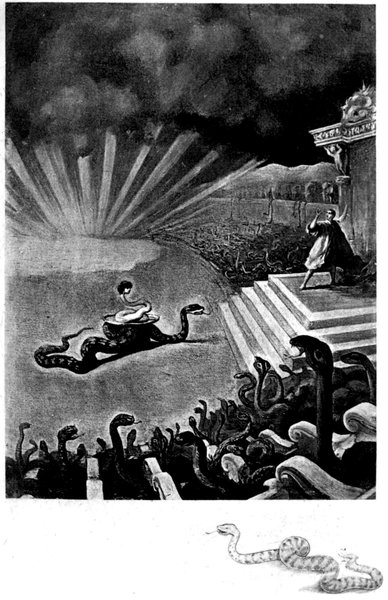
She said, It hath reached me, O auspicious King, that when Hasib reached the hillock he found it of green jasper surmounted by a golden throne studded with all manner gems, round which were set many stools, some of gold, some of silver and others of leek-green emerald. He clomb the hillock and, counting the stools, found them twelve thousand in number; then he mounted the throne which was set on the centre and, seating himself thereon, fell to wondering at the lake and the stools, and he marvelled till drowsiness overcame him and he dropt asleep. Presently, he was aroused by a loud snorting and hissing and rustling, so he opened his eyes; and, sitting up, saw each stool occupied by a huge serpent, an hundred cubits in length. At this sight, great fear gat hold of him; his spittle dried up for the excess of his dread and he despaired of life, as all their eyes were blazing like live coals. Then he turned towards the lake and saw that what he had taken for shimmering water was a multitude of small snakes, none knoweth their compt save Allah the Most High. After awhile, there came up to him a serpent as big as a mule, bearing on its back a tray of gold, wherein lay another serpent which shone like crystal and whose face was as that of a woman[511] and who spake with human speech. And as soon as she was brought up to Hasib, she saluted him and he returned the salutation. Thereupon, one of the serpents seated on the stools came up and, lifting her off the tray, set her on one of the seats and she cried out to the other serpents in their language, whereupon they all fell down from their stools and did her homage. But she signed to them to sit and they did so. Then she addressed 302Hasib, saying, “Have no fear of us, O youth; for I am the Queen of the Serpents and their Sultánah.” When he heard her speak on this wise, he took heart and she bade the serpents bring him somewhat of food.[512] So they brought apples and grapes and pomegranates and pistachio-nuts and filberts and walnuts and almonds and bananas and set them before him, and the Queen-serpent said, “Welcome, O youth! What is thy name?” Answered he, “Hasib Karim al-Din;” and she rejoined, “O Hasib, eat of these fruits, for we have no other meat and fear thou nothing from us at all.” Hearing this, he ate his fill and praised Allah Almighty; and presently they took away the trays from before him, and the Queen said, “Tell me, O Hasib, whence thou art and how camest thou hither and what hath befallen thee.” So he told her his story from first to last, the death of his father; his birth; his being sent to school where he learnt nothing; his becoming a wood-cutter; his finding the honey-cistern; his being abandoned therein; his killing the scorpion; his widening the crevice; his finding the iron door and his coming upon the Queen, and he ended his long tale with saying, “These be my adventures from beginning to end and only Allah wotteth what will betide me after all this!” Quoth the Queen, after listening to his words, “Nothing save good shall betide thee:”——And Shahrazad perceived the dawn of day and ceased to say her permitted say.
Now when it was the Four Hundred and Eighty-sixth Night,
She said, It hath reached me, O auspicious King, that when the Serpent-queen had heard his story she said, “Nothing save good shall betide thee: but I would have thee, O Hasib, abide with me some time, that I may tell thee my history and acquaint thee with the wondrous adventures which have happened to me.” “I hear and obey thy hest,” answered he; and she began to tell in these words,
303
THE ADVENTURES OF BULUKIYA.
Know thou, O Hasib, there was once in the city of Cairo a King of the Banu Isra’íl, a wise and a pious, who was bent double by poring over books of learning, and he had a son named Bulúkiyá. When he grew old and weak and was nigh upon death, his Grandees and Officers of state came up to salute him, and he said to them, “O folk, know that at hand is the hour of my march from this world to the next, and I have no charge to lay on you, save to commend to your care my son Bulukiya.” Then said he, “I testify that there is no god save the God;” and, heaving one sigh, departed the world—the mercy of Allah be upon him! They laid him out and washed him and buried him with a procession of great state. Then they made his son Bulukiya Sultan in his stead; and he ruled the kingdom justly and the people had peace in his time. Now it befel one day that he entered his father’s treasuries, to look about him, and coming upon an inner compartment and finding the semblance of a door opened it and passed in. And lo! he found himself in a little closet, wherein stood a column of white marble, on the top of which was a casket of ebony; he opened this also and saw therein another casket of gold, containing a book. He read the book and found in it an account of our lord Mohammed (whom Allah bless and preserve!) and how he should be sent in the latter days[513] and be the lord of the first Prophets and the last. On seeing the personal description Bulukiya’s heart was taken with love of him, so he at once assembled all the notables of the Children of Israel, the Cohens or diviners, the scribes and the priests, and acquainted them with the book, reading portions of it to them and, adding, “O folk, needs must I bring my father out of his grave and burn him.” 304The lieges asked, “Why wilt thou burn him?”; and he answered, “Because he hid this book from me and imparted it not to me.” Now the old King had excerpted it from the Torah or Pentateuch and the Books of Abraham; and had set it in one of his treasuries and concealed it from all living. Rejoined they, “O King, thy father is dead; his body is in the dust and his affair is in the hands of his Lord; thou shalt not take him forth of his tomb.” So he knew that they would not suffer him to do this thing by his sire and leaving them he repaired to his mother, to whom said he, “O my mother, I have found, in one of my father’s treasuries, a book containing a description of Mohammed (whom Allah bless and keep!), a prophet who shall be sent in the latter days; and my heart is captivated with love of him. Wherefore am I resolved to wander over the earth, till I foregather with him; else I shall die of longing for his love.” Then he doffed his clothes and donned an Abá-gown of goat’s hair and coarse sandals, saying, “O my mother, forget me not in thy prayers.” She wept over him and said, “What will become of us after thee?”; but Bulukiya answered, “I can endure no longer, and I commit my affair and thine to Allah who is Almighty.” Then he set out on foot Syria-wards without the knowledge of any of his folk, and coming to the sea-board found a vessel whereon he shipped as one of the crew. They sailed till he made an island, where Bulukiya landed with the crew, but straying away from the rest he sat down under a tree and sleep got the better of him. When he awoke, he sought the ship but found that she had set sail without him, and in that island he saw serpents as big as camels and palm-trees, which repeated the names of Allah (be He extolled and exalted!) and blessed Mohammed (whom the Lord assain and save!), proclaiming the Unity and glorifying the Glorious; whereat he wondered——And Shahrazad perceived the dawn of day and ceased saying her permitted say.
Now when it was the Four Hundred and Eighty-seventh Night,
She said, It hath reached me, O auspicious King, that when Bulukiya saw the serpents glorifying God and proclaiming the Unity, he wondered with extreme wonder. When they saw him, they flocked to him and one of them said to him, “Who and whence art thou, and whither goest thou, and what is thy name?” 305Quoth he, “My name is Bulukiya; I am of the Children of Israel and, being distracted for love of Mohammed (whom Allah bless and keep!), I come in quest of him. But who are ye, O noble creatures?” Answered they, “We are of the dwellers in the Jahannam-hell; and Almighty Allah created us for the punishment of Kafirs.” “And how came ye hither?” asked he, and the Serpents answered, “Know, O Bulukiya, that Hell[514] of the greatness of her boiling, breatheth twice a year, expiring in the summer and inspiring in the winter, and hence the summer-heat and winter-cold. When she exhaleth, she casteth us forth of her maw, and we are drawn in again with her inhaled breath.” Quoth Bulukiya, “Say me, are there greater serpents than you in Hell?”; and they said, “Of a truth we are cast out with the expired breath but by reason of our smallness; for in Hell every serpent is so great, that were the biggest of us to pass over its nose it would not feel us.[515]” Asked Bulukiya, “Ye sing the praises of Allah and invoke blessings on Mohammed, whom the Almighty assain and save! Whence wot ye of Mohammed?”; and they answered, “O Bulukiya, verily his name is written on the gates of Paradise; and, but for him, Allah had not created the worlds[516] nor Paradise, nor heaven nor hell nor earth, for He made all things that be, solely on his account, and hath conjoined his name with His own in every place; wherefore we love Mohammed, whom Allah bless and 306preserve!” Now hearing the serpents’ converse did but inflame Bulukiya’s love for Mohammed and yearning for his sight; so he took leave of them; and, making his way to the sea-shore, found there a ship made fast to the beach; he embarked therein as a seaman and sailed nor ceased sailing till he came to another island. Here he landed and walking about awhile found serpents great and small, none knoweth their number save Almighty Allah, and amongst them a white Serpent, clearer than crystal, seated in a golden tray borne on the back of another serpent as big as an elephant. Now this, O Hasib, was the Serpent-queen, none other than myself. Quoth Hasib, “And what answer didst thou make him?” Quoth she, “Know, O Hasib, that when I saw Bulukiya, I saluted him with the salam, and he returned my salutation,” and I said to him, “Who and what art thou and what is thine errand and whence comest thou and whither goest thou?” Answered he, “I am of the Children of Israel; my name is Bulukiya, and I am a wanderer for the love of Mohammed, whose description I have read in the revealed scriptures, and of whom I go in search. But what art thou and what are these serpents about thee?” Quoth I, “O Bulukiya, I am the Queen of the Serpents; and when thou shalt foregather with Mohammed (whom Allah assain and save!) bear him my salutation.” Then Bulukiya took leave of me and journeyed till he came to the Holy City which is Jerusalem. Now there was in that stead a man who was deeply versed in all sciences, more especially in geometry and astronomy and mathematics, as well as in white magic[517] and Spiritualism; and he had studied the Pentateuch and the Evangel and the Psalms and the Books of Abraham. His name was Affán; and he had found in certain of his books, that whoso should wear the seal-ring of our lord Solomon, men and Jinn and birds and beasts and all created things would be bound to obey him. Moreover, he had discovered that our lord Solomon had been buried in a coffin which was miraculously transported beyond the Seven Seas to the place of burial;——And Shahrazad perceived the dawn of day and ceased to say her permitted say.
307
Now when it was the Four Hundred and Eighty-eighth Night,
She said, It hath reached me, O auspicious King, that Affan had found in certain books that none, mortal or spirit, could pluck the seal-ring from the lord Solomon’s finger; and that no navigator could sail his ship upon the Seven Seas over which the coffin had been carried. Moreover, he had found out by reading that there was a herb of herbs and that if one express its juice and anoint therewith his feet, he should walk upon the surface of any sea that Allah Almighty had created without wetting his soles; but none could obtain this herb, without he had with him the Serpent-queen. When Bulukiya arrived at the Holy City, he at once sat down to do his devotions and worship the Lord; and, whilst he was so doing, Affan came up and saluted him as a True Believer. Then seeing him reading the Pentateuch and adoring the Almighty, he accosted him saying, “What is thy name, O man; and whence comest thou and whither goest thou?” He answered, “My name is Bulukiya; I am from the city of Cairo and am come forth wandering in quest of Mohammed, whom Allah bless and preserve!” Quoth Affan, “Come with me to my lodging that I may entertain thee.” “To hear is to obey,” replied Bulukiya. So the devotee took him by the hand and carried him to his house where he entreated him with the utmost honour and presently said to him, “Tell me thy history, O my brother, and how thou camest by the knowledge of Mohammed (whom Allah assain and save!) that thy heart hath been taken with love of him and compelled thee to fare forth and seek him; and lastly tell me who it was directed thee in this road.” So he related to him his tale in its entirety; whereupon Affan, who well-nigh lost his wits for wonder, said to him, “Make tryst for me with the Queen of the Serpents and I will bring thee in company with Mohammed, albeit the date of his mission is yet far distant. We have only to prevail upon the Queen and carry her in a cage to a certain mountain where the herbs grow; and, as long as she is with us, the plants as we pass them will parley with human speech and discover their virtues by the ordinance of Allah the Most High. For I have found in my books that there is a certain herb and all who express its juice and anoint therewith their feet shall walk upon whatsoever sea Almighty Allah hath made, without wetting sole. When we 308have found the magical herb, we will let her go her way; and then will we anoint our feet with the juice and cross the Seven Seas, till we come to the burial-place of our lord Solomon. Then we will take the ring off his finger and rule even as he ruled and win all our wishes; we will enter the Main of Murks[518] and drink of the Water of Life, and so the Almighty will let us tarry till the End of Time and we shall foregather with Mohammed, whom Allah bless and preserve!” Hearing these words Bulukiya replied, “O Affan, I will make tryst for thee with the Serpent-queen and at once show thee her abiding place.” So Affan made him a cage of iron; and, providing himself with two bowls, one full of wine and the other of milk, took ship with Bulukiya and sailed till they came to the island, where they landed and walked upon it. Then Affan set up the cage, in which he laid a noose and withdrew after placing in it the two bowls; when he and Bulukiya concealed themselves afar off. Presently, up came the Queen of the Serpents (that is, myself) and examined the cage. When she (that is I) smelt the savour of the milk, she came down from the back of the snake which bore her tray and, entering the cage, drank up the milk. Then she went to the bowl of wine and drank of it, whereupon her head became giddy and she slept. When Affan saw this, he ran up and locking the cage upon her, set it on his head and made for the ship, he and Bulukiya. After awhile she awoke and finding herself in a cage of iron on a man’s head and seeing Bulukiya walking beside the bearer, said to him, “This is the reward of those who do no hurt to the sons of Adam.” Answered he, “O Queen, have no fear of us, for we will do thee no hurt at all. We wish thee only to show us the herb which, when pounded and squeezed yieldeth a juice, and this rubbed upon the feet conferreth the power of walking dryshod upon what sea soever Almighty Allah hath created; and when we have found that we will return thee to thy place and let thee wend thy way.” Then Affan and Bulukiya fared on for the hills where grew the herbs; and, as they went about with the Queen, each plant they passed began to speak and avouch its virtues by permission of Allah the Most High. As they were thus doing and the herbs speaking right and left behold, a plant spoke out and said, “I am the herb ye seek, and all who gather and crush me and anoint 309their feet with my juice, shall fare over what sea soever Allah Almighty hath created and yet ne’er wet sole.” When Affan heard this, he set down the cage from his head and, gathering what might suffice them of the herb, crushed it and filling two vials with the juice kept them for future use; and with what was left they anointed their feet. Then they took up the Serpent-queen’s cage and journeyed days and nights, till they reached the island, where they opened the cage and let out her, that is me. When I found myself at liberty, I asked them what use they would make of the juice; and they answered, “We design to anoint our feet and to cross the Seven Seas to the burial-place of our lord Solomon[519] and take the seal-ring from his finger.” Quoth I, “Far, far is it from your power to possess yourselves of the ring!” They enquired, “Wherefore?” and I replied, “Because Almighty Allah vouchsafed unto our lord Solomon the gift of this ring and distinguished him thereby, for that he said to Him:—O Lord, give me a kingdom which may not be obtained after me; for Thou verily art the Giver of kingdoms.[520] So that ring is not for you.” And I added, “Had ye twain taken the herb, whereof all who eat shall not die until the First Blast,[521] it had better availed you than this ye have gotten; for ye shall nowise come at your desire thereby.” Now when they heard this, they repented them with exceeding penitence and went their ways.——And Shahrazad perceived the dawn of day and ceased saying her permitted say.
Now when it was the Four Hundred and Eighty-ninth Night,
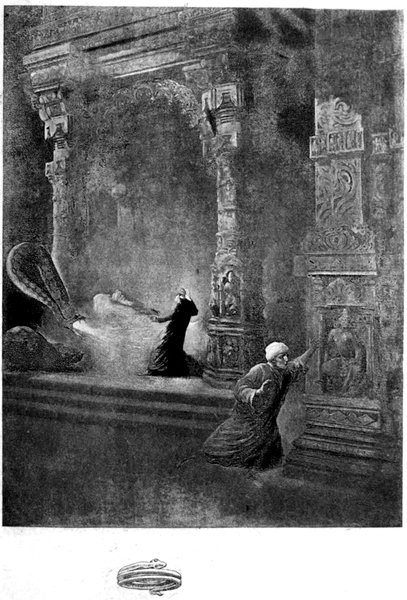
She said, It hath reached me, O auspicious King, that when Bulukiya and Affan heard these words, they repented them with 310exceeding penitence and went their ways. Such was their case; but as regards myself (continued the Serpent-queen) I went in quest of my host and found it fallen in piteous case, the stronger of them having grown weak in my absence and the weaker having died. When they saw me, they rejoiced and flocking about me, asked, “What hath befallen thee, and where hast thou been?” So I told them what had passed, after which I gathered my forces together and repaired with them to the mountain Kaf, where I wont to winter, summer-freshing in the place where thou now seest me, O Hasib Karim al-Din. This, then, is my story and what befel me. Thereupon Hasib marvelled at her words and said to her, “I beseech thee, of thy favour, bid one of thy guards bear me forth to the surface of the earth, that I may go to my people.” She replied, “O Hasib, thou shalt not have leave to depart from us till winter come, and needs must thou go with us to the Mountain Kaf and solace thyself with the sight of the hills and sands and trees and birds magnifying the One God, the Victorious; and look upon Marids and Ifrits and Jinn, whose number none knoweth save Almighty Allah.” When Hasib heard this, he was sore chafed and chagrined: then he said to her, “Tell me of Affan and Bulukiya; when they departed from thee and went their way, did they cross the Seven Seas and reach the burial-place of our lord Solomon or not; and if they did had they power to take the ring or not?” Answered she, “Know, that when they left me, they anointed their feet with the juice; and, walking over the water, fared on from sea to sea, diverting themselves with the wonders of the deep, nor ceased they faring till they had traversed the Seven Seas and came in sight of a mountain, soaring high in air, whose stones were emeralds and whose dust was musk; and in it was a stream of running water. When they made it they rejoiced, saying each to other:—Verily we have won our wish; and they entered the passes of the mountain and walked on, till they saw from afar a cavern surmounted by a great dome, shining with light. So they made for the cavern, and entering it beheld therein a throne of gold studded with all manner jewels, and about it stools whose number none knoweth save Allah Almighty. And they saw lying at full length upon the throne our lord Solomon, clad in robes of green silk inwoven with gold and broidered with jewels and precious minerals: his right hand was passed over his breast and on the middle finger was the seal-ring whose lustre outshone that of all other gems in the place. Then Affan taught Bulukiya adjurations 311and conjurations galore and said to him:—Repeat these conjurations and cease not repeating until I take the ring. Then he went up to the throne; but, as he drew near unto it lo! a mighty serpent came forth from beneath it and cried out at him with so terrible a cry that the whole place trembled and sparks flew from its mouth, saying, Begone, or thou art a dead man! But Affan busied himself with his incantations and suffered himself not to be startled thereby. Then the serpent blew such a fiery blast at him, that the place was like to be set on fire, and said to him, Woe to thee! Except thou turn back, I will consume thee! Hearing these words Bulukiya left the cave, but Affan, who suffered himself not to be troubled, went up to the Prophet: then he put out his hand to the ring and touched it and strove to draw it off the lord Solomon’s finger; and behold, the serpent blew on him once more and he became a heap of ashes. Such was his case; but as regards Bulukiya he fell down in a swoon.”——And Shahrazad perceived the dawn of day and ceased to say her permitted say.
Now when it was the Four Hundred and Ninetieth Night,
She said, It hath reached me, O auspicious King, that the Queen continued:—When Bulukiya saw Affan burnt up by the fire and become a heap of ashes, he fell down in a swoon. Thereupon the Lord (magnified be His Majesty!) bade Gabriel descend earthwards and save him ere the serpent should blow on him. So Gabriel descended without delay and, finding Affan reduced to ashes and Bulukiya in a fit, aroused him from his trance and saluting him, asked, “How camest thou hither?” Bulukiya related to him his history from first to last, adding, “Know that I came not hither but for the love of Mohammed (whom Allah assain and save!), of whom Affan informed me that his mission would take place at the End of Time; moreover that none should foregather with him but those who endured to the latter days by drinking of the Water of Life through means of Solomon’s seal. So I companied him hither and there befel him what befel; but I escaped the fire and now it is my desire that thou inform me where Mohammed is to be found.” Quoth Gabriel, “O Bulukiya, go thy ways, for the time of Mohammed’s coming is yet far distant.” Then he ascended up to heaven forthright, and Bulukiya wept 312with sore weeping and repented of that which he had done, calling to mind my words, whenas I said to them, “Far is it from man’s power to possess himself of the ring.” Then he descended from the mountain and returned in exceeding confusion to the sea-shore and passed the night there, marvelling at the mountains and seas and islands around him. When morning dawned, he anointed his feet with the herb-juice and descending to the water, set out and fared on over the surface of the seas days and nights, astonied at the terrors of the main and the marvels and wonders of the deep, till he came to an island as it were the Garden of Eden. So he landed and, finding himself in a great and pleasant island, paced about it and saw with admiration that its dust was saffron and its gravel carnelian and precious minerals; its hedges were of jessamine, its vegetation was of the goodliest of trees and of the brightest of odoriferous shrubs; its brushwood was of Comorin and Sumatran aloes-wood and its reeds were sugar-canes. Round about it were roses and narcissus and amaranths and gilly-flowers and chamomiles and white lilies and violets, and other flowers of all kinds and colours. Of a truth the island was the goodliest place, abounding in space, rich in grace, a compendium of beauty material and spiritual. The birds warbled on the boughs with tones far sweeter than chaunt of Koran and their notes would console a lover whom longings unman. And therein the gazelle frisked free and fain and wild cattle roamed about the plain. Its trees were of tallest height; its streams flowed bright; its springs welled with waters sweet and light; and all therein was a delight to sight and sprite. Bulukiya marvelled at the charms of the island but knew that he had strayed from the way he had first taken in company with Affan. He wandered about the place and solaced him with various spectacles until nightfall, when he climbed into a tree to sleep; but as he sat there, musing over the beauty of the site, behold, the sea became troubled and there rose up to the surface a great beast, which cried out with a cry so terrible that every living thing upon the isle trembled. As Bulukiya gazed upon him from the tree and marvelled at the bigness of his bulk, he was presently followed unexpectedly by a multitude of other sea-beasts in kind manifold, each holding in his fore-paw a jewel which shone like a lamp, so that the whole island became as light as day for the lustre of the gems. After awhile, there appeared, from the heart of the island, wild beasts of the land, none knoweth their number save Allah the Most High; amongst which Bulukiya noted lions and 313panthers and lynxes and other ferals; and these land-beasts flocked down to the shore; and, foregathering with the sea-beasts, conversed with them till daybreak, when they separated and each went his own way. Thereupon Bulukiya, terrified by what he had seen, came down from the tree and, making the sea-shore, anointed his feet with the magical juice, and set out once more upon the surface of the water. He fared on days and nights over the Second Sea, till he came to a great mountain skirting which ran a Wady without end, the stones whereof were magnetic iron and its beasts lions and hares and panthers. He landed on the mountain-foot and wandered from place to place till nightfall, when he sat down sheltered by one of the base-hills on the sea-side, to eat of the dried fish thrown up by the sea. Presently, he turned from his meal and behold, a huge panther was creeping up to rend and ravin him; so he anointed his feet in haste with the juice and, descending to the surface of the water, fled walking over the Third Sea, in the darkness; for the night was black and the wind blew stark. Nor did he stay his course till he reached another island, whereon he landed and found there trees bearing fruits both fresh and dry.[522] So he took of these fruits and ate and praised Allah Almighty; after which he walked for solace about the island till eventide.——And Shahrazad perceived the dawn of day and ceased saying her permitted say.
Now when it was the Four Hundred and Ninety-first Night,
She said, It hath reached me, O auspicious King, that Bulukiya (continued the Queen) walked for solace about the island till eventide, when he lay down to sleep. As soon as day brake, he began to explore the place and ceased not for ten days, after which he again made the shore and anointed his feet and, setting out over the Fourth Sea, walked upon it many nights and days, till he came to a third island of fine white sand without sign of trees or grass. He walked about it awhile but, finding its only inhabitants sakers which nested in the sand, he again anointed his feet and trudged over the Fifth Sea, walking night and day till he came to a little island, whose soil and hills were like crystal. Therein were the 314veins wherefrom gold is worked; and therein also were marvellous trees whose like he had never seen in his wanderings, for their blossoms were in hue as gold. He landed and walked about for diversion till it was nightfall, when the flowers began to shine through the gloom like stars. Seeing this sight, he marvelled and said, “Assuredly, the flowers of this island are of those which wither under the sun and fall to the earth, where the winds smite them and they gather under the rocks and become the Elixir,[523] which the folk collect and thereof make gold.” He slept there all that night and at sunrise he again anointed his feet and, descending to the shore, fared on over the Sixth Sea nights and days, till he came to a fifth island. Here he landed and found, after walking an hour or so, two mountains covered with a multitude of trees, whose fruits were as men’s heads hanging by the hair, and others whose fruits were green birds hanging by the feet; also a third kind, whose fruits were like aloes, if a drop of the juice fell on a man it burnt like fire; and others, whose fruits wept and laughed, besides many other marvels which he saw there. Then he returned to the sea-shore and, finding there a tall tree, sat down beneath it till supper-time when he climbed up into the branches to sleep. As he sat considering the wonderful works of Allah behold, the waters became troubled, and there rose therefrom the daughters of the sea, each mermaid holding in her hand a jewel which shone like the morning. They came ashore and, foregathering under the trees, sat down and danced and sported and made merry whilst Bulukiya amused himself with watching and wondering at their gambols, which were prolonged till the morning, when they returned to the sea and disappeared. Then he came down and, anointing his feet, set out on the surface of the Seventh Sea, over which he journeyed two whole months, without getting sight of highland or island or broadland or lowland or shoreland, till he came to the end thereof. And so doing he suffered exceeding hunger, so that he was forced to snatch up fishes from the surface of the sea and devour them raw, for stress of famine. In such case he pushed on till in early forenoon he came to the sixth island, with trees a-growing and rills a-flowing, where he landed and walked about, looking right and left, till he came to an apple-tree and put forth his hand to pluck of the fruit, when lo! one cried out to him from the tree, saying, “An 315thou draw near to this tree and cut of it aught, I will cut thee in twain.” So he looked and saw a giant forty cubits high, being the cubit of the people of that day; whereat he feared with sore fear and refrained from that tree. Then said he to the giant, “Why dost thou forbid me to eat of this tree?” Replied the other, “Because thou art a son of Adam and thy father Adam forgot the covenant of Allah and sinned against Him and ate of the tree.” Quoth Bulukiya, “What thing art thou and to whom belongeth this island, with its trees, and how art thou named?” Quoth the tall one, “My name is Sharáhiyá and trees and island belong to King Sakhr;[524] I am one of his guards and in charge of his dominion,” presently adding, “But who art thou and whence comest thou hither?” Bulukiya told him his story from beginning to end and Sharahiya said, “Be of good cheer,” and brought him to eat. So he ate his fill and, taking leave of the giant, set out again and ceased not faring on over the mountains and sandy deserts for ten days; at the end of which time he saw, in the distance, a dust-cloud hanging like a canopy in air; and, making towards it, he heard a mighty clamour, cries and blows and sounds of mellay. Presently he reached a great Wady, two months’ journey long; and, looking whence the shouts came, he saw a multitude of horsemen engaged in fierce fight and the blood running from them till it railed like a river. Their voices were thunderous and they were armed with lance and sword and iron mace and bow and arrow, and all fought with the utmost fury. At this sight he felt sore affright——And Shahrazad perceived the dawn of day and ceased to say her permitted say.
Now when it was the Four Hundred and Ninety-second Night,
She said, It hath reached me, O auspicious King, that the Queen continued:—When Bulukiya saw the host in fight, he felt sore affright and was perplexed about his case; but whilst he hesitated, behold, they caught sight of him and held their hands one from other and left fighting. Then a troop of them came up to him, wondering at his make, and one of the horsemen said to him, “What art thou and whence camest thou hither and whither art wending; and who showed thee the way that thou hast come to our 316country?” Quoth he, “I am of the sons of Adam and am come out, distracted for the love of Mohammed (whom Allah bless and preserve!); but I have wandered from my way.” Quoth the horseman, “Never saw we a son of Adam till now, nor did any ever come to this land.” And all marvelled at him and at his speech. “But what are ye, O creatures?” asked Bulukiya; and the rider replied, “We are of the Jánn.” So he said, “O Knight, what is the cause of the fighting amongst you and where is your abiding-place and what is the name of this valley and this land?” He replied, “Our abiding-place is the White Country; and, every year, Allah Almighty commandeth us to come hither and wage war upon the unbelieving Jann.” Asked Bulukiya, “And where is the White Country?” and the horseman answered, “It is behind the mountain Kaf, and distant seventy-five years journey from this place which is termed the Land of Shaddád son of ‘Ád: we are here for Holy War; and we have no other business, when we are not doing battle, than to glorify God and hallow him. Moreover, we have a ruler, King Sakhr hight, and needs must thou go with us to him, that he may look upon thee for his especial delight.” Then they fared on (and he with them) till they came to their abiding place; where he saw a multitude of magnificent tents of green silk, none knoweth their number save Allah the Most High, and in their midst a pavilion of red satin, some thousand cubits in compass, with cords of blue silk and pegs of gold and silver. Bulukiya marvelled at the sight and accompanied them as they fared on and behold, this was the royal pavilion. So they carried him into the presence of King Sakhr, whom he found seated upon a splendid throne of red gold, set with pearls and studded with gems; the Kings and Princes of the Jann being on his right hand, and on his left his Councillors and Emirs and Officers of state, and a multitude of others. The King seeing him bade introduce him, which they did; and Bulukiya went up to him and saluted him after kissing the ground before him. The King returned his salute and said, “Draw near me, O mortal!” and Bulukiya went close up to him. Hereupon the King, commanding a chair to be set for him by his royal side, bade him sit down and asked him “Who art thou?”; and Bulukiya answered, “I am a man, and one of the Children of Israel.” “Tell me thy story,” cried King Sakhr, “and acquaint me with all that hath befallen thee and how thou camest to this my land.” So Bulukiya related to him all that had occurred in his wanderings from 317beginning to end——And Shahrazad perceived the dawn of day and ceased saying her permitted say.
Now when it was the Four Hundred and Ninety-third Night,
She said, it hath reached me, O auspicious King, that the Queen continued:—When Bulukiya related to Sakhr what befel him in his wanderings, he marvelled thereat. Then he bade the servants bring food and they spread the tables and set on one thousand and five hundred platters of red gold and silver and copper, some containing twenty and some fifty boiled camels, and others some fifty head of sheep; at which Bulukiya marvelled with exceeding marvel. Then they ate and he ate with them, till he was satisfied and returned thanks to Allah Almighty; after which they cleared the tables and set on fruits, and they ate thereof, glorifying the name of God and invoking blessings on His prophet Mohammed (whom Allah bless and preserve!) When Bulukiya heard them make mention of Mohammed, he wondered and said to King Sakhr, “I am minded to ask thee some questions.” Rejoined the King, “Ask what thou wilt,” and Bulukiya said, “O King, what are ye and what is your origin and how came ye to know of Mohammed (whom Allah assain and save!) that ye draw near to him and love him?” King Sakhr answered, “O Bulukiya, of very sooth Allah created the fire in seven stages, one above the other, and each distant a thousand years’ journey from its neighbour. The first stage he named Jahannam[525] and appointed the same for the punishment of the transgressors of the True-believers, who die unrepentant; the second he named Lazá and appointed for Unbelievers: the name of the third is Jahím and is appointed for Gog and Magog.[526] The fourth is called Sa’ír and is appointed 318for the host of Iblis. The fifth is called Sakar and is prepared for those who neglect prayer. The sixth is called Hatamah and is appointed for Jews and Christians. The seventh is named Háwiyah and is prepared for hypocrites. Such be the seven stages.” Quoth Bulukiya, “Haply Jahannam hath least of torture for that it is the uppermost.” “Yes,” quoth King Sakhr, “the most endurable of them all is Jahannam; natheless in it are a thousand mountains of fire, in each mountain seventy thousand cities of fire, in each city seventy thousand castles of fire, in each castle seventy thousand houses of fire, in each house seventy thousand couches of fire and in each couch seventy thousand manners of torment. As for the other hells, O Bulukiya, none knoweth the number of kinds of torment that be therein save Allah Most Highest.” When Bulukiya heard this, he fell down in a fainting-fit, and when he came to himself, he wept and said, “O King what will be my case?” Quoth Sakhr, “Fear not, and know thou that whoso loveth Mohammed (whom Allah bless and keep!) the fire shall not burn him, for he is made free therefrom for his sake; and whoso belongeth to his Faith the fire shall fly him. As for us, the Almighty Maker created us of the fire; for the first that he made in Jahannam were two of His host, whom he called Khalít and Malít. Now Khalít was fashioned in the likeness of a lion, with a tail like a tortoise twenty years’ journey in length and ending in a member masculine; while Malít was like a pied wolf whose tail was furnished with a member feminine. Then Almighty Allah commanded the tails to couple and copulate and do the deed of kind, and of them were born serpents and scorpions, whose dwelling is in the fire, that Allah may therewith torment those whom He casteth therein; and these increased and multiplied. Then Allah commanded the tails of Khalit and Malit to couple and copulate a second time, and the tail of Malit conceived by the tail of Khalit and bore fourteen children, seven male and seven female, who grew up and intermarried one with other. All were obedient to their sire, save one who disobeyed him and was changed into a worm which is Iblis (the curse of Allah be upon him!). Now Iblis was one of the Cherubim, for he had served Allah till he was raised to the heavens and cherished[527] by the especial favour of the Merciful One, who made him chief 319of the Cherubim.”——And Shahrazad perceived the dawn of day and ceased to say her permitted say.
Now when it was the Four Hundred and Ninety-fourth Night,
She said, It hath reached me, O auspicious King, that the Queen continued:—Iblis served God and became chief of Cherubim. When, however, the Lord created Adam (with whom be peace!), He commanded Iblis to prostrate himself to him, but he drew back; so Allah Almighty expelled him from heaven and cursed him.[528] This Iblis had issue and of his lineage are the devils; and as for the other six males, who were his elders, they are the ancestors of the true-believing Jann, and we are their descendants. Such, O Bulukiya is our provenance.[529] Bulukiya marvelled at the King’s words and said, “O King, I pray thee bid one of thy guards bear me back to my native land.” “Naught of this may we do,” answered Sakhr, “save by commandment of Allah Almighty; however, an thou desire to leave us and return home, I will mount thee on one of my mares and cause her carry thee to the farthest frontiers of my dominions, where thou wilt meet with the troops of another King, Barákhiyá hight, who will recognize the mare at sight and take thee off her and send her back to us; and this is all we can do for thee, and no more.” When Bulukiya heard these words he wept and said, “Do whatso thou wilt.” So King Sakhr caused bring the mare and, setting Bulukiya on her back, said to him, “Beware lest thou alight from her or strike her or cry out in her face; for if thou do so she will slay thee; but abide quietly riding on her back till she stop with thee; then dismount and wend thy ways.” Quoth Bulukiya, “I hear and I obey;” he then mounted and setting out, rode on a long while between the rows of tents; and stinted not riding till he came to the royal kitchens where he saw the great cauldrons, each holding fifty camels, hung up over the fires which blazed fiercely under them. So he stopped 320there and gazed with a marvel ever increasing till King Sakhr thinking him to be anhungered, bade bring him two roasted camels; and they carried them to him and bound them behind him on the mare’s crupper. Then he took leave of them and fared on, till he came to the end of King Sakhr’s dominions, where the mare stood still and Bulukiya dismounted and began to shake the dust of the journey from his raiment. And behold, there accosted him a party of men who, recognising the mare, carried her and Bulukiya before their King Barakhiya. So he saluted him, and the King returned his greeting and seated him beside himself in a splendid pavilion, in the midst of his troops and champions and vassal Princes of the Jann ranged to right and left; after which he called for food and they ate their fill and pronounced the Alhamdolillah. Then they set on fruits, and when they had eaten thereof, King Barakhiya, whose estate was like that of King Sakhr, asked his guest, “When didst thou leave King Sakhr?” And Bulukiya answered, “Two days ago.” Quoth Barakhiya, “Dost thou know, how many days’ journey thou hast come in these two days?” Quoth he, “No,” and the King rejoined, “Thou hast come a journey of threescore and ten months.”——And Shahrazad perceived the dawn of day and ceased saying her permitted say.
Now when it was the Four Hundred and Ninety-fifth Night,
She said, It hath reached me, O auspicious King, that the Queen continued:—Barakhiya said to Bulukiya, “In two days thou hast come a journey of threescore and ten months; moreover when thou mountest the mare, she was affrighted at thee, knowing thee for a son of Adam, and would have thrown thee; so they bound on her back these two camels by way of weight to steady her.” When Bulukiya heard this, he marvelled and thanked Allah Almighty for safety. Then said the King, “Tell me thy adventures and what brought thee to this our land.” So he told him his story from first to last, and the King marvelled at his words, and kept Bulukiya with him two months. Upon this Hasib Karim al-Din after he had marvelled at her story, again besought the Serpent-queen saying, “I pray thee of thy goodness and graciousness command one of thy subjects conduct me to the surface of the earth, that I may return to my family;” but she 321answered, “O Hasib, I know that the first thing thou wilt do, after seeing the face of the earth will be to greet thy family and then repair to the Hammam-bath and bathe; and the moment thou endest thine ablutions will see the last of me, for it will be the cause of my death.” Quoth Hasib, “I swear that I will never again enter the Hammam-bath so long as I live, but when washing is incumbent on me, I will wash at home.” Rejoined the Queen, “I would not trust thee though thou shouldst swear to me an hundred oaths; for such abstaining is not possible; and I know thee to be a son of Adam for whom no oath is sacred. Thy father Adam made a covenant with Allah the most High, who kneaded the clay whereof He fashioned him forty mornings and made His angels prostrate themselves to him; yet after all his promise did he forget and his oath violate, disobeying the commandment of his Lord.” When Hasib heard this, he held his peace and burst into tears; nor did he leave weeping for the space of ten days, at the end of which time he said to the Queen, “Prithee acquaint me with the rest of Bulukiya’s adventures.” Accordingly, she began again as follows:—Know, O Hasib, that Bulukiya, after abiding two months with King Barakhiya, farewelled him and fared on over wastes and deserts nights and days, till he came to a high mountain which he ascended. On the summit he beheld seated a great Angel glorifying the names of God and invoking blessings on Mohammed. Before him lay a tablet covered with characters, these white and those black,[530] whereon his eyes were fixed, and his two wings were outspread to the full, one to the western and the other to the eastern horizon. Bulukiya approached and saluted the Angel, who returned his salam adding, “Who art thou and whence comest thou and whither wendest thou and what is thy story?” Accordingly, he repeated to him his history, from first to last, and the Angel marvelled mightily thereat, whereupon Bulukiya said to him, “I pray thee in return acquaint me with the meaning of this table and what is writ thereon; and what may be thine occupation and thy name.” Replied the Angel, “My name is Michael, and I am charged with the shifts of night and day; and this is my occupation till the Day of Doom.” Bulukiya wondered at his 322words and at his aspect and the vastness of his stature and, taking leave of him, fared onwards, night and day, till he came to a vast meadow over which he walked observing that it was traversed by seven streams and abounded in trees. He was struck by its beauty and in one corner thereof he saw a great tree and under it four Angels. So he drew near to them and found the first in the likeness of a man, the second in the likeness of a wild beast, the third in the likeness of a bird and the fourth in the likeness of a bull, engaged in glorifying Almighty Allah, and saying, “O my God and my Master and my Lord, I conjure Thee, by Thy truth and by the degree of Thy Prophet Mohammed (on whom be blessings and peace!) to vouchsafe Thy mercy and grant Thy forgiveness to all things created in my likeness; for Thou over all things art Almighty!” Bulukiya marvelled at what he heard but continued his journey till he came to another mountain and ascending it, found there a great Angel seated on the summit, glorifying God and hallowing Him and invoking blessings on Mohammed (whom Allah assain and save!); and he saw that Angel continually opening and shutting his hands and bending and extending his fingers. He accosted him and saluted him; whereupon the Angel returned his salam and enquired who he was and how he came thither. So Bulukiya acquainted him with his adventures including his having lost the way; and besought him to tell him, in turn, who he was and what was his function and what mountain was that. Quoth the Angel, “Know, O Bulukiya, that this is the mountain Kaf, which encompasseth the world; and all the countries the Creator hath made are in my grasp. When the Almighty is minded to visit any land with earthquake or famine or plenty or slaughter or prosperity, He biddeth me carry out His commands and I carry them out without stirring from my place; for know thou that my hands lay hold upon the roots of the earth,”——And Shahrazad perceived the dawn of day and ceased to say her permitted say.
Now when it was the Four Hundred and Ninety-sixth Night,
She said, It hath reached me, O auspicious King, that the Queen continued:—When the angel said, “And know thou that my hands lay hold upon the roots of the earth,” he asked, “And hath Allah created 323other worlds than this within the mountain Kaf?” The Angel answered, “Yes, He hath made a world white as silver, whose vastness none knoweth save Himself, and hath peopled it with Angels, whose meat and drink are His praise and hallowing and continual blessings upon His Prophet Mohammed (whom Allah bless and keep!). Every Thursday night[531] they repair to this mountain and worship in congregation Allah until the morning, and they assign the future recompense of their lauds and litanies to the sinners of the Faith of Mohammed (whom Allah assain and save!) and to all who make the Ghusl-ablution of Friday; and this is their function until the Day of Resurrection.” Asked Bulukiya, “And hath Allah created other mountains behind the mountain Kaf?”; whereto he answered, “Yes, behind this mountain is a range of mountains five hundred years’ journey long, of snow and ice, and this it is that wardeth off the heat of Jahannam from the world, which verily would else be consumed thereby. Moreover, behind the mountain Kaf are forty worlds, each one the bigness of this world forty times told, some of gold and some of silver and others of carnelian. Each of these worlds hath its own colour, and Allah hath peopled them with angels, that know not Eve nor Adam nor night nor day, and have no other business than to celebrate His praises and hallow Him and make profession of His Unity and proclaim His Omnipotence and supplicate Him on behalf of the followers of Mohammed (whom Allah bless and keep!). And know, also, O Bulukiya, that the earths were made in seven stages, one upon another, and that Allah hath created one of His Angels, whose stature and attributes none knoweth but Himself and who beareth the seven stages upon his shoulders. Under this Angel Almighty Allah hath created a great rock, and under the rock a bull, and under the bull a huge fish, and under the fish a mighty ocean.”[532] God once told Isa (with whom be peace!) of this fish, and he said, “O Lord show me the fish, that I may look upon it.” So the Almighty commanded an angel to take Isa and show him the fish. Accordingly, he took him up and carried him (with whom be peace!) to the sea, wherein the fish dwelt, and said, “Look, O Isa, upon the fish.” He looked but at first saw nothing, when, suddenly, the fish darted past like lightning. At this sight Isa 324fell down a-swoon, and when he came to himself, Allah spake to him by inspiration, saying, “O Isa, hast thou seen the fish and comprehended its length and its breadth?” He replied, “By Thy honour and glory, O Lord, I saw no fish; but there passed me by a great bull, whose length was three days’ journey, and I know not what manner of thing this bull is.” Quoth Allah, “O Isa, this that thou sawest and which was three days in passing by thee, was but the head of the fish;[533] and know that every day I create forty fishes like unto this.” And Isa hearing this marvelled at the power of Allah the Almighty. Asked Bulukiya, “What hath Allah made beneath this sea which containeth the fish?”; and the Angel answered, “Under the sea the Lord created a vast abyss of air, under the air fire, and under the fire a mighty serpent, by name Falak; and were it not for fear of the Most Highest, this serpent would assuredly swallow up all that is above it, air and fire and the Angel and his burden, without sensing it.”——And Shahrazad perceived the dawn of day and ceased saying her permitted say.
Now when it was the Four Hundred and Ninety-seventh Night,
She said, It hath reached me, O auspicious King, that the angel said to Bulukiya when describing the serpent, “And were it not for fear of the Most Highest, this serpent would assuredly swallow up all that is above it, air, and fire, and the Angel and his burden, without sensing it. When Allah created this serpent He said to it by inspiration:—I will give thee somewhat to keep for me, so open thy mouth. The serpent replied:—Do whatso Thou wilt; and opened his mouth and God placed Hell into his maw, saying:—Keep it until the Day of Resurrection. When that time comes, the Almighty will send His angels with chains to bring Hell and bind it until the Day when all men shall meet; and the Lord will order Hell to go open its gates and there will issue therefrom sparks bigger than the mountains.” When Bulukiya heard these things he wept with sore weeping and, taking leave of the Angel, fared on westwards, till he came in sight of two creatures sitting before a great shut gate. As he drew near, he saw that one of the gatekeepers had the semblance of a lion and the other that of a bull; so he saluted them and they returned his salam and enquired 325who and whence he was and whither he was bound. Quoth he, “I am of the sons of Adam, a wanderer for the love of Mohammed (whom Allah assain and save!) and I have strayed from my way.” Then he asked them what they were and what was the gate before which they sat, and they answered, “We are the guardians of this gate thou seest and we have no other business than the praise and hallowing of Allah and the invocation of blessings on Mohammed (whom may He bless and keep!).” Bulukiya wondered and asked them, “What is within the gate?”; and they answered, “We wot not.” Then quoth he, “I conjure you, by the truth of your glorious Lord, open to me the gate, that I may see that which is therein.” Quoth they, “We cannot, and none may open this gate, of all created beings save Gabriel, the Faithful One, with whom be peace!” Then Bulukiya lifted up his voice in supplication to Allah, saying, “O Lord, send me thy messenger Gabriel, the Faithful One, to open for me this gate that I may see what be therein;” and the Almighty gave ear unto his prayer and commanded the Archangel to descend to earth and open to him the gate of the Meeting-place of the Two Seas. So Gabriel descended and, saluting Bulukiya, opened the gate to him, saying, “Enter this door, for Allah commandeth me to open to thee.” So he entered and Gabriel locked the gate behind him and flew back to heaven. When Bulukiya found himself within the gate, he looked and beheld a vast ocean, half salt and half fresh, bounded on every side by mountain-ranges of red ruby whereon he saw angels singing the praises of the Lord and hallowing Him. So he went up to them and saluted them and having received a return of his salam, questioned them of the sea and the mountains. Replied they, “This place is situate under the Arsh or empyreal heaven; and this Ocean causeth the flux and flow of all the seas of the world; and we are appointed to distribute them and drive them to the various parts of the earth, the salt to the salt and the fresh to the fresh,[534] and this is our employ until the Day of Doom. As for the mountain-ranges they serve to limit and to contain the waters. But thou, whence comest thou and whither art thou bound?” So he told them his story and asked them of the road. They bade him traverse the surface of the ocean which lay before him: so he anointed his feet with the juice of the herb he had with him, and taking leave 326of the angels, set out upon the face of the sea and sped on over the water nights and days; and as he was faring, behold, he met a handsome youth journeying along like himself, whereupon he greeted him and he returned his greeting. After they parted he espied four great Angels wayfaring over the face of the sea, and their going was like the blinding lightning; so he stationed himself in their road, and when they came up to him, he saluted them and said to them, “I ask you by the Almighty, the Glorious, to tell me your names and whither are ye bound?” Replied the first Angel, “My name is Gabriel and these my companions are called Isráfíl and Míká’íl and Azrá’íl. There hath appeared in the East a mighty dragon, which hath laid waste a thousand cities and devoured their inhabitants; wherefore Allah Almighty hath commanded us to go to him and seize him and cast him into Jahannam.” Bulukiya marvelled at the vastness of their stature and fared on, as before, days and nights, till he came to an island where he landed and walked about for a while,——And Shahrazad perceived the dawn of day and ceased to say her permitted say.
Now when it was the Four Hundred and Ninety-eighth Night,
She said, It hath reached me, O auspicious King, that Bulukiya landed on the island and walked about for a while, till he saw a comely young man with light shining from his visage, sitting weeping and lamenting between two built tombs. So he saluted him and he returned his salutation, and Bulukiya said to him, “Who art thou and what are these two built tombs between which thou sittest, and wherefore this wailing?” He looked at him and wept with sore weeping, till he drenched his clothes with his tears; then said, “Know thou, O my brother, mine is a marvellous story and a wondrous; but I would have thee sit by me and first tell me thy name and thine adventures and who thou art and what brought thee hither; after which I will, in turn, relate to thee my history.” So Bulukiya sat down by him and related to him all that had befallen him from his father’s death,[535] adding, “Such is my history, the whole of it, and Allah 327alone knoweth what will happen to me after this.” When the youth heard his story, he sighed and said, “O thou unhappy! How few things thou hast seen in thy life compared with mine! Know, O Bulukiya, that unlike thyself I have looked upon our lord Solomon, in his life, and have seen things past count or reckoning. Indeed, my story is strange and my case out of range, and I would have thee abide with me, till I tell thee my history and acquaint thee how I come to be sitting here.” Hearing this much Hasib again interrupted the Queen of the Serpents and said to her, “Allah upon thee, O Queen, release me and command one of thy servants carry me forth to the surface of the earth, and I will swear an oath to thee that I will never enter the Hammam-bath as long as I live.” But she said, “This is a thing which may not be nor will I believe thee upon thine oath.” When he heard this, he wept and all the serpents wept on his account and took to interceding for him with their Queen, saying, “We beseech thee, bid one of us carry him forth to the surface of the earth, and he will swear thee an oath never to enter the bath his life long.” Now when Yamlaykhá (for such was the Queen’s name) heard their appeal, she turned to Hasib and made him swear to her an oath; after which she bade a serpent carry him forth to the surface of the earth. The serpent made ready, but as she was about to go away with him, he turned to Queen Yamlaykha and said, “I would fain have thee tell me the history of the youth whom Bulukiya saw sitting between two tombs.” So she said:—Know, O Hasib, that when Bulukiya sat down by the youth and told him his tale, from first to last, in order that the other might also recount his adventures and explain the cause of his sitting between the two tombs——And Shahrazad perceived the dawn of day and ceased saying her permitted say.
Now when it was the Four Hundred and Ninety-ninth Night,
She said, It hath reached me, O auspicious King, that the Queen continued:—When Bulukiya ended his recount, the youth said, “How few things of marvel hast thou seen in thy life, O unhappy! Now I have looked upon our lord Solomon while he was yet living and I have witnessed wonders beyond compt and conception.” And he began to relate
328
THE STORY OF JANSHAH.[536]
Know, O my brother, that my sire was a King called Teghmús, who reigned over the land of Kabul and the Banu Shahlán, ten thousand warlike chiefs, each ruling over a hundred walled cities and a hundred citadels; and he was suzerain also over seven vassal princes, and tribute was brought to him from the broad lands between East and West. He was just and equitable in his rule and Allah Almighty had given him all this and had bestowed on him such mighty empire, yet had He not vouchsafed him a son (though this was his dearest wish) to inherit the kingdom after his decease. So one day it befel that he summoned the Olema and astrologers, the mathematicians and almanac-makers, and said, “Draw me my horoscope and look if Allah will grant me a son to succeed me.” Accordingly, they consulted their books and calculated his dominant star and the aspects thereof; after which they said to him, “Know, O King, that thou shalt be blessed with a son, but by none other than the daughter of the King of Khorásán.” Hearing this Teghmus joyed with exceeding joy and, bestowing on the astrologers and wizards treasure beyond numbering or reckoning, dismissed them. His chief Wazir was a renowned warrior, by name ‘Ayn Zár, who was equal to a thousand cavaliers in battle; so him he summoned and, repeating to him what the astrologers had predicted, he said, “O Wazir, it is my will that thou equip thee for a march to Khorasan and demand for me the hand of its King Bahrwán’s daughter.” Receiving these orders the Wazir at once proceeded to get ready for the journey and encamped without the town with his troops and braves and retinue, whilst King Teghmus made ready as presents for the King of Khorasan fifteen hundred loads of silks and precious stones, pearls and rubies and other gems, besides gold and silver; and he also prepared a prodigious quantity of all that goeth to the equipment of a bride; then, loading them upon camels and mules, delivered them to Ayn Zar, with a letter to the following purport. “After invoking the blessing of Heaven, King Teghmus to King Bahrwan, greeting. 329Know that we have taken counsel with the astrologers and sages and mathematicians, and they tell us that we shall have boon of a boy-child, and that by none other than thy daughter. Wherefore I have despatched unto thee my Wazir Ayn Zar, with great store of bridal gear, and I have appointed him to stand in my stead and to enter into the marriage-contract in my name. Furthermore I desire that of thy favour thou wilt grant him his request without stay or delay; for it is my own, and all graciousness thou showest him, I take for myself; but beware of crossing me in this, for know, O King Bahrwan, that Allah hath bestowed upon me the Kingdom of Kabul, and hath given me dominion over the Banu Shahlan and vouchsafed me a mighty empire; and if I marry thy daughter, we will be, I and thou, as one thing in kingship; and I will send thee every year as much treasure as will suffice thee. And this is my desire of thee.” Then King Teghmus sealed the letter with his own ring and gave it to the Wazir, who departed with a great company and journeyed till he drew near the capital of Khorasan. When King Bahrwan heard of his approach, he despatched his principal Emirs to meet him,[537] with a convoy of food and drink and other requisites, including forage for the steeds. So they fared forth with the train till they met the Wazir; then, alighting without the city, they exchanged salutations and abode there, eating and drinking, ten days; at the end of which time they mounted and rode on into the town, where they were met by King Bahrwan, who came out to greet the Wazir of King Teghmus and alighting, embraced him and carried him to his citadel. Then Ayn Zar brought out the presents and laid them before King Bahrwan, together with the letter of King Teghmus, which when the King read and understood, he joyed with joy exceeding and welcomed the Wazir, saying, “Rejoice in winning thy wish; and know that if King Teghmus sought of me my life, verily I would give it to him.” Then he went in forthright to his daughter and her mother and his kinsfolk, and acquainting them with the King of Kabul’s demand, sought counsel of them, and they said, “Do what seemeth good to thee.”——And Shahrazad perceived the dawn of day and ceased to say her permitted say.
330
Now when it was the Five Hundredth Night,
She said, It hath reached me, O auspicious King, that King Bahrwan consulted his daughter and her mother and his kinsfolk and they said, “Do what seemeth good to thee.” So he returned straightway to the Minister Ayn Zar and notified to him that his desire had been fulfilled; and the Wazir abode with him two months, at the end of which time he said to him, “We beseech thee to bestow upon us that wherefore we came, so we may depart to our own land.” “I hear and obey,” answered the King. Then he prepared all the gear wanted for the wedding; and when this was done he assembled his Wazirs and all his Emirs and the Grandees of his realm and the monks and priests who tied the knot of marriage between his daughter and King Teghmus by proxy. And King Bahrwan bade decorate the city after the goodliest fashion and spread the streets with carpets. Then he equipped his daughter for the journey and gave her all manner of presents and rarities and precious metals, such as none may describe; and Ayn Zar departed with the Princess to his own country. When the news of their approach reached King Teghmus, he bade celebrate the wedding festivities and adorn the city; after which he went in unto the Princess and abated her maidenhead; nor was it long before she conceived by him and, accomplishing her months, bare a man-child like the moon on the night of its full. When King Teghmus knew that his wife had given birth to a goodly son, he rejoiced with exceeding joy and, summoning the sages and astrologers and mathematicians, said to them, “I would that ye draw the horoscope of the new-born child with his ascendant and its aspects and acquaint me what shall befal him in his lifetime.” So they made their calculations and found them favourable; but, that he would, in his fifteenth year, be exposed to perils and hardships, and that if he survived, he would be happy and fortunate and become a greater king than his father and a more powerful. The King rejoiced greatly in this prediction and named the boy Janshah. Then he delivered him to the nurses, wet and dry, who reared him excellently well till he reached his fifth year, when his father taught him to read the Evangel and instructed him in the art of arms and lunge of lance and sway of sword, so that in less than seven years he was wont to ride a-hunting, and a-chasing; he became a doughty champion, 331perfect in all the science of the cavalarice and his father was delighted to hear of his knightly prowess. It chanced one day that King Teghmus and his son accompanied by the troops rode out for sport into the wolds and wilds and hunted till mid-afternoon of the third day, when the Prince started a gazelle of a rare colour, which fled before him. So he gave chase to it, followed by seven of King Teghmus’s white slaves all mounted on swift steeds, and rode at speed after the gazelle, which fled before them till she brought them to the sea-shore. They all ran at her to take her as their quarry, but she escaped from them and, throwing herself into the waves,——And Shahrazad perceived the dawn of day and ceased saying her permitted say.
Now when it was the Five Hundred and First Night,
She said, It hath reached me, O auspicious King, that when Janshah and the Mamelukes ran at the gazelle, to take her as their quarry, she escaped from them and, throwing herself into the waves, swam out to a fishing bark, that was moored near the shore, and sprang on board. Janshah and his followers dismounted and, boarding the boat, made prize of the gazelle and were minded to return to shore with her, when the Prince espied a great island in the offing and said to his merry men, “I have a longing to visit yonder island.” They answered, “We hear and obey,” and sailed on till they came to the island, where they landed and amused themselves with exploring the place. Then they again embarked and taking with them the gazelle, set out to return homeward, but the murk of evening overtook them and they missed their way on the main. Moreover a strong wind arose and drave the boat into mid-ocean, so that when they awoke in the morning, they found themselves lost at sea. Such was their case; but as regards King Teghmus, when he missed his son, he commanded his troops to make search for him in separate bodies; so they dispersed on all sides and a company of them, coming to the sea-shore, found there the Prince’s white slave whom he had left in charge of the horses. They asked him what was come of his master and the other six, and he told them what had passed; whereupon they took him with them and returned to the King and acquainted him with what they had learnt. When Teghmus heard their report, he wept with sore weeping and cast the crown from his 332head, biting his hands for vexation. Then he rose forthright and wrote letters and despatched them to all the islands of the sea. Moreover he got together an hundred ships and filling them with troops, sent them to sail about in quest of Janshah, while he himself withdrew with his troops to his capital, where he abode in sore concern. As for Janshah’s mother, when she heard of his loss she buffeted her face and began the mourning ceremonies for her son making sure that he was dead. Meanwhile, Janshah and his men ceased not driving before the wind and those in search of them cruised about for ten days till, finding no trace they returned and reported failure to the King. But a stiff gale caught the Prince’s craft which went spooning till they made a second island, where they landed and walked about. Presently they came upon a spring of running water in the midst of the island and saw from afar a man sitting hard by it. So they went up to him and saluted him, and he returned their salam, speaking in a voice like the whistle[538] of birds. Whilst Janshah stood marvelling at the man’s speech he looked right and left and suddenly split himself in twain, and each half went a different way.[539] Then there came down from the hills a multitude of men of all kinds, beyond count and reckoning; and they no sooner reached the spring, than each one divided into two halves and rushed on Janshah and his Mamelukes to eat them. When the voyagers saw this, they turned and fled seawards; but the cannibals pursued them and caught and ate three of the slaves, leaving only three slaves who with Janshah reached the boat in safety; then launching her made for the water and sailed nights and days without knowing whither their ship went. They killed the gazelle and lived on her flesh, till the winds drove them to a third island which was full of trees and waters and flower-gardens and orchards laden with all fashion of fruits: and streams strayed under the tree-shade: brief, the place was a Garden of Eden. The island pleased the Prince and he said to his companions, “Which of you will land and explore.” Then said one of the slaves, “That will I do”; but he replied, 333“This thing may not be; you must all land and explore the place while I abide in the boat.” So he set them ashore,——And Shahrazad perceived the dawn of day and ceased to say her permitted say.
Now when it was the Five Hundred and Second Night,
She said, It hath reached me, O auspicious King, that the Prince set them ashore, and they searched the island, East and West, but found no one; then they fared on inland to the heart thereof, till they came to a Castle compassed about with ramparts of white marble, within which was a palace of the clearest crystal and, set in its centre a garden containing all manner fruits beyond description, both fresh and dry, and flowers of grateful odour and trees and birds singing upon the boughs. Amiddlemost the garden was a vast basin of water, and beside it a great open hall with a raised dais whereon stood a number of stools surrounding a throne of red gold, studded with all kinds of jewels and especially rubies. Seeing the beauty of the Castle and of the Garden they entered and explored in all directions, but found no one there, so after rummaging the Castle they returned to Janshah and told him what they had seen. When he heard their report, he cried, “Needs must I solace myself with a sight of it;” so he landed and accompanied them to the palace, which he entered marvelling at the goodliness of the place. They then visited every part of the gardens and ate of the fruits and continued walking till it waxed dark, when they returned to the estrade and sat down, Janshah on the throne in the centre and the three others on the stools ranged to the right and left. Then the Prince, there seated, called to mind his separation from his father’s throne-city[540] and country and friends and kinsfolk; and fell a-weeping and lamenting over their loss, whilst his men wept around him. And as they were thus sorrowing behold, they heard a mighty clamour, that came from seaward, and looking in the direction of the clamour saw a multitude of apes, as they were swarming locusts. Now the castle and the island belonged to these apes, who, finding the strangers’ boat moored to the strand, had scuttled it and after repaired to the 334palace, where they came upon Janshah and his men seated. Here the Serpent-queen again broke off her recital saying, “All this, O Hasib, was told to Bulukiya by the young man sitting between the two tombs.” Quoth Hasib, “And what did Janshah with the apes?”; so the Queen resumed her tale:—He and his men were sore affrighted at the appearance of the apes, but a company of them came up to the throne whereon he sat and, kissing the earth before him, stood awhile in his presence with their paws upon their breasts in posture of respect. Then another troop brought to the castle gazelles which they slaughtered and skinned; and roasting pieces of the flesh till fit for food they laid them on platters of gold and silver and spreading the table, made signs to Janshah and his men to eat. The Prince and his followers came down from their seats and ate, and the apes ate with them, till they were satisfied, when the apes took away the meat and set on fruits of which they partook and praised Allah the most Highest. Then Janshah asked the apes by signs what they were and to whom the palace belonged, and they answered him by signals, “Know ye that this island belonged of yore to our lord Solomon son of David (on both of whom be peace!), and he used to come hither once every year for his solace,”——And Shahrazad perceived the dawn of day and ceased saying her permitted say.
Now when it was the Five Hundred and Third Night,
She said, It hath reached me, O auspicious King, that when Janshah asked the apes by signs to whom the palace belonged, they answered him by signals, “Of a truth this place belonged of yore to our lord Solomon son of David (on both of whom be peace!), who used to come hither once every year for his solace, and then wend his ways.” Presently the apes continued, “And know, O King, that thou art become our Sultan and we are thy servants; so eat and drink, and whatso thou ever bid us, that will we do.” So saying, they severally kissed the earth between the hands of Janshah and all took their departure. The Prince slept that night on the throne and his men on the stools about him, and on the morrow, at daybreak, the four Wazirs or Captains of the apes presented themselves before him, attended by their troops, who ranged themselves about him, rank after rank, until the place was crowded. Then the Wazirs approached and exhorted him by 335signs to do justice amongst them and rule them righteously; after which the apes cried out to one another and went away, all save a small party which remained in presence to serve him. After awhile, there came up a company of apes with huge dogs in the semblance of horses, each wearing about his head a massive chain; and signed to Janshah and his three followers to mount and go with them. So they mounted, marvelling at the greatness of the dogs, and rode forth, attended by the four Wazirs and a host of apes like swarming locusts, some riding on dogs and others afoot till they came to the sea-shore. Janshah looked for the boat which brought him and finding it scuttled turned to the Wazirs and asked how this had happened to it; whereto they answered, “Know, O King, that, when thou camest to our island, we kenned that thou wouldst be Sultan over us and we feared lest ye all flee from us, in our absence; and embark in the boat; so we sank it.” When Janshah heard this, he turned to his Mamelukes and said to them, “We have no means of escaping from these apes, and we must patiently await the ordinance of the Almighty.” Then they fared on inland and ceased not faring till they came to the banks of a river, on whose other side rose a high mountain, whereon Janshah saw a multitude of Ghuls. So he turned to the apes and asked them, “What are these Ghuls?” and they answered, “Know, O King, that these Ghuls are our mortal foes and we come hither to do battle with them.” Janshah marvelled to see them riding horses, and was startled at the vastness of their bulk and the strangeness of their semblance; for some of them had heads like bulls and others like camels. As soon as the Ghuls espied the army of the apes, they charged down to the river·bank and standing there, fell to pelting them with stones as big as maces; and between them there befel a sore fight. Presently, Janshah, seeing that the Ghuls were getting the better of the apes, cried out to his men, saying, “Uncase your bows and arrows and shoot at them your best shafts and keep them off from us.” They did so and slew of the Ghuls much people, when there fell upon them sore dismay and they turned to flee; but the apes, seeing Janshah’s prowess, forded the river and headed by their Sultan chased the Ghuls, killing many of them in the pursuit, till they reached the high mountain where they disappeared. And while exploring the said mountain Janshah found a tablet of alabaster, whereon was written, “O thou who enterest this land, know that thou wilt become Sultan over these 336apes and that from them there is no escape for thee, except by the passes that run east and west through the mountains. If thou take the eastern pass, thou wilt fare through a country swarming with Ghuls and wild beasts, Marids and Ifrits, and thou wilt come, after three months’ journeying, to the ocean which encompasseth the earth; but, if thou travel by the western pass, it will bring thee, after four months’ journeying, to the head of the Wady of Emmets.[541] When thou hast followed the road, that leads through this mountain, ten days,”——And Shahrazad perceived the dawn of day and ceased to say her permitted say.