XV PEARLS AS USED IN ORNAMENTS AND DECORATION
Reading edition
And the necklace,
An India in itself, yet dazzling not.
Byron, Marino Faliero.
The brilliant diamond and the love of its possession has captivated many to such a degree that it has often been the cause of intrigue and bloodshed; and national history has been influenced by its acquisition or retention. The pearl, however, though the most quiet of gems, has, in its own way, found favor in the sight of emperors and empresses, kings and queens, generals, nobles, and priests; and even savages have admired its quiet, stately dignity.
The following pages are devoted to a description of the various ornamental uses of the pearl in different times and countries. Naturally, many of the famous pearls in the following chapter, if considered purely as ornaments, might have found a place here.
The Egyptians of olden times do not appear to have used fine pearls, although they probably knew of them on account of the proximity of the Red Sea. M. J. de Morgan, the explorer, says: “In the tombs of Dashour I have never seen any; the only ones that I know of in Egyptian jewelry belong to the Ptolemaic period and are mounted in Greek style.”[422]
This statement is confirmed by Dr. William F. Petrie, the well-known Egyptologist, who writes under date of July 26, 1907: “The pearl was often used in Roman jewelry in Egypt, but I do not know of any instance of it in pure Egyptian work. The Romans pierced it and hung it by gold wire on earrings. They also made glass, pearl-like beads, called luli by the modern natives. These beads are made by silvering glass beads and then flashing over them another coat of glass.”
Among specimens of the late Egyptian work we may note here some objects in the Louvre:
A pleasing decoration on gold wire is a necklace in the collection of 404the Egyptian Gallery. In this very small pearls are used as a connective decoration for the points of leaves, and to hold the leaves and ornaments is a gold wire which is secured by bending. This piece comprises 104 pearls, a greater number than is contained in any other object of antiquity found in Egypt.
An Egyptian pendant of unknown origin is also shown in this collection. At the lower end is a bull’s head, caparisoned, and the tip of each horn is fitted with a ball like the embolados toros of the Spanish bull-fights. The rein is double, and above this there are two rondelles of an unidentified material; then comes a rondelle of lapis lazuli, and after this a rondelle of gold. The whole is strung with twisted gold wire. The center stone is an hexagonal amethyst, evidently a crystal, the two faces of which had been polished and incised. One of these faces represents a priest with a staff of office, and the other a priest holding an incense-burner with the hieroglyph of the altar. With one hand he is offering the two sacrifices, the mineral and the vegetable; in the other he holds a garland of flowers or leaves. Above this is an Oriental pearl somewhat worn and abraded. All these are secured by a twisted gold wire, to which four tiny gold beads of graduated size are affixed at the top of the pendant.
There are six other pendants and earrings in the Egyptian Gallery, all of which contain pearls, and in most instances these pearls have been drilled and suspended by metal wires, unless they are used as an ornament facing outward. In four instances they are secured by a peg of gold.
The Assyrian and Persian bas-reliefs show that the sovereigns and great personages of those countries adorned themselves profusely with pearls. They wore them not only in their jewelry, but also on their garments and even in their beards![423] The coins of the Persian kings also bear testimony to the use of the gem in ancient Persia, since the sovereigns are represented wearing tiaras ornamented with triple rows of pearls.[424] The same may be said of the imperial Roman diadem from the time of Caracalla (188–217 A.D.).
One of the most interesting of all ancient pearl necklaces,[425] containing more pearls than any other that has been found, and in a better state of preservation, is the Susa necklace now in the Persian Gallery of the Louvre Museum. It consists of three rows, each containing 72 pearls, so that there are 216 in all. Ten gold bars, formed of three small disks, each about five millimeters in diameter, divide the necklace into nine equal sections; at each end there is a disk, ten millimeters in diameter, to which the three strands are secured. If there was any other setting, it has evidently disappeared, although it is quite possible that there may only have been a string at each end, as in the East Indian necklaces.
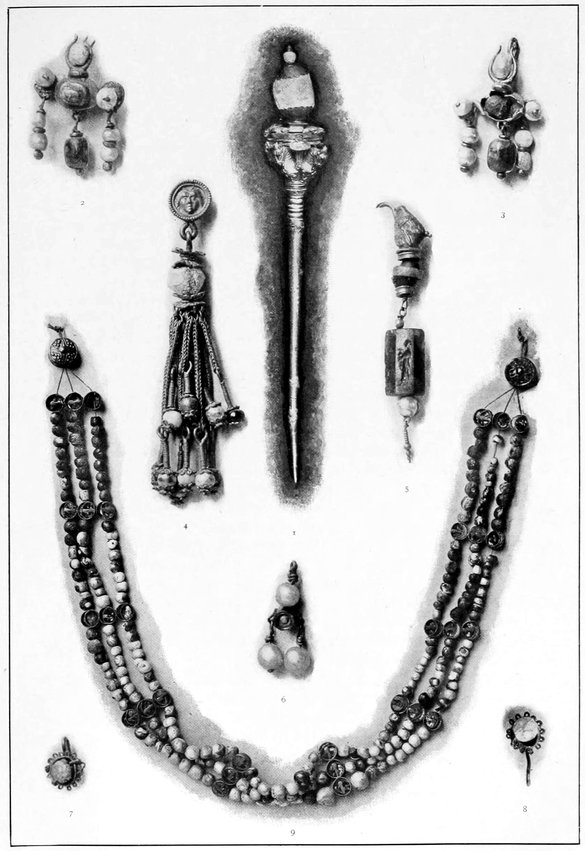
ANTIQUE ORNAMENTS OF PEARLS No. 1. Gold pin from Paphos, Island of Cyprus, mounted with large marine and small fresh-water pearl, now in British Museum. Nos. 2, 3, 4, 5, 6, 7, 8. Gold earrings and pins set with pearls, now in the Egyptian Gallery of the Louvre, Paris. No. 9. Pearl and gold necklace found at Susa, Persia, now in the Louvre, Paris.
405This ornament was found on the site of the ancient Susa or Shushan by M. J. de Morgan, February 10, 1901, in a bronze sarcophagus, which contained the skeleton of a woman, adorned with a great number of gold ornaments set and incrusted with precious stones. M. de Morgan gives circa 350 B.C. as the probable date of these objects. The pearls were much deteriorated. About 238 were found, but many of them crumbled away when they were touched. M. de Morgan considers that the necklace was of the type of the “dog-collar” of to-day, and he believes that it originally comprised from 400 to 500 pearls.
According to a personal communication from M. P. Cavvadias, of the Société Archéologique d’Athènes, there are no pearls on the ancient ornaments preserved in the National Museum at Athens. This is hardly surprising in view of the fact that the greater part of these ornaments belong to the archaic period of Greek art; that is to say, to a time when the pearl was evidently unknown to the Greeks.
The fact that we do not find more evidence of the use of pearls in Greece at a later period need cause no surprise, when we consider how many of the treasures of Greek art have disappeared in the course of more than twenty centuries. There can be no question that they were known and used as ornaments at an early time, as we can infer from the description of them by Theophrastus and later Greek authors.
Dr. Edward Robinson of the Metropolitan Museum of Art, and other authorities on Greek art and archæology, maintain that the Arethusa necklace, and other ornaments of that time, depicted on coins, etc., were meant to represent gold ornaments, as it is believed by many that pearls were unknown in Greece at that period.
One of the most interesting specimens showing the use of a pearl in ancient times is a very beautiful pearl pin from Paphos, on the Island of Cyprus, which is mounted with a large marine pearl, probably the largest antique pearl ever found, measuring fourteen millimeters in diameter, and weighing about 70 grains. This, unfortunately, has been very much abraded and worn away, although more than half of the pearl is still present. It is surmounted by a small fresh-water pearl, four millimeters in diameter, weighing about two grains and in a much better state of preservation. This unusually interesting example of prehistoric pearl is in the Greek and Roman department of the British Museum, and we are able to show it by the courtesy of the keeper of that department, Dr. Charles Hercules Read.
406In excavations made last spring (1907), in the Hauran district in Syria, Azeez Khayat found a number of loose pearls which had formed a necklace. The tomb in which they were discovered was cut in the rock, and appeared to be of Roman origin. The pearls were still attached to the old bronze wire with which they had been strung. Mr. Khayat also mentions the finding of a pearl pin, and a single earring bearing a pearl, in a rock-tomb at Cæsarea, in Syria. Rock-cut tombs from ten to twelve feet in depth are frequently discovered, and they probably date from the beginning of the Christian era.
The habit was so common of using pearls as a base to throw up the brilliance of other gems, that we may, perhaps, believe even in Caligula’s slippers of pearls, with rubies and emeralds set upon them like flowers.
The Roman ladies had a special favor for pearls as earrings, and it was one of their consuming ambitions to possess exceptionally fine specimens for this purpose. They preferred pear-shaped pearls, and often wore two or three of them strung together. They jingled gently as they moved about—a fitting accompaniment, it may be said, to their graceful movements—and from this jingling the name crotalia, or “rattles,” was applied to them.
The description given by Pliny of the pearl ornaments of Lollia Paulina is the principal claim which the wife of Caligula has on our interest.
I myselfe have seen Lollia Paulina when she was dressed ... so beset and bedeckt all over with hemeraulds and pearles, disposed in rewes, ranks, and courses one by another; round about the attire of her head, her cawle, her borders, her perruke of hair, her bongrace and chaplet; at her ears pendant, about her neck in a carcanet, upon her wrest in bracelets, & on her fingers in rings; that she glittered and shone againe like the sun as she went. The value of these ornaments she esteemed and rated at forty million Sestertij[426] and offered openly to prove it out of hand by her bookes of accounts and reckonings. Yet were not these jewels the gifts and presents of the prodigall prince her husband, but the goods and ornaments from her owne house, fallen to her by way of inheritance from her grandfather, which he had gotten together even by the robbing and spoiling of whole provinces. See what the issue and end was of those extortions and outrageous exactions of his: this was it. That M. Lollius, slandered and defamed for receiving bribes and presents of the kings in the East; and being out of favor with C. Cæsar, sonne of Augustus, and having lost his amitie, dranke a cup of poison, and prevented his judiciall triall: that forsooth his neece Lollia, all to be hanged with jewels of 400 hundred thousand Sestertij, should be seene glittering, and looked at of every man by candle-light all a supper time.[427]
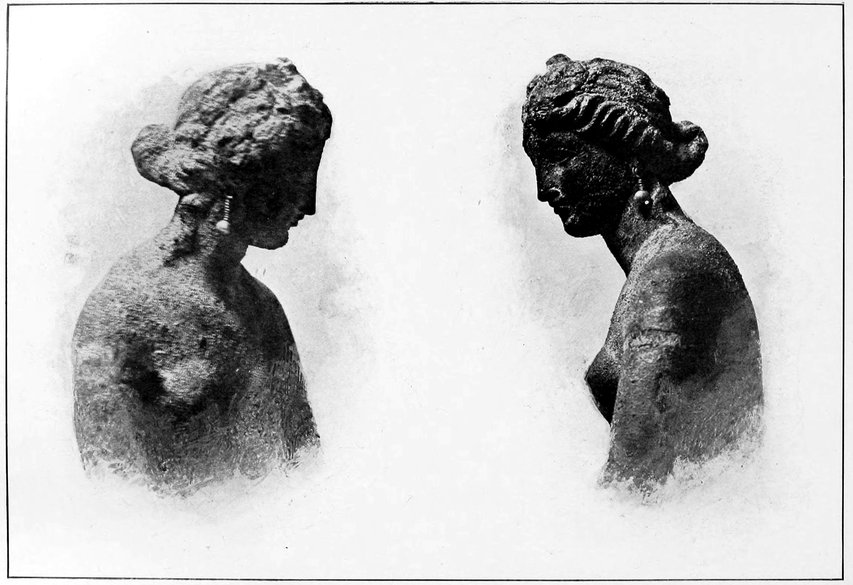
TYSZKIEWICZ BRONZE STATUETTE OF APHRODITE, SHOWING EARRINGS OF PEARL AND GOLD OF EARLY GREEK PERIOD Now in Museum of Fine Arts, Boston, Mass.
407And the taste of the Roman ladies for pearls has perpetuated itself in Italy, though other of the luxurious habits which in their case accompanied it, have long since died out. The women of Florence even now are not content if they do not possess a necklet of pearls, and this generally forms the marriage portion of the middle-class women. It is thought, just as it was in ancient Rome, that this gives an air of respectability, and forms a sure protection from insult in the street or elsewhere.
One of the earliest illustrations showing a pearl earring is the one in the ear of Julia, the daughter of Titus, incised on a splendid aquamarine in the Bibliothèque Nationale. This gem was formerly in the Treasury of St. Denis, and is considered to belong to the Carlovingian period.[428]
So large and heavy were the earrings worn in Rome that there were women known as auriculæ ornatrices, special doctresses whose sole occupation was the healing of ear tumors and of injured or infected ears. In a similar way, at the present day, we have the ear piercer, whose vocation, however, is rapidly becoming useless because of the ingenious modern devices for holding the pearls to unpierced ears; and we must consider this eminently desirable when we think of the ear-piercing outfits of the former jeweler, who never disinfected his apparatus, and when we recall the fact that it was always expected that the ear would swell, first, from the crude awl that was used, and, secondly, from the unsterilized instruments.
That the Romans believed in decorating the statues of their goddesses with pearls and dedicating them as offerings, is evidenced by the gift of Cleopatra’s pearl, which was cut in halves to make earrings for the Venus of the Pantheon; and by the buckler of British pearls for the statue of Venus Genetrix, given by Julius Cæsar. Quite a number of statues and busts of the Roman period, and some of an earlier time, have the ears pierced for the reception of earrings, and it is highly probable that pearls were used for this decoration. Among these are the busts of Pallas and Juno Lanuvina in the Vatican; that of Eirene, a marble copy of a work of Cephisdotus, in the Glyptothek, Munich, and the Venus de Medici in the Uffizi, Florence.
Pottier[429] mentions several other Greek statues which show that earrings were used for their adornment; as, for example, the winged Victory of Archernos, in Delos; the head of one of the caryatids found at Delphi, a cast of which is in the Louvre; the archaic Aphrodite of the Villa Ludovisi; the Athena from the frieze of the temple at Ægina; 408the Venus of Milo, etc. In other instances the ornament was simply painted on the ear as is shown in the Aphrodite in white marble which has been found in Marseilles. This may also have been the case in the frieze at Olympia. The earrings used in these statues were usually metal disks entirely covering the lobe of the ear. We have, however, many representations of pearl earrings in the paintings at Pompeii, and on cameos and coins. These show us several of the types mentioned by Pliny and other authors; still, they are smaller and more unpretentious than we might expect in view of the well-known luxury of the Roman ladies in this respect. The greater part of the earrings represented show a pearl suspended from a single wire; there are some, however, with three pearls, one above the other,[430] and a few bearing several pearls loosely hung together, answering to the description of the crotalia. Others, again, bear pear-shaped pearls or elenchi.[431] It is a singular fact that scarcely any of the busts of Roman women are ornamented with earrings, but it is quite possible that the cause for this must be sought in the desire of the artist to dispense with unimportant details which might detract from the general effect he wished to produce. We may note, however, four female figures in the Gallerie des Empereurs in the Louvre Museum, with the ears pierced for the reception of earrings (Nos. 1195, 1202, 1230, and 1269).
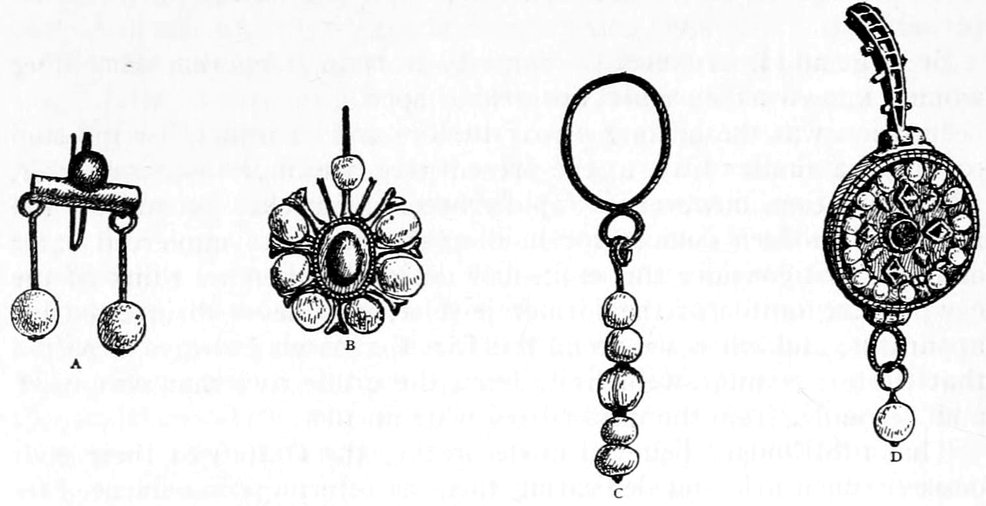
Pearl earrings from Herculaneum and Pompeii
Many numismatists, among them Dr. F. Louis Comparette,[432] believe 409that the necklaces and earrings represented on Greek coins from the fifth century B.C. are intended to represent pearl ornaments, since the personages depicted are in all cases female divinities, goddesses, or nymphs, held in great veneration in the city where the coins were minted, and it is almost certain that the artist intended to portray the choicest and most beautiful of gems as an adornment for the beautiful head of the city’s patron.
The Syracusan coins, by Euvenetus, minted in the early part of the fifth century B.C., and bearing the head of Arethusa, seem to be the earliest coins showing a neck and ear ornament. This was later imitated on the Greek and Greco-Roman coins. A coin of Sulla shows a double necklace, one strand consisting of round beads and the other of pendants. The later coins almost always represent the goddesses with neck and ear ornaments. Some of the latter, however, resembling amphoræ, are neither round nor pear-shaped.
In view of the great fondness of the Romans for pearls, it is not surprising that many of these gems have been found in the excavations at Pompeii, Herculaneum, and Capodimonte. The collection of earrings preserved in the Naples Museum is especially noteworthy. Here we can see earrings consisting of a simple golden hoop, from which hangs a wire bearing a single pearl; others in which a cross-bar is attached to the hoop, and at each end of this bar is a loosely hung wire with a pearl at its extremity, this earring suggesting the crotalia mentioned by Pliny (see Fig. A); and still others wherein the pearls are strung directly on the hoop. The cross-bars are of various designs, sometimes entirely smooth, and again shaped like a cornice or a pediment; in other cases we have an earring with two pearls on a wire, then a pierced transparent stone, and beneath that, two pearls terminating the large drop. A few of the earrings are more elaborate, as, for example, one represented in Fig. B which was found in Pompeii, March 8, 1870. Here there is an emerald in the center, surrounded by gold rays, between which were set eight pearls, two of which are now missing; above is a small pearl. The single earring shown in Fig. D came from Herculaneum, and bears a circlet of thirteen pearls, alternating with rubies and other stones; beneath there is a link from which depends a pearl about seven and a fifth millimeters in diameter, and weighing nearly twelve grains. The fact that we know the latest date to which these pearls can be assigned, namely, 79 A.D., renders them peculiarly interesting and valuable from a historical point of view. Naturally, many of them are calcined or otherwise damaged, but others are fairly well preserved as to form, although the luster has departed from them. There are twenty-seven earrings in the collection, and the pearls number about one hundred. No great pearls were found.
410In the Roman excavations, and in those of other early remains, many objects are found in which there may be a sapphire, an emerald, or several other stones, pierced, and pendant on a gold wire, with a blank space between, showing that something was there originally. This object has apparently decomposed and fallen away. We may reasonably suppose that it was either a pearl or a glass bead, and it is unlikely that glass would be used in connection with the more precious materials. This pearl or glass may have been affected by the organic acids or the acids resulting from the decomposition of the body with which the ornament was buried for a score of centuries.
Among the ancient jewels containing pearls which are preserved in the Hermitage at St. Petersburg, we may mention a broken gold ring with a roughly cut turquoise and two pendants, each set with two pearls separated by a garnet. This object was found in southern Siberia during the reign of Peter the Great, and may belong to the second century before Christ. Also may be noted a pair of gold earrings, with an engraved six-rayed star, in the center of which a pearl is set, while below hang three pendant sticks, two of which have a pearl at the extremity. These earrings were found in 1892 in a tomb situated close to the site of the ancient town of Chersonesus, in the Crimea. As a coin of the Emperor Gordianus III (224–244 A.D.) was discovered in the same tomb, we may assign the earrings to the first half of the third century A.D.
Beside another pair of earrings, one of which is set with a pearl, and two pearl-headed pins, all from the neighborhood of Tiflis, in the Crimea, we may especially refer to an earring made of a plain, thick, golden wire, on which seven pearls are threaded; one of these occupies the center and the others are grouped around it. This earring was purchased in 1903 by the Russian Imperial Archæological Commission from a collector residing at Odessa; it is said to have been found on the site of the ancient Greek colony of Olbia, but we have no definite external or internal evidence to sustain this view.
We may also note the gold necklace and earrings[433] containing pearls found near the site of Olbia during the reign of Napoleon III, and now in the collection of the Roman, Campana. These objects are especially interesting owing to the fact that the pearls are drilled and a gold cap is set on each side.
A pair of pearl earrings were found in a tomb on Mount Mithridates, near Kertch, in the Crimea. These earrings probably belong to the third or fourth century of our era. Of the four pearls which originally adorned the cross-bars, only one has been preserved. Another pair of earrings was discovered in the same place. It is probable that they were ornamented with pearls in a similar way, but the latter have entirely disappeared.
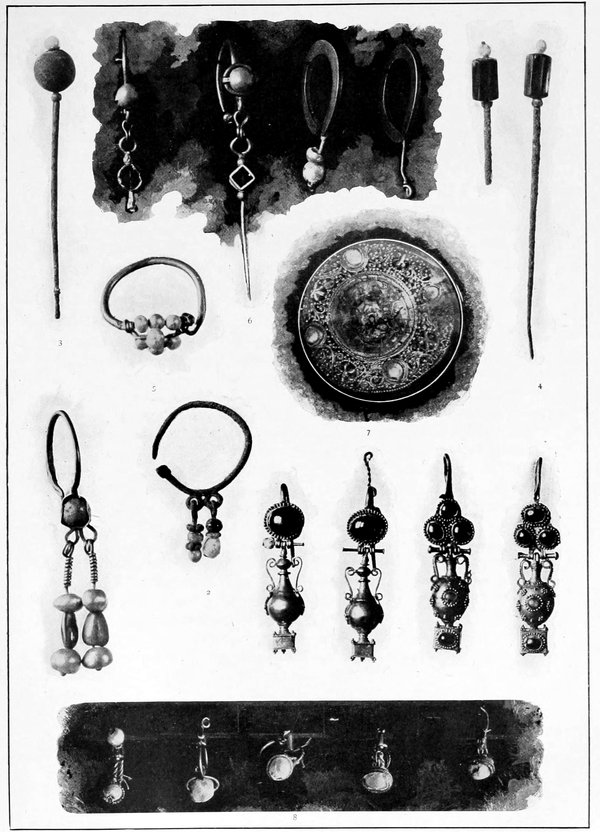
ANTIQUE PEARL ORNAMENTS No. 1. Gold earring with turquoise top. Two pearls, two garnets, and two pearls. Found in southern Siberia in 1726; believed to be of the second century, A.D. No. 2. Brass earring with one pearl and glass beads. Fourth century, A.D. No. 3. Brass dress pin. Sphere of amber, surmounted by a pearl. Found near village of Mzchet Caucasus. Fourth century, A.D. No. 4. Carnelian dress pins with pearl tops. Early Christian. No. 5. Gold earring, hook and eye type. From Olbia, the site of an ancient Greek colony. Fourth century, A.D. Nos. 1 to 5 are from the collection of the Imperial Hermitage in St. Petersburg. Nos. 6–8–9. Pearl and gold earrings, Greek, from the Island of Cyprus. Second century, A.D. No. 7. Roman brooch (pearls and gold), found in the river Thames, England. Ninth century, A.D.
411Gabriele Bremond states in his “Viaggi di Egitto,” Lib. I, c. 30, that it was a Mohammedan custom to embroider baldachins and carpets of precious metals with pearls. This use is especially typified in a baldachin of gold embroidered with pearls which is over the sepulcher of Mohammed at Mecca.[434]
When the Mohammedans captured the Persian city Ctesiphon, in 637, they collected an immense booty. Each of the 60,000 soldiers received the value of 12,000 dirhems ($1560), a total of $93,600,000. Among the treasures sent to Caliph Omar (581–644), in Medina, was a crown, perhaps that of Khusrau I (499–579), which Tabari says was studded with 1000 pearls each as large as a bird’s egg.[435] There was also a wonderful carpet 450 feet long and 90 broad, with a border of emeralds, rubies, sapphires, and pearls, representing luxuriant foliage and beautiful flowers. Tabari states that it was called the “Winter Carpet,” because “the Persian kings used it in winter when there was no longer verdure or flowers, for whoever was seated on this carpet thought he looked out upon a garden or a green field.”[436]
On the occasion of the marriage of the Caliph Al-Mamun (786–833) with the daughter of Hassan Sahal, all the grandees of Al-Mamun received slaves of both sexes as presents from the bride’s father. The preliminary negotiations were held at Fomal Saleh, and the road traversed by the bride and bridegroom to reach Bagdad, a distance of one hundred miles, was covered with mats of cloth of gold and silver. We are told that the bride wore on her head-dress a thousand pearls, each of which is said to have been of enormous value.[437]
Describing the birthday festival of Kublai Khan (circa 1275 A.D.), Marco Polo says: “The Great Kaan dresses in the best of his robes, all wrought with beaten gold; and full 12,000 Barons and Knights on that day came forth dressed in robes of the same colour, and precisely like those of the Great Kaan, except that they are not so costly; but still they are all of the same colour as his, and are also of silk and gold. Every man so clothed has a girdle of gold; and this as well as the dress is given him by the Sovereign. And I will aver that there are some of these suits decked with so many pearls and precious stones that a single suit shall be worth full 10,000 golden bezants [about $25,000].”[438]
In the Kan period, in China, the dead bodies of the emperors were 412embalmed and wrapped in a garment ornamented with pearls. They were then inclosed in a case of jade.[439]
Speaking of the jewels of the King of Maabar, or what is now known as the Coromandel Coast, Marco Polo tells us: “It is a fact that the king goes as bare as the rest, only round his loins he has a piece of fine cloth and round his neck he has a necklace entirely of precious stones,—rubies, sapphires, emeralds, and the like, insomuch that this collar is of great value. He wears also hanging in front of his chest from the neck downwards, a fine silk thread strung with 104 large pearls and rubies of great price. The reason why he wears this cord with the 104 great pearls is (according to what they tell) that every day, morning and evening, he has to say 104 prayers to his idols. Such is their religion and custom; and thus did all the kings his ancestors before him, and they bequeathed the string of pearls to him that he should do the like.”[440]
A favorite East Indian amulet is known as the “Nao-ratna” or “Nao-ratan,” and consists of “nine gems”: in former times the pearl, ruby, topaz, diamond, emerald, lapis lazuli, coral, sapphire, and a stone, not identified, called the gomeda. At the present time these stones are generally the coral, topaz, sapphire, ruby, flat diamond, cut diamond, emerald, hyacinth, and carbuncle. This talisman may suggest the Urim and Thummin or sacred oracle of the Jews, which was said to have been taken from Jerusalem in 615 A.D. by Khusrau II, the Sassanian Persian king.
The East Indian custom for persons of quality was to wear a pearl between two colored stones in each ear, that is, either between two rubies or two emeralds; and Tavernier noted, about 1670, that there was no person of any consideration in those regions who did not wear, in each ear, a pearl set between two colored stones. Another favorite ornament for women in India is a girdle elegantly embroidered, bearing a large pendant pearl in front, where it is fastened.[441]
A necklace of twenty-seven pearls bears in India the name of nakshatra mālā, nakshatras (originally “stars”) being the name of the twenty-seven divisions of the Hindu zodiac.[442]
In the Indian jewels often a small spot of enamel is fastened or melted on to a gold wire, and then one or several pearls are hung upon it; or beads of some gems, as sapphire, ruby, emerald, or even glass, may be added or alternated with pearls. Then the enamel stop-piece is turned down and the other end of the gold wire is twisted on to the setting, loosely, in such a manner as to swing freely. It is the effect of these dozens or even hundreds of swinging drops that add such grace and elegance to East Indian jewelry.
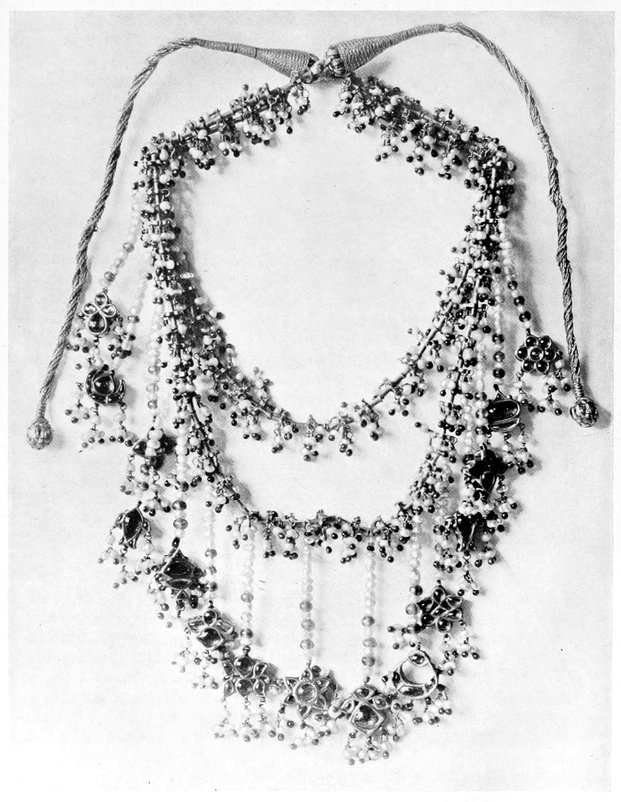
EAST INDIAN NECKLACE OF PEARLS, TABLE DIAMONDS, GLASS BEADS, GOLD AND ENAMEL Property of an American lady
413In China, such precious stones as the ruby, sapphire—both blue and yellow—the emerald, and the pink tourmaline, are not facetted, as with us, but are generally polished in conformity to the shape of the bead or other ornament, and never have a lathe-turned or cut appearance; they are either set in cabochon or as beads, rounded, oval, or elongated. All these forms, and the colors used by the Chinese, lend themselves well to combinations with pearls; and hence pearls are often found in Chinese jewelry, especially in those ornaments which are flexible and graceful, in which the pearls and gems are strung on wire and allowed to swing freely with a gentle tinkle when the wearer moves. This is not unlike the setting of such gems in ancient Roman times. An admirable example is shown and described in Bushell’s “Chinese Art” (Vol. II, plate 108, page 90). In this head-dress of a Manchu lady, there are combined with the pearls, jadeite, amethyst, amber, and coral, on a gilt silver openwork, with blue kingfisher feathers. This great cap of state is an admirable example of pure Chinese design and workmanship. The pendant strings of pearls are occasionally relieved by a bit of carved jade, carnelian or coral, especially the latter. Another example, the “cap of state” has silver-gilt openwork and immortelles (Taoist symbols), and is much enhanced in beauty by a decoration or inlay of plates of the beautiful blue feathers of the kingfisher, which are used so extensively and effectively in Chinese jewelry. The pearls are scattered at intervals over the cap, and ten strings of them hang from the sides of it. This is believed to be of Manchu origin by Dr. Stephen W. Bushell, the great Chinese scholar, to whom we are indebted for the use of the illustration. We are also told that young ladies in China wear a sort of crown constructed of pasteboard, covered with silk. This is adorned with pearls, diamonds, and other jewels.[443]
The pearls on many Chinese ornaments were generally strung upon silk, often with half a dozen or a dozen seed-pearls above and below the large pearl, to hold the latter in place, and also to add a softness to the whole jewel. The end pendant pearl, even if pear-shaped, was usually pierced entirely through, and a wire that was worked through it was flattened out, and this gold head was again ornamented in some way. A Chinese pendant from the China-Japan war-loot offers an excellent illustration of this kind of pearl-setting. This was preserved in a double box of finely carved gold.
The rosaries containing 104 pearls, which are used to-day, were mentioned centuries ago by Marco Polo, and an excellent pearl string 414of this kind has been in the Russian Treasury at Moscow for over two hundred years. Dr. Stewart Culin, the archæologist, who has paid much attention to Chinese customs, informs us that the black and white counters made for use in games by the Chinese are called black and white pearls.
Dr. T. Nishikawa writes us in 1908 that pearls were used in Japan for ornamental purposes more than a thousand years ago. Large abalone pearls are found in images of Buddha made in 300 A.D. Fresh-water pearls, usually from Dipsas and Unio, were also used. A beautiful color-print was made by Hoku’ai of the first pearl, called “tide-jewel” by the Japanese.
Most interesting pearls are those in a brooch in the British Museum, which was discovered in 1839 while excavating a sewer opposite Ludgate Hill in Thames Street, at the depth of about nine feet, in a dark-colored artificial stratum of earth, unaccompanied by any remains that could aid in throwing light upon its history. It is four inches and a half in circumference, and is composed of a circular compartment an inch and a quarter in diameter, set with variegated enamel, representing a full-faced head and bust, with a crown on the head, and the drapery of a mantle, formed of threads of gold effectively arranged so as to mark the features of the face and the folds of the drapery; this is inclosed in a border of rich gold filigree work, set at equal distances with four pearls.[444] Dr. Charles Roach Smith attributes this brooch to the time of King Alfred, and supposes it to have been executed in England by a foreign artist. He only ventures a conjecture that the head might be that of King Alfred.
Crowns, both ancient and modern, are richly ornamented with pearls. We shall treat of the crown of the Holy Roman Empire and of the imperial Austrian crown in the following chapter. One of the most interesting and ancient is the famous crown of Khusrau II (reigned 590–638), made in the latter part of the sixth century, which was brought to light by Shah Abbas after a thousand years of concealment in an obscure fortress among the mountains of Lauristan. It does not contain diamonds among its ornaments, but is incrusted with pearls and rubies.[445]
From the representation given on the cup of Khusrau, the throne of the Sassanian Persian kings appears to have been as large as a couch; it was supported by four winged animals, whose model had been borrowed by the Sassanians from their ancestors, and it was covered with an embroidered stuff thrown over mattresses and cushions. If we 415may believe Tabari (“Chronicles,” trans. by Zotenberg, Vol. II, p. 304), this throne was of gold, enriched with precious stones, and surmounted by a crown of gold and pearls, so heavy that the sovereign could not wear it, and therefore had it suspended above his head.[446]
One of the crowns in the Hermitage at St. Petersburg was discovered in 1864 in a tumulus near Novo-Tcherkask, with many other valuable objects, all of which had apparently been buried with some important personage. This crown resembles somewhat that of Reccesvinthus in the treasure of Guerrazar, although some portions of it seem to belong to the period of the Roman empire. The conjecture has been made that the crown may have been worn by a queen since it is decorated with a finely executed bust of a woman in amethyst. The crown itself is of pure gold, and was bordered with two rows of pearls, which have disappeared, leaving only the small disks to which they were attached; besides these, it was ornamented with a number of uncut precious stones. The date of this object cannot be exactly determined, although the consensus of opinion is that it belongs to about the third century after Christ. Possibly the bust and some other portions, which appear to be of Greco-Roman workmanship, are of this period, while the rest of the crown was executed one or two centuries later; it is about seven inches in diameter and two in height.[447]
Toward the end of the year 1858 a French officer who lived in Spain, while making some excavations on a property he owned there, discovered fourteen small gold crowns. They were taken to the Spanish mint and are said to have been melted for bullion. New excavations on the same spot brought to light eight other crowns of considerable weight, of the finest workmanship, and incrusted with precious stones, pearls, etc. There is no doubt that these crowns were buried in the early years of the eighth century, when the Arabs, led by Tarik, invaded Spain and forced the Gothic dynasty to take refuge in the north of Europe. The importance of this discovery is very great, since it gives us positive evidence of the development of the goldsmith’s art in Spain at that early period. An inscription proves that one of the crowns was dedicated in the second half of the seventh century, and it is one of the few authentic memorials we possess of that epoch. In February, 1859, the eight crowns were purchased by the French government and placed in the Musée de Cluny. Two other crowns found in the same place were added in 1860, and complete the collection.
The largest of these crowns is that of the Gothic king, Reccesvinthus, who was King of Spain from 649 to 672. It is composed of a 416wide band of solid gold, ten centimeters wide and twenty-one centimeters in diameter (about four and eight inches respectively). This band, which opens by means of a hinge, is surrounded by two borders of gold set with the red stones of Caria, called “gemmae alabandenses,” and the band itself is studded with thirty large oriental sapphires of the greatest beauty. Thirty fine pearls of appropriate size alternate with the sapphires on a ground incrusted with the red stones above mentioned. From twenty-three small gold chains depend large letters in cloisonné, and also incrusted, forming the sentence: RECCESVINTHUS REX OFFERET. Each letter has a gold pendant with a pearl from which hangs a pear-shaped sapphire.
The crown is suspended from four chains, converging to a double floral ornament of solid gold, adorned with twelve sapphire pendants. This ornament, the leaves of which are open, is surmounted by a capital of rock crystal, then comes a ball of the same material, and the whole is terminated by the gold center to which the four chains are attached.
The cross, which is suspended underneath the crown by a gold chain, is remarkable for its elegance and its richness. It is of solid gold and is inlaid with six very fine sapphires and eight large pearls, each of which is mounted in relief with claws. At the back, the cross still bears the wire by which it was attached to the royal mantle. The inside of the crown is quite smooth; the outside is composed of elegant fleurettes in openwork, the leaves being filled with the same species of red carnelian mentioned above. There are thirty sapphires, all of the finest water, and a few of them show the natural facetted crystallization; the two principal ones, placed in the center of the band, are thirty millimeters in diameter. The pearls are of an exceptional size, and only a few of them have been injured by time. The total number on the crown, cross, and top ornament, is seventy, thirty of which are unusually large. The chains are each composed of five openwork ornaments with an enamel paste inlaid in the gold edge. A close examination of the crown shows that it had been worn before the king presented it to some church.
The royal Hungarian crown given to St. Stephen by the pope in the year 1000 A.D., when Hungary became an empire, is one of the most ancient crowns in existence. It contains 320 pearls and was procured in Byzantium. It was pledged to the emperor, Frederick IV, by Queen Elizabeth of Hungary, probably about 1440.
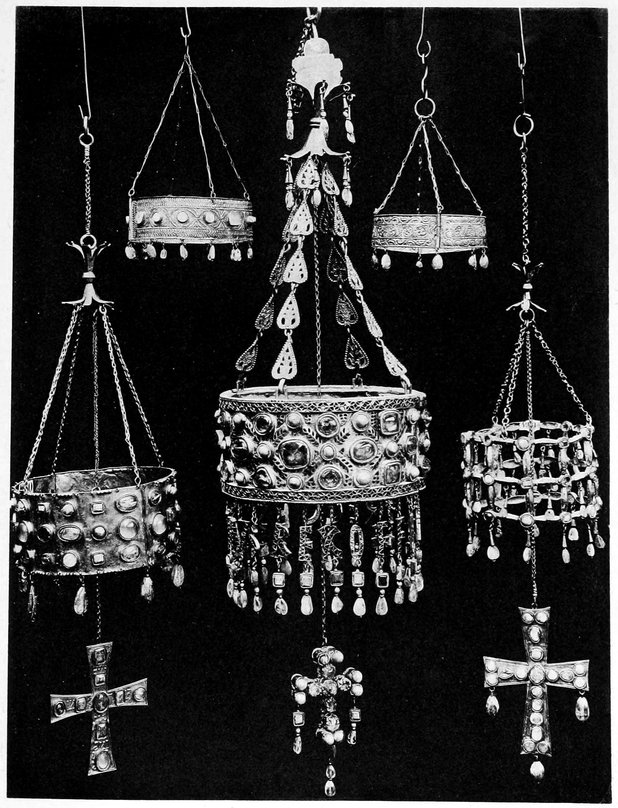
CROWN OF RECCESVINTHUS AND OTHER GOTHIC CROWNS OF THE SEVENTH CENTURY From the treasure of Guarrazar, near Toledo Musée de Cluny, Paris
417In the cathedral of Prague (the metropolitan church of St. Vitus) there may be seen the crown which was made by the order of Charles IV (1378) out of four pounds, ten and a quarter ounces of gold. It is adorned with twenty-nine pearls, forty-seven rubies, twenty sapphires, and twenty-five emeralds. The value of the gold and gems was estimated at $10,000 in 1898, which is probably less than it would be worth to-day. The sacred crown worn by St. Wenceslaus was inserted within the crown of Charles IV at the instance of Queen Blanca. The golden scepter and the golden orb are of very beautiful workmanship. The scepter has six rubies, eight sapphires, and thirty-one pearls. There may also be seen in the treasury a gilded monstrance, in the style of the Renaissance, studded with pearls and precious stones, a gift of the princely family of Schwarzenberg. Within the same cathedral, in the tabernacle of the chapel of St. Ludmilla, wife of the first Duke of Bohemia, is the head of that saint, bearing a crown studded with 1800 pearls.[448]
The crown of Vladimir, with its singular and thoroughly Russian form, is preserved in the treasury of the Kremlin at Moscow, and has been used at the coronation of all the Russian emperors. It has borne the name of the crown or cap of Monomachus from the reign of Ivan IV. Although, to judge from this designation, the crown was probably executed in the twelfth or thirteenth century, there is a legend to the effect that it was sent, in 988, from Byzantium by the ruler as a gift to St. Vladimir. It is executed in filigree work, and is surmounted by a plain cross with four pearls at the extremities; between these pearls are set a topaz, a sapphire, and a ruby. The crown itself is ornamented with four emeralds, four rubies, and twenty-five pearls from Ormus, set in gold. The cap has a bordering of sable fur, and is lined with red satin. (See Maskell, “Russian Art,” London, 1884, p. 125.)
The imperial state crown of her Majesty Queen Victoria, was made in the year 1838 by Messrs. Rondell and Bridge, with jewels taken from old crowns, and others furnished by command of her Majesty. It consisted of diamonds, pearls, rubies, sapphires, and emeralds, set in silver and gold. It had a crimson velvet cap with ermine border, and was lined with white silk. Its gross weight was thirty-nine ounces five pennyweights troy. The lower part of the band above the ermine border consisted of a row of 129 pearls, and the upper part of a row of 112 pearls; between these rows, in the front of the crown, was a large sapphire (partly drilled) purchased for the crown by his Majesty George IV. In the front of the crown, and in the center of a diamond Maltese cross, was the famous ruby said to have been given to Edward, Prince of Wales (the Black Prince), by Don Pedro, King of Castile, after the battle of Nájera, near Vittoria, 1367 A.D. This ruby was worn in the helmet of Henry V at the battle of Agincourt, 1415 A.D. It was pierced quite through, after the eastern custom, the upper 418part of the piercing being filled up by a small ruby. From the Maltese cross issued four imperial arches composed of oak leaves and acorns, thirty-two pearls forming the acorns. From the upper part of the arches were suspended four large pendant, pear-shaped pearls with rose diamond cups.[449] Writing in 1850, Barbot, the French jeweler, placed the value of this crown at $600,000.
The crown of St. Edward, the official crown of England, is used at each coronation.[450] The original crown of this name was destroyed by the republicans in 1649, but at the time of the coronation of Charles II, another crown was made to take its place, under the direction of Sir Robert Viner. As far as can be known, this crown was an exact copy of the older one, which was worn by Edward the Confessor, and perhaps even by King Alfred. The crown in use at present is of gold, richly studded with pearls and precious stones of various kinds: diamonds, rubies, emeralds, and sapphires. There is a mound of gold on top, and on this a cross of gold ornamented with very large oval pearls, one attached to the top and the two others pendant from the ends of the cross. The present arrangement of the jewels cannot date back earlier than 1689, as the crown was found to be despoiled of them at the time of the accession of William and Mary. Those now in the crown are acknowledged to be inferior to the former ones.
The orb or mound which is placed in the king’s hand immediately after his coronation, is a ball of gold, six inches in diameter, surrounded by a band of the same metal ornamented with roses of diamonds set around other precious stones, and bordered with pearls. It is surmounted by a cross, embellished with four larger pearls at the angles near its center, and three others at the ends. The orb, including the cross, is eleven inches high, and it is figured on the coins of many of the English kings, who are represented holding it in their left hands.
The regalia of Scotland,[451] consisting of the crown, scepter, and sword of state, are preserved in the castle of Edinburgh. It is not certainly known at what time this crown was executed. At the coronation of Robert Bruce (1274–1329) a simple circlet of gold was used; this fell into the hands of the English after the battle of Methven in 1306. In 1307 Edward I issued a pardon at the request of his “beloved Queen Margarate,” to a certain Galfredus de Coigniers, who was said to have concealed and kept “a certain coronet of gold with which Robert the Bruce, enemy and rebel of the King, had caused himself to be crowned in our own Kingdom of Scotland.”
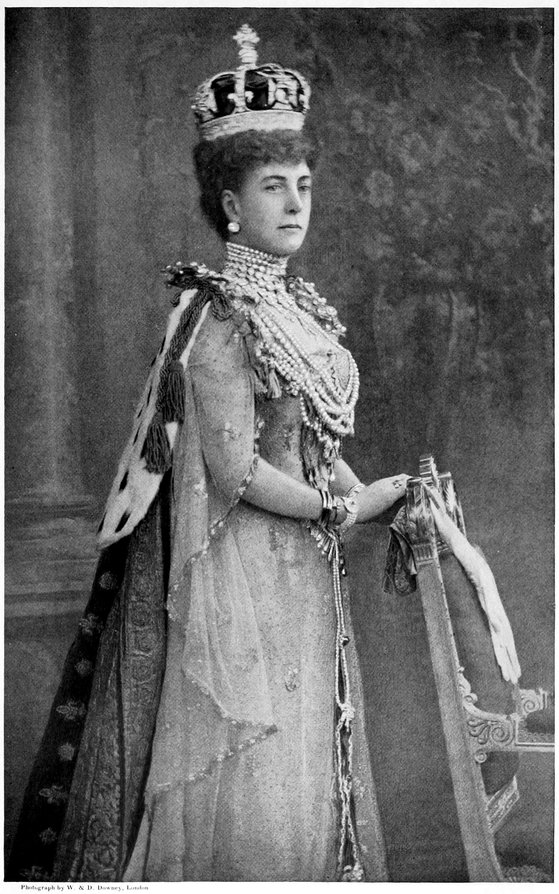
Photograph by W. & D. Downey, London HER MAJESTY, QUEEN ALEXANDRA OF GREAT BRITAIN AND IRELAND, EMPRESS OF INDIA
419Sir Walter Scott, in his account of the regalia, gives it as his opinion that the present crown was probably made for Robert Bruce at a later date, and that it was used at the coronation of his son, David II (1324–1376). The style of workmanship indicates a fourteenth-century origin. The crown was originally open and was arched over by James V (1512–1542). As Scott notes, this was done to many royal crowns in the fifteenth and sixteenth centuries, in order to assimilate them to the type of the old imperial crowns.
The following description is slightly abridged from that given by Sir Walter Scott:
The lower part consists of two circles, the undermost much broader than that which rises over it; both are of the purest gold and the uppermost is surmounted by a range of fleur-de-lis interchanged with crosses fleurées, and with knobs or pinnacles of gold topped with large pearls; this produces a very rich effect. The under and broader circle is adorned with twenty-two precious stones, betwixt each of which is interposed an oriental pearl. The stones are topazes, amethysts, emeralds, rubies and jacinths; they are not polished by the lapidary, or cut into facets in the more modern fashion, but are set plain, in the ancient style of jewellers’ work. The smaller circle is adorned with small diamonds and sapphires alternately. These two circles, thus ornamented, seem to have formed the original Diadem or Crown of Scotland, until the reign of James V, who added two imperial arches rising from the circle, and crossing each other, closing at the top in a mound of gold, which again is surmounted by a large cross patée ornamented with pearls and bearing the characters J.R.V. These additional arches are attached to the original crown by tacks of gold, and there is some inferiority in the quality of the metal.
The bonnet or tiara worn under the crown was anciently of purple, but is now of crimson velvet, turned up with ermine—a change first adopted in the year 1695. The tiara is adorned with four superb pearls set in gold, and fastened in the velvet which appears between the arches. The crown measures about nine inches in diameter, twenty-seven in circumference, and about six and a half in height from the bottom of the lower circle to the top of the cross.
The scepter, made by order of James V at the time he added the arches to the crown, is a slender silver rod about thirty-nine inches long. An antique capital of embossed leaves supports three small figures representing the Virgin Mary, St. Andrew, and St. James, above which is a crystal ball, surmounted by an oriental pearl.
The regalia have passed through many vicissitudes. After the execution of Charles I, his son Charles II was crowned King of Scotland at Scone on January 1, 1651. On the advance of the parliamentary army into Scotland, the regalia were placed in the care of the Earl Mareschal who preserved them in his castle of Dunrottar, and here they were kept until the castle was besieged and on the point of falling 420into the hands of the English. In this extremity, they were rescued by Christian Fletcher, wife of the Rev. James Granger, minister of Kinneff. She obtained permission from the English general to pay a visit to the Lady Mareschal and succeeded in carrying off the regalia. Her husband buried them in the church of Kinneff, just in front of the pulpit. When they were brought to light again after the Restoration, an Act of Parliament was passed which, after reciting Christian Fletcher’s services in the matter, stated: “Therefore, the King’s Majestie, with advice of his estates in Parliament, doe appoint Two Thousand Merks Scots to be forthwith paid unto her by his Majestie’s thresaurer, out of the readiest of his Majestie’s rents, as a testimony of their sense of her service.”
In 1707, after the union of England and Scotland, it was considered wiser to remove the regalia from public view, since they were calculated to arouse memories of the old Scotch monarchy. These precious objects were therefore inclosed in a chest, which was their usual receptacle, and locked up in the crown-room, a strong vaulted apartment in Edinburgh Castle. There the regalia remained until 1817, when, as doubts had been expressed as to their existence, a commission of investigation was appointed, one of the members being Sir Walter Scott. The chest—which had probably been the jewel-safe of the Stuarts—was forced open, and the regalia were found within, just as they had been deposited in 1707.
An imperial German crown does not exist; a design has been made and accepted, but at the present date, 1907, it has not yet been executed. On festive occasions, when the imperial insignia are necessary, the Prussian insignia are used, especially the Prussian royal crown. This consists of a circlet of gold set with thirteen diamonds. On this are five leaves, each composed of three larger diamonds and a smaller one, and four prongs, each bearing a diamond and above it a large pearl. From the five leaves start the same number of semicircular arches, tapering toward the central point, where they unite. Each of these is set with ten diamonds of decreasing size. On the center rests an imperial globe. It consists of a large Indian-cut sapphire,—the counterpart of the one on the Austrian imperial crown, evidently dating from the time of the Crusades,—and above it rises a chaplet ornamented with diamonds. The crown has a lining of purple velvet reaching to the arches. Between the arches are eight pearl pendants of an average weight of 80 grains; they are 25 millimeters in length, and have a fine, brilliant white color, although they are not perfectly regular in form.
In addition there belongs to the regalia a pearl necklace of three rows; the first consists of thirty-seven pearls averaging 28 grains 421each; the second of thirty-nine pearls averaging 34 grains, and the third of forty-five pearls averaging 39 grains. There is also a guard chain of 114 pearls, averaging 20 grains, making a total of 2280 grains for the chain. These pearls are also of irregular form.[452]
The crown jewels of the Sultan Abdul-Aziz (1830–1876) were of immense richness and value. At the exhibition in Vienna, 1873, many of these were exhibited in a building created specially for the purposes of display and protection. They were in five compartments, in what might be termed five impregnable fire-proof safes of a peculiar construction. Among other interesting objects was the armor of Sultan Murad I (1319–1389), the founder of the Ottoman empire in Europe. This armor is of the most delicate oriental workmanship. Diamonds, pearls, and rubies are worked broadcast over it with exquisite taste.[453]
In Germany and Austro-Hungary there are many valuable ecclesiastical ornaments, some of which possess great interest for the history of early German art. They also serve to show the appreciation of the pearl even in the Dark Ages and the Early Renaissance period.
One of the most curious productions of early German art is a reliquary in the form of a sack, which is from Enger near Herford, and is exhibited in the Kunstgewerbe Museum in Berlin. It is set with cameos and pearls; several of the latter have dropped out; a few, however, remain in their setting. According to a very probable tradition, this reliquary was given by Charlemagne to the Saxon duke, Wittekind, on the occasion of his baptism in 785. It is of very rude and primitive workmanship and, if we accept the tradition, it is not unlikely that it was executed at Aix-la-Chapelle.[454]
An interesting example of German art, from the time of Archbishop Egbert of Treves (977–993), is a frame now in the Beuth-Schinkel Museum, at Charlottenburg. This was probably the framework of a portable altar. It is decorated with a simple geometrical design in the three primary colors, and has four polished stones and four pearls on the outer border of gold filigree. Another example of the art of Treves at the time of Archbishop Egbert is the Echternacher Codex. The gold-plated cover is a worthy product of the school: ivory, enamel, and mosaic are combined in its decoration with rows of pearls. Among the representations of many saints, appears the figure of the Empress Theophanu, daughter of the Greek emperor, Romanos II, with the inscription “Theophaniu imp.” Opposite is a youthful figure, 422probably that of her son, Otho III. It seems likely that the work was executed, at the command of the empress, between 983 and 991.[455]
In the cathedral of Treves is the portable altar known as the altar of St. Andrew. This was primarily a reliquary and secondarily an altar. In memory of the relic of the sandal of St. Andrew, which was greatly prized by Archbishop Egbert, this altar bears the representation of a foot executed in wood and covered with plates of gold. The front of the case is divided into three fields; that in the middle containing a Byzantine lion in gold relief, and the others the symbols of the four evangelists in enamel work. The border is formed of rectangular pieces of enamel and smaller ones of gold, and it is set with round stones alternating with half-pearls; the ends are covered with filigree and enamel work wherein are embedded strings of pearls. A coin of Justinian II is set in the middle of the back of the case and is surrounded by a wreath of larger pearls.[456]
A gold cross, the work of Rogkerus Theophilus, is in the Kunstgewerbe Museum in Berlin, and comes from Herford. The frame, which is of wood, is covered with plates of gold; at the extremities and in the center are groups of precious stones surrounded by pearls; at the base is a fine Augustan cameo with a wreath of pearls; the entire cross is covered with filigree work and decorated with pearls in groups of threes. The arrangement of the precious stones, and the enhancement of their beauty by means of the circles of pearls, are highly artistic. As a work of Rogkerus, this cross must have been executed at the very end of the eleventh century and it may be regarded as one of the finest examples of the art of this period.[457]
A very rich collection of ecclesiastical ornaments is contained in the treasury of the cathedral of Gran in Hungary.[458] One of the most interesting objects is a reliquary in the form of a Latin cross, which is of great historical and artistic value. An inventory made after 1528 describes it briefly: “crux aurea continens lignum vitae” (a gold cross containing the wood of life). Although this reliquary probably belongs to the end of the twelfth century, the inventory of 1659 describes it as a gift of King Stephen, and proceeds to say that the kings of Hungary took their coronation oath upon it. This custom has been preserved to the present day, and Emperor Francis Joseph, on the occasion of his coronation as King of Hungary, June 8, 1867, swore, upon this cross, to uphold the constitution and the laws of the land. 423The cross is decorated with plates of gold in filigree design, and has four en cabochon cut sapphires and eighteen oriental pearls.
The greatest treasure of the collection is known as the cross of Corvinus, King of Hungary, and is decorated with a great number of pearls.[459] It is a remarkable example of early Italian Renaissance art. The entire structure is about twenty-eight inches high; the pedestal is triangular and ornamented with pearls and precious stones; three sphinxes bearing shields with the arms of Corvinus support a disk from which springs a triangular support sloping outward; on the three sides are mythological figures. Upon this base rests the chapel, a light Gothic structure with the figure of the Saviour bound to a pillar in the center, and the busts of three prophets in the niches outside. Above all is the crucifix, on each side of which are figures of the Blessed Virgin and of St. John. Around the base and about each division of this elaborate design is a row of pearls; the Gothic chapel is surmounted by a close-set row, and each of its six pinnacles terminates in an oval pearl. The cross itself has fifteen large pearls disposed in twos and threes, and many smaller ones. There are at least two hundred pearls on the whole structure.
Another cross, with the arms of the primate, George Szolepchényi, and bearing the date 1667, is of pure design and richly decorated with pearls and precious stones.[460] It is quite possible that this cross, which seems to belong to a better period, was bought by the archbishop, who afterward added his arms. There are thirteen oriental pearls, three at the top, three at the end of each of the arms, and four at the intersection. This cross was used as an “instrumentum pacis,” for the kiss of peace, on solemn occasions such as coronations.
We may also note the pendant with the image of the Virgin Mary as patroness of Hungary, which is of gold enamel and has two pendant pearls and a sapphire, and likewise the pectoral cross of the primate, Emerich Losy; this is of gold, decorated with green, blue, and black enamel, and has three pendant pear-shaped pearls, one quite large, as well as thirty-four smaller round pearls.
Among the many valuable and interesting objects in the treasury of the house and chapel of Maria Loretto am Hradschin,[461] at Prague, there is a monstrance of silver-gilt, thirty-seven and a half inches high and fifteen and three quarter inches wide. It dates from the beginning of the eighteenth century, and is not a harmonious whole, but only a combination of different ornaments of precious stones, corals, and several hundred pearls of various sizes. All these are the devotional 424offerings of now unknown givers, and many of the pieces are of artistic workmanship. This monstrance owes its origin to Josef von Bilin, who was a monk of the Capuchin order and a sacristan of Maria Loretto. On account of the many pearls which adorn it, it is known by the name of the “Pearl Monstrance.”
Another monstrance of Arabic gold, of the year 1680, is twenty inches high and is studded with fifty-one pearls, of which twenty-nine surround the disk, while the remainder are on the plate and the base. There are also two crowns of silver-gilt for the statues of the Virgin and of the Infant Jesus. The larger of these crowns has eighteen diamonds, a ruby, and 102 pearls set in two rows; while the smaller has nineteen diamonds and a great number of pearls; both crowns are made up of the offerings of the faithful.
In a historic description of the pearls in the treasury of the Kremlin, Margeret, a Burgundian captain (“Estat de l’empire de Russie,” 1649), says that the treasury was “full of all kinds of jewels, principally pearls, for they are worn in Russia more than in the rest of Europe. I have seen fifty changes of raiment for the emperors around each of which there were jewels for a bordering, and the robes were entirely bordered with pearls, some with a border of pearls measuring a foot, half a foot, or four inches in width. I have seen dozens of bed-coverings embroidered with pearls.”[462]
In the treasury of the celebrated Troiza Monastery near Moscow, there is an immense collection of ornamental objects for ecclesiastical use, the value of which has been estimated at many millions of rubles. Here may be seen miters and bishops’ crooks—many of them of solid gold and set with precious stones—Bibles and missals in golden bindings, priestly vestments, altar-cloths, etc., all literally covered with pearls. There is also a dish filled with large pearls of enormous value.[463]
The use of fresh-water pearls in one of the most interesting ecclesiastical objects of antiquity is shown in the “Shrine of St. Patrick’s Gospels,” which is in the Dublin Museum. It was purchased by the Irish Royal Academy in 1845 for £300 ($1500). This shrine, known as the “domnach airgid,” is of Irish manufacture and was perhaps made in the eleventh or twelfth century. It was found in the neighborhood of Clones, in County Monaghan, and is ornamented with three bosses which contained uncut crystals, and are decorated with figures of grotesque animals and traceries enameled in blue paste; between these may be seen representations of four horsemen. On each of the four corners there was a fresh-water pearl, one of which still remains in its setting. According to George Petrie, LL.D., in his “Christian Inscriptions in the Irish Language,” the shrine bears an inscription to the effect that it was made by John O’Barrdan at the instance of John O’Carbry, Abbot of Clones, who died in 1353.
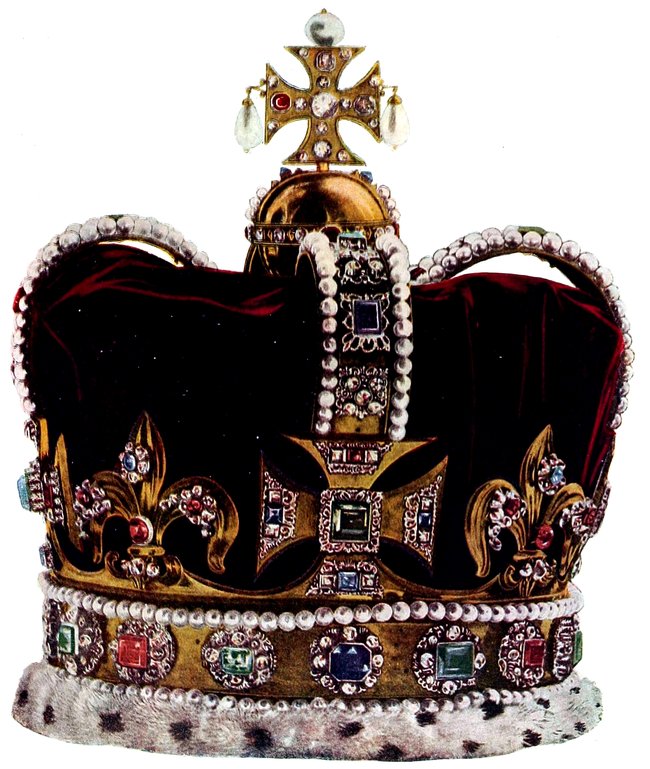
CROWN OF ST. EDWARD The official crown of England
425Dr. R. F. Scharff informs us that there is also in the Dublin Museum a modern Celtic gold brooch, presented to Queen Victoria on the occasion of her visit to Ireland in 1849, and containing a pearl of beautiful luster, discovered in Lough Esk, which is in the western part of Ireland. Dr. Scharff says that this pearl is undoubtedly from the Margaritifera margaritifera.
Mr. W. Forbes Howie of Dublin writes that the shrine of O’Donnel, made in 1084, originally contained pearls. It still retains some pieces of amber and coral. Mr. Howie believes that fresh-water pearls were freely used in the decoration of ancient Irish shrines.
The inventories of jewels and ornaments belonging to the kings and queens of France, to the nobility, and to the treasures of the Sainte-Chapelle, in Paris, and of the abbey and church of St. Denis, all mention a large number of objects decorated with pearls.[464] The more important of these are given below.
The following ornaments decorated with pearls are mentioned in the inventory of Louis, Duke of Anjou, which was made circa 1360:[465]
A large silver-gilt foot for a vase or chalice, resting upon six lions couchant, and set with groups of four pearls with a garnet in the middle.
A half girdle of gold with a hinge bearing two ornaments, one a balas set between two eagles. Between the ornaments is a gold bar set with eight pearls in two rows. In front is a clasp with a large sapphire in the middle, surrounded by two balases and two sapphires alternating with pearls.
A gold brooch having a balas-ruby in the middle, and at each side four sapphires and four clusters each of five quite large pearls.
A gold brooch of a very pretty design, with five balas-rubies, two sapphires, and eight very round pearls weighing about four carats each. At each end of the brooch is a flat pearl weighing about five carats.
There is in the Bibliothèque Nationale[466] in Paris, the original record of the execution of the testament of the Comte de Montpensier, son of 426the Duc de Berri. This document was written in 1398, and it mentions that the sale of the jewels and plate of the count produced the sum of “2390 livres tournois 11 sols 3 deniers [about $8265].” In the record we have a description of “a large gold cup, weighing 5 marcs, 7 ounces, 1 gros [nearly 3 lbs.], whereon there is a crown of precious stones.” The decoration of the cup comprised thirty large pearls, six balas-rubies, and four sapphires, and we are told that the Duc de Berri retained it for his own use.
An early mention of the use of pearls in rings occurs in the inventory of the Duc de Berri,[467] to whom we have just referred. This inventory, which was made in 1416, notes a gold ring with black enamel, set with a pearl called “the great pearl of Berri.”
The inventory of the personal property of Marguerite, Countess of Flanders, the mother of the Duke of Burgundy, was made in 1405.[468] In this inventory we have a list of an immense number of ornamental objects of every sort and kind, and everything, from the ducal crown to the smallest trinket, is garnished with pearls. In most cases the number of pearls is given, and we find that no less than 4494 are enumerated. Evidently the duchess was ever ready to honor the precious gem to which she owed her name, and fully recognized its poetical significance. The following are a few of the more noteworthy ornaments in the inventory:
The circlet of the great crown, composed of eight sections; four of which each comprise sixteen pearls, four diamonds, and four balas-rubies, with a sapphire in the center; the four others contain sixteen pearls, four diamonds, and four sapphires, with a balas-ruby in the center; beside this there are two pearls in each section. Also, eight large fleurons of the great crown, four of which bear each twenty-three pearls, five diamonds, three balas-rubies and a sapphire, and the other four each twenty-three pearls, five diamonds, four sapphires, and a balas-ruby; and eight small fleurons of the said crown garnished each with a pearl, a sapphire, and a balas-ruby. The whole is valued at 8724 florins ($22,682).
A gold cap with ten large ornaments fashioned like brooches, five of which are each of six pearls and a balas-ruby, and the other five each of five pearls and two balas-rubies, and between each ornament there is a balas-ruby. This is appraised at 2159 florins ($5613).
A head-dress garnished with balas-rubies and sapphires and tassels of large pearls, each of six pearls, and with a row of larger balas-rubies, larger sapphires and larger pearls. This was estimated at 2030 florins ($5278).
A gold necklace, enameled white and green, garnished with nine rubies, thirteen 427diamonds and thirteen pearls, with a clasp of three small rubies, and three large pearls with one large diamond in the center. The worth of this necklace is given as 1923 florins ($5000).
The jewels and ornamental objects in this inventory are appraised at the sum of 56,129 florins,—about $145,000,—equivalent to a much larger sum to-day in consideration of the greater purchasing power of money in the fifteenth century.
In 1480, during the reign of Louis XI, an inventory was made of the objects preserved in the treasury of the Sainte-Chapelle in Paris.[469] We select the following items from this inventory:
A very beautiful cross, covered with gold, bearing on one side a crystal reliquary which contained a piece of the True Cross. On supports attached to the cross were images of the Virgin Mary and of St. John, each holding a reliquary. The cross itself rested on a square silver-gilt base bearing the images of the four evangelists. The ornamentation consisted of fifty large Scotch pearls and 142 small ones, intermixed with garnets and emeralds; there were also many balas-rubies and sapphires of different sizes. The inventory says: “The goldsmith Nicholas Roet declares that the stones are genuine and that the pearls are from Scotland.”
Another gold cross, resting on a silver-gilt base which bore the arms of France and Burgundy, was decorated with fourteen sapphires, twenty balas-rubies, and twenty-four Scotch pearls. On the base were the figures of St. Louis and of the queen, kneeling in prayer.
Still another cross, covered with gold and of Venetian workmanship, bore thirty-nine pearls, twenty-seven balas-rubies, and four sapphires. A clasp attached to this cross was set with four large perforated pearls surrounded by small emeralds and sapphires.
A silver-gilt ornament, consisting of a golden image of St. Louis seated on a silver throne and holding in his hand a reliquary decorated with twelve pearls, six emeralds, and six Alexandrian rubies. The crown of the image was set with four large oriental pearls, three balas-rubies, etc.
An ivory image of the Virgin Mary, supported by a silver-gilt base with the arms of France. This base was borne by four lions. On the head of the Virgin was a crown of gold adorned with eight large, round, oriental pearls and four small ones, as well as four emeralds and four balas-rubies. On the breast of the image was a very large, square emerald.
A splendid miter studded with good-sized pearls and decorated with emeralds, rubies, sapphires, and balas-rubies. The pendants were covered with seed-pearls and precious stones.
A fine chasuble of Indian satin lined with crimson taffeta and covered with lilies, birds, unicorns, etc., embroidered in gold and pearls. It was also adorned with small clusters of pearls and with two shields bearing the arms of France and Navarre, quartered.
428A beautiful copy of the gospels with covers of gold, ornamented with fourteen large sapphires, thirteen balas-rubies, two cameos, and eighty-nine good-sized pearls.
The following items are taken from the inventory of the treasury of the abbey of St. Denis, made in 1534, during the reign of Francis I. This record is in the Bibliothèque Nationale, in Paris:[470]
A crown of gold, with four fleurons, garnished with several balas-rubies, emeralds, sapphires, and pearls; valued at 59,980 crowns (about $135,000).
A golden cross and within it a piece of the True Cross which belonged to “Jeanne d’Evreux, royne de France et de Navarre,” valued, with the pearls that decorate it, at 345 crowns ($776).
A wooden chest containing eleven cases in which were many precious stones and large and small pearls, both oriental and Scotch; valued at 1858 crowns ($4180).
A number of priestly vestments embroidered with seed-pearls are inventoried at 1200 crowns ($2700).
A blue satin chasuble bordered with pearls is valued at 350 crowns ($787).
An altar-table, set in the “grand altar,” is described as elaborately decorated with “arches and pillars and images of gold” in low relief, and garnished with precious stones and pearls. The value is given as 1203 crowns ($2700).
Another altar-table similarly ornamented is valued at 2645 crowns ($5850). Above this table was a great cross of gold with a silver border, called the “cross of St. Eloysius” (the patron saint of goldsmiths); this was valued at 2291 crowns ($5154).
Over the sarcophagus containing the body of St. Denis, there was “a large tabernacle of wood-work resembling a church, with a lofty nave and low arches.” In this nave and in the transepts there were three representations of sarcophagi; the whole was covered with gold, precious stones, and pearls, and was valued at 7275 crowns ($16,368).
The head of St. Denis, incased in gold, was borne by two silver-gilt angels, while a third held a small shrine containing a portion of the jaw-bone of the saint. All these objects were studded with precious stones and pearls, and were valued at 5622 crowns ($12,650).
There were also in the treasury several miters covered with “ounce-pearls” and decorated with gold and silver bands; on this field several larger pearls were set. One of these miters is valued at 964 crowns ($2169) and another at 509 crowns ($1135).
The total value of the articles inventoried is 185,500 crowns (at least $417,375).
Inventories of the property of the dukes of Lorraine, dated 1544, 1552, and 1614, mention a number of pearl ornaments. In the inventory 429of 1544, made about the time of the accession of Francis I of Lorraine, we read of “a very fine case of silver-gilt around which are thirteen personages in gold, and on the lock three balases and five pearls.” The inventory of 1552, made while Charles II was duke, mentions “a cap of crimson velvet whereon there are large pearls,” and another cap “entirely covered with pearls.” It is, however, in the inventory of 1614, made a few years after the accession of Henry II of Lorraine, that we find the greatest number of items relating to pearls. An estimate of the value of the rings and jewels was “faicte du commandement de son Altèze par jouailliers et Lapidaires et Espertz dudit ars.” All these jewels were to remain forever the property of the Duchy of Lorraine. Among the items relating to pearls, the following are worthy of note:
A gold collar with seven settings, each containing one large diamond and two large pearls. The diamond in the center was believed to weigh fifteen carats, and the collar was valued at 35,000 crowns (about $70,000).
Another collar contained seven diamonds and sixteen pearls set in pairs, and was considered to be worth 19,750 crowns (about $40,000).
A collection of one hundred large pearls, some weighing twenty grains, some twenty-four, some twenty-eight, and a few thirty-two grains, were estimated at 12,000 crowns ($24,000).
A large pearl, very nearly pear-shaped and almost as large as a pigeon’s egg, was set down at 2000 crowns ($4000).
A very fine pear-shaped pearl weighing forty-eight grains was valued at 800 crowns ($1600).
Another pear-shaped pearl weighing about thirty-two grains was placed at 500 crowns ($1000).
Four other pear-shaped pearls, nearly as large as the one above mentioned, were estimated at 300 crowns ($600), while a round “pearl of Seville” was valued at only fifty crowns ($100).
Six clusters of pearls, each containing two of fourteen grains, and four of eight grains, were thought to be worth 700 crowns ($1400).
A large chalice was decorated with seven large oriental emeralds and eight clusters, each composed of fourteen fine, round pearls, six of twelve grains and eight of eight grains; the whole valued at 2400 crowns ($4800).
A hat ornament composed of eleven fine rubies and ten large, round pearls, each weighing twelve grains, was estimated at 800 crowns ($1600).
A similar ornament, composed of thirteen rubies and fourteen pearls, partly flat and partly round, was placed at 2000 crowns ($4000).
A collar set with seven fine rubies and the same number of round pearls, each weighing twelve grains, and with seven other pendant pearls, was valued at 550 crowns ($1100).
There was also a bed called the “bed of pearls,” which was elaborately decorated with ornamentation in gold and richly studded with pearls.
430The inventory made in 1634 of the ornaments, etc., contained in the abbey of St. Denis, offers some new material and a fuller description of a few of the objects mentioned in the inventory of 1534. The most noteworthy entries are given below:
A golden scepter upon a staff of wood. The scepter bears the figure of Charlemagne seated upon a throne; at the corners are two lions and two eagles (one of the latter was lacking in 1634). The figure holds a scepter in its right hand, and a globe surmounted by a cross in its left; on its head is a crown with a large, round, oriental pearl valued at 200 livres ($135). The throne rested on a fleur-de-lys, beneath which was a ball of gold ornamented with eight oriental pearls. Around the throne was the inscription: “Sanctus Carolus Magnus Italia Roma Gallia Germania,” and three clusters of three pearls each. The value of this scepter was given at 3300 livres, or about $2200.
The reliquary of the hand of St. Thomas. Two angels, resting on a silver-gilt base, bore the crystal receptacle containing the relic. The ornamentation consisted of eight clusters of four large pearls each, with a small diamond in the center. On the hand was a gold band bearing the inscription: “Hic est manus beati Thomae apti. quam misit in latus domini nostri Jesu Christi.” On the hand was a pontifical ring set with a large sapphire. The reliquary also bore the images of St. John the Baptist, of St. Thomas, and of the Virgin Mary. It was valued at 5590 livres, or about $3700.
A vessel made of a porphyry resembling jasper and embellished with forty-six pearls; estimated at 1500 livres ($1000).
A cope given by Anne of Bretagne, Queen of France, and bearing six scenes from the life of the Virgin Mary embroidered in gold and pearls; the whole bordered with pearls and gold of Cyprus. On the cope were the letters A and S, and the words “plutost mourir.” There were two ounces of pearls. Valued at 2000 livres ($1350).
A vase of rock crystal, of antique workmanship, with a cover and base of silver-gilt; the top decorated with a band of amethysts, garnets, and sapphires, alternating with Scotch and oriental pearls. On the base are various precious stones and twenty-three Scotch and oriental pearls, and the inscription “Hoc vas sponsa dedit Anor. regi Ludovico.” This vase was given by Eleanor of Aquitaine to her husband, Louis VII of France (1137–1180), by whom it was bestowed upon Suger, Abbot of St. Denis (1082–1152). The goldsmith work and decoration belong to the time of Suger. The vase is now in the Louvre.
A chalice of agate, with two handles, and engraved with the figures of men, animals, and birds. It stood on a foot of gold adorned with sixteen sapphires, forty-four pearls, and twenty-two clusters of fourteen pearls each. This chalice rested upon a paten of porphyry decorated with seven fishes inlaid in gold, and with a bordering of pearls and precious stones disposed around the edge. Both together valued at 25,000 livres (about $16,000).
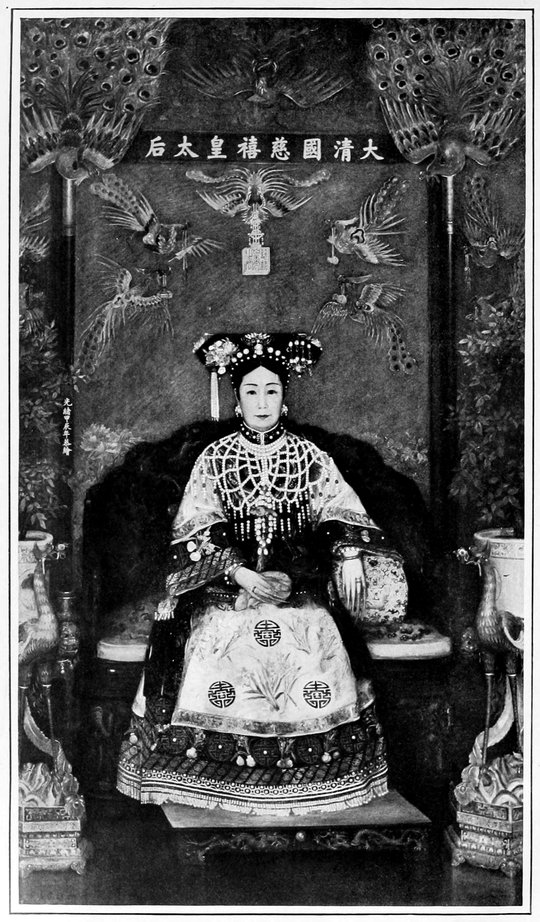
THE EMPRESS DOWAGER OF CHINA From a portrait painted by Miss Katharine A. Carl
431A vase of agate with a foot of silver-gilt, and furnished with a cover and a spout in the form of a serpent, both of silver-gilt. Around the base an inscription: “Dum libare deo gemmis debemus et auro, Hoc ego Sugerus offero vas domino” (Since we should pour libations to God out of gems and gold, I, Suger, offer this vessel to the Lord). This vase, which is now in the Louvre and is of sardonyx, was enriched with many precious stones and with nineteen Scotch and oriental pearls. The value given was 1500 livres (about $1000).
A book beginning: “Kyrie Eleison,” with covers of wood, one overlaid with gold and the other with silver. On the golden cover was an ivory crucifix, and images, in ivory, of the Virgin Mary and of St. John. The cross was bordered with seed-pearls, as were the diadems of the images. The cover was also decorated with an engraved crysolite, an engraved peridot, and with sapphires, emeralds, and garnets.[471]
A curious item regarding the use of pearls in embroidery is contained in one of the inventories of the dukes of Burgundy, made in 1414; this reads as follows:
The sum of 276 livres 7 sols 6 deniers tournois (about $960), the price of 960 pearls destined to ornament a dress; along the sleeves are embroidered the words of the song “Madame, je suis joyeulx,” and the notes are also marked along the sleeves. On each sleeve are 264 pearls which help in forming the notes of the said song, numbering 142; that is to say, a square made of four pearls for each note.[472]
Mention is made in two old French documents of the use of pearls from Compiegne in ornamentation. In the “Inventaire de la royne Clémence,” in 1328, we read of “a cock covered with precious stones and bearing a pearl of Compiègne”; and in the “Comptes Royaux,” under date of 1353, appears this item: “For four pearls, oriental, Scotch and of Compiègne, for the said arm-chair, 48 crowns.” As these pearls could not have been found in Compiègne, we may suppose that there was a market for their sale in that place, which gave rise to the designation.[473]
The English authority and writer on early English silver, F. Alfred Jones, communicated, under date of September, 1907, that pearls were rarely used in old English plate; in fact, any such embellishments were of exceedingly infrequent occurrence. They are, however, frequently mentioned in the inventory of the marvelous collection of gold plate dispersed by Charles I of England, which may have dated from the time of the looting of the churches and monasteries by Henry VIII.
The following items are from the inventories of Philip II of Spain 432and of Margarita, wife of Philip III. The original documents are in the Austrian archives.
A golden cup which came from England. Around the foot was a wreath of fifteen fleurons, each containing pearls, and also four St. Andrew’s crosses comprising eighteen pearls each. The interior of the cup showed scenes from the life of St. George and was studded with pearls, while thirty-one pearl pendants hung from the edge. 11,897 reals (about $1700).[474]
Some curious jewels, belonging to Queen Margarita, wife of Philip III of Spain, were entered in an inventory made in 1611.
An imperial eagle, full of diamonds, that came from England, with two pendants of two pearls, which could be unhooked from the said eagle and were worn by her Majesty at two masks as earrings. Valued at 77,000 reals (about $11,000).
Gold earrings, enameled in various colors, with seven diamonds in each one and three pendant pearls, two small ones of equal size and the other shaped like a pear. Valued at 1320 reals ($188).[475]
In the older Spanish jewelry pearls were frequently entirely pierced through, as if they had been worn in necklaces; and if hung as drops of one to three or more, they were strung on a wire, the upper end usually forming an ornament, and they were kept from falling off below by flattening the lower end of the wire, this flattening acting as a stop. These styles have a marked resemblance to the oriental methods elsewhere described, and suggest the derivation of the early Spanish pearl mounting from the Moorish occupation of the country. If they were set singly on any part of the jewel, they were put on a wire peg fastened to it, and then the end of the wire which projected was hammered flat to keep the pearl in place. Excellent examples of these styles are the Spanish earrings in the collection of the Hispano-American Museum of New York. The same method was used in Transylvania in the seventeenth century with remarkably artistic effect.
The pearls of the Virgin of the Rosary in the church of St. Domingo, Lima, were famous. It is believed that they were sold in the war of independence. Those of the monstrance in the sanctuary of the cathedral of Lima were sold during the last war with Chile. The monstrance of the cathedral of Cuzco still shows pearls and emeralds, but they are of small size.
A lady who left a great fortune in pearls to the church of Nazareno 433and the House of the Poor of the church of St. Peter, Lima, was Doña Maria Fernandez de Córdoba, from the family of Borda, grandmother to the minister of Peru in Washington. She was a descendant of Hernan Cortés and of Pizarro by her ancestor Carmen Cortés.
The pearls of Lima figure prominently in the history of the Peruvian families. The war of independence, which ended in 1822, was followed by the suppression of the entailed estates; this forced a division of the family fortunes, and it became necessary to sell the family jewels in Europe. Thither went all the famous pearls of the Peruvian aristocracy, whose luxury is proven by the fact that in 1780 there were in Lima no less than two thousand private carriages.
One of the most remarkable uses of Bohemian pearls was that of a large triptych owned by Count Moritz of Lobkowitz and Duke of Raudnitz. It measured six or more feet in height. The entire borders were ornamented with pearls. The center of the triptych represented the ascension of Christ on a chariot drawn by lambs. In the panel to the right was the Angel Gabriel, and to the left the Virgin Mary praying. The borders and lettering were magnificently embroidered and decorated in Bohemian pearls. This object probably dated from the sixteenth or early part of the seventeenth century. It was estimated by one of the authors to contain at least one hundred thousand pearls.
Madame Zelie Nuttal, the great Maya scholar, personally writes that pearls are not mentioned either as articles of tribute or of decoration in ancient Mexican codices; possibly a lack of fine, hard instruments with which to drill holes in pearls may have caused them to be comparatively little used in personal adornment. Neither do they appear to have been found incrusted in prehistoric objects, and we have no written evidence of their having been used in this way. We do not know of any instances of the wearing of pearls by the Indian women, but the women of the higher classes used to wear them profusely, more especially drop-earrings and pendants. Madame Nuttal also communicates as follows:
Bernadino de Sahagun states: “There are also pearls in New Spain, and they are familiar to everybody. They are named epyollotti,[476] which means the heart of the shell, because they are formed in the shell of the oyster.” In Molina’s dictionary “seed-pearls” are named “piciltic epyollotti,” which means “water-stars,” a poetical name, composed of the word a = att = water, and cittallin = star. The latter name leads us to infer the possibility that the “star-skirt, or skirt of, or with stars,” the “cittallin icue” of the living image of the goddess “Tlamateculitti” was decorated with pearls, although it is only described (Book II, chap. 36) as being “of leather, cut into strips at the bottom (forming a fringe), at the end of each of which hung a small shell named 434‘cueclitti’ which reproduced a sound when she walked.” As it is stated that this “star-skirt” was worn over “a white one” it seems as though it must have been of the kind, represented in codices and sculptures, made of openwork and netlike, and studded with round objects—possibly pearls—at the crossings or in the centers of the open spaces.
Oil-paintings of the madonnas represent them with robes richly embroidered with pearls, and wearing “ropes of pearls.” The Virgin of the Rosario, in the church at Santo Domingo, Mexico, was noted for her pearls, and there is a small oil-painting of this virgin, in which she is depicted with a wealth of pearls.
In the Bohemian National Exposition, held at Prague in 1891, Count Schwarzenberg exhibited four embroideries, each fourteen by eight inches. They were embroidered with Bohemian pearls found on his domains a century or more previous, and contained many thousands of pearls.
In Hungary pearls have always been the favorite jewels, especially among the aristocracy, and they have served to adorn the national costume of both men and women. A century ago nearly every family of distinction owned a necklace, but most of the pearls were small and of indifferent quality. Since that time fine pearls have become more usual, and many wealthy Hungarian families have acquired beautiful pearls of good size and excellent quality, and many splendid necklaces can now be seen in Hungary. The following are some of the finest:
A necklace of three large rows, owned by the Archduke Joseph and valued at one million francs.
A still larger necklace in the possession of Prince Nicholas Esterhazy; this, however, is an entailed heirloom, and may not be parted with without the king’s permission.
A very fine necklace of five rows, also an entailed heirloom, owned by Count Maurice Esterhazy.
A large necklace, possessed by Countess Alois Karoly, wife of the late ambassador in London. This is another entailed heirloom; its value is at least a million and a half francs.
An unusually large necklace of four rows, such as one rarely sees, owned by the Countess Wenkheim. The pearls are white, and have a good shape, but not much brilliancy. The average size of these pearls is approximately twenty-four grains.
An equally large necklace consisting of a single row, averaging twenty-six grains, in the possession of Countess Louis Batthyani.
There are a great many other necklaces of fine quality, worth from 300,000 francs down to 100,000 francs, belonging to families such as those of Count Joseph Hunyadi, Countess Festetics-Hamilton, Count Landor Nako, Peer Leo Lanczi, Count Albert Apponyi, Mr. Eugene Dreher, Madame Emma de Bachrach, etc., etc. Indeed, almost every wealthy family of the better class owns a necklace worth up to 100,000 francs and over.
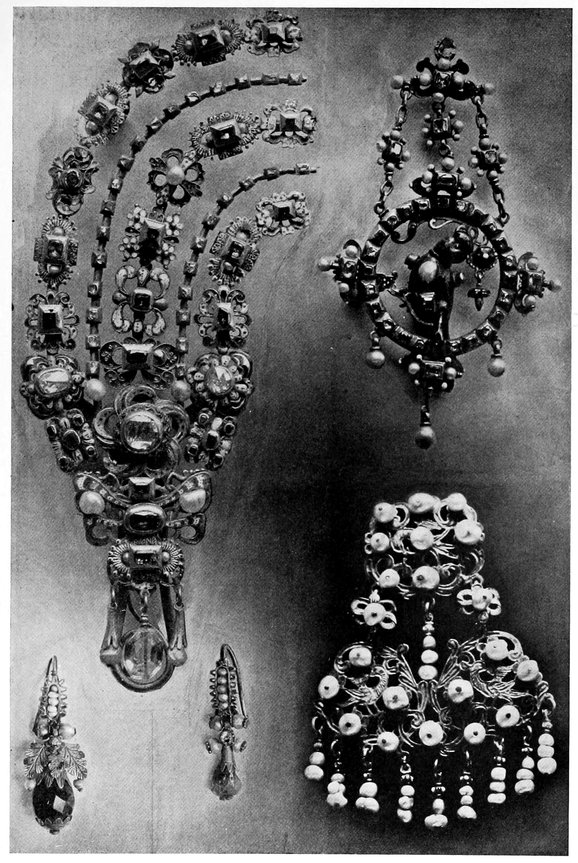
PEARL ORNAMENTS OF THE SEVENTEENTH AND EIGHTEENTH CENTURIES
Hungarian Aigret Earring, Hungary
Earrings, Nijni-Novgorod Spanish earring
435The portraits of the fifteenth, sixteenth, and seventeenth centuries afford us many interesting evidences regarding the various forms of jewelry in which pearls were used. Indeed, had we no other records, these pictures alone would prove the great popularity of the gem as an ornament.
In the finely executed portrait of the Duchess Anne de France, she wears a coronet with three pearls at each point. It seems to be made up of three large pearls, set on a row of pearls circling the entire top of her head, beneath which is a row of great emeralds, and then another row of pearls. Flaring downward and entirely covering the side of her head near the ear, are two rows of pearls with a row of fine emeralds between them, the rows of pearls deflecting slightly downward until the chin line is reached, and then turning back and slightly upward, meeting at the back. As in the crown cap, the same severe decoration in pearls is the main feature, and is repeated on each side of the robe, the front of which is of ermine. Beginning on a line with the shoulder is a broad band of pearls and emeralds set in gold which extends below her waist. At the top of this are six pearls set in a straight line. Then from the end of this line, dropping straight down, is a row on each side. Between the two rows is a gem, then two great pearls and another gem, then two more pearls, this being repeated to below the waist. The ermine is held at her waist by a trefoil reversed; that is, two pearls above and one below a great gem, and then a trefoil reversed below this. This portrait is dated 1498 and is on a triptych in the cathedral of Moulins.
Quite unique is the pearl decoration in a picture of St. Barbara, painted by an artist of the French school, and dated 1520, which is in the National Museum of Budapest. This artist uses pearls with the utmost severity of taste and richness. Beginning a trifle above the center of her forehead is an emerald ornament, and on each side there extend to the back of her head three rows of pearls, not placed exactly one row above the other, but the rows intertwined with each other. The whole is enriched by a great string of pearls about her neck. The effect produced is extremely artistic and beautiful.
Catharine de’ Medici wore two rows of pearls on her bonnet, and a quaint necklace in sections of two rows of four pearls, with a large pearl between; a pear-shaped pendant on a Renaissance jewel; a row of pearls around her low-cut bodice, and a girdle of jewels alternating with pearls, which extended to the lower end of her gown. In addition to all this, she wore a bracelet of jewels with a pearl set between each 436ornament. This artistic combination is best shown in her portrait in the Uffizi, Florence (No. 726), painted by an unknown artist.
One of the most unique, rich, and chic collections of pearls, and one worn with unusual grace, is that of the Infanta Isabella Clara Eugenia, shown in the fine portrait of her by Coello Sanchez. In this portrait her hat shows the plumes embroidered with slanting rows of three, four, and five pearls. In the center of the hat is an ornament shaped like a flower, with seven large pearl petals surrounding a great pearl center. The hat is tilted to one side showing her hair on the left, while a little to the right of the center of her forehead, and touching it, there hangs from her hair a great pear-shaped pearl, which adds a wonderful amount of character to the jeweling of her head. Around her neck is a high fluted ruff; below which is a collar of large gems relieved by an ornament of two pearls placed between each gem. The same interesting motive is carried out in a girdle of gems which comes down very low to her waist, terminating in a large jeweled heart ornament. The painting shows sixteen remarkable pearls in the collar, and thirty-six pearls in the jeweled girdle.
A very interesting collection of portraits was exhibited last spring (1907) at the Bibliothèque Nationale in Paris. The pictures are contained, in some instances, in old illuminated manuscripts, while in others they are contemporary crayon sketches. Many pearl decorations are represented, and we give a few of the most important.
The portrait of Anne de Bretagne (1476–1514), wife of Louis XII, from the “Heures d’Anne de Bretagne,” illuminated by Jean Bourdichon, represents the queen kneeling; she wears a collar ornamented with groups of four pearls alternating with precious stones.
A crayon sketch of Françoise de Foix, Comtesse de Châteaubriant (1490–1537), who became the mistress of Francis I, shows her wearing a hood or coif ornamented with forty oval pearls. She also wears a necklace of sixty fine round pearls.
Diane de Poitiers (1499–1566), granddaughter of Charles VII and Agnes Sorel, is represented with a head-dress similar to that worn by the Comtesse de Châteaubriant . It has a border of sixty round pearls. This crayon is of the time of Jean Clouet.
A portrait of Philip Strozzi (1541–1582) who, although an Italian, had the rank of colonel-général in the French army, is interesting as an illustration of the wearing of earrings by the men of this period. The fine round pearl which hangs from his ear strikes us now as a curious ornament for a warrior.
A crayon sketch of Gabrielle d’Estrées (d. 1599), mistress of Henri IV, is attributed to the hand of Daniel Dumonstier. Here may be seen a splendid pearl necklace, which apparently consists of six sections, each comprising three rows of eight round pearls, the sections being connected with each other by a large oval pearl. The necklace, which hangs down over the bosom, is fastened 437by a clasp in the form of a four-leaved clover, from which depend two other sections similar to those described above, and terminating in an oval pearl pendant.
The portrait of the Duchesse de Montpensier (1627–1693), the “Grande Mademoiselle” of Mme. de Sévigné’s letters, is from the “Maximes de nostre salut,” dedicated to the duchess by the author, M. de la Serre, and is attributed to Nicolas Jarry. It represents the duchess wearing a beautiful necklace of round pearls and a large pear-shaped pearl earring, while another pear-shaped pearl depends from a clasp which serves to loop up her fichu on the shoulder.
A fine example of the Renaissance style existing in the sixteenth century is that of a gold and enamel necklace of Italian workmanship, embellished with pearls. This necklace was presented to the Louvre Museum by Don A. de Rotschildt. The two-pearl motive is carried out exquisitely, two pearls appearing in a small connecting ornament between two larger enameled and engraved gold plaques, which represent scenes from the life of our Saviour.