VI THE PEARL FISHERIES OF THE PERSIAN GULF (continued 2)
Reading edition
The prices in different seasons vary greatly. In 1860, the average was Rs.134.23 per 1000, which was unprecedentedly large; the nearest to this was Rs.79.07 in 1874 and Rs.49 in 1905. In 1880, the average price per 1000 was only Rs.11, which was the lowest ever recorded. The records for individual days greatly exceed these limits. The highest figures at which oysters have sold on any one day was Rs.309 per 1000 in 1906, the equivalent for each oyster of 10½ cents in American money. In 1874, the price reached Rs.210 per 1000, and in 1905, the maximum price was Rs.124, or about 4¼ cents for each oyster.
The oyster-buyers are principally wealthy Chetties from Madura, Ramnad, Trichinopoli, Parambakudi, Tevakoddai, Paumben, Kumbhakonam, and other towns of southern India. These are quite different from the scantily clothed Naddukoddai Chetties so common in Ceylon. Many of them are fashionably dressed in semi-European 122costume, with walking-stick, patent leather boots, and other evidences of contact with Europe. Smaller quantities of oysters are purchased by Moormen of Kilakarai, Ramnad, Bombay, Adrampatam, Tondi, etc. A few oysters are also purchased by the Nadans or Chánár caste people of Perunali, Kamuti, and Karakal. Over 99 per cent. of the 50,346,601 oysters sold by the government in 1905 were secured by Indian buyers, and less than one per cent. by Cingalese. A few of the oysters—from two to five per cent.—are sent to Indian and Ceylon ports, but most of them are opened at the fishing camp.
The purchaser of only a small number of oysters may open them at once by means of a knife, and with his fingers and eyes search for the pearls. By this method very small pearls may be easily overlooked, and it is scarcely practicable in handling large quantities of oysters. These are removed to private inclosures known as toddis or tottis, situated some distance from the inhabited portions of the camp; where, exposed to the solar heat, they are permitted to putrefy, and the fleshy parts to be eaten by the swarms of big red-eyed bluebottle flies, and the residue is then repeatedly washed.
Shakspere may have had in view some such scene as this when he spoke of the “pearl in your foul oyster.” The lady who cherishes and adorns herself with a necklace of Ceylon pearls would be horrified were she to see and especially to smell the putrid mass from which her lustrous gems are evolved. The great quantity of repulsive bluebottle flies are so essential to success in releasing the pearls from the flesh, that a scarcity of them is looked upon as a misfortune to the merchants. However, except it may be at the beginning of a fishery, there is rarely ever a cause for complaint on this score, for commonly they are so numerous as to be a great plague to persons unaccustomed to them, covering everything, and rendering eating and drinking a difficult and unpleasant necessity, until darkness puts a stop to their activities. But the intolerable stench, impossible of description, the quintessence of millions of rotting oysters, fills the place, and makes existence a burden to those who have not acquired odor-proof nostrils. This animal decomposition seems almost harmless to health; indeed, the natives evidently thrive on it, and eat and sleep without apparent notice of the nauseous conditions. And yet vegetable decomposition in this region is usually followed by fatal results. Notwithstanding sanitary precautions and the usual quarantine camp and hospitals, cholera occasionally becomes epidemic and puts a stop to the fishery, as was the case in 1889; but this probably was due more to the violation of ordinary sanitary laws than to the decaying oysters.
In a large toddi the oysters are placed in a ballam, or a dug-out tank or trough, fifteen or twenty feet long and two or three feet deep, 123smooth on the inside so that pearls may not lodge in the crevices. This tank is covered with matting, and the toddi is closed up, sealed, and guarded for a week or ten days, when the fly maggots will have consumed practically all of the flesh tissues, leaving little else than the shells and pearls. The tank is then filled with sea water to float out the myriads of maggots. Several nude coolies squat along the sides to wash and remove the shells. The valves of each shell are separated, the outsides rubbed together to remove all lodgments for pearls, and the interior examined for attached or encysted pearls. The washers are kept under constant supervision by inspectors to prevent concealment of pearls; they are not permitted to remove their hands from the water except to take out the shells, and under no circumstances are they allowed to carry the hands to the mouth or to any other place in which pearls could be concealed.
After the shells have been removed, fresh supplies of water are added to wash the debris, which is turned over and over repeatedly, the dirty water being bailed out through sieves to prevent the loss of pearls. After thorough washings, every particle of the sarraku, or material at the bottom of the ballam, consisting of sand, broken pieces of shell, pearls, etc., is gathered up in a cotton cloth. Later the sarraku is spread out on cloths in the sun to dry, and the most conspicuous pearls are removed. When dry, the material is critically examined over and over again, and winnowed and rewinnowed, and after it seems that everything of value has been secured, the refuse is turned over to women and children, whose keen eyes and deft fingers pick out many masi-tul or dust-pearls; and even after the skill of these has been exhausted, the apparently worthless refuse has a market value among persons whose patience and skill meets with some reward. It is due largely to the extreme care in the search that so many seed-pearls are found in Ceylon.
And this leads to a discussion of what is commonly known in Ceylon as the “Dixon washing machine.” This is an invention of Mr. G. G. Dixon who constructed it at Marichchikadde in 1904 and 1905, at a total cost to the government of about Rs.162,000,[154] including all expenses incidental to the experiment. The machine involves two separate processes; the first consists in separating the shells from the soft portion of the oysters, and the second in recovering the pearls from the resultant sarraku after it has been dried. In 1905, about 5,000,000 oysters were put through this machine,[155] but with what result has not been announced.
The shells having pearls attached to the interior surface are turned 124over to skilled natives, who remove the valuable objects by breaking the shell with hammers, and then with files and other implements remove the irregular pieces of attached shell and otherwise improve the appearance.
In no fishery in the world is the average size of the pearls secured smaller, nor is the relative number greater than in that of Ceylon. It is rare that one is found weighing over ten grains, and the number weighing less than two grains is remarkable. For roundness and orient they are unsurpassed by those of any region. However, Ceylon pearls worth locally Rs.1000 ($400) are by no means abundant. The most valuable one found in the important fishery of 1904, is said to have been sold in the camp for Rs.2500. The fishery of 1905 yielded one weighing 76½ chevu, and valued at Rs.12,000.
The quantity of seed-pearls obtained in the Ceylon fishery exceeds that of any other—probably all other parts of the world. The very smallest—the masi-tul,—for which there is no use whatever in Europe, have an established value in India, being powdered for making chunam for chewing with betel. Those slightly larger,—tul pearls—for which also there is no market in Europe, are placed in the mouth of deceased Hindus of wealth, instead of the rice which is used by poorer people.
The great bulk of the Ceylon pearls are silvery white in color, but occasionally yellowish, pinkish, and even “black” pearls are found, although the so-called “black” pearls are really brown or slate-colored. In some seasons these are relatively numerous, as in 1887, for instance.
Notwithstanding the large product at the fishery camp, it is difficult to purchase single pearls or small quantities there at a reasonable price, the merchants objecting to breaking a mudichchu, or the lot resulting from washing a definite number of oysters.
The shells obtained in the Ceylon fisheries do not possess sufficient thickness of lustrous nacre for use as mother-of-pearl, and are mostly used for camp-filling. A few are burned and converted into chunam, i.e.: prepared lime for building purposes, or to be used by natives for chewing with the betel-nut. Forty or fifty years ago, before the large receipts of mother-of-pearl from Australia and the southern Pacific, there was a good market for the shell for button manufacture and the like, but since 1875 only the choicest have been used for this purpose, and these are worth only about $25 per ton delivered in Europe.
It will be observed that up to the close of the season of 1906, the Ceylon fisheries were operated by the colonial government as a state monopoly. In 1904, proposals were made to the British colonial office by a London syndicate with a view to leasing the fisheries for a term 125of years. The original suggestion was that they should be leased for thirty years in consideration of an annual rental of £13,000 or Rs.195,000, together with a share of the net profits after payment of a reasonable rate of interest on the investment; and later it was suggested that the rental be Rs.100,000 a year and twenty per cent. of the profits after seven per cent. on capital had been paid to the shareholders. But the government preferred a definite money payment without any rights to share in the profits realized; and after lengthy negotiations this was fixed at Rs.310,000 annually, with certain preliminary payments. Accordingly, on November 30, 1905, a preliminary agreement was executed between the crown agents for the colonies, acting on behalf of the government of Ceylon, and representatives of the Ceylon Company of Pearl Fishers, Limited. On February 27, 1906, this agreement was confirmed and made effective by special ordinance[156] of the governor and legislative council of Ceylon, and the crown agents were authorized to execute the lease as of January 1, 1906.
The principal financial terms of this lease required the company to purchase the expensive Dixon pearl-washing machine at a cost of Rs.120,000, which was Rs.42,000 less than it cost the government during the preceding two years; to purchase at a cost of Rs.62,501 the steamship Violet, which the government had used in its experimental oyster-culture; to reimburse the government each year the amount spent in policing, sanitation and hospital services at the fishery camp, which had in some individual seasons amounted to more than Rs.200,000; to expend each year from Rs.50,000 to Rs.150,000 in the development of pearl-oyster culture; and to pay an annual rental of Rs.315,000, a rate based roughly on the average return of the preceding twenty years, including the record year of 1905.
The company was authorized to take up the pearl-oysters by means of divers, or by steam dredges, or by such other mechanical means as might appear most advantageous, and to carry on such experiments with the immature oysters as appeared most conducive to the profitable working of the fisheries, provided they do nothing to make the resources less valuable at the expiration of the lease.
One of the most interesting features of the lease is that relating to the power of the colonial government to grant an exclusive right of fishing on the banks outside the three-mile limit. The question of this exclusive right arose in 1890, but was not conclusively determined. Fearing lest this authority did not exist, the terms in which the right of fishing was conveyed were carefully chosen by the attorney general to protect the government from liability “should any international 126question arise”;[157] and the government leased to the company “all the right or privilege which the lessors have hereto exercised and enjoyed of fishing for and taking pearl-oysters on the coasts of Ceylon between Talaimannar and Dutch Bay Point, to the intent that the company so far as the lessors can secure the same may have the exclusive right, liberty and authority to fish for, take and carry away pearl-oysters within the said limits.... But nothing in this lease shall be taken to make the lessors answerable in damages if owing to any cause beyond the control of the lessors the company is prevented from fully exercising and enjoying such exclusive right and privilege.”[158]
In the meantime, while the negotiations were in progress, there occurred the very profitable fishery of 1905, from which the colonial government derived a revenue of Rs.2,510,727, or approximately eight times the proposed annual rental; and before the lease was finally concluded occurred the fishery of 1906, with its revenue of Rs.1,376,746. While it is true that a succession of barren seasons prevailed from 1892 to 1902, yet, as the revenue in 1903 was Rs.829,548, and in 1904 it was Rs.1,065,751, there was, in the four years ending in 1906, a revenue to the government of Rs.5,782,772, or nearly as much as the total amount to be derived from the lease during the twenty years it was to run. These figures seemed to furnish strong reasons for retaining such a valuable source of revenue, with its possibilities of still greater expansion under the supervision and direction of specialists in the employ of the government.
Many of the inhabitants of Ceylon saw in this a decided objection to the lease, and there was a general feeling of indignation in the colony, with public meetings in protest, and the like. In reply to a memorial prepared at one of these meetings held in Colombo, Lord Elgin, the British secretary of state for the colonies, wrote under date of May 9, 1906:
The memorialists have protested against the lease on the double ground that a lease on any terms is contrary to the best interests of Ceylon, and that the rent agreed upon is “under existing circumstances wholly inadequate.” There must always be in cases of this kind a difference of opinion as to whether a fixed annual sum, with immunity from all expense and sundry other advantages, is or is not preferable to continuing to face all the risks for the sake of all the profits. In the present instance the lease appears to me to have been drafted with a sincere desire to safeguard to the utmost the property and interests of the Colony.
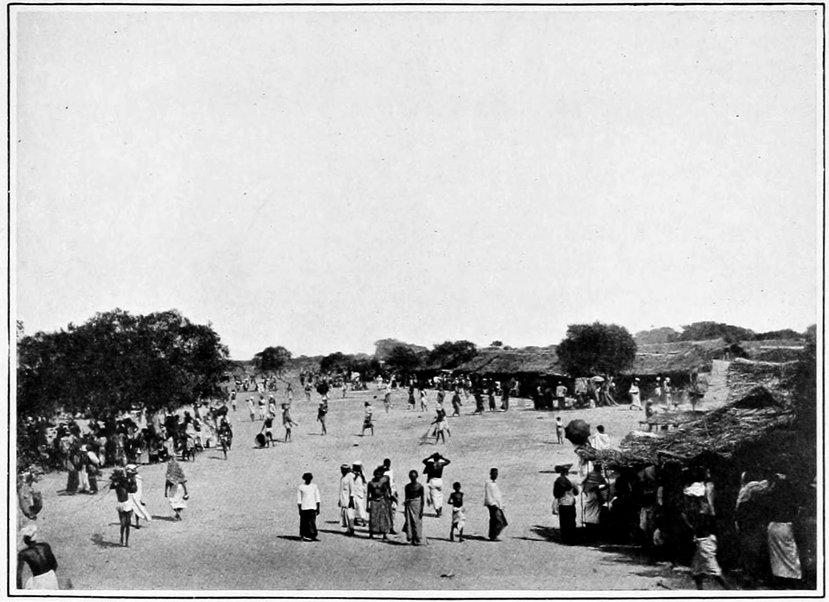
Street scene in Marichchikadde, the pearling camp of Ceylon
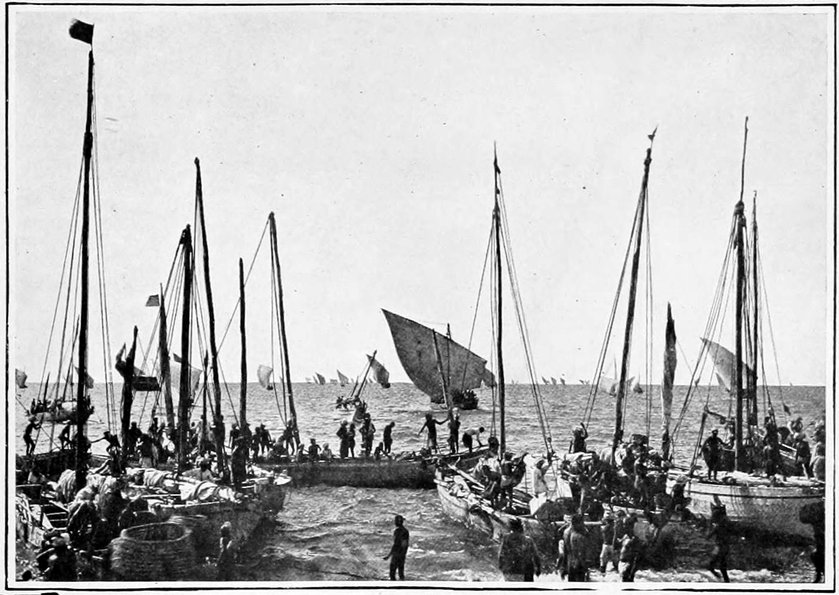
Return of the fleet from the pearl reefs to Marichchikadde, Ceylon
127It may be true that the development of the fishery upon a scientific system affords good prospect of a greater return in the future than has been obtained in the past, and affords at least the hope that the barren cycles which have been so common in the past will not recur to the same extent. But the operations necessary to that end are of a highly technical and experimental character, and I am very doubtful whether any machinery which could be set in motion by the Government would be suited to develop processes at once so doubtful and so delicate. In twenty years’ time the Colonial Government will receive back the fishery, not only intact, but in the most perfect state to which commercial enterprise and scientific methods can raise it, and, in the meanwhile, a regular and substantial payment is assured. Twenty years are no doubt a considerable period in the lifetime of individuals; but if within that time all the resources that science can contribute toward systematic development of the fisheries have been applied and thoroughly tested, the period will not, I think, be regarded as excessive or unfortunate in the history of a fishery which has lasted for more than two thousand years.[159]
The Ceylon Company of Pearl Fishers, Limited, with a paid up capital of £165,000, has just entered into possession of its lease, and it is uncertain what changes will be made in the methods of the fishery or what measure of success will follow the attempts at pearl-oyster culture and the growth of pearls. The attention of the pearling interests of the world is now directed to the work of this company in the development of its magnificent leasehold, and it seems not unlikely that greater changes will be made in the methods of the industry during the ensuing decade than have occurred in the whole of the last ten centuries.[160]
A curious fishery, with the Placuna placenta for its object, exists in Tablegram Lake, a small bay in northeastern Ceylon adjacent to the magnificent harbor of Trincomali, which Nelson declared to be “the finest in the world.” At intervals during the nineteenth century, the Ceylon government leased the Tablegram Lake fishery to native bidders for a period of three consecutive years. In 1857, Dr. Kelaart visited the place and calculated that in the three years preceding, eighteen million oysters had been removed.[161] Owing to scarcity of the mollusk, no fisheries have existed since 1890, but from 1882 to 1890 they were regularly leased at an average of Rs.5000 for each term of three years. Prof. James Hornell, who made a careful examination in 1905, reported that if the business were carried on providently and systematically, “it should become the source of a fairly regular annual revenue to Government of from Rs.10,000 to Rs.12,000, possibly even more.”[162]
128The Placuna oysters are caught by Moormen divers, who are scarcely equal physically to the pearl fishery in the sea. They rarely descend more than four fathoms, and most of the work in Tablegram Bay is in less than two fathoms. Each diver returns with from one to five or more oysters, depending on their abundance, and receives one half of the catch as his share of the proceeds. Unlike the method in the pearl-oyster fishery of Ceylon, the Placuna oysters are opened while fresh, this work being performed by coolies, who are compensated at the rate of about Rs.3 per 1000.
THE PEARL FISHERIES OF INDIA
There are two moments in a diver’s life:
One, when a beggar, he prepares to plunge;
Then, when a prince, he rises with his prize.
Robert Browning.
Notwithstanding the great fame of the pearl fisheries of India, those prosecuted within the limits of British India proper are of small extent. The only pearl resources within the empire are the rarely productive reefs on the Madras coast in the vicinity of Tuticorin, the relatively modern fisheries of Mergui Archipelago, and some small reefs of only local importance on the Malabar coast and in the Bombay presidency.
The celebrity of India in connection with the pearl fisheries has never rested on the extent of those within the territorial limits or under the control of this government. It originated in the fact that it is largely Indian capital which finances the fisheries of Ceylon and of the Persian Gulf; nearly all of the divers and others employed in Ceylon are from the coast of this empire, and most of the pearls are purchased by merchants of Bombay, Madura, Trichinopoli, and other large towns. Thus, from an economic and industrial point of view, the pearl fisheries of Ceylon, and to a less extent those of the Persian Gulf, have contributed to the fame and to the wealth of the Empire of India.
The pearl fisheries off Tuticorin in the Madras presidency have been referred to incidentally in the account of the fisheries of Ceylon. They are separated by only a few miles of water, and are prosecuted by the same fishermen and in precisely the same manner. Consequently, it is difficult to discuss them separately, especially in their early history and during the time that this part of the world was under the rule of the Portuguese and later of the Dutch.
129
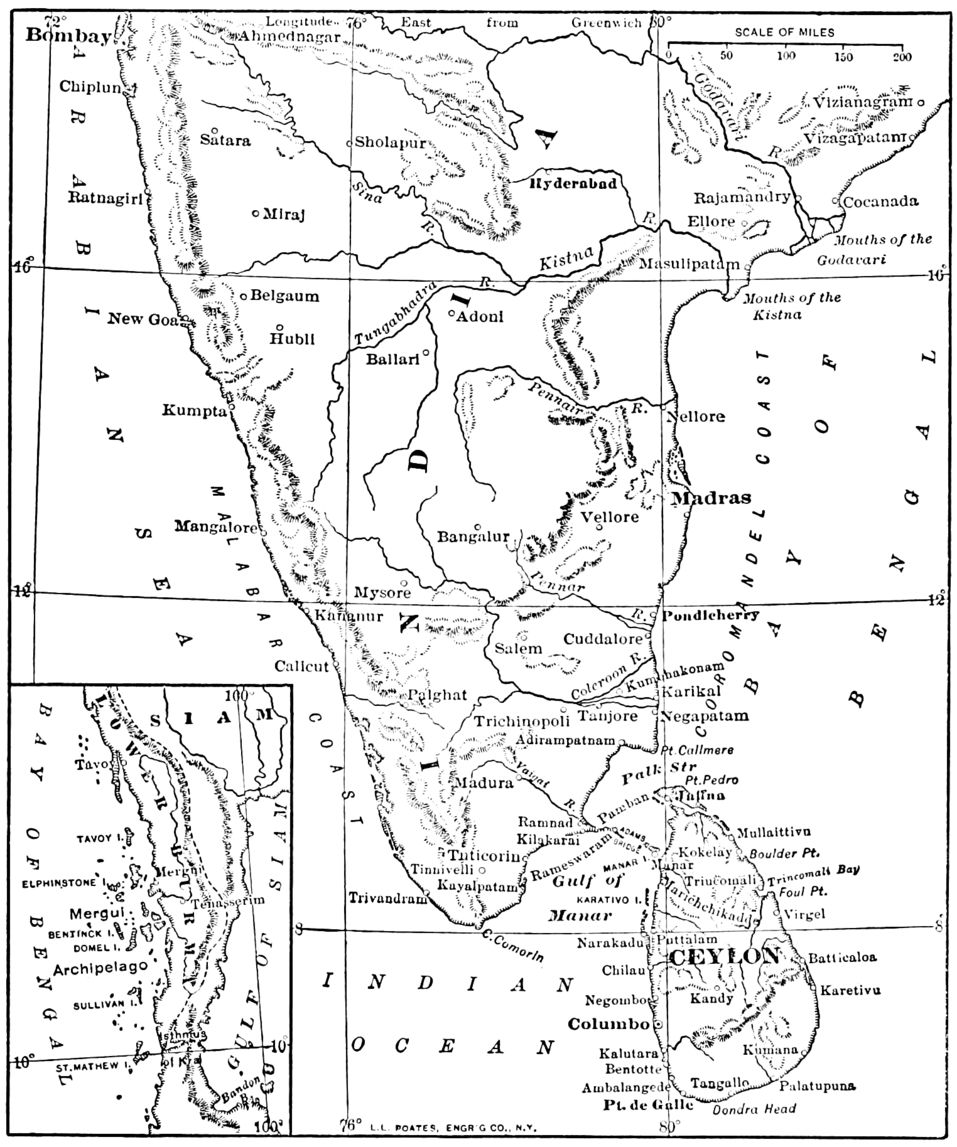
The pearling regions in Ceylon and British India
The fisheries of the Madras coast compete in antiquity with those of Ceylon. Indeed, from the time of Ptolemy to the seventeenth century, the industry seems to have been prosecuted largely from the Madras side of the gulf, centering at Chayl or Coil on the sandy promontory of Ramnad. This place appears to be the Κόλχοι of Ptolemy, the Ramana Koil of the natives, as well as the Cael of the travelers of the Middle Ages. But during the last three hundred years, the 130Ceylon side has been the scene of the greatest pearling operations; and from the Madras coast, the fisheries have not been prosecuted except at long intervals, averaging once in fifteen or twenty years.
Owing to the scarcity of oysters and to other causes, the fishery was prosecuted on the Madras coast in only eight years of the whole period from 1768 to 1907. These years of productivity were 1822, 1830, 1860, 1861, 1882, 1889, 1890, and 1900; and even then the yield was relatively small. The largest was 15,874,500 oysters in 1860, from which the Madras government derived a revenue of Rs.250,276; and about half as many oysters were obtained in 1861 with a revenue of Rs.129,003. Numerous and prolonged experiments in conserving the reefs and in cultivating the oysters have been made without success. The reason usually given for the greater wealth of oysters on the Ceylon side is, that it is more sheltered from the strong currents which sweep down the Bay of Bengal into the Gulf of Manaar and impinge directly on the coast of the mainland.
The headquarters of the fishery are at Tuticorin, near to Madura, the Benares of the south, the holy “City of Sweetness” which the gods have delighted to honor from time immemorial. But the camp is commonly erected of palmyra and bamboo on the barren shore several miles distant from Tuticorin. The 1890 fishery was at Salápatturai, and that of 1900 at a place which received the mouth-filling name of Veerapandianpatanam.
The preparations for pearling at Tuticorin are similar to those on the Ceylon coast. In the autumn the reefs are examined by government inspectors, and if the conditions seem to warrant a fishery in the following spring, arrangements are made therefor and the proper notification issued. The announcement follows the general plan of that in Ceylon. The following, from the Fort St. George “Gazette,” Madras, January 16, 1900, is a copy of the notification preceding the last fishery which has occurred:
Notice is hereby given that a pearl fishery will take place at Veerapandianpatanam on or about the 12th March, 1900.
1. The bank to be fished is the Theradipulipudithapar, estimated to employ 100 boats for twenty days with average loads of 7,000 oysters per day.
2. It is therefore recommended that such boat owners and divers as may wish to be employed shall be at Tuticorin on or before the 1st of March next and anchor their boats abreast of the government flagstaff; the first day’s fishing will take place on the 12th of March, weather permitting.
3. The fishery will be conducted on account of Government, and the oysters put up for sale in such lots as may be deemed expedient.
4. The arrangements of the fishery will be the same as have been usual on similar occasions.
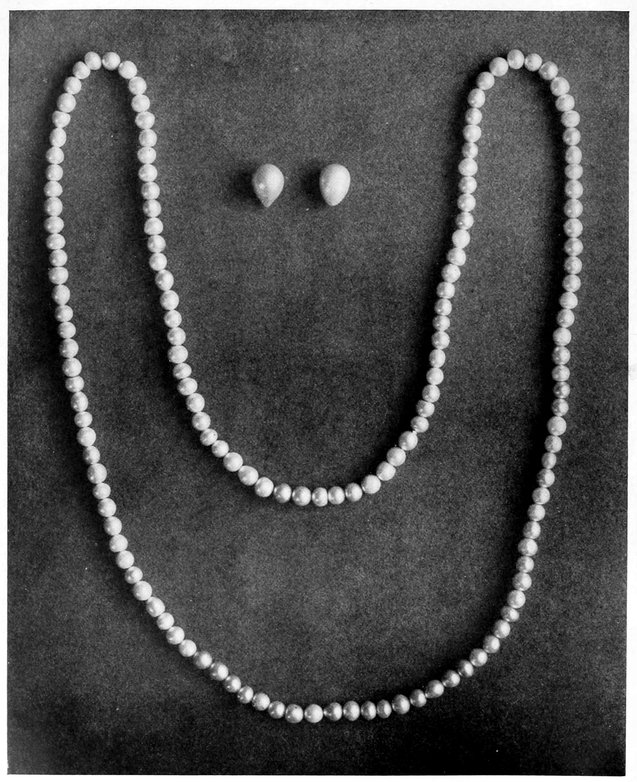
PEARLS PRESENTED BY THE IMAM OF MUSCAT TO PRESIDENT VAN BUREN Now in the United States National Museum, Washington, D. C.
1315. Payments to be made in ready money in rupees or in Government of India notes. Checks on the Bank of Madras or Bank Agencies will be received on letters of credit being produced to warrant the drawing of such checks.
6. All particulars can be obtained on application to the Superintendent of Pearl Fisheries, Tuticorin.
Sd/—J. P. Bedford,
Collector.
Tinnevelly Collector’s Office,
16th November 1899.
On the long sweep of desolate shore at a place convenient to the reefs, a temporary camp is erected, just as is done on the Ceylon coast. However, this camp is not nearly so large, only about one fourth or one fifth the size of that on the eastern side of the gulf. It resembles the larger one in the quarters for divers and merchants, the bazaars, the bungalows for the officials, the hospital, the sale and washing inclosures, etc.; in addition to these is the temporary Roman Catholic chapel.
The divers are mainly of the Parawa caste from Tuticorin, Pinnacoil, Pamban, etc. on the Madras coast. Although influenced by many Hindu superstitions, they are nominally Roman Catholics, as evidenced by the scapulars suspended from the neck, their ancestors having been converted and baptized through the zealous work of that prince of missionaries, St. Francis Xavier, in the sixteenth century. Even yet a chapel at Pinnacoil is held in special reverence by these people as a place where the saintly father preached. Professor Hornell writes that the present hereditary head of this caste is Don Gabriel de Croos Lazarus Motha Vaz, known officially as the Jati Talaiva More, or Jati Talaivan. He resides at Tuticorin, and is largely the intermediary between the government and the Parawa fishermen.
In the details of its prosecution, the Madras fishery differs in no important particular from that of Ceylon. The boats are manned and operated in precisely the same way; they fish in the morning only, taking advantage of the prevailing favorable winds; the divers carry the oysters into the government inclosure, and divide them into three equal lots, of which they receive one; the share of the government is auctioned daily, the divers disposing of theirs as they choose; and the oysters are rotted and washed in the same manner as in Ceylon.
In addition to the fishery for pearl-oysters at Tuticorin, two other species of pearl-producing mollusks are collected in the Madras presidency; one of these is a species of mussel (Mytilus smaragdinus, according to Dr. Edgar Thurston of the Madras Museum), which is collected from the estuary of the Sonnapore River near Berhampore; 132and the other is the Placuna placenta, found in many places in this presidency, and especially in Pulicat Lake and in the vicinity of Tuticorin.
The Sonnapore mussels, which are small and bright green in color, are found adhering to the masses of edible oysters in depths of ten or twelve feet of water. They are caught in a novel manner, as described in a letter from the acting collector of customs at Ganjam. Thrusting a long bamboo pole deep into the bottom of the reef, the fisherman dives down, and holding on to this bamboo, breaks off as large a mass of the oysters as he can bring to the surface in one hand, helping himself up the bamboo pole with the other. Removing the mussels from the mass, he opens them with a suitable knife and by running his thumbs and fingers over the flesh tissues, detects the pearls therein. These pearls are of very inferior quality and of little ornamental value. They are sold mostly for chunám and for placing in the mouth of deceased Hindus.
Along the west coast of India, in the Bombay presidency, a few pearls are found at various places, but the output is of slight value. The most important of these is off the coast of Nawanagar, on the south side of the Gulf of Cutch, where the true pearl-oyster is found.
According to the “Jamnagar Diwan,” the yearly value of the Nawanagar fisheries is about Rs.4000. This is smaller than formerly, as the reefs are in a depleted state; to give them a chance to recuperate, a close season was established in 1905. The oysters are found along a coast-line eighty miles in length extending from Mangra, near Jodya Bunder, to Pindera in the Gulf of Cutch, and also about the islands of Ajad, Chauk, Kalumbar, and Nora, which are also situated in the Cutch Gulf. They are not procured by diving, but are gathered off the rocks when the tide is out. During the monsoon, the collection is limited to eight days in the month; i.e., from the twelfth to the fifteenth of each half according to the Hindu calendar.
The fisheries are by law restricted exclusively to the waghers of ten villages, which are Varinar, Sashana, Sika, Balachedi, Jhakher, Sarmat, Bharana, Salaya, Chudesar, and Bedi. The collection of the pearls is left entirely to these men, who at Divala—the Hindu new year—bring all the pearls gathered by them to the durbar. There an estimate is made of their value, one fourth of which is paid to the waghers, and the pearls are turned over to the representatives of the state treasury for sale. This method of conducting the industry has been long established. In recent years the government experimented in farming out the revenue, but the old custom has been resumed in order to placate the native fishermen.
A few pearl-oysters are also found on the Ratnagiri coast below 133Bombay, and likewise at Kananur in the Malabar district. In 1901–1902, there was some local excitement about pearls found at Belapur and quantities were reported as collected; but since then little has been heard of the industry in that region.
Elsewhere on the west coast of India, pearls are obtained from the so-called “window-glass” shell, of the genus Placuna. The individual shells are flat, thin, and transparent, and are still used in Goa and vicinity as a substitute for glass in windows. This mollusk is abundant from Karachi, near the Baluchistan border, to the Kanara district south of Bombay; and wherever it occurs in any abundance it is collected for the sake of the small pearls found therein.
Of the fishery at Karachi, Mr. E. H. Aitken writes: “It is farmed out by Government for a good sum. In 1901, the amount realized was Rs.3650 for a period of three years; but the lessee lost heavily, and in 1904 the highest offer for a similar period of three years was Rs.1851. Pearls may be found in as many as ten to twenty per cent. of the mature mollusks.” Pearls are far more numerous in the Placuna than in the pearl-oysters, but few of them are of sufficient size or luster to be used as ornaments, ranking with the so-called medicinal pearls of Europe. They are much softer in texture than the pearls of the Margaritiferæ. The largest are commonly of irregular form, with the surface slightly botryoidal or like the “strawberry” pearls of the Mississippi. While not often used as ornaments, they are highly valued by the Hindus in calcined or powdered form for medicinal purposes, and especially to be chewed with the betel-nut, and are also used in the original form in funeral rites, a small quantity being placed in the mouth of a deceased person.
In the Mergui Archipelago, which is within the territory of lower Burma and under the jurisdiction of the government of British India, patches of pearl-oyster reefs are scattered over an area roughly computed at 11,000 square miles, taking 97° 40′ as the western boundary. They occur principally in the strong tidal passages among the islands. The bottom is formed largely of porphyritic granite interspersed with sand and thinly covered with corals, coral cups, the long whip-like black coral (Antipathes arborea), and other submarine animal and vegetable growths.[163] These constitute a home most favorable to the growth and development of molluscan life.
Of the several species of pearl-bearing mollusks occurring in the Mergui Archipelago, by far the most important is the “mok,” or large Australian pearl-oyster (Margaritifera maxima). The shell attains a maximum size of about thirteen inches in diameter, and the nacre is of a milky or silvery color. This species occurs in its two varieties of 134“golden lip” and “silver edge,” the former being in greater abundance. The “silver edge” shell is the more valuable owing to its uniformity of coloring, and the pearls found therein are of superior luster and orient.
The “pate goung,” or Lingah pearl-oyster (Margaritifera vulgaris), is similar to that of the Gulf of Manaar. It is circular in shape and measures about two and one half inches in diameter. The nacre is silvery, with slight yellowish tinge. Many of the pearls from this species are of a silvery color, but most of them are yellowish or golden. The fishery for this mollusk is of little importance compared with that for the larger pearl-oyster, which is the species referred to in Mergui when not otherwise mentioned.
The pearl fisheries of Mergui originated with the Selangs or Salangs, a nomadic race of maritime gipsies, the last remnants of whom live among the three thousand islands of this group. They are supposed to be of Malay descent; but their early history is unknown, and they are rapidly passing away in the conflict of existence with the neighboring peoples. Probably in no part of the world are the pearl fisheries prosecuted by a more primitive class of men. With their women and children, they live mainly in roomy dug-out boats; but during the southwest monsoon they erect temporary shelters on the shore, these consisting of a few frail sticks, supporting coverings of braided mats, and floors of bamboo strips.
They have few wants and derive a livelihood principally from gathering and bartering shells, pearls, cured thadecon, and nests of the sea-swallow (Collocalia). Within depths of six or eight fathoms they are fairly good divers, both the men and the women, but their physical endurance is slight. Their trade is mostly with Chinese merchants who visit them in small vessels. No information exists as to when the Selangs first found profit in searching for pearls; but it was probably many centuries ago, and for a long time they made contributions of them to the Buddhist rulers of Burma.
Shortly after the acquisition of Mergui Archipelago in 1826, representatives of the British government brought experienced divers from southern India to examine more fully the resources which the Selangs had made known; but as only seed-pearls were secured, the government concluded that they would yield an insignificant revenue, and the attempt to develop these resources was given up.[164]
However, the Selangs continued to fish in their primitive fashion; and as the market for the shell developed, the profits increased. But their wants were easily appeased, and the increased profits were counterbalanced by decreased activities. Old traders among the islands 135tell of the opportunities of those days when choice pearls could be obtained for a pinch of opium or for a few ounces of tobacco.
Far from the highways of the world, the Selangs remained undisturbed in their beautiful seas until nearly twenty years ago. Meanwhile, 800 miles distant, Singapore had arisen from a desert shore to the rank of a great seaport, and the headquarters for the pearl fishery of the Malay Archipelago and of the northwestern coast of Australia. In this fishery the vessels were well equipped and depended on the use of diving apparatus rather than on nude divers.
Beginning about 1888, some of these vessels made occasional visits to the Mergui pearl-oyster reefs, and usually with very profitable results. This was the first instance in which diving apparatus was successfully introduced on any part of the Asiatic coast from the Red Sea to Malacca Strait. So great was the profit that nearly every one on the lower coast of Burma with sufficient capital or credit hastened to obtain a boat and diving equipment. The success of some of these early ventures was remarkable, single pearls worth $3000, $5000, and even $10,000 each being secured. The reefs in the shoal waters were rapidly depleted, to the great disadvantage of the nude Selangs, who can do little in deep water.
With a view to deriving a revenue from these well-equipped vessels, the government of Burma in 1898 divided the 11,000 square miles of pearling territory into five definite areas known as “blocks.” The area within each of these blocks was surveyed, marked, and charted; and the financial commissioner from time to time determined as to each block whether licenses for pearl fishing should be issued, or whether the exclusive right therein should be leased. These leases were disposed of either by inviting tenders and granting the lease to any of the persons who might tender, or by public auction, as the financial commissioner might direct. By the terms of the lease, the lessee was obliged to register at the office of the deputy commissioner of finance the number of boats and pumps employed by him; to declare by letter, at the end of each month, the number, weight, and estimated value of all mother-of-pearl shell and pearls collected during the month, and to refrain from taking any mother-of-pearl measuring less than six inches from lip to hinge.
Outside the limits of blocks in which the exclusive pearl fishing was leased, licenses to use diving implements were granted in such number and on payment of such fees, not exceeding Rs.1000 per apparatus, as might from time to time be fixed, every such license expiring on June 30 next following the date on which it was granted, and no license was transferable.
The five blocks in which the Mergui pearling rights were leased are 136of large area, averaging somewhat over 2000 square miles each. The lessees customarily granted permits to subsidiary fishermen to operate in their respective blocks, on payment of a royalty, this ranging in amount from 12½ to 25 per cent. of the mother-of-pearl secured, and the pearls found were the absolute property of the fishermen.
Until 1900 the pearling rights were leased by blocks as above noted. Rights to catch trochus, green snail shells, and sea-slugs, were included in the lease. It was noticed that European pearlers always sublet the trochus and green snail rights, and it was decided to auction these separately; while as regards pearling proper the auction system was abolished in that year in favor of a system of licensing individual vessels for a fee of Rs.400 each. The right to collect pearls by nude diving was thought for some time to have been left free; but subsequently it was auctioned along with the rights to collect green snails, trochus and sea-slugs.
The following summary, compiled from data furnished by Mr. I. H. Burkill of the Indian Civil Service, shows the extent of the pearl and shell fisheries of Mergui for a series of years.
Year. No. of Pumps. Revenue from Pumps. Rs. Revenue from Auction Rights. Rs. Reported Value of Yield. Rs.
1904 70 28,000 22,500 149,239
1905 77 30,800 14,200 131,921
1906 80 32,000 15,300 124,798
1907 76 30,400 19,700
The local headquarters of the industry are at Mergui, but most of the supplies are drawn from Maulmain and Rangoon, or from the more distant Singapore, where the industry is financed. The season extends from October to April or May, when the southwest monsoon begins and puts a stop to the fishery on this exposed coast.
The boats used are mostly of Burmese build. They measure from 25 to 35 feet in length, and 7 or 8 feet in width, and have 18 to 24 inches of draft, with curved or half-moon shaped keels, and with high square sterns. Owing to the very light draft and the amount of free-board, they are deficient in weatherly qualities; but are fast sailors before the wind and are easily rowed from place to place. For this reason they are especially suited to the industry in Mergui, because during the pearling season calms and light winds prevail and oars form the principal motive power, especially in the channels and passageways between the islands where the tides are frequently very swift.
If a number of boats are of the same ownership, a schooner of thirty to one hundred tons’ capacity is commonly provided as a floating station and base of supplies for them; the gathering of such a fleet presents an interesting sight, like a great white hen among her brood of chickens.
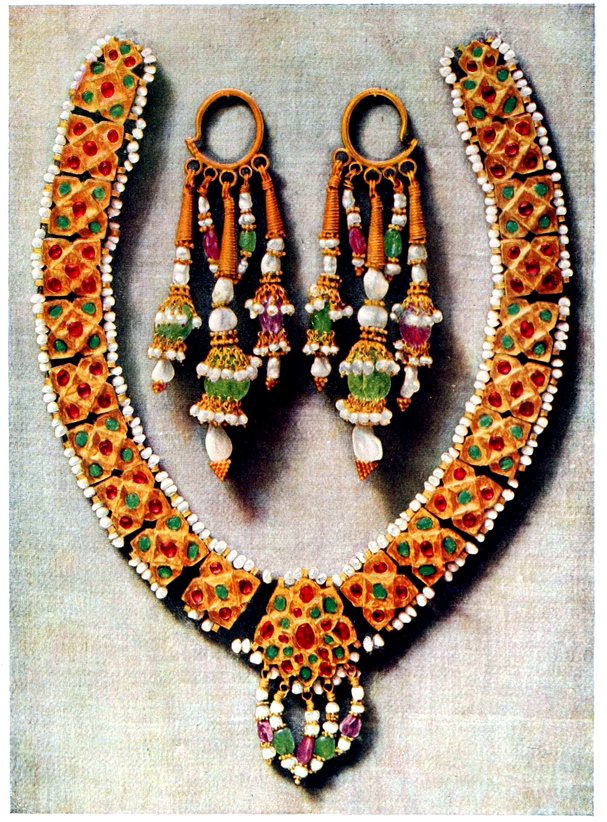
FROM THE TREASURY OF THE EMIR OF BOKHARA Necklace and earrings. Property of an American lady
137Most of the boats are from Mergui, and are chartered at a monthly rate of from Rs.105 to Rs.120 each, including a crew of four or five Burmans with their subsistence, consisting principally of rice and salted fish; the charterer is further required to pay each member of the crew four annas, or one rupee, for each day actually employed in operating the diving pump. In addition to these men, each boat carries one diver and an attendant, commonly known as “tender.” The boat is sailed or rowed by the crew, as directed by the diver; and while the latter is submerged, the boat and crew are under the supervision of the attendant.
The divers are the most important men in the fleet, for on their ability and efficiency depends the success of the enterprise. A very considerable portion of them are natives of the Philippine Islands, although many Japanese have been employed recently, and the number is increasing. The compensation is at the rate of £2 to £4 per month, and £20 for each ton of mother-of-pearl secured. The attendants are likewise mostly Manilamen, but many Malayans and Burmans are employed; the wages range from Rs.50 to Rs.80 per month, including provisions. The peculiar duties of the attendant are to help the diver into his dress, place the shoulder leads into position, screw on the helmet, and especially to receive and respond to signals and to direct the movements of the vessel in accordance therewith.
The scaphander, or diving dress, is composed of solid sheet rubber, covered on both sides with canvas. The head-piece is made of tinned copper, and is fitted with three glasses, one at the front and one on each side, so as to afford the diver as wide a view as is consistent with strength of construction. It has a valve by which he can regulate the pressure of the atmosphere. The dress has a double collar, the inner portion coming up around the neck, and the other hermetically fastened to the breastplate. The breastplate is likewise made of copper. The suit is connected with the air-pump by means of a stout rubber tube which enters the helmet, and through which air is supplied to the diver incased therein. This air-tube consists of three or four lengths—each of fifty feet—of light hose, commonly called “pipe.” This is buoyant so that it may be easily pulled along, and may not readily foul among the rocks. However, when working on very rough bottom with sharp-edged stones, the lower length is of stouter material in order to resist the chafing on the bottom. Before descending, the air-line is loosely coiled around the diver’s arm to prevent a sudden strain on it when it is tightened, and a signal-line is attached to his waist to enable him to communicate with the men above.
138In fishing, if the current is slight, the boat is permitted to drift therewith, and if there is little or no current, it is propelled by oars as may be required. The diver—fully dressed in the rubber suit with helmet, etc.,—goes overboard easily by means of a Jacob’s ladder of five or six rungs on the port side of the boat, and is lowered by an attendant, who gives close attention to the lines, the crew having manned the pump in the meantime. On reaching bottom, the diver walks along, following the course of the moving boat and swinging his shoulders from side to side to take in a wide vision in his search for oysters. In clear water he can discover them at a distance of twenty-five or thirty feet, even when fifteen fathoms below the surface; but sometimes the water is so clouded that it may be necessary for him to go almost on hands and knees to see them, and when the seaweeds are thick and high, he may locate them almost as much by feeling as by sight. Owing to this difficulty in seeing the oysters, the work is suspended in rough weather and for many days following. The catch is placed in a sack or basket of quarter inch rope, which is raised when filled, emptied, and returned to the bottom by means of a rope.
Finding the shell is by no means an easy matter, and much natural hunter-craft is necessary. Of a neutral color, it is not at all conspicuous as it lies on a gray coral bed, itself covered with coral or sponge or hidden in dense masses of gorgeous seaweeds. Still less visible is the shell on a muddy bottom, for there it embeds itself and exposes only half an inch or so of the “lip.” As the boat is impelled by the tide, the diver may have to walk rapidly in a swinging gait; and if he should stumble or fall while stooping to pick up the shell, recovery of balance may be difficult. He must be constantly on the alert and has many dangers to avoid. Sharks are numerous in these clear tropical waters; but although disaster sometimes results, they are timid, a stream of air bubbles from the sleeve of the dress sending them away in fright. More fruitful sources of danger are fouled air-pipes, broken pumps, falling into holes, and especially paralysis from recklessly deep diving.
When the diver wishes to come up, he closes the escape valve in his helmet; his dress fills and distends with air, causing a speedy return to the surface, and the tender hauls him alongside by means of the life-line. After “blowing” for a few minutes with the helmet removed, and usually enjoying the indispensable cigarette, he returns to the bottom.
When the Mergui reefs were first exploited by diving apparatus, the bulk of the shells were secured from depths of ten to twelve fathoms. These shallow reefs have been exhausted, temporarily, at 139least, and the divers now work in deeper water, fifteen, twenty, and even twenty-five fathoms, if the bottom is very uneven and rocky. Many shells are found in the depressions between the large boulders, which may be twenty or thirty feet deeper than the surrounding areas.
The oysters are opened by means of the long-bladed working-knife of the country, known as dah-she. The flesh is thrown into a large basket or washtub, where it is searched by the proprietor of the boat, who takes each piece between the hands and squeezes and feels through every part of it. After the flesh has been carefully examined, the sediment at the bottom of the tub is washed and panned to obtain those pearls which have fallen through the flesh tissues. The Mergui pearls are commonly of good color and luster, and compare favorably with those from the Sulu Archipelago or the Dutch East Indies.
The sea-green shell of the snail (Turbo marmoratus) is gathered in large quantities by the nude diving Selangs, who barter it to Chinese traders at the equivalent of Rs.8 or 10 per 100 in number. The flesh is also dried and disposed of to these traders under the name of thadecon, at about Rs.3 per viss of 3.33 pounds. This mollusk yields a few greenish yellow pearls.
In 1895, three pearl reefs were discovered off the Bassein coast in the district of Irawadi.[165] These proved fairly remunerative for one season and a portion of another, when they were abandoned.
THE PEARL FISHERIES OF THE RED SEA, GULF OF ADEN, ETC.
Under the Ptolemies, and even long after—under the Califs—these were islands whose merchants were princes; but their bustle and glory have since departed from them, and they are now thinly inhabited by a race of miserable fishermen.
James Bruce (1790).
The Red Sea was one of the most ancient sources of pearls, furnishing these gems for centuries before the Christian era, and particularly during the reign of the Ptolemies. These pearls were alluded to by Strabo, Ælianus, and other classical writers. Although the prominence of the fisheries has suffered by comparison with those of Persia and Ceylon, the yield has been more or less extensive from the days of Solomon up to the present time.
Of the several pearl-yielding mollusks in the Red Sea and on the 140southeast coast of Arabia, the largest and best known is that called “sadof” by the Arabs, and which has been identified by Jameson as Margaritifera m. erythræensis. This is closely related to the large species in the Persian Gulf. It is commonly four or five inches in diameter, and in exceptional instances attains a diameter of eight inches and a weight of three pounds or more. In addition to its size, it is distinguished by a dark green coloring about the edges, and a more or less greenish tint over the nacreous interior surface; this color is darker in the vicinity of Jiddah and Suakin than at the southern end of the sea, or in the Gulf of Aden. This species occurs singly rather than congregated in beds or reefs. Although it is found in depths of fifteen fathoms or more, most of the fishing is in less than five fathoms of water.
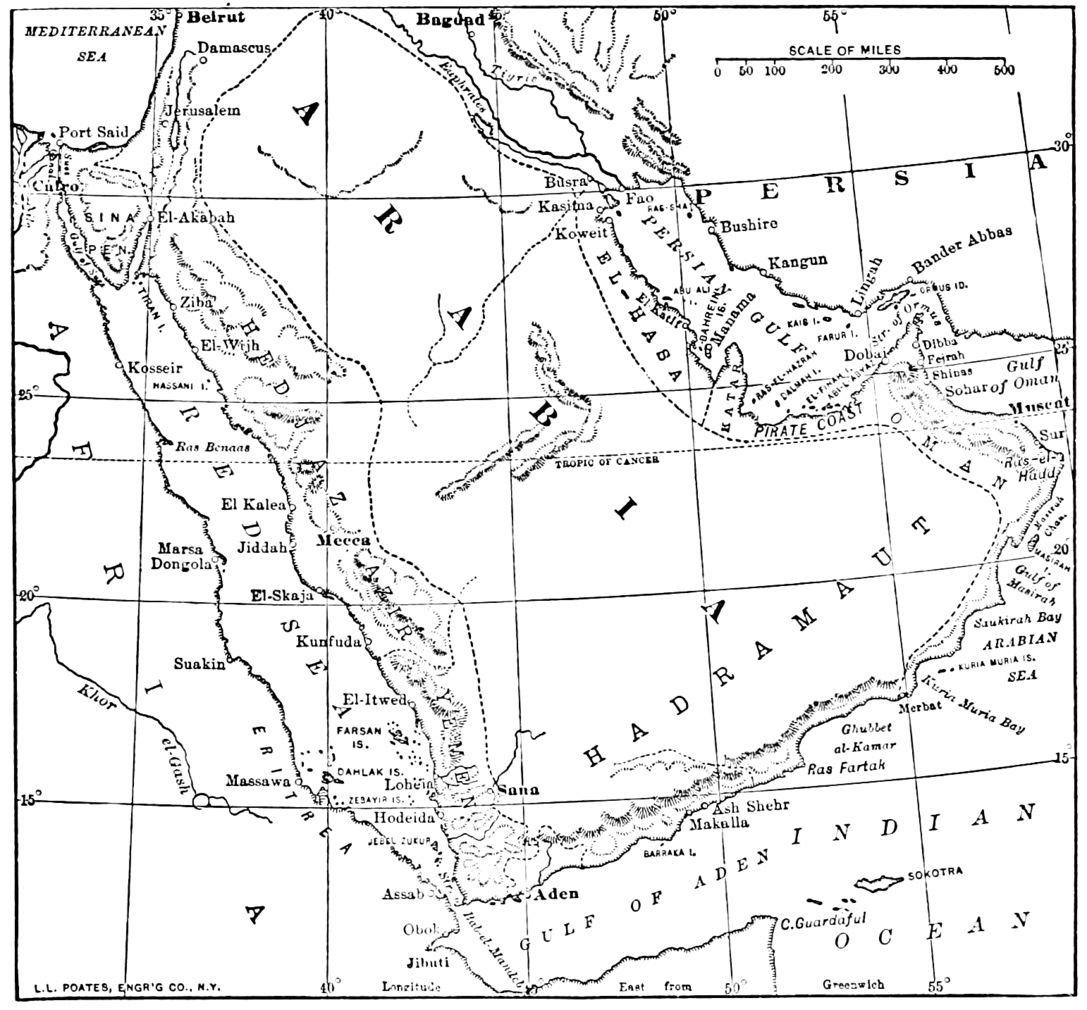
Persian Gulf and the Red Sea, the pearling center of the world
The “sadof” yields pearls only rarely, and is sought principally for 141the shells, which afford good qualities of mother-of-pearl, the pearls furnishing an additional but always looked-for profit to the regular source of income. As in other regions, there is no constant relation between the value of the pearls and the quantity of mollusks taken. The oysters of some reefs are comparatively rich in certain years; while in other seasons or on other reefs the mollusks may be numerous but yield very few pearls.
The second species of importance in the Red Sea is similar to the Lingah oyster and is known to the Arabs as “bulbul.” This is much smaller than the “sadof,” averaging less than three inches in diameter. It is collected for the pearls exclusively, the shells being too small for industrial use; but only 3 or 4 per cent. of the individuals yield pearls.
It is claimed by writers of authority that it is the red Pinna pearl from this sea that is referred to in the Scriptures under the name peninim as the most precious product, and which has been translated as rubies.[166] The shell is extremely fragile, and the nacreous interior is white tinged with a beautiful red. It is of little importance in the commercial fisheries of the Red Sea at the present time.
The “sadof” is more scattered and less numerous than the “bulbul”; and in order to save much useless diving, it is customary to inspect the bottom before descending. Therefore, operations are largely restricted to calm weather, when the water is sufficiently clear to enable the divers to sight the individual oysters on the bottom. In recent years, water-telescopes have been used to assist in locating them. The most popular form consists of a tin can with a sheet of glass inserted in the bottom. The glazed end of the tin is submerged several inches below the surface, affording a far-reaching and much clearer vision. In this fishery the divers work from small canoes (uri), each manned by two men, one of whom rows while the other leans over the bow and searches for the oysters. When one is sighted, he dives into the water for it, and then returns to the boat to resume the search.
The pearling season begins commonly in March or April, and continues until about the end of May; it is renewed in the autumn, continuing through September and October.[167] The vessels employed are of two varieties: dhows carrying from twenty to eighty men each, and the much smaller sambuks or sail-boats without decks, each with from six to twenty-five men, most of whom are Negro slaves. Many of the large vessels are from the Persian Gulf. The sambuks are owned principally by Zobeid Bedouins inhabiting the coast between Jiddah and Yambo, and also the islands near the southern end of the 142sea, which are very hot-beds of pearls, shells, religious frenzy and half famished Arabs and Negro slaves.
The “bulbul” oysters are taken in nearly the same manner as in the Persian Gulf. When the vessel is located over the reef, each diver descends, commonly with a short stick of iron or hard wood, with which he releases the oysters within reach; placing them in a sack, he is pulled up by an attendant when his breath is nearly exhausted.
The fisheries are prosecuted along both sides of the Red Sea and in the channels among the islands, from the Gulf of Akabah to Bab-el-Mandeb. They are especially extensive among the Dahlak Islands on the coast of the Italian colony Eritrea, where the population is largely supported by them. This was the center of the industry during the time of the Ptolemies and in the early Christian era. The fisheries are also important in the vicinity of Jiddah, the port of entrance for Mecca and Medina, holiest places of Islam. They likewise exist near Kosseir at the northern end of the sea, and at Suakin, Massawa, the Farsan Islands, and Loheia, near the lower end. They are carried on by Arabs, who succeed in evading efforts at control on the part of the local governments. Even on the African side, the Arab fishermen predominate, for the native Egyptian has never evinced much fondness for venturing on the sea.
On the southeast coast of Arabia, pearl fishermen are to be found at the various harbors from Aden to Muscat. Their fantastic dhows are met with in the harbor of Makalla, and also in that of Shehr. On the Oman coast, the ports of Sur and of sun-scorched Muscat do a considerable pearling business, not only locally but to the Sokotra Islands, and even on the coast of East Africa and Zanzibar, the trading baggalas adding pearling and illicit slave-trading to their many sources of income. A number of these traders, each with an instinct for pearls equal to that of a trained hound for game, visit the fishing centers at intervals, and exchange needful commodities for pearls and shells.
The Arab pearl-divers of the Red Sea have been noted for the depths to which they can descend. Lieutenant J. R. Wellsted, of the Indian Navy, who had unusual facilities for acquaintance with their exploits, reported that in the Persian Gulf the fishermen rarely descended beyond eleven or twelve fathoms, and even then they exhibited signs of exhaustion; but that in the Red Sea they go down twice that depth. Among the most noted of these divers of the last century was old Serúr, who attracted the notice of many travelers. Lieutenant Wellsted states that he saw him descend repeatedly to twenty-five fathoms without the slightest evidence of distress; that he frequently dived in thirty fathoms, and is reported to have brought up mud from the bottom at a depth of thirty-five fathoms, which is about the record, the pressure of the water being nearly 90 pounds to the square inch. His sons were also remarkably expert; one of them when scarcely thirteen years of age would descend to a depth of twenty-five fathoms.[168]
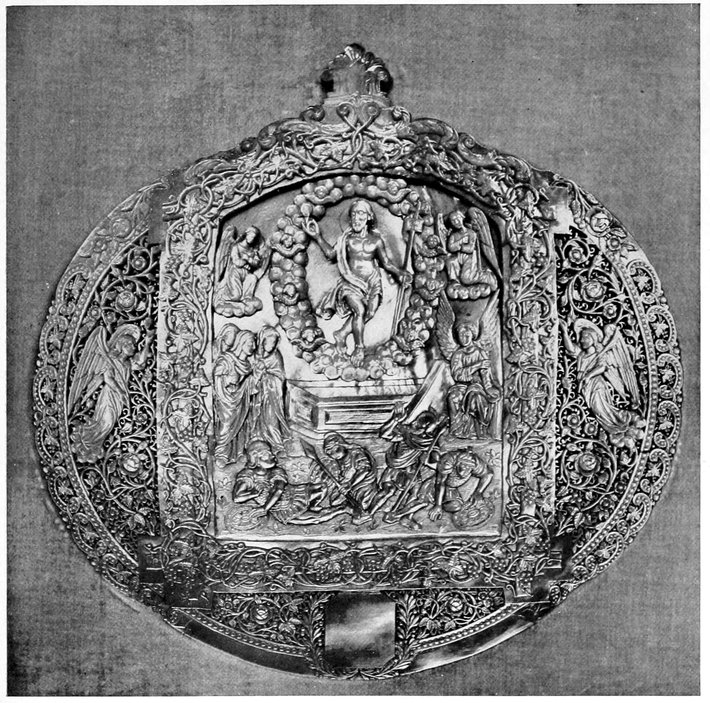
CARVED “JERUSALEM SHELL” FROM THE RED SEA In the collection of Dr. Bashford Dean
143An interesting story of an Arab’s diving ability is told by Lieutenant Wellsted: “In 1827, we were cruising in the sloop Ternate on the pearl banks. Whilst becalmed and drifting slowly along with the current, several of the officers and men were looking over the side at our Arab pilot, who had been amusing himself in diving for oysters. After several attempts, his search proved unsuccessful. ‘Since I cannot get oysters I will now,’ said he, ‘dive for and catch fish.’ All ridiculed the idea. He went down again, and great was our astonishment to see him, after a short time, rise to the surface with a small rock-fish in each hand. His own explanation of the feat was, that as he seated himself at the bottom, the fish came around and nibbled at his skin. Watching his opportunity, he seized and secured his prey by thrusting his thumb and forefinger into their expanded gills.”[169]
Owing to the character of the fishery and the lack of government supervision, it is extremely difficult to determine accurately the extent of this industry in the Red Sea and the Arabian Gulf. All over this coast extends the influence of the Hindu traders, who finance the fisheries and purchase most of the catch. The pearls are sent mostly to Bombay, and are not reported in the official returns of the Red Sea ports. The fishermen are suspicious of outside inquiries, and are far from anxious to impart reliable information. Probably the best estimates of the catch are to be obtained from Bombay merchants, from whom A. Perazzoli learned in 1898 that pearls to the value of 2,000,000 lire ($400,000) were carried from the Red Sea to Bombay each year.[170] In the last four or five years the output has been smaller than usual, owing to disturbed political conditions.
The annual product of “Egyptian” and “Bombay” shells in these fisheries is usually upward of 1000 tons, worth from $100 to $600 per ton, according to quality. Most of these go to Austria and France, only about 200 tons reaching London each year. Owing to the dark color and the lack of thickness in the nacreous layer, they are scarcely suitable for anything else than button manufacture. Many of them are sent to Bethlehem and Jerusalem, where they are cut into various shapes for crosses, crucifixes, wafer-boxes, beads, and nearly every conceivable article in which mother-of-pearl is 144manufactured. Many of the choicest shells are incised with scriptural or allegorical designs for sale to tourists as well as for export. The best of the engraved shells sell for $10 to $50, and the cheaper ones for less than $1 each. This industry is of great importance in Bethlehem, giving employment to a considerable percentage of the eight thousand inhabitants of the village.
Doubtless in no pearl fishery in the world are greater hardships endured than in the Red Sea and along the coast of the Arabian Gulf. In practically every other region, the industry is carried on under government supervision, and there is little opportunity for ill-treatment of the humbler fishermen. But the fanatics who control the fishery on the Arabian coast—untrammeled by authorities and responsible to none—show little consideration for the poor divers, and particularly for the unfortunate black slaves brought from the coast of Africa.
These pearl fishermen lead a very eventful life, the divers especially. They see some wonderful sights down below the surface-plant life and creeping things and enemies innumerable. Dropping from the sun-scorched surface down into the deep cool waters, everything shows “a sea change, into something rich and strange,” just as the eyes of the drowned man in Ariel’s song are turned into pearls and his bones into coral.
And there are enemies innumerable. The terrible sharks, prowling about near the bottom, prove a source of perpetual uneasiness, and in the aggregate many fishermen are eaten by these bloodthirsty tigers of the sea. There are horrible conflicts with devil-fish equaling that in Hugo’s “Toilers of the Sea.” The saw-fish is also a source of danger, particularly in the Arabian Gulf, and instances are reported in which divers have been cut in two by these animals, which sometimes attain a length of twelve or fifteen feet, and possess a saw five feet long and three inches broad, armed on each edge with teeth two inches in length. Another menacing peril is the giant clam (Tridacna gigas), a monster bivalve, whose shell measures two or three feet in diameter, and is firmly anchored to the bottom. This mollusk occurs on many of the Asiatic pearling grounds. Lying with the scalloped edges a foot or more apart, a foot or a hand of the diver may be accidentally inserted. When such a fate befalls a fisherman, the only escape is for him to amputate the member immediately. Once in a while on the pearling shores a native may be found who has been maimed in this manner, but usually the unfortunate man does not escape with his life.
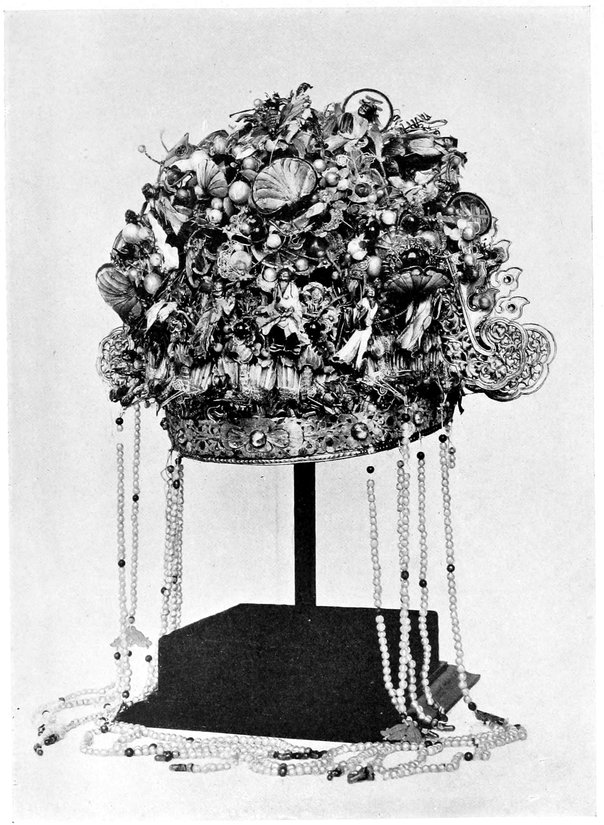
CAP OF STATE, FROM LOOTING OF SUMMER PALACE, PEKIN, IN 1860 Now in South Kensington Museum
145
THE PEARL FISHERIES OF CHINA, JAPAN, SIBERIA, ETC.
Do churls
Know the worth of Orient pearls?
Give the gem which dims the moon
To the noblest or to none.
Emerson, Friendship.
It appears from ancient Chinese literature, noted in the first chapter of this book, that pearl fisheries have existed in the rivers of China for several thousand years. The Chinese also derived pearls from the sea, and especially from the coast of the province of Che-kiang. Little is known of the early fisheries, but the fragmentary literature contains so many allusions to pearls as to lead us to believe that they were of considerable extent and importance.
It is related that about 200 B.C., a pearl dealer at Shao-hing, an ancient city between Hang-chau and Ning-po, on the shore of Hang-chau Bay, furnished to the empress a pearl one inch in diameter, for which he received five hundred pieces of silver; and to an envious princess the same dealer sold a “four-inch pearl.” A hundred years later, the reigning emperor sent an agent to the coast to purchase “moon pearls,” the largest of which were two thirds of an inch in diameter.
In the tenth century A.D., Mingti, one of the most extravagant of the early monarchs, used so many pearls—not only in his personal decoration but on his equipage and retinue,—that after a formal procession the way would be rich in the jewels which dropped from the gorgeous cortège. About 1000 A.D., an embassy to the emperor brought as tribute an ornament composed of strings of pearls, and also 105 liang (8¾ lbs.) of the same gems unmounted.
An interesting story is told of “pearl-scattering” by an embassy to the Chinese court from a Malayan state about 1060. Following the customs of their country, the ambassadors knelt at the threshold of the audience chamber, and then advanced toward the throne, bearing a golden goblet filled with choice pearls and water-lilies wrought of gold. These they scattered upon the floor at the feet of the emperor; and the courtiers, hastening to pick them up, secured ten hang (15 oz.) of pearls.[171]
The Keh Chi King Yuen, a Chinese encyclopedia, describes a pearl fishery in the southern part of Kwang-tung province, in the department 146of Lien-chau and near the city of Hóhpú. Fishing began in the spring, and was preceded by conciliating the gods through certain sacrifices, in order that the weather might be propitious and that no disaster might be suffered through sharks and other agencies. The five sacrificial animals,—horses, cattle, sheep, swine, and fowls,—were presented; but ordinarily paper images of these were economically substituted, as equally acceptable to the Chinese rulers of destiny. In the details of the diving, the fishery resembled somewhat that prosecuted about the same period in the Gulf of Manaar. The diver was let down by a rope, and after collecting the mollusks and placing them in a basket, he was drawn up at a given signal. Much complaint was made that the divers would open the mollusks, extract the pearls and conceal them in the mouth before returning to the surface.
The business became so perilous and the loss so great, that about the beginning of the sixteenth century, according to the same encyclopedia, dredges were adopted. These at first were simple rakes; later large dredges were trailed along between two boats, by means of which great quantities of shells were gathered. So important was the industry that an officer was designated by the viceroy of Canton to collect a revenue therefrom. It does not appear that pearls have been collected in considerable numbers on this part of the Chinese coast for very many years, probably not since the advent of Europeans.
Pearls are yet found in the river mussels in all parts of eastern Asia, from Siberia to the Indian Ocean, and from the Himalayas to the Pacific. It is represented that they are not from the Unio margaritifera, the common river-mussel of Europe, but from other species, such as Unio mongolicus, U. dahuricus, Dipsas plicatus, etc. It is quite impossible to obtain a reliable estimate of the total number of persons employed, or the output of pearls in China, but these items are certainly very much larger than the average Occidental believes.
In the vicinity of Canton the Dipsas plicatus has been used for centuries by the Chinese in the production of artificial pearls, this industry giving employment to thousands of persons.[172]
The pearl-mussel fishery is of importance in Manchuria, where it has been carried on for hundreds of years, not only by the citizens, but by the military department on account of the government, and especially in the streams which flow into the Songari, a tributary of the Amur. Jacinth relates that in case of a deficit, the officers and subalterns were punished by a deduction from their pay, and also by corporal chastisement.[173] Witsen speaks of the pearls from the River Gan, a tributary of the Amur, and also from the islands of the Amur, the 147boundary river of Manchuria. Pearl fisheries were established at these places by the Russians nearly two centuries ago.[174]
Pearls become finer and more plentiful the further we penetrate into Manchuria; and they are numerous in the lake of Heikow or Hing-chou-men, “Black Lake” or “Gate of Precious Gems,” where they have long been exploited for the account of the emperor of China.
The occurrence of pearls in many parts of Asiatic Russia was noted by Von Hessling. In northern Siberia, according to Witsen, writing in 1705,[175] pearls were found in the waters about the town of Mangasea on the Turuchan; and Von Middendorf notes that they were found in the Tunguska River, which flows into the Yenisei. Whether, however, they come from the Unio margaritifera is considered doubtful by Von Middendorf. Witsen referred to their occurrence in the rivers and streams of Irkutsk and Onon, and this is confirmed by several writers of more recent times. Pallas says that the mussels found there are quite large, and speaks of the Ilim, which flows into the Angara, as another river where they occur.
Ancient books relating to Japan repeatedly allude to the occurrence of pearls on the coasts of that country. They are mentioned in the Nihonki, of the eighth century, the oldest Japanese history.
Tavernier wrote about 1670: “It is possible that of those who have written before me concerning pearls, none have recorded that some years back a fishery was discovered in a certain part of the coasts of Japan, and I have seen some of the pearls which the Dutch brought from thence. They were of very beautiful water, and some of them of large size, but all baroques. The Japanese do not esteem pearls. If they cared about them it is possible that by their means some banks might be discovered where finer ones would be obtained.”[176]
In 1727, Kaempfer wrote that pearls, called by the Japanese kainotamma or shell jewels, were found in oysters and other mollusks almost everywhere about Saikokf. Every person was at liberty to fish for them. Formerly the natives had little or no value for them, till they learned of their estimation by the Chinese, who were ready to pay good prices for them, their women being very proud of wearing necklaces and other ornaments of pearls. “The largest and finest pearls are found in the small sort of oysters, called akoja, which is not unlike the Persian pearl-oyster. These are found only in the seas about Satzuma and in the Gulf of Omura (Kiusiu). Some of the pearls weigh from four to five candareens[177] and these are sold for a hundred 148kobans each.[178] The inhabitants of the Loochoo Islands buy most of those about Satzuma, since they trade to that province. Those found on the Gulf of Omura are sold chiefly to the Chinese and Tunquinese, and it is computed that they buy for about 3000 taels[179] a year. This great profit occasioned the strict orders, which were made not long ago by the princes both of Satzuma and Omura, that for the future there should be no more of these oysters sold in the market with other oysters, as had been done formerly.”[180]
Kaempfer also noted that the Japanese obtained pearls from the yellow snail shell and from the taira gai (Placuna) in the Gulf of Arima, and especially from the awabi or abalone (Haliotis). This mollusk was much sought after for food, being taken in large quantities by the fishermen’s wives, “they being the best divers of the country.”[181]
Of the several species of pearl-oysters which occur in the coastal waters of Japan, the only one of importance at present is the Margaritifera martensi. While this occurs in very many localities, it is most numerous among the southern islands, where some fine pearls have been secured. The fishery for this species was quite extensive thirty or forty years ago, and the reefs were largely depleted. For nearly a score of years it has been used in growing culture pearls, an account of which is given on pages 292, 293.
A few pearls are obtained from several other bivalve mollusks in Japan. Among the collections of the present writers are pearls from Margaritifera martensi, collected at Bay Agu; from M. panasisæ, about the Liu-kiu Islands; from Pecten yezocusis, in Sokhaido; from Mytilus crasitesta, in the Inland Sea, and from North Japan, and from a species of Dipsas found in Lake Biwa.
While the pearl fisheries of Japan are not of great importance in any single locality, the distribution of the reefs is so extensive that the aggregate yield is considerable.
The awabi or ear-shell (Haliotis gigantea), found on the coast of Japan, Korea, etc., yields many pearly forms. This species is much smaller than the California abalones. It has a fairly smooth, nacreous surface, but its value is depreciated by the great size of the marginal perforations, which render useless for commercial purposes all of the shell external to the line of perforations. While its opalescent tints make it desirable for manufacturing into certain styles of buttons and buckles, its principal use is for inlaying work or marquetry, for which it is especially adapted, owing to its fineness of texture and beauty of coloring even when reduced to thin sheets.
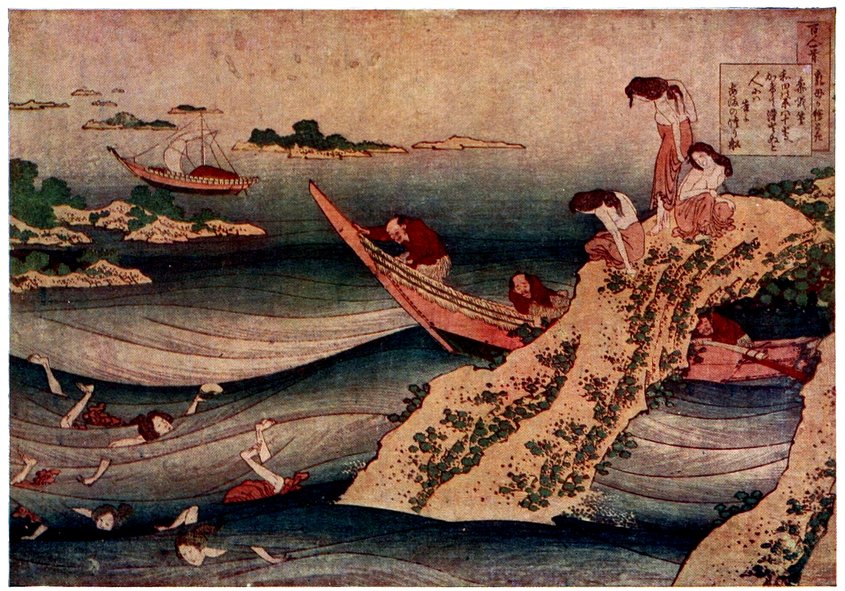
FISHING FOR THE AWABI (ABALONE) SHELLS AT WADA-NO-HARA, JAPAN
149Probably the most interesting of the abalone fisheries is that on the shores of Quelpaerd Island, about sixty miles south of the Korean coast, which is prosecuted largely by the women. Dressed only in a scanty garment, these women swim out to the fishing grounds, distant several hundred yards in some cases, carrying with them a stout knife and a small sack suspended from a gourd. On reaching the reefs, they dive to the bottom—sometimes to a depth of six or eight fathoms—and by means of the knife, remove the abalones from the bottom and place them in the sack. They may remain out an hour, diving repeatedly until the sack is filled, when they swim back to the shore. Pearls are found only rarely; in one lot of one hundred shells, only five were found bearing pearls; two with three pearls each, two with two pearls each, and one with a single pearl. The flesh of this mollusk after it has been cleaned and dried, is quite popular as an article of diet. Although white when fresh, the color changes to a dark red. The pieces of dried flesh, in the form of flat reddish disks four or five inches in diameter, are fastened on slender sticks—about ten to each stick—and displayed in the grocery shops in Seul and other cities.
In the Gulf of Siam on the Asiatic coast, pearls are obtained from a small oyster with a thin shell, presumably a variety of the Lingah oyster. The beds have not yet been thoroughly exploited, as the Siamese do not especially value pearls, attributing some superstitious sentiments of ill luck to them. However, from time to time Chinese traders have bought them from the Malay divers and sold them at great profit in the Singapore market. The known beds occur chiefly in the northern part of the gulf, on the west coast, and extend in a narrow belt for a distance of about one hundred miles. The fishing is prosecuted by nude divers in shallow water. A recent letter from Dr. K. Van Dort, a mining engineer of Bangkok, Siam, states that in 1906 in six weeks, with the aid of half a dozen divers he was able to collect 720 grains’ weight of pearls, mostly small ones, but including one of 20 grains, one of 14 grains, two of 12 grains each, and seven over 9 grains in weight. He reports that the total value of the large ones in Bangkok was $1500, but the small ones could not be sold to any advantage, as they are little prized by the Siamese. The shells are of no commercial value, as they are too thin for industrial use other than for inlaid work. Some fine old specimens of marquetry in which these shells were used exist in the Buddhist temples at Bangkok. This art of inlaying is almost lost among the Siamese, and there is said to be only one man in the king’s palace who can lay any claims to proficiency in working mother-of-pearl shell.
VII
PEARLS FROM THE AFRICAN COASTS
153