XIII VALUES AND COMMERCE OF PEARLS (continued 2)
Reading edition
The product of the pearl fisheries, either that of entire fisheries where they are managed by a company, or the gatherings of merchants, or even the single gems which may be acquired by the smaller merchants, all these usually find their way to the great markets, although occasionally they change hands at once. In the East they are sent either to Bombay, Calcutta, Madras or Colombo; frequently they are intended for a higher market. Many of them remain in the East, for in the East to-day a fine pearl is as much prized as ever, and there are those who love pearls as much as did the King of Maabar in 358the time of Marco Polo. However, the world over, there is a feeling that if things are sent to the greatest market there will be an opportunity for disposing of them at the greatest price. Therefore, the larger number of parcels of exceptionally fine pearls are sent to the London market, a few of them going to Paris, the cable, often within a few days after their arrival, informing the sender of the acceptance or rejection of a parcel, or of a new offer which is often accepted. In this market they are acquired by the dealers, who frequently exhibit many times before the lot is purchased.
Pearls from a fishery are in many cases of mixed quality; that is to say, they are of different sizes and varying grades of perfection as regards skin, color, and orient. These parcels are often sold directly on offers to dealers, but generally they are sold by brokers who show the various parcels to the dealers, each of the latter in turn making his offer on that portion of the parcel which is of most value to him. Thus a single dealer may want one pearl, a dozen, or even twenty or more, to complete a great necklace, or else to add to, or improve the necklace, by better graduation or by increasing the evenness of the color. When the broker receives enough offers to give him the desired price for the entire parcel, the sale is consummated, and each one who has made an offer and who has sealed his particular parcel until his offer is accepted or rejected, receives his portion. Pearls do not grow in the form of necklaces, although they are frequently seen in this form only, and to create a large necklace means not only the use of the pearls of one fishery alone, but it often requires a selection from pearls of various sizes, the product of many fisheries.
It is needless to say that even the shrewdest dealers do not always succeed in their purchases of lots which are to be broken up when the proper number of bids are obtained.
When the pearl revival came in 1898 there was a sudden and rapid upward tendency in the prices, because at that time, in England, money could be borrowed upon a very low rate of interest—as low as 3 per cent.,—and it was a temptation to a number of young men to enter as dealers into the pearl trade. The result was that a number of new stocks were created, not for a regular, but for a speculative demand, and this tended to advance the price spasmodically, rather than gradually, as it would have risen by regular consumption. However, when the foreign market became higher, the demand for pearls was not as great as had been anticipated, and there was a sudden adjustment of prices and a readjustment of the pearl stocks, resulting in the elimination of a certain number of speculative dealers; and, notwithstanding the state of the fisheries, pearls have not advanced so rapidly in the past two years as they did from 1898 to 1905.
359More than go per cent. of the pearls of commerce, whether they are round, perfect, half- or seed-pearls, are of oriental origin; that is, pearls from the true pearl-oyster. About 8 per cent. are probably from the fresh-water mussels, three fourths of which are from the United States.
American fresh-water pearls have had many prejudices to overcome, often because of the natural indifference in regard to anything that is found at home or is easily obtainable. It has been said that, in comparison with foreign pearls, they had less specific gravity; that they were not so hard, and that their luster was not as good. It is certain, however, that the skin is generally smooth, and although they may not have so peculiar an orient, their brilliancy equals that of any known pearls. Sometimes they are translucent and either pink or of a faintly bluish tint, like molten silver. More frequently their hue is white, rose, pale yellow, or pale copper, deepening to copper red until they resemble the most intense and highly polished copper button.
According to the estimates of the value of European fresh-water pearls given by seventeenth and eighteenth century writers, their worth was considered to be one half that of oriental pearls of approximately the same quality. Few European pearls, we feel sure, were ever found that possessed the wonderful beauty and brilliancy of the pearls found either in the Miami or the Mississippi and its many tributaries.
So great a quantity of the poorer quality of pearls have been found, principally in the Mississippi Valley, that a foreign dealer has bought 30,000 ounces of baroque pearls at $1 an ounce, and of the slightly better grades fully 100,000 dollars’ worth were obtained in the year 1906. The exportation was strictly limited to the poorer qualities. When pearls are worth from $1 to $6 a grain and upward, they are rarely sent abroad, as the regular pearls of this quality are much appreciated by Americans, and find a ready sale in the United States. The poor pearls above mentioned were principally sent to New York, either from the local fishermen, or else through the dealers in sweet-water shells, in lots of a fraction of an ounce, or in bags weighing a number of pounds. Thirty thousand ounces would equal 18,180,000 grains.
After all the fine pearls have been selected—buttons, baroques, turtle-backs, haystacks, wings, petals and other pearls that can be used in any way as a jewel on this side of the water—the balance of the material is sold by the ounce, varying in price from $1 to $5. These are shipped to Germany, France, and Austria, where they are again selected for cheaper forms of jewelry than are made in the United States. Of these pearls the baroques and slugs go mainly to 360Germany, while the somewhat finer ones are sent to France, where they are used in artistic but inexpensive work, such as flowers and other imitative forms, and in art nouveau jewelry. Some, again, are shipped to Algiers, Morocco, and Egypt, for the decoration of saddles, garments, etc., and quantities go to India to be used for medicinal purposes. In this way all the material is utilized and even the poorest is not wasted. No better proof can be required of the wide-spread appreciation of the pearl among all the races of mankind.
So extensive has become the finding of American pearls that great quantities have been gathered together of all varieties. At the time of this writing there are many large single lots of these pearls, slightly irregular, and not of fine quality, but yet of sufficient regularity of size to be termed baroques. At one time such quantities were gotten together that single papers of pearls, weighing one fourth, one half, one, two or three grains each, contained more than 10,000 grains, and quantities of the wing and dog-tooth varieties weighing as much as 20,000 grains were inclosed in a single paper.
So prolific has been the yield of these common American pearls that the markets of Europe and Asia have almost been flooded with them. In 1906, a single shipment of 3500 ounces, troy (equaling over 2,100,000 grains), were sent abroad, at prices varying from $1 to $15 per ounce, according to the quality. This alone would represent a worth of $30,000 at one time.
The turtleback is a form quite prevalent among American pearls, and they are often matched in pairs slightly resembling each other and weighing from 10 to 100 or more grains for each pair. Some of them are lustrous and many are of very good color and regular in form. Although differing but little in shape, they naturally are much less expensive than a finer formed pearl, and many of them have been sold for link buttons, and more especially for earscrews. Although they formerly sold for 50 cents a grain, they are now held at from $1 to $8 per grain.
In regard to the prices of some of the finer American pearls, one of 15 grains, of wonderful brilliancy, luster, and perfection, was sold for more than $2500–$166 a grain, or a base value of over $11 a grain. Two extraordinarily well-matched button pearls, weighing a trifle over 30 grains, were held at about $3500, or $115 a grain, a base value of about $8 a grain.
At the time of this writing there are for sale in the United States a pair of button earrings, almost round, not of absolutely perfect color, weighing about 140 grains, the price being $6000; a round, slightly ovate pearl, not of the finest color, weighing 85 grains, held at $3500; and a wonderful pearl with a rich, faintly pink luster, round, 361but slightly button on each side, weighing about 44 grains, and beautiful as are American pearls, is held at a fanciful valuation of over $6000.
The cupidity of many of the American pearl finders and pearl dealers cannot be exceeded even by that of the foreign pearl finder in any other land, and this is shown by the variety of materials that from time to time are sold to the unsuspecting public, or that are sent to pearl dealers in the large cities. This is surprising and suggests either that the sender believes the pearl dealers are not familiar with these deceptions, or else that he himself has been imposed upon, and is innocent in his commercial deceit. Among the notable examples are, first, spheres made out of the various shells, either from a good part of the material or from hinge-material, or else from the spot where the mussel is attached, these pieces of the shell being rounded and polished; such spheres vary in color from white to pink or yellow, just as the shell itself may have been colored. Second, the pupils of fish-eyes. Third, imitation pearls. Fourth, yellow or brown translucent or transparent masses of hinge-binding material having no greater hardness than horn, and about the same appearance. The most interesting, however, are the absolutely beautiful, smooth spheres of anthracite coal, which admits of a rich polish and has a peculiar luster; these they attempt to pass off as black pearls.
It is interesting to note that in Arkansas a negro sold a very valuable pearl for a few dollars, under the persuasion of a white man, who, it is said, resold the pearl for nearly a hundred times more than what he paid for it. The local authorities investigated the matter; the case was brought to court, and the negro received a large advance on the price that had originally been paid him.
If a list were kept of the thousand and one different methods of wrapping American pearls for shipment to the larger cities, it would show how much ingenuity is displayed in environments that frequently differ very much from each other. A box that has contained the pills that relieved him of fever, ague, and other ills due to swamps and damp climates, serves a secondary purpose for the fortunate finder of a pearl in forming a receptacle in which he can ship it to the greater market. Sometimes they are sewed in leather cut from gloves and shoes, or in strips of cloth, generally of the humbler varieties, such as calico or blue jean; in other cases they are wrapped in tissue-paper and newspaper; and occasionally they are packed in boxes made by hollowing out a bit of wood, a cover being nailed over the opening. In almost every instance they have been treated with a certain degree of care.
The majority of conch pearls which are carried by individuals to New York, London, or Paris, are generally brought in small papers or 362bits of cloth, each pearl being wrapped separately. Usually, there are a few white ones, a few yellow, a few pale pink, occasionally a few of a very beautiful rich pink, and once in a great while a fine, large pearl appears. Many of these pearls, commonly the inferior ones, are sold in the West Indies directly to the tourists who wish to purchase something in the country through which they are traveling, with the result that better prices are generally obtained than would have been secured if the pearls had been sent to the great markets.
The tariff on pearls at present operative in the United States is so indefinite as to have led to much serious misinterpretation and misunderstanding, as well as to an endless chain of lawsuits, often resulting in serious loss to the dealer or client who imports. As a consequence of the enforced outlay of large sums for unexpected and additional duties, the importer, who was both ready and willing to pay what seemed to him a just duty, often found that, where he had quoted a price to a customer, he was a loser by the transaction; and if, to escape this loss, he endeavors to dispute the payment of the duty, he becomes involved in an expensive and occasionally unsuccessful lawsuit. On the other hand, a private buyer who has paid all that he feels he can afford at the time for a necklace, expecting to pay a duty of 10 per cent. and interpreting the law to mean a duty of 10 per cent., may be called upon to pay a duty of 60 per cent., or have the notoriety of a public lawsuit, because the pearls have been strung, or because it is held that they had recently or at some former time been assembled as a necklace. In other words, if the pearls constituting such a necklace are bought at various times from various people, either here or in Europe, and not as a necklace, the duty is held to be 10 per cent., but if they are sent in one shipment, a duty of 60 per cent. is levied. As it is held that pearls assembled in the form of a necklace have a greater value than before they were so assembled, the purchaser might naturally expect to pay the 10 per cent. duty on this higher value, but instead of this a 60 per cent. duty is demanded on the higher assembled value.
The ambiguity of this clause of the tariff is such that a logical ruling should be made by some superior official such as the Secretary of the Treasury. As the law is now interpreted, a pearl worth $20,000 can be brought in with a duty of 10 per cent.; the addition of a simple gold wire makes it a piece of jewelry, with a duty of 60 per cent. It would seem that an amendment might be made to the tariff by which an importer, whether a private buyer or dealer, could be called upon to pay a 60 per cent. duty on a high valuation of the setting of the ring, brooch, or jewel, such as $20, $25 or $50; while the contents of the ring or ornament, whether a pearl, diamond, emerald, or a collection of stones, should pay a duty of only 10 per cent. This 363duty would sufficiently protect the jewelry industry, and would at the same time prevent the levying of an unjust and unexpected impost upon a fine pearl or gem of any kind.
It is eminently desirable that those residing in the United States who purchase pearls in foreign countries, should, if possible, consult with the United States consul in the city where they make their purchase, in case they wish to bring the pearls into the United States. In this way a proper declaration can be made, they will be correctly instructed as to the duties upon the pearls, whether unstrung, strung, or set, and they will thus avoid all complications when they reach the United States. Of course, this may not be necessary should the firm with which they are dealing be able to attend to the matter for them.
It must not be forgotten that the duty of 25 per cent. on precious stones, which was imposed during Cleveland’s administration, was enacted for the purpose of obtaining an increased revenue for the government, and there is no doubt but that the time was one of great financial stress. Yet even with the duty two and a half times as high as in the previous years, only a small fraction was added to the income of the Government. But one adequate explanation can be given of this remarkable decrease in the recorded imports, more especially when we consider that legitimate dealers could, at that time, buy precious stones in New York City for less than it cost them to purchase them abroad and pay the duty. It seems, therefore, that a 10 per cent. rate is calculated to produce the best and most satisfactory results in every way.
As examples of the difficulties encountered in the attempt to arrive at a proper classification of pearls we cite the following cases which have been the subjects of recent litigation: In 1901, two very valuable collections of pearls were brought to this country. One of these consisted of 45 drilled pearls weighing in all 672⅛ grains and entered at $60,734; the other, of 39 pearls, having an aggregate weight of 678¾ grains and entered at $63,070. At first a duty of 20 per cent. ad valorem was imposed upon these pearls under Section 6 of the Tariff Act, treating them as “unenumerated articles partly manufactured,” according to the rule that had been followed since the enactment of the present tariff. This was protested, and the case was brought before the Board of Appraisers.[407] Subsequent to the protest, however, the collector reliquidated the entry of the 45 pearls and imposed upon them a duty of 60 per cent. ad valorem, as pearls set or strung. This was done in view of Judge Lacombe’s decision in another notable case which had been taken shortly before to the Circuit 364Court of Appeals.[408] This decision was to the effect that pearls in any form not especially covered by paragraphs 434 or 436 of the Tariff Act should be referred to one or the other of those paragraphs, by similitude, according to the provisions of Section 7 of the Act.
The testimony taken before the Board of Appraisers revealed the fact that each of the collections of pearls had been inclosed in a handsome silk-lined morocco case, with a groove running through the center; in this groove the pearls were laid, the largest one in the middle and the others disposed on either side, graduated according to their size; the row or series having the effect of a necklace, although the pearls were unstrung. The importer testified that this arrangement was only made in order to enable him to judge of the size and quality of the pearls, and evidence was given showing that it was necessary to rebore some of them and to ream out the holes before any use could be made of the pearls in jewelry. Nevertheless, the appraisers adhered to their opinion that these gems had been selected especially to form a necklace, and that the time and labor requisite for the assembling of a carefully matched and graduated series of pearls suitable for a necklace constituted the main factor in its production, since the cost of stringing it was trifling; they, therefore, considered that such a series of pearls was dutiable, by similitude, under paragraph 434 of the Tariff Act as jewelry. An application was made to the Circuit Court of the Southern District of New York for a review of the appraisers’ ruling,[409] the judge decided against the petitioner,[410] and an appeal was then taken from his decision. On December 12, 1904, the Circuit Court of Appeals decided that the pearls were dutiable, by similitude, at 10 per cent. ad valorem, under Section 7, paragraph 436, and the excess of duty collected was refunded.
Another case has to do with a collection of 37 pearls, entered at $220,000, brought to New York in January, 1906. Duty to the amount of $22,000 (10 per cent. ad valorem) was paid by the importer, but the entry was liquidated at 60 per cent. and $110,000 additional duty demanded. This was paid and a protest was made to the Board of General Appraisers, who decided in favor of the petitioner. The Government appealed and the case[411] was tried in the United States Circuit Court on February 24 of this year (1908). It was shown that the pearls had been worn several times in Paris as a necklace, but the defense held that, as they were loose when imported and were not worth more collectively than separately, this was not material. The judge decided for the Government and an appeal has been taken in June, 1908.
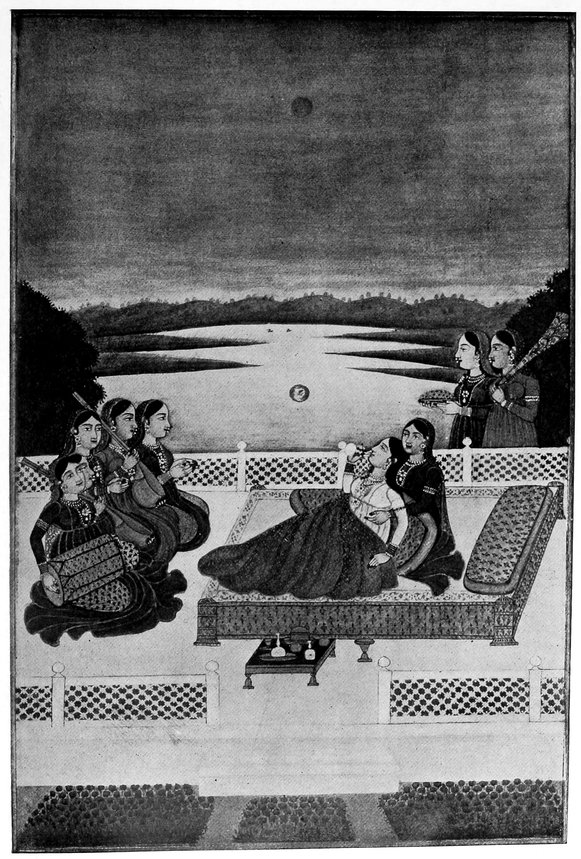
PERSIAN PRINCESS AND LADIES IN WAITING From a Persian illuminated manuscript of the eighteenth century, in the library of Robert Hoe, Esq.
365The proper classification of half-pearls has also been a matter of controversy. This question was brought before the Board of General Appraisers in New York on a protest[412] entered in 1897 against the imposition of a duty of 20 per cent. on several lots of so-called half-pearls imported during that year. This duty was imposed under Section 6 of the Tariff Act, providing for a duty of 20 per cent. on “unenumerated partly manufactured articles.” The petitioner claimed that half-pearls were dutiable at 10 per cent. ad valorem, “either directly or by similitude or component of chief value, under paragraph 436, or as precious stones, under paragraph 435 of the Tariff Act.” After hearing the testimony of a number of competent and reliable experts connected with some of the leading houses dealing in precious stones and pearls, the appraisers decided that the evidence showed that pearls, being the product of animal secretion, could not properly be denominated stones, and that they were not in fact so designated commercially. At the same time, half-pearls could not be looked upon as “pearls in their natural state,” since time and labor had been expended in their production; it was, therefore, evident that paragraph 436 did not apply to them. For this reason the original ruling was reaffirmed.
In 1902 a duty of 60 per cent. was levied on an assorted lot of half-pearls under a new ruling which brought them by similitude under the provisions of paragraph 434 of the Tariff Act, providing a duty of 60 per cent. on “jewelry ... including ... pearls set or strung.” A protest was entered against this ruling also.[413] In the meanwhile Judge Lacombe had given the opinion to which we have alluded above, and the Board of Appraisers upheld the duty of 60 per cent., basing their decision upon the fact that the material of half-pearls was similar to that of pearls in their natural state or of pearls set or strung, thus satisfying the requirements as to similitude of Section 7 of the Tariff Act. The same section provides that, in case two or more rates of duty shall be applicable to any imported article, it shall pay duty at the highest rate, and therefore the 60–per cent. rate applying to pearls set or strung was imposed, instead of the 10–per cent. rate on pearls in their natural state. In both of these cases an application for a review was made to the United States Circuit Court.[414]
DUTIES ON PEARLS IN VARIOUS COUNTRIES, MARCH, 1908
Basis. Amount in money of the country. U. S. currency.
Great Britain Free
British India Free
Australia Free
New Zealand Free
366Canada, precious stones (pearls), polished but not set, pierced, or otherwise manufactured ad val. 10%
Austro-Hungary, unset 100 kilogr. 60 kr. $24.00
Belgium, unenumerated.
Bulgaria, precious stones (pearls) in the natural state, polished, cut, or engraved, but not mounted kilogr. 75 lev (francs) 14.25
Denmark, unenumerated.
France Free
Germany, wrought (smoothed, polished, perforated), unset 100 kilogr. 60 marks 14.40
Unset, but strung on textile threads or tape for the purpose of packing and transportation 100 kilogr. 100 marks 24.00
Greece Free
Holland, unenumerated.
Italy, precious stones (pearls) wrought hectogr. 14 lire 2.66
Montenegro, precious stones (pearls) ad val. {min. 10% {max. 15%
Norway, precious stones (pearls) kilogr. {min. 250 krone .66
{max. 3 „ .80
Portugal, unenumerated.
Portuguese S. E. Africa (Quilimane, Chinde and Zambesia) Export Duty ad val. 6%
Portuguese India, real pearls or seed-pearls ad val. ½%
Rumania kilogr. 20 lei 3.80
Russia, loose or threaded funt 10 rubles 5.00
Finland Free
Servia, threaded for facilitating their preservation or sale kilogr. 50 dinars 9.50
Threaded for special uses kilogr. 70 dinars 15.30
Spain, loose or mounted hectogr. 25 pesetas 4.75
Sweden, not set Free
Switzerland, not mounted 100 kilogr. 50 francs 9.75
Turkey, unset gramme 3 piasters (gold)
Egypt (on all imports) ad val. 8%
China (on all unenumerated imports) ad val. 5%
Japan ad val. 60%
Persia, Export Duty ad val. 5%
Import Duty, precious stones, rough or cut, including fine pearls ad val. 25%
Morocco (on all imports) ad val. 2½%
367Guatemala, unenumerated.
Salvador, precious stones (pearls) unmounted kilogr. 10 pesos, nom. val. 9.60
Nicaragua, precious stones (pearls) kilogr. 100 pesos, „ „ 96.00
Honduras ½ kilogr. 5 pesos, „ „ 4.80
Costa Rica, unset kilogr. 100 colones, „ „ 96.00
Panama ad val. 15%
Mexico, unset kilogr. 100 pesos, „ „ 96.00
United States, not strung, not set ad val. 10%
Strung, set, or not, and split pearls sorted as to either size, quality, or shape ad val. 60%
Philippine, unset ad val. 15%
Argentine Republic, precious stones (pearls) ad val. 5%
Bolivia appraisal 3%
Brazil (natural) ad val. 2%
Chili ad val. 5%
Colombia, precious stones (pearls) set in jewelry ad val. 10%
Ecuador, precious stones (pearls), set or not set kilogr. 50 sucres, nom. val. 48.00
Paraguay, unset ad val. 2%
Peru, unset appraisal 3%
Uruguay gramme 13% on eval of 1 peso .12
Venezuela kilogr. 10 bolivars 1.90
Cuba, not set hectogr. $7.50
surtax of 25%
Dominican Republic ounce 6 pesos, nom. val. 5.76
The only changes from the customs lists as they existed in the tariffs of 1896 are as follows:
1896 1908
Portugal 3% ad val. unenumerated
Mexico 50 pesos per carat 100 pesos per kilogram
Nicaragua 5 pesos per libra 100 pesos per kilogram
Haiti 20% ad val. unenumerated
San Domingo 3.60 pesos per ounce 6 pesos per ounce
Argentina 36 pesos per gram precious stones 5% ad val.
Austro-Hungary 24 florins per 100 kilogr. 60 kroner per 100 kilogr.
In the Parliament of 1727–1732, the duty on pearls and precious stones was abolished in England. We give facsimiles of the title-page and last leaf of the report of this enactment.
368
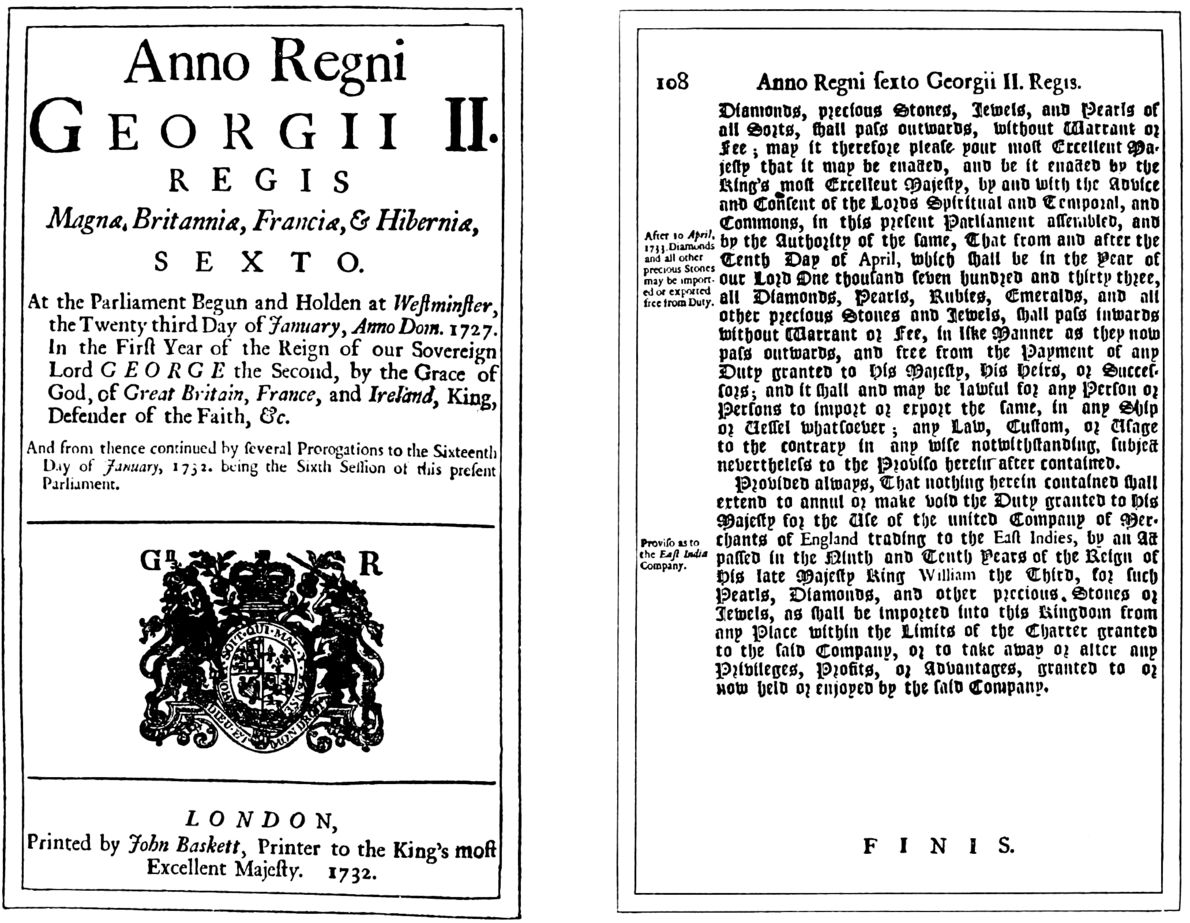
GEORGII II. REGIS Magnæ, Britanniæ, Franciæ, & Hiberniæ, SEXTO. At the Parliament Begun and Holden at Westminster, the Twenty third Day of January, Anno Dom. 1727. In the First Year of the Reign of our Sovereign Lord GEORGE the Second, by the Grace of God, of Great Britain, France, and Ireland, King, Defender of the Faith, &c. And from thence continued by several Prorogations to the Sixteenth Day of January, 1732, being the Sixth Session of this present Parliament. LONDON, Printed by John Baskett, Printer to the King’s most Excellent Majesty. 1732. 108 Anno Regni Sexto Georgii II. Regis. After 10 April, 1733, Diamonds and all other precious Stones may be imported or exported free from Duty. Diamonds, precious Stones, Jewels, and Pearls of all Sorts, shall pass outwards, without Warrant or Fee, may it therefore please your most Excellent Majesty that it may be enacted, and be enacted by the King’s most Excellent Majesty, by and with the Advice and Consent of the Lords Spiritual and Temporal, and Commons, in this present Parliament assembled, and by the Authority of the Same, That from and after the Tenth Day of April, which shall be in the Year of our Lord One thousand seven hundred and Thirty three, all Diamonds, Pearls, Rubies, Emeralds, and all other precious Stones and Jewels, shall pass inwards without Warrant or Fee, in the Manner as they now pass outwards, and free from the Payment of any Duty granted to his Majesty, his Heirs, or Successors; and it shall and may be lawful for any Person or Persons to import or export the same, in the Ship or Vessel whatsoever; and Law, Custom, or Usage to the contrary in any wise notwithstanding, subject nevertheless to the Proviso herein after contained. Proviso as to the East India Company. Provided always, That nothing herein contained shall extend to annul or make void the Duty granted to his Majesty for the Use of the united Company of Merchants of England trading to the East Indies, by an act passed in the Ninth and Tenth Years of the Reign of his late Majesty King William the Third, for such Pearls, Diamonds, and other precious Stones or Jewels, as shall be imported into this kingdom from any Place within the Limits of the Charter granted to the said Company, or to take away or alter any Privileges, Profits, or Advantages, granted to or now held or enjoyed by the said Company. FINIS.'
369The total value of diamonds and precious stones imported into the United States during the period from 1867 to 1906 inclusive, was as follows:
Glaziers’ (except 1873–83) $2,215,972
Dust 6,407,599
Rough or uncut (included with diamonds and other stones, 1891–96) 74,045,291
Set (not specified before 1897) 36,170
Unset (not specified before 1897) 124,615,662
Diamonds and other stones, not set 207,138,629
Set in gold or other metal 17,799
Pearls (from 1903) 7,809,261
Total $422,286,383
CLASSIFIED STATEMENT OF THE IMPORTS OF PEARLS INTO THE UNITED STATES FROM 1891 TO 1907 INCLUSIVE
Pearls Pearls, including pearls strung but not set Pearls in natural state, not strung or set Pearls split etc.
Year 10% 10% 10% 20%
1891 $11,711
1892 32,023
1893 6,926
1894 12,978
1895 $283,018
1896 583,214
1897 392,867
1898 $491,060 $205,998
1899 1,412,952 389,899
1900 1,163,382 432,528
1901 929,247 1,173,339
1902 1,896,322 1,314,368
1903 2,835,936 7,220
1904 1,680,615 2,908
1905 1,626,476
1906 2,072,561 218
1907 1,593,498
$63,638 $1,259,099 $15,702,049 $3,526,478
Note. Previous to 1891 pearls were classified with “jewelry and precious stones,” and it was not until 1895 that most of them were reported separately.
There are several things that are essential in pearl buying, and one of the most important of these is that the light in which the pearls are selected shall be absolutely pure daylight, with no reflections from the 370side or from above that can enhance or detract from the color of the pearl. This must be carefully considered, as it is not uncommon—more especially in certain parts of Europe—that jewelers have for their selling-offices rooms sumptuously fitted up with hangings of different colors, and sometimes with ground glass windows, provided with heavy silk hangings, so that artificial light becomes a necessity to make the article sold plainly visible. In absolutely pure daylight, more especially with an unclouded sky—on such days as are probably more frequent in the United States than in some of the European countries—it is possible to see the exact tint or color of the pearls; that is, whether it is really a pure white with a tinge of pink or an orient tending to cream-white, or whether it is more or less tinted with what is considered a crude or red color in a pearl. Besides this, in a pure light it is possible to see whether the pearl is brilliant, and to estimate the exact degree of its brilliancy; whether there are any cracks, scratches, or mars on the surface; and, lastly, whether the form is entirely regular. If one should select two necklaces, one absolutely perfect and the other having slight blemishes as to color or brilliancy, or with breaks, marks, or irregularities, these two necklaces would be scarcely distinguishable from each other in artificial light, or in daylight which had been partly confused with artificial light; although the differences between the two would signify that the former was worth two or three times as much as the latter.
At great receptions, large, and apparently magnificent pearls are frequently seen, which are really of inferior quality, and yet, owing to the absence of pure daylight, they can easily be mistaken for perfect specimens by any one not especially familiar with pearls. Indeed, if the royalties of Europe should wear all the pearls belonging to the crown jewels at the same time, in a palace or hall lighted with candles, gas, or even with some types of electric light, they would frequently seem to have a quality which many of them do not and never did possess. It is, therefore, essential for the buyer to use every precaution in reference to the light in which he examines his purchase. And we may add that it is just as essential that he should know the dealer from whom he buys; for, sometimes, after a few weeks or months, cracks or blemishes develop that were not apparent at first, more especially when the pearls have been “improved” for a prospective purchaser.
A test to ascertain the quality of pearls is quaintly expressed in a work published in 1778, as follows:
How to know good pearls. To discover the hidden Defects and Faults of a Pearl and to know whether she is speckled or broken or has any other imperfections, the best way is to make trial of it by the Reverberation of the 371Sun-beams; for by this means your eye will penetrate into the very Centre of the Pearl and discover the least defect it has; you will then see whether it be pure, or has any spots or not, and consequently you may the better guess its value.[415]
If you can cause a ray of sunlight or of electric light to fall on a pearl, the light will penetrate it and show any specks, inclosed blemishes or impurities. This can probably best be done by wrapping about the pearl a dark cloth of velvet or other material and having the ray fall slantingly, whereby the defects are much more clearly shown than if the ray be allowed to fall directly upon the gem.
A pearl necklace valued at $200,000, shown at one of our recent great expositions, was to all appearances a remarkably beautiful collection, and it was only when the intending purchaser took them from their velvet bed and held them in his hands that he realized that there was not a perfect pearl in the entire collection. It must have taken more than a week of study for the clever dealer to arrange them so that the best part, sometimes the only good part of each pearl, should be where the eye would fall upon it. After they had been turned in the hands a few seconds, not one perfect specimen was visible.
The demand for pearls has been so great, and the enhancement of value so rapid, that the greatest ingenuity has been employed in presenting the best part of the gems to view, as well as in many other ways. The result is that when pearls are to be used as borders or as a gallery on a comb or brooch, they are pierced in such a way that only the best side shall be outward, so that the general effect produced is that of a perfect row of pearls; but a careful examination may show that two thirds or three fourths of them are irregular, and bear abrasion marks, indentations, or other imperfections.
Following the analogy of the well-known precious stones—the diamond, the ruby, the sapphire, the emerald and those of less importance—the pearl is equally potent in creating great and permanent values for itself in catering to the human love of adornment; and though these large values may be greatly in excess of the original price that it commanded in the native oriental market, yet the increased valuation gives profitable livelihood to hundreds of thousands of persons. These embrace the dealers who sell the original pearls in lots, those who clean and treat them, others who drill and string them, and others again who handle them in setting jewelry of all kinds, and also the large number of dealers throughout the entire world who sell either the jewelry or the unmounted pearls. Directly connected 372with the industry in localities where the fisheries are pursued are a sufficient number of persons to populate a city the size of Boston, and to these we may safely add an equal number as herein noted, aggregating about 1,000,000 people whose livelihood is directly dependent upon the production and traffic of the pearl industry, and who for lack of it would be forced to seek some other employment. Brought thus to a concrete form, one may readily grasp the important bearing which the pearl has in a comprehensive estimate of the complexity of the world’s civilization as we know it to-day.
XIV
TREATMENT AND CARE OF PEARLS
375