X PEARL FISHERIES OF VENEZUELA
Reading edition
When I discovered the Indies, I said that they composed the richest country in the world. I spake of gold and pearls and precious stones, and the traffic that might be carried on in them.
Extract from Columbus’s Fourth Letter.
The Caribbean Sea furnishes one of the most interesting chapters in the history of the pearl fisheries. In no region of the world have these resources caused more rapid exploitation or affected the inhabitants to a greater extent than on the shores of Venezuela.
Before the discovery of America, the natives of this region collected pearls from the mollusks which they opened for food in times of necessity, and also sought them for ornamental purposes. And although they had large collections which they used for personal ornamentation and for decorating their temples, it does not appear that they prized them extravagantly, readily bartering them for small returns.
In Columbus’s account of his third and fourth voyages to America, he repeatedly refers to pearls. On the third voyage, in 1498, after passing the mouth of the Orinoco River, he entered the Gulf of Paria, where the natives “came to the ship in their canoes in countless numbers, many of them wearing pieces of gold on their breasts, and some with bracelets of pearls on their arms; seeing this I was much delighted and made many inquiries with the view of learning where they found them. They replied that they were to be procured in their own neighborhood and also at a spot to the northward of that place. I would have remained here, but the provisions of corn, and wine, and meats, which I had brought out with so much care for the people whom I had left behind, were nearly wasted, so that all my anxiety was to get them into a place of safety, and not to stop for anything. I wished, however, to get some of the pearls that I had seen, and with that view sent the boats on shore. I inquired there also where the pearls were 226obtained. And they likewise directed me to the westward and also to the north behind the country they occupied. I did not put this information to the test, on account of the provisions and the weakness of my eyes and because the ship was not calculated for such an undertaking.”
In his letter to one of the queen’s attendants, written in 1500, Columbus says, in justification of his conduct toward his miserable detractors: “I believed that the voyage to Paria would in some degree pacify them because of the pearls and the discovery of gold in the island of Española. I left orders for the people to fish for pearls, and called them together and made an agreement that I should return for them, and I was given to understand that the supply would be abundant.”
And again in the same letter, after speaking of a quantity of gold which mysteriously disappeared when Governor Bobadilla sent him and his brothers loaded with chains to Spain, he says: “I have been yet more concerned respecting the affair of the pearls, that I have not brought them to their Majesties.... Already the road is opened to gold and pearls, and it may surely be hoped that precious stones, spices, and a thousand other things will also be found.”
A more detailed account of Columbus’s pearling adventures, and of the subsequent discoveries and explorations on the Caribbean coast is given by Francisco Lopez de Gomara in his “Historia general de las Indias,” published in 1554, of which the following is a literal translation slightly abridged:
Since there are pearls on more than four hundred leagues of this coast between Cape Vela and the Gulf of Paria, before we proceed farther it is proper to say who discovered them. In the third voyage made by Christopher Columbus to the Indies, in 1498, having reached the island of Cubagua, which he called “Isle of Pearls,” he sent a boat with certain sailors to seize a boat of fishermen, to learn what people they were and for what they were fishing. The sailors reached the shore where the Indians had landed and were watching. A sailor broke a dish of Malaga ware and went to trade with them and to look at their catch, because he saw a woman with a string of rough pearls (aljofar) on her neck. He made an exchange of the plate for some strings of rough pearls, white and large, with which the sailors returned highly delighted to the ships. To assure himself better, Columbus ordered others to go with buttons, needles, scissors, and fragments of the same Valencian earthenware, since they seemed to prize it. These sailors went and brought back more than six marcs (forty-eight ounces) of rough pearls, large and small, with many good pearls among them. Said Columbus then to the Spaniards: “We are in the richest country of the world. Let us give thanks to the Lord.” They wondered at seeing all those rough pearls so large, for they had never seen so many, and could not contain their delight. They understood that the 227Indians did not care much for the small ones, either because they had plenty of large ones, or because they did not know how to pierce them.
Columbus left the island and approached the land, where many people had collected along the shore, to see if they also had pearls. The shore was covered with men, women, and children, who came to look at the ships, a strange thing for them. Many Indians presently visited the ships, went on board and stood amazed at the dress, swords, and beards of the Spaniards, and the cannon, tackle, and arms of the ship. Our people crossed themselves, and were delighted to see that all those Indians wore pearls on their necks and wrists. Columbus asked by signs where they fished them, and they pointed to the coast and island.
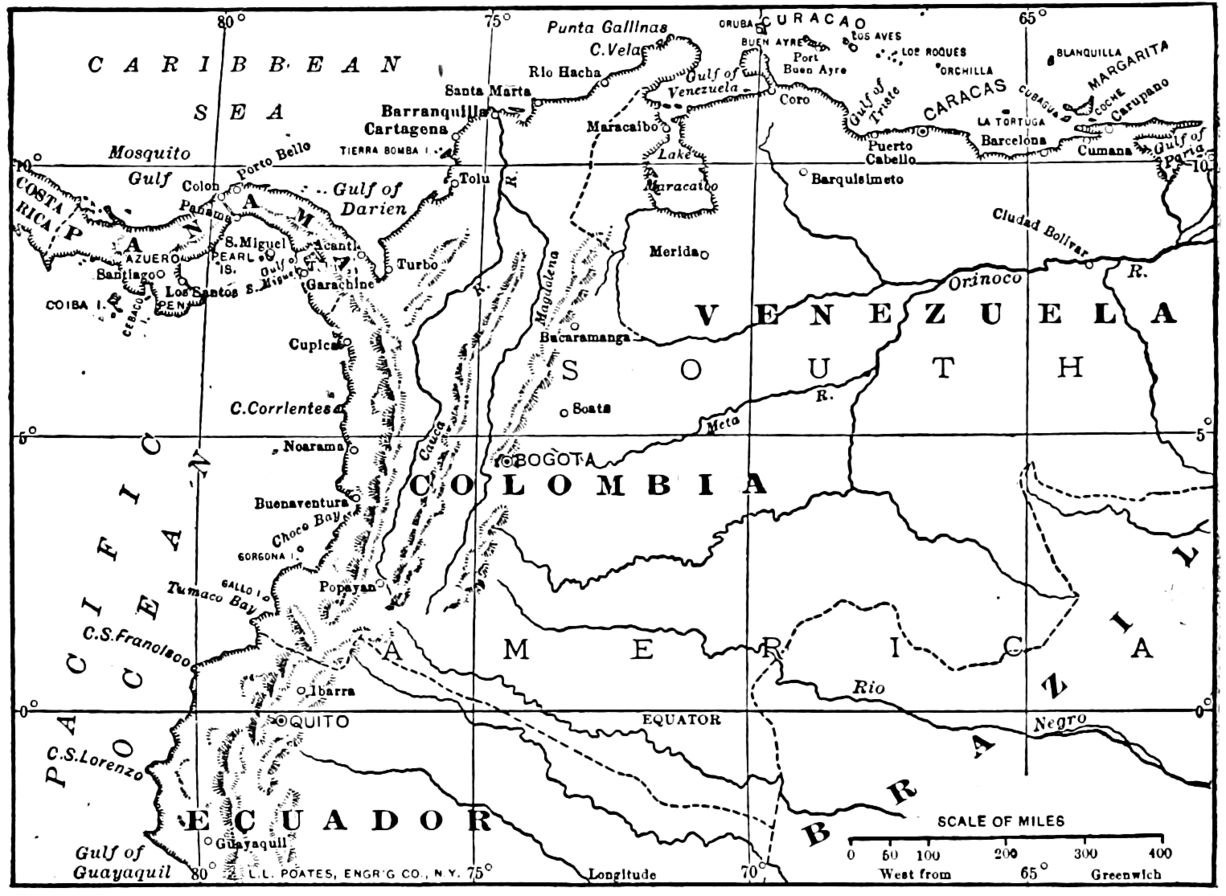
Venezuela and Panama; the principal pearling regions of South America
Columbus then sent to the shore two boats with many Spaniards, for greater certainty of those new riches, and because they importuned him. The chief took them to a place where there was a circular building that resembled a temple, where presently much bread and fruits of different kinds were brought. At the end of the feast he gave them pearls for sweetmeats, and took them afterward to the palace to see the women and the arrangement of the house. Of the numerous women there, not one was without rings of gold and necklaces of pearls. The Spaniards returned to the ships, wandering at such pearls and gold, and requested Columbus to leave them there. But he did not wish to do so, saying they were too few to settle. He hoisted 228sail and ran along the coast as far as Cape Vela, and from there came to Santo Domingo, with the intention of returning to Cubagua after regulating the affairs of the government. He suppressed the joy he felt at having found such treasures, and did not write to the king regarding the discovery of pearls, or at all events did not write it until it was already known in Castile. This was largely the cause for the anger of the king, and the order to bring Columbus a prisoner to Spain. They say that he did not so much intend to conceal this discovery from the king, who has many eyes, as that he thought by a new agreement to get this rich island for himself.
Of the sailors who went with Christopher Columbus when he found the pearls, the greater number were from Palos. As soon as these came to Spain, they told about the country of pearls, displayed many, and carried them to Seville to sell, whence they went to the court and into the palace. Excited by this report, some persons there hurriedly prepared a ship and made Pedro Alonso Niño its captain. He had from the Catholic king license to go in search of pearls and land, provided he should not go within fifty leagues of any discovered by Columbus.
Niño embarked in August, 1499, with thirty-three companions, some of whom had been with Columbus. He sailed as far as Paria, visited the coast of Cumana, Maracapan, Port Plechado, and Curiana, which lies united to Venezuela. There he landed, and a chief, who came to the coast with fifty Indians, conducted him amicably to a large town to take water, refreshments, and the barter he was in search of. He bartered for and secured fifteen ounces of pearls in exchange for pins, rings of horn and tin, glass beads, small bells, and similar trifles. The Spaniards stayed in the town twenty days, trading for pearls. The natives gave a pigeon for a needle, a turtledove for one glass bead, a pheasant for two, and a turkey for four. For that price they also gave rabbits and quarters of deer. The Indians asked to be shown the use of needles, since they went naked and could not sew, and were told to extract the thorns with them, for they went barefooted: Niño brought to Galicia ninety-six pounds of rough pearls, among which were many fine, round, lustrous ones of five and six carats, and some of more. But they were not well pierced, which was a great fault. On the route a quarrel arose over the division, and certain sailors accused Niño before the governor in Galicia, saying that he had stolen many pearls and cheated the king in his fifth, and traded in Cumana and other places where Columbus had been. The governor seized Niño, but did not keep him in prison very long, where he consumed pearls enough.[270]
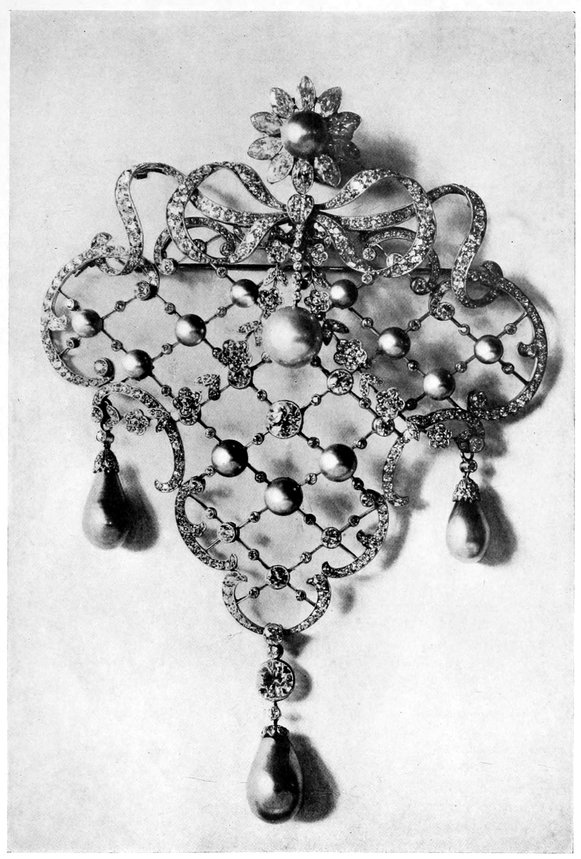
GRAY PEARLS FROM LOWER CALIFORNIA, AND DIAMONDS Pan-American Exposition, 1901
229This expedition of Pedro Alonso Niño was the first financially profitable voyage to America. After his return, the Cubagua pearl fishery became the object of numerous speculations, and many other Spaniards fitted out voyages, most of them sailing from Hispaniola or Haiti, nine hundred miles distant. Owing to the ill-treatment of the Indians and excessive cruelties toward them, much difficulty was experienced in securing divers. This was relieved in 1508 by transporting large numbers of Indians from the Lucayan or Bahama Islands and impressing them into the service. These were so expert in the work that individuals sold for upward of 150 ducats each.[271] With their aid the fishery prospered so greatly that in 1515 a settlement, called New Cadiz, was established on Cubagua Island by the governor of Hispaniola, Diego Columbus, son of the discoverer. This small island was dry and desolate, without water or wood, which were brought from the mainland twenty miles distant, or from Margarita Island about three miles to the northward.
An interesting description of the manner of securing the pearls by these early adventurers was given by Gonzalo Fernandez de Oviedo y Valdes (1478–1557) in his “Historia natural y general de las Indias,” written less than thirty years after the discovery of the mainland of America. A translation of this book was published in 1555 by Richard Eden in his “Decades of the New World”; from which we extract the following account, the retention of Eden’s quaint phraseology seeming permissible owing to this being one of the very earliest books on America.
Of the maner of fyshynge for perles
The Indians exercise this kynde of fyschynge for the moste parte in the coastes of the North in Cubagua and Cumana. And manye of theym which dwell in the houses of certeyne particular lordes in the Ilandes of San Dominico and Sancti Iohannis, resort to the Ilande of Cubagua for this purpose. Theyr custome is to go fyve, syxe, or seven, or more in one of theyr Canoas or barkes erly in the mornynge to sume place in the sea there about where it appeareth unto them that there shulde bee greate plentie of those shell fyshes (which sume caule muscles and sume oysters) wherein perles are engendered. And there they plonge them selves under the water, even unto the bottome, savynge one that remaynethe in the Canoa or boate which he keepeth styll in one place as neare as he can, lookynge for theyr returne owte of the water. And when one of them hath byn a good whyle under the water, he ryseth up and commeth swymmynge to the boate, enterynge into the same, and leavynge there all the oysters whiche he hath taken and brought with hym. For in these, are the perles founde. And when he hathe there rested hym selfe a whyle, and eaten parte of the oysters, he returneth ageyne to the water, where he remaynethe as longe as he can endure, and then ryseth ageyne, and swimmeth to the boate with his pray, where he resteth hym as before, and thus continueth course by course, as doo all the other in lyke maner, being all moste experte swymmers and dyvers. And when the nyght draweth neare, they 230returne to the Ilande to theyr houses, and presente all the oysters to the master or stewarde of the house of theyr lorde who hath charge of the sayde Indians. And when he hath gyven them sumwhat to eate, he layeth up the oysters in safe custodie untyll he have a great quantitie thereof. Then hee causeth the same fyssher men to open them. And they fynde in every of them pearles other great or smaul, two or three or foure, and sumtymes five and syxe, and many smaule graines accordyng to the lyberalitie of nature. They save the pearles bothe smaule and great whiche they have founde: And eyther eate the oysters if they wyl, or caste them away, havynge so great quantitie thereof that they in maner abhorre them. Those oysters are of hard fleshe, and not so pleasant in eatyng as are owres of Spayne. This Ilande of Cubagua where this manner of fysching is exercised, is in the Northe coaste, and is no bygger then the Iland of Zelande. Oftentymes the sea encreaseth greatly, and muche more then the fyshers for pearles wold, bycause where as the place is very depe, a man can not naturally rest at the bottome by reason of the aboundaunce of aery substannce whiche is in hym, as I have oftentymes proved. For althoughe he may by vyolence and force descende to the bottome, yet are his feete lyfted up ageyne so that he can continue no tyme there. And therefore where the sea is verye deepe, these Indian fyshers use to tye two great stoones aboute them with a corde, on every side one, by the weyght whereof they descend to the bottome and remayne there untyl them lysteth to ryse ageine: At which tyme they unlose the stones, and ryse uppe at their pleasure. But this their aptenesse and agilitie in swimming, is not the thynge that causeth men moste to marvaile: But rather to consyder how many of them can stande in the bottome of the water for the space of one hole houre and summe more or lesse, accordynge as one is more apte hereunto then an other. An other thynge there is whiche seemeth to me very straunge. And this is, that where as I have oftentymes demaunded of summe of these lordes of the Indians, if the place where they accustomed to fysche for pearles beynge but lyttle and narrowe wyll not in shorte tyme bee utterly without oysters if they consume them so faste, they al answered me, that although they be consumed in one parte, yet if they go a fyschynge in an other parte or on another coaste of the Ilande, or at an other contrary wynd, and continue fysshing there also untyll the oysters be lykewyse consumed, and then returne ageyne to the fyrste place, or any other place where they fysshed before and emptied the same in lyke maner, they find them ageine as ful of oysters as though they had never bin fysshed. Wherby we may judge that these oysters eyther remove from one place to an other as do other fysshes, or elles that they are engendered and encrease in certeyne ordinaire places. This Iland of Cumana and Cubagua where they fyshe for these perles, is in the twelfe degree of the part of the said coaste which inclineth toward the North.
The cupidity of the proprietors of the fishery led to most cruel treatment of the divers and, if the accounts of the time are to be relied upon, a large percentage of them died under the harsh regime. About 2311515 the unfortunate natives obtained an earnest and influential advocate in Bartolomé de las Casas, who, in 1516, prevailed upon the youthful Charles V to decree that the fishery should be prosecuted only in summer, that the divers should not be required to work more than four hours a day where the depth exceeded six fathoms, that they should receive good nourishment and half a quart of wine daily, should have hammocks or beds in which to sleep, and should be provided with clothes to put on as soon as they left the water.[272] And by later ordinances it was stipulated that death should be inflicted on any one forcing a free Indian to dive for pearls.
In 1528 the resources of Coche Island were exploited with so much success that within six months “1500 marcs (12,000 ounces) of pearls” were secured. Pearl banks were successively found at Porlamar, Maracapana, Curiano, and at various places on the coast from the Gulf of Paria to the Gulf of Coro, a distance of over five hundred miles, which became designated the “Pearl Coast.” For a number of years previous to 1530, the output exceeded in value 800,000 piastres annually, approximating one half the produce of the American mines at that time.[273] It was largely these pearls that enriched the cargoes of many of those famous caravels that crossed the Atlantic to Spain. Indeed, for several decades, America was best known in continental Europe as the land whence the pearls came.
An interesting account of an early effort to use dredges in the Cubagua pearl fishery was given by Girolamo Benzoni, who had lived in America from 1542 to 1555, and was familiar with the conditions. He states:
“At the time the pearl fishery flourished on this island there came here one Louis de Lampugnan with an imperial license authorizing him to fish such quantities of pearls as he pleased within all the limits and bounds of Cubagua. This man set out from Spain with four caravels loaded with all the necessary provisions and munitions for such an enterprise, which some Spanish merchants furnished him. He had made a kind of rake, the fashion of which was such that in whatever part of the sea it was used, not an oyster would escape. At the same time he would have raked and drawn out all that bore pearls if he had not been disappointed. But the Spaniards in Cubagua all banded against him in the execution of his privilege. They said the emperor was too liberal with other people’s goods, and if he wished to give he might give his own as he wished. As for themselves they had conquered and kept that country with great labor and at the peril of their lives, and there were far better reasons why they should enjoy it than a stranger. Poor Lampugnan, seeing that his patents did not avail him the value of a straw, and at the same time not daring to return to Spain, partly through fear of being ridiculed and 232partly on account of the money he owed, was ruined. In fact, the business and its anxieties drove him crazy and he was exposed to the mockery of all the world as a lunatic. In the end, after dragging out five years in this miserable condition, he died in this isle of Cubagua.”[274]
The average size of these pearls derived from the Venezuelan fisheries was small, specimens rarely exceeding twenty grains. In 1577, Urbain Chauveton wrote: “The pearls of Cubagua are mostly 2, 3, 4, and 5 carats. But the quantity of them is so great that the fifth part which is paid to the king of Spain yields every year the value of more than 15,000 ducats; this besides the frauds committed and the pearls which stick to the fingers of those who manage the business, and who pilfer the most beautiful in great numbers, sending them here and there for sale. They place themselves in great danger if the facts become known, but they do it all the same.”[275]
The enormous demands made by the Spaniards soon had its effect on the resources, for Chauveton adds: “It is apparent they decrease and not so many are found as in the beginning. The reason for this is that the Spaniards are so eager to gather large quantities of them quickly that they are not content to use their divers to search for them in the depths of the sea, but they have conceived and invented I know not how many machines of rakes and drags to scrape up everything. In fact they have at times collected them all so that another could not be found, and have had to abandon their fishing for a considerable time to give the oysters a chance to lay their eggs and grow their pearls.”[276]
The decrease noted by Chauveton was probably not very serious, for the Spanish historian, Jose de Acosta, reports that in 1581 he saw “the note of what came from the Indies for the king; there were 18 marcs of pearles, besides 3 caskets; and for private persons there were 1265 marcs, and besides them, 7 caskets not pierced, which heretofore we would have esteemed and helde for a lie.”[277] Also the records show that in 1597 Spain received from the Venezuelan fisheries “350 pounds’ weight of pearls.” It is to be regretted that the Spaniards so frequently reported the yield of pearls by pounds’ weight, for—owing to the great variation in quality—this is about as unsatisfactory as to report the wealth of an individual by the pounds’ weight of his title-deeds or of his stock certificates. The value of “350 pounds of pearls” might have been anywhere from twenty thousand dollars to as many millions. Assuming that all were two grains each in weight and of 233good quality, the total value would approximate $600,000 according to the valuation of that period; and on a basis of eight grains each, it would be $9,600,000, or sixteen times as much. But as original parcels of pearls from the fisheries, these figures should be divided by three.
Following 1597, the productiveness of the Cubagua beds rapidly decreased. By acts of cruelty and oppression the Spaniards had converted the surviving Indians into deadly foes, ready to take advantage of any opportunity to avenge themselves on their oppressors, and thus terrifying the settlers into abandoning the enterprise. Early in the seventeenth century the development of mining resources in Mexico, Peru, etc., attracted the adventurous Spaniards. A considerable decrease in the value of pearls, brought about by the skilful manufacture of imitations at Venice, and elsewhere in southern Europe, also affected the prosperity of the fisheries. As a result of these combined influences, the output in Venezuela was greatly reduced, and it ceased long before the close of the following century. Thus ended an enterprise which, for a number of years, represented the greatest single industry of the European people on the American continent.
According to General Manuel Laudecta Rosales, the Venezuela archives contain no reference to any renewal of the fishery until early in the nineteenth century. At the time of Humboldt’s visit in 1799, the fishery was entirely neglected around the islands of Margarita, Cubagua, and Coche, and the only evidence of pearls was a few very insignificant ones picked up about Cumana and sold among the natives at a piaster per dozen.[278]
After the overthrow of Spanish authority on this coast, Messrs. Rundell, Bridge and Rundell, a firm of well-known goldsmiths of London, obtained, in 1823, from the government of Colombia, a ten-year monopoly of the fishery at several places on the coast of the new republic, in consideration of one fifth of the pearls secured.[279] After the independence of Venezuela in 1829, the taxes imposed were so heavy that the industry languished, and about 1833 it was practically abandoned.
Owing to the improved physical condition of the reefs, the fishery developed largely in 1845; and for several years an average of 1600 ounces of pearls were secured, an ounce of good quality selling for 150 to 500 bolivars (one bolivar = 19½ cents), and the inferior quality at 80 to 100 bolivars.[280] At that time there was a tax of sixteen bolivars per boat monthly. In 1853 this was increased to forty-eight bolivars per boat, and the use of dredges (arrastras) was interdicted, 234soon reducing the fishery to a very low stage. Subjected to frequent changes in regulations, and burdened by heavy taxes, the industry remained in poor condition until about 1895. Since then the enhanced value of pearls, and the increased industrial activity on the coast, has resulted in a very large development of the fishery.
In recent years the government of Venezuela has granted concessions to individuals and to companies for the exploitation of defined areas for a limited period, exacting 10 per cent. royalty on the proceeds of the enterprise. In granting these concessions, the government usually reserves the right to examine the books, and to intervene when necessary in any phase of the enterprise. For protecting its revenue, the government requires that shipments of the pearls must be signed by its agent, and bills of sale must be countersigned by the Venezuelan consul in the place where the sales are consummated.
The Venezuelan pearl fishery now gives employment to about 350 boats, manned by five or six men each, sailing from the ports of Juan Griego, Cumana, and Carupano. These are sail craft, measuring from two to fifteen tons each, and are licensed by the Venezuelan authorities at a charge of 15 bolivars ($2.92) each. Most of the boats use dredges, but some of them resort to nude diving, after the manner of the sixteenth century. Attempts have been made to use the scaphander, or diving armor, but without success, owing largely to the difficulty in obtaining experienced workmen, and also to local prejudice against this form of fishery. It is claimed that in using the scaphander, all oysters are removed from the reefs, whereas the arrastra or dredge spreads the oysters and thereby enlarges the reefs. This is the principal and, except those at Sharks Bay and the Sulu Islands, the only important pearl fishery in which the oysters are secured by means of dredges. These are made of iron and are similar to those implements used in the scallop fisheries of New York and Rhode Island. They are dragged over the beds, and when filled are lifted and their contents emptied into the boat, the fishermen culling out the desirable oysters from the mass and throwing the refuse material overboard.
The pearl-oyster (Margaritifera radiata) secured on the coast of Venezuela is closely related to the Ceylon species. It averages slightly larger in size, and there is a much greater range in coloration. The pearls are of good quality. In color they range from white to bronze, and occasionally a so-called black one is found. The total output is valued locally at about 1,750,000 francs ($350,000) per year. Most of them are sold in Paris.
Owing to their small size and lack of thickness, the shells of the Venezuela pearl-oyster are of little or no value in the mother-of-pearl 235trade. Thousands of tons of them, the accumulations of scores of fisheries, lie in heaps and ridges along the coast, as though in years long past vast armies of oysters, engaged in deadly combat, had left their innumerable myriads of slain comrades to bleach on the shores.
THE PANAMA PEARL FISHERIES
The bordring Ilands, seated here in ken,
Whose Shores are sprinkled with rich Orient Pearle,
More bright of hew than were the Margarets
That Caesar found in wealthy Albion.
Robert Greene, Orlando Furioso (1594).
From the point of view of the Spaniards of his day, the greatest result of Balboa’s immortal journey in 1513 across the Isthmus of Panama to the broad waters of the Pacific, was the discovery of the pearl resources of the Gulf of St. Michael, now known as the Gulf of Panama. Probably the best description of this is given by Lopez de Gomara in his “Historia general de las Indias,” published in 1554, from which we translate the following account.
After Balboa had reached the Pacific in 1513, he proceeded a short distance along the coast until he met with an Indian chief by the name of Tomaco. Being questioned about the gold and pearls which some of his people wore, Tomaco sent for some gold and 240 large pearls and a great number of small ones—a rich present, which filled the Spaniards with pleasure. Seeing the Spaniards so delighted, Tomaco ordered some of his men to go and fish for pearls. These went and in a few days obtained 64 ounces, which also he gave them. The Spaniards were surprised to see such pearls, and that their owners did not value them; they not only gave them away, but their paddles were decorated therewith, for the principal income and wealth of these chiefs was the pearl fishery. Tomaco told Balboa that these riches were nothing in comparison with those of Tararequi, which had pearls larger than a man’s eye, taken from oysters the size of sombreros. The Spaniards wished to go there at once, but fearing another tempest, left it for their return. They dismissed Tomaco and rested in the country of Chiape, who, at the request of Balboa, sent thirty of his men to fish. These did it in the presence of seven Spaniards, who looked on and saw them take six loads of small shells. As it was not the season for that fishery, they did not go into very deep water where the shells were. Not only did they not fish in September and the following months, but they did not even travel by 236water, on account of the stormy weather which then prevails in that sea. The pearls which they extracted from those shells were like peas, but very fine and white. Of those received from Tomaco, some were black, others green, blue, and yellow.
On the return of Balboa’s expedition to Darien in 1514, the sight of the pearls and the wonderful reports made by the men, caused his successor, Pedrarias, to fit out another expedition, an account of which we likewise translate from Gomara.
By command of Pedrarias, Gaspar de Morales went in the year 1515 to the Gulf of St. Michael, with 550 Spaniards, in quest of the island of Tararequi, which was said by Balboa’s men to be so abundant in pearls and so near the coast. The chief of that island sallied forth with many people to prevent his entrance, and clamored and fought three times with our people on equal terms, but the fourth time he was defeated. He then made friends, carried the chief of the Spaniards to his house, which was a large and good one, gave him food to eat, and a basket of pearls which weighed 110 marcs [880 ounces]. The chief received for them some looking-glasses, stringed beads, bells, scissors, axes, and small wares of barter, which he valued more than he had the pearls. He promised to give as tribute to the emperor, in whose guardianship he placed himself, 100 marcs of pearls every year. With these the Spaniards returned to the Gulf of St. Michael and from thence to Darien.
Tararequi is within five degrees of the equator. It possessed a great fishery for pearls, which are the largest and best of the new world. Many of the pearls which the cacique gave were like filberts, others like nutmegs, and there was one of 26 and another of 31 carats, pear-shaped, very lustrous, and most perfect, which Peter of the Port, a shop-keeper, bought of Gaspar de Morales for 12,000 castilians. The purchaser could not sleep that night for thinking on the fact that he had given so much money for one stone, and so he sold it the very next day to Pedrarias de Avila, for his wife Donna Isabel de Bovadilla, at the same price, and afterwards the Bovadilla sold it to Donna Isabella the Empress.
Pedrarias, who delighted in such fishery, requested the cacique to make his men fish for pearls in the presence of the Spaniards. The fishermen were great swimmers and divers, and seemed to have spent all their lives in that employment. They went in small boats when the sea was calm, and not in any other manner. They cast a stone for an anchor from each canoe, tied by strong, flexible withes like boughs of the hazel. They plunged to search for oysters each with a sack or bag at the neck, and returned loaded with them. They entered four, six, and even ten fathoms of water, for the shell is larger the deeper they go, and if at times the larger ones come in shallow water it is through storms, or because they go from one place to another in search for food, and having found their pasture they stay there until they have finished it. They perceive those who search for them, and stick so close to the rocks or ground, or one to another, that much strength is needed to detach them, and many times the fishermen cannot raise them and leave them, thinking they are stones. In this fishery many persons are drowned, either by remaining too long at the bottom, or because they become entwined or entangled in the cord, or such carnivorous fish as the shark devour them. This is the manner of fishing pearls in all the Indies, and many fishermen die from the dangers aforesaid, and from the excessive and constant labor, the little food, and the maltreatment they have. The emperor was led to enact a law among those whom Blasco Nunez Vela brought, which imposed the penalty of death upon him who should forcibly compel any free Indian to fish for pearls. He thought more of the lives of the men than of his interest in pearls, though they were of great value. The law was worthy of such a prince and of perpetual memory.[281]
237
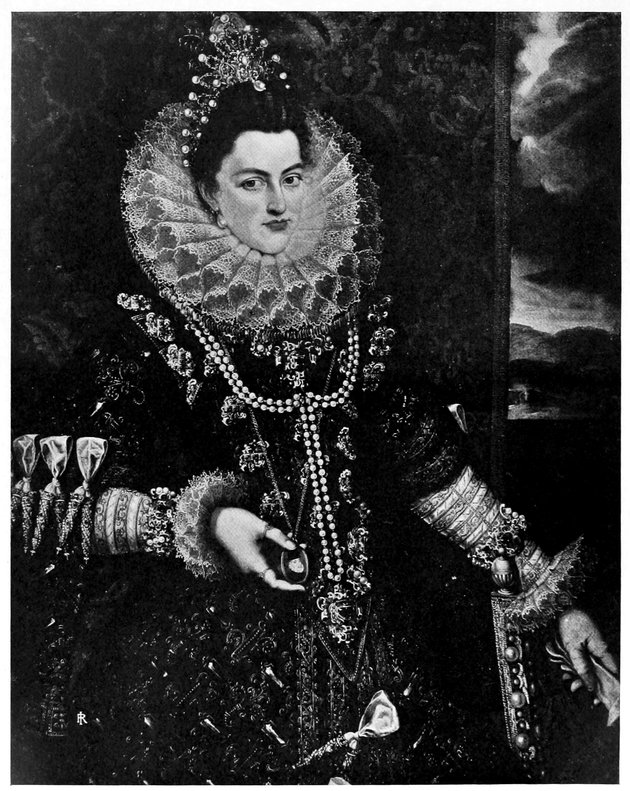
CLARA EUGENIA, DAUGHTER OF PHILIP II Painting by Gonzales, in the Galeria del Prado, Madrid Most of these pearls were doubtless from the early American fisheries
238Gonzalo de Oviedo referred to the pearl resources of Panama in his “Historia natural de las Indias,” Toledo, 1526, mentioned in the chapter on pearl fisheries of Venezuela. After describing the resources of Cubagua and Cumana on the Venezuelan coast, he states, according to Eden’s quaint translation:
Lykewise pearles are founde and gathered in the South sea cauled mare del sur. And the pearles of this sea [the Caribbean coast] are verye bygge. Yet not so bigge as they of the Ilande of pearles cauled de las perlas, or Margaritea, whiche the Indians caule Terarequi, lying in the gulfe of saincte Michael, where greater pearles are founde and of greater price then in any other coaste of the Northe sea, in Cumana, or any other porte. I speake this as a trewe testimonie of syght, havyng byn longe in that South sea, and makynge curious inquisition to bee certenly informed of all that perteyneth to the fysshvnge of perles. From this Ilande of Tararequi, there was brought a pearle of the fasshyon of a peare, wayinge xxxi carattes, which Petrus Arias had amonge a thousande and soo many poundes weight of other pearles which hee had when capitayne Gaspar Morales (before Petrus Arias) passed to the saide Ilande in the yeare 1515, which pearle was of great prise. From the saide Ilande also, came a great and verye rounde pearle, whiche I brought owte of the sea. This was as bygge as a smaule pellet of a stone bowe, and of the weight of xxvi carattes. I boughte it in the citie of Panama in the sea of Sur: and paide for it syxe hundredth and fyftie tymes the weyght therof of good gold,[282] and had it thre yeares in my custodie: and after my returne into Spaine, soulde it to the erle of Nansao, Marquisse of Zenete, great chamberleyne to youre maiestie, who gave it to the Marquesse his wyfe, the ladye Mentia of Mendozza. I thyncke verely that this pearle was the greatest, fayrest, and roundest that hath byn seene in those partes. For youre maiestie owght to understande that in the coaste of the sea of Sur, there are founde a hundredth great pearles rounde after the fasshyon of peare, to one that is perfectly rounde and greate. This Iland of Terarequi which the Christians caule the Ilande of pearles, and other caule it the Ilande of floures, is founde in the 239eyght degree on the southe syde of the firme lande in the provynce of golden Castyle or Beragua. (Arber, “The First Three English Books on America,” Birmingham, 1885.)
In addition to the gems noted by Oviedo, these waters furnished many other beautiful pearls in the sixteenth century, and added largely to the collections of the Spanish court and of the cathedrals of Seville, Toledo, etc. The Italian traveler, Gemelli-Careri, who visited the Panama fisheries in 1697, reported that they yielded pearls equal to those of Ceylon. He mentioned one weighing 60 grains, for which the owner—a Jesuit priest—refused 70,000 pesos.[283]
In 1735, the Spanish admiral, Antonio de Ulloa visited the Panama pearl fisheries and wrote an extended description of them.[284] According to his account the pearls were then found in such plenty that there were few slaveholders in the vicinity who did not employ at least a portion of their Negroes in the fishery. These were selected for their dexterity in diving, and were sent to the islands in gangs of from eight to twenty men each, under the command of an overseer. They lived in temporary huts on the shore, and visited the pearl reefs in small boats. Anchoring in eight or ten fathoms of water, the Negroes would, dive in succession to the bottom, returning with as many oysters as possible. It was laborious work, attended with danger owing to the numerous sharks.
Every one of these Negro divers is obliged daily to deliver to his master a fixed number of pearls; so that when they have got the requisite number of oysters in their bag, they begin to open them, and deliver the pearls to the officer, till they have made up the number due to their master; and if the pearl be but formed, it is sufficient, without any regard to its being small or faulty. The remainder, however large or beautiful, are the Negro’s own property, nor has the master the least claim to them, the slaves being allowed to sell them to whom they please, though the master generally purchases them at a very small price.... Some of these pearls, though indeed but few, are sent to Europe, the greater part being carried to Lima, where the demand for them is very great, being not only universally worn there by all persons of rank, but also sent from thence to the inland portions of Peru.[285]
During the hundred years following, the pearl reefs of Panama were not very productive, and relatively little attention was paid to them. The development of a market for the shells in the mother-of-pearl trade, about 1840, enhanced the profits of the few natives engaged in 240pearling in a desultory manner, and led to an increase in the number of fishermen. During some years when industrial and market conditions were favorable, large quantities of shells were exported. In 1855, for instance, 650 tons of these shells were shipped to England alone, and in 1859 the reported quantity was 957 tons. Those from the Island of San José, one of the Pearl Archipelago, were said to be the largest and choicest in the bay. Many of them were used in decorating the twin towers of the stately old cathedral at Panama.
Since then the industry has fluctuated greatly, depending on the market for the shell. Many outsiders have experimented in the fishery, but most of these attempts have resulted in financial loss, through mismanagement, storms, sickness, or other causes. A story is told locally of a party of thirty men, principally from Scotland, who arrived at Panama equipped with a diving-bell and such necessary machinery as air-pumps, windlasses, etc. Much was expected of their operations, but soon yellow fever broke out among them, and within six weeks two thirds of the members of the party had died. The remaining members, becoming disheartened, and in fear of the dread disease, lost no time in leaving the country. The diving-bell and machinery remained for several years as a curiosity at Panama, for no one returned to claim them, nor has the use of similar apparatus been attempted since then.
The scattered pearl reefs extend from the east side of the Bay of Panama nearly to the Costa Rica boundary. However, this gives an exaggerated idea of their area, as much of this territory yields no pearl-oysters whatever. The principal reefs and the headquarters of the fishery are at Archipelago de las Perlas or Pearl Islands, which are from thirty to sixty miles southeast of the Pacific terminus of the projected Panama Canal. This archipelago contains sixteen small islands, on which are about twice that number of small settlements of Negro and Indian descendants, with a total population of perhaps one thousand. About half of these live on Isla del Rey, the largest island, about fifteen miles long and half that in width. The chief village, San Miguel, is the center of the pearling industry, and consists mostly of palm-thatched huts and a handsome stone church, more costly than all the remaining buildings of the town combined. While the soil is fertile and some vegetables are raised, the inhabitants depend almost wholly on the fisheries.
In 1901, the Republic of Colombia invited bids for the right to operate the pearl and coral fisheries for a term of fifteen years, but nothing seems to have come of it, and the establishment of the Panama Republic in 1903 terminated the authority of Colombia in these resources.
241The Panama fisheries differ widely in their character from those of Venezuela. The mollusk is much larger, averaging about six inches in diameter when fully grown, thus furnishing a valuable quality of mother-of-pearl. The shell constitutes the principal object of the fishery; the pearls themselves are of incidental importance, but are always looked for and anxiously expected.
The season extends from May to November, with a rest during the remaining five months of the year. The fishery is open to natives and to foreigners alike. While the leading fishermen employ diving-suits, which were introduced here about 1890, nude diving is yet practised to a considerable extent, the men descending in eight or ten, and some even in twelve fathoms of water. There is no restriction whatever on the nude fishermen, but for each machine diver an annual license fee of $125 United States currency is exacted.
Owing to the low market price for Panama shell during recent years, the fishery has not been vigorously prosecuted, and it has even dwindled to low proportions. A letter from one of the leading pearling companies in Panama states that the machine divers number about twenty, while there are about four hundred nude fishermen; and another firm likewise prominent, estimates these fishermen at twenty and three hundred respectively.
Yet a third pearling company writes that there are fifteen machine divers and two hundred head divers; and adds that the small demand for this quality of mother-of-pearl has made the condition of the industry about as bad as it could be; many who have capital invested are getting out of the business, and unless the market improves, the industry may be abandoned. Probably with the introduction of new capital and methods in the infant republic, the pearl resources may receive greater attention and a large development ensue.
The Panama pearls are of good quality and frequently of large size. In color they range from white to green and lead-gray, and frequently greenish black. Valuable pearls are not common, but occasionally the fisherman is amply rewarded. A letter from the American consul at Panama states that in 1899 a native boy, fifteen years old, fishing in shallow water, as much for sport as for profit, found a pearl which he sold to a local speculator for 4000 silver dollars ($1760); this speculator delivered the same pearl to a dealer in Panama for 10,000 silver dollars ($4400), and an offer of 30,000 francs was refused for it later in Paris. A pearl worth $2400 was reported as found within half a mile of the steamship anchorage at Panama. A pearl from a giant oyster resembling Tridacna, was an absolute egg-shape, pure cocoanut white, and weighed 169 grains; it was 21 mm. at the longest and 16.5 mm. at the narrowest part. The 242surface showed very distinctly a wavy structure, occasionally with a tiny, brighter central point; the surface under the glass resembling a honeycomb network. At the smallest point there was a radiated center with quite a brilliant field. It was worth only $100.
Not always, however, does the poor, ignorant fisherman receive the full value of his find; and many a story is told of some thoughtless improvident native, who, for less than a mess of pottage, “like the base Indian, threw a pearl away, richer than half his tribe.”
Most of the Panama pearls are sold in Paris, relatively few of them coming to America direct. This is not because of any greater estimation of them in Paris or higher prices obtained; but the trade relation has been long continued and the credits are well established. From Paris many of these pearls reach the American market.
THE PEARL FISHERIES OF MEXICO
Then, too, the pearl from out its shell,
Unsightly in the sunless sea,
(As ’twere a spirit, forced to dwell
In form unlovely) was set free,
And round the neck of woman threw
A light it lent and borrowed too.
Thomas Moore, The Loves of the Angels.
Pearl-bearing oysters are found at various places on the Pacific coast of Mexico, and especially along the coast of Lower California, where extensive fisheries are prosecuted. The pearls are noted for the great variety of colors which they display. A large percentage are black, others are white, brown, peacock green, etc. Generally they are small and of irregular form, yet sometimes very large ones are secured, weighing 100, 200, and even 300 grains.
European knowledge of the pearl resources of Mexico dates from the conquest of that country by Hernando Cortés about 1522. The diary of his lieutenant, Fortuno Ximines, tells of finding native chiefs living in primitive huts along the sea-shore, with quantities of beautiful pearls lying carelessly around. From a tribe near the present site of Hermosillo, in the State of Sonora, Cortés secured great quantities of the gems. It appeared that the fishery had been in existence for centuries. The location of the pearl reefs was prominently noted on Cortés’ map of this coast, made in 1535, a copy of which was procured by the Rev. Edward E. Hale when in Spain in 1883.
243Following Cortés’ explorations of the Pacific coast of Mexico (1533–1538), a number of expeditions were fitted out for securing pearls by trading with the natives, by forcing them to fish, and by even more questionable means. Several of these expeditions found record in history either by reason of their unusual success or through the extreme cruelty with which they were conducted. The contact of the Spaniards with the Indians resulted in very bitter feelings on the part of the latter, so that it became risky for small traders to venture among them. From time to time, successful expeditions were made, especially the one of 200 men sent in 1596 by the viceroy of Mexico to “the rich Isles of California,” mentioned by Teixeira.[286] Antonio de Castillo, a Spanish colonist, with headquarters south of Mazatlan, was one of the most successful of the early adventurers, and Iturbide Ortega and José Carborel were also among the fortunate ones of that period.[287] Ortega marketed his pearls in the city of Mexico, and the reported sale of one for 4500 dollars had considerable effect in stimulating the industry.
The advent of the Jesuits to western Mexico in 1642, developed amicable relations with the Indians; and although the missionaries were agriculturists rather than fishermen, the restoration of harmony resulted in a more favorable prosecution of the fisheries. The colonists of Sinaloa and Nueva Galicia, who had formerly, in small vessels and with great danger, made occasional visits to the pearl beds, built larger vessels and made more frequent visits without apprehension. The skilful Yaqui and Mayo Indians were employed or impressed as divers, just as natives of the Bahamas had served in the fisheries of Venezuela. Great profits resulted from the operations. Venegas wrote that “it was certain that the fifth of every vessel was yearly farmed for 12,000 dollars.”[288]
So profitable was the fishery that the Spanish soldiers and sailors stationed in the Gulf of Cortes—as the Gulf of California was then called—were frequently charged with devoting more attention to pearling than to their official duties. In order to put a stop to this evil, in 1704, Father Silva-Tierra, who was in authority in that part of the country, ordered that no soldier or sailor should engage in the fishery. With a view to removing the demoralizing influences of promiscuous adventurers among the Indians, the industry was later restricted to persons specially authorized.
Probably the most successful of the early pearlers was Manuel 244Osio, who is credited with having marketed “127 pounds’ weight of pearls in 1743,” and “275 pounds’ weight” in 1744.[289] He operated in the vicinity of Mulege and northward, employing the Yaqui Indians; and through his pearling interests is said to have become the richest man in Lower California.
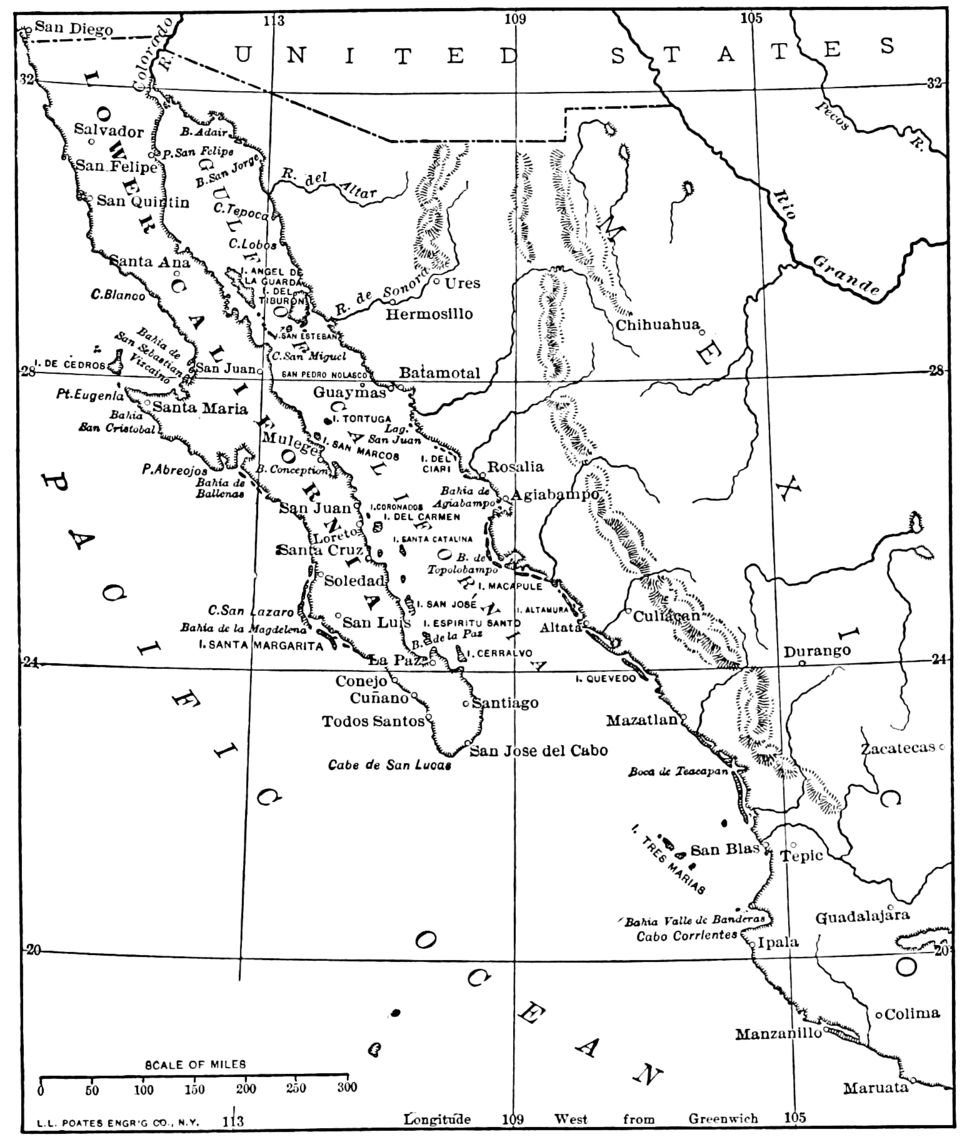
Gulf of California and the pearling territory of western Mexico
The revenue from the royal fifth, somewhat later, was reported by 245Alvarado[290] at 12,000 dollars per year; but this was disputed by Jacob Baegert, a Jesuit priest. Baegert spent seventeen years in Mexico and, returning to Europe on the expulsion of his order from that country in 1767, published a report in 1772, containing rather an unfavorable view of the fishery. He stated that each summer eight, ten, or twelve poor Spaniards from Sonora, Sinaloa, and elsewhere on the mainland, crossed the gulf in small boats to the California shore for the purpose of obtaining pearls. They carried supplies of Indian corn and dried beef, and also a number of Indians who served as divers, the Spaniards themselves showing little inclination to engage in the work when native fishermen could be employed so cheaply. Provided with a sack for receiving the oysters which they removed from the bottom, the fishermen dived head first into the sea, and when they could no longer hold their breath they ascended with the gathered treasure. The oysters were counted before opening; and, when the law was complied with, every fifth one was put aside for the king’s revenue. Most of the oysters yielded no pearls; some contained black pearls, others white ones, the latter usually small and ill-shaped. If, after six or eight weeks of hard labor and deducting all expenses, a Spaniard gained a hundred American pesos, he thought he had made a little fortune, but this he could not do every season. “God knows,” said Baegert, “whether a fifth of the pearls secured in the California sea yields to the Catholic king an average of 150 or 200 pesos in a year, even without frauds in the transaction. I heard of only two persons—with whom also I was personally acquainted—who had accumulated some wealth, after spending 20 or more years in the business. The others remained poor notwithstanding their pearl fishing.”[291]
Father Baegert’s statement of the returns seems to be substantiated by the reports of the royal fifth a few years later. For the period from 1792 to 1796 this was placed at “2 lbs. 2 ozs.” by some writers; and according to others, from 1788 to 1797 it amounted to only “3 lbs. 9 ozs.,” which is the quantity assigned by some accounts to 1797 alone.[292] These returns apparently indicate that a great decrease had occurred since the days of Osio; but it seems very doubtful whether, under the conditions existing in Mexico at that time, the royal treasury received its due share of the proceeds.
Shortly following the independence of Mexico in 1821, and after a period of little activity, several attempts were made to exploit the pearl resources. The great prosperity in England, ensuing upon the 246termination of the Napoleonic Wars, resulted in much speculation and the promotion of stock subscriptions in many visionary schemes. Among these was “The General Pearl and Coral-Fishing Association of London,” which in 1825 equipped and sent out to Mexico, by way of Cape Horn, two vessels prepared to exploit the pearl resources by the use of diving-bells similar to those formerly employed in submarine construction. This expedition was under the direction of Lieutenant R. W. H. Hardy, whose report thereon presents an interesting exhibit of the condition of the pearl fishery at that time.
Hardy found the fishery at a very low ebb, owing, largely, to the scarcity of oysters and the uncertainty of depending on the native divers. He adds with peculiar naïveté: “I had almost forgotten to mention a very curious circumstance with respect to the pearl-oyster, namely that on the coast of Sonora there are none at all, except at Guaymas.” He states also that to the northward of 28° 30′ not the trace of a shell could be discovered on either side of the gulf.
The center of the industry was then at Loreto, a village of 250 inhabitants; but another small station existed at La Paz. At Loreto six or eight vessels of twenty-five tons each were employed, each having three or four sailors and fifteen or twenty Yaqui Indians who served as divers. Head-diving was in vogue, the work proceeding from 11 A.M. to 2 P.M., and the depth ranging from three to twelve fathoms. The annual catch of pearls was “4 or 5 pounds’ weight, worth from $8000 to $10,000.”[293] After the government’s claim of one fifth had been set apart, the owner and captain of the vessel received one half and the divers the other half.
It was found impossible to use diving-bells when the sea was at all rough, and even during calm weather they were impracticable on account of the unevenness of the ground and the strong undercurrents. An effort was made to employ native divers, but owing to the disorganized state of affairs only four could be secured. In the Gulf of Mulege a large number of oysters were collected, but when these were opened “six very small pearls” were all that could be found. After spending about three years on the coast, Hardy returned to England, and the company abandoned the enterprise.
In the early history of the Mexican pearl fishery, the shells were of no market value; but about 1830 a French trader named Combier made experimental shipments to France, securing cheap freight rates by using the waste shells largely as ballast for the vessels.[294] The best quality sold for about 600 francs per ton, and the market was found 247sufficient for regular shipments. The value gradually increased, and in 1854 it approximated 2000 francs per ton in France, placing the industry upon a very remunerative basis. This resulted in much activity in the fishery, and an increase in the number of boats and divers.
In 1855, the fishery gave employment to 368 divers, and yielded $23,800 worth of pearls, and 350 tons of shells worth $13,500.[295] It was estimated by Lassepas that from 1580 to 1857, inclusive, 95,000 tons of oysters were removed from the Gulf of California, yielding 2770 pounds of pearls, worth $5,540,000.[296]
For protection of the reefs, the Mexican government in 1857 divided the Gulf of California into four pearling districts, and provided that only one of them should be worked each year, and then only in areas leased for the season to the highest bidders, thereby permitting the reefs successively to remain undisturbed for three years.
The yield of pearls in 1868 approximated $55,000, and that of shells $10,600 in value; while in 1869 these items were given as $62,000 and $25,000, respectively.[297] The local prices ranged from $15 per ounce for seed-pearls to $1500 for a choice gem.
At that period the fishery was carried on from shore camps or from large vessels, each carrying twenty to fifty divers, who were mostly Yaqui Indians from the eastern shore of the gulf. The camp or vessel was located in the vicinity of the reefs or beds, and the fishing was prosecuted from small boats, each carrying three or four nude divers. Fastened to the waist or suspended from the neck was a net for the reception of oysters, and each diver carried a short spud or stick with which to detach them from the bottom, and to some extent for use as a weapon of defense against sharks and similar enemies. The diving progressed mostly in the morning, when the sea was unruffled by the breeze which usually begins shortly after noon. The season lasted from May to late in September, when the water became too cold for further operations.
The divers were paid a definite share of the catch, and kept in debt-bondage by means of advances and supplies. Little clothing was necessary, and the provisions consisted principally of corn, beans, and sun-dried beef. Luxuries were added in the form of tobacco, and of mescal distilled from the maguey plant, indulgence in these constituting the chief remuneration for the season’s labor. The finding of an unusually choice pearl brought to the lucky fisherman a gratuity of a few dollars, and shore leave for several days in which to spend it. Dressing 248in his best calico garments, he hastened to the nearest town to indulge in release from restraint, in drunkenness and debauchery—the highest dreams of happiness of a Yaqui Indian—thoughts of which served to bring him to the fishery each year from his home across the gulf.
From the Spanish conquest until 1874, the Mexican pearl fishery was conducted exclusively by nude divers. The experiments with the diving-bell in 1825 had been without favorable result, and also an attempt by an American in 1854 to use a diving-suit with air-pump, etc., this failure being credited to imperfection of apparatus. In 1874, through the influence of European pearl merchants, two schooners, each of about 200 tons’ measurement, one from Australia and the other from England, visited the Mexican grounds, with a dozen boats fully equipped with scaphanders or diving armor, including helmets, rubber suits, pumps, etc. Owing to their working in deeper water than the nude divers were able to exploit, their success was remarkable, and they secured upward of a hundred thousand dollars’ worth of pearls and shells during the first season.
The hitherto somnolent inhabitants of Lower California were amazed at seeing their resources thus easily removed, and were awakened to the opportunities afforded them to acquire the wealth which nature had scattered at their very doors. With this object-lesson before them, companies were formed for raising sufficient capital for the business, and the leading operators equipped their men with scaphanders, to the great annoyance of the would-be independent fishermen, who had not sufficient means to purchase the costly equipment. Many of these continued to employ nude divers, but after 1880 this method of fishery was subordinate to the use of diving apparatus. The change was accompanied by many accidents, and rarely did a month pass without the loss of a man, due in most cases to faulty apparatus or to inexperienced management.
In 1884 President Gonzalez inaugurated the policy of granting exclusive concessions to the pearl reefs. On February 28 of that year, five concessions were granted to as many persons, giving them and their associates and assigns the exclusive right to all shell fisheries in their respective zones of large area, for a period of sixteen years, in consideration of a royalty and export duty, amounting altogether to about $10 per ton of shells exported in the first three years, and $15 per ton for the remaining thirteen years of the term. Immediately these five grants were consolidated, forming the Lower California Pearl Fishing Company (“Compañia Perlífera de la Baja California”), incorporated under the laws of California with an invested capital of $100,000.
249Other concessions were given covering the ocean shore of Lower California, the eastern side of the gulf within the States of Sonora and Sinaloa, and the ocean shore of Mexico southward from Sinaloa. In addition to these, certain territorial rights of fishing are claimed through grants dating back very early in the history of the country. So eagerly have these concessions been sought in recent years, that there is now little pearling ground on the coast which is not under corporate or private claim. And, owing to speculation in these concessions and in the formation of companies to develop them, it is somewhat difficult to obtain wholly reliable data relative to the condition and extent of the industry.
Two species of pearl-bearing mollusks occur on the Mexican coast. The principal one is the M. margaritifera mazatlanica, known locally as the concha de perla fina. This species is closely related to the “black lip shell” of the Australian coast. It is considerably larger than the Venezuelan oyster, averaging four or five inches in diameter and attaining an extreme diameter of seven or possibly eight inches. It occurs to some extent all along the Pacific coast of Mexico, in detached beds intercalated in places. The principal reefs, which have been exploited for nearly four centuries, are in the shallow waters of the Gulf of California and especially within the 300 miles between Cape San Lucas and Mulege Bay. The fisheries have centered about the islands of Cerralvo, Espiritu Santo, Carmen, and San José, and in the bays of Mulege, Ventana, and San Lorenzo. The depth of water on the reefs ranges from two to twenty-five fathoms, with an average of probably six or eight fathoms. The species is generally isolated, and firmly attached by the byssus to the bottom rocks or the stone corals, from which it may remove in case of necessity, though it probably does not do so frequently.
The second species is known locally under the name concha nacar, and has been named Margaritifera (Avicula) vinesi (Rochebonne).[298] It occurs only in the northern part of the gulf near the mouth of the Colorado River. Formerly it was abundant in that region, occurring in large areas, but it has become much reduced and is now little sought after. It is claimed that this species is far more productive of pearls than the M. margaritifera, and that it yielded the large quantities obtained by Osio in the eighteenth century. Although iridescent, the shell is so thin and convex that it is without commercial value.
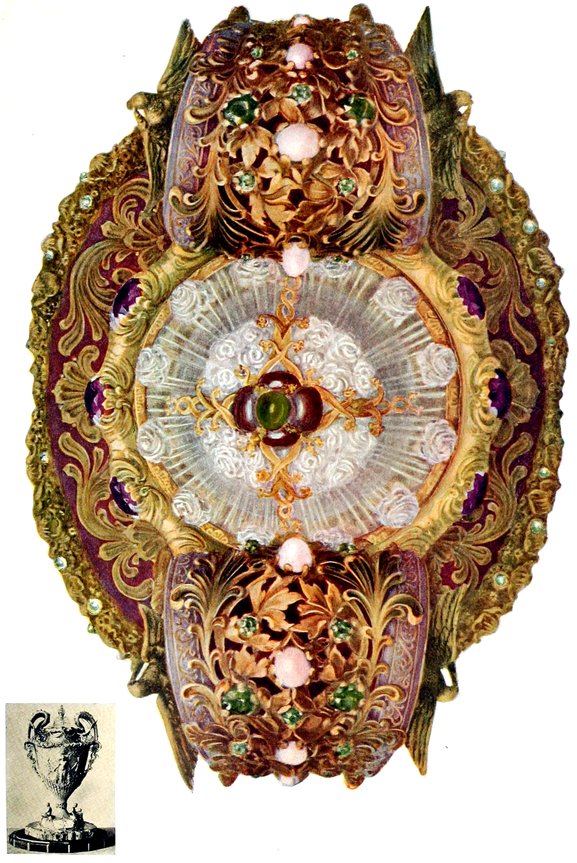
THE ADAMS GOLD VASE Ornamented with American gems and fresh-water pearls, rock crystal, gold quartz and agatized wood Top of vase and side view Now in the Metropolitan Museum of Art
250The headquarters of the Mexican pearl fishery are at La Paz, the capital of Lower California, 240 miles northwest of Mazatlan and 150 miles north of Cape San Lucas. This “Mantle of Peace”—the literal translation of La Paz—contains about 5000 inhabitants, nearly all of whom are more or less dependent on the pearl fishery. It presents an attractive picture, with the cocoanut-palms extending down almost to the water’s edge, and the high mountains forming a background. The low, stone houses, the tile roofs, the plaza with tropical trees, and the beautiful flower beds under perennial sunny skies, give it a quaint appearance. The most conspicuous objects from the harbor are the large old warehouses, with thick walls and iron-barred windows, for the storage of the pearls and the shells. During the season, from April to November, the arrival and departure of the pearling vessels presents a scene of great animation.
The present methods of the fishery on the Mexican coast are quite different from those of thirty years ago when nude diving was the only method in vogue. Instead of the haphazard work, largely in shallow water, the industry is conducted systematically, and the limit of depth is increased, much of the diving being in depths of ten to fifteen fathoms. The fishermen operate either from a large vessel making a cruise two or three months in length, or from a camp on the shore near the reefs. A vessel visits them frequently to furnish supplies and to transport the catch to La Paz. The fishing boats are undecked craft, each equipped with an air-pump and a crew of six men: a diver, a cabo de vida or life-line man, who is usually the captain, two bomberos at the air-pump, and two rowers.
The greatest depth at which armored diving is attempted in Mexico rarely exceeds twenty fathoms; twenty-five fathoms is fully as deep as it is practicable to go, and it is not advisable to remain at that depth more than a very few minutes. At fifteen fathoms a diver may remain half an hour or more, and at six or eight fathoms he may work uninterruptedly for several hours. When the water is very cold, the diver comes up frequently to restore his numbed circulation by vigorous rubbing. The occupation is especially conducive to rheumatism, and paralysis is more or less general, due, not only to the compressed atmosphere, but to the abrupt changes of temperature. The work is very debilitating, with particular effect on the nerves, and partial deafness is common. It is important that the diver be careful about overeating before descending, as heavy foods, and meats especially, make respiration difficult; therefore, breakfast consists of little more than bread and coffee. The risks and dangers from sharks, devil-fish, etc., have greatly diminished since the introduction of scaphanders; for a stout diver in his waterproof dress, with leads on the breast, shoulders, and shoes, and on his head a massive helmet containing great gaping windows for eyes, is enough to cause even a hungry shark to hesitate and to seek a more digestible meal.
There are yet many nude divers in Mexico, who operate in shallow 251waters, their cheap labor making them successful competitors of the armored divers. In arranging with these, the pearling company commonly grub-stakes a crew, pays a stipulated sum per hundredweight for the shells, and bargains for the pearls. If the fishermen are not satisfied with the price offered for these, they are at liberty to sell to other buyers under certain restrictions.
Nude diving is confined to the warm months, beginning about the middle of May and continuing until October. Owing to the cloudy or muddy condition of the water in the gulf, the nude diver can not inspect the bottom from the surface and select the best oysters before descending, nor can he work satisfactorily at depths greater than seven or eight fathoms. While the work is hard, it is more remunerative than the average branch of labor in this region.
Each day the boats deliver their catch of oysters at the fishing-camps or on board the receiving vessels. After they have been freed from marine growths and refuse, the mollusks are opened and searched for pearls. This operation is performed by trusted employees, usually elderly men who have become physically disqualified for diving, and who, seated together at a low table, work under the watchful eyes of overseers. A knife is introduced between the valves of the oyster, the adductor muscle is severed, and the valves are separated by breaking the hinge. The animal is removed from the shell and carefully examined with the eyes and the fingers, and then squeezed in the hands to locate any pearl which may be concealed in the organs or tissues. The debris is passed to other persons, who submit it to further examinations. A man may work all day long and find only a few seed-pearls, but occasionally there is the excitement of discovering a beautiful gem.
In some localities the flesh of the pearl-oyster is a source of profit through its sale to Chinamen, who dry and otherwise prepare it for sale among their countrymen in Mexico and America, as well as in the Orient. Frequently the large adductor muscle is dried for food, making excellent soup-stock, and, indeed, it is quite palatable when stewed.
It is difficult to approximate the output of the Mexican pearl fisheries, other than the pearl shell, because the dealers place a merely nominal value on the pearls in their invoices when sending them to Europe, an invoice of $500 sometimes representing gems valued in Paris at several thousand dollars. Furthermore, it is difficult to obtain satisfactory information from the pearling companies, owing, presumably, to the fear of developing greater competition. According to the estimates at La Paz, the local value of the pearl yield now approximates $250,000 annually, and the value of the same over the counters in Europe and America probably exceeds one million dollars.
252Some remarkably large pearls have been secured in the Mexican fisheries, especially considering the small size of the oysters. In 1871 a pearl of 96 grains, pear-shaped and without a flaw, sold at La Paz for 3000 pesos. In March, 1907, a beautiful pinkish white one, found near the lower end of the peninsula, sold for 28,000 pesos or $14,000. One of the best years for choice finds was 1881, when the scaphanders were first employed to their greatest efficiency. A black pearl was then secured which weighed 112 grains, and which brought 40,000 francs in Paris. In 1882 two, weighing 124 and 180 grains respectively, sold for 11,000 pesos. In the following year a light brown pearl, flecked with dark brown, and weighing 260 grains, sold for 7500 pesos. These are the prices which the La Paz merchants received for these pearls, and not the much greater amounts for which they were finally sold by the jewelers.
One of the finest pearls was found in 1884 near Mulege. This weighed 372 grains. The Indian fisherman is said to have sold it for $90; the purchaser declined an offer of 1000 pesos, and also a second offer of 5000, and soon sold it to a La Paz dealer for 10,000 pesos. Its value in Paris was estimated at 85,000 francs. Probably the most famous of all pearls obtained from these grounds was “the 400–grain pearl” found near Loreto, and “which is now among the royal jewels of Spain.” It is said that this was offered by the lucky fisherman to the Mission of Loreto, and by the Director of Missions in Lower California was presented to the Queen of Spain.[299]
As in every other fishery, one hears in Mexico of fishermen who have grasped a prize only to lose it through inexperience or improvidence. The account given above of the sale of the 372–grain pearl found near Mulege furnishes an instance of this. It is related in La Paz that in 1883 an Indian sold for ten pesos a gem weighing 128 grains, for which the purchaser received 27,500 francs in Paris. On another occasion a Mexican sold two pearls, easily worth $4000, for $16 worth of groceries.
In the eighteenth century, the Notre Dame de Loreto possessed a remarkable collection of Mexican pearls, which had been presented from time to time by the fishermen. During the régime of the Jesuits, it was customary to devote the proceeds of the last day of the fishery to the decoration of the altar of that mission. After the expulsion of this religious order in 1767, the mission was pillaged and the collection dissipated. From the old aristocracy of Mexico, family heirlooms of many choice pearls were placed on the European market during the civil wars in Mexico to contribute to the support of the contending armies. One lady in Sonora is said to have disposed of her collection for 253550,000 francs. A fine collection of these pearls, accumulated from 1760 to 1850, and showing them in a great variety of colors, shapes, and sizes, was in Chihuahua until recently.
AMERICAN FRESH WATERS
And my pearls are pure as thy own fair neck,
With whose radiant light they vie.
Whittier, The Vaudois Teacher.
The most recently developed pearl fisheries are within the limits of the United States, in the rivers and fresh-water lakes, and especially those in the Mississippi Valley. As an important industrial enterprise, these fisheries are less than two decades old, yet they are very productive, yielding annually above half a million dollars’ worth of pearls, many of which compare favorably in quality with those from oriental seas.
The prehistoric mounds in the Mississippi Valley present evidence of the estimation in which pearls were held by a race of men who passed away ages before America was first visited by Europeans. In some of these mounds, erected by a long-forgotten race, pearls have been found not only in hundreds and in thousands, but by gallons and even by bushels. Some of these equal three quarters of an inch in diameter, and in quantity exceed the richest individual collections of the present day. Damaged and partly decomposed by heat and through centuries of burial, they have lost their beauty, and are of value only to the archæologist and to indicate the quantity of pearly treasures possessed by these early people.
Owing to the great wealth of pearls which had been uncovered on the Spanish Main, at Panama, and in the Gulf of California, Eldorado explorers, in the sixteenth century, were particularly eager in searching for them within the present limits of the United States; in the reports of their wanderings, much space is given to these gems, and these reports aided largely in inducing and encouraging other expeditions. Some of these accounts read like the marvelous stories of Sindbad the Sailor, quantities of pearls—hundreds of pounds in some instances—being secured by the exchange of trinkets and by more questionable means. It would be easy to bring together numerous accounts of apparently reliable authorities to show that in the sixteenth century pearls were obtained here in far greater quantities than were ever known in any other part of the world; but this conclusion seems not wholly correct.
The unfortunate wanderings of Hernando de Soto from 1539 to 2541542 gave rise to most of the reports of rich pearl finds within the limits of this country. Of this voyage there are three principal accounts. The first was by Luis Hernandez de Biedma, who had accompanied De Soto as factor for Charles V of Spain. His brief report was presented to the king in 1544, although it was not published until 1841, nearly three centuries later, when it appeared in a French translation.[300] The second, and in our opinion the most reliable account,[301] published at Evora in 1577, was by an unnamed Portuguese (in English editions, commonly spoken of as the Gentleman of Elvas), who was a member of the expedition. The third account,[302] by far the longest and most widely known, but which was not written until 1591, was by Garcilasso de la Vega, who represented that his information was from a Spanish cavalier who had accompanied De Soto.
The only reference made to pearls in Biedma’s report seems to be his allusion to the large quantity secured at the village of Cofaciqui, on the east bank of the Savannah River. He states: “When we arrived there, the queen ... presented the governor with a necklace of pearls of five or six rows, procured for us canoes to pass the river, and assigned the half of the village for our quarters. After having been in our company three or four days, she escaped into the forest; the governor caused search to be made after her, but without success; he then gave orders to break open a temple erected in this village, wherein the chiefs of the country were interred. We took out of it a vast quantity of pearls, which might amount to six or seven arrobas,[303] but they were spoiled by having been underground.”[304]
The Portuguese narrative alludes to the pearls at Cofaciqui, stating that the queen “took from her own neck a great cordon of pearls, and cast it about the neck of the governor.... And the lady, perceiving that the Christians esteemed the pearls, advised the governor to search certain graves in the town, where he would find many; and that if he would send to the abandoned towns, he might load all his horses. He sought the graves of that town and there found fourteen rows of pearls, and little babies and birds made of them.”[305] This account makes no further mention of pearls, except to state that at the battle of Mavilla this great collection was burned, and that when the Queen of Cofaciqui escaped from the Portuguese she carried with her a little chest full of unbored pearls, which some of the 255Spaniards thought were of great value;[306] and further, that on one or two other occasions a few pearls were received from the Indians as presents.
The account of De Soto’s wanderings, given by Garcilasso, the Peruvian historian, contains many references to pearls, which read more like romance than reality. With his knowledge of the jewels, temples, etc., in Mexico and Peru, and recognizing some similarities in the manners of the people of those countries and the ones with whom De Soto came in contact, Garcilasso was easily led to statements which, though possibly true in the one case, seem fictitious in the other.
He gives the story of the Queen of Cofaciqui, with some additional particulars. The string of pearls which she presented to the governor made three circuits of her neck and descended to her waist. In his account, the graves in Cofaciqui became a temple containing, among other riches, more than a thousand measures of pearls, of which they took only two. Near Cofaciqui was the temple of Talomeco, over a hundred steps long by forty broad, with the walls high in proportion. Upon the roof of the temple were shells of different sizes, placed with the inside out, to give more brilliancy, and with the intervals “filled with many strings of pearls of divers sizes, in the form of festoons, from one shell to the other, and extending from the top of the roof to the bottom.” Within the temple, festoons of pearls hung from the ceiling and from all other parts of the building. In the middle were three rows of chests of graded sizes, arranged in pyramids of five or six chests each, according to their sizes. “All these chests were filled with pearls, in such a manner that the largest contain the largest pearls, and thus, in succession, to the smallest, which were full of seed-pearls only. The quantity of pearls was such, that the Spaniards avowed, that even if there had been more than nine hundred men and three hundred horses, they all together could not have carried off at one time all the pearls of this temple. We ought not to be too much astonished at this, if we consider that the Indians of the province conveyed into these chests, during many ages, all the pearls which they found, without retaining a single one of them.”[307] In the armory attached to this temple were long pikes, maces, clubs, and other weapons mounted with links and tassels of pearls.
Garcilasso has an interesting story of an incident said to have occurred a few days after leaving Cofaciqui, when the troops were passing through the wilderness.
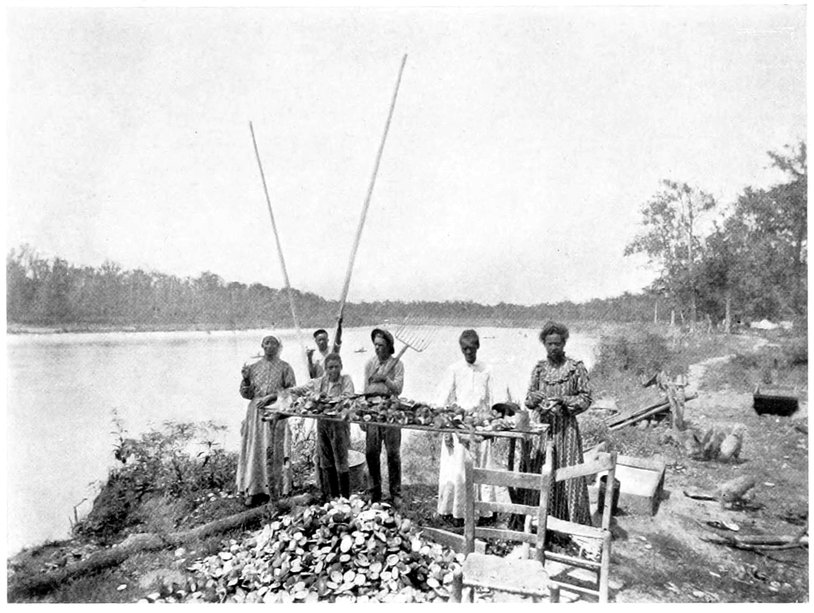
Negro pearling camp on bank of an Arkansas river
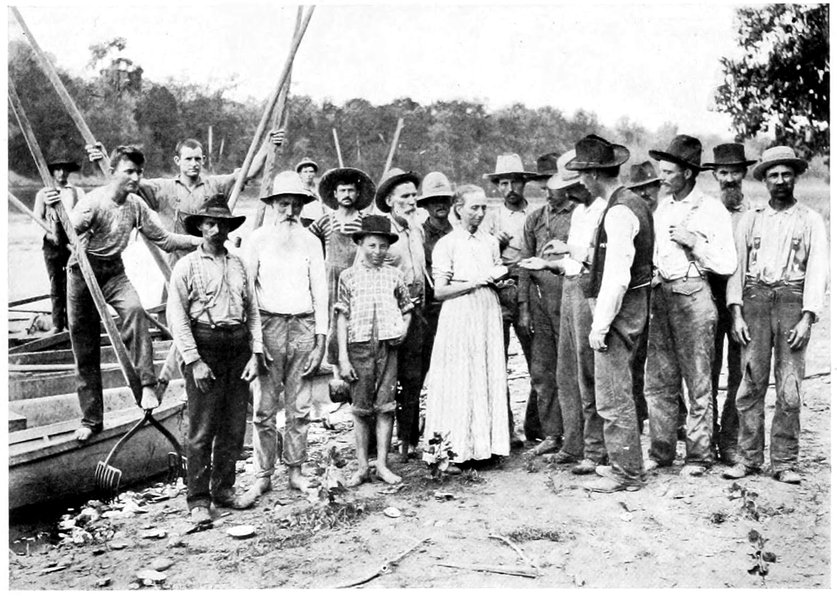
Group of Arkansas pearl fishermen; photographed shortly after the woman in the center of the group had found a pearl for which she received $800
256Juan Terron, one of the stoutest soldiers of the army, toward noon, drew from his saddle-bags about six pounds of pearls, and pressed a cavalier, one of his friends, to take them. The cavalier thanked him and told him that he ought to keep them, or rather, since the report was current that the general would send to Havana, send them there to buy horses and go no longer afoot. Offended at this answer, Terron replied that “these pearls then shall not go any farther,” and thereupon scattered them here and there upon the grass and through the bushes. They were surprised at this folly, for the pearls were as large as hazel-nuts, and of very fine water, and because they were not pierced they were worth more than six thousand ducats. They collected about thirty of these pearls, which were so beautiful that it made them regret the loss of the others, and say, in raillery, these words, which passed into a proverb with them, “There are no pearls for Juan Terron.”[308]
At the capital of Iciaha, De Soto received from the cacique or chief, a string, five feet in length, of beautiful and well-matched pearls as large as filberts. Upon De Soto’s expressing a desire to learn how the gems were extracted from the shells, the chief immediately ordered four boats to fish all night and return in the morning.
In the meantime they burnt a great deal of wood upon the shore, in order to make there a great bed of live coals, that at the return of the boats they might put thereon the shells, which would open with the heat. They found, at the opening of the first shells, ten or twelve pearls of the size of a pea, which they took to the cacique, and to the general who was present, and who found them very beautiful, except that the fire had deprived them of a part of their lustre. When the general had seen what he wished, he returned to dine; and immediately after, a soldier entered, who instantly said to him that, in eating oysters which the Indians had caught, his teeth had encountered a very beautiful pearl of a very lively color, and that he begged him to receive it to send to the governess of Cuba. Soto politely refused this pearl, and assured the soldier that he was as obliged to him as if he had accepted it; and that some day he would try to acknowledge his kindness, and the honor which he did his wife; and that he should preserve it to purchase horses at Havana. The Spaniards valued it at four hundred ducats; and as they had not made use of fire to extract it, it had not lost any of its lustre.[309]
Notwithstanding the strong indorsement given to Garcilasso’s narrative by Theodore Irving and some other writers, his tendency to exaggerate depreciates greatly the historical value of his account, and it seems wholly unreliable as an authority relative to early resources in America. We may reasonably doubt whether De Soto’s expedition came in contact with more pearls than those mentioned by Biedma and the Portuguese writer.
257The account of the first voyage along the coast of the United States, that of the Italian, Juan Verrazano, in 1524, contains no reference to pearls, although he penetrated into the interior a score or two of miles, and was frequently in contact with the natives, who lived largely by fishing, and who prized many ornaments of different colored stones, copper rings, etc.
The first expedition which went far into the interior was the ill-fated one under command of Pánfilo de Narvaez in 1528. A thrilling account[310] of this journey was written by Cabeza de Vaca, who was one of the four survivors, after eight years’ wandering through America to Mexico. Cabeza had been controller and royal treasurer of the expedition, and in that position it was his particular duty to acquaint himself with all the pearls, gold, and similar riches found by the party. Notwithstanding his tradings with the Indians and their efforts to gain his friendship by means of presents, his account makes no mention of pearls, except to refer to a statement made by some Indians that on the coast of the South Sea there were pearls and great riches.
Hernando D’Escalante Fontaneda, who was shipwrecked on the Florida coast about 1550, and was detained there a prisoner for seventeen years, wrote:
“Between Abolachi [Appalachicola] and Olagale is a river which the Indians call Guasaca-Esqui, which means Reed River. It is on the sea-coast, and at the mouth of this river the pearls are found in oysters and other shells; from thence they are carried into all the provinces and villages of Florida.”[311]
The European narrators also reported great stores of pearls along the Atlantic seaboard. Among the first of these may be mentioned David Ingram, who is represented as traveling by land from the Gulf of Mexico to the vicinity of Cape Breton in the years 1568 and 1569. As it appeared in the first edition of Hakluyt’s Voyages, this relation states:
“There is in some of those Countreys great abundance of Pearle, for in every Cottage he founde Pearle, in some howse a quarte, in some a pottel [half a gallon], in some a pecke, more or less, where he did see some as great as an Acorn; and Richard Browne, one of his Companyons, found one of these great Pearls in one of their Canoes, or Boates, wch Pearls he gave to Mouns Campaine, whoe toke them aboarde his shippe.”[312]
Estimation of Ingram’s wonderful relation is decreased by Purchas’s comment:
258As for David Ingram’s perambulations to the north parts, Master Hakluyt, in his first edition printed the same; but it seemeth some incredibilities of his reports caused him to leave him out in the next impression; the reward of lying being, not to be believed in truths.[313]
Even the members of Raleigh’s Roanoke Colony of 1585 reported pearls. Hariot stated:
Sometimes in feeding on Muscles we found some Pearle: but it was our happe to meet with ragges, or of a pide colour: not having yet discovered those places where we heard of better and more plenty. One of our company, a man of skill in such matters, had gathered from among the Savage people about five thousand: of which number he chooses so many as made a faire chaine, which for their likenesse and uniformity in roundenesse, orientnesse, and piednesse of many excellent colours, with equality in greatnesse, were very faire and rare: and had therefore been presented to her Majesty, had we not by casualty, and through extremity of a storme lost them, with many things els in coming away from the countrey.[314]
So far as we can learn, there is no evidence to show that, during the sixteenth or the seventeenth century, any pearls of value were received in Europe from within the present limits of the United States, as was the case with the resources of Venezuela, Panama and Mexico. Many of the accounts quoted above seem wholly fictitious, some of them possibly drawn up for the purpose of promoting exploring expeditions. It is also probable that knowledge of the enormous collections at Venezuela and Panama misled some of the narrators into recognizing as pearls the spherical pieces of shell or even the cylindrical wampum which the Indians made in large quantities and used as money.
However, it is unquestionable that pearls of value were in the possession of some of the wealthier tribes. Biedma’s account of the 150 pounds or more of damaged pearls in the graves at Cofaciqui seems wholly reliable, and likewise many other statements; and it is an interesting problem to determine the source from which the Indians obtained them.
Most of the narratives refer to the pearls as coming from the coast of the South Sea or Gulf of Mexico. The evidence of Fontaneda, who had spent seventeen years in the country, throws some light on this. He states that pearls were obtained at the mouth of Reed River near Appalachicola, whence they were distributed throughout Florida. This seems to indicate that on the west coast of Florida there might have been extensive reefs of pearl-bearing mollusks, which have since become extinct, although existing shell-heaps do not confirm this.
259While it is possible and even probable that many of these pearls in the possession of the Indians came from the Gulf of Mexico or even from the Caribbean Sea, it seems much more likely that they came largely from the Unios of the inland lakes and rivers.
The voyages of Narvaez, Ayllon, De Soto, Ribault, etc., had been so unfortunate that for a century little exploration was made in the territory of the southern part of the United States. When this territory was again invaded, little was seen in the way of pearls.
Iberville, who established the French settlement near the mouth of the Mississippi in 1699, was specially directed to look for them. His instructions state: “Although the pearls presented to his Majesty are not fine either in water or shape, they must nevertheless be carefully sought, as better may be found, and his Majesty desires M. d’Iberville to bring all he can; ascertain where the fishery is carried on, and see it in operation.”[315] Pearls were found in the territory of the Pascagoulas, but they were not worth the trouble of securing them. It appears that from these the Pearl River in Mississippi derived its name.
The only reference to pearls in the seventy-one volumes of Travels and Explorations of the Jesuit Missionaries in New France, from 1610 to 1791, is a note by Father Gravier stating that he saw no choice pearls: “It is true the chief’s wife has some small pearls; but they are neither round nor well pierced, with the exception of seven or eight, which are as large as small peas, and have been bought for more than they are worth.”[316]
Daniel Coxe’s description, in 1722, of pearl resources in America, is of special interest because of the extended experience of his father as a trader in the country. He states:
Pearls are found to be in great abundance in this country; the Indians put some value upon them, but not so much as on the colored beads we bring them. On the whole coast of this province, for two hundred leagues, there are many vast beds of oysters which breed pearls, as has been found in divers places. But, which is very remarkable, far from the sea, in fresh water rivers and lakes, there is a sort of shell-fish between a mussel and a , wherein are found abundance of pearls, and many of an unusual magnitude. The Indians, when they take the oysters, broil them over the fire till they are fit to eat, keeping the large pearls they find in them, which by the heat are tarnished and lose their native lustre; but, when we have taught them the right method, doubtless it would be a very profitable trade. There are two places we already know within land, in each of which there is a great pearl fishery. One about
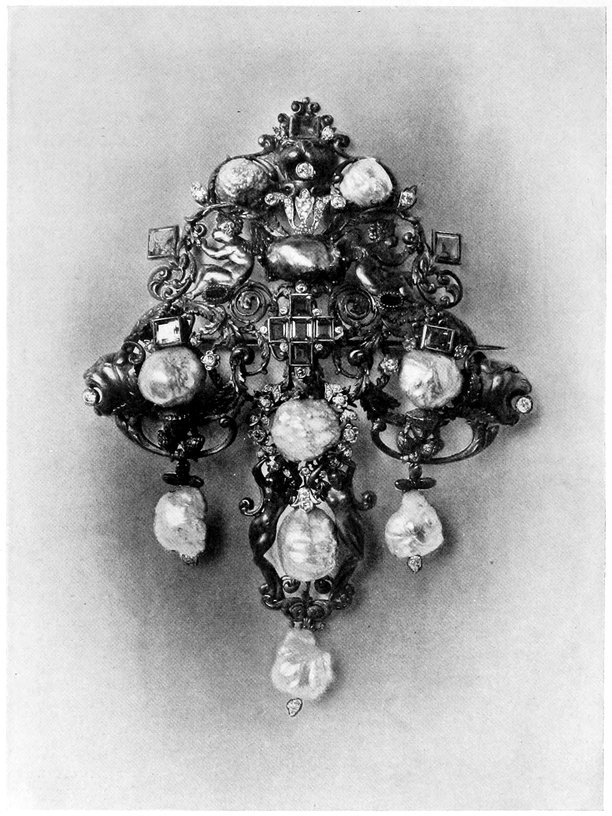
BROOCH, RENAISSANCE STYLE, SET WITH BAROQUE PEARLS, FROM AMERICAN STREAMS Pan-American Exposition, 1901
260one hundred and twenty leagues up the River Meschacebe [Mississippi], on the west side, in a lake made by the river of the Naches, about forty miles from its mouth, where they are found in great plenty and many very large. The other on the River Chiaha, which runs into the Coza or Cussaw River (as our English call it), and which comes from the northeast, and, after a course of some hundred miles, disembogues into the Gulf of Florida, about one hundred miles to the east of the Meschacebe.[317]
It is interesting to note that the first place mentioned by Coxe as the location of a great pearl fishery is not far from one of the most productive pearling regions of the last fifteen years, viz., the eastern part of Arkansas. The second place noted by him appears to be identical with the Iciaha, where, nearly two centuries before, the Indians exhibited the methods of their fishing to De Soto and his companions.
Excepting Coxe’s notice, for 250 years following 1600, little was heard of the occurrence of pearls within this country. This does not indicate necessarily that the gems were absent from the waters; but, not using the Unios for food as did the aborigines, the residents had little occasion to open them and in this way learn of their contents. And even where pearls were occasionally found in mollusks opened for fish-bait, the people were in few instances informed as to their market value, and did not attempt to sell them, although the most attractive ones may have been treasured as ornaments or as keepsakes. This was paralleled in the diamond fields of South Africa, where gems worth thousands of dollars were used as playthings by the farmers’ children. A jewel, like a prophet, is frequently without honor in its own country until the residents of that country learn of the great esteem in which it is held elsewhere.
And yet, in some localities a few pearls were collected from time to time. The Moravians—familiar with the pearls of their native streams in Europe—gathered many from the Lehigh River near Bethlehem, Pennsylvania, over a century ago;[318] and from Rhode Island and elsewhere a few were obtained.
The first awakening to a realization of the value of fresh-water pearls in America occurred fifty years ago, when several beautiful gems were marketed from the northern part of New Jersey. The story of this find has been frequently told. A shoemaker named David Howell, who lived on the outskirts of Paterson, occasionally relieved the monotony of his trade by a fishing excursion to some neighboring stream, where he would usually collect a “mess” of mussels. Returning from one of these visits to Notch Brook in the spring of 2611857, the mussels were fried with the usual abundance of grease and heat. After this preparation, one of them was found to contain a large, round pearl weighing “nearly 400 grains,” which possibly might have proven the finest of modern times, had not its luster and beauty been destroyed by the heat and grease.[319] Had the pearl been discovered in time, its value might have exceeded $25,000, thus making poor Howell’s fried mussels one of the most expensive of suppers.
Hoping to duplicate his wonderful find, Howell collected and searched other mussels, and his example was followed by several of his neighbors. Within a few days a magnificent pink pearl was found by a Paterson carpenter named Jacob Quackenbush. This weighed ninety-three grains, and was bought by the late Charles L. Tiffany for Messrs. Tiffany & Co., New York City, for $1500. Mr. Tiffany later described with much interest the feelings he experienced after making the purchase. Said he: “Here this man finds a pearl within seventeen miles of our place of business! What if thousands should be found, and many perhaps finer than this one! However, we risked buying the pearl, and as no one in New York seemed interested in it, we sent it to our Paris house for sale, and a French gem dealer offered for it a very large advance on the original price, paying 12,500 francs.” From this dealer it passed into the possession of the young and beautiful Empress Eugénie, from whom and from its great luster it derived the name “Queen Pearl.” Its present market value would doubtless amount to $10,000 or more.