X PEARL FISHERIES OF VENEZUELA (continued 2)
Reading edition
When news of the very large price received for Quackenbush’s find became public, great excitement developed in the vicinity of Notch Brook. Persons came from all directions to search in the shallow streams for valuable pearls. Farmers of the neighborhood tried their luck, and also mechanics and other residents of the adjacent villages and towns, and even some from Newark, Jersey City, and New York. An old resident, who was an eye-witness, describes the scene as one of great animation, the crowds of people and the horses and wagons along the shore giving “an appearance of camp-meeting time.” At least one schoolmaster in the vicinity is said to have closed his school to give his pupils an opportunity to engage in the hunt.
With trousers rolled up, the people waded into the shallow water and sought for the mussels in the mud and sand on the bottom. Many pearls were secured, but none approached in size or value the two above noted.[320] During 1857, the New York City market received about $15,000 worth of pearls from these waters, and in addition many were 262sold locally or retained as souvenirs of the hunt. At the low price of pearls existing then, this figure would mean possibly ten times as much at present, or $150,000.
The active search soon depleted the resources of the little stream, so that in the following year the reported value of the yield was only a few thousand dollars. The decrease continued until in a few years practically every mussel was removed, and at present scarcely a single Unio is to be found in these waters.
The interest in pearling extended far from the place of the original find; and in Pennsylvania, Ohio, and even as far away as Texas, search was made in the streams. In the Colorado and its tributaries, about 20,000 were found in a short while. Most of these were small and unattractive, but a considerable number were reported “as large as pepper-corns” and a few “the size of a small rifle ball,” the number decreasing with the increase in size. A correspondent in the “Neue Zeit” wrote:
Sometimes they are round, sometimes cylindrical, elliptical, hemispherical, or of an altogether irregular shape. The finest have a milk-white, silvery sheen; many, however, are reddish yellow, bluish brown, or quite black; the last naturally have no value whatever. As to their value, there is considerable uncertainty, and it can easily be understood that those who have a great number of them in their possession greatly overestimate them. So far they are found principally in the Llano and the San Saba.[321]
After the resources in northern New Jersey were depleted and the excitement had died out, little was heard of pearling in this country until 1878, when many were found in Little Miami River in southwestern Ohio. The fishing was carried on at low water, and principally by boys, who would wade out in the water and feel for the mollusks with their feet, and then bob under and pick them up with their hands. The senior author spent a day in this fishery with a party of six boys with some success. During 1878 about $25,000 worth of pearls were collected in the vicinity of Waynesville on that stream. Mr. Israel H. Harris, a banker of Waynesville, then began collecting these pearls; and by purchasing during several years nearly every interesting specimen found in the vicinity, he made his collection one of the largest and best known in the country. When sold in 1888, it contained several thousand pearls, mostly of small size, averaging in weight little more than one grain each. A large portion of this collection was exhibited in the American section of the Paris Exposition of 1889, and was awarded a gold medal. Included in this exhibit was a series of ornaments in which the gems were arranged according to color, so that in one the pearls were green, in another purplish brown, in another pink, 263in another waxy white, and in one a cream-white. It also contained a button-shaped pearl weighing thirty-eight grains and several pink ones almost translucent. A pink pearl of eight grains was admired by all who saw it; by reflected light this had the color and translucency of a drop of molten silver. Many of the pink pearls found in the Little Miami and its tributaries were of the most beautiful rose-petal pink; pearls of this peculiar color have never been found in any other waters.
From Ohio the industry gradually extended westward and southward, and new fields were developed, pearls to the value of about $10,000 annually coming on the market from such widely separated States as Vermont, Kentucky, Tennessee, Florida, Texas, Washington, etc. However, little general interest was taken in fresh-water pearls, and few choice ones were found until the magnificent resources of the upper Mississippi Valley were discovered. Owing to the ease with which the mollusks may be collected by wading, it was in the relatively shallow tributaries that the fishery first developed, rather than in the deep channels of the main stream and of the large affluents.
The first region in the Mississippi Valley to attract attention was southwestern Wisconsin. Early in the summer of 1889, many beautiful pearls were found in Pecatonica River, a tributary of Rock River, which in turn empties into the Mississippi. Within three months, $10,000 worth of gems were sent from this region to New York City alone, including one worth $500, which was a very considerable sum for a fresh-water pearl at that time. The interest quickly spread to neighboring waters, and within a short time pearls were found also in Sugar River, in Apple River, in Rock River, in Wisconsin River, and in the Mississippi in the vicinity of Prairie du Chien. The fact that little experience and no capital was required for the business drew large numbers of persons to the newly-found Klondike; and the finds were so numerous and of such high quality that about $300,000 worth of pearls were collected before the end of 1891, greatly exceeding all records for fresh waters.
The Wisconsin pearls are remarkable for their beauty, luster, and diversified coloring, and some lovely shades of pink, purple, and especially metallic green have been found. Several of them have weighed in excess of fifty grains each, and some individual values ran well into four figures. One shipment made from Sugar River to London in September, 1890, contained ninety-three pearls, weighing from four to twenty-eight grains each, for which £11,700 was received in payment. In the limits of one county in the following year, pearls to the value of nearly $100,000 were secured.
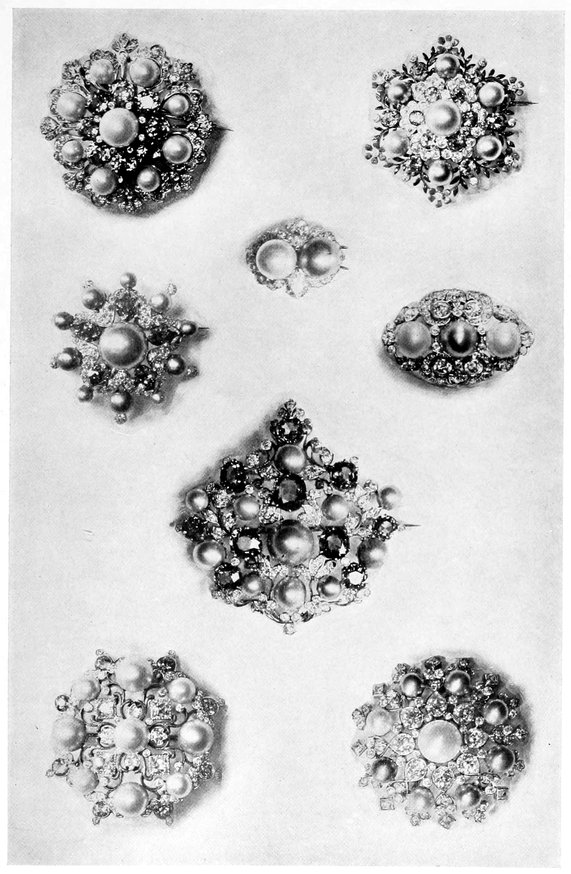
BROOCHES AND RINGS OF FRESH-WATER PEARLS FROM WISCONSIN AND TENNESSEE Paris Exposition, 1900
264Shortly following the outbreak of pearling in Wisconsin came the development of interest in certain parts of Tennessee. For many years pearls had been secured from the Cumberland and Tennessee rivers and their tributaries, especially Caney Fork, Duck, Calf Killer, and Elk rivers, the headquarters of the fishery and the local markets being Carthage, Smithville, Columbia, and Arlington. The search had been conducted in a moderate way by pleasure parties in the summer, and by farmers after the crops had been laid aside.
In 1901 pearling excitement developed in the mountain regions of eastern Tennessee, especially in Clinch River. These newly-discovered resources proved so valuable that the local interest became very great. Vivid and picturesque accounts published in the local papers reported hundreds of persons as camping at various points along the streams, some in tents and some in rough shanties, and others going from shoal to shoal in newly-built house-boats. They were described as easygoing, pleasure-loving people, the men, women, and children working hard all day, subsisting largely on fish caught in the same stream, and dancing at night to the music of a banjo around the camp-fires. The center of the new industry was Clinton, the county seat of Anderson County, whither the successful hunters betook themselves each Saturday, the preferred time for selling the catch.
The next outbreak of pearling excitement was in Arkansas, in the region referred to by Daniel Coxe two centuries ago as the location of great pearl resources.[322] Although in recent times little had been heard of pearls in Arkansas previous to 1895, they were not unknown in that State. For years they had been picked up by the fishermen, and used as lucky stones or given to the children for playthings. Some had come into the possession of persons acquainted with their value. About 1875, a few pearls were collected by a party of men engaged in cutting cedar poles on White River; in 1888, a brilliant pear-shaped pink pearl of twenty-seven grains was secured from the same river, and sold to a prominent resident. Little had been said about these finds, and in general the people of Arkansas had slight idea of the occurrence or the value of pearls in those waters.
In 1895, a surveying party on White River found pearls in the Unios of that stream, and collected them to the value of about $5000. News of this discovery attracted attention to the resource, and other persons sought for the gems in the White River and its tributaries, in the St. Francis and the Arkansas rivers. The unusually low water in 1896 facilitated the fishery, and resulted in the discovery of many large and valuable gems. The interest developed rapidly, and within twelve months nearly every stream of water in Arkansas yielded pearls, with the finds most extensive and valuable in White River and 265its tributary the Black River, which has proved to be the richest pearling region in America. The industry centered at Black Rock, more than a thousand persons fishing within twenty miles of that place. It is estimated that within three years following the development of this fishery, this State yielded pearls to the value of more than $500,000.
When the Arkansas fishery was at its height, it was reported that ten thousand persons were employed therein. The fishermen were from nearly every class and condition in the State. Women were not absent; even children participated in the industry, and some proved more fortunate than the older hunters. It was not uncommon to see several hundred persons congregated at one bar or in one stretch of the river, all intent on making a fortune, and all occupied in fishing or in opening the shells. So complete was the absorption of the people in this pursuit, and so many of the farm-hands were occupied in the eager search for anticipated fortunes, that the local papers reported much apprehension and difficulty in harvesting the cotton and other crops.
Within the main channel of the Mississippi, the relative scarcity of pearls in the Unios, and the greater preparation required for collecting the mollusks in the deep waters, retarded the fishery until the establishment of button manufacture afforded a market for the shells, this originating in 1891. The industry developed rapidly, and for several years has consumed about 35,000 tons of shells annually, obtained principally in the Mississippi between Quincy and La Crosse, and to a much less extent in other streams in this valley. This is more than twice the total product of mother-of-pearl shell in all parts of the world. However, the value per ton is very much less than that of the best grade of mother-of-pearl; that from Australia, for instance, commonly selling for $1200 per ton, whereas the Mississippi shell usually sells for less than $20, although the very choicest may bring upward of $50 per ton.
The gathering of shells for manufacture has extended to many of the large tributaries of the Mississippi, especially the Arkansas, the White, the St. Francis, the Ohio and the Illinois rivers, and this industry has added largely to the pearl yield in these waters.
In the last three years, the scenes of greatest activity have been the Wabash River and its tributaries, where shell-collecting developed in 1903, and the Illinois River, where the industry was of little importance previous to 1906. On the Wabash, camps were established at almost every town, from the mouth up to St. Francis, Illinois, and about one thousand persons found employment. Some of the most beautiful American gems have come from this river. They are usually silvery white in color and of the sweetest luster. A single 266pearl weighing only ten grains has been sold at the river for $1000; but it is frequently the case that a fine gem will sell for more at the place where found than in the great markets. During the spring of 1907, three pearls were found in the Wabash near Vincennes, which weighed forty-one, fifty-one, and fifty-three grains respectively. One of these was white, one faint pink, and the third was yellow. The finest pearls have been reported from the vicinity of Mount Carmel near the lower end of the river. Very large quantities of baroques or slugs are found in the Wabash and the Illinois; 30,000 ounces were reported from those rivers and their tributaries in 1907, for which the fishermen received a total of $50,000. A large symmetrical pearl found during 1907 weighed a trifle under 150 grains, and a slug was found which weighed fully one ounce, or 606 grains.
The pearl-hunting excitement has been felt even on the Atlantic seaboard, as a result of the publication of the discoveries in the Mississippi Valley. In Maine many pearls have been reported, especially in the vicinity of Moosehead Lake. In 1901 over one hundred were found in that vicinity; most of them were of little value, but more than a dozen were worth $10 or $15 each. Three found by Kineo guides were sold for an aggregate of $300. The choicest one reported in that year weighed twelve and one half grains and sold for $150; had it been perfect in form and luster its value would have been several times that amount. Most of these pearls were found by Moosehead guides, who found purchasers among the visiting fishermen and hunters.
Since 1901 many farm-boys as well as guides have devoted much attention to the business, some of them deriving as large a revenue therefrom as from the use of the rifle. Good finds have been made, during the last year or two especially. In 1906, one choice pearl sold for $700, and many have sold for $10 to $75 each. The search has proven so alluring that returning visitors have complained that some of the guides care to do little more than search every rill, brook, and creek they come across looking for the mollusks. Just at present the principal attention seems to be directed to the streams in the western part of Maine, where the river-beds are more sandy and the shell-fish more abundant than in the northern and eastern part of the State.
In Massachusetts pearls have been collected from many of the ponds and brooks. In Nonesuch Pond in Weston, the Unio complanata has yielded many small ones of attractive appearance, but not of sufficient size or luster to sell for more than $10 each. Ponds in the town of Greenwich and also in Pelham in Hampshire County are among the best in Massachusetts for pearls. The Sudbury River above Concord also yields many. Relatively few of the Unios contain pearls, and the gem-bearing individuals seem to be grouped in special localities. Outside 267of these places, thousands of mussels may be opened without revealing a single gem. A collection of small Massachusetts pearls was brought together a few years ago by Mr. Sherman F. Denton of Wellesley Farms, who has devoted much time to exploring the inland waters of Massachusetts.
Connecticut also has had a slight touch of the pearl fever. In 1897, Mr. C. S. Carwell of Ledyard, explored the headwaters of Mystic River, and in a few weeks collected a number of pearls, one of which he is reported as having sold for $500, and two others were estimated at $400 each. And from the other end of the State, along the Shepaug River, is reported a similar account of the success of Mr. Arlo Kinney of Steep Rock. Attracted by these reports, crowds of seekers have proceeded in the usual reckless manner to make wholesale destruction of the mollusks. The finds have been especially large and valuable in the lakes and streams of Litchfield County, particularly in Bantam Lake.
In New York State, pearls have been found in the swift shallow streams in the Adirondack region, and in several of those entering the St. Lawrence, particularly the Grass River in St. Lawrence County. Pearls were first reported from this region in 1894. In 1896 the Grass yielded one pearl weighing fifty-eight grains, worth $600 locally; and in 1897 one weighing sixty-eight grains was found, the fisherman selling it for $800. A resident of Russell township devoted most of his time to pearling in Grass River during 1896 and 1897, from which he is said to have realized $2000. In this region the mussels are found by wading in the shallow water and scanning the bottom through a water-telescope. Most of the pearls are of slight value, but many individuals are reported as worth from $30 to $60 each.
Pearl River in Rockland County, New York, has furnished a number of brown pearls. These are commonly small, weighing from one eighth to one half grain each, although some weigh seven or eight grains each. Most of these are not lustrous, but occasionally a bright brown or a bright copper-brown specimen of from one to four grains is met with. At the Paris Exposition, in 1900, were exhibited one hundred of these pearls, with an aggregate weight of 281 grains; these now form part of the Morgan-Tiffany Collection, in the American Museum of Natural History.
Even in the rich coal regions of Pennsylvania pearls are found. Possibly the most productive section in that State has been the headwaters of the Schuylkill River in the vicinity of Tamaqua, Quakake, and Mahony City. Of the tributaries of the Schuylkill, those contributing largely to the yield have been Lewiston, Nipert, Still, Locust, and Hecla. These rise in the mountains and are rivulets of fair size by the time they reach their common outlet.
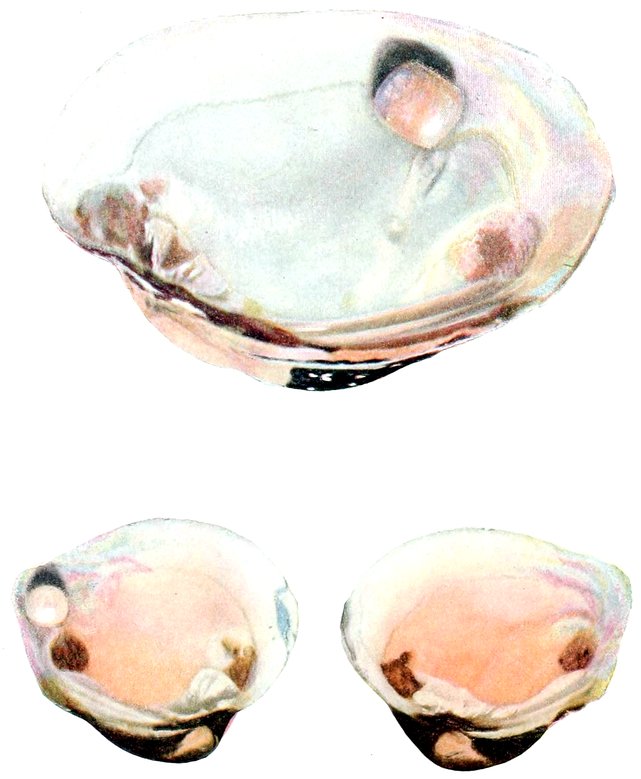
PEARL-BEARING UNIOS From the Mississippi Valley The upper pictures show the two valves of the same shell, and the pearl is detachable
268The original pearl finds in the Schuylkill date from half a century ago, when they were secured by farmers who used the mussel shells in removing hair from the hides of slaughtered pigs. During the Mississippi pearling excitement in 1897, several persons from New York, who were summering in Schuylkill County, searched the small streams for pearl-bearing mussels with such success that within a short while many farmers became enthusiastic hunters during their spare time. Half a dozen or more men did very well, their catch amounting to thousands of dollars’ worth. Mr. Frank M. Ebert, of Quakake, has put most of his spare time in the business in the last ten years, and has secured many good pearls. It is estimated that the total catch in Schuylkill County alone approximates $20,000 at local values. So actively has the search been conducted that at present few adult mussels of the pearl-bearing species remain, and a day’s work may result in finding less than a dozen.
The best price reported as received by a local fisherman was $200 for a twenty-grain pearl in the year 1904. Many individual specimens have been sold at prices ranging from $100 to $175. It is claimed that a pearl sold by a fisherman in Schuylkill for fifty cents was later marketed in Philadelphia for $125, and with slight mounting was ultimately sold for $1600. The most attractive weigh from ten to twenty grains each; larger ones have been found, weighing up to thirty-eight grains, but as a rule the luster is not so good as that possessed by pearls of medium size. The common colors are dark blue, pink, lavender, and white. A few are black and some are brown. The brown pearls are seldom of value, owing to deficiency in luster.
In Maryland pearls have been collected from the brooks near the head of Chesapeake Bay, and especially in Kent and Cecil counties. These are of almost every conceivable color, ranging from a clear white to a dainty pink, and to very dark colors, especially bronze and copper. Most of them are too small for commercial value, and only a few reach sufficient size to command more than $5 or $10 each, but single specimens have sold as high as $50.
Georgia has yielded some pearls, chiefly in the vicinity of Rome, at the junction of the Etowah and Oostanaula rivers. This is believed to be the site of the Indian town Cofaciqui, where, in his memorable expedition of 1540–1541, De Soto found the natives in possession of so many pearls. The general news of finds in the Mississippi Valley stirred up local interest in this region in 1897, and when the streams were low and clear in the autumn many persons engaged in hunting the mussels. An ex-sheriff of Rome is reported as having secured about fifty pearls, lustrous but irregular. A few miles above Rome, a farmer made a trial on Johns Creek, a tributary of the Oostanaula; 269and from a basketful of Unios he reports finding several marketable pearls for which he received $180 from a Baltimore jeweler. Others followed, and many fine specimens were secured. Unios are especially abundant in the Flint, Ocmulgee, and Oconee rivers, and it seems probable that many pearls might be found in these streams.
Florida has not yet been actively exploited, but it may prove a productive region ere long. The reports of De Soto’s expedition make special reference to the size and beauty of the pearls found at a point where he crossed the Ocklocknee River about thirty miles above its mouth, near the present site of Langston, Wakulla County. And there seems little doubt that pearls may be found in the Ocklocknee and also in its affluent, the Sopchoppy River. The banks of these streams are full of shells, and pearls of choice color have been sent from there.
It is unnecessary to refer in detail to the origin of pearling in each of the States. The general interest in this industry from 1889 to the present time has resulted in the examination of most of the rivers and creeks, and in few has the search been entirely unrewarded, although the finds have been relatively much greater in some waters than in others. As a rule, pearl-bearing Unios are most numerous in clear, swift streams, with sandy or gravelly bottoms and which flow through calcareous rocks. With pearlers as with miners, there is a stampede to the places where a good find is reported, since the rivers are free for all; consequently, there is much variation from year to year in the amount of attention which the individual streams and localities receive.
While many of the pearlers operating in the Mississippi River are professional fishermen or rivermen, most of those in the smaller streams have had no previous experience in similar work. Frequently whole families come twenty or thirty miles, and even greater distances, and camp on the river bank. In many instances farm-hands are there who have abandoned their crops, mechanics who have left steady jobs, railway men who have taken a lay-off, teachers, merchants, all eager and expecting to find a fortune. In some localities, pearl fishing has been used as an attraction in big picnic advertisements, and has drawn larger crowds than a public orator.
The mollusks are removed from the river bottoms in various ways and by many forms of apparatus. In the shallow streams the fishermen simply wade out in the water and pick up the shells by hand. If not readily visible from the surface, the shells may be located with the bare feet or by the use of a water-telescope. Where the water is too deep for wading, the fishermen work from small boats, and use garden rakes or other convenient inplements.
Where pearling has developed into more of an industry, special 270forms of rakes and drags are employed. A shoulder rake, with a handle twelve to twenty feet in length, is used extensively under the ice in frozen rivers, and in lakes and other places where the water is still and from eight to fifteen feet in depth. This is simply an overgrown or enlarged garden rake, armed with twelve or fifteen iron teeth about five inches in length. A wire scoop or basket is attached to receive the catch as it is pulled from the bottom by the teeth, and when this scoop is well filled it is lifted and the contents dumped on the ice or into the skiff. This method is laborious, and is employed only where the water is shallow and the mollusks are abundant. Scissor tongs—similar to those used by oystermen on the Atlantic coast—are also employed in some localities, especially in Arkansas, where it is estimated that 1700 pairs were manufactured and sold in 1899 and 1900, at about $7 each.
In the large streams of the Mississippi Valley, with their slow and steady currents, and where the Unios are taken largely for their shells to be used in button manufacture, the most popular form of apparatus since 1896 has been the crowfoot drag. This ingenious contrivance consists of a cross-bar of hollow iron tubing or common gas-pipe, six or eight feet long, to which are attached, at intervals of five or six inches, stout twine or chain snoods or stagings, each about eighteen inches in length. To each of these are attached three or four prongs or “hooks,” about six inches apart. These “hooks” are four-pronged, and are made of two pieces of stout wire bent at right angles to each other. According to the depth of the water, from twenty-five to seventy-five feet of three quarter inch rope is attached to the drag for the purpose of towing it behind the boat, which is permitted to drift down the stream with the current. This contrivance costs about $3, and each fisherman generally has at least two of them, as well as a wide flat-bottom boat costing $5 or $10.
Sometimes, when the current is light, the fisherman prepares a “mule” to assist the boat in towing the resisting drag. This “mule” consists of a wooden frame, hinged in V-shape, and is fastened several feet in advance of the boat with the V end pointed down the stream. It sinks low in the water, and the current pressing against the angle carries it along, and thus tows the skiff and the resisting drag at a uniform rate of speed. When there is not sufficient current even for this contrivance, as in the wide reaches and in the lakes, oars, sails, and even power engines may be used for propelling the boat.
As the crowfoot drag is slowly drawn along the bottom, it comes in contact with the mollusks feeding with open shells. When a hook or other part of the drag enters an open shell, the mollusk immediately closes firmly upon the intruding object and clings thereto long enough 271to be drawn up into the boat. In this way, where the Unios are thick, nearly every hook becomes freighted, and some may have two or three shells clinging thereto. It is easy to collect fifty mollusks in passing over a length of two hundred feet. Two drags are carried by each fisherman, and the second one is put overboard as soon as the first one is ready to be raised. This is suspended with the bar across two upright forks on either side of the boat with the prongs swinging freely, and the mussels are removed therefrom. When this operation is completed, the drag is put overboard and the other one is ready for lifting. This apparatus is very effective, and as much as a ton of shells has been taken by one man in twelve hours, but the average is very much less, probably not over four or five hundred pounds. Objection is made to this manner of fishing, since many mollusks not brought to the surface are so injured that they die.
A cruder implement of similar type has long been employed on many logging streams. The weighted branch of a tree is dragged on the bottom behind a raft of logs, and the mussels attach themselves to the twigs in the same manner as on the crowfoot hooks.
During the pearling excitement in Arkansas, a considerable portion of the choice pearls were found, not in the mussels, but lying loosely in the mud of the shores, indicating that under some circumstances, as agitation by freshets or floods, the loose pearls are shaken out from the Unios. In some instances, indeed, the pearls were found upon or in the soil at some distance from streams or lakes. It is reported that in October, 1897, Mr. J. W. McIntosh, of the northern part of Lonoke County, while digging post-holes in the old bed of Cypress Bayou, found a number of pearls, some “as large as a 44–caliber Winchester ball,” lying within the shells at a depth of a foot and a half below the surface. This peculiar occurrence is partly explained by the wide extension of the waters in flood times over the low region, and by the shifting of streams and the isolation of cut-offs.
Stray pearls have been found in many other odd places, as in the viscera of chickens and ducks, in the stomachs of fish, and even within a pig’s mouth. It is not an uncommon scene in the pearling region to see men raking over the muck in hog-pens along the river banks, hoping there to find a stray pearl lost from the mussels with which the animals had been fed by persons who had indeed “cast pearls before swine.” It is related that a Negro near Marley, Illinois, in this way secured a pearl weighing 118 grains, for which he received $2000 from a St. Louis buyer, and which was ultimately sold to a New York dealer for $5000.
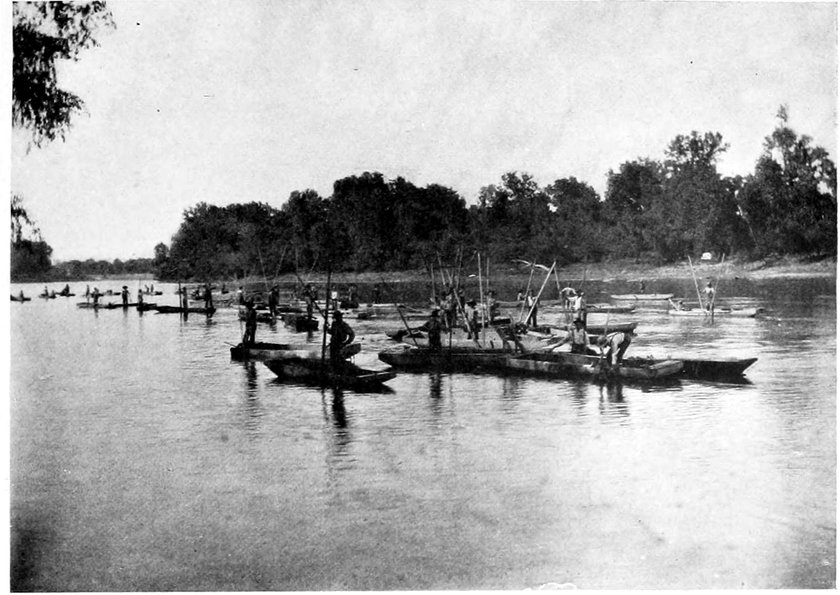
Pearling scene on White River, Arkansas The fishermen are using scissor tongs from flat-bottom skiffs
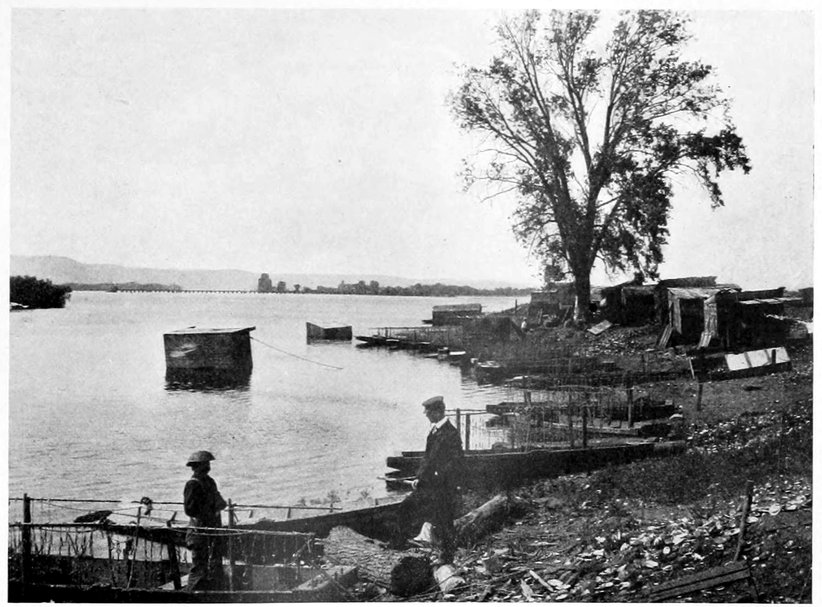
Pearling camp on upper Mississippi River Crowfoot drags are shown on the flat-bottom skiffs at the river bank
272During the height of the Arkansas pearling excitement in 1897, the speculative spirit was so rife that many persons—unwilling to engage in the labor of fishing—purchased unopened mussels from the fishermen in the venture for aleatory profits. The price for these ranged from twenty-five cents to $2 per hundred, and fluctuated rapidly, according to the immediate results, increasing several hundred per cent. in a few minutes under the influence of a valuable find. One fisherman sold mussels to the value of $28 in one day, and thought he had made an excellent bargain until over $1000 worth of pearls were revealed when the shells were opened.
While some pearlers work in southern streams throughout the year, generally the season is coincident with warm weather, when the water is low and the work may be conducted with comfort. In the vicinity of Muscatine and Rock Island about twelve years ago, large quantities of Unios were taken during the winter when the river was frozen over, the men working with long rakes from the surface of the ice.
When only a few mollusks are taken, they are readily opened with a knife to permit a search for the pearls. But where there are many, as in the Mississippi River, the opening is facilitated by heating. After a sufficient catch has been obtained, they are subjected to the action of steam in a box, or they are heated in an ordinary kettle; a few minutes of steaming or cooking are sufficient to cause the shells to spring open. The fleshy parts are removed and thoroughly searched, the interior surfaces of the shells are likewise examined for attached pearls, and the liquid at the bottom of the vessel is strained so that nothing of value may escape.
This cooking is a convenient method of opening the shells, but unquestionably it injures the quality of many pearls. In some instances when the shells open, the pearls fall out and descend to the heated iron bottom, where they are quickly injured. The surface of one exposed too long to the heat shows numerous minute cracks, which increase in number and size when subjected to changes of temperature. Some choice gems have in this manner been rendered almost valueless. If a jacket boiler, or one with a double bottom, were used, there would be less danger of injuring the pearls; or a similar result could be accomplished by placing a wire screen a few inches above the bottom.
Several fishermen have endeavored to devise mechanical methods for removing the pearls and thus avoid the painstaking search among the flesh tissues now necessary; but these contrivances have not proved satisfactory, and have not been employed except experimentally.
In the Mississippi and its tributaries, where the fishery is very extensive, after the pearls have been secured, the shells are sold to button manufacturers and to exporters at prices ranging from $4 to $40 per ton, according to species, quality, and market conditions. This provides a fairly remunerative income to the fishermen even if no pearls 273whatever are found. But in the small tributaries and where the mollusks are less numerous, the shells are of little value owing to the expense of bringing them together and conveying them to market.
Not every mollusk contains a pearl, and the village belle, intent on her evening toilet, need not buy a bushel of clams with the pleasant anticipation of finding a sufficient number of gems for a necklace. Small and irregular pearls are not at all uncommon, but choice ones are decidedly scarce, and each one represents the destruction of tens of thousands of mollusks. Quantities of irregular and imperfect nodules known as slugs are collected, which sell for only a few dollars per ounce. In some sections of the Mississippi, the slugs are so very numerous that their aggregate value exceeds that of the choice pearls.
In the Mississippi, the percentage of pearls found in a definite quantity of mollusks is less than in the tributary streams, yet the much greater quantity of shells collected raises the total yield to a very considerable amount. Pearling is subordinate and incidental to gathering the shells for manufacture. In that length of the river from St. Paul to St. Louis, a fair average yield to the fishermen is about fourteen dollars’ worth of pearls and slugs to each ton of shells. Of course, this is not the individual experience, for a single Unio may contain a gem worth $5000, and on the other hand several tons of shells may yield only a few cents’ worth of baroques. The market for the shells places the Mississippi fishing upon an industrial basis, and guarantees a substantial income to every fisherman even when no pearls whatever are found.
Unios from the upper part of the Mississippi yield a much greater percentage than those from below Davenport. In 1904, for instance, from the 4331 tons of shells taken in Wisconsin the fishermen secured pearls which they sold for $91,345, an average of $21 per ton; from the 822 tons in Minnesota the average was $16 per ton; in Iowa the average was $12 for each of the 7846 tons; in Illinois, $5 per ton for the 2364 tons, and in Missouri less than $1 worth of pearls was secured by the fishermen for each ton of shells which they took in the year named. A large number of choice pearls weighing over thirty grains each were found in the vicinity of Prairie du Chien and McGregor. Within a river length of one hundred miles in that region, the fishermen in 1904 gathered pearls which ultimately sold for $300,000. It is therefore apparent that the returns vary greatly in the different regions; nevertheless, even in the less productive localities fine pearls are sometimes found, which contribute to make the industry a profitable one.
Success in pearling is like that in mining. In the White River in Arkansas, for instance, one man found $4200 worth in one month. 274Another discovered a $50 pearl in the first shell he opened. A Negro found an $85 pearl the first day he worked, while another fisherman worked seven months and secured less than $10 worth. It is a question of finding or not finding; the finding brings riches sometimes, and though the failures reduce the average profits as low as in other local ventures, the big prizes affect the mind, and the average is lost to sight. Taking the country as a whole, it is probable that the total find has been sufficient to pay the average fisherman little if any more than $1 for each day’s work.
The fresh-water pearls range in size from that of the smallest seed to that of a pearl weighing several hundred grains. There is relatively only a small quantity of seed-pearls, especially when compared with the output in the fisheries of Ceylon and Persia. Possibly this is due largely to a scarcity of the parasites which seem to perform so important a function in the regions noted. A further reason may be found in the manner in which the mollusks are opened and searched. Were the Ceylon method of opening employed here—which, however, is not at all practicable—it seems probable that the quantity of seed-pearls found in this country would be greatly increased.
The pearls from the tributaries of the Mississippi are noted for their great range of coloration. From a dead white, the color is gradually enhanced to faint shades of pink, yellow, or salmon tints, then to a more decided form of these. From the light shades, the range extends to purple and to bright copper red, closely resembling a drop of molten copper. Some are very light green; others rose, steel blue, or russet brown, while purplish and very dark brown are not uncommon. White pearls are probably the most numerous; but pink, bronze, and lavender are by no means rare.
A large percentage of the Mississippi River pearls are very irregular in form, many of them resembling dogs’ teeth, birds’ wings, the heads or bodies of different animals, etc.
As a rule the fresh-water pearls do not rank so high in value as those from oriental seas, since ordinarily they are not so lustrous. However, some of them have sold at very high figures. A round pearl weighing 103 grains, found in Black River, Arkansas, in 1904, was eventually sold for $25,000; and one of 68 grains, found, in 1907, on the Wisconsin side of the Mississippi River, was recently marketed at $15,000.
One of the largest American pearl necklaces, brought together in 1904, consisted of thirty-eight pearls weighing 1710 grains in the aggregate, an average of 45 grains for each pearl. The central gem weighed 98½ grains and those on the left of it respectively 85¾, 79⅝, 65¼, 59⅝, 49⅜, 46¼, 45⅛, 43¾, 41½, 40½, 40⅝, 35⅛, 27537⅝, 30, 25⅛, 22¼, 20¼, and 19 grains. The pearls on the right were graduated as follows: 85¼, 76⅛, 64⅞, 59½, 47¼, 46, 45⅛, 44½, 42½, 41¾, 38, 37⅞, 36, 35, 34⅝, 29½, 25¼, 21, and 20⅜, grains. This necklace was exhibited at the St. Louis World’s Fair. It was sold to a London merchant, who in turn sold it to a Parisian dealer, and it was finally purchased by a Spanish nobleman at a price said to be about 500,000 francs.
Another necklace shown at the St. Louis World’s Fair, was of American fresh-water pearls from the rivers of Arkansas. The total weight of these pearls, sixteen in number, was 861⅝ grains, an average of 61½ grains for each pearl. Of these one drop pearl weighed 77 grains, and two others each 65½ grains. A round pearl of 70 grains completed the adornment of the pendant. The circlet consisted of ten round pearls alternating with precious stones. The central pearl weighed 98½ grains and on each side were two of 61 grains, then two of 56 grains, two of 54⅞, and two of 48 grains, one of 45⅜ grains being at the back of the necklace.
In the early days of pearl hunting in American streams, the fishermen had little idea of their value, and sold choice gems for insignificant sums. In 1887, a fisherman on Rock River, Illinois, found a 40–grain pearl which he carried in his pocket for several months. Showing it one day in Davenport, he was offered $20 for it. He quickly accepted the offer, and on his return home told his friends about “the sucker who gave $20 for the shell slug.” At present this “shell slug” is worth more than one hundred times that amount. Numerous instances of a similar nature occurred until the average fisherman lost all confidence in his judgment as to the values, and extravagant ideas prevailed regarding even almost worthless nacreous concretions. Thus, when a choice pearl is found, an exorbitant price is set upon it and the seller feels for the market value by repeated dickerings with several buyers. And unless one is an expert, he is quite likely to pay two or three times as much for a pearl at the river bank as in a metropolitan market. Some of the fishermen collect everything in the shape of nacreous concretions, and very often pearl buyers in New York and elsewhere receive packages which are not worth the postage; in many other packages nine tenths of the lot is worthless; and the practical joker and the swindler have solicited bids on bright marbles, rounded pieces of pearl shell, and even sugar-coated pills.
While many pearls of fine luster and beautiful and regular form have been derived from these fisheries, it occasionally happens, in the case of pearls consigned to the city pearl dealer, that cracks, breaks or marks, which might detract from their value, are closed or removed, either by means of water or oil, the pearls having been kept in one or the other until a few moments before they were shown to the merchant. Pearls worth hundreds of dollars have sometimes shown breaks, and in one instance a pearl valued at $7000 showed these cracks even a very short time after the sale.
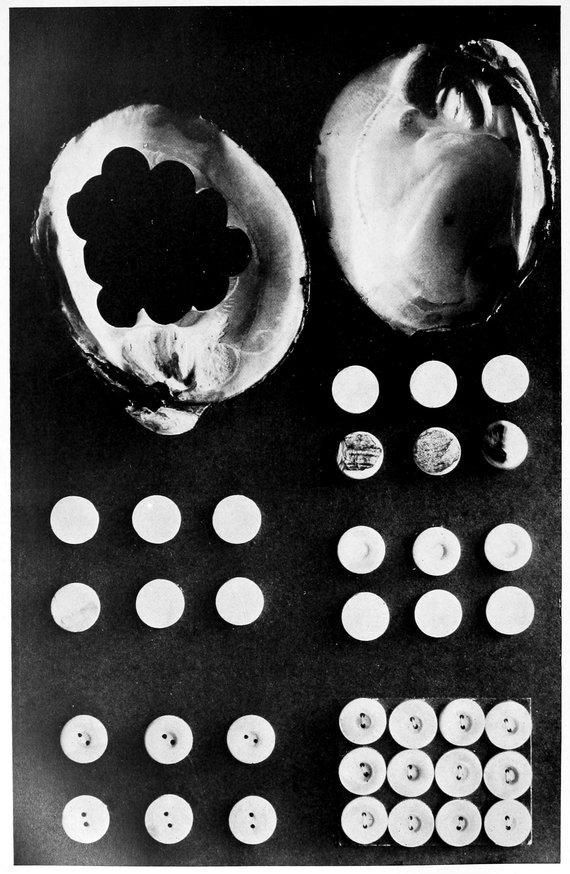
THE EVOLUTION OF BUTTONS, MADE FROM MISSISSIPPI SHELLS
276In many of the pearling regions of the Mississippi Valley, inquiry of almost any fisherman will result in his bringing forth from an inside pocket a small box padded with raw cotton and containing an assortment of pearls and slugs. Most of the slugs he will sell at prices ranging from fifty cents to $5 per ounce, for several of the small pearls he will likely ask from $2 to $20 each, and one or two of the largest he may value at $50 or more. At very rare intervals, a choice pearl will be found, for which he may expect anywhere from $200 to $5000.
While the highest prices are not received by the fishermen, there are many who have been so fortunate as to obtain $1000 or more for a single pearl, and several have received double that amount. Probably the highest figure obtained by the original finder was $3800, notwithstanding exaggerated stories of enormous five-figure prices. Recently the press credited a lad sixteen years of age with securing $20,000 for a pearl he had found.
A particularly striking yarn relative to a so-called “Queen Mary” pearl went the rounds of the press some time ago. According to the newspaper report, this pearl was found by the wife of a fisherman who was a cripple or something equally pathetic, and, fortunately, when the family resources were at the lowest. With tears of joy, the fisherman embraced his wife and told her it was her very own and she should wear it. However, by means of a check for $17,500, he was induced to part with it, but only on condition that it be named Queen Mary in honor of the hard-working wife. The report continues that the original buyer sold it for $25,000, and at last accounts it was held by a Chicago dealer who had “refused $40,000 and probably would not accept $50,000 for it.” The facts seem to be that this pearl, which was found near Prairie du Chien in 1901 and weighed 103 grains, was originally sold for $250, and the local buyer sold it in Chicago for $550, where for many months it was offered at $1000.
All sorts of stories of valuable finds are told in the pearling regions: stories of mortgages that have been released, of homes bought, of college educations secured from the proceeds of a single gem; but these tales are offset by the untold stories of the undermining of fine, strong character in awaiting the turn of fortune which never comes. The public is quickly apprised of the valuable finds, but it does not hear of the time and labor lost by the hundreds who are unsuccessful. Pearling excitement has many of the features of a mining craze. While a few are benefited, hundreds are made poorer, and in many instances 277reduced to absolute want. Persons have given up their established business to devote their time to pearling, staking all on the aleatory profits, and have squandered days and months in the hope that one great, immense, all-rewarding find will be made. The monotony of continued disappointment is occasionally brightened by the news that some one—possibly a near neighbor—has made a lucky find, and then the work is continued with renewed enthusiasm. A spirit akin to that which dominates the gambler takes possession of the fisherman, and the days go on and the seasons go by while the gem that is to bring the fortune still eludes him. In many localities the pursuit yields far less profit than pleasure, and many a man who spends a summer in pearling is in a fair way to spend the winter at the expense of some one else.
The pearls are collected for the trade by a score or more of buyers, who visit the fisheries at intervals and purchase of the individual fishermen by personal dickering and bargaining. The buyers endeavor to keep informed of all choice pearls discovered, and when an especially valuable find is reported each one endeavors to have the first chance to secure it. The principal local centers of the pearling industry and marketing are Prairie du Chien, Wisconsin; McGregor, Clinton, and Muscatine, Iowa; Newport, Black Rock, and Bald Knob, Arkansas; Clinton, Carthage, and Smithville, Tennessee; St. Francisville, Illinois; and Vincennes and Leavenworth, Indiana.
However, a large number of the pearls from American rivers are consigned by the finders to well-known gem dealers, the owners depending for fair treatment on the integrity and high standing of these experts. An interesting story is told of the pearl and the accompanying shell in which it was found, which was sent to a New York dealer by a poor woman. The price she received pleased her immensely; and in writing her appreciation, she added that she was especially gratified at receiving so good a price because it enabled her to send her boy to school. The dealer sent another check as a gift, and a few days before the next Thanksgiving Day a thirty-five-pound turkey was received by the four-score-year-old jeweler as an evidence of the mother’s gratitude.
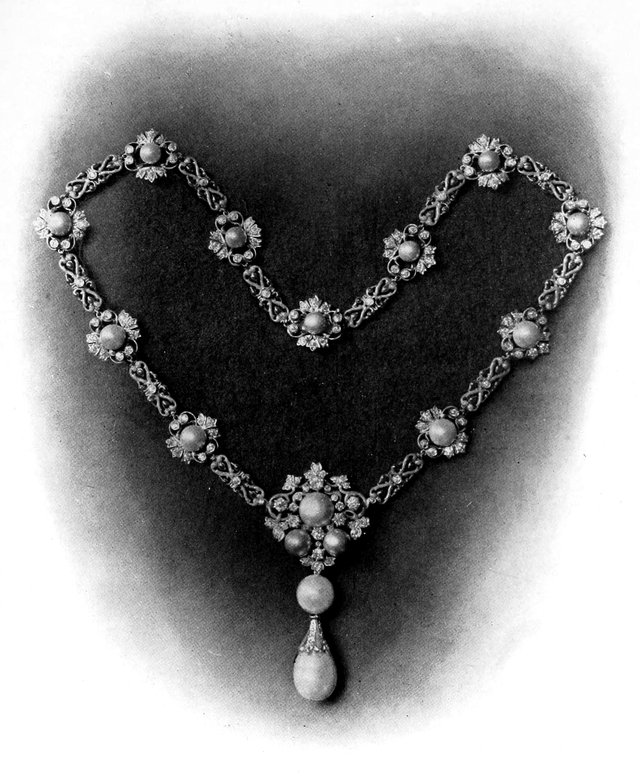
NECKLACE OF FRESH-WATER PEARLS Paris Exposition, 1900
278The outbreak of pearl hunting in various parts of the country is frequently chronicled by the newspapers. These despatches are much alike, usually telling how some fisherman discovered a beautiful pearl which he sold to some responsible jeweler for an amount varying from $100 to $2000. The despatches generally state further that the effect of the find has been remarkable; the whole region is seized with the fever, and into the rivers and creeks swarm the hunters of both sexes, of all ages, and from all classes of the community. Factory-men leave their mills, farmers their crops, and merchants their stores, and with the members of their families join in searching for the gems. The mussels are secured by whatever means is most convenient. If valuable finds continue, thousands and thousands of mollusks are destroyed in the search, and when the efforts begin to prove futile the excitement subsides almost as quickly as it began. In very many localities the industry has run the whole gamut of the feverish excitement of its beginning, the humor and romance of its existence, and the pathos of its ending.
If disturbed labor conditions at the height of the excitement were the only disagreeable attendant, these pearling furors could be viewed more favorably. But, unfortunately, in many localities, especially in shoal waters of restricted area, the fishery has been prosecuted so vigorously that it appears probable the resources will be very materially impoverished if not ruined in a few years, unless prompt and decisive protective measures are adopted. In some waters the crowds engaged in the search have removed practically every mussel without regard not only to protecting the immature mussels, but even to the necessity for preserving breeding mollusks. Many ponds and small river basins have been so denuded that not for many years, if ever, can they recover their former wealth of pearl-bearers.
This state of affairs has not come about without opposition on the part of those interested in the industry and the general welfare of the localities. Intelligent and well-directed efforts have been made to provide a system of regulations for protecting the mussels so that the maximum yield of pearls may be secured. But this is a very difficult problem to deal with. It involves not only the methods of fishery, but the question of sewage disposal by the cities and the large factories, through which great quantities of mussels have been destroyed.
Undoubtedly it will be difficult to devise regulations that will be satisfactory alike to the fishermen, the button manufacturers and the farmers. The great desideratum in the pearl fisheries—of the seas as well as in the fresh-water streams—is a restriction of the gathering to such mollusks and to such seasons and periods of years as produce the largest results with the least injury to the permanency of the resources.
It is generally agreed that the young or immature mollusks should be protected; but it is not easy to determine what is an immature Unio, as some species never grow large. Likewise, the beds should not be disturbed when the mollusks are loaded with young, but it is difficult to select particular months which would be better for close season than any others. The propositions which seem to be most actively advocated impose restrictions on the number and size of the mussels to be 279taken, a cessation of fishing from January 1 to May 31, closing certain areas when partly depleted, and prohibiting the use of especially injurious forms of apparatus. But whatever is done should be done without delay, before the pearl hunters and the button manufacturers kill the goose which for some years has been laying the golden eggs.[323]
MISCELLANEOUS PEARL FISHERIES OF AMERICA
The deep’s wealth, coral, and pearl, and sand
Like spangling gold, and purple shells engraven
With mystic legends by no mortal hand.
Shelley, The Revolt of Islam.
The beautiful pearls of the conch (Strombus gigas) are sought for in the West Indies and on the neighboring continental coasts. They are found most abundantly about the Bahamas, a group of more than four hundred islands off the Florida coast, where many of the fishermen devote a considerable portion of their time to collecting them. It is from this industry that the beach-combers of this group of islands, as well as those of the Florida reefs, have received the designation “Conchs.”
Near the shores, where they formerly abounded, a few conchs are yet picked up by wading fishermen. In waters of medium depth they are secured either by diving or by means of a long pole with a hook at the end. In great depths, the mollusks are located by means of a waterglass similar to the type employed in the Red Sea or among the South Sea Islands.
The animal is readily removed from the shell after crushing the tip end of the spire where the large muscle is attached. The flesh forms an important article of food to the fishermen and to the residents of the outlying islands. It is said that a “Conch” can make a visit to Nassau of a week or ten days, and subsist almost entirely on this dried meat, with which he fills his pockets on starting. A large demand exists for the beautiful shells for ornamenting flower-beds, garden-walks, etc. Many of them are burned into lime for building purposes. Formerly several hundred thousand shells were exported annually to England for use in porcelain manufacture.
The pearls are generally found embedded in the flesh of the mollusk; quite often they are in a sac or cyst with an external opening, from which they are sometimes dislodged by the muscular movement of the 280animal. The yield is small, a thousand shells in many cases yielding only a very small number of seed-pearls or perhaps none at all. Most of them are oval, commonly somewhat elongated. The usual size is about one grain in weight, but some of them weigh over twenty, and a very few exceed fifty grains each. These pearls are generally of a deep pink color, shading toward whitish pink at each end. While this is the usual color, yellow, white, red, and even brown conch pearls are occasionally obtained; these are not so highly prized as the pink ones. Conch pearls present a peculiar wavy appearance and a sheen somewhat like watered silk, a result of the reflections produced by the fibrous stellated structure. While many are beautifully lustrous, they are commonly deficient in orient, and the color is somewhat evanescent.
Most of the Bahama conch fishermen sell their catch of pearls at Nassau. According to the late Mr. Frederick E. Stearns, there are in Nassau four dealers who have an arrangement with Paris and London houses, to whom they can ship pearls in any number and draw against them with a bill of lading. In addition to these, there are a dozen dealers in Nassau who buy what pearls they can secure and offer them for sale.
The value of conch pearls is as variable as their form, color, and size, and they are sold by the fishermen at prices ranging from twenty-five cents to one dollar or more each. Those weighing from three to ten grains, and of good color and luster, but not quite regular in form, sell for about $10 per grain; those of exceptional perfection in color and form, and of about the same weights, sell for from $15 to $30 per grain. In other and exceptional cases, where the size is very large, the form perfect, and the color and luster choice, the value is enhanced to several hundred and even several thousand dollars each. A perfect conch pearl is among the most rare and most valuable of gems. An unusually choice one has sold in New York City for more than $5000. The yield fluctuates considerably, but perhaps averages about $85,000 in value annually. One of the finest conch pearls ever found is shown on the plate with the conch shell.
There are two important materials that have occasionally been sold and mistaken for the conch pearl. First, the pale Italian, Japanese, or West Indian coral, with a color very closely approaching that of the pearl. By means of a lens it can readily be seen that the coral is in layers, and does not possess the concentric structure of the pearl, or the peculiar interwoven structure, with its characteristic sheen, so frequent in conch pearls. Secondly, the pink conch shell in which the pearl itself is found; this is frequently cut to imitate the pearl and sold as such in the West Indies and elsewhere. This can also be detected by the fact that the layers are almost horizontal and the structure 281is not concentric or interwoven, as it is in the conch pearl, while the luster is more like that of the shell than that of the pearly nacre.
Streeter relates that many years ago an ingenious American turned out some bits of conch shell into the shape of pearls and placed them in the conch shells. A slight secretion formed over them, but it was not the true pearly secretion, and the layer was very thin, so that the deception was easily detected.
Not the least interesting of the American pearl fisheries is that which has the abalones (Haliotis) for its object. These occur in many inshore tropical and semi-tropical waters, and particularly in the marginal waters of the Pacific. They attach themselves to the rocks by means of their large muscular disk-shaped foot, which acts like a sucker or an exhaust-cup.
On the California coast the abalones are gathered in large quantities for the pearls, for the shells, and especially for the flesh, which is dried and used for food. The principal fishing grounds are at Point Lobos in Monterey County, and along the shores of Catalina and Santa Rosa islands in Santa Barbara County, with smaller quantities from Halfmoon Bay and from the rocks along the shores of Mendocino County. At low tide the fishermen wade out in shallow water, and, by means of a knife, separate the mollusk from its resting-place. Unless this is done quickly and before the mollusk has time to prepare itself for the attack, it closes down on the rock by means of its sucker-like foot, from which it cannot be removed without breaking the shell. A story is told at Santa Barbara of a Chinese fisherman having been drowned off one of the outer islands by having his hand caught underneath the shell of an abalone.
A few years ago, Japanese fishermen introduced the use of diving-suits in taking these mollusks in three fathoms of water; but in March, 1907, the California legislature interdicted this form of fishery. That legislature also interdicted the capture of black abalones measuring “less than twelve inches around the outer edge of the shell, or any other abalone, the shell of which shall measure less than fifteen inches around the outer edge.”
The animal is removed from the shell by thrusting a thin blade of soft steel between the flesh and the shell, and thus loosening the great muscle. The flesh is salted and boiled, and then strung on long rods to dry in the open air. When properly cured, the pieces are almost as hard and stiff as sole leather. Most of it is packed in sacks and exported to China, but large quantities are sold on the Pacific coast at from five to ten cents per pound. The catch is much less than it was forty years ago.
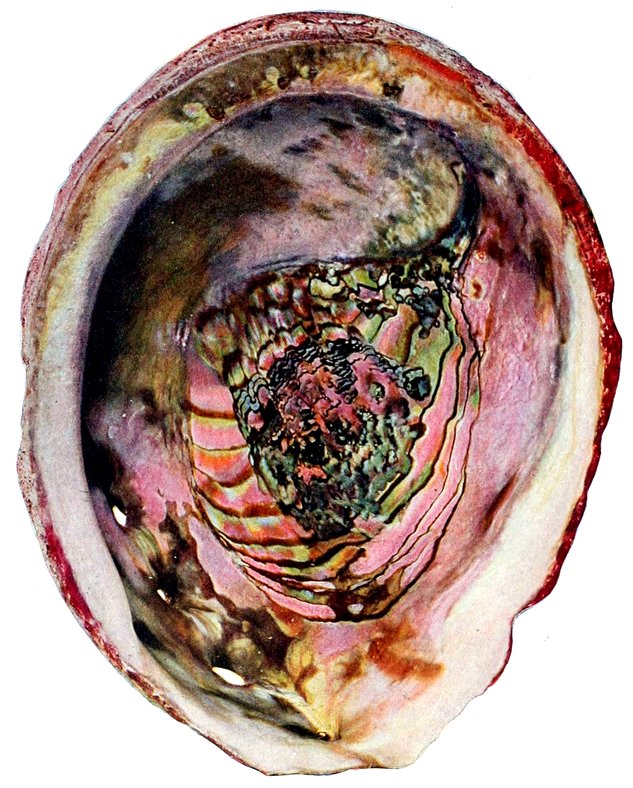
SHELL OF PEARL-BEARING ABALONE From the coast of California
282Many pearly masses are obtained from the abalones, and a few of these are of considerable beauty. Some are very large, measuring two inches in length and half an inch or more in width; but they are rarely of good form, and their value is commonly far less than that of choice Oriental pearls. Owing to their irregularity in form, they are scarcely suitable for necklaces. One of the best necklaces of these pearls ever brought together sold a few years ago for $2000; but individual specimens have exceeded $1000 in market value. While abalone pearls are not on the market in any great quantities, one resident of Santa Barbara has a collection of more than a thousand specimens, ranging in value from several hundred dollars to less than one dollar each. Most of the objects sold in curio and jewelry stores on the Pacific coast as abalone pearls are simply irregular knots or protuberances cut from the surface of the shell. The California fishermen are credited with having received $3000 for the abalone pearls in 1904; but it is safe to say that this represents only a small fraction of their final sale value.
In the river mussels of Canada, and especially in those from the Province of Quebec, and the Ungava Region, pearls are occasionally found. These are usually white and of good luster. They are not the object of systematic search, but in the aggregate many are secured by Indians and Eskimos, and some by the trappers and fishermen who operate from Quebec and Montreal. A number, weighing from one to sixty-five grains each, were shown at the Colonial Exhibition in London in 1886, and received favorable notice. Recently, two beautifully matched pink pearls, weighing about fourteen grains each, were obtained from one mussel. A single pearl found in Canada has sold for $1000, but as a general rule they are of relatively little value. The Hudson Bay traders are represented as having secured a fair share of these pearls.
During the last few years, many pearls have been found in the streams of Prince Edward Island and of New Brunswick Province, and also in those of Nova Scotia. Most of them are well formed, but their color is generally inferior and their luster deficient. Many of them are buff or brown in color, some are bright and fairly good, a few are rose-tinted, and others are slate-colored and even almost black. Toronto jewelers report that many Canadian pearls are in the possession of farmers and others in the lower provinces, held by them for higher prices than the jewelers are willing to pay. The Nova Scotia pearls are from a bivalve which has been identified as Alasmodon margaritifera. They are especially abundant in Annapolis and King counties.
Even in the streams of northern Labrador and of the Caniapuscaw watershed, pearls are obtained by the natives, and by the hunters and fishermen who resort to that desolate country. These closely resemble 283the pearls of Scotland in color, size, and luster. A story is told of a fisherman who by chance found in one shell two well-matched pearls, which he later sold for $150; so pleased was he with his success that he spent a fortnight in diligent search, but secured only half a dozen small ones, worth perhaps $3 for the lot. Most of these pearls are silvery white, but beautiful pink ones are not rare. An unusually choice 20–grain pearl from this region sold in 1905 for $1000.
On the coast of Ecuador, pearl fisheries of minor importance have been prosecuted from time to time. Dr. H. M. Saville, of the American Museum of Natural History, states that in his explorations in that country he frequently came across evidence of pearls and the information that fisheries had existed on the coast centuries ago.
An interesting letter from that world-wide traveler and interesting writer, William E. Curtis, states that formerly there was a pearl fishery on the coast of Ecuador at the little town known as Manta, in the Province of Manabi; but it had to be abandoned on account of a particularly voracious species of fish called el manti, which abounds in that locality and gives the place its name. Pearls are said to be even more abundant at Manta than in Panama Bay. It is reported that this is the place where the Incas obtained those splendid gems which the Spaniards found in the palaces and temples of Peru.
In the waters of Costa Rica, pearl-oysters are found, and at times the fishery has been of considerable local importance. Owing to fear of injury to the reefs, the use of diving machinery was interdicted there a few years ago; but in 1906 its employment was authorized under certain restrictions. Licenses good for six months were authorized for a maximum of thirty machines, which may work at a minimum depth of thirty-seven feet.
On the coast of Colombia, South America, scattered reefs of pearl-oysters occur. A lease of the pearl fisheries and those for corals and sponges was granted July 2, 1906, but it is unknown what results have followed. This lease lasts five years, beginning August 1, 1906.
There is almost an absolute paucity of information in regard to the occurrence of fresh-water pearls in other parts of South America. The only data we have obtained are from Prof. Eugene Hussak of the Mining School of Sao Paulo, Brazil, who writes us that some pearls have been obtained from one of the Bahia rivers. Possibly, when the resources of the interior of that continent are better known, many pearls may be found.
XI
PEARL-CULTURE AND PEARL-FARMING
285