Front matter
Reading edition
THE
BIRD WATCHER IN THE SHETLANDS
WITH SOME NOTES ON SEALS—AND DIGRESSIONS
All rights reserved
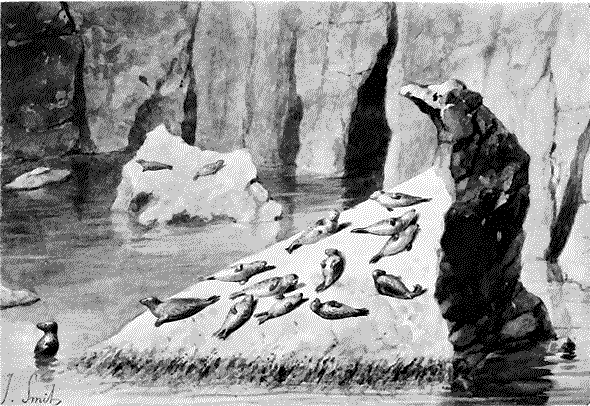
A Seal's Dormitory.
THE BIRD WATCHER
IN THE SHETLANDS
WITH SOME NOTES ON SEALS —AND DIGRESSIONS
BY
EDMUND SELOUS
WITH 10 ILLUSTRATIONS
BY
J. SMIT
LONDON: J. M. DENT & CO. NEW YORK: E. P. DUTTON & CO. 1905
PREFACE
I
IN the spring of 1900 I paid my first visit to the Shetlands, and most of what I then saw is embodied in my work Bird Watching. Two years afterwards I went there again, arriving somewhat later, and it is the notes made by me during this second stay which fill the greater number of these pages. They are my journal, written from day to day, amidst the birds with whom I lived without another companion, nor did I look upon them as more than the rough material out of which I might, some day, make a book. When it came to making one, however, it struck me more and more forcibly that I was taking elaborate pains to stereotype and artificialise what was, at any rate, as it stood, an unforced utterance and natural growth. I found, in fact, that I could make it worse, but not better, so I resolved not to make it worse. Except for a few peckings, therefore, and minor interpolations—mostly having to do with the working out of ideas jotted down in the rough—I send it to press with this very negative sort of recommendation, and with only the hope added that what interested me so much will interest others also, even through the veil of my writing. Besides birds, I was lucky enough this time to have seals to watch, and I watched them hour after hour and day after day. I believe I know them better now, than I do anybody, or than anybody does me; but that is not to say much, for, as the true Russian proverb has it, "Another man's soul is darkness." But I have them in my heart for ever, and I would take them out of the Zoological Society's basins, and throw them back into the sea, if I could.
I have no doubt that these pages contain some errors of observation or inference which I am not yet aware of—but those who only glance at them may sometimes be inclined to correct me, where, later, I correct myself. It is best, I think, to let one's mistakes stand recorded against one, for mistakes have their interest, and often emphasize some truth. Honesty, too, would suffer in their suppression—and besides, if one has got in some idea or reflection that pleases one, or a piece of descriptive writing that does not seem amiss, how tiresome to have to scratch it out, merely because it is founded on a wrong apprehension!—the spire to come tumbling just for the want of a base! For these reasons, therefore—especially the last, when it applies—I have not suppressed my errors, even where I happen to know them. There they stand, if only to encourage others who may be labouring in the same field as myself—which makes one more high-minded motive.
For my digressions, etc.—for which I have been taken to task—I hope this fresh crop of them will make it apparent that they are a part of my method, or, rather, a part of myself. I have still a temperament I find—and it gives me a good deal of trouble—but as soon as I have become a nonentity, I will follow the advice given me, and write like one. I would say more if I could, but I must not promise what it is not in my power to perform.
EDMUND SELOUS
CONTENTS
CHAPTER PAGE
I. My Island Again! 1
II. Spoiler and Spoiled 9
III. From Darkness to Light 15
IV. Duckings and Bobbings 26
V. A Vengeful Community 31
VI. Metempsychosis 37
VII. Bird Sympathy 39
VIII. Enchanted Caverns 47
IX. Ducks and Divers 59
X. From the Edge of a Precipice 68
XI. Darwinian Eider-ducks 74
XII. On the Great Ness-side 81
XIII. Mother and Child 88
XIV. "Dream Children" 95
XV. New Developments 104
XVI. Flight and Fancy 110
XVII. Mouths with Meanings 122
XVIII. Learning to Soar 133
XIX. The Dance of Death 138
XX. "By Any Other Name"! 150
XXI. "Not Always to the Strong" 156
XXII. Children of the Mists 160
XXIII. Love on the Ledges 172
XXIV. Grouse Aspirations 190
XXV. Unorthodox Attitudes 203
XXVI. Pied Pipers 218
XXVII. A Bitter Disappointment 225
XXVIII. Tammy-Norie-land 234
XXIX. Thoughts in a Sentry-box 249
XXX. Intersexual Selection 261
XXXI. An All-day Sitting 284
XXXII. Three Murderers 297
XXXIII. Gulls and Gibbon 314
XXXIV. All about Seals 327
XXXV. The Devil's Advocate 342
XXXVI. Comparing Notes 365
LIST OF ILLUSTRATIONS
A Seal's Dormitory Photogravure Frontispiece
Bird Sympathy Facing page 42
From the Rocks of Raasey Isle " 84
On the Edge of the Precipice " 92
Aerial Piracy " 133
A Seal's Plaything " 216
A Perilous Journey " 288
"One More Unfortunate" " 308
"Nature Red in Tooth and Claw" " 316
Polite but Insistent " 346
THE BIRD WATCHER IN THE SHETLANDS
WITH SOME NOTES ON SEALS —AND DIGRESSIONS
CHAPTER I
MY ISLAND AGAIN!
M
MY island again!—and all the birds still there, looking just as they did when I left it. More, too, have come. At night, but in a sort of murky daylight, I walk over the breeding-ground of the terns, a long flat strip of pebbly beach—or rather the heather a little way above it, for on the beach itself they do not appear to have laid. Rising, all at once, as is their wont, they make a second smaller canopy, above me, floating midway beneath the all-overshadowing one of dreary low-lying cloud. Out of it, ever and anon, some single bird shoots down, with a cry so sharp and shrill that it seems to pierce the ear like a pointed instrument. Occasionally an oyster-catcher darts in amongst them all, on quickly quivering wings, its quavering high-pitched note of "teep, teep!—teep, teep, teep!" threading, as it were, the general clamour, whilst like a grey, complaining shadow, the curlew circles, beyond and solitary, shunning even the outer margin of the crowd. How lonely is this island, and yet how populous! The terns—a "shrieking sisterhood"—make, as I say, a canopy above me, when I pace or skirt their territories; but what is that to the great perpetual canopy of gulls that accompanies and shrieks down at me, almost wherever I go? Were it beneath any roof but that of heaven, how deafening, how ear-splitting would be the noise, how utterly unendurable! But going forth into the immensity of sky and air it sounds almost softly, harsh as it is, and even its highest, most distressful notes, sink peacefully at last into the universal murmur of the sea, making the treble to the bass of its lullaby.
Most of the cries seem to resolve themselves into the one note or syllable "ow," out of which, through varied tone and inflection, a language has been evolved. "Ow-ow, ow-ow, ow-ow!" sadly prolonged and most disconsolately upturned upon the last, saddest syllable—a despair, a dirge in "ow." Then a series of shrieking "ows," disjoined, but each the echo of the last, so that when the last has sounded, the memory hears but one. Then again a wail, intoned a little differently, but as mournful as the other. And now a laugh—discordant, mirthless, but a laugh, and with even a chuckle in it—"ow, ow, ow, ow, ow!" the syllables huddling one another like the "petit glou-glou" of water out of a bottle. All "ow" or variants of "ow," till the great black-backed (the bulk are herring-gulls) swooping upon you, almost like the great skua itself, breaks the spell with a "gugga, gugga, gugga!" or, right over your head, says "er" with a stress and feeling that amounts almost to solemnity.
How lonely and yet how populous! Does life, other than human life, around one, in any way diminish the sense of solitude? I do not think it does myself, except through human association, and for this, human surroundings are more or less requisite. Thus woodland birds seem homely and companionable in woods near which one has a home, and gulls upon the roofs of houses take the place of pigeons or poultry in the feelings they arouse. So, too, as long as a natural alacrity of the spirits prevails over that dead, void feeling which prolonged solitude brings to the most solitary, the wildest creatures in the wildest and loneliest places may seem to cheer us with their presence. But the feeling is a false one, dependent on that very condition, and treacherously forsaking us—even to the extent of making what seemed a relief, an accentuation—when it fails. How often, as I have wandered over this little, noisy, thickly crowded retreat, has all the fellowship around me served but to remind me of my own exclusion from it—as from that of fairies, ghosts, elementals—but what all this life could not do, the cheerful firelight on the bare stone walls of the solitary shepherd's hut did at once for me, and with bacon in the frying-pan I had all the companionship I wanted. A dog—one's own or that knew one—or even a cat, might do more by its own personality than such inanimate objects by association merely, to relieve the sense of solitude; but no quite indifferent creature could do as much, I believe, or indeed anything.
But with the gulls here—and still more with the terns—there is more than mere indifference. It is a disagreeable reflection that all these many birds—these beings everywhere about one—resent one's presence and wish one away, that every one of all the discordant notes uttered as one walks about under this screaming cloud of witnesses has a distinct and very unflattering reference to oneself, upbraids one, almost calls one a name. To be hated by thousands—and rightly hated too! It is strange, man's callousness in this respect—that he should see his presence affect bird and beast as that of the most odious tyrant affects his fellow-men, yet never sleep or eat a meal the less comfortably for it! So it is indeed—and the principle holds good as between races and classes of men—when one has one's fellow-tyrants to laugh and joke and chat with; but here, with but oneself and one's own thoughts, the hostility of all these gulls begins to trouble one. There is no one to share in the obloquy—it falls upon you alone. You are the most unpopular person in the island.
I get another odd sensation through being here. Gradually, as the days go on, it seems more and more as though gulls made all the world, and this feeling, which, for its singularity, I value, I can encourage by seeking out some spot from which the sight of all but them and inanimate nature is, with extra rigour, shut out. The centre of the island, which is the gulls' especial sanctuary, presents these conditions. It forms an extended grassy basin, ringed in with low, swelling peat-hills, above which—for the intervening space is invisible—rise the tops of hills far higher, belonging to islands of some size which lie spread about this little one, hiding it from all the world. Through dips in these, and in the rim of one's own brown basin, one gets the sea—dull, cold grey lakes of it, engirt by dimmer islands, far away. No human sight in it all; no sail, for hours, upon the sea—only the gulls which, in their thousands and their all-possession, seem to have subdued the world. Men are gone, and gulls now take their place, become ennobled for want of a superior. Like snowy-toga'd Roman senators, they stand grouped about, or walk over the grassy amphitheatre—their natural senate-house—and it is wonderful with how slight an effort of the imagination—or indeed with none—the dissonant cries and shrieks, the clang and the jangle, become as the dignified utterance, eloquent oratory, to which one has sat and listened, spell-bound, in the gallery of the House of Commons. "Such tricks has strong imagination." "How easy," indeed, as Shakespeare tells us, "is a bush supposed a bear!"
It is curious how the gulls cling to their breeding-places long after the breeding-time is over. Summer—or say July—is now fast waning, yet in the way they stand amidst the heather, rise as I approach, and float, shrieking, above me, it is just as it was last time I was here, which was in early June, when things were hardly more than beginning. Any one not knowing the time of the year—and it is difficult to tell in the Shetlands—might expect from the birds' actions and the general appearance of the whole community, to find eggs and newly-hatched chicks all about; but all are gone, and the nests now hardly to be distinguished from the surrounding heather. A few young birds there are, but they are of large size, though unable as yet—or scarcely able—to fly. It is the habit of these, when approached, to crouch and lie flat along the ground, without making any attempt to escape, even allowing themselves to be stroked and taken up in the hand. When set down again, however, they generally start off running, and often get to a great distance before they stop. Young terns and young peewits do just the same thing, and it is curious that in their manner of thus crouching, before the power of flight has been fully gained, they exactly resemble the stone-curlew, in which bird the habit is permanent, though not, I should say, very frequently indulged in after maturity has been reached. As no adult gull or peewit crouches in this way, we must suppose either that natural selection has infixed a certain habit in the young bird, suited to its flightless condition, or that in thus acting it reverts to a trick of its ancestors, which were presumably, in that case, flightless, through life. The clinging of the stone-curlew to the early habit seems to support the latter supposition, and primâ facie it is perhaps more probable that crouching in a bird should have come before flying than after it, or, at least, that it should have been resorted to by certain species, on account of their flight having become weak. It is conceivable that some birds may have alternately lost and reacquired the power of flight many times in their genealogical history. But where have the majority of the young gulls gone? That they have left the island seems evident, for, were it otherwise, they would either be all about the heather, or fill the air more numerously than do the mature birds, when they cluster above me in my walks. In the air, however, none are to be seen, though, as by far the greater number must now be full-fledged, it is there that they ought to be, with the rest. On the ground there are, as I say, a few that seem to have been later hatched, and are not yet matriculated in flight. Their proportion, however, is not more than one to a hundred of the grown gulls, whereas since every pair of these rears three young, it should be as three to two. Gilbert White speaks of that general law in accordance with which young birds are driven away by their parents, when they are no longer dependent upon the latter's attention, but can feed and look after themselves; but with social birds this law of expulsion is apt to merge in a larger one, that, namely, which is expressed in the old adage that "birds of a feather flock together." We often see this illustrated in the case of the sexes, and after watching kittiwakes at the close of the breeding-season, I can have no doubt that the same principle governs the motions of young and old birds. Of hostility on the part of the parents I have seen but little, nor is it necessary; for the young, which are now distinguished by a different coloration, both of plumage and bill, making them look like another and quite mature species, delight to associate together, so that both the rocks and the water become the scene of tolerably large gatherings of them, at which hardly an old bird is present. As the parents of these assemblies are now free from the cares of domesticity, it seems as though the reason for such a segregation must be of a psychical nature, since one can hardly suppose that the dissimilarity of plumage has anything to do with it, seeing that young and old are as familiar with one another's appearance as with their own. It is the same thing, no doubt, with the gulls on this island, but as the whole interior, or rather the crown of it, is little else than their nesting-ground, it would be difficult for the younger generation to foregather, without the constraining presence of the elder one. The inconveniences of this may be imagined. Not a remark but would be overheard, not a side-glance but would be supervised and harshly interpreted, not a giggle that would pass unreproved. In these irritating circumstances, apparently—this, at least, is my theory of it—the young people have migrated en masse, a striking proof that, with birds no less than with ourselves,
Crabbed age and youth cannot live together.
CHAPTER II
SPOILER AND SPOILED
T
TO the one smooth beach that there is here come the terns, each year, to breed, and from these, as well as from the various gulls that nest upon the island, the lesser or Arctic skua—whom some call Richardson's, as though it belonged to that gentleman—is accustomed to take toll. Sweeping the sea with the glasses, one detects, here and there upon its surface, a dusky but elegantly shaped bird, that sometimes rises from the water and descends upon it again, slowly and gracefully, but is never seen to poise and hawk at fish, like the terns themselves, or, more rarely, some of the gulls. These are those skuas who elect to take their chances at sea, and whenever a tern rises after making his plunge, with a fish in his bill, they rise also and pursue him. Then may be witnessed a long and interesting chase, in the course of which the two birds will sometimes mount up to a considerable height, rising alternately, one above the other, as though each were ascending an aerial ladder. There are no gyrations in these ascents. They are, or at least they have the appearance of being, almost perpendicular, so that they differ altogether from those of the heron and hawk, once familiar in falconry, and of which Scott has given us such a splendid description in "The Betrothed," that delightful work which an obtuse critic and publisher (l'un vaut bien l'autre very often) almost bullied its author into discontinuing. The victory is by no means always to the robber bird, and I believe that if a tern only persevere long enough it has nothing to fear, for, as in the case of the black-headed gull and the peewit, with much threatening, there is never, or, to be on the safe side, very rarely, an actual assault. It almost seems as if this logical sequence of what has gone before had dropped into desuetude, and that the skua, from having long been accustomed to succeed by the show of violence only, had become incapable of proceeding beyond the show. Why, if this were not the case, should he always leave a bird that holds out beyond a certain time? It is not that he is outstripped in the chase, for the skua's activity and powers of flight have always seemed to me to be sufficient to overtake any bird of his own size, however swift, with whom he has piratical relations. Of his own size, or something approaching to it, for I have seen him altogether baffled by the smaller turns and evasions of such a comparatively feeble flyer as the rock-pipit. But this was out of the ordinary way of his profession. The rock-pipit carried nothing, and, even if he had done, it would have been too insignificant for the skua's attention. Either amusement or murder—or the amusement of murder, which is felt by birds as well as men—must have been the object here, nor does this contravene the theory I have just laid down, since such generalised and legitimate longings are only indirectly related to the bird's special instinct.
I do not myself see how these curious relations of robber and robbed could have arisen, unless there had been, from the beginning, a marked difference in the relative powers of flight possessed by each. The skua, originally, must have caught fish, like the birds on whose angling it is now dependent, and only an easy mastery over the latter could have induced it to abandon the one way of living for the other. This superiority was probably first impressed upon the weaker species through bodily suffering, but it would have been less trouble for the stronger one could it have succeeded without coming to extremities, and this, and its constantly doing so, might in time have made it forget, as it were, the last act of the drama. But say that the skua has forgotten this, then it is likely that a certain number of the persecuted birds have by practice discovered that it has, and so emancipated themselves from the tyranny. Whether this be the reason or not, I have often noticed the persistence with which some terns refuse to yield the fish, though the nearness of the skua, and its sweeping rushes, seem quite sufficient to induce them to. Those, on the other hand, who drop it quickly, often do so whilst the enemy is still at a distance, in which case the fish falls upon the water before the skua can catch it. Upon this, the latter—if not invariably, as the fishermen assert, yet certainly in the greater number of instances—flies off without any further attempt to secure it, and I have then seen the tern sweep back, and, plunging down, retake possession of its booty. Whether, in such cases, the fish was designedly relinquished, in order to be secured again, I cannot say, but here, at any rate, we see another way in which the parasite might come to be outwitted by the more intelligent of its vaches à lait.
These competitions between skua and tern, both of them birds of such swift and graceful flight, are very interesting to watch. The skua, in the midst of the chase, will frequently sweep away, as if it had abandoned all hope, and then return in a wide circling rush, at the end of which there may be a sudden upward shoot, for the tern generally seeks to elude its pursuer by rising higher into the air. Often—and again this is just as with the peewit and gull—a pair of skuas will give chase to the same tern, and then one may see the slender, shining bird quite overshadowed by the two evil figures, as, pressing upon either side, they rise or sink towards it, often almost covering it up with their broad and dusky pinions. Twin evil geniuses they look like, seeking to corrupt a soul, or else dark shadows that this soul itself has summoned up, and that attend it, hardly now to be shaken off:
Da hab' ich viel blasse Leichen Beschworen mit Wortesmacht. Sie wollen, nun, nicht mehr weichen Zurück in die alte Nacht.
For imagination can easily multiply the two into many—cares, shadows, sorrows, they are easily multiplied.
A tern that either eludes or is not molested by a skua at sea, flies home with its fish, to feed its young. But here it has often to run the gauntlet of other skuas, who wait and watch for it upon the land, sitting amidst the short stunted heather, with the brown of which their plumage, as a rule, harmonises. There are, therefore, land-robbers and sea-robbers—pirates, and highwaymen—amongst these aristocratic birds, and it would be interesting to know whether the two rôles are performed by different individuals, or indifferently by the same one. To ascertain this satisfactorily I have found a difficult matter, but I believe that here as elsewhere—in everything, as soon as one begins to watch it—a process of differentiation is going on.
Where there are terns to be robbed, the skuas—I am speaking always of the smaller and, as I have found it, the more interesting species—seem to prefer them to any other quarry, so that the gulls, generally, benefit by their presence; otherwise all are victimised, except, as I think, the great black-backed gull. The latter will, himself, attack the skua, who flies before him, so that, taking this and his size into consideration, it does not seem very likely that the parts should ever be reversed between them, nor can I recall any clear instance in which they were. Of all the birds attacked, the common gull—which, like common sense, seems to be anything but common—makes, in my experience, the stoutest resistance; for it will turn to bay and show fight, both in the air and on the water, when it has been driven down upon it. Generally it is able to hold its own, and I look upon it as a vigorous young Christian nationality, in course of establishing its independence against the intolerable yoke of Turkish oppression.
These skuas love brigandage so much that, amongst themselves, they play at it; swooping, fleeing, and pursuing, each feigns, in turn, to be spoiler or spoiled. So, at least, I understand it, for nothing ever comes of these mock skirmishings, no real fight or flight, or anything approaching to one. It is fun, frolic, with a sense of humour, maybe, as though two pirates were playfully to hoist the black flag at each other. I love the humour of it. I love the birds. Above all, I love that wild cry of theirs that rings out so beautifully "to the wild sky," to the mists and scudding clouds. By its general grace and beauty, by its sportings and piracies, its speed of flight and the rushing sweeps of its attack, this bird must ever live in the memories of those who have known it: but, most of all, it will live there by the inspiring music of its cry.
CHAPTER III
FROM DARKNESS TO LIGHT
T
TO all that I have said concerning the Arctic skua in my last chapter (I do not say it is much) I will now add what the Germans call a Beitrag, on the subject of the multitudinous variety of colouring and arrangement of markings which the plumage of this species exhibits.
Hitherto, indeed, I have spoken as if it were always of a uniformly dusky shade, but that was because I wanted that shade (and, indeed, it happened so to be) in the two that were chasing my tern. Otherwise they would not have suited the part I assigned them of twin evil geniuses, or have contrasted sufficiently with the white soul that they were seeking to corrupt. So, till that was all over, there could be no light or half-light skuas, but now that it is, and the effect produced, I permit things to be as they are.
The Arctic skua, then, is supposed by ornithologists—or, at any rate, that is how they are accustomed to speak of it—to be a bird of two different outer appearances, independent of sex, which does not add another one: dimorphic we are told it is, which means, or should mean, that it is two- or double-formed, taking form here to mean colour. Two! A hundred would be nearer the mark, I think, but I have only had the time, or the patience, to note down fifteen, which I did very carefully, through the glasses, as the birds stood amidst the short heather on the ness-side. Here they are; not, perhaps, very precisely or scientifically defined, but none the less truthfully so, for all that, and as accurate, I think, as the fact that no two people see colours quite alike will allow. But they, at any rate, bring out four facts, which, together, have, I think, a distinct meaning, viz. (1) the unmistakable and, for the most part, pronounced difference in these fifteen forms of a two-formed species; (2) the likeness of the extremely plain, permanent form to the plain-coloured great skua; (3) the same resemblance in the first true plumage of the young bird; and (4) the absence in the young bird of the two lance-like feathers which, in the old ones, project beyond the rest of the rectrices, but which are also absent in the great skua. Well, here they are.
(1) The neck, from just below the head, with the throat, breast, and ventral surface, as far as the legs, a beautiful creamy white; the rest dark, as in the ordinary dark form, but I was not careful to note the precise shade; the crown of the head—and this, it seems, is universal—sufficiently dark to appear black. This bird represents, I think, the extreme of the light or ornate form, in which dark and light are almost equally divided.
(2) The light colouring extends, speaking roughly, over the same parts, but is very much less bright and pure. It might be described as a dun-cream or cream-dun, the two shades seeming to struggle for supremacy. The cream prevails on the neck, the dun on the other parts; but even the neck is of a much duller shade than in the bird just described (No. 1). There are parts of the breast where the original sombre hue, a little softened, encroaches, cloudily, upon the lighter surface. These two birds cannot, certainly, be described as more or less handsome, merely, in the same colouring. The lighter surface, at any rate, is plainly different in shade, also its amount and distribution, though in a less degree.
(3) Another bird is much like this last one (No. 2), but there is, here, a distinct, broad, dunnish space, dividing the throat and breast parts, making, of course, a very palpable difference.
(4) Another bird—one of two standing together—is the common uniformly dark form, except that the neck and throat just below the head is, for about an inch, very much lighter, making a considerable approach to cream without quite attaining it. This light part is conspicuous in the one bird—this that I have been describing (No. 4)—but not in the other (No. 5) that it is standing by.
(5) This other one might pass for the ordinary dark form, but on examining it through the glasses a lighter, though less salient, collar is distinctly visible.
(6) In a third bird, not far off these two (Nos. 4 and 5) the whole colouring, from immediately below the crown of the head—which seems always to be black or very dark—is of a uniform brown-drab or brown-dun colour, there being not the slightest approach to a lighter collar, or any lightness elsewhere, except, as in every bird, without exception, on the quill feathers of the wings as seen in flight.
(7) In another bird the breast and ventral surface is of a delicate silvery cream, or creamy silver, something like that on the same parts of the Great Crested Grebe. On the sides of the neck, and just below the chin it is the same, perhaps a little less silvered; but between these two spaces, and so between the chin and breast, a zone of faint brown or dun, somewhat broken and cloudy, pushes itself forward from the wings, thus breaking the continuity of the light surface by the strengthening of a tendency which is, perhaps, just traceable even in the lightest specimens. Besides this, a similar clouded space is continued downwards from the back of the head, first in a diminishing quantity, and then, again, broadening out, till it joins the upper body-colour. So that here only a little of the nape is white, hardly more than what may still be described as the two sides of the neck. This is a very pretty and delicate combination.
(8) Close beside this last bird (No. 7) is a uniformly dark brown one; and
(9) Not far off, on the other side of it, one which exhibits the same sort of general effect, in a dark, smoky dun. This latter bird would generally pass as representing the dark form, and, with fluctuations in either direction, dark or light, it does represent the common form. Nevertheless, it is both light and varied compared with the extreme or uniform dark brown form beside it (No. 8), which appears to me to be the least common one of all, less so than the extreme light one (No. 1) at the other end. When I say uniform, however, I do not mean to include the crown of the head or tips of the wings, which are always darker than the rest of the plumage, nor yet that lighter shade which is on the primary quills of every individual, but only seen in flight. These exceptions must always be understood, and, moreover, the expression uniform is not to be construed with mathematical accuracy, but only as conveying the general effect upon the eye.
(10) A bird that from the dark crown of the head to the dark tips of the wings is, above and below, a uniform dark, browny dun, yet some washes lighter than the uniformly brown one (No. 8) that I have spoken of.
(11) A bird that, from the dark crown to the dark wing-tips, is, above and below, a uniform light fawny dun.
(12) A bird that would be the extreme light form (No. 1) that I have first described, were it not that, both on the throat and breast, the cream is encroached upon by cloudy barrings of a soft greyey-brown (or something between the two) which extend also over the under surface of the wings. Moreover, a toning of the darker colour of the general upper surface encroaches a little upon the cream of the nape.
(13) A bird exhibiting the uniform, dusky-dunnish colour of the common form (a shade lighter, perhaps, on the under surface), but with a cream patch on each side of the neck, just below the head. These patches are not, perhaps, of the brightest cream, but they are very conspicuous, whether the bird is seen standing or flying—in fact, the salient feature.
(14) A bird that would be the extreme light form (No. 1), but for a distinct collar of soft brown dividing the cream of the neck and throat from that of the breast.
(15) A bird that is yellowish dun on the neck and throat, mottled-brown on the breast, and a fine cream on the ventral surface.
Moreover, all these birds differed to a greater or less extent in those lighter markings of the quill feathers, both on the upper and under surface, some being lighter and some darker; following, in this respect, the general colouring. This feature, however, is only apparent when the birds fly, and I found it too laborious to include.
I can say with certainty, I think—judging by the lance-like projecting feathers of the tail, absent in the young bird, and by every other indication—that all the individuals here described by me, were birds of mature plumage. They were all established in one locality, and I was able to compare most of them with each other. I think, therefore, that though there might, perhaps, be some difference of opinion in regard to some of my colour terms—as where would there not be?—yet that the variation between the different forms is properly brought out. Without my seeking it, the list includes the two extreme forms, as I believe them to be, of dark and light; the former represented by a uniformly dark-brown bird, the latter by one having the whole under surface of the body, as well as the sides and nape of the neck, of a beautiful cream colour, by virtue of which, and of the salient contrast exhibited between this and the dusky upper surface, it is extremely handsome, not to say beautiful—one of the handsomest of all our birds in my opinion. Both the extreme forms are uncommon, but only, I think, as compared with all the intermediate shades, not with any one of them. Also the extreme light, or handsome, form seems to me to be commoner than the extreme plain one. Should not a bird like this be described as multi-morphic rather than as dimorphic? I believe that there exists as perfect a series between the two extreme forms as between the least eye-like and the most perfect eye-feather in the tail of the peacock—to take the well-known illustration given by Darwin to enforce his arguments in favour of sexual selection. The eye, however, insensibly masses the less saliently distinguished individuals together, so that those in whose plumage the light colour is more en évidence than the dark, go down as the light form, and vice versâ. Moreover, the more prononcé a bird is, in one or another direction, the more it is remarked; so that, perhaps, the intermediate shadings are forgotten, on the same principle as that by which extreme characters, in any direction, are more appreciated than less extreme ones, by the breeders of fancy birds—pigeons, poultry, etc. The uniform brown form, however, as being less striking (though extreme at one end) is not, I believe, so much noticed as those various dunnish shades, which have, in my view, been classed all together, as the dark variety.
In regard to the young birds, I only remember those nestling ones which had feathers under the fluff, as brown, without any admixture of cream. But I had not, at that time, these matters in my mind, and, moreover, I did not see many. When older, however, and able to fly, all that I have seen have had a distinct colouring of their own—for their plumage has borne a considerable resemblance to that of the Great Skua (Stercorarius catarriactes), being mottled on the back with two shades of brown, a darker and a lighter one. I got the effect of this when I watched young birds flying or standing, and one day I caught one whose wing had been injured, and saw that it was so. This resemblance is increased by such birds wanting the two lance-like feathers in the tail. As I say, this mottled brown is the only kind of colouring which I have seen in these immature but comparatively advanced birds, and my impression is that, in the still younger birds, such mottling was either absent or not so noticeable. At any rate, I have no clear recollection of it.
My own explanation of all these facts is that Stercorarius crepidatus—by my faith, 'tis a pretty name, though not wholly deserved—having been, originally, a plain homely-coloured bird, like his relative, the great skua, is being gradually modified, under the influence of sexual selection, into a most beautiful one, as represented by the extreme light or half-cream form. Natural selection, in the more general sense, seems here excluded, or, at any rate, extremely doubtful; and if it be suggested that the lighter birds have the more vigorous constitutions, that they are fuller of verve and energy, to which they owe their cream colouring, I, for my part, can only say "Prodigious!" (or think it), like Dominie Sampson. But I can assure all those who hold this unmanageable view—for really there is no dealing with it—that the one sort came not a whit nearer to knocking my cap off than did the other. But, leaving shadows, the main facts here suggest choice in a certain direction. There is a gradation of colour and pattern, connecting two forms—one plain, the other lovely. This suggests a passage from one to the other, and if the plain mature form—I mean the uniform brown one—most resembles the young bird in colouring—which to me it seems to do—whilst the young bird resembles, more than any old one, an allied plainer species, this makes it more than likely that the passage has been from the plain to the lovely, and not from the lovely to the plain. Supporting and emphasising this, we have the absence, in the tail of the young bird, of those lance-like feathers which give so marked a character to, and add so infinitely to the grace of, the old one. Of what use can this thin projection, an inch or so beyond the serviceable fan of the tail, be to the bird? Seeing how well every other bird does without it, can we suppose it to be of any service? Its beauty, however—which one misses dreadfully in the young flying bird—is apparent to any one, and it goes hand in hand with an ascending scale of beauty in colour. All this seems to me to point strongly towards sexual selection as the agency by which these changes have been, and are being, effected;[1] since I am, personally, a believer in the reality of that power, having never heard or read anything against it, so convincing to my mind as what Darwin said for it, nor seen anything that has appeared to me to be inconsistent either with his facts or his arguments.
No doubt if the varied coloration of the Arctic skua is really to be explained in this way, the lighter-coloured forms, especially the extreme one, in which the whole under surface is cream, ought to be on the increase, whilst the dark ones should ultimately die out or remain, perhaps, as a separate species, the intermediate tintings having disappeared. It is very difficult to form an idea of the relative number of individuals constituting any one form, because one unconsciously compares such form with a great many others instead of with each separately; but, whereas I remember various repetitions of the extreme light or half-cream variety, I have not the same clear recollection in regard to birds exhibiting other shades and proportions of cream. It was the opinion, moreover, of the man engaged to protect the sea-birds during the breeding season on Unst, that the light birds, by which he meant the ones more markedly so, were increasing in numbers. It would appear, therefore, that the process one might expect, were sexual selection the agency here at work, is in operation, and, for the rest, it is no use being in a hurry. A little patience, the "rolling" of "a few more years"—say a million—will settle the matter either one way or the other.
CHAPTER IV
DUCKINGS AND BOBBINGS
T
THE eider-duck is here, but not its beauty, for at this fag-end of the summer and breeding season the males have all departed, and it is the sober-coloured female, either alone or accompanied by her little brood of ducklings, that one meets now along the shores of the island. True there must be males in their just proportion among the latter, but at this tender age—the age of fluff and innocence—the sex of a bird is in abeyance—a world that is not yet begun. A pretty thing it is to see such little family parties coasting quietly along the shore and following all its bends and indentations. There is one such now—mother and three—coming "slowly up this way," like the spring, though not so slowly as the spring, or anything at all spring or summer-like, comes to these islands. They are feeding, apparently, upon the brown seaweed that clothes, as with a mantle, each rock and smooth stone that lies upon the shallow bottom along a gently shelving beach—making a continuous fringe which is but just submerged at low tide. In this the heads of the young ones are continually buried, but the mother eats more sparingly, and seems all-in-all happy to be thus with her family. Now as the eider-duck is certainly very much of an animal feeder—supposed, indeed, to be wholly so—one would naturally think that here the food sought for is not the seaweed itself, but any live things that may be clinging to it. This, accordingly, was my provisional hypothesis, but practical investigation hardly supported it, for on examining some of the seaweed, first in one spot and then another, along the track in which the birds had swum, I could find nothing whatever upon it—noticeably bare, indeed, it was. The eyes of an eider-duck are, no doubt, sharper than my own—or anybody's. Still I do not believe that even the most sharp-sighted one could find anything on this seaweed, at least without searching for it, whereas these ducklings are constantly dipping and, apparently, as constantly feeding all the way along. Finding always, they never have the appearance of looking for what they find. To me they seem to be browsing in their little ducking way, just as sheep browse in a field.
The seaweed here is not the long, brown sort, but another and almost equally common kind, which is shorter and covered with little lobes, shaped something like an orange-pip, but of a slightly larger size—small grapes, perhaps, since they grow in bunches, is more what they resemble. They are full of a clear, gelatinous substance that might well be appreciated, and having, to the boot of all the other indications, actually seen something that looked very like one of them in the beak of a duckling, I imagine—and it is a pleasing imagination—that the latter, at any rate, derive some part of their sustenance from these their subaqueous vineries. But I have seen seaweed in the mother's bill also, and this was not only the brown sort, but a soft green variety which grows sparingly with it. When feeding, without any doubt, upon living prey, eider-ducks are accustomed to dive, going right to the bottom, and often coming up with what they find there—a crab or other kind of shell-fish—to dispose of it on the surface at their leisure. The chick can dive as easily as the grown bird, but one may watch these family excursions for a long time without once seeing either of them do so. Instead, they now merely duck to get the seaweed, which almost reaches the surface. The chicks, however, are often raised by the swell of the sea beyond the height at which they can nibble it comfortably, and it is then funny to see the hinder portion of their little bodies sticking up in the air, with their legs violently kicking, as they hold on with might and main to prevent being floated off on the wave. Sometimes a brisk one bids fair to tilt them right over, but they always ride it in the most buoyant manner. The motion with which they do so—or rather with which it is done for them—is sometimes very curious, for they look as though they were swung out at the end of a piece of elastic, and then drawn smoothly back again, just as they are on the point of turning a somersault; but more often it is a plain bob-bobbing. Thus over wave and ripple they bob lightly along, whilst their mother, floating deeper and heavier, bobs with more equipoise—a staider bob, that has much of deportment about it. Each kind has its charm—never was there a prettier family bobbing. All bob to each other—that, at least, is what it looks like—and their song, if they had one, would be certainly this:
If it wasna weel bobbit, weel bobbit, weel bobbit, If it wasna weel bobbit, we'll bob it again.
But, for my part, I have never seen them bob it otherwise than well. They all of them bob to perfection.
Scenes like this belong to the pebbled beach and gently sloping shore. There are others in the deeply indented, rocky bays that bound the greater part of the island. Here, in the frowning shadow of beetling, cavern-worn precipices, one may often see the little eider-ducklings crawl out to feed upon the steeply-sloping sides of rocks or mightier "stacks"—as those great detached spurs of the cliff that the water swirls round are called here—whilst their mother waits and watches on the sea close at hand. She does not bob now. These sullen heaving waves sway her with a larger and more rhythmic motion, calm but portentous, like the breathings of a sleeping lion that may at any moment awake. Or she will follow her ducklings, sliding up on the heave of the wave, and remaining, most smoothly deposited, as though the sea, rough and rude as it cannot help being, yet really loved her, in its way, and were solicitous of her safety. There she will feed beside them till she tires, and with a deep note that brings them running after her down the smooth, wet slope of the rock, goes off on the wave that is waiting, like a ship with so many little pinnaces following in her wake. The most she ever sails with now is three, and very often she has only one to attend her.
CHAPTER V
A VENGEFUL COMMUNITY
I
IT was terns, I think, who, when some killing Scotch naturalist or other had wounded one of their number, came down to it, pitifully, as it lay on the sea, and bore it away upon their backs and wings. I can better realise this incident now, after having walked about a ternery in these northern parts, and again tried the experiment—which in the south produced no special consequences—of interfering with their young. Upon my taking one of them in my hand, the whole community, amounting, perhaps, to several hundreds, gathered in one great, air-filling cloud, a little above my head, and with violent sweeps and piercing cries, seemed to threaten an actual attack. When I let the young thing flutter to the ground, and it moved and struggled upon it, the excitement was redoubled. It seemed as though they were animated with hope at seeing it out of my grasp, and as I took it up and let it go twice again, each time with the same result, I have little doubt that this was really the case. It was not only the two parents—assuming them to have been there—who attacked me. Many did so; many, too, seemed to feel, at some time, an extra degree of fury, whilst not a bird in the whole crowd but was violently and vengefully moved. These terns, as they clustered and darted about, resembled, or at least made me think of an angry swarm of wasps or hornets; but how different is the anger of insects to that of any other sort of animal! Though so much smaller, they attack without any hesitation or mistrust as to the result whatever. A hornet or an ant threatening merely when its nest was attacked seems an absurdity, whilst in a creature many times their size it is the idea of courage only that is presented to us.
Yet it was not all threatening with these terns, for as the excitement and hubbub increased several of them attacked me, though only with missile weapons. To be explicit, they excreted upon me, as they swept down, in such an irate "Take that!" sort of manner and with such precision of aim, that the intention was quite evident. This habit I had heard of, though not felt, before, for a south coast fisherman told me that he once had a dog which had developed a strong liking for tern's eggs, to gratify which he used to make egg-hunting and feasting expeditions along a line of beach where they lived, from which he would return in a most unseemly plight, owing to the birds having "dunged" him. I did not doubt this account at the time, and I have now this interesting confirmation of it, but though I myself walked amongst these southern terns and often took the young ones up in my hand, they never vented their displeasure on me in this particular way, nor were such swoops and threatenings as they made of so pronounced and violent a character. They mobbed a hare, however, in a much more determined way, and certainly pecked at it, though, at the distance, this was all I could say with certainty. It is interesting if a means of defence resorted to against animals only, by some colonies of these birds, is by others employed to repel the intrusion of man also. For the habit itself, I do not remember reading of it, either in the case of terns or any other bird or animal, except one with which Swift has made us familiar—Swift, that great misanthrope, who, by the sheer force of his satire, has anticipated to some extent the reasoned truth of Darwin. As I say, I can hardly doubt that these terns acted as they did with malice prepense, yet, as their conduct is, perhaps, susceptible of another interpretation, I ought to mention that the bombardment was not continuous, but occasional only—a dropping fire, so to speak. As far as I could observe, however, the act was always in combination with the plunging sweep down, which makes me certain that, if not the mere mechanical effect of intense excitement, it was prompted by hostility—to which latter view I strongly incline.
A little way farther on I found two quite tiny terns—the other was of a fair size—lying together in the nest. There was excitement when I took up these also, but not nearly so great as just before, except, perhaps, on the part of the two parents. The first young bird had assumed almost its final appearance, though not quite able to fly. I concluded, therefore, that this had something to do with the different degree of excitement shown by the terns as a whole, but when, after some while, I found and took up another baby, almost as big as the first, there was still less demonstration than in the case of the two fluffy ones—again excepting the parents. Perhaps the boiling point of communal fury that had been aroused by my first unlawful act was not to be again reached; but birds are certainly capricious in their actions, and there is no judging from one to the next.
But, taking them at their best, why are these northern terns so much fiercer and more vengeful than those which breed in the south? Of the disposition of the latter I have had ample time to judge, and, though there was always anger when I walked over the great bank crowded with their nests, yet its manifestations were of a more ordinary kind, nor, as I say, did I notice any very acute development of it when I lifted a young one from the ground. Sometimes I think these Shetlanders look slightly smaller than the English kind, and always they seem to me to be more waspish and irritable in their disposition. Are they, therefore, of a different species—the Arctic, instead of the common tern, or vice versâ? The two, indeed, are so much alike that only an ornithologist—as ornithologists tell us—is capable of distinguishing them whilst the birds are alive and at liberty. However, as the sole mark of distinction appears to consist in a hardly appreciable difference in the length of the tarsus, it is easier to understand the difficulty than how the ornithological eye, even, unsupported by a measuring-tape, manages to surmount it. But when would any member of a fraternity admit himself on a level with mankind in general, in regard to his particular cult? The thing is always to ramp on one's pedestal, though it be no higher than the houses over the way. Personally I doubt the validity of a specific distinction so attenuated as this; but be that as it may, terns, in their northern and southern homes, seem to differ somewhat in their natures, even as do the respective beaches on which they lay, with their surrounding scenery of sea and sky. How different are these one from another! Here, in these desolate and wind-swept isles, I, at least, though I have sometimes seen the sun, have never caught one glimpse of summer—nothing at all nearer to it than a somewhat fresher and very much rougher November. But on that other great bank, in the more genial climate of southern England, not only is it summer, sometimes—and that in spring—for hours together, but one may even be, for a while, in the tropics. How else could there be the mirage? Yet there it is, or, at any rate, something like it; for as one lies at length and gazes through the golden haze that seems to beat in waves upon the hot, parched shingle, lo! this is gone, and where it lay, all glaring, a blue pellucid lake, that seems to partake equally of the nature of sea and sky, lies now, cool and delightful. Into it terns, ever descending, seem to plunge or softly dip, as though it were the sea itself; and as they do so they either disappear altogether, becoming lost in azure haze, or are seen through it, dimly and vaguely, sitting or performing such actions as are proper to their shore life, amidst those strange new waters, from which others as constantly ascend. Gulls, too, and sometimes cormorants, may be there, whilst dove-cot pigeons, with familiar, yet now half phantasmal strut and bow, mingle occasionally, like little household Pucks, with the more poetic figures of this fairy dream. A dream, indeed, it is; but, more and more, it passes into one of far-off, sunnier lands—seen once, remembered now. Bluer becomes the sky—the sea; softer the air. Palm-trees wave, the long, bright breakers are bursting on a coral shore, the surf roars in, hissing and sparkling, the gulls are the surf-riders, England is no more.
CHAPTER VI
METEMPSYCHOSIS
O
OH, if there is really a metempsychosis, has not the soul of Bardolph gone into an oyster-catcher, or at least has not his nose, which was his soul—Shakespeare, at any rate, has made it the most immortal part of him—gone into an oyster-catcher's bill? I believe it has, and it burns there, now, just as brightly, with nothing but the salt sea to drink. It is that bill, that wonderful bill, which makes the oyster-catcher a handsome bird. The ruby eye, the pale pink legs, and the gaily-chequered plumage, all help; but they are but adjuncts, and by themselves would work but small effect. This is well seen when the bird, having before been running actively about on the foreshore, becomes, all at once, oppressed with somnolence, stands still, turns its head over its shoulder, and thrusts its long, fierce, fiery tube amidst the plumage of the back. The transition from something showy to something plain, from brilliancy to mediocrity, is then quite remarkable; and equally so is it the other way when, for some imperative purpose, or in a wakeful moment, the red ray flashes out again. Every now and again come these swift conflagrations, and, between them, the bird stands like a little lighthouse, in the intervals between the flashes of the revolving light.
Oyster-catchers—or sea-pies, to give them their old name, which is a very much better one—seem somewhat sleepy birds, unless it be that in the Shetlands birds sleep more in the daytime and less at night than farther south. Sleep, I think, it may be called, taking the attitude and the complete quiescence into consideration. Yet the red eye is always open, seeming—for you see but one—to wake singly, keeping guard over the rest of the slumbering commonwealth to which it belongs. But there is another eye, and that, no doubt, is open too. A pair of these quaint birds will often rest thus, side by side, upon the rocks, and another, seeing them as he comes flying along the dividing-line of shore and sea, will wheel inwards, and, settling beside them, be a lotus-eater too.
CHAPTER VII
BIRD SYMPATHY
T
TO-DAY—which is my third here upon the island—I was actually assaulted by the terns. I saw a young one, now well advanced, that flew for a little and then went down on the grass. Walking towards it, a bird—presumably one of the parents—descended upon me twice in succession, and, with that angry and piercing cry that I have spoken or ought to have spoken of—it sounds very like a shrill "bah!"—delivered a fierce peck at my head, so that I felt it each time, quite unpleasantly, through the thin cloth of my cap. The difference is to be noted in this form of attack, to that employed by gulls and skuas, the former in battles inter se only, and the latter as against man in defence of their eggs or young. Both of them, when they thus "swoop to their revenge," use the feet only, and the superiority of the tern's method is so great that it makes this small bird almost as redoubtable—if this exaggerated word may be pardoned—as even the largest of the others. The Great Skua, especially, were it to use its powerful beak, would be really formidable, even to a man. In fighting with its fellows, it no doubt does so, and gulls, under these circumstances, make the greatest use of theirs. This, however, is when they struggle together on the ground; but when one fights on the ground and the other in the air, the latter uses its feet only, with effects that are irritating rather than to be feared. Now why is this, and what causes the difference in this respect as between gull and tern? From my own observation I think I can explain it. So long as two contending gulls fight with any equality, they do so upon the ground, but when one of them can no longer hold his own there, he rises into the air and, sweeping backwards and forwards over the other, who stays where he was, annoys him in this particular way. The bird, therefore, by whom these tactics are resorted to has already got the worst of it, and the last thing he wishes is again to close with a rival who has defeated him. This, however, is exactly what would happen were he to use his hooked beak in the manner proper to it, for it is adapted for seizing and tearing, and to these uses it has hitherto been put. To peck or stab with it would be like making a thrust with a sickle, and though possibly as against a weaker antagonist it might be made effectual in some other than the normal way, yet here there is always the fear of detention, to check any experiment of the sort. Let the hooked tip but pierce the skin to any extent, and the swoop would be checked sufficiently to allow of the flying bird's being seized. The feet, therefore, though without efficient claws and quite unadapted to anything except swimming, are employed by preference, and in the manner in which they are used we see the same principle at work, for instead of making any attempt at grasping or scratching, the flying gull, as it sweeps by, just gives a flick with the back of them, which the other revenges or parries with a blow of the wing.
The tern, however, having a straight and sharply pointed bill, adapted for pecking, and nothing else, can use it in this manner when flying also, though in other respects it delivers its attack in exactly the same manner as the gull does, allowing for the difference in bulk and aerial grace and mastery, between the two birds. Here, as it appears to me, we see structure affecting habit. As a rule, I think, it is rather the other way, for it is wonderful to how many uses, other than the primary one for the performance of which it has been specially adapted, almost any part of an animal's anatomy may be put. And indeed, if we look at it in another way, this truth is as strikingly illustrated by what we have just been considering as by almost anything, for the webbed foot of a gull or any swimming bird is extremely unadapted for fighting, and yet we here see it thus employed. But it is owing to the structure of the beak, in my opinion, that this has come about. That is the bird's real weapon, which I am convinced it would always use if it could or if it dared. Not even in their rough-and-tumbles, where they close and roll over and over together, have I seen gulls fight with their feet, upon the ground.
I had not gone far, after this episode with the terns, when I was pecked at, twice again, by another one, under similar circumstances. Each time, I believe, the sharp point of the beak went through the slight stuff of my cap, or I should hardly have felt it so sharply. It is not only the skuas, then, that attack you in defence of their young. These terns, though so much smaller, do so too, and, as appears by the story, they have more than one weapon in their armoury. But a more interesting experience was in store for me, which brought still more forcibly to my mind that incident with the wounded tern to which I have before alluded. Walking on, I noticed a bird which, though a young one, looked almost in its full plumage, and which kept flying for a little, and then going down again at some distance in front of me. Every time it alighted, a cloud of terns hovered excitedly over it, and first one, and then another of them kept swooping down, so as just or almost to touch it, until at last it flew up again, so that I could never approach it more nearly. It certainly seemed to me as though the grown community were trying to get this young one to fly, so as to be out of danger, and this they always succeeded in doing. I do not think they really prevented me from catching the bird, for, no doubt, it would have flown of itself before very long; but what interest and sympathy shown! Moreover, had I been pursuing it with a gun it might have made all the difference.
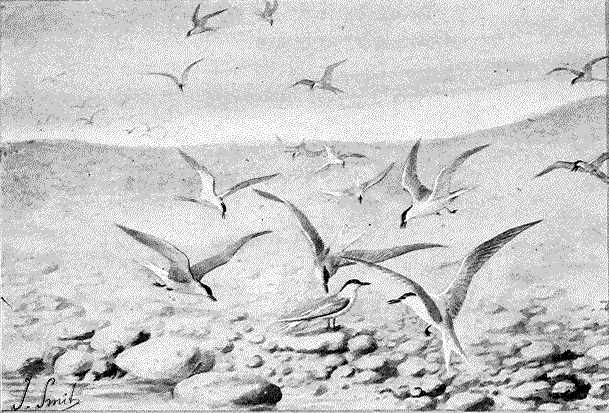
BIRD SYMPATHY
So, too, it must be considered how lethargic these young terns are before they can fly, and how easily they then let themselves be caught, though able to run quickly. When noticed, or approached closely, they crouch, but though this is probably due to an inherited instinct of self-preservation, they do not appear to have much fear of one. Therefore it seems likely that in their early flying days they might still be inclined to act in this way, and if so, any encouragement to fly which they received from their elders would be of assistance to them. It is noteworthy that the younger birds which I caught were not thus encouraged to run. The public attention, in this case, seemed concentrated on myself.
Terns vary much in the degree of resistance, or rather of evasion, which they offer to the attacks of the skuas—always I am speaking of the smaller of the two species. I have often seen them get off scot-free, without losing their fish, and, as before said, this has always seemed to me to be because of their persistency in holding out, and not at all on account of their superior speed. I have advanced a theory as to why the skuas should not actually attack the terns on these occasions, as they do not seem to me to do, and if there is any truth in it, we here see a road along which a certain number of the latter might become free of the tyranny under which they now suffer. It is doubtful, however, whether these more obstinate birds would gain, in this way, a sufficient advantage over the others to allow of natural selection coming into play. They could carry, no doubt, more fish to their young, but here, at least, the skuas seem hardly in sufficient numbers to make the difference a working one. With many birds, however, a similarly acquired change of habit would mean the difference between life and death. I remember once passing unusually close to a cock pheasant, which remained crouching all the while, though nineteen out of twenty birds would, I feel sure, have gone up. It struck me, then, that as all such pheasants as acted in this way would have a greater chance of not being shot than the others that rose more easily, whilst these latter were constantly being killed off, therefore, in course of time, the habit of crouching close ought to become more and more developed, and pheasants, in consequence, more and more difficult to shoot. Some time afterwards I met with some independent evidence that this was the case, for a gentleman who shot much in Norfolk, remarked, without any previous conversation on the subject, that the pheasants there had taken to refusing to rise, and that this unsportsmanlike conduct on their part was giving great trouble and causing general dissatisfaction. That was his statement. He spoke of it as something that had lately become more noticeable, but only, as far as his knowledge went, in Norfolk, which, I believe, is an extremely murderous county.
Beyond this I have no knowledge on the subject, but I feel sure that a gradual process of change and differentiation is every day going on amongst numbers of our British birds. I believe that I have myself, here and there, seen some traces of it, and my idea is that greater pains ought to be taken to collect evidence in this and similar directions. Along all those lines where fluctuation has been observed, or where modification might, in course of time, be expected, the present truth should be most carefully made out, and having been accurately recorded and published, observation, after a certain length of time, should again be focussed on the same points, and this being renewed every ten, twenty, fifty, or a hundred years, the results could be compared. For instance, our green woodpecker feeds now largely upon ants in their nests, whilst it both fights and copulates upon the ground. How interesting would it be if we had a continuous record of observations of this bird's habits, dating, say, from William the Conqueror or the days of the Saxon Heptarchy, and if we found that no mention was made of these peculiarities, by the field naturalists of those times, but that they first began to be doubtfully recorded in the reign of Henry the Fifth, or Richard the Third. No doubt a connected chain of evidence of this kind will gradually grow up, owing to the accumulation of works of natural history, but it would, I think, be a great deal more satisfactory if the object were kept steadily in view, and I am quite sure that observations made in this spirit would produce much more interesting matter than that which is to be found in the ordinary bird or beast book. For the great idea would then be to compare the present with the past habits of any creature, in order to see whether, or in what degree, they have changed, and this could only be done by continual re-observation, which would assuredly lead to novelty of some sort, instead of mere repetition, which is what we have now; and not only so, but the thing that is so constantly repeated seems often to be founded either on nothing, or nothing that one can get at. Take, for instance—but no, that would lead to twenty more pages at the least, and I want them for something better.
CHAPTER VIII
ENCHANTED CAVERNS
A
ALONG the bolder coast-line of this island, where the cliffs, without being very high, are steep and frowning, there are some remarkable caves, which I to-day visited with Mr. Hoseason, in his boat—he having sailed over from Yell Island. To me, at least, they seemed remarkable, principally by reason of the various and vivid colours which the rock perforated by them begins to display as soon as their entrance is passed. This rock, as elsewhere in the Shetlands, is sedimentary, but broken here and there with veins of quartz, often of considerable thickness, which seem to have been shot up in a molten state and to have afterwards cooled—"seem," I say, for I have no proper knowledge as to their geological formation. This quartz, which when exposed to the light of day is white or whitish, is here of a deep rust-red, and this, distributed in long zigzag lines or meanderings, is sufficiently striking, but nothing compared to the much brighter reds, the lakes, and brilliant greens with which the interior of the cavern is, as it were, painted; so that the whole effect, lit up by the candles which we used as torches, resembled, in a surprising and quite unexpected way, those highly coloured and very artificial-looking representations of natural scenery which one sees on the stage—in pantomimes more particularly or on some very florid drop-scene. These colours are due to some low form of vegetation which is spread like a wash over the face of the stratified rock, but it seems surprising, since one is accustomed to associate colour with light, that in the absence of all sun they should not only exist, but be so very brilliant. I have never seen anything like such vivid hues on the surface of rock or cliff exposed to the light of day, nor, indeed, in any landscape, if flowers and the autumn tints of leaves are excluded. Gaudily painted stage scenery, some enchanted or robber's cavern in a pantomime—Ali Baba's, for instance—is really the best comparison I can think of, nor shall I ever again think these exaggerated. Nature is really harder to outdo or burlesque than one may fancy—even on the stage, where the effort is so constantly, and, one would swear, successfully made.
In shape these caverns are long and narrow—throatal, one might call them—and the sea, with the many weird and uncouth noises that it makes as it licks, tongue-like, in and out of them, helps to suggest this resemblance. Though their height is really but moderate, yet, owing to the narrowness of their walls, they have the appearance of being lofty, especially near the entrance, or where, after descending till it nearly reaches the water, the roof is suddenly carried up again. For the most part, however, the height decreases gradually, with the breadth, till at length the cave ends in a low, dark tunnel, which the sea almost fills, and up which the boat can no longer proceed. Yet far beyond, where all is opaque darkness, one still hears the muffled wash and sob of the waves as they ceaselessly eat and eat into the hidden bowels of the rock. As the whole force and vastness of the ocean lies beyond this little tip of its tongue, to where may not such burrows extend? and might not, by a knowledge of their position and the direction in which they run, some inland towns be supplied with the blessing of sea-water?
The water in these caverns is delightfully clear, revealing in every detail, through its lucid green, the smooth-rolled pebbles and great white rounded boulders which strew, or rather make, their floor. To look down at them is like looking up into the arched roof of some other cave. One might think it the reflection of the one overhead, till, glancing up, the difference is remarked—jagged, bright-hued peaks and niches instead of smooth, even whiteness. This effect, as of a roof beneath one, is due, I think, to the continuation downwards of the sides of the cavern, for this gives the same vaulted appearance, but reversed, that there is overhead, and the mind, as with the image on the retina of the eye, soon sets it the right way up.
These caves must have been known from time immemorial to as many as were accustomed to coast round the island, and it is interesting to think of who, and what kind of craft may, from age to age, have visited or sheltered in them. Recently, however, they were first explored, if not discovered, by Mr. Hoseason (who has for years rented the island and done his best to protect the bird life upon it) in the spring of the preceding year, and they were at that time tenanted by numbers both of shags and rock-pigeons, who sat incubating their eggs on any suitable ledge or projection of the rock. Of the latter birds, to-day, there were none, but several of the former, though so late in the season, were sitting on eggs which, to judge by their whiteness, must have been but lately laid, and, no doubt, represented a second brood, whilst others, whose young were still with them on the nest, although full-fledged and almost as big as themselves, plunged, attended by these, into the water. The hollow sounds of splash after splash were echoed and re-echoed from sea to roof, and the air seemed filled with sepulchral croakings. It was easy to follow these birds as they swam midway between the surface of the water and the white pebbled floor of the cavern, and I was thus able to confirm my previous conviction that the feet alone are used by them in swimming, without any help from the wings, which are kept all the while closed. I have many times observed this before, but never so clearly or for such a length of time.
The young birds, after diving, made for the nearest rock or ledge on to which they could scramble, and they were so unwilling again to take the water that some of them allowed themselves to be caught by us, though showing every sign of fear—indeed, of extreme terror—which one might naturally suppose them to feel. This is a puzzling thing to understand—at least, to me it is. An aquatic bird that swims and dives all as easily as it breathes, and which has just before plunged into the water from a considerable height, stands now upon a rock but little above its surface, and watches a boat, the object of its dread, coming nearer and nearer, till at last it stops in front of it, and the hand is stretched out to seize and take, without ever escaping, which it might easily do in the way that it has just before done. What is the explanation? We may suppose, perhaps, that these young birds have not yet got to look upon the ocean as a place of long abode, that they enter it only with the idea of getting quickly out again, and that the rock is as yet so much more their true home that they cling to it in preference, and may even have a feeling of safety in being there. But if this last were the case, why should they leave it in the first instance? There would be no difficulty in understanding the matter if they refused to take the sea at all, but having done so once, it seems strange that they should so fear or dislike to, again. Possibly the having soon to come out—as being impelled to do so—and finding themselves no better off, but menaced as before, may give a feeling of inevitability and hopelessness of escape, sufficient to take away the power of effort. But this I do not believe—despair hardly belongs to animals, and if it did, imminent peril, with at least a temporary refuge at hand, ought to conquer such a feeling. As the birds which we thus caught were only in the water for a very little while, exhaustion could have had nothing to do with their self-surrender. The paralysis of fear ought, one would think, to have acted from the first, instead of supervening after a period of activity, but perhaps mere bewilderment, by preventing sustained exertion, may have produced a similar effect. Had it always been the parent bird that led the way on the occasion of the first leap from the rock, this powerlessness on the part of the young to leave it a second time might be attributed to her absence—but as far as I can remember there was no fixed rule in this respect. Both old and young birds generally went off with great unwillingness, but at other times this was not nearly so marked.
In their swimming so quickly to the shore again, after their first plunge, and refusing thereafter to leave it, these young cormorants brought to my mind those amphibious lizards of the Galapagos Islands which Darwin mentions as never entering the sea to avoid danger, but, on the contrary, always swimming to land on the slightest alarm, though it might be there precisely that danger awaited them. This "strange anomaly" Darwin explains in the following manner: "Perhaps this singular piece of apparent stupidity may be accounted for by the circumstance that this reptile has no enemy whatever on shore, whereas at sea it must often fall a prey to the numerous sharks. Hence, probably, urged by a fixed and hereditary instinct that the shore is its place of safety, whatever the emergency may be, it there takes refuge." The shag, as far as I know, has nothing particular to fear, either by sea or shore. His only enemy is man, who is not confined to either, but is as brutal and ignorant on the one as the other. But in avoiding danger the instinct of any animal would probably be to leave the place to which it was less accustomed, and run to that with which it was familiar—and this we constantly see. Thus a land-bird that was beginning to take to the water would leave it for the land on any alarm, whilst a water-bird under similar circumstances would make for the water. But all water-birds were probably land-birds once, so that we might expect sometimes to see in their young that old instinct of taking refuge there, which had become reversed in the parents. We might also expect to find greater dislike, on their part, to entering the water; and certainly the young shags did enter it very unwillingly from the first. So, indeed, for that matter did the old ones, as already stated, but with them there was the love of being on their nests, or at least their nesting-ledges—a late continuance of the breeding habits—to be overcome. When once they had plunged, however, they did not, like the young birds, swim at once to the shore again, but made for the open sea, and it must have required a strong contrary instinct on the part of the latter not to follow them. The lizards on the Galapagos Islands have, no doubt, also taken to the sea gradually, so that their habit of swimming to the shore when alarmed may, possibly, be due to a long-enduring ancestral instinct, having nothing to do with sharks.
We passed, whilst exploring one of these caverns, just beneath a ledge of rock, where a shag sat brooding over two tiny little things, but just hatched, perfectly naked, and jet black all over. This poor bird showed an anxiety which could hardly have been overpassed in the most devoted of human mothers, and I almost believe her sufferings were as great—for surely all extremities are equal. Her hoarse, bellowing cries reverberated through all the place, and helped, with the gloom, the murky light flung by our candles, the lurid colouring, and the deep, gurgling noises of the sea, to make a weird, Tartarean picture, difficult to excel. But it was not in sound alone that she vented her displeasure, for she was angry as well as alarmed. As the boat passed, she rose on the nest, and, in a frenzy of apprehension, snapped her bill, and alternately advanced and retreated her long, snake-like and darkly iridescent green neck. Though my head was but a foot or two away from her, she kept her place on the nest, and becoming more and more beside herself, behaved, at last, in such a manner as it is difficult to describe, but which upon the human plane and amongst the lower classes, is called "taking on." Not until I actually took up one of the young ones, to examine it—for this I could not resist—did she fling herself into the water, and then it was with a dramatic suddenness that looked like despair. It was as though she had attempted suicide, but no cormorant, I suppose, would do so in such a way.
What a strange sight this was! What a gargoyle of a creature—alive, in these gloomy shades! It seemed not a bird, but something in The Faerie Queen, one of
The uncouth things of faerie,
—a line, by the way, which only resembles Spenser by being, probably, unfamiliar to most people. But our knowledge makes things commonplace. Did the fairies exist, they would be classified, and, with Latin names and description of their habits, would be no more really the fairies than are birds or beasts. Let one but know nothing, and these caverns are enchanted.
It is not often that one has so close a view of a shag as this. My head was but a foot or so off, and on a level with her own; my eyes looked into her glass-green ones. One thing about her struck me with wonder, and that was the intense brilliancy of the whole inside of her mouth, which, in a blaze of gamboge, seemed to imitate, in miniature, the cavern in which she sat. Most stupidly I did not think to open the bill of the chick whilst I had it in my hand, in order to see what its mouth was like. As bearing on the conjecture which I have formed, this would have interested me, and such an opportunity is not likely to come again. I noticed, however, that the naked skin about the beak, which, in the grown bird, is thus vividly coloured, was very much lighter, and consequently not nearly so handsome, in the larger fledged young ones. That here the intensity of the hue was gained gradually through sexual selection, I—being a believer in sexual selection—can have no doubt, and the lesser degree of it in the young bird would be due to a well-known principle of inheritance, which has been pointed out or, rather, discovered by Darwin. If, therefore, the inner colouring has been acquired in the same manner, it ought also to be first light and become brighter by degrees.[2] I must now watch for these young cormorants to open their bills, for it is a habit which they share, more or less, with their parents, and out of it, as I believe, the adornment has grown.
I have no doubt that numbers of shags roost in these caverns during the night, for when I was lost on Raasey Isle in Skye, I came to a huge vaulted chamber in the cliffs, into which scores—perhaps hundreds—both of these birds and the common cormorant flew, after the sun had set. When they were all settled, every ledge, crevice, and pinnacle seemed tenanted by them, and never shall I forget the gloom, the grandeur, and the loneliness of this scene. I admired it, though naked, except for a torn pair of trousers which were half wet through. I should like to see them come flying into their caves here also, where I am not so forlorn; but the distance of my hut from this part of the shore, the lateness of the hour up to which the light lasts, and my having to cook my supper, makes this difficult, or, at least, inconvenient. But if I cannot see them fly in in the evening, I may see them fly out in the morning, and that should be "a sight for sair een."
Whilst rowing to these caves we had seen one black guillemot, or "tysty," flying over the sea with a fish in its bill, and another swimming with a young one by its side. The latter was of a greyish colour, and about a third smaller than the parent bird, which in shape and movements it closely resembled. These birds, therefore, breed in the Shetlands—a fact well known before, I believe; but I like to rediscover things. Another and more interesting thing that we saw was a seal swimming very fast, and leaping, at intervals, out of the water. I think I may use this expression, for if he did not leap quite free of it, he very nearly did, so as to show his whole body. He rose in a very bluff, bold way, with great impetus, as it seemed, and went straight, or nearly straight up, for a little, before falling forward again. Each time one seemed to hear the splash and the blow, but this was only in imagination, the distance being too great. When I say that this seal was swimming very fast I am giving my impression merely. All I saw was the leaps, which were quickly repeated, yet with a good space between each, and all in one direction. Between them, therefore, he must have been speeding along at a great pace, so that, each time he plunged up, it was as from a spring-board of impetus and energy. I do not remember reading of seals leaping thus out of the water, but Mr. Hoseason had seen them do so before, though not often. There was a fine joyous spirit in the thing—"there is" joy, as well as "sorrow on the sea."
It is good to see an animal like this in this United Kingdom of ours—or at least in its seas—for, for a moment, it makes one think one is out of it, and in some wilder, more life-teeming part of the world. It is hard to have to live in a country, glorified as being "a network of railways," and to have no taste for railways. Oh, wretched modern world of ugliness, noise, improvement and extermination, what a vile place art thou becoming for one who loves nature, and only cares for man in books!—the best books bien entendu.
CHAPTER IX
DUCKS AND DIVERS
T
THE red-throated diver moves softly upon the gentle play of the ripples, seeming, rather, to float with the tide than to swim, for there is no defined swimming action. When it turns and goes the other way, it meets the opposing motion—the little dance of the sea—as if it were a ripple itself, assuming the shape of a bird. This shape is a graceful one, something between that of a grebe and a guillemot. One might say that a guillemot had been sent to a finishing-school and had very much profited by it; but this is not to imply that the grebe—I am thinking of Podiceps Cristatus—is slighted in the comparison—no bird that swims need think itself so. Much there is grebe-like in manner and action, and in shape, except for the crest. By the want of this, the bird, I think, rather gains than loses to the human eye, for handsome as the grebe's crest is, the delicate curve of head and neck is interrupted by it, and the effect is rather bizarre than beautiful—it loses something in purity, that beauty of the undraped statue, to which Cicero compares the style of Cæsar. The neck of the red-throated diver offers a wonderful example of delicate yet effective ornament. Down the back of it, and encroaching a little upon either side, run thin longitudinal stripes of alternate black and white, so cleanly and finely divided that they look as though they had been traced by a paint-brush in the hand of a Japanese artist. There is a gorget of rich ruddy chestnut on the throat, but the rest of it, with the head and chin, is of a very delicious plum-bloomy grey, which looks in the sunlight as though it would be purple if it dared, but were too modest—a lovely and æsthetic combination, soft, yet bright, and the whole with such a smoothness as no words can describe. There is another effect wrought by the sun, if it should happen to be shining, and if the bird should be swimming so as to give a profile view. It then looks as though there were a broad, white stripe—white, but having almost a prismatic brilliancy—along the contour-line of the nape. This appearance is most deceptive, and it is only when the bird turns its neck so as to show the several thin delicate stripings that one sees it to be illusory. It is produced, I think, by the light being reflected from the white stripes alone, so that the black ones between them are overlooked. Whatever may be the cause, the effect is most striking and lovely, and if the stripes themselves are due to sexual selection—which I do not doubt they are—this far more beautiful appearance, being the effect and crown of them, must assuredly also be. Here is a neck, then! and I have seen three, and once even seven, together!
In their way of diving, again, these birds resemble the grebes. Sometimes they go down with a very quiet little leap, but often they sink and disappear so gently and gradually that one is hardly conscious of what they are about till one sees them no more. As much as any creature, I think, they "softly and silently vanish away." Another habit which they have is shared by the cormorant and other sea-birds, and has often puzzled me. It is that of continually dipping their bills in the water and raising them up from it again, as though they were drinking, though that they should drink the salt sea like this, for hours at a time, seems a strange thing. What is the meaning of this action, which I have just seen a shag perform forty-six times in succession, at intervals of a few seconds, as if for a wager? And this was after having watched it doing the same thing for some time before. After the forty-sixth sip, as it were, this bird made a short pause, and then recommenced. Is this drinking, and, if not, what is it? The head and part of the bill are, each time, sunk in the water, so that, as the bird moves on, they plough it like the ram of a war-ship. Then, in a second or two, the head is raised, not so high indeed as in an unmistakable thirsty draught—which I do not remember at any time to have seen shags indulge in—but with much the action of drinking. The bill, it is true, is very little opened, hardly sufficiently so to be noticeable, but very little would allow of water entering it. But why should the bird drink like this? It cannot be that the salt water makes it more and more thirsty, for this, as with shipwrecked sailors, would produce evil consequences—probably death—but, of course, this is out of the question.
Sometimes it has struck me that some small disseminated matter in the water might serve as food, and in regard to this, I have seen some large white Muscovy ducks, in the Pittville Gardens at Cheltenham, engaged for a long time, apparently, in carefully sifting the quite clear water of a little rill. Here, too, there was some action, as of drinking. On the whole, however, they seemed obviously to be feeding, but whatever they got must have been extremely minute. The waters of the sea are, no doubt, full of tiny floating substances, which a bird might yet be able to appreciate, and which would perceptibly add to its nourishment. If this were so, then drinking, as a special function, might become almost merged in the constant swallowing of water whilst taking food, and this may be the case with various sea-birds. Guillemots and razor-bills also act in this way, but not, I think, gulls. Gulls drink the fresh water of lochs and streams; whether they, of set purpose, also drink the sea, I am not quite sure. If they do, then no doubt I have seen them; but I have not set it down, and have no clear recollection of it.