Front matter (continued 5)
Reading edition
Well, like the world, one does go forward, though slowly. Not so many years ago the sight of these seals would have made me want to shoot them. God alone knows why—or, rather, I know why, perfectly well: the inherited instinct of the savage, which is not in itself, as some humanitarians think, a bad thing, or at any rate in the savage it was not, only it is now out of place, and reason and morality together ought to insist upon crushing it. It is because the wish, or rather passion, to kill wild animals is so natural, that it seems so right to those who have it, for the strong desire to do almost anything makes almost anything seem right, or rather the impelling force in such cases is a force, whereas that which seeks to restrain it is weak, cold, frigid, like the voice of reason in love.
Moreover, I believe that to sin out the evil in one is nature's true way of progress—in which I join issue with the spiritualistic doctrine of repression—and therefore were it not for the many ill consequences, the worst of which is specific extinction, I should not think a man did wrong to prey upon the animal world as long as to do so was his nature—that is to say, the stronger part of his nature; nor can it be denied that he who does so is acting in accordance with the scheme of the universe, as far as it is possible to make it out, whereas the humanitarian seems for ever to be flying in the very face of the deity, who, "with no uncertain voice," has said, through all time, to all His creatures:—"Kill one another." Whether one would be right to obey such a deity after one's nature has begun to rebel against His methods is another question, though, as plants must be included amongst the creatures, it would be rather difficult not to; but that, at any rate, is what He, or nature, or whatever we may choose to call it, has most clearly said, and I think that humanitarians, though they may be very right, ought to consider the difficulty here involved. My impression is that they shirk it.
But in regard to sport, I wish that every civilised representative of the savage in this particular respect would arrive at the point where I now stand, by the same natural process which has brought me there. One cannot long watch any creature without insensibly beginning to sympathise with it, to enter into its state, to imagine oneself it—which is to be it—and then, how can one shoot oneself? Why, it would be suicide. As for me, I watch wild animals, when I get the chance, not only with sympathy, but with envy. I am eternally wishing myself them—strange as it may appear to some who, I suppose, rate themselves highly. That was Iago's case. "Ere I would," says he, etc., etc. (something very preposterous), "I would exchange my humanity with a baboon." Well, and why not? With a guarantee against getting into the Zoological Gardens, most of us would be gainers by the bargain. I, at any rate—I say it merely as an expression of my conviction; let my enemies make the worst of it—I, at any rate, would. As to the advantages which would have accrued from the arrangement in Iago's case—not only to himself, but to almost all the dramatis personæ of the play—they are too obvious to need pointing out. Baboons, however, stand so high in the scale that the change for many of us would, except in regard to surroundings, be hardly perceptible, so that the desire to bring it about may offer too little proof of that force of sympathy which I pretend to. But I do not stop there, and even at this very moment I would gladly exchange myself with this bottle-nosed seal I am watching, could I bring myself to cheat the poor fool so. Oh that fine sensuous roll in the water! made with such sense of enjoyment—so slow, so lazy, eking it out—the whole of the animal seeming to smack its lips.
We "human mortals," I believe, quite underestimate the sensuous pleasures of animals. Their mere ways of moving must often be infinite joys to them, seeing that besides the motion itself—as with this seal, the gnu, or the springbok, the half-flying arboreal monkey, or the soaring bird—there is the ecstasy of perfect health and strength and the freedom of perfect nudity—absolute disencumbrance. The first of these may be felt almost, perhaps, in as great a degree by some savages, but if I may judge by my own experience it never is and never can be by a civilised man leading a civilised life. With us, speaking generally, health is more a negative than an affirmative proposition. To be well is not to be ill. But in the veldt, where one walks all day and eats one hearty meal by the camp-fire at the end of it, it is like a strong wine that one has drunk. It is a mighty, stirring, active, compelling force—ending, however, in fever, which the animals don't get. No doubt the pleasures of the intellect are of a higher order than those which spring from mere corporeal ecstasy; but is the civilised man, writing a treatise, happier than the savage in his war-dance, or the capercailzie going through his love antics? "That is the question"; or, in other words, does civilisation make for happiness?
Who, in spite of much laboured reasoning to the contrary, can doubt that more happiness enters into the life of most savages than into that of most civilised men? Not I, who have seen the Kaffirs, unblessed by our rule, and read Wallace's account of the Papuans in The Malay Archipelago, which, to show that I am not talking nonsense, I will here quote: "These forty black, naked, mop-headed savages seemed intoxicated with joy and excitement. Not one of them could remain still for a moment.... A few presents of tobacco made their eyes glisten; they would express their satisfaction by grins and shouts, by rolling on deck, or by a headlong leap overboard. Schoolboys on an unexpected holiday, Irishmen at a fair, or midshipmen on shore, would give but faint idea of the exuberant animal enjoyment of these people." The grown Papuan, therefore, is happier—so it struck Wallace—than the civilised schoolboy. It is a well-chosen point of comparison. We are not ashamed, most of us, to look back to our boyhood as to a state of high-tide happiness that, upon the whole, with a fluctuation or two not quite in favour of the intellect, has been receding ever since; but we kick at thinking savages happier than ourselves. Kick as we may, the Arab on his horse or his swift dromedary, the Lap on his snow-shoes, the Esquimaux in his canoe, the Indian chasing the buffalo—as he used to do—or the Pacific Islander surf-riding, carry it, I believe, as far as sheer happiness is concerned, high over the civilised man with all his greater powers of mind and his advanced morality.
"But witchcraft, with its terrors," says some one. True; but I have lain in a Kaffir village on the banks of the Zambesi, within the murmur of its Falls, and watched the young men and maidens dancing together in the full moon—there seemed little of terror there. And I have seen my own boys talking and smoking dacha round the camp fires. Where was the brooding terror, or the dark cloud? Savages do not anticipate, as we do. They feel no uncertain evils, not, at least, till they are very near indeed, till the wizard is actually "smelling" them out; they live, like the animal, in the joy or pain of the moment, and their moments have more of joy and less of pain in them than ours.
But if witchcraft were the "dark cloud that hangs for ever over savage life," that Lord Avebury (Sir John Lubbock) tells us it is, have we no dark clouds, and have we less or more capacity for feeling them? What is an engagement to dine then, or an enforced call? and consider the dark cloud of having to go every year, en famille, to the seaside, that hangs over the civilised married wretch! Surely the certainty of things like these is worse than only the risk of a witchcraft exposure, a thing which, when it occurs amongst savages (and it was the same with ourselves) is often, if not generally, deserved—for evidence of which I would refer to Miss Kingsley.[12]
Then take travelling. It is referred to by Lord Avebury as one great source of pleasure which civilised people enjoy, but which savages do not. He should have restricted the proposition to civilised women. No word more terrible in the ears of a husband than "Paris" on the lips of a wife. What worry, what anxiety, fear of adventurers, horror of waiters, hatred of hotels—what misery, in short, of almost every degree and kind, do not men go through who have to travel with their families! How they would all stay at home if they only could, and how glad they are—but this is a set-off—when they get back! As a real fact—and every one must really know it—a very great number of so-called civilised pleasures are much more in the nature of pains—and acute ones—to those who are most truly civilised. The joys of the savage, however, are real joys.
But comparisons of this sort are of little value, since they can only be drawn by those who belong to one of the two states, and not to both of them, and who, therefore, besides their prejudices, and that their wish is generally father to their thought, are of necessity unable to feel, or even to imagine, much of what is felt by members of the opposite one. Practically, of course, it is always the civilised man who passes judgment, and in doing so he often adds cant and insincerity to the disabilities under which he labours. For whilst insisting to the utmost on all the pleasures—many of them empty and artificial—which belong to and represent the civilised state, he says little or nothing about certain elementary, and, therefore, very real ones, which savages enjoy much more unrestrainedly than do we. Very fair, very impartial, truly, when the question is not which is the more advanced man, but which is the happier man. We have much the same sort of thing in the case of comparisons made by Christian divines and historians as between paganism and Christianity—their relative degree of truth, merit, influence in a right direction, etc.; judgment, of course, being always given in favour—generally immensely in favour—of the latter. Seeing that the pagans are all dead and cannot answer any point made against them, I wonder these complacent bestowers of unqualified approval on themselves are not ashamed to bluster so, where they have it all their own way. When I read one of these prejudiced panegyrics, affecting the form and manner of impartiality, I always seem to see a picture of some reverend old learned priest of Jupiter or Apollo, who, in similar pompous periods, and with the very same tones and gestures which one can imagine in the Christian author, goes over the same ground, and, with the same show of absolute fairness, settles everything precisely the opposite way.
As I have slidden out of a consideration of the relative happiness enjoyed by man and the lower animals into a similar appraisement as between the civilised man and the savage, I will just express my opinion (at this moment) that wherever the latter has the advantage over the former, the animal a fortiori has it still more. Amongst animals, moreover, there is not the same inequality of pleasure, as between the sexes, that there is, or is thought to be, amongst savages. But this is enough of la haute philosophie.
How snug it is, now, whilst I write this by the red fire in the little sentry-box, on the great lonely ness that the wind howls over, whose head-gear are the wreathing mists, and whose skirtings the sea and the sea-birds! There is no one within near three miles, and I myself am alone. On the "great lonely veldt," as city journalists like to call it, you have your boys, the fires, and the oxen sitting by the waggon-chain, and chewing the cud—a picturesque, a romantic and interesting scene, but not a lonely one. Here it is real aloneness—yet I wish I had not to say, with Scipio, that "I am never less alone than when alone." True solitude should imply no fleas.
During the time that this large bottle-nosed seal was away, a small common one—the same that lies on the rock in this sea-pool every day from before it is uncovered to the flowing in of the tide—came and disported himself—as usual I had said, but it was not quite the same. He first began to dive and reappear, at regular intervals, as does the great one, and I soon found that he was behaving like him in all things, even to the standing on end in the water, like a peg-top, with his nose straight up in the air. As his body, however, is not so bladdery, and his nose not so extraordinary, he did not present so strange an aspect. He differed, moreover, in the length of his immersions, which was not more than five or six minutes, whilst those of the other one—the great, portly bottle-nose—were as under, viz., from 12.6 to 12.15; from 12.16½ to 12.26; from 12.27 to 12.36½; from 12.37½ to 12.48; from 4.26 to 4.39; from 4.40 to 4.54½; from 4.55½ to 5.7¾; from 5.9½ to 5.23; from 5.24½ to 5.37½; from 5.38½ to 5.51; from 5.52½ to 6.4¼; from 6.5½ to 6.18¾. Thus only three out of a dozen of his subaqueous excursions was for less than ten minutes, the shortest one being for nine minutes and the longest for fourteen minutes and a half. His stays above water were of even more uniform duration, varying between a minute and a minute and a half, except in one instance where he stayed a minute and three quarters. An animal of regular habits, by my fay! No doubt the great bottle-nose can stay down longer on occasions if he wishes it, but as this is his usual period, it must, I suppose, be what he finds most comfortable; and the same should apply to every other kind of seal. The nostrils of this larger one have the appearance of being more highly developed than in the common species, and this may have something to do with his more prolonged submersions, if I may take what I have seen in these two individuals as typical of their respective communities.
Returning now to the common seal, what distinguished him this afternoon from the bottle-nosed one was that, after he had come up and gone down again several times, he at last remained floating for half an hour or more in this perpendicular fashion, his head for the most part straight up in the air, whilst at intervals he would open his mouth widely, and keep it so for some seconds at a time, then shutting and again opening it, as though he had some special object in so doing, though I can form no conjecture as to what it was. The inside of his mouth being—especially the parts farthest down—of a deep and bright red, contrasted most vividly with the cold grey of the water and the general colourlessness of this northern scene. The grass must be excepted from this picture; but though bright enough if looked at by itself, it is unable to overpower the general effect imparted by sky, by sea, by naked rock and precipice. After a considerable time spent in this curious performance, the seal at last desists and swims to his rock, now but thinly covered by the waves. He circumnavigates it, hangs about it affectionately, lies upon it in the wash of the waves, swims away again, returns, and now, it being just possible to do so, reclines in earnest, adjusting himself to his greater satisfaction as the tide recedes.
But it is not only on the rocks that seals lie sleeping. They do so also—as one is doing now—in the sea itself, rising and sinking with the heave and subsidence of the wave, advancing and retiring with its flux and reflux without exhibiting any kind of independent motion—less, indeed, than they indulged in, in basking on the rocks; for they do not, whilst thus floating, seem so inclined to scratch or kick or stretch the legs, or go through any other of their various quaint, uncouth actions. The eyes are shut, but they open at long, lazy intervals. They float, or rather drift, thus, mostly belly downwards, but will roll to either side or even round on to the back, not lying horizontally, however, but aslant, with all except their head, or rather face, sunk down in the water, just like a sack of something, quite enough asleep to seem dead; in fact, as much as possible they make the sea a rock. Delicious they look, thus idly swayed about with the play of the waves—drawn this way and that, sucked down and then back again; mixed up with a tangle of seaweed. An amateur watcher of seals feels inclined to wonder what they ever do except sleep, or try to sleep. Great sleepers they certainly seem to be, and this is the daytime. Are they, then, nocturnal? The carnivorous land animals from whom they are descended probably were so.
CHAPTER XXX
INTERSEXUAL SELECTION
I
IN all the birds which I have enumerated as having a bright or pleasingly coloured mouth cavity, acquired, as I believe, through the agency of sexual selection, the sexes are alike, both in regard to this special feature, and also in their plumage and general appearance. They are alike also in their habit of opening and shutting the bill, as it were, at one another, and in their other nuptial actions or antics. The first of these two identities involves no difficulty. In many birds of bright plumage the female is as gaudy, or almost as gaudy, as the male, and it is then assumed (by those, at least, who follow Darwin) that each successive variation in the hue and markings of the latter has, by the laws of inheritance, been transmitted in an equal or only slightly less degree to the former. As far, therefore, as the particular kind of beauty which I am here considering is, in itself, concerned, the arguments for or against its acquirement by the male, through the choice of the female, are the same as in regard to that of any other kind, nor do they extend any farther; but in the display of it by the female as well as by the male a fresh element enters into the problem, as it does also in the case of any other nuptial display common to the two sexes. The brilliant mouth cavity can, of course, only be exhibited by the opening of the bill, and in doing this—in the particular way, and with the accompaniments described in each case—both sexes act alike. In other words, if there is really a conscious display in the matter then each sex displays to the other. What conclusion are we to draw from this? Either, as it appears to me, we must assume that both the male and female equally strive to please one another, or that, while the actions of the male mean something, those of the female mean nothing, or nothing in particular, having been transmitted to her, through him, by those same laws of inheritance which have given her, in these and other cases, his own ornamental plumage, and not in accordance with any principle by virtue of which she has been rendered more and more attractive to him. For, except in some special cases where the female is larger and handsomer than the male, the Darwinian theory does not suppose that the hen bird has been modified to please the taste of the cock, whose eagerness, it is assumed, has made this quite unnecessary.
But any uniformly repeated action is a habit, and habits must bear a relation to the psychology of the being practising them, from which it would seem to follow that whatever be the mental state of the male bird through whom any habit has been transmitted to the female, such mental state, being the cause of such habit, must have been transmitted to her along with it. To suppose, however, that the female acts in a certain way in order to please the male, but that since she has not learnt to do so under the true laws of sexual selection, but has acquired her character incidentally, merely, by transmission from the male, and that, therefore, her conduct has no effect upon the male, since it has not been brought about in relation to his disposition, which is so eager as to make it indifferent to him what hen he gets, as long as he gets one—to suppose all this is—well, for me it is very difficult. The plain common sense of the thing seems to be that if the female displays her charms to the male in the same way that he displays his to her, she must do it for the same purpose, and is no more likely to be wasting labour, or expending it unnecessarily, than is he. If we do not give the same value to actions identical in either sex—if we will not allow "sauce for the gander" to be "sauce for the goose"—we become involved, as it appears to me, in inextricable confusion; and, moreover, can it be supposed that a habit which bore no fruit would remain fixed, or be governed by times and seasons, even if it did not cease on account of its inutility? Assuming, then, as I feel bound to assume, that the languishing actions of two fulmar petrels when sitting together on a ledge, or the throwing up of the head and opening the bill at each other of a pair of shags, each during the breeding season, are equally pleasing to one sex as to the other, may we not, or are we not rather compelled to think that such special adornments as we admit in the male to have been acquired through the agency of sexual selection (whether we include amongst these the bright colouring of the mouth or not), have been acquired by the female also in the same way—that there has been, in fact, a double process of sexual selection instead of a single one only; that the male, as well as the female, has been capable of exercising choice?
Great stress has been laid upon the eagerness of the male, as contrasted with the coyness of the female, in courtship, throughout nature; but were the latter to possess some eagerness also, her share of it need not be so great as the male's, so that we should not, by supposing her to, be contravening this principle: she might even fly, or seem to fly, from his pursuit. How, then, might her own ardour become valid to the extent of influencing the choice of the cock? As it appears to me, this might be brought about through the jealousy inspired in one hen bird by the sight of attentions paid to another. She, the jealous one, might have behaved coyly had the same, or another, male wooed her, but her feelings become inflamed and her modesty is lost when she sees that which, for all her seeming, she would have wished for herself, bestowed upon another. She interposes, let us say, at first, by attacking the favoured female, but if this one is as strong and as determined as herself, there will be now a series of indecisive combats, of which the cock will be the spectator; and why should not these combats be varied with displays, or something of that nature, on the part of either combatant, with the view of attracting him? If so, the cock who has previously, we will suppose, been chosen for his good looks, becomes in his turn—for how, under such circumstances, can he help it?—the chooser between those of others; and thus there will be a double process of selection carried on between the two sexes.
But may we not go a step farther in our suppositions?—for which, as I believe, there is a considerable body of evidence, in spite of the frequent great difficulty and consequent absence of proper observation. The theory of sexual selection is based upon the assumption that choice is exercised by the female, and this exercise of choice must go hand-in-hand with a corresponding development of the critical faculty in regard to the comparative merits of different males, which again would involve a power of taking a liking, or a dislike, to any one of them. How are we to reconcile all this with that quiescent, waiting-to-be-spoken-to frame of mind which we assume to be that of the hen bird in regard to the cock, during the season of courtship? A decided preference should show itself in actions. Why should she never exercise her critical faculty except as between such males as are rivals for her favour? If, for instance, she is courted by two or more males, why should she not declare in favour of a third or fourth that is either indifferent or courting another hen, on the ground of his superior beauty alone?
Why, in fact, should it not be with birds as it is with men and women? Women, to casual observation, seem at least as coy and modest as do hen birds, in whom, however, there can be no idea of modesty. They are supposed to be wooed, and not to woo; but they both can, and, to a considerable extent, do exercise the latter power. If they cannot ask, they can demand to be asked; and to think that the latter is a less powerful agency than the former is to think very naively. If women were not often, in reality, very active wooers, such common expressions as "setting her cap at him," "drawing him on," "throwing herself at his head," etc., etc., could hardly have arisen, and it must not be forgotten that the same thing can be done both coarsely and refinedly, visibly and so as to be hardly perceptible. No doubt there is something called modesty amongst civilised women, but there are also jealousy and prudential considerations—very powerful solvents of anything of the sort. Yet with all this we have the prevailing idea that (even in a civilised state of things) it is man who woos and woman who is won; man who advances and woman who retires; man who seeks and woman who shuns. The reason probably is that the actions of man are of a more downright nature, and easier to observe and follow, than those of woman—who, as a clever writer has remarked, approaches her object obliquely—and, secondly, that it is man mostly, and not woman, who has given his opinion on this and other matters through the most authoritative channels—for it is man who, by virtue of his intellect and his selfishness, holds the chief places of authority.
May not these factors have affected in some degree, also, our conclusions in regard to the lower animals? Here, too, the actions of the female may be often more subtle and difficult to follow than those of the male, though in many cases, as I believe, they are seen plainly enough, but, for a reason shortly to be mentioned, attributed to the male. Yet in the case of birds, at any rate, it is very noticeable in some species that the females, after the couples have once paired off, are extremely eager in their enticements of the males to hymeneal pleasures, and it seems difficult to reconcile this eagerness after marriage with any very real coldness before it—especially as the supposed coy sweetheart of one spring has been the forward wife of the spring before. But there is another point, in this connection, which it is of the utmost importance for us to bear in mind. Birds in which, if in any, we might expect to find the courting actions alike or similar in the male and female (and this would imply an active wooing on the part of each) are of two classes—viz. (1) those in which the sexes are alike or nearly so, and (2) those in which, though they may differ conspicuously, the one is as handsome, or nearly as handsome, as the other. In the first case, the colours of the hen must either be due to the selective agency of the cock, or they must have been transmitted to her through the latter (as being prepotent), in which case they can have no significance as far as the theory of sexual selection is concerned—two possibilities which equally require proving. In the second case—but examples of this nature are not, I believe, numerous—a double process of sexual selection seems the only available explanation. Only when the female is plain and unadorned, and the male gaudy, does it seem primâ facie evident that the latter, alone, has been selected for his beauty. But it is just this last class of cases that has attracted the largest amount of notice, for, as might have been expected, it is precisely here that we find the males—often the most ornate of birds—indulging in the most extraordinary antics, which, of course, arrest attention. In observing these birds, however, the sexes are at once, and without difficulty, distinguished, and as the females do not share in such antics, we assume, when we see similar ones on the part of birds, the sexes of which are indistinguishable, that here, also, the same law holds good, though there is by no means the same presumption that this should be the case. Confronted with a certain effect, which implies a corresponding causal process, in one case, we assume this same process in another, though we cannot there see the effect. We see, for instance, one stock-dove manifestly court another, and at once assume that the courting bird is the male. The courtship, as is often the case, ends in a pretty severe battle, where blows with the wing are given and received on either side. We may be surprised to see the female so belligerent, but we do not yet doubt the fact of her being the female. The courting bird is, at last, repelled, and a fight of much the same description takes place between him and another stock-dove. This one might just as well be a female as the first, but in the midst of the strife both birds bow, several times, according to their custom, and we then feel sure that both are males. Meanwhile, however, our assured female, who has been left where she was, is seen to bow to another bird who has alighted near her, upon which we change our minds, conclude that she is a male after all, and that what we, at first, thought to be courtship, was only a fight between two cocks. And thus we go on, correcting and correcting our opinion—until in a gathering of perhaps a dozen or more stock-doves there would seem to be no female at all—because if they were pheasants or blackcocks the hens would not behave in this way. Again, when one first sees a shag throw itself down before another one, and go through a variety of strange gestures to which the latter makes no response—if not by a caress of the bill—it is impossible not to feel sure that the bird thus acting is the male shag, and the other the female. But when one afterwards sees two birds at the nest—male and female beyond a doubt—mutually or alternately performing some portion of these antics, though without the primary prostration,[13] what is one to think then? In such cases as these, where the sexes are not to be distinguished except by dissection, or having the bird in one's hands, we cannot be sure that it is always the male we see displaying to the female, and never the female to the male. I believe, however, that we have tacitly assumed this to be the case.
An incident which I have recorded elsewhere seems to me to bear upon the foregoing remarks.[14] Here a stone-curlew that had been sitting quietly for some time rose and uttered some shrill cries, in obedience to which another came running up, and after the two, standing close together, had each assumed a remarkable and precisely similar posture, the nuptial rite was performed. Were it not that, even by the witnessing of this last, it is not always possible to differentiate the sexes of birds, I could say with certainty that it was the female stone-curlew, in this instance, that called up the male; but the very striking attitude which the birds assumed, and which, if it was not a sexual display, it is difficult to know what to call it, was identical in both. Again, in the case of a pair of crested grebes that I watched during two successive springs everything (and there was once something very striking) in the nature of an antic or display was indulged in equally by the male and female. Peewits, also, behave during the nuptial season in a very marked manner, both whilst flying and upon the ground, and as far as I can make out—though I will not here speak with certainty—the conduct of both sexes is the same throughout.
The nuptial cries or notes of birds are a chief way in which the one sex, on the theory of sexual selection, endeavours to render itself pleasing to the other. When these charm our own ears to an extent which we think deserving of the name of song, it is usually the male alone that utters them, those uttered by the female not rising to the height of such a definition. To how great an extent this law prevails I have not the knowledge to say, but it is not universal. The female canary, robin, lark, and bullfinch all sing, especially when widowed, though their song is not equal to that of the male, whilst in the red oven-bird of Argentina both sexes frequently join one another for the express purpose of singing a duet. Surely in this last case, especially, if it be assumed that the song of the male is uttered with the purpose of pleasing the female, or has that effect, the converse ought also to be assumed: and if so, why should not the hens, as well as the cocks, be sometimes chosen for their song?
But all nuptial notes of birds are equally song, in the sense that they are uttered under the impulse of sexual passion, and many of these are the same in both the sexes. Here, again, there is a danger of assuming, without sufficient evidence, that the characteristic courting or love-note is uttered only by the male. A mistake of this kind has been made in the case of the nightjar—both sexes of which I have heard "churr" together on the nest—and no doubt in many other instances, including, very possibly, the cuckoo. In a vast number of cases, however, the cries of the two sexes during the love-season are known to be the same. They may not always, when this is the case, be either very wonderful or very beautiful, but to suppose that the nuptial actions and notes of male birds are intended to attract and charm the female only when they are of a very pronounced and extraordinary character, or very musical, would not be logical. They must be always directed to this end, if at all, and if the females indulge in the same gestures and utter the same sounds, their motive in doing so, and the effect produced by their doing it, should be the same, but directed towards, and acting upon, the male.
Why, then, should the male not exercise some choice, especially should there be, in addition, jealousy and competition amongst the females? As to this, it is not easy to imagine a desire on the part of one sex to please the other, unattended with jealousy, nor can jealousy exist without competition. We are not, however, confined to likelihood, for it is certain that the hen bird does sometimes court the cock and fight for him with rival hens, even in those cases where the cock alone is beautiful. In support of this I will quote some cases long ago brought forward by Darwin, though not as pointing in the direction in which they seem to me to point. Darwin, then, in his magnificent work, The Descent of Man—now, as it appears to me, little read and much required to be—writes as follows: "Mr. Hewitt states that a wild duck, reared in captivity, after breeding a couple of seasons with her own mallard, at once shook him off on my placing a male pintail on the water. It was evidently a case of love at first sight, for she swam about the new-comer caressingly, though he appeared evidently alarmed and averse to her overtures of affection. From that hour she forgot her old partner. Winter passed by, and the next spring the pintail seemed to have become a convert to her blandishments, for they nested and produced seven or eight young ones" (p. 415). (Here, then, we have a male as coy as a female, who is wooed and ultimately won.) Again: "With one of the vultures (Cathartes aura) of the United States, parties of eight, ten, or more males and females assemble on fallen logs, exhibiting the strongest desire to please mutually" (p. 418). (Audubon, I think, is here quoted.) Again: "On the other hand, Mr. Harrison Weir has himself observed, and has heard from several breeders, that a female pigeon will occasionally take a strong fancy for a particular male, and will desert her own mate for him. Some females, according to another experienced observer, Riedel, are of a profligate disposition, and prefer almost any stranger to their own mate" (pp. 418-419). I myself had once a pigeon of this feather, and so marked was her personality, and really and strangely profligate her acts, that I have never forgotten her. Again we have: "'Sir R. Heron states that the hens have frequently great preference to a particular peacock. They were all so fond of an old pied cock that one year, when he was confined, though still in view, they were constantly assembled close to the trellis-walls of his prison, and would not suffer a japaned peacock to touch them. On his being let out in the autumn, the oldest of the hens instantly courted him, and was successful in her courtship. The next year he was shut up in a stable, and then the hens all courted his rival.' Female birds not only exert a choice, but in some few cases they court the male and even fight together for his possession. (I, however, would demur to the word "few" and ask how much we really know about it.) Sir R. Heron states that with pea-fowl the first advances are always made by the female; something of the same kind takes place, according to Audubon, with the older females of the wild turkey. With the capercailzie the females flit round the male whilst he is parading at one of the places of assemblage, and solicit his attention" (pp. 418-419). What is this if not a double courtship? And the male capercailzie, if I remember rightly, is capricious in his selection of the hens. Again: "Mr. Bartlett believes that the lophophorus, like many other gallinaceous birds, is naturally polygamous, but two females cannot be placed in the same cage with a male, as they fight so much together" (p. 420). Finally we have this: "The following instance of rivalry is more surprising as it relates to bullfinches, which usually pair for life. Mr. Jenner Weir introduced a dull-coloured and ugly female into his aviary, and she immediately attacked another mated female so unmercifully that the latter had to be separated. The new female did all the courtship, and was at last successful, for she paired with the male; but after a time she met with a just retribution, for, ceasing to be pugnacious, she was replaced by the old female, and the male then deserted his new and returned to his old love" (p. 420).
How ill do such facts as the above accord with the theory that the male bird is too eager to exercise choice in regard to the female. Darwin also (p. 420) adduces evidence to show that the domestic cock prefers the younger to the older hens; that the male pheasant, when hybridised with the fowl, has the opposite taste, "is most capricious in his attachments, and, from some inexplicable cause, shows the most determined aversion to certain hens"; that some hens are quite unattractive, even to the males of their own species; and that, with the long-tailed duck, certain females are much more courted than the rest, of which last state of things I have, if I mistake not, seen a hint with the eider-duck. Again, then, what becomes of the supposed indiscriminate eagerness of the male? Has not this theory been accepted too unreservedly, and on a too slender foundation of evidence?
It is significant that most of the above-quoted observations were made on birds in confinement, or under domestication, in which states, of course, they are very much easier to watch. Of the intimate domestic habits of birds—that is to say, of most birds—in a wild state, we know, I believe, very little, and have assumed very much. I might give here two cases—I have elsewhere given some instances—of what appeared to me to be violent rivalry on the part of hen blackbirds; but I refer again to what I have noticed in regard to the nuptial habits of those sea-birds, the bright interior colouring of whose mouths I have drawn attention to, and endeavoured to account for.
To recapitulate. As the theory of sexual selection supposes that the one sex has been adorned and made beautiful in accordance with the taste and choice of the opposite one during the love season, we might expect that amongst those birds where the males are beautiful and the females plain, the more active part in courtship would be taken by the former; for this is the very road along which such beauty must have been gained. On the other hand, if the females had been equally ardent they would have arrived, by the same road, at the same, or a similar, goal. Therefore, in the above cases we ought to be prepared to find what we do find. But when the sexes, whether beautiful or not, resemble one another, there is not the same reason for supposing that the male alone actively courts, and since, in such cases, it is very difficult to tell by actual observation whether this is so, or not, we really know very little about the matter. Instead of knowing, we assume, and of two birds, either of which may be, as far as outward appearance goes, either the male or the female, that one which we see pursuing or paying court to the other is always the male in our eyes. Yet even amongst those species where the male alone is adorned, courting on the part of the female is by no means unknown, and rival hens sometimes fight for the cock. How much more, therefore, is this likely to be the case where the sexes are alike, and where, consequently, as already explained, there is not the same primâ facie probability of one only (the male) having been selected!
The fact that both the male and female of various birds of this class utter the same cries, and indulge in the same antics, during the nuptial season, is some evidence that either sex tries to please—i.e. courts—the other; for similar actions and utterances must be taken as implying a similar psychology—they are not like colours or markings—and we cannot, therefore, conceive of them as being merely transmitted, by the laws of inheritance, through the male to the female, and having a mental significance only in the case of the former, or conversely. A bad constitution—the result of intemperance—might descend through the father to the temperate daughter; but if the habit of drinking be also inherited, so must the flaw in the character, of which it is the outcome.
If we admit that certain antics (or cries) common to both sexes of certain birds, have had a like origin in the case of either, then, if by such common actions some common beauty is displayed, it is unreasonable to think that this has been acquired through the action of sexual selection in the case of the one sex (the male) and not in the case of the other (the female), for where the psychology and actions are the same, the laws governing them must be the same, and their effects the same.
The above considerations, enforced as they have been by much that I have myself observed, make me doubt whether the view that where any species of bird has come under the influence of sexual selection, it is the one sex only—almost always the male—that has been modified by its action, is a correct one. It seems to me more probable that where the sexes are alike, or where they differ markedly, and are both handsome, each of them has acquired such beauty as it possesses in accordance with the taste and choice of the opposite one. Darwin, though he did not consider this probable, yet recognised its possibility, as the following passage will show: "It may be suggested that in some cases a double process of selection has been carried on: that the males have selected the more attractive females, and the latter the more attractive males. This process, however, though it might lead to the modification of both sexes, would not make the one sex different from the other, unless, indeed, their tastes for the beautiful differed; but this is a supposition too improbable to be worth considering in the case of any animal excepting man. There are, however, many animals in which the sexes resemble each other, both being furnished with the same ornaments, which analogy would lead us to attribute to the agency of sexual selection. In such cases it may be suggested with more plausibility that there has been a double or mutual process of sexual selection, the more vigorous and precocious females selecting the more attractive and vigorous males, the latter rejecting all except the more attractive females. But from what we know of the habits of animals this view is hardly probable, for the male is generally eager to pair with any female. It is more probable that the ornaments common to both sexes were acquired by one sex, generally the male, and then transmitted to the offspring of both sexes."[15]
I have given my reasons for doubting whether this last hypothesis really is more probable than the other one of a double process of sexual selection—at any rate as far as birds are concerned: and I suggest that, in their case, the whole question of the relations of the sexes to one another should be reconsidered after much more careful observation, especially in regard to those species where the male and female are alike, or where they differ markedly, and are both handsome. As to the possibility of the taste for the beautiful differing in the two sexes of any bird or animal, I cannot see why this should not sometimes be the case. One sex is attracted only by the beauty of the opposite one, so that if, owing to slight constitutional differences between them, the variations which occurred in the one were somewhat different to those which occurred in the other (which hardly seems very unlikely), these might be selected and "added up"—to use Darwin's expression—along two gradually diverging lines, and this would lead, insensibly and necessarily, to divergence of taste as between the male and the female. The law is for the one sex to admire what it gets in the other. Therefore, supposing individual differences in both, and a choice in regard to them on the opposite side, taste, in each case, must be guided by the variations offered for it to work upon; and though the final result of this, if such variations were affected by sex, might appear very surprising, there would be nothing remarkable in the process by which it had been arrived at. Must not, in fact, a difference of taste as between the two sexes—and that often a very decided one—in any case exist? For the male bird of paradise, let us say, is attracted by the dull hen, whilst she, presumably, admires only the resplendent cock. Beauty is only a relative term, and even the plainest bird possesses a good deal of it. We may, of course, say that it is only the hen bird, in such cases, which can be said to admire, but it would be difficult, I think, to defend this view. Both are sexually excited, and the eye is a channel for both.
These, then, are my arguments in favour of a process of intersexual selection in nature, and I think that those men, at any rate, who grant taste and choice to female animals, should be prepared to grant it, also, to their own sex, though the thinking woman, perhaps, may be expected to take another view. But, of course, I know that there are still numbers of people who do not accept the theory—or, as I would prefer to call it, the fact—of sexual selection at all, even in its narrower scope. I believe, however, that the chariness and hesitation which has been shown in adopting the latter of Darwin's two great principles, is a survival of that attitude of mind which caused such opposition to his whole teaching. Man's body is one thing, but his mind—especially all those supposed high things in it which we call, together, spirituality—is quite another. It offends our human pride to think that animals should woo and marry very much as we—when the better part of our nature is not in a strait-jacket—do ourselves. Therefore, there must be no preferences, no love-matches here, all must be in obedience to a blind sexual instinct—something very animal—about which we, of course, with our rings and our ceremonies, our novels, sonnets, spiritual affinities, and prudential considerations, know nothing. Unlike ourselves, the female brute must be ready to mate with any male brute that chance may throw in her way, and if it throw several, she must be absolutely impartial between them, there being neither looks, soul, nor money for her to found a choice on. Therefore she will go to the strongest, and ask no better, for love she knows not, nor can parental authority and filial obedience combine here to give the preference to riches or title, coupled with age or disease. Only by her complete passivity could the female brute be properly differentiated from the human female, and this she must be, or man (the worst brute that the world has yet seen or is ever likely to see) would lose his pre-eminence.
But do no difficulties attend this theory of entire impartiality on the part of the hen bird (for we will keep now to birds) in respect to the cock, during the pairing season? That she is sexually excited by him—as a male, at least, if not as an individual male—we would surely have to conclude, even in the absence of direct evidence, for how otherwise could the breeding be accomplished? Then what a most extraordinary thing it would be if she were excited in precisely the same degree—not one jot or tittle more or less—by any one male as by any other! Whatever the nature of that sexual appeal may be which every cock makes to every hen, and by virtue of which she feels that he is a cock, and not a hen like herself, why should we suppose that any two individuals should be more exactly alike in it than they are in anything else? But if there is not this absolute unity, then there is difference, and such difference in the degree of the sexual charm flung out by each male, must produce preference and choice in the female. The whole theory of evolution is based upon the undisputed and indisputable fact of individual variability; nor is there any one thing or quality, bodily or mental—amongst the higher animals at least—that does not vary largely in the different individuals possessing it. As it appears to me, therefore, choice in the one sex with regard to the other is what might have been, on a priori considerations, expected; though I can well understand that, as amongst ourselves, it would often be held in abeyance, or nullified, by the operation of higher—that is to say, more inexorable—laws, and also that its manifestations would often be too subtle and hidden for us to follow them. But we first, in deference to our human prejudices, assume something which is improbable in itself, and then obstinately resist a mass of the most striking evidence which shows our assumption to be wrong. In all intellectual and spiritual qualities, man, by the laws of evolution, may have greatly outdistanced his fellow animals; but it should never be forgotten that in judging of how far this has been the case, we—and there is no other court—are the most partial and prejudiced judges—dishonest, blinded, full of assumptions, delighting to deceive ourselves, and miserably vain.
If female birds are really so apathetic and male ones so equally satisfied with any partner they can get, it seems difficult to see on what principle the two, when paired, remain constant to one another during the nesting season, and still more, perhaps, why numbers of birds pair for life. Such a state of things ought, one would think, to lead to promiscuous intercourse. But if birds mate by preference and elective affinity, such constancy is what one might expect. What we want, however, to settle this and all other questions relating to the habits of animals is long, close, hard, exhaustive observation—real observation as distinct from mere writing, and even from good literature. There is wofully little of this, in my opinion, and none the less so because an impression exists that there is a great deal.
CHAPTER XXXI
AN ALL-DAY SITTING
A
ANOTHER all-day sitting with the seals. From the edge of the cliffs in the morning, and in the same pool by which I had sat all yesterday, I saw a creature which I at first thought was a seal of the common kind, then—for it began to look larger—that it was the bottle-nosed one, but which soon proved to be neither the one nor the other. In size it looked equal to Bottle-nose, if not even larger, but it had a magnificent skin, the whole of the undersurface, as well as the sides, being blotched and spotted black and white, like a leopard's or jaguar's, except that the markings are larger. In heaven's name, now, what creature is this? Can it be the sea-leopard that I have often read about, but of whose habitat, etc., I know nothing till I can look it up again?—the state of many a naturalist in regard to many a species, sometimes, perhaps, but shortly before he writes a treatise upon it. Upon coming down, now, and watching it closely, I see that in shape and general appearance—except for its wonderful skin—it is very like the bottle-nosed seal. Its body, however, is not so cylindrical, but bulges out into a greater roundness below the neck and shoulders, so that its weight may be somewhat greater. Its nose looks broader, and nearly, if not quite, as long. I think, indeed, it is the larger animal of the two. I can make these comparisons, for both are here together now, and they continue for hour after hour to haunt the pool; but whilst he of the bottle-nose rises always at his long intervals and soon goes down, the knight of the leopard comes up at as short, or even shorter ones than the common seal does, and sometimes stays for a longer time, as witness these twelve successive appearances, with their corresponding disappearances, which I timed, partly to know, and partly to feel scientific: from 11.44 to 11.48; from 11.50¼ to 11.53¾; from 11.55 to 12; from 12.1¼ to 12.5½; from 12.7¾ to 12.11; from 12.14 to 12.17¾; from 12.20 to 12.24; from 12.25¾ to 12.30¼; from 12.32 to 12.37½; from 12.44 to 12.49; from 12.50¾ to 12.55.
Also, though he often pegtops it, he has never yet pointed his nose straight up into the sky, which my bottle-nosed seal invariably does. Generally he soon adopts the horizontal attitude, and continues in it for the rest of the time he is up. When he goes down, he rolls round, as well as over—by which I mean both like a porpoise and like a barrel—and then his spotted, or rather blotched, belly makes a splendid mosaic under the water, for it is not only itself, which were enough of beauty, but the most lovely glaucous green is flung upon it, through which, all glorified, the pattern appears. A magnificent sight! "The very phenix!" Poor Bottle-nose is quite eclipsed.
This great beauty of the skin—which, strange to say, instead of being invisible was most conspicuously apparent—can only, I think, have been gained through sexual selection, and its being confined to the belly and sides may bear some relation to the habits of the animal. Suppose that this one is the male, then does his leopardess look up at him as he rolls in blubberly grace and barrel-like symmetry above her, or, since he swims with equal ease upon his back or belly, has the fair, portly expanse of the latter made it the principal area of decoration? Does he offer it as a carpet to her when she goes abroad, saying "Swim upon me," or display it over her as a banner, crying "Be these thy colours!" or, in swift circumvolution, does he enmesh and entwine her with it, playing about her like a stout coruscation, as the two swim together through grots, and caves, and pebbled halls, and cool groves of golden-brown seaweed? All this is the secret of the deep; but there is the belly, and it fires the imagination.
I am now sure that it was this great and glorious sea-leopard, and not the other large seal, that I first saw lying on the seaweed, and I had hoped it might have done so again as the tide went out. But I was again disappointed. As before, little of this deep-growing seaweed was exposed by the tide, nor did either of the two lie on the rock itself, or on any other one. Neither did the common seal come this time, whereas, in the adjoining cove, there was the accustomed complement. This one seems the haunt par excellence of these two superior creatures, but, very unlike the common seal, they are always in the water.
I have now satisfied myself that the young guillemot is petted, sometimes, by birds that are not its parents. The facts are as follows: having watched the seals till past five, I determined to explore a little, and walked out along the promontory which forms the opposite side of this little Shetland fiord, and the end of which, except for the outlying stacks, must be about the most northern point of that portion of the British Empire which imperialists care least about—I mean the British Isles. Here I found some more guillemot and kittiwake ledges, and on one of these were some half a dozen of the former birds, one being a young one. The latter was with its parents, on a place which, though it seemed to project but a hair's breadth, was yet the safest part of the ledge, which was very narrow and dangerous-looking. Here I left him for a very short time, to get further down the rocks, but on my return I found he had left this comparatively secure place and was now right away, on what, but for a very slight slanting slope, with a giddy projection here and there, looked like the sheer face of the precipice. No bird was with it: the chick was evidently in distress, and now, for the first time, I heard a little sharp note proceeding from it, which really did sound something like the word "guill," or "guilly." Some feet above where the chick was, but separated from it by a fearfully steep and dangerous face of rock, another guillemot sat on a ridge, which it almost covered. The chick made several efforts to scale this mauvais pas, failed as many times, but at last, with manifest danger to its poor little life, got up it, and stood by this bird, on the tiny ridge. The latter immediately stood up also, and bent over it, jodel-ing, and cossetting it with its beak. Here, then, it seemed evident, was one of the parents. But now there appeared, pressing forward amongst others, on that part of the cliff where the chick had been, an eye-marked bird who seemed to be much excited. She made her way along to near the place from which the chick had scrambled up, and, as one may say, called it down to her, though I heard no cry, for it followed her back along that fearfully steep and dangerous place, having now always to climb down instead of up, until, at last, it was back on the ledge where it had, at first, been sitting, and which, compared to where it had strayed to, looked almost safe.
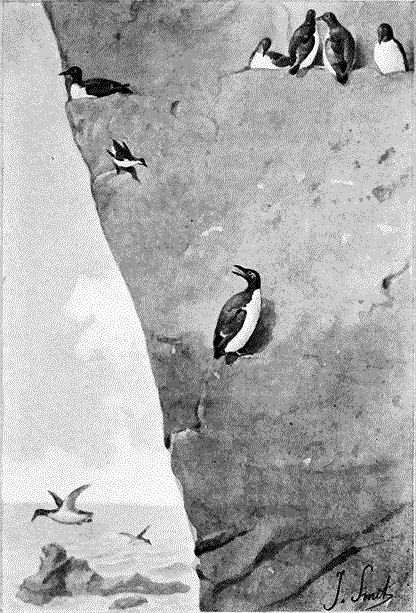
A PERILOUS JOURNEY
Could I give all the details of this fearful journey, it would make interesting reading, but I sat in rain and wind, and my hands were so numbed with cold that I found it difficult to use the glasses, and quite impossible to take notes. All that I can say now—this same evening—is that once, in getting down to its mother, who waited for it at different stages, it did actually fall and roll head over heels down the rock. I thought all was over, but it recovered itself on a tiny projection, seeming none the worse, and, shortly after, arrived with its mother on the ledge. Here there were some three or four more birds, and the chick, as I noticed, now, and several times afterwards, seemed glad to go to any of them. One it ran up to, and this bird behaved exactly as the first one had done, jodel-ing over it, and caressing it with its bill. Now, if this last bird was the chick's parent, the one that had a little before done the same thing, and still sat in the same place on another part of the rock, could not also be, for that the eyed bird who had fetched it away must have been either its father or mother, is a thing indubitable, not only by reason of that one act, but also on account of its general conduct both before and afterwards. One, therefore, of the two birds that caressed the chick must have been a stranger to it, but the fact is that both were, for whilst the last that had done so was still on the ledge, and but shortly afterwards, in flew a bird from the sea with a fish in his bill, and fed the chick. Now, I cannot, as far as eyesight goes, affirm that this bird was not the one that the chick had first gone to, and by whom it had been kindly received; but that one of a pair of guillemots should sit for a long time, not only by itself, but far removed from the chick and the other one, and that afterwards, when the chick had gone to it, this other one, its own mate, should excitedly fetch it away, is a thing quite out of accordance with all I have yet seen of the domestic relations of these birds. It is true that, in this case, a motive can be imagined for the chick's excursion, but whilst my later observations have shown me that, as the chick gets older, it does move about, I have never known it trouble about an absent parent whilst it had one by it. I have never, that I remember, seen the chick seek to be fed before one or other of its dams had flown in with a fish, and I attribute the anxiety which this one showed to reach the bird in question, to its distress at finding itself in so precarious a situation. In this, however, I may be wrong, but since it is beyond doubt that one stranger bird caressed the chick, it is not very essential to prove that another did. The likelihood is that one would be as willing to as another, and I did, indeed, notice that all the birds on the ledge to which the chick was brought back, seemed to take a kindly interest in it, especially another white-eyed one, which the mother several times drove away from it—being jealous, as I suppose. The state of affairs appeared to me to be this, that all the birds had a tender feeling towards the chick, that the chick, if left to itself, was inclined to go to any one of them, and that whatever one it did go to was ready to jodel over it, and caress it. Not having been able to note down every little thing at the time, I cannot now give the general evidence on which this impression was founded, but I have recounted the special incidents.
An interesting question arises here—at least it seems interesting to me. Is the conduct that we have been considering the result of mistake or confusion on the part of either the grown birds or the chick—or of both of them—or does it spring from an extension of sympathy in the one, and of Kinderliebe, or cupboard-love, in the other? Personally, I believe that both of these two latter brain-processes have to do in producing the result in question, but that the first—a tenderness, namely, on the part of the old birds—is the preponderating influence. We must remember that all these childless birds upon the ledges—and when I first came the ledges were crowded—must have had children with them only a short time ago. When, therefore, a chick runs suddenly up to them, just as their own chick used to, I can understand a train of recent memories being so strongly revived as to cause them to act as they do. I did, in fact, to my own senses, notice something in the manner of these non-parent birds thus acting parentally—in a certain degree, that is to say—which was different to that of the true parents. A certain surprise, I thought, was exhibited at first, and then the bird seemed to fall into the old train of things. If, indeed, as I am much inclined to believe, the mere bringing of a fish to the ledge may raise, for a time, in the mind of the bird that brings it, the hallucinatory image or impression of a chick that is not there, it is not wonderful that the actual running up to it of a chick not its own, should cause it to feel and act as though it were the true parent.
What, then, has been the origin of sympathy? Even amongst ourselves, to feel with a person ([Greek: syn pathos]) is to feel very much as though one were that person, and the effort of reason which assures us to the contrary might well be beyond the power of an animal. Indeed, when we think of what all children can pretend, and what many grown-up people believe, we should not expect too much of birds. The guillemot, we will say, upon seeing a young bird which, by calling up memories, takes the place of its own, becomes, in imagination, its parent—so that the sympathy it shows for it is not wider than that between parent and child. In other cases the feelings aroused in an animal when it sees, let us say, one of its fellows subjected to suffering or danger which it has been accustomed, itself, to fear and shun, may relate to itself only, so that any apparently sympathetic actions arising out of them would be due to that failure to distinguish between what is in the mind and what is outside of it (subjective and objective) that has often been remarked in savages—or, if not remarked, is at least attributed to them. Of this hypothesis I have given one illustration, and others may be easily imagined.
Do we become more, or less, sympathetic as we get more civilised? Two people who think and feel alike are said to be in sympathy, and the more primitive and uniform the conditions of life are, the more must those who live together under them think and feel alike. The process of advance may be a process of the more complete separation and realisation of one's own distinctive personality, and though reason and self-interest produce a higher power and degree of combination amongst civilised men than the state of animals, or the savage state of man, permits of, yet we must ask ourselves if, where it can and does exist amongst the latter, it is not of a more spontaneous and vigorous character, and if there is not more real sympathy attached to it. Where, for instance, can such perfect combination be found as amongst social insects—bees, wasps, ants, etc.—the conditions of whose existence are far simpler and more uniform than ours? And in what deep feelings of sympathy—or, as we may say, oneness—must blood-feuds have had their origin? If it is true that the sympathies of some civilised men have become widened so as to embrace humanity at large, and even the lower animals, is it not equally true that all civilised men stand more cut off from their immediate neighbours than do savages, because, owing to an increased diversity of individual character, consequent upon more diverse and complex conditions, they less resemble them? If so, though in one sense man may be said to sympathise more and more as he advances in culture, in another sense, and perhaps the truer one, he does so less and less; for as the river has widened it has become less deep, and the current less strong. Heine makes this same comparison in some interesting remarks upon the inhabitants of the Isle of Nordeney, which, as they exactly and felicitously express my meaning, I will here quote, albeit in a clumsy translation: "What links these men so fastly and inwardly together is not so much a mystic bond of love, as habit, the daily necessary living in each other's life, a common shared simplicity. The same spiritual width, or rather narrowness, issues in the same strivings and longings, whilst unity of ideas and experience makes mutual sympathy an easy matter. So they sit cosily by the fire in their little cabins, drawn close together against the cold, and, as they turn to speak, see their own thoughts in each other's eyes, read their own words, before they speak them, on each other's lips. Every life-memory, every life-experience, is a common possession, and with a tone, a look, a gesture, a silent motion, as much of joy, sorrow, or reflection is aroused in their bosoms as we can bring about through long expositions and spluttering declamations. For we live, in great part, mentally alone. Owing to different lines of education, to a different choice of reading—often accidentally stumbled on—difference, rather than sameness, of character has been developed amongst us. Each one of us, with masked spirit, thinks, feels, and strives in a lonely atmosphere of his own, and miscomprehensions are so many, and at-oneness, even in one household, is so rare, and we are everywhere cramped, everywhere repulsed, and everywhere strangers to each other."
This is just my idea, and though I had read Heine before I watched guillemots, I yet believe that my watching them has suggested it to me quite independently, for the passage quoted never came into my head till afterwards. Let us not, therefore, be too proud, for though there may, here and there among us, be a philosopher who feels himself able to sympathise with, say the Chinese—or a Chinese one with us—yet neither such philosophers, nor any of us, have that pleasant feeling of almost being one another which these islanders of Nordeney, or any tribe of simple-lived savages, or even, perhaps, some social animals, enjoy. So far from civilisation being altruistic in its tendencies, it appears to me (just at this moment) that by making the units more and more unlike each other, it fosters egotism and makes real sympathy harder.
I have as yet only speculated upon the feelings of the grown guillemots when they fête a chick that is not their own. Those of the chick are, I think, easier to understand. Its love for its parents is cupboard love; it is equally ready to be looked after by any other bird, and, if hungry and not fed, it will apply elsewhere. With what degree of accuracy it distinguishes its parents from the other birds on the ledge, I have not yet made up my mind; but I think it much depends upon the efforts of the parents themselves.
Besides the incidents which I have related, I noticed some other interesting points. Both the chick and the parents seemed ill at ease. The former did not seek to go to sleep, nor did the latter offer the wing. Often it struck me that one of the parents was on the point of doing something in regard to the chick, and, what was more curious, it also struck me that the other birds were restless, too, and that they, too, had designs upon, or, at least, felt an unusual interest in, the chick. In especial a second white-eyed bird came several times up to it with an important air, but also with a curious, hesitating action, and an expression as though in doubt what to do. The other white-eyed one would then bustle up in much the same way, causing the first to retreat; but after a little while, the two being exactly alike, I became quite bewildered, and could not possibly say which was and which was not the parent—a good evidence, I think, of the similarity of their behaviour. All this, and many other little things which struck me at the time, but which I could not then note down, and have now forgotten, convinced me that the flight from the ledge would not be long delayed. Though miserably uncomfortable, therefore, I waited and waited, in hopes to see it; but it grew late, the sun had sunk, and as I had a steep ascent to make, with some amount of climbing even before I came to it, it would not do to stay longer. Cliffs like these are not to be ascended in the dark—at least, not by me. To-morrow I feel quite certain that the birds will be gone.
CHAPTER XXXII
THREE MURDERERS
G
GONE they are. The ledges are quite bare—not a bird to be seen there—nothing but the spray and the wild winds to love them now. It was what I had expected, had been sure of; but again I felt bitter disappointment. It is more than disappointment—a sadness and emptiness of heart at finding these accustomed tenants, that have for days given life and beauty and domestic happiness to the desolate frowning precipice, gone, and their known places void. How I miss them! I retract now what I said before about wild creatures giving no relief to the sense of solitude. These guillemots did, I believe, and I feel lonelier now without them. And so, whilst I lay warm under the bedclothes, were you, you little mite of a guillemot—but stay, I have apostrophised you once already, and am not going to do it again.
There was rain, mist, and wind extraordinary to-day, but the sea dashed finely over the rocks. The pool, though a haven, was often seething, yet I saw Bottle-nose, and, later, a common seal, in it. The latter was the only one I watched. He came up at intervals of a few minutes only, and, as on former occasions, always rose perpendicularly in the water, with his nose pointed to the sky. In this position he remained all the while he was up—which was never more than a minute—and then sank without altering it, differing in this last respect from the two larger seals, which always went down with a porpoise-like roll. His eyes were shut all the while, even when he went down, but still I supposed that, once beneath the surface, he was accustomed to swim away and enter upon some active employment "under the glassy, cool, translucent wave": the line, indeed—which, by the way, with its exquisite context, is not to be found in that overpraised pert piece of ex cathedra dictation, The Golden Treasury—for the gold non olet, but out on its many omissions and at least one vile, prudish mutilation!—hardly suits such a pot-boil as this haven now is; but it is always untroubled in the deeps. But I was deceived in this supposition, for once he came sufficiently near to the great bulk of rock where I was lying for me to see him for some time before he rose; and, to my surprise, I saw that he was floating in just the same attitude, and just as quiescently. As he came up his eyes were fast closed, so that I think he must have been dozing, or sleeping, like this, under the water, all the while, yet rising—perhaps automatically—at the requisite intervals. The common seal, if it be not as nocturnal as the cat tribe, from which it may have descended, is certainly a very great sleeper.
The eye of the puffin is, by virtue of its setting, almost as marked a feature as the beak itself. First it is surrounded by a ring of naked skin, much resembling the feet in colour—of an orange-red, that is to say—and just within this ring there is a dot at one point of the iris, and a straight line at the other, both of which are really of a bluish or slaty hue, but have the appearance of being black. This line and dot form the base and apex respectively of a sort of little triangle, the sides of which are formed by a deep depression in the skin, and within it the eye is framed like a little miniature, and, as is sometimes the case with pictures, partly encroached upon by the frame, so that its circular shape is interfered with. The effect of the whole—for all these details blend together, and can only be distinguished with the glasses—is that the bird seems to have a triangular eye, and this bizarre appearance is heightened by another, and much deeper, line, or fold, in the feathers, which runs back from the base of the triangle till it meets, or tries to meet, the black feathers of the head and neck, in a little delta between the two. Hardly less wonderful than the eye are the cheeks—if one may call them so—those two sharply defined oval surfaces of light, shining grey, so smooth and polished that they do not suggest feathers at all, but look much more like little veneered panels of fancy woodwork, let into a framework of ebony. To all this the beak has been added, to give full and crowning effect to the idea that governed at the puffin's making, which was that it should be "as remarkable a figure of a bird as any in our country," or elsewhere.
I have sometimes wondered if the fish which the puffin catches so deftly, and then carries home, a dozen at a time, are paralysed at the sight of it. If a shoal of sand-eels fainted, and lay strewed about the bottom of the sea, it would then be easy for their enemy to pick them up one after the other, pack them securely, and get a firm grip on all of them before they began to revive and wriggle. At least, it ought to be easier; but how the bird chases and catches each in succession, without losing those it has already caught, and which lie in a row across its beak, it is not so easy to see. I have sometimes, I believe, made out a dozen, at the least—all sand-eels—closely wedged together along the cleft of the mandibles, their heads and tails hanging down on either side of the lower one. Perhaps, however, the difficulty is not so great as it seems to be—of understanding it, of course, I mean; it is no doubt easy enough for the bird to do. My theory, at any rate, of its modus operandi is this. The first sand-eel is, no doubt, passed to the base of the mandibles, and being firmly wedged against the membrane that unites them, I suppose that they are finally closed upon it. Were they opened again, at all widely, to catch the next and subsequent ones, there would be a danger of as many as were already there either escaping by their own efforts, or being floated out owing to the pressure of the water. But the beak of the puffin, though broad and leaf-like in its shape, is sharply tipped, and by opening it but a little, and pressing the fish against the bottom, the bird could no doubt pinch up the skin so as to get a secure hold of it. The various little tactile movements of the mandibles upon the fish, by which the latter would be first grasped between, and then passed carefully down them, to lie against the one last caught, can be pretty well imagined, and they could be very effectively aided by the rubbing or pressing of it, on either side, against the sand, rocks, stones, etc., of the bottom. It must be remembered, too, that the mandibles open like a scissors, so as to be wider apart at the tips than at the base, which would diminish the difficulty; and moreover, each fish is so deeply indented by the sharp, cutting blades—which, however, do not seem to pierce the skin—that, although alive—reflecting possibly on the beauty of maternal affection—they would be likely to "cleave to their mould" like putty, for a little while after the pressure were relaxed.
I think that the broad, blade-like bill of the puffin has to do with this power that the bird possesses of holding many fish at a time, and that the razorbill, whose beak is of the same type, and who bites the fish across in just the same way, is in the habit of doing so also. Be this as it may, the guillemot, whose bill is quite differently shaped, holds the fish, as a rule, in a different manner, longitudinally, namely, with the head towards the throat, and the tail drooping over to one side. This is not invariable; but I have never myself seen a bird bring in more than one fish at a time. It is the same, I think, with the black guillemot, at least in this latter respect, but I have seen much less of it than the other. Unless, however, it be supposed more difficult to catch and hold many fish than many insects, there is no reason why the puffin should be singled out for wonder in this respect. The water wagtail, when feeding its young, fills its bill with insects, which it catches, not only on the ground, but flying also—a great feat, surely—and the lesser spotted woodpecker brings a similar assortment to the nesting-tree. I believe myself that most insect-eating birds do the same whilst feeding their family, unless when they catch an insect sufficiently large to be a host in itself.
What a whirr of pinions, and fine wild chase beneath the beetling precipice, and out to sea! It was the Arctic skua, pursuing, this time, a black guillemot, no doubt en route for its young. They went so fast—the skua with the swoop of a peregrine falcon—that I could only just follow the smaller bird, but I caught its white wing-patches, so am sure it was not a puffin. Half-way out of the cove the guillemot must have dropped its fish, for its pursuer descended, and hung hovering over the water, seemingly embarrassed, and without alighting upon it. This, at first sight, seems evidence in favour of the theory that the skua, unless it succeeds in catching the spoil before it touches the sea, will have nothing to do with it; but as a herring-gull now flew up, and behaved in the same way, the more legitimate inference is that both birds were looking for what neither of them could see, and that the fish, being alive, as it probably would be, had, by a remarkable conjunction of two lucky accidents, escaped. But, on the other hand, would the herring-gull have dared to interfere with the skua?—which it would have been doing, were the latter in the habit of picking up the fish from the water. On other occasions I have seen the skua fly off as soon as he had missed his swoop, and I have once seen a herring-gull following the chase, with a view, as seemed obvious, to such a contingency. This happened on the island, so that I remember it quite plainly, though, what with one thing and another, it got crowded out of my notes. I was, however, much interested at the time, for it pointed to a possibility of a further and more complex development of these curious parasitic relations; for why should not gulls become, in time, the constant attendants of such chases as these, on the off-chance merely of the skua failing to get the fish that he had forced the bird he was chasing to drop? Here would be a secondary act of piracy grown out of the first and more direct one.
Herring-gulls—they are much the commonest species here—seem now to feed a good deal on the floating carcases of young kittiwakes, so I think it likely that the bird I twice saw doing this before, and took each time for a grown kittiwake, was really a herring-gull. It was at some distance, and I jumped to a conclusion without taking the trouble to verify it. But are these young kittiwakes first killed by the gulls, or found dead by them merely? As to this I can say nothing, except that I have not yet seen such an attack made—which is not much.
In the last two or three days I have pretty well demonstrated that seals, when they lie on the rocks, in company, do not post sentinels. In descending the cliffs, I have several times alarmed one or more out of the ten or a dozen that have lain on the great, slanting slab where they rendezvous; but their retreat, more or less precipitate, has not induced the others to a like course. Some have looked about a little, but remained where they were, whilst the greater number have lain in fancied—and this time real—security. It may be said that the seals which took to the water need not have been the sentinels, but this is an argumentum ad absurdum, since a sentinel that neither saw danger itself, nor gave the signal when it saw others in a state of alarm, would be no good.
For me, therefore, seals do not post sentries, at least not in these seas, but it does not necessarily follow that they may not do so in others where they are more persecuted by man, and preyed on by polar-bears. Whether this has been asserted, or not, I do not know, but I dare swear it has been, for sportsmen, besides that they draw very hasty inferences, like to get full credit for their miserable triumphs over brute intelligence. Take this very matter of sentinel-posting. It has been lightly made, and far too lightly credited. If you have a herd, or flock, of animals—say some geese browsing—some must stand on the outside, which is where we would post sentinels. That is enough for the sportsman. Such individuals are sentinels, and his skill, consequently, in outwitting them, something extraordinary. But let him bring some evidence of this—I mean of the first proposition; as for the other—the corollary—we will take it for granted, sentinels or not. No doubt of the man's capabilities. He can set his wit to a goose's, and shame, or cry quits, with it—but was the goose really so extremely clever? Was it anything more than a wary, vigilant bird, that a man of parts might be expected, sometimes, to get the better of? I doubt it extremely—at any rate, I doubt the sentry-go. When one comes to think of it, the systematic tailing off of one, or some, particular members of a band of animals, to warn the others in the event of danger, is a very high act of collective intelligence; and nothing short of this amounts to anything. That the first animal who takes alarm should utter a cry, and thus warn the rest, is a very different matter. These seals did not even do this, though the ones who saw me, and took to the water, must have associated my presence with danger. Of this I have now had another example, for in ascending the cliff, one out of two seals lying close together on a small rock saw me and went off. The other had not seen me, but evidently felt uneasy, owing to the haste and abrupt motions of his companion. Nevertheless, he took some time to make up his mind, and was on the rock, I should say, about two minutes after the other had left: whereas, had this latter communicated his alarm to him by any recognised signal, he would have been in the water almost at the same time. On the great slab itself ten seals were lying as I began to go up, but one went off whilst I sat quiet, without observing me. This left nine, and, of these, two saw me as I scrambled up an exposed ridge, and went off, whilst the other seven slumbered on.
As far as I can see, therefore, there was no communication of intelligence between these seals. Each acted for himself, and without thought of the others. I have noticed the same thing often with birds, and on the whole I cannot help thinking that, in a loose sort of way, wild animals are often credited with acting in a more highly organised manner than they really do, and that a too intelligent interpretation is often put upon their actions. When, for example, a bird, scenting danger, flies off, with a cry that warns all the others (though it frequently does so in silence), it does not follow that it was thinking of those others, nor can the cry be shown to be a special one until it has been heard, over and over again, in the same, or similar, circumstances, but not upon other occasions. Even then it will often be found to be due to excitement, merely, so that instead of expressing any definite idea, it but reflects the emotional state of the individual uttering it—it is the difference between thinking and feeling. The familiar alarm-note, as it is called, of the blackbird, is an example of this, for I have often heard the bird utter it when there has been neither fear nor danger—only excitement. Its organism reacts in this way to a certain state, which may be caused by a variety of incidents, so that no special, circumstantially limited meaning can attach, in its mind, to the cry.
I do not say that there are no cries, amongst animals, which have a certain definite meaning, and no other. Very possibly there are, and one may, perhaps, perceive the origin of them; for if such cries—at first general—were, in a large majority of cases, consequent upon a particular state of things, such state of things would come to be more and more associated with the cry, though from this to a definite and purposed signal, given by one and received by many, is a very considerable step. But the fact—if it really is one—ought to be better made out than it is. A sportsman has only to talk about the leader, a signal, or sentinels, in regard to any bird or beast, and no one pauses upon it. It is accepted as though it had dropped from heaven instead of from the lips of a man whose main interest lies in killing animals, who is generally most hasty in drawing inferences about them, and whose belief in their intelligence pays a compliment to his own.
The minds of some people must be in a strange state about animals, I think. They will not allow that they have reasoning powers, yet find no difficulty in crediting them with all sorts of actions, schemes, plans, and arrangements, that seem to demand a quite human understanding. Perhaps I, who admit the one, make too much difficulty over the other; but I like evidence (and plenty of it), and do not take conviction as proof. More, perhaps, than any other subject, natural history abounds with statements, the evidence for which there is often no getting at, or, if one does get at it, it amounts to very little.
Oh, thou villain gull! What have I not just seen thee do? But heroics are out of place with animals, so I will just recount the incident in a staid, sober way. As, in my ascent of the cliff, I came over the crest of a green peak, a herring-gull flew up from the ground with something in its bill, which, as it mounted aloft, I saw to be a young puffin. It hung by the nape of the neck from the very tip of the gull's beak, the legs dangling pitifully down—a pathetic spectacle—though I could not make out any movement in it, indicating that it was alive. The gull made for the sea, and, crossing to one of the great "stacks" that stands frowning a little off the shore, mounted high above it, and then let the puffin fall. Down, down, down, and down it came, a horrible descent; and I seemed to hear the far-off thud, as it struck that cruel rock. Then, in a second or two afterwards, the gull came circling down upon it, and began to feed upon the body, dragging it from this place to that, and seeming to fear a shag, which came up the stack towards it. I can hardly think it coveted the morsel, but I am reminded that I certainly saw another one with its beak at a dead kittiwake. No doubt, therefore, it did, and thus, once again, the fact is driven home to me that there is no such thing as "always" or "never" in animal life. As Darwin has most truly said, every creature is ready to alter its habits, as the opportunity arises, and the greater number of them are, in some way or another, always in process of doing so.