Front matter (continued 6)
Reading edition
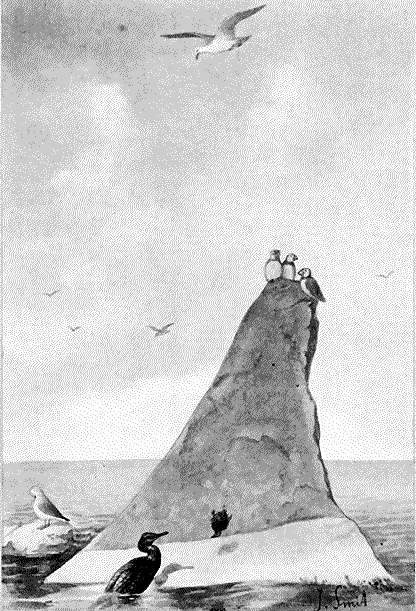
"ONE MORE UNFORTUNATE"
Was the puffin dead when the gull flew up with it? If it was, then had it found it so, or killed it itself? Did it drop it on purpose, to kill it, or let it fall by accident? These questions I am unable to answer; but in regard to the two last, gulls are credited here with letting crabs fall on the rocks, in order to break their shells. Even if the puffin were dead before, such a fall, by bursting or bruising the body, might make it easier to tear open—an operation which the gull, I believe, had not yet had time to perform.
The whole ground where this gull went up with its victim—for I have little doubt myself as to what had taken place—was honeycombed with puffin-burrows, and troops of puffins stood everywhere about. I sat down where I had halted, and before long two other herring-gulls came and stood in the same locality, close to several of these poor little birds, who, I thought, seemed embarrassed by their presence, but powerless to resent it, and perhaps not sufficiently intelligent to divine its true purport.
The gulls, I thought, had a sort of unpleasant, evil-boding look; a sullen, brazen, criminal appearance, like the two murderers in that scene with Clarence, just before the duke awakes—but this may have been partly due to imagination, after what I had just seen, with a late reading of Richard III. I love that play; almost more than ambition, perhaps, the keynote to its hero-villain's character is to be sought in his tremendous energy and intellectual activity. These are so great that they, to a large extent, guard him against the intolerable anguish of remorse—that constant attendant on the undiseased evil-doer—so that he fares better than Macbeth, who is inferior to Richard in both these respects, and whose more poetic and sensitive nature is much against him. Not that Macbeth is not an energetic and able man, but he is only normally so, while Richard's working qualities are abnormal. His energy, especially, is more like that of a Napoleon or Julius Cæsar. It is such a mighty and rapidly-moving stream, that, hurried along by it, he has no leisure to repine. It floats his crimes easily, one may say, making little dancing boats of them, whereas those of Macbeth are like huge vessels in a stream that has hardly volume enough to bear them. Is it not, in fact, almost impossible to feel mental depression, so long as the brain is very actively employed? It is in the calms and lulls of this activity that disagreeable reflections force themselves upon us, just as rain that has been kept from falling by a violent wind, falls as soon as it subsides. Accordingly, though Richard's robuster nature goes almost scot free by day—at least, for a considerable time—it becomes the prey of conscience by night, when the huge energy of his disposition is in abeyance; when, in Tennyson's language, "to sleep he gives his powers away." This we learn first through his wife Anne, who has been constantly "wakèd by his timorous dreams"—how strangely sounds the word "timorous" used of such a character!—and later—almost at the end—from himself, in that one terrifying outburst which gives the first and only clear view into the mental torments which this strong villain has to suffer, as soon as that daytime energy, which is to him as an armour, is laid aside. Is it not very striking—is it not the character-touch of this scene, how—when Richard is once fairly awake again, when the things of waking life have returned, with Ratcliff at the tent-door—how quickly this great load of suffering is shifted off?
A fortiori Macbeth suffers at night, too, but his life is all suffering. We never get the idea of his enjoying life, which, with Richard, we really do; for he is humorous—jocular even—in fact, in tiptop spirits often, but all by day, during the bustle and action of an energetic career. Later, the wound of guilt begins to show itself, and here, too, we may make an instructive comparison between these two practitioners in crime, so alike in their motive and careers, so different in their fibre and temperament, and yet yielding to the same law. Macbeth, indeed, suffers so much that his mind becomes, at last, almost unhinged, and, in the very end, conscience, perhaps, ceases to afflict him. The machine, too delicate for such rough work, has been broken by repeated blows—the nerve has throbbed itself out. Shakespearean parallels are, I think, very interesting and instructive, but they are seldom dwelt upon.
Thus far out of the path of what I am pledged to deal in, a fanciful comparison has led me; but I will go no further. Ne ultra crepidam sutor, etc., though, to be sure, I am no more altogether naturalist than King Lear's fool was "altogether fool." So as, from king or emperor downwards, I have no respect for titles, it is not much wonder if I forget now and again to be subservient to that of my own book.[16] Yet to do so is fiddle-de-dee, for books and people both, in this world, are judged of as they are labelled—often getting labelled by accident—and though, in this little excursion into other realms, I have talked no more nonsense than any literary critic may, without at all committing himself—except to nonsense, which doesn't at all matter—yet I talk it where it will not be thought sense. To return then—for your reviewer bites the thumb at a digression—I noticed many other herring-gulls hovering over these puffin-haunted slopes, and that they live largely upon the young of these birds, as well as on young kittiwakes, I do not now doubt. I can see no reason why they should not lie in wait, and drag the former from their holes. I must watch for this. This reminds me of how often I have found the newly-picked remains of puffins on the cliffs and shore; but these were all of full-grown birds. What bird, in especial, is responsible for this? Surely not gulls! And never having seen a peregrine falcon here, I have got to not much believe in him. I have seen no sign of such a thing on the part of the great skuas. The others, I think, are only robbers, or at least could hardly kill a puffin, whose beak should be more powerful than their own. It is somewhat of a mystery to me.
One more word upon the puffin. He is strongly ritualistic, if not actually a papist. I find it, as is so often the case, difficult to be sure which. See the whole series of pretty little genuflexions that he makes after coming down upon a rock, and then consider his vestments, his surplice—if that is the proper thing—"his rich dalmatic and maniple fine," his "rochet and pall," and so on—they are all there, I feel certain, for not otherwise could he look so extraordinary. His beak, too, if he only open it the least little bit in the world, is a bishop's mitre, and, for the ring, he wears it round his eye. "Pope," indeed, is one of his local names, but, on the whole, I class him as a ritualist, for he "out-herods Herod." Whether he secedes to Rome ever, or as near there as the mouth of the Tiber, I don't quite know; but if he does 'tis no matter, for he is sure to come back again.
CHAPTER XXXIII
GULLS AND GIBBON
A
ALL doubt as to the real nature of these horrid feastings of the herring-gulls on floating carcases of kittiwakes is now at an end. I had been watching the seals in one pool, when, turning to the other, I saw, as I thought, two gulls fighting together on one of the great rocks in the midst of it—a smaller "stack" one might almost call it. Raising the glasses, the truth was revealed. It was a herring-gull murdering a young kittiwake, and very soon it would have been "got done"—as Carlyle says with such a gusto—if I had not, in rising to follow it more closely, alarmed the murderer, who at once flew away. The poor little kittiwake got up—for it had been thrown on its back—and stood without moving on the rock, presenting a sick and sorry appearance, though there was as yet no blood about it, and it did not appear to have been seriously hurt. Its only chance now was to have flown away, but it stayed and stayed, seeming to doze after a while—the certain victim of the returning gull, as soon as the latter should have watched me off.
Turning my eyes from this disquieting spectacle—one brick in God's architecture—I looked over the water, and there, in this quiet little bay, which seems such a haven of rest and peace—il mio retiro, one would think, to every creature in it—I saw another kittiwake being savagely murdered by another herring-gull. This was a repulsive sight, and through the glasses I could watch it closely, not a detail escaping. The gull, with the hook of its bill fixed in the kittiwake's throat, pressed it down on the water, shook it with violence, paused, got a better purchase, shook it again, then, opening and gobbling up with the mandibles, seemed to be trying to crush the head, or compress the throat, between them. By this the young bird's struggles, which had been of an innocent and quite ineffectual kind, had almost ceased, but its legs still kicked in the air as it lay on its back in the water—just as the other had lain on the rock. The gull now, having managed the preliminaries, ceased to be so rough and violent, but, backing a little out from the body, so as to get the proper swing, began, in a cold, deliberate manner, to pickaxe down into the exposed breast, each blow ending in a bite and tear. A crimson spot, becoming gradually larger and larger till it represented almost the whole upper surface, as the body cavity was laid open, responded to this treatment; and now the gull, seizing upon entrail and organ, helped each backward pull with a flap or two of the wings, feasting redly and royally.
So it goes on, and, in time, both the part-players in this little sample fragment of an infinitely great whole are drifted by the waves to that same towering "stack" which has lately been the scene of the puffin tragedy. On it the gull lands, and, having dragged the carcase some way up, flings his head into the air, and exults with a wild, vociferous cry, in which his mate, who has now joined him, takes part. Then there is more feasting; but in spite of the community of feeling which this duet implies, the second gull is not allowed to partake of the good cheer, but must wait till the provider of it has finished. Should she approach too near, such intrusion is vigorously repelled. Well, thank God for the touch of poetry, whenever it appears! There is something picturesquely wild, as well as savage, in the latter part of this sea-scene—the gull's te deum, flung out to sea and sky; but anything more horrid, more ignobly, sordidly vile than what has preceded it, it would be hard to imagine. A kittiwake in its first full plumage, which differs much from the parents', is a very pretty bird, dove-like and innocent-looking. To see it savagely shaken and flung about, a huge hooked implement fastened in its slender throat, and that soft little head towzled, bitten on, mumbled, the wings all the while flapping in helpless and quite futile efforts to escape, is sickening. It is not the worst scene in nature certainly—serious deliberation amongst enlightened statesmen can produce things a good deal more horrible—but it is bad enough, bad enough. It looks like the negation of God, but a much better case can be made out for its being the affirmation, so here is the consolatory reflection for which optimists are never at a loss. "There's comfort yet," as Macbeth says.
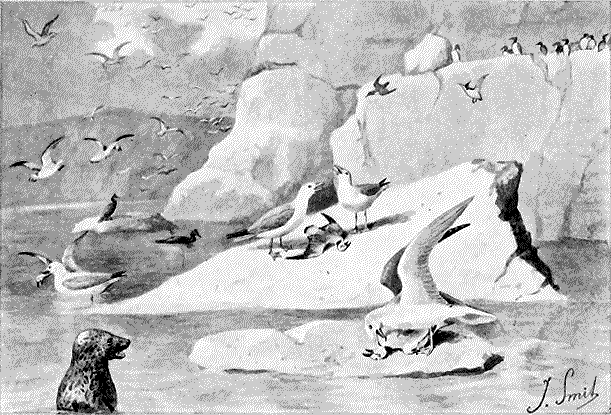
"NATURE RED IN TOOTH AND CLAW"
I suppose it sounds like a truism to say that the actual witnessing of nature's ruthlessness—of her "red tooth and claw"—has a very different effect upon one than is produced by the mere reading of it, however powerful the description may be. Judging by my own sensations, however, the difference is not merely of degree, but of kind, for such accounts, with the reflections made upon them, have in them a certain tone and tinting of the mind through which they pass, so that we get, not nature, but man softening her. "Why softening?" it may be asked. I am here speaking only of civilised man—who alone, perhaps, reflects about such matters—and it is my firm conviction that civilised man, in unconscious deference to his own peace of mind, does soften everything of a disagreeable nature, or if he cannot soften the thing itself—and it is difficult sometimes—yet, at least, his hopes and faith and longings fling a balm upon it, which, rather than the sore, is what we receive. So, too, in all general reference. Man, not nature, is what we get. Thus, when Tennyson speaks of "nature red in tooth and claw," it is not only—or so much—this stern and horrid truth, that the line calls up. Tennyson himself, if we recognise it as his, immediately comes into our mind, and with him the idea of one who, though he can admit so much, yet sees comfort and hope through it all, who believes, or at least trusts—
That somehow good Will be the final goal of ill.
Other nobly optimistic lines slide into the memory, sunlight passes over the desolate landscape, and the discomforting words, almost as they are uttered, are atoned for by the comforting personality of the poet who penned them. Thus nature, passing through the lips of man, is tempered and dulcified in the passage.
But supposing that such lines as the ones quoted, because their source is unknown to the hearer, can have no such comfort annexed to them, or supposing that the poet does not trust, but is a gloomy pessimist, or, which is more to the point, that instead of lines, with their music and generalisation, we have an actual horrid description, merely, of an actual horrid thing, all in the plainest prose, from some one whose personality we neither know, nor is worth the knowing—I have supplied an example—what softening influence is there here? Is not this but one degree better, in the sense I mean, than seeing the horror itself? I believe that here, too, the difference is of kind, and that a consolation is extracted which we cannot extract when brought face to face with nature herself, because the truth, then, is too overwhelming. The comfort, in such cases, comes not through the mind of the individual who is telling us, but through the general mind of which his is but a part, through the human ocean, rather than the human drop in it. For their own comfort, as I believe—in self-defence, to exclude misery—the great mass of mankind are optimistic, nor can any unit of the mass impart, or suggest, to us, ideas which are in opposition to this view, without suggesting, by association, the more popular and disseminated one, which we instantly lay hold of for our relief. If A can see no bright side to the thing he has witnessed, and can extract no comforting reflections out of it, yet B, C, D, etc., who have not witnessed it, can, and to the general alphabet, as against some exceptional letters of it, we immediately turn, and, enrolling ourselves amongst "les gros bataillons," feel that we are "in tune with the infinite," and of course that the infinite is in tune. But when, alone and amidst gloomy and stern scenery, we see a disagreeable little piece of this infinite, suggesting the whole, in actual manufacture before us, it is wonderful how little of music we find, either in it or ourselves. All seems "jangled, out of tune and harsh"; but for the "sweet bells," where are they? and were they ever there? We hear them not, even as a something behind, an undersong of hope. No, for there are no faces about us now, no comfortable looks and smiles, no good dinner or snug little circle round the fireside; no volumes of the poets either, and not a line of them, not one "smooth comfort false," comes to assist us. Man and his distortions are gone, and we have only nature—hard, stern, cold, uncompromising, truth-telling nature—before us. We look one way, and there are the huge cliffs and the iron rocks: another, and there is the great, wide, desolate sea: upwards, and there is the cold, grey sky—stern and cheerless as either. Nothing else but the birds in their thousands; and there, on the insensate waves or rocks, amidst spectators as indifferent as they, one of them is slowly, methodically, almost fastidiously, hacking, hewing, and picking another to death. You see the struggles, the flights of escape, the horrid, remorseless re-catchings; you see it proceeding and proceeding, see the wound growing larger and larger, the blood running redder and redder, and reason, with an impetuous inrush, says to you, suddenly, and as though for the first time, "This is nature—this is your God of Love—His scheme, His plan!"
And it is for the first time if you have not seen the same thing, or something like it, before, and even then, if there has been anything of an interval. You have got a fact at first hand, from nature herself, instead of through the falsifying medium of humanity—truth strained through benevolent minds—and the difference is so great that it is, I maintain, one of kind, and not merely of degree. You cannot, whilst actually seeing these things, get that sort of comfort that you can and do get when only hearing or reading about them. It is nature that is speaking to you, not a man, whose voice, be it ever so harsh, is mild and puny in comparison, and which, moreover, calls up, by association, the extenuating voices of a host of other men, that sea of human comfort on whose waves you float off and escape. No, but you are, and you feel, alone. You forget, almost, for the time, your own personality, and no thoughts of other personalities come to relieve you. Afterwards, perhaps, as you walk away, they may; but for some time they have a strangely hollow ring about them. One quotation indeed, not of comfort, but as descriptive of the kind of impression made upon me by such sights as these, has often since come into my mind. It is not, however, from the poets, but out of the pages of a great historian—of Gibbon—that I get it, and it is this: "The son of Arcadius, who was accustomed only to the voice of flattery, heard with astonishment the severe language of truth; he blushed and trembled." This, I think, describes more nearly the sort of effect which getting away from man and his optimistic chirruppings, and seeing gulls kill kittiwakes, by myself, has had upon me. I have heard, all at once, the severe language of truth, and I have blushed and trembled—trembled at what I saw—blushed for what I had tried to believe. Afterwards, as I reflect upon it, there come to me with sterner meaning, even, than they had before, those words of Shakespeare—pointed by your friends, through life—
From Rumour's tongues They bring smooth comforts false, worse than true wrongs.
Well, there are pleasanter sights than the one that has called forth this rigmarole, and I have just seen a seal playing with the long brown seaweed growing at the bottom of the sea, in a very delicious manner. He seized it in his mouth, and, rolling over and over, wrapped himself all round with it. Having thus put himself into mock fetters, his delight was to break out of them, which he did with consummate ease, and the grace of a merman. He did not keep hold of the seaweed all the while, but grasped it now and again, often opening his mouth and making pretence to bite. He acted like a very playful dog, but had a distinct idea of thus entangling himself with the seaweed. No one could have mistaken this. The design was perfectly evident. Two other seals, on a rock, played together most humorously, or rather one kept playing with the other, teasing him, but in a kindly way, by which it differed from most teasing. He would scratch him softly on the chest with one of his fore-flippers, and when this was parried, with a protest in look and action, he got farther down and scratched, or, as I think one may say, tickled him on the belly, beyond the reach of his guard. This caused the poor animal to flounce about in a very absurd way, and, at last, to half rise, and put on that funny, expostulatory look, half appealing, half resenting, and wholly humorous, which I have noted before. Most playful and humorously playful animals these are.
Could we see something of the inner life—the domestics—of many animals, the record of it might be very interesting. This is what is really wanted. But who has done so? Who has cared to do so? Instead, we have a few bald, jejune facts—habitat, diet, time of bringing forth young, period of gestation (on which latter point a good deal of prurient curiosity is manifested), etc. But the heart of a wild animal is seldom explored, for it needs a heart to explore it. She bears and tigresses have been robbed of their cubs, but who has waited by their cubs to see them return and fondle them? To do so might be both dangerous and difficult; but what danger is not undergone, what difficulty is not overcome, when merely to kill is the object? The zoologist of the future should be a different kind of man altogether: the present one is not worthy of the name. He should go out with glasses and notebook, prepared to see and to think. He should stalk the gorilla, follow up the track of the elephant, steal on the bear, get to windward of the moose or antelope, and lie in wait for the tiger returning to his kill; but it should be to biographise these animals, not to shoot them. The real naturalist should be a Boswell, and every creature should be, for him, a Dr. Johnson. He should think of nothing but his hero's doings; he should love a beast and hate a gun. That is the naturalist that I believe in, or that I would believe in if ever he appeared on earth; and I would rather found a school of such than establish a triumphant religion, or make the bloodiest war that ever delighted a people or rolled a statesman into Westminster Abbey. Every man has his ambition. To make a naturalist who shall use neither a gun nor a cabinet, is mine.
Some men have strange ambitions. I have one: To make a naturalist without a gun.
"Pretty, i' faith."
The great seal is again asleep upon his rock (it seems to belong to him and the common one in turn), and looking down upon him, now, from the tops of the cliffs, through the glasses, there does not appear to be any admixture of brown whatever in the shade of his fur. Wherever the light falls upon it, it is an absolute silver, and, where in shadow, tends to shade a little into the colouring of a very light-skinned mole. But this last is merely an effect: the real colouring is, I believe, a uniform silver—very pretty indeed, where the light catches it. The fur seems close and thick—very mole-like in texture—the general appearance, indeed, is very much that of a gigantic mole, if only the head, the character of which is different, be not well seen. In the water, however, when more or less immersed, even the head partakes of this resemblance, or lends itself to it, and the whole animal becomes "perfect mole" ("mine eye hath well examined his parts, and finds him perfect Richard"). In itself, however, the head is not mole-like—as may well be believed—but, when held in some positions, looks remarkably like that of a polar-bear—a resemblance much more à la Richard. He seems extremely fat—Falstaff's "three fingers on the ribs," I should say, at the very least.
A common seal has now, once or twice, swum close round him, and looks a mere pigmy by comparison. This latter may not be a large seal—I do not think he is—still, the juxtaposition of the two gives me a better idea of Falstaff's proportions than I had before. He must be more than twice the weight, I think, of the very largest phoca—phoca Antiquarius, as I would call the latter: lovers of Scott will take me. It is the great barrel of the body that is so immense. The build and general appearance is much more that of a walrus than of an ordinary seal. The fore-feet seem more modified, are more fin-like in appearance, than those of the latter, which are rounded—soft, round, fat pads—muffin-shaped, more like little cushions than fins; but here there is an approach to the true fin, an elongation and narrowing, and the toes all point inwards and tailwards.
As the water steals imperceptibly upon him, Falstaff—as I shall now always call him—stretches himself enjoyably, and makes some leviathan-like movements of his hinder, or tail, parts, looking somnolently up, from time to time, seeming to say, "O ocean, let me rest." How consummately happy he looks! lazily, sleepily happy—a god-like condition. Heroics for those who enjoy them—they are generally all in falsetto. The "cycle of Cathay" for me, and the untroubled sea-sleep of this grand old Proteus here! A good deal of his lower surface, and the whole of the rock he lies on, is now quite hidden by the sea, but still he sleeps or dozes on—immense, immovable—as though he were life-anchored there. At length, with a mighty yawn and stretch, he turns full upon his vasty stomach, and immediately, by virtue of the different appearance which his fur has when wet or dry, becomes a much smaller seal that has climbed up upon a buoy—the lower, wet part of him looks like that; the upper, alone, is himself. Then gradually he soaks all over, till he is, again, huge and indivisible, a great, naked, blue, greasy, oiled bladder,—yet firm still, as though he grew to the rock. But the end is now near. Sparkling and gleaming, the waves come tumbling in; they dance about him like fairies, like little familiar elves; they slap him and pat him, lap up to—then over—his back, sway him this way and that, speak to him, call him by his familiar pet name, tell him it is time to go, until, at last, with a great somnolent heave, he floats, and they float him—it is done together—right off the now sunken rock: his body sinks down, his head, with the fur yet dry, remains, for a time, straight up in the water, then follows—his nose, to the last, still pointing, like the "stern finger" of "his duty"—not so stern as with us, though—"heavenwards." As he goes down, you see that his eyes are still shut—he continues to sleep.
CHAPTER XXXIV
ALL ABOUT SEALS
O
ON coming to the cliffs, to-day, I saw, lying on the rock in the little pool where I have watched the sea-leopard, as I call it, and that other which I have hitherto called the bottle-nosed seal, or Bottle-nose—because that seems to be a local name for it, and its nose, I thought, bore it out—a mighty creature, the same, I at once saw, as had lain there on the seaweed, that first morning. It presented, as before, an extraordinary appearance, seeming to be parti-coloured, light above and dark below. The tide was coming in, and, wishing to see it go off with the wash, I descended rapidly—indeed, a little too rapidly. My knee, which is sometimes, in a rheumatic sort of way, painful to bend, has lately become very much so in descending the cliffs. To ease it, therefore, I sat, and began to slide down the steep, green incline, and, in doing this, my foot missed, or slid over, the little depression that I had destined for it, which produced such an acceleration of speed that, with several great bumps and a change of position from the perpendicular to the horizontal, I had nearly still further abridged the distance, and eased, perhaps, more than my knee. However, I managed to stop myself some way before a sheer edge, which, though not much in the way of height, would, no doubt, have been as good as Mercutio's wound for me—"'tis enough, 'twill serve." Continuing with more caution, I got down, and was on the promontory behind the "chevaux de frise" I had lately erected, before the tide was yet much over the rock. It would have floated off an ordinary seal perhaps, but this vast creature lay there, swayed to and fro by the waves, like a buoy, but still firmly anchored—"built," as one might say, "upon the rock."
At once, upon getting down, I saw that this was my bottle-nosed animal, and, also, that I had been entirely mistaken about his skin. On the lower side, where it was wet, this looked the same that it had ever done, as naked as that of the hippopotamus; but the other side, which was quite dry, showed a fur which seemed to be rather thick than otherwise, and of a brownish colour, but so light that it looked almost silvery. The head, whenever the creature looked round—for his burly back was turned to me—with the nose and muzzle, seemed much more elongated than in the common seal; it much resembled, in fact, that of the polar-bear—quite remarkably so, I thought, when turned profile. Now, however, I could see nothing very peculiar about the nose, nothing to justify the allusion to it contained in the local name—which, however, I have only heard once. The bottle-nosed seal—for there is such a species—of course he is not, though, at first, in my want of all learned equipment, I thought he might be. What seal he is, scientifically, I know not, but he is certainly not the common one, for besides the pronounced difference in the shape of the head and face, colour and appearance of the fur, etc., he is much larger, the great barrel of the body being, perhaps, twice the size. The figure, too, though less human, is more buoy-like, increasing more rapidly, though very smoothly, from behind the head and below the chin, and tapering more abruptly towards the tail. The fur may have some markings upon it, but, if so, they are so faint as to give it the appearance of being of one uniform colour—a light, browny silver. When wet it becomes bluish, and how smooth it then lies may be judged by my having mistaken it, up to the present, for the naked skin. True, I know of no seal that has a naked skin; but when in the open, with my notebook, I like to forget what I know, and make my own discoveries.
I watched this great seal for some ten minutes or so, as he lay in indolent repose, throwing his head, every now and again, over his great, swelling shoulder, till at length the elevatory power of the sea became too much, even for his proportions, and after rolling lazily about for a little, half moved by, half helping the waves to move him, he at length heaved himself around, and with a vasty, whale-resembling motion, plunged and disappeared beneath the deeply submerged edge of the rock-mass on which he had been lying.
In the adjoining little twin cove, or pool, the usual complement of seals lay on the great slanting slab with two or three upon the rocks around. Another was in the water, and I was much interested in watching the persistent but ineffectual efforts which this one made to get out upon a certain large rock, on which he had evidently set his fancy in a very unremovable manner. To look at this rock, no one would ever have thought of it as one on which a seal, or anything else, could lie. Its top was a sharp ridge, whilst its sides presented, every way, so steep a slope as to be quite unscalable. But there was a little projecting point, or chin—as sharp as Alice's Duchesse's chin—in which the central ridge ended, and behind which the mass was cleft, for some way, longitudinally, making a narrow ledge just large enough for one seal to lie on. This little spike of rock was a foot or so above the water, even when the sea swelled up towards it—it being not yet high tide—and as it projected out like a bowsprit, there was nothing underneath it for the seal's hind feet to get a hold on, so that everything had to be done by a first leap up from the sea. This leap the seal made over and over again, shooting up sometimes almost like a salmon—his hind feet alone remaining in the water—and grasping the hard little triangle between his fore-arms, or flippers, so as to assist the impetus by hoisting himself upon it. But he always had to fall back again, after clinging convulsively, and pressing tightly with his chin against the rough surface of the rock, which, just at this one little point only, had shell-fish upon it. He tried to time his efforts with the swell of the wave, but in this he was not always successful; that is to say, he did not always hit the exact moment. Having tried and failed several times, he would fall into a sort of rage or pet. He bit at the rock, cuffed the water, as he fell back into it, with one of his flippers, and then, as though this were an insufficient outlet for his irritated feelings, flung about with tremendous brio, revolving, contorting, curving his body to a bent bow, and then violently unbending it, diving and flashing up again, almost together, making a foam of the water, lashing it in all directions. Then, for a little, he would disappear, but always he would return and renew his efforts, always to be again frustrated in them. This lasted for half an hour, or longer. Once, after the first ten minutes or so, I thought he had given it up, for he swam to the great central slab, and began to make his way up towards the other seals. But when he had gone but a little way, he turned, and, flapping down again, swam back to that coveted rock, where it all commenced over again. This extremely human touch interested me greatly—as who would it not have done? How strong the desire must have been, and what an individual liking this seal must have taken for that particular rock, to make him leave a comfortable place amongst his companions, and go back to try, again, where he had so often failed before! How strong, too, must have been his memory of what he liked so much!—for it does not seem likely that any seal would so have tried to achieve a special practicable spot on an otherwise impracticable rock, unless he had lain there before. If so, I can only account for his inability to get on to it on this occasion by supposing that it was not a sufficiently high tide, though, at the last, the waves, when they washed up to their highest point, were quite on a level with the point of rock. It certainly seems curious that he could not manage it, even then; but such great longing and striving must, I think, have been for a pleasure known and tasted.
I have ascribed this seal's biting of the rock to irritation, as those other actions which so well became him, and which I have very inadequately described, certainly were due to this. But another explanation is possible here. I have several times seen seals, when on the rocks, take the long brown seaweed, growing upon them, into their mouths, in such a manner as to make me think it might have been to pull themselves along by, as one would use a rope fixed at one end. However, I could never be sure whether it was for this or any other practical purpose, or only sportively, that it was laid hold of. But now, if seaweed is ever really used by seals in this way—to pull themselves along the rocks, that is to say, or to hoist themselves up on to them, then a strong growth of it here would have been most useful to this much-striving one, so that it may have been with an idea of this sort, though not amounting to more than a regret—an "Oh if there were only!" sort of feeling—that he bit upon the rock. If so, he showed another human touch, for the nakedness of this particular rock, and especially of this point of it that he had been so often nearly up on, must have been well known to him. Perhaps, however, he thought to get some purchase on it with his teeth; and there remains my first theory of petulance. I ought to add that in all these little outbursts of pique and disappointment which I have recorded, something of a frolicsome nature also entered; there was nothing morose or gloomy in them. At the worst, the creature was a disappointed seal only, and "in the very torrent, tempest, and, as I may say, whirlwind of his passion" there was a touch of humour, a something of make-believe, a dash of most lovable playfulness.
Lovable and delightful creatures these seals are, indeed, for which reason the great idea is to shoot them, and they have been almost driven from our seas. The hunting instinct is an extremely strong, and a quite natural one, for it is lineally descended from our savage ancestors, who hunted and were demi-devils, of necessity. Therefore, perhaps, it may be said to be a healthy instinct, and therefore it seems right. Nevertheless, reason and humanity alike rebel against it, and there is no valid answer that I can see against their protest, except, indeed, that one I have already mentioned, viz. that it is in strict accordance with the scheme of the universe. I confess I hardly know how to get over this, except by admitting what I call an appeal against God; but putting this difficulty aside, then once let a man think (I mean, of course, a man who can think), and, if he be a sportsman, "farewell the quiet mind, farewell content." Though "Othello's occupation" be not yet "gone," yet from that moment he can no longer "go to 't" with that entire lightheartedness, that "in unreproved pleasures free" feeling, which hitherto he has done. A little leaven of uneasiness will mingle with what was once an unalloyed delight, it will grow and grow, until, at last, with some men, first the pleasure in the thing, and then the thing itself will cease. With others the instinct will remain too strong, but, even with them, something will have been done, since no thought, if only we could trace it out, is ever thought in vain. It occurred, no doubt, one day, to some Roman sitting in the colosseum, that what he was witnessing was not quite a right state of things. He continued all his life to witness it; but if the whole progress of that age could be laid before us, that thought would have its place.
I have said that both reason and humanity rebel at the unnecessary killing of wild animals. For the humanity, that is self-evident—to torture is not humane: and for the reason, when one comes to think of it a little, how absolutely silly it is! It is destruction, the child's pleasure, the unmaking of what one could not possibly make, smashing, breaking up, dashing to pieces, vandalism applied to the living works of nature, leading to their eternal perishing, with a hideous void in their stead. Something was alive, interesting, beautiful: you make it dead, uninteresting, ugly—at least, by comparison. And yet the hunting instinct—the heritage from countless generations in whom it was a virtue—is so strong that those—and there are many—in whom it is not developed, should not judge those in whom it is, too harshly—indeed, not at all; for how should one judge what one cannot feel? One can only hope that that dreadful way of being interested in animals which leads to their killing, and, ultimately, to their extinction, will one day cease in man. Nor is the hope vain. It will cease. I know it will, and should be happy in the knowledge did I not also know that the animals will have ceased first. As it is, my only comfort is that I will have ceased before either.
It is beautiful to see seals thus active under natural conditions. In spite of what they are and what one might expect them to do, one has to be surprised. Everything is increased beyond expectation; they make a greater splashing, a greater noise in the water, produce more foam, give more elastic leaps, make swifter progress, than your imagination had supposed them capable of. They are creatures of the waves, you know, modified, adapted, made like unto fishes, and strong, as all animals are. Therefore, though you may have hitherto seen them only in their languid moods—and till now, in fact, there has been nothing very violent—yet you might have imagined, and you have tried to imagine, what they could be when moved, roused, excited, "perplexed in the extreme." Yes, you have tried—but ineffectually. Nature, you find, as ever, emporter's it sur vous. Sur moi, I should rather say, perhaps, since there are certain lofty spirits to whom everything—the grandest sights of nature—come as disappointments, so much superior to them have been their own before-imaginings of what they were going to be. Well, I am not one of these. With Miranda, I can say, "my desires are, then, most humble." The sea, the Alps, the Himalayas, the Vale of Cashmere, the Falls of the Zambesi, the Zambesi itself, have all been good enough for me, as now these seals are, even. It is a humiliating reflection, but it is better to admit inferiority than affect the other thing—so I admit it freely.
Returning, now, to these seals, I have spoken of their great activity in the water, and yet I find myself wondering whether, on the principles of evolution, it ought not to be greater still. This craves a short disquisition. Give heed, then, ye puffins, ringing me round like a vast and attentive audience. "Lend me your ears." You shall know my thoughts on the matter; a lecture for nothing—for with you I am not shy—so "perpend." Is it not a somewhat curious thing, mark me, that, throughout nature, we find beings that are but partially adapted to some particular mode of existence, excelling others in it that, both by habit and structure, one might think would be altogether their superiors? Thus the seal, otter, penguin, cormorant, etc., creatures which, in comparison with fish, may be said to be but clumsily fitted for the water, are yet able to make the latter their prey. The reason, however—at least, I suppose so—lies in their greater size, since even the fleetest fishes cannot be expected to go eight or nine times their own length in the same time that seals or penguins take to double theirs, only. In the case of the otter, however, there is often no such great discrepancy in size, and here we must suppose the victory of the mammal to be due to its superior intelligence, or its power—as, perhaps, a result of it—of taking the fish by surprise.[17] But it is not only in such cases as the above, that this curious law of the superiority of the apparently less fit may be made out, or imagined. It obtains also amongst animals differing but slightly from one another, and whose habits are identical, or nearly so. Look, for instance, at the seals themselves. The common one of our northern coasts has much more lost the typical mammalian form, and become much more like a fish, to look at, than several species that are moving in the same direction, amongst them the fur-bearing seal that is skinned alive to keep ladies here warm, whilst the Japanese in Manchuria wear sheep-skins. In these, all four limbs are still used for their original purpose of terrestrial locomotion, so that instead of jerking themselves painfully forward on their bellies, as the common seal and others have to do, they go upright, and even fairly fast, though with a peculiar swing and shuffle. Inasmuch, therefore, as they have become far less unfitted for the land, one might imagine that they would be less fitted for the water, and that the common seal, from having been more modified in relation to an aquatic life, would here have considerably the advantage of them. But the reverse is the case, at least if one can at all judge from a comparison of the swimming powers of the two kinds as exhibited in captivity. Never have I seen anything more wonderful than the way in which these otariidæ tore through the water, when pieces of fish were thrown to them, in that wretched concrete basin which disgraces both our humanity and common sense at that beast-Bastille of our Gardens. The speed seemed really—I do not say it did—to approach to that of a galloping horse, and, in comparison to it, that of the seal, which could get nothing, and had to be fed afterwards, might almost be called slow. Yet whilst the latter swam with the motions of a fish, and looked like one, the other had more the appearance of a quadruped gone mad in the water. The great fore-flippers were largely used—indeed, they seemed to do the principal part of the work—whilst the much smaller ones of the common seal were pressed, as here, against the sides, and progress was almost wholly due to the fish-like motions of the posterior part of the body, and the hind feet or paddles, making, together, the tail. This was many years ago, when the common seals at the Gardens used to occupy the larger, or, to speak more properly, the less minute of the two concrete basins provided for oceanic animals. It was not till after the arrival of their more showy relatives that these poor creatures—the homely dwellers about our own coasts—were relegated to one that, though an ordinary man might find it rather large for such a purpose, would be of a convenient size enough for Chang, or some other giant, to wash his hands in. In neither, naturally, could a pinnipede do himself justice, and perhaps these ones felt it more than the other kind. Now, however, I have seen them far more active in their native ocean, yet they fell short of those others, in captivity, to a degree which makes me think they would never be able to compete with them.
It may be thought that the larger size of the sea-bear's, or sea-lion's flippers, and the greater use which they make of the anterior pair, simply and easily explains their greater speed in the water. But why, then, should the true seals—the phocidæ, which must once have been in the same sort of transition stage between ordinary walking and their own gait, that the otariidæ are now—why should they have passed forward into their present more fish-like condition, since both the advantage of walking has been thereby lost, and that of swift swimming seems to have been lessened? Of two creatures, each of whom has, from once being a land-animal, become a water-animal, why should the one whose structure has been least modified in relation to the change, be more active in the water than the other? The phocidæ and otariidæ, it is true, though belonging to the same sub-order, may be the descendants of species that differed considerably from one another, and thus they may have undergone a different course of modification. The fore limb of the former, we may perhaps surmise, was of so small a size that, even after it had become fin-like, only those variations in the direction of smallness were of benefit to it, whereas, for a contrary reason, the reverse was the case with the other—though I should think this far more likely if the true seals, like the beaver and otter, had a large and well-developed tail. As they have none, I rather suppose that their fore-feet were, for some period, enlarged and broadened out, and only ceased to be so owing to the gradual tail-like development of the hind feet and posterior part of the body. This, the evolved tail, began then to play the chief part in natation, as it does in fishes, and, for similar reasons, I believe that the otariidæ are advancing along the same lines, and that their mode of progression in the water will, one day, be more truly seal-like—that is to say, fish-like—than it is at present.
But let the ancestry and process of modification, as between the two families, have been as different as we can, with any likelihood, suppose it to have been, yet still it is not quite easy to understand why one marine animal should, whilst retaining the power of quadrupedal progression, possess also greater aquatic powers than another one, which, travelling by the same evolutionary road, has gone farther on it, has lost the terrestrial gait, become less a quadruped, and approached considerably nearer to the true aquatic, or fish, type. Should not the fish form excel all other forms in the water? and, if so, should not the quadruped that is more like a fish excel the one that is less so? But, instead of this, we see here the more generalised form excelling the more specialised one, not only in doing two things well, or fairly well, instead of only one, but also in the better doing of the one thing wherein the other ought, theoretically, to surpass it, as though it were at once more generalised and more specialised. This seems une étrange affaire. No doubt it is to be explained without controverting evolutionary doctrines. Indeed, I think I might hammer out some explanation, if it were not my cue, just now, to be very much astonished. The true seal, or phoca—phoca vitulina, as it is called, phoca Antiquarius as I would call it—ought, in my now mood, to be quicker and more agile in the water than the otaria—the sea-bear, or lion. But it is not; it is beaten—at least, if I may trust my memory—by its less specialised brother. This is what—just for the present—I am determined, oh ye puffins, not to be able to understand.
CHAPTER XXXV
THE DEVIL'S ADVOCATE
O
ONCE more in Eastcheap with Falstaff—and this I think will be the last time. I thought that by getting there before the first tide was down, I might see him come rolling up to his old haunts, to "take his ease in his inn," nor in this, I think, shall I be disappointed. His rock will soon be ready for him. Already he has come to it, swum about it, lain upon it—though it is still under the waves—and then, gliding slowly and smoothly away, has dived almost perpendicularly down, following its seaweed-clad sides, till lost to sight. Now, this last time, he seems come to it to stay. The way he expatiates upon it is delightful to see. Such great yawns, such stretchings, heavings, and throwings back of the head, with supple curvings of the neck! such luxurious anticipations of repose to come, and oh, such sleekness, such glistening! How intensely he enjoys this rest of his, his long intertidal sleep! He was not asleep when he came (it would not have surprised me if he had been), but now, as he lies at length, rolling, a little, with the waves that ripple about him, the eyes begin to close, and even when he throws back his head and opens his jaws, as he does often, they are shut, I think, or almost shut. Often he scratches his chin with one of his flippers, or passes it, indolently, all over his face.
I was right, I think, about the fore-feet. They are certainly more elongated and fin-like than in the common seal, but, which is curious, neither they nor his hind ones seem to me so large, in proportion to his size, as they are in the latter species. The tail, if not lengthened, looks broadened, and it is fringed with hair round the edges. Though the shape is oval, it reminds me of the last joint of a lobster's tail. Perhaps, therefore, it may be an aid to the feet in swimming. In the fold of skin between the two hind feet, there is something which I, at first, thought was a mussel, but am now not so sure about. In colour and sheen it answers perfectly, but now looks more like something membranous, hanging down on one side. There is something peculiar in two of the toes of the left front flipper—which is the one I see. Three out of the five claws are black, but the second and third—counting from the marginal one which lies towards the chest, are, if it is really the claws—white or whitish, and visible only to about half the length of the others, the rest of them being hidden by hair or fur. These claws have a peculiar rough, irregular appearance, different from the others, which seem smooth and shapely. The whiskers, which are white, are both long and thick. They are often shot out, so as to project almost straight forwards, and then brought back to their usual position, where they droop parallel with the line of the head and throat. The great blubbery lips from which they spring are thick and swollen, and have a soft, cushiony appearance. Here, no doubt, we have a very sensitive apparatus, of great use to the animal. The eyebrows seem represented either by three, or four, projecting hairs, like those of the whiskers, but shorter. One, however, is greatly longer than the other two—or three.
I have now noted all I can about this creature, which, I think, must be a female. Can it be the unmarked spouse of the great sea-leopard which was here once, but which I have never seen again? Both were in the pool together, and often quite near to one another, and, with the exception of their very different skins, looked very much the same animal. Though they did not converse, or frolic, with one another, yet I thought their very indifference had something conjugal about it—but this may have been imagination. But if they are really male and female of the same species, it seems curious that there should have been so much difference in the time that each remained under water. Of this, alone, I can be sure, that on one occasion, only, I saw at close quarters, and for a long time, a seal twice as large as the common one, and with a most magnificent skin, for which, and no other, reason I have called it the sea-leopard, not at all knowing its proper name.
The substance on the large seal's tail, which puzzled me, is, I think, connected with the parts adjoining, and this makes me conclude it to be a female, and that it may lately have had a young one, which, however, I have never seen with it. I can make out no very special development of the nose—longer and larger than that of the common seal, but I mean as a nose—so that if the name bottle-nosed is really applied to the creature—and one Shetlander certainly used it—it must be, I think, for the reason I have conjectured, the very round apertures of the nostrils, which look as if they would just hold a cork. I could never have imagined that an animal having fur—and pretty thick fur, I think—all over it, would look so absolutely naked in the water as this seal does. I noted down that it was, without the smallest suspicion of a doubt having occurred to me, and I remained in entire ignorance of the real fact till I saw it with the fur partly dry. Once, indeed, I noticed something—the least hint of a roughness on the shoulders—as it bent its neck; but I never really doubted, so naked did it everywhere appear. There is really some interest in letting one's errors stand; besides that it does not seem quite fair to suppress them.
Seals have strong preferences, not only for particular rocks, but for particular places upon them. A large one of the common kind but just now came out on a rock where five others were lying, and advanced through them, in a straight line, displacing four of them. One only of these seemed inclined to dispute his passage, and here there was some scratching, with a good deal of hoarse snarling, almost barking—an ugly guttural note. The large seal seemed not to wish to bring things "à de fâcheuses extrémités." He would pause, with a deprecating look, but without giving way one inch, and, very shortly, press forward again, the other snarling and scratching as before, but gradually retiring, till at last he gave "passage free." The fifth seal lay at right the end of the rock, where it narrowed very much, so that there was no retreat for it, as the large one came up—for that was just the place he wanted—except into the sea. And there, after many snarls, and growls, and faint shows of resistance, as, also, most melancholy looks, it had to go, the intruder, all the while, continuing to use that deprecating, almost apologetic, manner which he had done throughout. It was disagreeable to him to be at feud with any of his kind, but, still more so, not to have the place he liked; that was the idea quite transparently expressed. There was that in his manner which seemed to say, "With the sole exception of myself, madam, there is no one for whose rights I have a more profound respect than for yours"; for, this ousted seal being a small one, I put her down as a lady. Perhaps, indeed, that is why he was so forbearing.
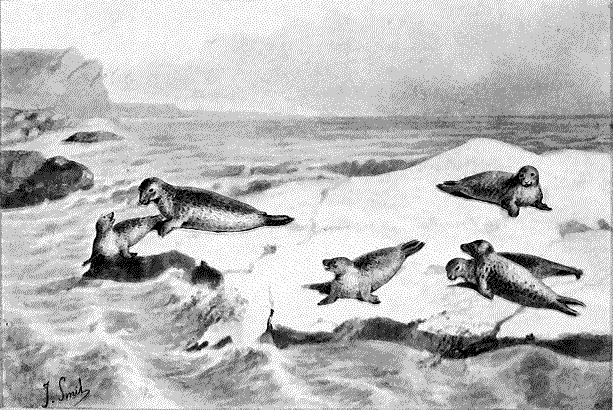
POLITE BUT INSISTENT
Several seals are now playing a good deal in the water, flouncing and bouncing about, making little white cauldrons, in the midst of which their round, black heads, bobbing up and down, look like pipkins, or crabs a-roasting. Two are sporting together in this way, which is a very pretty sight to see. They spin and shoot about, slap each other with their fins or tails, and, every now and again, one hears a curious burst of sound, like subaqueous thunder; whether caused by the swirl, as they go down, or being a growl, half-choked under the water, I do not know. Seals seem to lead a most happy life. I have mentioned one leaping out of the water, as it went along, in pure enjoyment—for what else could it have been? But how different is all this to the lonely sleep of that great thing yonder!—Falstaff—Proteus—Bottle-nose—but that last is a calumny on a very respectable feature. There is no real contrast, however. The common kind often sleep their leesome lane. With the play it may be different. I have not seen the great seal sportive.
A phoca has just come up with something white in its mouth, which it is eating—a fish, no doubt. This, too, it does in a playful manner, flinging open its jaws, and seeming to disport with it, in them. Full of the enjoyment of life they are; and the way up, through evolution, is to leave all this, and to acquire a multitude of cares, with gluttony, diseases, vices, cant—with a pat on the back from a poet, or so, now and again, making us out to be gods, and telling us to go to war. A queer scheme, "a miserable world," as Jacques says—but not for seals. Except through us, that is to say. We do skin them alive, which raises another point. Not only is man—highly civilised man—the most miserable being that exists, or has ever existed, upon this planet, but it is through him, for the most part, that the robe of misery has been flung down upon every other being that shares it with him. He plays, in fact, the part of a devil in nature, but because his fellow-beings are below himself in intelligence, he is not ashamed of this. Were he, however, to be treated in a similar way by some species as superior, mentally, to himself, as he is to animals, he might see the matter differently.
Does right exist at all, then, as apart from might? That which does not rest upon some active principle in the scheme of nature, does not, really, exist. We only fancy it, and thereby are only the more shocked at the continual negation of what we fancy. In nature there is no law of right, only of might, but, as man develops, he becomes, gradually, aware that the cruel exercise of this might does not always lead to the best results. Therefore, he exercises it more mercifully, and, in doing so, thinks that he acts according to the law of right, as against that of might, whereas what he really does is to carry out the law of might in a more judicious manner. The idea that animals have rights, in regard to us, has, for me, no meaning. How can they have what they cannot conceive of having? If they have, so must vegetables. Whenever they enforce something against us, it is through might that they do it, and this might we have, in a greater degree, over them. The whole question is how, in the highest sense, it is best to exercise it. For the idea of right, therefore, I would substitute that of might, judiciously exercised, as the highest ideal that is in accordance with the scheme of nature. All improvement, I believe, in the history of mankind—with the case against vivisection, now—can be reduced to that principle; the other is a delusion. The only right that nature knows anything about is the right which she has conferred on every creature, to do whatever it is strong enough to do—and that is might. But when might is well guided, all is well.
There is a puffin, now, within a few feet of me, with the largest fish I have yet seen one carrying; as large as a Cornish sardine, and that is as large as can possibly pass for one. And yet it has several smaller ones in its bill, besides. How is this done? For, to catch the big fish, it must have opened the beak a good deal. That one, however, is right at the base of the bill, as though it had been caught first. This, I think, supports my ideas as to the modus operandi. I do not see how so large a fish could be caught, without letting out any little ones that had gone before it. But if it were caught first, the beak, which can cut into the body, to the bird's convenience, need not be opened more widely, on the next occasion, than it would be if it held only a small fish. Did the big fish occupy any other position in the bill than that which it does, it would be against my theory; situated as it is, it is for it. Pray heaven, then, I don't see another puffin with a big fish!—for it may be held differently.
I have now seen, more in extenso, another young kittiwake killed by a herring-gull. Herring-gulls are much more numerous here than even the lesser black-backed, which is the reason, I suppose, why they seem to stand out in this character. I do not mean to brand them specially, or, indeed, at all. (Why cannot it be recognised that to blame any one, for anything, is to blame the Deity?) It is gull nature, and that is not the worst kind, after all. Though I did not see the actual commencement of this affair, I must have all but seen it, as a party of young kittiwakes that had been bathing near the ledges flew up all at once, and this I have no doubt was when the attack was made. Immediately afterwards, I saw the gull mauling and throttling one of them, in the way I have before described. I feel sure that if it had swooped to the attack, like a hawk, I must have seen it, and therefore I have no doubt it had been swimming amongst the troop, at the time, for only yesterday I had noticed two herring-gulls within a few feet of some young kittiwakes on the water, without the latter seeming to be in the least alarmed. Probably these gulls—whose plumage, by the way, a good deal resembles that of the adult kittiwake—swim quietly amongst them, and, all at once, seize on one. This poor little thing struggled, as well as it could, with its destroyer, and, several times, got loose and began to fly away; but the gull was after it, and caught it, again, before it had risen above a foot from the water. As before (or nearly) it seized it by the throat, near the head, and then kept compressing the part between its strong mandibles. It was some minutes—perhaps five, perhaps longer—before the kittiwake was floating, breast upwards, on the water, and being disembowelled—a horrid sight. Yet this gull could not have been very hungry, for he allowed another one—no doubt his partner—to approach and eat with him. A young gull was vigorously chased away, not by him, but by this other bird, who never let it come near. Neither was the favoured gull really hungry, for, very soon, the body was abandoned by both the birds, and then fell to two others, a young and an old one. Here, too, the old bird would no doubt have driven the young one away if its appetite had been at all keen. Probably they had all been kittiwaking in the earlier morning, and were now fairly sated. But all animals that live by killing—taking life in a chasing way—are sportsmen; they enjoy the killing, that is to say, for its own sake. I can see no difference, here, between the animal sportsman and the human one. Manifestly there is none, for no one, I suppose, with a brain in his head, can be led astray by all that irrelevant insistence on unessential distinctions, with which sportsmen seek to disguise the real nature of their ignoble pleasure—law, grace, close-time, and all the rest of it—differentiating themselves, to their own satisfaction, not only from their fellow beasts of prey, but from poachers, with whom they are essentially one, but for whom a far better case can be made out than for themselves.
What makes, or helps to make, these scenes so very unpleasant, is the prosaic and unimposing manner in which the gull goes to work. We have, here, no swoop and rush of wings, from giddy heights, as in the falcon tribe; there is no dilating of the plumage, no eloquent expression of the fiercer emotions; no fine embodiment of speed, power, rage, combined, is presented to us, nor does the victim lie, in an instant, prostrate and bleeding beneath the claws of its destroyer. Such sights make fine pictures. They personify, in a grand and striking way, our ideas of the inevitable and irresistible—of fate, clothed in terror. There is something in them of the old Greek drama, nay, of our real conceptions—drawn from nature and the Old Testament—of the Deity. But here there is nothing of all this—no impetuosity, and not enough strength or mastery to give a sense of power, at least not of mighty power. Structurally the gull is not specially fitted, nor, in general appearance, does he look fitted, for the part he is acting, and this, as is usual, gives something of a bungling appearance to his handiwork. Above all, he lacks fire, and this makes one doubly alive to the cruelty, which is not so disagreeably felt in witnessing the fierce thunder-bolts of a true bird or beast of prey. There it is masked, so to speak, under "the power and the glory," but here we see only a sordid and cold-blooded murder, unrelieved by any feature of special interest even, much less by any apparently ennobling element. As a spectacle, it compares very unfavourably with that of snakes killing their prey, and equally, or even more so, from the intellectual point of view. For with snakes we have a special, and very marvellous, adaptation to a certain end, which arouses admiration in a high degree in one direction, even though it may excite disgust in another. On the whole—to me, at least, who am a naturalist, with the curiosity proper to one strongly developed—there is far more of wonder and instruction, than of horror, in the scene, unless, indeed, the sufferings of the victim are prolonged, which is by no means always the case. Some of the smaller constrictors, for instance, will dart upon, and twist one or two of the first neck-coils round a rat, or other small mammal, with such lightning-like speed and dexterity, and with such tremendous strength, that death—as shown by the relaxation of the muscles, and hanging down of the limbs—is almost instantaneous, and the effect upon the mind comparable to that which would be produced by the stoop of an eagle, or the spring of a tiger. We are impressed by the speed and power, and have to admire the amazing ingenuity—one may even say the beauty—of the structural adaptation; for, after all, one should have an intellect, as well as a heart. This would soon pass into more distressing sensations, were the rat long a-killing; but in the cases to which I refer it is very soon over. The bowstring in a Turkish harem must be a lengthy process in comparison. Thus the balance of our emotions produces, or should produce, the exclamation, "How wonderful!" rather than the one, "How horrible!" but with the gull and kittiwake, only the latter is possible. Do I, then, defend the feeding of snakes with their ordinary living prey, in captivity? Yes, I do, so long as the conditions of nature are properly preserved. I would make that the test. If it is not permissible to study the living habits of the living animal, to stand as a spectator and see how nature works, then there is no such thing as natural history, and no place for a naturalist. What naturalist is there who would not esteem himself favoured of heaven, were he to see an anaconda seize and strangle its prey, in the forests of South America, or a cobra secure his, amidst the ruins of some jungle temple in India? Now, when the same naturalist keeps either these or any other snakes in captivity, what is the object with which he does, and which alone can justify his doing, so? There is—there can be—but one, which is, of course, to study its natural habits—for all others are puerile and contemptible. Is he, then, to shrink, like one who cannot read a tragedy, however great, from that very nature which for years, perhaps, as a part of his daily life, he has wooed and sought after? What, then, justifies him in doing that? Why should he look on whilst a gull, slowly and painfully, does a poor young kittiwake to death? Yet, had I shot that gull, to save that kittiwake, I should have done, in my opinion, an execrable act. I should not have stopped the ways of nature, in this respect, nor could they be stopped, except by a worse slaughter than the one which we would prohibit. I should have officiously saved the life of one kittiwake, and taken a gull's in exchange. But if we are justified in watching a certain act of nature's drama, in the field or the forest, why should we not, also, watch it under conditions which may, alone, make it possible for us to do so? The thing is not the worse because it is thus transported to another spot on earth; and the same snake that in captivity eats but once in a month or so, were it at liberty, would have a much better appetite. Therefore, when we keep snakes, and let them eat in the way that is natural to them, and which, not to the naturalist merely, but to every thinking man, should be full of interest, we do not increase the sum of misery which this earth contains, but, rather, take away from it. What we see, under these conditions, we do not create, any more than if we came upon it by chance, during a walk. We are spectators merely; and spectators of nature I hold that we have a right to be. If not, the very breath of his life is stifled in the naturalist's nostrils. He is strangled. He ceases to exist.
But there is a test and guiding path of reason and morality, here as in other matters. Whether it is right or wrong that a snake should feed in captivity, as it does when at large, depends, in my opinion, on the similarity, or otherwise, of the essential conditions in each case. In nature the victim is at some point taken unawares by the snake, and it is only after that, if at all, that it suffers any pain of apprehension. [18] If, therefore, we put a rat, or a guinea-pig, into a cage so small, or so bare, that its reptile occupant is conspicuously visible, then, if the sight is fraught with any meaning, or disagreeable sensation, for it, we do not treat the creature fairly. We are modifying nature, to the great increase, possibly, of its sufferings, for it may be some time before the snake acts, and if it were not seen, or noticed, till it did, its action might be so sudden as to leave little or no room for previous disquietude. In some way or another, therefore, either by the spaciousness of the cage, or the cover which it provides, or by giving it something to eat, the prey should always be made happy and comfortable during the interim between its being put inside, and the attack, or first offensive movements, of the snake. It should never be allowed to sit shivering, as it were, in the expectation of some dreadful thing—not, that is to say, before the snake obliges it to do so. Another most important point is this. Under nature, and in their own homes, snakes are in possession of their full muscular and vital energies during the time of year at which they are abroad, and take their meals. If they are not so, also, in captivity, then we do a grave wrong to an animal in exposing it to a death which, for this reason, is both more painful and more protracted. As to the poisonous snakes, their poison, I suppose, retains its strength in captivity, and if so—but not otherwise—I can see nothing more dreadful in the death, by this means, of a rat, or guinea-pig, in a cage, than in that of a marmot on the prairies, or of a cavy in the swamps of a Brazilian forest. With the constrictors, however, it is different. The smaller ones, indeed, seem to retain their full vigour, or, if not that, something very like it, for they are capable—as I have myself seen—of killing a rat almost instantaneously. It is different with the huge pythons, or anacondas, which lose their force, together with their appetite, in confinement, so that their languid and clumsy efforts—lasting for a long period—to take the life of their victims, may be compared to those of a drunken headsman with a blunt axe. Manifestly, therefore, to give them such a creature as a goat to mumble, and in such a sort of fern-case as they occupy, is a revolting thing; but I cannot see that a flagrant abuse like this condemns the principle. Were a combined rockery and shrubbery, as large as a good-sized garden, accorded the python, say, and were it in some hot country, the sun of which acted upon its system like Falstaff's "excellent sherris sack"—its own, for instance, at the Cape, or in Durban—then I should recognise no wrong done in introducing a goat or pig (preferably, however, a wild animal) into its sanctum. The conditions would, in that case, be the same, or closely similar, to those which govern under nature, nor can I see that it matters much, in ethics, whether a snake eats its dinner inside, or outside, a paling. If it is wrong to see it do so in the one case, it is wrong in the other, and the contention that it is wrong in either sanctions the principle of an officious interference in the ways of the animal world, which, upon the whole, are better than our ways.
There is a very fine line, as it seems to me, between thinking it wrong that a snake in confinement should eat in the way that nature has instructed it to, and wishing to exterminate snakes and various other wild animals, because of the way they have of dining. I may well think so, for the line, to my knowledge, has been overstepped, and here, in these remote islands, there are alarming indications of a campaign to be waged—with no other reason than this—against various poor birds, who are under the same necessity as was Caliban, of eating their dinners.[19] Some, for instance—and they advocate their views in the local papers—wish the gulls to be shot down, on account of the kittiwakes, whilst others would seek vengeance on the skuas for the way in which they persecute the gulls. It seems wonderful that such grotesque views should be held by educated people, but they seem to me to be the same in principle with those which would deny to snakes, in captivity, the natural use of their bodily structure. For myself, I only believe in such a Zoological Gardens as I have tried to sketch,[20] and hope I have foreshadowed. But if the rational study of the habits and life history of the creatures confined there be not the raison d'être of its existence, I, at any rate, can admit no other, and I would as soon think of training spiders not to make webs, as of habituating snakes to the eating of dead meat. An interesting, an instructive thing, truly, to see a creature, formed, by a long process of evolution, to kill in the most marvellous and admirable way, tamely eat something that has already been killed! What wretched vapidity! Like performing dogs, or monkeys, dressed in men's clothes. Where, then, is the soul of the naturalist?
These views I would apply to every beast of prey in the Gardens, each one of which, in my opinion, has a gross wrong done it in not being allowed to do that which both its soul and body expressly commission it to do—as though a sentient musical instrument, throbbing to play, should never, in all its faded life, be given the opportunity of emitting a note. The misery of such privation is far beyond that which would attend the energy now so cruelly restrained. It is out of all proportion to it, in my opinion. Not only snakes, then, but the lion and tiger, too, should, by my will, kill their prey; or, if this were too costly a proceeding—though I see not why it should be—then out with them to the wilds they belong to! I would have those only stay, that could stay, and be themselves. No neuters in my Gardens!
If animals have really rights—as to which, and our own, I have expressed my views—then snakes must necessarily have their share of them. They have a right, I maintain, upon that assumption, to eat their victuals according to the laws of their being, and I, on my part, shall always be pleased and interested to see them do so. I am greatly interested in snakes, and in reptiles generally. Their structure is wonderful, their powers are extraordinary, their ways and their habits, their whole life history, everything about them, is fascinating. They are not stupid, as they are erroneously supposed to be, and those who have been brought into intimate relations with them have found them capable of great and enduring affection.[21] For the sort of crusade, therefore, that has been got up against these maligned creatures, I altogether repudiate it, and I dissociate myself entirely from the many harsh, rude, unsympathetic and unappreciative things that have been said about them. Things, of course, are thus, or thus, according as we ourselves are, and snakes must be uninteresting indeed to some people, since—infandum!—in a place devoted, or that should be devoted, to the study of the living habits of the living animal, it is proposed, with a shout of "Eureka!", to substitute for the grace of motion and lithe sinuosity of the living serpent, its motionless, stuffed, dusty, dirty, faded, black, hard, cracky skin. A stuffed snake!—that awful production, from which all softness and smoothness is gone, out of which every intimate character is driven, from the very beginning, whilst the mere superficial resemblance fades slowly, day by day, till we have, at last, something like a vast sausage, or interminable gouty black-pudding, set hard in a bolster-like attitude, with a crack, or repulsive sharp angle, at every one of the stiff, graceless bendings, supposed to represent those marvellous flexures of the real creature, which, when we see them in their living beauty, set the mind in a glow of admiration, and are a rest, as well as a feast, for the eye to dwell upon. This—this monstrosity—we are to have, and to be thankful for having it, instead of the gracious glidings and foldings, the sweet wave-like coilings and uncoilings, the subtle entanglements, labyrinthine complexities, that, going hand in hand with the greatest simplicity of design, and with the perfect, deft power of unravelment, make the living body of a snake both a joy to the æsthetic, and a wonder to the intellectual mind: instead, too, of the radiance, lustre, sheen—the glory, both of pattern and hue—which sometimes sits upon its glistening scales, crowning them with a beauty hardly, if at all, inferior to that which decks the feathers of a bird, or waves on the wings of a butterfly. All this we are to fling away for worse than "dusty nothing," for a set of sorry deformities—worthy only of some wretched taxidermist's shop-window—which every real naturalist ought to be ashamed to look upon, but every one of which must cost some poor serpent its life. The worst plaster cast, substituted for the original marble of a Greek statue, were artistic luxury compared to this; and those, indeed, who have no taste for art can enjoy the one, as much—or as little—as the other. It is easy to be satisfied with stuffed snakes, when snakes are of no interest to one; and that, I think, is the position here. Those who would stand and look at the pavement, as soon as they would at a python or rattlesnake, say to those who have the life-loving instincts of the naturalist, "Oh, get rid of your live snakes, and have stuffed ones instead. They're just as interesting—in fact, more so, because you can set them up as you like." Exactly. I understand, quite, what is meant—only to me a live snake is much more interesting than a live man or woman, and a stuffed one almost more repugnant than a stuffed man or woman would be. That is the little difference—the little thing that makes all the difference. One is either a naturalist, or one is not.
No, these are not my plans of reform for the Gardens, and though I entirely condemn certain abuses in the feeding of snakes, for the disappearance of which I am thankful, yet I cannot sympathise with a movement which, though it has incidentally brought this about, is founded upon a principle which I think is a false one, and calculated to produce unhappy results in regard to the animal kingdom at large. Except where it cannot be helped, I do not believe in altering or modifying the laws of nature, as enforced upon animals, by one jot or one tittle. Nature, nature, nature—that is the beginning and end of my ideas about a collection of living wild animals. It is simpler even than Hamlet's view—long since become obsolete—as to the office and function of the stage—"to hold as 'twere, the mirror up to nature"—for here, instead of the mirror, there should be nature herself. I would keep no animal in respect to which proper and adequate arrangements could not be made for it to live its own life, and, where practicable, to die its own death. And in regard to suffering inflicted by one animal on another, I would ask only this one question, and be governed by the answer: "such suffering in accordance with the laws of nature, and the conditions of things in the world at large, or is it not?" In proportion as the power of exercising its natural functions and aptitudes is taken from it, I pity an animal, and that is why I hate—with an intellectual quite as much as with a humanitarian hatred—the miserable cellular confinement inflicted upon wild creatures in a Gardens like ours. But I would never curtail the activities of one animal in order to preserve the life or diminish the sufferings of another, though I would rigidly guard against those sufferings being unduly, i.e. artificially, increased. In my snake-house, by the way, the question as to the propriety of presenting the inmates with domestic animals, could hardly arise, since it would be co-extensive with a rabbit-warren, and my gardens indeed, could I have my real wish, would be quite as large as Rutlandshire (Yorkshire for choice).
In the principle of interference, as between one animal and another, I have no belief. It does not appear to me to be sound or healthy in itself, and its effect must be to check the growth of knowledge. Not, of course, that I would wish to curtail the liberty of personal action in this respect, any more than I would wish mine to be curtailed. He who, in his private capacity, keeps a snake, and feeds it on fruit or meat, has my hearty approval; but if a naturalist, seeking instruction, were to keep it in this way, he would be largely wasting his time. That he should be obliged, or considered morally bound, to do so, is intolerable. I lift up my voice, and protest against such an idea. I go very far—very far indeed, I think—in my humanitarian views in regard to animals, but as a naturalist I must draw the line somewhere, and I draw it at officious intermeddling, at any attempt to stop the course of nature in the animal world; in which term, however, I do not include domestic animals.
CHAPTER XXXVI
COMPARING NOTES
W
WHO would have thought that this same gull—the herring-gull—which kills and devours the young kittiwakes and puffins, besides living, habitually, on fish, crustaceans, molluscs, and any garbage it can find, is also a fruit-eater? It is, though, since the black berries of the stunted heather, here, are certainly its fruit, and these it eats, not as an occasional variation of diet merely, but systematically and with avidity. Indeed, these berries, now that they are ripe, seem to me to be the bird's favourite food. I will now give the evidence on which this statement is founded, and which I think will be admitted to be conclusive. During the last week of my stay here, I began to notice, more and more, as I walked over the ness, droppings of some bird, which were of a dark blue, or purple, colour—in fact, a very rich and beautiful dye. These droppings were full of the small seeds of some plant, and upon comparing these with the seeds of the heather-berries, I found them to be the same. They were too large and too numerous to be due to any birds except either gulls or skuas, and as I constantly found them over the domains of the Arctic skua, I thought at first, "Ye are their parents and original." One morning, however, whilst sitting on the rocks, watching my dear seals, there was a down-dropping on my right trouser (workman's cords at 6s. 6d.), making a great splotch of as fine a colouring, almost, as I have seen, and ineradicable, which makes me think that a splendid dye might be produced from these berries—in fact, it was produced. Looking up, at once, I saw a young gull just passing over me, there being no other bird about—with the exception of puffins, which made the atmosphere. Therefore I felt sure it was the gull, nor do I think that Sherlock Holmes, with a similar clue and a sound knowledge of puffins, would have concluded otherwise. Then, too, side by side with these droppings, I had lately been finding pellets such as birds habitually disgorge, formed generally of a mass of the skins and seeds of these same berries, but sometimes containing a certain number of them intact, or but slightly bruised. Some of these had seemed to me too large for any bird smaller than a herring- or lesser blackbacked-gull, and latterly I had found them mixed with the broken shells of mussels, and other shell-fish such as gulls eat, but which skuas, I believe, do not, or, at any rate, not as a rule.
Some of these pellets, by the way, made very curious objects. I have taken a few as specimens, but I regret that others, still more curious, formed of broken pieces of crab-shell, coagulated together into a globular form, which two years ago were very plentiful on the island, I have not this year been able to find. I would here suggest that a collection of this kind would be both interesting and instructive. It would form a key to the diet of every bird represented in it, but its crowning merit—one quite beyond estimation—would be that it would not increase the rarity or cause the extinction of a single species. For these reasons—more particularly the last one—I do not at all anticipate that such a collection will ever be made.
I had already concluded, therefore, that it was the gulls who ate the heather-berries, before I began to see them walking in flocks over the ness, and most assiduously doing so. First this was of an evening—always herring-gulls—then at all times of the day; but the evening continued to be the great time. Just as the kittiwakes, two years ago, used to feed, ghost-like, about my shepherd's-hut, through the short, light nights of June, so here, from my little sentry-box, I began now to watch these larger ghosts, as I sat at the door both eating and cooking my supper. From the door to the stove was a stretch—and there were many stretches—and after one of them the shadows would be fallen, and the ghosts hid, or fled. Then came other ghosts sometimes—all past scenes are ghosts—"Da hab'ich viel blasse Leichen," etc. Oh, it was sweet, then, in the little bunk, by the candle in its block of ship-wood, with a rivet-hole for the socket, in the fading glow of the peat-fire, to read the poets I had brought with me—Shakespeare, or Molière, or Heine—in those surroundings. That was the time to read—for it's all over now—amongst the "thens," the shadows—a dream, and so is everything.
This was my last discovery—for it was one for me. Soon after I made it I left this wild northern promontory, regretting, as I shall ever regret, that there is no comfortable little cottage upon it where I might stay, and be looked after—have my porridge made—for several months at a time. To be able to walk out from as much of civilisation as this would amount to into absolute wildness and solitude, returning into it again at the end of each day—that is the life I appreciate. For society there would be the good old body who cooked for me, and her husband—a fisherman, doubtless, with his tales of the sea. With them I could have a crack when I wished to, nor ever sigh for anything higher, since the homely utterances and out-of-the-heart-comings of simple country folks, especially of "the old folks, time's doting chroniclers," have for long been all I care for in the way of conversation. All other irks me, and my mind soon grows confused in it, so that I seem to have no ideas at all, and indeed, have none for the time, except a panting to be gone. Therefore, for the world of men and women here—those masks, those flesh-enshrouded spirits, never to be properly dug up or pierced into, give me but books, and for my own little circle of daily life, it lives in Miss Austen's novels, nor do I ever want to enlarge it. How many readers are there who can say this—that they have ever had one friend or acquaintance with whose loss they could not better have put up than with that of a favourite character in a favourite book? Somebody dies, and you talk him or her over, comfortably, with somebody else; but fancy turning to Emma, say, and finding there was no Mr. Woodhouse, or no Miss Bates!
Well, I was soon in a southward-going steamer, and here I read a paper entitled "Observations on the Distinctions, History, and Hunting of Seals in the Shetland Islands," by the late Dr. Laurence Edmondstone, M.D., of Balta Sound, lent me by the present representative of the family, and Laird of Unst, to whom I am indebted for all I have been able to see, either of seals or sea-birds, whilst in that island. Here was something to compare with my own observations, and my first endeavour was to find out the specific identity of the two large seals that I had watched with so much interest. To the best of my ability I have described the exact appearance of each of them, as seen by me, for hours at a time, at close quarters, and often examined through the glasses, and I have speculated on the likelihood of the two representing the male and female of one and the same species. This conjecture is supported by what Dr. Edmondstone says, since he states that the sexes of the great seal (phoca barbata) differ much from one another, nor does he think that, besides the great seal and the common one (phoca vitulina—as a Scotchman he would surely have approved my emendation here), any other species is to be found around the Shetland coasts. Yet his description of the skin-markings of both the male and female of the great seal does not altogether accord with the appearance of the two I saw. It is as follows:—"Male. The general colour of the body is dark leaden, with irregular and largish patches of black; the belly paler; the head and paws darkest." "Irregular and largish"—or rather downright large—"patches" my sea-leopard, as I have loosely called it, certainly had, but with regard to the rest, I should have said that the colour which alternated with these patches, and, indeed, made counter-patches itself, was a lightish yellow upon the belly, and that the mottled appearance became fainter in ascending the sides, and ceased, or was hardly noticeable, upon the back. There were, thus, two areas of coloration merging into one another, the one very handsome, the other not particularly so; and this was the most salient feature presented. As I saw it, indeed, the belly, turned upwards every time its owner went down, was a magnificent sight, in the effect of which the water, I think, must have played an important part. Therefore, I cannot quite understand any one who has seen it describing the animal other than in terms of admiration, whereas here it is not even termed handsome.