Front matter (continued 4)
Reading edition
During this last promenade the chick flapped its wings a good deal, and, once or twice, came a little towards the edge of the rock, nor did the mother keep so between it and him as I should have expected. By some instinct, however, he goes along the length of the ledge, but never for more than a step or two forward towards the sea. One of the two chicks is already gone, and this restlessness on the part of the other, which has never been so marked before, may be the prelude to his going too. I would fain see the flight, if I could, however it may be, but I have been here all day, and mother and chick are now, again, crouched together as usual. It is near seven, and so cold and wretched that I can stand it no longer, but have to go. When I get up I can hardly stand steady, and lumbago has crept upon me unawares. Understanding that he lodges with me, the toothache, later, pays him a little visit, and the two chat together all the evening. Bitterly cold it was during the last hour or so, and a wretched sort of day altogether. Getting to bed at last—for cooking takes a woful time—I turn to the British Bird-book again; and reading there about the plaintive cry of the young guillemot for food reminds me that I have not once heard either of my two little birds utter a syllable—at least, not to be sure. Once I thought I caught a very faint thin note, such as most young birds utter, but that was the only time. When I was here before, too, at a time when there were numbers of young birds on the ledges, I never noticed this cry, so find it difficult to believe that it ever attracted the attention of the French sailors sufficiently to make them name these birds "guillemots" in imitation of it, as is here suggested. To judge by all I have seen, the young guillemot is the most contented little thing, and generally squats asleep under the wing of the one parent, till the other brings it a fish, when it comes out, swallows it, swells, preens itself, and goes back to "sleepy-by" again, like Stella.
CHAPTER XXIV
GROUSE ASPIRATIONS
T
THE wind last night was simply awful. Why it has no effect on the sea I cannot understand, for it is always calm now. No, there is little beauty in the sound of the wind here—no mournful sighings, no weary complainings, no intangible strange sounds, but a horrible howling and blustering, the whole night through, like a mere rage, so that it has not that soothing quality that it is wont to have in England: there is no lullaby in it. Bed here is dreadful, partly on account of its hardness, partly of its narrowness, partly of its coming-untuckedness, partly because the wind comes in on both sides, through walls and clothes, and shares it with one. With all this I lie in a continual prologue to a play of lumbago, with wandering pains all about me. Oh for a nice little cosy, comfy cottage here, with my good old Mrs. Brodby to cook for me! I could be always out then. For the outdoor part of it, "this life is most jolly," but the indoor part is a weariness, and, with all he can do, man, in this country and climate, is a wretched indoor animal. If it were not so, I would be beetling over the ledges, now, for though moist and damp, and under a heavy pall of dun-grey cloud, it is yet not raining, so may pass for a fine day here: it is not Tahiti. But to get up a fire, to wash, and have some sort of breakfast—all in huge discomfort—takes time. Biscuits and cheese in my pockets serve me for the day, but rain and mist may drive me in, and something for a supper one must have. Oh the time that goes in waste of time, when one has to cook for one's self! And the washing first, at intervals—for I leave everything dirty as long as I can, that is my system—is worse still, much the worst. I thought, at first, I would only use one plate, and never wash it, but I had to give that up. How I do hate the washing! Oh, if there are meals in heaven, and I get there, I hope Mrs. Brodby may get there too!
This morning I heard a great noise of skuas—the smaller kind—and, coming out, saw a crowd of them chasing four ravens that were passing over the ness. I had previously seen them thus mobbing one. The ravens sometimes uttered an annoyed croak, and gave a twist round as though to defend themselves, but whether they were ever seriously attacked or pecked at I cannot say. The cries of the skuas, on this occasion, were different from their ordinary one, though the general tone and character was there.
On my island there were no ravens. Either the pair that bred there two years ago had hatched out another brood, and they had then all left the island together, or else, in spite of all Mr. Hoseason's efforts, they have been driven away by persecution—perhaps killed. A general raven battue is now in progress throughout the Shetlands, every landowner being anxious to exterminate this bird, so interesting both in itself and through the world of old legend and superstition that adheres to it, in order that they may have grouse to bang at over their barren brown moors. Had these men anything within them that responded to the real and only charms that these bleak northern isles they were born in possess, or ever can possess, except to vulgarians—their wildness, that is to say, their wild bird-life, and their past—they would care more for one raven than for a thousand brace of grouse. They would rejoice and congratulate themselves whenever they saw its sable flight, and think its presence amongst them a point of high superiority over richer and more fertile lands. They would see, then, how the gaunt, black bird was in keeping and harmony with their scathed hills and storm-lashed coasts, and, seeing and knowing and feeling, they would seek to keep it amongst them, with every other wild and waste-haunting thing. But no; instead of rejoicing they lament. Born to such a heritage, they would exchange it for a park and a game-preserve if they could; as they cannot—for the grouse will have nothing to say to them, it draws the line at the Orkneys—they will do their best to turn a living wilderness into a dead one, they will chase away the only smile that ever sat on the hard-featured face of their country, take away its youth—for the birds, each spring, are that—and leave it childless and unchild-bearing, like a gaunt, hideous, barren old hag. That is what they will do, these romantic islanders, for the rugged old mother that bore them.[8] "Kill, kill, kill, kill, kill!" is their cry. Down with the raven, the eagle, the peregrine, gull, skua, cormorant, and let the soul of the gamekeeper live for ever in the wild Shetland Islands!
There is something, I verily believe, in a gun and cartridges, that dries up all poetry in a man's heart. Of all the inventions that this world has ever seen, I most deplore that of gunpowder—not because it kills men, but because it kills beasts—and next to that I deplore railways, which take away all charm from the country, and kill the ballads and songs of a people. Would that I had lived before them, in the quiet days of Gilbert White! It is the absence, I believe, of all reference to railways in the writings of our grandfathers and grandmothers that makes, or helps to make, them such pleasant reading. Who would care for Sterne's Sentimental Journey, had he made it by rail? and is it not delightful, when reading Miss Austen, to know that none of those dear little quiet-world circles, into which, for years, you have had the entrée, and which have given you a thousand times more pleasure, through life, than you have derived from your real acquaintance—is it not delightful to know that they could none of them run up to town in an hour or a few minutes, as is the case now? How nice it is to have Highbury, through the whole of Emma, a quiet, untownified little place, and to know that it was not till long afterwards that it became absorbed into London, like the village that you once used to live in. Considerations of this kind add a charm, I really do believe, even to the character-drawing of Jane Austen. We are not so lucky with the other—the gunpowder. It is always, I confess, a little unpleasant to me to find Mr. Bennet going pheasant-shooting. I always wish he hadn't, such an esprit fin as he is. Bingley—or even Darcie—but I can't see Mr. Bennet pheasant-shooting. However, those were not the days of battues, and he would have worn knee-breeches, not knickerbockers.
Ravens, however, are very wary, and I hope may be able to hold their own in this their last stronghold of the British Isles, in spite of all the efforts of their unworthy and little-souled persecutors. Things seem to me to go very strangely in this world, and only satisfactorily to the optimist. In the days when Britain was full of birds and animals, before there were railways or breechloaders, before there was a large population, before the fens were drained or the broads crowded, in those days there were no naturalists, and now that there are naturalists the materials for natural history have disappeared, or are fast disappearing. Railways, towns, factories, golf-links, breechloading guns, quietude banished, solitude overrun—all is over, and the real naturalist is not a man for this world. But regrets are useless, so let me on to the affairs of state.
Along the opposite shores of the bay that skirts this hill on one side, a raven or two are generally to be seen; and I once saw one, whilst flying at some height, make an odd sort of manœuvre, the meaning of which I did not quite catch. It appeared to me, however, that he brought his foot forward towards his bill, and, at the same time, disgorged something, which he caught hold of with it. A second or two afterwards, as he came back into his natural pose, I thought I just saw something fall from him, like a faint shadow on the air, and almost instantly disappear. This raven had not been carrying anything in his bill before—at least, I believe not, for nothing broke the clear outline of it against the sky. What I believe he did was to bring up one of those curious pellets of indigestible materials that birds, generally, are in the habit of disgorging. But who would have thought that he would have first taken it into his claws, whilst flying, before letting it drop? But though I cannot be quite certain, yet I feel certain that this is what he did do.
Herrings are still scattered over that part of the ness where the great skua breeds, and still they are headless, as I noticed the first time I came here, and have recorded in my Bird Watching. Out of twenty-four, for instance, that I have counted, all but three of them are in this condition. With the exception of the head but little of them has been eaten, and, of some, not any. Whether it is the old bird that eats the head only, before bringing the fish to the chick, or whether the chick helps to eat it, or whether it is eaten at all, I cannot say; but I have noticed that the guillemot, also, sometimes brings in a sand-eel to the ledges, that has been neatly decapitated. I can quite understand that the head of a herring, if swallowed by a greedy young chick, might have a bad effect on it, but that the old birds, through some process of natural selection—for we cannot suppose that they are impelled by ordinary foresight—should have acquired the habit of first decapitating the herrings and thus removing the risk, seems very unlikely. On the other hand, that they should eat one particular part, and no other, of each fish that they bring to their young, is almost as difficult to believe. I have elsewhere suggested another explanation,[9] but this too I find it difficult to adopt, and the only remaining one I can think of is that the gulls who catch these herrings, and who are robbed of them by the skua, either bite off their heads in order to kill them, or eat the head separately. Whatever the reason of it may be, I once more draw attention to the fact.
At the tail, so to speak, of this track of herrings, I find another young great skua, and sit down by him to make my entry. He is a big chick, but the fluff still remains upon his head, neck, and under surface, springing from the ends of the true feathers, which have thus gradually pushed it out. On the back it is almost gone, thin patches of it only appearing above a thick brown panoply of the mature plumage. This chick is of milder mood than either of the other two. He lets me stroke him, and though, when I approach my finger to his face, he opens his beak, yet he cannot be said to show much fierceness. The father and mother sail overhead, and once the chick reaches up with its neck stretched straight into the air, and opening its mandibles widely and excitedly, utters a thin little sound. This is to the parents, I feel sure—a cry of distress—and has no reference to me, unless it be to call a rescue. It seems like this, certainly, yet neither of them make, for some time, even a pretence of swooping at me. Now, however, they begin, but always swerve off when some yards away. Meanwhile the chick has run off; but when I follow him I find him just as he was before, crouched against a little bank of heather, with his head pressed somewhat into it. It is curious how he now, a second time, lets me stroke him, without in the least moving.
This instinct of crouching and lying still when young is one which both the skuas here share with terns, gulls, peewits, etc. All of them lie in a very marked attitude, with the head and neck stretched straight out along the ground; yet all of them, as soon as they learn to fly, quite give up this habit. The stone-curlew, however, which, when young, has a precisely similar one, is supposed to keep it through life, but though this may be the case, I am convinced, from my own observation, that the grown bird acts in this manner far less frequently. To run with great swiftness, and then, if they think it worth while, to fly, is their common practice when approached—I, at least, have found it so—whilst the young ones, according to Dr. Bowdler Sharpe, as invariably crouch. The question is if the latter, when of a respectable size, are not sometimes mistaken for the fully-grown birds, for certainly none of these have ever allowed me to come close up to them as they lay crouched, like a pheasant, revealing their presence, at last, only by the bright golden eye, as they are said to do. It is this element of confusion, in my opinion, together with the fact that it is "a ratite bird," and therefore ought to act like one, which has caused that strange scientific delusion in regard to the domestic habits of the ostrich; a delusion which, it seems, is destined to endure till some one or other of the learned persons responsible for it happens to be living on an ostrich-farm, instead of in a museum or a class-room, since the statements of those who have, or have had, that advantage are not regarded by them. No, no! the ostrich is "a ratite bird," and the scientific exigencies of such a position require it to do what it doesn't do. In regard to the above crouching habit, it may conceivably relate to an antecedent period in the life of the various species which, in their young days, practise it, during which they may have been flightless, though perhaps at a still earlier period they flew as well as, or better than, they do now. Doubtless, the ostrich once flew—so much of truth is contained in the Arab fable—and were any gradual change in the character of the countries it inhabits to render swift running less practicable whilst, at the same time, its growth became stunted, it would be almost certain to fly again.
Young kittiwakes—as no doubt the old ones, too, though I have not yet noticed them doing so—bathe, or rather play about in the sea, very prettily. They flap their wings in an excited way, or hold them spread on the water whilst turning round, or half round in it, then, with their wings still spread, they make a little spring upwards, and flop down on it again, like a kite falling flat, and repeat the performance any number of times. There are staider intervals during which they duck and sprinkle themselves in the ordinary way, but this is not such a prominent feature as the other. I doubt if these little round-abouts, which seem to please the bird so much, are really in the nature of bathing, and the same doubt has been still more strongly impressed upon me in the case of the shag, and, to some extent, of the coot. To me it seems that the so-called bathing of many aquatic birds much more resembles an antic than movements made for a definite purpose—or rather I suspect that the one thing is in process of passing into the other.
The passage, as I believe, might take place in this way. A land-bird bathes in water with the express object of cleaning itself, and therefore the energy which it expends in so doing is both guided and regulated. It is confined within a certain channel, which it does not leave. But when this same bird takes to the water—for I assume all aquatic birds to have been land-birds once—bathing, as a special activity, is not so necessary to it there as it was on the land. Being always in the bath, it needs not to specially bathe, or, always bathing, it wants no special bath. It finds itself, however, with an inherited habit which it is impelled to continue; but as the constant sensation of being in the water weakens the desire, as the fact of being there does the necessity, for special ablutions, this energy becomes gradually less governed, and its direction less fixed. The movements being no longer limited to the purpose in which they originated, or exclusively shaped by it, grow more violent, and corporeal activity producing mental excitement, which again reacts upon the former, this violence tends to increase. The result is a mad sort of romp, or play, more or less boisterous in proportion to the greater or less vitality of the bird, or its quieter or livelier disposition, which perhaps is the same thing; and when we have this we have what, in bird life, is called an antic. To generalise it, this antic will be due to the continuance of an energy once directed to a special purpose, but which is now no longer so, or not exclusively; and this, I believe, has been one of the principal paths along which antics have been evolved.
I can, I think, see another reason why the bathing of aquatic birds has passed, as I believe it has in several instances, into an antic or something partaking of that character. They bathe in their own element—water—in which they are thoroughly at home, whilst the wide expanse of it around them allows of free and extended movement. But when a land-bird washes itself it does so under very different conditions, and a more or less lively tubbing is the utmost one would expect it to evolve out of the situation. Anything more than this would probably go hand-in-hand with an increased liking for the water, that is to say with a gradual change of habitat. Some, perhaps, may think that the fact which I am trying to account for has not yet been made out, but I beg these, if they have not already done so, to watch shags bathing, and then I think they will say that it has. I have already described it in the work to which I so often have to allude,[10] but any mere description must be weak compared with the reality.
Numbers of young kittiwakes are still on the ledges; they look quite mature, and much like some pretty species of dove. Many are on the nests and close beside the parent birds, though sometimes, but not often, the latter seem impatient of their presence and force them to take flight. Anywhere else than on the ledges the young seem to keep to themselves, swimming together in large flocks upon the sea, or standing so on the rocks. One may sometimes see an old bird amongst them, but the association is half-hearted, nor does it last long. Of the fulmar petrels I have nothing more to record except that my statement in regard to the hen bird not permitting her husband to sit with her by the chick was incorrect, or, at least, needs qualification, as I have now seen several such family parties. The grown birds continue, in some cases, to swell the throat and open the beak at one another, rolling, at the same time, the head, and uttering the hoarse, scolding note which seems reserved for the ledges—for I have never heard it in the air.
CHAPTER XXV
UNORTHODOX ATTITUDES
W
WHEN I saw eider-ducks eating seaweed off the coast of my island I was aware that they were doing something which they had no business to be doing; for it is stated in works of authority that they are purely animal feeders. I have had misgivings, therefore, ever since making the observation, but now, having seen a black guillemot also eating a piece of this same brown seaweed, I feel more comfortable about it, for surely this bird should be as exclusively a fish-eater as the eider-duck is supposed to be a devourer of shell-fish, crustaceans, etc. It was certainly, I think, a piece of this seaweed—short, brown, bunchy, and covered with little lobes—that this particular bird had in its bill. Through the glasses I could see it distinctly, and most distinctly it swallowed it. I doubt myself if there is any bird that feeds exclusively on anything, or that is absolutely confined to an animal or vegetable diet. They seem ever ready to enlarge their experience according to their opportunities of doing so, thus illustrating one of Darwin's most pregnant remarks.
When this "tysty" dived it presented a beautiful appearance under the water, owing to the snow-white patches on its wing-coverts, which flashed out distinguishably for some time. Besides this—whether or not this had anything to do with it—it became all at once of a lovely glaucous green colour, luminous, and with bubbles flashing about it. Gradually the form became lost, but the luminous green was never lost, and after becoming dimmer and dimmer began to get brighter and brighter again, till the bird reappeared out of it on the surface at some distance off. It seems just possible that this effect may be due in some measure to the white patches, since when the shag dives nothing of the sort, or, at any rate, nothing so marked, is to be seen, nor do I remember noticing it either in the guillemot, razorbill, or puffin, which are all dark above and only white underneath. On second thoughts, however, the colouring can have little or nothing to do with it, since the effect is very marked in the eider-duck of both sexes, and the female is uniformly dark. But how is the effect produced? by the clinging of innumerable small air-bubbles to the bird's plumage? If so, they may not cling equally to that of all species. The seal presented the finest appearance of all, but his size may perhaps have had something to do with this. Whatever may be the cause, I do not remember to have remarked the same thing in river-birds when diving. It is more difficult, indeed, to follow them under water when they dive, on account of the absence of cliffs to look down from. Still, one sees them sometimes, and, as I say, I do not remember noticing this luminous effect, so that it must be, at any rate, much less striking. I have seen the same thing with a shark at sea.
This morning the ravens again flew over the ness, going the other way, however, and I only saw three of them. As before, it was the skuas who informed me of this, but, in spite of their shrieking, they did not seem to meddle much with the grim, black birds. Though there is an impressiveness about the raven's whole appearance which, with the knowledge of what it is, sets the imagination working, yet there is nothing majestic in its actual flight, and these three, with their measured, laboured flappings, offer a clumsy contrast to the arrow-like grace of the skuas.
The chick is still upon the ledge, so I have still a chance of seeing him leave it; but even with two plaids, on one of which I lie and in the other wrap myself, like an embalmed mummy, it is cold work waiting—and still more when one has the lumbago. I was awakened early this morning by nasty pains, more right on the hip—the very bone of it—than in the true lumbagoey region; but it plays right lumbago music—"'tis enough, 'twill serve." This comes of lying on the rocks for six hours at a time in a Shetland summer. I was a fool, I think, to come here; but is there any one who is not, either in thinking or acting at any time ici bas?
When we are born we cry that we are come To this great stage of fools.
Now I have the lumbago, with very little for it, and had I not come here I should be regretting the loss of ten times as much as I have found, with no thought of the lumbago thereby avoided. Thus each way would have had its own particular foolery; and which way has not? Does not this apply to much greater matters, and often where there might seem to be no doubt as to where the foolery lay? The way of sin, for instance, that leads to remorse, has always been thought a foolish way, and that of virtue and clear conscience a wise one. Nevertheless, he who goes the first gains such knowledge by experience as can never be acquired in any other way, and is therefore to this extent the superior of the other unless he has already gained it, either in a life before this or in some other manner. If he has not, it seems probable that he will have to do so at one time or another, by the laws of development—assuming that personal life and personal development survive the thing called death. Who, then, if we make these assumptions, stands the better off, he who has learnt a great truth through his sinning, or he who, often owing to circumstances merely, has neither the sin nor the truth? Quite possibly, as it seems to me, the former; for what do we really know except through our own actual experience? What a dream must this life soon become to us if we are born, through death, into another one widely different from it! and seeing what death does to this body of ours, how can it be other than widely different? If, therefore, we could pass from life to life, or rather from stage to stage of life, keeping the knowledge gained in each to help us in the next, such knowledge, however bitterly, or, as we call it, evilly gained, would be really all in all good. The gain would be eternal and the pain transient as well as necessary. We may suppose, too, that it would become an ever-lessening quantity, as "John Brown went marching on." But somewhere and somehow all deep, essential knowledge—as the knowledge of good and evil—must, I believe, be individually gained if the individual is to advance. Innocence, though so highly recommended, is really a very trumpery thing.
That the path of individual advance should be through evil to good seems, in itself, likely, since it has been that of the race, and, moreover, what other can be imagined? Perhaps, however, it should rather be said to be through ignorance to knowledge. Evil is a misleading word. We speak of it as though it were something fixed and unchangeable, whereas there is no thing, however evil it may be in one set of circumstances, that may not be good in another. Murder, for instance, is good amongst bees, and sometimes also—so statesmen who make wars must think—amongst ourselves. Knowledge of good and evil consequently is knowledge of conditions; and how can one learn the conditions of anything better than by acting in disaccord with them? Putting aside, therefore, the question of inherited experience—another perplexing element in this perplexing problem—is it not possible that sometimes, at any rate, a sinner may be in a state of advance whilst a virtuous person is stagnating merely, or that the former at any rate—for most virtuous persons sin pettily—may be advancing more quickly than the latter? I feel sure of it myself. "My dukedom," however (if I had one), "to a beggarly denier," that said virtuous person would think very differently—which makes him, perchance, just a little more but one of the "fools" on "this great stage," where there are so many.
It might well be argued, I think—at any rate, I have seen many such arguments—that Shakespeare, in the lines I have quoted, intended to convey all this, in which case I have his great authority to shelter under. Goethe, however—at least, I am told so—supports me, if not more plainly, yet more categorically. He thought—or somebody, perhaps Eckermann, thought he thought—that we became good by sinning out our evil, and that evil still in us, in the shape of desire, was like prurient matter which ought to be discharged, and, at some time, would have to be, to the consequent benefit of the constitution. Given, as I say, a continuance of life and advance—I cannot, for myself, imagine the one without the other—there seems to me much force in this doctrine, and I commend it—as that sort of physic which Lady Macbeth so much needed—to the members of any cabinet that has made any war, and to politicians and millionaires generally, and to South African millionaires in particular.
All this must be the effect of lumbago, which is the effect of the Shetlands; but let me shake it off. The chick has been fed once, but I was taken by surprise, and almost missed it. Now, at only a quarter of an hour's interval, he is fed again, and over this there is quite an interesting little scene. The chick, when a very substantial fish is brought in for him, is asleep under his mother's wing, and both parents seem averse to disturbing him. The plain one with the fish seems quite embarrassed. He approaches, stands still, looks at his partner as if for advice, shuffles about, turns this way and that, and several times, bending his head, gives a choked and muffled jodel, for his mouth is almost too full to speak. Still the chick sleeps on and still the parents seem to doubt the advisability of waking him. At length, however, they admit it to be necessary. The father shuffles up into his usual position, the mother rises by slow and reluctant stages, as though apologetically, and finally stirs the chick several times with her bill till at last he rouses. Then, in a moment, he brisks up, and, seizing the large fish, swallows it in one good whole-hearted gulp. Perhaps there may have been a second, but it was a weak one if there was, and hardly necessary. It was more like the grace after the meal, that can very well be dispensed with. Instantly then the father, having done his business, flies off, the mother sinks down, and the chick, retiring with the taste of the fish still in his mouth, there is peace on the ledge again. The eye of the guillemot is very bright, and seems to beam with intelligence. No bird, I believe, ever looked more intelligent, albeit embarrassed, than the one just gone as he stood with the fish in his bill waiting for the chick to wake up. He, it will be remembered, was the plain bird; and such are very greatly in the majority. The white mark round the eye impairs this look of intelligence. It is lost in strangeness, and the bird so adorned has something the appearance of one of those queer kind of demons that one sees in Japanese drawings. The eye itself is black.
The chick, therefore, has had two good fish—one a particularly large one—within twenty minutes. There is now an interval of near three hours, and then the father flies in again with yet another fish—a very long sand-eel it looks like, even bigger than the last—and the chick seizing it as it is let drop, before it touches the ledge, it disappears by a process which looks like magic. They are like little bag-purses, these guillemot chicks, and when they are full of money—i.e. fishes—it is difficult to think that there is room for anything more inside them—anatomy seems out of the question. Just before this, this particular one has lain in the queerest way under his mother's wing, flat upon the rock, with his legs stretched straight out behind him as one sometimes sees dogs lie. He has lain like this several times altogether, but never for long at a time. Now, after his surfeit, he has retired again. By the way, the inside of the little chick's mouth is pinky-flesh-coloured merely, whereas that of the old bird is of a fine lemon. Why should we, in so many species, find this difference in coloration between young and old in such a region—the mature tint being, in all of them, so vivid and so often exposed—unless sexual selection has been the operating cause? We would not, I suppose, find a corresponding difference in the colour of the internal organs, according to the age of the bird.
The mother guillemot, now, for the first time whilst I have been here, utters that guttural, yet sharp "ik, ik, ik," note, which, two years ago, in June and early July, was the only one I ever heard on the ledge I watched so closely. When another fish is brought in there is some more of it, mixed with the jodel-ing; so that it seems now to be becoming more frequent. But never have I been able to make out with anything like clearness that the chick has uttered any note at all. No undoubted sound from it has reached me. The time before last that it was fed, however, I thought I heard a sharp little cry, but it was impossible to be sure whether this was from the chick or some of the thronging and clamouring kittiwakes perched and flying all about. In any case, it was nothing particular.
On the ledge, where there were fifteen birds yesterday, there are now only eight; on my ledge, which from here I see in its entirety, only the mother and chick, another bird—not the father—having just flown off. On all the others together I make out only thirty-six. I see but one other chick, but a bird is sitting as if she might have one under her. Nothing can be plainer than that the old birds have stayed behind on the ledges after the young ones have left them, though whether the latter went by themselves or were conducted by their parents, who afterwards returned, I cannot tell. As the ledges, when I first came, were thick with guillemots, and as both sexes were represented, there being still a considerable amount of coquetry and dalliance, carried sometimes to an extreme length, there is no room for the hypothesis that the great majority had gone with their chicks, leaving only a few, who, for some reason, had not reared one. Had I got here to-day only I might have thought this, but, as it is, I should rather think that, full as the ledges were on my arrival, they were fuller still a few days earlier, and that the proportion of chicks was not much greater. The statement, therefore, which is made in works of authority, that, at the end of the breeding season, the young and old guillemots go off together for good, seems not to be in accordance with the facts of the case. Certainly it does not apply to the state of things here, in this particular year.
The chick is again stretched out quite flat on the rock with its legs behind it, looking most funny. Well, funny as you are, I must leave you for a little, for I've the cramp, as well as lumbago, so
I am gone, sir, and anon, sir, I will be with you again.
And I am back at about seven, and find my little Sir still on the ledge, clasped by his mother's wing. I almost expected he would be gone, but have still a chance now to see the flight down—if it should not take place in the night—a parlous fear. I was away for some four hours, and during this time had a splendid sight of seals. Quite near to where I watch the guillemots there is a little iron-bound creek or cove, walled by the precipice, guarded by mighty "stacks," and divided for some way into two by a long rocky peninsula running out from the shore. On the rocks in one of these alcoves were lying eight seals, which were afterwards joined by another, making nine, whilst in the adjoining one were four—also, as it happened, joined by another whilst I watched—making fourteen in all: such a sight as I had never seen before, except something like it as the steamboat passed a small rocky islet on my way to Gutcher. Here lay, indeed, some nine or ten seals; but oh, the difference in the conditions! The horrid, vulgar steamboat, with the whistle blowing to frighten them; the men, the women, the remarks—a stick pointed gunwise—oh, dear! Oh, the difference, the difference! They were soon all in the water and, with their little oasis, left far behind. The sooner the better. Worse than "crabbed age and youth" "together" is wild nature seen from amidst vulgar surroundings, in vulgar company—like a drive through paradise with the Eltons "in the barouche-landau." But here—ah, here it is different. Not one human being save myself (and one excuses oneself), no tiresome prosaic figure—"god-like erect"—to break the sky-line above the mighty towering precipice that rises just behind this dark, still, frowning bay. I can gloat on what I see here.
I watched these seals of mine on this, my first meeting with them, for a considerable time from the top of the cliffs—the glasses giving me a splendid view—and soon knew more about them than I had before, and got rid of some popular errors. For instance, I had always imagined that seals had one set attitude for lying on the rocks—viz. flat on their bellies—a delusion which every picture of them in this connection had helped to foster. Imagine my surprise and delight when it burst upon me that only some three or four were in this attitude, and that even these did not retain it for long. No; instead of being in this state of uninteresting orthodoxy, they lay in the most delightful free-thinking poses, on their sides, or much more than on their sides, showing their fine portly columnar bellies in varying degrees and proportions, whilst one utter infidel was right and full upon his broad back—yet looked like the carved image of some old crusader on the lid of his stone sarcophagus. Then every now and again they would give themselves a hitch, and bring their heads up, showing their fine round foreheads and large mild eyes; a very human—mildly human—and extremely intelligent appearance they had, looking down upon them from above. Again, they had the oddest or oddest-appearing actions, especially that of pressing their two hind feet or flippers together, with all their five webbed toes spread out in a fan, with an energy and in a manner which suggested the fervent clasping of hands. Then they would scratch themselves with their fore feet lazily and sedately, raising their heads the while, looking extremely happy, having sometimes even a beatific expression. And then again they would curl themselves a little and roll more over, seeming to expatiate and almost lose themselves in large luxurious ease—more variety and expression about them lying thus dozing than one will see in many animals awake and active.
Even in this little time I learnt that they were animals of a finely touched spirit, extremely playful, with a grand sense of humour and—once again—filled "from the crown to the toe, top-full" of happiness. Thus one that came swimming up the little quiet bay, in quest of a rock to lie upon, seemed to delight in pretending to find first one and then another too steep and difficult to get up on to (for obviously they were not) and would fling himself off from them in a sort of little sham disappointment, gambolling and rolling about, twisting himself up with seaweed, and, generally, having a most lively solitary romp. A piece of bleached spar, some four or five feet long, happened—and I am glad that it happened—to be floating in the water at quite the other side of the creek, and, espying it, this delightful animal swam over to it and began to play with it as a kitten might with a reel of cotton or a ball of worsted. More frolicsome, kitten-hearted, and withal intelligent play I never saw. He passed just underneath it, and, coming up on the opposite side, rolled over upon it, cuffed it with one fore-foot, again with the other, flipped it, then, with his footy tail as he dived away, and returning, in a fresh burst of rompiness, waltzed round and round with it, embracing it one might almost say. At last, going off, he swam to a much steeper rock than any he had made believe to find so difficult, and, scrambling up it with uncouth ease, went quietly to sleep in the best possible humour.
What intelligence all this shows! Much more, I think, than the sporting of two animals together. This seal was alone, saw the spar floating at a distance, and swam to it with the evident intention of amusing himself in this manner. That spar may be a piece of a shipwreck, may have floated out of the crash and confusion of human agony, hands may have grasped it, arms clung around it, to be washed off, stiffened in death. Now, in these silent dream-pools of the sea's oblivion, it is played with by a happy animal. And of all those influences that cling about a thing life-touched, and tell their several tales to the clairvoyant, I would choose to feel and breathe this last.
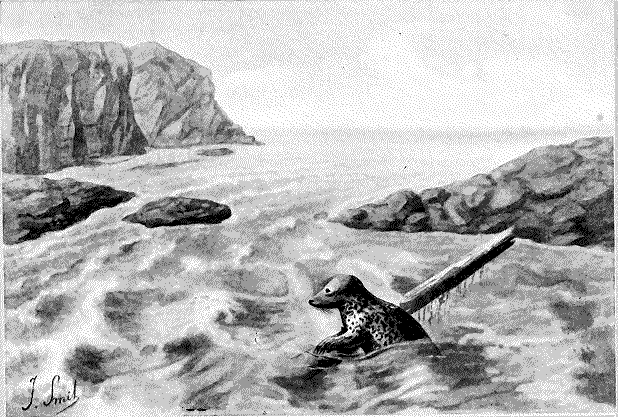
A SEAL'S PLAYTHING
Later, another seal played with this same spar in much the same way; yet both of them seemed to be quite full-grown animals. Then I saw something which looked like a spirit of real humour, as well as fun. Three seals were lying on a slab of rock together, and one of them, raising himself half up, began to scratch the one next him with his fore-foot. The scratched seal—a lady, I believe—took it in the most funny manner—a sort of serio-comic remonstrance, shown in action and expression. "Now do leave off, really. Come now, do leave me alone"—and when this had reached a climax the funny fellow left off and lay still again; but as soon as all was quiet, he heaved up and began to scratch her again. This he did—and she did the other—three times, at the least, and if not to have a little fun with her I can hardly see why.
On my last return from the guillemots, the tide was rising, and most of the rocks where the seals had been lying were covered. I was in time, however, to see one—an immense parti-coloured seal—gradually floated off. He lay upon a great mass of seaweed, and as long as he could stay there, he did; but little by little, as the waves came in, he rose unwillingly, seeming to cling to it to the last. Whether he really did grasp the seaweed with his hind feet, and stay, thus anchored, as long as he possibly could, I cannot say; but certainly, for a good many minutes, and keeping in much the same place, he stood, or rather floated, perpendicularly in the water, even including his head, so that his nose, which projected just a little above the surface, pointed straight up into the air. This was, at once, seen to be the case when he brought it down and stood with head in the usual position, as he did at intervals. Finally, he rolled slowly over and sought the depths in a vanishing blue streak. Another seal clung, in like manner, to the smooth rock he was on, letting the rising waves wash him about till at last he swam off.
CHAPTER XXVI
PIED PIPERS
I
I HAVE just seen a sea-pie several times pull and tweak with his bill at the seaweed, apparently, till he secured something that had a white appearance. Holding this between the extreme tip of his mandibles, he each time retired up the rock with it, placed it, as it seemed to me, amidst some seaweed, and then ate it. This was looking down upon a great stack of rock at some distance, so that it was impossible to be certain in regard to such minutiæ. It seemed to me, as it has seemed before, that he had pulled, not hit, some small limpet or other shell-fish from off the seaweed, and then wedged it amidst other seaweed higher up so as to be able to pick out the inside more easily. Possibly, however, he merely laid it down without wedging it, but I cannot tell, and it is very difficult to get close enough to see just what these birds really do when they feed. On the grass, which they probe like starlings, one can get a pretty good sight of their actions, but not on the seashore. One thing I cannot help noticing, that whereas limpets are all about on the rocks and need no looking for, they walk about as if they were looking for something, and they leave the bare rock that is all stuck over with them for the parts that are covered with seaweed, and at this they pull and tweak. In spite, therefore, of the peculiar wedge-like bill with its obtuse tip that seems so well adapted for striking a limpet or other shell-fish with a sudden blow from the rock to which it had been clinging, I am beginning to doubt whether they often use it in this way, and especially whether limpets are a special food of theirs. I remember, however, once seeing a sea-pie make just the sort of blow required on the theory, but ineffectively, and in a peculiar half-hearted way, as a man might feebly clench his fist and strike in his sleep. It is curious that this trivial action, which seemed to be of an involuntary nature, made under a misapprehension discovered in time to check, but not to stop, the blow, has remained in my memory with a strange persistence and vividness, and on the strength of it I still think that limpets are sometimes struck from the rock in this way. There must, I think, have been something very specialised in the movement of the head and bill, slight as it was, to make me retain it so long in my mind's eye.
Afterwards I watched several of these birds feeding on the rocks, and I distinctly saw one with his beak amongst a bed of the same small blue mussels that I have seen the eider-ducks feeding on, picking and pulling at them in much the same way. Others, like the first one, pulled at the brown, or black, seaweed with which the rocks are plentifully hung. They ran down upon it when the sea receded, and back, or else jumped into the air or flew to another rock, when it foamed in again. The sea boils in about the rocks off these iron shores in a tremendous manner, even when, like to-day, it is quite calm. On the stillest day, indeed, there is often a sullen swell which makes varying patches and long chequered lines of foam all around them. The sea never sleeps in these islands—only slumbers uneasily like some terrific monster that anything may awake.
It is observable that some of these sea-pies are bolder than others in outstanding the swell of the waves. Some flee it before it comes, others fear not to have it wet their feet, whilst others, again, will almost risk being soused in it. But are these different birds, or are they all different at different times? On that, of course, must depend whether a process of differentiation, on evolutionary lines, is in action amongst them or not. For myself, I think the first, and that, from waders or paddlers, some of these birds may in time become swimmers—which would make them a sort of sea moorhen. The redshanks has gone farther in this direction, for he sometimes swims, but I know of no intermediate form, no sea and seashore bird corresponding to our moorhen or coot.—Mussels, then, and the beak thrust in amongst seaweed; but no limpets up to the present. Now limpets, as I said before, are all over the rocks, and so need no searching for. Why so chary, then, if the birds really affect them?
What ails ye at the puddin'-broo That boils into the pan, O?
Under favourable circumstances—solitude and nonmolestation are, no doubt, the most favourable—oyster-catchers leave the foreshore, and browse, in flocks, over the grass-land beyond it. There are now, for instance, twenty-one, at the least, browsing, and I have watched them for some time digging their beaks well into the soil—to half their length, perhaps, sometimes—and then tugging violently at something. What this was, however, I could not, in any case, make out. It appeared to be taken into the beak before the latter was withdrawn. At last, however—for I like to see it all through the glasses, if I can—I went to the place, and, going down on my hands and knees, commenced a minute investigation. All about were round, straight holes going down through the grass into the turf, like those on a lawn after starlings have searched it, but, of course, larger. With my knife I cut down into several of these, and in two or three I found a small worm quite near the surface of the soil. It seemed as though the bird's bill had passed it in looking for or aiming at another one deeper down. Be this as it may, worms, it seems likely, form a common food of the sea-pie, for what else could these ones have been searching for? Worms, however, must be taken to include grubs, caterpillars, and so forth, an ordinary land diet, in fact, and did these birds get to preferring it, their habits would rapidly change. These, I should think, must a good deal depend upon locality, and perhaps, too, on their numbers, for birds become bolder when they go many together. Even here the sea-pie is wary, and in a more populous place I doubt if anything would tempt him inland. Yet it is curious that in an island where I have been the one inhabitant I have never seen these birds feeding or walking anywhere except on the tidal shore, quite near the sea, though they often flew over the island, whereas here, in Unst, I have seen them thus searching the greensward in the neighbourhood of Burra Firth, which is a village, though a small one. But then they are much more numerous here, and it was always in the close neighbourhood of the beach, even when not upon it, that I saw them. In this last instance, too, they were no distance at all from the sea—but again, most of the smooth, turfy stretches, where it would be easy to find worms, are so situated. Here, then, is another path along which differentiation might proceed, and by which, in time, an oyster-catcher might become a bird with the habits of the great plover. It is curious that one of the cries of the latter bird in the spring, though very much weaker, is a good deal like the "ki-vick, ki-vick, ki-vick, ki-vick, ki-vick!" of the sea-pie, so that the one rendering might stand for both.
It is pleasant to see a fair-sized flock of these birds gathered together on a smooth stretch of sand just above the line of the waves. Some walk about or stop to preen themselves, others lie all along, whilst a few stand motionless upon one leg, fast asleep, with the head turned and the red bill hidden amongst the pied plumage. Sometimes, when excited, or about to fly, they will run, for a little, over the sand, holding the wings elevated above the back, which has a quaint yet graceful appearance. They keep together, generally, in a group or series of groups, but at other times stand in a long row amidst or but just beyond "the light sea-foam" beating from the waves, looking as though the sea had cast them up, like a line of drifted seaweed. Gulls often come down amongst them, and the two sit or stand, side by side, quite indifferent to one another, each hardly conscious of the other's presence—so far, at least, as one can judge. Besides the piping note I have mentioned, these sea-pies have others—"queep, queep!" and a kind of twittering trill leading up to it—which remind one strangely of the great plover, and suggest a common ancestry.
I have confirmed to-day all that I said in Bird Watching (pp. 90-3) about the love-piping of these sea-pies. For some reason or other—rivalry, I think, passing into a form—two birds, that I put down as males, seem to like to pipe together to one who, by her quiescence and general deportment, I judge to be the female. I have seen this twice since coming here, once yesterday, and now again within these few hours. This last time it was almost as marked as in the instances I have described, and towards the end one of the piping birds showed a tendency to go down on his shanks, as though kneeling to his lady love. I do not think he quite did this, but he bent towards it. I am convinced myself that the dance of three peewits, as described by Mr. Hudson in The Naturalist in La Plata, has had some such origin as this. What one wants, in order to arrive at the real nature of the latter, is a number of detailed descriptions, instead of a mere general one, never in my opinion of much value in such matters. Pains, also, should be taken to ascertain the sexes of each of the three birds that takes a part in the show.
Another nuptial sport or play which these birds indulge in belongs to air—where, indeed, they pipe as strongly and easily as upon the ground. This that I speak of, however, appeals in an equal degree to the eye and ear. Two birds pursue each other closely, mounting all the while in a steep slant, till, having gained some elevation, both turn at an acute angle, and descend in the same manner, in a reversed direction, thus tracing the shape of a pyramid. Having completed the air-drawn figure, they immediately reproduce it, and thus they continue on quickly vibrating wings—now upwards, far above the cliff-line, now downwards, almost to the sea—piping the whole time in the fullest-throated way. Even in a small and sober-suited bird such a performance might attract attention. How much more here where, to the boot of the large size of the two artistes, and the noise they make, the boldly contrasted black and white of their plumage, the deep rose-red of the bill, and pale rose-pink of the legs, give it a very lovely appearance. For myself, I have seen few things more striking.
CHAPTER XXVII
A BITTER DISAPPOINTMENT
A
AMAN here—one accustomed to the sea, but not a Shetlander—had told me that seals come up on the rocks as the tide goes out, and are floated off them as it comes up again—and this, indeed, I have seen. He did not seem to think that they lay on the rocks independently of the tides, so, as the tide to-day should be out about 5.30, I resolved to go to the same place as yesterday—the accustomed haunt of seals here—about two, so as to be in good time. I arrive accordingly, but what is my astonishment to see, on a vast, sloping slab of rock, ending in a miniature cliff, far above the highest line of moist seaweed, and comfortably independent of all tides, twelve seals, of varying figures and different degrees of obesity, lying, roughly, in two rows, and in all sorts of attitudes and depths of repose. What a sight! What beautiful, fat, sleepy things! and what a lovely little secret creek of the wave-lashed, iron-ribbed coast have they found to sleep in! How the waters sleep in it, too! How gently they creep to shores strewn with a wild confusion of titanic black boulders heaped about still huger fragments of the cliff's wastage, so huge, some of them, that they are dwarfed only by the frowning precipices that tower behind! How they lick up upon the brown hanging seaweed that drips against the high, dark walls of this their boudoir, falling back from it again with a deep-sucked gurgle that ravishes the ear! What a snug sea-chamber, formed and fashioned by the waves! How the cormorants dive and fish in it, how the gull tears at the drifted carcase of its kind, how the puffins, in ceaseless flight between ocean and their myriad burrows, arch and dome it in! Oh, it is a fine apartment! Its portals on either side are columns of spouting foam, and beyond lies the wild, houseless sea. A seal's dormitory!—how well do the wild things choose! So here, at once, one learns something different to what one is told. Seals care nothing about tides when they can get great slanting slabs that lie high and dry above them. At high tide, or low tide, or middle tide, they are equally ready to sleep.
I came down the steep descent in a way which made me and everything I had on, or carried with me—which was everything I have here to keep me warm and dry—both wet and dirty. At the bottom there was a mass of nasty, brown, wet discomfort; but it had successfully stalked the seals. They lay now right before me, so near as to make the glasses almost a superfluity. Yet how splendidly they showed them up—every mark, turn, and expression, their whiskers, wrinkles, and their fine eyes. And now, still more markedly than yesterday, I note that the favourite attitude of a seal, when lying asleep or dozing, is either on its back or half or three-quarters rolled over towards it. Out of all these twelve, only one lies in the way that all illustrations persist in depicting them as lying. Three are absolutely on their backs, with their faces, or rather chins, looking, for long periods, straight up into the sky; others are almost as supine, but, by turning their faces sideways, seem to be less so, whilst the rest vary between this and full on their side, in which position they look much like a huge salmon lying on a fishmonger's dresser. Who has ever drawn seals like this? Where is there such a rendering? Always, as far as I can remember, they are made to lie on their stomachs. Yet here is the living thing.
As various as their attitudes seems to be the degree of their rest. Some raise their heads and look to this side or that, at irregular intervals that are not very long apart. Others seem sunk in deep and heavy slumber, their very attitudes—or rather, their attitudes more than anything else—expressing "the rapture of repose that's there." Yet even these, if watched for long enough, are seen occasionally to raise their heads, or scratch themselves lazily with their front paws, or expand or interlace their hind ones, moving them sometimes in a very curious manner suggesting the rotating screw of a steamer. It would seem, therefore, that, however fast asleep they may look, they are really only in a sort of doze.
Many of these seals are scarred and marked in a very bad way; raw and bleeding the places are sometimes, and I notice here and there what looks like a deep and gaping bite. These wounds are mostly on the belly, but the tail of one seal is bloody all round, as though another had seized it in its mouth and severely bitten it. No doubt it is all due to fighting, and the claws, I think, must have played as great a part as the teeth. Two other seals lie on a smaller rock, raised similarly above high-water mark, and a third on one that has only just become uncovered. Altogether, then, there are fifteen of them, making me think of Virgil's description of the Protean herds, written in those happy days before the accursed gun had thinned, as it now has, almost to the verge of extinction, the brave, honest, animal world. Surely the lower thing rules on earth for ever. Those who love living animals, with souls inside them, must see this world made dead and empty by those who love only their skins, stuffed with straw. They conquer, these Philistines, and the finer-touched spirit lies bleeding and suffering beneath them. How grossly we deceive ourselves!... I say that the "pale Galilean" has not conquered here, but that Thor has, though often in his rival's name.
The modern Christian poet speaks truth as though it were falsehood, and falsehood as though it were truth. Hear Longfellow, for instance—
Force rules the world still, Has ruled it, shall rule it, Meekness is weakness, Strength is triumphant, Over the whole earth Still is it Thor's-Day!
Now that is truth—simple, plain truth. So it is put into the mouth of Thor—a heathen god—who, of course, is brought up only to be knocked down, and what he says confuted. Only through some such machinery can poets now speak the truth.
These seals differ greatly from one another, both in size, figure, markings, and colour of the fur, and especially, as a result of all, in beauty. Most of them look rough, swollen, dropsical creatures, but some are very pretty and elegant, and as these are smaller I suppose them to be the females. Often one may see a look and action in them that seems to speak of coquetry and being wooed.
It is curious that the one seal that lies on its face is the only one out of the twelve that is turned towards the sea. The sea, however, in this case is only a narrow inlet between the rock on which it lies and the shore, the great expanse of it being entirely hidden by the rock itself, which rises perpendicularly, like a cliff, from the highest point of its upward slope. The seal, therefore, really looks shorewards, but across a narrow strip of sea. His eyes, I notice, seem never shut, and at frequent intervals he turns his head to one side or another. All the rest lie either sleeping or dozing, though, as said before, most of them from time to time raise their heads a little and give a lazy look before sinking back into slumber. Is the one seal a sentinel? It looks like it. But why, if this were their custom, should seals ever sleep singly? And this they often do.
In spite of the shortness of all their four limbs, yet seals, as they stretch themselves, throw up the head, bend the neck and back, raise their fore-feet into the air, or push out the hind ones to their full length whilst at the same time stretching them apart, often have a very startling resemblance to a man. The curves and symmetries of the body—especially the upper portion of it—are sometimes wonderfully suggestive of the human torso, and the resemblance is often helped by the shape of the rock, which, by curving away from the body, allows the lines of it to appear. Nothing, in fact, can look both more like and more unlike a man than do these creatures. See one lying quiescent, a great, swollen, carrot-shaped bladder, and one may scoff at the possibility of any such resemblance; but wait and watch, and in a hundred odd ways one will catch it. When a seal scratches one of his front flippers it is wonderfully like a man scratching the back of one hand with the other. The hind feet can look almost more hand-like. It is true that when the toes are distended to their full width the whole foot is just like a fish's tail in shape, but when they are not stretched so widely apart, and those of the one play, as they often do, with those of the other, then they have a wonderful resemblance to fingers—swollen, gouty fingers, it is true; gloved, too, they look—but still fingers.
Another interesting sight now in the adjoining cove, or rather in the adjoining half of this semi-divided one! A seal comes to its rock there before the tide has sufficiently gone down to let it lie upon it. It plays about the rock, fawns upon it, caresses it, woos it, one might say, dives down and circumnavigates it, tries or pretends to try to lie upon it, even under the water, swims away and returns, and does the same thing several times; and as soon as the water is sufficiently shallow to allow of it, it reclines, sea-washed and gently heaving, till the receding tide leaves it high and dry. A pretty thing it is—very—to see a seal thus waiting for its chosen rock to appear.
I was at the ledges about twelve, and found my particular one a blank—not a bird there. Mother and child—father too, and every other bird besides—was off; the cupboard was bare. A bitter disappointment seized hold upon me, sunk into my very soul. Yet what else could I have expected? They may have gone in the night; and, in any case, how, except by actually bivouacking above that ledge, could I have hoped to be there at the exact moment when the departure took place? This I might have managed, or at least have managed better, had my little black sentry-box been a cottage, with some one in it to cook for me. Then I could have got to bed by eight, or at least nine, and been up by three or four; but without this it was impossible. I can do—and I do now—with as little as most men, but porridge here is like charity, and oh, the time that it takes to make! They talked to me of ten minutes or a quarter of an hour at the outside, spoke even of boiling milk flung upon the raw meal—said it would be good like that. "Women said so, that will say anything." Sweetly they smiled, but they understood not the conditions. Oh fire that will not burn up! Oh kettle that will not boil! Oh egg that will crack when you drop it in! Oh one spoon that goeth a-missing! This, and much more "of this harness," as the Spaniard says, has kept me up till ten or later—till eleven, once, when the frying bacon, "in the very moment of projection," was breathed on by the flame of paraffin. (Nothing but paraffin will make a fire burn up in the Shetlands, and even that gets damp sometimes.) So that, having my notes to extend and decipher, and with hard boards, and the wind, and a flea or so, and sometimes the lumbago, I may say, with Comus, almost any night, "What has night to do with sleep?" but without being able to continue, for certainly it has no "better sweets to prove."
But perhaps I should have missed it in any case. Perhaps—nay, I will be certain of it, to lessen heart-ache—they went off in the night. To think of it! that young, tiny creature! And was it then, in the dark night, when the wind was blowing so furiously, that you were carried down—a little soft, fluffy, delicate-looking thing—to be put upon the great tumultuous sea? through mist and driving spray, with neither moon nor stars to light you, to toss, for the first time in life, on those tumbling, rough-playing waves? I, a grown man, was glad of all I could heap on my bed to keep the wind away. I lay and thought of ship-wrecks as I listened to it roaring, but I never thought of you, flitting out to sea through it all, cradled so delicately on your mother's back—if that, indeed, was the way of it. How could I imagine it? Even to watch you, as you lay warm on your cold ledge in the daytime, gave me the lumbago, though wrapped in two good plaids. But at night, and with nothing round you, to leave even that shelter, to cast off from the sheer, horrid edge "into the empty, vast, and wandering air," and then souse into yeasty salt water, without cold or chill taken, without a touch of lumbago—oh, what an iron constitution! You are not the lathe painted to look like iron; you are feathers in steelwork, rather, a powder-puff made out of adamant. But here I register a vow that I will return here, some day, in the height of the putting-off season, and see the little guillemots fly from their cliff's cradle, or ride down on one cradle to another—their mother's soft, warm back, and then
In cradle of the rude, imperious surge.
CHAPTER XXVIII
TAMMY-NORIE-LAND
S
SEAL-COVE again to-day, and there, upon the same great slab, and at much the same time, five great seals are lying, whilst on other rocks there are six more. The tide is coming in, and one that is on a low rock goes gradually off with the wash of it. The others lie on, though now, at high noon, the tide, I think, must be in. Seals, therefore, do not go off their rocks at high tide, as a custom, unless the water leaves them no choice. Of course if they have a favourite rock which is covered at high tide, they are then compelled to do so, but in that case they can seek another one which is not so restricted, and lie there sleeping, if they will, "the washing of ten tides." Their bed-times are not governed by the ebb and flow of the sea.
The larger seal which I spoke of yesterday is called here, locally, a bottle-nosed seal, or at least some so designate it. He is here again to-day, rising at intervals and staring at the sky, in the other of these two-in-one-contained bays, which seems to be more particularly his own. When he rises he remains for a full minute standing upright, as it were, in the water, with his muzzle about six inches above it and pointing straight into the sky. Then it sinks for an instant, and the next his whole head appears above the surface, held horizontally. Another moment, and his back makes a bent bow in the water, as with a rolling motion, something like that of a porpoise, he dives and vanishes. He always makes for a great mass of brown seaweed clothing the rocks, now covered, where I had first seen him lying, and extending down into the depths. In this I lose him, but whether he stays there or merely coasts along it I cannot tell; but he always rises in about the same spot, and this suggests that he comes each time from the same place. Seals may, perhaps, lie upon the bottom, under the overarching edges of the rocks they bask on at low water, and wound amongst the seaweed that grows on them; but their sleep, if they slept, would be broken.
I took out my watch and measured the time this great seal stayed under water, finding it to be, on an average, from ten to twelve minutes, his longest submersion being fourteen minutes and a half. I then thought I would descend the cliffs and get along the shore to just opposite where he usually came up, which would be very near him. This I easily managed, concealing myself once, when I knew that he would rise, and going on again as soon as he was down. When he next came up I had the satisfaction of beholding him from some dozen or twenty yards. He was considerably larger than the common seal, his skin perfectly naked and of a bluish colour, which, with the breadth of his back, gave him something the appearance of a hippopotamus in the water. This was when I just got his back, without the head or other parts. Seen in toto—or as much of him as could be seen—he more suggested, both by shape and colouring combined, a gigantic mole; or again, his head, with the long cylindrical-looking nose, had a very porcine appearance. But whilst floating upright in the way I have described, he looked like a buoy merely, of which the muzzle, with its round-bore nostrils—they looked as if a ping-pong ball would just fit into each of them—was the apex. All resemblance to a living thing was then gone; but when the great beast brought down his head again into a natural position, and looked about with full eyes, dark and mild, one saw that he was an intelligent and refined animal.
Modification seems to have gone considerably farther in this species than in the common seal. The skin, except for the long, strong whiskers, is absolutely smooth and hairless. The nose, head, and neck are more in a line, whilst the back rises from the latter with a still gentler undulation. This elongation and prominence of the nose, or rather the muzzle, which is broad, also, in proportion, take away from that full and rounded appearance of the forehead which gives such a look of intelligence—almost of humanity—to the common seal. But this, no doubt, is an inferiority in appearance only, and "the eye's black intelligence" remains. But though the jewel is there the setting of it is very poor. There appears to be no defined eyelid, so that when the eye is shut it looks like a mere slit in the naked skin. Eyebrows, however, are represented by three or four strong white bristles on either side. The nostrils open and close with strong expansive and contractive power, and blow the water away from them almost like the spouting of a miniature whale. When wide open they look as round as the aperture of a champagne or beer bottle, which they somewhat suggest, and this, perhaps, has given their bearer his title of bottle-nosed. Whether this is more than a local name amongst the Shetlanders I do not know. It is here that I first heard it, and that was two years ago when I was describing this very selfsame animal, as I now believe, to a young man who suggested that "perhaps it was a bottle-nosed seal."
Such was the peculiar creature which I now set myself to observe, and which, except for a long interval during which it disappeared altogether, continued to rise and sink and rise again, till after five, when I left, having observed it thoroughly. Several times he went down with a fine roll over, sideways, as well as forward. This I should not have seen had I gone away in an hour or two; but why I stayed so long was that I hoped to see this great bottle-nosed seal lie upon the seaweed-covered rocks at low water, as I had seen him do once before. For some reason or other, however—I doubt not there is a good one—there has been no such low tide since that day; the seaweed has but just shown for a little, and the great creature, who could hardly have lain there, has not lain anywhere else—not, at least, in this cove which he affects, or for the greater part of the time. He seems to be a much less lazy sort of seal than the common kind. I am not quite sure why he went away, as he did for an hour, from about three. I thought at the time I had alarmed him, for although I lay flat upon a huge slanting rock, with my head not projecting beyond the edge, he seemed to look full at me with a questioning countenance, and then till four o'clock the pool that had known him knew him no more. Whilst he was gone I, with a lot of labour, brought a number of flat stones from the chaos of rocks and boulders which makes the beach here, and with these I made a sort of loopholed wall, through and from behind which I could look, as I had done before to watch the shags on my island. That, by the way, was still standing when I got there again after two years. I wonder how long this other may remain on this most lonely shore, to which no one, to judge by all appearances, ever comes down, from one year's end to another. Long may it be so!
Just before beginning my masonry I had an interesting experience. From a crevice in the pilings of these huge black boulders that lie strewn in wild confusion between the base of the cliffs and the sea—making the gloomy beach—from amongst these, I say, and within about three steps of me, forth hopped a little wren, and began immediately to procure food in the more or less near neighbourhood of my boots. The boulders had hitherto seemed bare enough, but wherever the wren went numbers of little hopping things, with long bodies and many legs, began to hop and skip about like a routed army. They seemed to know the enemy was amongst them, and for the wren, he pursued them with the most relentless activity, and looking very fierce about it. He came so near me that I could see him catch them individually, see the whole chase, all his little runs, hops, turns, flights, flutters, each with its distinct object; nor did I ever see him chase one that he did not shortly capture. From the very first, something in the bird's manner shot into me the idea that he had never before seen man—never, at least, with the eye of a full recognition. Supposing him to live and breed in this one great rocky amphitheatre, this would be likely enough, for even at the top of it, on the ness-side, one man only lives, and that but for three months in the year. It is true that during those three months the ness is often visited—by thieves and others—but none, it is safe to assume, either know of or come down to this cove.
At any rate this wren came at last so near me that I expected every instant he would hop on to one of my boots, and although he did not actually do this I believe it was simply because he saw nothing there to catch. He often ran up the steep, rough sides of these great blocks with the greatest ease, investigating all their chinks and every little piece of moss or lichen that adhered to them. Always he had an air of severity, something farouche, about him, which was very amusing to see. It is fascinating, I think, thus to watch little familiar woodland birds by the wild sea shore and amidst stupendous scenery like this.
Puffins, at the right time, are, no doubt, very amorous, as even now, when they should be a little passé in such matters, I have seen them so. In this state they will sometimes indulge in quite a little frenzy first of kissing and then of cossetting—nibbling, that is to say, each other's feathers about the head and face. Indeed, such pretty little lover-like actions—mostly on the part of one bird of the two, I presume the female—were never seen.
But they are not only loving, these little birds. They are playful too, and, as I think, sympathetic. Thus when one, standing on the rock, gives its wings a little fluttering shake, another by the side of it—its mate, probably, but perhaps only its friend—will sometimes catch one of them in its adorned beak and playfully detain it. This is done with wonderful softness—obviously in good part, and so it is received. Is it not fun, then, playfulness? Perhaps it is not. It may be but a part of the passion-play, and we should not step too lightly in our judgment from primaries to secondaries. On my last visit here, for instance, whilst climbing painfully along this black beach—a horror of heaped stones and fragments, making, often, unscalable, albeit only miniature, precipices—I happened to see—looking down from a huge tilted rock that guarded one entrance to a little dark valley of confusion—I happened to see there a poor little puffin that had got its head caught in some way amongst the rocks at the bottom, and was struggling and flapping its wings to escape, as it lay flat along one of them. Another puffin was standing beside it, and whilst I looked it took hold of the distressed one's wing and, as it seemed to me, pulled at it as though trying to assist, but in a feeble half-knowing sort of way, which had its pathos. But here, too, how careful one should be in attributing motives, either to birds or men; for this puffin may merely have taken hold of its companion's wing, as I have seen others do whilst standing together at their ease. If so, then the action was not prompted by any idea of aiding, but merely by general good-will, unsharpened by a proper realisation of what had taken place. Here, once again, was a flapping wing, which may have suggested no more to the mind of the bird taking hold of it than it had upon other occasions. Not that I think this myself, but in the little I saw there was no certainty. Unfortunately, I startled away the helper (as I like to think of him) and this to no purpose, since after various attempts to get to the distressed puffin I had to give it up, for though I might have reached it there seemed a likelihood, if I did, of my having to remain there indefinitely in its place. To slide down a steep rock is one thing, but to climb up it again quite another—nor was there any other way that I could see of getting back when once at the bottom. Some time afterwards, however, I could not see the bird, so, though I purposely did not look very closely, I am glad to think that it had got free.
This little incident gives a hint as to some of the mischances which may befall puffins here. With such a jumble of heaped rocks and boulders there are great facilities for slipping or getting between them in such a way as might make it difficult to get out again, and an alarmed bird, caught as this one was, would, of course, pull and pull, wedging itself all the tighter. If found in this situation by a gull—or perhaps, skua—its fate would be sealed, and its picked and disembowelled carcase would then be left upon the rocks, as I have so often found it. Such a misfortune, indeed, cannot be supposed to be of common occurrence; but the hundreds of thousands of puffins must be considered.
I have said that puffins are amorous. They are bellicose also—the two, indeed, are interwoven together—and have a tendency—but this, perhaps, is included in the main proposition—to fight in mêlées. When two are about it a third and then a fourth joins, and so on, and several will stand menacing one another with their sharp, razor-like mandibles held threateningly open, and often moving like scissor-blades. Then, all at once, one springs on another, seizes him by the scruff of the neck, and—so it has often appeared to me—endeavours to throw him over whatever edge they both happen to be near—for they are generally near the edge of something. It is curious—or at least it takes one by surprise—that when the beak is thus opened it looks quite different to what it did before. Being divided, its breadth, which is such a peculiar feature, is much diminished, and the leaf-like shape is also lost since the mandibles diverge more and more widely towards the tips, like a real pair of scissors. Thus the bird itself, since the beak is so salient a part of it, suddenly loses its characteristic appearance.
Marvellous is this beak, and indeed, as far as its appearance is concerned, it exists now wholly and solely for courting and nuptial purposes, being put on each spring before the breeding season commences, like the false nose in a pantomime, which, though not so artistic and without the same justification for its employment, seems equally a necessity to the æsthetic susceptibilities of a British audience.[11] It reminds one something of the bill of a toucan, much abridged—beginning, as it were, from near the tip—and as far as it goes it is perhaps even more wonderful, for not only is it brilliant with rose-red, lemon-yellow, and bright bluish-grey, but the lines of colour correspond to alternate ridges and furrows running down the length of it, which give it a fine embossed appearance, as though both the sculptor and painter had exercised their art upon it. The funny little orange-vermilion legs are more brilliant even than the bill, but they are cruder. You do not think of a real artist in their case, only of a clever artisan with a paint-pot, who, employed by the other, has taken up each bird as its beak was finished, and given it several good coatings. That is what it looks like, and so close do the little toy things stand, and so little do they seem to think or care about you that, with the proper materials, you almost think you could do it yourself; yes, and would like to try, too—if only there were a few with the paint off—black coats, white waistcoats, vermilion legs and all: except the beak and face, which are beyond you, unless, indeed, you are an artist—and a clever one—yourself.
It is wonderful sitting here. To have a dozen or twenty of these little painted puffins on a rock within three paces of you, in full view, with nothing whatever intervening, some standing up, others couched on their breasts, some preening, some shaking their wings, most of them unconscious of your presence, a few just looking at you, from time to time, with an expression of mild curiosity unmixed with fear, seeming to say "And who may you be, sir?" is almost a new sensation.
Yes, this is Tammy-Norie-land. Puffins are everywhere. They dot all the steep, green slopes, and cluster on the flat surfaces or salient angles of half the grey boulders that pierce the soil, or lie scattered all about it. Great crowds of them float on the sea, and other crowds oppress the air with constant, fast-beating pinions, passing continually from land to sea and from sea to land again, whilst many, on the latter journey, even though laden with fish, circle many times round, in a wide circumference, before finally settling. The soil, too, is honeycombed with their burrows, and in each of these, as well as in the nooks and chambers of rocks that lie closely together, there is a young fluffy black puffin, which increases the population by about a third, to say nothing of those parent birds which may also be underground. A million of puffins, I should think, must be standing, flying, or swimming in the more or less immediate vicinity; the air, especially, if it be a sunny day—or, rather, for a sunny minute or so—is like one great sunbeam full of little dancing bird-motes. On the shore they stand together in friendly groups and clusters, and leave it for those much larger gatherings where they ride, hundreds together, ducking and bobbing on the light waves like a fleet of little painted boats, each one with a highly ornamental bird- or, rather, puffin-headed prow. Thus their duties are carried on under the mantle of social pleasure; it is all a coming and going between a land-party and a sea-party, so that the domestic life of these birds would be a type and pattern of feminine happiness if only they were a little—by which I mean vastly—more noisy. Puffins indeed are somewhat silent birds—at least they have been so during the time I have seen them—from the middle of June, that is to say, till the middle of August—though as they can and do utter with effect, on occasions, they are, perhaps, more vociferous at an earlier period, before domestic matters have become so far advanced. Not that amidst such a huge number of them, their note—which I have described—is not frequently heard; but still, whatever I have seen them doing they have generally been doing it dumbly. This includes the series of funny little bows or bobs, accompanied by a shuffling from one foot to the other, which the male, one may say with certainty, is in the habit of making to the female, but which probably the female—as in the case of other sea-birds I have mentioned—also sometimes makes to the male. A display of this sort is usually followed by a little kissing or nebbing match, after which, one of the birds, standing so as directly to face the other, will often raise, and then again lower, the head, some eight or nine times in succession, in a half solemn manner, at the same time opening its gaudy beak, sometimes to a considerable extent, yet all the while without uttering a sound. All this looks very affectionate, but I have often remarked that after one such display and interchange of endearments, the bird that has initiated or taken the leading part in both, turns to another, and repeats, or offers to repeat, the performance—for on such occasions it does not, as a rule, receive much encouragement from the second bird.
The male puffin, therefore—for I hardly suppose it to be the female who acts in this way—would seem to be of a large-hearted disposition. This silent opening of the bill which I have spoken of is, therefore, an accustomed—probably an important—part of the advances made by the one sex towards the other; and here again I have been much struck by the bright yellow colour of the buccal cavity which is thereby revealed, and the display of which supplies, in my opinion—as in the other cases I have brought forward—the true motive of the bird's conduct in this respect. Handsome—or, at any rate, outré—as the puffin's beak is, it is hardly, if at all, more striking to the eye than is this vivid gleam of one bright colour, revealed suddenly in a flash-light by this distension of the mandibles. It is like the sword gleaming out of the scabbard, whose brightness comes as a surprise, whereas the latter, however rich and ornate, is a permanent quantity, and so lacks the charm of novelty. The fact that the puffin's beak is a superlative ornament does not, in my opinion, render it unlikely that there should be another one lying within it. It is absurd in such a matter to say that this or that is enough, and in the puffin's case we are certainly debarred from doing so, since not only has the beak been decorated, but the parts adjacent to it, as well as the whole head, have also been, so as to join in the general effect. The eye is almost as salient a feature as the beak itself, and moreover, where the mandibles meet at their base, there is on either side a little orange button or rosette, formed by foldings of the naked skin, which must certainly rank as a sexual adornment in the eyes of all who believe in such a thing, and with which, apparently—as in the other cases—the inner coloration is continuous.
The puffin, therefore, makes the seventh species of sea-bird in which, as I believe from my own observation, the buccal cavity is displayed by the one sex as a charm or attraction before the eyes of the other, having been specially coloured in order to render it so. A question, however, is raised by this conclusion in regard to which I have, as yet, said nothing, but which I will shortly discuss in a separate chapter, since I have been unable to compress it into any of the foregoing ones. It had occurred to me as a result of my general field observations, before these particular ones which have only served to emphasise it.
CHAPTER XXIX
THOUGHTS IN A SENTRY-BOX
T
THAT wren was an interlude, and the puffins another. When he of the bottle-nose returned, I at first used the shelter which I had constructed during his absence, but soon left it for another great precipice of a rock that also overhung the pool, and in which a huge fracture, half-way up, made a splendid natural concealment. Afterwards, however, I came to the conclusion that as long as one behaved with any sense of propriety, avoiding loud or startling noises, and not putting oneself shamelessly en évidence, these seals would never take alarm, for indeed they seemed to have lived all their lives in a happy unfamiliarity with man, upon which terms I devoutly hope they may continue.