Front matter (continued 2)
Reading edition
These Muscovy ducks that I spoke of have another curious habit of drinking dew in the early morning. This, at least, is what it looks like. They walk about for hours over the well-kept lawns, and with their heads stretched straight out, just above the herbage, continually just open and shut the mandibles very quickly and very slightly, nibbling the dew as it were. They certainly do drink it—one can see it disappear in their mouths; but whether that is all they do, or their chief object, it is not so easy to be sure of. Why should they walk about imbibing dew for such a length of time? and why should dew be so much preferred by them to ordinary water, of which there is abundance? These ducks, indeed, or at least the larger kind of them, which are of great size, are never to be seen swimming, but they often walk about by the edge of the lake. They have a most portentous appearance, and walk with an extraordinary swing of the body, first to one side and then another. They are fond of bread, but their ordinary eating and drinking is something of a mystery to me. I have seen them apparently browsing some long, coarse grass, more like rushes, but though occasionally they did crop a piece, the incessant nibbling was out of all proportion to what they got, and seemed for the most part to be simply in the air. They seem indeed to have a habit of incessantly moving the mandibles in this way, without any particular object, or, at any rate, without any clearly discernible result following upon their doing so.
But as I remember these fine white Muscovy ducks with their vermilion faces and wild, light eye, with something a look of insanity in it, I remember, too, that they are now gone, or, at any rate, that most of them are, and those the best—the hugest and most dragon-like. "Sometimes we see a cloud that's dragonish" and sometimes a duck. These wonderful, waddling, swinging red and white Muscovy ducks were, and to have them running after one, with uncouth hissings and with their heads held down, yet scooping up and wagged from side to side at one—and with that insane eye—made one think all sorts of odd things. Well, they are gone, nor are they the only ones that are. When I first, by necessity, came to live at Cheltenham, the ducks in the Pittville Gardens were a great consolation to me. There was quite a fleet of them, a gay little flotilla of all kinds and colours, and at the smallest hint of bread, on one side of the lake, they would all come flying over from the other; and then it was the sport to feed them. How diverting that was! Being in such numbers, one took notice of all the little differences in their dispositions, the different degrees of boldness or retiringness, of pugnacity, greediness, aggressiveness, pertness, impudence, swagger, imperialism, and so on, all of which one could bring out, in some amusing way or another, by the varied and nicely-schemed throwing of the bread. To contrive that a timid bird should always get it, whilst a boldly greedy one pursued in vain, that two should contend for a large piece, to the end that a third might swim securely away with it, to tempt some to walk on thin ice till it broke, and others to make little canals through it, each from a different place, each struggling to be first, to have one bird feeding from the hand, whilst a crowd stood round, looking enviously on, to see greed just drag on fear, or fear just drive back greed, or the two so nicely balanced that they produced a deadlock, so that the bird stood on a very knife-edge, trembling between a forward and a backward movement; and then, too, gradually to come to connect the look and bearing of each bird with its disposition, to know them, both outwardly and psychologically, to see them grow into their names that grew with them, and have the bold orange-bill, the modest grey, the swaggering white bird, the Duchess, the Fine Lady, the My Lord Tomnoddy, the Kaiser, the Swashbuckler, and so on, all about one, so many characters, so many amusing little burlesques of humanity—human nature stripped, without its guards, disguises, softenings and hypocrisies—all this was the solace and beguilement of many a tedious afternoon.
But there exists for some reason, in every town in England, a body of men who can do what they like, without asking anybody, to the annoyance of everybody, though everybody pays for them. One day, after an absence, I came with my bag of bread as usual, but there were no ducks to be fed; all had vanished—there was only the uninteresting pond. Alarmed, I inquired of the man at the entrance, and found that the Cheltenham Corporation had got rid of the whole of them on account of their being of no particular breed or strain, just ordinary tame ducks and no more. Their appearance, the indiscriminate diversity of their plumage, their infinite variety of colour and pattern, had been against them. It had, indeed, made the water gay, and gladdened the eyes of subscribers to the gardens, but it had not been creditable to the Corporation. True elegance, it appears, which can only come from true breeding, had been wanting. These ducks were "a mongrel lot," and though they might be pretty to look at and entertaining to feed, that was not what the Corporation cared about. What the Corporation did care about, presumably, was to read in the local papers, or be told by their friends that now, at last, there were some ducks on the Cheltenham lakes a little better than the "mongrel lot" one had so long been accustomed to see there, more worthy of themselves, more worthy of the town they represented, and so forth. So the poor "mongrel lot," the delight of all the children, and of many a grown-up person to boot—Charles the Second was grown up, and a clever man too—were done away with, and a few pairs of select, blue-blooded strangers (more soothing to gentle bourgeois feelings) were introduced in their place. The children who came to feed them said, "Where are the others? Where are all the rest gone to? There's no fun in feeding three or four." Nor is there, in comparison with feeding a hundred, as one grown-up person at least can testify. As additions, these new arrivals would have been welcome enough, and being of distinct species they would not, probably, have entered into mésalliances with the others, to make a correct Corporation blush. Why could they not have stayed? But this, I suppose, was the way of it. Here were pleasure gardens for which the public paid. This pretty little fleet of ducks, painted all sorts of colours and not one painted quite like another, made a very considerable part of the pleasure thus paid for. So the Corporation, vested with mysterious and almost unlimited powers of annoyance, decided that the proper thing to do was to do away with them, and they did do away with them, and the gardens have been the duller for it ever since. What they could have thought——But there! they were a Corporation and acted like one. They had a precedent. They had previously done away with the peacocks.
CHAPTER X
FROM THE EDGE OF A PRECIPICE
I
I HAVE been watching the black guillemots. Like the common ones, they often carry a fish they have caught, for a very long time in the bill, before swallowing it, or even before giving it to their young. They will swim with it for half an hour or so, constantly dipping it beneath the water, and apparently nibbling on it with the bill, whilst they hold it thus submerged. Then finding themselves near a rock which is ascendable, they ascend it, and lie couched there for a while, resting, always with the fish in their bill. Anon, with refreshed energies, they re-enter the sea with it, and, if very patient, and prepared to watch indefinitely, one may at last see that fish swallowed; but I hardly think I should be exaggerating were I to say that hours may pass in this way. They usually hold the fish by the middle, or just below the head, and if they want to shift their hold from one place to the other, they sink down their bills into the water, as though better able to do so through its medium. To mandibulate a fish in the air, quite freely, as does the cormorant, is, perhaps, beyond their power. Any moment, however, may show me that it is not. So, too, when I have seen them swallow the fish, they have done so in the same way. Instead of raising the head and gulping it down, they gulped it up, with the water to help them; though I can hardly think that they are compelled to act in this way.
These little birds—old ocean's pets, his darlings—seem to me to play at fighting. Whilst swimming together in little changing troops—for the numbers are always increasing or diminishing—they constantly approach one another in a threatening manner, the body raised in the water, the head held straight up, and the mandibles opening and shutting like a slender pair of scissors—a thoroughly warlike appearance. Yet it hardly ever ends in anything, nor does the threatened bird seem really alarmed. Generally, the threatener, as he comes alongside, subsides into quiet humdrum, or two birds, after circling round one another in this way, each almost on its own pivot, like a pair of whirligig corks, both quiet down. Each, whilst thus acting, will, at intervals, drop the head and sink the beak a little in the water—one of their most usual actions. Sometimes, indeed, the menacing bird may fly at the one he menaces, who ducks at the right moment; but what makes me think it more play than wrath is that, often, instead of flying right at him, he flies to beside him only, and both then swim together, looking the best of friends. Yet too much stress is not to be laid on this either, and certainly it can be "miching malicho" on occasions. Often, when one bird is attacked, all the others will dive and scurry about under the water, in the most excited manner, seeming to pursue one another, as though it were a game or romp. Sometimes, indeed, there will be a little bit of a scuffle; but if there be fighting, still more, as it appears to me, is there the play or pretence of fighting, which is tending to pass into a social sport or dance.
The antics of birds are often so very curious, and the whole subject of their origin and meaning is so full of interest, that nothing which might by any possibility throw light upon this ought to be neglected, or can be too closely observed. I believe that the feelings of animals, still more than is known to be the case with savages, pass easily from one channel into another, and that, therefore, nervous excitement brought forth by one kind of emotion is apt, in its turn, to produce another kind, so that if any special transition of this sort were at all frequent, it might, through memory and association of ideas, become habitual. If, however, a mêlée or scrimmage—to meet the case of these guillemots—became, almost as soon as started, a mere hurrying and scurrying about, it would be difficult to detect the one as the cause of the other, and this is just the difficulty one might expect, for in such a sequence the tendency would, no doubt, be for the first or causal part of the activity to become more and more abbreviated (what should delay the passage?) till, at length, a mere start on the part of any one bird might set the others off dancing. Finally, what had become a mere pretence or starting-point might vanish entirely, or only survive as an indistinguishable part of the other, in which case there would be the dance or sport alone, which would then seem a very unaccountable thing. In this way I can imagine the evening dances or antics of the great plover, which used to impress me so when I lived in Suffolk, to have originated. One might watch these performances a great many times without seeing anything to suggest that a feeling of pugnacity entered into them. Nevertheless, there is, sometimes, a slight appearance of this, for I have several times seen a bird pursue and wave its wings over another one. My theory is that an initial energy or emotion sometimes flows out into subsidiary channels, and that gradually this secondary factor may encroach upon and take the place of the primary one.
At any rate, to come back from the general to the particular, it is apparent to me that these little ebullitions, or whatever they may be called, of the black guillemots are of a blended nature, and I should think it misleading to describe them simply as fights. Whatever they are, they are very pretty to see. The actions of all the little dumpling birds are so pert, brisk, and vivacious—so elegant, too. Yet a bird will go through it all, play every part in the little affaire, carrying, all the while, a fish in its bill. It makes no difference to him; he will even threaten in the way I have described, whilst thus encumbered. Whether this makes it more likely that the whole thing is sport, I hardly know.[3] It seems strange to seek one's enemy with one's dinner in one's hand—the beak is used more as a hand here than a mouth—yet what is done with entire ease is as though it were not done at all. Even so do the guillemots—the common ones, I mean—but then, they used to fight for their fish. Here I saw little or nothing of any real attempt on the part of one bird, to take the fish from another.
In swimming under water the black guillemot uses its wings only—the rose-red legs trail behind it, a fading fire as it goes down. The body becomes one great glaucous-green bubble, which has, still more, a luminous appearance. The effect may almost be called beautiful, but it is still more odd and bottle-imp-like. Most diving sea-birds exhibit this appearance under water, but not all in the same degree. Whether sexual selection has come into play here I know not.
A pair of these birds are now feeding their young. The nest is in a hole in the earth, on a ridge of the precipitous grass-slope of the cliff, just above where it breaks into rocks, and drops sheer to the sea. Both parents feed the chick—for their family is no larger—but one more often than the other. They bring, each time, a single fish—a sand-eel, often of a fair size—and disappear with it into the hole, reappearing shortly afterwards. Once both are in the hole together, having entered in succession, each with a fish, but generally when the two meet at the entrance one only brings a fish and goes in, and the other, having nothing, stays outside. When the parent bird has fed its young and come out again, it will often sit for a little on the steep slope, above or below the hole, before flying away. It looks solicitously at the hole, and from time to time utters a little thin note that just reaches me where I am. Once both the birds sat like this, one above and one below the hole. What I particularly noticed was that when the bird that had taken a fish in had come out again, the other, even though it had nothing, would always go in too, as though to pay the chick a little visit. It stayed about the same time—less than a minute that is to say. How interesting are these little birds to watch, and how delightful is it to watch them from the summit of precipices that "beetle o'er their base into the sea," where all is wild and tremendous, and in the midst of utter solitude!
CHAPTER XI
DARWINIAN EIDER-DUCKS
I
I HAVE seen a fair number of eider-ducks within the last few days. All the grown ones are females—not a male to be seen now—and the greater number of them are unaccompanied by ducklings. Of those that are, most have but one, and three is the maximum number that I have seen swimming together with their mother. Yet two years ago, in early June, the males here were courting the females, and when I left, about the middle of the month, but very few eggs, I believe, had been laid. This year, I learn, the birds have been very late in breeding, there having been some very "rough weather," as it is euphoniously called, in the spring—that is to say, the spring has been like a bad winter, and now the summer, though it has no very close resemblance to any of the four seasons as I have seen them elsewhere, yet comes nearest to a phenomenally bad November. I wonder, therefore, that so many of these mother eiders are without their young ones, for they should all have hatched out a brood of them not so very long ago. Why, too, should so many be swimming with one duckling only? Were these single ones of any size, one could understand the others of the brood having escaped from tutelage, but, like all I have seen, they are but little fluffy things. It looks as though their fellow nestlings had come to grief in some way, and if so it is probable that many entire broods have also. Yet perhaps they have merely drifted away into the wide, watery world, where they may be able enough to shift for themselves thus early. To judge by these, however, they would not have left the mother duck voluntarily—they are dutiful, dependent little things.
Where the coast is iron-bound, in delightful little bays and inlets—those sea-pools lovely to look down upon—one may watch the eiders feeding on the rocks, and try, through the glasses, to make out exactly what they are getting. In this way I am amusing myself this morning, having just run round a projecting point, towards which a family of three were advancing, and concealed myself behind a projecting ridge. Over this I can just peep at some black rocks, up which, whilst their mother waits, the little ducklings now begin to crawl. So steep is the slope that sometimes they slip and roll a little way down it, but they always recover themselves and run up it again, none the worse. In the intervals between such little mishaps they seem to be picking minute shell-fish off the rock; but what shell-fish are they? for the small white ones, with which large areas of the rock are covered, are as hard as stone, and might defy anything short of a hammer and chisel to dislodge them. It is not on these assuredly that these soft little things are feeding, and now I see that where they are most active the rock is black. There are broad, black bands and streaks upon it, but what these consist of, or whether they are anything more than seaweed I cannot quite make out; and here, where I lie, being above the sea's influence, there is nothing similar to instruct me. Rocks now I find—as I have often before—are inferior to foliage for concealing oneself, that is, if one wishes to see as well as to be unseen. One's head, projecting over their hard, sharp, uncompromising lines, catches the eye of a wary bird, and recesses made by their angles are not often to be found where one wants them. Twice has the mother duck been slightly suspicious, and now, to my chagrin—though it really should not be, for what can be more entertaining?—she goes to the length of calling her ducklings off the rock. This she does by uttering a deep "quorl"—a curious sound, not a quack, but something like one—on which they come scurrying down to join her, putting off to sea with the greatest precipitation, like two little boats that have only just themselves to launch—no waiting for people to get into them. I have heard this note before, and always it has been uttered as a danger-signal to the chicks. There is another one that is used on ordinary occasions, and this much more resembles a true "quack."
In spite of these various alarms, however, the young eiders are soon on the rock again, and after a while the mother walks up it, too, and begins picking and pulling with her bill over these same black surfaces. I still cannot quite make out, though now I surmise, what it is that gives this black, or rather indigo, tinting to the rock, and in trying to get nearer, the mother duck is again alarmed, and with another deep "quorl" or two, runs quickly down the slant, and slides into the water, close followed by her two little children. This time she swims away with them and returns no more, leaving me as disappointed as though I had thirsted for her blood.
Going down now to the rocks, where they have just been, I find that the black appearance of which I have spoken is caused by immense numbers of quite small mussels which grow thickly wedged together. It is on these that all three have been feeding, and I have no doubt that they form one of the staples of the eider-duck's food just now. Earlier in the year it seemed to be all diving, and when they brought anything up it did not look like a mussel. All about the rocks there are certain little collections of broken mussel-shells—often of a very pretty violet tint—coagulated more or less firmly together, and these must evidently have been ejected, as indigestible, by birds that had swallowed them; but whether by gulls only, or by both gulls and eider-ducks, I cannot tell. Gulls, I know, disgorge these queer kinds of pellets as well as others still more peculiar, since they occur over the interior of the island in numbers too great for any other bird to have produced them.
The eider-ducks, therefore, feed on the beds of mussels that the sea exposes at low tide, but they also, to go by appearances, devour the actual seaweed, irrespective of anything that may be growing upon it. Having seen them do both, I see no reason why I should reject the evidence of my eyesight in the one case more than in the other. What interests me is that I have several times during this week seen the same duck, with her young ones, feeding along this one flat part of the coast-line, where it forms a beach, whereas all the others that I have seen have kept in the neighbourhood of the rocks. Even about the shores of this small island it seems as though a process of differentiation were going on, and that whilst the great majority of the eider-ducks affect a diet of shell-fish, and, therefore, haunt the broken, rocky parts where it is to be best obtained, some few prefer the seaweed growing on the smooth, shallow bottoms, which they therefore do not leave, or, at least, more frequently resort to.
A difference of food like this, involving a residence in different localities, must lead to change in other habits, to which structure would, in time, respond, so that, at last, upon Darwinian principles, two different birds would be produced. Thus anywhere and everywhere one may see with one's own eyes—or think that one sees, which is just as instructive—the early unregarded stages of some important evolutionary process.
It is a good thing, I think, thus to exercise one's imagination, and by observing this or that more or less slight deviation from the main stream of an animal's habits, to try and picture its remote future descendants. Too little, I think, has been done in this way. The imaginative element is one without which all things starve. In natural history it is particularly wanted, and would have particularly good effects. Most naturalists think only of what is the rule in any animal's habits—exceptions they do not care about—yet, looked at in a certain way, they are still more interesting. Moreover, there is a great tendency to see an animal do just what it is supposed to do, and this tendency does not conduce to keen and interested observation. But the future modification of any species must depend largely upon deviations, on the part of individuals belonging to it, from its more ordinary line of conduct, so that any man who should wish rationally to speculate on this future must become, perforce, a patient noticer of such deviations, and, therefore, a great observer of the animal in question.
To support a theory is a great motive towards the collection of facts, yet a number of small-minded people are always deprecating what they call "mere theory" in field natural history, and crying out for facts only. Theory, however, is a soil in which facts grow, and there is a greater crop from a false one than from none at all. The history of astrology and alchemy are instances of this—if, indeed, the latter, in its fundamental belief, does not turn out to have been true after all. When have men been much interested in facts—apart from mere gaping wonder or amusement—except in connection with some idea in their mind, which, by giving, or seeming to give, them significance, as it were irradiated them? The "matter-of-fact man," as that lowest type of one is called, is interested in comparatively few facts even, and such fancy and imagination as he does possess plays around those few.
To return to the eider-ducks, I cannot, of course, be quite certain that it is always the same family party that I see along the beach by the fringe of seaweed, but I have little doubt that it is; for, in the first place, it always consists of the mother and three ducklings, and in the next, there is never another bird or party of birds there at the same time with them. The double coincidence is, I think, decisive, for most of the eiders that have ducklings at all, have either one only or two, whilst the greater number are without any. But then, to be sure, I have only been here a week, nor have I given the matter any very special attention. It is not quite constaté, only I like to think things, and then think as though they were as I think.
CHAPTER XII
ON THE GREAT NESS-SIDE
T
TO-DAY I was to see the cormorants fly out from their caves, but my hopes were too high, and so proper for dashing. Having gone to bed at six, I awoke at ten, dozed till eleven, read Shakespeare till near twelve, and, soon after, got up. It was night when I first opened the door and looked out, morning when I went away. The moon had possessed the world in fullest sovereignty, had streamed her silver over land and sea. Now she was deposed, dethroned, yet there had only intervened the short time necessary to resuscitate the peat fire and make a cup of tea. Yet it is not morning either, even yet—or only on the eastern sea and in the eastern sky; the one a lake of lucid light, hung in an all but universal pall of dun cloud, the other lying beneath it, bathed in it, glowing with reflected colours, which yet seem deeper and more lurid than those from which they have their birth. Two seas of surpassing splendour: and long lines of heavy purple cloud hang, like ocean islands, in the one of the sky. The other, the true sea, has a strangely opaque appearance—it does not look like water at all. It is this that makes the morning; all else is dark and shrouded. Standing here, upon a cornerstone of this island, one looks from night into day. Just before the sun rises the clouds about become rosy red, and then take fire; but from the moment he has risen they begin to fade back into grey again. All flame himself, he puts all other out. It is a strange effect. The sun here wants his state. He has been up but a moment, yet, but for a very tempered glow just about him, all light and all colour is gone. Soon it will be all gone, for into the great grey cloudy continent that broods upon the one clear space and spreads from it, illimitable as the sky itself, he, "the King of Glory," is now entering, and there, in all probability, he will be for the rest of the sombre day. Here in the Shetlands the sky that waits for the sun is a much more wonderful sight than the actual sunrise, whereas elsewhere I have seen it throb to his coming and relume at his torch.
Walking to the caves, I miss my way and long overshoot the point. This is a pity, for it has grown lighter yonder, and I do not wish to disturb the shags, some of whom, no doubt, roost near the entrance. However, when I get there, the island is still dark and shrouded, and sitting, as I have to, with my face to the western sea, that, too, lies in a grey-blue something that is neither light nor dark. Through it and over it the Skerries Lighthouse still throws at regular intervals its revolving beam, showing that it still counts as night. The shags do not seem to wait for the true morning—the one over to the east. Many of them have flown out to sea like shadows, or great, uncouth bats, yet I hardly think they can have seen me in the greyness after I had sat down. I am not sure whether they came from the cavern itself or only from about its frowning portals. Wondrous noises the sea is making now, as, with the heaves of a dead calm, even—heaves that in their very quietude suggest a terrible reserve of power—it laps into and out of this awesome cavern—moans, rumblings, sullen sounds that want and seem to crave a name.
It is now near three, and the first gull yet—of its own free will, and not unsettled by me—has flown by. Just before, some very large fish—for I think it must be a shark, and not a cetacean—has passed on its silent way along the silent sea. It came several times to the surface, and showed each time a very long back, with one small pointed fin, very much out of proportion to its bulk, rising sharply and straightly from it, just as a shark's dorsal fin does. Each time it made that same sort of roll that a porpoise does, only more slowly and in a much greater space. This, indeed, does not suggest a shark—indeed, it can't be one—but one of the smaller cetaceans that is yet much larger than the common porpoise. Every time it comes up it makes a sort of grunting snort or blow. On account of this—for it gives itself more leisure to do it—and that its roll describes a longer curve, I doubt if it be the porpoise—the one we know so well. It must be a larger sort, nor should I ever have supposed it to be a shark had I not been assured that sharks of some size are common round the shores of these islands. This must be true, I think, for my informants could hardly have been mistaken.
At two I could see, though dimly, to write, and now, at a quarter-past three, I can as plainly as by full daylight, though it is not that yet. The Skerries light is still flashing, though it must be now superfluous; but even as I write this, it must have flashed its last, for the proper interval has gone by. There is now a great bellowing of shags from the cave, which may proceed either from a single pair or from several. No words can describe the strangeness of these sounds. They are more than guttural—stomachic rather. They harmonise finely with those of the sea, and sometimes, indeed, bear a curious resemblance to some of its minor, sullen gurgles, deep within the cavern. But no birds fly out.
Several times, again, now, I have seen this large small cetacean, and once another one, larger still—in fact, an unmistakable small whale, which came briskly up at no great distance away and blew a jet of oily-looking vapour from its nose. It looked almost black, and had the right whale shape, though not more, perhaps, than some dozen or twenty feet long. These small whales are common off the Shetlands, but suddenly to see one is very exciting. It reminds me of when, from the rocks of Raasey Isle, I saw in the clear, pale light of the morning, true whales—huge monsters of the deep—leaping, head first, out of the water and falling back into it again with a roar, which, though several miles off, I heard each time most distinctly, and attributed, at first, to the breaking away of portions of the cliff on the opposite shores of Skye. Nothing, it seemed to me, but a landslip was sufficient to account for such a tremendous sound, and it was with an interest the vividness of which I can even now feel that its true nature first dawned upon me. These whales, as, with their huge dimensions, I could see, though so far away, leapt almost if not entirely clear of the water, and perpendicularly into the air. At that time I was quite unaware that they ever did this, but since then I have both heard and read of it, and Darwin, somewhere in his journal, speaks of the cachalot or sperm-whale doing the same thing.
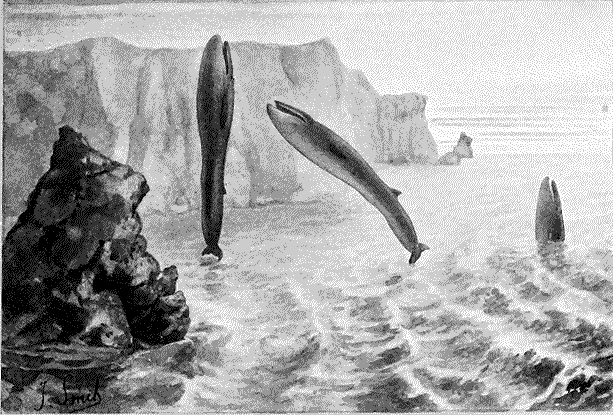
FROM THE ROCKS OF RAASEY ISLE
Puffins are beginning now to fly hither and thither over the sea, and terns are fishing about a low-lying eastern isle. They are the common kind, but some clouds above the island are becoming flame-touched, making them roseate terns. An Arctic skua goes by too, and a black guillemot flies with a fish to feed its young. Still from the recesses of the cavern come those deep, hoarse, bellowing sounds, but they must be uttered by shags upon their nests, and that do not mean to come forth. What there was to see I have seen—those bat-like shadows. There can be no more to speak of—it is too late—but, were there hundreds, I can no longer resist the impulse to walk and walk in the clear and cool-aired morning. The shags that roost in these caverns cannot, I think, be numerous, and they leave them, it would seem, whilst night still broods upon the sea.
True, there was the morning, clear and lovely, in the east, but, to see that, they would have had to peep round the point. Both in numbers, therefore, and impressiveness the Ausflug has been a failure, but the morning, with the almost midnight sun, a splendid success.
This was my last day on the island. In the afternoon my friends sailed over from Yell, bringing me my letters. One was from my sentry-box man, telling me the birds were still on the ledges, but advising me to come at once, if I wished to find them there—otherwise they might be flown. I therefore went back the same evening, and next day, which was Sunday, took steamer to Uyea Sound, from whence I walked through a barren desolation to Balta Sound, getting in, about 10 p.m., to tea and cakes at one of the most homelike, friendly-breathing hostels possible to find either in the Shetlands or the rest of the United Kingdom—or, indeed, the world, to judge by probabilities—to wit, Mrs. Hunter's establishment, where many a one has had cause to say, like myself:
"Sleep (or rather rest) after toil, port after stormie seas, * * * * * does greatly please."
Next day I made what purchases I wanted, not forgetting a good serviceable porridge-spoon—I had used a stick before—and, on Tuesday, drove over to Burra Firth, where I was met by the watcher, and between us we carried my belongings up the great hill—or ness, to give it its Shetland name—to the little black sentry-box that I knew so well. The "pockmantle" fell to my share, and was the lesser burden. It was very heavy, however, and I had almost as lief be taken to a tea-party as have such another trudge. But how the skuas greeted me, again, with their wild cries, as we climbed the higher slopes where their nurseries are. Having set everything where it would best go, in the little cabin, I walked out and made my way to the cliffs.
CHAPTER XIII
MOTHER AND CHILD
T
THE young fulmar petrels here are still all in a state of fluff—not one true feather to be seen—just as I left them in the middle of July, on my last visit, though now it is the end of it. They are larger, however, which, with their softness, whiteness, and general appearance, as of a great powder-puff, makes them more marvellous-looking than ever. Their shape, as they lie on the rock, is that of a round flat disc—a muffin somewhat inflated, or an air-ball compressed. Only when they flutter their wings, or waggle out their legs, have they any more intricate shape than this, except that the funny little head, with the black eyes and black hooked beak, projects permanently out of their roundness. The latter is frequently held open, with the mandibles widely distended—sometimes fixed so, at others gently moving. The neck, on these occasions, is often stretched out and swayed from side to side, so that we have here, in embryo, those curious movements which, in the grown birds, are nuptial ones, and accompany the note then uttered. Although the chick, as would be naturally expected, often opens its bill in order to persuade the parent bird to feed it, yet after some hours' watching I came to the conclusion that the action was too frequent and too habitual to be altogether explained in this way, and I look upon it as an inherited tendency. But may not the habit have originated in the hunger of the chick, and have been worked in, sexually, at a later age, when the reproductive system had become active? Strong emotion, one may suppose, would require an outward manifestation in the shape of movements of some sort, and it would be such as were already known, that, by first coming to hand, would be likely to be first employed. If we had been accustomed to do one kind of work for which we had a suitable implement, and it became suddenly necessary to do some other for which we had none, it would be natural for us to catch up the one we had and make a shift with that. If a swim-bladder can be worked in as a lung, or a pair of legs as part of a mouth, then why not a hunger-signal as a love-signal? Be this as it may, it is certainly strange to see little fluffy chicks on the nest going through the same sort of pantomime as their parents do when in love. But why do I call them little? I have never seen such big baby things, and their size makes them look all the weirder. So great, indeed, is the chick's fluffiness that though the wings are tiny and the tail invisible, it looks almost, if not quite, as big as the graceful and delicately shaped parent bird sitting beside it.
The lethargy of these young fulmars is very noticeable. They do occasionally rise a little on their feet and shuffle about in the place where they sit, so that in this way they may, in time, turn quite round. But after watching them now, for some two hours, I should doubt if they ever moved more than an inch or so beyond an imaginary line drawn close round them, as they lie. Here natural selection seems a demonstrable thing, for often, were the chick to move so much as six inches forward, or a few feet in any other direction, it must fall and be dashed to pieces. What but this force—or, rather, process—can have produced such a want of all inclination to move? It is the same, I suppose, with birds that nest in trees or bushes. With the nightjar, however, though the chicks become, after a while, somewhat active, so that the nest, or rather nursery, is shifted from day to day, yet for some time they lie very quiet, though well able to run about. Here the above explanation does not apply, so that one can never be sure. "Theories," says Voltaire "are like mice. They run through nineteen holes, but are stopped by the twentieth." Still, it would generally be an advantage for young birds to keep still when left by themselves, even in a field or wood, and how much more so where a step or two, or one little run, would be death. Looking at these fat, fluffy, odd-looking creatures as they sit motionless from hour to hour, and then at the grown bird sailing on spread wings, all grace and beauty,—a being that seems born of the air—the change from one to the other—from the fixed to the free phase of life—seems hardly less or more remarkable than that by which a chrysalis becomes a butterfly. Not the egg itself differs more from this last stage of its inmate—this free flitting, gliding thing—than does the round, squat, stolid chick, which in appearance is nearer to an egg than to a full-blossomed bird.
The mother fulmar—for I suppose it is the mother—cossets the chick as she sits beside it, leaning tenderly over it, and nibbling with her bill amidst its long, soft, white fluff, the chick sitting still, the while, with its beak held open, but not at all as though it were thinking of food. Sometimes, by inadvertence, the mother pricks the chick a little, with her bill, upon which it turns indignantly towards her, with distended jaws. She, to cover her maladresse, does the same, but in a dignified, parental manner, as though it were she who had cause to be angry. But it is easy to see that she is really a little ashamed of herself, and purposes to be more careful another time. Mother and chick often sleep side by side on the rock, and then it is noticeable that whilst the mother has her head turned and partially hidden amongst the feathers of the back—"under her wing," as one says—the chick's is often held straight in the usual manner. Not always, however: at other times, it is disposed of in the same way. As far as I can see, the chick is in the charge of one parent only. On several occasions a bird, which I suppose to be the other one, has flown in, and settled on the rock near, but always, on its coming nearer than some three feet or so, the one in charge, distending its jaws, and with threatening gestures, has uttered an angry "ak, ak, ak, ak!" and, on two occasions, has squirted something—I presume, oil—at the intruder, causing it to go farther off. This cry is sometimes preceded by a more curious and less articulate one of "rherrrrrr!"—at a venture: I would not answer for the spelling being exact.
I believe it is the mother who takes charge of the chick, and becomes so intensely jealous of it that she will not suffer even her cáro spóso, to whom she was so much attached, to come within a certain distance of it. One cannot, indeed, say for certain that it is the husband who thus sometimes flies up, and seems to show a wish to approach his wife or child, but it is not likely that a strange bird would act in this way—for all are mated—and if both parents fed the young one, why should either repulse the other? I feel sure, therefore, that only one does, and this one is much more likely to be the female.
The chick, in order to be fed, places its bill within that of the parent bird, and evidently gets something which she brings up into it. This appears to be liquid and, I suppose, is oil. Had it been solid, I must, I think, at this close distance, have seen it—or at least have seen that it was. Where, however, this supply of oil comes from, or how it is procured, I have no very clear idea. Though the actions of the old bird in thus feeding the chick are something like those of a pigeon, yet they are much easier and, so to speak, softer. The liquid food is brought up without difficulty or straining, as one might, indeed, expect would be the case, seeing the ease with which the bird can at any moment squirt it out, when angry, and the distance to which it is shot. Nor is this the only power of the kind which these petrels possess, for they are able to eject their excrement to a quite astonishing distance—greater even, perhaps, than that to which the cormorant or shag attains in this art—at least it seems so at the time. This power is fully developed in the chick—by whom, indeed, it is the more needed—and I notice that the rock where each one lies is clean enough, though all round about it is whitened.
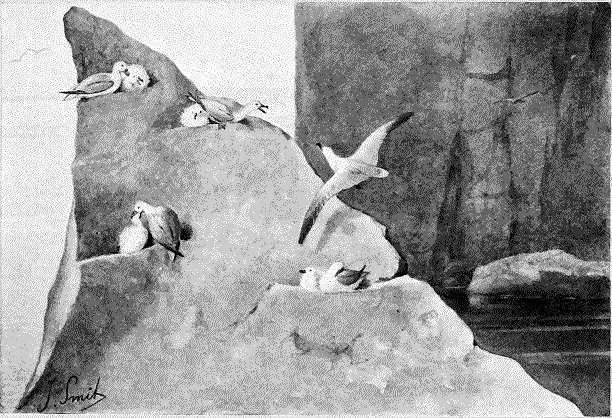
ON THE EDGE OF THE PRECIPICE
When the mother petrel leaves the chick, she, for the most part, continually circles round in the neighbourhood, and almost at every circle looks in at it, sometimes waking it up as it lies asleep, causing it to give an impatient little snap of the bill towards her. It is as though she could not sufficiently love, cherish, and look at it. It is her only child, and a spoilt one.
I must not forget to note down—now that it is full before me—that the inside of the chick's bill, with the mouth generally, is somewhat more lightly coloured than in the old bird; it is more pink—which may represent the natural colour—and less mauvy. This difference, as in the other cases, is what we might expect to see, were the colour a sexual adornment; but why, if it is not so, should there be any difference depending on age in such a region?
The great skua still reigns here in its accustomed territory, which, whilst encircled on all sides by that of the lesser one, is not intermingled with it, even on the frontiers. Many of the young birds are still about, but being now feathered and active in proportion to their size, they are more difficult to find than when I was here before. Though the old birds still swoop at one, they are not so savage as they were when the chicks were young and fluffy; they do not actually strike, but swerve off, particularly if one glances up at them as they approach. The Arctic skua, on the other hand, is still as bold as ever, and will strike one as repeatedly and come as near to knocking one's hat off without doing it (not near at all, that is to say) as ever it did before; or the great one either, I might add, as far as my own personal experience is concerned. I would not, however, be unduly sceptical, and this I can say, that I could easily set my hat on my head so that either bird—or any bird—might knock it off again.
CHAPTER XIV
"DREAM CHILDREN"
V
VISITING these islands in the late summer impresses me with a fact that it is easy to forget, viz. that even the most oceanic of sea-birds—the wandering albatross or stormy petrel, for instance—pass almost as much of their life upon the land as the water. The breeding season is no slight matter, lasting but a short time. It goes on for months and months, and sometimes, from its earliest beginnings, must represent a period not very far short of half the year. On the ——shire coast, for instance, the terns appeared in the earlier part of April, and I was told by the fishermen that they stayed sometimes till well into September. How the gulls at the end of July stand congregated on their nesting-grounds, as if the business of matrimony were rather beginning than ending, I have already mentioned, and it is the same thing here in August with the guillemots. Everywhere the ledges are crowded with them, as they were when I last came in June—indeed, if there is any difference, the numbers seem even greater. But though there is the same general appearance, the glasses soon reveal the fact that, with very few exceptions, all the young birds are departed. Such as remain are no larger than the chicks I saw in the spring, and as most of the parents were then still incubating, besides that the young guillemot is known to leave the ledge whilst quite small, there is no room for doubt on this point.
No; the young are gone. Why, then, do the parents stay? They will rear no second brood, so that it seems as though they love the ledges better than the little fluffy things that they were feeding upon them, up to the moment of their departure. Affection apparently must be bounded by the sea, for whilst the parents, if we suppose them to have accompanied the chicks down, and swum about with them for a little, must have soon flown back, the chicks, owing to the undeveloped state of their wings, would have been unable to make the return journey. It would seem, therefore, that the first night after the down-flight must have separated mother and child for ever; but if this is the case we may well wonder how the rising generation of guillemots are able to support themselves. Up to now they have been fed upon the ledges, but henceforth they must dive and catch fish for themselves. That they should at once and of their own initiative acquire the skill to do this, or learn the art in so very short a time, from the parent birds, hardly seems possible. We must perforce suppose—or at least I must—that either the mother, as is most probable, or both the parents, remain with the chick for a little, feeding it now on the sea as they did before on the ledge, until in time—and no doubt very quickly—it learns to feed itself. But how strange, if this is so, that the grown birds return to the ledges and stay there day after day—I know not for how long—without laying a second egg. If they do not do so, then none of these birds can have bred. But the ledges are alive with them, and they are of both sexes. How long does the mother bird remain with her chick upon the sea, and does she, during such period, remain with it there at night, thus abandoning the ledges for a time altogether, though she afterwards returns to them, or does she fly up each night to the ledges, whilst the chick roosts upon some rock at the cliff's base, to be rejoined by its mother next morning? I cannot answer these questions in a satisfactory manner. It seems as though time must be wanting for such a little family exodus as I am here suggesting, for on the 16th of July, upon the occasion of my first visit, I left these same ledges crowded with guillemots, all, or almost all, of whom were still feeding their young, and now, on the last day of the same month, I find all the old birds still upon them, but nearly all the young are gone. This gives about a fortnight for the birds I left to have gone off to sea with the young ones, and returned to the ledges alone, supposing the exodus to have commenced almost on the day I went away. But did it? As the few chicks that are still here are just about as big as the others were at the time I left them last year, I shall be better able to judge of this when I see how long they stay.
Meanwhile, there is something to interest me under my eyes—a curious matter as it seems to me, which requires some sort of explanation. As I have said, but very few of these guillemots have still a chick to look after, but those that have not, often seem to be under the hallucination that they are blessed in this way. But a little while ago, for instance, a bird—one of such a childless pair—flew in with a fish, and running with it to its partner, both of them stood together drooping their wings, and, at the same time, projecting them forwards, so as to make that little tent, within which the young one is so characteristically fed. Always either one or both of them had the wings thus drooped, as though to shield and protect something, though "nothing was but what was not." Standing in this way, they passed the fish several times to and from each other, and, alternately bending their heads down till its tail hung a little above the ground, appeared to wait for an imaginary chick to take it from them. Now had the fish, which was a sand-eel, been held by the head in the tip of the bill, very little stooping would have been necessary for this purpose, and therefore I might the more easily have imagined what I here describe. But instead of this it lay longitudinally within the beak, so that only about an inch of the tail projected beyond it, as is very commonly the case. Therefore, when the birds bent down as a preliminary to moving the fish forward along the bill—which, however, they can do as well in one position as another—it was in a quite unmistakable manner that they did so, and, looking almost directly down upon them from the edge of the cliff, at a height of not more than twenty feet or so, I was enabled to see the whole process. Judging by their actions, any one would have said that these birds had a chick, and were feeding it; and calling up the many such scenes that I was witness of when last here, I can think of no point in which they differed from this present one, except in the presence of the chick. This curious make-believe, or whatever it may be called, lasted for some little time, but at last, I think, one of the birds ate the fish. Between them, at any rate, it swam out of the ken of my glasses.
And now, what is the meaning of all this? Many birds, of course, are in the habit of feeding one another—conjugally or loverly—or the male is in the habit of feeding the female, and this seems the most obvious and natural explanation here. I do not, however, think that this is a special trait of the guillemot, and inasmuch as there are but few young birds now, it is quite a rare thing to see a bird flying in with a fish in its bill. I believe, myself, that when a childless one does so, it is with the idea of feeding the chick—the last one, the one that it remembers and pictures as still on the ledge—in its mind; and it is the more easy for me to think this, because I feel sure that this habit of conjugal feeding has grown out of the feeding of the young, and I can even imagine that, by one of those mental transitions which with animals (as with savages) are so quick and so easy, the bird offering the food, does, occasionally and for a moment, put its partner in place of the young one.
We must not think only of the forgetfulness of animals—of their inability to retain past actions or events clearly in the mind, so as to remember them, long afterwards, in the way that we do. We should bear in mind, also, that they are influenced, like ourselves, by association of ideas, and that savages, whose psychology should stand nearer to theirs than our own, often confound the subjective with the objective—the idea of a thing in their mind, that is to say, with the thing itself, outside it. It would be quite natural, in my idea, that any of these guillemots should, by the mere catching of a fish, be reminded of the occupation it had for so long previously been engaged in, and the mental picture, thus raised, of the chick on the ledge, might well be so vivid as to overcome the mere negative general impression that it was no longer there. Under the influence of this delusion—let us say, then—the bird flies in with its fish, and, seeing it do so, its partner, by a similar association of ideas, is affected in just the same way, seeing also in its mind's eye—less blurred, perhaps, by innumerable figures than our own—a lively image of its child. What follows we have seen—a little play or pretence, as it looked like, on the part of the two birds, who thus, as it were, reminded one another of what both so well remembered. Of such conscious reminiscence, however, I do not suppose them to have been capable, but they may both, I think, have acted in something the same way that a bereaved mother may be supposed to, when she almost unconsciously lays out clothes or goes through some other once habitual process, in behalf of a dead child—forgetful, for a moment, or half-forgetful, of the change. All would have been brought about through association of ideas, one appropriate act suggesting and leading to others no longer so, but of whose propriety or otherwise the bird—or any animal—has probably but one means of judging—the presence or absence, namely, of the idea of them in its mind.
Now when, as Miss Kingsley tells us, a negro, chatting in his hut, turns with a smile or a remark, to his mother—deceased, but whom he supposes to be sitting in the accustomed place there—may not this also be through association of ideas, producing a strong visual image of what he has so long been used to see? There is hardly anything that so readily summons up the image, with the remembrance, of the dead, as the place where they lived or the objects amongst which they moved. How much, for instance, does the familiar chair suggest the presence of some one who used habitually to sit in it. "I know," says Darwin—referring to a visit to his old home after his father's death, which had occurred during his absence on the famous voyage—"I know if I could have been left alone in that greenhouse for five minutes, I should have been able to see my father in his wheel-chair as vividly as if he had been there before me."[4] If such an effect, so produced, may be strong—and it varies greatly—in the civilised man, it is likely to be much stronger in the savage, who does not distinguish so clearly between the world without him and what is in his own mind. To him, therefore, the visual image of a deceased person, that is summoned up by the sight of anything that more particularly appertained to him, during life, might well seem to be that person himself, and thus, as it appears to me, a belief might arise of the continual presence amongst us of the departed, even without anything else to help it. That there is much else—real, as well as seeming evidence—I know, or at any rate I am of that opinion. I do not write as a disbeliever in real apparitions, in clairvoyance, premonitions, thought-transference, or a host of other things, for I am one of those who really go by evidence in such matters—very few do—and to me no one thing in "this great world of shows" is in itself more wonderful or incredible than another—which is my own idea of what the scientific attitude of mind should be. But because there may be much that goes to prove what Myers calls the survival of human (which, to me, involves animal) personality after physical death, it does not, therefore, follow that the belief in man's immortality has originated through this, and still less that it could not have arisen without it. Association of ideas, producing a strong mental image, with the confusion between thought and objective reality, would, I believe, have been sufficient; for it must be remembered that man's ancestry leads up, through the semi-human, to the primeval savage, and it is amongst the lowest tribes of existing savages that the tendency last indicated is most noticeable. In regard to this, one should read Tylor, as likewise Clodd, concerning the probable effect that dreams have had in producing the idea of a soul. From the dream figure to that of our waking mind's eye there is but a step; and as animals dream, we may suppose that they likewise see mentally.
This seems clear, that wherever the visualising faculty—to give it a name—produced the image of anything, it would be mistaken for that thing if reason did not convince to the contrary. In animals, reason is weaker than with us, but that the power of mental vision, within the narrower range of their experience, is weaker also, I can see no reason to conclude. Rather, I think, it is likely to be the other way, and this should make it an easier matter for a guillemot than for a negro to see, or seem to see, an absent relative. But possibly this vivid conjuring up of the mere outward form of anything may not be required in order to induce the belief of its being there. The negro, perhaps, rather feels the presence of his mother than thinks that he actually sees her; and might not this effect, also, be produced through a strong association of ideas? If so, this is all that would have been necessary to give man that belief in his immortal destinies which, upon the whole, we find him with.
CHAPTER XV
NEW DEVELOPMENTS
I
IT is curious to see the guillemot-ledges so thronged now, when everything speaks of the departure of summer, if that, indeed, can be said to depart which has never, apparently, arrived. As I said before, there are very few young birds to be seen, and since the sexes in the guillemot are alike, one might think, at first, that the mothers had all gone off with their chicks, leaving only the males on the ledges. This, however, cannot be the case, since there is much cossetting, and sometimes a touch of "the wren," and "small gilded fly," of King Lear—I trust I express myself clearly.
I was beginning to think that there were no young guillemots at all here now, but just at this moment a bird flies in with a fish in its bill, and, running up to another one, with it, the chick immediately appears from under a projecting cranny of the ledge, where it has been concealed, and receives and eats the fish. It is the usual thing—the wings of the two parents drooped, like a tent, in which the little thing stands, and both of them equally interested. This chick seems of considerable size—as guillemot chicks go—is properly feathered, and the plumage has the colouring of the grown birds, except that the throat and chin are white as well as the breast—a continuity of white, therefore, over the whole under surface. Moreover, from each eye to the base of the bill, on the corresponding side, there is a thick black line. The wings, which I have seen it flap, are small, with the quills not sufficiently developed for flight—at least, I should think not. Some time after this I saw a smaller chick which had been hidden hitherto behind the two parents. The non-locomotion of both was as marked a feature as ever—for this struck me very much the last time I was here. The smaller one I could never make out again. The other was for a long time invisible behind its slight escarpment, and then, though it came out and was active where it stood, it did not move more than an inch or so beyond it, or in any direction.
As this chick evidently could not fly, it, as evidently, could not have left the ledge, and returned to it. Imagine, therefore, that the chicks are conveyed down by the parents, in this state, as it is asserted that they are, and the emptiness of the ledges, of young birds, is explained; for by the time they could fly they would have forgotten all about them, even if they were not far away, as they probably by that time would be. But if they wait till they can fly before leaving the ledges, why do they not fly back to them, and then backwards and forwards, like the young kittiwakes, or the young shags? Why do they not accompany their parents when they return, since their parents will not stay with them upon the sea? All this is explained upon the supposition that the parent guillemot flies down with the chick on its back, but it does not follow that there is no other way of explaining it. I think there is another; for though the chick, when it leaves the ledge, may not be able to fly in any true sense of the word, yet it might make a shift to flutter down to the sea, in a line sufficiently diagonal to avoid the danger of striking upon the face of the cliff where it projected at a lower elevation, or upon the rocks at its base. This may not be likely, but at least it is possible, and, on the other hand, if the parent guillemots do really carry their chicks down, why do they not do so shortly after they are hatched, or, at least, much sooner than they do? Why should they feed them on the ledges for a fortnight or three weeks, for I think they are as long as that there, during all which time they are getting larger and heavier? Though the young guillemot keeps so quiet on the ledge, yet it has the full use of its limbs, and seems quite as forward and capable as are young chickens and ducklings. It would, no doubt, be at home in the water at once, if only it were put there. Does it, then, wait until it can get there itself, or does the parent bird take it? This question I hope to be able to answer before I leave here.
A bird that has no chick now brings in a fish to the ledge, and seems not to know what to do with it. At last he puts it down, and another bird—not, I think, the partner, but it may be—takes it. It seems as though the instinct of feeding the young still continued with this bird, though its young one is gone. We may think "out of sight, out of mind" with animals, but what is probably wanted to make them remember is a reminder of some sort; and when they are reminded, though their memory may be less capacious than ours, it does not follow that it is likewise less vivid within their own limited range. Indeed, I think there is some reason to conclude the contrary. The imagination of a great writer is such that he sees the scenes and persons that exist but in his own mind, as clearly, possibly, as we do our own familiar friends and their, or our, all as familiar surroundings. We must suppose so, at any rate, as we read Scott or Shakespeare; and indeed their productions are such that it cannot be far short of this. I question if any man ever saw his absent friend more clearly than did Shakespeare his Falstaff, for instance, or Scott his Balfour of Burleigh. But does it, therefore, follow that either of these great writers would, when hungry, have summoned up before him a clearer picture of his approaching dinner, than does the equally hungry or very much hungrier boor? This I doubt; and on the same principle I doubt if the said boor would see his dinner more clearly than a wolf, bear, or tiger would theirs when in quest of it.
The memory of an animal, as compared with that of a man, may be not so much weaker as less multitudinous. As a rule we remember those things best in which we take the greatest interest. This gives to man a much wider range of memory than any animal can possess, with a proportionately increased area for association to work over. But there are certain primitive interests, as we may call them, connected with food, and the family and sexual relations, which are very strong in animals, and in regard to which the memory, when put in action, may be equally strong. Who shall say that a man, returning to his home at the end of the day, sees in his mind's eye a clearer picture of what awaits him there than does the bird flying to its nest, or the bee to its hive? Now could anything, by association, call up this picture, suddenly, in the bird's or insect's mind, they would, no doubt, act for the moment as though it were real—as did Darwin's dog when he called him after five years' absence; and thus I can understand one of these guillemots flying with a fish to its ledge, to feed its chick, although its chick were no longer there. It might be so; I can see no reason against it. In the actions of these two birds there may lie—for me, now, there does lie—a great psychological interest. Suggestive they certainly are. I shall keep this in my mind and watch the ledges more closely.
The larger of the two young guillemots is now frequently flapping its wings, and latterly it has been jumping up, at the same time, though always it keeps in one place by its mother, and does not run about. Mother and chick often delectate themselves by nibbling the tip of each other's bills. And now there comes a surprise. For the first time that I have ever seen, the chick moves right away from where it was, leaving its father and mother. It travels along the ledge, often uncomfortably near to the edge of it, and at last gets round a corner, out of my sight. The parents, as far as I can make out, have not followed it. This is quite a new development in my experience of the chick, if not in the chick's own experience. It is not, then, quite immovable, till it flies or is carried down. Were it to fall now, how aptly would it illustrate that law of natural selection which I have called in to account for its general quiescence. I hope it won't though—which is to my credit surely.
I note one more thing before leaving. A bird picks up and, as it were, plays with some feathers lying on the ledge, one of which it now brings to its partner, lays it on the rock, and then both pull it about. This, too, I noticed when I was last here. I have mentioned it in my Bird Watching, and account for it by supposing that we here see a last trace of the once active nest-building instinct. Perhaps, however, the act is too trivial to need any special accounting for.
CHAPTER XVI
FLIGHT AND FANCY
W
WOULD God my home were here, that I might make a lifelong and continuous study of the wild sea-bird life about me! What more should I want, then? except, indeed, a better climate, which is not a matter of culture. Of all that civilisation has to give I value nothing much (that I can get) except books, and those I might have here, at least in a moderate profusion, "the hundred (or so) best" ones—of my own choice bien entendu; the devil take any other man's. "Oh, hell! to choose love by another's eyes." But all my own writers—with never an impudent, pert critic amongst them to échauffer ma bile—awaiting me at home, with these birds—these dear birds—to look down upon outside, and I think I might be happy, as things go. But with such a strange blending of tastes and desires as nature has put upon me, how can I ever hope to be, to any satisfactory extent? What I want, really, is the veldt, or Brazilian forests, or Lapland, or the Spanish Marisma, with the British Museum library round the corner; but, as Cleopatra says of two other things, "they do not go together."
"Well, here's my comfort" for a time—my half-measure of content. Oh, is there anything in life more piquant (if you care about it) than to lie on the summit of a beetling cliff, and watch the breeding sea-fowl on the ledges below? In the Shetlands, at least, it is possible to do this in perfect safety, for the strata of the rock have often been tilted up to such an extent that, whilst the precipice formed by their broken edges is of the most fearful description, their slope, even on the landward side, is so steep that when one has climbed it, and flung oneself full length at the top, one's head looks down—as mine does now—as from a slanting wall, against which one's body leans. To fall over, one would first have to fall upwards, and the knowledge of this gives a feeling of security, without which one could hardly observe or take notes. The one danger lies in becoming abstracted and forgetting where one is. Those steep, green banks—for the rock, except in smooth, unclimbable patches, is covered with lush grass—have no appearance of an edge, and I have often shuddered, whilst plodding mechanically upwards, to find myself but just awakened from a reverie, within a yard or so of their soft-curled, lap-like crests. But I think my "subliminal," in such cases, was always pretty well on the watch, or—to adopt a more prosaic and now quite obsolete explanation—the reverie was not a very deep one.
At any rate, here I am safe, and, looking down again from my old "coign of vantage" of two years before, the same wonderful and never forgotten—never-to-be-forgotten—sight presents itself. Here are the guillemots, the same individual birds, standing—each in the old place, perhaps, if the truth were known—in long, gleaming rows and little salient clusters, equally conspicuous by their compact shape and vividly contrasted colouring; whilst both above and below them, on nests which look like some natural, tufted growth of the sheer, jagged rock, and which touch, or almost touch, one another, sit hundreds and hundreds of kittiwakes, the soft bluey-grey and downier white of whose plumage, with their more yielding and accommodating outlines, make them as a tone and tinting of the rock itself, and delight with grace, as the others do with boldness. Seen from a distance all except the white is lost, and then they have the effect of snow, covering large surfaces of the hard, perpendicular rock. Nearer, they look like little nodules or bosses of snow projecting from a flatter and less pure expanse of it. An innumerable cry goes up, a vociferous, shrieking chorus, the sharp and ear-piercing treble to the deep, sombrous bass of the waves. The actual note is supposed to be imitated in the name of the bird, but to my own ear it much more resembles—to a degree, indeed, approaching exactitude—the words "It's getting late!" uttered with a great emphasis on the "late," and repeated over and over again in a shrill, harsh, and discordant shriek. The effect—though this is far from being really the case—is as though the whole of the birds were shrieking out this remark at the same time. There is a constant clang and scream, an eternal harsh music—harmony in discord—through and above which, dominating it as an organ does lesser instruments—or like "that deep and dreadful organ-pipe, the thunder"—there rolls, at intervals, one of the most extraordinary voices, surely, that ever issued from the throat of a bird: a rolling, rumbling volume of sound, so rough and deep, yet so full, grand, and sonorous, that it seems as though the very cliffs were speaking—ending sometimes in something like a gruff laugh, or, as some will have it, a bark.
This marvellous note is the nuptial one of the guillemot, or, rather, it is that, swelled and multiplied by the echoes to which it gives rise, and which roll and mutter along the face of the precipice, and mingle with the dash of the waves. The effect is most striking when heard at a little distance, and especially across the chasm that divides one precipice from another. Under these circumstances it is less the actual cry itself than what, by such help, it becomes, that impresses one. Uttered quite near, by some bird that stands conspicuous on the ledge one looks down upon, the sound is less impressive, though still extraordinary enough. It can then be better understood, and resolves itself into a sort of jodel, long continued and having a vibratory roll in it. It begins usually with one or two shorter notes, which have much the syllabic value of "hărāh, hărāh"—first ă as in "hat," with the accent on the last syllable, as in "hurrah." Very commonly the outcry ends here, but otherwise the final "rah" is prolonged into the sound I speak of, which continues rising and falling—which is why I call it a jodel—for a longer or shorter time, the volume of sound being increased, sometimes, to a wonderful extent. It ends, usually, as it began, with a few short, rough notes which may be called a bark, as the other is called a bray, though to neither is there much resemblance if we make either a dog or a donkey the basis of comparison. Altogether it is one of the strangest, weirdest sounds that can be imagined, and nobody, not accustomed to such surprises, would suppose it could issue from the lungs of so small an animal as a guillemot.
I made a strange error in regard to the utterer of this note when I first came to the Shetlands, and the history of it will show either what a fool I was (and am, in that case), or else how possible it is for such mistakes to arise, even with great care and close and continued observation—I should prefer it to show the latter. I thought it was impossible that I could have been mistaken, but now that I know I was I can see how it happened perfectly. At that time I knew nothing about the matter, for though I love natural history I hate the "British Bird" books, nor am I often in the way of being told anything, since, to be frank, I am as much a hermit as I am mercifully permitted to be: therefore, when I first heard the "bray" of the guillemot, as it is called, I was lost in wonder, and as it came but rarely, and never from any of the birds upon the one particular ledge that I watched day after day—often for many hours at a time—I never suspected its true origin. These particular birds never uttered any sound more extraordinary than a kind of "ik, ik, ik!" and this though they were constantly fighting, whilst the performance of the nuptial rite was frequent amongst them. The note which so astonished me never came from very near; I heard it, as I have said before, only occasionally, and it always seemed to come from a part of the rock where a few pairs of fulmar petrels were sitting. When I mentioned it to the watcher, who occupied the little sentry-box on the ness, during the daytime, when I was out, leaving it for me to sleep in at night, he said nothing about guillemots, but expressed his opinion that the sound was produced by these fulmar petrels. Now the fulmar petrel, though I have never met with any reference to it, does utter, when on the breeding-ledges—or at least, it does in the Shetlands—a note which is sufficiently marked and striking, a sort of angry, hoarse, gruff interjection—guttural too—several times repeated, and sounding sometimes like a laugh. Often too, these notes are not divided, or else are so quickly repeated that they sound like one, continuously uttered for some little space of time. As I now think, I must sometimes have caught this note at the beginning or end of the cry of the guillemot, and put it down as a part of it. Then, when, with this idea in my mind, I watched the petrels at but a few yards' distance, and heard them uttering the note they do utter, to my heart's content—swelling out the throat and rolling the head at one another, the while, in the way I have described—I was so foolish as to think that this was the cry that I thought so wonderful, but not at its best, and that the real one, when I heard it again in the distance—for, as I say, it never sounded very near—was the same one at its best. With this false idea in my head I went home, and when somebody, assuming the character of a "Fulmar Petrel" himself—assured me that I had mistaken the guillemot's note for his own, I was as convinced that he did not know what he was talking about, and that I did, as I am now to the contrary.
On one point, however, I am clear, and cannot possibly be mistaken, since I have verified it only in these last few days, having come, in fact, partly to do so—at least that made another motive for my journey. The fulmar petrel, if it does not bray like a guillemot, has at least a nuptial note—and that a sufficiently striking one—of its own, which is uttered by both sexes as they lie on the rock, but never, in my experience, whilst flying. Moreover, just as the vocal powers of the guillemot are now marvellously increased—or rather multiplied—compared with what they were some weeks earlier in the year, on my last visit, so, if I may trust my own memory—which, however, I never do trust—those of the fulmar petrel have suffered a corresponding diminution. I attribute both these facts to one and the same cause. At the earlier date the guillemots were in the very midst of their domestic duties, so that those feelings proper to the courting period were in abeyance. Now, however, they are free, and, under the influence of returning emotion, have become noisy again, as no doubt, at the very beginning, they were noisier still. Though their physical energy may not be sufficient to enable them to rear another brood, that, I am sure—and there is plenty of evidence of it—is what they feel like—there is dalliance and a "smart set" morality. But with the petrels, at the same time, things had not gone so far—some, if I remember rightly, had not even yet laid their egg—and so their nuptial vociferations were more energetic than they are now—or, at any rate, I think they were. Here, then, was a mistake, and I have shown clearly how it came about. Some perhaps—especially those who get all their information from books, and feel as if they had found it out for themselves—may admit no excuse for it, my explanation notwithstanding; but, for my part, I think it is easy to make mistakes. Had but one of the guillemots on my own ledge been so good as to bray for me, all would have been well, but never a word did any of them say except "ik, ik, ik!"
There was another point on which "Fulmar Petrel" took exception to what I said about him—or rather to what I seemed to say. In view of his oil-squirting and other unangelic propensities, he thought the descriptive phrase "half angel and half bird," which formed the title of my article, was not quite suitable to him. Well, I may tell him now that I never thought so either—titles, as most authors nowadays have good cause to know, are not always one's own. I never compare birds to angels, for fear of thinking slightingly of the latter, and though I admit that, in the hands of a skilled artist, a pelican's wings on a pair of human shoulders may make a pretty enough combination, and that the whole human body need not look so heavy and unmanageable as it, no doubt, would be in reality, still, as far as flight is concerned, I confess I think it takes a bird to beat a bird. Angels are out of it in my opinion, or, if they are not, at least my powers of imagination in regard to them are. I shall always think of "Fulmar Petrel" as flying much better than the best of them, though, as his habit of squirting oil does not in the least degree lessen his aerial grace and beauty, as far as that alone is concerned I see no reason why he should not be half an angel, at any rate, if not a whole one.
Yes, here are powers indeed! What buoyant ease! What marvellous, least-action grace! Surely no bird has ever flown before. This—this only—is flight; for a moment, at any rate, one forgets even the nightjar. And yet all these storm-riding, blast-defying powers belong to one of the most placid-looking, delicately dove-like beautiful beings of all air's kingdom. How soft is its colouring! How gentle its look! Was there ever a more "delicate Ariel" than this?
One cannot, indeed, watch for long the flight of the fulmar petrel without becoming dissatisfied, or at least critical, in regard to that of other sea-birds. The larger gulls grow hopelessly coarse and heavy; the kittiwake is not what it was, something is gone from the bold corsair-like sweeps of the Arctic skua, and even in the seeming-laboured grace of the tern the eye begins to dwell more on the labour and less on the grace. All these birds are bodies: the fulmar petrel more suggests a soul. Something of this it owes to its colouring, which, though approaching to blue above, and of the purest-looking white below, yet has in it that exquisitely smoked or shadowed quality which allows of no glint or gleam, avoids all saliency, and almost seems alien from substance itself. It blends with the air, of which it seems to be a condensation rather than something introduced into it. Yet most lies in the flight. In this there is conveyed to one a sense, not so much of power over as of actual partnership in the element in which the bird floats, as though it had been born there, as though it might sleep and awake there, as though it had never been, nor ever could be, anywhere else. It is, I suppose, the small apparent mechanism of the flight that gives this impression, the absence, or the ease, of effort. Sliding, as it were, from the face of the precipice, and often from the most towering heights of it, the thin cleaver-like wings are at once, or after a few quick, flickering vibrations, spread to their full extent, and on them the bird floats, sweeps, circles, now sinking towards the sea, now cresting the summit of the cliff,[5] but keeping, for the most part, within the middle space between the two. Ever and anon it sails smoothly in to its own rocky ledge, pauses above it, as though to think "My home!" then, with another quick shimmer or flicker of the thin shadow-wings, sweeps smoothly out again, to enter once more on those wonderful down-sliding, up-gliding circles that have more of magic in them, and are more drawn to charm, than had ever a necromancer's.
This light flickering of the wings, as I have called it, for they cannot be said to flap or beat—even quiver is too gross a term for so delicate a motion—is a characteristic part of the fulmar petrel's flight. They move for a moment—for a few seconds more or less—in the way in which a shadow flickers on the wall, and then the bird glides and circles, holding them outspread and at rest, opposing their thin, flat surface, now to this point, now to that, by a turn of the head or body, but giving them no independent motion. Then another flicker, and again the gliding and circling. When spread thus, flat to the air, the wings have a very thin, paper-knifey appearance. The simile does not seem worthy either of them or of the bird, but as it is continually brought to my mind, I must employ it, albeit apologetically. It is the shape of them that suggests it. Their ends are smooth and rounded, and they are held so straight that they seem to be in one piece, without a joint; though, just when the wind catches them freshly, and drives the bird swiftly along, they are turned slightly upwards toward the tips, through the momentary yielding of the quills. Strange though it may seem, this straightness—almost stiffness—of the wing-contour adds to—nay, makes—the grace of the fulmar petrel's flight, and the pronounced bend at the joint, which, in the gull and kittiwake, causes the forepart of the wing to slope backwards in a marked degree, looks almost clumsy by comparison. The reason, I think, is that the petrel's straight, thin, flat-pressed wings look so splendidly set to the wind, suggesting a graceful ship—lateen-rigged—in fullest sail, whilst the others seem timidly furled and reefed, by the side of them. Sometimes, indeed, the wings do bend just a little—for, after all, they have a joint—but the straight-set attitude is more germane to them, and soon they assume it again, shooting forward so briskly, yet softly, that one seems to hear a soft little musical click.
And thus this dream and joy of glorious motion, this elemental spirit of a bird, floats and flickers along, cradled in air, looking like a shadow upon it, sweeping and gliding, rising and falling, in circles of consummate ease. No, this is not dominion, but union and sweet accord. There is no in-spite-of, no proud compelling, here. Lighter than the air that it rides on, the bird seems married to it, clasps it as a bride.
CHAPTER XVII
MOUTHS WITH MEANINGS
T
THE young kittiwake differs in appearance from the parent birds in a quite uncommon manner, for, being prettily and saliently marked, it looks like a mature gull of another species, whereas the young of other gulls, being plain brown things, suggest their juvenility on the analogy of pheasants or birds of paradise. The general colour is mauvy grey, but black, falling here and there upon it, seems striving to blot it out. Half of the wings are thus darkened, and a broad half-moon of sooty black nearly encircles the neck, looking like black velvet on the back of it, where it is by much the broadest. There is a clouded black mark, too, on either side of the head, with some nuances of black between, black tips the tail, and the beak is all black. The tout ensemble of all this is very pretty, and the young kittiwake is a pretty bird. Mauve and black velvet is the dress it comes out in, and it looks like a soft little dove. Many might admire it beyond the grown bird, but, personally, I prefer the latter.
One of these well-grown young kittiwakes has just been fed by the mother, or father—but call it the mother, it always sounds better. Being importuned by sundry little peckings at her beak, she opened it, and the young one, thrusting in its own, helped himself as though her throat were a platter. It was much the same as with the fulmar petrels. Numbers of the young have left their nests, and keep all together, standing on the rocks or floating on the sea. Others remain, and I notice that these keep flapping their wings. This must strengthen them, and have the effect of preparing Dædalus for his first flight—for it seems probable that these particular ones have not made it. But they have, though, and bang goes a provisional hypothesis! Every moment, to laugh at me, one or other of them is flying out from the ledges, whilst others are returning to them.
When one of these young kittiwakes opens its bill, it is at once apparent that the inside of its mouth is much less brilliantly coloured than it is in the parent bird, being of a pale pinkish, merely, with, perhaps, a tinge of light yellow. As for the grown bird's mouth, one can hardly exaggerate the lurid brightness of it. The whole buccal cavity, including, as I think is usual, the tongue, is of a fine rich red, or orange-red colour, carrying on that of the naked skin adjoining the mandibles outside, with which, indeed, it is continuous. It is just the same in the case of the old and young shag. The mouth of the former presents a uniform surface of splendid gamboge, whilst that of the latter is almost the natural pink, only just beginning to pass into yellow. In the young guillemot, also, the interior of the mouth is pinkish merely, whilst in the grown bird it is of a pleasing lemon or gamboge. With the fulmar petrel again, we have much the same thing, though here—and this is significant—the difference, as well as the actual colour, is less striking. These varying degrees of brilliancy of colouring in this particular region, as between the mature and immature form, must surely have some meaning, and as it goes hand-in-hand with a similar, if not, as I believe, an identical difference in the hue of the naked facial integument, as well as with the pattern and shade of the plumage, I feel persuaded that all three are governed by the same general law.
As explained by Darwin—and nothing better, that I can see, than opposition has ever been opposed to his views—the beauty of certain birds has been acquired through the principle of sexual selection, and the lesser degree of it, which we notice in the young, represents the earlier and less-finished beauty of the adult in times gone by. Of all the elements which go to make up the beauty thus acquired, colour, on the whole, plays the most conspicuous part, and nothing can be more brilliant and striking than some of the colours that I am here speaking of. The only reason, therefore, why, in their use, and the laws that have governed their acquirement, they should be thought to differ from the hues and tintings of the plumage, or of the naked outer skin—the cere or the labial region—would be their habitual, necessary concealment. If, then, it can be shown that, far from their being always concealed, they are prominently displayed during the breeding season by certain birds which possess them in a marked degree, then, as far as these birds are concerned, there ceases to be a reason for thus, in idea, separating them. Let us see, now, how far this is the case. To begin with these kittiwakes, in their courting, or rather connubial actions on the ledges—as may be seen now, but much more earlier in the year—both sexes open their bills widely, and crane about, with their heads turned toward each other, whilst at the same time uttering their shrieking, clamorous cry. The motion, however, is often continued after the cry has ceased, and this we might expect if the birds took any pleasure in the brilliant gleam of colour which each presents to, and, as it were, flashes about in front of the other. The effect of this it is not easy to exaggerate, and if it is extremely noticeable to an onlooker at some little distance, what must it be to the bird itself, who looks right into the almost scarlet cavity? We have only to think of the inside of some shells, or of a large, highly-coloured flower-cup, to understand the kind of æsthetic pleasure that may be derived from such a sight.