LONG-WINGED SWIMMERS. Order II. LONGIPENNES SKUA AND JAEGERS. Family STERCORARIIDAE (continued 6)
Reading edition
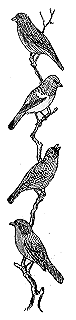
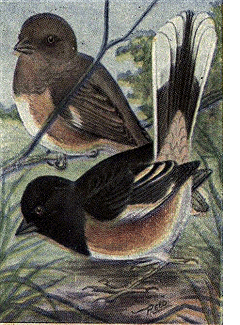
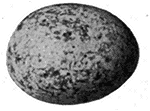
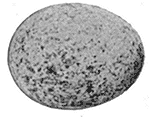
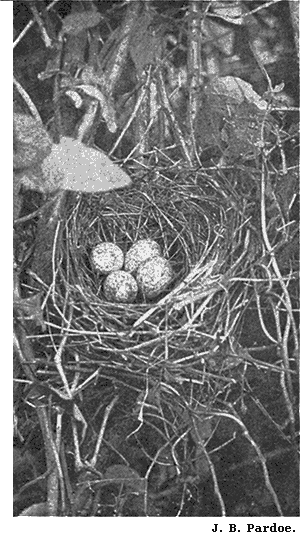
Page 359 NEST AND EGGS OF TOWHEE.
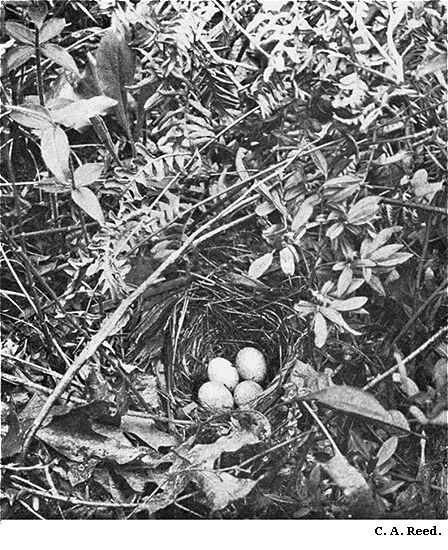
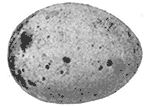
Page 360 588b--591. 588b. Oregon Towhee. Pipilo maculatus oregonus. Range.--Pacific coast from California to British Columbia; winters to Mexico. Similar to the last but with still fewer white markings on the back and the chestnut flanks brighter. The nesting habits and eggs of this variety differ in no essential particular from those of the preceding Towhees. 588c. San Clemente Towhee. Pipilo maculatus clementæ. Range.--San Clemente Is. and other of the Santa Barbara group. Black of male said to be duller. Probably no difference between the eggs and others. 588d. San Diego Towhee. Pipilo maculatus megalonyx. Range.--Coast of southern California and Lower California. Said to be darker than megalonyx. 588e. Large-billed Towhee. Pipilo maculatus magnirostris. Range.--Southern Lower California. Similar to arcticus; bill said to be larger. 589. Guadalupe Towhee. Pipilo consobrinus. Range.--Guadalupe Island, Lower California. Similar to oregonus but smaller and with a relatively shorter tail. The nesting habits and eggs of this species will not likely be found to differ essentially from those of others of the genus. 591. Canon Towhee. Pipilo fuscus mesoleucus. Greenish blue. Range.--Mexico and north to Arizona and New Mexico and casually farther to Colorado. A common species in the valleys and on the side hills, nesting in bushes near the ground, and sometimes on the ground; the nests are made of grasses, weeds and twigs lined with rootlets, and the three or four eggs are greenish blue sparingly spotted or scrawled with blackish brown, the markings being similar to those on many Red-winged Blackbirds' eggs. Size 1.00 × .70. 591a. San Lucas Towhee. Pipilo fuscus albigula. Range.--Southern Lower California. This variety is like the last but is usually paler below. It is abundant in the region about the cape where they nest in thickets, either in the bushes or on the ground. The eggs cannot be distinguished from those of the Canon Towhee. 591b. California Towhee. Pipilo crissalis crissalis. Range.--Pacific coast of California. This variety is similar to the Canon Towhee but is browner, both above and below. They are one of the most common of California birds, frequenting scrubby thickets, both on mountain sides and in valleys and canons, from which their harsh scolding voice always greets intruders.
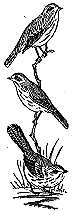
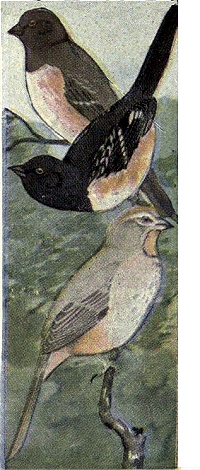
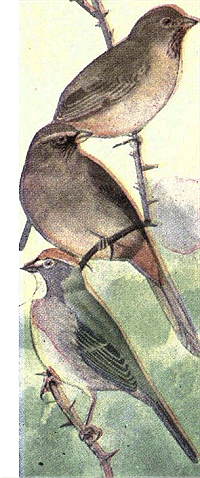
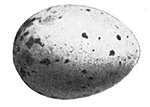
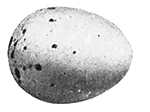
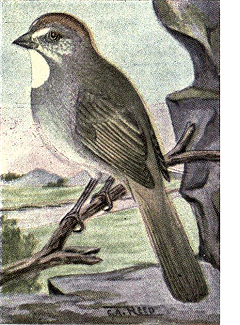
Page 361 591.1--592--592.1. They place their nests in bushes at low elevations from the ground and sometimes on the ground; they are made of twigs, strips of bark, weeds and coarse grasses, lined with fine rootlets. Their three or four eggs are laid in April or May; they are light bluish green marked like the others with purplish or brownish black. Size .95 × .72. 591.1a. Anthony's Towhee. Pipilo crissalis senicula. Range.--Southern California and south through Lower California. Greenish blue. A very similar bird to the last but sightly smaller and lighter below. The habits and nesting habits of these birds are in every way identical with those of the California Towhee and the eggs cannot be distinguished from those of that variety. They are fully as abundant in the southern parts of California as the others are in the northern. 592. Abert's Towhee. Pipilo aberti. Range.--Arizona and New Mexico north to Colorado and Nevada and east to southeastern California. Greenish blue. This bird is wholly brownish gray both above and below shading into reddish brown on the under tail coverts; the face is black. They are abundant in the valleys of Arizona and New Mexico, but unlike the preceding species, they are generally wild and shy. They nest in chaparral thickets along streams, the nests being constructed similarly to those of the California Towhee, and the eggs are not easily distinguishable from those of that species, but they are usually more sparsely specked and the markings more distinct. Size 1.00 × .75. Green-tailed Towhee. 592.1. Green-tailed Towhee. Oreospiza chlorura. Range.--Western United States, chiefly west of the Rockies from Montana and Washington south to Mexico; wintering in southwestern United States. Whitish. This handsome and entirely different plumaged species from any of the preceding would, from appearance, be better placed in the group with the White-throated Sparrow than its present position. It has a reddish brown crown, the remainder of the upper parts, wings and tail being greenish yellow; the throat is white, bordered abruptly with gray on the breast and sides of head. These birds place their nests on the ground. The nests are built similarly to those of the eastern Towhee, and the eggs, too, are similar, being whitish, finely dotted and specked with reddish brown, the markings being most numerous around the larger end. Size .85 × .65.
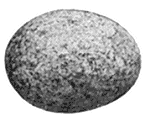
Page 362 CARDINAL.
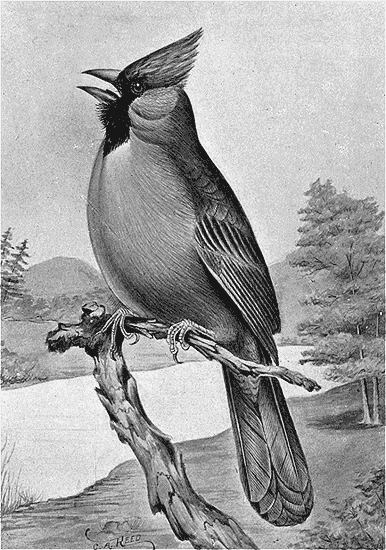
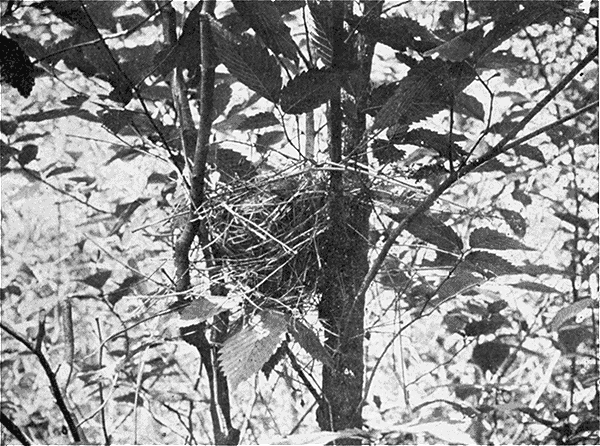
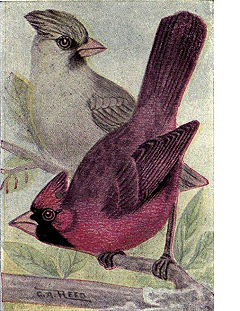
Page 363 593. Cardinal. Cardinalis cardinalis cardinalis. Range.--Eastern United States, north to New York and Illinois, west to the Plains and Texas. Resident in most of its range. Bluish white. These beautiful fiery red and crested songsters are one of the most attractive of our birds, and in their range, nest about habitations as freely as among the thickets and scrubby brush of wood or hillside. Their nests are rarely placed higher than ten feet from the ground in bushes, branches, vines, brush piles or trees; they are loosely made of twigs, coarse grasses and weeds, shreds of bark, leaves, etc., and lined with fine grass or hair. They frequently lay two or three sets of eggs a season, the first being completed usually early in May; three or four, and sometimes five, white or pale bluish white eggs are laid; they are very varied in markings but usually profusely spotted, more heavily at the large end, with reddish brown and lavender. Size 1.00 × .70. 593a. Arizona Cardinal. Cardinalis cardinalis superbus. Range.--Northwestern Mexico and southern Arizona. A larger and more rosy form of the Cardinal. Its eggs cannot be distinguished from those of the eastern Redbird. 593b. San Lucas Cardinal. Cardinalis cardinalis igneus. Range.--Southern Lower California. Like the last but smaller and with less black on the forehead; eggs the same. NEST OF CARDINAL.
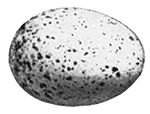
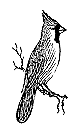
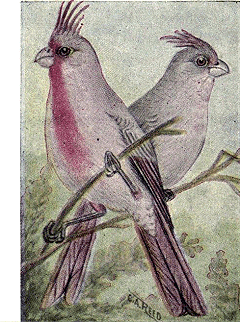
Page 364 Cardinal. 593c. Gray-tailed Cardinal. Cardinalis cardinalis canicaudus. Range.--Northeastern Mexico and southern Texas. The male of this species is like the eastern Cardinal but the female is said to be grayer. The nesting habits are the same and the eggs identical with those of the latter. 593d. Florida Cardinal. Cardinalis cardinalis floridanus. Range.--Southern Florida. Supposed to be a deeper and richer shade of red. Eggs like those of cardinalis. 594. Arizona Pyrrhuloxia. Pyrrhuloxia sinuata sinuata. Range.--Northwestern Mexico and the southern border of New Mexico, Arizona and western Texas. Bluish white. This species is of similar form and crested like a Cardinal, but the bill is very short and hooked like that of a Parrot; the plumage is grayish, with wings and tail dull reddish; face and throat, and middle of belly rosy red. Their habits are the same as those of the Cardinal, but their nests are said to be slighter; they are placed in similar locations to those of the latter, the two species often nesting together in the same thicket. Their eggs are like those of the Cardinal but average smaller, although the ranges overlap so that the eggs cannot be distinguished. Size .90 x .70. Data.--San Antonio, Texas, May 16, 1889. Nest of fine grasses, lined with rootlets; 4 feet from ground in a mesquite tree. Texas Pyrrhuloxia. 594a. Texas Pyrrhuloxia. Pyrrhuloxia sinuata texana. Range.--Northeastern Mexico and southern Texas. Said to be grayer and the bill to average larger than that of the last. There are no differences in the nesting habits or eggs between the two varieties. 594b. San Lucas Pyrrhuloxia. Pyrrhuloxia sinuata peninsulæ. Range.--Southern Lower California. Smaller than the Arizona Cardinal but with a larger bill. The eggs are like those of the others but may average a trifle smaller.
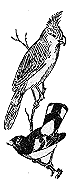
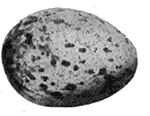
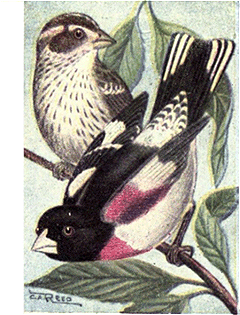
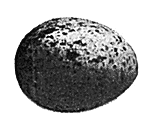
Page 365 Rose-breasted Grosbeak. 595. Rose-breasted Grosbeak. Zamelodia ludoviciana. Greenish blue. Range.--United States, east of the Plains, breeding from the Middle States and Ohio north to Manitoba and Nova Scotia. This beautiful black and white bird with rosy red breast and under wing coverts, is one of the most pleasing of our songsters. They nest either in bushes or trees, generally between six and twenty feet from the ground and usually in thick clumps of trees or scrubby apple trees. The three or four eggs, which are laid in June, are greenish blue, spotted, most heavily about the larger end, with reddish brown. Size 1.00 × .75. Data.--Worcester, Mass., June 5, 1899. Nest of twigs and rootlets in small apple tree in woods; nest very frail, eggs showing through the bottom. NEST OF ROSE-BREASTED GROSBEAK. 596. Black-headed Grosbeak. Zamelodia melanocephala. Pale greenish white. Range.--United States, west of the Plains, breeding from Mexico north to British Columbia; winters south of the United States. This species is of the size of the last (8 inches long), and is a bright cinnamon brown color with black head, and black and white wings and tail. The habits of this bird are the same as those of the Rose-breasted Grosbeak and its song is very similar but more lengthy. Their nests, like those of the last, are very flimsy structures placed in bushes or trees, usually below twenty feet from the ground; they are open frameworks of twigs, rootlets and weed stalks, through which the eggs can be plainly seen. The eggs are similar to those of the preceding but are usually of a paler color, the markings, therefore showing with greater distinctness. Size 1.00 × .70.
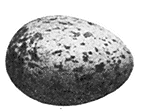
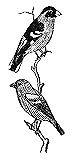
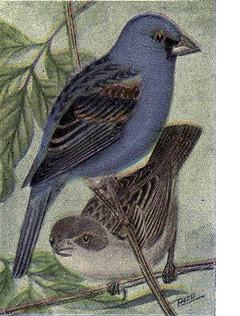
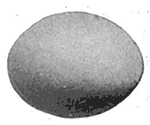
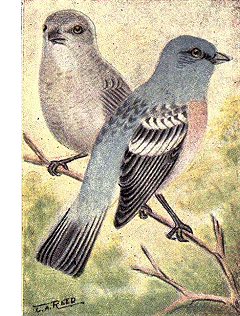
Page 366 Blue Grosbeak. 597. Blue Grosbeak. Guiraca cærulea. Bluish white. Range.--Southeastern United States, breeding from the Gulf north to Pennsylvania and Illinois, and casually to New England. Smaller than the last two species and deep blue, with wings and tail blackish, and the lesser coverts and tips of greater, chestnut. It is a fairly common species in the southerly parts of its range, nesting most frequently in low bushes or vines in thickets; the nest is made of rootlets, weed stalks and grasses and sometimes leaves. The three or four eggs are bluish white, unmarked. Size .85 × .65. Data.--Chatham Co., Ga., June 10, 1898. 3 eggs. Nest of roots, leaves and snake skin, lined with fine rootlets, 3 feet from the ground in a small oak bush. 597a. Western Blue Grosbeak. Guiraca cærulea lazula. Range.--Western United States north to Kansas, Colorado and northern California. Slightly larger than the last and lighter blue; nests the same and egg not distinctive. 598. Indigo Bunting. Passerina cyanea. Range.--United States, east of the Plains, breeding north to Manitoba and Nova Scotia; winters south of the United States. Indigo Bunting. This handsome species is rich indigo on the head and neck, shading into blue or greenish blue on the upper and under parts. They are very abundant in some localities along roadsides, in thickets and open woods, where their song is frequently heard, it being a very sweet refrain resembling, somewhat, certain passages from that of the Goldfinch. Pale bluish white. They nest at low elevations in thickets or vines, building their home of grass and weeds, lined with fine grass or hair, it being quite a substantial structure. The eggs, which are laid in June or July, are pale bluish white. Size .75 × .52. 599. Lazuli Bunting. Passerina amœna. Range.--Western United States, breeding from Mexico to northern United States and the interior of British Columbia; east to Kansas. This handsome bird is of the size of cyanea, but is azure blue above and on the throat, the
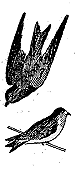
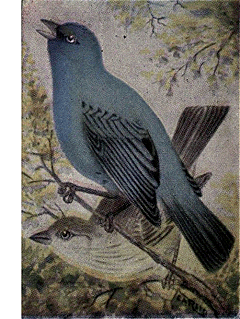
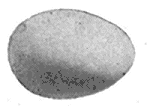
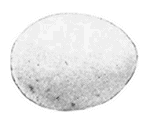
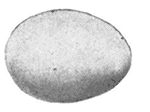
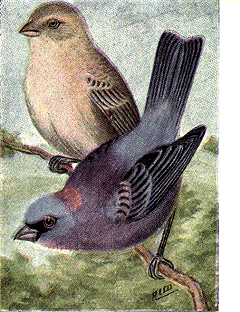
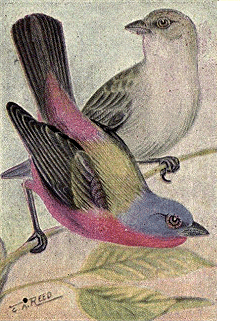
Page 367 Lazuli Bunting. breast being brownish and the rest of the underparts, white. Pale bluish white. It is the western representative of the Indigo Bunting, and its habits and nesting habits are in all respects the same as those of that species, the nests being made of twigs, grasses, strips of bark, weeds, leaves, etc. The eggs are like those of the last, pale bluish white. Size .75 × .55. 600. Varied Bunting. Passerina versicolor. Pale bluish white. Range.--Mexico and north to southern Texas. The general color of this odd bird is purplish, changing to bright blue on the crown and rump, and with a reddish nape. They are quite abundant in some localities along the Lower Rio Grande, where they nest in bushes and tangled under brush, the nests being like those of the last species, and rarely above five feet from the ground. The eggs are pale bluish white, three or four in number, and laid during May or June. Size .75 × .55. 600a. Beautiful Bunting. Passerina versicolor pulchra. Range.--Southern Lower California. Slightly smaller but very similar to the last; eggs will not differ. Varied Bunting. 601. Painted Bunting. Passerina ciris. Range.--South Atlantic and Gulf States; north to Illinois in the interior. Without exception, this is the most gaudily attired of North American birds, the whole underparts being red, the head and neck deep blue, the back yellowish green, and the rump purple, the line of demarcation between the colors being sharp. They are frequently kept as cage birds but more for their bright colors than any musical ability, their song being of the character of the Indigo Bunting, but weaker and less musical. White. They are very abundant in the South Atlantic and Gulf States, where they nest usually in bushes or hedges at low elevations, but occasionally on branches of tall trees. Their nests are made of weeds, shreds of bark, grasses, etc., lined with fine grass, very much resembling that of the Indigo. Their eggs are laid in May, June or July, they frequently raising two broods; they are white or pale bluish white, speckled with reddish brown. Size .75 × .55.
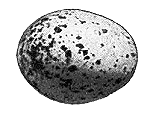
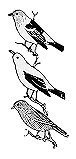
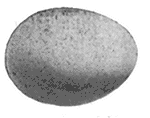
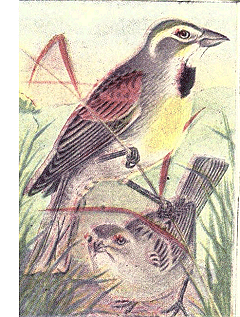
Page 368 Painted Bunting. 602. Sharpe's Seed-eater. Sporophila morelleti morelleti. Range.--Eastern Mexico, breeding north to the Lower Rio Grande Valley in Texas. Greenish blue. This peculiar, diminutive Finch is but 4.5 inches in length, and in plumage is black, white and gray. In restricted localities in southern Texas, they are not uncommon during the summer months. They build in bushes or young trees at low elevations making their nests of fine grasses or fibres, firmly woven together and usually placed in an upright crotch. The eggs are pale greenish blue, plentifully speckled with reddish and umber brown, and some markings of lilac. Size .65 × .45. Data.--Brownsville, Texas, May 7, 1892. Nest of fine fibre-like material lined with horse hairs, on limb of small tree in open woods near a lake of fresh water; 6 feet above ground. Collector, Frank B. Armstrong. This set is in the collection of Mr. C. W. Crandall. 603. Grassquit. Tiaris bicolor. Range.--This small Finch is a Cuban species which casually strays to southern Florida. They are abundant on the island, building large arched nests of grass, with a small entrance on the side. They lay from three to six white eggs, specked with brown. Size .65 × .50. 603.1 Melodious Grassquit. Tiaris canora. Another Cuban Finch which has been taken in the Florida Keys. Eggs like the last. Sharpe's Seed-eater. 604. Dickcissel. Spiza americana. Range.--Interior of the United States, breeding from the Gulf to northern United States, west to the Rockies, east to the Alleghanies. Bluish white. A sparrow-like Bunting with a yellow breast patch, line over eye and on side of throat; throat black, chin white and wing coverts chestnut. These sleek-coated, harmoniously colored birds are very common in dry bush-grown pastures and on the prairies. They are very persistent singers, and their song, while very simple, is welcome on hot days when other birds are quiet. They nest anywhere, as suits their fancy, on the ground, in clumps of grass, in clover fields, bushes, low trees, or in thistles. The nests are made of weeds, grasses, leaves and rootlets, lined with fine grass, and the three to five eggs are bluish white. Size .80 × .60.
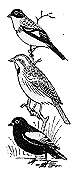
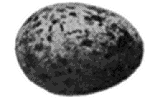
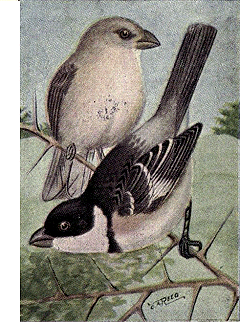
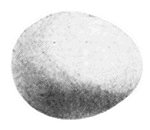
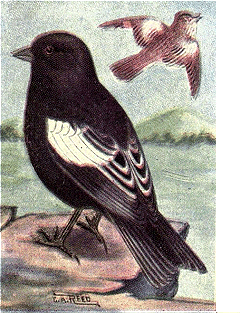
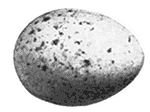
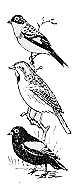
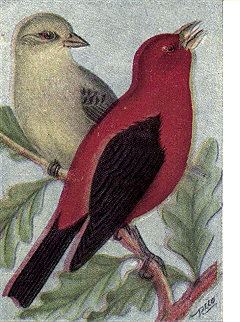
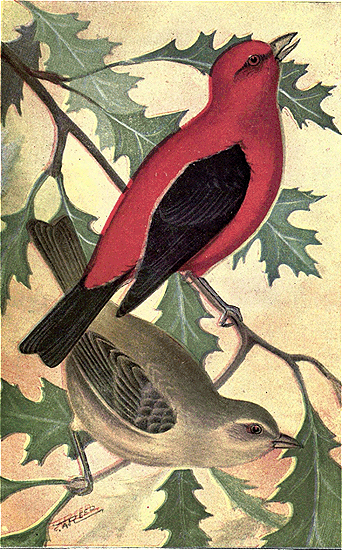
Page 369 Dickcissel. 605. Lark Bunting. Calamospiza melanocorys.. Range.--A bird of the Plains, abundant from western Kansas to eastern Colorado and north to the Canadian border; winters in Mexico. Bluish white. These black and white birds have a sweet song which they often utter while on the wing after the manner of the Bobolink, all their habits being similar to those of this bird, except that this species likes the broad dry prairies where it nests on the ground under the protection of a tuft of grass or a low bush. Their four or five eggs are like those of the last but slightly larger. Size .85 × .65. Data.--Franklin Co., Kansas. 4 eggs. Nest in cornfield in a hollow on the ground at the base of a stalk; made of straw and weeds. TANAGERS. Family TANAGRIDÆ 607. Western Tanager. Piranga ludoviciana. Range.--United States, west of the Plains and north to British Columbia. Lark Bunting. Bluish green. This handsome species is black and yellow, with an orange or reddish head. They are common and breed in suitable localities through their range, nesting as do the eastern Tanagers in trees usually at a low elevation, the nests being saddled on the forks of horizontal branches; they are made of rootlets, strips of bark, and weed stalks, and are usually frail like those of the Grosbeaks. Their eggs, which are laid in May or June, are bluish green, specked with brown of varying shades. Size .95 × .65. 608. Scarlet Tanager. Piranga erythromelas. Greenish blue. These beautiful scarlet and black birds frequent, chiefly, woodlands, although they are very often found breeding in orchards and small pine groves. They are quiet birds, in actions, but their loud warbling song is heard at a great distance, and is readily recognized by its peculiarity.
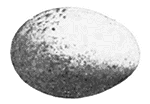
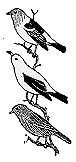
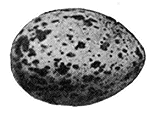
Page 370 Scarlet Tanager. They nest upon horizontal limbs or forks at elevations of four to twenty feet, making frail nests of twigs, rootlets and weeds; they are often found in pine trees, but apparently just as frequently in other kinds. Their eggs are greenish blue, specked and spotted with various shades of brown. Size .95 × .65. Data.--Holden, Mass., May 31, 1898. Nest on low limb of an oak, 4 feet above ground; of weeds and rootlets and very frail. 609. Hepatic Tanager. Piranga hepatica. Bluish green. Range.--Western Mexico, north to New Mexico and Arizona in summer. This species is similar to the next but is darker red on the upper parts and bright vermilion below. They nest on the lower horizontal branches of trees, usually live oaks, making the nests of rootlets and weeds; the eggs are bluish green, like those of the next, but the markings appear to average more blotchy and brighter. Size .92 × .64. 610. Summer Tanager. Piranga rubra rubra. Range.--Eastern United States, breeding from the Gulf to New York and Kansas, and casually farther; west to Texas; winters south of our borders. Summer Tanager. This bird is of the size of the Scarlet Tanager, but is of a uniform rosy red color, darker on the back. They are very common in the South Atlantic and Gulf States. Their nests are located at low elevations on horizontal branches of trees in open woods, edges of clearings, or along the roadside; the nests are made of strips of bark, weed stems, leaves, etc., and are frail like those of the other Tanagers. Light bluish green. Their eggs are light bluish green, speckled and spotted with reddish brown, and not distinguishable with certainty from those of the Scarlet Tanager. Size .92 × .64. 610a. Cooper's Tanager. Piranga rubra cooperi. Range.--Western United States, breeding from the Mexican border and Texas north to central California and Nevada. Similar to but slightly larger than the last. There are no differences between the nesting of this form and the last and the eggs are not in any way different.
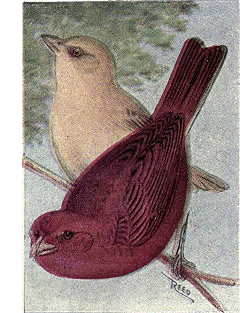
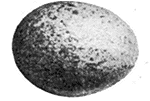
Page 371 SCARLET TANAGER.
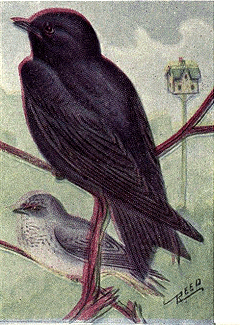
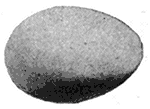
Page 372 SWALLOWS. Family HIRUNDINIDÆ 611. Purple Martin. Progne subis subis. Purple Martin. Range.--Breeds throughout the United States and temperate British America; winters in South America. White. These large, lustrous, steely-blue Swallows readily adapt themselves to civilization and, throughout the east, may be found nesting in bird houses, provided by appreciative land owners or tenants; some of these houses are beautiful structures modeled after modern residences and tenanted by twenty or thirty pairs of Martins; others are plain, unpainted soap boxes or the like, but the birds seem to take to one as kindly as the other, making nests in their compartments of weeds, grass, mud, feathers, etc. They also, and most commonly in the west, nest in cavities of trees making nests of any available material. During June or July, they lay from four to six white eggs; size .95 × .65. Data.--Leicester, Mass., June 16, 1903. 5 eggs in Martin house; nest of grasses. 611a. Western Martin. Progne subis hesperia. Range.--Pacific coast from Washington south. The nesting habits, eggs, and birds of this form are identical with those found in the east. 611.1. Cuban Martin. Progne cryptoleuca. Range.--Cuba and southern Florida (in summer). Slightly smaller than the Purple Martin and the eggs average a trifle smaller. Cliff Swallow. 612. Cliff Swallow. Petrochelidon lunifrons lunifrons. Range.--Whole of North America, breeding north from the south Atlantic and Gulf States. White. These birds can easily be recognized by their brownish throat and breast, whitish forehead and buffy rump. They build one of the most peculiar of nests, the highest type being a flask shaped structure of mud securely cemented to the face of a cliff or under the eaves of a building, the entrance being drawn out and small, while the outside of the nest proper is large and rounded; they vary from this typical nest down to plain mud platforms, but are all warmly lined with grass and feathers.
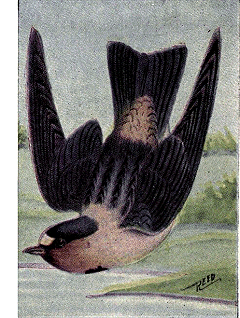
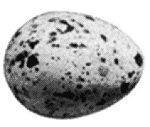
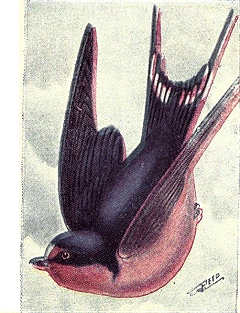
Page 373 Barn Swallow. In some localities, cliffs resemble bee hives, they having thousands of these nests side by side and in tiers. Their eggs are creamy white spotted with reddish brown; size .80 × .55 with great variations. Data.--Rockford, Minn., June 12, 1890. Nest made of mud, lined with feathers; placed under the eaves of a freight house. 612.1. Cuban Cliff Swallow. Petrochelidon fulva. Range.--West Indies and Central America; accidental on Florida Keys. 613. Barn Swallow. Hirundo erythrogastra. Range.--Whole of North America; winters south to South America. This Swallow is the most beautiful and graceful of the family, and is a familiar sight to everyone, skimming over the meadows and ponds in long graceful sweeps, curves and turns, its lengthened outer tail feathers streaming behind. Tree Swallow. White. Throughout their range, they nest in barns, sheds or any building where they will not be often disturbed, making their nests of mud and attaching them to the rafters; they are warmly lined with feathers and the outside is rough, caused by the pellets which they place on the exterior. Before the advent of civilized man, they attached their nests to the sides of caves, in crevices among rocks and in hollow trees, as they do now in some localities. Their eggs cannot be distinguished from those of the Cliff Swallow. Data.--Penikese Is., Mass., July 2, 1900. Nest on beam in sheep shed; made of pellets of mud, lined with feathers. 614. Tree Swallow; White-bellied Swallow. Iridoprocne bicolor. Range.--Whole of temperate North America, breeding from middle United States northward; winters in the Gulf States and along the Mexican border and southward. This vivacious and active species is as well known as the last, and nests about habitations on the outskirts of cities and in the country.
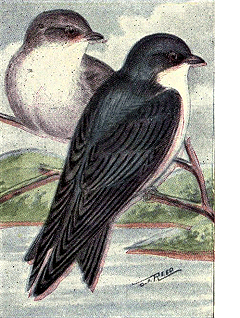
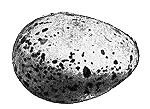

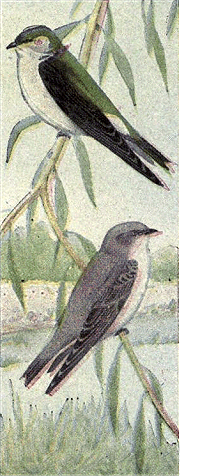
Page 374 615--616. White. They naturally nest in holes in trees or stumps, preferable in the vicinity of water, but large numbers now take up their abode in houses provided for them by man, providing that English Sparrows are kept away. They make their nests of straws and grasses, lined with feathers, and lay four to six plain white eggs; size .75 × .50. Data.--Portage, Mich., May 26, 1897. Nest in a gate post; hole about 6 inches deep, lined with feathers. 615. Northern Violet-green Swallow. Tachycineta thalassina lepida. Range.--United States in the Rocky Mountains and west to the Pacific coast, breeding from Mexico to British Columbia; winters south of our borders. White. This very beautiful species is smaller than the last, but, like it, is white below, but the upper parts are blue, green and purple without gloss. They are common in their range and nest, usually in holes in trees, less often in banks and under eaves; the nests are made of grass and feathers, and the eggs are pure white, four or five in number; size .72 × .50. 615a. San Lucas Swallow. Tachycineta thalassina brachyptera. Range.--Southern Lower California. Practically the same bird as the last but with the wing very slightly shorter. Nesting habits or eggs will not differ. 615.1. Bahaman Swallow. Callichelidon cyaneoviridis. Range.--Bahamas; casual at Dry Tortugas, Florida. This very beautiful species is similar to the western Violet-green Swallow, as are also its eggs. 616. Bank Swallow. Riparia riparia. Range.--Whole of North America, north to the limit of trees, breeding from the middle portions of the United States northward; winters south of our borders. White. This dull-colored Swallow is grayish above and white below, with a gray band across the breast, they breed in holes in embankments, digging small tunnels from one to three feet in length, enlarged and lined at the end with grass and feathers. During May, June or July, according to latitude, they lay from four to six pure white eggs; size .70 × .50. 617. Rough-winged Swallow. Stelgidopteryx serripennis. White. Range.--United States, breeding from Mexico north to southern New England, Manitoba and British Columbia; winters south of our borders. This species is slightly larger than the last and similar but with the throat and breast grayish and with the outer web of the outer primary provided with recurved hooks. They nest in holes in embankments, in crevices in cliffs or among stones of bridges or buildings. Their eggs are like those of the Bank Swallow but average a trifle larger; size .75 × .52.
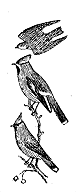
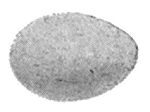
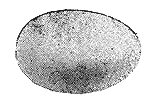
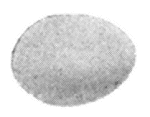
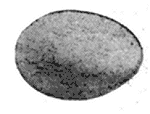
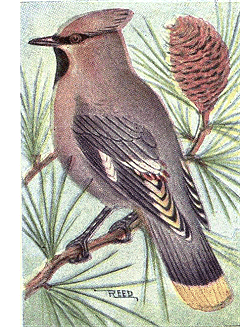
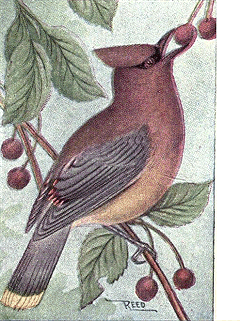
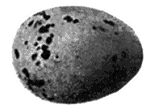
Page 375 WAXWINGS. Family AMPELIDÆ 618. Bohemian Waxwing. Bombycilla garrulus. Bohemian Waxwing. Range.--Breeds in the Arctic regions except in the Rockies where it nearly reaches the United States; winters south to the northern tier of states. Dull bluish. This handsome crested, grayish brown Waxwing resembles the common Cedar Waxwing but is larger (length 8 inches), has a black throat, much white and yellow on the wing and a yellow tip to tail. Their nests are made of rootlets, grass and moss, and situated in trees usually at a low elevation. The eggs resemble those of the Cedar-bird, but are larger and the marking more blotchy with indistinct edges; dull bluish blotched with blackish brown; size .95 × .70. Data.--Great Slave Lake, June 23, 1884. Nest in a willow 8 feet from the ground. Collected for Josiah Hooper. (Crandall collection). 619. Cedar Waxwing. Bombycilla cedrorum. Range.--Whole of temperate North America, breeding in the northern half of the United States and northward. Cedar Waxwing. These birds are very gregarious and go in large flocks during the greater part of the year, splitting up into smaller companies during the breeding season and nesting in orchards or groves and in any kind of tree either in an upright crotch or on a horizontal bough; the nests are made of grasses, strips of bark, moss, string, etc., and are often quite bulky. Their eggs are of a dull grayish blue color sharply speckled with blackish brown; size .85 × .60. Data.--Old Saybrook, Conn., June 22, 1900. Nest composed of cinquefoil vines, grasses, wool and cottony substances; situated on an apple tree branch about 10 feet from the ground. Collector, John N. Clark. Dull bluish. This species has a special fondness for cherries, both wild and cultivated, and they are often known as Cherry-birds. They also feed upon various berries, and frequently catch insects in the air after the manner of Flycatchers. Their only notes are a strange lisping sound often barely audible.
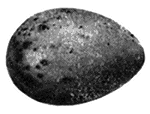
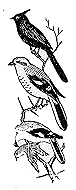
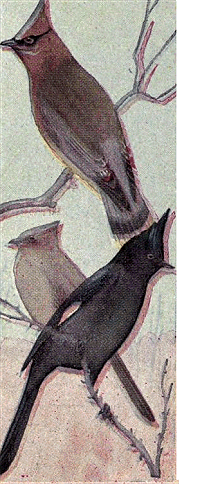
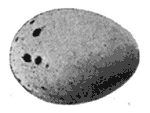
Page 376 619--620. 620. Phainopepla. Phainopepla nitens. Range.--Southwestern United States and Mexico; north to southern Utah and Colorado. Light gray. This peculiar crested species is wholly shining blue black except for a patch of white on the inner webs of the primaries. Their habits are somewhat like those of the Cedar-bird, they being restless, and feeding upon berries or insects, catching the latter in the air. They make loosely constructed nests of twigs, mosses, plant fibres, etc., placed on branches of trees, usually below 20 feet from the ground, in thickets or open woods near water; the eggs are two or three in number, light gray, spotted sharply with black; size .88 × .65. Data.--Pasadena, Cal., July 15, 1894. Nest in an oak 10 feet up; composed of weeds and string. Collector, Horace Gaylord. SHRIKES. Family LANIIDÆ 621. Northern Shrike. Lanius borealis. Range.--North America, breeding north of our borders; winters in northern half of the United States and casually farther south. Grayish white. All Shrikes are similar in nature and plumage, being grayish above and white below, with black wings, tail and ear patches, and with white outer tail feathers and bases of primaries; the present species may be known by its larger size (length over 10 inches) and wavy dusky lines on the breast. They are bold and cruel birds, feeding upon insects, small rodents and small birds, in the capture of which they display great cunning and courage; as they have weak feet, in order to tear their prey to pieces with their hooked bill, they impale it upon thorns. They nest in thickets and tangled underbrush, making their nests of vines, grasses, catkins, etc., matted together into a rude structure. During April or May they lay from four to six grayish white eggs, spotted and blotched with yellowish brown and umber; size 1.05 × .75. Northern Shrike. 622. Loggerhead Shrike. Lanius ludovicianus ludovicianus. Range.--United States, east of the Plains, breeding north to New England and Illinois; winters in Southern States. Grayish white. Like the last but smaller (length 9 inches), not marked below and with the ear patches sharply defined. They nest in hedges or thickly tangled brush, showing a predilection for dense thorn bushes, where they place their piles of weeds, grasses, feathers and rubbish; the four or five eggs are laid in April or May; they are like those of the last, but smaller, averaging .96 × .72.
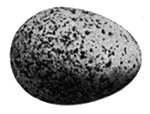
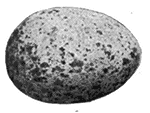
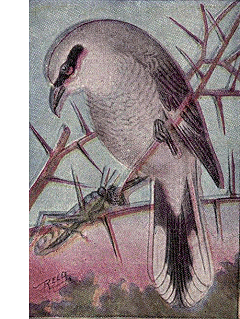
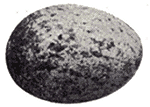
Page 377 LOGGERHEAD SHRIKE AND NEST.
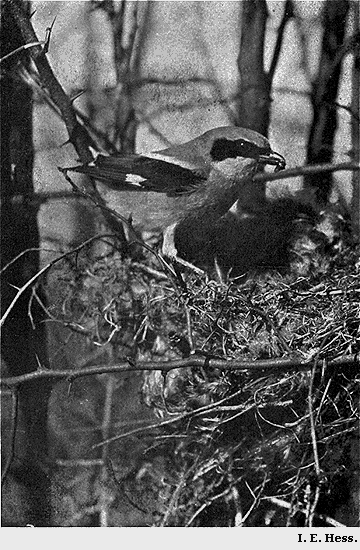
Page 378 Loggerhead Shrike. 622a. White-rumped Shrike. Lanius ludovicianus excubitorides. Range.--North America, west of the Plains, breeding north to Manitoba and the Saskatchewan; winters south to Mexico. Like the last but paler and the rump white. Their nesting habits and eggs are in every respect like those of the Loggerhead Shrike. 622b. California Shrike. Lanius ludovicianus gambeli. Range.--Pacific coast north to British Columbia. Similar to the eastern form but with the breast washed with brownish and with indistinct wavy bars. The eggs cannot be distinguished from those of the others. 622c. Island Shrike. Lanius ludovicianus anthonyi. Range.--Santa Barbara Islands, California. Like the last but smaller and darker. Eggs not distinguishable. VIREOS. Family VIREONDIDÆ 623. Black-whiskered Vireo. Vireosylva calidris barbatula. 622a--622b. Range.--A Central American species, breeding in Cuba, Bahamas and southern Florida. White. Like the Red-eyed Vireo but with a dusky streak on either side of the chin. They build pensile nests of strips of bark and fibres, swung from the forks of branches. The eggs cannot be distinguished from those of the next species, being white, more or less specked about the large end with reddish brown and umber. Size .78 × .55.
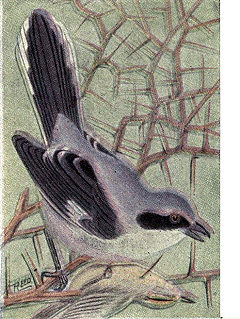
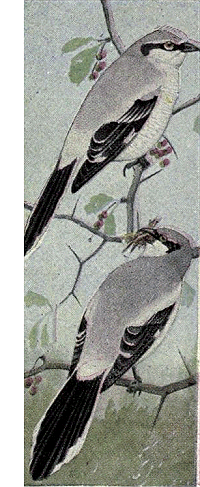
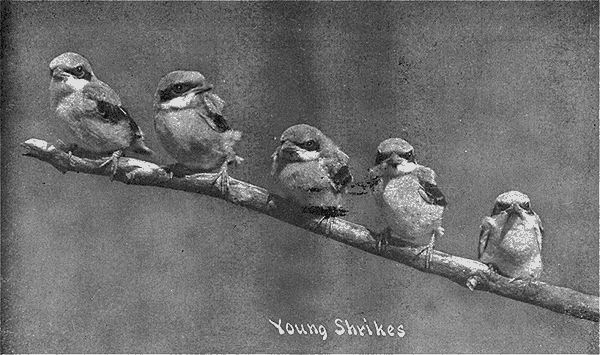
Page 379 YOUNG SHRIKES (All ready for flight).
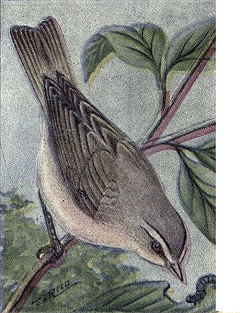
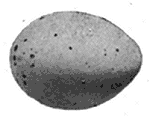
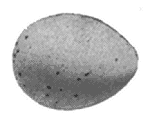
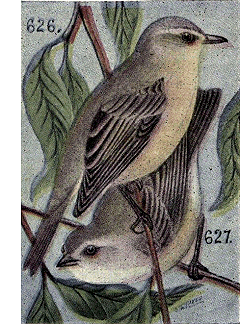
Page 380 Red-eyed Vireo. 624. Red-eyed Vireo. Vireosylva olivacea. Range.--United States, east of the Rockies, breeding north to Labrador, Manitoba and British Columbia. White. This is the most common of the Vireos in the greater part of its range and is a most persistent songster, frequenting groves, open woods or roadsides. Their eyes are brown, scarcely if any more red than those of any other species and I have yet to see one with red eyes outside of mounted museum specimens. They swing their nests from the forks of trees at any elevation from the ground but usually below ten feet, and I have found them where the bottom rested on the ground; they are made of strips of bark, fibre, etc., and often have pieces of string or paper woven into the sides; they are one of the most beautiful of bird homes and are woven so strongly that old nests hang to the branches for several seasons. Their three or four eggs, often accompanied by one of the Cowbirds, are laid in May or June; they are white, sparingly specked with blackish brown. Size .85 × .55. 625. Yellow-green Vireo. Vireosylva flavoviridis. Range.--Southern Texas and southward to South America. Similar to the Red-eye but greener above and more yellowish on the sides. The nesting habits are the same and the eggs indistinguishable from those of that species. 626. Philadelphia Vireo. Vireosylva philadelphica. Range.--Eastern United States breeding from northern New England and Manitoba northward. White. 626-627. This species is much smaller than the Red-eye (length 5 in.) and is yellowish below, and without black edges to the gray crown. Their eggs do not differ from those of the Red-eyed Vireo except in size, averaging .70 × .50. 627. Warbling Vireo. Vireosylva gilva gilva. Range.--North America east to the Plains, breeding north to Labrador. White. This Vireo is nearly as abundant as the Red-eye but is not generally as well known, probably because it is usually higher in the trees and more concealed from view. Their nests are like those of the Red-eye, but smaller and usually placed higher in the trees. The birds are even more persistent singers, than are the latter but the song is more musical and delivered in a more even manner, as they creep about among the foliage, peering under every leaf for lurking insects. The eggs are pure white, spotted with brown or reddish brown. Size .72 × .52.
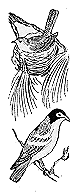
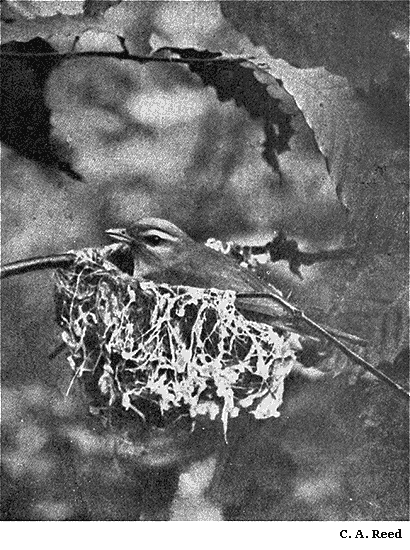
Page 381 RED-EYED VIREO ON NEST.
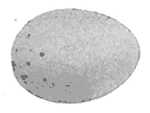
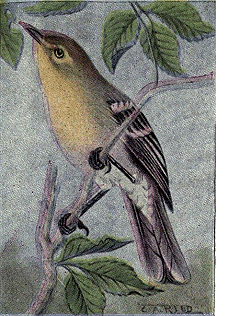
Page 382 Yellow-throated Vireo. 627a. Western Warbling Vireo. Vireosylva gilva swainsoni. Range.--Western United States, breeding from Mexico to British Columbia. This species is like the last but said to be a trifle smaller and paler color. Its nesting habits and eggs are precisely like those of the eastern form. 628. Yellow-throated Vireo. Lanivireo flavifrons. Creamy white. Range.--United States east of the Plains, breeding from the Gulf to Manitoba and New Brunswick. This handsome bird is wholly unlike any others of the Vireos, having a bright yellow throat and breast; the upper parts are greenish and the wings and tail gray, the latter with two white bars. They are fairly common breeding birds in northern United States, placing their handsome basket-like structures in forks of branches and at any elevation from the ground; the nests are like those of the preceding Vireos but are frequently adorned on the outside with lichens, thereby adding materially to their natural beauty. The four or five eggs are pinkish or creamy white, speckled about the large end with reddish brown. Size .80 × .60. 629. Blue-headed Vireo. Lanivireo solitarius solitarius. White. Range.--Eastern United States, breeding from southern New England and the northern states north to Hudson Bay; winters in the Gulf States and southward. Blue-headed Vireo. A beautiful Vireo with a slaty blue crown and nape, greenish back, white wing bars and underparts, the flanks being washed with greenish yellow; a conspicuous mark is the white eye ring and loral spot. They build firm, pensile, basket-like nests of strips of birch and grapevine bark, lined with fine grasses and hair, suspended from forks, usually at low elevation and often in pine or fir trees (of some twenty nests that I have found in New England all have been in low branches of conifers). Their three or four white eggs are specked with reddish brown. Size .80 × .60. 629a. Cassin's Vireo. Lanivireo solitarius cassini. Range.--United States west of the Rockies; north to British Columbia. Similar to the last but with the back grayish. 629b. Plumbeous Vireo. Lanivireo solitarius plumbeus. Range.--Rocky Mountain region, breeding from Mexico to Dakota and Wyoming. Like the Blue-headed Vireo but with the yellowish wholly replaced by leaden gray.
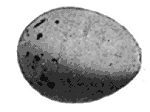
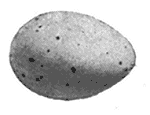
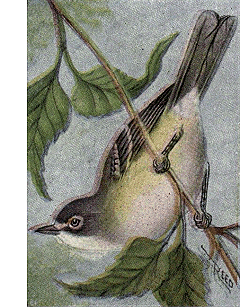
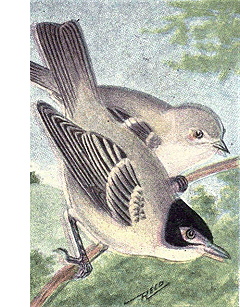
Page 383 Black-capped Vireo. 629c. Mountain Vireo. Lanivireo solitarius alticola. Range.--Mountains of Carolina and Georgia; winters in Florida. Said to be larger and darker than solitarius proper. From all accounts, the habits, nests or eggs of this species differ in no wise from many of those of the northern Solitary Vireo, whose nests show great variations in size and material. 629d. San Lucas Vireo. Lanivireo solitarius lucasanus. Range.--Southern Lower California. Similar to cassini but with the flanks more yellow. Their nesting habits or eggs will not differ from the others. 630. Black-capped Vireo. Vireo atricapillus. Range.--Central Texas north to Kansas; winters in Mexico. White. This peculiar Vireo has a black crown and sides of head, broken by a white eye ring and loral stripe; upper parts greenish, below white. They appear to be fairly common in certain localities of their restricted range, and nest at low elevations in mesquites or oaks, placing the nests in forks the same as other Vireos; they are of the ordinary Vireo architecture, lined with grasses. The three or four eggs are pure white, unmarked. Size .70 × .50. Data.--Comal Co., Texas, May 21, 1888, 4 eggs. Nest located in a scrub Spanish oak, 5 feet from the ground. 631. White-eyed Vireo. Vireo griseus griseus. White-eyed Vireo. Range.--Eastern United States, breeding from the Gulf to northern United States. This Vireo has white eyes, as implied by its name, is yellowish green on the sides and with two prominent bars. They have no song, like the other Vireos, but a strange medley of notes resembling those of the Chat or Shrike. White. They nest near the ground in tangled thickets, making large nests for the size of the birds and not always suspended; they are made of weeds, leaves, grass, bark or any trash. Their three or four eggs are laid late in May or early in June; they are white, sparingly speckled with brown; size .75 × .55. 631a. Key West Vireo. Vireo griseus maynardi. Range.--Southern Florida. This grayer and paler variety nests in the same manner and the eggs are not distinct from those of the last form.
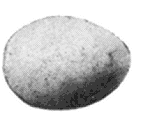
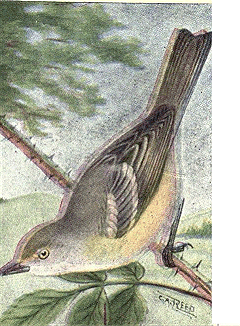
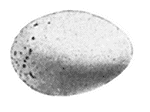
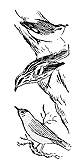
Page 384 629a--632. 631b. Bermuda Vireo. Vireo griseus bermudianus. Range.--Bermudas. This variety is said to be slightly smaller and to have no yellow on the sides. Its eggs are probably the same as those of the others. 631c. Small White-eyed Vireo. Vireo griseus micrus. Range.--Eastern Mexico north to southern Texas. Said to be slightly smaller and grayer than the common White-eyed Vireo. Its eggs will not differ. 632. Hutton's Vireo. Vireo huttoni huttoni. Range.--Resident on the California coast; chiefly in the southern parts. White. A similar species to noveboracensis but with the under parts tinged with yellow. These birds are quite common but shy, nesting at any height from the ground in open woods or groves; the nests are made of grasses and moss and swung from forked limbs; the three or four eggs are pure white, finely specked with reddish brown. Size .70 × .50. 632a. Stephen's Vireo. Vireo huttoni stephensi. Range.--Northwestern Mexico and the boundary of the United States. 633a-634. This variety, which is more yellowish than the last, appears to be rather uncommon but as far as I can learn its habits and nesting do not differ from those of the other Vireos; the eggs are white, specked with brown. Size .70 × .50. 632c. Anthony's Vireo. Vireo huttoni obscurus. Range.--Pacific coast from Oregon (and Cal. in winter) to British Columbia. The nesting habits and eggs of this darker and smaller variety are the same in all respects as those of the Hutton's Vireo. 633. Bell's Vireo. Vireo belli belli. Range.--Interior of the United States, breeding from Texas to Minnesota and Dakota. White. The nesting habits of this smaller species are just the same as those of the larger varieties, they suspending their small grass-woven baskets in the forks of bushes or trees and usually at a low elevation. Their nests are handsome and compact little structures, being often made almost wholly of strips of bark lined with very fine grasses. The eggs are white, specked with reddish brown. Size .70 × .50. Data.--Austin, Texas, June 16, 1898. Nest of strips of bark, fibres and grasses, neatly woven and swung from the fork of a low bush, 2 feet from the ground.
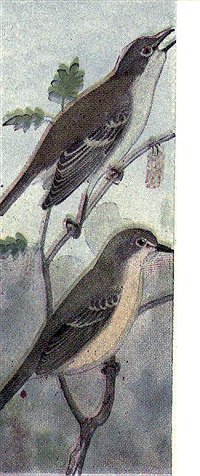
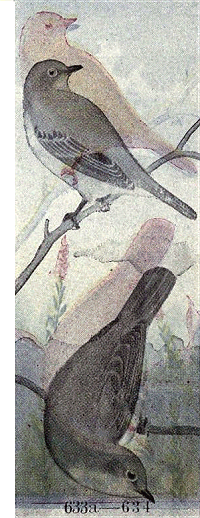
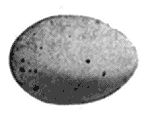
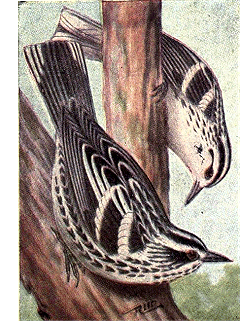
Page 385 633a. Least Vireo. Vireo belli pusillus. Range.--Western Mexico, Arizona and southern California. This Vireo is slightly smaller and grayer than the last; they are quite common in southern Arizona, nesting the same as Bell's at low elevations in bushes or small trees. The eggs cannot be distinguished from those of belli. 634. Gray Vireo. Vireo vicinior. White. Range.--Southwestern United States from western Texas, southern California and Nevada southward. This species is grayish above and grayish white below, with white eye ring, lores and wing bar. They are not uncommon birds in the Huachuca Mts. of southern Arizona, where they nest in bushes at low elevations, making the semi-pensile structures of woven strips of bark and grasses, lined with fine round grasses attached by the rim to a fork and sometimes stayed on the side by convenient twigs. Eggs white, specked with brown. Size .72 × .53. HONEY CREEPERS. Family COEREBIDÆ 635. Bahama Honey Creeper. Cœreba bahamensis. Range.--Bahamas, casually to southern Florida and the Keys. This peculiar curved-billed species is dark brown above, with the underparts, superciliary line and spot at base of primaries, whitish; the rump and a breast patch are yellow. They nest at low elevations in bushes or trees usually in tangled thickets, making a large dome-shaped nest of grasses, leaves and fibres and, during May or June, lay from three to five pale creamy white eggs, speckled sparingly all over the surface and more abundantly at the large end with reddish brown. Size .65 × .50. WARBLERS. Family MNIOTILTIDÆ Warblers as a family may be classed as the most beautiful, interesting and useful birds that we have. With few exceptions, they only return from their winter quarters as the trees shoot forth their leaves or flowers, they feed largely among the foliage upon small, and mostly injurious, insects. They are very active and always flitting from branch to branch, showing their handsome plumage to the best advantage. Their songs are simple but effectively delivered and the nests are of a high order of architecture. Black and White Warbler. 636. Black and White Warbler. Mniotilta varia. Range.--North America east of the Plains, breeding from the Gulf States north to the Hudson Bay region; winters from our southern borders to South America. White. This striped black and white Warbler is usually seen creeping about tree trunks and branches after the manner of a Nuthatch. They are very active gleaners and of inestimable value to man. They nest on the ground in woods or swamps, making their nest of strips of bark and grass, placed among the leaves usually beside stones, stumps or fallen trees. Their three to five eggs are white, finely specked and wreathed with reddish brown. Size .65 × .50. Data.--Worcester, Mass., June 3, 1889. Nest of strips of bark on the ground in an old decayed stump.
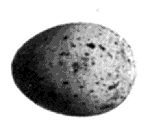
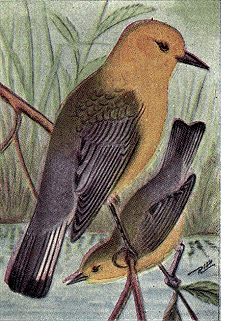
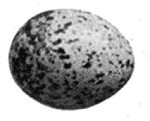
Page 386 Prothonotary Warbler. 637. Prothonotary Warbler. Prothonotaria citrea. Range.--South Atlantic and Gulf States, north in the interior to Iowa and Illinois. Creamy white. This species is often known as the Golden Swamp Warbler because of the rich golden yellow of the head and underparts. They frequent and nest in the vicinity of swamps or ponds, nesting in the cavities of trees or stubs at low elevations, filling the cavity with leaves, moss and grasses, neatly cupped to receive the four to seven eggs, which are creamy or pinkish white, profusely spotted with reddish brown and chestnut. Size .72 × .55. Data.--Quincy, Mo., June 1, 1897. 5 eggs. Nest in hole of a dead stub 6 feet up, in timber some distance from water; made of moss and grasses, lined with hair. Swainson's Warbler. Worm-eating Warbler. 638. Swainson's Warbler. Helinaia swainsoni. Bluish white. Range.--South Atlantic and Gulf States, north to Virginia and Indiana, and west to eastern Texas; winters in Mexico and the West Indies. This species is brownish above and white below, with a whitish superciliary stripe. It has been found breeding most numerously in thickets and tangled underbush about swamps and pools in any locality. Their nests are either in bushes or attached to upright rushes over water after the manner of the Long-billed Marsh Wren, being made of leaves, moss, rootlets, etc., lined with fine grasses or hair, and deeply cupped for the reception of the three or four unmarked white or bluish white eggs which are laid during May or June. Size .75 × .58. Data.--Near Charlestown, S. C., May 12, 1888, 3 eggs. Nest in canes 4 feet from ground, made of strips of rushes, sweet gum and water oak leaves, lined with pine needles. 639. Worm-eating Warbler. Helmitheros vermivorus. White. Range.--United States east of the Plains, breeding north to southern New England and Illinois; winters south of our borders. This bird can be identified in all plumages by the three light buff and two black stripes on the crown and narrower black stripes through the eye. Their habits are similar to those of the Oven-bird, they feeding largely upon the ground amid dead leaves.
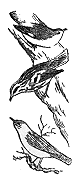
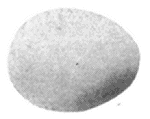
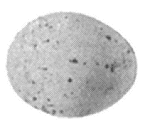
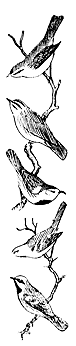
Page 387 Bachman's Warbler. Lawrence's Warbler. Brewster's Warbler. They are quite abundant in most localities in their range, nesting in hollows on the ground in open woods or shrubbery on hill sides; the nest is made of leaves, grasses and rootlets, lined with hair or finer grasses, and is usually placed under the shelter of some small bush. They lay (in May, June or July) three to six eggs, white, marked or blotched either sparingly or heavily with chestnut or lavender. Size .70 × .52. 640. Bachman's Warbler. Vermivora bachmani. Range.--Southeastern United States, along the Gulf coast to Louisiana and north to Virginia and Missouri. This species is one of the rarest of the Warblers, but is now much more abundant than twenty years ago, when it had apparently disappeared. They are greenish above, and yellow below, and on the forehead and shoulder, and with black patches on the crown and breast. They have been found breeding in Missouri, nesting on the ground like others of this genus; the eggs are white wreathed about the large end and sparingly specked over the whole surface with reddish brown and chestnut. Size .65 × .50. 641. Blue-winged Warbler. Vermivora pinus. Range.--Eastern United States, breeding north to southern New England and in the Mississippi Valley to Minnesota; winters south of our borders. White. This common species has the crown and underparts yellow, line through the eye black, and white wing bars and spots on outer tail feathers. They breed most abundantly in the northern half of their United States range, placing their nests on the ground in thickets or on the edge of woods; the nests are made of strips of bark, usually grapevine, and leaves, and are usually high and deeply cupped, they are almost always placed among the upright shoots of young bushes. The eggs are white, finely specked with reddish brown with great variations as to markings. Size .65 × .50. Data.--Old Saybrook, Conn., June 1, 1900. 5 eggs. Nest composed chiefly of dry beech leaves and strips of cedar bark, lined with shreds of bark and fine grass; situated on the ground among a bunch of weeds in the woods.
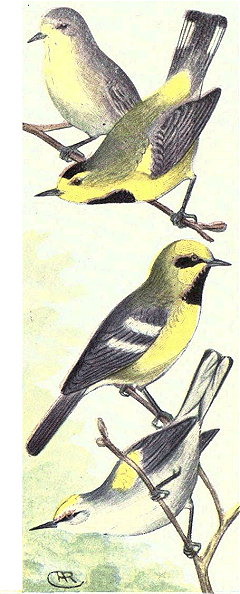
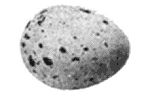
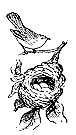
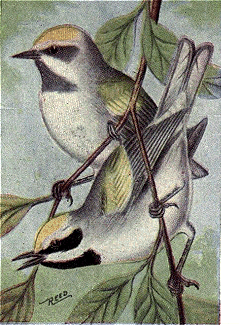
Page 388 Golden-winged Warbler. 642. Golden-winged Warbler. Vermivora chrysoptera. Range.--Eastern United States, breeding north to the southern parts of the British Provinces, winters south of the United States. White. This is a very handsome species with black throat and ear patches, and yellow crown and wing bars, the upper parts being gray and the lower white. They frequent low fields or hillsides where they nest among weeds or vines, making the nest of strips of bark, grasses and fibres, and locating it close to the ground in clumps of weeds, low bushes or briers. The three to five eggs are white with a very great diversity of markings, either heavily or minutely spotted or wreathed with chestnut and gray. Size .62 × .50. 643. Lucy's Warbler. Vermivora luciæ. Lucy's Warbler. Virginia Warbler. White. Range.--Western Mexico, north commonly to Arizona and casually to southern Utah. This small gray and white Warbler is especially distinguished by a chestnut rump and patch in center of the crown. Besides nesting in forks of low bushes, this species is said to place the domiciles in almost any crevice or nook that suits their fancy, such as loose bark on tree trunks, holes in trees, or other birds' nests. The eggs which are usually laid during May are white, sparingly specked and wreathed with reddish brown. Size .60 × .50. 644. Virginia's Warbler. Vermivora virginiæ. Range.--Western Mexico, north to Arizona and New Mexico, and also less commonly to Colorado. White. This species is similar to the last but has the rump and a patch on the breast, yellow. They are found quite abundantly in some localities, usually on mountain ranges, nesting in hollows on the ground beside rocks, stumps or in crevices among the rocks; the nests are made of fine strips of bark and grasses, skillfully woven together, and the three to five eggs are pure white, specked and wreathed with reddish brown. Size .62 × .50.
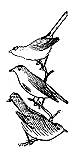
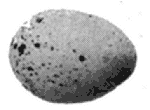
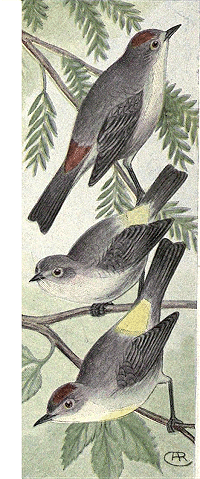
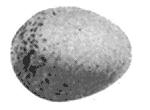
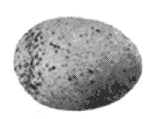
Page 389 Nashville Warbler. Orange-crowned Warbler. 645. Nashville Warbler. Vermivora rubricapilla rubricapilla. Range.--North America east of the Plains, breeding from New York and Illinois north to Hudson Bay and Labrador; winters south of our borders. White. This small species is yellow below and greenish above, with an ashy gray head and neck, enclosing a chestnut crown patch. They breed abundantly in New England, usually on side hills covered with clumps of young pines, the nests being placed flush with the surface of the ground and usually covered with overhanging grass; they are made of grasses and pine needles, the eggs are white, finely specked with bright reddish brown. Size .60 × .45. Data.--Worcester, Mass., June 23, 1895. Nest of pine needles and grasses in hollow in the moss on a scrubby pine hillside. 645a. Calaveras Warbler. Vermivora rubricapilla gutturalis. Range.--Western United States, breeding on ranges from California and Idaho north to British Columbia; winters in Mexico. A slightly brighter colored form of the last species. Their habits are the same and the eggs cannot be distinguished from those of the eastern bird. 646. Orange-crowned Warbler. Vermivora celata celata. Range.--North America, chiefly in the interior, breeding north of the United States except in the Rockies south to Arizona and New Mexico; winters in the Gulf States and southward. White. This plainly clad, greenish colored species has a concealed patch of orange brown on the crown. They have been found breeding about Hudson Bay and in the Mackenzie River district, placing their nests in hollows on the ground, usually on the side of banks or hills and concealed by small tufts of grass or bushes. The three or four eggs are white, speckled with reddish brown. Size .64 × .45. 646a. Lutescent Warbler. Vermivora celata lutescens. Range.--Pacific coast, breeding from California to Alaska; winters in Mexico. Similar to the last but more yellowish below. They make their nests of leaves, rootlets, moss, etc., lined with hair, and placed on the ground, concealed by tufts of grass or by bushes. The eggs are like those of the last. Data.--Danville, Cal., April 21, 1898. Nest on the ground on a side hill; among weeds in the shade of a large oak.
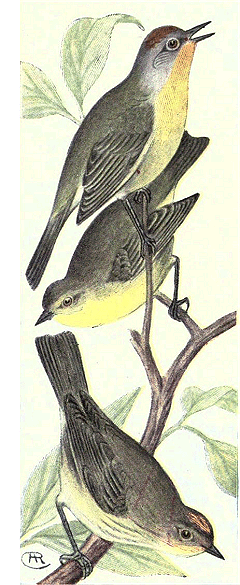
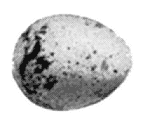
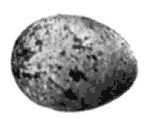
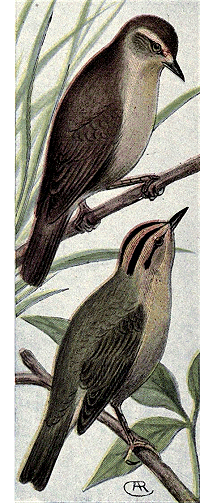
Page 390 Tennessee Warblers. Olive Warblers. 646b. Dusky Warbler. Vermivora celata sordida. Range.--Santa Barbara Islands, off California. Said to be duller colored and darker than the others. The eggs cannot be distinguished. 647. Tennessee Warbler. Vermivora peregrina. Range.--Eastern North America, breeding from the northern tier of states, northward; winters to northern South America. White. This species has greenish upper parts, white lower parts and superciliary line, and gray crown and nape. They nest either on the ground or at low elevations in bushes, making the structure of grasses and fibres, lined with hair; they are found on wild, tangled hillsides and mountain ranges. The eggs are pure white, sparingly specked with reddish brown. Size .62 × .45. 648. Parula Warbler. Compsothlypis americana americana. Range.--Eastern United States, breeding in the southern half. The upper parts of this handsome species are bluish gray with a greenish patch in the middle of the back; the throat and breast are yellow with a patch of black and chestnut. They are abundant birds in suitable localities, breeding in swamps, especially those with old or dead trees covered with hanging moss (usnea). White. The nests may be found at any height from the ground, and are usually made by turning and gathering up the ends of the hanging moss to form a pocket, which is lined with fine grass or hair. The four to six eggs are white or creamy white, wreathed with specks of reddish brown and chestnut. Size .64 × .44. 648a. Northern Parula Warbler. Compsothlypis americana usneæ. Range.--Northern half of eastern United States and southern Canada; winters from the Gulf States southward. The nesting habits of the northern form of the Blue-yellow-backed Warbler are in all respects like those of the last, and like them, where moss grown swamps are not to be found, they have been known to construct nests of moss suspended from branches of trees, or to nest in bunches of dead leaves. Data.--Oxford, Mass., June 7, 1895. Nest in a dead pine swamp; made in end of hanging moss about 6 feet from the ground. Large colony breeding.
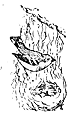
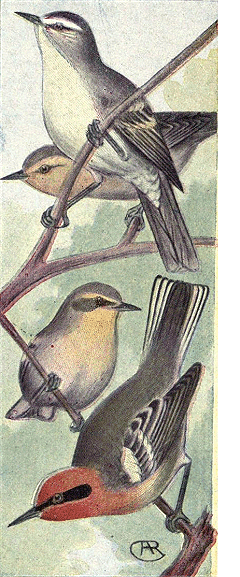
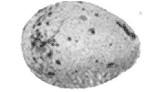
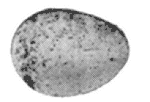
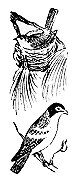
Page 391 Parula Warbler. Sennett's Warbler. 649. Sennett's Warbler. Compsothlypis piti ayumi nigrilora. Range.--Eastern Mexico, north to the Lower Rio Grande Valley in Texas. This species is similar to the Parula but is more extensively yellow below, and has black lores and ear coverts. Their habits are the same as those of the last and their nests are generally placed in hanging moss, and are also said to have been found hollowed out in the mistletoe which grows on many trees in southern Texas, New Mexico and Arizona. The eggs cannot be distinguished from those of the last. 650. Cape May Warbler. Dendroica tigrina. White. Range.--Eastern North America, breeding from northern New England and Manitoba northward; winters south of the United States. This beautiful Warbler is yellow below and on the rump, streaked on the breast and sides with black; the ear coverts and sometimes the throat are chestnut. They are very local in their distribution both during migrations and in their breeding grounds. They nest in the outer branches of trees, preferably conifers, making the nest of slender twigs, rootlets, grasses, etc., lined with hair; the four or five eggs are white, variously specked with reddish brown and lilac; size .65 × .48. 651. Olive Warbler. Peucedramus olivaceus. Range.--Mountains of New Mexico and Arizona southward. Grayish blue. This peculiar species may readily be recognized by its saffron or orange-brown colored head and neck, with broad black bar through the eye. They nest at high elevations in coniferous trees on the mountain sides, placing their nests either on the horizontal boughs or forks at the end of them. The nests are very beautiful structures made of moss, lichens, fine rootlets and grasses and setting high on the limb like those of the Blue-gray Gnatcatcher. The eggs are grayish white with a bluish tinge, thickly speckled with blackish; size .64 × .48. Data.--Huachuca Mts., Arizona, June 21, 1901. Nest in a sugar pine near extremity of branch, 25 feet from the ground and 20 feet out from the trunk of the tree; composed of lichens and fine rootlets, lined with plant down.
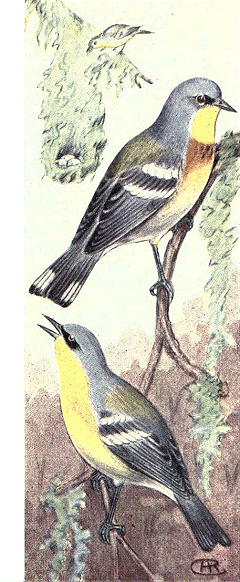
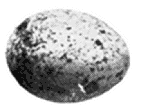
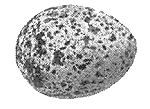
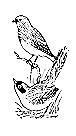
Page 392 Cape May Warblers. Yellow Warblers. 652. Yellow Warbler. Dendroica æstiva æstiva. Range.--Breeds in the whole or North America; winters south of our borders. Greenish white. This well known and very common species is wholly yellow, being more or less greenish on the back, wings and tail, and the male is streaked on the sides with chestnut. They nest anywhere in trees or bushes, either in woods, pastures, parks or dooryards, and their sprightly song is much in evidence throughout the summer. The nests are usually placed in upright crotches or forks, and are made of vegetable fibres and fine grasses compactly woven together and lined with plant down and hair; the eggs, which are laid in May or June, are greenish white, boldly specked in endless patterns with shades of brown and lilac; size .65 × .50. 652a. Sonora Yellow Warbler. Dendroica æstiva sonorana. Range.--Arizona, New Mexico and western Texas, southward. This form is brighter yellow, especially above, than the last. The nesting habits are the same and the eggs indistinguishable from those of the preceding. 652b. Alaska Yellow Warbler. Dendroica æstiva rubiginosa. Range.--Breeds in Alaska and on the coast south to Vancouver; winters south of the United States. Similar to the common Yellow Warbler but slightly darker above; its eggs and nesting habits are the same.
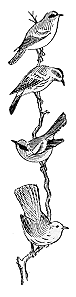
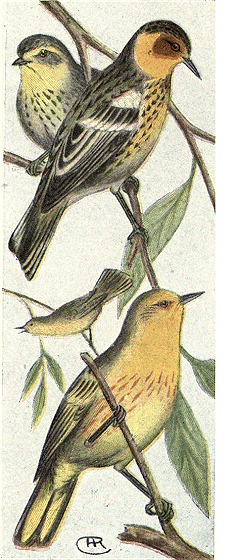
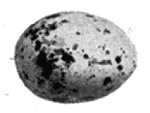
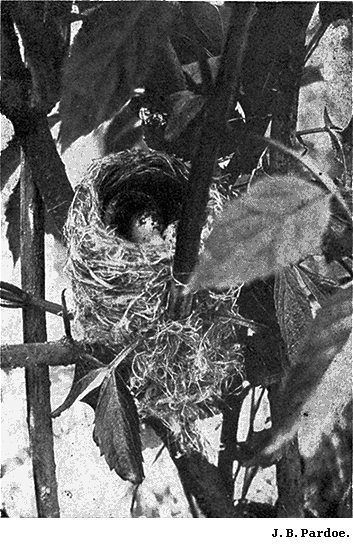
Page 393 NEST OF YELLOW WARBLER.
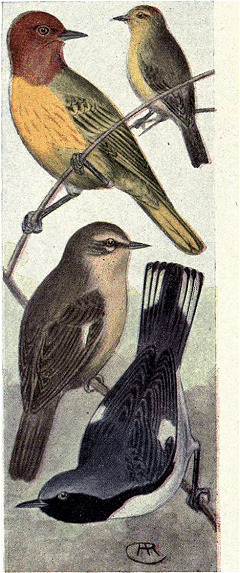
Page 394 Mangrove Warblers. Black-throated Blue Warblers. 653. Mangrove Warbler. Dendroica bryanti castaneiceps. Greenish white. Range.--Southern Lower California and western Mexico and Central America. This species is very similar to the Yellow Warbler but the entire head and neck of the male are yellowish chestnut. Their nesting habits or eggs do not vary in any essential particular from those of the common Yellow-birds of the United States. 654. Black-throated Blue Warbler. Dendroica cærulescens cærulescens. Range.--Eastern North America, breeding from northern United States northward; winters in the Gulf States and southward. Buffy white. These black-throated bluish-backed Warblers are abundant in swampy woodland both during migrations and at their breeding grounds; either sex can readily be identified in any plumage, by the presence of a small white spot at the base of the primaries. They nest in underbrush or low bushes only a few inches above the ground, making the nests of bark strips, moss rootlets, etc., lined with fine grasses or hair; the eggs are pale buffy white more or less dotted with pale brownish; size .65 × .50. Data.--Warren, Pa., June 9, 1891. 3 eggs. Nest one foot from the ground in brush; made of fine pieces of rotten wood, laurel bark and lined with fine grasses. 654a. Cairns Warbler. Dendroica cærulescens cairnsi. Range.--Mountain ranges of North Carolina to Georgia. A darker form whose habits and eggs are identical with those of the last.
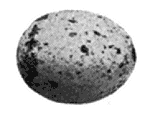
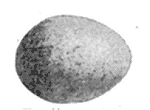
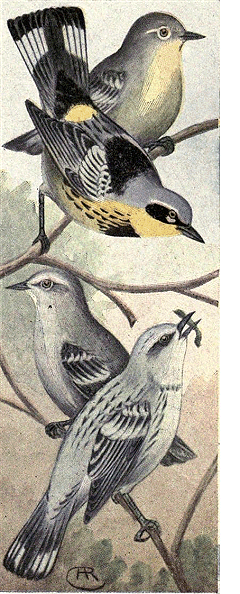
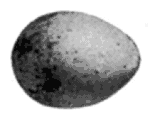
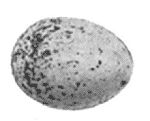
Page 395 Myrtle Warblers. Audubon's Warblers. 655. Myrtle Warbler. Dendroica coronata. Range.--Eastern North America, breeding from northern United States northward. Winters in the southern half of eastern United States. White. This beautiful gray, white and black Warbler can readily be identified by its yellow rump, side patches and crown patch. It is one of our most common species during migrations when it is found west to the Rockies and casually farther. They nest on the lower branches of coniferous trees, making their homes of rootlets, plant fibres and grasses; during June or the latter part of May, three or four eggs are laid; they are white, spotted with several shades of brown and lilac; size .70 × .50. Data.--Lancaster, N. H., June 7, 1888. Nest in a small spruce, about 6 feet up; made of fine twigs, lined with feathers. 656. Audubon's Warbler. Dendroica auduboni auduboni. Range.--Mountain ranges of western United States from British Columbia to Mexico. Bluish white. This bird resembles the last in the location of the yellow patches but has a yellow instead of a white throat, and is otherwise differently marked. They are as abundant in suitable localities as are the Myrtle Warblers in the east, nesting on the outer branches of coniferous trees at any height from the ground. The nests are made of bark strips, rootlets, plant fibre, grasses and pine needles, the three to five eggs are greenish or bluish white marked with brown and lilac; size .68 × .52. The one figured is from a beautiful set of four in Mr. C. W. Crandall's collection, and the ground color is a delicate shade of blue. Data.--Spanaway, Washington, April 23, 1902. Nest on the limb of a large fir in a clump of three in prairie country. 656a. Black-fronted Warbler. Dendroica auduboni nigrifrons. Range.--Mountains of southern Arizona and Mexico. Similar to the preceding, but with the forehead and ear coverts black. Their nests and eggs are in no way different from those of Audubon's Warbler.
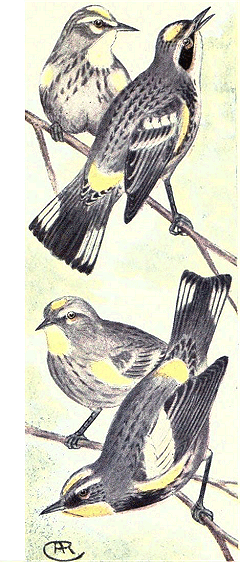
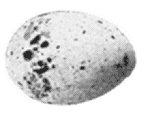
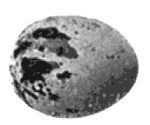
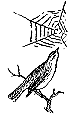
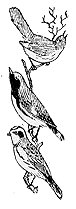
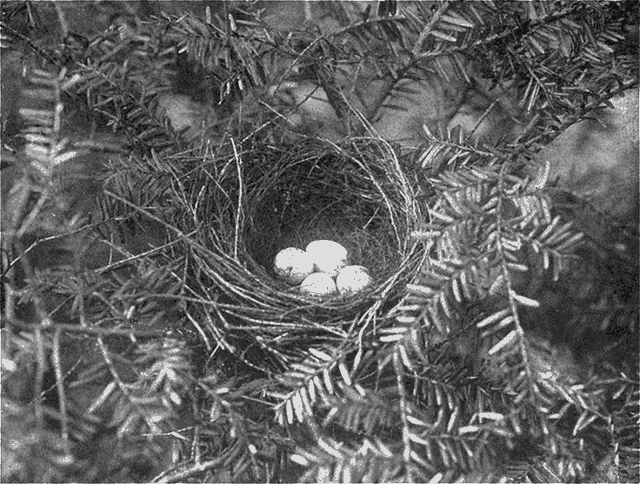
Page 396 Magnolia Warblers. Cerulean Warblers. 657. Magnolia Warbler. Dendroica magnolia. Range.--North America east of the Rockies, breeding from northern United States to Hudson Bay region and in the Alleghanies, south to Pennsylvania. Winters south of our borders. This species, which is one of the most beautiful of the Warblers, is entirely yellow below and on the rump, the breast and sides being heavily streaked with black; a large patch on the back and the ear coverts are black. White. They build in coniferous trees at any elevation from the ground, making their nests of rootlets and grass stems, usually lined with hair; the eggs are dull white, specked with pale reddish brown; size .65 × .48. Data.--Worcester, Mass., May 30, 1895. 4 eggs. Nest of fine rootlets and grasses about 30 feet up on the end of a limb of a pine overhanging a brook. 658. Cerulean Warbler. Dendroica cærulea. Range.--United States east of the Plains, breeding chiefly in the northern half of the Mississippi Valley, rare east of the Alleghanies and casual in New England. White. These beautiful Warblers are light blue gray above, streaked with black on back, white below, with a grayish blue band on breast and streaks on the sides; they have two wide white wing bars and spots on the outer tail feathers. They are found chiefly in the higher trees where they glean on the foliage; they build also usually above twenty feet from the ground in any kind of tree, placing the nests well out on the horizontal limbs, generally in a fork. The nests are made of fine strips of bark, fibres, rootlets, etc., lined with hair; the eggs are white or pale bluish white, specked with reddish brown; size .62 × .48. Data.--Fargo, Ontario, June 2, 1901. Nest in a burr oak, 18 feet from the ground on a horizontal limb.
Page 397 NEST OF MAGNOLIA WARBLER.
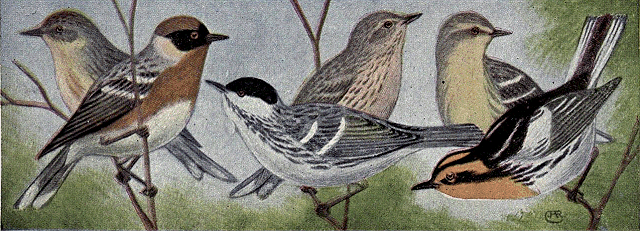
Page 398 Chestnut-sided Warblers. Bay-breasted Warblers. 659. Chestnut-sided Warbler. Dendroica pensylvanica. Range.--United States, east of the Plains, breeding in the Middle States and Illinois, north to Manitoba and New Brunswick. Winters south of our border. White. The adults of this handsome species may readily be known by the white underparts and the broad chestnut stripe on the flanks; the crown is yellow. They frequent low brush in open woods or on hillsides and pastures, nesting at low elevations, usually below three feet from the ground, and often concealing their nests beneath the leaves in the tops of low small bushes. The nests are made of grasses, weed stems and some fibres, but they do not have as wooly an appearance as those of the Yellow Warblers which nest in the same localities and similar locations. Their eggs are white or creamy white (never greenish white), specked with brown and gray. Size .65 × .50. Data.--Worcester, Mass., June 6, 1890. Nest in the top of a huckleberry bush, 2 feet from the ground; made of grasses and plant fibres. Bird did not leave nest until touched with the hand. 660. Bay-breasted Warbler. Dendroica castanea. Range.--North America, east of the Plains, breeding from northern United States north to the Hudson Bay; winters in Central and South America. White. This species has the crown, throat and sides a rich chestnut; forehead and face black; underparts white. They nest in coniferous trees in swampy places, making their nests of bark shreds and rootlets and placing them in horizontal forks at elevations of from five to thirty feet from the ground. The three or four eggs are laid late in May or during June; they are white, usually quite heavily spotted and blotched with reddish brown, umber and grayish. Size .70 × .50.
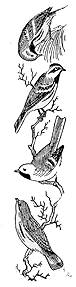
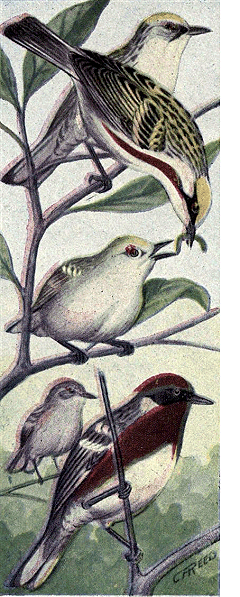
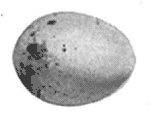
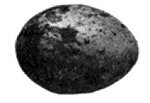

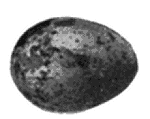
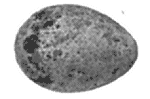
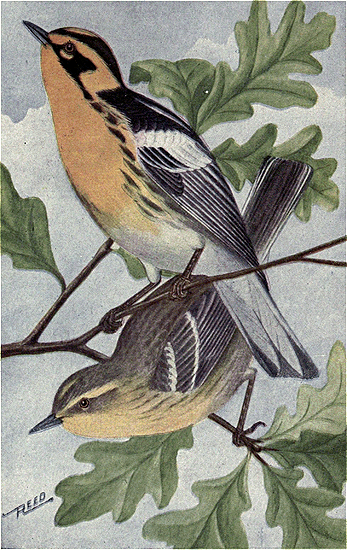
Page 399 Black-poll Warblers. Blackburnian Warblers. 661. Black-poll Warbler. Dendroica striata. Range.--North America, east of the Rockies, breeding from northern United States north to Labrador and Alaska; winters in South America. White. This black and white Warbler has a solid black cap, and the underparts are white, streaked with black on the sides. In the woods they bear some resemblance to the Black and White Warbler, but do not have the creeping habits of that species. During migrations they are found in equal abundance in swamps or orchards. In their breeding range, they nest at low elevations in stunted pines or spruces, making their nests of rootlets and lichens, lined with feathers. The eggs are dull whitish, spotted or blotched with brown and neutral tints. Size .72 × .50. Data.--Grand Manan, N. B., June 12, 1883. Nest and four eggs on branch of a stunted spruce 2 feet from the ground. 662. Blackburnian Warbler. Dendroica fusca. Range.--North America, east of the Plains, breeding from Massachusetts and Minnesota north to Hudson Bay; south in the Alleghanies to the Carolinas. Winters in Central and South America. Greenish white. This species is, without exception, the most exquisite of the family; the male can always be known by the bright orange throat, breast and superciliary stripe, the upper parts being largely black. They arrive with us when the apple trees are in bloom and after a week's delay pass on to more northerly districts. Their nests are constructed of rootlets, fine weed stalks and grasses, lined with hair, and are placed on horizontal limbs of coniferous trees. The three or four eggs are greenish white, speckled, spotted and blotched with reddish brown and neutral tints. Size .70 × .48. Data.--Lancaster, Mass., June 21, 1901. Nest in a white pine, 38 feet from the ground on a limb 4 feet from the trunk; composed of fine rootlets and hair, resembling the nest of a Chipping Sparrow.
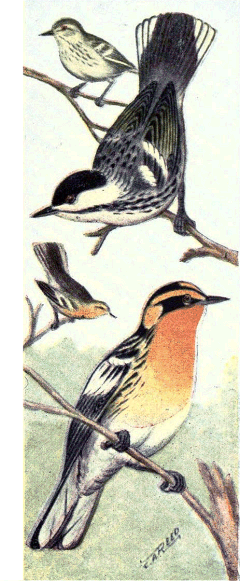
Page 400 BLACKBURNIAN WARBLERS.
Page 401 Yellow-throated Warblers. Grace's Warblers. 663. Yellow-throated Warbler. Dendroica dominica dominica. Range.--South Atlantic and Gulf States, north to Virginia and casually farther; winters in Florida and the West Indies. Greenish white. This species has gray upper parts with two white wing bars, the throat, breast and superciliary line are yellow, and the lores, cheeks and streaks on the sides are black. These birds nest abundantly in the South Atlantic States, usually in pines, and either on horizontal limbs or in bunches of Spanish moss. The nests are made of slender pieces of twigs, rootlets and strips of bark, and lined with either hair or feathers, the eggs are three to five in number, pale greenish white, specked about the large end with reddish brown and gray. Size .70 × .50. Data.--Raleigh, N. C., May 3, 1890. Nest 43 feet up on limb of pine; made of grasses and hair. 663a. Sycamore Warbler. Dendroica dominica albilora. Range.--Mississippi Valley, breeding north to Ohio and Illinois, and west to Kansas and Texas; winters south of the United States. This bird is precisely like the last except that the superciliary stripe is usually white. Their nesting habits are precisely like those of the last, and the nests are usually on horizontal branches of sycamores; the eggs cannot be distinguished from those of the Yellow-throated Warbler. 664. Grace's Warbler. Dendroica graciæ. Range.--Southwestern United States, abundant in Arizona and New Mexico. White. This Warbler is similar in markings and colors to the Yellow-throated variety except that the cheeks are gray instead of black. The nesting habits of the two species are the same, these birds building high in coniferous trees; the nests are made of rootlets and bark shreds, lined with hair or feathers; the eggs are white, dotted with reddish brown and lilac. Size .68 × .48.
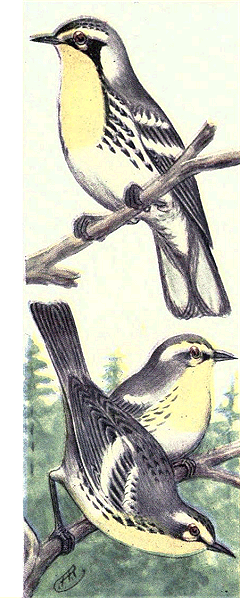
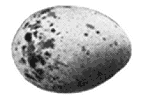
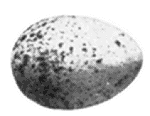
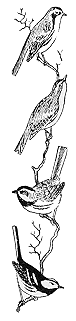
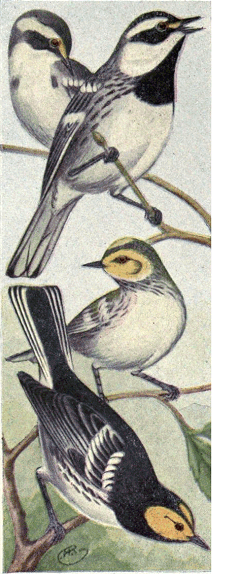
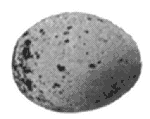
Page 402 Black-throated Warblers. Golden-cheeked Warblers. 665. Black-throated Gray Warbler. Dendroica nigrescens. Range.--United States from the Rockies to the Pacific coast and north to British Columbia; winters south of our borders. Greenish white. The general color of this species is grayish above and white below as is a superciliary line and stripe down the side of the throat; the crown, cheeks and throat are black and there is a yellow spot in front of the eye. They inhabit woodland and thickets and are common in such localities from Arizona to Oregon, nesting usually at low elevations in bushes or shrubs; the nests are made of grasses and fibres, woven together, and lined with hair or fine grasses, resembling, slightly, nests of the Yellow Warbler. The eggs are white or greenish white, specked with reddish brown and umber. Size .65 × .52. Data.--Waldo, Oregon, June 1, 1901. Nest 3 feet from the ground in a small oak in valley. Collector, C. W. Bowles. (Crandall collection.) 666. Golden-cheeked Warbler. Dendroica chrysoparia. Range.--Central and southern Texas south to Central America. White. This beautiful and rare species is entirely black above and on the throat, enclosing a large bright yellow patch about the eye and a small one on the crown. In their very restricted United States range, the birds are met with in cedar timber where they nest at low elevations in the upright forks of young trees of this variety. Their nests are made of strips of cedar bark, interwoven with plant fibres and spider webs making compact nests, which they line with hair and feathers. Their three or four eggs are white, dotted and specked with reddish brown and umber. Size .75 × .55.
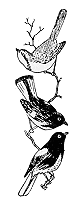
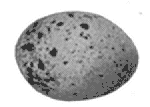
Page 403 Black-throated Green Warbler. Townsend's Warblers. 667. Black-throated Green Warbler. Dendroica virens. Range.--Eastern United States, breeding from southern New England, South Carolina in the Alleghanies, and Illinois north to Hudson Bay; winters south of the United States. White. These common eastern birds are similar to the last but the entire upper parts are olive greenish. They are nearly always found, and always nest, in pines, either groves or hillsides covered with young pines. The nests are usually placed out among the pine needles where they are very difficult to locate, and resemble nests of the Chipping Sparrow. I have found them at heights ranging from six to forty or fifty feet from the ground. The three or four eggs, which they lay in June, are white, wreathed and speckled with brownish and lilac. Size .60 × .50. 668. Townsend's Warbler. Dendroica townsendi. White. Range.--Western United States, from the Rockies to the Pacific and from Alaska southward; winters in Mexico. This is the common western representative of the last species, and is similar but has black ear patches and the crown is black. They nest in coniferous woods throughout their United States and Canadian range, the nests being placed at any height from the ground and being constructed like those of the Black-throated Green. Their eggs are not distinguishable from those of the latter. Size .60 × .50.
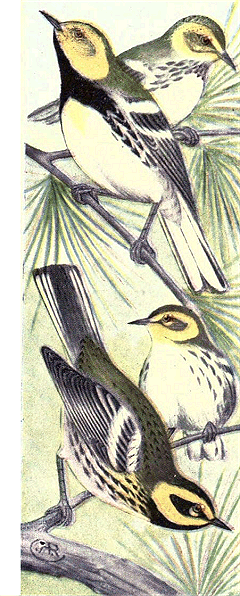
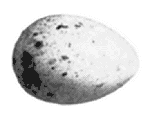
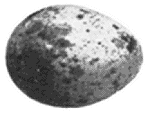
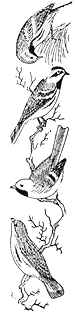
Page 404 Hermit Warblers. Kirtland's Warblers. 669. Hermit Warbler. Dendroica occidentalis. Range.--Western United States and British Columbia chiefly on the higher ranges. Winters south to Central America. This peculiar species has the entire head bright yellow and the throat black; upperparts grayish, underparts white. They are found nesting in wild rugged country, high up in pine trees, the nests being located among bunches of needles so that they are very difficult to find. The nests are made of rootlets, shreds of bark, pine needles, etc., lined with fine grasses or hair. The three or four eggs are laid during June or the latter part of May; they are white or creamy white, and sometimes with a faint greenish tinge, specked and wreathed with brown and lilac gray. Size .68 × .52. 670. Kirtland's Warbler. Dendroica kirtlandi. Range.--Eastern United States; apt to be found in any of the South Atlantic, Middle or Central States, and in Ontario, Canada. Winters in the Bahamas where by far the greater number of specimens have been found. This very rare Warbler is bluish gray above, streaked with black, and yellow below with the throat and sides streaked. Until the summer of 1903, the locality where they bred was a mystery. The capture of a specimen, in June, in Oscodo Co., Michigan, led to the search for the nests by N. A. Wood, taxidermist for the Michigan Museum at Ann Arbor. He was successful in his quest and found two nests with young and one egg. The nest in which the egg was found contained two young birds also. It was in a depression in the ground at the foot of a Jack pine tree and only a few feet from a cart road. The nest was made of strips of bark and vegetable fibres, lined with grass and pine needles. The egg is white, sprinkled with brown in a wreath about the large end. Size .72 × .56. It is estimated that there were thirteen pairs of the birds in this colony.
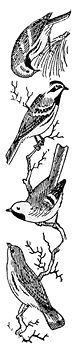
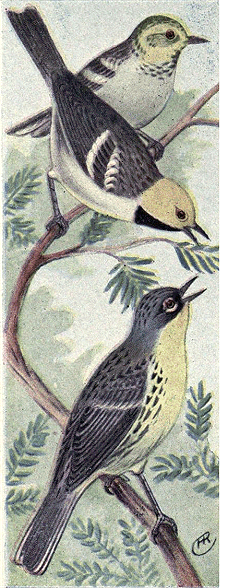
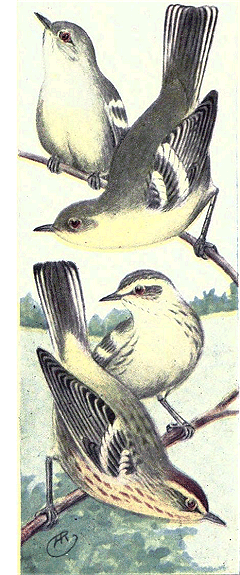
Page 405 Pine Warblers. Palm Warblers. 671. Pine Warbler. Dendroica vigorsi. Range.--Eastern United States, breeding from the Gulf to southern British Provinces; winters in the Gulf States and southward. Dull white. This common eastern species is greenish above and dull yellowish below, streaked with dusky on the sides. They are almost exclusively found in pine woods, either light or heavy growth, where they can always be located by their peculiar, musical lisping trill. They nest high in these trees, placing their nests in thick bunches of needles, so that they are very difficult to locate. They nest from March in the south to May in the northern states, laying three or four dull whitish eggs, specked or blotched with shades of brown and lilac; size .68 × .52. Data.--Worcester, Mass., May 28, 1891. Nest 30 feet up in a pine; made of pine needles and rootlets. 672. Palm Warbler. Dendroica palmarum palmarum. Range.--Interior of North America, breeding about Hudson Bay and northward and wintering in the lower Mississippi Valley and the West Indies. Creamy white. This species is brownish yellow above and yellow on the throat and breast, the crown and streaks on the sides are chestnut. They are found during migrations on or near the ground on the edges of woods or thickets and along roadsides; have a peculiar habit of "teetering" their tail which will readily identify them. They nest on the ground in, or on the edges of swampy places, lining the hollow with grasses and rootlets. In May or June they lay three or four eggs which are creamy white, variously specked with brown and lilac; size .68 × .52. 672a. Yellow Palm Warbler. Dendroica palmarum hypochrysea. Range.--Eastern North America, breeding from Nova Scotia, northward. This is the common Yellow Redpoll Warbler of the eastern states, and is very abundant during migrations. Their habits are the same, if not identical with the interior species. Their nests are also like those of the last, placed on the ground and the eggs are indistinguishable.
Page 406 PRAIRIE WARBLER NEST.
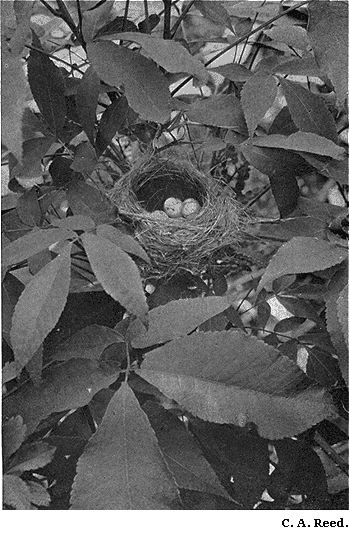
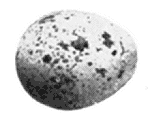
Page 407 Prairie Warblers. Oven-bird. 673. Prairie Warbler. Dendroica discolor. Range.--Eastern United States, breeding from the Gulf to Massachusetts and Ontario; winters in southern Florida and the West Indies. Whitish. A species readily recognized by its bright yellow underparts and the black stripes on the face and sides; several bright chestnut spots are in the middle of the greenish back. These birds will be found on dry scrubby hillsides and valleys, where they nest in low bushes, and the male will be found in the tops of the tallest lookout trees delivering his quaint and very peculiar lisping song. Their nests are handsomely made of vegetable fibres and grasses, closely woven together and lined with hair; this structure is placed in the top of low bushes so that it is well concealed by the upper foliage. Their three to five eggs are whitish, specked and spotted with shades of brown and neutral tints; size .64 × .48. Data.--Worcester, Mass., June 23, 1891. Nest in the top of a young walnut, two feet from ground; made of plant fibres and grasses. Four eggs. 674. Oven-bird. Seiurus aurocapillus. Range.--North America east of the Rockies, breeding from the middle portions of the United States, north to Labrador and Alaska. Winters from the Gulf States southward. This species is fully as often known as the Golden-crowned Thrush, because of its brownish orange crown bordered with black. White. They are woodland birds exclusively and nest on the ground, arching the top over with rootlets or leaves, the nest proper being made of grasses and leaf skeletons. As they are concealed so effectually, the nests are usually found by flushing the bird. The four to six eggs are white, slightly glossy and spotted, blotched or wreathed with reddish brown and lilac; size .80 × .60. Data.--Old Saybrook, Conn., June 19, 1899. Domed nest with a side entrance on the ground in woods.
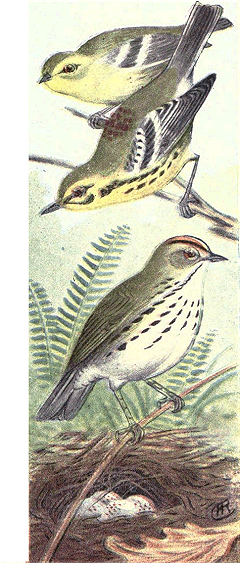
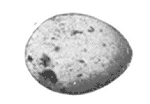
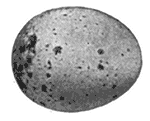
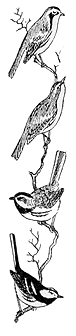
Page 408 ARCHED NEST OF OVEN-BIRD. NEST AND EGGS OF LOUISIANA WATER-THRUSH.
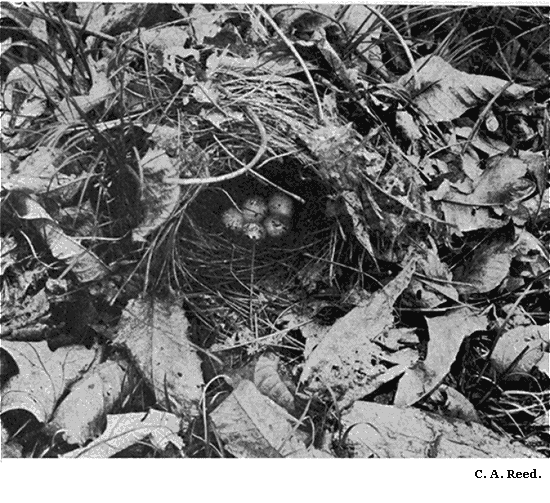
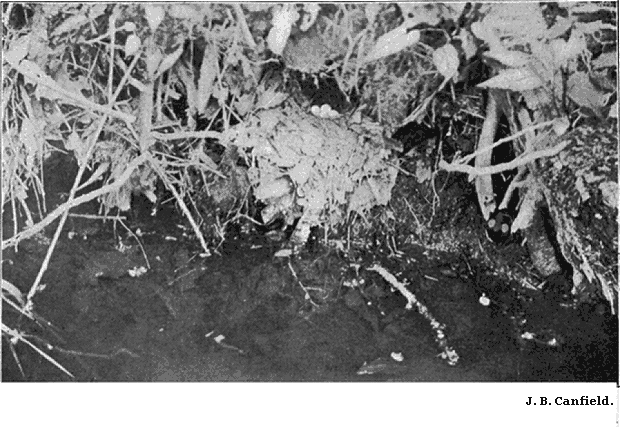
Page 409 Louisiana Water Thrush. Water-Thrush. 675. Water-Thrush. Seiurus novebora censis noveboracensis. Range.--Eastern North America, breeding from northern United States north to Hudson Bay and Newfoundland. Winters from the Gulf to South America. White. This species is uniform brownish olive above and white below, streaked heavily with blackish; it has a whitish superciliary line. It is known in most of the United States only as a migrant, being found in moist woods or swampy places. They nest in such localities in their breeding range, placing their nests among the cavities of rootlets and stumps, the nest being made of moss, leaves and rootlets. Their eggs are white, profusely specked and blotched with reddish brown and lavender gray. Size .80 × .60. Data.--Listowell, Ontario, May 28, 1895. Nest in a turned-up root over water; made of moss, grass and hair. Collector, Wm. L. Kells. This set of five is in the collection of Mr. C. W. Crandall. 675a. Grinnell's Water-Thrush. Seiurus noveboracensis notabilis. Range.--Western North America, migrating between the Mississippi Valley and the Rockies; breeds from northern United States north to Alaska; winters in the south. This sub-species is said to be very slightly larger, darker on the back, and paler below. Their nesting habits and eggs are identical with those of the last. 676. Louisiana Water-Thrush. Seiurus motacilla. Range.--Eastern United States, breeding from the Gulf, north to southern New England, Ontario and Minnesota; winters south of our borders. White. This species is similar to the last but is larger, grayer and less distinctly streaked on the underparts. They nest in swampy places, concealing their home in nooks among roots of trees or under overhanging banks, the nest being made of leaves, moss, mud, grasses, etc., making a bulky structure. The eggs, which are laid in May and number from four to six, are white, spotted and blotched with chestnut and neutral tints. Size .76 × .62.
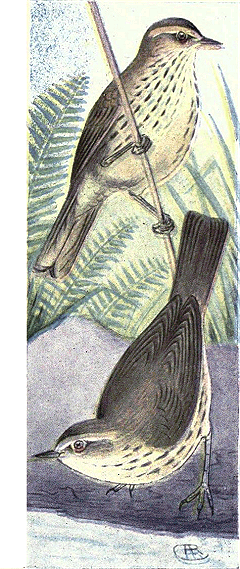
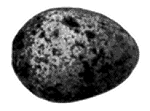
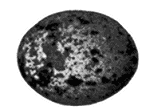

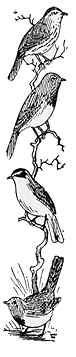
Page 410 Kentucky Warbler. Connecticut Warblers. 677. Kentucky Warbler. Oporornis formosus. Range.--Eastern United States, breeding from the Gulf to New York and Michigan; winters south of the United States to South America. White. Crown and ear coverts black, underparts and line over eye yellow; no white in the plumage. These birds are found in about such localities as are frequented by Oven-birds, but with a preference for woods which are low and damp. They are locally common in some of the southern and central states. They are active gleaners of the underbrush, keeping well within the depths of tangled thickets. Like the Maryland Yellow-throat, which has similar habits to those of this bird, they are quite inquisitive and frequently come close to you to investigate or to scold. They nest on the ground in open woods or on shrubby hillsides, making large structures, of leaves and strips of bark, lined with grasses. The eggs are white, sprinkled with dots or spots of reddish brown and gray. Size .70 × .55. Data.--Greene Co., Pa., May 26, 1894. 4 eggs. Nest a mass of leaves, lined with rootlets, placed on the ground at the base of a small elm sprout in underbrush on a hillside. 678. Connecticut Warbler.--Oporonis agilis. Range.--Eastern United States; known to breed only in Manitoba and Ontario. These birds have greenish upperparts and sides, yellowish underparts, and an ashy gray head, neck and breast; they have a complete whitish ring about the eye, this distinguishing them in any plumage from the two following species. As they do most of their feeding upon the ground and remain in the depths of the thickets, they are rarely seen unless attention is drawn to them. They are quite abundant in New England in fall migrations, being found in swampy thickets. They have been found breeding in Ontario by Wm. L. Kells, the nest being on the ground in the woods among raspberry vines. It was made of leaves, bark fibres, grass, rootlets and hair. The eggs are white, specked with brown and neutral tints. Size .75 × .55.
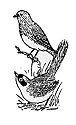
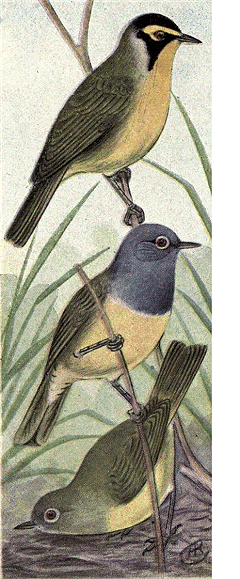
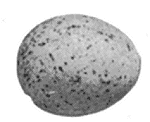
Page 411 Mourning Warblers. Macgillivray Warblers. 679. Mourning Warbler. Oporornis philadelphia. Range.--Eastern United States, breeding from northern New England, Pennsylvania, (Philadelphia) and Nebraska northward. White. Very similar to the last but with no eye ring and a black patch on the breast. The habits and nesting habits of this species are very similar to those of agilis, the nest being on or very close to the ground. With the exception of on mountain ranges it breeds chiefly north of our borders. The eggs are white, specked with reddish brown. Size .72 × .55. They cannot be distinguished from those of the last. Data.--Listowell, Ontario, June 5, 1898. Nest in a tuft of swamp grass in low ground; not very neatly made of dry leaves, grasses and hair. Collector, Wm. L. Kells. (Crandall collection.) 680. Macgillivray Warbler. Oporornis tolmiei. Range.--Western United States from the Rockies to the Pacific, breeding north to British Columbia; winters in Mexico and Central America. White. Similar to the last but with white spots on the upper and lower eyelids, black lores, and the black patch on the breast mixed with gray. These ground inhabiting birds are found in tangled thickets and shrubbery where they nest at low elevations, from one to five feet from the ground. Their nests are made of grasses and shreds of bark, lined with hair and finer grasses, and the eggs are white, specked, spotted and blotched with shades of brown and neutral tints; size .72 × .52. Data.--Sonoma, Cal., May 17, 1897. A small nest, loosely made of grasses (wild oats) lined with finer grasses; placed in blackberry vines 14 inches from the ground in a slough in the valley.
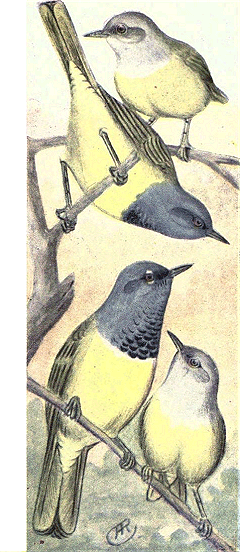
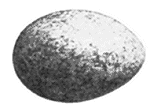
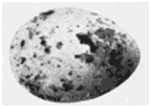

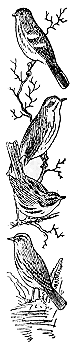
Page 412 Maryland Yellow-throats. Belding's Yellow-throat. 681. Maryland Yellow-throat. Geothlypis trichas trichas. Range.--Eastern United States; this species has recently been still further sub-divided so that this form is supposed to be restricted to the south Atlantic coast of the United States. White. The Maryland Yellow-throat is represented in all parts of the United States by one of its forms. They are ground loving birds, frequenting swamps and thickets where they can be located by their loud, unmistakable song of "Witchery, w i t c h e r y, witch." They nest on or very near the ground, making their nests of grass, lined with hair; these are either in hollows in the ground at the foot of clumps of grass or weeds, or attached to the weed stalks within a few inches of the ground. They lay from three to five eggs in May or June; these are white, specked about the larger end with reddish brown and umber, and with shell markings of stone gray. Size .70 × .50. All the sub-species of this bird have the same general habits of this one and their eggs cannot be distinguished from examples of the eastern form; the birds, too, owing to the great differences in plumage between individuals from the same place, cannot be distinguished with any degree of satisfaction except by the ones who "discovered" them. 681a. Western Yellow-throat. Geothlypis trichas occidentalis. Range.--This variety, which is said to be brighter yellow below, is ascribed to the arid regions of western United States; not on the Pacific coast. 681b. Florida Yellow-throat. Geothlypis trichas ignota. Range.--South Atlantic and Gulf coast to Texas. 681c. Pacific Yellow-throat. Geothlypis trichas arizela. Range.--Pacific coast from British Columbia southward. 681e. Salt Marsh Yellow-throat. Geothlypis trichas sinuosa. Range.--Salt marshes of San Francisco Bay.
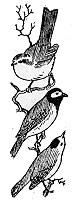
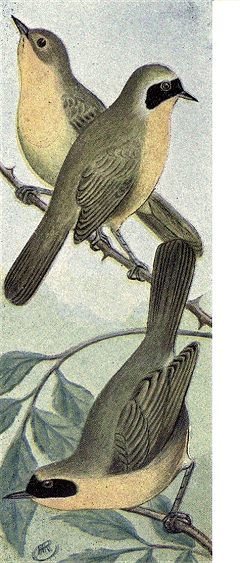
Page 413 Rio Grande Yellow-throat. Yellow-breasted Chat. 682. Belding's Yellow-throat. Geothlypis beldingi. Range.--Lower California. This peculiar species is like the common Yellow-throat but has the black mask bordered by yellow instead of white, and the black on the forehead extends diagonally across the head from in front of one eye to the rear of the other. Their habits are like those of the other Yellow-throats and the nests are similar to those of the latter, which are frequently placed in cane over the water. Nests found by Mr. Walter E. Bryant were situated in clumps of "cat-tails" between two and three feet above the water; the nests were made of dry strips of these leaves, lined with fibres; the eggs were like those of the common Yellow-throats but larger; size .75 × .56. 682.1. Rio Grande Yellow-throat. Chamæthlypis poliocephala. Range.--Mexico north to the Lower Rio Grande Valley in Texas. This Yellow-throat has the crown and ear coverts gray, only the lores and forehead being black. The nests and eggs of these birds, which are fairly common about Brownsville, Texas, do not differ from those of the other Yellow-throats. 683. Yellow-breasted Chat. Icteria virens virens. Range.--Eastern United States, breeding from the Gulf coast north to southern New England and Minnesota. White. This strange but handsome species is very common in underbrush and thickets in the south; they are usually shy and endeavor, with success, to keep out of sight, but their strange song and calls, consisting of various whistles and squawks mingled together, are often heard. Their nests are built in bushes or briars at low elevations, being made of grass, strips of bark and leaves, lined with finer grass; their eggs are white, sharply speckled and spotted with various shades of brown and lavender; size .90 × .70. 683a. Long-tailed Chat. Icteria virens longicauda. Range.--United States west of the Plains, breeding from Mexico to British Columbia. This bird is said to be grayer and to have a slightly longer tail than the last. Its nesting habits and eggs are precisely the same.
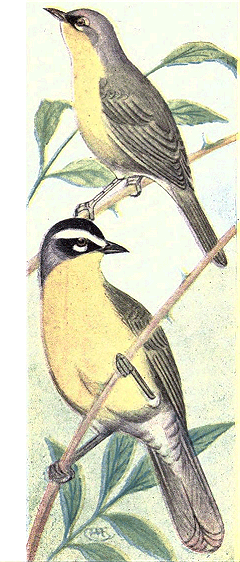
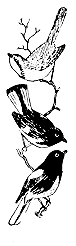
Page 414 Hooded Warblers. Wilson's Warblers. 684. Hooded Warbler. Wilsonia citrina. Range.--Eastern United States, breeding north to southern New England and Michigan; winters south of our borders. White. This yellow and greenish species can be identified by its black head, neck and throat, with the large yellow patch about the eye and the forehead. The members of this genus are active fly-catchers, darting into the air after passing insects in the manner of the Flycatchers. They frequent tangled thickets where they build their nests within a few inches of the ground, making them of leaves, bark and grass, lined with hair; the four or five eggs are white, specked with reddish brown and neutral tints; size .70 × .50. Data.--Doddridge Co., Mo., May 29, 1897. Nest one foot from the ground in a small bush; made of leaves, strips of bark and fine grasses. 685. Wilson's Warbler. Wilsonia pusilla pusilla. Range.--Eastern North America, breeding from northern United States northward; south to Central America in winter. White. These handsome little black-capped flycatching Warblers are abundant during migrations, especially in the spring, being found on the edges of woods and in orchards. They nest on the ground, usually on the edges of swamps, embedding their nests in the ground under the shelter of low branches or on the edges of banks; the nest is of bark strips, fibres and leaves, and the eggs are white, specked with reddish brown; size .60 × .50. 685a. Pileolated Warbler. Wilsonia pusilla pileolata. Range.--Western United States, breeding in the Rocky Mountain region from Mexico to Alaska; winters south of the United States. Similar to the eastern form but the yellow underparts and greenish back are brighter. Like the last species, this form nests on the ground or very close to it, in weeds or rank undergrowth, in swamps. Their eggs which are laid in May or June are not distinguishable from those of the last.
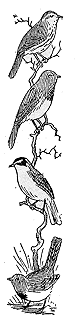
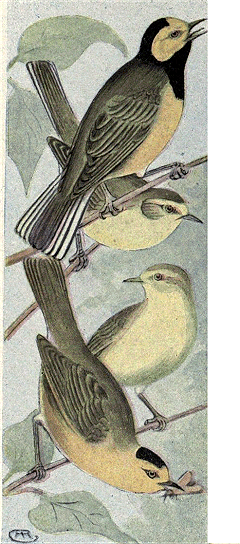
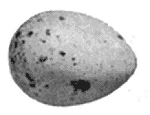

Page 415 Canadian Warblers. American Redstart. 685b. Golden Pileolated Warbler. Wilsonia pusilla chryseola. Range.--Pacific coast of North America, breeding from southern California in mountain ranges north to British Columbia. 686. Canadian Warbler. Wilsonia canadensis. Range.--Eastern North America, breeding from Mass., New York, and Michigan north to Labrador and Hudson Bay; winters in Central America. White. This handsome Warbler is plain gray above and yellow below, with a black stripe down the sides of the neck and across the breast in a broken band. They frequent swamps or open woods with a heavy growth of underbrush, where they build their nests on or very close to the ground. I have always found them in Massachusetts nesting about the roots of laurels, the nests being made of strips of bark, leaves and grass; in June or the latter part of May they lay from three to five white eggs, specked and wreathed with reddish brown and neutral tints; size .68 × .50. Data.--Worcester, Mass., June 10, 1891. Nest on the ground under laurel roots in swampy woods; made entirely of strips of laurel bark lined with fine grass. [Illustration: ] 687. American Redstart. Setophaga ruticilla. Range.--North America, chiefly east of the Rockies, breeding in the northern half of the United States and north to Labrador and Alaska; winters south of our borders. White. The male of this handsome, active and well known species is black with a white belly, and orange patches on the sides, wings and bases of outer tail feathers. They breed abundantly in swamps, open woods or thickets by the roadside, placing their nests in trees or bushes at elevations of from three to thirty feet above ground and usually in an upright fork. The nests are very compactly made of fibres and grasses, felted together, and lined with hair. Their eggs are white, variously blotched and spotted with brown and gray; size .65 × .50. Data.--Chili, N. Y., June 1, 1894. Nest, a cup-shaped structure of plant fibres lined with fine grasses and hair; 4 feet from the ground in the crotch of a small chestnut.
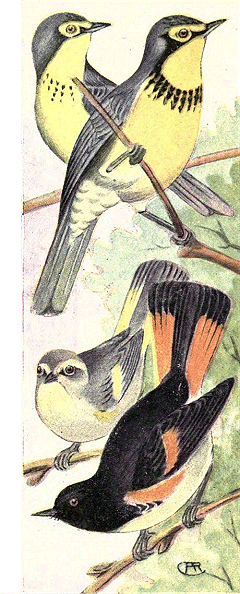

Page 416 MALE REDSTART FEEDING YOUNG.
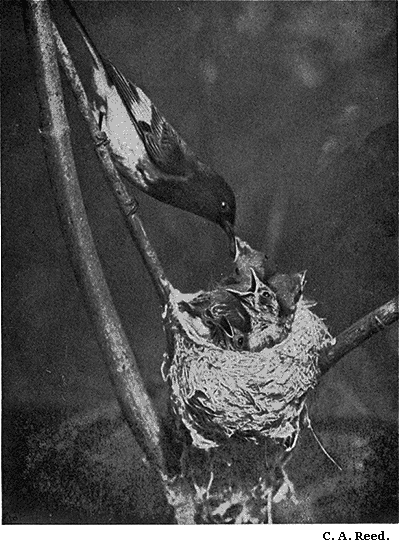
Pgee 417 Painted Redstart. Red-faced Warblers. 688. Painted Redstart. Setophaga picta. White. Range.--Southern New Mexico and Arizona, southward. This beautiful Redstart is black with a large white patch on the wing coverts, white outer tail feathers, and with the belly and middle of the breast bright red. These active birds, which have all the habits and mannerisms of the common species, nest on the ground in thickets or shrubbery usually near water, and generally conceal their homes under overhanging stones or stumps; the nests are made of fine shreds of bark and grasses, lined with hair; the eggs are white, dotted with reddish brown; size .65 x .48. Data.--Chiricahua Mts., Arizona, May 31, 1900. Nest of fine bark and grass under a small bush on the ground. 689. Red-bellied Redstart. Setophaga miniata. Range.--Mexico; admitted to our avifauna on the authority of Giraud as having occurred in Texas. This species is similar to the last, but has a chestnut crown patch, more red on the underparts, and less white on the tail; it is not probable that their nesting habits or eggs differ from the last. 690. Red-faced Warbler. Cardellina rubrifrons. Range.--Southern Arizona and New Mexico, southward. White. This attractive little Warbler is quite common in mountain ranges of the southern Arizona. They nest on the ground on the side hills, concealing the slight structure of grasses and rootlets under overhanging shrubs or stones. Their eggs are specked and blotched with light reddish brown and lavender. Size .64 x .48. Data.--Chiricahua Mts., Arizona, May 31, 1902. Nest in a depression under a tuft of grass growing about 8 feet up on the side of a bank.
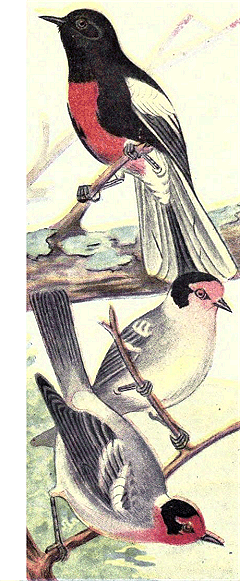
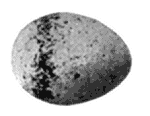
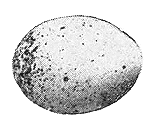
Page 418 WAGTAILS. Family MOTACILLIDÆ American Pipit. Sprague's Pipit. 694. White Wagtail. Motacilla alba. Range.--An Old World species; accidental in Greenland. White. These birds are abundant throughout Europe, nesting on the ground, in stone walls, or in the crevices of old buildings, etc., the nests being made of grass, rootlets, leaves, etc.; the eggs are grayish white, finely specked with blackish gray. Size .75 × .55. 695. Swinhoe's Wagtail. Motacilla ocularis. Range.--Eastern Asia; accidental in Lower California and probably Alaska. 696. Alaska Yellow Wagtail. Budytes flavus alascensis. Range.--Eastern Asia; abundant on the Bering Sea coast of Alaska in the summer. White. These handsome Wagtails are common in summer on the coasts and islands of Bering Sea, nesting on the ground under tufts of grass or beside stones, usually in marshy ground. Their eggs number from four to six and are white, profusely spotted with various shades of brown and gray. Size .75 × .55. Data.--Kamchatka, June 20, 1896. Nest on the ground; made of fine rootlets, grass and moss, lined neatly with animal fur. 697. Pipit. Anthus rubescens. Range.--North America, breeding in the Arctic regions, and in the Rocky Mountains south to Colorado, winters in southern United States and southward. Gray. The Titlarks are abundant birds in the United States during migrations, being found in flocks in fields and cultivated ground. Their nests, which are placed on the ground in meadows or marshes under tufts of grass, are made of moss and grasses; the four to six eggs are dark grayish, heavily spotted and blotched with brown and blackish. Size .75 × .55. 698. Meadow Pipit. Anthus pratensis. Range.--Whole of Europe; accidental in Greenland. This species is similar to the American Pipit and like that species nests on the ground; they are very abundant and are found in meadows, woods or thickets in the vicinity of houses. Their nests are made chiefly of grasses, lined with hair; the eggs are from four to six in number and are grayish, very heavily spotted and blotched with grayish brown. Size .78 × .58.
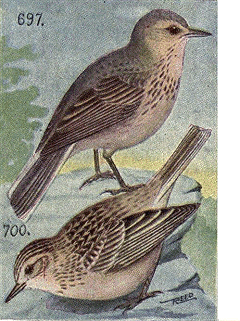
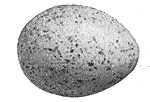
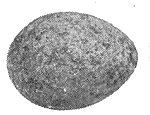
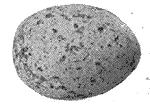
Page 419 Sage Thrasher. 699. Red-throated Pipit. Anthus cervinus. Range.--An Old World species; accidental in the Aleutians and Lower California. The nesting habits of this bird are like those of the others of the genus. 700. Sprague's Pipit. Anthus spraguei. Range.--Interior of North America, breeding from Wyoming north to Saskatchewan. Winters in the plains of Mexico. Grayish white. These birds are common on the prairies and breed abundantly on the plains of the interior of northern United States and Manitoba. They have a flight song which is said to be fully equal to that of the famous European Skylark. They nest on the ground under tufts of grass or up-turned sods, lining the hollow with fine grasses; their three or four eggs are grayish white, finely specked with grayish black or purplish. Size .85 × .60. Data.--Crescent Lake, Canada. Nest of fine dried grasses, built in the ground at the side of a sod. DIPPERS. Family CINCLIDÆ 701. Dipper. Cinclus mexicanus unicolor. Range.--Mountains of western North America from Alaska to Central America. These short-tailed, grayish colored birds are among the strangest of feathered creatures; they frequent the sides of mountain streams where they feed upon aquatic insects and small fish. Although they do not have webbed feet, they swim on or under water with the greatest of ease and rapidity, using their wings as paddles. They have a thrush-like bill and the teetering habits of the Sandpiper, and they are said to be one of the sweetest of songsters. They nest among the rocks along the banks of swiftly flowing streams, and sometimes beneath falls; the nests are large round structures of green moss, lined with fine grass and with the entrance on the side. The eggs are pure white, four or five in number, and laid during May or June. Size 1.00 × .70. WRENS, THRASHERS, ETC. Family TROGLODYTIDÆ 702. Sage Thrasher. Oreoscoptes montanus. Range.--Plains and valleys of western United States, east of the Sierra Nevadas, from Montana to Mexico. Greenish blue. This species is abundant in the sage regions of the west, nesting on the ground or at low elevations in sage or other bushes. Their nests are made of twigs, rootlets and bark strips, lined with fine rootlets; the three or four eggs are a handsome greenish blue, brightly spotted with reddish brown and gray. Size .95 × .70. Data.--Salt Lake Co., Utah, May 11, 1900. Nest placed in a sage bush; made of twigs of the same and lined with bark strips. Collector, W. H. Parker, (Crandall collection.)