LONG-WINGED SWIMMERS. Order II. LONGIPENNES SKUA AND JAEGERS. Family STERCORARIIDAE (continued 4)
Reading edition
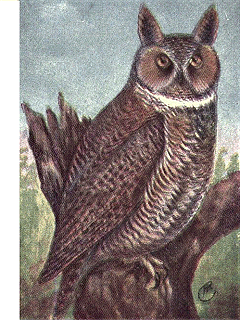
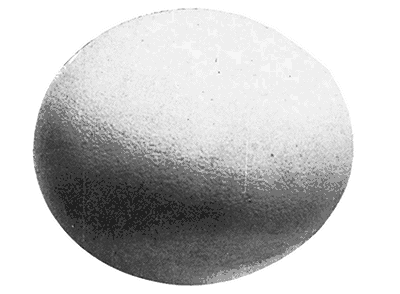
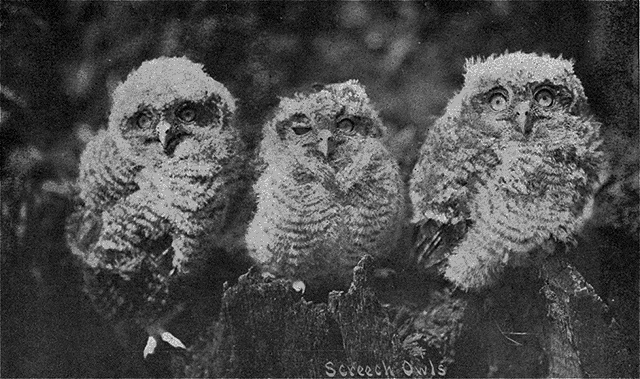
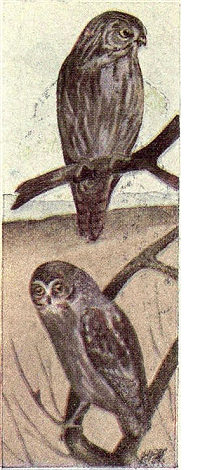
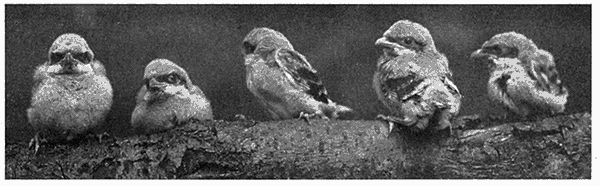
Page 236 YOUNG SCREECH OWLS.
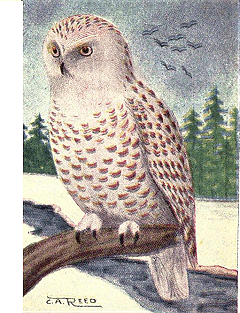
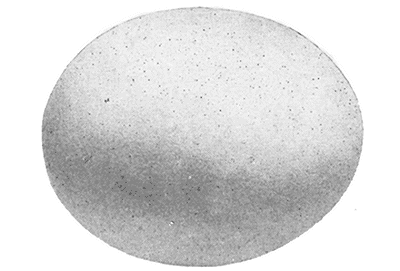
Page 237 Snowy Owl. 375e. Dwarf Horned Owl. Bubo virginianus elachistus. Range.--Lower California. This is a similar but darker form of the Horned Owl and is very much smaller than virginianus. The nesting habits will be the same, but the eggs may average smaller. White. 376. Snowy Owl. Nyctea nyctea. Range.--Arctic regions, breeding within the Arctic Circle and wintering to the northern border of the United States and casually farther. This very beautiful species varies in plumage from pure white, unmarked, to specimens heavily and broadly barred with blackish brown. It is, next to the Great Gray Owl, the largest species found in America, being 2 feet in length. Like the Great Horned Owls, they are very strong, fearless, and rapacious birds, feeding upon hares, squirrels and smaller mammals, as well as Grouse, Ptarmigan, etc. They nest upon the ground, on banks or mossy hummocks on the dry portions of marshes, laying from two to eight eggs, white in color and with a smoother shell than those of the Great Horned Owl. Size 2.25 × 1.75. Data.--Point Barrow, Alaska, June 16, 1898. Three eggs laid in a hollow in the moss. 377. European Hawk Owl. Surnia ulula ulula. Range.--Northern portion of the Old World; accidental in Alaska. Similar to the American species, but lighter and more brownish.

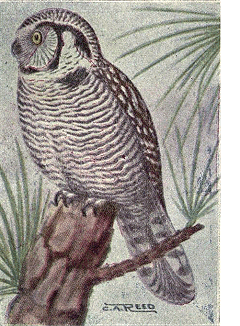
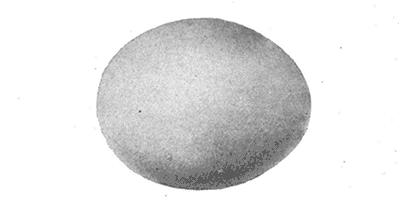
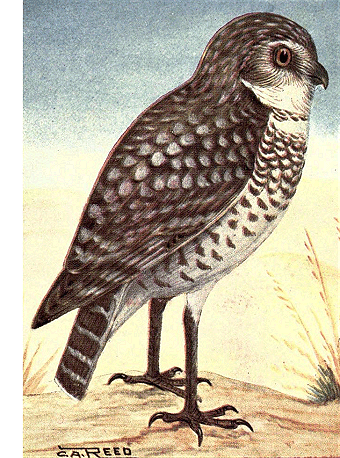
Page 238 American Hawk Owl. 377a. Hawk Owl. Surnia ulula caparoch. White. Range.--Northern North America, breeding from the central portions of British America northward; probably also breeds in the Rocky Mountains in the northern tier of states and casually farther. This handsome mottled and barred, gray and black Owl might readily be mistaken for a Hawk, because of his Hawk-like appearance and long rounded tail. They are very active birds, especially in the day time, for they are more diurnal than nocturnal; their food is mostly of small rodents, and also small birds. They nest either in the tops of large fir trees, in hollows of stumps, or, in some cases, upon the ground. When in trees their nests are made of twigs, leaves and weeds, and sometimes lined with moss and feathers; they lay from three to eight white eggs, size 1.50 × 1.20. Data.--Labrador, May 3, 1899. Five eggs. Nest in the top of a dead tree, 15 feet from the ground. 378. Burrowing Owl. Speotyto cunicularia hypogæa. White. Range.--Western North America from the Mississippi Valley west to California; north to the southern parts of British America and south to Central America. These peculiar birds are wholly different in plumage, form and habits from any other American Owls. They can readily be recognized by their long, slender and scantily feathered legs. Their plumage is brownish, spotted with white above, and white, barred with brown below; length 10 inches. They nest, generally in large communities in burrows in the ground, usually deserted Prairie Dog holes. While generally but a single pair occupy one burrow, as many as twenty have been found nesting together. Sometimes the burrows are unlined, and again may have a carpet of grasses and feathers. Their white eggs generally number from six to ten; size 1.25 × 1.00. Data.--Sterling, Kans., May 7, 1899. Nest of bits of dry dung at the end of a deserted Prairie Dog burrow.
Page 239 378a. Florida Burrowing Owl. Speotyto cunicularia floridana. Burrowing Owl. Range.--Local in the interior of Florida. Like the last, but slightly smaller and paler, and with the tarsus less feathered. Their habits or eggs do not differ from the preceding. 379. Pygmy Owl. Glaucidium gnoma gnoma. Range.--Rocky Mountain region and westward; from British Columbia southward. These interesting little Owls, which are but seven inches in length, feed in the day time upon insects, mice and, occasionally, small birds. They frequent extensively wooded districts, chiefly in the mountain ranges. They nest in tall trees, generally in deserted Woodpeckers' holes, laying three or four white eggs during May; size about 1.00 × .90. 379a. California Pygmy Owl. Glaucidium gnoma californicum. Range.--Pacific coast from British Columbia, south through California. This sub-species is darker and more brownish than the last. It is not an uncommon bird in California. They nest in the tallest trees along the ranges, often being found 75 or more feet from the ground. The eggs do not differ from those of the Pygmy Owl, ranging in size from 1.00 × .85 to 1.20 × .95. 379.1. Hoskin's Pygmy Owl. Glaucidium hoskinsi. Range.--Southern Lower California. This species is smaller and more gray than the preceding. It is not probable that its manners of nesting or eggs differ in any respect from those of the others of this genus.
Page 240 380--381. 380. Ferruginous Pygmy Owl. Glaucidium phalœnoides. Range.--Mexico and Central America; north to the Mexican border of the United States. This species is of the same size as the last, but is much tinged with rufous on the upper parts, and the tail is of a bright chestnut brown color, crossed by about eight bars of black. They nest in hollow cavities in trees, from ten to forty feet from the ground, laying three or four glossy white eggs; size 1.10 × .90. 381. Elf Owl. Micropallas whitneyi. White. Range.--Mexico, north to the bordering states. This odd little bird is the smallest member of the family found in America, attaining a length of only six inches. In plumage it may be described as similar to a very small, earless Screech Owl, only with the pattern of the markings a great deal finer. They are said to be quite abundant in the table lands of central Mexico and in southern Arizona, where they build their nests in deserted Woodpeckers' holes, perhaps most frequently in the giant cactus. It is said to be more nocturnal than the Pygmy Owls and to feed almost exclusively upon insects. They lay from three to five eggs having a slight gloss. Size 1.02 × .90. Data.--Southern Arizona, May 22, 1902. Nest in a deserted Woodpecker hole. Two eggs.
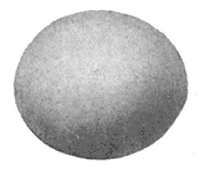
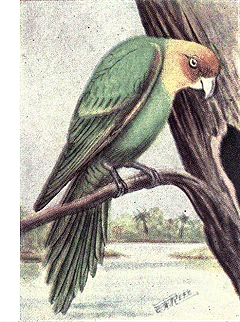
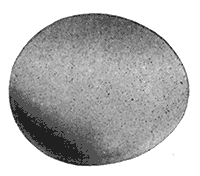
Page 241 PAROQUETS AND PARROTS. Order XIII. PSITTACI. Family PSITTACIDAE 382. Carolina Paroquet. Conuropsis carolinensis. Carolina Paroquet. Range.--Now rare in Florida and along the Gulf coast to Indian Territory. As late as 1885, the Carolina Paroquets were abundant in the South Atlantic and Gulf States, but owing to their wanton destruction by man, they have been exterminated in the greater portion of their range, and now are rarely seen in any locality, and then only in the most unhabitable swamps and thickets. White. A reliable account of their nesting habits is lacking, as are also specimens of their eggs taken from wild birds. They are said to build rude nests of sticks upon horizontal branches of cypress trees, and to nest in colonies; it is also claimed that they nest in hollow trees, laying from three to five pure white eggs. The one figured is one of three laid in confinement at Washington, D. C., by a pair of birds owned by Mr. Robert Ridgeway. It is 1.31 × 1.06 and was laid July 12, 1892. This set is in the collection of Mr. John Lewis Childs. 382.1. Thick-billed Parrot. Rhynchopsitta pachyrhyncha. Range.--Mexico, north casually to the Mexican border of the United States. This large Parrot (16 inches long) has a heavy black bill, and the plumage is entirely green except for the deep red forehead, strips over the eye, shoulder, and thighs, and the yellowish under wing coverts. Their eggs are white and are laid in natural cavities in large trees in forests. CUCKOOS, TROGANS, KINGFISHERS, ETC. Order XIV. CUCKOOS, ANIS, ETC. Family CUCULIDAE 383. Ani. Crotophaga ani. Range.--Northeastern South America and the West Indies; casual in Florida, and along the Gulf coast; accidental in Pennsylvania. This species is similar to the next, but the bill is smoother and without grooves. Its nesting habits are the same as those of the more common American species.
Page 242 ROADRUNNER.
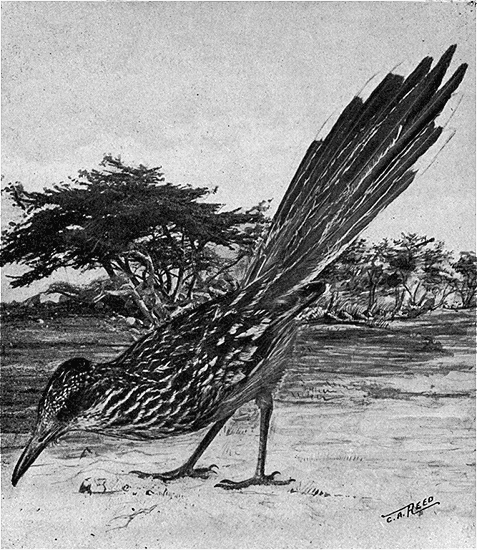
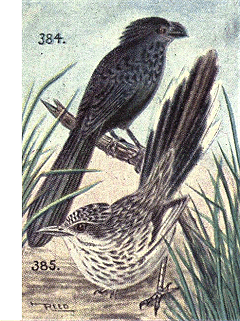
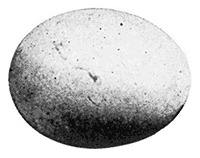
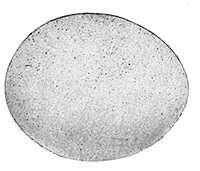
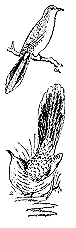
Page 243 Groove-billed Ani. Road Runner. 384. Groove-billed Ani. Crotophaga sulcirostris. Greenish blue. Range.--Mexico and the border of the United States; common in southern Texas. This odd species has a Cuckoo-like form, but is wholly blue black in color, and has a high thin bill with three conspicuous longitudinal grooves on each side. They build large bulky nests of twigs, lined with leaves and grasses, and located in low trees and bushes. They build in small colonies but do not, as is claimed of the common Ani, build a large nest for several to occupy. They lay from three to five eggs of a greenish blue color, covered with a chalky white deposit. Size 1.25 × 1.00. They are laid in May or June. 385. Road-runner. Geococcyx californianus. White. Range.--Western United States from Oregon, Colorado and Kansas, southward; most abundant on the Mexican border, and wintering in central Mexico. This curious species is known as the "Chaparral Cock", "Ground Cuckoo," "Snake-killer," etc. Its upper parts are a glossy greenish brown, each feather being edged or fringed with whitish; the tail is very long, broad and graduated, the feathers being broadly tipped with white. They are noted for their swiftness on foot, paddling over the ground at an astonishing rate, aided by their outstretched wings and spread tail, which act as aeroplanes; their legs are long and have two toes front and two back. Their food consists of lizards and small snakes, they being particularly savage in their attacks upon the latter. They build rude nests of sticks and twigs, in low trees or bushes, and during April or May, lay from four to ten eggs, depositing them at intervals of several days. They are pure white and measure 1.55 × 1.20.
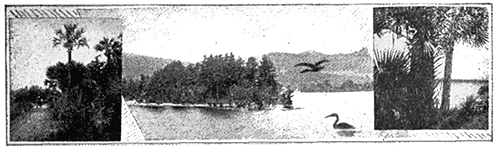
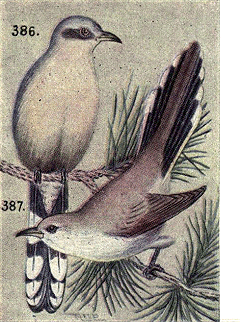
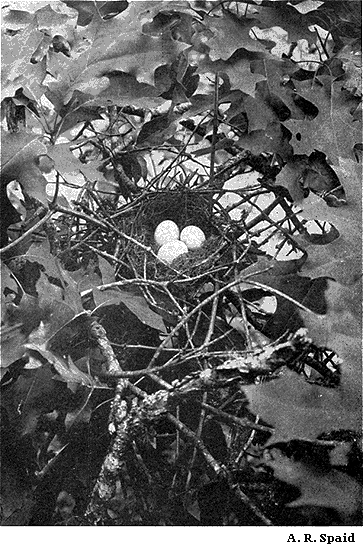
Page 244 Mangrove Cuckoo. Yellow-billed Cuckoo. 386. Mangrove Cuckoo. Coccyzus minor minor. Light greenish blue. Range.--West Indies, Mexico and South America, north regularly to southern Florida. This species is very similar to our common Yellow-billed Cuckoo, but the whole underparts are deep buff. It is a common species and nests abundantly in the West Indies, but occurs only in limited numbers in southern Florida. Their nests are shallow platforms of twigs and rootlets, placed in bushes and low trees, and upon which they lay three or four pale greenish blue eggs, similar to those of the Yellow-billed species but averaging smaller; size 1.15 × .85. 386a. Maynard's Cuckoo. Coccyzus minor maynardi. Range.--Bahamas; accidental on Florida Keys. This is a slightly smaller and paler form than the preceding. 387. Yellow-billed Cuckoo. Coccyzus americanus americanus. Range.--United States east of the Plains and from southern Canada southward. Pale greenish blue. This species is generally abundant in all localities in its range, which afford suitable nesting places of tangled underbrush or vines. It may be distinguished from the Black-billed variety by its larger size (12 inches long), blackish tail with broad white tips, and yellowish lower mandible. They are often regarded by the superstitious as forecasters of rain, and as omens, probably because of their gutteral croaking notes. Their nests are made of twigs, lined with shreds of grape vine bark or catkins; the nests are generally very shabbily made and so flat on the top that the eggs frequently roll off. They are located near the ground in bushes or low trees. The three or four eggs are deposited at intervals of several days, and frequently young birds and eggs are found in the nest at the same time. Like the Flicker, this bird will frequently continue laying if one egg is removed at a time, and as many as twelve have been taken from the same nest, by this means. The eggs are light greenish blue. Size 1.20 × .90. They are usually laid during May or June.
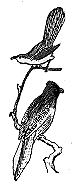
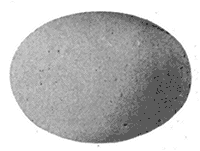
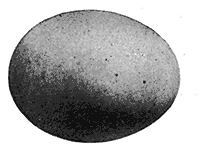

Page 245 NEST AND EGGS OF YELLOW-BILLED CUCKOO.
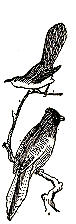
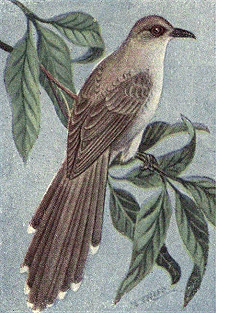
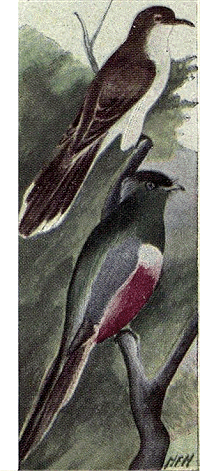
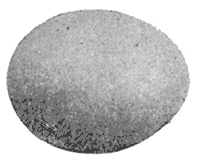
Page 246 Black-billed Cuckoo. 387a. California Cuckoo. Coccyzus americanus occidentalis. Range.--Western North America, from British Columbia, southward. Slightly larger and with a stouter bill than the last. Eggs not distinguishable. 388. Black-billed Cuckoo. Coccyzus erythrophthalmus. Range.--United States east of the Rocky Mountains; north to Labrador and Manitoba; south in winter to Central and South America. Greenish blue. This species is rather more common in the northern part of the United States than the Yellow-billed variety. The bird is smaller, has a blackish bill, and the tail is the same color as the back and only slightly tipped with white. Their nests are built in similar locations and of the same materials as used by the Yellow-bill; the three or four eggs are smaller and a darker shade of greenish blue. Size 1.15 × .85. All the Cuckoos are close sitters and will not leave the nest until nearly reached with the hand, when they will slowly flutter off through the underbrush, and continue to utter their mournful "Kuk-kuk-kuk," many times repeated. 388.1. Kamchatka Cuckoo. Cuculus canorus telephonus. An Asiatic subspecies of the common European Cuckoo, accidentally occurring in Alaska. 387a--389. TROGONS. Family TROGONIDÆ 389. Coppery-tailed Trogon. Trogon ambiguus. Dull White. Range.--Southern Mexico, north to the Lower Rio Grande in Texas and in southern Arizona, in both of which localities they probably breed. This is the only member of this family of beautiful birds which reaches our borders. This species is 12 inches in length, and is a metallic green color on the upper parts and breast, and with coppery reflections of the middle tail feathers, the outer ones being white, very finely vermiculated with black, as are the wing coverts. The underparts, except for a white band across the breast, are rosy red. This species nest in cavities in large trees, generally in large, deserted Woodpecker holes. They are also said to have been found nesting in holes in banks. Their eggs are three or four in number and are a dull white in color. Size 1.10 × .85.
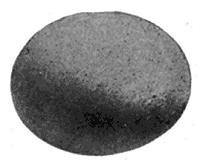
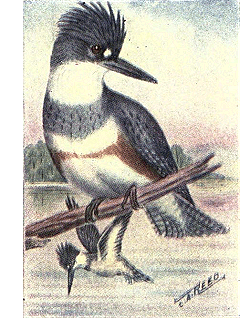
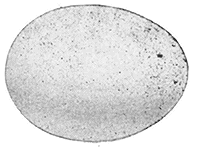
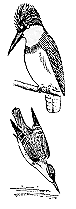
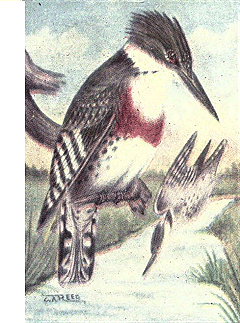
Page 247 KINGFISHERS. Family ALCEDINIDÆ Belted Kingfisher. 390. Belted Kingfisher. Ceryle alcyon. Range.--Whole of North America, breeding from southern United States, northward and wintering from the southern parts of its breeding range, southward. This well known bird is abundant in all localities near water, where its rattling notes are among the most familiar of sounds. White. Their food is almost entirely of small fish, which they catch by plunging upon from their perch on an old dead limb overhanging the water, or by hovering in the air like an Osprey. Their nests are located at the end of burrows in sand banks or the banks of creeks and rivers. These tunnels, which are dug by the birds, generally commence two or three feet from the top of the bank and extend back from six to eight feet, either in a straight line or curved; the end is enlarged to form a suitable nesting place, in which from five to eight eggs are laid. They are glossy and pure white in color. Size 1.35 × 1.05. Data.--Lake Quinsigamond, Massachusetts, June 6, 1900. 7 eggs at the end of a 6 foot tunnel in a sand bank. Bird removed by hand from the nest. Collector, C. E. Howe. 390.1. Ringed Kingfisher. Ceryle torquata. Range.--Mexico, north casually to the Lower Rio Grande Valley in Texas. This handsome species is much larger than the Belted Kingfisher and the underparts are nearly all bright chestnut, except the white throat. They nest in river banks the same as the common American species, and the eggs are white, but larger. Size 1.45 × 1.10.
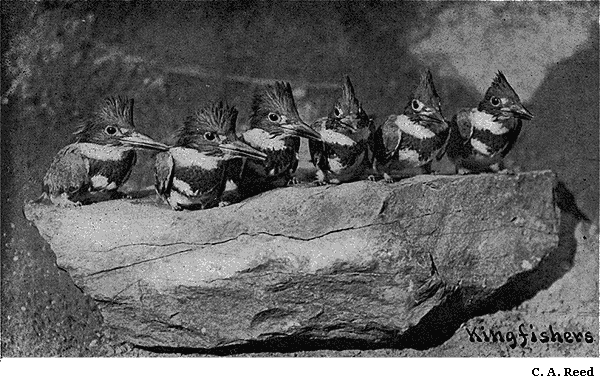
Page 248 YOUNG KINGFISHERS.
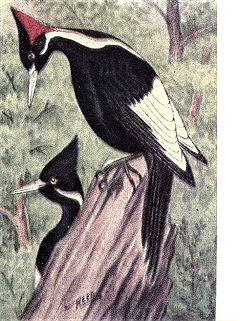
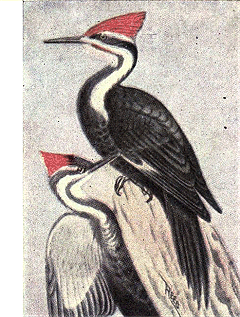
Page 249 391. Texas Kingfisher. Ceryle americana septentrionalis. Texas Kingfisher. Range.--Southern Texas, south through Mexico. This variety is much smaller than the Belted, length 8 inches, and is a lustrous greenish above, variously speckled with white, and is white below, spotted with greenish. It is a common and resident species in southern Texas, where it lays its eggs in holes in the banks along streams. The eggs are white and glossy, and measure .95 × .70. WOODPECKERS. Order XV. PICI. Family PICIDAE Woodpeckers are well known birds having sharp chisel-like bills, sharply pointed and stiffened tail feathers, and strongly clawed feet with two toes forward and two back, except in one genus. Their food is insects and grubs, which they get by boring in trees, and from under the bark, clinging to the sides of trunks or the under side of branches with their strong curved nails, aided by the tail, for a prop. They are largely resident where found. Ivory-billed Woodpecker. 392. Ivory-billed Woodpecker. Campephilus principalis. Range.--Locally distributed, and rare, in Florida, along the Gulf coast and north casually to South Carolina and Arkansas. This is the largest of the Woodpeckers found within our borders, being 20 inches in length. But one other American species exceeds it in size, the Imperial Woodpecker of Mexico, which reaches a length of nearly two feet; as this species is found within a few miles of our Mexican border, it may yet be classed as a North American bird. The present species has a large, heavy, ivory-white bill. They can readily be identified, at a great distance, from the Pileated Woodpecker by the large amount of white on the secondaries. They used to be not uncommonly seen in many sections of the southeast but are now found very locally and only in the largest and remote woods. They nest in holes in large trees in the most impenetrable swamps; laying three, and probably as many as six pure white glossy eggs measuring 1.45 × 1.00.
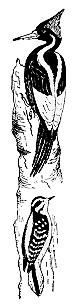
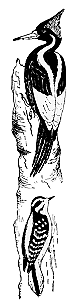
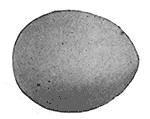
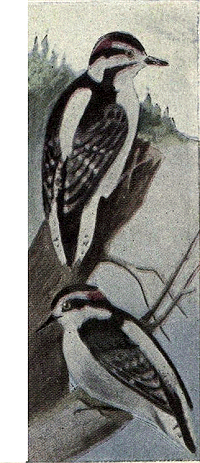
Page 250 Hairy Woodpecker. 393. Hairy Woodpecker. Dryobates villosus villosus. Range.--United States east of the Plains and from North Carolina to Canada. The Hairy Woodpecker or its sub-species is found in all parts of North America. The nesting habits and eggs of all the sub-species are not in any way different from those of the eastern bird, consequently what is said in regard to the eastern form will apply equally to all its varieties. White. Except during the winter months, this species is not as commonly seen about houses or orchards as the Downy Woodpecker. During the summer they retire to the larger woods to nest, laying their eggs in holes in the trunks or limbs of trees at any height from the ground, and generally using the same hole year after year, and often twice or three times during one season, if the first sets are taken. They lay from three to six glossy white eggs; size .95 × .70. This species can be distinguished from the Downy Woodpeckers by their larger size (9 inches long), and the white outer tail feathers, which are unspotted. 393a. Northern Hairy Woodpecker. Dryobates villosus leucomelas. Range.--North America, north of the United States. Slightly larger than the preceding. 393b. Southern Hairy Woodpecker. Dryobates villosus auduboni. Range.--Southern United States; north to South Carolina. Similar to the Hairy Woodpecker, but smaller. 393c--394a. 393c. Harris's Woodpecker. Dryobates villosus harrisi. Range.--Pacific coast from California to British Columbia. Similar to the Hairy but with fewer or no white spots on the wing coverts, and grayish on the underparts. 393d. Cabanis Woodpecker. Dryobates villosus hyloscopus. Range.--Southern California, east to Arizona and south into Mexico. Like the preceding but whiter below. 393e. Rocky Mountain Hairy Woodpecker. Dryobates villosus monticola. Range.--Rocky Mountains from British Columbia south to New Mexico. Similar to harrisi but slightly larger and pure white below. 393f. Queen Charlotte Woodpecker. Dryobates villosus picoideus. Range.--Queen Charlotte Islands, British Columbia. Like Harris Woodpecker, but with the flanks streaked and the middle of the back spotted with blackish.
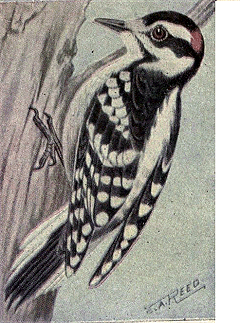
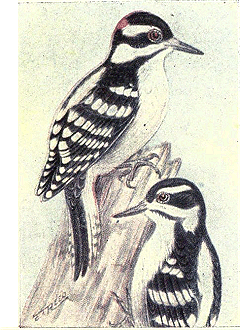
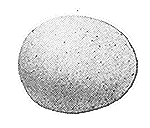
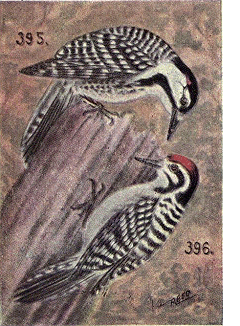
Page 251 Southern Downy. 394. Southern Downy Woodpecker. Dryobates pubescens pubescens. Range.--Gulf and South Atlantic States; north to South Carolina. This species, which is the smallest of the North American Woodpecker (length 6 inches), is similar in plumage to the Hairy Woodpecker, but has the ends of the white, outer tail feathers spotted with black. White, glossy. Like the last species, it is represented by sub-species in all parts of North America, the nesting habits of all the varieties being the same and the eggs not distinguishable from one another. They nest in holes in trees, very often in orchards or trees in the neighborhood of houses. They are not nearly as shy as the Hairy Woodpeckers, and also associate with other birds very freely. The three to six eggs are laid upon the bottom of the cavity, with no lining. The height of the nesting season is during May or June. The white glossy eggs are .75 × .60. 394a. Gairdner's Woodpecker. Dryobates pubescens gairdneri. Range.--Pacific coast from northern California to British Columbia. This sub-species is like the last, but is without spots on the wing coverts and is a dingy white below, differing the same as Harris Woodpecker from the Hairy. 394b. Batchelder's Woodpecker. Dryobates pubescens homorus. Range.--Rocky Mountain region of the United States. Like the last but whiter below. 394c. Downy Woodpecker. Dryobates pubescens medianus. Range.--North America, east of the Plains and north of South Carolina. Similar to the southern variety but slightly larger and whiter. 394d. Nelson's Downy Woodpecker. Dryobates pubescens nelsoni. Range.--Alaska. Similar to the northern variety but still larger. 394e. Willow Woodpecker. Dryobates pubescens turati. Range.--California except the northern parts and the ranges of the south. Similar to Gairdner Woodpecker, but smaller and whiter. 395. Red-cockaded Woodpecker. Dryobates borealis. Range.--Southeastern United States, from South Carolina and Arkansas, southward. This black and white species may be known from any other because of the uniform black crown and nape, the male having a small dot of red on either side of the crown, back of the eye. They are quite abundant in the Gulf States and Florida, where they nest during April and May, and in some localities in March. They build in hollow trees or stumps at an elevation from the ground, laying from three to six glossy white eggs; size .95 × .70.
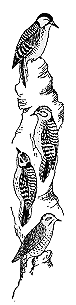
Page 252 Red-cockaded Woodpecker. Texas Woodpecker. 396. Texas Woodpecker. Dryobates scalaris bairdi. Range.--Southwestern United States from southern Colorado south to northern Mexico. This species is brownish white below, has the back barred with black and white, and the male has the whole crown red, shading into mixed black and whitish on the forehead. Its habits and nesting are just the same as those of the Downy, but the three or four white eggs, that they lay in April, are larger; size .80 × .65. 396a. San Lucas Woodpecker. Dryobates scalaris lucasanus. Range.--Lower California, north to the Colorado Desert, California. Very similar to the last; less barring on the outer tail feathers. Eggs the same. 397. Nuttall's Woodpecker. Dryobates nuttalli. 398--399. Range.--Pacific coast from Oregon south to Lower California. Similar to the Texan Woodpecker but whiter below, with whitish nasal tufts, and the fore part of the crown black and white striped, the red being confined to the nape region. They nest in holes in trees, either in dead stumps or in growing trees, and at any height above ground. During April or May they deposit their white glossy eggs upon the bottom of the cavity. The eggs measure .85 × .65. 398. Arizona Woodpecker. Dryobates arizonæ. Range.--Mexican border of the United States, chiefly in Arizona and New Mexico. This species is entirely different from any others of our Woodpeckers, being uniform brownish above, and soiled whitish below, spotted with black. The male bird has a red crescent on the nape. They are said to be fairly abundant in some sections of southern Arizona. Their nesting habits do not vary from those of the other Woodpeckers found in the same regions, and they show no especial preference for any particular kind of a tree in which to lay their eggs. The nesting season appears to be at its height in April. The pure white eggs average in size about .85 × .60.
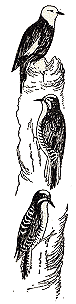
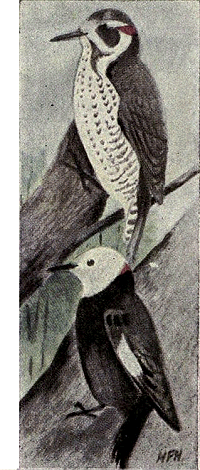

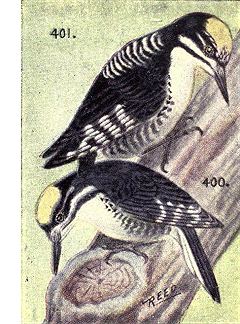
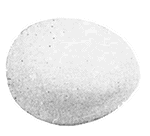
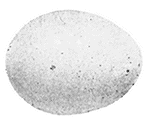
Page 253 Three-toed Woodpecker. Arctic Three-toed Woodpecker. 399. White-headed Woodpecker. Xenopicus albolarvatus. Range.--Western United States from southern California to southern British Columbia. White. This odd species is wholly a dull black color, except for the white head and neck, and basal half of the primaries. They are quite abundant in some localities, particularly in California on mountain ranges. They nest at any height, but the greater number have been found under twenty feet from the ground and in old pine stubs. They lay from four to six glossy white eggs, measuring .95 × .70. They are said to be more silent than others of the Woodpecker family, and rarely make the familiar tapping and never drum. It is claimed that they get at their food by scaling bark off the trees, instead of by boring. White. 400. Arctic Three-toed Woodpecker. Picoides arcticus. As implied by their name, members of this genus have but three toes, two in front and one behind. The plumage of this species is entirely black above, and whitish below, with the flanks barred with blackish. The male has a yellow patch on the crown. They breed abundantly in coniferous forests in mountainous regions throughout their range, laying their eggs in cavities in decayed stumps and trees, apparently at any height, from five feet up. The eggs are laid in May or June. Size .95 × .70. Range.--Northern parts of the United States, north to the Arctic regions. 401. Three-toed Woodpecker. Picoides americanus americanus. Range.--From northern United States northward. The chief difference between this species and the last is in the white on the back, either as a patch or in the form of broken bars. The nesting habits are just the same and the eggs cannot be distinguished from those of the preceding. Both forms are found breeding in the same localities in the Adirondacks and in nearly all other portions of their range.
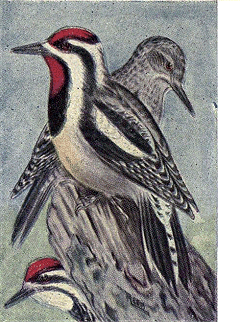
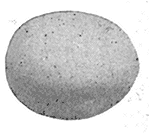
Page 254 Yellow-bellied Sapsucker. 401a. Alaska Three-toed Woodpecker. Picoides americanus fasciatus. Range.--Alaska, south to British Columbia and Washington. Like the last, but with more white on the back. Eggs like the arcticus. 401b. Alpine Three-toed Woodpecker. Picoides americanus dorsalis. Range.--Rocky Mountains from British Columbia south to New Mexico. Slightly larger than the preceding and with more white on the back, almost entirely losing the barred effect of the American Three-toed variety. They nest chiefly in dead pines, laying four or five white eggs that cannot be distinguished from those of many other species. Size .95 × .70. 402. Yellow-bellied Sapsucker. Sphyrapicus varius varius. Range.--North America, east of the Plains; breeding from Massachusetts northward, and wintering from the Carolinas and Illinois southward. White. This species is one of the most handsomely marked of the family; they can easily be recognized by the red crown and throat (white on the female), each bordered by black, and the yellowish underparts. The members of this genus have been found to be the only ones that are really injurious, and these only to a slight extent, to cultivated trees. This species and the two following are the only real "sapsuckers," a crime that is often attributed to the most useful of the family. Their nesting season is during May and June, they then resorting to the interior of the woods, where they deposit their four to seven glossy eggs on the bottom of holes in trees, generally at quite an elevation from the ground. Size of eggs .85 × .60. 402a. Red-naped Sapsucker. Sphyrapicus varius nuchalis. Range.--Rocky Mountain region of the United States and southern Canada south to Mexico and west to California. This variety differs from the last, chiefly in addition of a band of scarlet on the nape in place of the white on the Yellow-bellied species. Coming as it does, midway between the ranges of the preceding species and the following, this variety, with its extension of red on the head and throat, may be regarded somewhat as a connecting link between the two species, but it is perfectly distinct and does not intergrade with either. There appears to be no difference in the nesting habits of the two varieties, except that the present one, according to Bendire, shows a preference to nesting in live aspens. The eggs measure .90 × .65.
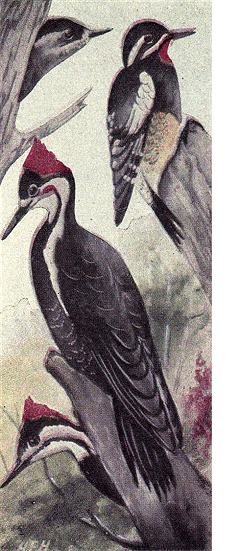
Page 255 Pileated Woodpecker. 403. Red-breasted Sapsucker. Sphyrapicus ruber ruber. Range.--Pacific Coast from Lower California to Oregon. Except for a whitish line from the eye to the bill, the entire head, neck and breast of this species is red, of varying shades in different individuals, from carmine to nearly a scarlet; the remainder of their plumage is very similar to that of the Yellow-bellied Sapsucker. This is an abundant species and in most parts of the range they are not timid. Like many of the Woodpeckers, they spend a great deal of their time in drumming on some dead limb. They nest commonly in aspens, preferably living ones, and are said to build a new nesting hole each year rather than use the old. The eggs are laid during May or June, being glossy white, five to seven in number, and measuring .90 × .70. 403a. Northern Red-breasted Sapsucker. Sphyrapicus ruber notkensis. Range.--Pacific coast from California to Alaska. 404. Williamson's Sapsucker. Sphyrapicus thyroideus. This is a deeper and brighter variety, and is more yellowish on the belly. Its nesting habits and eggs are the same as those of the southern form. Range.--Mountain ranges from the Rockies to the Pacific; north to British Columbia. This oddly marked species shows a surprising number of variations in plumage; the normal adult male is largely black on the upper parts and breast, with only a narrow patch of red on the throat, and with the belly, bright yellow. The female is entirely different in plumage and for a long time was supposed to be a distinct species; she is brownish in place of the black in the male, has no red in the plumage, and is barred with black and white on the back and wings. They nest at high altitudes in mountain ranges, either in coniferous forests or in aspens. There is no peculiarity in their nesting habits; they lay from four to seven eggs, glossy white. Size .97 × .67. 405. Pileated Woodpecker. Phlœotomus pileatus pileatus. Range.--Southern and South Atlantic States. This heavily built Woodpecker is nearly as large as the Ivory-bill, being 17 inches in length. They are not nearly as beautiful as the Ivory-bills, their plumage being a sooty black instead of glossy, and the white on the wing, being confined to a very small patch at the base of the primaries; the whole crown and crest are vermillion, as is also a moustache mark in the male. They breed in the most heavily timbered districts, and generally at a high elevation; excavating a cavity sometimes 25 inches in depth and eight inches in diameter. In most localities they are very shy and difficult to approach. During April or May they lay from three to six white eggs. Size 1.30 × 1.00.
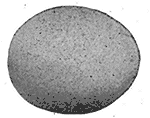
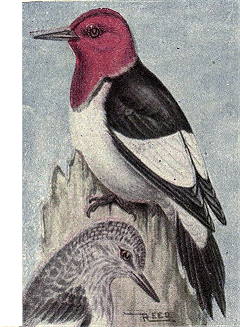
Page 256 Williamson Sapsucker Northern Pileated Woodpecker. 405a. Northern Pileated Woodpecker. Phlœotomus pileatus abieticola. Range.--Local throughout North America, from the northern parts of the United States northward. This variety is only very slightly larger than the preceding, it otherwise being the same. It is still abundant in many localities, but its range is rapidly being reduced, on account of cutting away the forests. Its nesting habits and eggs are the same as those of the southern variety. 406. Red-headed Woodpecker. Melanerpes erythrocephalus. Range.--United States, east of the Rockies, except New England; north to northern Canada; winters in southern United States. White. This beautiful species has a bright red head, neck and breast, glossy blue black back, wings and tail, and white underparts, rump and secondaries. It is the most abundant of the family in the greater portion of its range, where it nests in any kind of trees or in telegraph poles at any height from the ground; they also sometimes nest in holes under the eaves of buildings. They are the most pugnacious of the Woodpeckers, and are often seen chasing one another or driving away some other bird. Red-headed Woodpecker. They are also known to destroy the nests and eggs of many species, and also to kill and devour the young, they being the only Woodpecker, so far as known, to have acquired this disreputable habit; they also feed upon, besides ants and larvæ, many kinds of fruit and berries. Their nesting season is during May and June, when they lay from four to eight white eggs, with less gloss than those of the Flicker. Size 1.00 × .75. 407. Ant-eating Woodpecker. Melanerpes formicivorus formicivorus. Range.--Mexican border of the United States, southward. This species may be identified by the black region around the base of the bill, the white forehead, red crown and nape, yellowish throat, and blackish upper parts, extending in a band across the breast, this variety having the band streaked with white posteriorly. The habits of this variety are the same as the next which is most abundant in the United States.
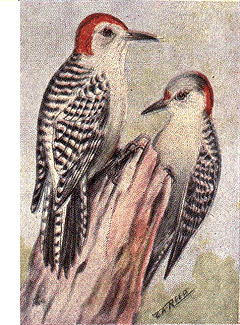
Page 257 407a. California Woodpecker. Melanerpes formicivorus bairdi. Red-bellied Woodpecker. Range.--California and Oregon. This bird differs from the last in having fewer white stripes in the black breast band. In suitable localities, this is the most abundant of Woodpeckers on the Pacific coast. They have none of the bad habits of the Red-heads, appear to be sociable among their kind, and are not afraid of mankind. It nests indifferently in all kinds of trees at any height from the ground, laying from three to seven eggs. Size 1.00 × .75. This species has the habit of storing food for future use developed to a greater extent than any other of the family. They sometimes completely honeycomb the exterior surface of decayed trees, with holes designed to hold acorns. 407b. Narrow-fronted Woodpecker. Melanerpes formicivorus angustifrons. Range.--Southern Lower California. This variety differs from the others in being slightly smaller and in having the white band on the forehead narrower. Its nesting habits are the same, but the eggs average smaller. Size .95 × .75. 408. Lewis's Woodpecker. Asyndesmus lewisi. Range.--Western United States from the Rockies to the Pacific coast; from British Columbia south to Mexico. White. A very oddly colored species, 11 inches in length having a dark red face, streaked red and white under parts, a gray breast band, and glossy greenish black upperparts. They are not uncommon in the greater part of their range, can not be called shy birds, and nest in all kinds of trees at heights varying from six to one hundred feet from the ground, the five to nine white eggs measuring 1.05 × .80, and being laid during May or June. 409. Red-bellied Woodpecker. Centurus carolinus. Range.--United States east of the Plains, breeding from the Gulf States north in nearly all parts of their range, frequenting the more heavily timbered regions, where they nest in any place that attracts their fancy; in some localities they also commonly nest in telegraph poles. They are quite tame, and during the winter months come about yards and houses, the same as, and often in company with Downy Woodpeckers. Their eggs, which are laid during May, are glossy white, average in size 1.00 × .75 and number from four to six.

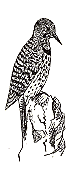
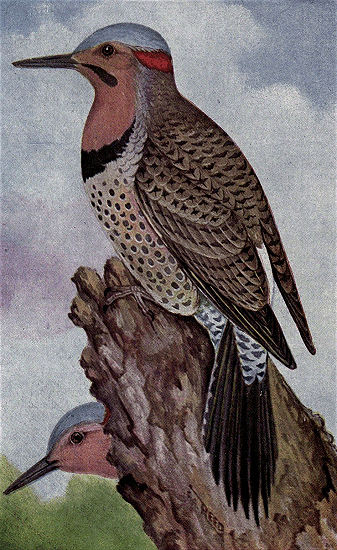
Page 258 408--411. 410. Golden-fronted Woodpecker. Centurus aurifrons. Range.--Mexico and southern Texas, resident. White. This is also one of the "zebra" or "ladder-backed" Woodpeckers, having the back and wings closely barred with black and white, the same as the preceding; the forehead, nasal tufts and nape are golden yellow, and the male has a patch of red on the crown. This is a very common resident species in the Lower Rio Grande Valley in Texas, where it nests in trees or telegraph poles, sometimes so numerously in the latter situations as to become a nuisance. Their nesting habits are not in any manner peculiar, and the eggs cannot be distinguished from those of the preceding. Size 1.00 × .75. Laid during April and May. 411. Gila Woodpecker. Centurus uropygialis. Range.--Mexican border of the United States, in southern Arizona and New Mexico. Like the preceding but without any yellow on the head, the male having a red patch in the center of the crown. They are locally distributed in New Mexico, but appear to be abundant in all parts of southern Arizona, where they nest principally in giant cacti, but also in many other trees such as cotton-woods, mesquite, sycamores, etc. Besides their decided preference for giant cacti, there is nothing unusual in their nesting habits, and the eggs are not different from those of others of the genus. They lay from three to six eggs in April or May. Size 1.00 × .75. 412. Flicker. Colaptes auratus auratus. Range.--Southeastern United States. White. Flickers are well known, large Woodpeckers (13 inches long), with a brownish tone to the plumage, barred on the back and spotted on the breast with black. The present species has a golden yellow lining to the wings and tail, and the shafts of the feathers are yellow; it has a red crescent on the nape, and the male has black moustache marks. This species and its sub-variety are the most widely known Woodpeckers in eastern North America, where they are known in different localities, by something like a hundred local names, of which
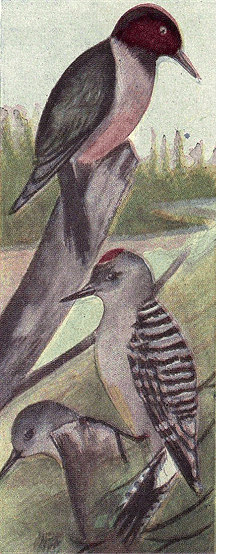
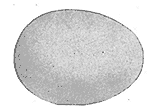
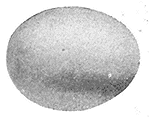
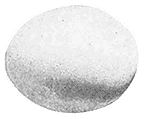
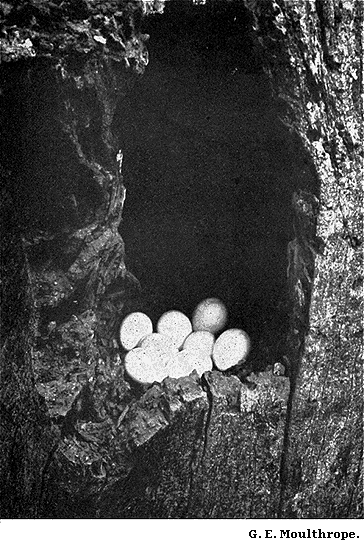
Page 259 Northern Flicker. Pigeon Woodpecker and Yellow-hammer seem to be the most universal. They have the undulating flight common to all Woodpeckers and show the white rump patch conspicuously when flying. They are often found on the ground in pastures or on side hills, feeding upon ants; they are more terrestrial than any others of the family. They nest anywhere, where they can find or make a suitable cavity for the reception of their eggs; in trees in woods or solitary trees in large pastures, in apple trees in orchards, in fence posts, in holes under the roofs of buildings, etc. They ordinarily lay from five to ten very glossy eggs, but it has been found that they will continue laying, if one egg is removed from the nest at a time, until in one case seventy-one eggs were secured. Fresh eggs may be found at any time from May until August, as they frequently raise two broods a season. Size of eggs, 1.10 × .90 with considerable variations. 412a. Northern Flicker. Colaptes auratus luteus. Range.--Whole of North America, east of the Rockies, except the southeastern portion. Averaging larger than the preceding, but individual specimens of the northern variety are frequently found to be even smaller than the southern, and vice versa, making the distinction one of the study rather than Nature. Red-shafted Flicker. 413. Red-shafted Flicker. Colaptes cafer collaris. Range.--United States west of the Rockies. White. This species is marked similarly to the preceding, but the top of the head is brownish instead of gray, and the underparts of the wings and tail, and their quills are reddish. Neither sex has the red crescent on the back of the head, except in the case of hybrids between the two species, but the male has red moustache marks. There are no differences in the nidification between this species and the preceding, but the eggs of this average a trifle larger (1.15 × .90). 413a. Northwestern Flicker. Colaptes cafer saturatior. Range.--Pacific coast, breeding from Oregon to Alaska. This is a much darker variety of the Red-shafted Flicker, but its nesting habits or eggs do not differ in any way.
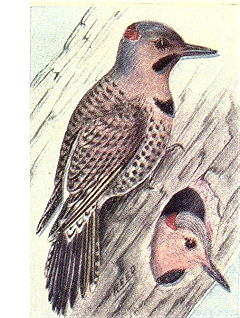
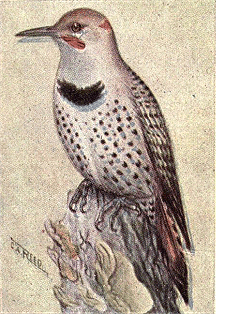
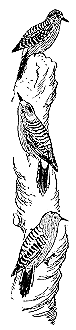
Page 260 NORTHERN FLICKER.
Page 261 NEST AND EGGS OF NORTHERN FLICKER.
Page 262 414. Gilded Flicker. Colaptes chrysoides. Range.--Arizona and southward through Mexico to southern Lower California. This pale species has the yellowish lining to the wings and tail as in the Flicker, but has a pale cinnamon brown crown, no crescent on back of head, and the male has red moustache marks. It is a common species in all localities where the giant cactus abounds, and shows a preference to nesting in these strange growths, to any other trees. Their habits are, in all respects, the same as those of the other Flickers and their eggs cannot be distinguished. Size 1.10 × .90. 414a. San Fernando Flicker. Colaptes chrysoides brunnescens. Range.--Northern Lower California. This is a slightly smaller and darker variety of the Gilded Flicker. 415. Guadalupe Flicker. Colaptes rufipileus. Range.--Guadalupe Island. Similar to the Red-shafted Flicker, but with the crown darker and the rump a solid pinkish white. They are common in a large cypress grove in the middle of the island, but rarely found on any other portions. The eggs have been described by Mr. Walter E. Bryant, who found them breeding on the island, to be indistinguishable from those of the others of the genus. [Illustration z264.] GOATSUCKERS, SWIFTS, AND HUMMINGBIRDS. Order XVI. MACROCHIRES. GOATSUCKERS, Family CAPRIMULGIDAE. Goatsuckers are long winged birds, with small bills, but with an extraordinarily large mouth, the opening of which extends beneath and beyond the eyes. They are chiefly dusk or night fliers, their food consisting of insects which they catch on the wing. Their plumage is mottled black, brownish and white, resembling the ground upon which they lay their eggs.
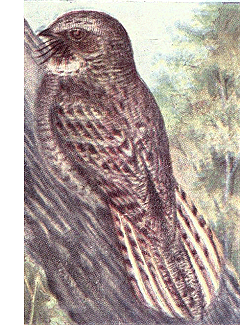
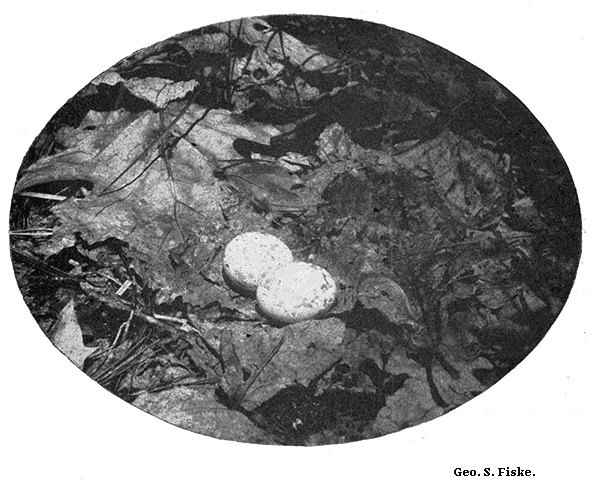
Page 263 Chuck-will's-widow. 416. Chuck-will's-widow. Antrostomus carolinensis. Range.--South Atlantic and Gulf States, breeding north to Virginia and Indiana, and west to Arkansas and eastern Texas. Grayish white. These birds are abundant summer residents in the southern portions of their range, but as they are silent and hiding in the woods during the day time, they are not as popularly known as are most birds. They rarely fly during the day time unless disturbed from their roosting place which is on the ground under underbrush or in hollow logs. Their notes, which are a rapid and repeatedly uttered whistling repetition of their name, are heard until late in the night. They nest during April, May or June, laying two eggs on the ground amid the leaves in woods or scrubby underbrush. The eggs are grayish to creamy white in color, handsomely marked with shades of lilac, gray and brownish; size 1.40 × 1.00. 417. Whip-poor-will. Antrostomus vociferus vociferus. Range.--North America east of the Plains; north to the southern parts of the British possessions; winters along the Gulf coast and southward. Whip-poor-will. This species is well known, by sound, in nearly all parts of its range, but comparatively few ever observed the bird, and probably the greater number mistake the Nighthawk for this species. The two species can readily be distinguished at a distance by the absence of any pronounced white marking in the wings, and by the white tips to the outer tail feathers in the present species, while the Night Hawk has a prominent white band across the tail, but the top is black, and the tail slightly forked. Creamy white. The Whip-poor-will, rarely leaves its place of concealment before dark, and is never seen flying about cities, as are the Nighthawks. In their pursuit of insects, they glide like a shadow over fields and woods, their soft plumage giving forth no sound as their wings cleave the air. Until late at night, their whistling cry "whip-poor-will," repeated at intervals, rings out in all wooded hilly districts. Their two eggs are deposited on the ground among dead leaves, generally in dense woods. They are grayish white or cream color marbled with pale brown and gray, with fainter markings of lilac. Size 1.50 × .85.
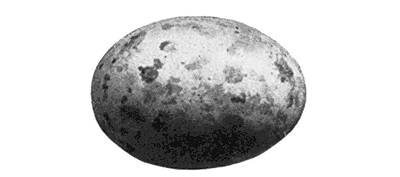
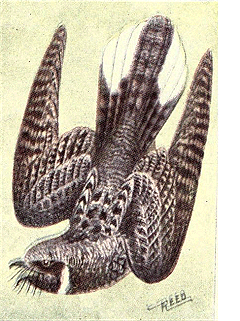
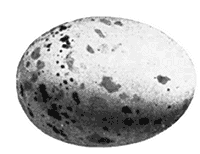
Page 264 Merrill's Paraque. Poor-will. 417a. Stephen's Whip-poor-will. Antrostomus vociferus macromystax. Range.--Arizona and New Mexico, south through the tableland of Mexico. This sub-species is slightly larger and has longer mouth bristles than the eastern bird. Their nesting habits are the same and the eggs differ only in averaging lighter in color, with fainter markings, some specimens being almost immaculate. 418. Poor-will. Phalænoptilus nuttalli nuttalli. Range.--United States west of the Mississippi, breeding from Kansas and northern California northward to Montana and British Columbia. White. This handsome species is the smallest of the family, being under 8 inches in length. Its plumage is mottled black, white and frosty gray, harmoniously blended together. They can easily be distinguished from all other Goatsuckers by their size and silvery appearance. They nest on the ground, either placing their two eggs upon a bed of leaves or upon a flat rock. The breeding season is from the latter part of May through July. The eggs are pure white and glossy; size 1.00 × .75. 418a. Frosted Poor-will. Phalænoptilus nuttalli nitidus. Range.--Texas and Arizona, north to western Kansas. This variety is like the last but paler, both above and below. Eggs indistinguishable from those of others of the genus. 418b. Dusky Poor-will. Phalænoptilus nuttalli californicus. Range.--A darker race found on the coast of California, having the same nesting habits as the others. The egg figured is of this species. Data.--Los Angeles, Cal., June 24, 1900. 2 eggs on the ground at the foot of an oak tree on the side of a hill. Collector, F. M. Palmer.
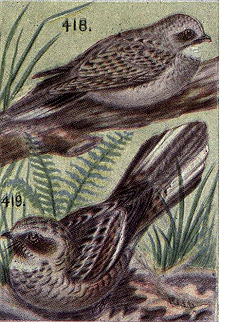
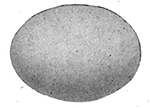
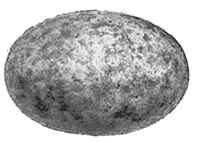
Page 265 419. Merrill's Parauque. Nyctidromus albicollis merrilli. Range.--Mexico, north to the Lower Rio Grande in southern Texas. Salmon buff. This species is the same length as the Chuck-will's-widow, but is not as stoutly built, and has a slightly longer tail. It can be distinguished from any other of the family by its tail, the outer feather on each side being black (or brownish barred with black in the female), and the next two having white ends for nearly half their length. Their eggs are laid on the ground in open localities, and generally under the protection of an overhanging bush. They are two in number and differ greatly from those of any other American member of this family, being a buff or rich salmon buff in color, spotted and splashed with gray, lavender, and reddish brown; size 1.25 × .90. Data.--Brownsville, Texas, April 16, 1900. Eggs laid on the ground in a dense thicket. Collector, Frank B. Armstrong. NEST AND EGGS OF WHIP-POOR-WILL.
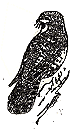
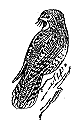
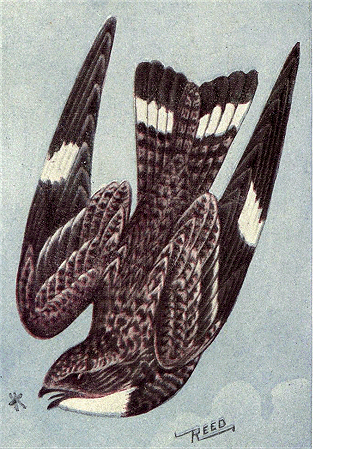
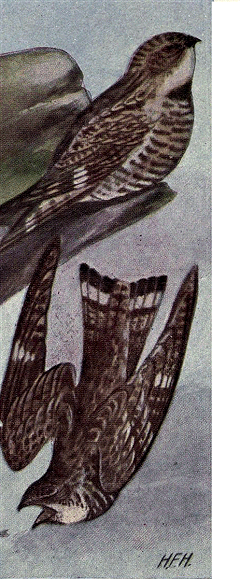
Page 266 Nighthawk. 420. Nighthawk. Chordeiles virginianus virginianus. Range.--North America, east of the Plains and from Labrador to the Gulf of Mexico; winters through Mexico to northern South America. Grayish white. The Nighthawk or some of its sub-species is found in nearly all parts of North America, its habits being the same in all localities. It is of the same size as the Whip-poor-will, from which species it can readily be distinguished by its lack of mouth bristles, forked tail with a white band near the end, and the white band across the primaries, the latter mark showing very plainly during flight. Besides in the country, they are very common in cities, where they will be seen any summer day towards dusk flying, skimming, sailing, and swooping over the tops of the buildings, upon the gravel roofs on which they often lay their eggs. They nest generally on rocky hillsides or in open woods, laying their two eggs upon the top of a flat rock. The eggs are a grayish white color, marbled, blotched and spotted with darker shades of gray. Size 1.20 x .85. 420a. Western Nighthawk. Chordeiles virginianus henryi. Grayish white. Range.--United States west of the Plains. A similar bird to the preceding, but with plumage somewhat more rusty. It frequents the more open portions of the country in its range, its habits and nesting habits being the same as others of the former species; the eggs average a trifle lighter in color. 420b. Florida Nighthawk. Chordeiles virginianus chapmani. Range.--A smaller and paler form found in Florida and along the Gulf coast. No difference can be observed in the nesting habits of this as compared with the northern form and the eggs are indistinguishable.
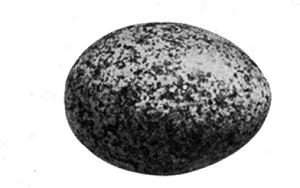
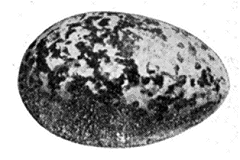
Page 267 NEST AND EGGS OF NIGHTHAWK.
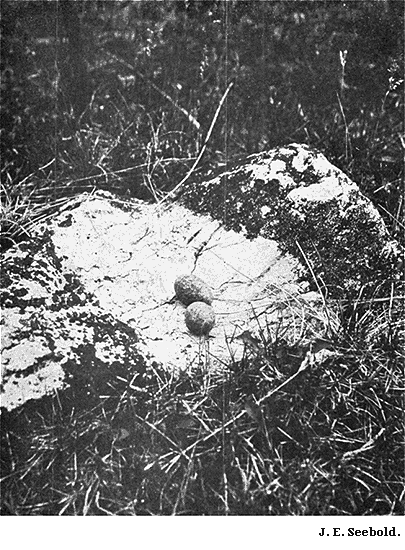
Page 268 420-421. 420c. Sennett's Nighthawk. Cordeiles virginianus sennetti. Range.--A very pale species with little or no tawny; found in the Great Plains from Texas north to the Saskatchewan; winters south of the United States. 421. Texas Nighthawk. Chordeiles acutipennis texensis. Range.--Mexico and Central America, breeding north to southern Utah and California. Grayish white. 422-424. The pattern of the marking of this species is finer and more mottled with rusty than the Nighthawk. Its habits do not differ to any extent from those of the preceding species; they lay their two mottled gray eggs upon the bare ground, often on the dry sand and in arid regions where they are exposed, with no protection, to the scorching rays of the sun. The eggs vary endlessly in extent of markings, some being very pale and others very dark gray, mottled with various shades of gray, brown and lilac. Size 1.10 x .75. SWIFTS. Family MICROPODIDÆ 422. Black Swift. Cypseloides niger borealis. Range.--Mountain ranges from Central America north to British Columbia, locally distributed throughout its range. The plumage of this Swift is entirely sooty black, darkest above; the tail is slightly forked and is without spines; length of bird, 7 inches. Although the general habits of this species are well known, little is known of their nesting; they are seen during the breeding season about the higher ranges throughout their United States habitat, and are supposed to nest in crevices on the face of cliffs at a high altitude.
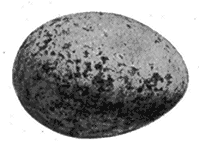
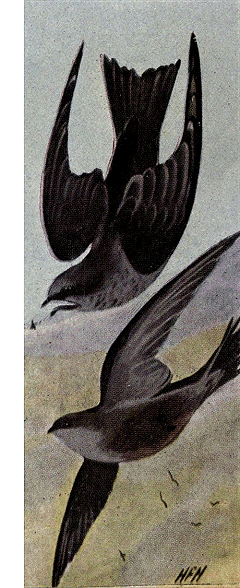
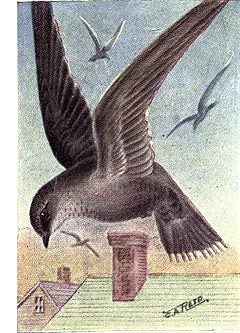
Page 269 Chimney Swift. 423. Chimney Swift. Chætura pelagica. Range.--North America east of the Plains, breeding from central Canada, south to the Gulf coast, and wintering south of our borders. This well known species is sooty brownish black, 5.5 inches long, and has the tail feathers terminating in sharp spines. They are very abundant in all portions of their range, and may be seen on the wing at all hours of the day, but especially abundant in the early morning and toward dusk. They formerly dwelt and bred only in hollow trees, and a great many still continue to do so, as large hollow stumps are known where hundreds nest every year. The majority of the eastern Chimney Swifts now nest in old chimneys that are unused, at least during the summer; some small chimneys contain but a single pair while other large ones may have from fifty to a hundred or more nests glued to the sides. The birds are on the wing during the greater part of the day, generally not frequenting the vicinity of their nesting site, but returning toward dusk, when they may be seen to, one at a time, dive headforemost into the tops of chimneys. NEST AND EGGS OF CHIMNEY SWIFT.
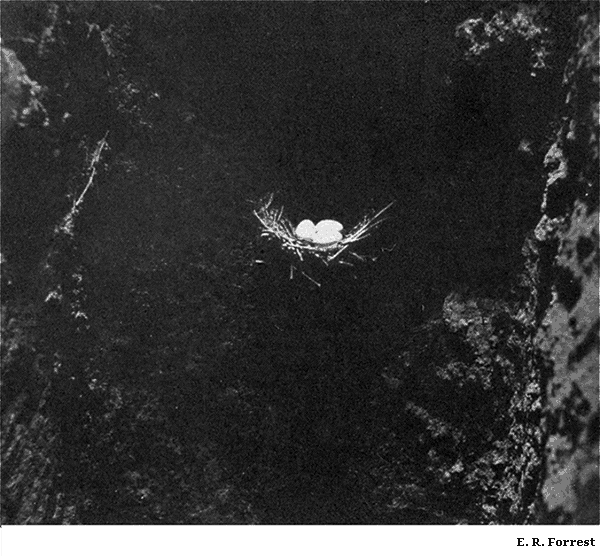
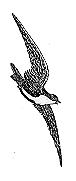
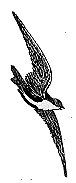
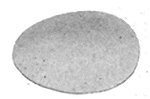
Page 270 425--426. White. The nest is made of small twigs firmly glued to the sides of the chimney, or tree, and to each other, with the glutinous saliva of the bird, making a narrow semi-circle platform for the reception of their three to five white eggs which are deposited in May or June; size .75 × .50. 424. Vaux's Swift. Chætura vauxi. Range.--Western United States, chiefly west of the Rockies; breeding north to British Columbia, and wintering south of the United States. White. Similar to the last but smaller (length 4.5 inches), and paler in color, fading to white on the throat. The habits of this species are like those of the eastern Chimney Swift, except that the majority of these species still continue to use hollow trees as nesting places. The eggs are just like those of the last bird. 425. White-throated Swift. Æronautes melanoleucus. Range.--Western United States south of Canada, and chiefly in the Rocky Mountains, and in California ranges, north to Lat. 38°. White. A handsome species, 6.5 inches in length, with blackish upper parts and sides, and white throat, breast and central line of under parts, flank patches and ends of secondaries; tail feathers not spined or stiffened. These birds are fairly common in some localities within their range, but appear to be found only on high ranges or in their immediate vicinity. They nest in crevices and caves in the face of cliffs, making a nest similar in construction to that of the Chimney Swift but of weed stalks instead of twigs, and lined with feathers. They lay four or five dull white eggs, during June or July; size .85 × .50.
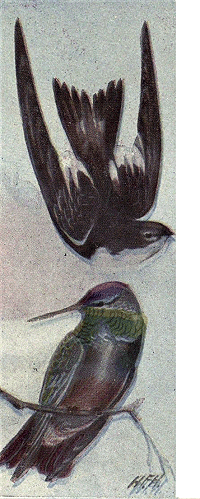
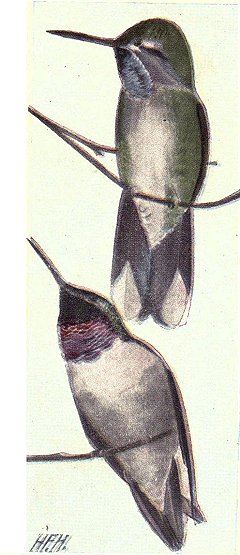
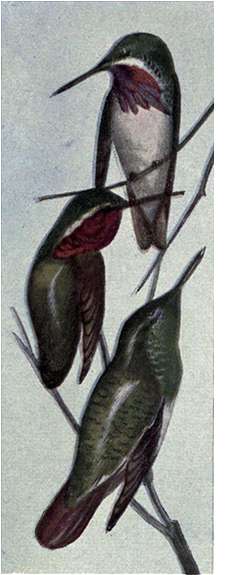
Page 271 HUMMINGBIRDS. Family TROCHILIDAE Hummingbirds have been truly called "Winged Gems." They are the smallest of birds, the usual plumage being a metallic green with throat or crown patches of the brightest of iridescent shining red, orange, blue or violet. 427--429. Their nests are marvels of architecture being compactly and intricately made of plant fibres and downy feathers ornamented in some cases with lichens. Their flight is accompanied by a peculiar buzzing sound produced by their rapidly vibrating stiffened wing feathers. Their food is small insects and honey both of which they get chiefly from flowers. 426. Rivoli's Hummingbird. Eugenes fulgens. Range.--Mexico, north in summer to southern Arizona where they breed at high elevations in the Huachuca Mountains. This is one of the most gorgeous of the Hummers having the crown a violet purple color, and the throat brilliant green. This species saddles its nest upon branches often at heights of 20 or 30 feet from the ground. They are made of plant down and generally decorated with lichens on the outside, similar to nests of the Ruby-throat. The two white eggs measure .65 × .40. 427. Blue-throated Hummingbird. Cyanolæmus clemenciæ. Range.--Mexico, north in summer to the border of Arizona and western New Mexico. This species is the largest of North American Hummers being 5.25 inches long, this being slightly larger than the preceding. As the name implies, it has a patch of blue on the throat, the upper parts being a uniform greenish; the outer tail feathers are broadly tipped with white. Their nests, which are placed upon the limbs of trees, are made of mosses and plant fibres covered with cobwebs. The two eggs are laid during July and August, and measure .65 × .40.

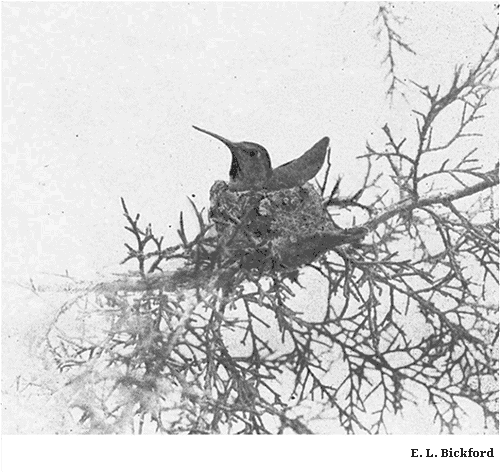
Page 272 FEMALE RUBY-THROATED HUMMINGBIRD ON NEST.
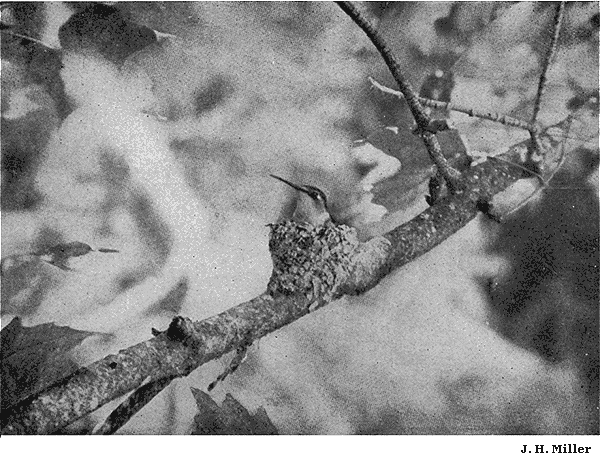
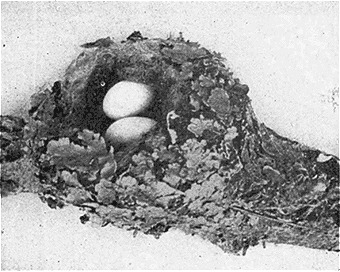
Page 273 Ruby-throated Hummingbird. 428. Ruby-throated Hummingbird. Archilochus colubris. Range.--North America east of the Plains and north to Labrador. This is the only representative of the family found east of the Mississippi. It is a small species, 3.5 inches long, with greenish upper parts and a bright ruby throat. Its nest is as beautiful, if not more so, than that of any other species. They build their nests on horizontal limbs of trees at any height from the ground, but usually more than six feet. Branches an inch or more in diameter are usually selected, they not being particular as to the kind of tree, but oaks, pines and maples perhaps being used the most often. The nests are made of plant fibres and down, and the exterior is completely covered with green lichens so that it appears like a small bunch of moss on the limb. The two white eggs are laid in May or June; size .50 × .35. 429. Black-chinned Hummingbird. Archilochus alexandri. Range.--North America west of the Rocky Mountains; north to British Columbia; winters south of the United States. Similar in size and appearance to the Ruby-throat, but with the chin and upper throat black, the rest of the throat gorget being violet or amethyst. It is an abundant species in summer in many localities, especially in the southern half of its range. They build their nests at low elevations, rarely above ten feet, on small branches or the fork at the end of a limb. The nests are made of yellowish plant fibres and are not covered with lichens, so that they have a peculiar spongy appearance. Eggs indistinguishable from those of the Ruby-throat. Laid during April, May or June.
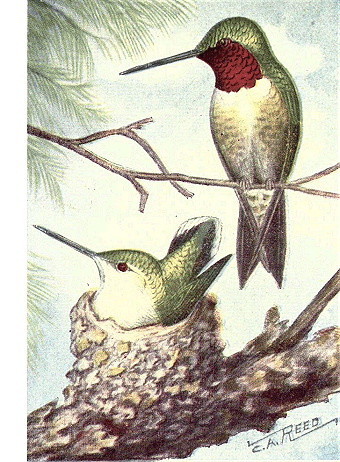
Page 274 RUBY-THROATED HUMMINGBIRD.
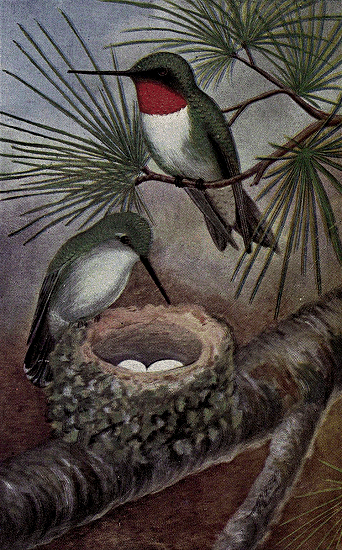
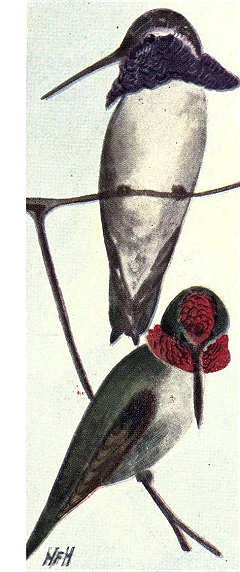
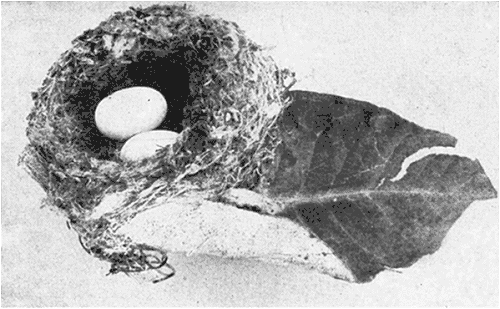
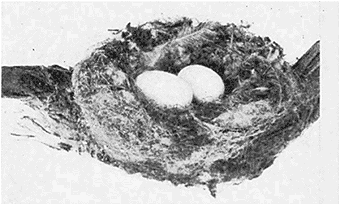
Page 275 430--431. 430. Costa's Hummingbird. Calypte costæ. Range.--Southwestern United States; north to southern Utah; winters south of our border. Smaller than the last and with both the crown and the throat gorget, violet or amethyst, the feathers on the sides of the latter being lengthened. Their nests are situated in the forks of branches generally near the ground, and seldom above six feet from it. They are made of plant down with shreds of weeds, bark and lichens worked into the outside portions, and are often lined with soft feathers. The two eggs average .48 × .32. Data.--Arroyo Seco, California, June 10, 1900. Nest in an alder bush. Collector, Charles E. Groesbeck. 431. Anna's Hummingbird. Calypte anna. Range.--Pacific coast of the United States from northern California, southward, wintering in Mexico and southern California. This handsome species has both the crown and the broadened and lengthened throat gorgets, a purplish pink; it is slightly larger than the Ruby-throat. They are very abundant in their restricted range, and nest in February and March and again in April or May, raising two broods a season. Their nests are made of plant down and covered on the outside with cobwebs and a few lichens, and are generally located at a low elevation. The white eggs average .50 × .30. Data.--Santa Monica, California, March 4, 1897. Nest in a bunch of seed pods in a gum tree, ten feet from the ground. Collector, Tom Bundy.
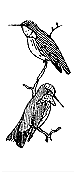
Page 276 432--433--434. 432. Broad-tailed Hummingbird. Selasphorus platycercus. Range.--Rocky Mountain regions, north to Wyoming; winters south of the United States. This species is similar to the Ruby-throat, but larger and with the back more golden green color, and the throat shining lilac. They are very abundant in Colorado and Arizona, nesting as do the Ruby-throats in the east, and their nests being similar in construction and appearance to those of that species. The eggs cannot be distinguished from those of other species. 433. Rufous Hummingbird. Selasphorus rufus. Range.--Western North America, breeding from the Mexican border north to Alaska and fairly abundant in most of its range. A handsome little species with the back and tail reddish brown, and with a throat gorget of orange red, the feathers being slightly lengthened into a ruff on the side of the gorget. They nest in a great variety of locations and at a low elevation, such as vines, bushes and the low hanging branches of trees. The nest is made of vegetable fibres covered with cobwebs and often with lichens. The eggs do not differ from those of the other Hummers.
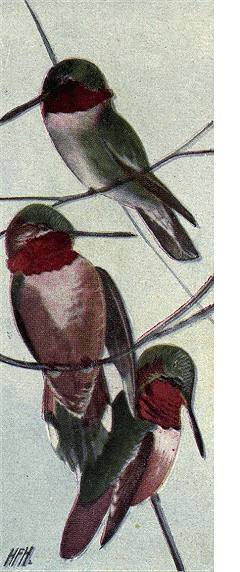
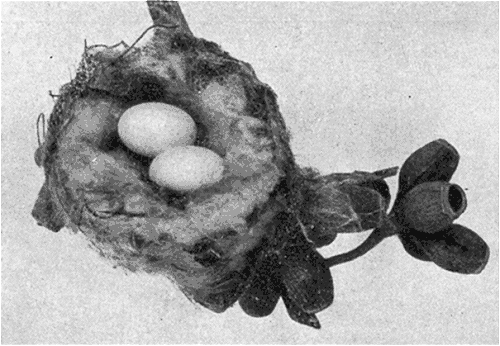
Page 277 434. Allen's Hummingbird. Selasphorus alleni. Range.--Pacific coast from British Columbia southward; most abundant in California. Winters in Mexico. This species is like the last, but the back is greenish, only the tail being reddish brown. These birds generally locate their nests at low elevations near the end of overhanging branches, on vines, weed stalks, or bushes, but have been found as high as 90 feet above ground. The nests of this species are made of plant fibres and cobwebs, generally decorated with lichens. The two white eggs measure .50 × .32. Data.--Santa Monica, Cal., May 29, 1896. Nest two feet from the ground in a sage bush. Collector, W. Lee Chambers. ANNA'S HUMMINGBIRD.
Page 278 436--437--438. 435. Morcom's Hummingbird. Atthis morcomi. Range.--This species is known only from a single specimen, taken in the Huachuca Mountains, Arizona, in 1896. 436. Calliope Hummingbird. Stellula calliope. Range.--Western United States from British Columbia southward, and from the Rocky Mountains west to eastern Oregon and California. This is the smallest of North American Hummers, being but 3 inches in length. It is greenish above and has a violet gorget showing the white bases of the feathers. They build their nests in all manner of locations from high up in tall pines to within a foot of the ground in slender bushes. The nests are made interiorly with plant down, but the outside is generally grayish colored shreds and lichens. The eggs average but a trifle smaller than those of colubris, .45 × .30. 437. Lucifer's Hummingbird. Calothorax lucifer. Range.--Mexico, north to southwestern Texas and Arizona. This species, which is common in parts of Central Mexico, occurs only casually north to our borders and has not yet been found nesting there. They build small compact nests of plant down attached to the stalks or leaves of plants or weeds. 438. Reiffer's Hummingbird. Amizilis tzacatl. Range.--Abundant in southern Mexico; casual in southern Texas. This species is greenish above, with a bronzy lustre; the tail is reddish brown, and the throat and breast are metallic green. They breed abundantly about houses and nest apparently at all seasons of the year in Central America, where they are the most common species of Hummers.
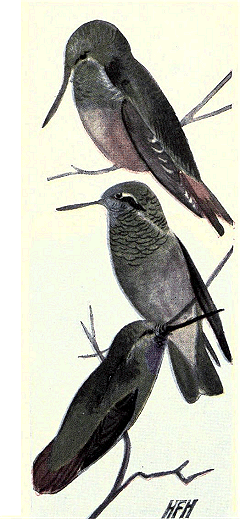
Page 279 439--440.1--441. 439. Buff-bellied Hummingbird. Amizilis cerviniventris chalconota. Range.--Lower Rio Grande Valley in Texas and southward through Mexico. These birds are like the last but have the underparts a pale brownish buff color. They are quite common in their summer range in the United States, nesting at a low elevation in bushes and low trees. The two eggs are white, .50 × .35. Data.--Brownsville, Texas, May 5, 1892. Nest of fine bark-like fibre on the outside, lined with lint from thistle plant; located on limb of small hackberry. Collector, Frank G. Armstrong. 440. Xantus' Hummingbird. Basilinna xantusi. Range.--Southern Lower California. A handsome species, greenish above, with a coppery tinge and shading into reddish brown on the tail; under parts buffy, throat metallic green, and a broad white streak behind the eye. They breed on the ranges making a similar nest to those of other Hummers, placed on weeds or bushes near the ground. The eggs cannot be distinguished from those of the majority of other species. 440.1. White-eared Hummingbird. Basilinna leucotis. Range.--A Central American and Mexican species, casually found on the ranges in Southern Arizona. The plumage of this species is greenish above and below, being metallic green on the breast; the forehead, sides of head, and throat are iridescent blue and a white line extends back from the eye. 441. Broad-billed Hummingbird. Cynanthus latirostris. Range.--Mountains of central Mexico north to southern Arizona and New Mexico. The throat of this species is a rich metallic blue; otherwise the plumage is greenish above and below, being brighter and more irisdescent on the breast. They are not uncommon on the ranges of southern Arizona, where they have been found nesting in July and August, their nest not being unlike those of the Rufous Hummer, but with the exterior largely composed of shreds of grayish bark and lichens. Their eggs are like many others of the Hummers.

Page 280 PERCHING BIRDS. Order XVII. PASSERES COTINGAS. Family COTINGIDAE 441.1. Xantus Becard. Platypsaris aglaiæ albiventris. Range.--Mexico; north casually to the southern border of Arizona. Buffy gray. This peculiar species is grayish above and lighter gray below, has dark slaty crown, and a patch of rose color on the lower throat. This is the only representative of this tropical family that has been found as yet over the Mexican border, but its near ally, the Rose-throated Becard has been found within a very few miles and will doubtless be added to our fauna as an accidental visitor ere long. Their nests are large masses of grasses, weeds, strips of bark, etc., partially suspended from the forks of branches. Their eggs number four or five and are a pale buffy gray color, dotted and scratched with a pale reddish brown and dark gray. Size .95 × .70. The one figured is from a set in the collection of Mr. Crandall, taken June 1, 1897 at Presidio Sinaloa, Mexico. FLYCATCHERS. Family TYRANNIDÆ Flycatchers, which are found only in America and chiefly in the tropics, are insect-eating birds, generally having a grayish colored plumage, sometimes adorned with a slight crest or a coronal mark of orange, red, or yellow. Only two of the species found in North America are gaudy in plumage, the Vermilion, and the Derby Flycatchers. They all have the habit of sitting erect on a dead twig, and watching for passing insects, which they catch on the wing. 442. Fork-tailed Flycatcher. Muscivora tryannus. Range.--A Central and South American species accidentally having occurred in the United States on several occasions. This is a handsome black, white and gray species of the size and form of the next.
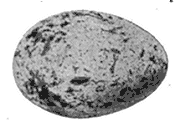
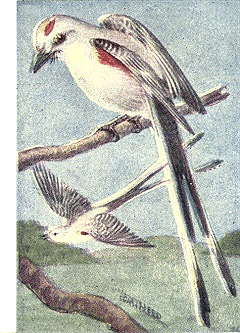
Page 281 Scissor-tailed Flycatcher. 443. Scissor-tailed Flycatcher. Muscivora forficata. Range.--Mexico, north through Texas to southern Kansas; accidental in other parts of the country. Creamy white. The Scissor-tail or "Texan Bird of Paradise" is the most beautiful member of this interesting family. Including its long tail, often 10 inches in length and forked for about 6 inches, this Flycatcher reaches a length of about 15 inches. It is pale grayish above, fading into whitish below, and has scarlet linings to the wings, and a scarlet crown patch. They are one of the most abundant of the breeding birds in Texas, placing their large roughly built nests in all kinds of trees and at any elevation, but averaging between ten and fifteen feet above ground. The nests are built of rootlets, grasses, weeds and trash of all kinds, such as paper, rags, string, etc. The interior is generally lined with plant fibres, hair or wool. They lay from three to five, and rarely six eggs with a creamy white ground color, more or less spotted and blotched with reddish brown, lilac and gray, the markings generally being most numerous about the larger end. They average in size about .90 × .67. Data.--Corpus Christi, Texas, May 18, 1899. 6 eggs. Nest of moss, vines, etc., on small trees in open woods near town. Collector, Frank B. Armstrong. 444. Kingbird. Tyrannus tyrannus. Kingbird. Range.--Temperate North America, breeding from the Gulf of Mexico north to New Brunswick, Manitoba and British Columbia; rare off the Pacific coast. Cream color. This common Tyrant Flycatcher is very abundant in the eastern parts of its range. They are one of the most pugnacious and courageous of birds attacking and driving away any feathered creature to which they take a dislike, regardless of size. Before and during the nesting season, their sharp, nerve-racking clatter is kept up all day long, and with redoubled vigor when anyone approaches their nesting site. They nest in any kind of a tree, in fields or open woods, and at any height from the ground, being found on fence rails within two feet of the ground or in the tops of pines 70 or 80 feet above the earth. Nearly every orchard will be found to contain one or more pairs of these great insect
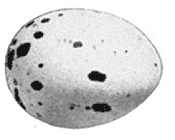
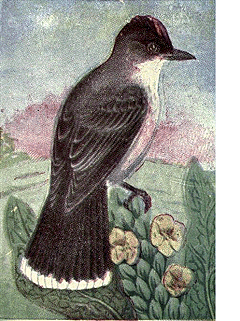
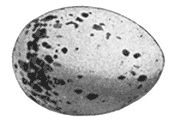
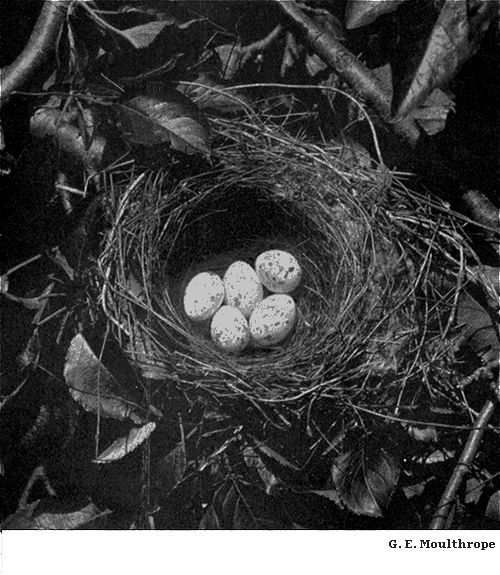
Page 282 destroyers; if more than one pair, there will be continual warfare as often as one encroaches on the domains of the other. Their nests are made of strips of vegetable fibre, weeds, etc., and lined with horsehair or catkins. They are sometimes quite bulky and generally very substantially made. The three to five eggs are laid the latter part of May, and are of a creamy ground color splashed with reddish brown and lilac. Size .95 × .70. Data.--Worcester County, Massachusetts, June 3, 1895. 4 eggs. Nest 10 feet from the ground in an apple tree; made of fibres, string, rootlets and weeds, lined with horse hair. Collector, F. C. Clark. NEST AND EGGS OF KINGBIRD.
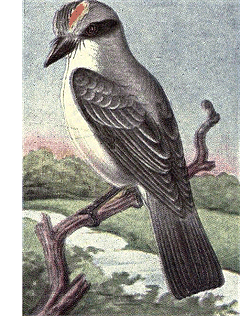
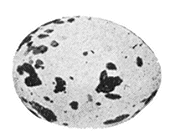
Page 283 Gray Kingbird. 445. Gray Kingbird. Tyrannus dominicensis. Range.--West Indies; north in April to Florida and the South Atlantic States to South Carolina and casually farther. Creamy. This species is slightly larger than our Kingbird, (9 inches long), grayish instead of dark drab above, white below, and without any white tip to tail. Like the common Kingbird, it has a concealed orange patch on the crown. Their habits and nesting habits are the same as those of our common bird, but the nest is not generally as well built, and nearly always is made largely of twigs. The three or four eggs have a creamy or a creamy pink ground color, spotted and blotched with dark brown and lilac, most numerously about the large end. Size 1.00 × .73. Tarpon Springs, Florida, May 28, 1802. Nest of twigs and weeds in a low bush. Collector, J. A. Southley. Buff. 446. Couch's Kingbird. Tyrannus melancholicus couchi. Range.--Mexico, north in summer to southern Texas. This species is very similar to the next but the throat and breast are white, and the underparts a brighter yellow. Like the other members of this genus, these build their nests in any location in trees or bushes, making them of twigs, weeds and moss. Their three or four eggs have a creamy ground with a pinkish cast and are spotted with brown and lilac. Size .97 × .12. Arkansas Kingbird. 447. Arkansas Kingbird. Tyrannus verticalis. Range.--Western United States and southern British Provinces from Kansas and Minnesota west to the Pacific. This species has grayish upper parts, shading into darker on the wings and tail, and lighter on the throat and upper breast; the underparts are yellow, and there is a concealed patch of orange on the crown. They are very abundant throughout the west, where they have the same familiar habits of the eastern species, nesting in all sorts of locations such as would be used by the latter. Their nests are made of plant fibres, weeds, string, paper or any trash that may be handy, being sometimes quite bulky. Their eggs do not differ in any particular from those of the eastern bird, except that they may average a little smaller. Size .95 × .65.
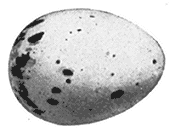
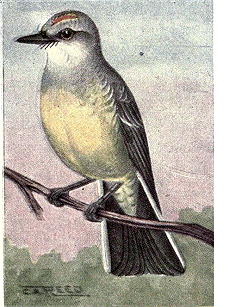
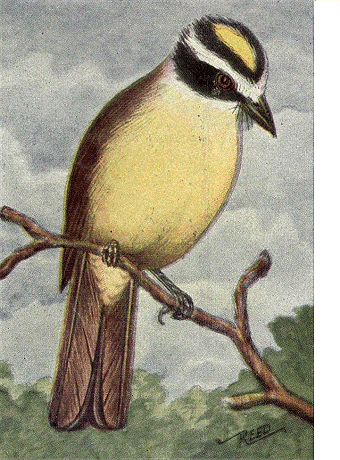
Page 284 Derby Flycatcher. 448. Cassin's Kingbird. Tyrannus vociferans. Range.--Western United States from the Rocky Mountain region to California, and from Wyoming southward. Buff. This species is like the last except that the throat and breast are darker. Their habits, nesting habits and eggs are indistinguishable from those of the other Tyrant Flycatchers, and they are fully as courageous in the defense of their homes against either man or bird, their notes resembling those of the common Kingbird of the east. 449. Derby Flycatcher. Pitangus sulphuratus derbianus. Range.--Mexico and Central America, breeding north to southern Texas. Creamy white. This handsome bird is the largest of the Flycatcher family found in the United States, being 11 inches in length. It has a black crown enclosing a yellow crown patch; a broad black stripe from the bill, through the eye and around the back of the head, is separated from the crown by a white forehead and line over the eye; the throat is white shading into yellow on the underparts. They are abundant in the interior of Mexico, but can hardly be classed as common over our border, where they nest in limited numbers. Their nests are unlike those of any of our other Flycatchers being large masses of moss, weeds and grass, arched over on top and with the entrance on the side. The three or four eggs are creamy white, sprinkled chiefly about the large end with small reddish brown or umber spots; size 1.15 × .85.
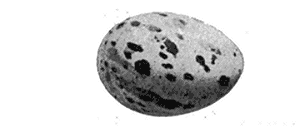
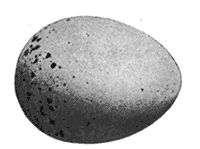
Page 285 451. Sulphur-bellied Flycatcher. Myiodynastes luteiventris. Crested Flycatcher. Range.--Mexico and Central America, breeding north to the Mexican border of Arizona. Creamy buff. This peculiar Flycatcher, which is unlike any other American species, can only be regarded as a rare breeding bird in the Huachuca Mts. It is 8 inches in length, has a grayish back streaked with black, the tail largely rusty brown and the underparts sulphur yellow, streaked on the breast and sides with dusky; a yellow crown patch is bordered on either side by a stripe of mottled dusky, and is separated from the blackish patch through the eye, by white superciliary lines. Their habits are similar to those of the genus Myiarchus, and, like them, they nest in cavities in trees, and lay from three to five eggs of a creamy buff color thickly spotted and blotched with brown and purplish, the markings not assuming the scratchy appearance of the Crested Flycatchers, but looking more like those of a Cardinal; size of egg 1.05 × .75. Data.--Huachuca Mts., Arizona, June 29, 1901. 4 eggs. Nest in the natural cavity of a live sycamore tree about fifty feet from the ground; composed of twigs. Collector, O. W. Howard. 452. Crested Flycatcher. Myiarchus crinitus. Range.--North America, east of the Plains, and from New Brunswick and Manitoba southward; winters from the Gulf States southward. Buff. This trim and graceful, but quarrelsome, species is grayish on the head, neck, and breast, shading to greenish on the back and quite abruptly into bright yellow on the underparts; the head is slightly crested and the inner webs of all the lateral tail feathers are reddish brown. They are abundant in most of their range but are generally shy so they are not as often seen as many other more rare birds. They nest in cavities of any kind of trees and at any elevation from the ground, the nest being made of twigs, weeds and trash, and generally having incorporated into its make-up a piece of cast off snake skin. They lay from four to six eggs of a buffy color, blotched and lined with dark brown and lavender. Size .85 × .65.
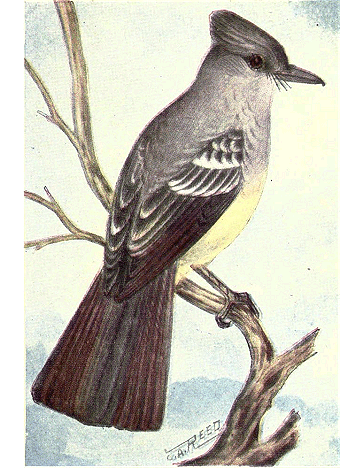
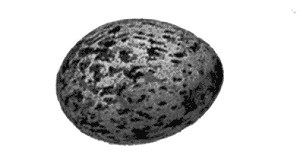
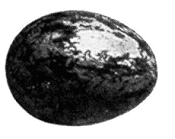
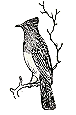
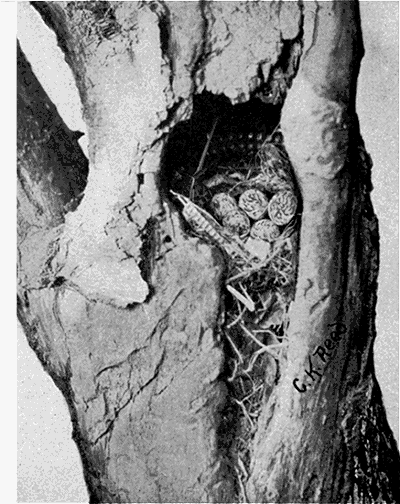
Page 286 453--454. 453. Arizona Crested Flycatcher. Myiarchus magister magister. Range.--Southern Arizona and New Mexico, south through Mexico. Pale buff. This bird is very similar to, but averages slightly larger than the Mexican Flycatcher. Its nesting habits are the same and the eggs cannot be distinguished from those of the latter, the nest being most frequently found in giant cacti. 453a. Mexican Crested Flycatcher. Myiarchus magister nelsoni. Range.--Mexico, north to southern Texas. This species is similar to the last but is considerably paler. They are common in some localities, nesting in holes in trees or stumps, often those deserted by Woodpeckers. Their eggs are like those of the last but average paler. Data.--Corpus Christi, Texas, May 10, 1899. Nest in hole in telegraph pole; made of red cow hair, feathers and leaves. 4 eggs. Collector, Frank B. Armstrong. 454. Ash-throated Flycatcher. Myiarchus cinerascens cinerascens. Range.--North America, west of the Plains and south of Canada. Similar to the others of the genus but grayish brown above and with the underparts much paler, the throat and breast being nearly white. Like the others they nest in cavities in trees, either natural or ones made by Woodpeckers. Their four to five eggs are lighter in color than those of crinitus but cannot be distinguished from those of the Mexican Crested Flycatcher. Buff.
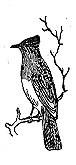
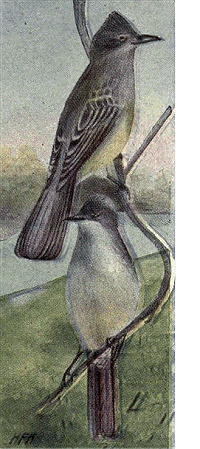
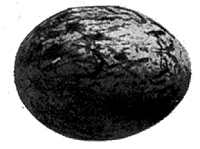
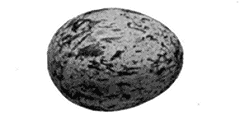
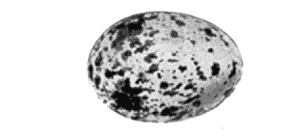
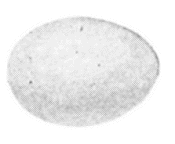
Page 287 454b. Lower California Flycatcher. Myiarchus cinerascens pertinax. Phœbe. Range.--Lower California. This sub-species is similar to Nutting Flycatcher but paler below and grayish above. 455a. Olivaceous Flycatcher. Myiarchus lawrencei olivascens. Range.--Western Mexico, north to southern Arizona. Buffy. This is the smallest of the genus found in the United States, being but 7 inches in length. Except for size it is similar to crinitus but with very little, if any, rusty brown on tail, except for a slight edging on the outer web. Their nesting sites are the same as those chosen by the other Crested Flycatcher, but their eggs appear to have but little of the scratchy appearance of the other members. They are pale buffy, speckled and spotted with brown and lilac; size .80 × .60. Data.--Toluca, Mexico, May 20, 1895. Nest of brown hair and feathers, in hole in tree in woods. Collector, Fred T. Francis. 456. Phœbe.. Sayornis phœbe. Range.--North America, east of the Rockies and north to Nova Scotia. White. These very common, grayish colored birds are very often known as "Bridge Birds" because of the frequency with which they construct their nests under bridges and arches; they also build in crevices in ledges or among the hanging roots near the tops of embankments, and on the rafters or beams of old buildings. The nests are made of mud, moss and grass, lined with feathers. The four or five eggs measure .75 × .55. Occasionally, eggs will be found that have a few minute spots of reddish brown. Freak situations in which to locate their nests are often chosen by these birds, such as the brake beam of a freight car, in the crevices of old wells, hen houses, etc. The birds are one of the most useful that we have; being very active and continually on the alert for insects and beetles that constitute their whole bill of fare.
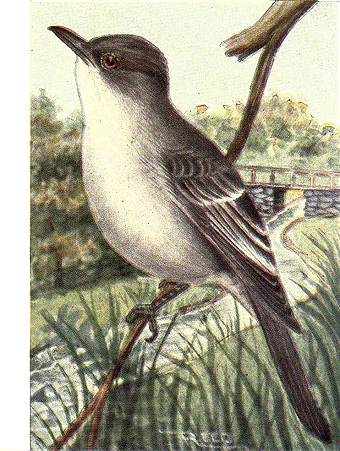
Page 288 PHOEBE ON NEST.
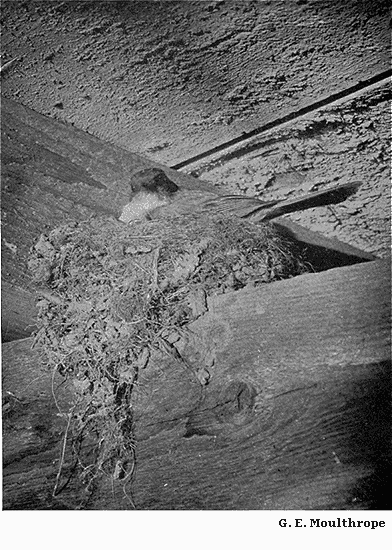
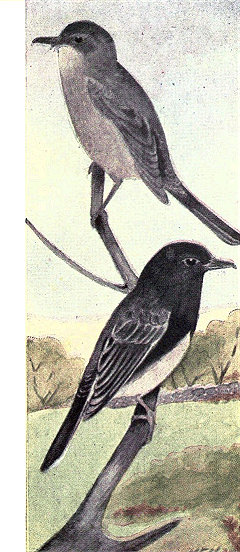
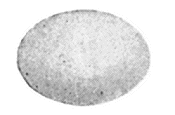
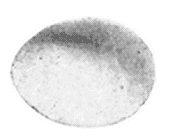
Page 289 457-458. 457. Say's Phœbe. Sayornis sayus. Range.--Western United States, breeding from southern United States, north to the Arctic regions, and from Kansas and Wisconsin westward. Winters in Mexico. White. This bird is slightly larger than the last (7.5 inches long), and is rusty brown color on the belly and lower breast. Like the eastern Phœbes they are one of the earliest birds to return in the spring and are abundant in the greater parts of their range. Like the latter, they often raise two broods a season, one in April and another in July. Their nests are generally placed on narrow shelves and crevices of ledges, but they also nest as commonly about houses and farms as does the eastern bird. The nests are made of weeds, mosses, fibres and wool, and are quite flat. They lay four or five white eggs. Size .78 x .58. 458. Black Phœbe. Sayornis nigricans. White. Range.--Mexico and north in summer into the bordering States. This species is of the size of the last but is blackish (darkest on the head and breast), with a white belly and under tail coverts, the latter streaked with dusky. Their habits and nesting habits are the same as those of the eastern Phœbe, they building their nests of mud, moss, weeds and feathers on ledges or about buildings, and generally close to or in the vicinity of water. They breed during April or May, laying four or five white eggs which cannot be distinguished from those of the common Phœbe. Size .75 x .55. 458a. Western Black Phœbe. Sayornis nigricans semiatra. Range.--Pacific Coast of Mexico and the United States, breeding north to Oregon. This variety differs from the last in having the under tail coverts pure white. Its nesting habits are precisely the same and the eggs indistinguishable.

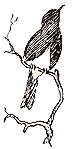
Page 290 Olive-sided Flycatcher. 459. Olive-sided Flycatcher. Nuttallornis borealis. Range.--Whole of North America, breeding from the Middle States and California northward, and in the Rockies, south to Mexico; winters south of the United States. These Flycatchers are nowhere abundant, and in some parts of the country, especially in the middle portion, they are very rare. Creamy white. They breed very locally and generally not more than one pair in any locality. In New England, I have always found them nesting in company with Parula Warblers, in dead coniferous swamps in which the branches are covered with long pendant moss. Their nests are placed high up in the trees, generally above fifty feet from the ground, and on small horizontal limbs; they are made of small twigs and rootlets, lined with finer rootlets and moss, and are very flat and shallow; as they are generally made to match the surrounding, they are one of the most difficult nests to find. They lay three or four cream colored eggs which are spotted with reddish brown and lilac, chiefly about the large end. Size .85 x .65. Data.--Lake Quinsigamond, Massachusetts, June 12, 1897. Nest of twigs and moss, about 60 feet above the ground, in a dead pine tree in center of a large wet swamp. Nest could not be seen from the ground, and was found by watching the birds.
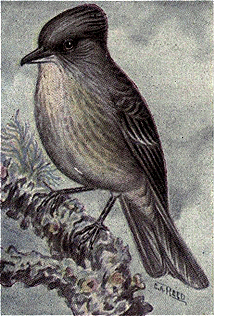
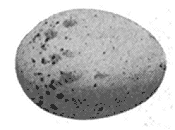
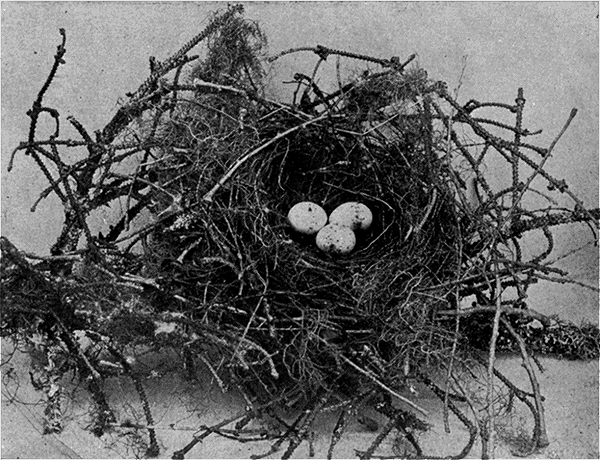
Page 291 460. Coues's Flycatcher. Myiochanes pertinax pallidiventris. Range.--Western Mexico, breeding north to central Arizona. Cream color. This Flycatcher builds one of the most artistic nests created by feathered creatures. It bears some resemblance on the exterior to that of the next species, but it is much more firmly made, and the walls are usually higher, making a very deeply cupped interior. The outside of the nest is made of fibres, cobwebs, catkins, etc., firmly felted together and ornamented with green lichens to match the limb upon which it is saddled. The interior is heavily lined with dried, yellowish grasses, making a very strong contrast to the exterior. They are fairly abundant birds in the ranges of southern Arizona, where they nest generally during June. They lay three eggs of a rich creamy color, spotted and blotched, chiefly about the larger end, with reddish brown and lilac gray. Size .95 x .61. Data.--Huachuca Mts., Arizona, July 8, 1897. 3 eggs. Nest in a yellow pine about 60 feet up and near the extremity of a long slender limb. Elevation 7000 feet. Collector, O. W. Howard. 461. Wood Pewee. Myiochanes virens. Wood Pewee. Range.--North America, east of the Plains and north to the southern parts of the British Provinces. Winters south of the United States. Cream color. This is one of the best known and one of the most common frequenters of open woods, where all summer long its pleasing notes may be heard, resembling "Pee-a-wee" or sometimes only two syllables "pee-wee." They nest on horizontal limbs at elevations of six feet or over, making handsome nests of plant fibres and fine grasses, covered on the exterior with lichens; they are quite shallow and very much resembles a small knot on the limb of the tree. They lay three or four eggs of a cream color spotted in a wreath about the large end, with reddish brown and lavender; size .80 x .55. Data.--Torrington, Conn., June 16, 1890. Nest of fibres covered with lichens, saddled on the branch of an oak tree near roadside. Collector, John Gath. Chickadee Family.
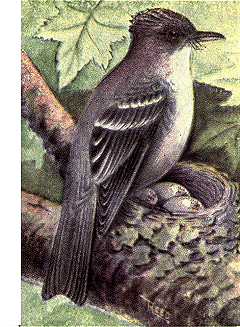
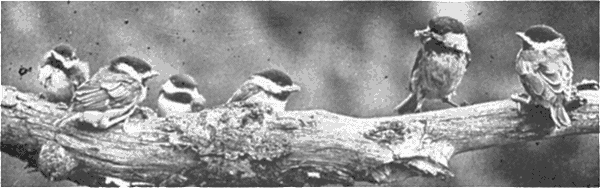
Page 292 NEST AND EGGS OF WOOD PEWEE.
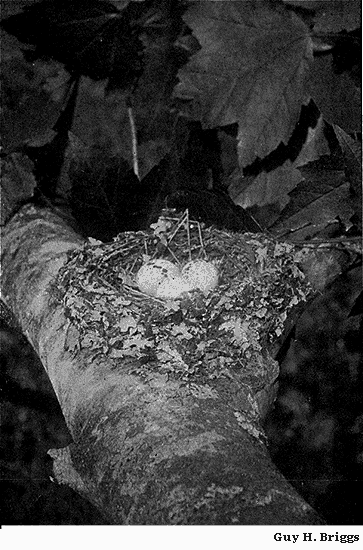
Page 293 Yellow-bellied Flycatcher. Acadian Flycatcher. 462. Western Wood Pewee. Myiochanes richardsoni richardsoni. Range.--Western United States from the Plains to the Pacific, and from Manitoba southward, wintering south of the United States. The nesting habits of this bird are the same as those of the eastern Pewee, but their nests are more strongly built and generally deeper, and without the outside ornamentation of lichens. They are saddled upon horizontal branches, like those of the preceding, as a rule, but are also said to have been found in upright crotches like those of the Least Flycatcher. Their three or four eggs cannot be distinguished from those of the eastern Wood Pewee. 462a. Large-billed Wood Pewee. Myiochanes richardsoni peninsulæ. Range.--This species which differs from the last only slightly, as is indicated by the name, inhabits the peninsula of Lower California; its nesting habits and eggs will not differ from those of the other Pewees. 463. Yellow-bellied Flycatcher. Empidonax flaviventris. Range.--North America, east of the Plains and north to Labrador; winters south of the United States. Creamy white. This species is slightly larger than the Least Flycatcher and is more yellowish above and below, the breast being quite bright. While common in some districts it is quite shy and frequents thickly wooded regions, where it is not very often seen. They nest near or on the ground among rocks or roots of fallen trees, chiefly in swampy places; the nests are made in bunches of moss, hollowed out and lined with very fine grasses. Their four eggs are creamy or buffy white, spotted and speckled about the larger end with reddish brown and gray; size .68 × .51. 464. Western Flycatcher. Empidonax difficilis difficilis. Range.--Western North America, from the Rocky Mountain region to the Pacific, and north to Alaska; winters chiefly south of the United States. Creamy white. This Flycatcher, which is similar to the last, nests in similar locations as well as in many others, such as crevices and fissures in rocks, holes in banks, cavities in trees, rafters in buildings, etc. The nests are variously made, but consist chiefly of fine grasses, weeds and fibres. The eggs are as a rule similar to those of the last species and cannot be distinguished.
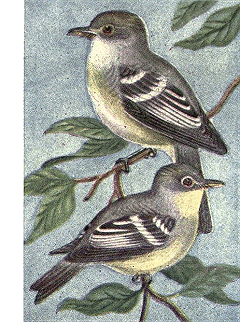
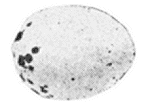
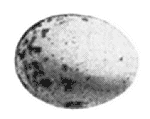
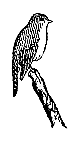
Page 294 464--466. 464a. San Lucas Flycatcher. Empidonax difficilis cineritius. Range.--Lower California. This species is similar to, but duller in plumage than the Western Flycatcher. Their nesting habits do not probably vary from those of the latter. 465. Acadian Flycatcher. Empidonax virescens. Range.--Eastern United States, breeding from the Gulf to southern New England, and in the Mississippi Valley to Manitoba. Buffy. This species is very pale below and greenish yellow on the back. They are among the latest of the migrants to reach our borders and arrive in the Middle States about the latter part of May, when they are quite common. They build semi-pensile nests in the forks of bushes or overhanging branches at heights of from four to twenty feet, the nests being made of rootlets, fibres, fine grasses, etc., and partially suspended from the branch; they are quite shallow and loosely constructed and often appear more like a bunch of debris deposited in the fork by the wind than like the creation of a bird. Their three or four eggs are buffy, spotted or specked with brown; size .75 × .55. 466. Traill's Flycatcher. Empidonax trailli trailli. Range.--Western North America, from the Mississippi Valley to the Pacific; winters south of the United States. Creamy white. This species is very similar to the next, but the back is said to be more brownish. They are common and nest abundantly in thickets and low scrubby woods, usually placing the nest at a low elevation, preferably in a clump of willows; the nests are made of fine strips of bark, plant fibres, and very fine rootlets being woven about and firmly fastened in upright crotches. Their eggs, which are laid in June, are buffy white, specked and spotted, chiefly at the large end, with brownish; size .70 × .54.
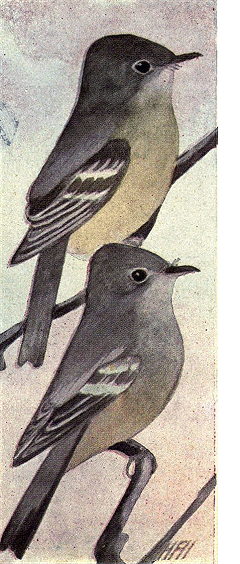
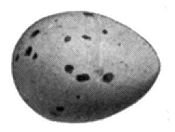
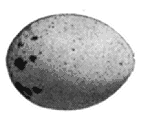
Page 295 Least Flycatcher. 466a. Alder Flycatcher. Empidonax trailli alnorum. Range.--United States, east of the Mississippi and north to New Brunswick. The only difference between this and the preceding variety is in the more greenish upper parts. They are quite abundant in the breeding season from New England and northern New York northward, frequenting, to a great extent, alder thickets bordering streams. Their nests and eggs do not differ appreciably from those of the western variety of Traill Flycatcher. 467. Least Flycatcher. Empidonax minimus. Range.--North America, east of the Rockies and north to the interior of Canada, wintering south of the United States. White. These little birds (5.5 inches long) are common about houses and orchards on the outskirts of cities, and on the edges of forests or open woods. They are very frequently known by the name of Chebec from their continually uttered note. In nearly all instances, the nests are placed in upright forks at elevations varying from four to twenty-four feet from the ground. The nests are made chiefly of plant fibres, fine grasses, string, cobwebs, etc., and the three to five eggs are pale creamy white; size .65 × .50. 468. Hammond's Flycatcher. Empidonax hammondi. Range.--North America, west of the Rockies and from British Columbia southward, wintering south of the United States. 462--469--469.1. White. This western representative of the Least Flycatcher is less abundant and more shy, but has the same nesting habits as the eastern birds, placing its nests either in upright crotches or, more rarely, upon horizontal branches at a low elevation. The eggs cannot be distinguished from those of the last species. 469. Wright's Flycatcher. Empidonax wrighti. Range.--Western United States, breeding from the Mexican border to Oregon and wintering south of the United States. White. A very similar bird to the last but whiter below. It is a much more abundant species than the last and is found breeding in open woods and thickets on all the ranges. The nests are built like those of the Least Flycatcher and nearly always are found in the crotch of trees or bushes at a low elevation; their nests, like those of the two preceding species, bear a strong resemblance to those of the Yellow Warblers which are found in the same localities and locations. The eggs are pale creamy white, four in number and measure .68 × .52.
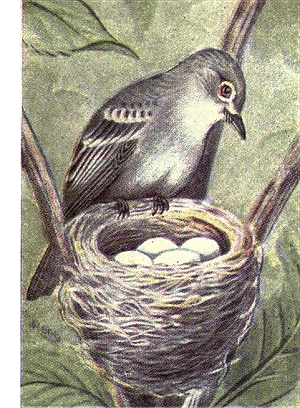
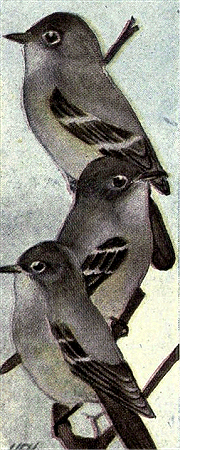
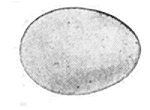
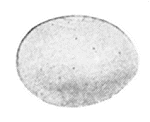
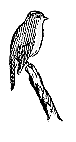
Page 296 Vermillion Flycatcher. 469.1. Gray Flycatcher. Empidonax griseus. Range.--Lower California, north to southern California. This is a slightly larger species than the preceding and is grayish above and paler below, with little or no tinge of brownish or yellow. As far as I can learn its eggs have not yet been taken. 470a. Buff-breasted Flycatcher. Empidonax fulvifrons pygmæus. Range.--Western Mexico, north to southern New Mexico and Arizona. This small bird, which is but 4.75 inches in length, is brownish gray above and brownish buff below. It is not a common species anywhere, but is known to nest during June or July, on high mountain ranges, saddling its nest of fibres, covered with lichens, on horizontal boughs at quite an elevation from the ground. The eggs are pale buffy white, unspotted, and measure .60 × .50. 471. Vermillion Flycatcher. Pyrocephalus rubinus mexicanus. Range.--Mexico, north regularly to southern Texas, Arizona and New Mexico. Buff. This is one of the most gaudy attired of all North American birds, being brownish gray on the back, wings and tail, and having a bright vermillion crown, crest and underparts. They are quite common in southern Texas, but far more abundant in the southern parts of Arizona. Their habits do not differ from those of other Flycatchers, they living almost exclusively upon insects. The majority of their nests can not be distinguished from those of the Wood Pewee, being covered with lichens and saddled upon limbs in a similar manner, but some lack the mossy ornamentation. Their three or four eggs are buffy, boldly blotched with dark brown and lavender, chiefly in a wreath about the middle of the egg; size .70 × .50. Data.--San Pedro River, Arizona, June 10, 1899. Nest in the fork of a willow about 20 feet above the stream. Collector, O. W. Howard. 472. Beardless Flycatcher. Camptostoma imberbe. Range.--Central America; north casually to the Lower Rio Grande in Texas. This strange little Flycatcher, several specimens of which have been taken in the vicinity of Lomita, Texas, is but 4.5 inches in length, grayish in color and has a short bill, the upper mandible of which is curved. It has all the habits peculiar to Flycatchers. Their eggs have not as yet been found as far as I can learn.
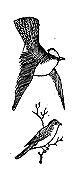
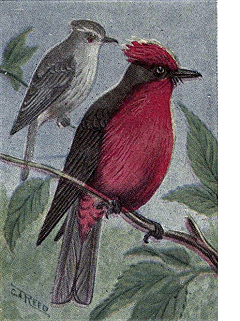
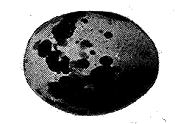
Page 297 LARKS. Family ALAUDIDÆ Horned Lark. 473. Skylark. Alauda arvensis. Range.--Old World, straggling casually to Greenland and Bermuda. Grayish. This noted foreigner has been imported and liberated a number of times in this country, but apparently is not able to thrive here, a fact which will not cause much regret when we remember the experiment with the English Sparrow. They are abundant in Europe and Great Britain where they nest on the ground in cultivated fields or meadows, laying from three to five grayish eggs, marked with brown, drab and lavender. 474. Horned Lark. Otocoris alpestris alpestris. Range.--Eastern North America, breeding in Labrador and about Hudson Bay; winters in eastern United States south to Carolina. This variety of this much sub-divided species is 7.5 inches in length, has brownish gray upper parts and is white below with black patches on the breast and below the eye, yellowish throat and small black ear tufts. The various subspecies are all marked alike, their distinction being based upon slight differences in size, variations in the shade of the back, or the greater or less intensity of the yellowish throat and superciliary stripe. The nesting habits of all the varieties are the same and the eggs differ only in the shade of the ground color, this variation among the eggs of the same variety being so great that an egg cannot be identified without knowing the locality in which it was taken. The present variety build their nests on the ground generally under tufts of grass or in hollows in the moss which is found in their breeding range, making them of dried grasses and generally lining them with feathers. The eggs are grayish with a slight greenish tinge, and are specked and spotted over the whole surface with drab, brownish and dark lavender. The eggs of this and the next variety average considerably larger than those of the more southerly distributed varieties; size .92 × .65. 474a. Pallid Horned Lark. Otocoris alpestris arcticola. Range.--Breeds in Alaska and winters south to Oregon and Montana. This is the largest of the Horned Larks and has the throat white, with no trace of yellow. Its nest is built in similar locations and the eggs are like those of the preceding species.
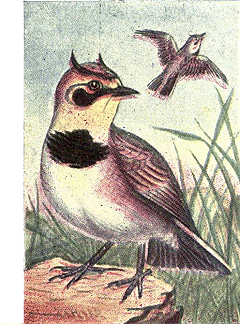
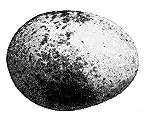

Page 298 474c--474e--474f. 474b. Prairie Horned Lark. Otocoris alpestris praticola. Range.--Breeds in the Mississippi Valley from Illinois north to Manitoba and east to the Middle States; winters south to Carolina and Texas. Olive buff. This sub-species is considerably smaller than the Horned Lark, and the throat is paler yellow, while the line over the eye and the forehead is white. They are the most abundant and have the most extended range of any of the better known species. In the Mississippi Valley, where they are of the most common of the nesting birds, they build on the ground in meadows or cultivated fields, and very often in cornfields; the nests are made of grasses and lined with horse hairs or feathers, and placed in slight hollows generally under a tuft of grass or sods. They raise two broods a season and sometimes three, laying the first set of eggs in March and another in June or July. The three or four eggs have an olive buff ground and are thickly sprinkled with drab and lavender; size .83 × .60. 474c. Desert Horned Lark. Otocoris alpestris leucolæma. Range.--Plains of western United States, east of the Rockies and west of Kansas and Dakota; breeds north to Alberta, and winters south to Mexico, Texas and southern California. This species is like praticola, but paler on the back; nest and eggs the same. 474d. Texas Horned Lark. Otocoris alpestris giraudi. Range.--Coast of southeastern Texas. A pale variety like leucolæma, but smaller; throat bright yellow, and breast tinged with yellow. Nest and eggs like those of the others. 474e. California Horned Lark. Otocoris alpestris actia. Range.--Lower California and southern California. This bird is similar to the last but the yellow areas are brighter, and the nape and back are ruddy. Olive buff. 474f. Ruddy Horned Lark. Otocoris alpestris rubea. Ranges--Sacramento Valley, California. This variety has the yellow areas brighter than in any other and the back and nape are more ruddy. The eggs cannot be distinguished from those of the others.
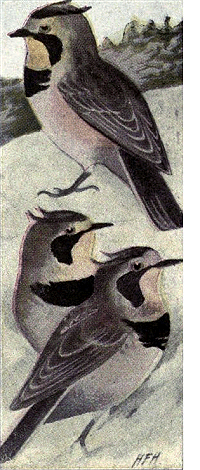
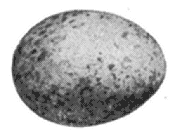
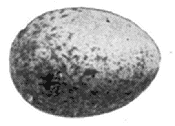

Page 299 474g. Streaked Horned Lark. Otocoris alpestris strigata. Range.--Northwestern United States (Washington, Oregon and northern California). Similar to the last, but with the back broadly streaked with black, the ruddy less intense and the underparts tinged with yellowish. 474h. Scorched Horned Lark. Otocoris alpestris adusta. Range.--Western Mexico, north in summer to southern Arizona. This variety has the back and nape nearly a uniform pinkish ruddy with but little streaking. 474i. Dusky Horned Lark. Otocoris alpestris merrilli. Range.--Northwestern United States and southern British Columbia, wintering south to central California. Similar to praticola but slightly darker above. 474j. Sonora Horned Lark. Otocoris alpestris pallida. Range.--Gulf coast of northern Lower California. The upperparts of this variety are very pale pinkish brown. 474k. Hoyt's Horned Lark. Otocoris alpestris hoyti. Range.--Interior of British America, west of Hudson Bay and east of Alaska, south in winter in the interior of the United States to Kansas. Much larger than the last; equal in size and similar to articola but with the throat yellowish and the upperparts darker and brighter. 474l. Montezuma Horned Lark. Otocoris alpestris occidentalis. Range.--Western New Mexico and eastern Arizona, south in winter to northern Mexico. This variety has the upperparts pale brownish and not streaked; throat and forehead yellowish. 474m. Island Horned Lark. Otocoris alpestris insularis. Range.--Santa Barbara Islands, California. Similar to strigata but darker. With the exception of the three large varieties of Horned Larks found north of our borders, neither the eggs nor, in most cases, the birds can be identified without the precise location where they were taken.
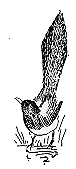
Page 300 CROWS, JAYS, MAGPIES, ETC. Family CORVIDÆ. Magpie. 475. Magpie. Pica pica hudsonia. Range.--Western North America from the Great Plains to the Pacific and from Alaska to Arizona and New Mexico. Grayish white. These large handsome birds have the entire head, neck and breast velvety black, abruptly defined against the white underparts. The back, wings and tail are greenish or bluish black, and the scapulars, white; length of bird 20 inches. They are well known throughout the west, where their bold and thievish habits always excite comment. They nest in bushes and trees at low elevations from the ground, making a very large nest of sticks, with an opening on the side, and the interior is made of weeds and mud, lined with fine grasses; these nests often reach a diameter of three feet and are made of quite large sticks. During April or May, they lay from four to eight grayish white eggs, plentifully spotted with brown and drab. Size 1.25 x .90. Grayish white. 476. Yellow-billed Magpie. Pica nuttalli. Range.--Middle parts of California, west of the Sierra Nevadas. This species is slightly smaller than the last and has a yellowish bill and lores, otherwise being precisely like the more common species. Their habits do not differ from those of the other, the nests are the same and the eggs are indistinguishable. Size 1.25 x .88.