A DESCRIPTION OF BOOKS PRINTED IN TYPE No. 6.
Reading edition
BOOKS PRINTED IN TYPE No. 6.
81. Fayts 1489
82. Statutes 1489
83. Governal 1489
84. Reynard. Second Edition 1489?
85. Blanchardyn 1489?
86. Four Sons of Aymon 1489?
87. Directorium Sacerdotum. Second Edition 1489?
88. Eneydos 1490?
89. Dictes. Third Edition 1490?
90. Mirror. Second Edition 1490?
91. Divers Ghostly 1491?
92. Fifteen Oes 1491?
93. Art and Craft 1491?
94. Courtesy. Second Edition 1491?
95. Festial. Second Edition 1491?
96. Four Sermons. Second Edition 1491?
97. Ars moriendi 1491?
98. Chastising 1491?
99. Treatise of Love 1491?
BOOKS PRINTED IN TYPE NO. 6.
No. 81.—The Fayts of Arms and of Chivalry. Folio. “Per Caxton.” Without Place. Printed the 14th day of July, the fourth year of the reign of K. Henry VII., or 1489.
Collation.—Two unsigned leaves of table; A B C D E F G H J K L M N O P Q R all 4ns; S a 3n, with the last leaf blank. In all 144 leaves, of which one is blank.
Typographical Particulars.—There is no title-page. The whole book is in one type only, No. 6. The lines, which are fully spaced out, measure 4¾ inches, and there are 31 to a full page. Without folios or catchwords. Woodcut initial letters.
The Text begins, with a 3-line initial,
H
Ere begynneth the table of the rubryshys of the boke of the fayt of armes and of Chyualrye whiche sayd boke is departyd in to foure partyes / ℂ The fyrst partye deuyseth the manere that kynges and
On sig. A j recto,
Here begynneth the book of fayttes of armes & of Chyual- rye / and the first chapytre is the prologue / in whiche xpry- styne of pyse excuseth hir self to haue dar enterpryse to speke ‖ of so hye matere as is conteyned in this sayd book
The Text ends on the verso of the same leaf,
remayne alleway vyctoryous / And dayly encreace fro ver tu to vertue & fro better to better to his laude & honour in this ‖ present lyf / that after thys short & transitorye lyf / he may at- ‖ teyne to euerlastyng lyf in heuen / Whiche god graunte to ‖ hym and to alle hys lyege peple AMEN /
Per Caxton
Remarks.—There is a MS. in the British Museum (Roy, 15 E vi) containing the original French text of Christine de Pisan. It agrees very accurately with Caxton’s English version, and has the introductory chapter, in which Christine excuses herself, and explains her reasons for writing a work on chivalry. This manuscript is also interesting from having been written for the celebrated John Talbot, Earl of Shrewsbury, who died in 1453, and by whom it was presented to Queen Margaret. A still greater degree of interest would invest the volume if we suppose it to be the identical manuscript from which Caxton made his translation. This is certainly not improbable, as the original from the Royal Library was intrusted to our printer, for the purpose of translation and printing, by King Henry VII of England, as we learn from the prologue:—“which book, being in French, was delivered to me, William Caxton, by the most christian king, my natural sovereign lord, King Henry VII, in his Palace of Westminster, and desired me to translate this said book, and to put it in print.”
Many French bibliographers (Les Msc. Franç. t. v, page 94) ascribe the composition of “Fait d’Armes et de Chevalerie” to Jean le Meun, so well known from his connection with “Le Roman de le Rose.” The sole reason for this appears to have been the fact that Jean le Meun translated into French the celebrated work of Vegetius, “De re militari,” written in 1284, a work often quoted in the “Faits d’Armes;” but since the writings of Christine have become better known, no one has ventured to claim for the thirteenth, a work containing references and facts applicable only to the fifteenth century. That a book on the “Rules of War” should in any age have been written by a woman, is sufficiently improbable to require a critical examination; and, therefore, as the claims of Christine to the authorship of “Les Faits d’Armes” are still denied by some writers, it may not be inappropriate to state both sides of the argument.
Among the manuscripts in the British Museum is one entitled “The Boke of Noblesse” (Royal 18, B. XXII). This, for the first time, was printed in 1860, for the members of the Roxburghe Club. The author is entirely unknown, and the only reason for mentioning this at all is that the name of Christine frequently appears in its pages as an authority upon military matters, but is always referred to as “Dame Cristyn in hir booke of Tree of Batailes,” or some military phrase. But “L’Arbre des Battailes” is the well-known compilation of Honoré Bonet, of which copies may be seen in Royal 20 C. VIII, and Addit. 22768. Now, what is the natural conclusion from this erroneous ascription? Evidently that the unknown writer of the “Book of Noblesse,” quoting probably from a copy of “L’Arbre des Battailes,” which had neither prologue nor epilogue; and having in his mind the great fame of Christine as the writer of a book on a similar subject, made the not unpardonable mistake of misquoting the author’s name, and attributing to Christine, the compiler of “Les Faits d’Armes,” all the quotations drawn from Bonet’s “L’Arbre de Battailes.” Not so, argues Mr. John Gough Nichols, in his interesting preface to the Roxburghe impression. “Christina de Pisan,” he urges, “was a Poetess;” and it is not likely that she had more to do with the “Faits d’Armes” than the “dame Christine” of “The Book of Noblesse” had with the “Arbre des Battailes.” In support of this opinion is quoted a marginal note in “The Boke of Noblesse,” in an old hand-writing, but more modern than the original manuscript, to the following effect:—
“L’Arbre des Battailles compose par Honore Bonet Prieur de Sallon en Prouuence.”
“Note yt in some Authors this Booke is termed Dame Christine of ye tree of Battayles, not that she made yt; But bicause she was a notable Benefactour to Learned men and perchance to ye autor of this Booke And therefore diverse of them sette furthe their Bookes under her name.”
The author of this note was evidently unacquainted with the particulars of the life, or the character of the writings, of Christine—the “virilis fœmina” of her eminent contemporary, Gerson—and “La grant sagesse” of her editor, Jean Marot. The assertion that authors set forth their books under her name is unsupported by a single known instance; while her early tuition, political life, and numerous writings, would both enable and incline her to compose such a work.
Christine expressly states in the preface that she wrote the work; and although Verard, in his printed edition of 1488, omits the prefatory address, it appears in numerous manuscripts, and may be read in Caxton’s translation. “Because,” says Christine, “men of arms are not clerks, nor instructed in the science of language, I have assembled and gathered together diverse books to produce this work. And because that this is a thing not accustomed and out of usage to women / which commonly do not intermit but to spin on the distaff and occupy them in things of household. I supplicate humbly * * to have nor take it for no evil if I a woman charge myself to treat of so high a matter.”
Then follows an appeal to the goddess Minerva, who, being born in “Puylle” in Italy, was “somewhat consonant in the nation,” for, adds Christine, “I am as thou wert, a woman Italian.”
Christine was no common poetess whose strength was in the prettiness of her amatory verses. The short account of her already given (see ante page 195) will show the energetic and comprehensive character of her mind. Educated by her father in the whole course of literature at that time in vogue, she had, while yet young, made herself mistress of the Latin language, and stored her mind by the perusal of the most celebrated writings, as well Pagan as Christian. Living in the midst of wars and preparations for war, many of her acknowledged writings teem with warlike allusions. In politics her opinion had great weight; she was consulted by the highest nobles of France; and many years of her life were spent in the endeavour to raise the political and moral tone of the country. The celebrated Jean le Meun found in her no weak opponent, and the equally celebrated Chancellor Gerson a most potent ally.
There are 21 copies of this work known, of which eleven are in private libraries.
No. 82.—Statutes of Henry VII. Folio. Sine ullâ notâ. (1489?)
Collation.—a b c d are 4ns, with the first leaf of a blank; e a 5n, with the last blank. Total 42 leaves, of which two are blank.
Note.—The signature is omitted on a ij. The third and fifth leaves of e are erroneously signed d iij and d v.
Typographical Particulars.—There is no title-page. The type is all No. 6. The lines, which are spaced to an even length, measure 4⅝ inches, and there are 31 (in three instances 33 lines) to a full page. Without folios or catchwords. Only one 2-line woodcut initial is used.
After a blank leaf, the work commences on the second recto of sig. a.
The Text begins thus—
ℂ The kynge our souereyn lorde henry the seuenth after the conquest by the grace of god kyng of Englond & of Fraunce and lorde of Irlonde at his parlyamet holden at west-
The Text ends with nine lines on sig. e 9 verso, the last three being as follows:—
‖ pleysure Wheder he wylle after the fourme conteyned & ordei ‖ ned in and by this acte / or after the maner & fourme afore ti ‖ me vsed /
Remarks.—This is the earliest known volume of printed statutes, and is further remarkable as being in English. It contains some very curious and interesting legislation on political, trade, and domestic matters.
The British Museum copy was purchased from Mr. Lilly, who, a few days before, had bought it at Hodgson’s for £2, 10s. It was then bound up with some other law tracts and year-books, mostly from the press of Machlinia, one of which, being unique, was catalogued by Mr. Lilly at 100 guineas. There is also a perfect copy in the National Library, Paris, and the Inner Temple, London, with one copy only in private hands.
No. 83.—The Governal of Health.—The Medicina Stomachi. Quarto. Sine ullâ notâ. (1489?)
Collation.—The “Governal,” A and B 4ns; the “Medicina,” two unsigned leaves = eighteen leaves.
Typographical Particulars.—Without title-page. Only one type, No. 6, is used throughout. The lines, which are of an even length, and measure 2⅝ inches, excepting B 7 verso, which has 24, have all 23 lines to a page. Woodcut initials to chapters. Without folios or catchwords.
The Text begins on sig. A j recto,
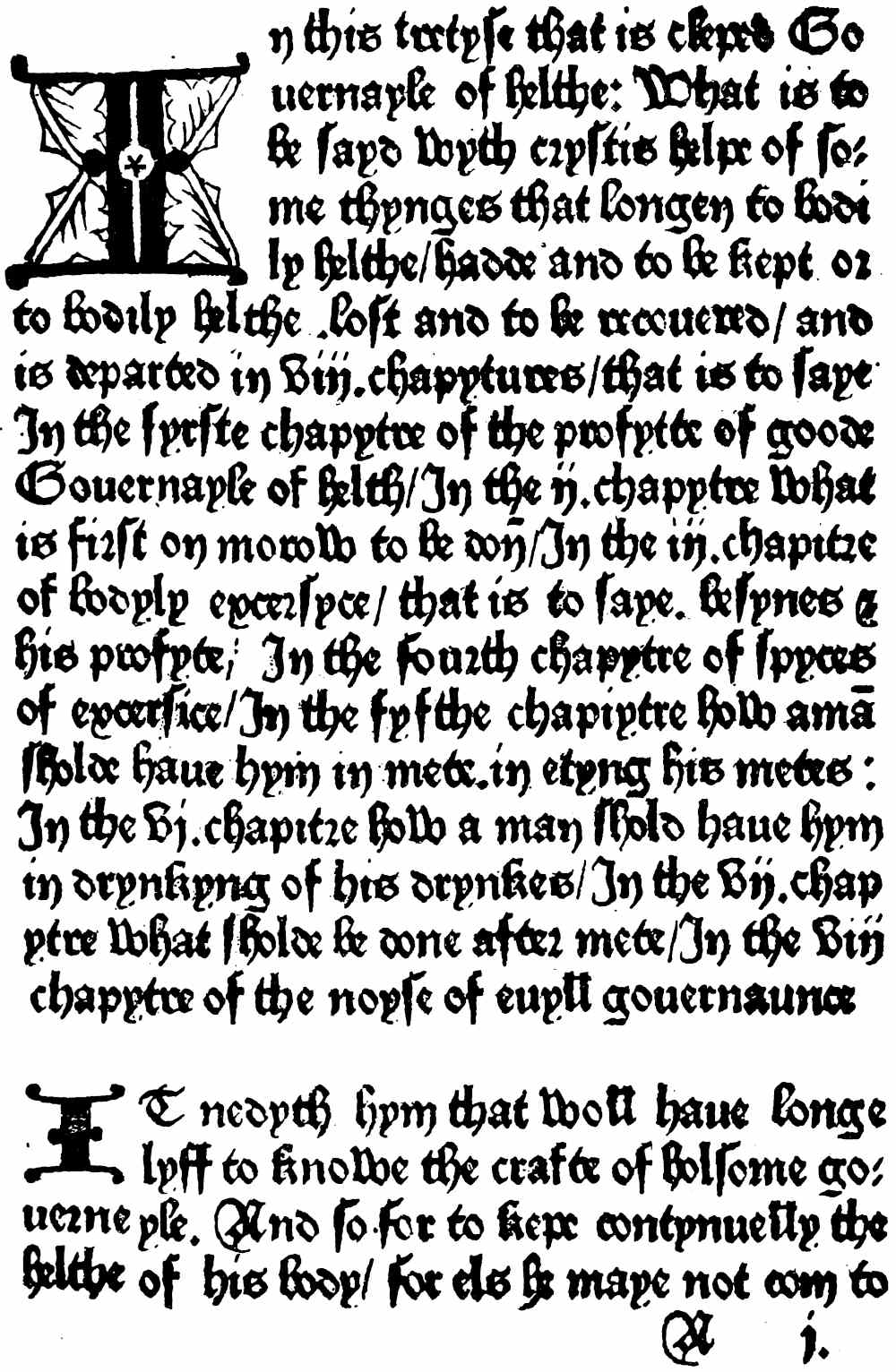
n this tretyse that is cleped Go uernayle of helthe : What is to be sayd wyth crystis helpe of so- me thynges that longen to bodi ly helthe / hadde and to be kept or to bodily helthe . lost and to be recouered / and
and ends,
This receyte boughte is of no potycarye Of mayster antony ne of mayster hughe To all indyfferent it is rychest dyetarye
Explicit medicina stomachi:
Remarks.—The “Governal” was originally written in Latin, and soon after translated into English, but no trace of the translator’s name is left. The date of the original composition is unknown; we can only gather from the non-existence of manuscripts of an earlier date than the latter half of the fourteenth century that it was composed about that period.
The name of the author or compiler is doubtful. From Sloane 989 one would say that John de Burdeux wrote it for the good of a “frende,” but Sloane 3149 attributes it to another writer, “Explicit tractatus Bartholomei.” John de Burdeux was the author of several tracts on medicine, and flourished in the latter half of the fourteenth century. Bartholomeus was rather a prolific writer of the fourteenth and fifteenth centuries, but the “Governal” is not found among the works generally attributed to him. Whoever may have been the author, the work possesses small claims to originality, being a compilation from the medical works of the Arabian and Greek physicians, and quoting largely from the “Regimen Sanitatis Salernitanum.” The “Medicina Stomachi” is contained in most collections of Lydgate’s poetry, and in Harl. 116 is directly attributed to him.
Plate XIII.
Caxton’s Type, No. 6.
Both tracts were reprinted by Wynken de Worde, sine anno, who repeats all the blunders of the first edition. These editions are equally rare, the only copy of the second being in the Public Library, Cambridge. An annotated reprint of Caxton’s text was issued privately by the editor of this work in 1858. On no other occasion does this interesting treatise, which was the earliest medical book printed in the English language, appear to have passed through the press.
A good copy is in the old library of the Earls of Dysart, at Ham House, Surrey, and another in the Bodleian.
No. 84.—The History of Reynard the Fox. Second Edition. Folio. Sine ullâ notâ. (1489?)
Collation.—An unsigned sheet of introductory matter; sigs. a b c d e f g h are 4ns; i is a 3n. No blank leaves. In all seventy leaves.
Typographical Particulars.—There is no title-page. The type throughout is No. 6. The lines, which are fully spaced out, measure 5⅝ inches, and there are 31 (sometimes 32) to a page. Woodcut initials are used. On the first recto is Caxton’s device, underneath which is the following line only:—
ℂ This is the table of the historye of Reynart the foxe /
On the verso commences the table, which ends seven lines down the second recto, underneath which is,
ℂ Hyer begynneth hystorye of reynard the foxe.
The preface finishes the page. The second verso is blank.
On sig. a j,
ℂ How the lyon kynge of alle bestys sent oute hys maude ‖ mentys that alle beestys sholde come to hys feest and court / ‖
ℂ Capitulo Primo
The conclusion of the text cannot be given, no perfect copy being at present known. For an account of the first edition of this celebrated allegory see ante page 229.
The only Existing Copy is in the Pepysian Library, Cambridge. It unfortunately wants the last two leaves, containing the epilogue of Caxton, and ends on sig. i 4 verso, with these words,
And her wyth wil J leue fforw hat haue J to wryte of thyse mysdedis J haue ynowh to doo
It is in good condition, but cropped, measuring 9 × 6¾ inches. Pepys’s arms on the binding, and his book-plate inside. The wanting leaves are supplied in manuscript of seventeenth century.
No. 85.—The History of Blanchardin and Eglantine. Folio. Sine ullâ notâ. (1489?)
Collation.—Imperfectly known. The introductory matter makes a 3n, signed i, ii, iij, the sixth leaf being blank. A B C D E F G H J K L M are 4ns, and there were probably several other additional signatures.
Typographical Particulars.—Without title. The type is all No. 6. The lines, which are all of one length, measure 4⅝ inches, and there are 31 to a full page. Woodcut initials. Without folios or catchwords.
The Text begins on sig. j recto, with a prologue by Caxton,
U
Nto the right noble puyssaut & excellet pryncesse my redoubted lady my lady margarete duchesse of So- mercete / moder vnto our naturel & souerayn lord and most
and finishes on the verso of the same leaf,
Joyes desirs in thys present lyf: ℂ And after this short and transytorye lyff . euerlastynge lyff in heuen Amen /
The table follows on sig. ij, with a 2-line initial,
H
Ere begynneth the table of the victoryous prynce Blanchardyn / sone of the noble kyng of Fryse
and finishes on the 5th recto, which, however, in the only copy known, is, unfortunately, in manuscript. This appears to have been copied from the very rare reprint by Wynken de Worde, the last four lines being—“How Blanchardin wedded his love the proude | pucelle in amours: And of the grete ioye that | was made there . and of the Kynge of Fryse deth capl° liiij°”
The sixth leaf is blank. On sig. A j recto the first chapter commences as follows:—
ℂ The first chapitre of this present boke conteyneth how Blanchardyn departed out of the court of his fader kynge of fryse / Capitulo primo .
T
Hat tyme when the Right happy . wele of
All the text after sig. M iiij is wanting in the only known copy.
Remarks.—The prologue to Caxton’s translation of this romance is fortunately preserved, from which we learn that Margaret, Duchess of Somerset, brought to Caxton the French version of this romance (which she had “long before” purchased of him), with her commands that he should translate it into English. Having made the translation, he presented it to Her Grace, probably as a manuscript, as he says nothing of any command to print it. It was, however, soon after put to press, perhaps at Caxton’s own risk, as a trade speculation. As to the date, there are only the typographical particulars to guide us, which, however, all point to about the year 1489.
The only known Existing Copy is in the library of Earl Spencer. One leaf is in the Library of the British Museum.
No. 86.—The Four Sons of Aymon. Folio. Sine ullâ notâ. (1489?)
The Collation cannot be given accurately, as no perfect copy is known. A B C D E F G H J K L M N O P Q R S T U X Y Z aa bb cc dd ee ff gg hh ii kk ll are all 4ns, mm being a 3n, with the sixth leaf, probably, blank. This makes a total of 278 leaves; but it is more than likely that some introductory matter preceded sig. A.
Typographical Particulars.—Only one type, No. 6, is used. The lines, which are all of an even length, measure 4⅝ inches, and there are 31 to a full page. Without folios or catchwords. Woodcut initials throughout.
The only known copy of this edition begins on sig. B iij, in the middle of a sentence:—
Reynawde one of the sones of Aymon / wherof specyally tre
The Text ends on the fifth verso of sig. mm, with the following sentence:—
M
y fayr lordes thenne that this present boke shal re- de or here . we shall praye god & the gloryous saynte Reynaude the marter / that he gyue vs grace to perseuere / and ‖ contynue our liff in good werkes . by the whiche we may ha ‖ ue at our endynge the liff that euer shall laste /
AMEN.
Remarks.—Manuscripts of this favourite romance, concerning the original of which little appears to be known, mount up to the thirteenth century, and references to it are found in manuscripts of a still earlier date; but all these are rhythmical romances, and Caxton’s translation (if we may give him the credit of it) was evidently made from a French prose text, perhaps that printed at Lyons, about 1480, under the title “Les quatre filz Aymon.”
Before the discovery of the volume under review, the earliest printed English text of “The four sons of Aymon” was the 1554 edition of R. Copland, to which was appended the following colophon:—
“ℂ Here finishith the hystory of the | noble and valiaunt knyght Reynawde | of Mountawban, and his three bre- | thern ℂ Imprinted at London, by | Wynken de Worde, the . viij . daye of | Maye, and ye yere of our lorde . M,C | CCCC iiii . at the request and com- | maundement of the noble and puis- | saunt erle, the Erle of Oxenforde, | And now Emprinted in the yere of | our Lord . M . CCCCC . l iiii . the | vi daye of Maye, By wylliam Cop- | land, for Thomas Petet.”
From Copland’s colophon we learn that an edition was issued in 1504 by Wynken de Worde, although, unfortunately, not a single copy is now known to exist. He, of course, reprinted from the text under review; and, indeed, the first portion of the colophon above quoted, so far as it concerns Wynken de Worde, is quite in Caxton’s style, and recalls the numerous instances already noticed in which Wynken de Worde, by altering the printer’s name and the date, has falsified both typographical and historical truth. That in this case he used Caxton’s colophon, with alterations, is rendered almost certain when the prologue to Copland’s edition is perused. Here we have all the peculiarities of our first printer’s style, and his very diction.
No manuscript or printed copy of Caxton’s life of Robert, Earl of Oxford, is known.
The only known Existing Copy of Caxton’s edition is in the library of Earl Spencer. It is imperfect, wanting all before sig. B iij; D 8, N 8, and MM 6, upon which probably was the Device.
No. 87.—Directorium Sacerdotum, una cum Defensorio ejusdem; item Tractatus qui dicitur crede mihi. Folio. Second Version. Second Edition. “Impressum per Willelmū Caxton apud westmonasteriū prope London/” Without Date. (1489?)
Collation.—A preliminary 4n, signed only on the fourth recto with the figure 4; a b c d e f g h i k l m n o p q r s t u x y are all 4ns; z is a 5n. Total 194 leaves. No blanks.
Typographical Particulars.—There is no title-page. The type is all No. 6. The lines, which are spaced to an even length, measure 4⅝ inches. Exclusive of head-lines there are 31 to a page. A few 2-line woodcut initials. Without folios or catchwords. The Table on the 8th recto is printed in black and red.
The “Kalendar,” which has the same woodcut KL as in the first edition, commences on the first recto, thus:—
Prima dies mensis et septima trucat vt ensis Januarius habet dies xxxj / luna vero .xxx
The Text ends on sig. z 10 verso,
vix poterit errare: in seruicio diuino Deo Gracias
ℂ Caxton me fieri fecit .
Remarks.—From the fact of the Printer beginning his table for finding the Golden and Dominical Letters at the year 1489, we may safely assume that year to be the date of printing, as to print back years would be useless. The combination of red and black figures, the black form being first printed, and the red form secondly and separately, shows a great advance in workmanship over other books by Caxton.
Like the first edition, there is only one Existing Copy known of this, which is in the Bodleian Library. It is, with “The Art and Craft to know well to die” by the same printer, still in the original parchment wrapper, as issued from Caxton’s workshop. It is perfect, and in good condition.
No. 88.—Eneydos. Folio. Without Printer’s Name, Place, or Date. “Translated by me wyllyam Caxton,” June 22nd, 1490.
Collation.—Sig. A a 3n, with the first leaf blank: B C D E F G H J K L are 4ns, with L 8 blank. In all 86 leaves, of which two are blank.
Dr. Dibdin erroneously ascribes only four leaves to sig. A.
Note.—Sig. a is very irregular: the first leaf, which is blank, is not reckoned in the signatures, the second and third leaves being signed respectively A j, and A ij. The fourth leaf, which, to agree with the others, should have been signed A iij, has no signature at all; while the omitted signature, A iij, appears on the sixth or last leaf of the 3n.
Typographical Particulars.—There is no title-page. The type is all No. 6. The lines are spaced to an even length, and measure 4¾ inches. There are 31 lines to a full page. Woodcut initials of two, three, and six lines in depth.
After a blank leaf the prologue begins on the second recto, signed A j,
After dyuerse werkes made / translated and achieued / ha uyng noo werke in hande . J sittyng in my studye where as laye many dyuerse paunflettis and bookys . happened that
The Text ends on sig. L 7 recto, with the following colophon:—
HERE fynyssheth the boke yf Eneydos / compyled by Uyr ‖ gyle / whiche hathe be translated oute of latyne in to frenshe / ‖ And oute of frenshe reduced in to Englysshe by me wyllm ‖ Caxton / the xxij . daye of Juyn . the yere of our lorde. M . iiij ‖ C lxxxx. The fythe yere of the Regne of kynge Henry ‖ the seuenth
Caxton’s device on the verso. The eighth leaf is a blank.
Remarks.—The “lytyl booke in frenshe, named Eneydos,” which happened to come under our Printer’s notice while sitting in his study surrounded with many divers pamphlets, is a free paraphrase of portions of “The Æneid,” by Virgil. Had Gawin Douglas, who, in 1553, issued a Scotch metrical version of “The Æneid,” read Caxton’s preface, he would have seen that Caxton does not pretend to give a translation of the Latin poem, and might have spared himself the trouble of some hundreds of lines in abuse thereof. The “Eneydos” was issued only as a romance compiled from Virgil’s “Æneid,” and Bocace’s “Fall of Princes;” and, with little merit, it seems to have gained little favour, even with the lovers of such compilations, for it never reached a second edition. It would appear, however, that a good sale was expected, and an impression more numerous than usual struck off, as few of Caxton’s books are so common as “Eneydos.”
Existing Copies.—British Museum (3); Cambridge; Trinity College, Cambridge; Oxford (3); St. John’s, Oxford; Hunterian, Glasgow; and 11 in private libraries.
No. 89.—The Dictes and Sayings of the Philosophers. Third Edition. Folio. Westminster. The year 1477 erroneously reprinted, the real date being about 1490.
Collation.—The device and prologue occupy two unsigned leaves; then, A B C D E F G are 4ns; H and J 3ns, the sixth leaf of J being blank. In all 70 leaves, of which the last is blank. Dr. Dibdin erroneously says “only 66 leaves.”
There is no title-page. The only type used is No. 6. The lines, which are fully spaced out, measure 4⅝ inches. There are 30 and 32 lines to a page, but mostly 31. Without folios or catchwords. 2 and 3-line woodcut initials.
Caxton’s device is in the centre of the first recto, the prologue commencing on the verso with a 2-line wood initial,
W
Here it is so that euery creature by the suffraunce of our lord god is born and ordeyned to be subgette and thrall vnto the stormes of fortune . And so in diuerse and
On sig. Aj the work commences:—
S
Edechias was the first. Philosophir by whom through the wyl and pleaser of oure lord god. Sa- pience was vnderstande and lawes resceyued. whi- che. Sedechias saide that euery creature of good beleue
The Text ends at foot of fifth recto of sig. J,
Whom J beseche Almyghty god tencrece and to continue in his vertuous disposicion in this world . And after this lyf to lyue euer lastingly in heuen . Amen .
ℂ Caxton me fieri fecit .
The verso and final leaf are blank.
Remarks.—This is another instance of the original date and imprint of a book being reproduced in subsequent editions. All the typographical particulars prove it to have been printed about 1490; and the presence of signatures, printed initials, and evenly spaced lines, give direct testimony against the date 1477, at which time none of these improvements had been adopted at Westminster.
For literary particulars, see the first edition, page 188, ante.
Existing Copies.—Cambridge: St. John’s College, Cambridge; Oxford, and Lambeth Palace. Three copies are in private libraries.
No. 90.—The Mirrour of the World. Second Edition. Folio. The Name, Place, and Date of the First Edition reprinted; but about 1490.
Collation.—a b c d e f g h i k l are 4ns, the last leaf occupied with the device only. In all 88 leaves.
Typographical Particulars.—There is no title-page. The type is all No. 6. The lines, which are spaced to an even length, measure 4⅝ inches, and a full page contains 31. Without folios or catchwords. 2 and 3-line initials in wood.
Commencing with a blank leaf, the table follows on the second recto, signed, however, a j.
The Text begins on a j recto,
H
Ere begynneth ye tahle of the rubrices of this presen- te volume named the myrrour of the world or thy- mage of the same /
The Text ends on the seventh verso of sig. l,
and transytorye lyf he brynge hym and vs in to his eelesty- all blysse in heuene AMEN /
ℂ Caxton me fieri fecit .
On the eighth verso is the device, the recto being blank.
Remarks.—Although this book bears the same dates as the first edition, it is very evident from the type, from the device, from the use of a woodcut to head Chapter II, which had been used shortly before in the “Royal Book,” and from many other more minute evidences, that it really was not printed till about 1490.
It would seem that the proper cut for Chapter II, viz. a figure of a philosopher with the globe in his hand, having been injured or lost, that the workman chose the first which offered itself, and thus, in this edition, we have the very inappropriate illustration of Christ’s transfiguration, as head to the chapter, “Why God made and created the World.”
Existing Copies.—Cambridge: Pepysian, Cambridge; Exeter College, Oxford; Hunterian, Glasgow; Baptist College, Bristol; and eight in private hands.
No. 91.—A Book of divers Ghostly matters, containing:—The Seven points of true Love and everlasting Wisdom, or Orologium Sapientiæ: The Twelve profits of Tribulation;—The Rule of St. Benet. Quarto. Wyllelmū Caxton. “Emprynted at westmynstre.” Without Date. (1490?)
Collation.—The “Seven points of True Wisdom” has A B C D E F G H J K L M all 4ns, or 96 leaves.
The “Twelve profits of Tribulation” has A B C D all 4ns, or 32 leaves.
The “Rule of St. Benet” has a b 4ns, and c a 2n, or 20 leaves.
Total of the three tracts, 148 leaves, all printed.
Note.—The signatures to the third tract are unusual, viz. a is signed aa, a ij, aa iij, a iiij; b is signed bb, b ij, b iij, b iiij; c is signed cc, c ij.
Typographical Particulars.—Without title-page. The type throughout is No. 6. The lines, which are spaced to an even length, measure 3⅝ inches, and 24 make a full page. Without folios or catchwords.
The Text of “The Seven points of True Wisdom” begins on sig. A j:—
T
Hese ben the chapitres of thys tretyse of ye seuen poyntes of trewe loue and euerlastyng wysdom drawen oute of ye booke yt is writen in latyn and cleped Oro- logium sapiencie /
The tract ends thus, on sig. M 8 verso,
ℂ Thus endith the treatyse of the vij poyntes of true loue & euerlastyng wysdom / drawen of of the boke that is wryten in laten na med Orologiu sapiecie .
ℂ Emprynted at westmynstre
ℂ Qui legit emendet / pressorem non repre hendat
ℂ Wyllelmu Caxton . Cui deꝰ alta tradat
The “Rule of St. Benet” ends on verso of sig. c 4,
ℂ Emprynted at westmynstre by desiryng of certeyn worshipfull persones:.
Remarks.—Little is known of Jehan de Soushavie, or Souaube, as a French copy has it. Bibliographers generally call him Henry de Suso, probably after the example of Echard, in his “Script. ordin. Prædicat.” The English version printed by Caxton is correctly described, not as a translation, but as “drawen oute of” a book named “Orologium Sapientiæ.” The printed text is not equal in extent to one-half of the original. Was it this induced Caxton to end the tract with “Qui legit emendet, pressorem non reprehendat?”—a parody of the phrase often seen in manuscripts “Qui legit emendet scriptorem non reprehendat.” Caxton says of the “Rule of St. Benet,” which is a translation from the Latin, that he was employed to print it “by desire of certain worshipful persons.”
The signatures given by the Printer to these three tracts suggest the probability that they were intended to be issued separately; but as in all the known copies they appear bound together, and as they have hitherto been described under the general head of “Divers Ghostly matters,” it has been deemed advisable to retain that arrangement.
Existing Copies.—Cambridge, Durham Cathedral, and four in private libraries.
No. 92.—The Fifteen Oes, and other Prayers. Quarto. “Printed by commandment of the Princess Elizabeth, Queen of England, and the Princess Margaret, Mother unto our sovereign lord the King, by their most humble subject and servant William Caxton.” Without Place or Date. (1491?)
Collation.—a b are 4ns; c is a 3n = 22 leaves.
Typographical Particulars.—There is no title. The type is all No. 6. The lines, which are spaced to an even length, measure 3¼ inches, and there are 21 to a full page. Without folios or head-lines. Woodcut initials. A woodcut border, in four separate pieces, is placed round each page. This border was used later, for an undated but very early edition of “Horæ,” by Wynken de Worde. The wood engraving of the Crucifixion, which appears upon the verso of the first leaf, has considerable artistic merit. It appears to have been a favourite, having been used at a later period by Wynken de Worde in several publications.
The recto of the first leaf is blank, but the verso is occupied with the woodcut of the Crucifixion, already noticed.
Upon the second recto (not signed, unless the signature has been cut away in binding) the Text begins with a 5-line initial in wood,—
Jhesu endles swetnes of louyng soules / O Jhesu gostly ioye passing & ex- cedyng all gladnes and desires. O Jhesu helthe & tendre louer of al repentaut sinners that
and on the verso of c 6, ends thus:—
ℂ Thiese prayers tofore wreton ben en prited by the comaudementes of the mos te hye & vertuous pryncesse our liege la di Elizabeth by the grace of god Quene of Englonde & of Frauce . & also of the right hye & most noble pryncesse Marga rete Moder vnto our souerayn lorde the kyng / &c
ℂ By their most humble subget and seruaut William Caxton
Remarks.—The fifteen prayers, named from the fact of their all commencing with the letter O, “the fifteen Oes,” are commonly found in the manuscript Horæ of the fifteenth century, in their original Latin. They were frequently printed both in that language and in English, Caxton’s version of the latter being possibly the earliest. All these prayers breathe a spirit of earnest devotion, and as an example the following is laid before the reader.
“O Jhesu heuenly leche haue mynde of thy langour and blewnes of thy woūdes & sorowe that thou suffredest in the heyght of the crosse / when thou were lifte vp fro the erthe / that thou were all to torne in all thy limmes / soo that there was noo limme abydynge in his right ioynte / soo that noo sorowe was like to thyne fro the sole of thy fote to the toppe of thy hede there was no hole place / And yet forgetying in maner all those greuous paynes / thou preydest deuoutly & charitably to thy fader for thine enmyes sayeng thus / Fader foryeue it theim / for they wyte not what they done / For this blessed charytable mercy that thou shewdest to thyne enmyes. and for mynde of thyse bytter paynes / graunte me / that the mynde of this bytter passion be to me plenar remyssion & foryeuenes of my sinnis Amen / ℂ Pater noster Aue maria”
Another prayer commences thus:—
“O blessid Jhesu swetnes of hertes and gostli hony of soules. I beseche the for the bytternes of the aysel and galle that thou tasted,” &c.
The “Rex Henricus” of the Prayer on c iiij verso, was Saint Henry, surnamed the Pious and the Lame. He was son of Henry Duke of Bavaria, and was born in the year 972; crowned King of Germany, at Mentz, in 1002; died 14th July 1024; and was canonised by Pope Eugenius III in 1152.
Preceding a printed Latin version of the “Fifteen Oes” in the British Museum (C. 23. b. 24), is the following paragraph in English:—“These be the . xv . oos the whyche the holy virgyn saint brygitta was wonte to saye dayly before the holy rode in saint Paules chyrche at rome : who so saye this a holy yere he shall deleuer . xv . soules out of purgatory of hys nexte kyndred . and conuerte other . xv. synners to gode lyf and other . xvx. ryghtuouse men of hys kynde shall perseuer in gode lyfe.”
In Harl. MS. 2255 is a paraphrase of the “Fifteen Oes,” by John Lydgate, beginning—“O blessyd lord my lord, O Christ Jesu.”
The only Existing Copy known is in the British Museum (C. 25. c), and is bound with several tracts printed by Wynken de Worde. It is perfect and in good preservation, although a good deal cropped in the binding. Measurement, 6⅞ × 5 inches. Purchased in 1851.
No. 93.—The Art and Craft to Know well to Die. Folio. Translated by Caxton in 1490. Without Printer’s Name, Place, or Date. (1491?)
Collation.—A a 4n; B a 2n; then a single leaf improperly signed B iij, which was, probably, followed by a blank. Total, thirteen printed leaves.
Typographical Particulars.—There is no title-page. The only type used is No. 6. The lines, which measure 4⅝ inches, are spaced to an even length, and there are 31 to a page. Without catchwords or folios. Several 2 and 3-line woodcut initials are used.
The Text begins on sig. A j recto,
ℂ Here begynneth a lityll treatise shorte and abredged spe- kynge of the arte & craft to knowe well to dye
W
Hhan it ys soo that what a man maketh or doeth / it is made to come to some ende / And yf the thynge be goode and well made / it muste nedes come to goode ede . Thenne by better & gretter reason / euery man oughte to
The Text ends on a single leaf, signed B iij,
Thus endeth the trayttye abredged of the arte to lerne well to deye / translated oute of frenshe in to englysshe . by willm Caxton the xv . day of Juyn ⸝ the yere of our lord a M iiij Clxxx x .
Remarks.—Manuscripts of this work are usually known as “The Art and Craft to live well and die well.” This was often printed. A Latin edition was issued by Guy Marchand, at Paris, in 1483, and French editions by Verard, at Paris, and Colard Mansion, at Bruges. From the latter it seems very probable that our Caxton, as he says in the colophon, “abredged” his text.
An English version of the full work was made early in the sixteenth century by Andrew Chertsey, and printed by Wynken de Worde in 1506.
Copies are in the British Museum, Oxford, and National Library, Paris.
No. 94.—The Book of Courtesy.—Quarto. Second Edition. “Emprynted atte westmoster.” Without Name or Date. (1491?)
Collation.—This little piece probably consisted, like Caxton’s early editions, of a 4n and a 3n, making fourteen leaves, all printed—a conclusion gathered from the only fragment known.
Typographical Particulars.—The fragment, from which alone we know that such an edition was printed, consists of two quarto pages only, printed upon one side of a half-sheet, the other side being blank. One of the pages is signed bb, which, as already seen in “The Rule of St. Benet,” was used for b j. Here then we have the first recto of the outermost sheet of the second signature, and, by folding the half-sheet with the unprinted part inside, we see directly that the opposing page must be the last of that signature, and, in all probability, the last of the tract.
The type is all No. 6, but the appearance of the small device, which was probably never used in Caxton’s lifetime, points out a late date for its execution.
The last lines, underneath which are the imprint and the small device, are as follows:—
a Thraue of thresshersa Lyeng of pdoners
a Lasshe of cartersa Hastynes of cookes
ℂ Here endeth a lytyll treatyse called the booke of curtesye or lytyll John .
Enprynted atte westmoster .
The small “W. C.” Device up-side-down.
As this edition, like the first and second, has three stanzas to the page, it would, although in a somewhat smaller type, take up the same number of leaves. The early editions had a blank leaf at the end, which here we find filled up with the curious phrases noticed above.
The fragment is in the Douce collection at the Bodleian, having apparently been rescued from the cover of a book. Measurement, 6¾ × 5¼ inches. The reversal of the device, and the blank side of the paper, suggest the idea that this fragment was a first proof, although, from the numerous blunders in most of Caxton’s pages, it is difficult to believe that corrections were ever made after the matter was once set up.
No. 95.—The Festial (Liber Festivalis). Folio. Second Edition. “Caxton me fieri fecit.” Without Place or Date. (1491?)
Collation.—a b c d e f g h i k l m n o p are 4ns, with the first leaf of a blank; q has but one printed sheet, or two leaves; R a 4n; s a 3n, with device on s 6. In all 136 leaves, of which one is blank.
Typographical Particulars.—There is no title-page. The type consists of two sizes, Nos. 6 and 7, the latter being that in which Wynken de Worde printed many of his early books. The lines are in double column, and measure only 2⅝ inches. They are spaced to an even length, and there are 33 to a column. Without folios or catchwords. Plain initials, cut in wood, of the depth of 2, 3, or 5 lines are used. There is a small rude woodcut on sig. f 6 verso.
Commencing with a blank leaf, the prologue follows, in double column, on sig. a ij, the Text beginning—
ℂ The helpe and grace of al- ‖ myghty god thrugh the besechyn ‖ ge of his blessed moder saynt ma ‖ of all the hie festis of the yere. J ‖ wyll & praye that it be called fes- ‖ tiuall / the whiche begineth at the ‖
The Text ends on the fifth verso of sig. s, three-fourths of the way down the second column,
the rather by the helpe of his bles ‖ sid moder mary / & his holy spow- ‖ sesse saynt brygytte / and all sayn ‖ tes . AMEN Caxton me fieri fecit
The next recto is a blank page, the verso having the large device.
Remarks.—From the use of No. 7 type, which was Wynken de Worde’s, it is very probable that this book was printed by him immediately after his master’s death. This edition too is not an exact reprint of Caxton’s, issued in 1483. Every Festival has the prefix “Gode men and wymmen,” or “Good frendis,” and every tale is preceded by the word “Narracio.” Several stories not in the first edition have been added, while the Pardon of Corpus Christi, in Latin and English, which follows Trinity Sunday in first edition, is here entirely omitted.
Copies are in the British Museum, Cambridge, Oxford; and three in private libraries.
No. 96.—Four Sermons. Folio. Second Edition. Sine ullâ notâ. (1491?)
Collation.—A B C are 4ns; D is a 5n = 34 leaves.
Typographical Particulars.—There is no title. The type is all No. 6. In double column. The lines measure 2½ inches, being a very little shorter than the “Festial,” and are spaced to an even length. 33 lines to a column. Without folios or catchwords.
The Text begins on sig. A j with a 3-line woodcut initial:—
T He mayster of sentence in the seconde boke · and the fyrst dystynction / sa- ‖ yth that the souerayn cause / whi ‖ god made all creatures in heuen ‖ se myn owne soule . ne yours / J ‖ purpose me by his leue hoomly ‖ thus to shew it and rede it to you ‖ in the boke / for to your lernynge ‖ it is as good thus as wythout ‖
The Text ends half-way down the second column of the ninth verso of sig. D, with the collect “Absolve quesumus,” the last three lines being—
gloria inter sanctos et electos tuos ressussitati respirent / Per ‖ xpm dmn nostrum Amen / ‖
On the recto of the tenth leaf is the device of Caxton, the verso being blank.
For Remarks, see the first edition, page 264.
Copies are in the British Museum, Cambridge, and three private libraries.
No. 97.—Ars moriendi; that is to say, the Craft for to die for the health of Man’s Soul. Quarto. Without Printer’s Name, Date, or Place. (1491?)
Collation.—A a 4n = 8 leaves, all printed.
Typographical Particulars.—No title-page. The type of the text is No. 6, but the four lines of heading at the beginning, and some head-lines at the end, are in Wynken de Worde’s No. 1 type. The lines are spaced very evenly, except on four pages at the end, and there are 24 to a page. Woodcut initials to chapters. Without folios or catchwords. With the exception of the use of Wynken de Worde’s type, this tract agrees in all particulars with No. 83, “The Gouvernal of Helthe.”
The Text begins on sig. A j recto,
ℂ Here begynneth a lytyll treatyse schortely compyled and called ars moriendi / that is to saye the craft for to deye for the helthe of mannes sowle .
W
han ony of lykly hode shal deye / thenne is moste necessarye to haue a specyall
The tract ends on A 8 verso, with a full page:—
For suche right bere ad=usite or oni tribulacon To that ye chirche techeth ye put ful credulyte .
That god hath pmysed trust it well withou defallacyon .
In hope abydyng his reward and eulastyng glorie . Amen Explicit .
Remarks.—This short tract appears to be a translation from the Latin, and doubtless by Caxton himself. No other copy, however, manuscript or printed, in Latin or any other language, appears to be known.
This unique specimen is in the middle of a volume of black-letter tracts in the Bodleian Library.
No. 98.—The Chastising of God’s Children. Folio. Sine ullâ notâ. (1491?)
Collation.—An unsigned sheet (two leaves), containing table and prologue; A B C D E F G are 3ns; H a 2n. In all 48 leaves, and no blanks.
Typographical Particulars.—In this book we meet with the first approach to a title-page, which consists of a 3-line paragraph printed in the centre of the first recto. The types are No. 6 for the Text, No. 7 being found on the first page only. Double column—the lines measuring 2⅝ inches, and being fully spaced out. 36 lines to a column. Without folio or catchwords. Initials in wood 3 and 4 lines deep.
The Text begins with the following 3 lines in the centre of the first recto,
ℂ The prouffytable boke for manes soule / And right comfor= ‖ table to the body / and specyally in aduersitee & trybulacyon / whiche ‖ boke is called The Chastysing of goddes Chyldern
On the verso, with a floriated 4-line initial, and in double column, the first two lines being in type No. 7,
N drede of almigh= ty ‖ god Relygyous sus= ‖ ter a short pistle J sen ‖ de you of the mater of ‖ temp= tacons / whiche pystle as me ‖ The causes considered . and many ‖ other skylfully . J may drede to wri ‖ te of this chastysing But askyng ‖ helpe of god almyghty / by whoos ‖ might the asse had speche to the pro ‖
The Text ends on the recto of sig. H 4, with the verso blank,
not denye to the alone that prayest ‖ her soo besely / Yet ouer all this ‖ whan thou art harde tempted . and ‖ * * * * * to ful Joye & blisse / Now god gra ‖ unt that it myghte so be . that euer ‖ is lastyng in Trinyte /
Remarks.—The use of a title-page, a practice unknown to Caxton, the appearance of type No. 7, and the adoption of signatures having three sheets only—all point to Wynken de Worde, rather than to Caxton, as the printer of this book, which was probably executed about 1491. The original writer of the work is unknown, and there seems but little reason for attributing its composition to Caxton, as some writers have done.
Existing Copies.—British Museum; Cambridge, University Library (2); Pepysian, and Sydney Sussex College; Hunterian, Glasgow; Lincoln Cathedral; Sion College, London; Göttingen University; and three copies in private hands.
No. 99.—A Treatise of Love. Folio. Translated in 1493. Without Printer’s Name, Place, or Date. (1493?)
Collation.—A B C D E F G H are all 3ns = 48 leaves, all printed.
Typographical Particulars.—Without title. The type is No. 6 for the Text, but on the first page is a line in type No. 7, the first of Wynken de Worde’s founts. The whole is in double column.
The Text begins on sig. A j recto,
ℂ This tretyse is of loue and spe ‖ kyth of iiij of the most specyall lo ‖ uys that ben in the worlde and she * * * * * whiche tretyse was translatid out of frenshe Into en= ‖ glyshe / the yere of our lord M cccc ‖ lxxxxiij / by a persone that is vnper ‖ fight insuche werke wherfor he hu ‖ bly byseche the lernyd reders wyth ‖ pacyens to cor= recte it where they ‖ fpnde nede. And they & alle other ‖ redders of their charyte to pray for ‖ the soule of the sayde translatour ‖
The Text ends on the second column of the sixth recto of sig. H,
Whiche boke was lately transla- ‖ ted outeof frensh in to englisshe ‖ by a Right well dysposed persone / ‖ for by cause the sayd persone thoug ‖ hte if necessary to al deuoute peple ‖ to rede / or to here it redde / And also ‖ caused the sayd boke to be enpryn- ‖ ted /
Underneath this is the small device. The reverse is blank.
Remarks.—This is evidently an issue from the press of Wynken de Worde, whose earliest type is seen in the first page, and who was accustomed to make up his books in 3ns instead of 4ns, as was the plan during Caxton’s life. The tract does not appear to have been translated till 1493, and may have gone to press the succeeding year: now Caxton died in 1491. The non-occurrence of the small device in any other book attributed to Caxton is another reason for supposing it to be in reality the workmanship of Wynken de Worde, who frequently used this shaped device in his early publications. At a later period he added his own name to the design.
Although not the work of Caxton, “A Treatise of Love” has been included in this chapter, because “A List of Books printed in Type No. 6” would be imperfect without it.
Copies are in the University Library, Sydney Sussex College, and Pepysian Library, Cambridge; in Lincoln Cathedral Library; the Hunterian Museum, Glasgow; University Library, Göttingen; and two in private libraries.
Plate XIV.
From Caxton’s “Order of Chivalry.” Type 4*
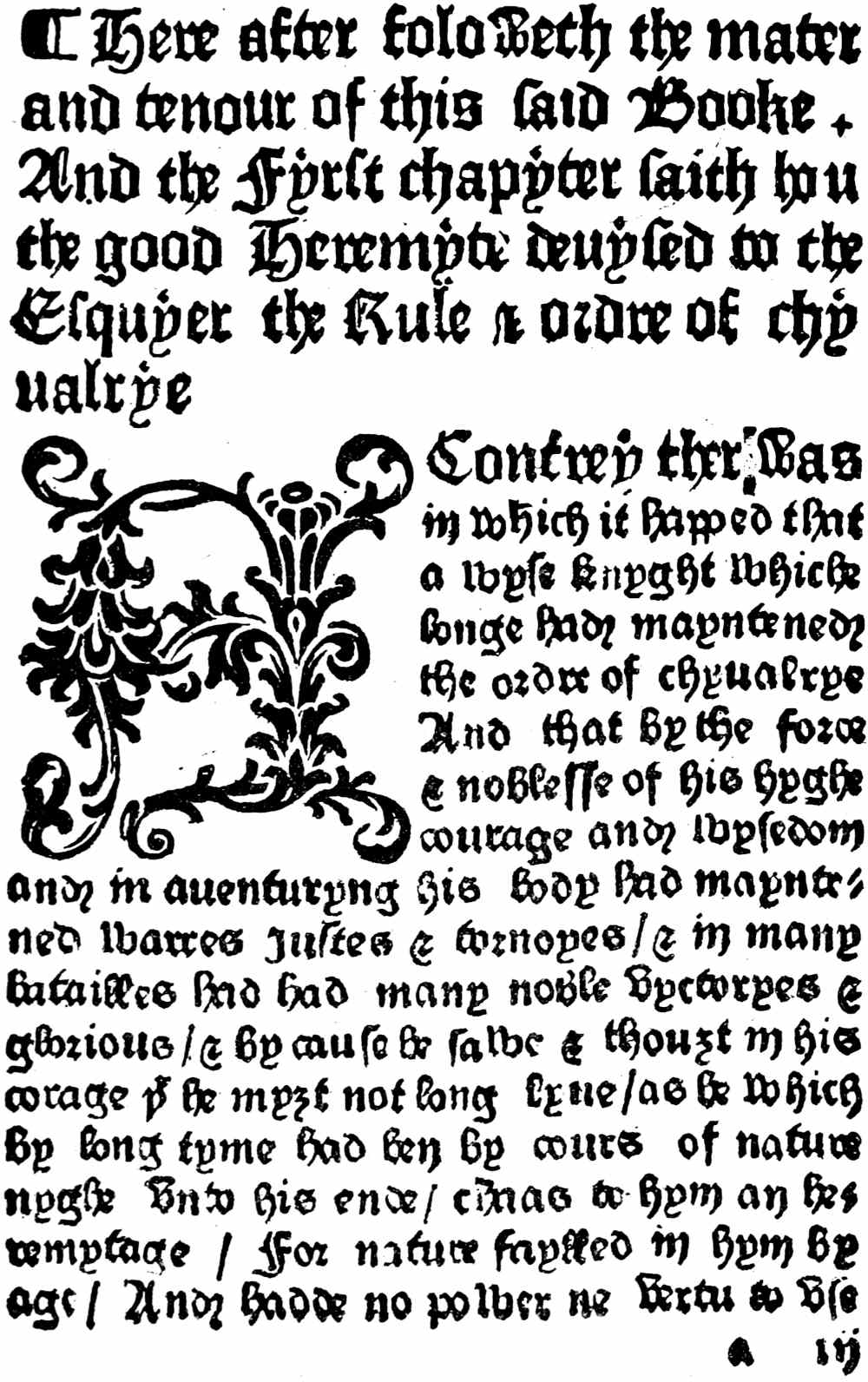
Plate XV.
Woodcuts from Caxton’s “Speculum vitæ Christi.”
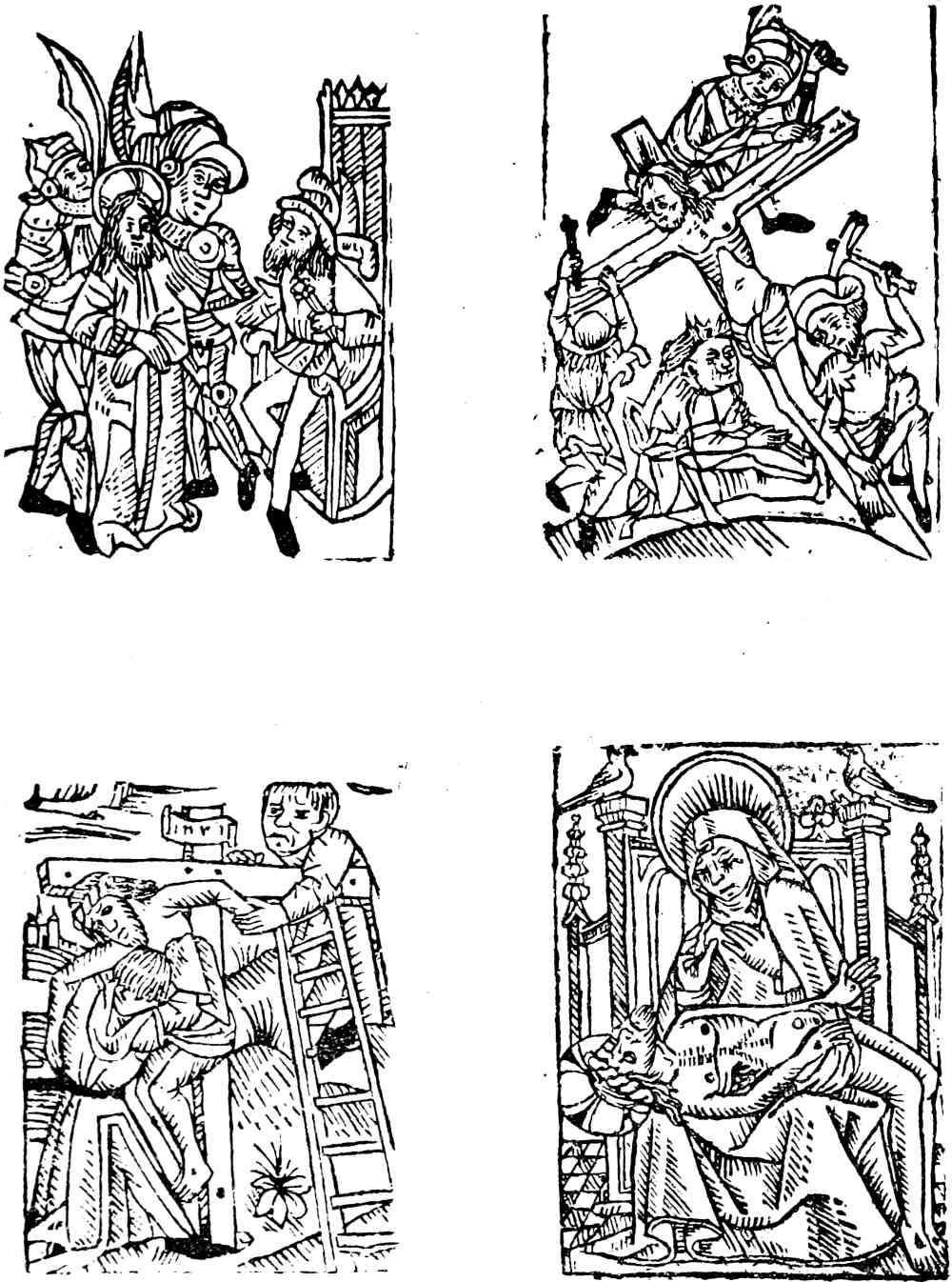
Plate XVI.
The earliest instance of a Title-page in any English Book; Printed about 1491.

Plate XVII.
WOODCUT INITIALS FROM CAXTON’S BOOKS.
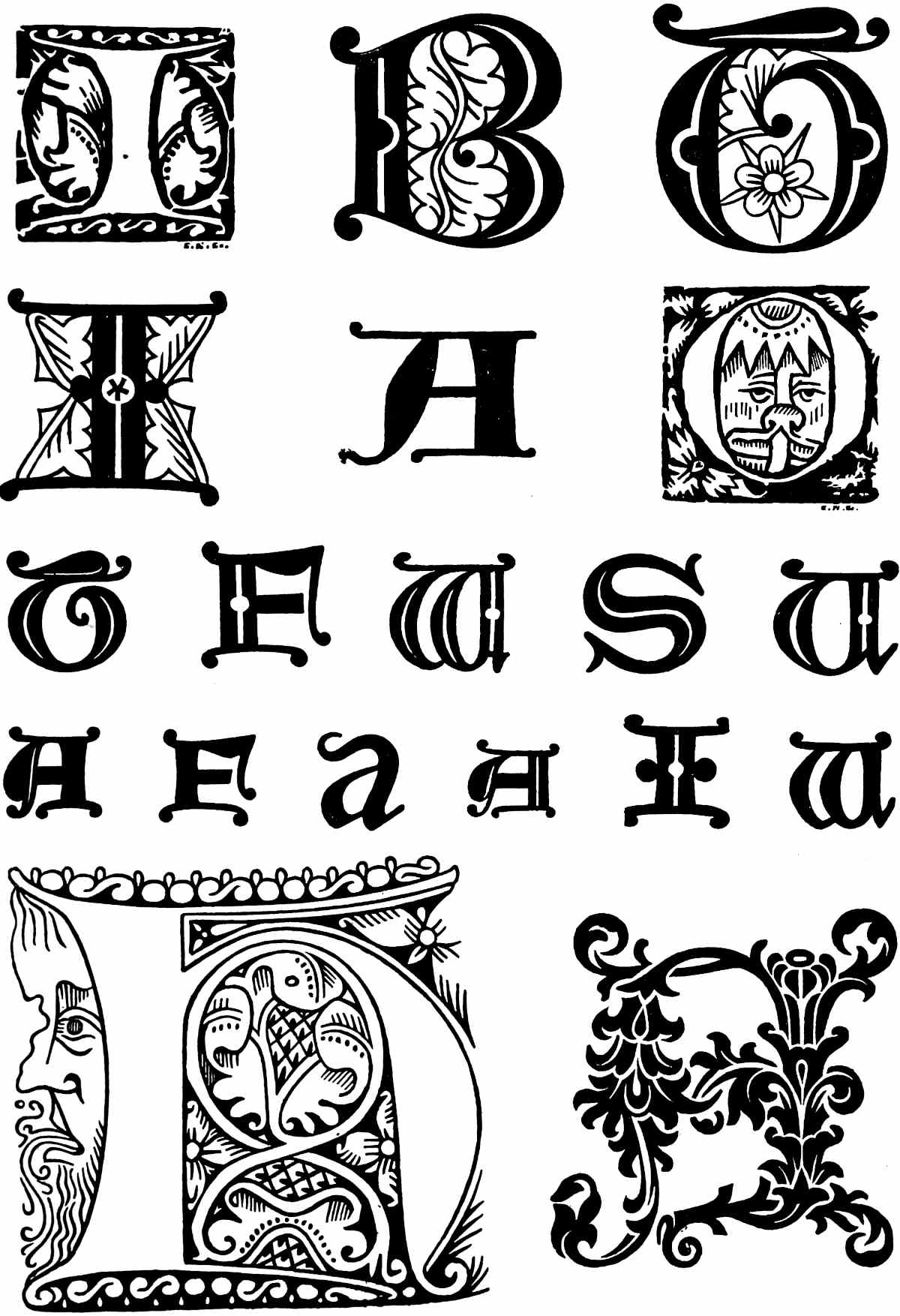
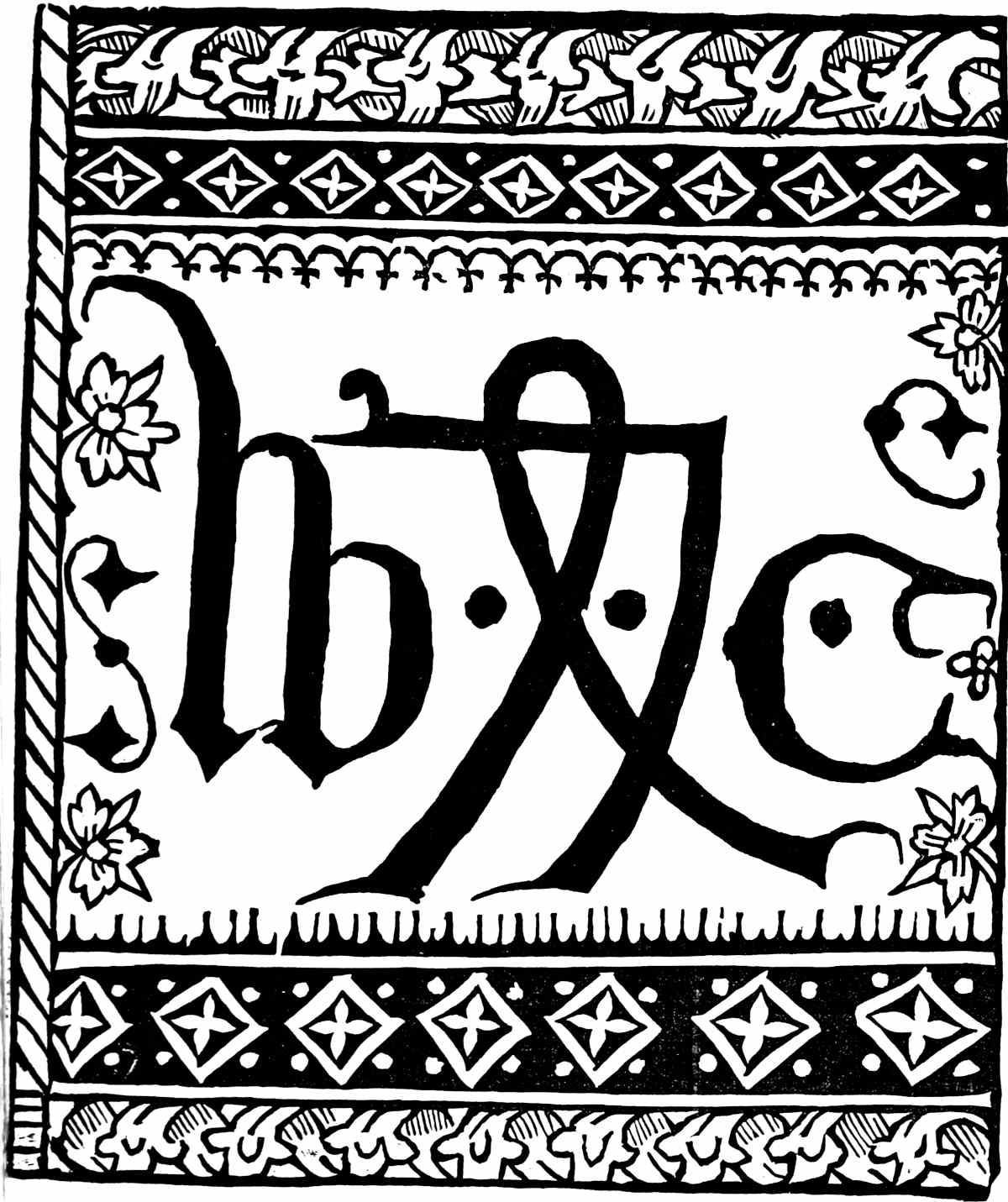
Plate XVIII.
CAXTON’S DEVICE.
A
LIST OF BOOKS
NOT PRINTED BY
WILLIAM CAXTON,
BUT HAVING SOME
CONNECTION WITH HIS TYPES;
ALSO OF
DOUBTFUL WORKS,
AND
BOOKS ERRONEOUSLY ASCRIBED TO HIS PRESS.