A DESCRIPTION OF BOOKS PRINTED IN TYPE No. 5.
Reading edition
BOOKS PRINTED IN TYPE No. 5.
70. Good Manners May 11th, 1487
71. Speculum. First Edition 1487?
72. Directorium. First Edition 1487?
73. Horæ. Third Edition 1488?
74. Royal 1488?
75. Image of Pity 1489?
76. Doctrinal. May 7th, 1489?
77. Speculum. Second Edition 1490?
78. Commemoratio 1491?
79. De Transfiguratione 1491?
80. Horæ 1491?
Plate XII.
Caxton’s Type, No. 5.
BOOKS PRINTED IN TYPE No. 5.
No. 70.—The Book of Good Manners. Folio. “Explicit et hic est finis per Caxton.” Without Place. “Enprynted the xj day of Maye” the year of our Lord 1487.
Collation.—a b c d e f g are 4ns, h a 5n = 66 leaves (no blanks).
Typographical Particulars.—There is no title-page. The type throughout is No. 5. The lines are spaced to an even length, and measure 4⅝ inches. A page has 33 lines. Without catchwords or folios. Woodcut initials of two to three lines in depth.
The Text begins on sig. a j recto,
W
Han J consydere the condycions & maners of the comyn ‖ people whiche without enformacion & lernyng ben rude ‖ and not manerd lyke vnto beestis brute acordyng to an olde ‖
making a full page. On the verso, with 2-line wood initial,
H
Ere begynneth the table of a book named & Jntytuled the ‖ book of good maners the which was made & com posed ‖ by the venerable & dyscrete persone Frere Jaques le graunt ly ‖ cecyat in Theologye religyous of the ordre of saynt augustyn ‖ of the conuent of parys.
The end is on the tenth recto of sig. h, the verso blank,
ℂ Explicit / et hic est finis / per Caxton &c
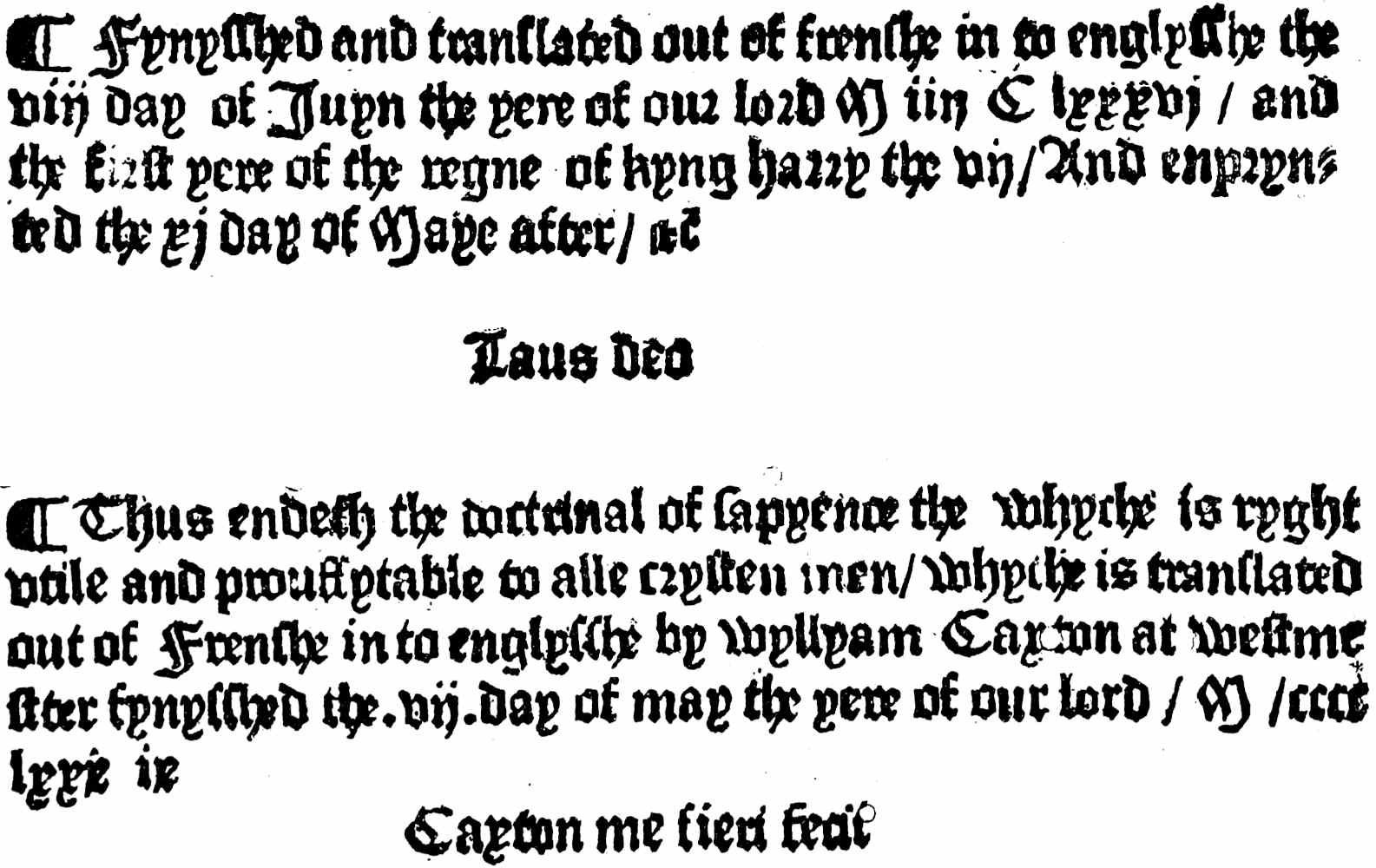
ℂ Fynysshed and translated out of frenshe in to englysshe the ‖ viij day of Juyn the yere of our lord M iiij C lxxxvj / and ‖ the first yere of the regne of kyng harry the vij / And enpryn- ‖ ted the xj day of Maye after / &c
Laus deo
Remarks.—Jacques Legrand was an Augustin friar, and is stated (though upon what authority does not appear) to have been a native of Toledo, in Spain, confessor to Charles VII, and to have refused a bishopric. He is known to have been the author of the “Sophologium,” originally written in Latin, and translated by himself into French for the Duke of Orleans, son of Charles V. He also was the author of “Le livre des bonnes meurs,” which he dedicated to the Duke de Berri.
In an interesting prologue appended by Caxton to this work we are informed that he undertook the task at the desire of William Praat, a fellow-mercer. The terms in which Caxton speaks of Praat as “an honest man” and “a singular friend of old knowledge,” whose death-bed request it was that the book which had pleased and instructed his own mind should have greater currency among the people by means of his friend’s new Art of Printing, prove the close amity which must have existed between the two Mercers. Caxton, according to his friend’s wish, translated and printed it “for the amendment of manners and the increase of virtuous living.”
Only three copies are known—one at Cambridge, one at the Royal Library, Copenhagen, and one at Lambeth.
No. 71.—Speculum Vitæ Christi. Folio. “Emprynted by wyllyam Caxton.” Without Place or Date. Edition A. (1487?)
Collation.—a b c d e f g h i k l m n o p q r s are 4ns, with the first leaf of sig. a blank; t a 2n, with the fourth leaf blank. In all 148 leaves, of which two are blank.
Typographical Particulars.—Without title-page. The type throughout is No. 5. The lines are spaced to an even length, and measure 4⅝ inches. A page has 33 lines, exclusive of the head-lines, and one line space between. Without folios or catchwords. There are side notes throughout the volume, a rare practice with Caxton, who, however, probably followed his copy in this particular, as side notes appear in nearly all the manuscript versions. An initial, cut on wood, begins every chapter.
Commencing with a blank leaf, the Text begins thus on sig. a ij recto:—
ℂ Jncipit Speculum vite Cristi.
A
T the begynnynge of the prohemy of the booke that is cleped the myrroure of the blessyd lyf of Jhesu Cryste the fyrst parte for the monedaye / ℂ A deuoute medy- tacion of the grete counceyll in heuene for the restorynge of man ‖ and hys sauacyon . Capitulum primum . ℂ Of the manere
At the head of sig. b ij recto,
Die lune ℂ Prima pars ca j.
dome all the Courte of heune wondrynge and commendyng the souerayne wysedome assented wel here to / but ferther- more ‖
At the head of sig. f 6 verso,
ℂ Ca / xv ℂ Die Mercurij ℂ Tercia pars
parauentur there with a fewe smal fysshes that oure lady had ‖ ordeyned theme as god wold / & soo therwith the Aungels co-‖
The “Speculum” ends at foot of sig. s i recto,
lord ihesu and his moder Mary now and euer withoute ende ame
ℂ Explicit speculum vite Cristi.
On the verso begins a treatise on the Sacrament of Christ’s body,
ℂ A shorte treatyce of the hyhest and most worthy sacra- mente ‖ of crystes blessid body . and the merueylles therof.
which finishes on sig. t 3 recto with the following imprint:—
ℂ Emprynted by wyllyam caxton
Remarks.—There appear to have been two original works on the “Life of Christ” in the libraries of the fifteenth century. One by Father Ludolphe, or Rudolphe (Addit. 16609), was translated, as already noticed, into French, and thence into English; but this is an entirely different work to that printed by Caxton. St. Bonaventure, in 1410, wrote “The Life of Christ” in Latin (Royal 17, D. XVII), which became very popular, and was translated several times into French, with amplifications more or less. In the early part of the fifteenth century Jean de Gallopes, already noticed as the translator of “The Pilgrimage of the Soul” (ante page 259), made a French prose translation of Bonaventure’s Latin work (Royal 20, B. IV). This bears a close resemblance to the English text as printed by Caxton, was dedicated by Gallopes to Henry V, and probably had considerable currency among the English, to whom Gallopes, if not an Englishman himself, was well known from his connection with the Duke of Bedford. The author of Caxton’s English text is unknown, but he professes to have borrowed largely from the Latin of Bonaventure.
Of the “Speculum vitæ Christi” two distinct editions were issued, both printed with the same types, page for page, line for line (with few exceptions), and nearly letter for letter. The typographical minutiæ do not enable us with facility to determine which edition has the better claim to priority of workmanship. The greatest variations will be found in the head-lines, where, from sig. k to the end of the volume, there is a difference in every page; one edition (A) using the word Ca in the heads, while the other (B) has the full word Capitulum. In the University Library, Cambridge, there is a copy of each edition.
There is a curious transposition of pages in the copy belonging to W. E. Watkyn Wynne, Esq., proving that even so late as 1489, the practice of printing one page at a time was retained. This is shown by the verso of sig. e iiij being printed on the recto of sig. e 6, and vice versâ. In sig. e there are several instances of the side notes having been blocked out in the printing. Pressmen call it “a bite.”
Existing Copies.—British Museum; Cambridge; Hunterian Museum, Glasgow; and four in private libraries. One of the copies in the British Museum is on vellum, and before the Reformation was in Sion Nunnery.
No. 72.—Directorium Sacerdotum, una cum Defensorio ejusdem; item Tractatus qui dicitur Crede mihi. Folio. Second Version, First Edition. Per William Caxton apud westmonesteriu. Without Date. (1487?)
Collation.—Kalendar a 3n, signed j ij iij; a b c d e f g h i k l m n o p q are 4ns; r a 5n; s t are 4ns. In all 160 leaves. In the only copy known the whole of the kalendar is inserted between the first and second leaves of sig. a, making a j appear as the first leaf in the book.
Note.—The signature to e j is not printed.
Typographical Particulars.—Without title-page. The type is all No. 5. The lines, which are fully spaced out, measure 4⅝ inches. Exclusive of head-lines there are 33 to the page. Without folios or catchwords. A few 2-line woodcut initials.
The work commences with a kalendar of the months, a month to a page, each being headed by a Latin couplet on unlucky days, and a woodcut KL.
The Text begins on sig. j recto,

Prima dies mensis. & septima truncat vt ensis Januarius het dies xxxj / luna vero xxx iij A Januarij Circusicio dm dup fm ix l’c
The Text ends on sig. t 8 verso,
de michi / Na qui predcas regulas memoriter tenet vix pote- rit errare in seruicio diuino / Deo gras /
ℂ Caxton me fieri fecit
Remarks.—The large woodcut, which is really on sig. a j verso, is, in the only known copy, transposed, very naturally, to precede the Kalendar. This at first misleads one to believe that it does not belong to the volume. It measures 9 × 5¾ inches, and occupies the entire page, being thus described by Herbert—“In the middle part Christ is seen naked, half length, as at a window, with his arms across and his head inclined, showing the wounds on his hands and under the right breast; a spear erect on the right and a sponge on the left; over his head is a tablet with INRI. On a tablet beneath the window the title appears evidently to have been printed, but from this copy has been indiscreetly cut out. About this middle part are 28 square divisions, each containing some symbol of the passion, forming a kind of border.” An engraving similar in design was used for the “Horæ,” described at No. 75 post.
There was another edition of this work in type No. 6, printed in 1489 (see No. 87). In both the Latin is printed with many contractions. In the various editions of “Typographical Antiquities,” these two editions being treated as one has led to several errors.
The numerous and constantly varying alterations in the daily order of Church Service must have rendered, in all ages, a book of directions most necessary to all officiating priests. But the introduction of new Feasts and Commemorations would, in course of time, render any such book incorrect. Thus it happened that Clement Maydestone, a monk of the order of St. Bridget, and a priest, finding, as he tells us in his prologue, that one of the most important festivals in the year, that of Corpus Christi, with its Octave, was, according to the written directions, celebrated cum regimine chori, while the admitted and general custom of the Salisbury rule was to celebrate that festival sine regimine chori; finding also several necessary things omitted altogether, and a wrong disposition made of others, determined, by the consent of his superiors, to correct and supply all defects. When Clement Maydestone had thus reformed and renewed the Pica, he gave his work the now recognised title of “Directorium Sacerdotum.” This is the text as printed by Caxton.
Clement Maydestone appears to have been the son of Thomas Maydestone (probably of Hounslow, Middlesex), and flourished in the reign of Henry V. An account of the martyrdom of Archbishop Scroop is also ascribed to him.
In the latter half of the fifteenth century the reformed Pica of Maydestone was again collated with the true “Sarum Ordinale,” by one Clarke, a singing man of King’s College, Cambridge, by order of the University, which at this period evidently followed the Salisbury use. A notice of Clarke’s work may be seen in the prologue appended by Pynson to his “Directorium” of 1497. In the copy of this edition, lately purchased of Mr. Maskell for the British Museum, are numerous notes in the autograph of Bishop Wagstaffe, the nonjuror, which have supplied material for some of the above remarks.
The only Existing Copy at present known is that in the King’s Library, British Museum (C. 10. b. 16), which is perfect, in fair condition, and measures 10½ × 7½ inches. On a fly-leaf is the autograph “W. Bayntun, Gray’s Inn, bought of a man introduced by Doctor Nugent.” This copy, which is catalogued by Dr. Middleton as being in the University Library, Cambridge, was stolen thence between 1772 and 1778. Before 1787 it was purchased by W. Bayntun—and probably (though, of course, in ignorance) from the thief himself.
No. 73.—Horæ.—A Fragment.—Third Edition. 8vo. Sine ullâ notâ. (1488?)
The Collation cannot be given, eight leaves, or the whole of sig. m, being all that is known at present.
Typographical Particulars.—The type is No. 5 only. The lines, of which there are seventeen to the page, are fully spaced out and in length measure 2⅝ inches. Large full-faced capital letters are used.
On sig. m j recto the Text begins,
Non fecisti
The first words on the rectos of each leaf are—1, non; 2, perhanc; 3, habitabile; 4, A Doro; 5, (injured); 6, woodcut; 7, Domine; 8, siones; the last word on the eighth verso, being cospui.
The woodcut on m 6 recto is an “Image of Pity,” very similar in treatment to that noticed on page 316. It occupies only the depth of ten lines of text, and beneath, in six lines, is the following:—
To them that before * * * * yma ge ofpyte deuoutly sey . v . P’r noster / v . Auyes & a * * * * py- teously beholdyng * * * * * * of Xp’s passyon ar graunted * * * * M / vij . C & . lv / yeres of pardon
These unique leaves, which have evidently been rescued from the binding of an old book, were presented, in 1858, by Mr. Maskell to the British Museum (C. 35. a). Measurement 5¼ × 4 inches. They are in the same binding as the fragments of another Horæ described at page 332.
No. 74.—The Royal Book or Book for a King. Folio. Without Printer’s Name, Place, or Date. “Translated out of frensshe into englysshe by me wyllyam Caxton / whiche translacion was fynysshed the xiij day of septembre in the yere of our lord M / CCCC. lxxxiiij.” (1488?)
Collation.—a b c d e f g h i k l m n o p q r s t are 4ns, the first leaf of a being blank; u a 5n, with the last leaf blank. In all 162 leaves, of which two are blank.
Note.—m iij is wrongly signed m ij; and n j is wrongly signed n iiij.
Typographical Particulars.—There is no title-page. The type is entirely No. 5. The lines are fully spaced out, and measure 4⅝ inches, 33 forming a full page. Without folios or catchwords. 2-line initials in wood are used at the commencement of the chapters. There are six small vignette illustrations in wood, all of which, however, except the first, which appeared in the “Golden Legend,” are from the “Speculum” just described, where they are suited to the text, and not, as here, used without any reference to fitness.
Commencing with a blank leaf, the prologue follows on a ij recto, with a 2-line initial.
The Text begins thus:—
W
Han J remembre and take hede of the conuersacion of ‖ vs that lyue in this wretched lyf . in which is no surete ‖ ne stable abydyng . And also the contynuel besynes of euery ‖
The Text ends, with a full page, on sig. u 9 recto,
T
his book was compyled & made atte requeste of kyng Phelyp of Fraunce in the yere of thyncarnacyon of our lord / M . CC · lxxix . & translated or reduced out of frensshe in ‖ to englysshe by me wyllyam Caxton . atte requeste of a wor-‖shipful marchaunt & mercer of london . whiche Jnstauntly re-‖
to be called Ryall / as tofore is sayd . whiche translacion or re-‖ducyng oute of frensshe in to englysshe wos achyeued . fynys-‖shed & accomplysshed the xiij day of Septembre in the yere of ‖ thyncarnacyon of our lord . M / CCCC.lxxxiiij / And in the ‖ second yere of che Regne of Kyng Rychard the thyrd / ‖
In the printed epilogue appended to the book by Caxton we read:—“Which book is called in French ‘Le livre Royal,’ that is to say the royal book, or a book of a king; for the Holy Scripture calleth every man a king which wisely and perfectly can govern and direct himself after virtue.” But “Le livre Royal” was by no means the title by which Caxton’s contemporaries knew this work. The most common name is that found in Royal MS. 19 C. II “Le livre des Vices et des Vertus;” although it was sometimes entitled “La Somme de Roi,” or “La Somme des Vices et des Vertus.” By whatever name known it was for centuries a favourite book, as is proved by the numerous copies still extant. Its author is said to be “Frere Laurent de l’ordre des predicateurs et confesseur de Phillippe le Hardi” (Les Msc. Franç. t. iii, page 388), but his name does not appear in any of the above-mentioned manuscripts of the work. Very soon after its appearance it was favourably received in England, where, in the year 1340, it was translated by a priest of Kent, for the purpose of being read to the people in their own dialect. This was called “The Ayenbite of Inwit,” and was printed from the Arundel MS. (No. 57) in the British Museum, in 1855, for the Roxburghe Club. Another and purer translation into English (Addit. 17013) was also made in the fourteenth century.
Existing Copies.—Bedfordshire General Library, British Museum, Cambridge, and five in private collections.
No. 75.—Image of Pity. Quarto Broadside. Sine ullâ notâ. (1489?).
This is a woodcut measuring 5½ × 3⅝ inches, printed on one side of a quarto. Like the folio woodcut described at page 320, and the 8vo cut described at page 322, there is a central figure of our Saviour upon the Cross, surrounded by eighteen small compartments, each having some reference to the Passion. Beneath the central figure the block has been cut, and the following sentence inserted in type No. 5:—
To them that before this ymage of pyte de uoutly saye v Pr nr v Aues & a Credo py- teuously beholdyng these ar of Xps passio ar grauted xxxij . M . vij. C & lv. yeres of pardon ·
No. 76.—The Doctrinal of Sapience. Folio. “Caxton me fieri fecit.” Without Place or Date. Translated May 7th, 1489.
Collation.—A B C D E F G H J are 4ns; K and L 5ns. In all 92 leaves. No blanks.
Typographical Particulars.—There is no title-page. The type throughout is No. 5. The lines, which are spaced to an even length, measure 4⅝ inches, and there are 33 to a page. Without folios or catchwords. There are side-notes, which, however, never exceed the three letters Exa, which are placed in the margin whenever an “Example” occurs in the Text. Two woodcuts and printed initials.
The Text begins on sig. A j recto, with a 3-line initial,
T
his that is written in this lytyl boke ought the prestres to lerne and teche to theyr parysshes: And also it is ne- cessary for symple prestes that vnderstode not the scrip
This prologue is followed by the table, which commences on the bottom line of sig. A j verso, and finishes at foot of A iij recto; and on the verso, with a woodcut down the side of the type, and a 2-line initial E, is the commencement of the work.
Woodcut from “Speculum,” of Jesus in the Temple. E Very crysten man & woman ought to bi leue fermely the xij arty- cles of the cristen feith.
On B j is another woodcut, the Crucifixion, also from the “Speculum.” On the verso of sig. J ij the 64th chapter is thus dismissed:—
ℂ Of the neclygences of the masse and of the remcdyes J pas ‖ se ouer for it apperteyneth to prestes & not to laie men . C . lxiiij ‖
The Text ends on the tenth recto of sig. L,
god bi his grace graunte for to gouuerne vs in such wyse and ‖ lyue in thys short lyf that we may come to hys blysse for to ly ‖ ue and regne there wythout ende in secula secu- lorum Amen
ℂ Thus endeth the doctrinal of sapyence the whyche is ryght ‖ vtile and prouffytable to alle crysten men / whyche is translated ‖ out of Frenshe in to englysshe by wyllyam Caxton at westme ‖ sster fynysshed the . vij . day of may the yere of our lord / M / cccc ‖ lxxx ix
Caxton me fieri fecit
On the verso is Caxton’s large device.
Remarks.—The “Manipulus Curatorum,” compiled in the early part of the fourteenth, was printed frequently in the fifteenth century. Greswell mentions—“Savilliani anno 1470; Aug. Vindel. 1471; Gering at Paris 1478;” and several times later. In these, as in all the early French editions, the authorship is ascribed to Guy, Archbishop of Sens, who died 1409. This has been adopted by the compilers of the Harleian Catalogue (III. 1552), and from them by all subsequent bibliographers. That it is, nevertheless, erroneous, appears from the extracts given above. In no manuscript copy is the authorship attributed to Guy de Roye: in fact, it was well known before his time, for it was “envoié à Paris,” by Blanche, Queen of France, who died in 1370. The archbishop was, nevertheless, the cause of its being circulated in the French language; for about the year 1388 he employed several doctors of divinity to translate it from the original Latin, and promoted its use by the clergy in all the parishes of his diocese. Further than this he appears to have had no direct connection with it.
It was known in France under the titles of “Livre de Sapience” and “Doctrinal de la foy catholique,” but most commonly as “Le Doctrinal au simples gens.”
The following remark of Mr. Douce is written in his copy of the “Doctrinal.” “The Sermons of Vitriaco,” or some other of his works, much quoted in “Scala Perfections,” seem to have been used in the “Doctrinal.”
Existing Copies.—Cambridge and Oxford (2), and seven in private libraries. The copy at Windsor Castle is so interesting that a special description is necessary. It is printed on vellum, and has a chapter on “Negligences happing in the Mass,” which does not appear in any other known copy. The parchment used is very coarse, discoloured, uneven in substance, and disfigured with holes. Dr. Dibdin could never have seen it, or he would not have written in terms of admiration. A slip of paper at the beginning states, “This book was presented to the Royal Library by Mr. Bryant,” which was doubtless the reason why it was (together with the Æsop) retained when that splendid collection became national property. It is not known how Bryant obtained it, but it is curious to note in these days, when every leaf of a Caxton represents a bank-note, how Bryant demurred at giving the exorbitant price of four guineas for this vellum copy, and then only after mature consideration with “old Pain,” the celebrated bookbinder.
The unique chapter at the end of this copy occupies three leaves, unsigned, and begins thus:—
ℂ Of the necligences happyng in the masse . and of the reme-‖ dyes Capitulo · lxiiij°
L
Jke as we haue seyd that thys is made especyally for the symple peple· and for the symple prestes. whiche vnderstond not latin / bycause that he is not so suffy- saut ‖ but that somtyme for necligence or other wyse he may faylle ‖
The whole of this chapter is very curious, and is occupied with what the officiating priest is to do—if, after the consecration of the wine, he remembers that no water had been mingled with it; or finds that he has consecrated water only; or remembers that he has eaten ought since midnight; or finds a fly, a “loppe,” or a venomous beast in the chalice; whether, if a small piece of meat abide in the teeth, and be swallowed during the celebration, it incapacitates the priest from singing Mass; what is to be done when the priest lets fall any portion of the consecrated elements, or meets with a similar accident.
On the third verso the chapter ends,
And yf the body of Jhesu crist or ony piece fylle vpon the palle of the aulter or vpon ony of the ‖ vestymentes that ben blessyd · the piece ought not to be cutte ‖ of on whyche it is fallen . but it ought right wel to be wasshen ‖ And the wasshyng to be gyuen to the mynistres for to driuke / ‖ or ellys drynke it hym self / This chapitre to fore J durst not sette in the boke by cause it ‖ is not conuenyent ne aparteynyng that euery laye man sholde ‖ knowe it Et cetera /
No. 77.—Speculum Vitæ Christi. Folio. “Emprynted by wyllyam Caxton.” Without Place or Date. Edition B. (1488?)
Collation the same as No. 71.
Typographical Particulars the same as No. 71.
Commencing with a blank leaf, the Text begins thus on sig. a ij recto:—
ℂ Jncipit Speculum vite Cristi.
T the begynnynge of the prohemye of the booke that is cleped the myrroure of the blessyd lyf of Jhesu Cryste the fyrst parte for the monedaye/⁚ℂ A deuoute medy- tacion of the grete counceyll in heuene for the restorynge of man ‖ and hys sauacyon. Capitulum primum. ℂ Of the manere ‖
At the head of sig. b ij recto,
Die lune ℂ Prima pars Capitulo j
dome all the Courte of heuene wondrynge and commendynge the souerayne wysedome assented wel here to . but forther- more ‖
At the head of sig. f 6 verso,
ℂ Die mercurij ℂ Tercia pars Capitulum xv /
parauenture ther with a few smale fisshes that oure lady had ‖ ordeyned thenne as god wold . & soo therwyth the aungels co-‖
The “Speculum” ends at foot of sig. s i recto,
hys moder Marye now and euer wythout end Amen
ℂ Explicit speculum vite Cristi.
On the verso is a treatise on the Sacrament of Christ’s body,
ℂ A shorte treatyce of the hyhest and most worthy sacra- mente ‖ of crystes blessid body . and the merueylles therof /
which finishes on sig. t 3 recto with the following imprint:—
ℂ Emprynted by wyllyam caxton
On the verso of the same leaf the Text ends,
ℂ Jhesu lord thy blessyd lyf / helpe and comforte oure wret ‖ chid lyf · Amen · soo mote it be Explycit speculum vite Cristi complete / ℂ Jn omni tribulacione / temptacione · necessitate & an- gustya ‖ succurre novis pijssima virgo maria Amen.
The recto of sig. t 4 is blank, and the verso occupied with Caxton’s device.
Existing Copies.—British Museum; Cambridge; Lambeth and two in private collections.
No. 78.—Commemoratio Lamentationis sive Compassionis beatæ Mariæ in morte filii. Quarto. Without Name, Place, or Date. (1491?)
Collation.—a b c d are 4ns, signed on the first and third leaves only. Altogether 32 leaves. If a sheet is printed in 4to, a signature on the first page is sufficient guide for the binder; and two sheets so printed, and the second inserted after folding inside the first, would give signatures as in this copy, and, as in the “Servitium,” No. 79, which has Caxton’s imprint. This method, however, points to a late period of Caxton’s career, and the date 1491 has therefore been affixed.
Typographical Particulars.—There is no title-page. Type No. 5 only. The lines are evenly spaced, and 24 to a full page. Without folios or catchwords. One small woodcut is on the first page.
The Text begins on a j recto,
Comemoraco Lametacois sine copassiois bte marie i morte filij & dr Comemoraco bte ma- rie pietatis vl’ ꝯmemoraco pietatis q celebrari debet feria sexta imediate pcedete domica i passi one p eo q) ipo die legit’ i eccl’ia de resuscitacoe lazari
The Commemoration ends on sig. d 8 verso.
This particular Commemoration seems quite unknown to all bibliographers; and of the edition printed by Caxton, the only copy known is preserved in the Public Library at Ghent. It was first recognised as a Caxton by Mr. M. F. A. G. Campbell, chief librarian of the Royal Library, The Hague.
No. 79.—Servitium de Transfiguratione Jhesu Christi. Quarto. Caxton me fieri fecit. Without Place or Date. (1491?)
Collation.—Sig. a consists of a sheet folded in quarto, having a half-sheet inside; the first recto of the sheet is unsigned, but upon the first recto of the half-sheet, which is the third recto in the book, is the sig. a ij. Sig. b is a whole sheet, signed only on the first recto, b j. There are altogether ten leaves and no blanks.
Typographical Particulars.—There is no title-page. The type is No. 5 only. The lines are spaced to an even length, and measure 3⅝ inches. 24 lines to a full page. Without folios or catchwords. One small woodcut of the transfiguration on the first recto. The initial letter in wood, with many rubrics, are printed in red, not as noticed in “Quatre derrennieres choses,” by the same pull of the press, but by a separate operation.
The Text begins on an unsigned leaf, in red ink,
ℂ Octauo Jdꝯ Augusti fiat seruic’ / de tnsfigu
The Text ends on sig. b 4 verso,
Sci deꝯ . Per oia scl’a seculoru amen
ℂ Caxton me fieri fecit /
Remarks.—This little tract has considerable interest for the bibliographer, for although Caxton had already printed several service books before this was undertaken, such as the two (if not three) editions of the “Horæ” (pages 189 and 240 ante), the Psalter with Service for the Dead (page 105 ante), and the “Servitium de Visitatione” (page 264 ante), not to mention the service books for the priests, such as “The Festial” and the three editions of “Directorium,” yet this can certainly claim a unique distinction in two particulars, for it is the only perfect service book in the types of Caxton, and it is the only one known to have his imprint.
The observations concerning the printing of the “Horæ,” last noticed, might be repeated here. This also has every appearance of being a very late issue. No other book from the same press was signed in a similar way. The first sheet was evidently, like sig. b, printed four pages at once, in which case it would be only necessary to sign the first page, so as to show the binder how to fold it. As in the first sheet the red-ink title and the woodcut would answer that purpose, we find no signature at all; but the first page of the half-sheet, which is the third leaf in the tract, is signed a ij. This is very systematic, and according to the same plan the second sheet is signed b j on the first recto only; but it is an advance in the art, beyond the usual practice of Caxton.
This service is one of the numerous additions made to the “Church Calendar” in the fifteenth century, and, being newly ordained by the Church, would not be found in the old manuscript “Service Books.” To supply this deficiency it was, therefore, printed separately.
The only Existing Copy was purchased many years ago in a volume of theological tracts by Joshua Wilson, Esq., of Tunbridge Wells. When, in 1831, Mr. Wilson presented a large portion of his collection to the Congregational Library, Blomfield Street, London, this volume was among the number. Here it was first noticed, in 1860, as containing a Caxton, by Mr. Cowper, who sent an account of the volume to Notes and Queries. It was determined shortly after to dispose of it, and, in July 1862, it came under the hammer of Mr. Puttick, when it fetched the high price of £200, and added another curiosity to the Caxtonian treasures of the British Museum. The volume is in its original binding, somewhat dilapidated, of oak boards covered with stamped leather, and contains besides four other black-letter tracts.
No. 80.—Horæ.—a Fragment. Fourth Edition. 8vo. Sine ullâ notâ. (1490?)
The Collation cannot be given, as four leaves only, signed d j, d ij, d iij, d iiij, are known.
Typographical Particulars.—The type is No. 5 only. The lines, of which there are seventeen to a page, are fully spaced out, and measure 2⅝ inches. Large full-faced Lombardic capitals are plentifully used, and printed in red ink separately, as are also such words as Psalmus and Versicle. This points to quite a late production in the career of Caxton, probably after he had resigned the management of the practical part to his successor, Wynken de Worde.
The Text of sig. d j recto begins thus, with a 2-line capital O in red ink,
O
Gloriosa femina exel- la p’rper sidera qui te cre- auit prouide lactasti sacro vbere
These are Latin rhymes printed as prose.
The first words on the succeeding recto are—2, rum liberati; 3, dominum; 4, Deus.
These unique leaves, which have evidently been used as binder’s waste to form the covers of a book, were presented to the British Museum, in 1858, by Mr. Maskell (C. 35. A.). Measurement 5¼ × 4 inches.