A DESCRIPTION OF BOOKS PRINTED IN TYPE No. 2.
Reading edition
BOOKS PRINTED IN TYPE No. 2.
6. Les Quatre Derrenieres Choses 1475?
7. The History of Jason 1477?
8. The Dictes and Sayings. First Edition 1477
9. Horæ 1478?
10. The Canterbury Tales. First Edition 1478?
11. The Moral Proverbs of Christine 1478
12. Propositio Johannis Russell 1478?
13. Stans puer ad Mensam ante 1479
14. Parvus Catho. First Edition ante 1479
15. Ditto Second Edition ante 1479
16. The Horse, the Sheep, and the Ghoos. First Edition ante 1479
17. Ditto ditto Second Edition ante 1479
18. Infancia Salvatoris ante 1479
19. The Temple of Glass ante 1479
20. The Chorle and the Bird. First Edition ante 1479
21. Ditto ditto Second Edition ante 1479
22. The Temple of Brass, or the Parliament of Fowls ante 1479
23. The Book of Courtesy. First Edition ante 1479
24. Queen Anelida ante 1479
25. Boethius ante 1479
26. Corydale 1479
27. Fratris Laur. Gulielmi de Saona Margarita 1479-10?
28. The Dictes and Sayings. Second Edition 1480?
29. Indulgence 1480
30. Parvus et Magnus Chato. Third Edition 1481?
31. The Mirrour of the World. First Edition 1481?
32. Reynard the Fox. First Edition 1481
33. Tully of Old Age 1481
34. The Game and Playe of the Chesse. Second Edition 1481?
BOOKS PRINTED IN TYPE No. 2.
No. 6.—Les quatre derrenieres choses advenir. Folio. Without Printer’s Name, Date, or Place. (1476?)
Collation.—Nine 4ns = 72 leaves, of which the first only is blank.
Typographical Particulars.—Type No. 2 only is used. The lines are of very irregular length, 28 to a page. Without signatures, folios, or catchwords. Commencing with a blank leaf, the table follows on the second recto, the first three lines being in red ink.
The Text begins:—
Ce present traictie est diuise en quatre parties principa les : Desquelles chascune contient trois autres singuli ⸝ res parties en la fourme gui sensuit:
and ends on 72nd verso:—
quilz pourueissent aux choses derrenieres ⸝ dont la frequēte memoire et recordacion Rapelle des pechiez a culpe aux ver tus et conferme en bounes oeuures / par quoy on paruient a la gloire eternelle :Amen
Explicit liber de quatuor Nouissimis
An important typographical peculiarity in this work is the mode in which the printer has employed red ink for the title-lines of chapters. The modus operandi and how the red ink overlies the black, is explained at p. 52, ante. This curious and primitive practice is not seen in any books except that under notice, and those printed by Colard Mansion of Bruges. Another typographical characteristic which intimately connects this book with those printed in Type No. 1 is the existence of two small holes on the outer margin of each leaf, made by points in use by the pressman. These, it should be noticed, occur in all the works for which type No. 1 was used, but none, except the present, printed with type No. 2, nor indeed in any English printed books. Again, we find among the undoubted first issues of the press at Westminster that the books in folio, such as “The Life of Jason,” “Dictes,” “Canterbury Tales,” “Cordyale,” &c., have all 29 lines to the page, while “Les quatre derrenieres choses” has but 28. On taking, however, the actual measurement, it will be seen that the depth of the page is exactly the same as in the type No. 1 books. Evidence has been already produced to show that the five books in type No. 1 were printed in Bruges by Colard Mansion alone, or assisted by Caxton; and to the same source we have no hesitation in ascribing “Les quatre derrenieres choses.”
Remarks.—The title, “De quatuor novissimis,” was applied to many religious treatises of the fourteenth and fifteenth centuries; and so many Latin manuscripts of distinct works have come down to us that it is difficult to distinguish between them: nor were the early printed editions less numerous, Hain, in his “Repertorium Bibliographicum,” giving the titles of twenty-one editions printed in the fifteenth century. They all agree, however, in one particular, viz.—that no copy gives the name of its author. The Latin original of one work on this subject is attributed to “Denis de Leewis, natif de Rikel,” who died in 1471: it was printed at Antwerp about 1486. But the authorship of this particular version is given to Gerardus à Vliedenhoven, and Mr. Holtrop gives an account of three printed editions. There is a fourth in the University Library, Cambridge, besides which there are four Dutch editions. Early French anonymous versions were also very numerous, and it is fortunate that a manuscript in the Royal Library, Brussels, has preserved the name of the author to whom we are indebted for the present translation. It bears the following colophon: “Cy fine le traittie des quatre dernieres choses, translaté de latin en francois par Jo. Mielot l’an de grace mil cccc liij.”
Philippe le Bon, as is well known, maintained many secretaries for the purpose of adding to the treasures of his library by translations, collations, commentaries, &c. In this way were employed Guy d’Angers, David Aubert, de Hesdin, Droïn Ducret, de Dijon, and others. They brought into use that peculiar style of writing termed “grosse bâtarde,” which, at a later date, Colard Mansion took as a pattern for his types. Among the duke’s secretaries, one of the most indefatigable was Jean Mielot. He united in himself the qualifications of author, translator, and scribe, as he lets us know in the manuscript, “Traité de vieillesse et de jeunesse,” now in the Royal Library, Copenhagen.
The only Existing Copy known of this edition was discovered by Mr. J. Winter Jones, while re-cataloguing a portion of the old royal library in the British Museum. It was bound in the same volume as the “Meditacions,” already described at page 179, to which the reader is referred for further particulars.
No. 7.—The History of Jason. Folio. Without Printer’s Name, Place, or Date. (1477?)
Collation.—Eighteen 4ns and one 3n = 150 leaves, of which the first and two last are blank.
Typographical Particulars.—There is no title. The only type used is No. 2. The lines are very uneven in length, the longest measuring 5 inches. A full page has 29 lines. Without signatures, folios, or catchwords. Space is left at the commencement of chapters for the insertion of a 2-line initial, with director.
The Text begins thus, on the second recto, the first leaf being blank:—
f
Or asmoche as late by the comaūdement of the right hye & noble princesse my right redoubted lady ⸝ My lady Margarete by the grace of god Duchesse of Bour-
and ends on the 148th verso,
among the most worthy · And after this present life eu- lastinglife in heuen who grant him & vs that boughte vs with his bloode blessyd Thus Amen
Remarks.—As already noticed when treating of the original French version of “Jason,” its compiler was Raoul Lefevre, secretary to the Duke of Burgundy, and while in the service of the duchess, it seems most probable that Caxton became possessed of a copy. The date of imprint has been generally attributed by bibliographers to the year 1475, but this is, I think, too early. The features of Caxton’s history about that time seem to point to 1476-77 as the date of his settlement in England; and November 18th, 1477, is, as we know, the day on which the printing of “Dictes” was finished. Now the typographical appearance of “Jason” proves it to have been one of the very earliest products of the Westminster press; and Caxton’s remarks in the prologue to “Golden Legend” show the translation to have followed “The Recuyell” and “Chess Book.” The evidence, therefore, seems to point to a date immediately preceding “Dictes” or the early part of 1477, when the young prince, to whom it was dedicated, would be six years old, and much more likely to make use of the work than if presented to him two years earlier.
Gerard Leeu, at Antwerp, reprinted this English text in 1492, a fact noticed thus by Gerard Legh in “The Accidence of Armory,” 1576—“The History of Jason, which was translated out of Frenche, and printed at Andwarpe by one of my name.”
Of the six known copies there is one in the British Museum, one in the Bodleian, and four in private libraries.
No. 8.—The Dictes and Sayings of the Philosophers. Folio. “Enprynted by me William Caxton at Westmestre.” 1477. First Edition; without Colophon.
Collation.—Nine 4ns and one 3n = 78 leaves, of which the first and two last are blank.
Typographical Particulars.—There is no title-page. Only type No. 2 is used. The lines are of very uneven length, the longest measuring 5 inches; 29 lines to a full page. Without folios, catchwords, or signatures. Space is left at the beginning of chapters for the insertion of 3-line initials, with director.
Commencing with a blank leaf, Earl Rivers’s prologue follows.
The Text begins thus, on the second recto:—
w
Here it is so that euery humayn Creature by the suffraūce of our lord god is born & ordeigned to be subgette and thral vnto the stormes of fortune And so in diuerse & many sondry wyses man is perplex-
The work concludes on the verso of the 73rd folio at foot, and is followed on the 74th recto by Caxton’s epilogue and additions, commencing with space for 3-line initial.
h
Ere endeth the book named the dictes or sayengis of the philosophres enprynted ⸝by me william Caxton at westmestre the yere of our lord · M · CCCC · Lxxvij · Whiche book is late translated out of
The Text ends on the 76th verso, with a short page of sixteen lines—
posicion in this world ⸝ And after thys lyf to lyue euer- lastyngly in heuen Amen
Et sic est finis . · . ·
Remarks.—This book is remarkable as being the first which bears a plain statement of the place and time of its execution. It is thought by some to be really the first book printed in England. A few of the quarto pieces may perhaps have preceded it, but there is none that can be proved of earlier workmanship; and if, as there seems good reason for supposing, Caxton did not settle at Westminster before 1476-77, he would not have had time to produce much.
The history of the English translation of this work is interesting. It appears that Earl Rivers, moved thereto by a remembrance of relief from many worldly adversities, determined to pay his vows at the shrine of St. James of Compostella. In the British Museum (C. 18. e. 2) is “An Abbreviation of the graces and indulgences which Alexāder vj granteth to all true believing people of every sexe or communitie of the grete hospytall of Saynt James of Cōpostella.” This shrine had been for many years the favourite resort of those who intended a short pilgrimage. Many ships, and those of the largest burthen, were engaged in this passenger traffic, the chief port of embarkation being Southampton. Thence in the year 1473 the earl sailed, and while on the voyage Lewis de Bretaylles, a Gascon knight celebrated for his great prowess, at the court of Edward IV, showed the earl a copy, in French, of “Les dits moraux des philosophes,” with which Lord Rivers was greatly delighted, retaining it for more intimate perusal. On his return to England, in the same year, the king appointed him one of the governors of the Prince of Wales; and now, having more leisure, the earl began a translation of the work into English, which, however, notwithstanding the assistance of an earlier translation by Scrope, occupied him some years, supposing it to be completed only a short time previously to its being printed in 1477. Earl Rivers evidently had a good opinion of Caxton’s literary abilities, for he requested him “to oversee” his translation before printing it, and the result was the addition of a chapter “towching wymmen,” introduced by a very characteristic prologue from Caxton’s own pen. This prologue is replete with a quiet humour, which reveals to us more of Caxton’s real disposition than all his other writings. It proves also the intimate terms which must have existed between Lord Rivers and himself.
We may infer from this, the first edition had a rapid sale, as about 1481 a second edition (described further on) was produced in the same type, and page for page, the same as the original.
There is an oft-quoted but much overrated manuscript of this translation in the Archiepiscopal Palace, Lambeth. It is on vellum, and has one inconsiderable illumination, famous only on account of giving the sole representation known of Edward V. Earl Rivers is presenting a copy on bended knee (probably this very one) to the prince, who is seated on his throne. By the earl’s side is pourtrayed an ecclesiastic with shaven crown, probably “Haywarde,” whose name appears at the end of the volume as the writer. We may suppose the earl to be in the act of reciting the metrical prologue which appears at the commencement, and the first five lines of which are—
This boke late translate here in sight By Anthony Earl (erasure) that vertueux knyght Please it to accepte to youre noble grace And at youre conueniens leysoure and space It to see reede and vnderstonde
The writing is the usual secretary hand of the fifteenth century, and the date of transcription, as given in the colophon, is December 29th, 1477, or about six weeks after the publication of Caxton’s printed edition, of which it is a verbatim copy, with the addition of the metrical prologue already noticed, and the following paragraph which precedes Caxton’s prologue to the chapter on women—“And suffice you with the translation of the sayinges of thes Philosophres, And one William Caxton atte desire of my lorde Ryuers / emprinted many bokes after the tonour and forme of this boke / whiche Willm saide as foloweth:” then comes Caxton’s chapter.
A different and somewhat earlier translation is in the Ms. department of the British Museum (Harl. 2266), “late translatyd out of frensh tung in to englysh the yer of our lord M cccc L to John Fostalf knyght for his contemplacion and solas by Stevyn Scrope squyer sonne in law to the seide Fostalle.” Literary taste is not often associated with the name of Sir John Falstaff.
Thirteen copies of this edition are known—Two in the British Museum, one at Cambridge, and the remainder in private libraries. The Rev. T. Corser’s copy, sold in 1868, wanting three leaves, sold for £110.
No. 9.—Fragment of a “Horæ.” Octavo. Without Printer’s Name, Place, or Date. (1478?)
Four leaves only. Type No. 2. Lines very uneven in length, the longest measuring 2¼ inches; twelve lines to a full page. Without signatures, catchwords, or numerals.
The evidence which a perfect volume might afford being absent, the following suggestions by Mr. Bradshaw, of Cambridge, are offered:—From the small portion remaining of the original, it is impossible to state with accuracy under what particular class of service-books it should be ranged. To all appearance it is part of a primer, or “Horæ secundum consuetudinem Angliæ;” though its diminutive size renders it improbable that it contained, as well as the Hours, the Litany, the Vigils of the Dead, and all the miscellaneous prayers usually found in this class of books. The above fragment will be found to include the following portions of Suffragia at Lauds:—St. Thomas of Canterbury (the last few words only), St. Nicholas, St. Mary Magdalene, St. Katharine, St. Margaret; after which, in the four leaves that are wanting, there is room for All Saints, the Prayer for Peace, the Versicle and Response, Benedicamus domino, Deo gracias, and the commencement of the Suffragia of the Three Kings, the rest thereof occupying, as above, the head of the second portion of the fragment. Then follow the Suffragia of St. Barbara and the concluding verse Benedicamꝰ dño Deo gs, with which the service ends. On comparing this with the Horæ of the same period it will be seen that these prayers always occur at the end of Lauds, and are peculiar in their order to the English Church, with the exception of the Three Kings and St. Barbara, which, in this sequence, are peculiar to this fragment. Suffragia of the Three Kings, and of St. Barbara, are found amongst the miscellaneous commemorations in most of the English primers; but those of St. Barbara, as found in this fragment, differ altogether from those which occur in other Horæ. It is well known that the Esterlings were a thriving and influential corporation in Caxton’s time, consisting of German merchants from the City of Cologne and the other towns in the Hanseatic League, and occupying the Steel Yard in Cannon Street as their London residence, with All Hallows the Great as their parish church, and St. Barbara as their patron saint. Now in their accustomed service, comprising Matins and Lauds, the Suffrages of the Three Kings of Cologne, which, as already remarked, do not commonly occur at those hours, would be most appropriate, not on account of the name so much as the subject of the prayer, which is for success in trade, and for peace and health in travelling;—“concede propitius ... ut itinere quo ituri sumus, celebritate, letitiâ, gratiâ et pace, ad loca destinata in pace et salute et negotio bene peracto cum omne prosperitate, salvi et sani redire valeamus.” This alone proves very little; but when we find that the next suffrages are those of St. Barbara, whose name never occurs in the English Lauds, but to whom the Esterlings prayed as their patron saint, it becomes probable that the fragment before us was part of an Anglican primer (or Horæ), with additional prayers, for their especial use. And if these German merchants, in whose country the typographic art had made great progress, wished to have this, their daily service, printed, to whom could they go but to Caxton, the only printer then in England.
Should this view be correct it considerably increases the bibliographical value of the fragment, which is otherwise of great interest as being, in all probability, the earliest English-printed service in existence, and which, from the unevenness in the printing and the early types, must have been one of the first products of the Westminster press.
The fragment on which the foregoing remarks have been founded is in the Bodleian Library (Douce Fragments). When originally extracted from an old book-cover it formed a half-sheet, but now two quarters.
No. 10.—Chaucer’s Canterbury Tales. Folio. Sine ullâ notâ. First Edition. (1478?)
Collation.—Forty 4ns, one 3n, one 5n, one 3n, one 5n, one 3n, one 5n, and one 2n, making together 372 leaves, of which the first only is blank.
Typographical Particulars.—There is no title-page. The only type used is No. 2. The lines in the prose portions are very unevenly spaced, but the longest measure 5 inches; 29 lines to a full page. Without folios, signatures, or catchwords. The book commences with a blank leaf, after which the Text begins thus:—
w
Han that Apprill with his shouris sote And the droughte of marche hath peid ye rote And badid euery veyne in suche licour Of whiche vertu engendrid is the flour
On the 372nd leaf recto are the following lines, being the conclusion of the Parson’s tale:—
tificacion of synne / To that lyf he vs brynge that bought with his precyous blood Amen.
Explicit Tractatus Galfrydi Chaucer de Penitencia vt dicitur pro fabula Rectoris.
The reverse is occupied by what is called Chaucer’s retraction, commencing—
n Ow pray J to hem alle that herkene this litil treatyse
and ending—
deus . Per omnia secula seculor’ Amen.
which concludes the volume.
Nine copies are known, of which two are in the British Museum, one at the Bodleian, one at Merton College, Oxford, and the others in private libraries.
No. 11.—The Moral Proverbs of Cristyne. Folio. “Enprinted by Caxton At Westmestre,” 1478.
Collation.—Two sheets, or four leaves, all printed.
Typographical Particulars.—The only type used is No. 2. 28 lines to a page. Without signatures, catchwords, or folios.
The Text begins, with a head-line on the first recto, thus:—
t
The morale prouerbes of Cristyne He grete vertus of oure elders notable Ofte to remembre is thing profitable An happy hous is . where dwelleth prudence
and ends on the fourth verso,
At westmestre . of feuerer the . xx . daye And of kyng Edward / the . xvij . yere vraye
Enprinted by Caxton In feuerer the colde season
Remarks.—Cristyne de Pise was, with the single exception of Joan of Arc, the most famous woman of her age. She was born A.D. 1363, in Italy, and, at the early age of fifteen, married Etienne Castel. After a few happy years her husband was taken from her by death; and now, although, to quote her own words, “nourri en delices et mignottemens,” she found herself almost in destitution, with aged parents and three young children dependent upon her. Fortunately her father, who had been physician to Charles V of France, had taken great pains in her education, by which she had well profited. Urged on by necessity, she devoted herself to a literary life, and soon became famous. Her writings, which show a vast amount of reading, were ever on the side of virtue, morality, and peace. Her unimpeachable life assisted the tendency of her writings, and both were an honour to the age in which she lived. For many years her labours were incessant. After a last song of rejoicing on the victories of the French arms under “La Pucelle” she retired to a convent for the remainder of her days. The date of her death is unknown. The biographers of Cristyne vie with one another in her praises. There is a charming monograph upon her, by M. Raimond Thomassy, entitled “Essai sur les Ecrits Politiques de Christine de Pisan.” 8vo. Paris, 1838. See also “Les Msc. Franc.,” vol. iv, p. 186; and “Mém. de l’Acad. des Insc.,” vol. ii, p. 762.
“Les prouerbes moraulx” were originally composed as a supplement to “Les enseignemens moraux,” written by Cristyne for the instruction of her son, Jean Castel, who passed a part of his youthful days in the service of the Earl of Salisbury, in England.
The translation of these proverbs into English by Earl Rivers appears to have taken place about the same period as his longer effort the “Dictes of the Philosophers.” And here we may notice that the earl has been credited by Horace Walpole and Dr. Dibdin with the pedantic design of making nearly all the lines of his translation end with the letter “e.” A very cursory examination of the poetry of the fifteenth century would have shown that the terminal e was common in all writings of that period.
In the “Fayttes of Arms,” translated and printed by Caxton at a later period, we meet with another production of the same authoress. The only copies known of the “Moral Proverbs” are in the libraries of Earl Spencer, Earl of Jersey, and Mr. Christie-Miller.
No. 12.—Propositio Johannis Russell. Quarto. Without Printer’s Name, Date, or Place. (147-?)
Collation.—Four printed leaves, the recto of the first and the verso of the last being blank.
Typographical Particulars.—There is no title-page. Only one type, No. 2, is used. The lines are very irregular in length, a full line measuring 4 inches. A full page has 22 lines, without signatures or catchwords. The speech, which is all in one paragraph, bears evidence of having been printed a page at a time. It commences with a 2-line space for the insertion of an initial, with a small director, and has been reprinted in full by Dr. Dibdin.
The Text begins on the first verso:—
Propositio Clarissimi Oratoris . Magistri Jo hannis Russell decretorum doctoris ac adtunc Ambassiatoris xpianissimi Regis Edwardi
and ends with twelve lines on the fourth recto, of which the last three are—
phare ad dei laudem / et exaltationem fidei xpia ne ⸝ nostri qꝫ seremissimi regis robur . solacium re uelationem qꝫ / et gloriam plebis sue . amen
In the eighth volume of the “Censura Literaria,” page 351, appeared the first public notice of this tract, which till then had been mistaken for a manuscript. Whether printed at Bruges, which is not unlikely, or at Westminster is difficult to decide.
John Russell, “Orator clarissimus,” Bishop of Lincoln and Lord Chancellor, held many offices of trust under three sovereigns. He was born in the parish of St. Peter’s, Winchester, in the beginning of the reign of Henry VI, and commenced his education there. At an early age he went to the University of Oxford, where he obtained the degree of Doctor of Decrees. In 1449 he was made fellow of New College; was afterwards appointed to a prebendal stall in Salisbury, and in 1466 to the Archdeaconry of Berkshire. On the latter appointment he removed to court, where he was much noticed by Edward IV. In September, 1467, he was commissioned by the king, together with Lord Hastings, Lord Scales, and others, to conclude a treaty of marriage between the king’s sister Margaret and the Duke of Burgundy. A few months later he was engaged in arranging the trade relationship between this country and Flanders. It was probably then, if not at an earlier period, that he became acquainted with our printer. His name appears often after this as assisting in the negotiation of various treaties. In February, 1469-70, “Messire Galiard, chevalier; Thomas Vaghan, Escuier et Tresorier de la Chambre; et Jehan Russell, Docteur en Decret, Arcediacre de Berksuir,” accompanied by Garter King at Arms, were commissioned by King Edward IV to invest the Duke of Burgundy with the order of the Garter. On this occasion the oration which forms the foundation of the present article was delivered. The investiture took place at Ghent, and here, if Caxton were present, of which however there is no positive evidence, he would again make acquaintance with John Russell. In 1476 the Archdeacon was raised to the bishopric of Rochester, and in 1480 translated to Lincoln. In March, 1483, he appeared as “Orator” before Pope Sixtus IV (see Harleian MS. No. 433), and was probably in Rome when his Sovereign, Edward IV, who had appointed him one of his executors, breathed his last. In the short reign of Edward V he was appointed Lord Chancellor, to which office he was re-appointed by Richard III. In 1485 he retired to private life, and died in January 1494. He was interred in Lincoln Cathedral, under an altar tomb in the Chantry Chapel, founded by him on the south side of the Lady Chapel.
He was the first Chancellor of Oxford appointed for life, in which university he was very popular. England also should keep his name in memory if only for the great change he initiated in promulgating the statutes of the realm in the vulgar tongue, instead of Latin or French, a practice continued ever after. Sir Thomas More thus draws his character: “A wyse man and a good, and of much experyence; and one of the best learned menne undoubtedly that Englande had in hys time.”
An interesting autograph, as showing the Archdeacon at Bruges in 1467, when Caxton was governor, occurs in a volume of “Cicero de Officiis,” in the Public Library of Cambridge:—“Empt’ p Jo. Ruscel . archidiaconū berkshyrie apud oppidū bruggense flandrie a° 1467 mens’ Apil’ 17° die.”
A fine uncut copy is in the magnificent library of Earl Spencer. It appears to have been bound up by mistake in a volume of blank paper intended for manuscript alone, being in the original binding, and the whole volume otherwise consisting of the common manuscript hand of the fifteenth century, which affords no indication of local execution. It was discovered in cataloguing the library of John Brand, which was sold in 1807, and where it appeared among the manuscripts (Part I, Lot 30), “A work on Theology and Religion, with five leaves at the end, a very great curiosity, very early printed on wooden blocks or type.” The Marquis of Blandford bought it at the reasonable price of £2 5s. At the sale of his library in 1819 (Lot 5752), Earl Spencer was obliged to give £126 for it. It was for many years considered as unique, until another copy was discovered in the library at Holkham, these two being the only copies known.
No. 13.—Stans Puer ad Mensam—Moral Distichs—Salve Regina. Quarto. Sine ullâ notâ. (Ante 1479.)
Collation.—Four leaves, all printed.
There is no title-page. Type No. 2 only is used. There are 23 lines to a page, or three stanzas in “Balad Royal,”[14] with a blank line between the stanzas. Long lines measure 4 inches. Without signatures or catchwords.
The Text begins, on the first recto, thus:—
m
. Stans puer ad mensam . I dere childe first thy self enable With all thin herte to vertuoꝰ discipline Afore thy souerayn stondyng at the table
The poem concludes with two stanzas on the third recto, the latter of which is:—
Go litill bylle bareyn of eloquence Pray yong children that the shal see or rede Though thou be not compendious of sentence Of the clawses for to take hede Which to alle vertue shal thy yongth lede Of the wrytyng though ther be no date Yf ought be amys put the faute in lidgate
. Explicit .
Moral Distichs immediately follow the above, and fill up the page. The whole is here given.
Aryse erly Serue god deuoutly The world besily Goo thy way sadly Answere demurely Go to thy mete appetently And aryse temperatly And to thy soup soberly And to thy bed merily And be there iocondly And slepe sewrly . Explicit .
The Salve Regina begins on the verso of the preceding, at the head of the page.
. An holy Salue regina in englissh .
Alue with all obeisance to god i humblesse Regina to regne euyr more in blysse Mater to crist as we byleue expresse
The “Salue” ends at the foot of the 4th recto,
Mater of lyf and eterne creacion Salue euer as feir as we can suffyse . Amen.
The reverse of this leaf gives the following:—
Wytte hath wonder and kynde ne can How mayden is moder and god is man Leue thyn askyng and beleue that wonder For myght hath maistry & skyll goth vnder
. Deo laus &c .
This is followed by six proverbial couplets, the last being—
Knowe er thou knytte & than thou maist slake Yf thou knyt er thou knowe than it is to late
This finishes the Text as it stands in the only two copies known.
From the absence of the word Explicit, or any other similar ending which Caxton made a rule of placing at the end of his works, great and small, it is not unlikely that this piece is imperfect. This is rendered more probable by the absence of the blank leaf at the beginning, which, supposing a printed leaf wanting at the end, would be its counterpart. At the same time it should be noticed that the only two known copies agree in this deficiency, and that Wynken de Worde, who reprinted from Caxton’s edition, concludes in the same abrupt way; though it is not impossible that he printed from an imperfect copy, and did not know it, as in this very tract he has reproduced, with his usual carelessness, an accidental error of Caxton’s edition. Caxton, in printing, had transposed the two pages of the second leaf, proving that, even in the quarto size, he had not arrived at the art of printing more than one page a time, and Wynken de Worde blindly repeats the mistake.
Among the many pieces which make up the catalogue of Lydgate’s works must be included “Stans Puer ad Mensam,” as the two concluding lines prove:—
“Of the writing, though there be no date, If ought be amiss put the fault in lydgate.”
Dan John Lydgate, who knew Chaucer in his old age, and may have been acquainted with Caxton in his youth, was an indefatigable rhymester. Ritson gives a list of 251 pieces attributed to his pen. The dates of his birth and death are equally obscure, and the only fact concerning him, of any certainty, is that he was born at Lidgate, near Bury St. Edmunds, whence he doubtless derived his name. (Harl. MS. 2251, folio 283.)
The “Stans Puer” is a translation of the “Carmen juvenile de moribus puerorum” of Sulpitius, of which the first edition was probably printed at Aquila in 1483. But the type used for Caxton’s tract (the last dated use of which, in its first state was in 1479) proves it to have been printed at least some years previous to the impression at Aquila; so that we may fairly consider this as the “editio princeps” of the tract. It was reprinted by Wynken de Worde three times early in the succeeding century.
The “Salve Regina,” in its style and metre, closely resembles the acknowledged pieces of Lydgate, and was also, in all probability, from his pen.
The copy in the University Library of Cambridge is the only one known, and though now in a separate binding, was formerly in a volume of poems all printed by Caxton, of which an account is here appended.
Bishop Moore’s library, rich in old black-letter poems, contained, among its other treasures, one priceless little volume, in quarto, bound in plain brown calf, and lettered on the back “Old poetry printed by Caxton.” The collection appears to have been made before it came into the bishop’s possession; but the fact of the poems being bound together led Middleton and all succeeding writers to describe them as one work. Mr. Bradshaw’s careful examination, however, showed that the volume contained eight distinct publications, which have since been bound separately. Some of these are unique, and some are found alone in other collections. Before re-binding, the volume contained the following pieces in the following order:—
I. Stans Puer ad Mensam; Moral Distichs; The Salve Regina. II. Parvus Catho and Magnus Catho. III. The Chorle and the Bird. IV. The Horse the Goose and the Sheep; Stanzas; The proper use of certain nouns; The proper use of certain verbs. V. The Temple of Glass. VI. The Temple of Brass; A treatise which John Skogan sent unto the lords and gentlemen ... exhorting them to use virtues in their youth; The good counsel of Chaucer; Balad of the village without painting. VII. The Book of Courtesy. VIII. Anelida and Arcyte and The Complaint of Chaucer to his purse.
There is nothing to show in what order these tracts were printed. Being all in verse we can draw no conclusions from irregularity of spacing, and even where two editions were printed it is sometimes impossible to say which had precedence. That they were all printed before February 2nd, 1479, we may safely assume, as they are, without exception, in the early state of type No. 2, which then made its last dated appearance in “Cordyale;” and that many were among Caxton’s first essays seems probable from their popular nature, and the small amount of labour required in their production. For these reasons they are treated consecutively, together with three other editions, in Nos. 14 to 25, those pieces whose longest lines all measure 4 inches being placed before those measuring 3¾ inches.
No. 14.—Parvus Catho.—Magnus Catho. Quarto. First Edition. Sine ullâ notâ. (Ante 1479.)
Collation.—Three 4ns and one 5n = 34 leaves, of which the first was doubtless blank, though wanting in the only known copy.
There is no title-page. The type is No. 2 only. Full lines measure 4 inches, and each page contains 23 lines, counting the blank line between the stanzas. Without signatures or catchwords.
The Text commences with title-line on the second recto, a blank leaf having originally preceded it—
. Hic Jncipit paruus Catho .
Cu aiadutere qua plurimos hoies guiter errare Whan J aduerte to my remembrance And see how fele folkes erren greuously
“Parvus Catho” terminates in the middle of the third recto,
Whan ye it rede let not your hert be thense But doth as this saith with al your hole entente
. Hic finis parui cathonis .
making in all seven stanzas, in “Balad Royal.”
“Magnus Catho” immediately follows on the verso, with space left for the insertion of a 2-line initial S with director.
. Hic Jncipit magnus Catho .
s
J deus est aimus nobis vt carmina dicut Hic tibi precipue fit pura mente colendus For thy that god is inwardly the wit
The Text ends on the 34th verso,
Here haue J fonde that shal you guyde & lede Streight to gode fame and leue you in hir hous . Explicit Catho .
The work is in four books, containing 42, 39, 27, and 52 stanzas of “Balad Royal,” each of which is headed by a couplet from the original Latin.
The “distichs” of Cato were very popular for many centuries. Their author, and even the origin of their title, is entirely lost, though some of their stanzas are traced as far back as the second or third century of the Christian era. In the middle ages they were used as a school-book, to teach Latin, as well as to inculcate moral maxims; so that to be unacquainted with “Cato” was synonymous with general ignorance. Chaucer continually mentions the work. “He knew not Catoun, for his wyt was rude,” says the miller of the rich “Gnof.” These remarks apply to “Magnus Cato” only. About 1180 Daniel Churche, an ecclesiastic attached to the court of Henry II, added a few Latin precepts as introductory to the original, and from that period the two were mostly transcribed together, being distinguished as “Parvus Cato” and “Magnus Cato.” Of the English version of these “distichs” we cannot have a better account than that given us by Caxton himself in his preface to “Cathon” glossed; “which book,” he says, “hath been translated out of Latin into English by Master Benet Burgh, ... which full craftily hath made it in Balad Royal for the erudition of my Lord Boucher son and heir at that time to my Lord the Earl of Essex.” This translation of Benet Burgh is the text printed by Caxton, twice in quarto, and once in folio with woodcuts, before he undertook the translation of the extensive French Gloss, which will be brought to the reader’s notice under the year 1484.
“Maister Benet Burgh” was Vicar of Malden, in Essex, when he translated “Cato,” as we learn from the colophon in Harl. MS., No. 271. He afterwards filled the offices of Archdeacon of Colchester, 1464; Prebendary of St. Paul’s, 1472; and soon after High Canon of St. Stephen’s, Westminster. He appears to have been an author as well as a translator. The following is the title of a poem in Harl. MS. 7333, folio 149b—“A cristemasse game made by Maister Benet: howe god almyghty seyde to his apostelys and echeū off them were baptiste and none knew of othir, &c.” He also appears to have written a considerable portion of the poetical translation of “De regimine principum” attributed to Lydgate, as we infer from Harl. MS. 2251, folio 236, in which occurs this side-note, in the same handwriting as the body of the poem—“Here deyde the translator a noble Poet Dane John Lydgate And his folower gan his prolog in this wise p’ Benedictū Burgh.” He or Lydgate also wrote an original fourth book to “Catho Magnus,” which, although not printed by Caxton, may be seen in several manuscripts. Ritson, indeed (Bib. Poet., page 66), ascribes the whole to Lydgate.
It does not seem improbable that the printing of “Parvus et Magnus Catho” was undertaken by desire of “High Canon Burgh,” who, holding a canonry in Westminster, was likely to have become acquainted with Caxton.
The only Existing Copy is in the Public Library, Cambridge (AB. 8. 48. 2). It is perfect, but without the original blank leaf, and measures 8¼ × 5½ inches. For an account of the volume which contained it, see page 198 ante.
No. 15.—Parvus Catho.—Magnus Catho. Quarto. Second Edition. Sine ullâ notâ. (Ante 1479.)
Collation.—Three 4ns and one 5n = 34 leaves, of which the first was doubtless blank, although wanting in the only known copy.
Typographical Particulars.—The variation in this edition is only typographical. The poem is reprinted page for page, and line for line, yet the composition of the type is different throughout.
The only Existing Copy known is in the library of the Duke of Devonshire, at Chatsworth, where it is bound with the quarto edition of “Stans Puer,” already described. It came from the old library at Hardwicke Hall. In the Harleian Catalogue (III. 6202) the above two tracts appear together—probably this very copy.
No. 16.—The Horse, the Sheep, and the Goose.—Various Stanzas.—The proper application of certain Nouns substantive, and Verbs. First Edition. Quarto. Sine ullâ notâ. (Ante 1479.)
Collation.—One 4n and one 5n = 18 leaves, of which the first was doubtless blank, although wanting in the only known copy.
Typographical Particulars.—There is no title-page. The type is all No. 2. Full lines measure 4 inches, and each page contains 23 lines, inclusive of the blank line between the stanzas. Without signatures or catchwords.
The Horse, the Sheep, and the Goose commences on the second recto, the first leaf being blank.
The Text begins, with space for a 2-line initial, with director,
c
Ontreversies / plees and discordes Bitwene persones were two or thre Sought out the groundes be recordes This was the custom of antiquite
On the fourteenth leaf verso,
Alle in one vessell to speke in wordes pleyn That no man sholde of other haue disdayn
.Thus endeth the horse the ghoos & the sheep.
There are in this poem 77 stanzas of seven lines each.
Various Stanzas follow, ending on the sixteenth recto, the verso being occupied with short sentences, as “An herde of Hertes. A murther of crowes. A byldyng of rooks,” &c. The whole ends on the eighteenth verso—
a Cony vnlaced a Heron dismembrid Yf he take the londe he fleeth. Explicit.
The only Existing Copy is in the Public Library, Cambridge (AB. 8. 48. 4), and was formerly bound, with other pieces, in a volume already described at page 51.
The whole of these fugitive pieces are attributed to the prolific pen of Dan John Lydgate.
No. 17.—The Horse, the Sheep, and the Goose.—Various Stanzas.—The proper application of certain Nouns substantive, and Verbs. Quarto. Second Edition. (Ante 1479.)
Collation.—One 4n and one 5n = 18 leaves, of which the first is blank.
Typographical Particulars.—These are the same as in the first edition, with the exception of the orthography and the use of a title-line, which in the other edition is altogether wanting, a sufficient reason for attributing this to a later period; for, had the first edition been printed with a head-line, we may certainly assume that the improved appearance would not have been omitted by Caxton in the reprint. In this edition we find the sixth leaf, noticed as wanting in the only known copy of the first edition.
The text begins on the second recto,
The hors . the shepe & the ghoos.
Ontreversies . plees and discordes Bitwene persones were two or thre Sought out the groundes be recordes This was the custom of antiquite
and ends with Explicit on the eighteenth recto.
There is a fragment of six leaves in the University Library, Cambridge, and a perfect copy, with the original leaf, in the Cathedral Library, York, a reprint of which was presented by Sir M. M. Sykes to the members of the Roxburgh Club.
No. 18.—Infancia Salvatoris. Quarto. Without Printer’s Name, Date, or Place. (147-?)
Collation.—Eighteen printed leaves, unsigned, with a blank both at beginning and end.
The type is all No. 2. There are 22 lines of uneven length to a full page, and a long line measures 3¾ inches. Without signatures, folios, or catchwords.
The Text begins thus on the recto of the first printed leaf:—
Hic Jncipit Tractatus qui Jntitulatur Jnfancia saluatoris .
e
Xijt edictu a Cesare Augusto vt de scriberetur vniusus orbis Hec autem descripcio prima facta est a preside . Sirie Cirino . Et ibant oms ut pfiterentur Singuli in ciuitatem sua Ascendit et Joseph
and ends with a full page on the eighteenth recto.
Ecclesiastici vij° . Si filii tibi sint . erudi illos et curva illos a puericia illor’ . Si filie tibi sint ⸝ serua corpus illar’ et non ostendant hilarem faciem tuam ad illas . Gregorius . Quauis q’s iustus sit . tu in hac vita no debet esse securꝰ qꝫ nescit quo fine sit terminandus .
This printed tract differs entirely from the MS. in the British Museum, Royal 13 A xiv, “De Xti infantia,” but agrees partially with the “Evangelium Infantiæ” attributed to St. James, and printed in vol. i of the “Codex apocryphus Novi Testamenti,” by Fabricius.
The only Existing Copy known is in the Royal University Library, Göttingen. It is in good condition, and was purchased in 1746 of Osborne, for this library, at 15s (?). Ames described this very copy when in the library of Lord Oxford, but neither Herbert nor Dibdin could hear of its existence, nor discover it in the Harleian Catalogue. It is there nevertheless, among the “Libri Latini. Quarto,” and thus described, “Infantia Salvatoris Tractatus, corio turcico, deaurat. Lond. apud Caxton, sine Loco.” (See Catalogus Bibliothecæ Harleianæ, vol. v, page 252, No. 7008.)
No. 19.—The Temple of Glass. Quarto. Sine ullâ notâ. (Ante 1479.)
Collation.—Three 4ns and one 5n unsigned, or 34 leaves, of which the 1st is (?) blank.
Typographical Particulars.—There is no title-page. The type is No. 2 only. Full lines measure 4 inches, and each page contains 23 lines. Without signatures or catchwords.
After the blank the poem commences on the 2nd recto, with space for a 2-line initial, with director:—
. The temple of glas .
f
Or thought constreynt & greuous heuynes For pensifhed and high distres To bed J went now this other nyght
The Text ends at the foot of the 34th recto,
J mene that benygne and goodly of face Now go thy way and put the in her grace
. Explicit the temple of glas .
There seems no doubt that this was one of the less favoured compositions of Dan John, although by some writers it has been attributed to Hawes. It was reprinted by Wynken de Worde.
The only Existing Copy is in the Public Library, Cambridge (AB. 8. 48. 5). It is perfect, excepting the blank (?) leaf, and was formerly bound with other pieces in a volume already described at page 201. Measurement 8¼ × 5½ inches.
No. 20.—The Chorle and the Bird. Quarto. First Edition. Sine ullâ notâ. (Ante 1479.)
Collation.—One 5n, or 10 leaves, of which the 1st is blank.
Typographical Particulars.—There is no title-page. The type used is No. 2 only. Full lines measure 4 inches, and each page contains three verses of “Balad Royal,” or 23 lines, including a blank line between the stanzas. Without signatures or catchwords.
After the blank the poem commences on the 2nd recto, space being left, with a director, for the insertion of a 2-line initial.
The Text begins thus:—
p
Roblemes of olde liknes and figures Whiche prouyd ben fructuoꝰ of sentence
The Text ends on the 10th verso,
Goo litell quayer and recomande me Unto my maister with humble affection Beseke hym lowly of mercy and pyte Of thy rude makyng to haue compassion And as touching thy translacion Out of frenssh / how that hit englisshid be Alle thing is said vnder correction With supportacion of his benygnyte
. Explicit the chorle and the birde .
This fable is always included among the compositions of Lydgate. It was reprinted by Pynson, and a copy in the Grenville Library (11226) has the following autograph note:—“The same story is told by Alphonsus in his fable of the labourer and the nightingale, and in Gesta Romanorum, cap. 169.” A perfect copy is at Cambridge, taken from the volume of poems already described at p. 201, and a fragment is in the British Museum.
No. 21.—The Chorle and the Bird. Quarto. Second Edition. Sine ullâ notâ. (Ante 1479.)
The similarity of these two editions is exact so far as the number of stanzas, number of lines to a page, and the general state of the text; but there is an evident variation in the typographical minutiæ, such as the omission of the director, the use of full-points and colons as ornamentation, and above all the constant variation in orthography. Take the 1st line as an example:—
Ed. 1. p Roblemes of olde liknes and figures
Ed. 2. roblemes of olde liknes and figures
and the last line,
Ed. 1. . Explicit the chorle and the birde .
Ed. 2. Explicit the Chorle and the birde .:.
The only known Existing Copy is in the Chapter Library at York. It is perfect, with the original blank. A reprint from this copy was presented to the Roxburghe Club by Sir M. M. Sykes.
No. 22.—The Temple of Brass, or the Parliament of Fowls. Some Balads. Envoy of Chaucer to Skogan. Quarto. Sine ullâ notâ. (Ante 1479.)
Typographical Particulars.—There is no title-page. The type used is No. 2 only. Full lines measure 3¾ inches, instead of 4 inches, as in the former pieces, and each page contains 23 lines. Without signatures or catchwords.
The Text begins on the first recto, without a blank leaf,—
he lyf so short the craft so loge to lerne Thassaye so hard so sharp the conqueryng
On the 17th recto,
Explicit the temple of bras
The Tract ends on 24th verso,
Was neuer erst scogan blamed for his toge
Doubtless the poem did not end here, but the copy at Cambridge is imperfect, having only 24 leaves, besides which there are a few leaves at the British Museum, but no perfect copy has yet been discovered.
No. 23.—The Book of Courtesy. Quarto. First Edition. Sine ullâ notâ. (Ante 1479.)
Collation.—One 4n and one 3n = 14 leaves, of which the last is blank.
Typographical Particulars.—There is no title-page. The type is all No. 2. Full lines measure 3¾ inches. 23 lines to a page, including a blank line between the stanzas. Without signatures or catchwords.
The Text begins thus:—
l
ytyl John syth your tendre enfancye Stondeth as yet vnder ⸝ in difference To vice or vertu to meuyn or applye
The Text ends on the 13th recto,
And how to hurte / lyeth euer in a wayte Kepe your quayer / that it be not ther bayte
Explicit the book of curtesye.
The 13th verso and the 14th leaf are blank.
The only Existing Copy is in the Public Library, Cambridge (AB. 8. 48. 7), and was formerly in the volume of tracts described at page 201.
No. 24.—Queen Anelida and False Arcyte.—The complaint of Chaucer to his Purse. Quarto. Sine ullâ notâ. (Ante 1479.)
Collation.—One 5n or 10 leaves, all printed.
Typographical Particulars.—There is no title-page. The type is No. 2 only. Full lines measure 3¾ inches, 23 lines to a page. Without signatures or catchwords. Space is left at the commencement for a 2-line initial.
The Text begins:—
t
hou fiers god of armes / mars the rede That in the frosty contre called trace Within thy grysly temple full of drede
The Text ends on the 9th recto,
How that arcite / anelida so sore Hath thirled with the peynt of remebrace
Thus endeth the compleynt of anelida
On the same page is Chaucer’s “Complaint to his Purse,” in three stanzas of “Balad Royal,” the tract ending with
Et sic est finis . · . ·
on the 10th recto.
The only Existing Copy known is in the Public Library, Cambridge, and was formerly in the volume of tracts described at page 201.
No. 25.—Boethius de consolacione Philosophiæ, translated into English by Geoffrey Chaucer. Folio. “I William Caxton have done my devoir to enprinte it.” Without Place or Date. (Ante 1479.)
Collation.—Eleven 4ns and one 3n = 94 leaves, of which the first is blank.
Typographical Particulars.—Without title-page, signatures, catchwords, or folios. Two types are used, No. 2 for the body and No. 3 for the Latin quotations. The lines are not spaced to one length. Full lines measure 5 inches, and there are 29 to a page. Space has been left at the commencement of chapters for the insertion of 2-line initials.
After a blank leaf the Text commences with the title in Latin in type No. 3, on the 2nd recto, the English translation being uniformly in type No. 2:—
Boecius de consolacione philosophie
Carmina qui quondam studio florente peregi Flebilis heu mestos cogor inire modos
a
Llas I wepying am constrained to begynne vers of soroufull matere· That whylom in flourisshing studye made delitable ditees / For lo rendyng muses of
On the 93rd recto, third line,
eyen of the Jugge that seeth and also that demeth alle thynges ⸝ Deo gracias Explicit boecius de consolacione philosophie
Caxton has added an interesting epilogue, which occupies the remainder of the recto and the whole of the verso, being followed, on the 94th recto, by the “Epitaphiū Galfridi Chaucer,” printed in type No. 3, which concludes on the verso, and the last few lines of which are:—
Post obitum Caxton voluit te viuere cura Willelmi . Chaucer clare poeta tuj Nam tua non solum compressit opuscula formis Has quoqz sz laudes . iussit hic esse tuas
This epitaph was written by a brother poet, Stephen Surigo, Lic. Decr., of Milan, and is most interesting as showing, in connection with the previous epilogue from the pen of Caxton himself, that not only did he perpetuate the memory of the great poet by printing his works, but that he also raised a public monument to his memory before St. Benet’s Chapel, in Westminster Abbey, in the shape of a pillar supporting a tablet upon which the above “Epitaphye” was written.
There are few ancient authors whose works received greater attention in the fifteenth century than those of Boethius. M. Paris gives an account of five different translations of the “De Consolatione” into French verse, all of that age, and contained in the Bib. Imp., Paris.
Every library of the fourteenth and fifteenth centuries, of which we have any account, appears to have contained a copy: many had several. In the Ducal Library, Bruges, 1467, was a manuscript with this title, “Boece de Consolacion en englois,” which is not unlikely to have been the translation of Chaucer.
Some writers, and among them Dibdin (“Typ. Ant.” Vol. I, page 306), have doubted whether Chaucer was the real translator of the version under review, but none of the manuscripts attribute it to any other writer; and, not to quote the express mention of it in the “Retractation,” Chaucer himself includes it among his works in the following couplet (line 425) from the “Legend of Good Women:”—
And for to speke of other holynesse He hath in prose translated Boece.
In this translation Chaucer appears to have chosen the original Latin for his text. He certainly did not take it from any of the French versions noticed above, nor from those described by M. Paris; nor is it, as Dibdin suggests, from the anonymous translation printed by Colard Mansion in 1477. But from whatever source derived, it was, if we may judge from the many copies extant, very favourably received. Our printer especially took great delight in what he terms the “ornate and fayr” language of the poet, and in the epilogue to his edition he has left us a most interesting tribute of his admiration.
There are three copies of this book in the British Museum one at Cambridge, two at the Bodleian, one at Exeter, and one at Magdalen College, Oxford; one at Ripon Minster, one at Sion College, London, and six in private hands. The copy discovered at the St. Alban’s Grammar School was sold to the British Museum, and was remarkable for the largest “find” of printed fragments in the boards with which the book was bound, ever recorded.[15]
No. 26.—Cordyale, or the Four Last Things. Folio. With Printer’s Name, but without Place. March 24th, 1479.
Collation.—Nine 4ns and one 3n = 78 leaves, of which the 1st and last are blank.
Typographical Particulars.—There is no title-page. Two types are used, Nos. 2* and 3, the latter for proper names and Latin only. The lines are not spaced out to one length. A full line measures 5 inches. Mostly 29 lines to a page, but sometimes 28. Without signatures, catchwords, or folios. Space left for the insertion of 3 and 4-line initials, with director. Commencing with a blank leaf the prologue of the translator follows on the 2nd recto, space being left for a 4-line A.
The Text begins thus:—-
Prologue of the Translator.
a
L Ingratitude vtterly settyng apart / we owe to calle to our myndes the manyfolde gyftes of grace ⸝ with the benefaittis . that our lorde of his moost plentiueuse bonte hath ymen vs wretches m this present transitoire lif . Whiche Remem
The Text ends with twenty lines on the 77th verso, the last eight of which are—
lasting permanence in heuen Amen. Whiche werke pre- sent I began the morn after the saide Purificacionof our blissid Lady. Whiche was the the daye of Seint Blase Bisshop and Martir. And fiinsshed on the euen of than nunciacion of our said bilissid Lady fallyng on the wed nesday the xxiiij daye of Marche. In the xix yeer of Kyng Edwarde the fourthe
The 78th leaf, which closes the volume, is blank.
The French edition of this work (see page 185, ante) was, if similarity of workmanship in all points may justify the conclusion, before the printer while at work upon this, the English, edition.
Dr. Dibdin, to whom the French edition was unknown, says that Earl Rivers translated from the Latin; but as all the other productions of the Earl’s pen printed by Caxton were from the French, there would be strong grounds for supposing that this had come through the same channel, were not the fact established by its not being a literal translation of any Latin edition, while it is an accurate reproduction, line for line and almost word for word, of the French edition.
About the date also there has been some confusion. Maittaire and Panzer attribute the printing to 1478, Lewis to 1479, Dibdin to 1480; and Lord Orford thinks Caxton, unless he was two years employed upon it, has made a typographical error in the date. The dates in reality are very plain. Caxton says that Lord Rivers delivered the English translation to him to be printed, upon the day of “The Purification,” which is further stated to have been the 2nd day of February, 1478; but as the year did not then begin until the 25th of March, it would, according to the present reckoning, be February, 1479. The printing was begun the very next day, on the “morning after the said Purification,” and completed upon the 24th day of March, in the nineteenth year of Edward IV. This regnal year was comprised between March 4th, 1479, and March 3rd, 1480, thus again giving the year 1479 for the completion of the book. From this it is evident that instead of taking over two years for the printing it occupied Caxton just seven weeks. The epilogue to this book was written entirely by Caxton.
For the literary history of “Cordyale,” see the remarks on “Les Quatre Derrenieres Choses,” already noticed.
Copies are in the British Museum, Cambridge, Bodleian, and Hunterian Museum, Glasgow. Five are in private libraries.
No. 27.—Fratris Laurentii Gulielmi de Saona Margarita Eloquentiæ castigatæ ad eloquendum divina accom- modata. Folio. Sine ullâ notâ. (1479-80?)
Collation.—One 3n, one sheet, eleven 5ns, and one 3n = 124 leaves.
Typographical Particulars.—There is no title-page. Type No. 2* only is used. The lines, of which there are 29 to a page, are in most cases of uneven length, although in some pages they are spaced out very regularly. Long lines measure 5 inches. Without signatures or catchwords. Space is left, with a director, for the insertion of initials 3 or 4 lines in depth. The hyphen is in this volume not unfrequently used instead of the / or ⸝ , as a mark of punctuation. Chapters generally commence with a line, or two or three words, in capital letters; and the ends of paragraphs are often ornamented with an array of points; for instance, . : ˙ : . : ˙ : .
The Text begins on the 1st recto, with the prohemium,—
c
Fratris laurencij guilelmi de saona ordinis mior face theoe doctois phemiu i noua rthoica Ogitanti michi sepenumero-ac diligenciꝰ con- templati q’tu comoditatis q’tuqz splendoris & glorie afferre
On the 5th verso,
EXPLJCJT PROHEMJUM . : .
On the 53rd recto,
JNCJPJT SECUNDUS LJBER rhe- torice facultatis : Jn quo specialiter auctor agit de hijs que
The Second Book ends and the Third begins on the 83rd recto,
JNCJPJT LJBER tercius rhetorice faculta
On the 135th recto is a concluding chapter, the Text ending, on the verso of the 136th leaf, thus:—
in trinitate perfecta uiuit et regnat per infinita secula secu- lorum. AMEN.
Explicit liber tercius : et opus rhetorice facultatis p fra tre laurentiu Guilelmi de Saona ordinis minor sacre pa gine pfessore ex dictis testimonijsqꝫ sacratissimar scriptu- rar / doctorqꝫ pbatissimor compilatu et ꝯfirmatu : quibus ex causis censuit appellandu fore Margaritam eloquentie castigate ad eloquendu diuina accomodatam
Compilatu ant’ fuit hoc opus in alma uniuersitate Can tabrigie . Anno dni . 14 ^ 8 die et . 6 . Julii . quo die festum Sancte Marthe recolitr. Sub protectione Senissi mi regis anglorum Eduardi quarti
Remarks.—There can be no doubt in the mind of any one acquainted with the Westminster books that this issued from Caxton’s press. It agrees with them not only in character of type, but in length of line, depth of page, and other typographical peculiarities. Nor is there much uncertainty about the date. It was not written till July, 1478, and the first dated book in the types with which it is printed (Type No. 2*) made its first appearance in March, 1479, the latest dated book in the preceding Type (No. 2) being February, 1478. In 1480 Caxton discontinued entirely the practice of leaving his lines of an uneven length, but the majority of pages in this volume have their lines uneven. The book was therefore printed after July, 1478, and before or very early in 1480.
It is worthy of notice, that about the same time that Caxton, at Westminster, was engaged upon this work, the printer-schoolmaster at St. Albans was also making it one of the first essays of his press. There certainly was not a longer period than two years and a half between the two editions, which, so far as the text goes, agree very closely, the St. Alban’s printer having apparently reprinted from the edition by Caxton.
It is also very remarkable that this work should have been known and described for more than 150 years, yet never till October, 1861, recognised as the production of Caxton’s press. In the Public Library, Cambridge, is a volume of documents relating to Corpus Christi College, which was used by Strype for his Life of Archbishop Parker; and among them is a catalogue of the books bequeathed by the Archbishop to the library of that College. At folio 255 is the following entry under the general head of “Books in parchment closures as they lye on heaps on the upmost shelves:”—“Rethorica nova impressa Canteb. fo. 1478.” Strype, in his Life of Parker, misled by this entry, attributed the book to an early press at Cambridge; and Bagford, writing to Tanner in 1707, says, “I cannot but impart unto you, that very lately good Mr. Strype hath gave me an account of a booke which archbishop Parker gave to the Publick library of Benet college, and is a piece of rethorick, by one Gul. de Saona, a minorit, printed at Cambridge, 1478.” Ames, who only knew the book from these accounts, and a facsimile of the beginning and end sent him by Mr. North, placed this work at the head of the list of Cambridge books in his Typographical Antiquities, 1749, and gave an engraving of North’s facsimile; which led him to state that “the types were much like Caxton’s largest.” Herbert merely repeated the account of Ames; and thus it was reserved for Mr. Bradshaw in consulting the library of Corpus Christi College for another purpose, to examine the volume and to recognise the interesting fact that, although compiled at Cambridge in the year 1478, it was printed with the unmistakeable types of Caxton, and agreed in typographical particulars with the books issued from the Westminster press between 1479-80.
Laurentius Gulielmus de Traversanis, of Saona (or Savona, as it is more commonly called), was born about 1414. His native city, not very far from Genoa, is better known as the birthplace of Christopher Columbus. He entered the Franciscan Convent there under Francesco di Rovere, afterwards Pope Sixtus IV. He studied at the universities of Padua, Bologna, Cambridge, and Paris, and seems finally to have retired to his own convent at Savona, where he died, and to which he was a great benefactor. Wadding (Scriptores Ord. Min. folio, Romæ, 1650) mentions several of his works.
Besides the copy mentioned above, there is one at the University Library, Upsala, both being in perfect condition.
No. 28.—The Dictes and Sayings of the Philosophers. “Emprynted by me William Caxton at Westmestre.” Folio. Second Edition. Dated 1477, but printed about 1480. With Colophon.
Collation.—Eight 4ns, and two 3ns = 76 leaves, of which the 1st is blank.
Typographical Particulars.—There is no title-page. Type No. 2* only is used. The lines are nearly always spaced out to an even length, and measure 5 inches; 29 lines to a full page. Without signatures, folios, or catchwords. Space is left at the beginning of chapters for the insertion of 3-line initials.
The difference between this and the 1st edition (see page 188, ante) is considerable. That was printed from the original fount of type No. 2; this from a re-casting of the same fount, showing many alterations in the punches. (See the remarks on type No. 2, page 102, ante.) That has the pages throughout the volume very uneven as to the length of the line; this nearly always even. That, with the unique exception of the Althorpe copy, is without the colophon; this has the colophon in every copy. Lastly, the orthography varies throughout the whole volume.
We must here notice the first instance of a practice common among the early printers, and doubtless inherited from the scribes, namely, that of reprinting in subsequent editions the colophons and dates strictly applicable to the 1st edition only. Thus the three editions of “Dictes and Sayings,” which issued from Caxton’s printing office, all bear the same date of imprint, November, 1477, while we know that type No. 2*, in which the 2nd edition is printed, was not used till after February, 1478, and type No. 6, in which the 3rd edition is printed, was not in use till about 1488.
The literary history of “Dictes and Sayings” has been already recounted at page 189, ante.
Copies are in the British Museum, Trinity College, Dublin, the library of the Duke of Devonshire, and Göttingen University.
No. 29.—Letters of Indulgence issued by John Kendal in 1480, by authority of Pope Sixtus IV, for Assistance at the Siege of Rhodes. On parchment.
Typographical Particulars.—The type is No. 2* only, but from the warping of the skin assumes in many parts a very deceptive appearance. The lines, which are considerably extended, but all of one length, measure 9¼ inches. The large 4-line wooden initial is to be noticed as being in all probability the earliest instance of printed initials in this country; they certainly do not appear in any book for which this type was used. The whole of the document occupies 19 long lines, of which the following are the beginning and end:—
F
Rater Johannes kendale Turcipelerius Rhodi ac commissarius A sanctissimso in xpristo patre | et domino nostro domino Sirto diuina prouidencia papa quarto et vigore litterarum suarum pro expe- | ditione contra perfidos turchos xpristiani nominis hostes . in defensionem insule Rhodi & fidei catholi= | ce facta et facienda concessarum ad infrascipta p vniuersum orbem deputatus . Dilect’ nobis in xpo | Symoni Mountfort et Emme vxori eis Salute in dno sempiterna Prouenit ex tue deuotionis affectu quo romana | * * * * * In quor’ fidem has l’ras nostras Sigilli nostri ap | pensione munitas fieri iussimus atqꝫ mandauimus . Dat’ ultimo die Mēsis marcij Anno domini | Millesimo quad- ringentesimo octogesimo
Remarks.—The following particulars concerning John Kendal are gathered from an article in Archæologia, vol. xxvii, page 172, written by Sir F. Madden, and entitled “Documents relating to Perkin Warbeck.”
In a deposition made by one Bernard de Vignoles, at Rouen in 1495, concerning a plot against the king’s life, one of the persons implicated was John Kendal, Grand Prior of the Order of St. John of Jerusalem in England. He is also remarkable as having been the subject of the earliest contemporary English medal in existence, which is dated 1480, the period of the Siege of Rhodes. On this he is styled “Turcopolier,” or General of the Infantry of the Order, the office of which was annexed to that of Grand Prior of England. Yet although the medal so designates him, it is not probable that he was actually present at the siege, as in that very year (Rymer, April, 1480) Edward IV ordered all persons to assist John Kendal, in Ireland, in procuring aid and money against the Turks. In this proclamation he is styled “Turcopolier of Rhodes, and locum tenens of the Grand Master in Italy, England, Flanders, and Ireland.” In Browne-Willis (Mit. Abb.) Kendal appears in 1491 and 1501 as Prior of the Hospital of St. John of Jerusalem in London. He was lieutenant of the Grand Master in Italy, England, Flanders, and Ireland, and was amply furnished with indulgences and pardons for all who gave personal service. In this office of recruiting he was occupied at the time of the celebrated Siege of Rhodes in 1480. His arms, impaled with those of England, may still be seen on the walls of an hotel at Rhodes.
In the Numismatic department of the British Museum is a medal connected with John Kendal. Obv. Bust of Kendal in armour marked with the cross of the Knights of St. John; head bare; hair straight and long; legend, 10. KENDAL RHODI TVRCVPELARIVS. Rev. Arms of Kendal. Cross of St. John in Chief. Legend, ✠ TEMPORE OBSIDIONIS TVRCHORVM MCCCCLXXX.
There are probably two Existing Copies, although but one is at present known. This is in the British Museum (C. 18, e. 2), and was purchased in 1845. The blank space for the name is filled in with “Symoni Mountfort et Emme vxori eis,” and it is dated the last day of March, 1480.
The Rev. Joseph Hunter noticed the existence of this “Indulgence,” and wrote to Herbert about it, but it was not then recognised as a production of Caxton’s press; and, although from the same types, must have been another copy, as the blanks in that were filled in with the names of Richard Cattlyn and John Cattlyn, April 16th, 1480.
No. 30.—Parvus et Magnus Chato. Folio. Sine ullâ notâ. With Woodcuts. Third Edition. (1481?)
Collation.—a b c 4ns, d 2n = 28 leaves, of which a j is blank.
Typographical Particulars.—There is no title-page. Two sizes of type occur. No. 2* and No. 3, the latter being used for the Latin couplets as well as the “Incipit” and “Explicit” lines. Length of long lines 4¾ inches; 29 lines to a page. Signatures are met here for the first time, lower-case letters and Roman numerals being used. Without folios or catchwords.
Commencing with a blank leaf the title-line follows, on a ij recto, in Type No. 3. The text begins thus:—
Hic incipit paruus Chato
(Woodcut of Four Pupils, one of whom wears a fool’s cap, kneeling before a Tutor, who, rod in hand, sits in a high-backed chair.)
Um aia aduertere quam hoies grauiter errare Whan J aduerte in my remembraunce And see how sele folkes erren greuously
On sig. a iiij recto,
Whan ye it rede let not your herte be thence But doth as this sayth with al your entente
Hic finis parui cathonis
(Woodcut of Five Pupils kneeling before their Tutor, who, seated in a chair, is teaching them from a book upon a lectern before him.)
“Parvus Chato” contains 7 stanzas, and is followed, on sig. a iii verso, by
Hic incipit magnus Chato
The Text ends, on 4th recto of sig. d—
Here haue J fond that shal ye guyde and lede Streyght to good fame & leue you in hyr hous
Explicit Chato
Remarks.—The Text is evidently a reprint from one of the early editions in quarto (see pages 202 and 205, ante), and was by no means intended as a kind of “supplement” to the “Cathon glossed,” printed a year or two later by Caxton, as supposed by Dr. Dibdin in Typ. Ant., vol. i, page 201.
Two very rude woodcuts add to the interest of this volume; one being at the beginning and one at the end of the “Parvus Chato.” The same cuts also appear in the “Mirrour of the World,” which raises the question of precedency. Here, at first sight, one would give priority to the “Mirrour,” as the cuts appear newer and cleaner; but this is very deceptive, depending more upon the amount of ink and pressure used than on the condition of the cuts. The breakage of some of the lines in the “Mirrour” is a much more sure sign, and this tells strongly in favour of “Parvus Chato.” The greater appropriateness of the designs to the “Parvus Chato,” a boy’s book, than to the illustration of grammar and logic as in the “Mirrour,” leads to the same conclusion. It is therefore considered that these two cuts were designed originally for the “Parvus Chato,” which in that case must have been printed previously to the “Mirrour,” 1481.
There is nothing to induce us to attribute to foreign artists the production of these woodcuts, which show no amount of skill either in design or execution, which is not far surpassed in the undoubted productions of English scribes and miniature painters of the same period. They may, therefore, be considered as probably the earliest specimens of wood-engraving in England.
Two perfect copies are known: one in St. John’s College, Oxford, and the other at Althorpe.
No. 31.—The Mirrour of the World. Folio. First Edition. Translated 1481. Woodcuts. Without Printer’s Name, Date or Place, but in 1481.
Collation.—a b c d e f g h i k l m are 4ns, n is a 2n = 100 leaves, of which a 1 and the verso of n 4 are blank.
Typographical Particulars.—There is no title-page. The only type used is No. 2*. A full page contains 29 lines, which are fully spaced out and measure 4¾ inches. Without folios or catchwords. Signatures in lower-case letters and Arabic numerals. The number of woodcuts is 34. After the first (blank) leaf the “Table” commences on sig. a 2 recto.
The Text begins thus:—
Here begynneth the table of the rubrices of this presen te volume named the Mirrour of the world or thymage of the same
and ends on the 4th recto of sig. n, the verso being blank,
helthe, And after this short & transitorye lyf he brynge hym and vs in to his celestyal blysse in heuene Amen /
Remarks.—The origin of this work cannot be traced very satisfactorily; but as showing a much better acquaintance with the cosmology of the world than any previous composition, it may be interesting to examine the evidence of its authorship.
Vincent de Beauvais, of the Order of Preaching Friars, who, from the dedication attached to several of his productions, appears to have flourished in the reign of St. Louis, composed an extensive work in Latin, consisting of four parts—“Speculum Naturale,” “Speculum Doctrinale,” “Speculum Historiale,” and “Speculum Morale.” The whole was entitled “Speculum majus,” for the following reason, given in the third chapter of the First Book, “Majus autem, ad differentiam parvi libelli jamdudum editi, cujus titulus Speculum vel Imago mundi, in quo scilicet hujus mundi sensibilis dispositio et ornatus paucis verbis describitur. M. Daunou thinks that the “parvus libellus” here referred to was the “Imago Mundi” from which “Lymage du Monde” was translated, and that it was a previous composition of Vincent de Beauvais; and Montfauçon quotes a manuscript in the St. Germain Collection (Fonds Latin, 926) in support of the same view, in which we read “Iste liber intitulatus Speculum vel Imago Mundi editus a fratre. Vincentio ordinis fratrum predicatorum.” But Vincent’s reference to a Speculum Mundi, “jamdudum editus,” by no means suggests that he wrote that as well as his own; and unfortunately as no copy is known, the fact even of its agreement with “Lymage du Monde” cannot be verified. The manuscript quoted by Montfauçon is no evidence at all, as M. Paris, on examination, found it to be identical with the “Speculum Historiale,” or the Third Part of Vincent’s “Speculum Majus,” which is by no means “a rational description of the world and its products shortly described.” The compilation of “Speculum Mundi,” from Vincent’s “Speculum Naturale,” as suggested by Greswell, is equally far from the truth. Although no copy of the Latin “Speculum vel Imago Mundi,” referred to by Vincent, is known, there appears little reason to doubt that it existed in the thirteenth century. Perhaps an earlier copy of the Latin manuscript in the Cotton Library, (Vesp. E. III., sæc. xiv.) may have formed the foundation of the French version, although in that case, as in Vignay’s translation of the “Chess Book,” considerable additions have been made. The history of the “Mirrour of the World” may be summed up thus:—Before the middle of the thirteenth century an unknown author wrote in Latin “Speculum vel Imago Mundi;” of this no copy has yet been recognised (Cotton, Vesp. E III?) In 1245 this was turned into French metre for the Duke of Berry, of which manuscripts in several libraries attest the popularity (Sloane 2435; Royal 20, A III). Shortly afterwards the French metre was turned into French prose, probably by “Maistre Gossouin.” (Royal 19, A. ix; Bib. Imp., Paris, No. 7070). Here we find the Text used by Caxton for his translation, who even adopted a considerable portion of the French prologue, without the least acknowledgment. Who this “Gossouin” or “Gossevin” was, and whether he was the author or only the scribe, is quite unknown.
The celebrated Cardinal Pierre d’Ailly compiled, in 1409, a work entitled “Tractatus de ymagine mundi” (Harl. MS. 637), which, however, is principally astronomical, having little in common with the work under review.
The publishing of this book was not a speculation on Caxton’s part. He was employed, as we learn from the prologue, to translate and probably to print it by Hugh Brice, citizen, alderman of London, and in after years mayor, who wished to make a present to Lord Hastings. To adorn, as well as illustrate the pages, the art of the wood-engraver was employed, and we may consider the figures here displayed as some of the earliest specimens of that art in England. The designs were borrowed from the manuscript copy, the illuminations in the French manuscripts showing the same treatment. All the copies issued from Caxton’s press have the words necessary for the explanation of the diagrams inserted with the pen, instead of being engraved on the wood, which may perhaps be an argument for their home execution, as the Flemish artists were certainly well skilled in engraving words in their blocks. They all appear to have been perfected by the same scribe, which probably induced Oldys to assert that they are in Caxton’s autograph. Of this there is no evidence.
Hugh Brice, of the same county as Caxton, where he held the manor of Jenkins (Lysons, vol. iv, page 75), was also of the Mercers’ Company, although Stow calls him a goldsmith (Thoms’s Stow, page 77). He was knighted about 1472; and in that year accompanied John Russell and others on a trade embassy to Bruges. John Russell was the orator whose celebrated speech, upon the reception of the Order of the Garter by the Duke of Burgundy, is one of the earliest pieces attributed to the press of Caxton. In 1473, Hugh Brice, who is called “Clericus in officio Contrarotulatoris Monetæ nostræ,” was sent on a similar embassy, “De difficultatibus super intercursu Burgundiæ removendis;” and on both occasions would necessarily become personally acquainted with Caxton, who at that time was in the service of the Duchess of Burgundy at Bruges (Rymer, edit. 1727, vol. xi, page 738, &c. &c.) He also held the offices of Keeper of the King’s Exchange, London; Governor of the King’s Mint in the Tower, under Lord Hastings; and Mayor of London, 1494. He died in 1496.
Sixteen copies are known: British Museum (2), Cambridge, Bodleian, Windsor, Göttingen, and ten in private libraries.
No. 32.—The History of Reynard, the Fox. First Edition. Folio. Translated in the Abbey of Westminster by William Caxton, 1481, but without Printer’s Name, Place, or Date.
Collation.—a b c d e f g h i are 4ns, k and l are 3ns, a 1 and l 6 being blank. Between the leaves h 8 and i 1 is inserted a leaf half printed on both sides. This was probably owing to the accidental omission of a page by the compositor. Total, 84½ leaves, of which the first and last are blank.
Typographical Particulars.—There is no title-page. The type is No. 2*, none other being used throughout the volume. The lines are spaced out to one length, and measure 4¾ inches. A full page has 29 lines. Without folios or catch-words. Arabic figures are used in the signatures. Spaces 2 lines deep are left for the insertion of initials.
The Text begins, on sig. a 2 recto, thus:—
This is the table of the historye of reynart the foxe
ending half-way down sig. a 3 recto,
How the foxe with his frendes departed nobly fro the kynge & wente to his castel maleperduys / capitulo xliij
On the verso begins the story—
Hyer begynneth thystorye of renard the foxe
ending half-way down the verso of the 5 th folio of sig. l,
Where they shal fynde faute / For J haue not added ne mynusshed but haue folowed as nyghe as J can my copye whiche was in dutche ⸝ and by me willm Caxton trans- lated in to this rude & symple englyssh in thabbey of west- mestre . fynysshed the vj daye of Juyn the yere of our lord · M . CCCC . Lxxxj . & the xxj yere of the regne of kynge Edward the iiijth /
Here endeth the historye of Reynard the foxe &c
Remarks.—The date of printing this book is nowhere stated, though it was probably put to press directly after if not during the translation, which was finished on the 6th of June, 1481. The literary history of this fable is very obscure. It appears to have had great popularity for some centuries previous to Caxton’s time, as quotations from it appear so early as the twelfth century. Caxton’s translation was made from “Die Historie van Reinaert die Vos, ghepreñt ter goude in hollant by mi gheraert leeu Jnt iaer Mcccc en lxxix,” or perhaps from the still earlier edition in Dutch, discovered in 1854, and described in K. Gödike’s Deutsche Wochenschrift for that year, Heft 8, page 256.
Copies are in the British Museum, Eton College, and two private libraries.
No. 33.—Tully of Old Age; Tully of Friendship; The Declamation of Noblesse. Folio. “Emprynted by me symple persone William Caxton.” No Place. 1481.
Collation.—Old Age: sigs. 1 and a are 3ns, with 1 1, and a 6 blank—b c d e f g h are 4ns—i is a 2n, with i 4 blank. Friendship and the Declamation: a b c d e f are 4ns, with no blanks. The first section in the “De Senectute” is signed in Arabic numerals only, thus: 1 2—1 3—1 4, the rest of the work being signed in letters and Arabic numerals. The three tracts together have 117 printed and three blank leaves.
Typographical Particulars.—There is no title-page to any of the three treatises. The type is all No. 2*, except where Latin quotations or proper names are introduced, when Caxton’s largest type, No. 3, is used. The lines are fully spaced out, and the long lines measure 4¾ inches; 29 lines make a full page. Without folios or catchwords. Space is left at the beginning of the chapters with a director, for the insertion of 2 to 5-line initials. The peculiar &c belonging to type No. 1 is used in this book.
Although in three distinct treatises, Caxton intended them to form but one volume, as is plainly stated in the epilogue, which renders it difficult to imagine a reason for his printing the volume with two sets of signatures.
After a blank leaf the Text begins on sig. 1 2, space being left for a 2-line initial H with director,
h
Ere begynneth the prohemye vpon the reducinge ⸝ both out of latyn as of frensshe in to our englyssh tongue / of the polytyque book named Tullius de senec- tute . whiche that Tullius wrote vpon the disputacons &
The treatise “De Senectute” ends, with the following colophon, at the head of the 3rd recto of sig. i,
Thus endeth the boke of Tulle of olde age translated out of latyn in to frenshe by laurence de primo facto at the comaundement of the noble prynce Lowys Duc of Burbon / and enprynted by me symple persone William Caxton in to Englysshe at the playsir solace and reue- rence of men growyng in to olde age the xij day of Au- gust the yere of our lord . M . CCCC . lxxxj :
A blank leaf, and then the “De Senectute” begins with a new series of signatures on a j, the whole work ending on the 8th verso of sig. f,
that we at our departyng maye departe in suche wyse, that it maye please our lord god to receyue vs in to his euir- lastyng blysse . Amen:
Explicit per Caxton
Remarks.—We learn from Caxton’s own pen, that the translation of Cicero’s “De Senectute” and “De Amicitiâ” into French was made by the command of Louis Duke of Bourbon, in 1405, by Laurence de Premierfait. This learned priest was a native of the city of Troyes, and obtained great celebrity by his numerous translations.
To Jean Mielot we must attribute the French version of “The Declamation,” in which he styles the author “Surse Pistoie, Docteur en Loix, et grand Orateur.” This was one of the first books that issued from the press of Colard Mansion at Bruges.
The English translation of the “De Senectute” was accomplished, as we learn from the first prologue, at the ordinance and desire of Sir John Fastolfe. It has been ascribed by Leland to the Earl of Worcester, and by Anstis to Wyllyam de Wyrcestre; in both cases without evidence. We have seen already that the “Dictes and Sayings of the Philosophers” had been translated in 1450 for Sir John Fastolfe, by Stephen Scrope, his son-in-law (see page 191, ante), and this possibly came from the same pen. Whoever the translator may have been he took for his text the work of Laurence Premierfait, of which this version is a most literal translation, notwithstanding his assurance (see the end of the first prologue) that “this book is more amply expounded and more sweeter to the reader, keeping the just sentence of the Latin.” The English version of “De Amicitiâ” and the “Declamation” are attributed by Caxton to the Earl of Worcester, a great traveller, a great collector of books, and a great orator. The Earl’s history and acquirements have been described by Fuller, Dr. Henry, and many others; Caxton’s admiration for him is expressed in the most touching and characteristic terms. Probably their love of literature was a friendly bond. The Earl also translated, at a later period, Cæsar’s Commentaries, which Rastell printed.
Of 22 copies extant, twelve are in the chief corporate libraries in England, and ten in private hands.
No. 34.—The Game and Play of the Chess. Second Edition. Folio. Woodcuts. “Explicit per Caxton.” Without Place or Date. (1481?)
Collation.—a b c d e f g h i are 4ns, k l are 3ns = 84 leaves, of which the first is blank.
Typographical Particulars.—There is no title-page. The only type used is No. 2.* The lines are spaced out to an even length, and signatures are used. A full page has 29 lines, and a full line measures 4⅞ inches. Space left for the insertion of 2 or 3-line initials, with director. Without folios or catchwords.
After the blank leaf the prologue of Caxton commences on sig. a ij.
The Text begins thus:—
t
He holy appostle and doctour of the peple saynt Poule sayth in his epystle . Alle that is wryten is wryten vnto our doctryne and for our ler- nyng . Wherfore many noble clerkes haue endeuoyred
The table of chapters follows on the verso, and ends on a iij recto, the verso being blank. On a iiij recto, the first chapter commences, and is illustrated with a woodcut representing King Evilmerodach, son of Nebuchadnezzar, “a jolly man without justice who did do hew his father his body into three hundred pieces.”
The Text ends on l 6 recto, the verso being blank—
man but as a beste . Thenne late euery man of what condycion he be that redyth or herith this litel book redde · take therby ensaumple to amende hym ·
Explicit per Caxton.
Remarks.—All the copies of this book show the types thick and worn. Also many double letters and ligatures which occur frequently in earlier books never appear in this.
The woodcuts in this volume number only sixteen, not twenty-four, as Dibdin and other writers say, eight of them being impressions from blocks used for previous chapters. As already noticed, there seems a probability that the two cuts for “Parvus Chato,” third edition, were the earliest used by Caxton. These were soon after printed again, with the addition of many others in the “Mirrour of the World.” The present cuts were perhaps the third essay of Caxton in this department, and for these, judging by the general style, he appears to have employed another artist.
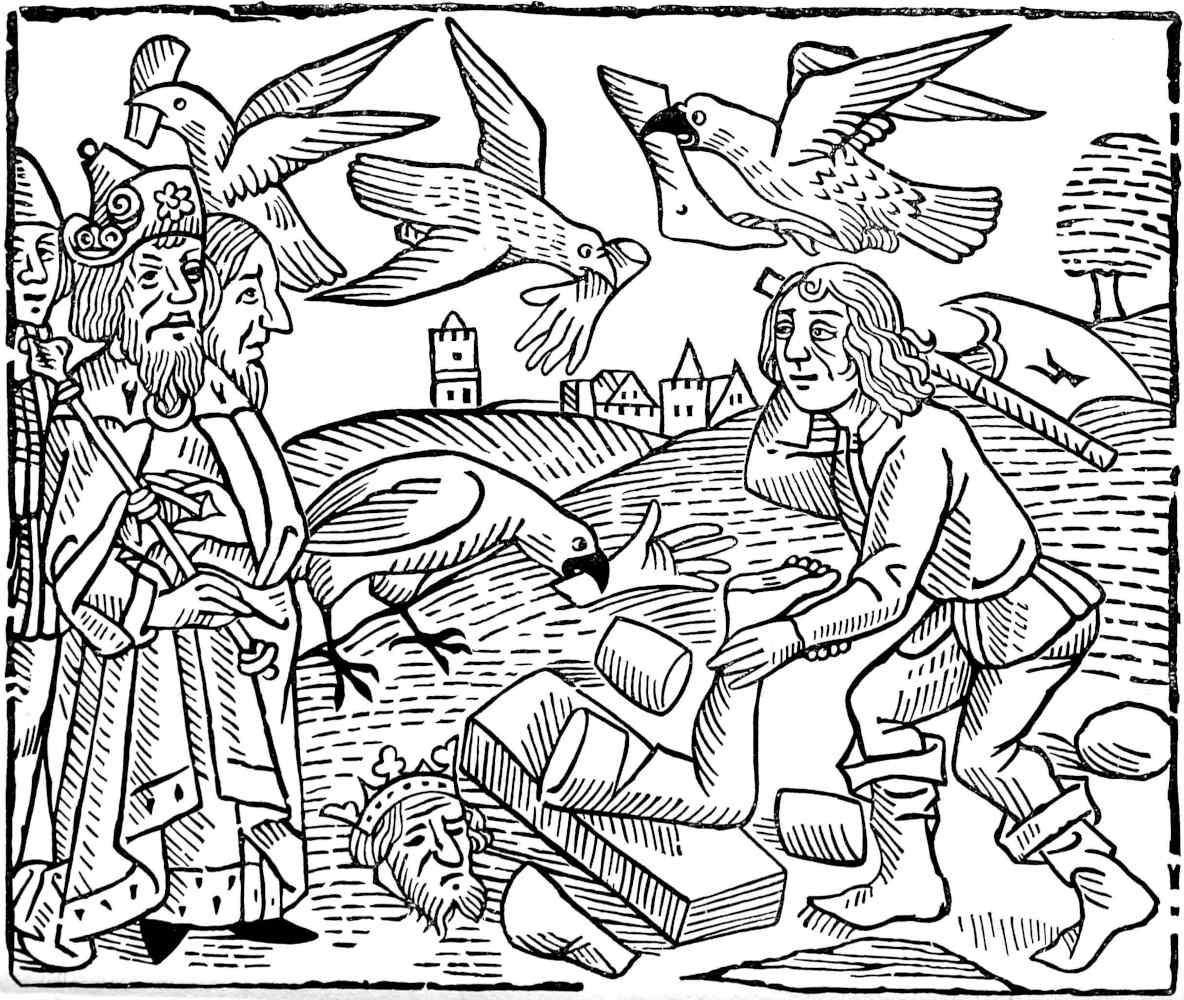
“EVILMERODACH, A JOLLY MAN WITHOUT JUSTICE WHO DID DO HEW HIS FATHER IN PIECES.”
The literary history of the work has been given under the first edition, but we must notice that the original prologue dedicated to the Duke of Clarence, the major portion of which was a translation from the French, has been superseded in this edition by a prologue from Caxton’s own pen, the ideas in which, with the exception of the first few lines, and almost the very words, are often met with in manuscripts of that age.
In the first chapter of the Fourth tractate is a curious interpolation by Caxton respecting “the good old times” of his youth. The original text has this remark: “And truly a royame wythout habundaunce of goodes by whyche hyt may be gouerned and prospere may better be callyd a latrocynye or a nest of theuys than a royame.” To this Caxton adds the following:—“Alas what habundaunce was somme tymes in the royames / and what prosperite / in whiche was Justyce . and euery man in his offyce contente! how stood the cytees that time in worship & renome . how was renomed the noble royame of englond alle the world dradde hit and spake worshyp of hit. How hit now standeth and in what habundaunce I reporte me to them that knowe hit . yf there ben theuys wyth in the royame or on the see . they knowe that laboure in the royame and sayle on the see / I wote wel the fame is grete therof / I pray god saue that noble royame . & sende good trewe and polletique councellours to the gouernours of the same.”
The year in which this edition is generally considered to have been issued seems to me very incorrect. Ames assigns no date to it, but Dibdin, probably misled by Bagford’s observations, thinks it one of Caxton’s earliest efforts, while in some remarks attached to a reprint of this edition by Mr. Figgins, it is considered as the earliest specimen of the Westminster press, and to have been printed from cut metal types. An examination of the work, however, with a typographical eye does not afford a single evidence of very early workmanship. All Caxton’s early books were uneven in the length of their lines—this is quite even. Not one of the early works had any signatures—this is signed throughout. These two features alone are quite sufficient to fix its date of impression at least as late as 1480, when Caxton first began the use of signatures. Probably it was the last book for which Type No. 2* was used.
Copies are in the British Museum; the Pepysian and Trinity, Cambridge; Bodleian and St. John’s, Oxford; Imperial Library, Vienna; and seven in private hands.