A DESCRIPTION OF BOOKS PRINTED IN TYPE No. 4.
Reading edition
BOOKS PRINTED IN TYPES No. 4 AND 4*.
39. Chronicles. First Edition Type 4 1480
40. Description of Britain Type 4 1480
41. Curia Sapientiæ Type 4 1481?
42. Godfrey of Boloyne Type 4 1481
43. Indulgence. First Edition Type 4 1481
44. Ditto Second Edition Type 4 1481
45. Chronicles. Second Edition Type 4 1482
46. Polychronicon Type 4 1482
47. Pilgrimage of the Soul Type 4 1483
48. A Vocabulary Type 4 1483?
49. The Festial. First Edition Type 4* 1483
50. Four Sermons Type 4* 1483?
51. Servitium de Visitatione Type 4 1483?
52. Sex Epistolæ Type 4 and 4* 1483?
53. Confessio Amantis Type 4 and 4* 1484
54. The Knight of the Tower Type 4 and 4* 1484?
55. Caton Type 4* 1484
56. Golden Legend. First Edition Type 4 and 4* 1484
57. Death-bed Prayers Type 4* 1484?
58. Æsop Type 4* 1484
59. Order of Chivalrye Type 4* 1483-85
60. Canterbury Tales. Second Edition Type 4* 1484?
61. Book of Fame Type 4* 1484?
62. The Curial Type 4* 1484?
63. Troilus and Cresside Type 4* 1484?
64. Life of our Lady Type 4* 1484?
65. St. Winifred Type 4* 1485?
66. King Arthur Type 4* 1485
67. Charles the Great Type 4* 1485
68. Paris and Vienne Type 4* 1485
69. The Golden Legend. Second Edition Type 4* 1487
BOOKS PRINTED IN TYPE No. 4.
No. 39.—The Chronicles of England. Folio. “Emprynted by me William Caxton in thabbey of Westmynstre.” June 10th, 1480. First Edition, with short commas.
Collation.—Prologue and table a 4n, signed ij, iij, and iiij, the first leaf being blank, a (a j blank) b c d e f g h i k l m n o p q r s t u x are 4ns; y is a 3n. Total 182 leaves, of which two are blank.
Typographical Particulars.—There is no title-page. Type No. 4 only is used. There are forty lines to a full page. The lines are spaced out to an even length, and measure 4¾ inches. The signatures are in lower-case letters and Arabic numerals. Spaces left for the insertion of initials. Without folios or catchwords. The short comma (⸝) only is used.
Commencing with a blank leaf, the prologue follows on sig. ij recto, the Text beginning, with a space for a 5-line initial,
J
N the yere of thyncarnacion of our lord Jhu crist M. CCCC . lxxx . And in the xx . yere of the Regne of kyng Edward the fourthe ⸝ Atte requeste of dyuerce gentilmen I haue endeueurd me to enprinte the cro- nicles of Englond as in this booke shall by the suf- fraunce of god folowe ⸝ And to thende that euery mon may see and
The Chronicle ends on the sixth recto of sig. y, the verso being blank,
Thus endeth this present booke of the cronicles of englond ⸝ enp’n | ted by me william Caxton In thabbey of westmynstre by london | Fynysshid and accomplisshid the x . day of Juyn the yere of thin- | carnacion of our lord god M . CCCC . lxxx . And in the xx . yere of | the regne of kyng Edward the fourth
Remarks.—The use of short commas, which characterises the early state of this type, would induce us to give priority to this edition over the other, in which the long commas are used, independently of any printed date.
The history here printed by Caxton differs but little from the “Cronicle of Brute,” one of the most popular of the fifteenth and sixteenth century books. It is, however, carried further than any manuscript chronicle I have seen, and it appears probable that, as any writer who felt competent made his own additions in transcribing, so Caxton added more or less to his copy, and brought the history down, as he acknowledges having done in “Polycronicon,” to the battle of Towton. The old “Cronicle of Brute” was so called from the opening chapter which describes the settlement of Brutus, the descendant of Æneas, in Britain. The respective parts due to Nennius, Douglas of Glastonbury, and Geoffrey of Monmouth, are probably too obscure to determine. The St. Alban’s Chronicle, printed two or three years later, and in types somewhat resembling those of Caxton, is the same text, interpolated throughout with a history of the Popes and ecclesiastical matters. This, and the edition of Machlinia (Caxton’s text), about the same date, are not unfrequently catalogued erroneously as from Caxton’s press.
One of the most rare books from the early Dutch Press is a reprint of Caxton’s text by Gerard Leeu.
This work is often called “Caxton’s Chronicle” by old writers, probably from the publicity he gave it both as editor and printer, and he is often blamed for its inaccuracies, although, with the exception of the last few pages, he had nothing to do with its compilation; nor indeed does he in any way lay claim to it.
Of this edition with the short commas there are copies at Cambridge, Bodleian (2), St. John’s, Oxford, Hunterian Museum, Glasgow, and Lambeth Palace. Six are in private hands.
No. 40.—The Description of Britain. Folio. “Fynyshed by me William Caxton.” No Place. 18th August, 1480.
Collation.—Three 4ns and one 3n, unsigned. Thirty leaves, the last being blank.
Typographical Particulars.—There is no title-page. Type No. 4 only is used. There are forty lines to a full page. The lines are spaced out to an even length, and measure 4¾ inches. Spaces left for the insertion of initials. Without signatures, folios, or catchwords. The signatures were probably omitted on account of the limited extent of the work.
The Text begins, on the verso of the first leaf, thus:—
Hit is so that in many and diuerse places the comyn cronicles | of englond ben had and also now late enprinted at westmynstre |
and ends on the 29th recto,
lated the book of Policronicon into englissh ⸝ Fynysshed by me | william Caxton the xviij . day of August the yere of our lord god | M. CCCC. lxxx . and the xx . yere of the regne of kyng Edward | the fourthe .
Remarks.—“The Description of Britain” is one of the chapters out of Ralph Higden’s “Polycronicon.” Caxton printed it as a supplement to the Chronicles, and evidently intended it to follow on after the termination of that work. The blank leaf at the end instead of the beginning favours this idea.
It is improbable that a second edition of “The Description of Britain” was issued, as no copy with the long commas (/) has yet been found.
Copies are in British Museum, Cambridge, Oxford (3), St. John’s, Oxford, Lambeth, Glasgow, and four in private libraries.
No. 41.—Curia Sapientiæ; or the Court of Sapience. Folio. Without Printer’s Name, Place, or Date. (1481?)
Collation.—a b c d are 4ns, e is a 3n = 38 leaves, of which the first is blank.
Typographical Particulars.—There is no title-page. The type is No. 4 throughout. The whole work is in “Balad Royal,” or stanzas of seven lines, of which there are five to each page. Without folios or catchwords. Space is left for the insertion of 3-line initials.
After a blank the Text begins on a ij recto, with space for a 3-line initial, with director,
t
He laberoꝰ & ye most merueyloꝰ werkes Of sapience syn firste regned nature My purpos is to tell as writen clerkes And specyally her moost notable cure
The Text ends half-way down the second column, on the sixth verso of signature e,
lyuyng ⸝ nedeful werkes ⸝ and dredeful dedes of ioye and of peyne
Remarks.—The only manuscript copy of this poem is preserved in the library of Trinity College, Cambridge. It belonged formerly to John Stow, who has noted several omissions in the text, as compared with some other copy, probably the printed edition; and who has written over the top, “By John Lydgate.” The poem itself is headed “Here beginneth a brief compiled treatise called by the Author thereof Curia Sapientiæ.”
The following description by Oldys is taken from Bib. Harl. Vol. III, No. 3313: “Though neither the author’s nor printer’s name appears to this poem, it was visibly enough printed by Caxton and composed by Lidgate, had we not the authority of John Stowe for it, in the catalogue of his writings. The author tells us it was written at the command of his Sovereign (perhaps King Hen. V), and it seems to be one of the scarcest of his pieces extant. There seems to be more invention in it and variety of matter than in most other poems of his composition, displaying, after a copious debate between Mercy and Truth, Justice and Peace, a distinct survey throughout the palace and domains of Sapience, of all the products of nature, in distinct chapters, and of arts and sciences; with his further reference, at the end of each, to the authors who have written on them.” Ames says (Typ. Ant., page 67), after quoting the whole of the “Prohemium,” “I take Caxton to be the poet or author, by the above verses.” This opinion was perhaps too readily adopted. Although there is a curious parallel between the poet’s statement of his rude and corrupt speech, and the apology of Caxton in his additions to “The Recuyell” for his “vnperfightness” in English, owing to his having been educated where was “spoken as brode and rude englissh as is in ony place of englond;” and although we know that Caxton could put together a few verses, as in the instance of the last two stanzas of “Moral Proverbs;” yet, judging from the literary ability of his known works and translations, we should hardly be justified in ascribing the authorship of “Curia Sapientiæ” to him. The plan of this work, in which theology, geography, natural history, horticulture, grammar, rhetoric, arithmetic, geometry, music, and astronomy are all in turn described, was certainly too high a flight for our printer.
The titles given to this book, “The werke of Sapience” and “Tractatus de Fide et Cantus famule sue,” adopted by Ames and other bibliographers, were taken from the first and last lines of the poem. The proper title, “Curia Sapientiæ,” appears at the end of “Liber Primus.”
Caxton’s edition is very scarce. St. John’s, Oxford, and Earl Spencer, have copies, and fragments are in the Bodleian and the British Museum. This last library is inaccurately stated by Dibdin to possess a perfect copy.
No. 42.—The History of Godfrey of Boloyne; or the Conquest of Jerusalem. Folio. Printed the 20th November, in the Abbey of Westminster, by William Caxton, 1481.
Collation.—a is a 3n with a j blank; b a 2n, b 1 being blank; 1, 2, 3, 4, 5, 6, 7, 8, 9, 10, 11, 12, 13, 14, 15, and 16 are all 4ns, 17 is a 3n = 144 leaves, of which two are blank. Excepting the first two gatherings, the signatures are entirely in Arabic numerals. Dibdin corrects Ames, and says he counted 146 leaves, but Ames was right.
Typographical Particulars.—There is no title-page. The type is entirely No. 4. A full page has forty lines, which are of an even length, and measure 4¾ inches. Without folios or catchwords. Space at the commencement of chapters is left for the insertion of 3 to 7-line initials.
The volume commences with a blank leaf, after which follows the prologue, the Text beginning on a 2, with a space for a 4-line initial,
t
He hye couragyous faytes / And valyaunt actes of noble Jllustrous and vertuous personnes ben digne to be recounted ⸝ put in memorye ⸝ and wreton. to thende that ther may be gyuen to them name Jnmortal by so- uerayn laude and preysyng. And also for to moeue and tenflaw |
ending half-way down the recto of the sixth folio of sig. 17, the verso being blank,
myng . whiche boook J began in marche the xij daye and fynys- | shyd the vij day of Juyn ⸝ the yere of our lord · M . CCCC · lxxxj | & the the xxj yere of the regne of our sayd sauerayn lord kyng Ed | ward the fourth . & in this maner sette in forme & enprynted the | xx day of nouem- bre the yere a forsayd in thabbay of westmester | by the said wylliam Caxton
In the British Museum is a splendid manuscript of this work, a large folio, on vellum, fifteenth century, with numerous illuminations. The character of the writing is very similar to the large type of Colard Mansion, and it begins “Les anciennes histoires dīet que eracles fut moult bon x’pien et gouuerneur de lempire de romme.” The text is without doubt the original of Caxton’s translation, with which it agrees chapter for chapter, but is carried much further than the death of Godfrey, with which Caxton concludes. The author appears to be unknown.
An edition was printed at Paris, in 1500, with the title “Les faits et Gestes de preux Godefroy de Bovillon et de ses chevalereux freres Baudouin et Eustache.”
Copies are in the British Museum, Cambridge (2), Imperial Library, Vienna, Hunterian College, Glasgow, Bristol, Göttingen, besides four in private libraries. The copy belonging to S. Holford, Esq., is specially interesting; it is in its original vellum cover, and contains the following interesting notice:—“This was king Edw. ye fourth Booke.” Also the autographs, “p’tinet Rogero Thorney,” and “Robt Wellborne.” The former of these names is worth a comment, because it throws some doubt upon the accuracy of the previous notice. Roger Thorney, like other literary mercers of his time, was probably a friend and supporter of Caxton: he certainly patronised his successor, Wynken de Worde, as the following lines from the “Polychronicon” of 1495, show:—
“————this boke of Policronicon “Whiche Roger Thorney Mercer hath exhorted “Wynken de Worde of vertuous entent “Well to correcte, and gretely hym comforted, “This specyal boke to make and sette in prente.”
How then did Roger Thorney become possessed of the copy of “The History of Godefroy of Bulloyn,” belonging to his king? On the inside cover is also the book-plate of Sir John Dolben, Bart., of Finedon, in Northamptonshire. This volume was sold among the books of Secondary Smyth, in 1682, and passed into the library of the Earl of Peterborough. It was afterwards in the Vernon collection, which is now included in that of Mr. Holford.
No. 43.—Letters of Indulgence from Johannes de Gigliis, alias De Liliis, issued in 1481 on the authority of Pope Sixtus IV, for assistance against the Turks. On Parchment. 1481.
This indulgence is represented by two slips of parchment, extracted from the St. Alban’s “Boethius.” (See ante, page 215.)
Originally in one, the document was cut in two pieces by Caxton’s binder, who used them for strengthening the back of the book. They were pasted, one at the beginning and one at the end, down the whole length, inside the boards. When the volume was dissected they were, unfortunately, subjected to the usual soaking in water. This has entirely changed their original appearance, as the print has necessarily participated in the shrinking of the parchment. From personal examination, while the fragments were in the original state, the following particulars are obtained:—
Typographical Particulars.—The Type is all No. 4. The lines, which are spaced to an even length, measured nine inches. The complete document, apparently, contained 13 lines.
The second slip containing the date, is as follows:—
mutare libere et licite . . . . . | . et singuloru fide pre- sentes sigilli ꝯmissionis indulgeciaru et dispensacionu sancte cruciate qu . . | mus et fecimus appensione com . . ixi / Datum die mensis | CCCC. lxxxj . Ac pontificatus prefati sanctissimi domini nostri do . ini Sixti pape . .
The two slips, now measuring each 7¼ × 1 inches, were originally about 11 × 2 inches. They are now in the British Museum.
No. 44.—Letters of Indulgence issued in 1481, on the authority of Pope Sixtus IV, for assistance against the Turks. Second Edition. On Parchment. 1481.
The type is all No. 4. The lines are spaced to an even length. The whole document is printed on one side of a slip of paper.
The only two copies known are pasted inside the “Royal Book” printed by Caxton, and now in the Bedford Library, Bedford. They measure 8 × 6 inches. A slip of parchment containing four lines of the same Indulgence was discovered by Mr. Bradshaw in the Library of King’s College, Cambridge.
No. 45.—The Chronicles of England. Folio. “Emprynted by me william Caxton In thabbey of westmestre” October 8th, 1482. Second Edition, with long commas.
Collation.—Prologue and title a 4n, signed ij, iij, and iiij, the first leaf being blank, a (a j blank) b c d e f g h i k l m n o p q r s t u x are 4ns; y is a 3. Total 182 leaves, of which two are blank.
Typographical Particulars.—There is no title-page. Type No. 4 only is used. There are forty lines to a full page. The lines are spaced out to an even length, and measure 4¾ inches. The signatures are in lower-case letters and Arabic numerals. Spaces left for the insertion of initials. Without folios or catchwords.
The above collation and particulars are identical with those of the first edition, described at page 247, ante.
Commencing with a blank leaf, the prologue follows on sig. ij recto, the Text beginning with space for a 4-line initial,
i
N the yere of thyncarnacyon of our lord Jhu crist M CCCC / lxxx / And in the xx yere of the Regne of kyng Edward the fourth / Atte request of dyuerse gen tylmen J haue endeuyryd me to enprynte the Cro- nycles of Englond / as in this book shal by the suffraunce of god
The Text ends on the sixth recto of sig. y, the verso being blank,
Thus endeth this present book of the Cronycles of Englond / Enprynted by me William Caxton Jn thabbey of westmestre by london / Fynysshed / and accomplysshyd the / viij / day of Octobre / The yere of the Incarnacyon of our lord God / M / CCCC / lxxxij And in the xxij yere of the regne of kyng Edward the fourth
Copies are in the British Museum (2) and Oxford, with three in private libraries.
No. 46.—Polycronicon. Folio. “Imprinted and set in forme by me William Caxton.” Without Place or Date. Translation ended 2nd July, 1482.
Collation.—a b are 4ns, with the first leaf of a blank; C is a 2n; sigs. 1 to 28 are 4ns, the first and 5th leaves of sig. 1 being blank; sig. 28 is followed by an unsigned single sheet, of which but one leaf is printed, the other being blank; 29 to 48 are 4ns; 49 a 2n; 50 to 55 are 4ns, with the last leaf of 55 blank; sig. 50 is followed by 52, sig. 51 being accidentally omitted = 450 leaves, of which five are blank.
Typographical Particulars.—There is no title-page. The type is all No. 4. The lines, which measure 4¾ inches, are fully spaced out, and forty make a full page. Space is left at the beginning of the chapters for the insertion of initials. The first gatherings have the signatures in Roman numerals, but all the rest are signed with Arabic numerals. After the introductory matter folios are introduced, although with many errors.
The Text, preceded by a blank, begins on sig. a 2 recto, with space for a 4-line initial,
Prohemye
g
Rete thankynges lawde & honoure we merytoryous- ly ben bounde to yelde and offre vnto wryters of hys- toryes / whiche gretely haue prouffyted oure mortal lyf / that shewe vnto the reders and herers by the ensamples of thynges passyd / what thynge is to be desyred /
The Text ends on the recto of 55-7; the verso and 55-8 being blank.
wrytynge / Ended the second day of Juyll the xxij yere of the regne of kynge Edwardthe fourth & of the Jncar- nacion of oure lord a thousand four honderd foure score and tweyne /
Fynysshed per Caxton
Remarks.—Few of Caxton’s books have excited more interest and research than the “Polycronicon.” It appears to have had its origin with Roger, Monk of St. Werberg, in Chester, who, about the beginning of the fourteenth century, made an extensive compilation in Latin from several of the old chronicles and works on natural history then in existence. Ralph Higden, of the same monastery, who died before 1360, amplified this compilation, entitling his work, “Polycronicon;” and this, judging from the numerous copies still extant, had a very extended popularity. In 1387 Trevisa, chaplain to the Earl of Berkeley, translated the Latin of Higden into English prose. An account of Trevisa, with a history of his works, is given by Dr. Dibdin, in Typ. Ant. vol. i., page 140, who, however, has not included in his list Trevisa’s English translation of the Gospel of Nicodemus (Addit. MS. 16165). Trevisa’s translation of the Bible is expressly mentioned by Caxton in his prologue. Nearly a century later, Caxton “a little embellished” the antiquated text of Trevisa, which, together with a continuation of the history to the year 1460, was finished on July 2nd, 1482, and printed soon after: he entitled his continuation “Liber ultimus,” and it is most interesting as being the only original work of any magnitude from our printer’s pen.
Caxton tells us very little of the sources of his information. He mentions two little works, “Fasciculus temporum” and “Aureus de Vniverso,” from which, however, he certainly obtained but little material for his “Liber ultimus,” which treats almost entirely of English matters.
As a specimen of the alteration made by our printer, when he “a lytyl embellyshed” the text as rendered by Trevisa, the following quotation is given, in which the consequences of Man’s fall are graphically described. The embellishment chiefly consists in modernising the old English, although here and there Caxton added sentences to the text.
TREVISA’S TEXT, 1387. (Harleian MS., No 1900, fol. 94b). From that day forthward ye body yt is corrupt by syne greuey ye soule / Ye flesche couetiy azenꝰ ye soule / and mānes wittes torney & assentith liztlich to euel A mānes owne meynal wittes bey his owne enemyes ℂ So yt al a mānes lif is temptacion while he lyuey here in erye Also man is eū failynge and aweyward . he may nouzt stidfastlich abide he falliy liztliche bot he may nouzt lightlich arise . P’fite is of birye sorrowe & care ī lyuyng/ and man mot nedes deye And thouz alle oye yat bey made haue schelles · ryndes · skynnes · wolle. heer. bristels · fethers · wynges other skales · man is y bore wiyout eny helyng / naked & bar . anone at his birye he gyney forto wepe atte bygynyng liche to a best . but his lymes failey hym & may nouzt help hymself . But he is febler yan any oyr beste · he kan noon helpe · he may nouzt do of hymself but wepe wiy al his myzte. No best hay lif more brutel and vnsiker. Noon hay sekenesse more greuous · noon more likynge to do oyrwise than he sholde / noon is more cruwel Also oyr bestes louey eūeche oye of ye same kynde & woney to gedres & bey nouzt cruwel but to bestes of other kynde yt ben contrairie to hem But man torney yt maner doyng vpsodoū & is contr’ie to hym self & cruel to oyr men CAXTON’S TEXT, 1483. (Sig, 10 4 verso). Fro that day forth the body that is corrupt by synne greueth the soule The flesshe coueyteth ayenste the soule and mannes wyttes torne and assente lightly to euyl A mannes oune meynal wyttes / be his owne enemyes / so that al mannes lyf is in temptacion whyle he lyueth here in erthe . & the disposipon of the soule ruleth meynteneth / helpeth and conforteth the body / But ayeinward the wretched disposicion of the bodye distourbeth the soule · Also man is euer fayllyng and wayward he may not stydfastly abyde / he falleth lightly but he may not lightly aryse / Profyt of byrth is sorow and care in lyuyng and man must nedes dye And thaugh oll other that be made haue shelles ryndes skynnes . wolle heer bristels feders wynges owther skals / Man is born withoute ony helyng or keueryng nakede and bare / anone at his birth . he gynneth for to wepe atte begynnyng lyke a beest but his lymmes fayllen hym and maye not helpe hym self · but he is febler than ony other beeste / he can noon helpe / he may nought doo of hym self but wepe with al his myght No beest hath lyf more brutyl & vnseker / None hath sekenesse more greuous noon more lykyng to do otherwyse than he shuld . none is more cruel Also other bestes loue eueryche other of the same kynde . and dwell to gyder and be not cruel / but to beestes of other kynde that be contrary to hem / But man torneth that maner doyng vp so downe and is contrary to hymself and cruel to other men /
This is one of the most common of Caxton’s works, at least thirty copies being known, of which half are in various public libraries.
No. 47.—The Pilgrimage of the Soul. “Emprynted at westmestre by william Caxton, and fynysshed the sixth day of June,” 1483.
Collation.—An unsigned 2n, with the first leaf blank; a b c d e f g h i k l m n are 4ns, with a j blank; o is a 3n, with the last two leaves blank. Total 114 leaves, of which four are blank.
Typographical Particulars.—There is no title-page. The type throughout is No. 4. The lines are of an equal length, and measure 4⅞ inches. A full page has forty lines. There is a running head to the pages, and the leaves have printed folios, numbered very carelessly. Space has been left for the insertion of 2, 3, and 6-line initials. Commencing with a blank, the title and table follow on folio ij, which is unsigned.
The Text begins, on the second leaf, thus:—
Folio ij
This book is intytled the pylgremage of the sowle / trans- lated ‖ oute of Frensshe in to Englysshe / whiche book is ful of deuonte ‖ maters touchyng the sowle / and many ques- tyons assoyled to cau ‖ se a man to lyue the better in this world / And it conteyneth fyue ‖ bookes / as it appereth her- after by Chapytres
The Text ends on the fourth leaf of sig. o, and the verso of folio Cx,
Here endeth the dreme of pylgremage of the soule trans- latid ‖ out of Frensshe in to Englysshe with somwhat of addicions / the yere of our lord / M.CCCC / & thyrten / and endeth in the Uigy ‖ le of seynt Bartholomew
Emprynted at westmestre by William Caxton / And fynysshed ‖ the sixth day of Juyn / the yere of our lord / M.CCCC ⸝ lxxxiij ‖ And the first yere of the regne of kynge Edward the fyfthe / ‖
This is the only book from the press of Caxton having the name of Edward V in the colophon.
Remarks.—The common custom among preachers of the Middle Ages of engaging the attention of their hearers by spiritualising tales and even jests current among the people is well known. This practice seems to have suggested to a monk named Guillaume de Deguilleville the idea of moralising the celebrated “Roman de la Rose.” His poem was divided into three parts, and completed about 1335. It contains more than 36,000 lines, and its title is “Le Romant des trois Pelerinages.” These three pilgrimages are “Le pelerinage de la vie humaine;” “Le pelerinage de l’Ame;” and “Le pelerinage du Jesus Christ.” Brit. Mus. Addit. MS. 22937 contains the three parts complete. None of these appear to have been printed. Not satisfied, however, with the result of his labours, Guillaume again set to work and recast the whole poem, with many amplifications and additional verses. This, which was finished about 1350, and of which a manuscript copy is in the Bib. Imp. Paris, 69882, is the text of which several editions were issued from the early French press.
Nearly a century passed when another monk, Jehan de Gallopes, transposed the rhymes of Deguilleville into French prose. This was with the object of modernising the old language, or, as he says, “pour esclaircir et entendre la matiere la contenue.” Gallopes, however, apparently extended his labours no further than “The Pelerinage de l’Ame,” and here we find the text used by the translator of “The Pylgremage of the Sowle,” printed in 1483 by our William Caxton. Manuscripts of the prose “Pelerinage de l’Ame” are very scarce, but a perfect copy is in Bib. Imp. Paris, No. 7086.
Of the author and translators mentioned above, but little can be said. Guillaume de Deguilleville was monk, and afterwards prior, of the Abbey of Chalis; and this seems all that is known of him. His name appears in the later manuscripts as Guillaume de Guilleville, and is mostly so printed, but is spelt correctly in some of the early French printed editions. In a fourteenth century manuscript, already noticed, the name appears “de Deguilleville,” and that this is the true orthography is placed beyond question by an acrostic, consisting of two “chansons” in the French text. Here the author has veiled himself in the initial letters of each line, and by putting these together we obtain his real name, “Guillaume de Deguilleville.”
“Jean de Gallopes, dit le Galoys,” as we learn from the prologue to his French prose version, was the “humble chapellain” to John, Duke of Bedford and Regent of France, for whom the translation was undertaken. It was, therefore, executed before the death of the Regent, in 1435, and there seems reason to suppose that its author was an Englishman. In the Imperial Library, Paris, is a manuscript, mentioned by M. Paris (Les Msc. Franç., vol. v, page 132), entitled “Vie de Jesus Christ,” which is attributed also to Gallopes, but which appears to be a different work from the third “Pilgrimage” of Deguilleville.
To John Lydgate, monk, of Bury, is generally attributed the English version of “The Pylgremage of the Sowle,” and probably with truth, as some of the additional poems found here form a part also of Lydgate’s well-known poem “The Life of our lady.” He is also supposed, from internal evidence of style, to be the author of “The Pilgrimage of man” (Cotton MSS., Vitel. C. XII), an English metrical translation of Deguilleville’s “Pelerinage de la vie humaine.”
The numerous copies of the “Pilgrimages” still extant in our old libraries prove that they must have attained a considerable amount of popularity. In France there were several printed editions, but in England, probably owing to the growth of the Reformation, “The Pylgremage of the Sowle,” printed by Caxton, is the only known edition.
Copies are in the British Museum, St. John’s, Oxford, and Sion College, London; also in the Althorpe and Britwell Libraries.
There is no connection whatever between this work and Bunyan’s “Pilgrim’s Progress.” Caxton’s book treats of the journey and trial of the soul after death, the only point in common being that both are supposed to happen in a dream. “The Pilgrimage of man” is nearer in idea, but equally distinct in treatment.
No. 48.—A Vocabulary in French and English. Folio. Sine ullâ notâ. 1483?
Collation.—Two 4ns, and one 5n, unsigned = 26 leaves, the first being, doubtless, blank.
Typographical Particulars.—There is no title of any sort. The type is No. 4 throughout. 42 lines in double column (84 lines) make a full page, and the long lines measure 2⅞ inches. The words “Frensshe” and “Englissh” appear as head-lines to every page. Without folios, catchwords, or initials.
The Text begins, in double column, on the 2nd recto, thus:—
Frensshe Cy commence la table De cest prouffytable doctrine Pour trouuer tout par ordene Ce que on vouldra aprendre Englissh Hier begynneth the table Of this prouffytable lernynge For to fynde all by ordre That whiche wen wylle lerne
The Text ends, with seven lines on the 26th recto, thus:—
Frensshe La Grace de sainct esperit Ueul enluminer les cures De ceulx qui le aprendront Et nous doinst perseuerance En bonnes operacions Et apres ceste vie transitorie La pardurable ioye & glorie Englissh The grace of the holy ghoost Wylle enlyghte the hertes Of them that shall lerne it And vs gyue perseueraunce Jn good werkes And after this lyf transitorie The euerlastyng ioye and glorie
“A Book for Travellers” is the title given to this work in Typ. Ant. vol. i, page 315, but as there is no especial suitability in it for the use of travellers, and as from its composition it appears to have been formed with a scholastic aim, it has been thought advisable to change so evident a misnomer.
No manuscript of this compilation in French or English is known to exist, nor is there any clue to the author.
A copy is in each of the four following libraries—Ripon Cathedral, Bamborough Castle, Earl Spencer, and Duke of Devonshire.
No. 49.—The Festial (Liber Festialis). First Edition. Folio. “Emprynted at Westmynster by Wyllyam Caxton the laste day of Juyn, 1483.”
Collation.—a b c d e f g h i k l m n are 4ns, a j being blank; o and p are 3ns = 116 leaves, of which one is blank.
Typographical Particulars.—There is no title of any sort. The type is entirely No. 4*, which here appears for the first time. The lines, which are fully spaced out, measure 5 inches. A full page has 38 lines. Without folios or catchwords. Space left for the insertion of 3 to 5-line initials, with director.
Commencing with a blank leaf, the sermon for the First Sunday in Advent follows on sig. a ij, space being left for the insertion of a 5-line initial.
The Text begins thus:—
t
His day is callyd the first sonday of aduent / that is the sonday in cristys comyng / Therfore holy chirche this day maketh mencion of ij comynges The first comyng was to bye mankynde out of bon dage of the deuyll and to brynge mannys sowle to blysse / And this other comyng shal be at the day of dome
The Text ends on the sixth recto of sig. p,
vs that for vs deyed on the rood tree / Qui cum deo patre & spū ‖ sancto viuit et regnat deus AMEN /
Explicit
Enprynted at Westmynster by wyllyam Caxton the laste day of Juyn Anno domini M CCCC Lxxxiij
The compiler of “The Festial,” John Mirkus, was a canon of the Monastery of Lilleshul, an old foundation in Shropshire, as we learn from a MS. copy of his work in the Cottonian Library. He says that, finding many priests, from incapacity, were, like himself, unable to teach their parishioners properly, he had taken pains to compile sermons for all the principal feasts of the year, which he had extracted chiefly from the “Golden Legend.” The omission of the prologue, by Caxton, as well as the final sermons on the Paternoster and Burial of the dead, makes us suspect that our printer had a copy imperfect at beginning and end. The subject of nearly every chapter in “The Festial” may also be found in the “Golden Legend;” but, taking the two books, as printed by Caxton, for comparison, it will be seen that the sermons for the Moveable Feasts, with which each work commences, have nothing in common but their subject, and that the histories of the saints are treated very differently, and often disagree even in their supposed historical facts. The “Gesta Romanorum” furnished many stories for the “Golden Legends,” but in “The Festial” that mine of anecdotes has contributed still more largely to the illustration and enforcement of the preacher’s remarks. “The Festial” is yet further removed from our Book of Common Prayer, with which it has been associated by some writers. With the exception of the names in the calendar there is nothing in common between them.
Although in Caxton’s edition of this work it is entirely without a name, there seems no reason for giving it the Latin title by which it is generally known, “Liber Festivalis.” John Mirkus, its compiler, who wrote it in English, says, “I will and pray that it be called a Festial;” and, accordingly, it was so called by Wynken de Worde in several editions, by Rood of Oxford, and by other early printers.
Copies are at the British Museum, Bodleian, Lambeth, and Althorpe.
No. 50.—Four Sermons, etc. (Quatuor Sermones, etc.) First Edition. Folio. “Enprynted by Wylliam Caxton at Westmestre.” Without Date. (1483?)
Collation.—a b c are 4ns, d a 3n = 30 leaves. No blanks.
Typographical Particulars.—There is no title. The type is entirely No. 4*. The lines are fully spaced out, and measure 5 inches. A full page has 38 lines. Without folios or catchwords. In this book we find, for the first time, the paragraph mark ℂ used—a mark which never appears in the early state of this type.
The Text begins on sig. a j, with space for a 3-line initial, without director,
He mayster of sentence in the second booc and the first ‖ dystynction / sayth that the souerayn cause / why god made ‖ al creatures in henen erthe or water / was his oune good- ‖ nes / by the whiche he wold that some of
On sig. d iij. recto,
ℂ The Generalle Sentence.
g
Ood men and wymmen J do you to vnderstonde that We that haue cure of your sowlys be commaumdyd of our ordenaries and by the coystytucions and the laWe of holy chirche to shewe to you foure tymes by the yere in eche a quarter of the yere onys when the peple is most
The Text ends on the sixth verso of sig. d,
resurrectionis gloria inter sanctos et electos tuos resussitati respi ‖ rent / per xpristum dominm nostrum Amen /
Enprynted by wylliam Caxton at westmestre /
Remarks.—The name of the writer of these homilies is not known, nor do they appear attached to any of the manuscripts of the Festial above noticed. That they were, however, printed by Caxton at the same time as the Festial appears evident from the identity of their typographical arrangements, strengthened by the fact of their being, in several instances, under the same cover. That Caxton also intended to allow their separate use may, nevertheless, be deduced from the first gathering having a for its signature, and from the existence of some copies unaccompanied by the Festial. In the Lambeth copy the sermons precede the Festial.
The four sermons are thus apportioned:—
1. On the Paternoster, the Creed, and the Ten Commandments.
2. The Seven Sacraments, the Seven Deeds of Mercy, and the Seven Deadly Sins.
3. A continuation of the subject of Deadly Sins.
4. On Contrition, Confession, and Satisfaction.
After the sermons are “The General Sentence or Comminacion,” and two forms of bidding prayer, called “The Bedes on Sondaye.”
Every priest was obliged by the Canon Law to read the “Modus Fulminandi,” or Commination, and to preach at least one sermon every three months. These homilies appear to have been written for this purpose, and would probably meet with a good sale among the preaching orders of the clergy.
Nine copies are known, of which two only are in private hands.
No. 51.—Servitium de Visitatione B. Mariæ Virginis. Quarto. Sine ullâ notâ. (1481-3).
Collation.—One 4n = 8 leaves, of which the last is blank.
Typographical Particulars.—The type is entirely No. 4. The lines, which are fully spaced out, measure 3¼ inches in length; there are 26 lines to a full page. Without signatures, folios, or catchwords.
The first leaf is wanting in the only copy known. The second recto commences with space for a 2-line initial, with director,
p
Rima aut mihi tunc aurora refulsit & horridis polo fugientibz vmbris celo ru bescente die vtcunqz a nocte distinxi . tuc quo
followed, on the same page, by—
Lectio sexta
On the verso is—
Lectioties de Omel’ . p octauas prima die
giving the lessons for the week. On the fourth recto is—
Ad missam Jntroitus
The sixth verso begins—
Oratio sanctissimi . d. n. Sixti pape quarti
The Text ends on the seventh verso, two lines short of a full page,
et exultatioe ppetua renascamur . Per xpm dominu nostru
The only Existing Copy is in the British Museum (C. 21. c), and, although wanting the first leaf, has the final blank. Measurement, 8⅜ × 5⅝ inches.
No. 52.—Sex perelegantissimæ Epistolæ per Petrum Carmelianum emendatæ. Quarto. Per Willelmum Caxton. In Westmonasterio. (1483.)
Collation.—a b c are 4ns = 24 leaves, of which a j is blank.
Typographical Particulars.—There is no title-page. The types used are Nos. 4 and 4*. The lines, which are spaced to an even length, measure 3¼ inches, and there are 26 to a page. Without catchwords or folios. The whole appearance of the print is like the “Servitium de Visitatione” and the “Order of Chivalry.”
The use of types 4 and 4* together points unmistakably to 1483 as the period of issue; and this date, gathered from the typographical particulars only, is completely verified by the letters themselves, the dates of which range from December 11th, 1482, to February, 1483.
The Text begins on a ij recto, with an introduction which occupies three pages.
h
Ercules dux Ferrarie in eo ducatu venetoru armis constitutus paulo post vetustissimus eorum violat immunitates / init foedus cum Therdinando Rege Nea- politano Mediolanensium duce / et floren- tinorum repu / quod per veneta foedor’ no licebat / Ueneti propria reposcunt ⸝ ille ter- giuersari ⸝ Xystus pontifex quartus / relic- Therdinadi foed &c.
The six letters begin on sig. a iij verso. On c 8 recto is the following colophon:—
Finiunt sex p’elegantissime epistole / quarum tris a summo Pontifice Sixto Quarto et Sacro Cardinalium Collegio ad Jllustrissimum Uenetiarum ducem Joannem Mocenigum totidemqz ab ipso Duce ad eundem Pontificem et Cardina- les / ob Ferrariense bellum susceptum / con- scripte sunt / Jmpresse per willelmum Cax- ton / et diligenter emendate per Petrum Camelianu Poetar’ Laureatum in West- monasterio
Beneath this is a Latin quatrain, beginning
Eloquii cultor,
followed by
Jnterpretatio magnarum litterarum punctatarum parua- rumque.
The Text ends with 23 lines on the verso of the same leaf.
Remarks.—These six letters passed between the Sacred College of Cardinals on one side and the Doge of Venice on the other, the subject being the necessity of closing the war with the City of Ferrara.
Petrus Carmelianus, the editor of these letters, is noticed by Mr. Gairdner, in his preface to the “Memorials of King Henry the Seventh,” published in 1858, for the Master of the Rolls, as having been in England from the time of Edward the Fourth. He may, therefore, have personally employed Caxton to print his “Sex Epistolæ.” The title “Brixiensis” sometimes attached to his name shows that he was a native of the town of Brescia. He seems to have taken an interest in educational matters, as verses by him to John Anwykyl and to William Waynflete, Bishop of Winchester, are prefixed to the “Compendium totius grammaticæ,” printed at Oxford about 1482-83. Some more of his poetry is printed in the Oxford “Phalaris” of 1485. Tanner assigns to Carmelianus the following promotions—Rector of St. George’s, Southwark, 1490; Prebend of York, 1498; Archdeacon of Gloucester, 1511; Prebend of London, 1519. Being in such favour, no wonder that he waxed rich, and that when, in 1522, “an annual grant was made by the Spirituality for the King’s personal expenses in France for the recovery of the Crown,” the name of “Mr. Petrus Carmelianus” appears among the “Spiritual Persons” for the handsome sum of £333 6s. 8d. In the Calendar of State Papers, where he is called “Latin Secretary of King Henry the Seventh,” mention is made of a letter sent to him from Ferdinand and Isabella of Spain, thanking him for his services, and promising him favour and reward. On the projected marriage of Prince Charles of Castile with the Princess Mary of England he wrote a poem in Latin, printed by Pynson about 1514, of which a unique copy is in the Grenville Library (see Archæologia, vol. xviii.) In the same library is a manuscript poem on the birth of the Prince of Wales (1486), another copy, beautifully illuminated, being among the royal MSS. in the British Museum. Both are evidently in the handwriting of Carmelianus, the latter being his presentation copy to the king. The argument of this poem is so characteristic of the age that it is worth noting. Almighty God, compassionating the miserable state of England lacerated with civil war, convoked a meeting of the Saints in Heaven to ask their opinions as to how the long-standing dispute between the Houses of York and Lancaster might be composed. The saints reply that, if the Omniscient Deity cared for any of their counsels, no one was better qualified to state how the wars might be terminated than King Henry the Sixth (already in heaven), who knew the country and the causes of dissension, and they recommended that he should be appealed to. Henry is accordingly called upon to reply to the Supreme Being, and proposes that the two houses should be united so as to be one house, for which an opportunity then offered by the marriage of the Earl of Richmond with the Princess Elizabeth. The Deity approves and decrees its execution, the marriage takes place, and the poem terminates with an exhortation to England to rejoice on account of the prince’s birth. Carmelianus died August 18th, 1527; John de Giglis, Bishop of Worcester, in 1497, his contemporary and countryman, also employed Caxton to print Indulgences.
A manuscript, “Carmen de Vere,”[18] in the British Museum, which is dedicated to Edward Prince of Wales (afterwards Edward V), dated April 1482, affords some information from the pen of Carmelian himself. He says that for the previous ten years he had been travelling about the world, having very lately arrived in England, with the intention of proceeding to Germany and Switzerland; but, captivated by the pleasantness of the country, he had been unable to leave it. He adds that his poem was written to gain the favour of the prince. Whence his dignity of Poeta laureatus was obtained is not known.
The only copy known of this tract was discovered in the year 1874 by Dr. G. Könnecke, archivist of Marburg, in an old volume of seventeenth century divinity, in the Hecht-Heinean Library at Halberstadt. It was described in the “Neuer Anzeiger” of Dr. Julius Petzholdt for October 1874; also in the Athenæum for February 27th, 1875.
No. 53.—Confessio Amantis. Large Folio. “Enprynted at Westmestre by me Willyam Caxton the ij day of Septembre / a thousand / CCCC lxxxxiij (a typographical error for lxxxiij)”.
Collation.—A 4n, signed ij, iij, iiij, the first and eighth leaves being blank, followed by a 4n, signed on the second leaf only 1 2, the first leaf being blank; then b c d e f g h i k l m n o p q r s t u x y z & A B all 4ns; C a 3n, with the sixth leaf blank. In all 222 leaves, of which four are blank.
Typographical Particulars.—There is no title-page. Type No. 4 is used for sigs. 1 to x; sigs. & to C, as well as the introductory matter, are in type No. 4*, while sigs. y and z are partly in one and partly in the other. Where type No. 4 is used there are 46 lines to a column, and 44 lines of type No. 4*. On sig. z iiij recto the two types appear in the same page, the first column being in No. 4 and the second in No. 4*. Without catchwords or folios. Space left for inserting 2 to 6-line initials, with director. The signatures at the beginning of the volume are irregularly printed, and show the want of a settled plan in the printer’s mind. The first 4n, which, as it includes the index, must have been printed last, is properly signed; but, on beginning the book, it appears as if the compositor thought there could be no use for signatures if every leaf had a printed folio, and accordingly they were omitted except on the second sheet, which is signed in Arabic numerals only. The inconvenience of this being seen, the folios were omitted, and the signatures printed in the second 4n, b; while in sig. c both plans are united, and we have signatures and folios too to the end of the book—the latter, however, with continual errors. The introductory 4n is not included in the enumeration of the folios. Note that sig. b 4 is printed 2 4, and that from sig. p to the end the Arabic numerals used in the signatures give place to Roman numerals. The book is in double column throughout. The date in the colophon is printed a thousand CCCC lxxxxiij, a typographical error, which would have led to some confusion had not the regnal year, “the first year of the reign of King Richard the third,” been also added, fixing the right date as 1483.
Commencing with a blank leaf, the paragraph title and table follow on sig. ij, space being left for a 3-line initial, with director.
The Text begins thus:—
t His book is intituled confes- ‖ sio amantis / that is to saye ‖ in englysshe the confessyon of ‖ the louer maad and com- pyled by ‖ Johan Gower squyer borne in walys ‖ how the world was first of golde / & ‖ after alwey werse & werse folio bj ‖ Thus endeth the prologue
The Text ends on the verso of sig. C 5, Folio CCxj with colophon in first column,
Enprynted at westmestre by me ‖ Willyam Caxton and fynysshed the ij ‖ day of Septembre the fyrst yere of the ‖ regne of Kyng Richard the thyrd / the ‖ yere of our lord a thousand / CCCC / ‖ lxxxxiij /
Remarks.—The life and poetical writings of the “moral” Gower have received frequent illustrations from modern critics. His chief work, the “Confessio Amantis,” appears to have been begun about 1386 and completed in 1392-3. It was originally dedicated to Richard II, but, on the wane of that monarch’s power, Gower suited himself to the changing times, and recast his prologue. The copies made after this version are termed Lancastrian. The Latin verses and the marginal index are in some manuscripts, as in Caxton’s printed edition, included in the text. They were, Dr. Pauli believes, the original composition of Gower, abounding, like his other poetry, in instances of false prosody and even bad grammar. The verses are imitations in the manner of Boethius, but often unintelligible.
Seventeen copies are extant. British Museum (3); Cambridge; Pembroke College, Cambridge; Hereford Cathedral; Lambeth; Queens’ College and All Souls, Oxford; and eight in private libraries.
No. 54.—The Book which the Knight of the Tower made to the “enseygnement” and teaching of his daughters. Folio. “Emprynted at Westmynstre the laste day of Januer the fyrst yere of the regne of Kynge Rychard the thyrd.” (i.e. 1484.)
Collation.—A 2n, signed on second leaf only ij; a b c d e f g h i k l m are 4ns; n a 3n, with the last two leaves blank. In all 106 leaves, of which two are blank.
Note—sig. c iiij is wrongly printed d iiij, and the first leaf of d is without any signature.
Typographical Particulars.—There is no title-page. The type, as far as sig. f, is No. 4, and forty lines, each 4⅞ inches long, make a full page. From sig. f j to the end the type is No. 4*, with 38 lines, each 4⅝ inches long, to the page. The lines are fully spaced out. Without folios or catchwords. Space is left for 3, 4, and 6-line initials, with directors.
The Text commences with the prologue on an unsigned leaf, with space for a 3-line initial A,
a
Lle vertuouse doctryne & techynge had & lerned of suche ‖ as haue endeuoured them to leue for a remem- braunce
On sig. a j recto,
Here begynneth the book whiche the knyght of the toure made / And speketh of many fayre ensamples and then- sygnementys and techyng of his doughters
The Text ends on the fourth verso of sig. n,
Here fynysshed the booke ⸝ whiche the knyght of the Toure ma ‖ de to the enseygnement and techyng of his doughters transla ‖ ted oute of Frenssh in to our maternall Englysshe tongue by ‖ me William Caxton / whiche book was ended & fynysshed the ‖ fyrst day of Juyn / the yere of oure lord M CCCC lxxxiij And enprynted at westmynstre the last day of Janyuer the fyrst yere of the regne of Kynge Rychard the thyrd
Remarks.—In the department of “Maine et Loire,” between Chollet and Vezins, may still be seen the ruins of an ancient château, called “Latour-Landry.” Archæologists ascribe the structure to the twelfth century. The place originally bore the name of “La Tour” only, the old family name of the owners being “Landry;” but eventually the two were combined, and “De la Tour Landry” became the patronymic of a long race of knights. The earliest instance of the double name is found in a document dated 1200. Passing over the history of the family, we will confine ourselves to Geoffrey and his book, “pour l’enseignment de ses filles.” The date of neither his birth nor death is known. He was at the siege of Aiguillon in 1346, when he must be supposed to be at least of the age of twenty years. He tells us he wrote his book in 1371, which would make him, at the youngest, 45 years old, though he was probably older. In all the illuminated copies of his work he is represented as discoursing with his three daughters, for whose instruction in their journey through life it was written, as the knight himself in a preface informs us.
He had also sons, as we learn that a similar work had previously been undertaken for their instruction, “as hit is reherced in the booke of my two sonnes, and also in an Euangely.” (See Caxton’s edition, sig. n 4.) It is interesting to note here, as an instance of the entire disappearance of books once well known, that neither of these compositions of the knight are known now to exist. We also learn that in the compilation of this work he called to his aid two priests, who read to him the Bible, the “Gesta,” and various chronicles of France, England, and other countries. To this may, perhaps, be attributed the predominance of the ecclesiastical element in this book. The knight originally intended to write the whole work in verse, but finding that method necessitated a less concise narration, he soon changed his composition into prose. In the original French, however, a considerable portion of the introduction, though prose to the eye, will be found to have retained its metrical form.
Several writers have denounced the work as obscene, and more fitted for the corruption than the instruction of youth; while others, taking into consideration the manners of that age, have arrived at the very opposite conclusion. At any rate, it is plain our Caxton thought highly of it: he says in his preface, “I advise every gentleman or woman having children, desiring them to be virtuously brought forth, to get and have this book, to the end that they may learn to govern them virtuously in this present life.” He tells us also the occasion of his translating and printing it, which was “at the request of a noble lady which hath brought forth many noble and fair daughters, which he virtuously nourished.” An interesting article upon this work appeared in the Retrospective Review: New Series, 1827; vol. i, part ii, page 177. See also, Le Livre du Chevalier de la Tour Landry, par M Anatole de Montaiglon. 12mo. Paris, 1854.
We must here notice that, although the anonymous English translation (Harl. 1764) preceded that by Caxton, a comparison of the two versions makes it evident that our printer owed nothing to his predecessor. M. Montaiglon, indeed, from a literary point of view, gives a decided preference to the earlier text.
The following amusing extract is suggestive of Shakspere’s “Taming of the Shrew.” Act V, Scene II.
How a woman sprange vpon the table · Capitulo xviij.
J
N a tyme it happed that Marchauntes of Fraunce cam from certayn Fayres / where as they sought Draperye / and as they cam with Marchaundyse fro Roan / that one of them said / it is a moche fayre thynge a man to haue a wif obeysaunt in alle thynges to her husbond / Verayly sayde that one / my wyf obeyeth me well / And the second said. J trowe / that my wyf obeye me better / ye sayd the thyrd / lete laye a wager / that whiche wyf of vs thre that obeyeth best her husbond / and doeth sonnest his commaundement that he wynne the wager / wherupon they waged a Jewele / and accorded al thre to the same / & sworen that none shold aduertyse his wyf of this bargayn / sauf only to saye to her / doo that whiche J shall commaunde what soeuer it be / After when they cam to the first mans hows / he sayd to his wyf Sprynge in to this bacyne / and she answerd / wherfore or what nede is it. And he said by cause it playsyth me so / and J wyll that thou do so / Truly said she J shall knowe fyrst wherfor J shall sprynge / And soo she wold not doo it · And her husbond waxe moche angry and felle / and gafe her a buffet / After thys they cam to the second marchauntes hows / and he saide to his wyf lyke as that other saide / that she wold doo his commaundement / And it was not long after that he said to her Sprynge in to the basyn / And she demaunded hym wherfore / And at the last ende for ought that he dyde / she dyd it not / wherfore she was beten as that other was / Thenne cam they to the thyrd mans hous And there was the table couered · and mete set theron And the marchaunt said to thother marchauntes in theyr eres / that after dyner he wold commaunde her to sprynge in to the bacyn / And the husbond sayd to his wyf / that what someuer he commaunded her she shold do it / his wyf whiche that moche louyd hym and dred hym herd wel the word. And it was so that they bygan to ete / and there was no salt vpon the table / And the goodman sayd to his wyf / Sail sur table And the good wyf whiche hadde fere to disobeye hym / sprang vpon the table and ouerthrewe table ⸝ mete / wyn / and platers to the ground / How said the good man / is this the manere / Cōne ye none other playe but this / are ye mad or oute of youre wyt. Syre said she / J haue done your commaūdement / haue ye not said that youre commaundement shold be done what someur it was. Certaynly J haue it done to my power how be it that it is youre harme and hurte as moche as myn. For ye sayd to me that J shold spryge on the table ⸝ J said he /J sayd ther lacked salt vpon the table / Jn good feyth J vnderstode said she for to spryng / thene was ther laughter ynouz & al was taken for a bourd and a mocquerye / Thenne the other two Marchauntes said it was no nede to late her sprynge in the basyn / For she had done ynough / And that her husband had wonne the wager.... And thus ought euery good woman to fere and obeye her lord & husbonde and to do his commaundement is hit right or wrong / yf the commaundement be not ouer outrageous / And yf ther be vyce therin / she is not to blame / but the blame abydeth vppon her lord and husbonde.
There are two copies in the British Museum, one at Cambridge, one at Oxford, and two in private libraries.
No. 55.—Caton. Folio. Without Printer’s Name, Place, or Date. “Translated ... by William Caxton in thabbey of Westmynstre the yere of our lord M CCCC lxxxiij.” (1484?)
Collation.—The prologues and table a 3n, signed ij and iij on the second and third rectos, the first and last leaves being blank: then a b c d e f g h are 4ns; i a 5n; a j and i 10 being blank. In all eighty leaves, of which four are blank.
Typographical Particulars.—There is no title-page. Two sizes of type are used: No. 2 for the Latin headings, and No. 4* for the Text. The lines, which are fully spaced out, measure 4⅝ inches, and there are 38 to a full page. Without folios or catchwords. Space is left for the insertion of 3-line initials, sometimes with and sometimes without directors.
Commencing with a blank leaf, Caxton’s short prologue and his dedication to the City of London follow on sig. ij.
The Text begins thus:—
ℂ Here begynneth the prologue or prohemye of the book callid ‖ Caton / whiche booke hath ben translated in to En- glysshe by ‖ Mayster Benet Burgh / late Archedeken of Colchestre and ‖ hye chanon of saint stephens at westmestre / which ful craftly ‖ hath made it in balade ryal for the erudi- cion of my lord Bou- ‖ sher / Sone & heyr at that tyme to my lord the erle of Estsex ‖ And by cause of late cam to my hand a book of the said Caton ‖ in Frensshe / whiche reherceth many a fayr lernynge and nota ‖ ble ensamples / J haue translated it oute of frensshe in to En ‖ glysshe / as al along here after shalle appiere / which J presente unto the Cyte of london /
v
Nnto the noble auncyent and renomed Cyte / the Cyte ‖ of london in Englond / J William Caxton Cytezeyn ‖ & coniurye of the same / & of the frater- nyte and felauship ‖ of the mercerye owe of ryght my seruyse & good wyll / and of
The table follows, making, with the introductory matter, eight printed pages, the whole concluding on the fifth verso, with the sixth blank leaf. After another blank is the Gloss, headed by a quotation of seven lines of Latin in type No. 3, with a ij for the signature.
The Text ends on the ninth recto of sig. i, the tenth leaf being blank,
thynge men may intytule this lytell book the myrour of the re ‖ gyme & gouernement of the body and of the sowle /
Here fynyssheth this present book whiche is sayd or called ‖ Cathon translated oute of Frensshe in to Englysshe by Will- ‖ iam Caxton in thabbey of westmynstre the yere of oure lord ‖ M CCCC lxxxiij / And the fyrst yere of the regne of kynge ‖ Rychard the thyrd the xxiij day of decembre
Remarks.—In his prologue Caxton says, “To the end that the histories and examples that be contained in this little book may be lightly found ... they shall be set and entitled by manner of Rubrics ... and they shall be signed as that followeth of the number of leaves where they shall be written.” Accordingly the numbers given in the table agree with their proper folios, but these folios are not inserted, either in print or manuscript, in the body of the work, rendering the table almost useless.
Caxton says in his preface that he translated from a French copy, “which rehearsed many a fair learning and notable example;” and some portions of his own introductory matter suggest also a French original. Were a manuscript to be found, its title would probably agree with Caxton’s concluding description of the work—“the mirror of the regime, and government of the body and of the soul.”
The year 1483 is usually assigned to the printing of this book; but as the translation was not ended till December 23rd, it seems improbable that it was printed till 1484.
As already noticed, this “Caton” is a very different work from the composition known as “Catho Magnus,” the distichs of which serve here only as a text whereon to hang an extensive gloss. A short notice of “Mayster Benet Burgh” has already been given.
There are copies in the British Museum, Cambridge, Glasgow, Oxford, Exeter College, Oxford, and seven in private hands.
No. 56.—The Golden Legend. Largest Folio. First Edition. “Fynysshed at westmestre the twenty day of nouembre / the yere of our lord M / CCCC / lxxxiij / By me Wyllyam Caxton.” (1484?)
Collation.—An unsigned 3n, with first and sixth leaves blank; a b c d e f g h i k l m n o p q r s t u x y z & are 4ns; 9 a 3n; A B C D E F G H J K L M N O P Q R S T U are 4ns; X a 3n; Y is a single sheet, followed by a single leaf, the back edge of which is sometimes returned round Y, and sometimes sewn separately; aa bb cc dd ee ff are 4ns; gg a 3n; hh ii 4ns; kk a 3n, kk 6 being blank. In all 449 leaves, of which three are blank.
Typographical Particulars.—There is no title-page. There are two sizes of type, No. 3 being used for head-lines and headings to chapters, while No. 4* is used for the text. The whole is in double columns, and the lines, which are fully spaced out, measure three inches; 55 lines in a column, and 110 to a full page. There are folios throughout, but numbered very irregularly. Space is left for the insertion of 3 to 6-line initials, with directors. There are no catchwords. Woodcuts are used throughout, apparently from the hand of the same artist who engraved the cuts for the second edition of the “Chess Book.”
The first edition is principally distinguished by the use of Type No. 3 for head-lines, &c., and also by a variation in the signatures X and Y. Both this and the second edition are printed upon very large sheets of paper, larger indeed than Caxton ever used before or after. The edition of 1493 is upon the usual size.
The first leaf is blank; on the second recto is a large woodcut of Saints, 9 × 6½ inches, under which the Text begins thus, making a full page:—
(Woodcut of Saints.)
t He holy & blessed doctour ‖ saynt Jerom sayth thys aucto ‖ ryte / do alweye somme good ‖ werke / to thende that the deuyl fynde ‖ the not ydle / And the holy doctour ‖ saynt austyn sayth in the book of the ‖ labour of monkes / that no man stronge ‖ or myghty to laboure ought to be ydle ‖ for which cause when J had parfour- ‖ med & accomplisshed dyuerse werkys ‖ & hystoryes trans- lated out of frensshe ‖ in to englysshe at the requeste of cer- ‖ teyn lords / ladyes and gentylmen / ‖ as thy- storye of the recuyel of Troye / ‖ the book of the chesse / the hystorye of ‖ Ja- son / The hystorye of the myrrour ‖ of the world / the xv bookes of Meta- ‖ mor- pheseos in whyche been con- teyned ‖
This prologue finishes, half-way down the second column, on the verso of the same leaf. On the third recto is another woodcut, 8 × 4½ inches, of a horse galloping past a tree, bearing a label, My Truste Js (see a facsimile in Dibdin’s Typ. Ant., vol. i, page 186). This was the device of William Fitzallan, Earl of Arundel, Caxton’s patron. Underneath this commences Caxton’s own prologue, with space for a 3-line initial A,
Nd for as moche as this ‖ sayd werke was grete & ouer charge- able to me taccomplisshe ‖ J feryd me in the begynnyng also haue enprynted it in the moost best ‖ Wyse that J haue coude or myght / and ‖ presente this sayd boook to his good & ‖ noble lordshyp ⸝
This occupies the whole page. On the third verso the table is begun, ending on the sixth recto, with sixteen lines in the first column, the rest of the page being blank. It ends thus—
Dues folio CCCC xxvij Explicit
On sig. a j the original Text is begun, space being left for a 6-line T,
He tyme of thaduet or comyng of our lord in to this world quysshid of ygnorance & Jmpuissauce /‖ to ye yf he had so come to fore / pauen- ture ‖ man myght saye yt by his owne merites ‖
The Text ends on kk 5 recto, half-way down the second column,
afore is made mencyon / Whiche werke ‖ J haue accomplisshed at the com- maun-‖demente and requeste of the noble and ‖ puyssaunte erle / and my special good ‖ lord Wyllyam erle of aron- del / & haue ‖ fynysshed it at westmestre the twenty ‖ day of nouembre / the yere of our lord ‖ M / CCCC / lxxxiij / & the fyrst yere ‖ of the reygne of Kyng Rychard the ‖ thyrd By me wyllyam Caxton
In the latter half of the thirteenth century, Jacobus de Voragine, Archbishop of Genoa, who died in 1298, compiled a book called “Legenda Aurea,” in which the lives and miracles of numerous saints were narrated. This was found very useful to the priests in their sermons, and soon became so popular that it was translated into nearly every European language. The Latin text of “Voragine” has been reprinted from an early manuscript, and edited by Dr. Th. Graesse, 8vo, Lipsiæ, 1840. It has also received a modern French dress under the title “La Légende dorée, par Jacques de Voragine, traduit du Latin, par M. G. B., 8vo, Paris, 1843.” In the early part of the fourteenth century, Jean Belet, an author but little known to modern bibliographers, though often quoted by the writers of his age, translated the Latin of Jacobus into French, not, however, without embellishing it with many new additions. Shortly after the production of Belet, Jehan de Vignay, who has been already noticed as translating the Book of Chess, undertook a new version in French of “La Légende dorée,” which he accomplished before 1380, as he dedicated it to “Jeane, royne de France.” His translation, however, was founded on the previous labours of Belet, which he amplified, adding about 44 new legends. About the middle of the fifteenth century, certain “worthy Clerks and Doctors of Divinity” compiled a “Book of the Life of Saints,” which they describe as “drawn into English after the tenor of the Latin.” These worthy Clerks and Doctors, however, would have given a much more true account of their labours had they stated that, with the exception of some additional fables not traceable in the original Latin, they owed the whole of their compilation to “La Légende dorée” of Jehan de Vignay.
It is probable that in Caxton’s time the English version here noticed was well known; indeed we may infer this from the account given by our Printer of the origin of his own text: “Against me here might some persons say, that this Legend hath been translated tofore, and truth it is; but forasmuch as I had by me a Legend in French, another in Latin, and the third in English, which varied in many and diverse places; and also many histories were comprised in the two other books which were not in the English book, therefore I have written one out of the said three books.” Caxton, with his Latin, French, and English copies before him, found a prologue ready to his hand in the version by Jehan de Vignay. This, as was his wont, he translated literally, merely changing two or three of the inapplicable proper names, and adding some personal observations of his own. The bulk of his text comes also from the same source, being nearly identical with that of the English manuscript already noticed; although to Caxton may be given this praise, that in several places where the “worthy doctours of divinite” had inserted in their English version some stories more incredible or more filthy than usual, he very discreetly considerably modified or altogether omitted them. The reader curious in this matter may compare the tales about Nero in the “Life of St. Peter,” as narrated in Harl. 630, with folio 202 in Caxton. How much he took from the Latin is impossible to say; nor have I been able to trace to their origin the curious explanatory derivations of the name of each saint, which form the first paragraph in every “Life.” As in “The Festial,” many saints in the “Golden Legend” have their lives illustrated or interwoven with tales from the “Gesta Romanorum.”
This work may be considered the most laborious, as well as the most extensive, of all Caxton’s literary and typographical labours. The compilation of the text only must have been a most arduous task, and the very extensive use of woodcuts must have been extremely expensive and troublesome. Caxton, indeed, confesses that he was “in a manner half desperate to have left it,” when the Earl of Arundel, who apparently suggested the undertaking, sent John Stanney to him, promising the Printer a small annuity, and to take a “reasonable quantity” of copies when completed. The annuity was to be a buck in summer and a doe in winter; but it is not improbable that these presents were commuted into a fixed sum of money, as was certainly the practice with the Gifts of Wine, which, in the fourteenth and fifteenth centuries, were so frequently bestowed as rewards for services rendered. As a memorial of the Earl’s connection with the work, Caxton placed the Arundel device, “My truste is,” after the preface.
Although, from the numerous copies still extant, it is evident that this edition must have been larger than usual, no perfect copy has yet been discovered. The Legend of St. Thomas of Canterbury has been a special object of destruction, being, in nearly every instance, torn out of the volume.
While making every allowance for the rudeness of the age and the plain speaking then customary, the tendency of many of the “Lives” here narrated is so immoral, that many persons have doubted whether these legends were really read to congregations of men and women. But the legacy of several copies of this work to the parish church of St. Margaret’s, as already noticed (p. 159), and the following extract from the will of Queen Margaret, prove that the “Golden Legend” was reckoned among the Church Service Books:—“Item, I will that mine executors purvey a complete Legend in one book, and an Antiphony in another book; which books I will be given to abide there in the said church to the worship of God as long as they may endure.” (Norf. and Norwich Arch. Soc., Dec. 1850, fol. 163.)
This is one of the most common of the productions of Caxton’s press, and probably a larger number than usual was printed. Of the thirty known copies sixteen are divided between the British Museum, Cambridge, Corpus and Pembroke, Cambridge, Oxford, Glasgow, Loganian Philadelphia, King’s College, Aberdeen, Lincoln, Hereford and Bath Cathedrals, Rawlett’s Library, Tamworth, others being in private libraries.
Plate XI.
Portion of the “Death-bed Prayers,” 1484. Caxton’s Type, No. 3, and Type, No. 4.
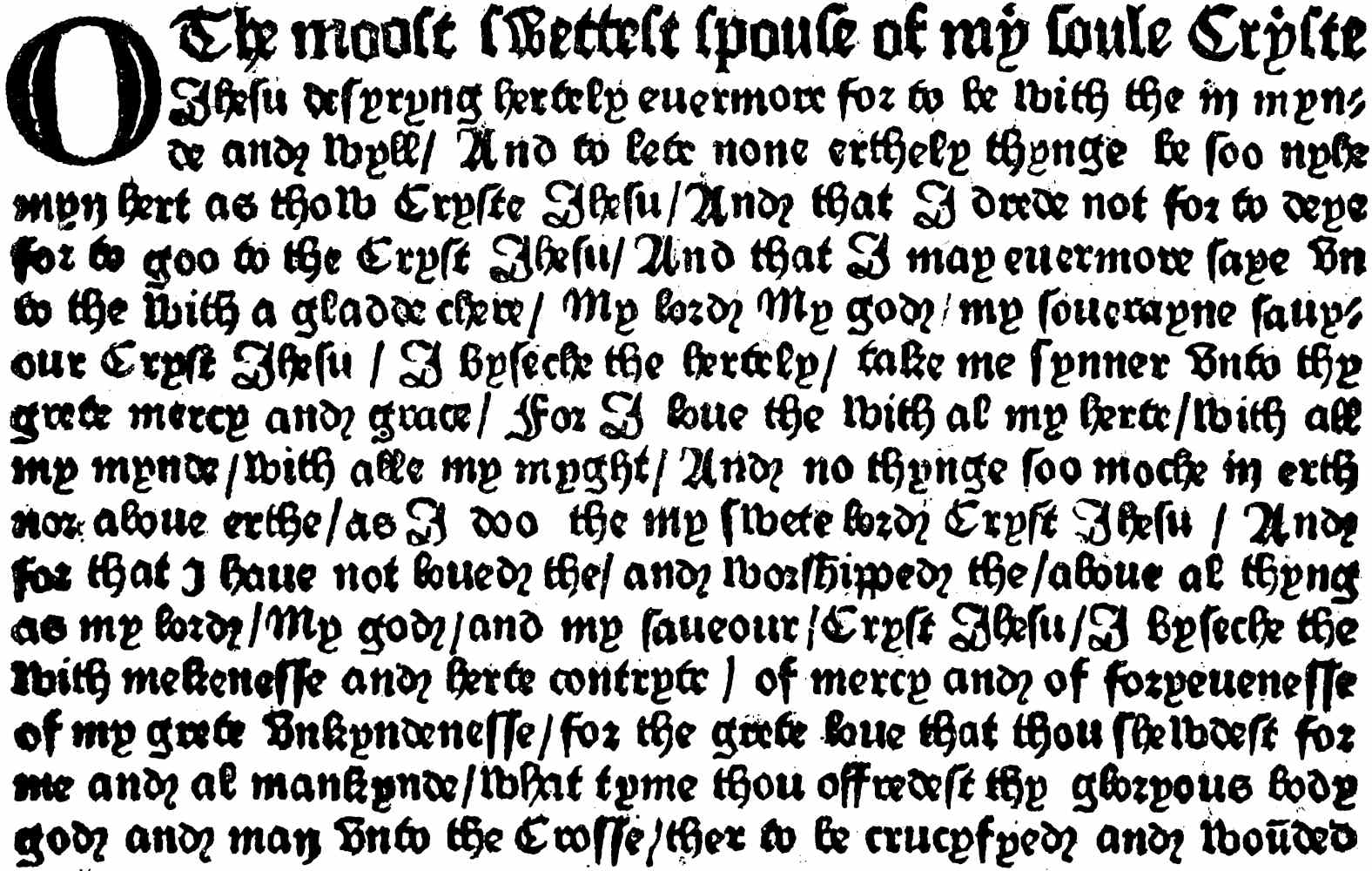
No. 57.—Death-bed Prayers. A Folio Broadside. (1484?)
Typographical Particulars.—Types No. 3 and 4* are used. The lines are spaced to an even length. It is half a sheet of paper printed on one side only.
From the language of these prayers it is evident that they were intended for use by the death-bed. They were probably printed in this portable form for priests, and others, to carry about with them.
Although short their interest is great, and the reader may not be displeased to read them in the following more modern spelling than that of the original.
O glorious Jesu! O meekest Jesu! O most sweetest Jesu! I pray thee that I may have true confession, contrition, and satisfaction ere I die; and that I may see and receive thy holy body, God and man, Saviour of all mankind, Christ Jesu without sin. And that thou wilt my Lord God forgive me all my sins, for thy glorious wounds and passion. And that I may end my life in the true faith of all holy church, and in perfect love and charity with my even[19] Christians as thy creature. And I commend my soul into thy holy hands through the glorious help of thy blessed mother of mercy, our lady Saint Mary, and all the holy company of heaven. Amen. ¶ The holy body of Christ Jesu be my salvation of body and soul. Amen. The glorious blood of Christ Jesu bring my soul and body into the everlasting bliss. Amen. I cry God, mercy! I cry God, mercy! I cry God, mercy! Welcome my Maker! Welcome my Redeemer! Welcome my Saviour! I cry thee mercy with heart contrite of my great unkindness that I have had unto thee.
O thou most sweet spouse of my soul, Christ Jesu, desiring heartily evermore for to be with thee in mind and will, and to let none earthly thing be so nigh my heart as thou, Christ Jesu; and that I dread not for to die for to go to thee, Christ Jesu; and that I may evermore say unto thee with a glad cheer, my Lord, my God, my sovereign Saviour Christ Jesu, I beseech thee heartily take me, sinner, unto thy great mercy and grace, for I love thee with all my heart, with all my mind, with all my might, and nothing so much in earth nor above earth as I do thee, my sweet Lord, Christ Jesu. And for that I have not loved thee, and worshipped thee above all things as my Lord, my God, and my Saviour, Christ Jesu, I beseech thee with meekness and heart contrite, of mercy and of forgiveness of my great unkindness, for the great love that thou showedst for me and all mankind, what time thou offerdst thy glorious body, God and man, unto the Cross; there to be crucified and wounded, and unto thy glorious heart a sharp spear, there running out plenteously blood and water for the redemption and salvation of me and all mankind. And thus having remembrance steadfastly in my heart of thee, my Saviour Christ Jesu, I doubt not but thou wilt be full nigh me, and comfort me both bodily and ghostly with thy glorious presence, and at the last bring me unto thy everlasting bliss, the which shall never have end. Amen.
The only Existing Copy known is in the library of Earl Spencer, where it is bound up in a copy of Caxton’s “Pilgrimage of the Soul.” It is in perfect condition, and measures 11 × 8 inches.
No. 58.—The Fables of Æsop; of Avian; of Alfonse; and of Poge, the Florentine. Folio. “Emprynted by me William Caxton at Westmynstre . . the xxvj daye of Marche the yere of oure lord M CCCC lxxxiiij.”
Collation.—a b c d e f g h i k l m n o p q r s are 4ns, the last two leaves of s being blank. In all 144 leaves, of which two are blank.
Note.—The first leaf of a is not signed, being printed only on the verso.
Typographical Particulars.—There is no title-page, unless we call the great cut of Æsop by that name. The type is of two sorts, No. 3, used in three places at the beginning of the work for headings, and No. 4*, in which is the whole text and the head-lines. The lines, which measure 4⅝ inches, are fully spaced out, and in those few pages where there is no woodcut there are 37 or 38 lines. There are head-lines and folios throughout, except in sig. n, which has folios only. Woodcut initials are used throughout, and on the verso of sig. a ij is a large floriated A, afterwards used in the “Order of Chivalry.”
The first recto of sig. a is blank. Upon the verso is a large woodcut (4⅝ × 6¾ inches), of Æsop, surrounded by the subjects of his fables, with the word ESOPVS at the top. On the second recto, which is signed a ij, the book commences with the following title, in large type, No. 3—
ℂ Folio ija
ℂ Here begynneth the book of the subtyl hystoryes and Fables of Esope whiche were translated out of Frensshe in to Englysshe by wylliam Caxton at westmynstre Jn the yere of oure Lorde . M . . CCCC . lxxxiij .
F
Jrst begynneth the lyf of Esope with alle his fortune how he was subtyll/wyse/and borne in Grece / not ferre fro Troye the graunt in a Towue named Amoneo / whiche was amonge other dyfformed and euylle shapen / For
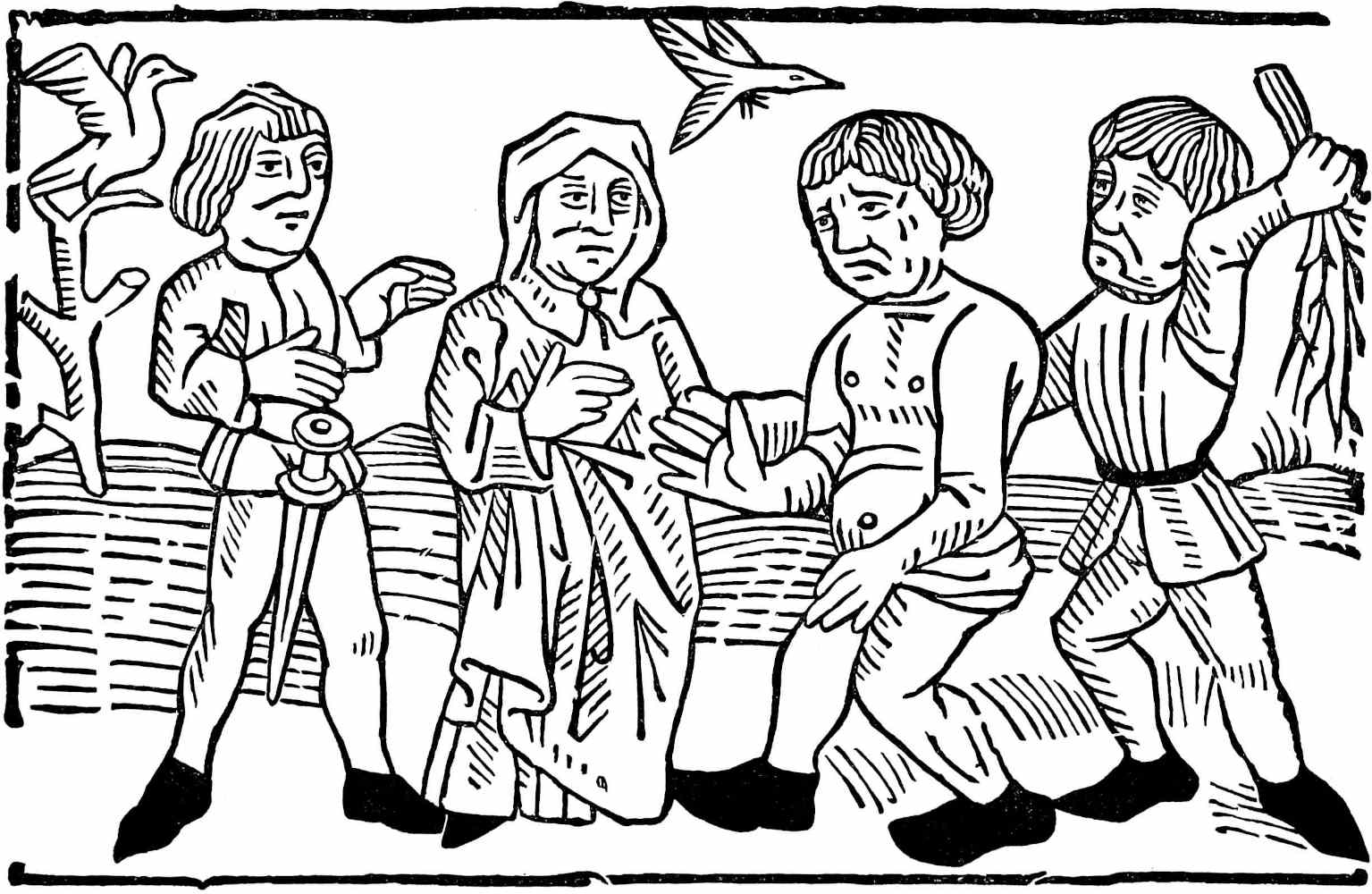
ÆSOP BEATEN BY HIS MASTER.
The whole is finished by an epilogue, written by Caxton himself, which begins on the recto, and concludes on the verso of sig. s 6.
swere of a good preest and an honest / And here with J fy- nysshe this book / translated & emprynted by me William Cax-‖ton at westmynstre in thabbay / And fynysshed the xxvj daye ‖ of Marche the yere of oure lord M CCCC lxxxiiij / And the ‖ fyrst yere of the regne of kyng Rychard the thyrdde
The woodcuts by their treatment evidently came from the hands of the artist who had previously illustrated the “Game of Chess.” It is perhaps impossible to decide whether they are of Flemish or English origin. The woodcut on p. 288 represents Æsop beaten by his master.
Caxton himself tells us at the beginning of the book that it was a translation of his own from the French. It is rather remarkable that although the fables of Æsop, in French, were found in all the great libraries of the fourteenth and fifteenth centuries, and as many as three or four different copies in some, yet none apparently have descended to our time. No trace of an English translation previous to that of Caxton has been discovered, and he must therefore have the credit of introducing these fables to his countrymen in the English tongue. They were reprinted in London, with scarcely any alteration, for nearly two centuries. Whether translated from a manuscript, or an early French printed edition, it is now impossible to say.
This is a very rare book: the only perfect copy known was devised by Mr. Hewett, of Ipswich, to King George III, and is now in the Royal Library, Windsor. Imperfect copies are in the British Museum and at Oxford.
No. 59.—The Order of Chivalry. Quarto. Without Printer’s Name, Place, or Date. Translated by Caxton and presented to Richard III. (1483-5.)
Collation.—a b c d e f are 4ns, aj being blank; g a 2n, with the last leaf blank; in all 52 leaves, of which two are blank.
Typographical Particulars.—There is no title-page. The type is No. 4*, but two headings at the beginning of the work are in type No. 3. The lines, which measure 3⅛ inches, and of which there are 26 to a full page, are fully spaced out. Without folios or catchwords. Initial letters cut in wood are used.
Commencing with a blank leaf the work opens with a short preface, on sig. a ij, the first four lines being in type No. 3. The Text begins thus:—
ℂ Here begynneth the Table of this present booke Jntytled the Book of the ordre of chyualry or knyghthode
The Text ends:—
vertuouse dede / And J shalle pray almyz- ty god for his long lyf & prosperous wel- fare / & that he may haue victory of al his enemyes / and after this short & transitory lyf to haue euerlastyng lyf in heuen / whe- re as is Joye and blysse world without ende Amen /
The date of printing, which was in the reign of Richard III, must have been between June 26th, 1483, and August 22nd, 1495. The “Order of Chivalry” has no connection with “L’ordene de chevalerie.” Dibdin, in the Typ. Ant., and Moule, in Bib. Herald., both err in this matter.
Two copies are in the British Museum, and two in private libraries: no others are known.
No. 60.—Chaucer’s Canterbury Tales. Folio. Second Edition, with Woodcuts. “By William Caxton.” Without Place or Date. (1484?)
Collation.—a b c d e f g h i k l m n o p q r s t are 4ns, with a j blank; v a 3n, aa bb cc dd ee ff gg hh are 4ns; ii a 3n; A B C D E F G H J K are 4ns; L a 2n. In all 312 leaves, of which one is blank.
Typographical Particulars.—There is no title-page. The type of the Text is No. 4*, the heads being all in No. 2*. The lines in the prose portion are spaced to an even length, and measure 4⅞ inches. 38 lines to a page. Without catchwords or folios, and almost without punctuation. Space left for the insertion of initials.
This second edition, Caxton tells us, was printed six years after the first. Having fixed the year 1477-8 as about the date of the first, that will give about 1484 for this.
Commencing with a blank leaf, the prohemye follows on a ij.
Prohemye
g
Rete thankes lawde and honour / ought to be gy- uen vnto the clerkes / poetes / and historiographs that haue wreton many noble bokes of wysedom of the lyues / passios / & myracles of holy sayntes of hystoryes / of noble and famous Actes / and faittes / And of the cronycles sith the begynnyng of the creacion of the world/vnto thys present tyme/by whyche
The proheme, which is an excellent and indubitable specimen of Caxton’s own composition, and reflects as much credit upon his disposition as upon his literary abilities, finishes on the verso of sig. a ij—
after thys short and transitorye lyf we may come to euer- lastyng ‖ lyf in heuen / Amen
By Wylliam Caxton
On sig. a iij recto, with room for a 4-line initial,
w
Han that Apryll wyth hys shouris sote The droughte of marche hath percyd the rote And bathyd euery veyne in suche lycour Of whyche vertue engendryd is the flour Whanne Zepherus eke wyth hys sote breth
The Parson’s Tale finishes on sig. L iij verso, and is followed by the Retraction.
The Text ends with seven lines on sig. L 4 recto,
be one of hem at the day of dome that shal be sauyd / Qui cum ‖ patre et spiritu sancto viuit et regnat deus / Per omnia secula ‖ seculorum AMEN /
The verso is blank.
Remarks.—The wood-cut illustrations appear to be by the same artist that was engaged upon Æsop. The wife of Bath is represented on page 293.
Two copies are in the British Museum, and one in each of the following libraries—Magdalen and Pepysian, Cambridge; St. John’s, Oxford; Royal Society, London; Earl of Ashburnham, and Earl Spencer. In the year 1858 I discovered a copy in the Library of the French Protestant Church, in a torn and dirty state, having been used for some time to light the vestry fire. I drew attention to its great value and interest, and it was doubtless saved from further mutilation. Some time afterwards it disappeared from the library altogether, and no one now knows what has become of it. For identification the following particulars are here given:—it wants all before sig. h 5; p 7; t 8 and v ij; bb ij; and dd 8; A j; B iij and 4; and all after E 8. In the original binding. Torn, dirty, and ill used. Measurement, 10⅝ × 7¾. Autograph “·· Rawlinson A° 1717.” Also, “Ex dono · · · Bateman Bibliopola.”
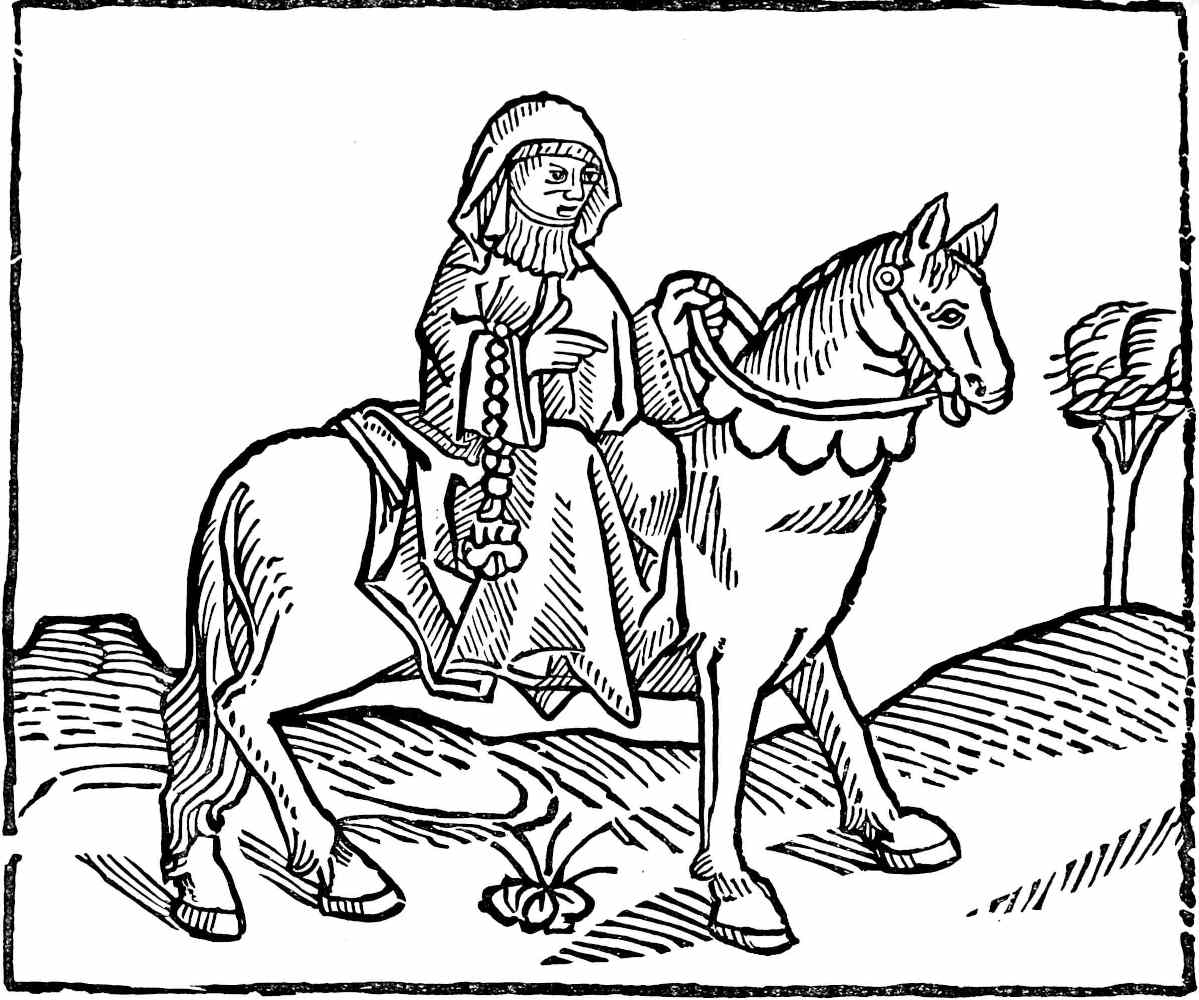
“THE WIFE OF BATH.” FROM THE SECOND EDITION OF CHAUCER’S “CANTERBURY TALES.”
No. 61.—The Book of Fame. Folio. “Emprynted by wylliam Caxton.” Without Place or Date. (1484?)
Collation.—a b c are 4ns. a j being blank; d a 3n, d 6 being blank = 30 leaves, of which two are blank.
Typographical Particulars.—There is no title-page. The type is entirely No. 4*. In the epilogue, which is the only prose part, the lines are fully spaced out, and measure 4⅞ inches. 38 lines to a page. Without folios or catchwords. Space left for the insertion of 2 or 3-line initials, with directors.
Commencing with a blank leaf, the Text follows on sig. a ij recto,
The book of Fame made by Gefferey Chaucer
g
Od torne vs euery dreme to good For it is wonder thyng by the rood To my wyt / what causyth sweuenys On the morowe / or on euenys
The poem ends on sig. d 5 recto,
Thus in dremyng and in game Endeth thys lytyl book of Fame
Explicit
The epilogue immediately follows, the Text ending,
J humbly beseche & praye yow / emonge your prayers / to remem-‖bre hys soule / on whyche / and on alle crysten soulis / J beseche al-‖myghty god to haue mercy Amen
Emprynted by wylliam Caxton
The epilogue has considerable interest, as showing Caxton’s opinion of Chaucer, and is here given verbatim.
“J fynde nomore of this werke to fore sayd / For as fer as I can vnnderstōde / This noble man Gefferey Chaucer fynysshyd at the sayd conclusion of the metyng of lesyng and sothsawe / where as yet they ben chekked and maye not departe / whyche werke as me semeth is craftyly made / and dygne to be wreton & knowen / For he towchyth in it ryght grete wysdom & subtyll vnderstondyng / And so in alle hys werkys he excellyth in myn oppynyon alle other wryters in our Englyssh / For he wrytteth no voyde wordes / but alle hys mater is ful of hye and quycke sentence / to whom ought to be gyuen laude and preysyng for hys noble makyng and wrytyng / For of hym alle other haue borowed syth and taken / in alle theyr wel sayeing and wrytyng / And I humbly beseche & praye yow / emonge your prayers to remembre hys soule / on whyche and on alle crysten soulis I beseche almyghty god to haue mercy Amen”
Remarks.—As will be seen by the list of Existing Copies, the printed text of Caxton is extremely rare; so is the reprint by Pynson in 1526. Manuscripts of this poem were, probably, even in our printer’s time, difficult to obtain. The copy used by him was certainly very imperfect. Many lines are altogether omitted, and in the last page Caxton was evidently in a great strait, for his copy was deficient 66 lines, probably occupying one leaf in the original. We know from his own writings the great reverence in which our printer held the “noble poete,” and we can imagine his consternation when the choice had to be made, either to follow his copy and print nonsense, from the break of idea caused by the deficient verses, or to step into Chaucer’s shoes and supply the missing links from his own brain. He chose the latter course, and thus instead of the original 66 lines, we have two of the printer’s own, which enable the reader to reach the end of the poem without a break-down. These lines are in the following quotation printed in italics; the entire extract being the first six lines of the last page:—
They were a chekked bothe two And neyther of hym myght out goo And wyth the noyse of themwo Caxton J Sodeynly awoke anon tho And remembryd what I had seen And how hye and ferre I had been
It should be noticed that Caxton has here printed his name in the margin to make known his responsibility to his readers. The “out” not having been hitherto noticed, the position of his name there has been a puzzle to all bibliographers, until explained by Mr. Bradshaw.
Copies are in the British Museum; Cambridge; Imperial Library, Vienna, and Althorpe.
No. 62.—The Curial. Folio. “Translated thus in Englysshe by wylliam Caxton.” Without Printer’s Name, Place, or Date. (1484?)
Collation.—A 3n, signed j, ij, and iij, without any blanks. In all six leaves.
Typographical Particulars.—There is no title-page. The type is entirely No. 4*. The lines, which are spaced to an even length, measure 4⅞ inches, and there are 38 to a full page. Without catchwords or folios.
The Text begins on sig. j recto,
Here foboweth the copye of a lettre whyche maistre Alayn ‖ Charetier wrote to hys brother / whyche desired to come dwelle in ‖ Court / in whyche he reherseth many my- seryes & wretchydnesses ‖
The “Curial” finishes on the sixth recto,
to god J comande the by thys wrytyng whyche gyue the hys gra ‖ ce / Amen
Thus endeth the Curial made by maystre Alain Charretier ‖ Translated thus in Englyssh by wylliam Caxton
On the verso Caxton has given us the translation of a ballad, written by Alain Chartier, consisting of 28 lines. It has a burthen:—“Ne chyer but of a man Joyous,” and commences thus:—
Ther ne is dangyer / but of a vylayn Ne pryde / but of a poure man enryched
The Text ends on same page, with Caxton’s name at foot,
Ther is no speche / but it be curtoys Ne preysyng of men / but after theyr lyf
Ne chyer but of a man Joyous
Caxton
Remarks.—Caxton translated the Curial from the French, “for a noble and virtuous Erle,” probably Lord Rivers, who was beheaded at Pomfret, on June 13th, 1483.
Alain Chartier, born in Normandy about 1386, earned for himself the appellation of “excellent orateur, noble poëte, et très-renommé rhétoricien.” He held the office of “Secretaire de la Maison” to both Charles VI and Charles VII. He died about 1457. The most complete editions of his works are those by Galiot du Pré, 16mo, Paris, 1529; and by Duchesne, 4to, Paris, 1617. In the former, however, is an error which has led to some confusion, as “Livre de l’Esperance” is there entitled “Le Curial,” the real Curial being a much shorter piece, and totally different in design. By the “Curial” being addressed to his brother it is supposed to have been written by Alain to Jean Chartier, known as the author of “Histoire de Charles VII.” As an instance of the great repute, in which the writings of Chartier were held in his age, it is reported that Margaret, the wife of the Dauphin of France, afterwards Louis XI, finding him one day asleep in his chair, kissed his lips to the great astonishment of her attendants. “Je ne baise pas la personne mais la bouche dont estoíent sortes tant de beux discours,” she exclaimed. There is a painting in Add. MS. No. 15300, vividly depicting this scene.