THE THIRD DAY
Reading edition
The first engagement on the third day was a continuation and conclusion of the attack and defense of Meade’s right. His forces, returning from the left, where they had been sent on the afternoon of the 2nd, found part of their earthworks in possession of the enemy. At daybreak preparations were made to recapture the lost entrenchments. By 10.30 the effort was successful, and Meade’s line was once more intact from end to end.
Second Battle at Culp’s Hill.
This action on the morning of the 3rd was one of the most hotly contested of the battle. The Confederate losses in killed were almost the same as those of Pickett’s Division in the attack on Meade’s left center in the afternoon. Meade’s losses were comparatively light, as his line was well protected by the line of earthworks. So intense was the artillery and musketry fire that hundreds of trees were shattered. After the repulse, Johnson’s forces were withdrawn, and this ended their participation in the battle.
Meade’s Line of the Third Day.
After the engagement on the morning of the 2nd, the 12th Corps reoccupied its original line, beginning on the right at Spangler’s Hill and extending to and over Culp’s Hill. Wadsworth’s Division of the 1st Corps retained its position of the 2nd, between Culp’s Hill and Barlow’s Division under Ames of the 11th Corps, at the foot of East Cemetery Hill. Barlow’s Division was strengthened by a brigade of the 2nd Corps. Doubleday’s Division of the 1st Corps, which had taken the position of Caldwell’s Division on the left of the 2nd Corps, remained. Caldwell was posted so as to support the artillery reserve to the left of Doubleday.
The other divisions of the 1st and 2nd Corps remained in the positions they occupied on the morning of the 2nd. The 5th Corps extended the line from the left of the artillery reserve to Big Round Top. Some of the brigades of the 6th Corps were put in position as local reserves and others to protect the flanks of the line. The 3rd Corps was posted in rear of the center as a general 38 reserve. A detachment of cavalry was in reserve in rear of the 2nd Corps at the Angle. Few changes were made in the artillery positions. Beginning at Cemetery Hill and extending to Little Round Top, about ninety guns, under General Hunt, were in position to operate.
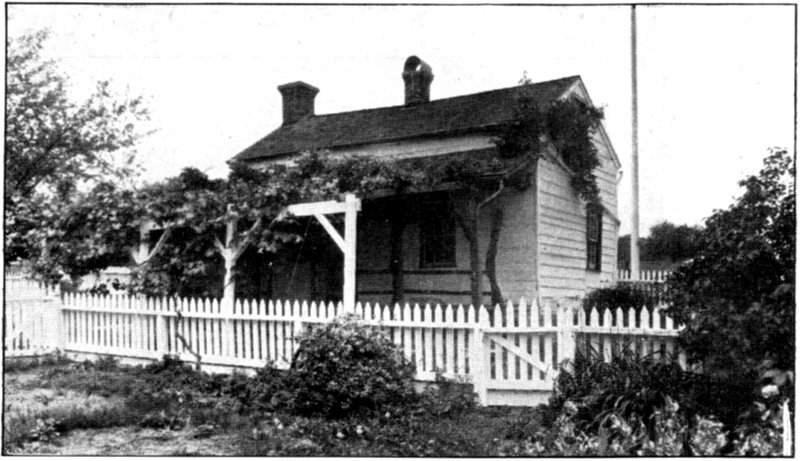
Meade’s Headquarters.—The Leister House, General Meade’s headquarters until the artillery fire on the third day compelled him to move
Lee’s Line of the Third Day.
Beginning on the right, Longstreet’s Corps held the ground west of Plum Run, including the base of Big Round Top, Devil’s Den, and the Peach Orchard. Pickett’s Division, after its arrival on the field on the morning of the 3rd, took the place of Anderson in reserve. Heth’s and Pender’s Divisions extended the line to the left on Seminary Ridge, connecting with part of Rodes’ Division in the western part of the town. Early’s and Johnson’s Divisions, after the engagement on the morning of the 3rd, held their positions of the 2nd. Changes in the positions of the batteries of artillery were made on the morning of the 3rd. A total of 138 guns were in position to operate. Those on the right were in charge of Colonel E. P. Alexander; those on the left under Colonel R. L. Walker.
The Bliss Buildings.
After the end of the engagement at Culp’s Hill at 10.30 A.M. 39 there was a short battle for the capture of the Bliss house and barn, midway between the lines in front of Ziegler’s Grove. These buildings were occupied by Confederate sharpshooters, who were causing considerable loss in Hays’ line of the 2nd Corps at the grove. Two regiments were sent forward, the 12th New Jersey and the 14th Connecticut, and the buildings were captured and burned.
The Artillery Duel.
Until 1 o’clock there was comparative quiet. It was ended on the stroke of the hour by two guns of Miller’s battery belonging to the Washington artillery of New Orleans, posted near the Peach Orchard, and fired in rapid succession as a signal to the Confederate artillery.
The Confederate Colonel Alexander says:
“At exactly 1 o’clock by my watch the two signal guns were heard in quick succession. In another minute every gun was at work. The enemy was not slow in coming back at us, and the grand roar of nearly the whole of both armies burst in on the silence.
“The enemy’s position seemed to have broken out with guns everywhere, and from Round Top to Cemetery Hill was blazing like a volcano.”
The artillery duel was but a preface, intended to clear the ground for the infantry action to follow. The order had already been given by Longstreet to Alexander:
“Colonel: The intention is to advance the infantry if the artillery has the desired effect of driving the enemy off, or having other effect such as to warrant us in making the attack. When the moment arrives advise General Pickett, and of course advance such artillery as you can use in making the attack.”
General Wright, who was present when this order was received, expressed doubt as to whether the attack could be successfully made. He said:
“It is not so hard to go there as it looks; I was nearly there with my brigade yesterday. The trouble is to stay there. The whole Yankee army is there in a bunch.”
For one and a half hours the air was filled with screaming, whistling shot and shell. An occasional Whitworth missile, from Oak Hill on the north, made, on account of its peculiar form, a noise that could be heard above the din of all others. The headquarters of General Meade at the Leister House formed a concentric point continually swept with a storm of shot and shell. Headquarters were therefore moved to Slocum’s headquarters at Powers’ Hill, along the Baltimore Pike.
40
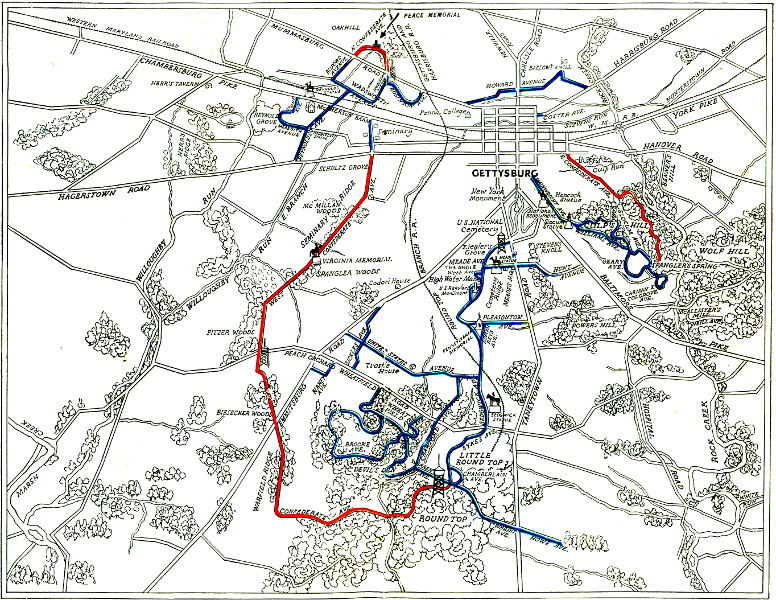
Locations, Buildings and Avenues as referred to in “The Battle of Gettysburg” High-resolution Map
42
Batteries on the Union line, especially at the Angle, were badly damaged, and General Hunt had others brought forward with additional supplies of ammunition. On the whole the losses inflicted upon the Union infantry were comparatively light. The stone wall and the undulations of the ground afforded protection, as most of the men were lying down.
After the artillery had operated for about an hour and a half, Meade and Hunt deemed it prudent to stop the fire, in order to cool the guns, save ammunition, and allow the atmosphere between the lines to clear of the dense cloud of smoke before the expected attack was made. This pause in the fire led the Confederates to believe that the Union line was demoralized, and that the opportune time had arrived for the onset of the infantry. Accordingly, they moved forward and Pickett’s Charge was on.
At the signal station on Little Round Top, General Warren and others saw gray infantry moving out across the plain in front of the Spangler Woods. Warren at once wig-wagged to General Hunt:
“They are moving out to attack.”
This message was passed from man to man along the entire Union line.
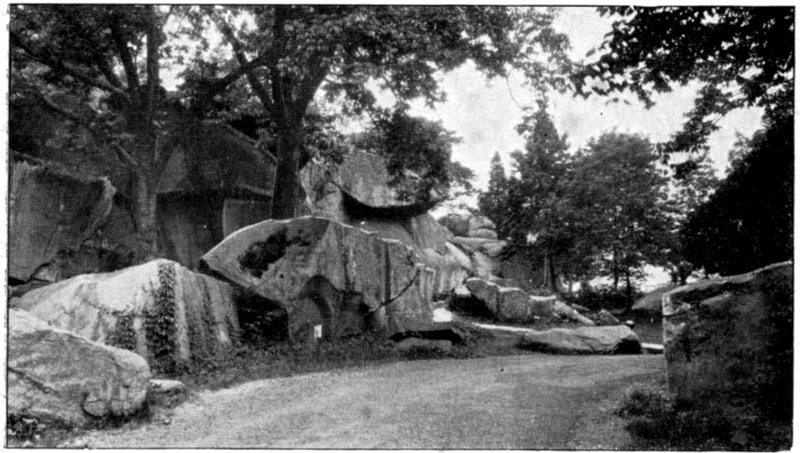
Devil’s Den.—Hid among the rocks of Devil’s Den, Confederate sharpshooters picked off officers and men occupying Little Round Top
43
Pickett’s Charge.
Pickett’s Division of Longstreet’s Corps was moved from the rear to the ravine in front of the Spangler Woods and placed in line as follows: Kemper on the right; Garnett on the left in the front line; Armistead in the rear, overlapping Kemper’s left and Garnett’s right, in the second line. On the left of Garnett was ranged Archer’s Brigade of Hill’s Corps under Frye, then Pettigrew’s Brigade under Marshall. Next to Marshall came Davis’ Brigade of Hill’s Corps, and on the extreme left Brockenbrough’s Brigade, also of Hill’s Corps. In the rear of the right of Pickett were the brigades of Wilcox and Perry of Hill’s Corps and in the rear of Pettigrew were the brigades of Scales and Lane of Hill’s Corps, in command of Trimble.
The column of assault consisted of 42 regiments—19 Virginia, 15 North Carolina, 2 Alabama, 3 Tennessee, and 3 Mississippi—a total of about 15,000 men.
In addition to the artillery fire, they encountered 27 regiments—9 of New York, 5 of Pennsylvania, 3 of Massachusetts, 3 of Vermont, 1 of Michigan, 1 of Maine, 1 of Minnesota, 1 of New Jersey, 1 of Connecticut, 1 of Ohio, and 1 of Delaware—a total of 9,000 to 10,000 men.
In advance of the assaulting column a strong skirmish line was deployed. A skirmish line was also deployed in front of Meade’s line, which fell back as the assaulting column drew near.
The Advance.
General Longstreet ordered General Alexander, Chief of Artillery, to watch the havoc wrought in the Union line and signify the moment for advance.
General Alexander says:
“Before the cannonade opened I made up my mind to give the order to advance within fifteen or twenty minutes after it began. But when I looked at the full development of the enemy’s batteries and knew that his infantry was generally protected from fire by stone walls and swells of the ground, I could not bring myself to give the word.
“I let the 15 minutes pass, and 20, and 25, hoping vainly for something to turn up. Then I wrote to Pickett: ‘If you are coming at all, come at once, 44 or I cannot give you proper support; but the enemy’s fire has not slackened at all; at least eighteen guns are still firing from the cemetery itself.’
“Five minutes after sending that message, the enemy’s fire suddenly began to slacken, and the guns in the cemetery limbered up and vacated the position.
“Then I wrote to Pickett: ‘Come quick; eighteen guns are gone; unless you advance quick, my ammunition won’t let me support you properly.’
“Pickett then rode forward, and on meeting Longstreet said: ‘General, shall I advance?’ Longstreet nodded his assent and the column moved forward.”
The column passed through the line of guns, fifteen or eighteen of which had been ordered to follow. Meanwhile the eighteen Union guns that were withdrawn were replaced by others. The Union line was once more intact, and it opened a terrific fire against the rapidly moving columns of assault. As the Confederates continued to advance, their courage unaffected in face of the tremendous fire of both artillery and infantry, their enemies were filled with admiration.
At the Emmitsburg Road, where post-and-rail fences had to be crossed, the line was broken, but only for a moment. The musketry fire from the Union line was so heavy that the attacking column was unable to maintain a regular alignment, and when the Angle was reached the identity of the different brigades was lost.
Armistead’s Brigade forged to the front at the Angle, and, reaching the wall, Armistead raised his hat on his sword and said:
“Give them the cold steel, boys!”
With a few men he advanced to Cushing’s guns, where he fell, mortally wounded. Cushing also was mortally wounded. Garnett, who was mounted, was killed a short distance from the wall. Kemper was badly wounded. Pickett lost all of his field officers but one. The Union Generals Hancock and Gibbon were wounded at the same time. For a short time the struggle was hand to hand.
To the right of the Angle most of the brigades on Pickett’s left reached the stone wall on Hays’ front at Ziegler’s Grove, but were obliged to retreat after meeting a withering fire both in front and on flank.
The brigades of Wilcox and Perry, in the rear of Pickett’s right, did not move until after the advance lines were part way across. Because of a misunderstanding, a gap was opened between Pickett’s right and Wilcox’s left. At once Stannard’s Vermont Brigade of the 1st Corps attacked both Pickett’s right and Wilcox’s left.
45
General Pickett, who had reached the Codori buildings, saw that the assaulting forces were unable to accomplish the object of the charge, and ordered a retreat. It was accomplished, but with heavy losses.
Both commanding officers witnessed the retreat: General Meade from where his statue stands east of the Angle, and General Lee from the position of his statue north of the Spangler Woods.
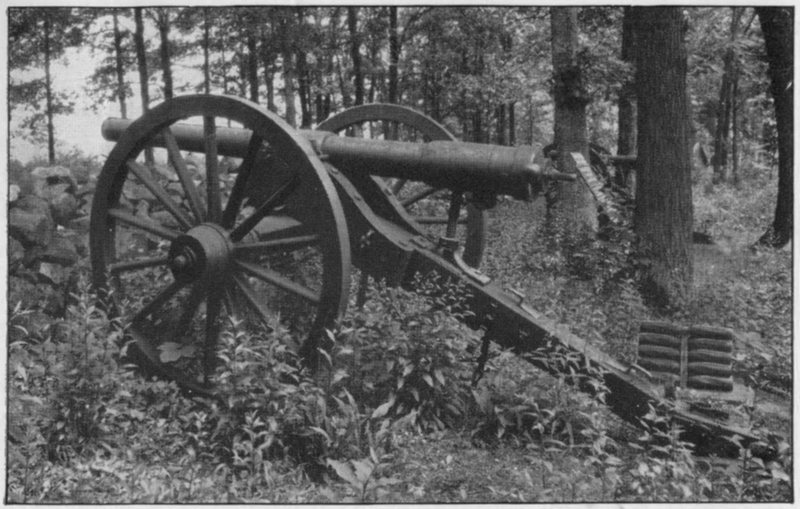
Whitworth Guns.—These two Whitworths, imported from England by the Confederates, were the only breech-loading guns used in the battle
Engagements on the Union Left.
While Pickett’s Charge was under way, the Pennsylvania Reserves, under McCandless, charged from the stone wall on the east side of the Wheatfield and regained possession of Devil’s Den and adjacent territory held by Longstreet’s forces since the engagement of the afternoon of the 2nd. Farther south, between Big Round Top and the line held by Longstreet’s right, a cavalry charge was made by Farnsworth’s Brigade of Kilpatrick’s Division. Farnsworth was killed. Merritt’s Brigade of Buford’s Division, which reached the field on the 3rd, engaged some of Longstreet’s troops along the Emmitsburg Road. The accomplished object of these movements was to prevent Longstreet from giving assistance to the charge of Pickett on Meade’s center.
46
The Cavalry Fight on the Right Flank.
As already noted, General Stuart in his movement in rear of the Army of the Potomac with three brigades of cavalry—Fitzhugh Lee’s, Wade Hampton’s, and Chambliss’—reached Hanover on June 30th, fought a battle in the streets, and moved on to Carlisle on the afternoon of July 1st. There he got in touch with the main Confederate Army, with which he had been out of communication for seven days.
After an encounter with a portion of Kilpatrick’s forces at Hunterstown on the afternoon of July 2nd, he moved up to a position between the Hunterstown and Harrisburg roads on Ewell’s left, expecting to reach Meade’s rear about the time of Pickett’s Charge on Meade’s front. He was joined by Jenkins’ Confederate Brigade of mounted infantry armed with Enfield rifles. Jenkins was wounded at Hunterstown, and the brigade and the command fell to Colonel Ferguson.
General Gregg, in command of the 2nd Cavalry Division of the Union Army, reached the field east of Gettysburg at the intersection of the Hanover and Low Dutch roads at 11 A.M. on July 2nd. In the afternoon he halted a movement of Walker’s brigade of Johnson’s Division, Ewell’s Corps, in their movement from Brinkerhoff Ridge to assist in the attack on Meade’s right at Culp’s Hill. He bivouacked for the night near the bridge across White Run. On the morning of the 3rd he returned to the position of the 2nd, and took an active part in the cavalry fight on the right flank at the time of Pickett’s Charge. In the afternoon, in the important engagement on East Cavalry Field he successfully opposed General Stuart in his efforts to get behind the Union line.
The Location.
East Cavalry Field is 3 miles east of Gettysburg and includes the territory lying between the York Pike on the north and the Hanover Road on the south. On the east it is bounded by the Low Dutch Road which intersects the Baltimore Pike at its southern end, and the York Pike at its northern end. Brinkerhoff Ridge, which crosses the Hanover Road at right angles about 1½ miles east of the town, forms its boundary on the west. Cress Ridge is formed by the elevation between Cress’s Run on the west and Little’s Run on the east. Both ridges right angle across the Hanover Road.
47
All the positions held by troops have been marked and the entire field is readily accessible over well-built roads and avenues. Because of its partial isolation from the principal fields, this important area is not visited as frequently as it should be.
General Stuart’s Plan.
General Stuart did not wish to bring on a general engagement. He expected his skirmishers to keep the Union Cavalry engaged while his other forces were moving undiscovered toward the rear of Meade’s line. He says in his report:
“On the morning of July 3, pursuant to instructions from the commanding general, I moved forward to a position to the left of Gen. Ewell’s left, and in advance of it, where a commanding ridge (Cress Ridge) completely controlled a wide plain of cultivated fields stretching toward Hanover, on the left, and reaching to the base of the mountain spurs, among which the enemy held position. My command was increased by the addition of Jenkins’ Brigade, who here in the presence of the enemy allowed themselves to be supplied with but 10 rounds of ammunition, although armed with approved Enfield muskets.
“I moved this command and W. H. F. Lee’s secretly through the woods to a position, and hoped to effect a surprise upon the enemy’s rear, but Hampton’s and Fitz Lee’s Brigades, which had been ordered to follow me, unfortunately debouched into the open ground, disclosing the movement, and causing a corresponding movement of a large force of the enemy’s cavalry.”
It was the advance of Hampton and Fitzhugh Lee which caused Stuart’s plans to miscarry.
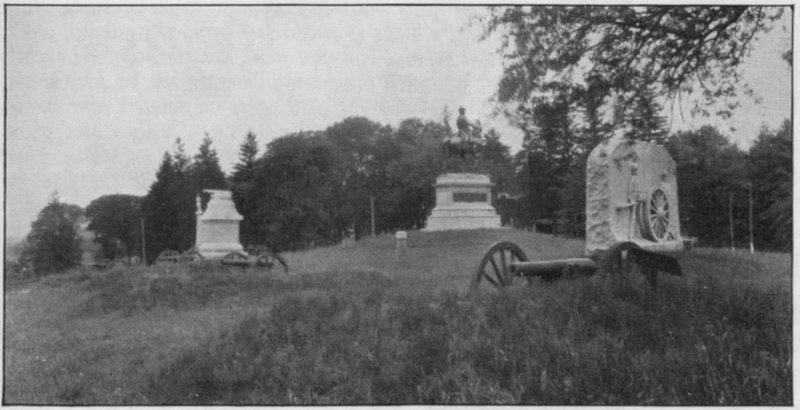
Reaching East Cemetery Hill on the afternoon of the first day, General Hancock took command of the Union troops. On the second day the guns pointed downward to meet the onslaught of the Confederates
48
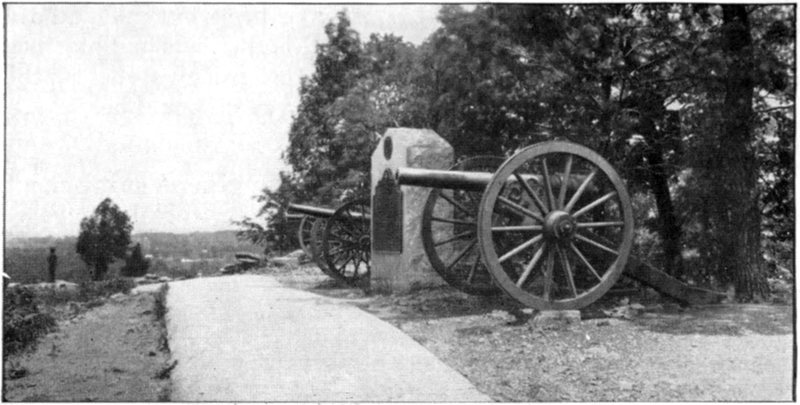
Little Round Top.—Its strategic importance was seen by General Warren who commanded it to be fortified and held
General Gregg’s Report.
On the Union side, General D. McM. Gregg had under his command three brigades of cavalry—one in command of General George A. Custer, who later was responsible for “Custer’s Last Charge” in Indian warfare. General Gregg’s report gives a brief description of the many charges and countercharges:
“A strong line of skirmishers displayed by the enemy was evidence that the enemy’s cavalry had gained our right, and were about to attack, with the view of gaining the rear of our line of battle. The importance of successfully resisting an attack at this point, which, if succeeded in by the enemy, would have been productive of the most serious consequences, determined me to retain the brigade of the Third Division until the enemy were driven back. General Custer, commanding the brigade, fully satisfied of the intended attack, was well pleased to remain with his brigade. The First New Jersey Cavalry was posted as mounted skirmishers to the right and front in a wood. The Third Pennsylvania Cavalry deployed as dismounted skirmishers to the left and front in open fields, and the First Maryland on the Hanover turnpike, in position to protect the right of my line.
“The very superior force of dismounted skirmishers of the enemy advanced on our left and front required the line to be re-enforced by one of General Custer’s regiments. At this time the skirmishing became very brisk on both sides, and the artillery fire was begun by the enemy and ourselves. During the skirmish of the dismounted men, the enemy brought upon the field a column for a charge. The charge of this column was met by the Seventh Michigan Cavalry, of the First (Second) Brigade, Third Division, but not successfully. The advantage gained in this charge was soon wrested from the enemy by the gallant charge of the First Michigan, of the same brigade. This regiment drove the enemy back 49 to his starting point, the enemy withdrew to his left, and on passing the wood in which the First New Jersey Cavalry was posted, that regiment gallantly and successfully charged the flank of his column. Heavy skirmishing was still maintained by the Third Pennsylvania Cavalry with the enemy, and was continued until nightfall. During the engagement, a portion of this regiment made a very handsome and successful charge upon one of the enemy’s regiments. The enemy retired his column behind his artillery, and at dark withdrew from his former position. The fire of the artillery during this engagement was the most accurate that I have ever seen.”
Stuart’s forces numbered about 7,000, and Gregg and Custer’s about 5,000.
Lee’s Retreat.
On the night of the 3rd, Lee withdrew all his forces to Seminary and Snyder ridges. Orders were issued and instructions given for the retreat to the Potomac River at Williamsport and Falling Waters. The effectives moved to Fairfield over the Hagerstown or Fairfield Road. The wagon-train, 17 miles long, with the wounded, was moved by way of the Cashtown Road (Chambersburg Pike), under the command of Brigadier-General John D. Imboden, who has described his interview with General Lee at his headquarters, which were still located in an orchard in the rear of the Seminary buildings, as follows:
“He invited me into his tent, and as soon as we were seated he remarked: ‘We must now return to Virginia. As many of our poor wounded as possible must be taken home. I have sent for you because your men and horses are fresh and in good condition, to guard and conduct our train back to Virginia. The duty will be arduous, responsible, and dangerous, for I am afraid you will be harassed by the enemy’s cavalry. I can spare you as much artillery as you may require but no other troops, as I shall need all I have to return safely by a different and shorter route than yours. The batteries are generally short of ammunition, but you will probably meet a supply I have ordered from Winchester to Williamsport.”
On account of a terrific rainstorm shortly after noon on the 4th there was considerable delay in getting the Confederate train started. Well guarded in front and rear, the head of the column near Cashtown was put in motion and began the ascent of the mountain. The wounded suffered indescribable hardships. Many had been without food for thirty-six hours, and had received no medical attention since the battle. Among the wounded officers 50 were General Pender and General Scales. The trip cost Pender his life. General Imboden said:
“During this retreat I witnessed the most heartrending scenes of the War.”
As a military movement the retreat was a success. Though harassed by pursuing forces, the train reached the Potomac with comparatively little loss.
The main Confederate Army crossed the mountain, principally at the Fairfield gap. On account of the heavy rain, Ewell’s Corps, which brought up the rear did not leave Gettysburg until the forenoon of the 5th. Somewhat delayed, but not seriously impeded, Lee arrived at the Potomac on July 12, finding it too high to cross. There he entrenched his army. The next day, the waters having fallen, he got safely away.
No Pursuit by Meade.
Because of Lee’s strong position, Meade made no countercharge. He had won a notable victory, and believed it unwise to risk undoing his work. His army had suffered heavily. Both armies moved south. The Confederate cause had received a severe blow. The defeat at Gettysburg and the surrender of Vicksburg on July 4th to Grant ended all hope of foreign recognition. Yet, for almost two years the desperate struggle was to continue!
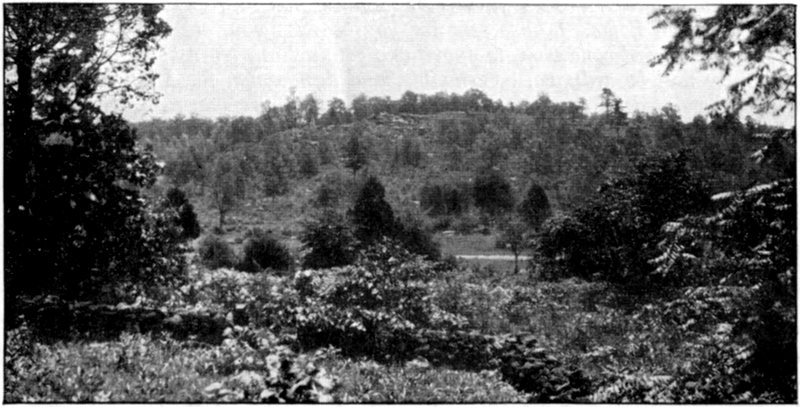
The boulder-strewn face of Little Round Top, assaulted by brave Confederates and held by brave Unionists
51
The Gettysburg Carnage.
The War records estimate the Union casualties, killed, wounded, and missing, at 23,000 of the 84,000 engaged. The Confederate casualties are estimated at over 20,000 of the 75,000 engaged. Approximately 10,000 bodies were left at Gettysburg for burial, and 21,000 living men to be healed of their wounds.
No words can picture the desolation of the little town. As the soldiers marched away, their places were taken by physicians and surgeons, nurses and orderlies, civilian as well as military, and the ministrations of mercy began. In these the citizens of Gettysburg, especially the women, took an important part. Hither came also a new army of parents and wives and brothers and sisters, seeking, sometimes with success, sometimes with grievous disappointment, for their beloved.