THE BATTLE OF GETTYSBURG
Reading edition
It is difficult to present a great battle with sufficient detail to please both the student of tactics and the average reader. If the visitor is not satisfied with the brief outline here presented, he is recommended to read further in the books listed, and especially to employ a guide, without whose trained and supervised services the best manual is inadequate. The reader in search of romance is recommended to the successive Incidents of the Battle as herein presented.
According to official records, the Gettysburg campaign of 1863 began on June 3rd and ended on August 1st. No effort will be made to describe the movements, counter-movements, and fifty minor engagements that occurred before the armies crossed the Mason and Dixon’s line and finally concentrated at Gettysburg, where they engaged in battle on July 1st, 2nd, and 3rd. It is necessary, however, that the visitor should understand the approach to the field.
Location of the Armies.
On June 3rd the Union Army, called the Army of the Potomac, lay at Falmouth, Va., on the north side of the Rappahannock River, Major-General Joseph Hooker in command.
The Confederate Army, called the Army of Northern Virginia, occupied the south bank, with headquarters at Fredericksburg, General Robert E. Lee in command.
Both armies were resting after the major engagement at Chancellorsville, in which the Confederates were victorious.
The Army of the Potomac was made up of seven infantry and one cavalry corps. It numbered at the time of the battle approximately 84,000.
The Army of Northern Virginia was made up of three infantry corps and one division of cavalry. It numbered at the time of the battle about 75,000.
6
Following the text is a roster of officers, which should be consulted, both for an understanding of the battle and because of the obligation to honor brave men.
General Lee’s Plan.
During the month of May, General Lee visited Richmond to discuss with the Confederate government various plans involving political and military considerations. Up to this time, the South had won the major victories, but her resources, both in men and sinews of war, were diminishing, and a prolonged conflict would be disastrous. It was decided that the army should invade the North via the Shenandoah and Cumberland valleys, with Harrisburg as an objective. This route not only afforded a continuous highway but put the army in a position to threaten Baltimore, Philadelphia, and Washington from the north. The Blue Ridge Mountains to the east would screen the advance, and the rich agricultural section would furnish supplies of food and forage.
The time was propitious. General Lee’s army was in the prime of condition. The North was discouraged by losses, distrustful of Lincoln, weary of war. The South believed that one great victory would assure her the friendliness of the leading powers of Europe. Her independence once acknowledged, she could import the materials of war and the necessities of life which she lacked. It was thought certain that at the prospect of invasion the North would withdraw troops from the siege of Vicksburg then being conducted by General Grant. With high hopes the march was begun.
Lee’s First Movement.
On June 3rd Lee put his army in motion northward, with Ewell’s Corps, preceded by Jenkins’ and Imboden’s Cavalry, in the advance, followed by Longstreet and lastly by Hill. Longstreet moved on the east side of the Blue Ridge in order to lead Hooker to believe that Washington would be threatened. On reaching Snicker’s Gap, he crossed the Ridge into the Shenandoah Valley and followed Hill, who was now in advance. The great army was strung out from Fredericksburg, Va., on the south to Martinsburg, W. Va., on the north, with the cavalry division under Stuart guarding the gaps along the Blue Ridge.
7
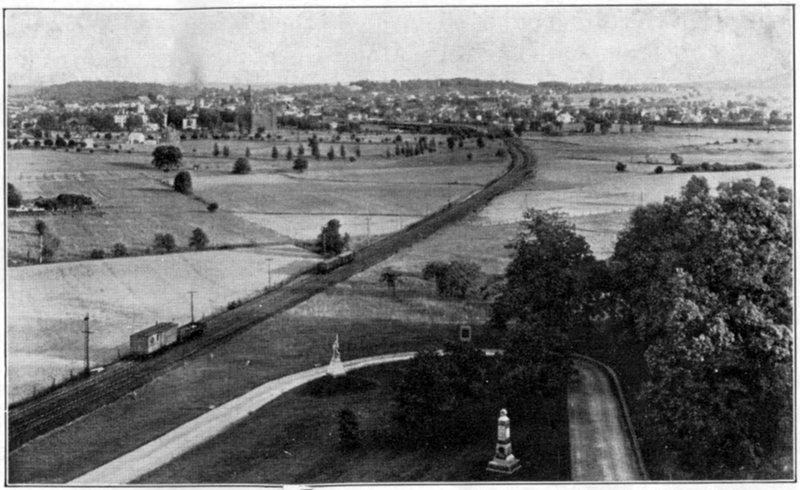
Since 1863 the population of Gettysburg has increased from 2,000 to 5,500
After driving out Union forces stationed at Winchester under Milroy, Lee’s Army crossed the Potomac at Williamsport and Shepherdstown on June 23rd, 24th, and 25th, and advanced northward, unopposed, through the Cumberland Valley, toward Harrisburg.
Hooker’s Plan.
On June 10th, Hooker proposed to President Lincoln that he cross the Rappahannock and attack Hill, who still remained, and then move south, threatening Richmond. He thought this might divert Lee from his invasion of the North. In reply Lincoln said:
“I think Lee’s Army and not Richmond is your sure objective point.”
The Appointment of Meade.
Thereupon Hooker started in pursuit of Lee on June 13th, moving east of the Blue Ridge on a line parallel with Lee on the west, with the cavalry guarding his left. He thus protected Baltimore and Washington. He crossed the Potomac at Edward’s Ferry on the 25th and 26th and reached Frederick on the 27th, where he halted. Believing himself handicapped by orders from General Halleck, Chief in Command at Washington, who refused the use of the Union forces at Harper’s Ferry, he asked to be 8 relieved of the command of the Army of the Potomac. The request was granted, and, on June 28th, Major-General George G. Meade, in command of the 5th Corps, was appointed his successor, Sykes taking command of General Meade’s Corps.
Advance of Lee.
Lee’s Army had been steadily moving northward in the Cumberland Valley. Ewell, in the advance, detached Early’s Division on reaching Chambersburg, directing him to move through Gettysburg on June 26th and thence to York and Wrightsville, there to cross the Susquehanna to Columbia and move up to Harrisburg to meet the divisions of Rodes and Johnson. Rodes reached Carlisle on June 28th, accompanied by Ewell; Johnson was at Greenvillage, between Chambersburg and Carlisle. Hill moved from Chambersburg to Cashtown, and Longstreet was in the rear at Chambersburg. Lee’s headquarters were in Messersmith’s Woods near Chambersburg.
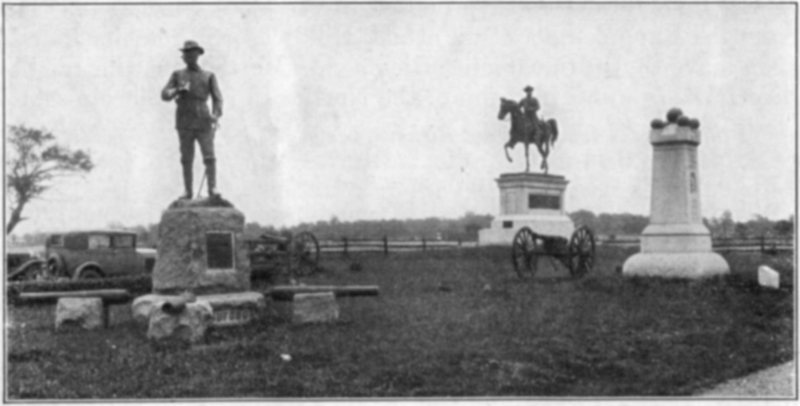
General Reynolds’ position shortly before his death.—Near General Buford’s statue, pointing toward the spectator, is the first gun fired by the Union forces
In his advance into Gettysburg, Early was opposed by the 26th Emergency Regiment of Pennsylvania Volunteers, Company A, consisting of students of Pennsylvania (now Gettysburg) College, citizens of the town, and some volunteers from Harrisburg. After skirmishing on the Chambersburg Pike about 3 miles from the town, this regiment was obliged to retreat, finally reaching Harrisburg. About 175 were captured, but were afterward paroled. 9 On the same day, George Sandoe, a Union scout, was shot by one of Early’s pickets on the Baltimore Pike. He was the first Union soldier killed in the vicinity of Gettysburg prior to the battle.
On account of the absence of his cavalry under Stuart, who had been left with five brigades to guard the rear and hold the gaps of the Blue Ridge, Lee did not know until June 28th that the Union Army had crossed the Potomac and was threatening his line of communication with the South. Learning this, he ordered a concentration of his forces at Cashtown.
Meade’s Movement.
On assuming command, General Meade moved his army northward from the vicinity of Frederick and established a tentative line along Pipe Creek, between Manchester on his right and Emmitsburg on his left, with headquarters near Taneytown.
Stuart’s Movement.
After the Union Army crossed the Potomac, Stuart left the line of the Blue Ridge with three brigades of cavalry and made a raid around the Union Army, crossing the Potomac at Seneca Creek and moving thence to Hanover, where he engaged Kilpatrick’s Division of Union cavalry on June 30th. Passing through Jefferson, Dover, and Dillsburg to Carlisle, he reached Carlisle on the afternoon of July 1st, getting into communication with Lee, after an interval of a week.
Situation of Confederate Forces on June 30th.
On June 30th, Pender’s Division, Hill’s Corps, moved from Fayetteville to Cashtown; Anderson’s Division to Fayetteville; Rodes’ Division, Ewell’s Corps, from Carlisle via Petersburg to Heidlersburg. Early’s Division advanced from York through Weiglestown and East Berlin, and encamped 3 miles from Heidlersburg. Johnson’s Division marched from Greenvillage to Scotland. Hood’s and McLaws’ Divisions, Longstreet’s Corps, moved from Chambersburg to Fayetteville; Pickett’s Division remained at Chambersburg. Lee’s headquarters were at Greenwood.
Situation of Union Forces on June 30th.
On June 30th the 11th Corps was at Emmitsburg, the 1st at Marsh Creek, the 3rd at Bridgeport, the 5th at Union Mills, the 10 6th at Manchester, the 12th at Littlestown, the 2nd at Taneytown. Two brigades of Buford’s Cavalry Division were at Gettysburg; Gregg’s Cavalry Division was at Manchester; Kilpatrick’s at Hanover. Meade’s headquarters were at Taneytown.
The Approach.
Neither commander yet foresaw Gettysburg as a field of battle. Each had expected to take a strong position and force his adversary to attack. But in the hot summer weather fate was moving the mighty hosts closer and closer. The sky was cloudless, and the summer moon was at its brightest. The wheat was ripe, and the armies marched between partly reaped fields.
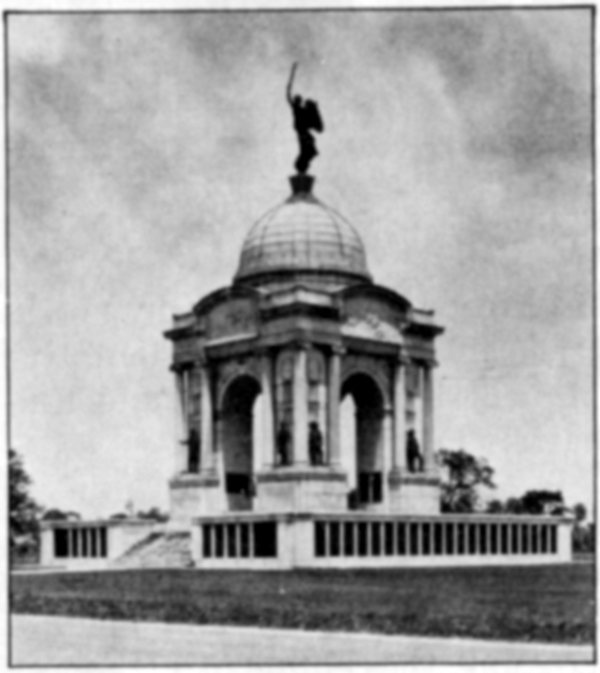
The Pennsylvania Monument, with bronze figures of distinguished officers and a roster of all Pennsylvanians in battle.
On the 30th, Hill, in the front at Cashtown, sent Pettigrew’s Brigade to Gettysburg for supplies, shoes especially being badly needed. In the meantime, Meade ordered Buford, with two brigades of cavalry at Emmitsburg, to make a reconnaissance to Gettysburg. Buford reported:
“I entered this place today at 11 A.M. Found everybody in a terrible state of excitement on account of the enemy’s advance.”
On reaching Seminary Ridge, Pettigrew saw the approach of Buford. Not wishing to bring on an engagement, he withdrew to the vicinity of Cashtown.
Buford moved through the town and bivouacked for the night west of the Seminary, along McPherson Ridge. He assigned to Gamble’s Brigade the task of watching the Fairfield and Cashtown roads and to Devin the Mummasburg, Middletown (now Biglerville), and Harrisburg roads. Early on the morning of the 1st, he picketed all the roads leading north and northeast.
11