THE FIRST DAY
Reading edition
Informed by Pettigrew that Union forces had reached Gettysburg, and anxious to know their strength, Hill sent Heth’s and Pender’s Divisions with Pegram’s battalion of artillery forward on a reconnaissance in force. This movement, made at 5.30 A.M. on July 1, precipitated the battle.
The advance was soon interrupted by Buford’s skirmishers. On reaching Herr Ridge, which crosses the Cashtown Road at right angles, Hill deployed his line of battle—Heth on both sides of the road with Pender in reserve. Pegram posted his artillery on Herr Ridge, and at 8 o’clock fired his first shot. Buford’s artillery, under Calef, posted on the opposite ridge, fired in reply. The battle was on, and the gravity of the situation was clear to Buford, who at 10.10 A.M. sent this message to Meade:
“The enemy’s force are advancing on me at this point and driving my pickets and skirmishers very rapidly. There is a large force at Heidlersburg that is driving my pickets at that point from that direction. I am sure that the whole of A. P. Hill’s force is advancing.”
Arrival of Reynolds.
Union reinforcements were at hand. General Reynolds, in advance of the 1st Corps, arrived from Marsh Creek, via the Emmitsburg Road. After a short conference with Buford at the Seminary buildings, he sent an orderly urging Wadsworth, whose division was advancing across the fields, to hasten. On its arrival, Reynolds posted Cutler to the right, across the railroad cut which lies parallel to the Chambersburg Pike, and Meredith on the left. (Reynolds Avenue now marks this line.)
Death of Reynolds.
After posting Hall’s battery in place of Calef’s, Reynolds rode to the McPherson Woods, and while directing the advance of Meredith at 10.15 A.M. was instantly killed by a Confederate sharpshooter. Doubleday consequently assumed command of the 1st Corps, and Rowley succeeded Doubleday in command of the Division. Compelled to fall back into the grove, Buford moved 12 his cavalry to the left near the Fairfield Road, and Meredith advanced into the woods, drove Hill’s right across Willoughby Run, and captured General Archer and part of his men.
On the Union right, Cutler was attacked in flank by Davis’s Brigade, of the left of Hill’s line, and was compelled to withdraw. Davis advanced into the railroad cut where part of his force was captured. He then withdrew to his original line.
A Morning Lull.
At 11 A.M. there was a lull. Doubleday withdrew his forces from across Willoughby Run and established a new line through the McPherson Woods from north to south. Robinson’s Division reached the field and was held in reserve at the Seminary buildings. Rowley’s Division (formerly Doubleday’s) arrived a little later; Stone’s Brigade of this Division was deployed in the front line on what is now Stone Avenue, and Biddle’s Brigade was placed on the left of Meredith, along what is now South Reynolds Avenue. In the afternoon, Robinson’s Division was moved to the right, prolonging the Union line to the Mummasburg Road in order to meet the advance of Rodes’ Division, coming forward via the Carlisle Road. Devin’s cavalry was moved from Buford’s right to the vicinity of the York Pike and the Hanover Road.
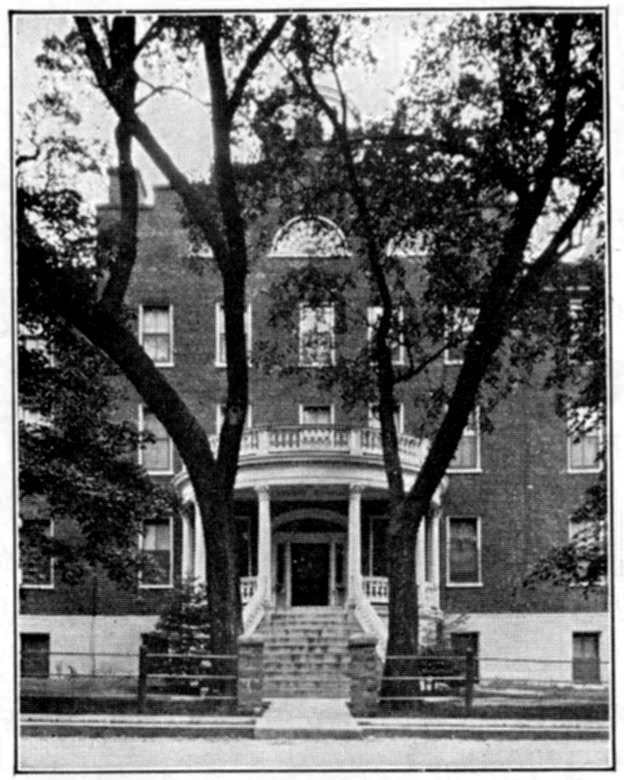
Gettysburg Seminary Doorway.—The Lutheran Theological Seminary was used as an observation point and hospital. The portico was erected in 1913 to commemorate the fiftieth anniversary of the battle.
In this preliminary action of the forenoon the advantage was in favor of the Union forces. The Confederate General Heth reported:
“The enemy had now been felt, and found in heavy force in and around Gettysburg. The division was now formed in line of battle on the right of the road; Archer’s brigade on the right, Pettigrew’s in the center, and Brockenbrough’s on the left. Davis’s brigade was kept on the left of the road that it might collect its stragglers, and from its shattered condition it was not deemed advisable to bring it again into action that day.”
13
The Union General Buford reported:
“On July 1, between 8 and 9 A.M. reports came in from the 1st Brigade (Colonel Gamble’s) that the enemy was coming down from toward Cashtown in force. Colonel Gamble made an admirable line of battle, and moved off proudly to meet him. The two lines soon became hotly engaged, we having the advantage of position, he of numbers. The 1st Brigade held its own for more than two hours, and had to be literally dragged back a few hundred yards to a more secure and sheltered position.”
Arrival of Rodes and Early.
On learning at Middletown (now Biglerville) that Hill was engaged with the Union forces at Gettysburg, Rodes marched thither directly via the Carlisle Road. Early approached via the Harrisburg or Heidlersburg Road. The advance of both was quickened by the sound of cannonading. Arriving a little past noon, Rodes deployed his Division of five brigades on both sides of Oak Ridge, his right on the left of Heth’s Division and his left with Early’s right, extending across the plain north of the town. Carter’s artillery was posted on Oak Hill.
The Opposing Lines.
Robinson’s Division of the 1st Union Corps was moved from its position in reserve at the Seminary buildings to the right of Cutler, to oppose Rodes’s Confederate line.
Hill prolonged his right by bringing up Pender’s Division that had been held in reserve. The artillery of McIntosh’s battalion was brought into action in support. These guns, with Carter’s and Pegram’s, together numbering 60, and 11 brigades of infantry now opposed the 1st Union Corps of 36 guns and 6 brigades.
Arrival of Howard.
General Howard, in command of the 11th Union Corps, reached Gettysburg from Emmitsburg between 10 and 11 A.M., in advance of his Corps, and took command of the Union forces. Schurz succeeded Howard in command of the Corps, and Doubleday resumed command of his Division.
On reaching Gettysburg, Howard went to the top of the Fahnestock building at the corner of Baltimore and Middle streets to observe the lines of battle. He reported:
“I had studied the position a few moments, when a report reached me that General Reynolds was wounded. At first I hoped his wound might be slight 14 and that he would continue to command, but in a short time I was undeceived. His aid-de-camp, Major William Riddle, brought the sad tidings of his death. This was about 11.30 A.M. Prior to this the General had sent me orders to move up at a double quick, for he was severely engaged. On hearing of the death of Reynolds, I assumed command of the left wing, instructing General Schurz to take command of the 11th Corps. After an examination of the general features of the country, I came to the conclusion that the only tenable position for my limited force was the ridge to the southeast of Gettysburg (now well known as Cemetery Ridge). I at once established my headquarters near the cemetery, and on the highest point north of the Baltimore Pike.”
Howard’s Position.
On the arrival of the 11th Corps, Howard ordered Schurz to move the 3rd and 1st Divisions to positions north of the town, while the 2nd Division was held on Cemetery Hill in reserve. On account of the prior arrival of the Confederates under Rodes, who covered the plain north of the town, Schurz was unable to connect with the right of the Union line on Oak Hill, and a gap remained between the two lines. The position of the 11th Corps coincides with what is now Howard Avenue.
The Confederate General Early’s Position.
Shortly after the 11th Corps moved to the front, Early’s Division of Ewell’s Corps arrived from Heidlersburg and went into line to the right of Howard, connecting with Rodes’s left across the plain. Early posted his artillery, Jones’s battalion, in position to enfilade the right of Howard, while Carter’s batteries on Oak Hill enfiladed the left. The Confederate forces largely exceeded the Union forces, the former being about 28,000 and the latter about 18,000. The whole Confederate line advanced and attacked the Union forces in front and on both flanks. On Oak Hill part of Rodes’ forces, O’Neal’s and Iverson’s brigades, were repulsed, a large part of the latter being captured.
The Union Retreat.
After a strenuous resistance the whole Union line was compelled to withdraw to Cemetery Hill. The 11th Corps retreated through the center of town where many were captured. The 1st Corps fell back through the western part of the town. By 4.30 P.M. all the territory held by the Union forces was occupied by the Confederates.
15
Arrival of Lee.
General Lee reached the field from Cashtown about 3 P.M., witnessed the retreat of the Union forces, and established his headquarters in tents in an apple orchard back of the Seminary. He ordered Ewell to follow up the repulse if he thought it practicable. In this connection Ewell reported:
“The enemy had fallen back to a commanding position known as Cemetery Hill, south of Gettysburg, and quickly showed a formidable front there. On entering the town, I received a message from the Commanding General to attack this hill, if I could do so to advantage. I could not bring artillery to bear on it, and all the troops with me were jaded by twelve hours’ marching and fighting, and I was notified that General Johnson’s division (the only one of my corps that had not been engaged) was close to town. Cemetery Hill was not assailable from the town.... Before Johnson could be placed in position the night was far advanced.”
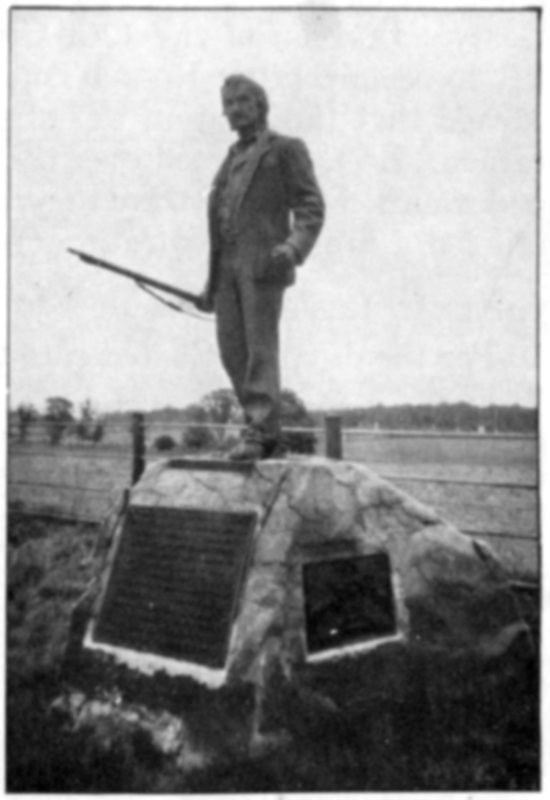
John Burns, Gettysburg constable and Mexican War veteran, shouldered his musket and went out to meet the Confederates.
General Hill reported:
“Under the impression that the enemy was entirely routed, my own two divisions exhausted by some six hours’ hard fighting, prudence led me to be content with what had been gained.”
The failure of Ewell to follow up the repulse and capture Cemetery Hill and Culp’s Hill, defended by a weak line of the Union forces, enabled the Union commanders to establish during the night a line of defence that was secure against attack. By many military critics, this is generally considered Lee’s lost opportunity.
Formation of Union Line.
The retreating Union soldiers were met at East Cemetery Hill by Generals Hancock and Howard, who directed them to positions, the 1st Corps on Cemetery Ridge and Culp’s Hill, and the 11th 16 on East Cemetery Hill. The 12th Corps arrived on the Baltimore Pike, and soon after Sickles’ 3rd Corps came up from Emmitsburg.
Hancock had been instructed by Meade to take command and report if he thought the ground a suitable place to continue the battle. A battle-line was at once established on Cemetery Ridge. Geary’s Division of the 12th Corps was ordered to the extreme left to occupy Little Round Top. Hancock sent word to General Meade that the position was strong, but that it might be easily turned. He then turned over the command to Slocum, his senior, and returned to Taneytown to report in person. Meade had already ordered a rapid concentration of all his forces at Gettysburg.
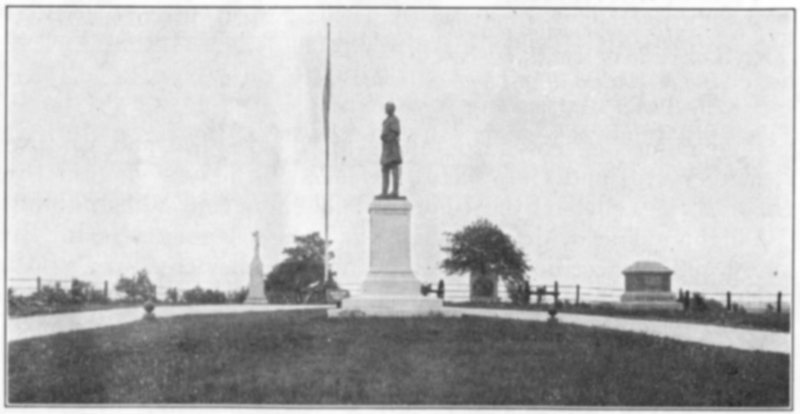
Barlow’s Knoll.—The extreme right of the Union line on the first day
General Lee’s Report.
For the day, the Confederate commander reported:
“The leading division of Hill met the enemy in advance of Gettysburg on the morning of July 1. Driving back these troops to within a short distance of the town, he there encountered a larger force, with which two of his divisions became engaged. Ewell coming up with two of his divisions by the Heidlersburg road, joined in the engagement. The enemy was driven through Gettysburg with heavy loss, including about 5,000 prisoners and several pieces of artillery. He retired to a high range of hills south and east of the town. The attack was not pressed that afternoon, the enemy’s force being unknown, and it being considered advisable to await the arrival of the rest of our troops. Orders were sent back to hasten their march, and, in the meantime, every effort was made to ascertain the numbers and position of the enemy, and find the most favorable point of attack. It had not been intended to fight a general battle at such a distance 17 from our base, unless attacked by the enemy, but, finding ourselves unexpectedly confronted by the Federal Army, it became a matter of difficulty to withdraw through the mountains with our large trains.... Encouraged by the successful issue of the engagement of the first day, and in view of the valuable results that would ensue from the defeat of the army of General Meade, it was thought advisable to renew the attack.”