INCIDENTS OF THE SECOND DAY
Reading edition
The Roger House
The Roger House is located on the west side of the Emmitsburg Road, about a mile south of Gettysburg, midway between Meade’s line of battle on Cemetery Ridge and Lee’s line on Seminary Ridge. On the afternoon of July 2nd, after Sickles advanced his corps from its first position to the Emmitsburg Road, it was surrounded by the right of the new line. The 1st Massachusetts Regiment, whose monument stands adjacent to the house, held this part of the line, and was hotly engaged when the brigades of Wilcox and Wright advanced during the assault of Longstreet on the Union left on the afternoon of the 2nd. During Pickett’s Charge, on the afternoon of the 3rd, the house was again surrounded by fighting men.
While the battle raged on all sides, a granddaughter of the owner, Miss Josephine Miller, remained, and, notwithstanding the great danger, baked bread and biscuits for the hungry soldiers. In 1896, Miss Miller, then Mrs. Slyder, paid a visit to her old home, and related the following story of her experience to Mr. Wilfred Pearse, of Boston, Mass., a visitor to Gettysburg at the same time. After his return he published the following article.
“The veterans of the 1st Massachusetts Infantry Regiment will be glad to learn that the only woman member of the 3rd Army Corps ‘Veterans’ Association,’ Mrs. Slyder, née Miss Josephine Miller, granddaughter of farmer Roger, owner of the farm near which the 1st Massachusetts monument stands, is visiting her old home on the battleground where she stood from sunrise to sunset for two days of the battle making hot biscuits for the Boys in Blue. She refused to take money for the bread, and refused to stop her work even when Confederate shells were bursting around the house. She told me the other day that when her stock of flour was almost exhausted six members of the 1st Massachusetts kindly volunteered to go out and steal three sacks of flour from General Sickles’ commissary stores. In an hour’s time they returned with flour, raisins, currants, and a whole sheep, with which a rattling good meal was made.
“The old range still stands in the kitchen, and in it, at the last reunion of the 3rd Corps, Mrs. Slyder cooked a dinner for General Sickles.”
Spangler’s Spring
This spring, which takes its name from Abraham Spangler, its owner at the time of the battle, is located at the southeast corner of Culp’s Hill. Inasmuch as it was used by soldiers of both armies during the battle, and since then by thousands of tourists, it is an interesting feature of the field. Only during the drought of 1930 has it failed to give forth a copious flow of cool, pure water. At the time of the battle it was surrounded by a wall of flat stones with a flagstone cover over the top. These were removed and a canopy top erected.
The 12th Corps of the Army of the Potomac occupied this part of Meade’s line on the night of the first day and until the afternoon of the 2nd, when the troops were ordered to the left to help repel Longstreet’s assault. Until this time the spring was used only by the Union troops. During their absence, the Confederates under Johnson moved up and took possession of part of the vacated line. In the early morning of the third day, the Union forces, who had returned from the left during the night of the 2nd, attacked Johnson, drove him out and succeeded in regaining possession of the line that had been vacated by them on the afternoon of the 2nd, including the spring.
The story that a truce was entered into between the opposing forces on the night of the 2nd and that they met in large numbers at the spring to get water is a 33 mistake. The captured and wounded of the Union forces were allowed access to it along with the Confederates who were there at the time, but there was no truce. When armies were encamped, pickets from the opposing lines would sometimes get together, usually to trade coffee and tobacco, but this was never done when a battle was in progress.
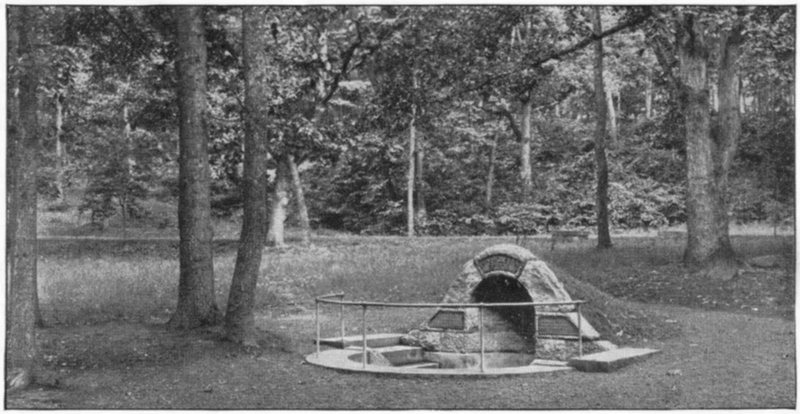
Spangler’s Spring.—Spangler’s Spring was used first by the Union, then by the Confederate troops, and since by thousands of tourists
The following extract from the address of Captain Joseph Matchett at the dedication of the monument erected by the 46th Pennsylvania Infantry Regiment, shows that there was no truce:
“Some time in the night (2nd), we were ordered to return to our works on Culp’s Hill. It seems Captain Selfridge of Company H had taken some of his men’s canteens and gone ahead to Spangler’s Spring to fill them, when he discovered ‘Johnnies’ also filling their canteens. He backed out with the best grace he could command, and reported it to the colonel. Colonel McDougall, the brigade commander, did not believe it and got very angry, but the colonel of the regiment insisted on deploying his men, and sent a skirmish line, who found the enemy as stated and saved many lives.”
Colonel Avery’s Lost Grave
Among those who faced death in the desperate charge on the Union right on East Cemetery Hill, July 2nd, Colonel I. E. Avery, of North Carolina, in command of Hoke’s brigade, bore a gallant part. At the head of the column he led his men up the slope of Cemetery Hill and, a conspicuous mark, fell mortally wounded.
Unable to speak, he drew a card from his pocket and wrote the following: “Tell father that I died with my face toward the enemy.” In the retreat from Gettysburg, his body was taken along to be delivered to his family, but when the army reached Williamsport the Potomac was too high to cross. There, in the cemetery overlooking the river, the remains were interred in an oak coffin under a pine tree. He was buried in his uniform by the men who saw him fall.
Thirty years after, Judge A. C. Avery, of the Supreme Court of North Carolina, a resident of Morgantown, and Captain J. A. McPherson of Fayette, N. C., both veterans of the Confederacy, came to Williamsport with the object of locating Colonel Avery’s grave. Their search was fruitless.
34
The Leister House
On his arrival, General Meade established his headquarters at the Leister House, one of the oldest houses in the community, located at the intersection of Meade Avenue and the Taneytown Road. At the time of the battle it was the property of a widow, Mrs. Leister. It now belongs to the Government, and a bronze plate marks it as Meade’s Headquarters. It is built of logs, chinked and weatherboarded with rough pine boards, pierced by bullet-holes and scarred by shells.
Inside there are two rooms, a small kitchen at the west, and a larger room at the east. In the latter, Meade held a council of war after the battle of the 2nd had ended, summoning his Corps commanders between 9 and 10 o’clock to consult them as to what action, if any, should be taken on the 3rd. Generals Sedgwick, Slocum, Hancock, Howard, Sykes, Newton, Birney, Williams, and Gibbon were present. The following questions were asked:
(1) Under existing circumstances is it advisable for this army to remain in its present position, or to retire to another nearer its base of supplies?
(2) It being determined to remain in present position, shall the army attack or wait the attack of the enemy?
(3) If we wait attack, how long?
Replies:
Gibbon: (1) Correct position of the army, but would not retreat. (2) In no condition to attack, in his opinion. (3) Until he moves.
Williams: (1) Stay. (2) Wait attack. (3) One day.
Birney and Sykes: Same as General Williams.
Newton: (1) Correct position of the army, but would not retreat. (2) By all means not attack. (3) If we wait it will give them a chance to cut our line.
Howard: (1) Remain. (2) Wait attack until 4 P.M. tomorrow. (3) If don’t attack, attack them.
Hancock: (1) Rectify position without moving so as to give up field. (2) Not attack unless our communications are cut. (3) Can’t wait long; can’t be idle.
Sedgwick: (1) Remain. (2) Wait attack. (3) At least one day.
Slocum: (1) Stay and fight it out.
The unanimous opinion of the council was to stay and await attack. Just as the council broke up, General Meade said to Gibbon, “If Lee attacks tomorrow, it will be on your front. He has made attacks on both our flanks and failed, and if he concludes to try it again it will be on our center.” The attack of Lee on the 3rd was made where Meade expected.
During the forenoon of the third day, conditions at headquarters were generally quiet. In the afternoon, when the Confederate artillery on Seminary Ridge opened fire as a prelude to Pickett’s Charge, it was directed mainly against the left center of the Union line on Cemetery Ridge. As the location of Meade’s headquarters was in the immediate rear, just under the crest of the ridge, much damage was done by the hail of shot and shell that crossed the ridge. A shell exploded in the yard among the staff officers’ horses tied to the fence, and a number of them were killed, while still other horses were killed in the rear of the building. Several members of the headquarters’ guard were slightly wounded.
George G. Meade, a grandson of General Meade, in his interesting narrative “With Meade at Gettysburg,” tells the following story:
“During this rain of Confederate shell, and while Meade, deep in thought, was walking up and down this little back yard between the house and the Taneytown Road, he chanced to notice that some of his staff, during the enforced inactivity while waiting the pleasure of their general, were gradually and probably unconsciously edging around the side of the house.
“‘Gentlemen,’ he said, stopping and smiling pleasantly, ‘Are you trying to find 35 a safer place? You remind me of the man who was driving the ox-cart which took ammunition for the heavy guns on the field of Palo Alto. Finding himself within range, he tilted up his cart and got behind it. Just then General Taylor came along, and seeing the attempt at shelter, shouted, “You damned fool; don’t you know you are no safer there than anywhere else?” The driver replied, “I don’t suppose I am, General, but it kind o’ feels so.”’”
As the firing still continued it was decided to move the headquarters several hundred yards south on the Taneytown Road, to a barn on the Cassatt property. There a Confederate shell exploded and wounded General Butterfield, the chief of staff, who was obliged to leave the field and was unable to return that day. After remaining a short time, General Meade and staff removed to General Slocum’s headquarters at Powers’ Hill, along the Baltimore Pike, moving there by way of Granite Lane.
The Louisiana Tigers
Major Chatham R. Wheat’s battalion of Louisiana Infantry was organized in New Orleans in May, 1861. Their first engagement was in the first battle of Bull Run, where Major Wheat was shot through both lungs. After his recovery, he re-entered the service and took an active part in command of the battalion in the defense of Richmond in 1863 against the advance of the Union forces under McClellan. During this campaign the battalion became known as “The Louisiana Tigers” on account of their desperate fighting qualities. At the battle of Gaines Mill, Major Wheat and several other leading officers of the battalion were killed, and the loss of the organization was very heavy. It was then broken up and the survivors distributed among the other Louisiana regiments, of Hays’ brigade of Early’s Division, and Nicholls’ brigade of Johnson’s Division of Ewell’s Corps. A number of them were in the battle of Gettysburg with these brigades, but not as the separate organization originally known as “The Louisiana Tigers.” This designation was given to all the Louisiana troops after the original battalion was discontinued. The story sometimes told, that 1,700 Louisiana Tigers attacked East Cemetery Hill on July 2nd, that all but 300 were killed or captured, and that the organization was unknown afterward, is not correct.
General Meade’s “Baldy”
In the first great battle of the Civil War, at Bull Run, there was a bright bay horse with white face and feet. He, as well as his rider, was seriously wounded and the horse was turned back to the quartermaster to recover. In September General Meade bought him and named him “Baldy.” Meade became deeply attached to the horse but his staff officers soon began to complain of his peculiar racking gait which was hard to follow. Faster than a walk and slow for a trot, it compelled the staff alternately to trot and walk.
“Baldy” was wounded twice at the first battle of Bull Run; he was at the battle of Drainsville; he took part in two of the seven days’ fighting around Richmond in the summer of 1862; he carried his master at Groveton, August 29th; at the second battle of Bull Run; at South Mountain and at Antietam. In the last battle he was left on the field for dead, but in the next Federal advance he was discovered quietly grazing on the battleground with a deep wound in his neck. He was tenderly cared for and soon was fit for duty. He bore the general at the battles of Fredericksburg and Chancellorsville. For two days he was present at Gettysburg, where he received his most grievous wound from a bullet entering his body between the ribs and lodging there. Meade would not part with him and kept him with the army until the following spring.
In the preparations of the Army of the Potomac for the last campaign, “Baldy” was sent to pasture at Downingtown, Pa. After the surrender of Lee at Appomattox, 36 Meade hurried to Philadelphia where he again met his faithful charger, fully recovered. For many years the horse and the general were inseparable companions, and when Meade died in 1872, “Baldy” followed the hearse. Ten years later he died, and his head and two fore-hoofs were mounted and are now cherished relics of the George G. Meade Post, Grand Army of the Republic, in Philadelphia.
General Lee’s “Traveller”
The most famous of the steeds in the stables of General Lee, was “Traveller,” an iron-gray horse. He was raised in Greenbriar County, Virginia, near Blue Sulphur Springs, and as a colt won first prize at a fair in Lewisburg. When hostilities commenced, Traveller, then called “Jeff Davis,” was owned by Major Thomas L. Broun, who had paid $175 in gold for him. In the spring of 1862, Lee bought him for $200 and changed his name to “Traveller.”
“Traveller” was the especial companion of the general. His fine proportions attracted immediate attention. He was gray in color, with black points, a long mane, and flowing tail. He stood sixteen hands high, and was five years old in the spring of 1862. His figure was muscular, with deep chest and short back, strong haunches, flat legs, small head, quick eyes, broad forehead, and small feet. His rapid, springy step and bold carriage made him conspicuous. On a long and tedious march he easily carried Lee’s weight at five or six miles an hour without faltering and at the end of the day’s march seemed to be as fresh as at the beginning. The other horses broke down under the strain and each in turn proved unequal to the rigors of war, but “Traveller” sturdily withstood the hardships of the campaigns in Virginia, Maryland, and Pennsylvania. When, in April, 1865, the last battle of the Army of Northern Virginia had been fought and Lee rode to the McLean House at Appomattox Court House, he was astride “Traveller” who carried him back to his waiting army, and then to Richmond. When Lee became a private citizen and retired to Washington and Lee University as its president, the veteran war-horse was still with him, and as the years passed and both master and servant neared life’s ending, they became more closely attached. As the funeral cortege accompanied Lee to his last resting-place, “Traveller” marched behind the hearse. After “Traveller’s” death, his skeleton was mounted and is on exhibition in the museum in the chapel on the campus of Washington and Lee University.
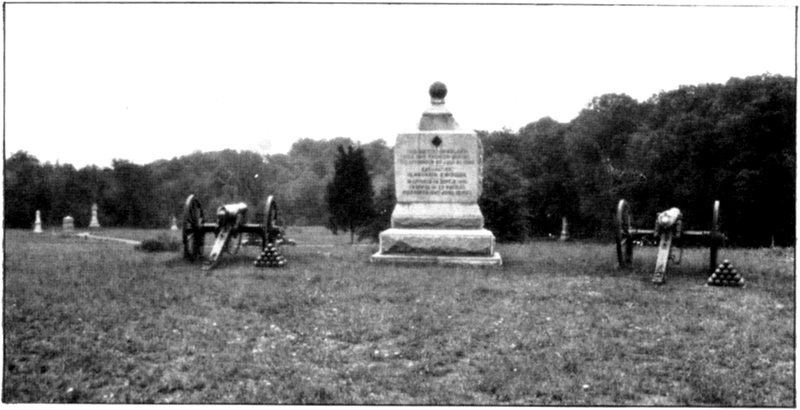
A Union Battery, in action on the afternoon of the second day
37