THE SECOND DAY
Reading edition
The scene of the engagements of the second and third days shifted to the south and southeast of Gettysburg. General Meade arrived on the field from his headquarters at Taneytown, Md., at 1 A.M., July 2nd, and established his headquarters at the Leister House, on the Taneytown Road, in rear of the line of the 2nd Corps. As soon as it was light he inspected the position already occupied and made arrangements for posting the several corps as they should reach the ground.
The Union Line of Battle.
Starting on the right with Slocum’s 12th Corps, Williams’ Division extended from Rock Creek by way of Spangler’s Spring to Culp’s Hill, with Geary’s Division on the hill. The line between Culp’s Hill and Cemetery Hill was held by Wadsworth’s Division of the 1st Corps. Barlow’s Division of the 11th Corps under Ames was located at the foot of East Cemetery Hill. Carman, Colgrove, Slocum, Geary, and Wainwright avenues follow these lines of battle.
On Cemetery Hill, across the Baltimore Pike, the line was held by Schurz and on his left Steinwehr, both of the 11th Corps. Robinson’s Division of the 1st Corps extended across the Taneytown Road to Ziegler’s Grove. Beyond lay Hancock’s 2nd Corps, with the Divisions of Hays, Gibbon, and Caldwell from right to left. To the left of Hancock, Sickles’ 3rd Corps, consisting of the Divisions of Humphreys and Birney, prolonged the line to the vicinity of Little Round Top. Beginning at the Taneytown Road, Hancock and Sedgwick avenues follow these lines of battle.
Arriving later in the day, the 5th Corps, under General Sykes, was posted on the Baltimore Pike, at the Rock Creek crossing. Later it occupied the ground about Round Top to the left of the 3rd Corps. The 6th Corps, under General Sedgwick, reaching the field still later after a march of over 30 miles, was posted in reserve back of Round Top, from which position portions were moved as circumstances demanded. The lines held by the 5th and 6th Corps coincide with Sykes, Ayres, Wright, and Howe Avenues.
24
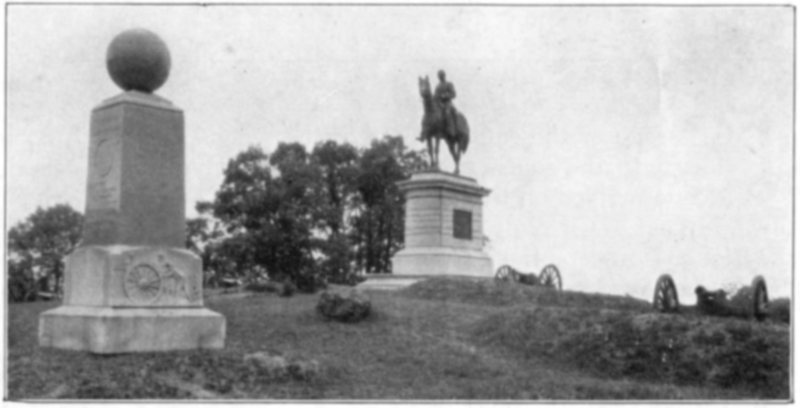
Stevens’ Knoll.—Arriving on Stevens’ Knoll at the end of the first day, General Slocum brought supporting troops. The lunettes protecting the cannon remain intact.
Gamble’s and Devin’s brigades of Buford’s Cavalry, which had had an active part in the battle of the first day, were on the left between Cemetery and Seminary Ridges until 10 A.M. when they were ordered, by some mistake, to move to Westminster, Md., before the arrival of Gregg’s Division on its way from Hanover, and Merritt’s brigade of Buford’s Division from Mechanicsburg (now Thurmont), Md.
General Meade’s line, shaped like a fishhook, was about 3 miles long. The right faced east, the center over Cemetery Hill, north, and the left from Cemetery Hill to Round Top nearly west. The whole line was supported by artillery brigades belonging to the different corps.
Confederate Line of Battle.
General Lee’s line was nearly the same shape as General Meade’s but, being the outer line, was about 6 miles long. On the right, facing the two Round Tops, were Hood’s and McLaws’ Divisions of Longstreet’s Corps. On the left of McLaws, extending along the line of Seminary Ridge, were the Divisions of Anderson and Pender of Hill’s Corps, with Heth’s Division in the rear in reserve. On the left of Pender, extending through the town along the line of West Middle Street, was Rodes’ Division of Ewell’s Corps, then Early’s and Johnson’s Divisions, the latter reaching to Benner’s 25 Hill, east of Rock Creek. Pickett’s Division of Longstreet’s Corps was at Chambersburg, guarding trains, and Law’s Brigade of Hood’s Division of Longstreet’s Corps at New Guilford, guarding the rear. The latter arrived at noon on the 2nd in time to participate in the day’s engagement. Pickett’s Division arrived later and was not engaged until the afternoon of the 3rd. The artillery was posted according to the different corps to which it was attached.
General Lee’s line coincides with the present West Confederate Avenue along Seminary and Warfield or Snyder Ridges, west of the town, then runs through the town to coincide with East Confederate Avenue. The distance between the Union and Confederate lines is three-fourths of a mile to a mile.
Military critics agree that General Meade held the stronger position. Both flanks presented precipitous and rocky fronts, difficult to attack, and it was possible to send reinforcements by short distances from point to point.
Sickles’ Change of Line.
As already stated, General Sickles’ 3rd Corps was on the left of General Hancock’s 2nd Corps on Cemetery Ridge, and Birney’s Division was near the base of Little Round Top, replacing Geary’s Division after its withdrawal to be posted on Culp’s Hill. Humphreys’ Division was on low ground to the right between Cemetery Ridge and the Emmitsburg Road.
Anxious to know what was in his front, Sickles sent the Berdan Sharpshooters and the 3rd Maine Infantry forward on a reconnaissance. On reaching the Pitzer Woods, beyond the Emmitsburg Road, they found the Confederates there in force, and after a sharp engagement with Wilcox’s Brigade, withdrew and reported.
Believing that Lee planned a flank movement on his line, and that the Emmitsburg Road afforded better positions for the artillery, Sickles moved his Corps forward and posted Humphreys’ Division on the right along the Emmitsburg Road and his left extending to the Peach Orchard. Birney’s Division prolonged the line from the Peach Orchard across the Wheatfield to Devil’s Den. This new line formed a salient at the Peach Orchard and therefore presented two fronts, one to the west, the other to the south.
About 3 P.M. Sickles was called to General Meade’s headquarters to a conference of corps commanders. Upon the sound of 26 artillery, the conference adjourned, and Meade, Sickles, and Warren, Meade’s Chief Engineer, rode to inspect Sickles’ change of line. The artillery was already engaged, and believing it too late to make any changes since the enemy was present, Meade decided to attempt to hold the new position by sending in supports. After reviewing the new line, General Warren left the other members of the party and rode up Little Round Top. He found the height unoccupied except by the personnel of a signal station.
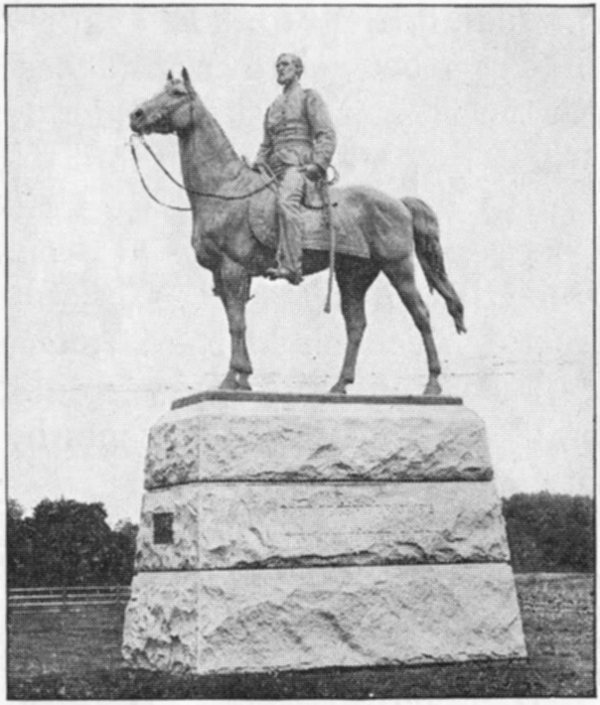
General Meade’s Statue.—General Meade viewed Pickett’s Charge from the center of the Union line. This statue, like those of Reynolds and Sedgwick, is the work of Henry K. Bush-Brown.
General Lee’s Plan.
Lee as well as Meade occupied the forenoon in the arrangement of his line of battle. After a conference with Ewell, he decided to attack Meade’s left. In his report, Lee says:
“It was determined to make the principal attack upon the enemy’s left, and endeavor to gain a position from which it was thought that our artillery could be brought to bear with effect. Longstreet was directed to place the division of McLaws and Hood on the right of Hill, partially enveloping the enemy’s left, which he was to drive in.
“General Hill was ordered to threaten the enemy’s center to prevent reinforcements being drawn to either wing, and coöperate with his right division in Longstreet’s attack.
“General Ewell was instructed to make a simultaneous demonstration upon the enemy’s right, to be converted into a real attack should opportunity offer.”
When General Lee arranged this plan of attack he believed Meade’s left terminated at the Peach Orchard; he did not know that Sickles’ advance line extended to the left from the salient at the Peach Orchard to Devil’s Den. In plain view of the Union signal station on Little Round Top, some of his forces were compelled to make a wide detour via the Black Horse Tavern on the Fairfield Road in order to avoid observation.
27
Little Round Top.
Meanwhile, General Warren on Little Round Top saw the importance of the hill as a tactical position on Meade’s left. The signal officers were preparing to leave; he ordered them to remain and to keep waving their flags so as to lead the Confederates to believe that the hill was occupied. He dispatched a messenger to Devil’s Den, where a Union battery was posted, with an order that a shot be fired to produce confusion in the woods in front, through which Hood’s forces were supposed to be advancing. Seeing the reflection of the sunlight from Confederate muskets, he realized that if this important position were to be held, it would be necessary to get troops there without delay.
Quickly he sent a member of his staff to Sickles for troops. Sickles said none could be spared. Warren sent another staff officer to Meade, who immediately ordered Sykes to move his Corps to Little Round Top. Barnes’ Division of this Corps had already been called for by Sickles to defend his line, and three brigades, Vincent’s, Tilton’s, and Sweitzer’s, were moving toward the Wheatfield. Learning of the need of troops on Little Round Top, Vincent moved back, skirted the east side of Little Round Top, and went into position between Little and Big Round Top, arriving just before the Confederates from Hood’s right advanced over Big Round Top.
Having watched these movements, Warren rode down to the crossing of what is now Sykes Avenue and the Wheatfield Road. There he met Colonel O’Rorke, in command of the 140th New York, and ordered his regiment, together with Hazlett’s battery, to the crest of the hill. With the addition of Weed’s Brigade, the combined forces held the Round Tops. There was a desperate engagement in which both contestants displayed courage of a very high order. The Union soldiers were victorious, and Meade’s left was secured against further attack.
The Peach Orchard and the Wheatfield.
After the struggle for the possession of Little Round Top, the other Confederate brigades of Hood and McLaws advanced rapidly. A lack of coordination in their movement allowed Meade to bring up supports. Three brigades of Anderson’s Division of Hill’s Corps advanced against Humphreys’ line, in the following 28 order: Wilcox, Perry, Wright. Wounded, General Pender was unable to direct Posey and Mahone in support of Wright, and Wright was obliged to withdraw. Humphreys was compelled to change front in order to meet the assault on his flanks. This maneuver served to stay the Confederate attack for a brief time. The Valley of Death between the Round Tops and the opposite height was now a seething mass of opposing forces, enshrouded in clouds of smoke.
Meade had already depleted his right to support his left by withdrawing all of Slocum’s 12th Corps except Greene’s Brigade. He now sent all of the 5th Corps to the left and ordered Caldwell’s Division from the left of Hancock’s 2nd Corps south of the Angle to the Wheatfield. Willard’s Brigade on Hays’ line of the 2nd Corps was ordered to advance and oppose the Confederate, Barksdale, who, after crossing the Emmitsburg Road north of the Peach Orchard and the field beyond, reached Watson’s Union battery posted on the Trostle farm. General Sickles was severely and Barksdale mortally wounded.
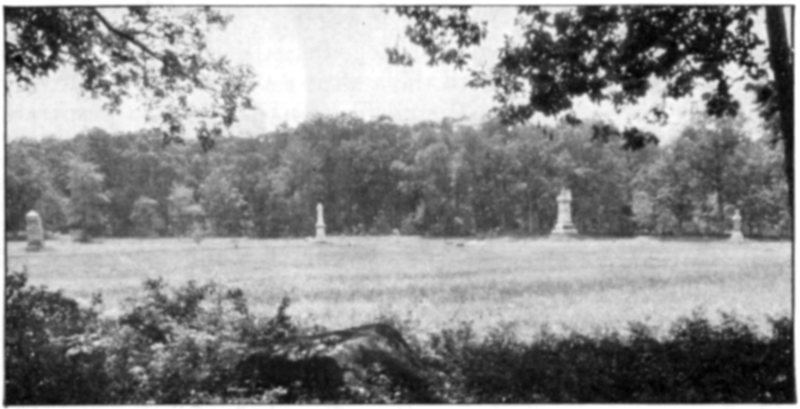
Wheatfield.—Scene of carnage on the second day
Wofford’s Brigade of McLaws’ Division broke through the salient at the Peach Orchard and reached the valley between Devil’s Den and Little Round Top, where they were met by a charge of the Pennsylvania Reserves of Crawford’s Division, led by McCandless, some of whose men fought in sight of their own homes. Wofford was obliged to withdraw to and beyond the Wheatfield; the Reserves advanced across the valley from their position 29 on the north of Little Round Top and reached the stone wall on the east side of the Wheatfield. Here they remained until after Pickett’s charge on the 3rd, when they advanced against the Confederates who had succeeded in regaining control of that part of the field.
About the time when Sickles was wounded, Meade directed Hancock to assume command of Sickles’ Corps in addition to his own. Meade in person led Lockwood’s brigade, brought from the extreme right, against the Confederate advance. Newton, now in command of the 1st Corps, sent in Doubleday’s Division. With these troops Hancock checked the advance of the Confederate brigades of Barksdale, Wilcox, Perry, and Wright, while Sykes checked the advance of Hood and McLaws. Brigades of the 6th Corps reached the field toward the close of the engagement. Withdrawing from the Wheatfield Road, Bigelow’s battery made a determined stand at the Trostle buildings and succeeded in checking the Confederate advance until the gap on Sickles’ first line was protected by a line of guns. Most of the Confederate brigades got no farther than Plum Run, except Wright’s, which actually reached the line of guns on Hancock’s front before it was obliged to withdraw.
During the repulse of the Confederate advance, the 1st Minnesota regiment of Harrow’s Brigade of Gibbon’s Division of Hancock’s Corps was ordered by Hancock to oppose Wilcox’s and Perry’s Brigades, rapidly advancing against Hancock’s left. The Minnesota regiment moved up at once and succeeded in repelling the attack, but only after losing 82 per cent of its men.
Though seriously threatened, Meade’s line held, and after the repulse of Wright, the attack ended. During the night the line was prolonged to the top of Big Round Top. The Confederates remained west of Plum Run, except at Big Round Top, where they intrenched along the western slope.
Ewell’s Attack on Meade’s Right.
Ordered by Lee to begin his attack on Meade’s right at the same time as Longstreet’s attack on Meade’s left, Ewell’s artillery on Benner’s Hill opened fire on Culp’s Hill and Cemetery Hill where the Union forces were posted and well protected with earthworks. On account of the destructive fire from the 30 Union batteries on East Cemetery Hill, Ewell lost most of his guns, and no infantry advance was made until Longstreet’s assault had ended. At sundown General Johnson’s infantry advanced against Culp’s Hill, General Early against East Cemetery Hill. Rodes, who was directed to move against West Cemetery Hill, was unable to obey instructions. General Walker, who had been sent east to Brinkerhoff Ridge in the forenoon, to guard Ewell’s flank, and who was expected to assist in this attack, was prevented by meeting part of the Union cavalry of Gregg’s Division that had arrived via Hanover on the forenoon of the 2nd. After an engagement with Gregg, Walker moved up to assist Johnson, but too late to be of service, as the attack on Culp’s Hill had ended.
The attack was conducted with the greatest dash and daring, in part up rough slopes of woodland over heaped boulders. On East Cemetery Hill the fight among the Union guns was hand to hand, and clubbed muskets, stones, and rammers were used to drive back the assailants. After sunset a bright moon illuminated the field. The Union troops stood firm, and at 10 o’clock the Confederates desisted, having captured only a few Union entrenchments.
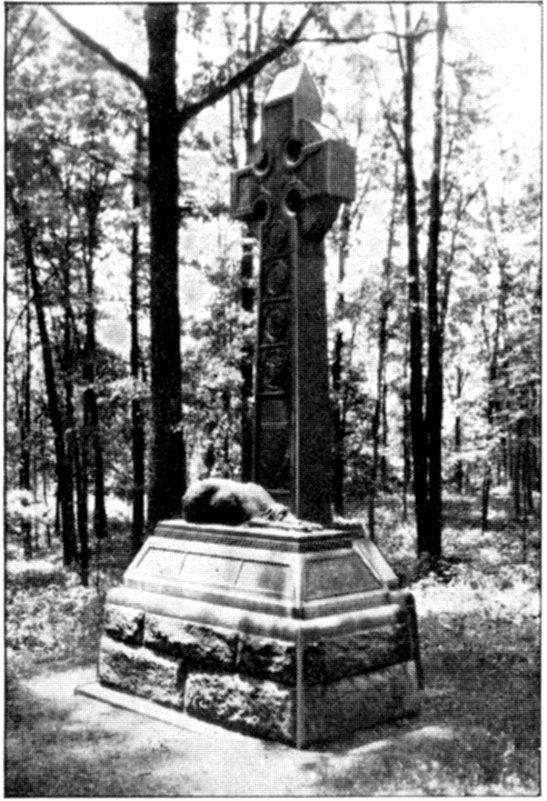
Monument of the Irish Brigade.—At the foot of the Celtic Cross is the Irish wolfhound, symbolic of devotion.
Situation at End of the Second Day.
Lee’s assaults on Meade’s left had failed to accomplish anything decisive. While Sickles’ advance-line was driven back and most of the field, including the Peach Orchard, the Wheatfield, Devil’s Den, and the base of Big Round Top, was occupied 31 by the Confederates, Meade’s line was practically intact from the crest of Big Round Top on the left to near Spangler’s Spring on the right. On the slopes of Round Top, on Cemetery Hill and Culp’s Hill, the advantage of the defensive positions multiplied the forces of the defenders in comparison with the attackers at least three to one. Prodigious deeds of valor were performed by both armies, and courage of the highest order was displayed in attack and in the defense. Casualties were very heavy on both sides. Meade estimated that his losses were 65 per cent of the total for the three days. At the end of the day he made the following report:
“July 2, 1863, 8 P.M. The enemy attacked me about 4 P.M. this day, and, after one of the severest contests of the war, was repulsed at all points. We have suffered considerably in killed and wounded. Among the former are Brigadier Generals Paul and Zook, and among the wounded are Generals Sickles, Barlow, Graham, and Warren slightly. We have taken a large number of prisoners. I shall remain in my present position tomorrow, but am not prepared to say, until better advised of the condition of the army, whether my operations will be of an offensive or defensive character.”
Later in the night, at a council of war held by Meade with his corps commanders—Gibbon, Williams, Sykes, Newton, Howard, Hancock, Sedgwick and Slocum—sentiment favored remaining and fighting a defensive battle. As Lee attacked both wings of Meade’s line on the 2nd it was expected that if another attack were made it would be on the center. This expectation was correct—Wright’s attack on the 2nd, when he succeeded in reaching Meade’s line south of the Angle, led Lee to believe that this was the most vulnerable point.
General Lee had more definite plans:
“The result of this day’s operations induced the belief that, with proper concert of action, and with the increased support that the positions gained on the right would enable the artillery to render the assaulting column, we should ultimately succeed, and it was accordingly determined to continue the attack.”
The general plan was unchanged. Longstreet, re-enforced by Pickett’s three brigades, which arrived near the battlefield during the afternoon of the 2nd, was ordered to attack the next morning, and General Ewell was directed to assail the enemy’s right at the same time. The latter, during the night, re-enforced General Johnson with three brigades from Rodes’ and Early’s Divisions.
32