Platinotype Printing.
Reading edition
Amongst the various printing processes in common use amongst photographers, platinotype is unique in several respects.
Printing is conducted by daylight in precisely the same manner as silver printing, but the action of light only suffices to make the image partially visible. In this respect, platinotype stands, as it were, midway between what are familiarly termed "print-out" processes—that is, those in which the image is made completely visible by daylight, and those in which the action of light is latent or invisible, such as bromide paper and in the carbon process.
The distinctive character of the platinotype print, with which, probably, everyone is so familiar that a platinotype effect almost amounts to a generic term, is not so much essential to the process, but has been largely determined by the different kind of papers and the preparation of those adopted by the manufacturers of platinotype printing papers.
In the first place, the platinotype print is before anything a matt surface print, and possesses a certain kind of texture or surface which gives the finished print an appearance similar to a pencil drawing or an engraving; an appearance largely assisted by the characteristic colour of the platinum image, which is black.
The invention and production of platinotype paper is due to Mr. Willis and the Platinotype Company, and although subsequently there have been both English and foreign imitators, we may safely confine our attention to those papers made and supplied by the Platinotype Company.
As, however, the purpose of this article is to furnish the beginner with simple working instructions, rather than to describe the principles of the process, we will at once proceed to say how a platinotype print is made.
To begin with, platinotype printing is divided into cold-bath process and hot-bath process. Of the latter we shall speak later on, but for the present, as being most suitable for the amateur and beginner, we will consider the cold-bath method. The reason for this division and the meaning of the name will be abundantly evident presently.
We first of all procure a tin of paper of the quality marked AA. The paper is put up in tin cylinders containing twenty-four pieces of either ¼-plate or ½-plate sizes, or less for larger sizes. It may, if preferred, be obtained in full-size sheets 20 × 26 inches.
We have now to bear in mind that the paper is sensitive to daylight to a slightly greater degree than are the silver print-out papers, and hence, whilst handling the paper, placing it in the printing frames, or what not, we need to be a little more careful as to how near the window we bring the paper. At the side of the room furthest from the window, or with an intervening screen between the paper and the window, or yet again, with the blind drawn down, we shall be quite safe in opening our tin of paper and inspecting it.
On removing the lid of the tin we find a false top or cover hermetically sealing it, which has to be cut through in the manner becoming customary with various tinned foods and comestibles.
We then find that the paper within is yellow on one side which is the sensitive side. Within the roll of papers at the bottom of the tin we shall find a hard irregular lump of some substance wrapped round with cotton wool. Keep this in the tin and now note its use from the following:—Platinotype paper is highly susceptible to moisture and deteriorates under its influence. The air we breathe, and therefore the air enclosed within the tin case or any other vessel contains a large amount of moisture, and this moisture would be taken up by the platinotype paper to its own detriment. The presence of water or moisture in the atmosphere or in things we handle, although quite unperceived by us, would be discoverable by the platinum salts on the paper, which would thus become unfit for use, hence the only way of preserving it is by placing in the tin containing the paper some chemical which is even more susceptible to moisture than platinotype paper. Such a body is calcium chloride, and this it is which we find wrapped in cotton wool in each tin tube of paper, or to speak more accurately it is asbestos prepared in a solution of calcium chloride. So long as that little lump remains dry and hard we may be quite sure that it has left no moisture in the air around it for the platinotype paper, and it will go on drinking it up until it becomes softened by saturation, when it must be removed and a fresh piece substituted, or it may be restored to its former condition by drying it on a red-hot shovel, the asbestos remaining unconsumed.
Whilst perhaps in after practice we may find it possible to relax our precautions against damp, yet at the outset the necessity of the utmost caution being observed cannot be too strongly insisted upon. Out of a very large number of prints representing the beginner's first attempts at platinotype, by far the greatest number of failures are due to damp, and this, probably, for want of conception of the danger to which the paper is exposed. Remember then that where there is ordinary air there is also abundant moisture, and as no tin box with a movable lid is air-tight, neither is it moisture-proof, but in the case of our tin of platinotype paper when once opened will go on admitting moisture which the calcium chloride will take up until it can take no more.
After having cut through the inner sealed top of the tin, close up the little hole in the outer lid where the cutting point is with sealing wax, next cover the mouth of the tube with a piece of waxed paper or tinfoil, shut the lid down on to this, and then cover the junction of the lid with a broad indiarubber band. In this way damp may be prevented from gaining access to the inside of the tube to a great extent.
Specially constructed tubes are made which close with an air-tight stopper and have a false bottom with a perforated partition in which the calcium chloride may be kept. Such a "calcium-tube," as it is called, if not an absolute necessity, is a very desirable acquisition.
If you now take the negative to be printed from and hold it near the fire or a spirit lamp, it will on becoming warm give off perceptible moisture, thus showing that it was distinctly damp before. The negative, therefore, should be dried before being brought into contact with the platinotype paper.
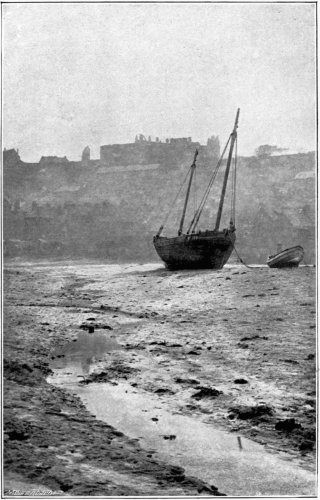
STREONSALCH W. J. WARREN.
The wood printing frame itself, if it has been used for printing in the open air, should be placed in an oven or held near the fire to thoroughly dry it.
Having placed the negative and the platinotype paper in the frame in the ordinary manner, there should next be placed at the back of the paper a thin sheet of waterproof cloth, vulcanized rubber of the proper size and thickness being sold for the purpose; this will prevent damp from penetrating to the paper from the back of the frame. The frame may now be closed and placed in the light for printing, and even having taken all these elaborate precautions against damp it would not be advisable to print out of doors except in dry weather, nor should the paper be left in the frame longer than need be, but if it is not proposed to finish the print off at once, it should be returned as soon as convenient to the security of the calcium tube.
GENERAL OUTLINE OF THE PROCESS.
Platinotype paper is ordinarily only available for daylight printing, though the Platinotype Company have introduced a lamp of special construction and great power, by the use of which daylight may be dispensed with, and electric light, should it be available, may be used.
As has been already said, platinotype paper is rather more sensitive to light than silver paper, and hence takes proportionately less time to print.
The duration of the exposure to light constitutes the only real difficulty in platinotype printing, and whilst just at first it may result in the beginner's meeting with much disappointment, yet probably, with a little care and watchfulness the trouble will be surmounted, and sufficient experience gained to secure fairly uniform success thereafter, before even the first tube of paper has been used.
The printed image shows on the yellow ground of the sensitized side as a faint grey, the darkest portions assuming an orange-grey tint, whilst the lighter parts remain all but invisible.
A little practice will enable one to judge the right depth, that is to say, how visible the image should be before printing is to be stopped, but as a rough guide to commence with it may be said that printing is complete when the image is about half as deep as we should expect it to be if it were a "print-out" process.
As we shall have occasion to return to the question of printing presently, we may now pass to the next step in the process.
In twenty-five ounces of hot water dissolve half a pound of best neutral oxalate of potash, and keep this in a stoppered bottle as stock solution. What is known as neutral oxalate should be used, and in order to ensure having a suitable salt it had better be obtained from a recognised photographic chemist or dealer.
As the above solution becomes cool, a good deal of the oxalate will probably settle at the bottom in the form of solid crystals; of these no notice need be taken, for as long as there are undissolved crystals at the bottom of the bottle we know we have a saturated solution.
We shall now require a dish of porcelain or enamelled iron, and if we choose the latter great care must be taken to see that the enamel is not cracked or blistered, as it will have an injurious effect if the oxalate of potash solution obtain access to the iron under the enamel.
As it will be convenient to be able to alter the temperature of the solution when in this dish at will, a spirit lamp or stove or a small gas-stove will be a useful, if not an essential addition. Over such heating apparatus the dish should be supported on an iron tripod, or by any extemporized substitute.
If a porcelain dish be used, a thin sheet of iron should be placed first on the tripod stand, and then three or four scraps of iron, large common iron nails will serve very well, and on these the porcelain dish is allowed to rest so that it does not come into direct contact with the iron plate.
The purpose of this is to save the dish from cracking, moreover the iron plate becomes hot, and retaining a good deal of heat serves as a kind of accumulator which goes far to maintain the dish and the contained solution at a uniform temperature for at least a short time. Even better than this arrangement will be an iron dish filled with clean dry sand, the porcelain dish to rest on the sand which retains much heat.
If an enamelled iron dish be employed, these precautions are not so necessary, though they may still be used with advantage.
Next we shall require another dish or similar vessel into which we pour a weak solution of hydrochloric acid, the usual proportions being:—
Water 70 parts.
Pure hydrochloric acid 1 part.
This constitutes the whole of the very simple apparatus needed, and we may now proceed to develop our print, which as already described is exposed to light in a printing frame in the usual manner until the image appears rather less than half-printed.
DEVELOPMENT OF THE PRINT.
If convenient it would be an advantage to have the above-mentioned apparatus set up close to the window or other situation where the printing is actually carried on in order that each print may be developed and finished off forthwith,; the reason for this will, I think, appear as we proceed.
Development—that is, the changing of the print from the partially visible condition to its full degree of intensity—is practically instantaneous. The image does not gradually attain its maximum strength as in a negative or bromide print, but does so within a few seconds of its coming into contact with the oxalate of potash solution.
Fig. 1.
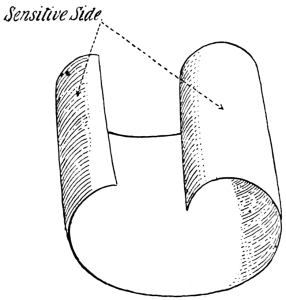
Having put into the dish on the tripod stand sufficient of the saturated solution of oxalate of potash to cover the bottom of the dish to the depth of half an inch or an inch, we light the lamp or stove and bring the solution up to a temperature of about 70° Fahrenheit. This may be tested with a thermometer or may very well be guessed by touch; we merely require the solution quite warm, but not so hot as to cause the slightest inconvenience if the fingers are placed therein. This will be a sufficiently accurate guide as to temperature.
In case any dust or scum should have accumulated on the surface of the bath, wipe the surface of the solution with a piece of clean paper, and now take the first print to be developed in both hands, giving it a decided curl, or roll it round into a cylinder sensitive side out, so that it naturally takes a curled-up form (Fig. 1). We now take the print to the dish containing the oxalate solution without previous washing and without exposing the paper to the influence of light or moisture, and lowering the edge of the paper held in the left hand, sensitive side downwards, until it touches the fluid quickly and smoothly bring the rest of the print down until the right-hand end finally reaches the solution, then give it a sliding sort of shake in order to set free any bubbles of air which may be imprisoned under the paper, and then on raising the paper again after five to ten seconds, the image will be found to have come out to the full degree of visibility, which the amount of exposure had paved the way for.
The paper may be returned to the oxalate bath for a minute or two longer if it be thought desirable, though only in the case of a very cold bath is any effect produced on the print by the oxalate after the first few seconds. The print is then passed direct to the hydrochloric acid bath, which should be ready in a dish close at hand, and the print is now practically finished.
Before placing the print in the acid bath it may be noticed that the portions of the print not affected by light still remain yellow, and this yellowness the acid bath removes almost at once.
In order to effectually remove the yellow surface (which is the unacted-upon sensitive salts and hence upon their removal the permanence of the print depends) three successive applications of the acid bath should be resorted to, the prints remaining for 5 to 10 minutes in each, and then finally washed in running water for a quarter-of-an-hour, dried between blotting paper or in any other manner preferred, and the platinotype print is finished and ready for mounting.
It should be seen from the foregoing general outline of the process that for directness, simplicity, and for the short time in which a finished print may be produced that platinotype stands alone amongst printing methods.
There are, however, some points needing careful consideration at each stage of the print's production, and to these we may now pay attention.
PRACTICAL CONSIDERATIONS AS REGARDS EXPOSURE.
As has already been stated right exposure constitutes the crux of the whole process; this once mastered the rest of the performance—development, clearing in acid and washing—is so simple that the chance of failure is remote.
Hence the greater need of paying especial attention to the question of exposure or printing.
Obviously, the duration of time of exposure cannot be fixed, not even to the extent it can be in bromide printing or any other method of printing with artificial light which may be a definite and permanent quantity.
The variable quality of the daylight and the density of the negative are both fluctuating factors in the calculation and hence some means may advisedly be resorted to for acquiring a sort of exposure index suitable for each individual negative and every variety of light.
First let it be noted that even with very great over-exposure the image will not become wholly visible, whilst to the inexperienced eye but little change takes place in the appearance of the printed image after the correct exposure has been reached.
If then the print has been over-exposed, the fact is not made evident until the print is subjected to the influence of the oxalate developing bath.
To start platinotype work trusting to chance or good fortune to secure for us good results, means that our whole course will be one of uncertainty and filled with exasperating disappointments to say nothing of the amount of paper and material which is certain to be wasted in unsuccessful efforts.
The reader will probably have learned something of this from his past experiences of negative exposure, the difficulties of which he has by now, we may hope, overcome by careful and patient study, or else if he is not even now undergoing this stage of learning he is the victim of endless mistakes, every plate exposed is a shot in the dark with no certainty attending any one of them.
Exposure, however, in platinotype is not so difficult a matter as that of a dry plate, and the correct exposure with any particular negative once ascertained, every subsequent print from the same negative can, by simple mechanical means, be made with the certainty of its being an exact facsimile of the others.
PRINTING WITH AN ACTINOMETER.
Several kinds of Actinometers are made for sale, the purpose of which is either to indicate the right exposure of a plate in the camera or to tell the duration of exposure for papers such as platinotype or carbon, the image on which is invisible, or nearly so.
A simple, yet thoroughly efficient meter may be made as follows:—Cut some fine tissue paper or papier minéral into strips about a quarter of an inch wide and attach one to a piece of clean glass 4¼ × 3¼ with fresh starch or other colourless mountant. Upon this first strip and exactly over it place a second, but bring it to within a quarter of an inch of the end of the first, next place a third strip in like manner a quarter of an inch short of the second strip, and so on until some seven or eight strips have been fixed. The combination will now be somewhat as the following drawing (Fig. 2), thus forming a tissue band which at each quarter-inch is one thickness more opaque.
Fig. 2.

In the centre of each strip or increased thickness, paint with opaque colour, black or red, a letter or figure as in (Fig. 3). On the back or other side of the glass to which these strips are attached, paint over or cover with opaque paper all except the space covered by the strips. Now place the whole in an ordinary ¼-plate printing frame, with the paper strips inside, next adjust a piece of silver paper, albumenized, or gelatine chloride precisely as though printing from a negative. Close the back and we then have a thoroughly efficient actinometer.
Fig. 3.

We now put out our first piece of platinotype paper to print, and alongside it so as to receive the exact same amount of light, we place our actinometer.
The first print must admittedly be guess-work.
After an interval of time, which may vary from say fifteen minutes to an hour according to the amount of light, we will withdraw the frame containing the platinotype print, and simultaneously turn the actinometer over with its face down, thus stopping its printing whilst examining the platinotype.
Retiring from the light we examine the progress of printing precisely as in silver printing, and we shall probably find that the image on the negative is now faintly visible on the platinotype paper, impressed in a sort of warm grey colour.
If the darkest portions are of about the tint which we might produce by shading with an H pencil on a piece of primrose yellow or pale buff paper, we may reckon that the print has been sufficiently exposed.
Now refer to the actinometer and see what has taken place on the silver paper which we put into it. Probably while the platinotype paper has been reaching the required depth of printing, the silver paper has also registered the image of the strips of paper, and has become printed through up to the fourth or fifth step of the tissue strips, showing on each strip its letter in white. Make a note of the highest letter visible and proceed to develop the platinotype print. If upon development the print is weak and grey, lacking depth or intensity in the deepest shadows, and having blank and detailless whites for the higher tones, we may reckon that our print is under-exposed. The letter visible then, with that particular negative is not sufficient. We then shift the paper in the actinometer so as to get a fresh portion under the tissue strips, or we substitute a new piece. We refill the printing frame and print again until the actinometer registers one, two, or three more steps and letters, and then try again. If, however, in the first case the platinotype print upon development gives a heavy dark print, with the details in shadows blocked up, and the high-lights grey, the whole possessing an overdone appearance, then in our second attempt we shall stop printing when the actinometer records some one or two letters less. But we may be more fortunate in our first attempt, and the print may be about right. In that case we mark on that negative in some way the tint or step or letter in the actinometer at which we arrested action, and henceforth, no matter the time of year, hour of the day, or latitude, that negative will give a similar print if stopped in accordance with that memorandum which it bears.
If, however, we do not hit the right exposure the first time, we are pretty certain to do so the second, or at the most the third time, and having done so, we have not only an infallible guide for all subsequent prints from that same negative, but we have also some sort of index to base our calculations on for other negatives. Thus if we at once proceed to print from another negative, that is, before any considerable alteration takes place in the light, we may by comparing the negatives at least estimate what will probably be the second negative's printing letter or step on the actinometer. Sooner or later every negative (especially those from which we anticipate wanting subsequent prints) should bear either on the negative itself, or else in a carefully kept register or note book its correct printing letter.
Although this may seem a rather laborious practice, it is not so in reality, and so great is its educational power that I anticipate that after the first dozen or so negatives we shall almost dispense with the actinometer altogether, having by then trained the eye to tell when a print is finished merely by the appearance of the half-visible image. Do not let this prospect, however, tempt the beginner to dispense with this valuable help at first, for to the inexperienced eye the appearance of the platinotype image is very deceptive, and having under-exposed the first print, it will not be safe to judge the extra printing of the next print only by the eye; the beginner is nearly certain to err, and the eye must not be trusted until it has had considerable training.
After having had some considerable and varied experience in platinotype printing, one feels no little regret that an operation which has become so simple cannot be laid before a beginner in a more precise and definite manner, and I can only assure my reader that in a very little while what may now look like a very serious business, only surmountable by long and serious practice, will become a sort of intuitive faculty, and just as one feels after a little practice the precise amount of pressure which one should use when the fingers are placed on the notes of the piano, so just the right visible depth of print required to give a developed print of such and such intensity comes to be a matter of instinct.
It may here be stated that paper which has been affected by damp gives a slightly less visible image than dry paper. But moisture alone without oxalate will effect partial development, and if the time of exposure to light be so greatly prolonged, that despite all precautions moisture obtains access to the print during exposure, this may, as it were, start a kind of local development whilst the paper is still in the frame and printing, so that on looking at the print to watch its progress some of the deeper shadows may have sprung quite suddenly into a deep blackish-grey colour. In many cases this will quite spoil the finished result, whilst in others no harm seems to be done when the print is ultimately developed.
Remembering that the high-lights and indeed some of the lighter tints of the print are quite invisible until after development, care should be taken to look at the paper only in decidedly subdued light, or better still, artificial light, because the injury which is being done by even a short exposure to actinic light is not made manifest until after development, and as most of us know how soon a piece of silver paper will discolour in even moderately faint daylight, we should be additionally cautious with platinotype paper which is from twice to three times as sensitive to light.
Fig. 4.
SOME POINTS TO BE CONSIDERED WITH REGARD TO DEVELOPMENT.
To avoid confusion it will be well to repeat here that at present we are only considering the practice of what is known as the cold-bath paper. This term is applied only in a comparative sense. The older hot-bath process requires the developing bath to be raised to a temperature of about 170° F., whereas the best temperature for the cold process is about 70° F. or even less; nevertheless, the cold-bath paper may be developed in an oxalate bath of 170° or even hotter, so also it may be developed on a solution which is quite cold. The result of altering the temperature is two-fold and may be stated thus:—The colder the bath, the colder the colour, that is, the bluer the greys and blacks, also development is slower and takes longer, and the contrasts harder. The hotter the bath the warmer or browner the colour of the print; the more sudden the development and the greater the amount of half-tone and consequent softer contrasts.
With these maxims in mind some amount of control may be exercised over the prints produced, especially as regards arresting development at any point desired if a cold developer be used, but in such case the print must be instantly removed to and plunged into the acid bath, until which immersion development continues, even after the print has been removed from the bath.
Development, as a general rule, should be conducted in feeble daylight or artificial light.
Development need not take place immediately, but at some subsequent time, provided the prints be meanwhile stored in a calcium tube and in every way rigorously protected from damp.
The proportions which I have given for the oxalate of potash bath represent the standard developer as given by the makers of the paper for the hot-bath papers, and they recommend that this be diluted to about half strength for cold-bath papers. Personally, I use it at full strength for the cold process, and see no reason for diluting it.
It may be said that such a course is calculated to give strong, vigorous prints, for generally speaking, the stronger the bath, the stronger the contrasts of the print. The difference, however, produced by altering the strength of the bath is not very great.
There are two alternatives to the oxalate of potash developer, both possessing certain, if not very strongly marked characteristics. The first of these is known as the "D" salts. These are sold in tins by the Platinotype Company, and consist of a loose admixture of certain salts, and hence it is essential that the entire contents of a half-pound tin be dissolved at once and kept thus as a stock solution.
The proportions to be used are as follows: Dissolve ½ lb. of D salts in 50 ozs. water, and then take equal portions of this solution and water, in other words, dilute it to half-strength.
The "D" salts are said to give colder colours and more half-tone, but the colour derived from development on the first-named oxalate bath may be made colder by adding to 20 parts of developer 1 part of a saturated solution of oxalic acid, in like manner slightly warmer colour may be obtained if the oxalate bath be made alkaline by the addition of carbonate of potash, but only just enough should be added to turn a red litmus test paper blue.
If prints developed on D salts should appear mealy or granulated, the bath should be strengthened or used at the full strength of the stock solution (salts ½ lb. to water 50 oz.).
Another developer, the effect of which is to minimize half-tone and increase the vigour of the contrasts, and so give very brilliant and even hard blacks and whites, is as follows:
Oxalate of potash 16 ozs.
Phosphate of potash 4 ozs.
Sulphate of potash ½ oz.
Water 120 ozs.
This should be made with hot water, and to get the full advantage of its contrast-giving powers, used quite cold. Development will then probably take one or two minutes, but can be arrested sooner when the desired effect is attained.
It may now be as well to enumerate and describe the various kinds of platinotype paper obtainable, and whilst the general treatment of them all is the same as described in the foregoing, some special recommendations may be made in each case.
The papers for the Cold-Bath process are two called respectively AA and CC. AA is a smooth surface paper and is the kind usually employed for portraiture and general small work. CC is a heavier, stronger paper with a surface similar to stout cartridge or drawing paper. For pictorial work and for landscapes, also for large portraits or heads this paper is eminently suitable.
Next we have the papers for Hot-Bath process, to be presently described. These are firstly A and C, both precisely the same in character as the AA and CC just referred to, but intended to be developed in a bath at high temperature. These four kinds of paper all yield a picture of the normal platinotype black colour, the black tending to cooler or warmer tints according to slight modifications of treatment, but it is also possible to produce a platinotype print of a rich sepia brown by using the papers S and RS—these both in substance and character corresponding with AA or A and CC or C respectively. Thus we have a thin smooth and a thick rough paper for each Cold bath, Hot bath, and for Sepia printing.
DEVELOPMENT OF HOT-BATH AND SEPIA PAPERS.
With the Hot-Bath papers perhaps the precautions against damp should be rather more stringent than for Cold-Bath papers, certainly they may not be relaxed, and in the sepia papers, S and RS, there seems to be even greater susceptibility still, but for this, printing and development are performed precisely as already described, but the temperature of the oxalate bath should not be less than 150° to 170°, whilst in some cases it may be convenient to raise it still higher. The oxalate solution should, moreover, always be at full strength, namely, ½ lb. in 25 ozs. of water or thereabouts, a much more diluted bath will result in granular prints.
As a general rule the colour of A and C prints is a rather browner black than their cold-bath equivalents—AA and CC—with also rather softer contrasts.
Development takes place in shorter time than with cold-bath papers, and is indeed so instantaneous that any control is next to impossible. On this account, rather more dexterity will be required in development, that is to say, between the time that one end of the print touches the developer and the rest of the print is brought into contact with it, the shortest possible time should elapse. There must be no hesitation, the whole surface must be brought down gradually but swiftly, and accompanied by a sliding movement in order to squeeze out or wipe out any air bubbles which might cling to the surface of the paper. If this be not done evenly and continuously, it is more than likely that there will be marks of unequal development on the surface.
Fig. 5.
It is no uncommon thing for the tyro to let the print hover over the bath before giving it its plunge in the hot solution, but in so doing it should be remembered that he is submitting it to the direct action of the steam which the bath is giving off, and so exposing it to damp.
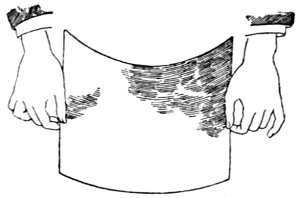
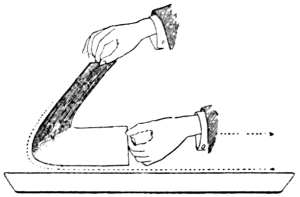
Whilst with prints of ½-plate size and under it may be sufficient to hold the print by one corner and wipe it across the surface of the solution, pressing it down with the fingers of the other hand, with larger sizes it will be well to cultivate a little trick in manipulation, and the accompanying figure may perhaps be suggestive (Fig. 5), in which it will be seen the left hand is bringing one end of the print into contact with the bath, whilst the right hand holds the opposite end above and well back, and the left hand will next be moved in the direction of the arrow, drawing the print with it along the surface of the bath, the right hand following but simultaneously lowering the whole of the print—thus the solution attacks the print smoothly and continuously, whilst the air is pressed out in the opposite direction. Instantly the entire print is floating on the bath it should be moved about a little, as a further means of disengaging any air bubbles.
As far as possible, prevent the developer from flowing over the back of the print, but this will be a far less evil than not bringing the whole printed surface immediately and at one stroke on to the developer. The print is next passed direct and without intermediate washing into the hydrochloric acid bath, as already described.
The sepia papers, S and RS, are both hot-bath papers, and no special instructions need to be given as regards development, except that to get the full benefit of the sepia tint and secure a fine rich bright colour, the Special Sepia Solution prepared and supplied by the Platinotype Company should be employed in the developer.
Of this, one or two drams should be added to each ounce of oxalate bath, either before heating it in the dish or afterwards and just before floating the prints. In the latter case stir the whole so as to get it equally mixed, and wipe the surface to remove any scum.
A good substitute for the bath as above prepared for sepia prints may be made by adding one part of saturated solution of oxalic acid to each ten parts of oxalate of potash solution.
The Sepia papers are rather more sensitive to light than the Black papers, and hence all operations should be conducted in very subdued daylight, a precaution even extending to the first acid bath.
The bath containing the special solution should be used for sepia prints only, and when done with kept in a separate bottle for future use, but the bottle must be kept from the light, and the sediment which will fall should be left undisturbed at the bottom of the bottle or filtered out, and the dish used for sepia development should be well washed before using it for black prints.
Opinions seem to differ as to the wisdom of keeping old developing baths, but as far as my own experience goes I use the oxalate solution for black prints again and again, taking no heed of its discoloured condition.
After developing, the bath is poured into the stock bottle, and so long as undissolved crystals remain at the bottom of the bottle hot water may be added from time to time to make up the loss occasioned by spilling and waste, thus the stock solution is always a combination of old and freshly-dissolved oxalate, and I have had one large jar of solution thus in very frequent use for over twelve months, a greenish-black encrustation gradually accumulating at the bottom without detriment.
CONCERNING THE HYDROCHLORIC CLEARING OR FIXING BATH.
Little needs to be said as to the Hydrochloric Acid bath into which the prints are passed immediately after development. The purpose of the acid bath is to dissolve out the sensitive salts which have been unaffected by light and which are still light-sensitive, the removal of these making the paper white and clean. Thus the acid bath is both fixing and clearing in its action.
Into the first acid bath the prints will carry a good deal of the oxalate solution in which they have been developed, and it therefore soon becomes very much discoloured, wherefore after a lapse of about five minutes the print should be removed to a second acid bath of the same strength as the first (pure hydrochloric acid 1 part, water 70 parts) and after five or ten minutes into a third.
After the prints (many may be done at the same time) have been in the third acid for five minutes, the bath should be examined, and if it is quite colourless, that is if the prints have not discoloured it at all, we may rest satisfied that clearing and fixation are complete, but if not, yet another acid bath should be given.
Whilst five or ten minutes in each acid bath is long enough, probably no harm to the print itself, yet no good, will follow a longer immersion. There may, however, be a danger of softening or rotting the paper, a danger which is increased should the bath be made stronger in acid.
If a number of prints are being made, or if numerous dishes for acid constitute a difficulty or inconvenience, we may modify procedure as follows:—
Make up the first acid bath to about half the prescribed strength, say hydrochloric acid one part to water 120 to 140 parts. Into this each print may be flung as soon as developed, until the entire batch is thus far finished. In this weak acid bath the prints will take no harm if left for several hours, when an acid bath (one to seventy) of full strength having been prepared, the first weak solution may be poured off and the fresh poured on. In this the prints should be separately turned over, so that each receives thorough treatment, when the second bath may be thrown away and a third substituted. One dish thus serves for the whole series of acid baths.
If adopting this course, it will be safer not to mix sepia and ordinary black prints in the same first acid bath, after which, however, they may be treated altogether.
Sufficient washing to rid the paper of acid is all that is required to complete operations; but acid does not cling to the print as does hypo, moreover, we have not an absorbent gelatine surface to deal with, so that if prints were dealt with individually and washed by hand, probably a few minutes sluicing under a tap would suffice, but in a properly constructed print-washer, or even a large dish, twenty minutes to half-an-hour should be ample. If any doubt is felt, the last washing water may be tested with blue litmus paper.
MODIFICATIONS IN DEVELOPMENT.
To impart a warmer and richer tone to prints on CC (cold-bath) paper, the following slight modification may be resorted to, but it must be regarded merely as an exception for definite purposes, being in violation of the instructions and rules already laid down. It consists of developing CC paper as though it were hot-bath paper, using a bath of about 170° F and submitting it to the influence of damp to a slight degree. This latter very heterodox course may be effected by leaving the paper laid out all night in a room where there has been no fire to dry the air, or by using paper which has been kept for a week or so in its tube without calcium chloride and without sealing the lid, or yet again, the print may be held over the steam of the developer for a few minutes before developing it.
It must be remembered that in doing this we are taking liberties with the process, and if poor, "muddy" prints result, we can only blame ourselves, but as a rule this will not be the case, the effect being rather to impart a slight creamy tone to the whites without otherwise degrading their brilliance, whilst the use of a hot bath gives the whole a distinctly brown-black image, which combined with the cream tint of the high-lights has a very luminous and warm effect.
Another method of development which must also be taken as an exceptional one, only to be used in special cases to attain special ends, is local development with a brush, using glycerine as a medium.
As may have been seen from the foregoing descriptions, the development of a platinotype print, even with a cold bath, is so rapid that there is not a possibility of developing one portion more than another, or if such could be done, still it would be done with the certainty of leaving a mark where development had been stopped. These difficulties, however, may be overcome by the use of glycerine, the effect of which is to retard development to almost any degree, and by its soft, viscid character to soften and blend the line of demarcation where greater or less development ceased. The method of applying it is as follows: On removing the print from the frame it should be fastened to a board with pins, print side upwards. Next pour on to the surface a small pool of pure glycerine, and with the finger tip, a brush or soft pad, spread it evenly and thinly over the print. It must not be allowed to remain on the surface in irregular patches of unequal depth, but after spreading it had better be wiped with a fresh pad of cotton wool, so as to remove any superfluous glycerine. Now have four small vessels at hand, and into No. 1 place an ounce or two of the ordinary oxalate developing solution, in No. 2 put equal parts of oxalate solution and glycerine, in No. 3 one part oxalate solution and two parts glycerine, and in No. 4 pure glycerine.
With a broad, soft hair brush apply the contents of No. 3 to the less printed portions of the image and wait results. These portions will presently begin to gain in depth and to slowly develop up, now spread the No. 3 mixture to the rest of the print and apply the contents of No. 2 to the portions first treated with No. 3. The most obstinate parts may be touched with No. 1, plain oxalate solution, whilst any spots which have come up too quickly may be promptly arrested from further progress by the application of pure glycerine.
Here we have a method of developing up any one part, and restraining or entirely stopping any other.
I do not think any good will be done by a more detailed description of its working, even if there be anything more to tell. It is essentially a method of development in which the individual worker will invent modifications and dodges for himself, and when all is said for it, it must be admitted only as a means of improving a subject when ordinary procedure fails.
THE CHARACTER OF THE NEGATIVE FOR PLATINOTYPE.
In the earlier days of platinotype printing it was generally insisted upon that the most suitable negatives were such as we should describe as somewhat vigorous or "plucky." Whether it is that some alteration has been made in the manufacture of the paper or that taste as regards what constitutes a good print has changed, I cannot say. Certain it is that in the experience of a good many, a "plucky" negative is by no means essential to the production of a good platinotype print.
The soft, delicate negatives, of which the best professional portrait negatives are a good sample, yield the best possible results, whilst with the CC paper, negatives so thin and delicate as to be suitable for hardly any other printing process, give all that can be wished for.
Much, of course, will depend on the kind of print desired and the paper used, and here it may be remarked that from a given negative the different kinds of platinotype paper give different results.
From a given negative the hot-bath papers yield the greatest amount of half-tone, the hot development tending to yield flatter results. Next comes the smooth, cold-bath paper, and finally as yielding the maximum amount of vigour is the CC paper. Hence if we make our negatives specially for our chosen printing process, a stronger negative will be needed for S, RS, A and C than for the AA and CC, whilst for the latter a negative distinctly erring on the side of extreme thinness will be best.
If a negative gives prints which are too weak and flat for our purpose, a great improvement may be effected by printing through blue glass. If on the other hand the prints are too hard and harsh in contrast, it is advisable to print through "signal" green glass.
TONING PLATINOTYPE PRINTS.
Several formula and methods have been published from time to time, the object of which is to change the colour of the platinotype print by subsequent staining or toning, and whilst by such methods pleasing colours may sometimes be obtained, they possess an element of uncertainty, and must not be too much relied upon. An exception in this respect must, however, be made in the case of what is known as Packham's method, the effect of which is to change the black platinotype to a sepia brown, or a brown slightly tinged with green. The necessary "tinctorial powder" must be obtained from Mr. Packham or through a dealer. To prepare the bath a packet of this powder is dissolved by boiling for three or four minutes in five fluid ounces of water, to which when cold add one ounce methylated spirit. This forms the stock solution and will keep for a long time if well corked. For use add thirty or forty minims of the stock solution to one pint of water, and in this steep the prints, turning them over frequently. Toning may occupy several hours. To expedite matters, the dilute solution should be made with water of 150° F., and the bath maintained at this temperature as in the case of hot-bath development. As soon as the desired tint is secured, remove the prints and wash well in three changes of cold water.
Prints may be so treated at any time after they have been made.
Glycerine developed prints are not suitable. Prints must have been very thoroughly washed, so as to free them from every trace of acid, also thoroughly fixed in acid if they are to be "toned" by Packham's method. If after "toning" and washing the whites of the print appear to have suffered, the prints should be placed for five or ten minutes in the following bath, which should be kept at a temperature of 180° F.
Castille soap 40 grains.
Bicarbonate of soda 80 grains.
Water, hot (180° F.) 1 pint.
This will clear the whites and intensify the colour generally.
Platinotypes may be toned to a red-brown by uranium nitrate, or to a bluer colour with chloride of gold. They may also be intensified by pyrogallic acid or hydroquinone, but as the purpose of this article was merely to give simple working instructions for platinotype printing for the beginner, he may defer the consideration of such side issues until he has become au fait in the production of a good platinotype print.
A. Horsley Hinton.