P.O.P.
Reading edition
The three letters "P.O.P." are now so widely understood as referring to the Gelatino-Chloride Printing-Out class of Papers that it may be said that P.O.P. is known to many who are not acquainted with the fully-written name of this class of productions.
Also it should be mentioned that when these papers are spoken of as gelatino-chloride papers it is not to be concluded therefrom that chloride of silver is the only silver salt present. What they do actually contain is probably only known to their respective producers. But generally speaking, it is enough to say that so far as the ordinary consumer is concerned, the family resemblance is so strong and chief characteristics so general that the following directions for using them may be held as generally applicable to the various well-known brands now on the market. At the outset, however, it will be convenient to note that for the purposes of manipulation we may roughly group them into two chief classes—viz., the matt (probably from the German word "matt," i.e., dull) and the glazed, glossy or enamelled. The latter comes to us with a highly glazed, i.e., shiny smooth surface, the former being slightly rough, of a surface and texture somewhat like that of very finely ground glass.
Care of the Paper.—The paper is sent out either in the full-sized sheet, measuring about 24 × 17 inches, or in smaller cut sizes, suitable for the usual 1/4, 1/2, 1/1 plate and other popular dimensions of plates. Compared with albumenized print-out paper, P.O.P. is more sensitive to light; therefore, some care must be taken to avoid needlessly exposing it to the influence of daylight or strong artificial light. For example, the printing frames should be filled as far away from any window as possible, and the prints examined from time to time either by gaslight or as feeble daylight as possible.
In handling the paper—cutting it up, etc.—care must be taken to avoid touching the sensitive surface with the fingers in any case. The touch of a moist or hot finger is very likely to produce a mark or stain which is usually irremovable. The paper should be protected from damp, excessive heat and impure air. If kept rolled in a tin tube or flat under pressure in the original packages, it will keep a considerable time—i.e., longer than ordinary albumenized paper.
Printing is done in the usual way. Strong diffused light reflected from the sky or clouds usually gives a better print than direct sunshine. In case, however, of a thin flat negative—i.e., one with insufficient contrast—good results may sometimes be obtained by covering the printing frame with a sheet of green glass and printing in moderately strong sunshine. In hot summer sunshine it is as well to cover the green glass with a sheet of tissue paper or fine-ground glass. Care must be always taken when printing in sunshine or very hot weather to see that the negative itself does not get too warm, or the paper may stick to it. In this case the print is of course lost, and the negative, unless varnished, is also probably seriously damaged by silver stains, which are very difficult to remove. Printing should not be carried quite so far as in the case of ordinary albumenized paper because in the subsequent operations of toning, etc., not so much strength is lost. The same care as regards shielding from light, etc., should be given to the prints after they leave the printing frame. They may be proceeded with at once or kept for some days before being toned, etc., but if this is done the prints should be kept under pressure. Some workers have thought that the light action goes on, "continues" in the print after it is removed from the printing frame. This, however, is not the generally received opinion.
Washing.—It is important that the first washing should be done with some care, or the prints may become stained. The points calling for attention are (1) running water and plenty of it, (2) care to see that the prints do not stick together. What is needed is that the soluble salts should be washed out of the paper as quickly as possible, and that the prints be not allowed to remain in the water containing these soluble salts longer than is necessary. Hence the advantage of running water and plenty of it. The washing water must not be too cold or the salts will not pass out of the paper quickly enough; and again, it must not be too warm or the gelatine will melt. The best temperature is about 65° F., and the limits should not go beyond 60° and 70° F., and preferably are kept within 60° and 65° F. As the paper is usually rather stout, it will need washing in running or constantly changed water for about ten to fifteen minutes, and in any case must be continued until all milky appearance of the water ceases. The print at this stage has a red-brown colour. If it is now passed direct into the fixing bath without toning it becomes somewhat more yellow, and when dry is usually a colour somewhat between yellow ochre and sienna.
Toning is usually our next operation, and for this purpose we have a variety of toning baths recommended by different workers. The sulphocyanide and gold is perhaps the chief favourite.
1. Ammonium sulphocyanide 10 to 15 grains.
Gold chloride 1 grain.
Water 8 to 10 ounces.
The proper way to mix this bath is to add the gold to the solution of sulphocyanide a little at a time. The following method will be found convenient. As ammonium sulphocyanide is somewhat deliquescent, it is convenient to keep it in solution. Therefore, one ounce of the salt dissolved in twenty ounces of (distilled or filtered rain) water gives us roughly a strength of twenty-two grains per ounce. Dissolve the contents of a fifteen-grain chloride of gold in fifteen drams of distilled water. To mix a bath, take of the sulphocyanide solution half-an ounce; to this add eight ounces of water. Now take one dram of the gold solution and dilute with one ounce of water. Then add this dilute gold solution a little at a time to the eight ounces of sulphocyanide solution, and stir well with a glass rod. It will be noticed that as the gold solution drops into the sulphocyanide solution an orange-red precipitate is formed, which is redissolved on stirring. Hence the gold must be added to the sulphocyanide, and not vice versa.
2. Another favourite bath is as follows:—
Ammonium sulphocyanide 22 grains.
Soda sulphite 2 "
Gold chloride 2 "
Water 20 to 25 ounces.
Instead of weighing out two grains of sulphite it is more convenient to weigh twenty grains and dissolve in two-and-a-half ounces of water—i.e., at the rate of one grain per dram of solution. Thus, to mix this bath, take an ounce of the above-mentioned sulphocyanide solution dilute with twenty ounces water. To this add two drams (¼ oz.) of the sulphite solution. Then take two drams of the gold chloride solution and dilute with an ounce of water, and add slowly with stirring as before.
3. Another favourite bath is:—
Sodium chloride (table salt) 60 grains.
Ammonium sulphocyanide 15 "
Gold chloride 2 "
Water 10 to 12 ounces.
Some of the adherents of this bath recommend that the prints be only washed in running water for a few minutes and then put into the toning bath. Others advise the prints to be immersed in the toning bath without any previous washing—i.e., straight from the printing frame.
4. Here, again, is another bath which usually yields excellent results:—
Soda phosphate 5 grains.
Sodium chloride (table salt) 20 "
Gold chloride 1 grain.
Water 10 ounces.
5. Other workers omit the sodium chloride and increase the phosphate and get good tones.
Soda phosphate 20 grains.
Gold chloride 1 grain.
Water 10 ounces.
6. Others, again, combine the phosphate and sulphocyanide baths thus:—
Sodium phosphate 10 grains.
Ammonium sulphocyanide 15 "
Gold 1 "
Water 10 ounces.
The various toning baths mentioned above have one drawback common to them all in varying degrees—viz., that when once mixed and used they do not keep in good working order longer than a few hours.
7. The following bath claims to have the advantage that it will keep in working order for a short time at any rate, but the disadvantage that it cannot be used until it has been mixed twelve to twenty-four hours.
Soda acetate 60 grains.
Ammonium sulphocyanide 20 "
Gold chloride 1 grain.
Water 12 ounces.
Toning should be conducted in very weak daylight, or what is much better, gas or lamplight. The latter, being practically constant, enables the operator to judge the relative colour of the prints from time to time. Care must be taken so that the prints do not stick together in the toning bath, and preferably only a few, say half-a-dozen or so, dealt with at a time, so that each print can be frequently turned over and examined. The change of colours proceeds somewhat slowly at first, but when once it begins it seems to gain in rapidity of rate of change, so that a careful watch must be kept. Let it be remembered that the print, after fixing and drying, will appear a little darker and more blue (less red) than when wet in the toning bath. The temperature of the bath must not be too cold or toning is very slow, nor too warm or the gelatine may melt and toning be uneven. From 60° to 65° F. will be found a convenient range. The prints should not be touched on their printed surface more than can be helped. The fingers must be quite clean, the solutions uncontaminated with other chemicals, and a dish set apart for toning operations only. This dish should always be washed out well with tepid or cold water before and after use, and when put away should rest flat, opening downwards, on a shelf covered with a sheet of clean blotting paper. Many failures in toning are entirely due to lack of care in details and sufficient attention to cleanliness.
When toning is judged to be carried far enough, the prints should be placed in a roomy dish containing a solution of common salt, strength one ounce to twenty or thirty ounces of water, to stop further toning.
Fixing is done with a "one in ten" solution of sodium thiosulphite—i.e., hypo. This should be prepared with tepid water, or some time before use, as the dissolving of hypo in water is accompanied by a fall of temperature. A convenient method is to place a couple of ounces of hypo in a clean pint jug, and add about half a pint of fairly warm water and stir with a glass rod until the salt is dissolved, then fill up the jug from the tap with cold water. It is highly desirable to have plenty of fixing solution, and never attempt to use the same lot twice. Place each print face down in the bath and submerge by pressing on its back. Again see that the prints do not stick to each other, and turn each print two or three times. They should be in the fixing bath not less than twelve or fifteen minutes, and a few minutes longer will do no harm. At the end of, say, fifteen minutes, pour away about one half of the fixing bath and slowly fill up with water. Turn the prints again, and then transfer them one by one to another roomy dish and wash in running water for a couple of hours, or in a dozen changes of water every five or ten minutes. Then hang up to dry, using either clips or pin a corner to the edge of a wooden shelf or long lath suspended in a cool, airy place.
Alum Bath.—Hot weather considerably increases the danger of the gelatine melting. To meet this trouble the following plan has to be resorted to:—
8. Dissolve common (potash) alum, one ounce in a pint of tepid water. Let it stand until cold and pour off gently the clear part should any sediment appear. After washing and before toning, place the prints in this alum bath for about ten minutes and again wash before toning for ten or fifteen minutes in running water.
The Combined (Toning and Fixing) Bath.—The general weight of opinion is not in favour of combining these two operations at one time when reliable results are desired. Nevertheless, there are times when this method may be found a convenience and yield results which are all that may be desired. The following bath is a favourite with some workers:—
9. Ammonium sulphocyanide 15 grains.
Table salt 30 grains.
Hypo 2 ounces.
Water 10 ounces.
To this is slowly added one grain of gold chloride in half an ounce of water. The prints first washed for five or ten minutes in running water, and placed in the combined bath and kept moving by being constantly turned over and over for about ten or fifteen minutes. The longer they remain in the bath the more blue and less red will they be when dried.
Here is another bath which finds some stout supporters:—
10. Ammonium sulphocyanide 20 grains.
Hypo 1 ounce.
Alum 30 grains.
Water 10 ounces.
Shake well, until thoroughly dissolved, then add
Lead nitrate 20 grains.
Again shake well and set aside to settle, pour off the clear part, and add
Gold chloride 1 grain.
dissolved in half an ounce of water.
Others recommend a still more simple bath as follows:—
11. Hypo 1 ounce.
Water 8 ounces.
Gold chloride 1 grain.
It is said that this bath gives better results if it is prepared a few hours before use, e.g., prepared in the morning and used in the evening. Meanwhile, it should be kept away from daylight, and not in a very cold place.
Drying and Glazing.—Some workers are of opinion that it is better to first "rough dry" the prints, e.g., by suspending by clips, or pinning one corner to a strip of wood, etc., and then to wet again and dry on a rough or smooth surface according as a matt or glazed final effect is desired. If however, the print has been through the alum bath (No. 8.) this preliminary rough drying may not be necessary.
Matt Surface.—The matt paper when rough dried has a matt or slightly rough surface, but it may be desired to accentuate the effect. This may be done as follows:—Thoroughly clean with soap water and a nail brush a sheet of "fine-ground" glass similar to that used for a focussing screen. When quite dry, lightly dust it with fine talc powder (French chalk) and polish off again with a bit of clean rag. Now slip this plate rough side up into a dish of cold water, which also contains the print face downwards. Bring the print and glass into contact under water, carefully avoiding any air bubbles between them, as the two together are now raised from the water; firmly, evenly, but lightly pass a squeegee over the back of the print now in contact with the glass. Then lightly press a sheet of blotting paper over the print to take up all adhering water, and set up in a cool airy place to dry, e.g., in a passage or between the door and half-open window. When quite dry, the print will very probably of itself come away from the glass, but if not, the finger nail inserted under one corner and a gently backward pull will separate it from the glass. In place of the fine ground glass, rougher glass of course may be employed. Some workers also use for the same purpose a sheet of roughened celluloid. This is more costly than glass, but being not so fragile may prove cheaper in the end.
Glazing Prints is done exactly in the same way, with the single difference, of course, that we use a smooth piece of glass, vulcanite, celluloid, paper maché slab, sheet of ferrotype metal, etc., etc., in place of a ground-matt, or rough surface. All the above-named substances have their partizans; perhaps the greatest favourite being good plate glass free from scratches. In all cases it is important to attend to two points, viz., thoroughly cleaning the support and waxing it. Various substances and mixtures have been recommended for giving a glaze, polish to the glass, etc. Many workers adhere to the powdered talc or French chalk already mentioned. Others prefer some of the mixtures given below:—
12. Bees wax 20 grains.
Turpentine 1 ounce.
13. Spermaceti 20 grains.
Benzole 1 ounce.
A few drops only of the lubricant are applied to the glass plate with a bit of clean flannel, and well rubbed all over. Then a final polish is given with a clean old silk handkerchief, or clean dry wash leather. On no account attempt to strip the print from the glass until the print is quite dry or failure is more than likely to arise.
Mounting.—Care should be taken that the mountant does not give an acid reaction. Test with litmus paper. Clearly it is no use being at the trouble of producing a high gloss on the print if we are going to damp the print and so destroy the gloss in the operation of mounting. To avoid this, various plans have been adopted.
(1.) If a cut-out mount is used it will suffice if the print be attached to the mount by glue at the edges only of the "cut-out." (2.) Another method is to paste down on to the back of the print before it is quite dry, and while still on the glazing support, a backing of thin waterproof paper specially prepared for this purpose. This prevents the moisture of the mountant penetrating to the print. (3.) Another plan is to use a mountant which does not contain water. The following mixtures are recommended:—
14. Masticated rubber 10 grains.
Benzole 1 ounce.
A thin layer of this is applied by means of a short, stiff, flat hog's hair brush to the back of the print. It is then allowed to evaporate for a minute or so, and when tacky is applied to the mount, covered with a sheet of glazed paper, and a roller squeegee passed over the surface.
15. Saturated solution of bleached shellac in alcohol.
This must be applied as thinly as possible.
16. Le Page's fish glue applied to the edges only of the back of the print.
A fourth method is to first carefully clean the edges of the glass surrounding the print still adhering to it. Then to paste down the mount to the print and let all dry. Then strip the print from the glass now already mounted. This is, however, a process not to be recommended, because requiring a long time for the print to dry, as the evaporation has to take place through the substance of the mount.
ADDITIONAL PROCEDURES WITH P.O.P.
Development of Partially Printed Proofs.—This method of procedure is sometimes a matter of convenience in dull weather, etc. The printing is to be carried on until one can just see a very slight indication of detail in the high-lights. It is then washed in running water for about ten minutes, and then put into a ten per cent. bath of potassium bromide, and there it remains for another ten minutes or so. In this bath some of the image seems to fade away, and generally the print takes on a yellow tinge. The print is next washed in running water for about ten minutes, and then developed with ortol, metol, or preferably, hydroquinone. A considerable variation in the proportions of the constituents of the developer are possible. In general terms, one may say that a developer which gives a good black and white lantern slide when diluted with about an equal quantity of water will give a satisfactory print.
17. As an example of a thoroughly practical developer for this purpose we may give just one example:—
A
Hydroquinone 70 grains.
Potassium metabisulphite 5 "
Potassium bromide 30 "
Water 20 ounces.
B
Soda sulphite 1 ounce.
Caustic soda 60 grains.
Water 20 ounces.
Take equal parts and mix just before use, wash for at least ten minutes in running water at once after development.
Developed prints may be toned in the combined bath 9, 10 or 11, or may first be fixed, then thoroughly washed, and then toned and again washed.
If good results are wanted by the development process it is important to be careful that the paper is not exposed even to weak daylight more than can be helped, and not even to strong artificial light more than is necessary. At the same time it is quite practicable to do the operation of the bromide bath and developing in fairly strong gas-light, i.e., one need by no means be limited to the ordinary dark-room light as when developing plates.
Another point worth noting is that it is quite practicable to use magnesium ribbon for printing. For a rather thin negative it will be perhaps found sufficient to burn about a foot of the metal ribbon about three or four inches from the glass. The printing frame should be set up on edge in the vertical plane. The strip of metal ribbon is held by a pair of pliers, and ignited at the flame of a candle or spirit lamp. The lid of a biscuit box just in front of the frame does very well to catch the white magnesium oxide formed by burning. It is as well to move the flame of the burning metal opposite various parts of the negative during the exposure. It will be found a comfort to wear a pair of rather dark blue glasses during this operation, as the bright light of combustion prevents one seeing anything with ease for a little while.
After development the print may be fixed only, and under certain conditions it is possible to obtain a fairly satisfactory black or brown colour without toning, but there is usually a slight tendency towards rather too much yellow.
Platinum Toning.—This method of toning is a favourite with many workers. By it a considerable variety of colour tones may be obtained, from a rich red chocolate brown through sepia brown to a warm black.
The following toning baths have each their several advocates, and each worker must discover by experiment the one that gives him the particular brown colour he prefers:—
18. Potassium chloroplatinite 1 grain.
Water ½ ounce.
Add dilute nitric acid (one part strong acid, twenty parts water) drop by drop until the mixture just turns a bit of blue litmus paper a red tinge. Now take a glass rod and make of it a mop by tying a small bunch of clean cotton wool over one end, using for the purpose a bit of white cotton. Having thoroughly washed the print for at least ten minutes in running water, lay it face up on a sheet of glass, and apply the above toning solution with the cotton wool mop. Having got a tint or colour nearly what you want, but allowing for a loss of red in fixing, wash off the toning solution and immerse the print in:—
19. Washing soda 1 ounce.
Water 10 "
for three or four minutes, and then fix in the usual way in a ten per cent. hypo bath.
Here are some platinum toning baths well recommended:—
20. Lactic acid 2 drams.
Water 12 ounces.
Pot. chloroplatinite 2 grains.
21. Citric acid 20 grains.
Water 10 ounces.
Table salt 20 grains.
Pot. chloroplatinite 2 grains.
22. Phosphoric acid 3 drams.
Water 10 ounces.
Pot. chloroplatinite 2 grains.
The chief points to bear in mind in platinum toning are: (1) that the print must have practically all the free silver washed away before toning. To this end it is a very good plan to dip each print for a couple of minutes or so in a bath of table salt one ounce, water ten ounces, and again rinse under the tap for a minute or two.
(2) That the toning bath is acid, therefore one must either neutralize this acidity by passing through an alkaline bath, such as No. 19, or what perhaps is rather more convenient, though not quite so desirable—i.e., using a fixing bath made distinctly alkaline. The following proportions are recommended:—
23. Hypo 1 ounce.
Water 10 ounces.
Soda sulphite ½ ounce.
Washing soda ½ "
Toning with Gold and Platinum.—A large number of experimenters have tried to find out how to produce platinotype-like effects with P.O.P. papers. Perhaps none of them have been completely successful. The following procedure, however, seems to give the nearest approach to that ideal.
The best results are obtained with a slightly matt-surfaced paper. This should be printed a shade or two deeper than the print is intended to appear finally. The print is well washed and then partly toned in a gold bath:—
24. Soda acetate 30 grains.
Borax 25 "
Water 10 ounces.
Gold chloride 1 grain.
It is then washed for a minute or so, and the toning continued in the following bath.
25. Phosphoric acid 1 dram.
Water 5 ounces.
Pot. chloroplatinite 2 grains.
Wash for five minutes and fix in bath 23.
Intensifying and Reducing P.O.P.—When the negative is obtainable and printable it is very much better, and altogether more satisfactory to make a fresh print than to attempt to intensify or reduce an unsatisfactory one.
Nevertheless, it sometimes happens that this course is not possible, and the best has to be made from an unsatisfactory print.
If the print is only very lightly printed, and comes straight from the printing frame, it is best to strengthen it by development (see formula 17 et seq.). If the print has been toned and fixed, etc., the following may be tried:—
26. Make a saturated solution of mercury bichloride in cold water, let it settle, and use only the quite clear supernatent liquid. Immerse the print in this for 15 minutes, turning it from time to time, and see that no air bells are clinging to either side. Wash the print in running water for 15 minutes at least, and longer if convenient. Then immerse it in a bath consisting of strong ammonia one part, water ten or twelve parts. Again wash for five minutes under the tap.
Reducing P.O.P.—
27. Hypo 120 grains (120·)
Uranium nitrate 4 "
Water 2 ounces.
The advocates of this solution claim for it that it can be used either before or after toning with equal facility and advantage. Prints must be well washed both before and after its use in any case.
Another method, which is somewhat risky except in expert hands, is as follows:—
28. Dissolve metal iodine in alcohol to a rich dark port wine colour. Dilute a small quantity with cold water until the whole is a pale sherry colour. Now prepare a one in ten solution of potassium cyanide (N.B.: a powerful poison) and add this a little at a time until the pale yellow colour of the iodine solution is just discharged.
The print may be immersed in this until sufficiently reduced, or it may be applied locally with cotton wool mop (as described above under platinum toning formula 18). The print must of course be quickly washed just before the desired degree of reduction has been produced. This solution acts somewhat quickly when once the action begins, and therefore it is well to deal with prints one at a time.
DEFECTS, ETC.
Red-orange patches are usually due to touching the gelatine surface with dirty fingers, etc. These places, being somewhat greasy, repel the various fluids and cause uneven action of the developing, toning, etc.
Brown Stains are also often produced in the same way. They may sometimes be removed by the application of a saturated solution of alum. If this fails one may try "chloride of lime" ("bleaching powder") one part in twenty parts of hot water. Allow to stand until cold and apply with cotton wool mop.
Yellow Stains may sometimes be removed by a dilute solution of potassium cyanide (poison) of strength one part cyanide in fifty parts water. (Yellow stains usually indicate hypo splashes.)
General Fog from Age.—This sometimes may be considerably reduced by giving the prints the bath of: Soda sulphite (one in fifteen) before toning, but well washing after this bath and before toning.
Very Slow Toning generally points to the fact that the toning bath is too cold, or that it has been spoilt by a small quantity of hypo or developer, or that it does not contain sufficient gold.
Uneven Toning, i.e., blue edges, generally points to a bath too strong in gold, or that there are too many prints in the bath at once, so that the edges are getting more of the metal than the central parts, or it may arise from prints sticking together or to the bottom of the dish.
Blue-Grey Tones indicate too long a time in the toning bath, or a bath too strong in gold.
Red-Yellow Tones arise from just the opposite state of affairs.
Pinking of the high-lights points to the bath being too weak or becoming worked out.
Double Toning, i.e., the print shewing different colours, points to insufficient washing or uneven action of the toning bath, i.e., not keeping the prints moving, or too slow toning, or that the toning bath does not suit the brand of paper.
Blisters are usually due either to using a hypo fixing bath too strong, or passing the print from one solution to another of a markedly different temperature. Hence the importance of dissolving the hypo either in tepid water or some time before use. The best all-round temperature for working this process is between the limits of 60° and 65° F.
Tinting P.O.P.—The colours to be used may be the usual moist water colours by some good maker, or solutions of aniline colours. These latter may usually be dissolved in water and applied in thin washes. The surface of the print should be rubbed as little as possible. If water colours are to be used it will be found helpful to prepare the surface of the print with one or other of the following preparations.
29. White (bleached) lac. 1 part.
Alcohol 12—15 parts.
Apply evenly and quickly with a spray diffuser or with a broad soft brush, and let the print become nearly dry before applying the colours.
30. The white of an egg in twenty ounces of water. Shake well, then add ammonia drop by drop until the mixture just very faintly smells of it. Filter and brush over the surface of the print. In mixing the water colours also use this albumen solution in place of water.
Advantages of P.O.P.—As compared with ordinary albumenized silver paper the P.O.P. class has the advantage of giving more detail with marked transparency in the shadows. The operations are more flexible and the results are as permanent, if not more so, than those on albumen paper. The paper keeps in good condition for a longer time. The negative giving the best results with P.O.P. is one having delicacy rather than vigour, i.e., a long scale of gradation of delicate steps is well rendered. Printing takes place quicker with P.O.P. than with albumen papers. The cost of paper and materials is much about the same in both instances.
Notes.—In the glazed variety of paper the smooth shiny surface is the sensitive one, and, of course, goes next the negative in the printing frame. In the matt paper the sensitive side may generally be known by its tendency to curl inward, i.e., the concave or hollow side is the printing side.
Formalin may be used in place of alum for hardening the gelatine. Of the usual 40 per cent. solution of formalin take one ounce and dilute with ten or twelve ounces of water.
Dark spots or specks are frequently due to metallic dust either from the fingers or in the water. Mounts having sham gold edges or bronze powders should be banished from the dark-room. Dry "pyro" floating in the air may also account for spots.
Rev. F. C. Lambert, M.A.
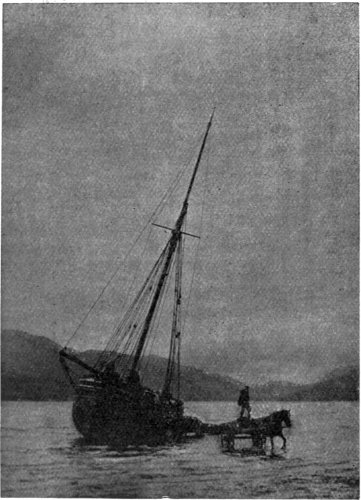
UNLOADING. A. M. MORRISON.