Pictorial Photography.
Reading edition
Unlike the subjects of the other articles in this book, in pictorial photography we are not brought to consider one of the many processes which go to make up the photographic craft, but merely a special and exceptional application of any and all means known to the photographer.
The particular end to which this application is made will be explained as far as the limits of space will permit, and some of the methods of such application will be described. Beyond this I have no intention of going. I do not present pictorial photography as a branch of photography especially worthy of study—I am not concerned in making converts. It is for the photographer who has already formed a desire to give his attention to the pictorial side of photography and who is seeking help, that this chapter is designed.
First let us come to a mutual understanding as to the term Pictorial Photography. Picture-making by photography would perhaps be a simpler phrase, but that to my mind the word "picture-making" is too similar in idea to boot-making, lace-making, etc., all of which imply a mechanical manufacturing, whereas a picture—a real picture—like a musical composition, a poem or a beautiful thought, grows or is evolved rather than made to order.
Art photography would be a better term, but that in photography the word "art" has been so often coupled with things the very antithesis of artistic and might hence be misleading, moreover the photographer will show discretion rather than weakness if he be not too hasty to claim for photography a position among the arts, and whilst its claims to that dignity remain as yet in dispute, we may be content with "Pictorial Photography" as a less assuming title, yet one which will sufficiently differentiate between what we may call the ordinary photographic production and—— Well, what?
That is the first thing I have to try and explain.
Look at the illustrations in this book on pages 72, 136, and 120, and, making due allowance for some loss of quality due to reproduction by a "half-tone" block, try to imagine what the originals were like. Then say if they please you. If you say no, you do not care for them, they do not appeal to you, you do not mind if you never saw anything of the kind again from this day henceforth; very well, doubtless there are other things in the world in which you can find pleasure, but so far as my present subject is concerned, here you and I part company. These illustrations are more or less successful reproductions of pictorial work, and if you do not like them, making as I have said due allowance for their being reproduced and reduced, then it is certain you do not want to hear anything about them, and it is not my intention to persuade you, so please pass on and make room for those who do care for these things and wish to learn all they can concerning them, or at most stand aside and peradventure some stray word dropped unintentionally may quicken your interest and discover in you a sympathy of which you were previously unconscious.
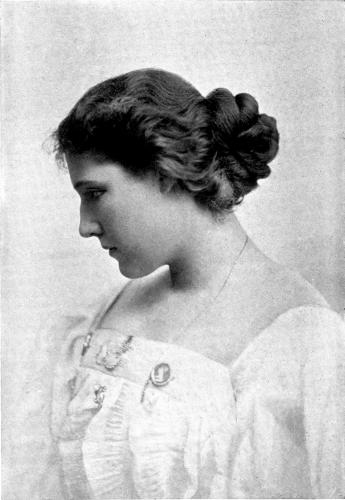
MISS LILY HANBURY—A PORTRAIT. HAROLD BAKER.
Referring now again to the illustrations which in the absence of anything else we take as fairly typical of pictorial photographs and assuming that one or the other, if not all, do please some of my readers, I will ask them to endeavour to analyse their feelings when confronting such productions.
Take now an ordinary commercial photographic view such as one may purchase from any seaside stationer, and compare the sensations awakened by each. In the case of the topographical view we feel some satisfaction at being able to recognise a familiar spot, or the view reminds us of some other place, or it may be quaint buildings, or rugged mountains, or miles of foliage, or what not inspire curiosity or interest because we know the photograph to be a true record of facts, that is to say we accept the photograph in lieu of the actual presence of the objects represented, and experience nearly the same feelings as we should were we to visit the spot represented. We know that the wonderful, curious, or unusual things portrayed have an existence, otherwise we could not have a photograph of them.
In all such cases our interest and value of the photograph would vastly diminish, were it possible for a photograph of this kind to be made simply by the photographer's hand and imagination without any original at all.
You look at a photograph of this or that sea-side place and remark, "Ah, yes, that's dear old Yarmouth, many a time, etc., etc.," or else, "Dear me, I wonder what place that is, it's so like——" such and such a town, or it may be you enquire "Where's that?" and you express or think to yourself you would like to go and visit the spot. These and kindred sensations are those kindled by the average photograph, but there is yet another, for you may be impelled to exclaim, "How wonderfully clear and bright that photograph is," "What a good photograph." In this case you are interested purely in the execution as an example of clever manipulation and skilful craftsmanship.
Now, compare such feelings as these with those stirred by an example of good pictorial work. In the first place your esteem for it, if you value it at all, is quite as great whether you know the place where it was made or not. If it pleases you, that pleasure is not dependent upon the fact that it does represent some place. In the case of paintings and drawings as often as not they do not pretend to represent any place at all, but are pure fiction, yet we do not value them the less. To what then is the pleasure we feel when looking at a good picture due? Is it not that a picture stirs up, that is, creates pleasant or beautiful thoughts and ideas—by pleasant I do not mean necessarily merry or joyous ones, for some hearts feel profounder pleasure in the grandeur of storm or the majesty of the mountain than in the sweet wilderness of flowery wastes, but notice that such beautiful ideas are created by the picture. You were thinking of something totally different before you came upon the landscape picture which instantly made you feel the glowing light, the stirring breeze, and hear the rustling corn and noisy brook, and yet it cannot be said it is because we recognise these things in the picture that we receive these impressions, at least it is not the kind of recognition which takes place when we see a photograph of Brighton Pier or Haddon Hall.
Notice, it is not the exact and faithful portrayal of objects that creates the emotions instanced, for if you closely observe the manner in which a good painting is done you will find that rude splashes of paint, broad brush strokes, and the like stand for foliage or water, or corn stalks as the case may be, when we know that had the painter desired he could have produced his likeness of nature with a good deal more of the precise detail and fidelity to outlines which photography excels in, had he wished. But if the painter or other pictorial artist needs not to trouble about accuracy to details to secure the effect aimed at he must be faithful to general facts. There is a great difference between not recognising things or having no particular wish to do so, and feeling conscious that a portrayal is so utterly unlike anything in our past experience of nature that we should not recognise the objects even if we were acquainted with them. To take an extreme case—our enjoyment of the effect and sentiment of a beautiful landscape picture is not enhanced by our being able to recognise whether the trees are oaks or elms, but it would be distinctly disturbed if the palm trees were represented as growing on the slopes of a Welsh mountain. Innumerable examples and instances might be given to show that the artist, whatsoever his medium, be it colour or monochrome, may depart from truth, or may be indifferent to precise details, only so far as he avoids palpable untruth.
Why is this?
When we look at a powerful and impressive picture we feel at once the sentiment, our emotions are at once stirred, subsequently we recognise objects and facts portrayed, but only when we begin to look for them or think about them; but a gross exaggeration or a very obvious error strikes us at once before we begin to receive sentiments and ideas, and that error or exaggeration once seen is never lost sight of, and whole enjoyment of the picture is hopelessly marred.
Now, from the foregoing (for want of space I am aware that the argument is incomplete, and must therefore ask the student to think the matter out and grasp the side issues by reading between the lines) we may formulate the broad definition that a picture does not depend for its excellence on the faithful representation of objects, and is not chiefly valuable on account of our immediate recognition of things portrayed, yet on the other hand it must not let us feel that there is obvious inaccuracy.
Here then we have two opposite positions in both of which the mere objects employed to build up the picture are subordinated to the effect or impression of the picture. In one case the spectator must not be allowed to feel that the representation is wrong, in the other success will not directly depend on the representation being very right, neither startling rightness or truth nor the obvious wrongness or untruth should thrust the objects composing the picture upon the beholder's attention, he should be left free to receive the expression or sentiment of it.
I hope the reader is following me in this line of thought closely. I am aware that it may seem dry and uninteresting, but I see no other way of placing the student in a proper position at the outset than by explaining the essential elements of pictorial work, and I will make this introductory part as brief as possible.
Reverting now to our argument, I have in other words suggested that obvious violation of truth will prevent the sentiment or effect of the picture from being paramount, and now I will submit that an excess of accuracy to detail is equally detrimental to the success of a picture as a picture.
If by now the reader is prepared to admit that the chief purpose of a picture is the feelings, emotions, ideas which it suggests or creates, and not the facts it portrays, he will be able to go further and perceive that in a landscape, for instance, cottages, trees, or what not are introduced, not for their own intrinsic interest but as vehicles of light and shade, which go to express the picture's sentiments.
If we stand before a good picture with closed eyes and suddenly open them, our first impression (precluding any question of colour) is that of masses of light and shade pleasingly and harmoniously arranged; if we retreat to such a distance that the objects constituting those lights and shades are unrecognisable the balance and pleasing arrangement should still be felt, and our æsthetic sense is satisfied, although we do not see fully of what the picture is composed. This is the quality which is termed breadth and which is admittedly of very great value.
If on the other hand the shadow masses are filled with innumerable details, and are thus broken up into tiny lights and shadows they no longer exist as broad masses of dark, but if before retreating as proposed from the picture, the lights or shadows appear so blank as to prompt particular investigation, and upon examination we find detail absent which we know must have been present, then we encounter an instance of untruth and exaggeration which is obvious and which disturbs our appreciation of other fine qualities. Thus we require sufficient detail to avoid giving the idea that detail is left out.
The delineation of sharp outlines and redundance of detail is not wrong in itself, but it is usually inexpedient when considered with respect to the effect to be produced, similarly the suppression of sharp focus both as regards outlines and details has no artistic merit of itself except as it assists the picture to impress the beholder first with the general effect.
The painter and photographer start from two opposite standpoints. The painter, or draughtsman, starts with nothing but blank paper, and having built up his picture and produced his desired effect he elaborates no further; the photographer with his more or less mechanically produced facsimile starts from the opposite extreme with a transcendentally elaborate image, from which he will require to eliminate all such excess of truth as is likely to force the mere facts of the view upon the beholder's attention.
Photography, so faultlessly complete in its delineation, gives us more than the pictorial worker needs for the expression of an idea, and this is why I would remind the student that pictorial photography is not photography in the full sense of the word, but the application of some of its powers, just as much as we need and no more, to a definite end.
As just hinted the purpose of a picture is to express ideas, hence I will fall back on a kind of definition which I have used on a previous occasion that a picture is the portrayal of visible concrete things for the expression of abstract ideas.
To give an example by way of exposition we may look upon a picture and be made to feel by it the calm and luminous atmosphere of evening; we feel at once the restfulness, and almost feel the warmth of the humid air, giving place to the chill gathering mists of night; but the same objects, the same tangible materials, paper, pigment, metallic salts, etc., in another picture give us the sense of angry turbulent storm or perhaps bright joyous sunshine frolicking with the fresh breezes on the hill-tops. These are abstract ideas expressed or created by the manner in which concrete things, commonplace facts, are portrayed and rendered.
Finally, let me enunciate that a very excellent photograph may not necessarily be a good picture, because it may contain more than is required for the expression of its idea, and the surplus will overwhelm it; again, a good pictorial photograph may be but a poor photograph, because if we claim the right to apply photographic means to pictorial ends, we may find it convenient to leave out the very qualities which the scientific or technical expert considers most precious.
And now I think we may proceed to more practical matters.
COMPOSITION AND SELECTION.
In all matters from which the eye expects to derive pleasure, symmetry of design seems essential. In the formation of the letters that we write, in personal attire, in the decoration of our homes, in buildings, and practically in everything which is not of a purely utilitarian character, a sense of proportion and a symmetrical disposition of parts is observed. Hence it is no source of surprise that in a picture which as much as anything should aim at pleasing the eye, design, otherwise Composition, is with Expression a co-essential.
In a purely decorative production this natural desire of design is the only thing to be observed, but in a picture which may be decorative, but must be something more, we have expression as well to consider. If decoration alone were to be regarded, something like fixed rules might perhaps be tyrannically laid down, but in a picture the implicit observance of rules of composition would be certain to make itself seen in the result, and the undue obtrusiveness of a code of rules would be as inimical to the supremacy of ideas and feelings, as the excessive prominence of fact would be, which has already been described.
Hence the difficulty in prescribing any definite course for the beginner, because whilst to most instinctive artistic temperaments a certain knowledge of or feeling for composition is natural, so soon as this is reduced to definite rule and given to another, the, as it were, secondhand use, is nearly certain to betray itself by its misapplication. I would ask therefore that any suggestions given here on the subject of composition should be taken as one takes lessons in the rudiments of a language, which rudiments we violate and forget so soon as we have become proficient enough to speak it. Such rules in composition should be observed only so far as to avoid the appearance of having infringed or ignored them.
The rules of composition which may be found to apply in one of the pictorial arts must necessarily apply equally in the others, and so therefore to pictorial photography which at least aspires to be considered an art. If on a sheet of paper a rectangular space is given us wherein to draw the likeness of anything, the most natural course to pursue would be to draw that figure in the centre or thereabouts, and if then we are asked to add the likeness of two or three more objects we should naturally place these near the first object. Thus should we compose a group of objects which draw the attention to the middle of the picture or space.
Suppose we are asked to draw the picture of a church tower we should probably comply with the request somewhat as shown in fig. 1. Next we will suppose we are asked to add a cottage, some trees, and a path to the church, we should, if possessed of some sense of symmetry and order, coupled with average intelligence, make the additions somewhat as in fig. 2. It would surely be an unusual thing to follow instead the course suggested by figs. 3 and 4.
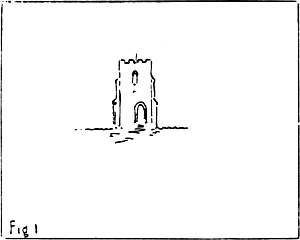
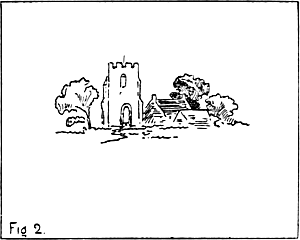
In figs. 1 and 2 we have instinctively placed the primary object in or near the centre, and the others near and around it, and the result strikes one at once as being better composed, that is, more symmetrical, than in fig. 4, in which amongst other things one is not sure which object to regard as the principal one, and one also feels that but for the boundaries of the picture left and right we might have seen a good deal more beyond, which would have added to the interest of the picture.
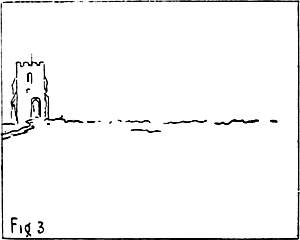
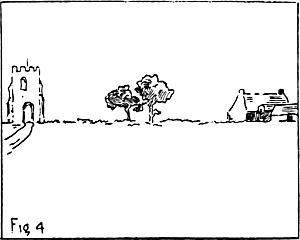
In this we have one of the first rules in composition, namely, that the principal object should be near the centre, and the next important near to, and as it were supporting it, and no object likely to attract the eye should be so near the edge of the picture as to make us instantly conscious of the boundaries and wish to see more beyond.
But now if in compliance with the supposed request we had made our drawing as in fig. 5, might it not at once be felt by the observer that we had put the objects in a central position intentionally, which is equivalent to saying that we had allowed our endeavour to observe the rule just laid down to betray itself. Fig. 2 is preferable as being only just sufficiently symmetrical to avoid being unsymmetrical, which is an example of what has already been said about the necessity of observing rules of composition just so far as to escape the appearance of having broken them.
Fig. 5.Fig. 6.
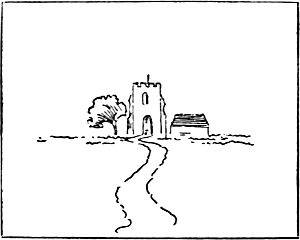
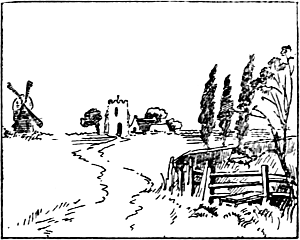
If this rule is right as regards voluntarily drawing a picture, it is equally so in the case of a photograph, but instead of deliberately placing things in such and such positions, we attain the same end by moving the camera and selecting our point of view so that the objects come into the positions desired.
Now suppose then, we have done this, but in doing it we are quite unable to prevent other objects coming into the field of view and occupying undesirable places near the margins of the picture, as for instance in fig. 6. Here we are brought to consider another rule or principle in composition, namely, that there must be one and only one chief object in the picture, whereas in fig. 6, apart from the gate and tree on the one side and the windmill on the other attracting attention to the margins of the picture, these same objects arrest the attention quite as much as the church, and we feel the eye wandering about from one to the other and missing the sensation of centralization and rest which fig. 2 gives.
If we were drawing or painting we should put in what we want and then stop, we should omit or ignore what we did not require, but in photography our powers in this direction are limited, and hence we must as far as possible select those views, and only accept such, as comply with what we feel to be right.
The angle of view included by different lenses is an auxiliary not to be neglected, for by substituting a narrower angle lens, that is, one of longer focus, we may cut off or leave out undesirable objects which the shorter focus lens might include. Then again, when the print is finished we can after careful consideration cut off what would have been better left out, for it will be better to have a picture half the size well composed, than double the number of inches with a distracting and unsatisfactory arrangement of objects, hence with many most successful workers it is no uncommon thing to take quite a small portion of a negative, and either print it as it is or else enlarge it up to the desired size, but mere size will reckon as nothing as compared with pleasing composition.
If it is inexpedient to let the principal object or group of objects occupy the exact centre of the picture, measured from left to right, it is equally so if the centre be measured from top to bottom, and hence we may formulate the rule (to be broken perhaps later when we are strong enough to be independent of guiding) that the horizon should not be allowed to come midway between the top and the base of the picture.
Fig. 7.
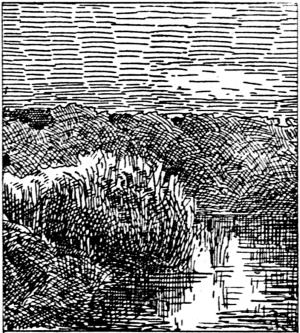
Remembering now that, as set forth in the earlier part of this article, a picture should appeal to our feelings and stir our emotions, it may be pointed out that in most ordinary things, and certainly in the arts, the most powerful things are those which possess one dominant idea or feature, as in a piece of music the refrain keeps recurring, a preacher takes a text, in a story there is one hero, and so forth, and in point of composition fig. 7 is better than fig. 8, although the view is less comprehensive.
Fig. 8.
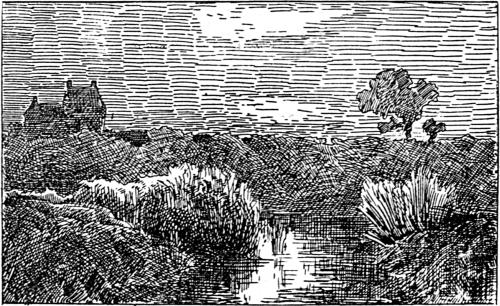
It may not, however, always be easy for the beginner to determine what is the chief object which should occupy the central position, or which object or group to choose in a landscape.
Fig. 9. Fig. 10.
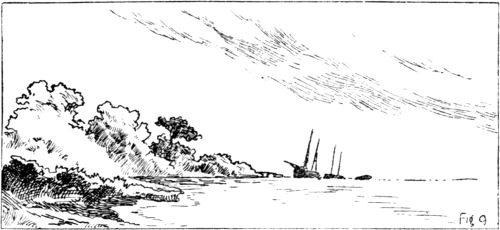
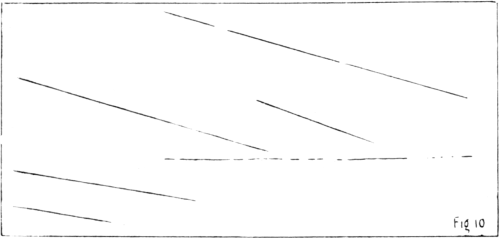
This brings us to speak of another important matter, and that is the right disposition of lines which form the view or the selection of view so that the lines formed by the component parts shall fall in a desirable manner. The various objects in any view tend to form or suggest lines, thus in fig. 9 the outline of the trees, the bank along the shore, the clouds, and the boats suggest the lines shown in the diagram, fig. 10, which lines all run the same way, but in fig. 11 we have a similar view in which the lines suggested counterbalance each other, and not only so, but by their convergence they carry the eye to a spot near the centre, and so make the boat, although not very large nor conspicuous, the one and principal object (see diagram fig. 12).
Fig. 11. Fig. 12.
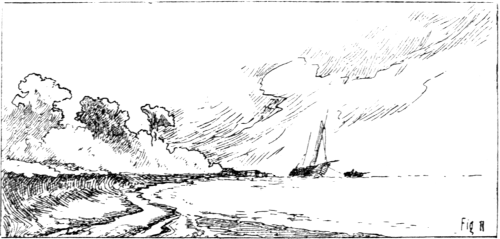
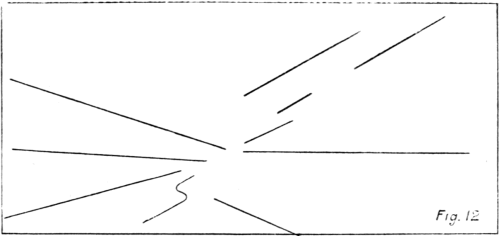
For the sake of training one's perceptions look at any good pictures, and in your mind resolve them into line diagrams and see how these lines fall, and in considering any landscape or other subject to be photographed make up your mind as to what lines are suggested, and then select your point of view so that these lines balance or are symmetrical in arrangement, and also that they converge towards some point well within the picture, and near the centre of it.
Fig. 13. Fig. 14.
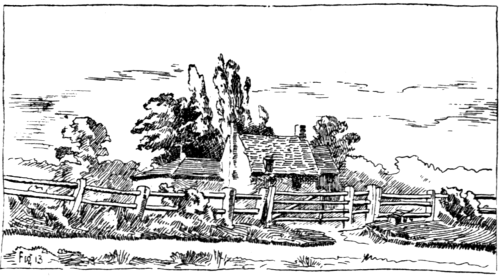
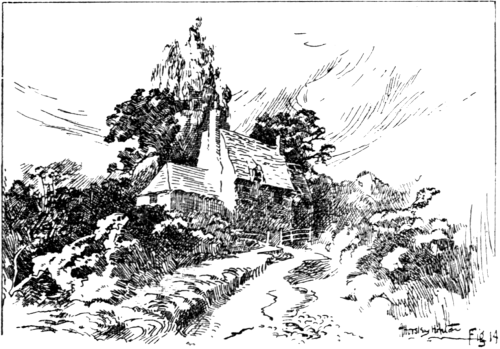
But in fig. 13 we have a subject in part well composed, but the composition is spoilt because of the line formed by the road and fence, which seem to cut the picture in two, whereas could we have chosen the same subject from a point of view giving such an arrangement as fig. 14, a difference is at once felt and a more pleasing effect gained.
Fig. 15. Fig. 16.
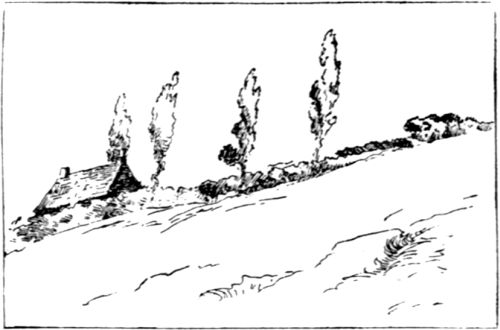
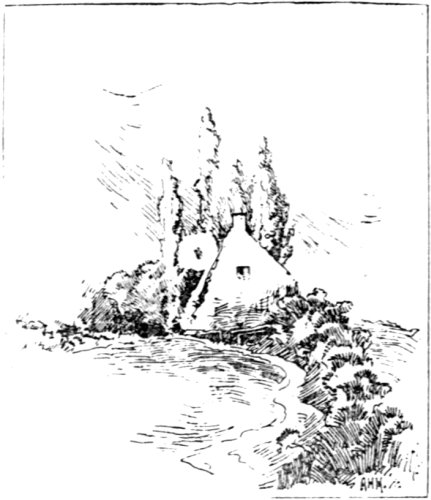
Lines which seem to separate us from the picture and cut off one part from another must be carefully avoided, and an endeavour to find something which will, as it were, lead the eye into the picture, should be diligently sought for, and indeed a subject, however it may interest us, must often be abandoned if it lacks those things which go to make pleasing composition, remembering as we should always do that in pictorial work the fact that objects are curious, or interesting, or pretty, has nothing to do with the case, but that they are only to be valued according as they act as media for expressing pleasing ideas, beautiful thoughts and sentiments, which they will not do if some part creates a feeling of unpleasing arrangement or design. If a scene does not compose well, we should as pictorial workers feel no desire to reproduce it. But you may say "Cannot we often by changing our point of view get an otherwise ill-composed subject to compose well?" Most decidedly, that is precisely what we should do, but it is no longer the same subject or view.
And now let me say that it is often surprising how much alteration may be made by changing our position. Figs. 15 and 16 are together an instance of this, the outline here given being made from a pencil sketch made on the spot, whilst figs. 17 and 18 are examples of the desirable change brought about by watching and waiting for a change in the position of light and the condition of the river's tide.
Fig. 17.Fig. 18.
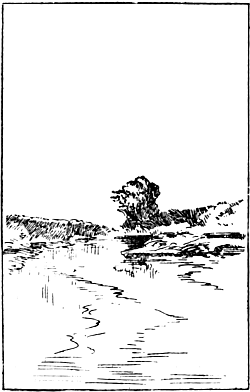
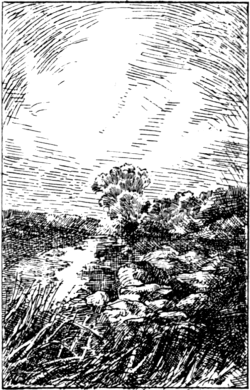
Where the beginner most often fails is in taking things as they are without pausing to consider whether they might not be improved, and if so in what way, and then patiently searching to see if such better way can be found.
Pictorial success will as often as not depend on the exercise of fastidious taste, which is satisfied with nothing but the very best, and not quite content even then.
A great deal more might usefully be said with reference to the composition of lines if space would permit, but this general reference may be given as a sort of summing up.
If the disposition of the lines constitutes such a perfectly symmetrical design that it is at once recognised as symmetrical, then it is wrong, because the artifice by which pleasing composition is attained is betrayed, and we feel the thing to be artificial. If, on the other hand, the lines fall so as to make the beholder conscious of their presence, as, for instance, cutting off a portion of the subject or presenting a one-sided appearance, again it is wrong. In neither case should the lines or the objects suggesting them be felt at all until sought for, neither as being very right or very wrong.
In art it is a maxim that the means by which the thing is done should not proclaim itself, and hence it must apply to pictorial photography, which is an effort after the artistic. A composition should please without our quite knowing why, and without our being able to see the machinery, as it were, by which our pleasurable sensations are set in motion.
But whilst it is convenient to speak of lines in the landscape, it is only a manner of speaking, for, as we know very well, photography, unlike pen drawing, has to do with "tones," that is, masses of light and shade. Now the general rules suggested as regards the arrangement of lines, apply in much the same way if we regard a picture (as we should do) as consisting of masses of light and shade.
If when standing before a picture we close the eyes and then suddenly open them, our attention is certain to be drawn to the highest light or the deepest shadow, and hence, as a general rule, whichever of these is the strongest to attract attention, that should be in or near the principal object (indeed it will make of itself the principal object), and should therefore be well removed from the margins of the picture.
Refer back to fig. 8, in which the light patch of sky, the light in the water and the two clusters of light rushes, all form competing points of attraction, and if these are too near the margins, they remind us of those margins, hence the improvement in effect when these are cut away or left out.
But disposing of the highest light and deepest dark does not finish the matter. There is a certain relative degree of lightness and darkness between everything in nature. Moreover, colours have to be interpreted by certain degrees of light and shade according to the distance objects are away from us, and according to the amount of light falling on them.
Such relative lightness and darkness is called "tone." The word used in this sense has nothing to do with "tone" as applied to the colour of a print, which colour we change by a process we call "toning," and upon the correct rendering of relative tones so much of the effect of a picture depends, and so much of its emotional qualities.
Generally speaking, although there are often exceptions, the further an object is from us the grayer it seems. White becomes less white, and dark objects grow less dark, until in the distance both, under ordinary circumstances, come almost to the same "tone," and we see the distance only as a gray hazy mass.
If for a subject we have a figure of a woman by a stream of water and we make an under-exposed negative of it, or develop the negative to too great a density, we shall very likely have a print in which the water and the woman's apron and cap come very much whiter with regard to the rest of the subject than ever they appear in nature, whilst the distance will very likely come too dark. Here we show a disregard for the correct rendering of relative tones and the effect is hard and harsh, unlike nature. We must therefore endeavour, both in exposure and development and printing, to preserve relative tones exactly as they are in nature, and constant study and observation of nature should be carried on in order that the eye may be trained to know how things come relatively in nature, and so be able to decide at a glance if the photograph is good.
Ultimate success, by the way, often depends less on knowing what to take and how to take it than on a well-trained judgment which knows what is good or bad when we have taken it.
Whilst the mere lines or forms of objects may impart some amount of feeling and sentiment to a scene, inasmuch as there is restfulness and repose in the long horizontal lines of the river-side pastures, something rhythmical in the sinuous curves of the winding stream, or vigour and variety in the irregular forms of the rugged cliffs and so on, yet the ideas and feelings which the picture will promote depend more on the lights and shades, and the masses contrasting or merging each with each.
But Nature does not always present herself in pleasingly arranged masses, and is consequently at such times commonplace and unpicturesque in the literal sense of the word. At such times she will not attract the pictorial worker any more than she will when perchance the lines and groupings are unsuitable.
The landscape which basks under the full blaze of sun, glittering throughout every inch with a myriad twinkling lights and sharp details, awakens no feeling akin to those which probably everyone feels when in the twilight of evening plane after plane recedes as one broad flat tint behind the other. Under the bright light of day we may wonder at the richness and plenty upon the earth, we may rejoice in that there are so many curious and pretty things to look at, but these are like the feelings inspired by reading a book on natural history, rather than the emotions created by the perusal of a poem, or listening to sweet music.
Compare for a moment the two photographs, fig. 19 and fig. 20.
Fig. 19.
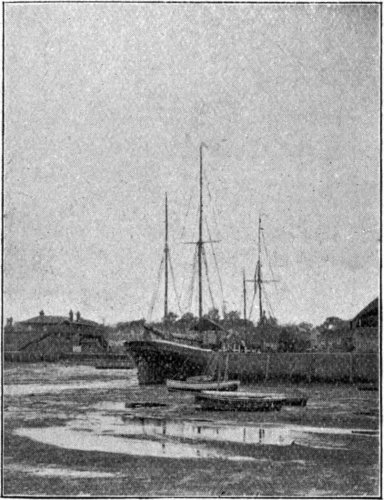
The first is by no means an extreme case of the ordinary photograph, and notice that although the composition is fairly good as far as grouping goes, there is an absence of any quality which might make one feel anything outside the bare recognition of the facts depicted, but the second, if it be good at all, must depend for admiration on a certain amount of sentiment which it suggests or creates. You will notice that in the first there is no sense of distance, and although a church tower, behind the masts of the boats, is half a mile or so away it does not possess the "tone" and veiling of atmosphere which would make it appear distant. Every part of the view seems equally near, or nearly so; the eye wanders over the whole, alighting on details here and there which interest and amuse, yet there is an absence of just that breadth which is noticeably present in the second example.
Fig. 20.
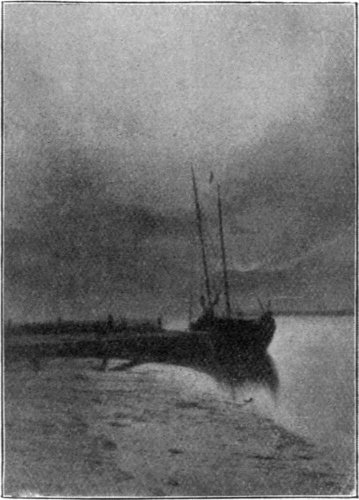
Now let it be distinctly understood that detail, its omission or suppression, and its introduction or sharp delineation, is not a question of lens focus only, or even chiefly, but it is largely a question of light. Imagine the photograph, fig. 19, with the greater part of the detail taken out so that the quay, the houses, the shore, etc. were just broad masses of lighter or darker tone, should we not then get a composition which would be less disturbing, more compact, more concentrated in interest? Is not this the case in fig. 20, in which detail is almost entirely absent? And yet detail could not have been truthfully introduced in this photograph, because with the light in the position it is, and in the misty evening air, no detail was there to reproduce; it was the fact that objects ranged themselves in masses one against the other, leaving room for imagination and creating ideas that determined its selection and its consequent portrayal.
In many cases a clear and sharp delineation of details will perhaps be desirable, not, however, for the sake of showing detail, but just so far as the production of the effect may require; on the other hand, just the full amount of detail that a lens will give is by no means always wanted.
Lenses were not invented for pictorial purposes, and therefore there is no reason for concluding that what the lens gives is necessarily right, for remember that we started with the distinct understanding that we were merely applying to a certain purpose just so much of the photographic process as we considered we needed; because I have the means of travelling at sixty miles an hour there is no reason why I should not apply the same means of locomotion to coaching a pedestrian at a tenth of that speed if I choose. It may be said that in the two photographs referred to the comparison is not a fair one, because so much depends on the sky. Granted that much in the second example does depend on the sky, which is an essential part of the picture, and indeed one cause of its very existence, but in the other (fig. 19) the presence of clouds would not improve the pictorial faults to which reference has been made. As a mere record or portrayal of Old Woodbridge Quay, the absence of clouds is as much a characteristic of its particular species, as the clouds in the second one are inseparable from its existence.
So, but little more than half hinting at the principles involved in the due suppression of unnecessary details, and the elimination of undesirable objects in order to obtain breadth, and having said but little as to the preservation of correct relative values or tones, I must pass on.
Every corner of nature's broad expanse is, as it were, enveloped in atmosphere, and invisible as we are commonly in the habit of considering it to be, it affects to a greater or less degree everything we see, and the visible atmosphere is often responsible for some of nature's most beautiful and most appealing aspects. Obviously then we cannot afford to leave out so important a contributory to picturesque effect, and it is on this account rather than on account of sharp or un-sharp detail that the question of stops and lens apertures comes in.
Look at the image of a landscape on a moderately hazy day, as it appears on the ground-glass focussing screen of your camera, using the lens at full aperture—then quickly insert f/32, and notice the difference. Not alone have objects near at hand and more remote become more sharply or more equally defined, but you may also notice that objects are more brilliant, and that a sense of atmosphere has been cut out.
Compare if you will two photographs, the one made respectively with full aperture of f/6 or f/8 and the other made with f/32 or f/45, and provided that in the first case we have not actual blurring to the extent of destroying form and structure, does not the first remind you more of nature? I do not say it is so instructive, so surprising, so dainty, or of such exquisite finish, but is it not more reminiscent of the effects we remember to have seen and felt in nature. It is not the function of this article to say to what optical laws this difference is due, and yet the student may expect to receive something by way of practical working instructions.
My recommendation is then to use a single landscape lens or the single combination of a doublet, and in starting to use the full aperture.
With this it may be that when the foreground is moderately sharp, trees more remote are so ill defined as to appear as a collection of little blots and irregular patches. Whilst sharp detail in all places may not be productive of pictorial effect, yet the extreme opposite will be displeasing in another way, and it will be best to secure just so much definition and no more as shall save the representation from appearing to have been wilfully put out of focus—once let the destruction of detail be obvious and we betray the artifice by which we are working, which is just what we should avoid.
In the case just supposed then, we may now introduce the first stop, simultaneously racking the lens in a little until we get middle distance without unpleasantly obvious blurring. The foreground may be a little out of focus, and in practice I find it is rather helpful to general effect if detail is sacrificed more in the foreground than in the middle distance.
This I believe is contrary to the teaching of many, but my feeling is that with a sharply defined foreground the eye is attracted and the interest so far arrested, that it is difficult to travel further and enter into the poetry and sentiment of the scene beyond.
Wide-angle lenses have a double disadvantage, shared in part by so-called rapid rectilinear doublet lenses. In the first place they flatten the view, bringing distant planes to appear as near as the nearer ones, and by including a comparatively wide angle they bring into the plane of the foreground, objects so near that they appear out of proportion, and hence proportions are false when judged as the observer must judge by the standard of visual perspective.
A long-focus, narrow-angle lens necessitates a camera which racks out to a considerable length, and probably a greater extension than any camera in the ordinary way can give, would be an advantage on some occasions.
Passing reference has been made to the interpretation of colours in nature in their true relative value of black and white.
If we have a subject in which brilliant orange-coloured rushes in autumn are seen as glowing bright against a background of dark blue water, and the rushes made still more golden of hue by the ruddy rays of a sinking sun, a difficult case is before us.
Such a case I remember very well in the south of Devonshire, close to what is known as Slapton Ley. It was late afternoon in November, and from over the rounded hills behind me to the westward, the declining sun sent warm red rays on to the belt of faded reeds which stretched out into the expanse of the still land-locked water of the Ley—a great sheet of fresh water which placidly lay under the shelter of the bank of shingle which alone separated it from the ever-restless sea—placidly listening to the ceaseless voices of sea music, and at this particular hour reflecting the sky deep blue and of almost leaden hue—just above the bank rose the full moon, orange in tint, on a background of blue-green sky—the yellow reeds, kindled into glowing amber tints by the sun's rays, flamed out from the deep blue water—yellow the shingle bank against the blue water and green-blue sky, deeper yellow the moon as it rose from out the sea. So grand a scheme of colour that by its side the essays of the most daring painter might well seem feeble, so exquisite a poem that the intrusion of the photographer, analysing the values and tones and calculating his powers of reproduction seemed like sacrilege. In the main it was yellow, orange-yellow, and red standing out as luminous against the deep blue of water and only a little less blue sky. It was gorgeous non-actinic colour appearing as light against a highly actinic but darker colour. The consequence of an indiscreet exposure with an ordinary plate might be anticipated to produce dark rushes against a pale grey background of water, and so probably the very effect we were minded to secure, reversed and dissipated.
This is an extreme case, perhaps, but throughout the whole range of nature the contrasting and blending of adjacent colours is so subtle a thing that I should feel one were throwing away at least a possible advantage by not using colour-corrected or isochromatic plates on nearly every occasion, and in order to get the full advantage of isochromatic plates, I should consider the addition of a yellow screen an essential.
The rapidity of one's plates, isochromatic or otherwise, must be governed entirely by the nature of the subject, as also to some degree must be development and subsequent printing.
In every case I would endeavour to get a comparatively thin negative, with even the portions representing deepest shadows slightly veiled. "Clear glass shadows" is an enormity and an outrage both of science and art; equally are solid high-lights to be shunned. With modern printing methods it needs much less than actual opacity in the negative to produce white paper, and if the picture requires any part of it at all to appear as quite white, no subject will need more than the very smallest region to be so. A general softness and very subtle gradation, with a total absence of "sparkle" and brilliancy in the negative, will yield by at least most processes the most suggestive print, bearing in mind that delicate gradations suggest atmosphere, and atmosphere is one of nature's most precious qualities.
Whilst plain salted papers sensitized with silver present possibilities not yet sufficiently exploited, yet until such time that something more entirely satisfactory in all respects is given us in silver papers, platinotype and carbon, and perhaps also gum bichromate will be the processes most suitable for our purpose. Personally, platinotype has been the favoured medium, being, as I believe, more ductile and more amenable to various methods of control than is generally recognised.
And leaving much more of importance unsaid than space limits admit of my saying, I must leave it.
A. Horsley Hinton.