Lenses.
Reading edition
Photographs of flat objects such as leaves, lace, drawings, etc., can be made by simply putting the object on the sensitive surface and exposing the arrangement to light. But this method will not serve if the photograph is wanted of any other size than the original, nor with solid objects of any size, except perhaps in the production of full-size profiles of faces. It is therefore quite the exception in photography to "print" directly from the object itself, and the only alternative is to produce an image on the sensitive surface.
All illuminated objects reflect light and so become for practical purposes sources of light, just as the moon shines, as we say, although it only shines because it is shone upon by the sun. The simplest source of light to consider is a point of light, and if we can get a dot of light on a white surface from a point of light we have at once an image of that point of light. The smaller the dot the sharper or more perfect is the image, the larger the dot the more diffused or fuzzy is the image. It is impossible by any known means to get the dot so small that it is an actual point, that would be absolute perfection, and on the other hand there is no size of the dot at which it can be definitely said that it ceases to be an image. Every point of an illuminated object is a point of light, and fine definition consists in keeping these points separate in the image. So far as the dots overlap they are confused. Confusion, or diffusion, or fuzziness is sometimes desirable, as for example in a portrait, which may be excellent although it is impossible to distinguish in the picture the individual hairs on the person's head.
Fig. 1.
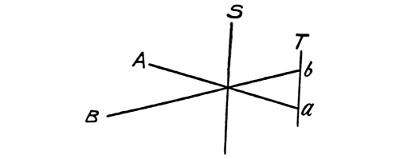
The simplest means for getting an image is a small hole in an opaque screen. In fig. 1, two points of light, A and B, shine through the hole in the screen S and produce two dots of light, a and b, on the surface T. The two pencils of light do not practically interfere with each other although they pass through the same small hole, nor would any greater number; so that an illuminated object, which may be regarded as consisting of an infinite number of points of light, would give an image on the surface T. The disadvantages of a small hole, or "pinhole," for the production of images are (1) it must be so small that it lets very little light through and therefore gives a very feeble image, (2) that it can never give a sharp image. The first disadvantage is obvious. With regard to the second, a little consideration will show that the image of a point must be larger than the hole itself, it is always larger though it may have a central brighter part that is smaller. If the hole is reduced in size beyond a certain limit, it gives an increased spreading of light on the surface, so that a sharp image can never be produced.
Fig. 2.
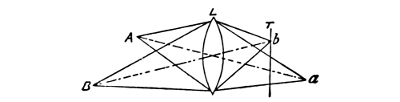
Now the function of a lens is to obviate these drawbacks as far as possible; namely, to let more light through and form a brighter image, and to give sharper definition. In figure 2, the lens L collects all the light that falls upon it from the point B, and condenses it to the point b on the surface T. The light from the point A that falls on the lens is also condensed and would be brought to a point or "focus" at a beyond the surface T, but on the surface the light forms a patch of considerable size. Suppose that the lens is thirty times the diameter of the pinhole its area is 900 times as large, and the light that falls upon it is 900 times as much as the light that passes through the hole. Such an enormous gain of light is worth so much that photographers willingly put up with the very many imperfections of lenses for the sake of it, and if to this gain there is added the superior definition that is possible, it will be seen that lenses are indispensable to the photographer. To take a Daguerreotype portrait with a pinhole might have required several days if not weeks exposure of the plate and therefore would have been impossible, so that the gain in brightness of image is a great deal more than a mere convenience.
It will be observed in figure 1 that both points of light, A and B produce images on the surface T, although they are at different distances from it, but in fig. 2, although the effect of the lens is to concentrate the light from both points to two other points, one of these is beyond the surface T. This is a disadvantage inherent in lenses. They have so many other imperfections or "aberrations" that it is desirable to consider these separately. The reader should bear in mind that the one aim of opticians in perfecting lenses is to concentrate as much light as possible from each point in the object to a corresponding point, or as small as possible a dot, in the image, and the image should be flat because the plates used in photography are flat.
Fig. 3.
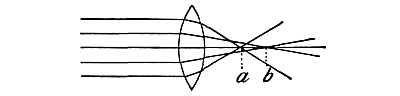
Spherical Aberration.—The surfaces of lenses are always ground to spherical curves, and this fact makes it impossible for a single lens, such as that shown in figure 2, to bring to a point all the light that falls upon it from a point. If a pencil of light passes through a piece of glass with sloping sides it is bent or "refracted" towards the thicker part of the glass, and the greater the angle of inclination of the two sides the more is it refracted from its original path. In figure 3 it is clear that the two sides of the lens shown in section are inclined to each other at a continually increasing angle as they approach each other at the edges of the lens. The refracting effect of the lens increases from the centre outwards, and it increases to a greater extent than is necessary to bring the incident light to a point. The focus of the pencils of light that pass through the edges of the lens is nearer to the lens than the focus of the pencils that pass through its central part. In the figure two foci are shown, a and b, but of course, in fact, intermediate parts of the lens produce intermediate foci, and what should be a point in the image, is spread out into a line on the axis of the lens, and all along this line is surrounded with the light that either is coming to a focus or that has come to a focus and has spread out again. On a screen placed at b there would be a point of light surrounded by a halo, while at a, nearer the lens, the central focus or point is surrounded by a brighter or more condensed light, and the appearance is of a circular patch of light with a brighter boundary. This is positive spherical aberration. Negative spherical aberration is due to over correction, the focus of the light passing through the margins being furthest from the lens, and the appearances on a screen are of course reversed.
Chromatic Aberration.—When light is refracted, that is bent out of its original path by a single piece of glass, it is not refracted as a whole, but each constituent behaves as if none other were present. Ordinary white light or daylight is a mixture of many coloured lights as seen in the rainbow, and when refracted, the blue is bent more than the green, the green more than the yellow, and the yellow more than the red. So that using a single lens the focus of the blue light is nearer the lens than the focus of the red light and the others come in between. In figure 4 this is represented in an exaggerated degree to make it more distinct. It will be observed that a screen placed at the focus of the blue light will show a reddish margin and if removed further from the lens the margin or halo will be bluish.
Fig. 4.
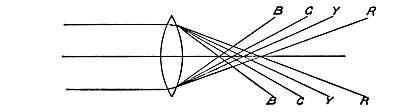
These two aberrations, spherical and chromatic were the principal faults that opticians had to deal with, because they affect the whole of the image, even the very central parts. But in photography it is necessary to get an image of a very large size as compared with the focal length of the lens, and there are some faults that only begin to show themselves at a little distance from the centre of the image and increase as the distance from the centre is greater. These aberrations were, practically speaking, incurable until a few years ago, but as recent optical advances have provided kinds of glass by the use of which they may be eliminated, or nearly so, they have become of practical importance. They are astigmatism and curvature of field.
Astigmatism and Curvature of Field.—If a diagram of suitable size is made with a series of concentric circles and radial lines upon it, and the centre of it is arranged exactly opposite the centre of the lens, and in a line with the centre of the focussing screen, the screen and diagram being parallel, then if the lens suffers from astigmatism it will be found impossible to get the outer circles and the radial lines where they cross them simultaneously focussed. Where this difficulty begins the astigmatism begins, and the greater the difference there is between the focal planes of the radial lines and the circles, the greater is the astigmatism. It will probably be found with any of the older types of lenses that neither is in focus at the same time that the centre of the diagram is, but that the screen must be racked in; this is due to curvature of field, and the difference between the curvature of field for the circles and the radial lines is due to astigmatism. In the older lenses a flatter field could only be obtained by the introduction of astigmatism, but now by the employment of the new glasses made at Jena, it is possible to practically eliminate astigmatism, and still keep the field flat.
Fig. 5.
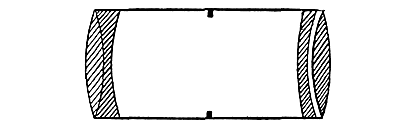
The Development of Photographic Lenses.—When photography was first practised the best lenses available were those made for use as telescope objectives, and they had to be used with a small diaphragm to get good definition over a sufficient field. With the slow processes then in vogue a more rapid lens was much desired, and Voigtlander introduced a "portrait" lens constructed according to the results of the calculations of Professor Petzval. This portrait lens is still very largely used, and figure 5 will serve to show its general character and will be a guide to the putting of one together correctly if it has been taken to pieces for cleaning. A rapid lens such as this could not cover a sufficiently large field for landscape work, so that single lenses were still used for work in which rapidity was not of very great importance. Single lenses were improved, and other kinds of lenses were introduced from time to time, but it was not till 1866 that the "rapid rectilinears" or "rapid aplanats," called later "rapid symmetricals," and by innumerable other names according to the fancies of the makers, were introduced. Probably no lens has been made in such large numbers as this.
At about the same time, Dallmeyer introduced his portrait lens in which the position of the convex and concave elements of the back combination is reversed, the concave lens being outside, and this gives the photographer the opportunity of screwing it back a little, and so introducing a measurable amount of spherical aberration which has the effect of modifying the otherwise exceedingly fine definition at the centre of the field, and giving a greater depth of definition.
In 1881, Messrs. Abbe & Schott began a series of experiments in the manufacture of optical glasses, and they were so successful in making new and useful varieties, that an optical glass factory was eventually established at Jena, by Schott & Co. By the use of these newer glasses the limitations that had previously restricted opticians were removed, and it became possible to correct astigmatism and secure a flat field at the same time. Zeiss of Jena, towards the end of 1890, introduced his first series of "anastigmats." The "concentric" lens of Ross was introduced in 1892, a lens which probably remains unsurpassed for flatness of field and freedom from astigmatism; but as spherical aberration is present to a notable degree, an aperture of about f/22 is the largest that gives sharp definition. The "double anastigmat" of Goerz of Berlin was put on the market in 1893. It is a symmetrical lens, and in this different from the Zeiss anastigmats that preceded it. It consists of two similar combinations, each of three lenses cemented together. The unsurpassed qualities of this lens stimulated other opticians to seek to rival it, and there appeared similar lenses with four and even five lenses in each combination, besides other lenses that are more or less a copy of the double anastigmat. One of the most notable of these is the "satz-anastigmat" of Zeiss, each combination consisting of four lenses cemented together and forming an excellent single lens. These combinations are interchangeable in the same mount so that with, for example, one mount and three lenses, six different focal lengths can be obtained, as the lenses may be used singly or any two together as a doublet.
The "Cooke" lens is remarkable for the simple means by which the various corrections are made, consisting as it does of only three single lenses separated from each other. Obviously it must be used entire. These lenses do not cover so large a plate in proportion to their focal lengths as most of the other anastigmats, but perform excellently over the plates for which they are constructed.
The "stigmatic" of Dallmeyer is the latest lens of general utility. It gives good definition to the margin of the circle of light that it transmits, reduction of aperture being necessary, when its full field is employed, to get equality of illumination rather than to improve the marginal definition. Its two combinations are different, and either may be used alone as a single lens, giving focal lengths of approximately one-and-a-half and twice the focal length of the whole lens.
The "planar" of Zeiss introduced just as we write, is a symmetrical doublet characterized by a very large aperture, from f/3.6 to f/4 up to 10 inches in focal length, and a little smaller above that. It is therefore comparable with portrait lenses. Although it is symmetrical, a single combination cannot with advantage be used alone as a single lens. Telephotographic lenses are subsequently referred to.
The one aim of opticians in improving photographic lenses has been to get good definition all over a comparatively large flat surface without having to use small apertures. A defining power on the axis of the lens, that is, at the centre of the field, far exceeding what can be taken practical advantage of in ordinary photography, has long been possible. But until recently, the defining power always rapidly deteriorated as the distance from the centre was increased. But to judge of the quality of a lens, or to compare one lens with another, there are other matters that must be understood, and these we shall proceed to consider. Focal length, aperture and image angle are the chief details concerning lenses, granting that the aberrations referred to above are satisfactorily corrected.
Focal length.—The focal length or focal distance of a thin lens is the distance between it and the point to which it converges parallel rays. The rays of light are parallel when they issue from an object at an infinite distance. For ordinary practical purposes, any object, that is not nearer than a thousand focal lengths of the lens may be regarded as at an infinite distance, that is the image of an object so far off, and the image of the sun or stars (which are situated at the nearest approach to an infinitely great distance that we know of) would if separately focussed give an inappreciably small difference of position of the focussing screen. But no photographic lens is very thin. The measurement from the back surface of the lens to the screen, when focussed on a distant object, is called the "back focus," but this is of no use whatever except as to the determining of the camera length necessary. The "equivalent focal length" is the focal length (or focal distance) of a thin lens that would give the same effect, so far as focal length is concerned, as the lens in question. When the simple expression "focal length" is used, it always refers to the equivalent focal length. The single word "focus" is sometimes used erroneously instead of "focal length."
The focal length of all lenses (except to a very small extent, with single or so-called "landscape" lenses) is proportional to the linear dimension of the image that it gives under similar conditions. For example, a lens of 6 inches focal length will give just the same amount of subject on a quarter plate that a lens of 12 inches focal length will give on a whole plate, because the linear measurement of the whole plate is exactly double that of the quarter plate. The easiest way to compare the focal lengths of two lenses, is to focus both on a fairly distant object or view, and to measure in the image the distance between two fixed points in both cases. The proportion between these measurements is the proportion between the focal lengths of the lenses. By this method the focal length of any lens can easily be determined if one has a lens of known focal length.
If a lens is first focussed on a distant object, and the focussing screen is then moved back until the image of any object is of the same size as the object, the distance travelled by the focussing screen is exactly the focal length of the lens. It is however exceedingly difficult to get at the same time an image of an exactly predetermined size, and to secure the very best definition, so that it is more convenient to get the image as near as it happens to come to the size of the object and then to allow for the difference, as then nothing interferes with the operation of focussing. The best near object to use is an accurately divided scale, and the details wanted in addition to those mentioned above are the comparative lengths of the image and the object. To get these, two fine marks are made on the focussing screen, and the distance between these is the length of the image. The scale is focussed with critical exactness and so that it falls over these marks, then the amount of the scale represented between the marks can be measured, and the divisions counted for the length of the object. The distance over which the focussing screen was moved between the two focussings is to be multiplied by the length of the object and divided by the length of the image, and the result is the focal length of the lens.
Aperture.—The "aperture" of a lens is the diameter of the cylinder of light that it can receive and transmit. If the diaphragm is in front of the lens, the hole in the diaphragm is the aperture, but if the diaphragm is behind a part of the lens, so that the incident light passes through a lens first, the hole in the diaphragm is not the "aperture," the "aperture" is larger because the lens condenses the light before it gets to the diaphragm. The aperture of any lens can be measured by focussing a distant object, then replacing the focussing screen by a sheet of cardboard with a pinhole in the middle of it. In a dark-room a light must be placed behind the pinhole, and a bit of ground glass held in front of the lens. A disc of light will be seen on the ground glass and the diameter of this is the diameter of the aperture, or simply, the "aperture," with the diaphragm employed.
Rapidity.—The rapidity of a lens depends almost wholly on its focal length and aperture. The thickness of the glass makes a little difference, and at every surface in contact with air there is loss by reflection, but these and analogous matters are of comparatively little importance, and as they are uncertain and cannot be determined it is customary to refer rapidity to the focal length and aperture only. The aperture found, that is, the diameter of the effective incident cylinder of parallel rays, should be divided into the focal length, and the diaphragm corresponding to the aperture should then be marked with a fractional expression indicating the proportion of aperture to focal length. Thus if the aperture is one eighth the focal length, it is marked f/8, if a sixteenth f/16, and so on. All lenses with the same aperture as so marked may be regarded as of equal rapidity whatever their focal lengths may be. Now the more rapid a lens is the shorter the exposure that it is necessary to give for any subject, and the exposure required is proportional to the square of the figure in the expressions as given above. Namely 8 and 16 squared give 64 and 256 which are as one to four, the proportional exposures required. Or we may say that 8 to 16 are as 1 to 2 and square these and get 1 to 4 the proportional exposures.
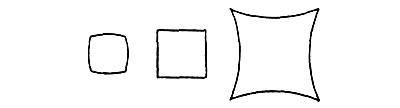
Fig. 6.
The best way to mark stops is, for example, f/8 and f/16, as these expressions are universally understood, but some persons think that the relative rapidities or intensities are better, others prefer to express the relative exposure necessary, and every system of numbering on these plans has a unit which is merely empirical, not one of them adopting the only true or scientific unit of f/1.
Zeiss has recently changed his unit from f/100 to f/50. Dallmeyer marks some of his lenses now with the practical expression. The following table may be of service to those who happen to have lenses with their diaphragms marked on any of these empirical systems.
f/ Royal Photo- graphic Society. Dall- meyer. Paris Con- gress. Zeiss (old). Zeiss (new). f/ Royal Photo- graphic Society. Dall- meyer. Paris Con- gress. Zeiss (old). Zeiss (new).
3.16 1 1/10 18 32 8
3.2 1024 256 20 40 4
4 1 22.36 50 5
5 2.5 1/4 22.6 32
4.5 512 128 25 16 4
5.66 2 27.36 75 7.5
6.3 4 4/10 256 64 31.62 100 10
7.07 5 1/2 32 64
8 4 36 8 2
8.66 7.5 3/4 38.7 150 15
9 32 44.72 200 20
10 10 1 45.2 128
11.3 8 50 250 25 4 1
12.25 15 1.5 54.77 300 30
12.5 64 16 63.25 400 40
14.14 20 2 64 256
15.81 25 2.5 70.71 500 50
16 16 71 2
17.32 30 3 100 1
Image Angle.—The image angle represents what is called covering power. It may be expressed in terms of the focal length, and doubtless this is the best method, but it is not customary. It may be expressed as an angle, the angle formed when a line is drawn from each extremity of a line equal to the diameter of the circle covered, and caused to meet at a point distant from the base line equal to the focal length of the lens. The angle where the two lines meet is the image angle. But generally the covering power is expressed more roughly, as the ordinary size of the plate that sufficiently good definition can be obtained on.
Tele-Photographic Lenses.—If a negative (or dispersing or concave) lens is introduced between the ordinary lens and the plate, the equivalent focal length of the arrangement is greater than that of the ordinary lens alone, but the length of camera necessary is not proportionately great. It is possible therefore to obtain an image of a size that would otherwise require a lens of long focal length and a corresponding and perhaps impossible length of camera. But this is not the only advantage, for if the ordinary lens and the negative lens are separable to a variable extent, the amount of magnification of the image, or increase in the equivalent focal length of the optical system, is adjustable at will. For further details concerning tele-photographic lenses and their use, reference should be made to Mr. Dallmeyer's pamphlet on the subject.
There are two other subjects connected with the production of images by photographic lenses that must be referred to, though neither of them is of great importance if we exclude the use of hand cameras (which are separately treated of) and bear in mind the ordinary practice of to-day. These are depth of definition and the distortion due to the use of single lenses.
Depth of Definition.—It has already been shown that the action of the lens is to bring to a point in the image all the light that falls upon it from the corresponding point of the object. Now it is clear from fig. 2 that, if different parts of the object are at different distances from the lens, and this must be the case with solid objects, these different parts cannot be in focus at the same time. Still it is possible to get them so nearly in focus that the result is serviceable, and the ordinary method of doing this is to examine the image on the ground glass, and if the whole subject is not sharp enough, to reduce the size of the aperture. Depth of definition is increased by using a lens of shorter focal length or by reducing the aperture. If a large aperture has to be used, the focal length must be short if much depth of definition is wanted, or conversely, if the focal length must be long the aperture must be small. It follows that very rapid lenses that have a very long focus are of no use, for in portraiture, for example, this combination of properties would lead to the ear in the image being fuzzy if the eye was sharp.
If a lens were perfect and had a flat field, the depth of definition would depend only on the aperture and focal length. But if the lens gives inferior definition towards the edges of the field, it is quite obvious that there must be less depth of definition there, if a minimum of defining power is accepted. The definition at its best may be inferior to the minimum accepted and then obviously there is no depth. Depth of definition therefore at the centre of the plate depends entirely on the focal length and aperture, but away from the centre it depends also on the quality of the lens, and is much greater in a flat field anastigmat than in a lens of an older type. But depth of definition is not a quality apart, it depends entirely upon other factors, and it is better in examining a lens to determine these factors separately rather than to lump them together as depth.
Distortion produced by single lenses is due to the fact that the diaphragm is either in front of or behind them. If the diaphragm is in front, the image is drawn towards the centre of the plate to an extent that increases as the margin of the field is approached. A line along one side of the plate has its ends drawn in to a greater amount than its centre, because they are further from the middle of the plate, and therefore it becomes curved like the side of a barrel, and this effect is called barrel-shaped distortion. If the diaphragm is behind the lens, the displacement is outwards, also increasing towards the edges of the field, and a straight line at the edge of the plate becomes curved so that it is convex towards the centre of the plate. This is known as hour-glass distortion. Both these effects are illustrated (and exaggerated for clearness' sake) in fig. 6, the central square representing the true figure. This "curvilinear distortion" is absent in all cases in the middle of the plate and generally for a considerable area, and if single lenses of only long focal length are used, say of a focal length equal to at least one and a half times the length of the largest side of the plate, it may be neglected. Wide-angle single lenses should never be used except on a suitably small plate, so that the above conditions hold. The nearer the diaphragm is to the lens the less is the distortion, and some of the most modern single lenses have the diaphragm so near that the photographer is even more safe in the use of them.
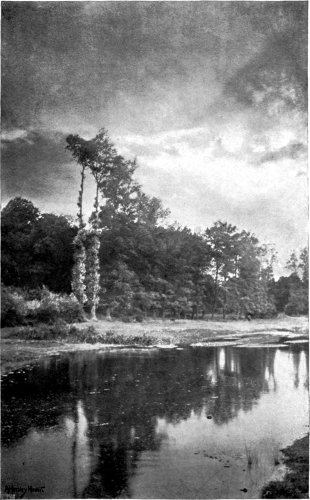
MELTON MEADOWS. A. HORSLEY HINTON.
The Comparison and Use of Lenses.—The optician when he tests lenses looks for each fault individually, but this the ordinary photographer is hardly able to do, nor is it particularly desirable for him, because if a lens is inferior it matters little to him why it is so. On the other hand occasion may arise when he wants to identify a fault, then the information already given will probably be sufficient to enable him to do so, if to it is added that a small pinhole with a flame behind it is a convenient point of light, and that if the image of this luminous point is examined with a good eyepiece, without the focussing screen, at various parts of the field, the character of the defect may be discovered.
The main things that the photographer needs to look to in judging of a lens or comparing it with another, are (1) that it works to focus, (2) the quality of its defining power especially towards the edges of the plate. There must also be taken into account the focal length and aperture, and if both these are not the same in the lenses to be compared they should be nearly the same, and the proportion that the aperture bears to the focal length should be exactly the same. A special diaphragm may have to be cut out of card for one of them. The best test object that is always at hand is a newspaper pinned flat against a flat wall. The camera must not be moved during the work. Each lens is very carefully focussed and a negative made, using the same aperture, time of development, and in all ways similar treatment for both. If the focal lengths are different, the images will be of correspondingly different sizes, and then the same detail must be compared, not the definition at the same distance from the centre.
All good lenses work to focus, but some of the cheaper ones do not. To test this, any series of small objects arranged side by side, but at distances varying by intervals of say two inches from the camera, is photographed after carefully focussing on the middle one. If any other than the middle one is the best defined, the lens is at fault. But in this, as in all similar tests, it must be remembered that ordinary dry plates are not quite flat, and the error of the plate may make an appreciable difference.
The use of lenses comprises the whole art of working with the camera, it is therefore not our province to say much about it. But so far as lenses themselves are concerned it may be remarked that, if a lens has a round field, it may be advantageous to tip up the lens with regard to the plate when only a part of the plate is being used, as for example sometimes in taking a landscape. But in using the modern flat field lenses special care should be taken to keep the lens and plate exactly true to each other, the plate exactly at right angles to the lens axis. The image and plate must coincide or definition will suffer. If the image is rounded and the plate flat, then in any case the result is only a compromise, but to take full advantage of the larger apertures when the field is flat, much more care than has been usual must be devoted to this matter.
Simple uncorrected lenses such as spectacle lenses or "monocles," suffer from the defects that have already been described, and are valued on this account by some workers because they give blurred or "soft" images. With a small enough diaphragm they will give good definition, and generally it may be stated that reducing the aperture lessens the effect of any fault that a lens may possess. To get the best definition that a simple lens will give, the plate must be brought nearer the lens after focussing by about one-fiftieth of the focal length of the lens, so that it may be brought from the best focus of visual light into the best focus of the photographically active light. If the object photographed is nearer to the lens than about one hundred times its focal length, the amount of movement after focussing must be increased. If four focal lengths distant, the correction is nearly one-thirtieth of the focal length, at three focal lengths distant, nearly one-twentieth, and at two focal lengths, about a thirteenth.
Pinholes give an image that for all practical purposes may be said to be equally blurred or "soft" over the whole plate. Much has been written about pinholes and their use, but it is not definitely known yet whether the exposure should be longer or shorter than the exposure required when a lens is used, allowing, of course, for the smallness of the aperture. The following short table and exposure rules from the writer's "Science and Practice of Photography," will probably prove useful:—
Pinholes—diameters 1/16 1/22 1/32 1/45 1/64
Distance from plate for sharpest image } 64 32 16 8 4
All the above figures are in inches. Whatever pinhole and at whatever distance, estimate the exposure for a lens at f/16, f/22, f/32, f/45, or f/64, as the case may be, and multiply it by the square of the number of inches that the plate is distant from the pinhole. But if the distance is as given above for any hole, it is sufficient to expose for as many minutes as the plate is inches distant from the hole, for a subject that would require one second with an aperture of f/16.
Chapman Jones.