Volume 1 — CHAP. XXI.
Reading edition
PRESS FOR AN ATTACK.—RESULTS OF DELAY.—THE FRENCH PREPARATIONS.—FRENCH ADMIRAL’S ACCOUNT. INSULT TO THE ENGLISH FLEET.—STATE OF PREPARATIONS. START FOR THE ATTACK.—THE ATTACK.—THE EXPLOSION.—FAILURE OF THE ATTACK.—TERROR OF THE FRENCH.—THE FRENCH AGROUND.—APATHY OF LORD GAMBIER.—THE AIX ROADS.—THE FRENCH FLEET PERMITTED TO ESCAPE.—DRIFT TOWARDS THE ENEMY.—ATTACK THE FRENCH FLEET.—THE CALCUTTA STRIKES.—THE ATTACK.—FAILURE OF FIRESHIPS.—SINGULAR INCIDENT.—SIGNAL OF RECALL.—CAPTAIN SEYMOUR.—LORD GAMBIER’S EVASIVENESS.—AM RECALLED.—REMONSTRATE WITH LORD GAMBIER.—AM SENT HOME.—LORD GAMBIER’S DESPATCH.—THE FRENCH DESPATCH.—DESTRUCTION OF THE BOOM.—THE MEDIATOR.
On the 10th of April, the Beagle, having arrived from England with the fireships in company, I pressed Lord Gambier to permit an attack to be made on the same night; but, notwithstanding that the weather was favourable, his lordship saw fit to refuse. My reason for pressing an immediate attack was, that as the enemy could not remain in ignorance of the character of the newly arrived vessels, they might have less time to make additional preparations for their reception.
Notwithstanding the importance of prompt action in this respect, argument was unavailing. His lordship 371urged that the fireships might be boarded, and the crews murdered, though there was more danger of this from delay than from attacking unawares. There was in reality no danger; but I urged in vain that it was an essential part of my plan personally to embark in an explosion vessel, preceding the fireships, so that in conducting and firing her all risk would fall on myself and the volunteer crew which would accompany me; it not being probable that after the explosion the enemy’s guard-boats would board the fireships which might follow, as every one would certainly be taken for a mine similarly charged. Under that impression, however gallant the enemy, there was little chance of the fireships being boarded.
His lordship replied, that “if I chose to rush on self-destruction that was my own affair, but that it was his duty to take care of the lives of others, and he would not place the crews of the fireships in palpable danger.”
To this I rejoined, that there could not be any danger, for the use of explosion-vessels being new to naval warfare, it was unlikely that, after witnessing the effect of the first explosion, the enemy’s officers and men would board a single fireship. I further told his lordship that my brother, the Hon. Basil Cochrane, and Lieut. Bissel were on board the Impérieuse as my guests, and so well satisfied were both of the little danger to be apprehended that they had volunteered to accompany me. Lord Gambier, however, remained firm, and further remonstrance being useless, I had no alternative but to delay, whilst the French, who quickly 372became aware of the character of the newly arrived vessels, adopted all necessary precautions.[45]
A most favourable opportunity was thus thrown away. The French admiral, however, lost no time in turning the delay to account, by altering the positions of his fleet, so as to expose it to the smallest possible amount of danger.
The enemy’s ships of the line struck their topmasts, got their topgallant yards on deck, and unbent sails, so as to expose as little inflammable matter aloft as possible; the frigates only being left in sailing trim, ready to act as occasion might require; whilst the boats and launches of the fleet, to the number of seventy-three, were armed and stationed in five divisions for the purpose of boarding and towing off the fireships.[46]
The French admiral, Allemand, disposed his force in the following manner:—The ten sail of the line, which before the arrival of the fireships had been moored in two lines overlapping each other, were formed afresh 373in a double line, nearly north and south; the outer line comprising five, and the inner six ships, including the Calcutta; the inner fine being so anchored as to face the openings between the ships of the outer line, the extremity of which was somewhat more than a mile from the batteries on the Isle of Aix. About half a mile in advance of the whole lay the four frigates, and immediately in front of these was a boom of extraordinary dimensions. As this boom will form an important feature in the narrative, I subjoin the French admiral’s description, first premising that, although there was reason to expect that an obstacle of the kind would have to be encountered, its exact nature was not known till the attack was made[47]:—
“Notre armée étoit sur deux lignes de bataille, endentées, très-serrées, gisant au nord, un quart nord-ouest et sud, un quart sud-est du monde, afin de présenter moins de surface à l’envoi des brûlots.
“Au coucher du soleil il ventoit encore très-gros frais. Je laissai chaque capitan libre de sa manœuvre pour la sûreté de son vaisseau.
“J’envoyai un officier prévenir le général Bronard, commandant à l’île d’Aix, que l’ennemi, par sa manœuvre, annonçoit vouloir profiter du gros vent et de la marée pour 374entreprendre un coup de main. Il me fit dire qu’il l’attendoit de pied ferme, et qu’il répondoit de la terre.”—Vice-Admiral Allemand’s Despatch of the 12th of April.
The French, no doubt, considered their position secure against fireships, having no expectation of other means of attack; and so it undoubtedly was, from the protection afforded by the boom, which, from its peculiar construction, could neither be destroyed nor burned by fireships—as well as further defended by the guard-boats, which were judged sufficient to divert the course of such fireships as might drift past the boom. Their fleet was anchored so as to expose the smallest possible front; and what added no little to their sense of security was the delay which had taken place on the part of the British admiral without attack of any kind. On such grounds, therefore, they not unreasonably felt confident that, if the fireships failed, as from the judicious preparations made, Admiral Allemand had every reason to anticipate, no attack on the part of the British fleet would follow. In this belief, on altering their position, the French dressed their fleet with flags, and, by way of contempt for their assailants, hung out the English ensign of the Calcutta—which, as has been said, was a captured English vessel—under her quarter gallery! The peculiar nature of the insult needs not to be explained—to naval men it is the most atrocious imaginable.
The fortifications on Isle d’Aix, alluded to by Admiral Allemand, were, as Lord Gambier had reported to the Admiralty in his letter of the 11th of March, insignificant, or, as his Lordship at first expressed it, “no obstacle;” a dozen guns being the utmost number 375mounted on the batteries commanding the roads, though these were afterwards characterised by his Lordship as the “strong works on the Isle of Aix.”[48] The nearest of the batteries on Oleron was out of gunshot, and therefore of no account.
As narratives of the attack on the French fleet in Basque Roads have been often, though in some of the main points incorrectly, written from the contradictory, and in many instances incomprehensible, evidence on the subsequent court-martial, as compared with the no less contradictory despatches of Lord Gambier, I shall in the following account strictly confine myself to what took place under my own personal conduct and observation.[49]
On the 11th of April, it blew hard with a high sea. As all preparations were complete, I did not consider the state of the weather a justifiable impediment to the attack, to which Lord Gambier had now consented; 376so that after nightfall, the officers who volunteered to command the fireships were assembled on board the Caledonia, and supplied with instructions according to the plan previously laid down by myself.
The Impérieuse had proceeded to the edge of the Boyart shoal, close to which she anchored with an explosion vessel made fast to her stern, it being my intention, after firing the one of which I was about to take charge, to return to her for the other, to be employed as circumstances might require. At a short distance from the Impérieuse were anchored the frigates Aigle, Unicorn, and Pallas, for the purpose of receiving the crews of the fireships on their return, as well as to support the boats of the fleet assembled alongside the Cæsar, to assist the fireships. The boats of the fleet were not, however, for some reason or other, made use of at all.
The enemy had calculated on the impending attack, and, as was afterwards ascertained, by way of precaution against fireships, sent two divisions of their guard-boats, with orders to lie under the boom till two in the morning; but wind and tide being against them, they were compelled to put back, without effecting their orders. Both wind and tide, however, though dead against the French boats, were favourable for the boats of the British fleet, had they been employed as arranged; and they would have been of great use to the less efficient boats of the fireships, some of which, in returning, were nearly swamped. For want of such assistance, as will presently be seen, most of the fireships were kindled 377too soon, no doubt to save the men the terrible pull back, against a gale of wind and a high sea.
Having myself embarked on board the largest explosion vessel, accompanied by Lieut. Bissel and a volunteer crew of four men only, we led the way to the attack; the Impérieuse afterwards, in accordance with my instructions, signalising the fireships to “proceed on service.”
The night was dark, and as the wind was fair, though blowing hard, we soon neared the estimated position of the advanced French ships, for it was too dark to discern them. Judging our distance, therefore, as well as we could, with regard to the time the fuse was calculated to burn, the crew of four men entered the gig, under the direction of Lieut. Bissel, whilst I kindled the port fires; and then, descending into the boat, urged the men to pull for their lives, which they did with a will, though, as wind and sea were strong against us, without making the progress calculated.
To our consternation, the fuses, which had been constructed to burn fifteen minutes, lasted little more than half that time, when the vessel blew up, filling the air with shells, grenades, and rockets; whilst the downward and lateral force of the explosion raised a solitary mountain of water, from the breaking of which in all directions our little boat narrowly escaped being swamped. In one respect it was, perhaps, fortunate for us that the fuses did not burn the time calculated, as, from the little way we had made against the strong head wind and tide, the rockets and shells from the exploded 378vessel went over us. Had we been in the line of their descent, at the moment of explosion, our destruction, from the shower of broken shells and other missiles, would have been inevitable.
The explosion vessel did her work well, the effect constituting one of the grandest artificial spectacles imaginable. For a moment, the sky was red with the lurid glare arising from the simultaneous ignition of 1500 barrels of powder. On this gigantic flash subsiding, the air seemed alive with shells, grenades, rockets, and masses of timber, the wreck of the shattered vessel; whilst the water was strewn with spars, shaken out of the enormous boom, on which, according to the subsequent testimony of Captain Proteau, whose frigate lay just within the boom, the vessel had brought up, before she exploded. The sea was convulsed as by an earthquake, rising, as has been said, in a huge wave, on whose crest our boat was lifted like a cork, and as suddenly dropped into a vast trough, out of which, as it closed upon us with a rush of a whirlpool, none expected to emerge. The skill of the boat’s crew, however, overcame the threatened danger, which passed away as suddenly as it had arisen, and in a few minutes nothing but a heavy rolling sea had to be encountered, all having again become silence and darkness.
This danger surmounted, we pulled in the direction of the Impérieuse, whose lights could be distinguished at about three miles’ distance. On our way we had the satisfaction of seeing two fireships pass over the spot where the boom had been moored. Shortly afterwards 379we met the Mediator steering in the direction of the enemy, whose ships of the line were now firing towards the spot where the explosion had taken place, and consequently on their own advanced frigates! which, as was afterwards learned, cut their cables, and shifted their berths to a position in the rear of the larger ships.
On reaching the Impérieuse, I found, to my great mortification, that the second explosion vessel, which, by my orders, had been made fast to the frigate’s stern, had been cut away, and thus set adrift: a fireship in flames having come down on her instead of the enemy! The Impérieuse herself had a narrow escape of being burned, and was only saved by veering cable; the fireship which caused the disaster drifting harmlessly away on the Boyart Shoal. This clumsy occurrence completely frustrated the intention with which I had reserved her, viz. for further personal operations amongst the enemy’s fleet, now that the first explosion vessel had cleared the way.
Of all the fireships, upwards of twenty in number, four only reached the enemy’s position, and not one did any damage! The way in which they were managed was grievous. The Impérieuse, as has been said, lay three miles from the enemy, so that the one which was near setting fire to her became useless at the outset; whilst several others were kindled a mile and a half to windward of this, or four miles and a half from the enemy. Of the remainder, many were at once rendered harmless, from being brought to on the wrong tack. Six passed a mile to windward of the French fleet, and 380one grounded on Oleron. I could scarcely credit my own vision when I saw the way in which they were handled; most of them being fired and abandoned before they were abreast of the vessels anchored as guides.
The fear of the fireships operated strongly enough, but, notwithstanding the actual effect attributed to them by naval historians, they did no damage whatever. A matter of little consequence, had the British fleet, or even a portion thereof, subsequently taken advantage of the panic created amongst the enemy.
As the fireships began to light up the roads, we could observe the enemy’s fleet in great confusion. Without doubt, taking every fireship for an explosion vessel, and being deceived as to their distance, not only did the French make no attempt to divert them from their course, but some of their ships cut their cables and were seen drifting away broadside on to the wind and tide—whilst others made sail, as the only alternative to escape from what they evidently considered certain destruction from explosive missiles!
Had the commander-in-chief witnessed this scene, he would never again have deemed such extraordinary precaution on his part requisite to guard against fireships being boarded when preceded by explosion vessels. In place of becoming the aggressors, as his Lordship had anticipated, the only care of the enemy was how to get out of the way, even at the risk of running their ships ashore. Unfortunately the commander-in-chief was with the fleet, fourteen miles distant.
381At daylight on the morning of the 12th not a spar of the boom was anywhere visible, and with the exception of the Foudroyant and Cassard, the whole of the enemy’s vessels were helplessly aground. The former of these ships lying out of the sweep of the tide, and being therefore out of danger from the fireships, appeared not to have cut her cable, and the Cassard, which had at first done so, again brought up about two cables’ length from the Foudroyant.
With these exceptions, every vessel of the enemy’s fleet was ashore. The flag-ship of Admiral Allemand, L’Océan, three-decker, drawing the most water, lay outermost on the north-west edge of the Palles Shoal, nearest the deep water, where she was most exposed to attack; whilst all, by the fall of the tide, were lying on their bilge, with their bottoms completely exposed to shot, and therefore beyond the possibility of resistance.
The account given by the captain of the Indienne, French frigate, Captain Proteau, of the position of the grounded ships, will not be called in question. It is as follows:—“The Indienne aground on Point Aiguille, near the fort; the Pallas off Barques; the Elbe and Hortense on the Fontenelles; the Tourville, Patriote, and Tonnerre, as seen from the Indienne, in a line on the Palles Shoal; the Calcutta, Regulus, Jemappes on the extremity of that shoal; the Varsovie and Aquilon aground on Charenton; and the Océan, three-decker, close to the edge of the Palles.”
We did not reach the Impérieuse till after midnight. At daylight observing seven of the nearest enemy’s 382ships ashore, amongst which was the admiral’s ship L’Océan, and a group of four others lying near her, in a most favourable position for attack, without the possibility of returning it, at 6 A.M. we signalised the admiral to that effect. As the Impérieuse at this time lay just within range of the batteries on Aix, which had commenced to fire upon us, we weighed, and stood in the direction of the fleet, letting go our anchor as soon as the ship was out of range. At 7 A.M. we signalised again, “All the enemy’s ships, except two, are on shore;” this signal, as well as the former one, being merely acknowledged by the answering pennant; but, to our surprise, no movement was visible in any part of the fleet indicating an intention to take advantage of the success gained.
Reflecting that, from the distance of the British force from the stranded enemy’s ships, viz. from twelve to fourteen miles, the Commander-in-chief could not clearly be acquainted with their helpless condition, I directed the signal to be run up, “The enemy’s ships can be destroyed;” this also meeting with the same cool acknowledgment of the answering pennant.
Not knowing what to make of such a reply, another signal was hoisted, “Half the fleet can destroy the enemy.” This signal was again acknowledged by the answering pennant, the whole fleet still remaining motionless as before. On this I made several telegraph signals, one of which was probably regarded as impertinent, viz. “The frigates alone can destroy the enemy,” though it was true enough, their ships aground being perfectly helpless. To my astonishment the answering pennant was still the only reply vouchsafed!
383Eight and nine o’clock passed without any indication of movement on the part of the fleet, though the tide was now fast rising, so that any ships sent to the attack of the stranded vessels would have had the flood-tide to go in and the ebb to return, after having accomplished their destruction; whilst it was evident that if not attacked, the same flood-tide would enable the French ships aground to float and escape, with which view some were heaving their guns and stores over board. On ascertaining this, I again signalised, “The enemy is preparing to heave off;” and entertaining no doubt that the Commander-in-chief would not permit such a catastrophe, the Impérieuse dropped her anchor close to the Boyart Shoal, in readiness for any service that might be required.
As much has been said respecting the alleged narrowness of the channel leading to Aix Roads, by way of excuse for the British fleet not having followed up the advantage gained by the panic created on the previous night, from terror of the explosion vessels, I may here mention, that on our coming to an anchor, a fort on Isle d’Oleron commenced firing shells at us. As not one of these reached us, the French gunners adopted the expedient of loading their mortars to the muzzle, this being evident from the fact that they now discharged them by means of portfires, the men gaining a place of security before the mortars exploded. Not a shell, even thus fired, reached our position, a clear proof that had the British fleet come to the attack, it could have been in no danger from Oleron, though even these distant batteries were afterwards brought forward as an obstacle, in default of stronger argument.
384At 11 A.M. the British fleet weighed, and stood towards Aix Roads. By this time the Océan, three-decker, and nearest ships aground were busily employed in heaving off, with a view of making sail for the Charente!! The advance of our fleet had been too long delayed; nevertheless, as the bulk of the enemy’s ships were still aground, good service might have been rendered. To our amazement, the British fleet, after approaching within seven or eight miles of the grounded ships, again came to anchor about three and a half miles distant from Aix, i. e. just out of range.
There was no mistaking; the admiral’s intention in again bringing the fleet to an anchor. Notwithstanding that the enemy had been four hours at our mercy, and to a considerable extent was still so, it was now evident that no attack was intended[50], and that every enemy’s ship would be permitted to float away unmolested and unassailed! I frankly admit that this was too much to be endured. The words of Lord Mulgrave rang in my ears, “The Admiralty is bent on destroying that fleet before it can get out to the West Indies.”
The motive of Lord Gambier in bringing the ships to an anchor being beyond doubt, I made up my mind, if possible, to force him into action by attacking the enemy with the Impérieuse, whatever might be the consequence. It was, however, a step not to be taken without consideration, and for some time I hesitated to carry out this resolution, in the hope that a 385portion, at least, of the British fleet would again weigh and stand in.
Noon passed. The Océan, three-decker, had now got afloat, and the group of four others on shore near her, seeing the British fleet anchor, proceeded with additional energy to heave off. From her position the three-decker, lying as she did on the edge of the shoal, nearest the deep water, ought to have been the easiest prize of the whole; for whilst she lay on her bilge, close to the most accessible part of the channel, even a single gunboat might have so riddled her bottom as to have prevented her from floating off with the rising tide!
The surprise of the enemy at seeing the fleet anchor was probably greater than my own. Before that, they had been making great exertions to lighten and heave off, but no sooner had the fleet brought up, than, seeing the possibility of escape, they strained every nerve to hasten the operation.
In place of the fleet, or even the frigates, a single bomb, which, being armed with a 13-inch mortar, could project her shells to a great distance, without being exposed to danger from shot, was ordered in to shell the ships aground. On my asking her commander, “what attack was going to be made on the enemy by the fleet?” he replied, that “he knew nothing further than that he was ordered to bombard the ships ashore.” This was proof enough that no intention of attacking with the fleet, or any part of it, existed.
In despair, lest the ships still aground should also effect their escape, at 1 P.M. I ordered the anchor of 386the Impérieuse to be hove atrip, and thus we drifted stern foremost towards the enemy. I say “drifted,” for I did not venture to make sail, lest the movement might be seen from the flagship, and a signal of recall should defeat my purpose of making an attack with the Impérieuse; the object of this being to compel the commander-in-chief to send vessels to our assistance, in which case I knew their captains would at once attack the ships which had not been allowed to heave off and escape.
Had this means not been resorted to, not a single enemy’s ship would have been destroyed, for all could have hove off almost without damage, and that, to all appearance, without the slightest attempt at molestation on the part of the British fleet. It was better to risk the frigate, or even my commission, than to suffer such a disgraceful termination to the expectations of the Admiralty, after having driven ashore the enemy’s fleet; and therefore we drifted by the wind and tide slowly past the fortifications on Isle d’Aix, about which the commander-in-chief had expressed so many fears in his last letter to the Board; but though they fired at us with every gun that could be brought to bear, the distance was too great to inflict damage.
Proceeding thus till 1.30 P.M., and then suddenly making sail after the nearest of the enemy’s vessels escaping, at 1.40 P.M. the signal was run up to the peak of the Impérieuse, “Enemy superior to chasing ship, but inferior to the fleet.” No attention being paid to this signal, at 1.45 P.M. I again signalled, “In want of assistance,” which was true enough, being in a single frigate, close to several enemy’s ships of the line.
387As this signal, according to the code then in use, was coupled with the one signifying “In distress,” the signal officer on board the flagship thus interpreted it to the commander-in-chief; a circumstance which will require brief explanation.
In order to divert our attention from the vessels we were pursuing, these having thrown their guns overboard, the Calcutta, which was still aground, broadside on, began firing at us. Before proceeding further, it became, therefore, necessary to attack her, and at 1.50 we shortened sail, and returned the fire. At 2 the Impérieuse came to an anchor in five fathoms; and veering to half a cable, kept fast the spring, firing upon the Calcutta with our broadside, and at the same time upon the Aquilon and Ville de Varsovie with our forecastle and bow guns, both these ships being aground stern on, in an opposite direction.
This proceeding—though there could be no doubt of our being “In want of assistance,” seeing that our single frigate, unaided, was engaging three line-of-battle ships—did not look much like being “In distress,” as the signal officer of the Caledonia had interpreted the signal; the nature of which could not, however, have deceived the commander-in-chief, who must have witnessed the circumstances under which the signal had been made by the Impérieuse.
After engaging the Calcutta for some time, and simultaneously firing into the sterns of the two grounded line-of-battle ships, we had at length the satisfaction of observing several ships sent to our assistance, viz. Emerald, Unicorn, Indefatigable, Valiant, 388Revenge, Pallas, and Aigle. On seeing this, the captain and crew of the Calcutta abandoned their vessel, of which the boats of the Impérieuse took possession before the vessels sent to our “assistance” came down.
On the subsequent court-martial, it was declared that the Calcutta did not strike to the Impérieuse, but to the ships sent to her assistance. This was deliberately untrue; as proved beyond question by the fact that the French government ordered a court-martial on the captain of the Calcutta, Lafon, and condemned him to be shot, clearly for having abandoned his ship to inferior force. The French did not shoot any of the other captains for abandoning their ships, and would not have shot Captain Lafon for fighting his vessel as long as he could, and then abandoning her to two line-of-battle ships and five frigates. On the contrary, they would have highly rewarded him, for saving his crew against such odds. There cannot be a stronger proof, if proof in addition to my word be wanted, that Captain Lafon abandoned the Calcutta to the Impérieuse, and not to the line-of-battle ships which came up afterwards, as was subsequently asserted.
On the arrival of the two line-of-battle ships and the frigates, the Impérieuse hailed them to anchor, or they would run aground on the Palles Shoal, on the very edge of which the Impérieuse had taken up her berth. They anchored immediately and commenced firing on the Calcutta, Aquilon, and Ville de Varsovie. On this I signalled the Revenge and others to desist from firing, as the Calcutta had already struck to the Impérieuse, 389and we had at that time a boat’s crew on board her.
On this they desisted, and turned their fire wholly on the other two vessels. At 3.30 P.M. the Impérieuse ceased firing, the crew being thoroughly exhausted by fatigue; whilst I was so much so, as to be almost unable to stand. My reason, however, for ordering the Impérieuse to cease firing was, that the ships sent to our assistance were more than sufficient to destroy the enemy which remained, and had they been sent in time—not to our “assistance,” but for the more legitimate object of attacking the grounded ships—they would have been abundantly sufficient, had they not been recalled, to have destroyed all those that got away.[51]
At 5.30 P.M. the Aquilon and Ville de Varsovie struck.
Shortly afterwards, the Calcutta was set on fire, and in half an hour was burning furiously. At 6.0 P.M. the crew of the Tonnerre, which was not attacked, set fire to her, escaping in their boats. At 7.0 the Tonnerre blew up, and at 9.0 the Calcutta also, with an effect, from the large quantity of ammunition on board, almost equalling that of the explosion-vessels the night before. The Calcutta was the storeship of the French fleet.
It has been said, that my having rushed single-handed 390amongst the enemy’s ships, and then hoisted the signal “In want of assistance,” was unjustifiable, as forcing the commander-in-chief to attack against his judgment. My answer to this is, that the expectations entertained by the Admiralty of destroying the enemy’s fleet would not have been in any way carried out, had not this means been adopted; because, as has been said, not a ship belonging to the enemy would have sustained even the slightest damage from the measures of the commander-in-chief.
The fire-ships entrusted to my command had failed, not from any fault of mine, but of those who were entrusted with them. It was, then, a question with me, whether I should disappoint the expectations of my country; be set down as a charlatan by the Admiralty, whose hopes had been raised by my plan; have my future prospects destroyed; or force on an action which some had induced an easy commander-in-chief to believe impracticable.
Some proof has been given of the jealousy of a portion of the fleet towards me. Another instance of this occurred even after the two line-of-battle ships and the frigates came down. Perceiving that the shot from two sloops, or rather brigs, ordered to protect the Etna bomb, did not reach the enemy, from the long range at which she had anchored, I made the signal for them to close. As no signal was at hand to express brigs only, to the exclusion of frigates or larger vessels, I endeavoured to explain my meaning that the signal was intended for the brigs, by firing towards them from the main-deck of the Impérieuse, the object of this being to 391avoid giving offence to my senior officers in command of the frigates and line-of-battle ships now present. The signal “to close” in the same defective code expressing also “to close the Admiral,” it was construed by my seniors into an insult to them, as arrogating to myself the position of chief-in-command, which was simply absurd; as, being my seniors, I had no power to order them, nor was I so ignorant of my duty as wantonly to usurp the functions of the commander-in-chief. Yet this at the time gave great offence, though afterwards satisfactorily explained, to Lord Gambier.
I may here mention a singular incident which occurred some time after the Aquilon and Ville de Varsovie had struck, and after their officers and crews had been removed on board the British ships. The captain of the Aquilon having informed me that he had left his personal effects behind, I volunteered to take him on board in my boat and procure them. As we left the Aquilon a shot from a heated gun on board one of the vessels to which the French had set fire—the Tonnerre, if I recollect rightly—struck the stern sheets of the boat on which both he and I were sitting, and lacerated the lower part of the gallant officer’s body so severely that he shortly afterwards expired.
Before daybreak on the following morning the officer of the watch called me, and reported that three lights were hoisted in the squadron outside. This proved to be a signal, afterwards reported to have been made by Admiral Stopford, for the recall of the ships that had been sent in on the previous evening! In obedience to this signal, they, at 4 A.M., got under 392weigh, having previously kindled the French line-of-battle ships Aquilon and Ville de Varsovie; an act for which there was not the slightest necessity, as they could easily have been got off. Fatigued, and mentally harassed as I was, I had neither time nor opportunity to protest against this wanton destruction; besides which, not knowing that the magazines of the burning ships had been drowned, my attention was directed to the preservation of the Impérieuse, which was in close proximity.
The two ships Foudroyant and Cassard, had cut their cables and made sail, when on the previous evening the British fleet stood towards Aix Roads, but afterwards so unaccountably came to an anchor. On seeing this they shortened sail, but run aground in the middle of the channel leading to the Charente.
It being clear to me that these ships were not in a fighting condition, I determined, notwithstanding the recall of the British vessels, to remain and attack them; considering the signal of recall to be addressed only to the ships sent to our assistance, which, in obedience to that signal, were working out of the inner anchorage without any attempt to destroy other ships which were clearly at their mercy. As they were passing out I hailed the Indefatigable, and asked the captain if he would go on one quarter of the three-decker (l’Océan), whilst the Impérieuse engaged the other? The reply was that “he would not, and that they were going out to join the fleet.”
To his infinite credit, Captain Seymour, of the Pallas (the present distinguished admiral, Sir George Seymour), 393hailed us to know “if he should remain with the Impérieuse?” he being evidently as reluctant as myself to give up advantages so manifest. I replied, that if no orders had been given him to the contrary, I should be obliged to him so to do; whereupon the Pallas anchored, and four brigs, the Beagle, Growler, Conflict, and Encounter, followed her example.
We now commenced clearing the decks for further action, throwing overboard a boat which had been shot to pieces. The carpenters were then set to stop shot holes in the sides and decks, and the seamen to repair the rigging, and shift the fore-topmast, which had been shot through. The brave, but unfortunate, captain of the Calcutta had, in our short action, inflicted on us an amount of damage which the forts on Aix and Oleron had in vain attempted to effect; neither the one nor the other having once touched us.
Whilst the refitting of the frigate was going on, I ordered our only bomb, the Etna, protected by the brigs, to fire on the enemy’s Vice- and Rear-Admiral’s ships, as well as on the Foudroyant and Cassard, which, having thrown all overboard, were now pressing sail to get up the Charente, thus taking on myself to commence the action anew, after the auxiliary line-of-battle ships and frigates had retired!
To my regret, a signal of recall was immediately hoisted on board the Caledonia! To this I replied by another, “The enemy can be destroyed;” of which no notice was taken. Shortly afterwards a boat brought me the following letter from Lord Gambier:—
394
“Caledonia, 13th of April.
“My dear Lord,—You have done your part so admirably that I will not suffer you to tarnish it by attempting impossibilities[52], which I think, as well as those captains who have come from you, any further effort to destroy those ships would be. You must, therefore, join as soon as you can, with the bombs, &c., as I wish for some information, which you allude to, before I close my despatches.
“Yours, my dear Lord, most sincerely,
“Gambier.
“Capt. Lord Cochrane.
“P.S.—I have ordered three brigs and two rocket-vessels to join you, with which, and the bomb, you may make an attempt on the ship that is aground on the Palles, or towards Ile Madame, but I do not think you will succeed; and I am anxious that you should come to me, as I wish to send you to England as soon as possible. You must, therefore, come as soon as the tide turns.”
I felt deep regret at what must be considered as the evasions of this letter. First, Lord Gambier ordered me to come out of the anchorage and join the fleet! but evidently not choosing to take upon himself the responsibility of ordering me out, in opposition to my own views, he told me he would send some brigs with which I might attack vessels which his own neglect had permitted to escape up the Charente! and thirdly, I was ordered, to come out as soon as the tide turned!
As the commander-in-chief’s letter was thus indecisive, 395I chose to construe it as giving me the option of remaining, and returned his lordship the following answer:—
“Impérieuse, 13th April.
“My Lord,—I have just had the honour to receive your Lordship’s letter. We can destroy the ships that are on shore, which I hope your Lordship will approve of.
“I have the honour, &c.
“Cochrane.
“The Right Hon. Lord Gambier.”
At daylight on the 14th the enemy were still in the same condition, but with a number of chasse-marées quietly taking out their stores. Three of them were getting out their guns, evidently in expectation of certain destruction from the small vessels which remained after the line-of-battle ships and heavy frigates were recalled; and, had we been permitted to attack them even now, their destruction would have been inevitable.
In place of this the recall signal was once more hoisted on board the Caledonia, to which I replied by the interrogatory signal “Shall we unmoor?” considering that his lordship would understand the signal as a request to be permitted to resume the attack. I did not repeat the signal that the enemy could be destroyed, because, having conveyed to him by letter my opinion on that subject the day before, I thought a repetition of that opinion unnecessary,—the more so, as, from the enemy heaving overboard them guns, its soundness was more than ever confirmed.
In place of being ordered to attack, as from his lordship’s previous letter I had every reason to expect, 396the recall signal was repeated, and shortly afterwards came the following letter:—
“Caledonia, 13th (14th) April.
“My dear Lord,—It is necessary I should have some communication with you before I close my despatches to the Admiralty. I have, therefore, ordered Captain Wolfe to relieve you in the services you are engaged in. I wish you to join me as soon as possible, that you may convey Sir Harry Neale to England, who will be charged with my despatches, or you may return to carry on the service where you are. I expect two bombs to arrive every moment, they will be useful in it.
Yours, my dear Lord, most sincerely,
“Gambier.
“Capt. Lord Cochrane.”
Here was a repetition of the same thing. I was ordered away from the attack, to “convey Sir H. Neale to England,” or I “might return to carry on the service where I was,” viz. after the enemy had got clear off, and after being formally superseded in the service to which the Board of Admiralty had appointed me, by a senior officer whom I could not again supersede!!!
There was, however, no evading Lord Gambier’s letter this time without positive disobedience to orders, and that was not lightly to be risked, even with the Board’s instructions to back me. I therefore returned to the Caledonia, and at once told Lord Gambier that the extraordinary hesitation which had been displayed in attacking ships helplessly on shore, could only have arisen from my being employed in the attack, in preference to senior officers. I begged his lordship, by 397way of preventing the ill-feeling of the fleet from becoming detrimental to the honour of the service, to set me altogether aside, and send in Admiral Stopford, with the frigates or other vessels, as with regard to him there could be no ill-feeling; further declaring my confidence that from Admiral Stopford’s zeal for the service, he would, being backed by his officers, accomplish results more creditable than anything that had yet been done. I apologised for the freedom I used, stating that I took the liberty as a friend, for it would be impossible, as matters stood, to prevent a noise being made in England.
His lordship appeared much displeased; and making no remark, I repeated, “My Lord, you have before desired me to ‘speak candidly to you,’ and I have now used that freedom.”
Lord Gambier then replied, “If you throw blame upon what has been done, it will appear like arrogantly claiming all the merit to yourself.”
I assured his lordship that I had no such intention, for that no merit was due, and told him that I had no wish to carry the despatches, or to go to London with Sir Harry Neale on the occasion, my object being alone that which had been entrusted to me by the Admiralty, viz. to destroy the vessels of the enemy.
His lordship, however, cut the matter short by giving me written orders immediately to convey Sir Harry Neale to England with despatches. In obedience to this order we quitted Basque Roads for Plymouth on the following morning.
398These matters are officially on record, and therefore do not admit of dispute. I will not comment further upon them, but will leave them to the judgment of posterity. I will even go further, and acquit Lord Gambier of all blame up to this period, except that of an easy disposition, which yielded to the advice of officers interested in my failure, that calm judgment which should characterise a commander-in-chief, and which, had it been exercised, would have rendered, as Napoleon afterwards said, the whole French fleet an easy prey.
As much misrepresentation was made at the time relative to the damage inflicted by the explosion-vessel under my immediate command, and as the same misrepresentation has been adopted by all English historians, it will be necessary particularly to advert to this. As mere assertion on my part may be deemed egotistical, if not partial, I will adduce the testimony of Captain Proteau, who commanded the enemy’s frigate Indienne, and was close to the boom at the time it was destroyed by the explosion-vessel. The point here alluded to is the statement of the commander of the Mediator, that HIS VESSEL BROKE THE BOOM BY HER WEIGHT!! and Lord Gambier, without any personal knowledge of the fact, was thereby led to endorse his statement.
The captain of the Indienne, on the other hand, states that when the explosion-vessel blew up she was “at the boom,” or, nautically speaking, “brought up by the boom.” His words, are “flottant à l’estacade.”
It will be best, however, to extract the passage entire:—
399
“Nous distinguâmes, à 9 heures et demie, sous notre boussoir de tribord, un corps flottant à l’estacade. L’explosion s’en fit tout-à-coup, et vomit quantité de fusées artificielles, grenades et obus, qui éclatèrent en l’air sans nous faire le moindre mal, cependant nous n’en étions qu’à une demie encâblure.”—Captain Proteau’s Journal.
As the Indienne was only half a cable’s length from the boom when the explosion took place, the testimony of her captain on this point ought to be decisive.
Lord Gambier stated in his despatch, and afterwards in his defence, that the explosion-vessel blew up at half-past nine, whilst at three-quarters past nine (a quarter of an hour later), the Mediator and other vessels came up, and were fired on by the French ships!
Lord Gambier, being himself more than a dozen miles from the scene of action, made this statement on the authority of Captain Wooldridge, who commanded the Mediator, and who reiterated in his evidence on the court-martial the statement he had previously made to Lord Gambier, viz. that his ship, and not the explosion-vessel, broke the boom: of the truth of which statement the nautical reader shall judge on professional grounds.
Admiral Allemand, who commanded in Aix Roads, thus describes, in his despatch to the French Government, the boom which had been laid down by his directions:—“Elle (the French fleet) étoit flanquée d’une estacade à quatre cents toises au large, qui avoit huits cents toises de long.”
400The boom formed two sides of a triangle, with the apex towards the British fleet, thus,—
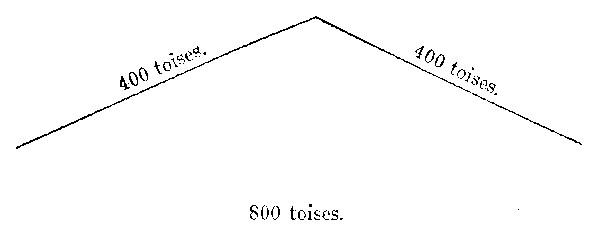
That is to say, each wing of the boom was more than half a mile long, and the distance between the extremities of the base was nearly a mile. This formidable obstacle was composed of large spars, bound by chains, and moored along its whole double line with heavy anchors at appropriate intervals, forming the most stupendous structure of the kind on record.
The statement of Captain Wooldridge to Lord Gambier, therefore, amounts to this,—that his ship, the Mediator, an Indiaman of 800 tons, broke up a double boom, each side of which was upwards of half a mile in length; tore up, by pressure on one point only, a double line of heavy anchors more than a mile in extent; and snapped many miles of iron chains and lashings connecting the spars together!!!—though her contact could not have been more than a few feet, the collision necessarily taking place on one wing of the boom only. This was Captain Wooldridge’s own version to Lord Gambier. To the nautical reader it is unnecessary to write one word of comment; so much so, indeed, that 401I will not insult the common sense even of the unprofessional reader by any attempt at further explanation.
Yet this statement was made by Captain Wooldridge, not only to Lord Gambier but to the officers composing the subsequent court-martial; more strangely still, it was accepted by those officers, though every one present must have known that the Mediator would either have been brought up on her first contact with the boom, or, if she were weighty enough to overcome the obstacle, must have passed over it, by pressing it beneath her bow into the water.
It was not even pretended by those on board the Mediator that any shock was felt! a pretty clear proof that, when she passed over the place where the boom had been, no such obstacle existed. That a vessel could have broken up a boom of such magnitude is too absurd for reflection. Nor, had not this version of the matter appeared in every naval history since 1809, should I have deemed a statement so truly incredible worthy of notice.[53]
Even the explosion-vessel did not break the boom by actual contact. It was the combined effect of the explosion upon the boom and upon the surface of the sea that shook it to pieces. The huge waves caused by the explosion lifted the boom along its entire length, and the strain so loosened the chains which bound the 402spars together, that the latter floated out of the fastenings, and were carried away with the tide, the chains sinking as a matter of course. It is certain that at daylight the next morning not a vestige of this formidable boom was to be seen; no one pretended to have seen so much as a single spar of it; though, had the Mediator broken through it, as falsely alleged, the whole length of the boom, except the part ruptured, must necessarily have remained at anchor!!
403