THE ASSAULT (continued 6)
Reading edition
It was a depressing beginning for the First Sea Lordship of Lord "Jackie" Fisher, who succeeded Prince Louis of Battenberg. Churchill was still First Lord of the Admiralty--what we in the United States should call Secretary of the Navy--but Fisher, as First Sea Lord, was in practical control of everything connected with the actual activities of the Fleet. The First Lord of the Admiralty's business is to get ships for the navy. The First Sea Lord's task is to man, arm and fight them. Fisher lost no time in angry remorse over Cradock's disaster. He set about to repair it. He applied forthwith the "Fisher touch." He ascertained that it was Rear-Admiral Sir Frederick Doveton Sturdee, Chief of the War Staff, who had been chiefly responsible for dispatching Cradock's squadron to waters in which it would have to meet a German force superior in both tonnage and gun-power. Whereupon Fisher ordered Sturdee to place himself at the head of a squadron which was to find and destroy von Spee, and not come back until it had done so. Sturdee "delivered the goods" with neatness and dispatch. Almost a month later to the day--it is a fortnight's journey from British waters to the Southern Atlantic even for twenty-seven-knot battle-cruisers--he carried out Fisher's imperious orders. On December 8 Cradock was gloriously avenged. Von Spee in his flagship, the Scharnhorst, together with the sister cruiser Gneisenau and the smaller Leipzig, was sent to the bottom off the Falkland Islands, and the remaining units in the German squadron, the Dresden and Nürnberg, were accounted for later. Britain breathed easier. The bulldog breed in her navy was still to be relied upon. Everybody instinctively felt that there was any number of more Sturdees and ships and guns and sailors ready to do equally invincible service for England if the Germans would but give them the chance von Spee had offered at the Falklands.
Spirits which had drooped when Cradock was lost were revived ten days later by the most welcome piece of naval news the British people had had since the war began--the destruction of the Kaiser's champion commerce-raider Emden by the Australian cruiser Sydney off the Cocos Islands and the capture of her intrepid commander, Captain von Müller, and many of his crew. The Emden sank seventeen ships and cargoes worth eleven million dollars before her career was ended. But von Müller won universal renown and even popularity in Great Britain for his daring, "sportsmanship" and gallantry to vanquished merchantmen. Germans do not appreciate such a spirit, and do not deserve to be its beneficiary--the utter lack of the sporting instinct in the Fatherland is responsible for that unfortunate fact--yet if von Müller had been landed a prisoner of war in England and could have been paraded down Pall Mall, he might have counted confidently on a welcome which Englishmen customarily reserve for their own heroes. Here and there in London protests were raised against the encomiums which almost every newspaper, and for the matter of that almost every Englishman, uttered in praise of von Muller's vindication of the nobility of the sea, but the overwhelmingly prevalent opinion was that he had "played the game" and, pirate though he was, deserved well of a race which still holds high the traditions of the naval service.
Ever-changing and stirring were November's events--the capitulation of Germany's prized Chinese colony of Kiau-Chau to the besieging Japanese; Lord Roberts' tragic death in the field among the soldiers he loved so well, the Indians who had come to Europe to fight Britain's battles; the still victorious advance of the Russians in East Prussia, though Hindenburg's smashing blow in the Tannenberg swamps had been delivered many weeks before; the honorable acquittal of Rear-Admiral E. C. T. Troubridge, commanding the Mediterranean cruiser squadron, on the charge of having allowed the German cruisers Goeben and Breslau to slip through his meshes into Constantinople--the Admiral had applied for a court-martial, to clear himself of a grotesque accusation that a relationship with the captain of the Goeben had induced him to let the Germans through. But all these things combined left no such indelible impression on my mind as the Lord Mayor's dinner at the Guildhall in the city of London on the night of November 9. That function, the inauguration of the new chief magistrate, is celebrated in British history as the annual occasion on which leaders of the State promulgate some great new line of Governmental policy--a national keynote for the year to come. The Guildhall dinner in the midst of Britain's greatest war was sure to be of immemorial significance, and my heart beat high with anticipation when Lord Northcliffe assigned me to attend it and record an American's impressions of England's most august feast.
Guildhall was the scene of a famous flamboyancy by the Kaiser not so many years ago, when he had talked about the comparatively firmer consistency of blood compared to water and consecrated himself to the cause of Anglo-German peace and friendship. I was keenly anxious to hear what sort of sentiments would echo through the century-old sanctuary of the City to-night, with men like Asquith, Balfour, Kitchener, Churchill and Cambon, the French Ambassador, as the speakers. I looked forward to an evening sure to be crowded with imperishable memories. I was not disappointed. At midnight when it was all over, I sat down to write "an American's impressions" for The Daily Mail, and as they were exuberant with the freshness of mental sensations just experienced and have not cooled in the sincerity of their utterance in the long interval which has supervened, I make no apology for repeating them herewith verbatim:
"When I became the joyful recipient of an invitation to attend last night's Guildhall banquet I reveled in the prospect of a feast of Bacchanalian pomp and pageantry. I expected to witness nothing much except a Lord Mayor's 'show,' translated into Lucullian environment, a riot of food, drink, cardinal robes, gold braid, gold chains, gold sticks, wigs and the other trappings of mayoral magnificence. I came away utterly disillusioned, for I had spent three hours in what will live in my recollection as the Temple of British Dignity.
"Those stately Gothic walls, whose simple groups of statuary which tell of Wellington and Nelson and Beckford; those amazingly non-panicky war speeches of your Romanesque premier, your grim Kitchener, your--and our--Winston Spencer Churchill, and your polished Balfour, all made me feel that I was tarrying for the nonce within four walls which, if they did not envelop all the great qualities of the British race, at least typified and epitomized them.
"Guildhall is dignified by itself beyond my feeble hours of description. I have never trod its historic floors before, but I have the unmistakable impression that it has taken on fresh dignity to-day for the words which were spoken in it yestereve. I was about to say, in the idiom which springs more naturally to the lips of an American, 'for the words which rang through it.' Words were not made to 'ring' through Guildhall. They would be ludicrously out of place. An American political spellbinder, no matter how silver-tongued, would pollute the atmosphere of London's civic shrine. Its acoustic qualities, which I should think were not faultless, are intended for exclusively such oratory as put them to the test last night.
"Guildhall's tone is the tone of Mr. Asquith--'practicing the equanimity of our forefathers, the fluctuating fortunes of a great war will drive us neither into exaltation nor despondency.' I thought that striking phrase of a brilliant peroration British character in composite. It was more than that. It was Guildhallian. The cheers for the Premier, like those for Balfour, Churchill and Kitchener, would have been more vociferous in my country. But my country is not British. We are not devoid of dignity, I hope, but we have no Guildhall."
It was left to other hands to report in detail the speeches of the Prime Minister, the First Lord of the Admiralty and the Secretary of War. Each uttered phrases of golden significance. Mr. Churchill was evidently still his ebullient self, although he had not yet fulfilled his promise of September that the German navy, if it remained in port and refused to come out, would be "dug out like a rat from a hole," nor had his now acknowledged personal responsibility for the fiasco of the Antwerp naval expedition perceptibly staled his infinite buoyancy. "Six, nine, twelve months hence," he declared, "you will begin to see the results that will spell the doom of Germany." I had never heard "Winston" speak before, but I understood now the charm of his personality and the attractiveness of an oratorical style made even more magnetic by the suggestion of a combined stammer and lisp. "In spite of its losses," he continued, "our Navy is now stronger, and stronger relatively to the foe, than it was on the declaration of war." Asquith read his speech, and Kitchener was about to do the same, but Churchill, youthful, vibrant, tense, spoke extemporaneously, and the consequent effect was indubitably the most striking of all the oratory of the night.
Lord Kitchener, in khaki and with a mourning band on his arm, was redolent of strength and impressiveness, but when he rose, clumsily adjusted a pair of huge horn-rimmed reading glasses, and began to chant his carefully-prepared "speech" in monotone from manuscript, he was far less convincing, and certainly not approximately so electrifying as Churchill. But he had messages of no less magnitude and cheer. "We may confidently rely on the ultimate success of the Allies in the west," he said simply. "But we want more men and still more men. We have now a million and a quarter in training."
But it was Asquith's peroration, at which my impressionistic sketch in The Daily Mail only hinted, which was the nugget of the night. Englishmen still repeat it as something which puts in more terse and concrete words than anybody else has clothed it the solemn spirit in which they have consecrated themselves to the task now trying the Empire's soul:
"It is going to be a long, drawn-out struggle. But we shall not sheathe the sword until Belgium recovers all, and more than all, she has sacrificed; until France is adequately secured against the menace of aggression; until the rights of smaller nations are placed on an unassailable foundation; until the military domination of Prussia is finally destroyed."
It was in that incorrigible resolve that Britain entered upon the second calendar year of war, bleeding uncomplainingly, losing stoically, taking what came and ruing it not; determined as she lived, to keep on until her vow to herself was vindicated and her duty to civilization performed.
CHAPTER XIX
THE INTERNAL FOE
Britain's autumn of complacency faded unruffled into a winter and spring of lassitude and bungle. Nothing, no matter how ominous or catastrophic, seemed capable of rousing the nation to the immensity of its emergency. The Kingdom was aflame with recruiting posters, in ever increasingly lurid hues and language, but with amazingly little red-blooded interest in or enthusiasm for the war. If one commented on the oppressive and disconcerting nonchalance of the populace, one was called a "Dismal Jimmy," or a "professional whimperer" whose mind was poisoned by the "Northcliffe Press." If you remarked that indications were countless that the enemy was vastly more alive to the stupendousness of the moment than England seemed to be, you were set down for a "pro-German," and the patriot whose guest you were when you ventured that suggestion never invited you to dinner again. If you were an Englishman, you were simply snubbed henceforth. If you were a foreigner, your name may have been handed in to Scotland Yard as that of an "alien" worth watching. Whoever you were, or whatever your views, unless they represented unadulterated admiration of unshakable British calm, you were headed straight for a crushing rebuke. Retribution took the form of branding you either as pitiably ignorant of "British character" or not knowing history well enough to realize that the British are "slow starters" and "always muddle through somehow." You were advised to squander your qualms on a needier cause. The "boys of the bulldog breed" were "all right."
You wondered, if you were a blithering, neurotic American, for example, what would stir the British temperament into something faintly resembling ardor and emotion. Zeppelins came, despite Mr. Churchill's swagger that a horde of "aeroplane hornets" was ready to greet and sting them. They came periodically, leaving destruction in their wake, but the coast towns are one hundred fifty miles away from London, and nobody cared. They had demonstrated, it was true, that England was no longer an island, but "they can't reach London--that's one sure thing," and, "anyway, the time to worry about that was when they tried it." Was not the metropolis magnificently equipped with searchlights, even if the sky-pirates should attempt the impossible and try to pick their way up the Thames in the dark? Then, always, there were those "hornets," and "British coolness."
"Scarborough Shelled by German Cruisers!" So ran the newspaper posters in the streets at midday of December 16th, 1914, an announcement grim with historical import. For the first time in centuries the sacred shores of these sea-girt isles had felt the impact of bombardment. The raid extended far along the Yorkshire coast. Whitby and Hartlepool had been attacked--there were a hundred deaths in the latter alone. Material damage was extensive; homes, shops, hotels, churches, hospitals were struck and shattered. Yet England was "calm." It did not matter in the least that there was a list of seven hundred Britons dead and injured, or that the Kaiser's "Canal Fleet" apparently was able to risk a sortie in the North Sea. What mattered most was that the islanders still alive were unmoved and immovable. That the "baby-killers" by air and water had signally failed to "excite" or "frighten" the country was the circumstance which made incomparably the liveliest appeal to the imagination. Kitchener's astute recruiting advertisers shrieked "Remember Yarmouth!" (where the Zeppelins had been) and "Avenge Scarborough!" across the top of their newest posters, but West End London, where the seats of the mighty are, and where the opinion which gives tone to national thought is molded, remained Gibraltarian. A flock of British aeroplanes assailed Cuxhaven on Christmas Day by way of "reprisal" for the intermittent Zeppelin raids over English territory. The attack was not noteworthy in its results, but it gave a fresh fillip to British confidence that "everything was all right."
As a matter of fact, "everything" was about as all wrong as it could be. Beneath the surface of national life a volcano was boiling and sputtering, and though it gave early and unmistakable evidence of its presence, British calm with invincible indifference tossed it off as a sporadic manifestation unworthy of serious consideration. I refer to the Labor question--to trade-unionism's revolt against reorganization of industry for the purposes of war, and to its stubborn opposition to the introduction of compulsory military service. As long ago as January, the Labor controversy raised its hydra-head, and yet, in October, despite nine months of subsequent turmoil, it only began to be recognized for what it is--the peril which threatens these isles with danger hardly less gigantic than invasion itself. It is the decade-old British story of temporizing with impending menace, oblivious of its portent, serenely conscious only that it, too, can be "muddled through," like everything else in Britain's glorious past. It is the spirit in which Britain almost invited war with Germany, the flaming warnings of which the islands had for years.
The workmen on the Clyde, the engineers, mechanics and artisans responsible for the maintenance of British life itself--for in their hands rests the creation of the ironclads to preserve England from invasion and the merchantmen to bring food to her shores--were the first to cause the volcano to rumble. They objected to "overtime." The process of "speeding up" in every department, due to the iron necessities of war, was violating the most sacred traditions of trade-unionism. If not forcibly checked, practises tolerated in the name of emergency were in imminent peril of becoming fixed rules. The Clyde workmen struck. They paid no heed to Sir George Askwith, the Chief Industrial Commissioner, when he declared that "the requirements of the nation were being seriously endangered." Jellicoe urgently needed those six new destroyers waiting to be riveted. But the Clyde engineers wanted the overtime question settled, and settled in their way; and until it was, the navy could go hang. Englishmen were disappointed when they read the news from Glasgow and Greenock, but they were not upset. Matters would "right themselves." Trade-unionists were an "unreasonable lot." But they always "came around." At any rate, there was no cause to "worry."
One man, a big man, was "worrying." He was Lloyd-George, whose specialty is taking bulls by their horns. Being Welsh, it was not "un-English" for him to dignify an emergency with its intrinsic importance and act accordingly. He grasped instantly the menace which the situation on the Clyde conjured up. With decision of Napoleonic boldness in a politician to whom report ascribed the ambition to hoist himself into a dictatorship on the shoulders of the "masses," Lloyd-George determined to "speed up" industrial England for war by Act of Parliament. If labor would not voluntarily throw trade-union dogma to the wind when national existence was at stake, the possibility of imperiling it should simply be taken from them. Thereupon he introduced in the House of Commons an amendment to the "Defense of the Realm Act," which provided for nothing short of Industrial Conscription. Emerged later as the Munitions Act, it conferred enormous powers upon the Government. Reduced to essentials, it robbed Labor of the right to strike. It forbade lockouts, as well. It provided for compulsory arbitration of all disputes. It withheld from a workman the right to leave one employment and take another. It obliterated primarily and absolutely that holiest of holy trade-union regulations, by which output is restricted. On the other hand, it provided for the limitation of employers' profit by establishing a system of "controlled establishments," i.e., works engaged exclusively in the production of munitions for the Government and whose financial operations could, therefore, be exactly checked.
The Munitions of War Act was Great Britain's longest step in the direction of Industrial Socialism. It emanated with singular appropriateness from Lloyd-George, the father of the German-imported system of old age pensions and workmen's insurance introduced six years previous. Trade-unionism was aghast at the radicalism of the new proposals, which Mr. Balfour rightly described as the "most drastic" for which British Parliamentary sanction had ever been sought. Lloyd-George only partially subdued Labor's misgivings by pledging the Government's word that the scheme applied for the duration of the war only, and that with peace the old order of things would be automatically reestablished.
The men on the Clyde had no sooner gone back to work, reluctantly and sullen after a "compromise" settlement, when the dockers of Manchester, Birkenhead and Liverpool struck on the overtime issue. Lord Kitchener, while reviewing troops in the district, formally notified the Dock Laborers' Union that if they "did not do all in their power to help carry the war to a successful conclusion," he would have to "consider what steps would be necessary" to hammer patriotism into their souls. "K.'s" unambiguous language signally failed to impress the dockers. They remained on strike. A deputation of shipbuilding and shipowning firms now waited on Lloyd-George. They told him that drink, more truly the curse of the British working classes than of any other in the world, was at the bottom of the rebellious, lazy spirit of the men. They urged prohibition for the period of the war. The deputation declared that eighty per cent. of avoidable loss of time could be ascribed to drink. Lloyd-George sympathized with that view. "We are, plainly," he said, "fighting Germany, Austria and drink, and as far as I can see, the greatest of these three deadly foes is drink."
Now the miners became restless. They demanded a revision of the wage scale in accordance with the mine-owners' notoriously swollen war profits. Their Federation decided that notice should be given on April 1st to terminate all existing agreements at the end of June. There were hints that the miners intended pressing not only for a "war bonus," but for an advance of twenty per cent. on current wages. From the pits of South Wales comes the coal which is the navy's black breath of life. A week's idleness meant one million tons unproduced. The Government summoned the Miners' Federation for conference. Coal prices were already soaring. Here and there there was a shortage of supply. Germany was jubilant. Labor's temper in the Clyde country, the docker districts and in the colliery regions was far from improved by Lloyd-George's support of the suggestion that drink was the root of the industrial evil. The Chancellor of the Exchequer essayed to play a trump card. He announced that King George, "deeply concerned over a state of affairs which must inevitably result in the prolongation of the horrors and burdens of this terrible war," was himself prepared to set an august example to Labor by giving up all alcoholic liquor, "so that no difference should be made as far as His Majesty is concerned between the treatment of rich and poor in this question." Working-class Britain committed wholesale lèse-majesté by paying no attention to the King's decree of self-denial.
The sequel, though not, of course, the immediate result of King George's total abstinence proclamation, was the outbreak of the South Wales miners' dispute in full fury a few weeks later. Joint conference between the Federation, the owners and the Government ended in hopeless deadlock. The miners stubbornly refused to accept the principle of compulsory arbitration provided by Lloyd-George's now enacted Munitions Law. Two hundred thousand men stopped work. Threats to enforce the punitive provisions of the law did not terrify them. The establishment in Wales and Monmouthshire of a "Munitions Tribunal," before which they could be haled, only made them more defiant. In London one heard irresponsible mutterings that "a few leaders of the Federation" might usefully be shot, and it was suggested that if England were Germany, they would be. More than one voice advocated lynching "a few owners," too. The country waited dutifully for the Government to employ the "drastic powers" it had arrogated to itself only a few short weeks before. Instead of anything so heroic, it flung Lloyd-George into the breach. It sent him to South Wales, and in his entourage went Arthur Henderson, the new Labor member of the Cabinet, and Mr. Runciman, the President of the Board of Trade (the government department which deals with industry). The little Welshman drew forth from his inexhaustible arsenal the weapon he seldom unsheathes in vain--his persuasively silver tongue. New terms were drawn up between the miners and the colliery owners. The men got about everything they wanted. "Fill the bunkers," Lloyd-George cried to them amid their cheers in a farewell speech at Cardiff. "It means defense. It means protection. It means an inviolate Britain." The miners went back to work. But peace had been dearly bought by the Government. It had not dared to enforce the coercive paragraphs of the vaunted Munitions Law. The Act, it was now painfully evident, might do very well to discipline a handful of "shirking-men" at some shell works or shipyard, but to invoke its machinery to browbeat two hundred thousand organized miners was manifestly a horse of a different color. And one which the British Government was not prepared to back. Industrial Conscription was magnificent in theory. In its first great test in practise it had proved to be fire with which the authorities preferred not to play. Some one (I think it was Price Collier) called England the Land of Compromise. The Welsh miners seem to have shown that he was right.
Events were not long in forthcoming to demonstrate that neither forceful persuasion by a popular Cabinet Minister nor "drastic" Acts of Parliament were in themselves capable of regenerating the British working man or inspiring him with full and patriotic realization of the national emergency. Shortly after becoming Minister of Munitions in May, Lloyd-George began a speech-making tour of the industrial districts. He pleaded eloquently to Labor to forget its "isms" and its "rules" and throw the full weight of its Titan strength into the balance for the winning of the war. He addressed his appeal alike to masters and men. Passionately he begged both to relegate traditions, suspicions and prejudices and join hands for the common cause. He did not mince words as to the national consequences if either of them permitted ancient antagonisms to restrict their producing power at a moment when nothing short of the Empire's existence was trembling in the balance. "Pile up the shells!" was the burden of his plea. Bristol, Birmingham, Sheffield, Coventry, Leeds, Nottingham, Manchester, all the great industrial centers of the Kingdom, listened, and promised. By the beginning of autumn Lloyd-George had pledged nearly one thousand establishments, hitherto engaged in the peaceful arts, to devote their plants exclusively to the manufacture of sinews of war, and employers and workmen passed automatically under the "control" of the Ministry of Munitions. The country seemed to be yielding effectively to Lloyd-George's project for "speeding up" war industry.
Yet, as sporadic announcements in the newspapers presently indicated, the system was by no means producing desired results. Dogmatic trade-unionism was dying hard. The Government's call to men and women to do their "bit" for the war, either by enlisting in the fighting forces or engaging in munitions work, naturally sent tens of thousands of people to the factories who never possessed a "union card" in their lives. Organized Labor was horrified by the deluge of "scabs" thus created. It saw the results of decades of crusade for "union shops" and for privilege for skilled hands swept away like chaff in the wind. Another phenomenon of no less disagreeable omen was making its appearance. Marvelous American automatic lathes for shell-making were being installed on a prodigious scale--machinery so simple in construction that one man, or even a woman or girl, might learn to keep five lathes running at one time. This conjured up disquieting visions for the devotees of a system which looks upon arbitrary limitation of output and minimum employment of maximum numbers of skilled men as an inalienable heritage of Organized Labor. War might be war, national existence might be at stake, nothing else might count except victory, to say nothing of a dozen other shibboleths dinned incessantly into their ears, but trade-unionists had "rights" and "necessities," too. It had cost them years of blood and tears, and strikes and lockouts galore, to enforce them. Was Labor supinely to permit them to be snatched away bodily under cover of war, which Labor had always opposed? Were sainted rules about Sunday work and other "overtime," about apprentices, about female labor, and a dozen other trophies of triumphant trade-unionism to be renounced? Could Governments, from which hard-won prerogatives had had to be extorted almost by violence, be trusted voluntarily to restore them, once Labor had been cowed into surrendering them, and comfortable precedents established? Was the British proletariat, now only on the threshold of its liberties, to be hurled back at one fell swoop into the abyss of inglorious mid-Victorian "slavery"? Let the nation rant itself blue in the face over Labor's "disgraceful lack of patriotism." Let Germany find comfort, if it could, in the spectacle of British working men refusing to relinquish their holiest privileges on the blood-smeared altar of Militarism. "Patriotism begins at home," said the trade-unionist. "The Government is looking after its own interests. I am looking after mine," he explained.
With such recalcitrant and explosive conditions prevailing, the public was not surprised, though profoundly chagrined, to learn at the end of September--I choose the case as typical, and by no means because it was an isolated instance--that the Liverpool Munitions Tribunal had fined hundreds of workmen employed by Messrs. Cammell, Laird & Company, one of the most important firms of armament manufacturers in the country. It was testified that owing to shirking during the period of the preceding twenty weeks, there had been a loss of 1,500,000 hours' time. The evidence is so characteristic that I reproduce it textually:
"The average daily number of men employed was 10,349, and the average number of men out on each day of the week was: Monday, first quarter, 2,135, and the whole day, 1,156; Tuesday, 1,421 and 1,030; Wednesday, 1,439 and 1,231; Thursday, 1,764 and 1,126; Friday, 1,492 and 984; and Saturday, 1,057 and 1,015. The average number out per day for the whole period was 1,552 who lost a quarter, and 1,090 losing the whole day. In other words, fifteen per cent. lost a quarter, and about ten and one-half per cent. did not go into work at all on every day of the whole twenty weeks. The loss of working hours on ordinary working days was a million and a half, and represented a full week's work for nearly thirty thousand men; or, alternatively, the time lost practically represented a complete shutting down of the whole establishment for three working weeks. Neither the men themselves nor their societies could plead ignorance of what was going on. Frequent appeals had been made to representative deputations of the men in the works by the managing director of the company, also to the local representatives of the men's unions, pointing out this most discreditable state of affairs. Seeing that the men had proved deaf to all persuasion, and had shown no improvement in response to appeals either from Ministers of the Crown, their own trade unions, or their employers, the only course was to prosecute them before that tribunal."
The announcement of the sentences on the shirkers caused an outbreak of dissatisfaction, and the chairman of the Tribunal was interrupted several times by the men as he was giving the judgments. Half a dozen or more of the men all attempting to speak at once caused great confusion. "There'll be a revolution in this country," cried one, and such phrases as, "It's time the Germans were here if we are to be treated like this," "What did South Wales do? Defy them!" "We are not here as slaves" were shouted from various quarters. The disturbers were asked to leave the Court. "Let's all go," called one of the men--and they all went, giving "three cheers for the British workman."
Labor pleads in extenuation of its seemingly treasonable disregard of national interests that it is not merely reluctance to yield ground on fixed trade-union principles which inspires a spirit of revolt in the "munition areas." It is only fair to record that the attitude of Union leaders throughout has generally been above reproach. Their counsel to the men to forget "rules" and give the best that is in them has in many cases fallen on deaf ears. What particularly gnawed at the men's hearts was a conviction that they were not getting even an approximately "square deal" under the abnormal conditions of "war industry." They insisted that while employers' profits had risen inordinately in almost every branch--shipping, collieries, the steel and iron trades, and primarily, of course, in the armaments industries--the wages of the men who were doing the actual producing lamentably failed to keep step with the masters' swollen revenue. The men assert, indeed, that such advance in wages as has taken place does not remotely correspond to the increased cost of living, which averaged forty per cent. up to the end of the summer of 1915, with a further rise in almost inevitable prospect. Labor, in other words, so the working classes claimed, was being "sweated" in order that the coffers of the "profiteers" might continue to overflow. If British trade-unionism had an epigrammatist as inventive as Mr. Bryan, it would no doubt have adopted as its war-time slogan the aphorism that Capital was determined to press down a crown of thorns upon Labor's brow, and crucify working mankind upon a cross of gold. Those, at any rate, were precisely the sentiments which fired British Labor's soul.
But if revolt on the old-time issues of output, overtime and Unionism was bitter and menacing, it was destined to be a mere whisper compared to Labor's rebellious hostility to Conscription. The "controlled establishment" system evoked more or less continuous opposition. Almost every day batches of workmen, ranging from twos and threes to troops of fifty or a hundred, were dragged before Munition Tribunals, and fined a week's pay for shirking. In one or two cases they preferred the martyrdom of imprisonment to money punishment. But on the whole, notwithstanding the ceaseless howl of Ramsay Macdonald's Labor Leader and George Lansbury's Socialist Herald against the "tyranny" and "slavery" of the Munitions Act and the "unchecked piracy of the employer-profiters," the ambitions of Lloyd-George to "speed up" war industry were satisfactorily realized. He was able to state that "taking the figure one as representing the output of shells in September, 1914, the figure for July, 1915, was fifty times greater. It was a hundred times greater in August, and thenceforward production would continue to rise in a surprisingly rapid crescendo."
By midsummer of 1915 Britain was faced by an emergency not a whit less urgent than shells. She had effectively organized her facilities for turning out a maximum of high-explosives. She had now to confront and solve the insistent problem of manning her decimated armies. Kitchener and the voluntary system had worked wonders. The actual figures, for some unaccountably censorious reason, were never disclosed, except in the case of Ireland, which up to October 1 had furnished 81,000 recruits; but the authorities allowed to pass uncontradicted the statement that the United Kingdom and the Colonies between them had raised a volunteer army of approximately 3,000,000 men. Had it turned out to be anything except a War of Miscalculations, this gigantic contribution of British military force might have sufficed, but with 500,000 British casualties after fourteen months of fighting--roundly, 400,000 in France and Flanders and 100,000 in the Dardanelles--and with the Germans not only not yet expelled from Belgium or France, but in undisputed possession of Poland and about to pound through Serbia on "the road to Constantinople, Egypt and India," it was apparent that probably twice 3,000,000 British soldiers would be required. Two spectacular attempts to "break through" the wall of concrete and iron Germany had erected in the West had been made. Both failed, however gloriously. Neuve Chapelle and Artois inscribed fresh and imperishable deeds of valor on the scroll of the British army, but each was strategically valueless. Results attained were frightfully out of proportion to the price they cost in blood and treasure.
Succeeding events of the war of stalemate in the West and fiasco in the Dardanelles--dreary and weary months of fighting accounted "victorious" if it took three hundred yards of trenches, or a hill, or a cemetery, or a sugar-factory, or a strip of beach, or if it advanced the British line a mile and a half over a front of twelve miles--every "gain" entailing a terrible toll in killed and maimed and fabulous expenditure of shells--all demonstrated one outstanding, immutable fact: that nothing but sheer preponderance of man-power weight would or could "cleave the way to victory." If it cost 25,000 or 30,000 young British lives to win Neuve Chapelle, probably twice that many to carry out the trial push of the great offensive at the end of September, and 100,000 casualties to fail in Gallipoli, what rivers of blood would not have to be spilled along that once-vaunted "march to Berlin"?
Britain's volunteers had done nobly. But they manifestly did not do enough. Mighty as was their response, Britons must yet come, or be brought, forward in their millions if the Empire was to be saved. The specter of Conscription became more of a tangible reality from day to day. Voluntaryism had received a fair and a long and patient trial. It accomplished far more, probably, than its most sanguine supporters hoped for. It outstripped any record approximated by Lincoln in our Civil War, but now, like him, England was plainly compelled to resort to more heroic measures if the overthrow of Germany was to be anything more than a pious aspiration. "Mahanism" had given Britannia control of the sea, but "Moltkeism" was still unbeaten on the Continent.
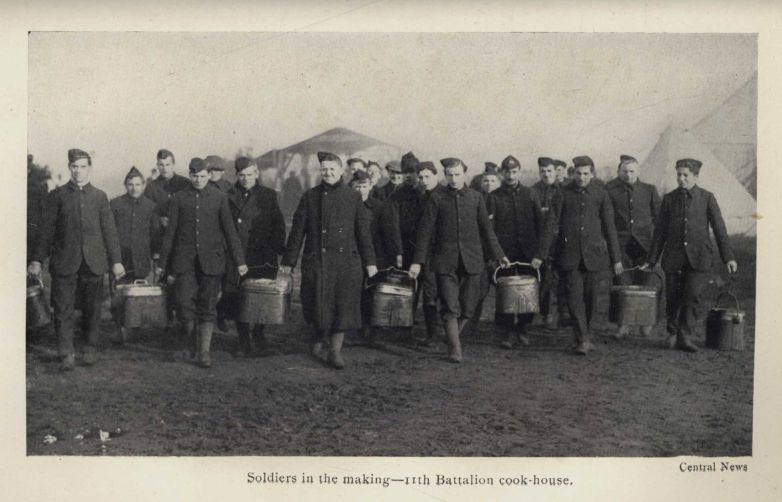
Soldiers in the making--11th Battalion cook-house.
Now Organized Labor revolted afresh. It would not hear of the "Prussianization" of England by Conscription. It had already "surrendered" its "industrial liberty." It did not propose to part with whatever vestige of "personal freedom" remained. It pilloried Conscription as "Compulsion" and, as brazenly as they dared, certain leaders threatened any Government which essayed to fasten it upon the "British Democracy" with political ruin for itself and gory revolution for the country. The Conscriptionists were accused of wanting, instead of an army of volunteer freemen, "a servile, cheap and sweated army." They aspired to "something which would imperil the civic basis of British liberty and degrade the nation." Conscription was "desired for the war and for after the war, in order that its advocates might better be able to promote their Imperialistic schemes abroad and their class vanity and political interests at home." In the midst of a war to "crush militarism," it was now plotted to impose that monster on Englishmen themselves. Shrieked Bruce Glasier, for example, a paladin of the Socialist-Labor phalanx:
"Compulsion, especially with regard to personal service, to one's choice of occupation and way of life, is of the essence of slavery and oppression. Nothing but actual extremity of life and death ought to justify us in resorting to it even temporarily. No such extremity has arisen, or is, happily, likely to arise. The voluntary principle has not failed either in the Army or any other profession. What has failed, what does fail, is the political policy and administration of the Government.
"Since the days of Feudal slavery in Great Britain no man or woman, except he be a criminal, a lunatic, or a pauper, has been compelled personally to serve any master or Government, or engage in any occupation or task by legal compulsion.
"Shall we allow the old-world tyranny to return?"
Glasier, unwittingly, tapped the very root of the problem, as far as his own particular cohorts, "downtrodden labor," are concerned. The British masses, in their preponderant majority, have not been brought to comprehend what Germany's war is--that it involves for Britain "nothing but actual extremity of life and death." Although leaders of public opinion, from the highest to the lowest, never ceased to emphasize the true inwardness of the struggle, Organized Labor was not convinced that Voluntary Service was unequal to the emergency. At Bristol, in the first week of September, 610 delegates to the annual Trade Union Congress, representing nearly 3,000,000 workers, placed themselves on record flat-footedly against Conscription. With British military failure in the war crying to Heaven, the following "anti-Compulsion" resolutions were adopted:
"We, the delegates to this congress, representing nearly three millions organized workers, record our hearty appreciation of the magnificent response made to the call for volunteers to fight against the tyranny of militarism. We emphatically protest against the sinister efforts of a section of the reactionary press in formulating newspaper policies for party purposes and attempting to foist on this country Conscription, which always proves a burden to workers and will divide the nation at a time when absolute unanimity is essential.
"No reliable evidence has been produced to show that the voluntary system of enlistment is not adequate to meet all the empire's requirements. We believe that all the men necessary can and will be obtained through a voluntary system properly organized, and we heartily support and will give every aid to the Government in its present efforts to secure the men necessary to prosecute the war to a successful issue."
When the cheers following the unanimous adoption of these resolutions subsided, Robert Smillie, the miners' leader and one of the most respected Labor chieftains in Britain, received the heartiest applause of the whole debate when he rapped out: "Now that this congress has declared, on behalf of organized labor, that it is against Conscription, it will be the duty of organized labor to prevent Conscription taking place."
It was not long after the Bristol Trade Union Congress defied the Government to establish Conscription that Vernon Hartshorn, the Socialist miners' leader, declaimed in the Christian Commonwealth that "a golden opportunity for Labor" had arrived, asked "whether trade-unions shall now not be successfully recognized as the controlling authority in a new industrial democracy," and set up "the irresistible claim of Labor to control its own destinies and those of the country." The Bristol and Hartshorn manifestoes were followed by the most extraordinary outburst of all--the formal declaration on the official premises of the British House of Commons by J. H. Thomas, a Member of Parliament for Derby and Organizing Secretary of the Amalgamated Society of Railway Workmen, that if the Government attempted to enforce Conscription, 3,000,000 employees of the national transportation lines of the country would not shrink from precipitating "industrial revolution!"
Interesting to the foreign observer as are all these manifestations of the British masses' opposition to war-time "control" and universal military service, the pathological causes of it are no less absorbing. They are not, in my judgment, far to seek. I thought I gained a composite glimpse of them one day at Shepherd's Bush, by no means the most squalid section of London, for it lies in the west, far from the putrid east. I had gone to watch a great "recruiting-rally"--an attempt to inject some patriotism into regions where it was sadly lacking. I found myself in the midst of a huge typically lower-class and lower middle-class multitude. Scattered throughout it were countless hundreds of what should have been young men fit for military service. It was for the most part a motley throng of blear-eyed men and women of all sorts, sizes and conditions of mental and physical deterioration. Nearly everybody, particularly children, was unkempt and seemed underfed. In the wide-open doors of odoriferous saloons stood hatless, slovenly females, balancing with one hand a half-emptied mug of beer, while the other shepherded a cluster of wretched youngsters with dirty faces, tattered clothing and shredded shoes. Collarless men slouched along, filthy of attire and language alike. The remarks one overheard, as the troops trudged by and the bands blared Rule, Britannia, were usually purely ribald, and the cheering, when a taxi full of wounded Tommies, shoved into the procession to lend corroborative detail to what Sir W. S. Gilbert would have called an otherwise bald and unconvincing spectacle, was desultory and short-lived. The parade had been assigned a line of march through several miles of district precisely like Shepherd's Bush. I could hardly imagine that the scenes anywhere were considerably different from those of which I was an astonished and chagrined witness. There were very few recruits.
I could not resist a reminiscent soliloquy. I had stood in the midst of German crowds in Berlin and elsewhere times without number. But I was quite sure that nowhere in the Fatherland had I ever been in contact with such concentrated, omnipresent, apparently inconquerable squalor and proletarian apathy. It was manifestly not this stratum of English society which was to perpetuate Britannia's rule of the waves. Lamentably little of the "bulldog breed" was visible here. It was more like the starved cur type. Starved! That was the word. Starved for generations of the nourishment on which health, education, ideals and patriotism must be developed, if they are to stand the test in the hour of supreme trial! Why, I asked myself, was such a disheartening picture as good as physically impossible in Berlin or Hamburg or Düsseldorf or Breslau? I may be wrong, but the answer seemed to me to be that paternalistic Government in Germany had produced a race of men and women who, because better educated, better housed, better fed and generally better cared for--even under the relentless jackboot of Militarism--looked upon a war for national existence through entirely different-colored spectacles than this slipshod composite of British illiteracy and nonchalance. I seriously doubted if Shepherd's Bush understood the meaning of Patriotism as the Germans know it; understood that Service and Sacrifice are necessary in the hour of the nation's jeopardy, and, because necessary, must be lavishly, unquestioningly rendered. I found myself excusing the British proletariat. I felt that they were what they were, and acting as they were, or, rather, failing to act as they ought, because they knew no better. Patriotism is not altogether instinct. It is largely a cultivated virtue. That is why we teach immigrant children from Russia and Italy and Hungary to sing "My Country, 'Tis of Thee" as the rudiment of their American schooling. Education has been compulsory in Britain for many years, but drink has been traditionally universal, and housing of the poor and the working classes was only in comparatively recent years deemed a subject worthy of vast national effort. Public hygiene is no longer a neglected theme, and playgrounds and parks are numerous. But illiteracy, intemperance and disease can not be eradicated in a generation. Masses which have for decades been neglected and held in subjection and contempt by an unrelenting class-distinction system heavily charged with arrant snobbishness can not be churned, by the turning of a crank, into a community of enlightened, high-minded or able-bodied patriots and war-makers. Britain has sown the wind. She is reaping the whirlwind. That has been said before, but never has it applied with such grim significance as at this hour.
Recruiting "rallies," recruiting advertisements, reproaches of the "slacker" and the "shirker" in the press, on the platform, in the parks and from the pulpit, have signally failed to shame lower-class Britain into doing its duty as the upper and middle classes have so gloriously done. In consequence, the Voluntary system is on its last legs. Early in October Lord Kitchener appointed Lord Derby "Director of Recruiting." In assuming the thankless job, Derby said he felt like taking over the receivership of a bankrupt concern. He proposed granting Voluntaryism a six weeks' respite. He would give the stay-at-homes one more chance. The Government (which enacted the National Register for the purpose--hated Prussian system which card-indexed every male and female in the realm between fifteen and fifty-five!) knew exactly who and where they were. "Push and Go," said one of the last-ditch poster appeals, "But It's Better to Go than Be Pushed." Lord Derby intimated that "pushing" would set in on December 1. It was estimated that, by hook or crook, not less than thirty thousand fresh men a week would be needed to keep the British armies in Europe and Africa at effective strength in 1916, and, if they did not come forward voluntarily, Kitchener was determined to "fetch" them. That means Conscription. Northcliffe calls it National Service. Shepherd's Bush calls it National Servility. If Labor means what it says, "Compulsion" will not be established until Trafalgar Square and Whitechapel, Clydebank and South Wales, have run red with the organized proletariat's "freeman" blood. On Britain's recreant past, then, rather than on her embattled present, will lie, in my judgment, the real responsibility for that dread triumph of ignorance and indolence over the elementary dictates of patriotism and self-preservation.
If I have emphasized British Labor's influence in blocking National Service, I must, in all fairness, point out that brows not accustomed to sweat and hands never grimy from toil have joined their frowns and their strength with Trade-Unionism and Socialism against Conscription. The professional pacifists, the "anti-militarists," the statesmen and the newspapers which for years prior to 1914, and even during the weeks immediately preceding August of that year, ridiculed the idea of "war with Germany," were all mobilized against the revolutionary idea of converting able-bodied Britons by law into defenders of the realm. From these quarters the men who have dared to advocate Conscription have been besmirched with abuse no less torrential than that which was heaped upon them at the Trade-Union Congress in Bristol or from week to week in the columns of Socialist-Labor organs. It will not be only certain famous proletariat leaders who prevented Britain from rising in the great war to her full military stature--if prevented she be--but the party-hack editors, authors and anything-for-office politicians who preferred the fetish of "our unenslaved Democracy" and "Voluntaryism" to the system under which every other single one of Britain's Allies is fighting and under which, if the opinion of professional soldiers is to be trusted, victory alone can be made to perch on the Union Jack.
CHAPTER XX
THE EMPIRE OF HATE
Though the end of the carnage is not even approximately in sight, a synoptic view of Germany in war-time is feasible to a more comprehensive extent than is possible in Britain. Armageddon found the Fatherland completely caparisoned for war, with her people so steeped in discipline that it was the merest formality to harness their peace-time habits to Mars' Juggernaut and drive the entire nation to battle as one would a well-trained team. "Team-work," in fact, exactly describes Germany's war-time performances. They are achievements in national unison without parallel in history. Britain, on the other hand, having been overtaken by war, except for her navy, in a state of naked unpreparedness, was plunged forthwith into the melting-pot. Traditions, customs, institutions, hobbies, prejudices, fetishes, even cherished laws, had to be abandoned, upset or reconstructed to fit a world of iron conditions unsuited to a dreamland of comfortable theories. The remaking of Britain, after sixteen months of war, is not yet ended. It has, indeed, hardly commenced. The time to write an accurate history of these isles during the Great Test will come not when peace is signed, but perhaps a decade later, when the New England will have begun to assume, in misty outline at least, the physical, moral and intellectual dimensions in which war, with its scars and its cleansings, left her.
Organized for war, body and soul, as Germany has been for generation upon generation, and never more so, of course, than in the living generation, the country slid into the bloody groove as neatly as if it had never had its being elsewhere. The prospect of "starvation," for instance, quite apart from the fact that it was a German-invented bogy trotted out to deceive the enemy and extort the commiseration of neutrals, never seriously disturbed the Germans' equanimity, for from the cradle up frugality has been instilled in them as a virtue sister to patriotism. No people in the world could overnight descend to a war standard of living so rapidly as the Germans. Accustomed to the affluence of sudden prosperity as the nation, as a whole, was, it had yet only to return to familiar inculcated habits, when the Kaiser called. The grand German bluff of the first year of the war was the introduction of the bread-ticket ration system. How the grain-shippers of Chicago and Duluth must have chuckled over it, when they recalled the gigantic advance purchases of wheat made for German and Austrian account in May, 1914--three full months before "the Russian mobilization menace!" Germany can never be starved, and she knows it. Von Tirpitz knew it when he proclaimed submarine piracy as a "reprisal" for British "attempts to starve us out." The grip of the British Fleet around Germany's neck has inconvenienced the Germans, but it can never cause them to famish. The "starvation" myth which the German propagandists in the United States so assiduously circulated was devised, purely and simply, for the purpose of arousing the compassion of the generous-hearted American people, in the hope that our most sentimental of governments would intervene, in humanity's name, to lift from Germany's throat a yoke which she herself was powerless to remove. That is the long and short of the "starvation" story.
As inborn and cultivated habits of frugality and thrift enabled the introduction of the bread-ticket without marked disturbance to normal German life, so the nation resorted willingly and easily to all the other new conditions which war imposed. A people goose-stepped and policed from the nursery to the grave, bred in docility, with wills of their own eternally broken before they have left the Kinderstube, with initiative and self-reliance knocked out of them with the rod at home and in school, and with blind unyielding subordination to discipline literally pounded into their bones in barracks, provides no astonishing spectacle in making war, when war comes, as one man obeying one supreme will. War is the ultima ratio, indeed, which this national system of self-suppression has in mind. The surprising thing is not that the world has witnessed so colossal an exhibition of team-work in Germany. The unexpected would have been if Germany had given any other account of herself. When we speak, as we all do, and especially the English, of "Germany's years of preparation," we should eliminate the notion that these preparations were confined to shells, guns, fortifications, battleships and legions. No single other "preparation" of the German war gods measured up, in my judgment, to the unseen and unnoticed, yet all-engulfing, decade-old, national scheme of molding the minds of men, women, children and babes along the line of unresisting, complete slavery to Superiority, uniformed as the State. When you dilute this super-subjugation with the wine of true patriotism which, despite their Socialism, their police, their burdensome taxes, their goose-step, their powerless parliaments and all the other concomitants of an autocratic monarchy, flows red and joyously through the soul of the Germans, you secure a spiritual admixture which approaches invincibility. You discover the ingredients of what Lloyd-George christened the "potato-bread spirit," which he truly described as a greater danger for Germany's enemies than Hindenburg's strategy. The former will survive long after the latter has broken down.
For a full year, interrupted only by six weeks in the United States at the end of the winter of 1914-15, I have kept in as close touch with Germany in war-time as if I were at my old lookout in the Friedrichstrasse. My professional task in London all that time has been to study the German Press. Day in and day out I have done so. I have read the Government-controlled Lokal-Anzeiger, the radical Berliner Tageblatt, the venerable Vossische Zeitung, Count Reventlow's organ of Frightfulness, the Deutsche Tageszeitung, the Pan-German Tägliche Rundschau, the Thunderer of Prussian conservatism, the Kreuz-Zeitung, and Maximilian Harden's vitriolic Zukunft. The voice of paralyzed Hamburg has come to me morning and night through the malevolent Hamburger Nachrichten and Fremdenblatt. Vorwärts has kept me informed of German Socialism's invertebrate vagaries. The cultured Cologne Gazette, the property of Doctor Neven-Dumont, whose wife is half-English and whose son is proud of his Oxford degree, and yet has almost led the German Press in the violence of its Anglophobism, has told me what semi-official Germany wanted the world to believe was its views from hour to hour. In the Frankfurter Zeitung I have been able to glean the news and opinion of the great German financial and commercial classes for which it speaks. Catholic Bavaria, the land of Crown Prince "Rupprecht, the Bloody," has been interpreted to me by the Munich Neueste Nachrichten. The Dresdner Anzeiger has mirrored Saxony day by day. And, as the Stimmung of no country in the world is so faithfully reproduced by its comic press as is opinion in Germany, my readings have been amplified, as well as lightened, by heartlessly ironic Simplicissimus, artistic Jugend, Fliegende Blätter and Lustige Blätter. My German literary diet, which was ruining my eye-sight, has been almost more opulent than when in Berlin, has finally been enriched from week to week by the incessant grist of pamphlets and booklets which has poured from the German mill even in more copious and overwhelming measure than in peace-times. If the printed word is the index of a nation's thought, little of moment in Germany since August, 1914, has escaped me. I have had the inestimable advantage of being able to absorb it in the light of its relationship to the situation outside of Germany--an opportunity of which the Germans themselves, though I would not try to make them believe it, have been cruelly deprived.
Telescopic observation of Germany, as reflected by its press, a little knowledge of what Doctor Münsterberg would call the Fatherland's "psychology," and the actual deeds of the German army, navy and Government have provided me, I think I may make so bold as to say, with a fairly complete and accurate picture. Germany, thus visualized, stands out to me in bold, clear-cut relief. It is a strange and terrible composite of forces generally considered incongruous and mutually destructive--Efficiency, Malice and Intolerance. The world ought to have known that in war Germany would reveal titanic powers of scientific organization. It did not expect to find her an Empire of Hate. It hardly imagined that the land of Goethe and Wagner, Koch, Behring and Ehrlich, Siemens, Rathenau and Ballin, Hauptmann, Strauss and Reinhardt, Eucken, Haeckel and Harnack, could be turned even by the devouring blasts of war into a community capable of elevating to the dignity of a national anthem such a ferocious song as Lissauer's Hymn of Hate Against England, whose soul is best breathed by its closing stanza:
"Take you the folk of the Earth in pay,
With bars of gold your ramparts lay,
Bedeck the ocean with bow on bow,
Ye reckon well, but not well enough now.
French and Russian, they matter not,
A blow for a blow, a shot for a shot,
We fight the battle with bronze and steel,
And the time that is coming Peace will seal.
You will we hate with a lasting hate,
We will never forego our hate,
Hate by water and hate by land,
Hate of the head and hate of the hand,
Hate of the hammer and hate of the crown,
Hate of seventy millions, choking down.
We love as one, we hate as one,
We have one foe, and one alone--
ENGLAND!"
Even Barbara Henderson's brilliant translation of this epic of spleen, the first version of which to be published in Great Britain it was my privilege to reprint in The Daily Mail from the columns of the New York Times, fails to do justice to the innate rancor and gall of Lissauer's original verses. Americans who visited Germany during the war were unanimous in agreeing that no rendering of the Hymn of Hate in English could possibly interpret its consuming spirit. You had to hear it rasped with the ferocity of snarling, guttural German, they would say, to gain even an approximate idea of its power. You had to watch a man or woman recitationist or singer, for it was set to music, too, bawl it out, in a crescendo of passionate fury as the final word of each stanza, England! was reached. You had to sit in the midst of a theater, café or music-hall audience, or even in a drawing-room, and note all around you the frenzied countenances, the clenched fists, the whole enraged being, of men, women and children, to know how Lissauer's ballad of gall had burnt itself into a people's soul. There have been more or less sincere efforts in Germany to banish the Hymn of Hate. Lissauer having previously received the Iron Cross for poetic gallantry, and from the pulpit and the school rostrum the unrighteousness of hate had been sanctimoniously proclaimed. But Lissauer only put into verse the spirit which maddened Berlin on the night of August 4, 1914, which grew in intensity as the magnitude of British intervention in the war slowly dawned, and which, surface manifestations to the contrary notwithstanding, lingers deep and ineffaceable in the German breast, and will remain there, barring a miracle, for generations after the war is over.
While the Hymn of Hate was at the zenith of its glory, some genius whose name, unfortunately, will be lost to posterity, invented Gott strafe England! (God punish England) as the most patriotic form of greeting which one German could exchange with another. Friends meeting in the suburban trains or street-cars, or in the streets, no longer lifted their hats as usual and said Guten Morgen. They shook hands solemnly and exclaimed Gott strafe England! When they parted at night, it was not Guten Abend, but Gott strafe England! Then they began stamping it--with a rubber-stamp which was sold by the thousand for the purpose--on their letters to correspondents at home and abroad. It was even adopted, now and then, as an epitaph for a fallen soldier, whose relatives would end up the customary obituary in the advertising columns of the newspapers with Gott strafe England. Now postcards blossomed forth with the new national motto. Scarf-pins made their appearance in the windows of cheap-jewelry stores, inscribed Gott strafe England! The legend was reproduced in a score of different designs on cuff-links, brooches, and even wedding-rings, while hardly a schoolchild was without a badge or button emblazoned with the Fatherland's holiest war prayer. Handkerchiefs were embroidered with it, pocket-knives had it enameled on their handles, and many a Liebesgabe to a dear one in the trenches went forth with a pair of black-white-red braces imprinted Gott strafe England! On a medal which doubtless decorated thousands of German breasts--a sample reached England--was engraved:
"Give us this day our daily bread; England would take it from us. God punish her!"
Crown Prince Rupprecht of Bavaria, who was beaten by Sir John French's "contemptible little army" at Neuve Chapelle and Artois, placed Royal approval on the Gott strafe England cult in his notorious battle-order in the winter campaign to "annihilate the British arch-foe in front of us at any and all cost."
Englishmen, and especially English soldiers, perhaps measured the Gott strafe England sentiment at below its real value as a German fighting asset when they decided to treat it as a joke. That was the spirit, at any rate, which animated a group of young Eton men at the front, who sent a postcard to the Headmaster of their historic school rival reading: Gott strafe Harrow! And on April Fool's day British Tommies across a certain meadow of death in Flanders expelled from a mine-thrower something which looked murderously like a bomb. When it bounced in front of the German lines, and bounced again, without exploding, a "Boche" ventured out of the trenches and picked it up. He found it was a football, and on it was inscribed:
April Fool!
Gott strafe England!
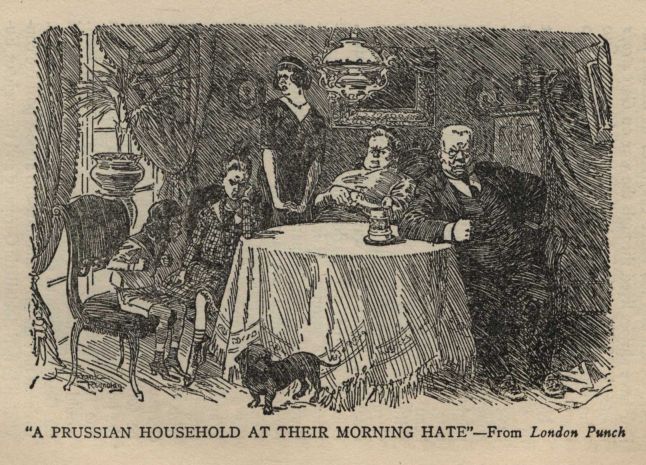
"A PRUSSIAN HOUSEHOLD AT THEIR MORNING HATE--From London Punch"
Mr. Punch and his lesser confrères in British humor have almost lived through the war on Gott strafe England! The sentiment has not struck terror into John Bull's heart, but it has very materially added to his war-time gaiety.
Next to the Hate epidemic, the mystifying account of themselves which the German Social Democrats have given during the war stands out as the main phenomenon. I have asked myself more than once what might have been if Bebel, the brains, or Singer, the fists, of the old-time Socialistic movement had been alive in August, 1914. Certainly the utter failure of the Socialists to hamper the operation of the German war-machine will remain forever one of the amazing episodes of the war. It will rank, of course, also, as one of the blazing miscalculations of the Fatherland's enemies. It is true that Bebel, the long-time autocrat of the German "Reds," proclaimed often enough that when Germany was in peril, he and his Genossen would shoulder the musket with a will. Yet the suspicion always lurked that when the German War Party's time came and it essayed to drag the German people across the Rubicon, the Social Democracy, with 4,250,000 voters, 111 members of parliament and German trades-unionism almost solidly behind it, would be found standing like an insuperable barrier against the powers of aggression. There had been more than one hint that working-class Germany, in that hour, would not shrink from utilizing the potent weapon of the General Strike to stay the hand of the war zealots. Opinion on that score amounted to almost positive conviction in non-Socialistic Germany and throughout Europe, in case the test were to be forced by a German war of manifestly provocative character. It therefore was of prime importance to the clique which engineered the war that the Social Democracy be made to believe, forthwith and implicitly, that the impending conflict was a "defensive war," to which Socialist leaders had always pledged the proletariat's unswerving support. Categorical and lachrymose assurances to that effect were accordingly given to the Social Democratic group of the Reichstag by the Imperial Chancellor in the confidential conferences with the parties, which preceded the public session of the House on August 4, 1914. The once-despised "Reds," so often denounced by William II as "men without a country," but whose votes in the national legislature were now so essential to the show of Imperial unity with which Germany desired to go to war, were supplied with ample "evidence" that Germany's cause was "just." She had been "fallen upon" by ruthless, envious enemies, the struggle about to begin would be waged by the Fatherland in "defense" of its holiest national interests, and the support of all classes was essential to the waging of the fight with which nothing short of "the Empire's existence" was was bound up. The Socialists listened, patriotically, to this siren song. They believed its tale of woe. They bade the Chancellor to be assured that they would not be found wanting in Germany's moment of peril. And a few hours later Herr Haase, the chairman of the party, was on his feet in the Reichstag, uttering glittering platitudes about Socialism's constitutional abhorrence of war and all its works, but proclaiming that the party's full strength and support were at the Government's disposal for the purpose of repelling the invader! Sic transit gloria mundi! August Bebel might well have remarked, could his shade have hovered over this abject surrender to Mars by his supine heirs of the fundamental principles to which he had consecrated a life-time.
From that moment forth the Kaiser needed to give himself no concern as to "the internal foe," the nickname of reproach always saddled on the Social Democracy by the Military Autocracy. The wing-clipped "Reds" were even allowed a certain latitude of free speech and thought about the war. They were permitted to indulge in their favorite academic discussions about the propriety of Socialist votes for war credits, and even Haase himself, having gradually come to realize that the Kaiser and Bethmann Hollweg had sold the Social Democracy a political gold brick, was not locked up for sedition for issuing, together with two fellow-leaders, Bernstein and Kautsky, a courageous manifesto against support of limitless war grants. Vorwärts, the Socialist organ, and other party newspapers were from time to time suppressed by the military censor for airing war opinions too freely, but as successive war measures were presented for the approval of the Reichstag, a safe majority of Socialist votes was on each occasion cast in their favor. The myth of a "war of defense" was never broken down. The King of Bavaria and the National Liberal Party gave the game away during the spring and summer of 1915, by blustering about the necessity for sweeping "rectifications of our frontiers," or, in other words, wholesale annexation of conquered territory, but Germany's war was well into its second year finding the Social Democracy, for the purposes and needs of the Government at least, entirely harmless. Food shortage and high prices churned proletariat Germany into growing discontent, as the war proceeded. Butter and meat riots have occurred in Berlin, and there have been ominous suggestions that the military authorities are alive to the possibility of "revolutionary" manifestations. But the day of Germany's Commune is not yet. No better evidence of the completeness with which the Socialist party was hypnotized from the outset could have been supplied than by the action of Doctor Ludwig Frank, one of its brilliant young leaders, in volunteering for military service. Frank fell in the earliest fighting in France, in August, 1914, and now fills a hero's grave. A Jewish lawyer in Baden, he was commonly looked upon as the future chieftain of Social Democracy. The war interfered with a cherished plan of his--to visit and lecture in the United States--and I suppose the last interview he ever gave was one I had with him, in which he spoke with enthusiasm of the American impressions he hoped to gather. He was keenly interested in the corporation problem, recognized that it contained evils with which Germany before long would have to cope, and wanted to equip himself with first-hand knowledge of its ramifications in the home of its highest development. Frank was not a fire-eating German Social Democrat. He belonged to the moderate or "revisionist" wing of the party. He was obsessed with no illusions as to the future possibilities of Socialism in Germany and acknowledged that sane democrats had long since abandoned hope of accomplishing anything more than the establishment of a truly constitutional monarchy and Parliamentary government. It is a thousand pities that Ludwig Frank has not been spared to play his capable part in the political reconstruction of Germany which, win or lose, is almost inevitably certain to follow the war. Doctor Karl Liebknecht, that stormy petrel of German Socialism, remained the one man to utter anti-war sentiment day in and day out. Even the Government's action in sticking him into field-gray and dispatching him to the front for intermittent service failed to check the flow of his invective. Liebknecht represents the Imperial borough of Potsdam, of all places in the world, in the German Parliament, but, though he has talked incessantly and voted rebelliously, the voice of the representative of the Kaiser's congressional district was destined to remain as one crying in the wilderness.
I have said that the triumphs of Germany behind the firing-line--the fortitude with which she has borne her hideous losses in life, the magnificently effective demonstration of unity, economy, self-sacrifice, industrial and financial organization, and adaptability to all the domestic conditions of war--were only things which those of us who knew the Germans expected to come to pass. They were as inevitable, in their paternalized State, the Empire of System, as were the early cannon-ball successes of the German army. We who were aware, as eye-witnesses, of Germany's prodigious preparations for "the Day," never doubted that, having chosen her own moment for launching her thunderbolts, they would accomplish precisely the staggering blows and strangle-holds which August and September, 1914, brought forth. Although (including myself) there was not one man in ten thousand in Berlin who knew who Hindenburg was--I have merely a faint recollection of having once read his name as an army commander in Kaiser Maneuvers--a good many of us had an abiding impression that the Russian army was no match for the German war machine, however easily the Czar might roll up the Austrians. The victories of the German armies in the war are no surprise to the German people. They have been raised in the belief that their military power was invincible, even against a world of foes. Events in the first year and a half of the war, even though Paris and Calais remained untaken, were certainly such as to convince Germans that their traditional and child-like confidence in their armed prowess was justified.
But in addition to Hate and Socialist impotence, two things which astounded those who knew and admired the German people, were their callousness toward the deeds which have been committed by their army and navy and their savage intolerance of any other point of view except their own. I am not one of those who believe that all Germans have cloven hoofs. Bitterly as I oppose their cause in this war and fully as I hold their War Party responsible for the war, I am not prepared to believe that the Germans are either a decadent or a lost race. What I do believe is that the war has, temporarily at least, annihilated the moral qualities of the Germans and dragged them from the high estate of ethical and discriminating intelligence in which they lived in antebellum times. The Germans of Louvain, of the Lusitania, asphyxiating gas, liquid fire, submarine piracy, airship assassination and General Frightfulness are not the Germans among whom I spent thirteen happy, fruitful years. They are not the Germans whose main concern, as it is that of the average run of men and women in other climes, was to prosper, raise families, educate children, live comfortably, acquire a competence and enjoy life generally. These Germans no longer exist. They have been succeeded by a race of war-maddened Germans, who were told by their Imperial Chancellor that "necessity knows no law," that treaties are "scraps of paper," and who have been made to believe that, in war, there is but one thing to do--"to hack our way through"--and that, as Bismarck and the German War Book said, the enemy must be left with nothing except eyes to weep with. The Germans have been steeped in all this by their overlords, living and dead, and, being children of discipline, they have looked with unmoistened eye upon all and sundry done in the holy name of these bedrock German principles.
The Fatherland's heartlessness toward such events as the rape of Belgium becomes less inexplicable when one recalls the cult of brutality which pursues the German from the nursery upward. As a child in swaddling clothes, he is taught that he has no right to a will of his own, and if he attempts to cultivate one, it is promptly beaten out of him. I recall, with more amusement than the episode inspired in me at the time, the struggle we had with our beloved family physician in Berlin, Doctor Keiler, to allow us to bring up our three or four-year-old son as a boy and not as a machine. "Das Kind darf keinen Willen hoben!" I remember dear old Keiler shrieking in Wilmersdorf more than once, as he labored in vain to convince us that if Frightfulness was necessary to break the youngster's inborn initiative and self-reliance, we must not shrink from resorting to it. And when the German escapes the Kinderstube with its unfailing rod and enters Gymnasium, he is once more under the cruel lash of Efficiency, which drives scores of lads to suicide at each recurring Easter-time because they have failed in examinations for the higher grade, notwithstanding a term's unceasing hounding by their drill-sergeant of a teacher and class-room and home cramming which have kept his frame thin and his cheek pallid. A whole literature has come into existence in opposition to the intellectual brutality to which German schoolboys between the ages of eight and sixteen are subjected, but the consensus of opinion is that the system's advantages outweigh its deficiencies, and that youthful suicides are part of the price the Fatherland must pay for what Professor Lasson of Berlin calls its "cultural superiority" over the rest of mankind.
Thrashed in the nursery, tormented in school, the German lad must then face a period of bullying in barracks, for, if he has managed to survive his Gymnasia years in health, he will enter the army. It is not necessary in this narrative to dilate upon the cruelties committed in German barracks in the sacrosanct name of Discipline and Thoroughness. There is a literature in Germany on that subject, too, and the penal records of the military and civil courts comprise the bulk of it. It is only with the lesson of the system with which we need to concern ourselves here; and that is, that the German man who emerges from the army comes out with notions about the efficacy and justifiability of brute force and brutality which are certain, under the red license which war confers, to find expression in terrible deeds. In other words, a German who has himself perhaps been assaulted by his regimental sergeant on scores of occasions (such cases are plentiful), who has seen the bloody saber-duel elevated in his university days to the level of the manliest art, who has throughout his life been a supine victim of police violence, who holds womankind in semi-contempt, who thinks it sportsmanlike to shoot birds alight, who rejoices in his prowess as a slaughterer of wild game, who beats his horses, who is as unfamiliar with the ethics of sport and play as he is with the lingo of a Choctaw dialect--such a man, I say, is bound, when he is sent forth with his Kaiser's mandate to "hack his way through," to stagger humanity as the Germans have never ceased to stagger it on land, on sea and in the air since August, 1914. Given a nation of non-combatants who have been instructed to believe that these things must be because otherwise their existence will be imperiled, and you have to do with a community which, however delightful its qualities as individuals, is no longer capable of measuring right and wrong, by normal standards and which is ready to tolerate any and everything, as long as it is part and parcel of the general scheme to "preserve the Fatherland." If one considers all these things, which I set down in no spirit of venom, but purely in an attempt to diagnose German war callousness, one will begin to be able to understand why German sensibilities remain unshocked in the presence of things which have horrified civilization. One's understanding will be complete if it is remembered that not one in a million Germans believes that these things have happened at all!
Philosophy, logic, metaphysics and psychology are cultivated sciences in Germany. It is even sometimes claimed--in Berlin and in certain regions of Harvard--that they were "made in Germany." Yet as applied sciences they have given a woefully sorry exhibition of themselves in the Fatherland during the war. They have, as a matter of fact, entirely disappeared. They have been supplanted by a new doctrine, for which the Germans themselves have an old and incomparable word--Rechthaberei. I learned that precious term from an American colleague in Berlin, a South Carolinian and profound student of German character named William C. Dreher. Dreher, who is an able journalist specializing in economics, has held forth to me on countless occasions about "Prussian Rechthaberei"--the unquenchable conviction of the average Teuton that he not only is "right" about everything, but that everybody else whom he permits to have a thought or a word on the same subject is essentially, inherently and incorrigibly "wrong." I can hardly credit the report that Dreher himself has fallen a victim to the insidious influence of Rechthaberei. It is something that presupposes omniscience and mental aristocracy on the part of the propounder of a given theory, and senility or utterly misguided stubbornness on the part of the opponent. Germany has wallowed in Rechthaberei since August 1, 1914. It has sucked into the mire of intolerance everybody who has dared to cherish a contrary view. It has refused the right of independence of thought to every living soul, unless that thought is pro-German. It has swallowed whole anything the German Government and its muzzled press have said, and it has condemned as criminal falsehood anything published in enemy countries. It allows British, French and Russian newspapers, in a lordly way, to circulate freely in Germany, as of yore, thumping its chest and saying "We are not afraid of the truth"--but only after having drilled the country into believing that nothing printed abroad about the war is or can be true! So the German who finds The Daily Mail or the New York Times on its accustomed file at his favorite café, just as he used to do in peace days, knows in advance that he is to read "lies," and he digests them, leaving his patriotism unpolluted.
"Mass-suggestion" has thus worked wonders in War Germany. It has driven me for example--I hope not forever--from the ranks of my oldest and best friends in Germany--Americans, as well as Germans. It impelled my wife's dearest friend, the Philadelphia-born wife of a German, to write a letter early in the war, formally "canceling" the friendship, because "your husband, instead of choosing to identify himself with an honest cause, has thrown in his lot with England, and, with her, will share the downfall toward which that nation is headed." That would be funny, if it were not so tragically pathetic. I hear that a great many good people in Berlin, wasting upon me breath and choleric energy which deserved to be spent on a far worthier object, fairly splutter when they hear or read my name. I have been the target of absurd and filthy personal abuse in the German press. I have won undying execration, for I have dared, in a most un-German way, to have a view of my own on the question which is agitating men's minds and searching their hearts as never was done before.
Yet all the millstones of hate and intolerance are not preventing the Germans from conducting a fight which challenges, in its efficiency, barring its inhuman aspects, the admiration of foe and neutral the world over. They are, indeed, a nation in arms. Their Spartan qualities behind the front, their contempt of death in the enemy's fire, will not easily be conquered. Exhaustion, economic and human, must tell against them in the long run, though the process of attrition will be vastly slower, I fancy, than armchair war critics in England think. The Germans will fight to the last man and the last pfennig, as I know them, and when they are beaten, they will furl their tattered standards after a combat which, stripped of its horrors, will yet have been marked by deeds of patriotism, courage and glory fit to take their place alongside the heroic traditions of mankind.
CHAPTER XXI
THE NEW ENGLAND
Rome was not built in a day, but England has been made over in a year. Personal liberty is gone. A free press no longer exists. Extravagance is "bad form." Economy has become respectable. Dukes' sons and cooks' sons are "pals." Drunkenness is disappearing. Conscription looms on the horizon. The Irish are loyal. Suffragettes are making shells and bandaging wounds instead of smashing windows and going to jail. Pride is humbled, though not crushed. Still ringed by Kipling's "leaden seas," Britain is no longer an island, for Zeppelins have maimed and killed and wrecked in the heart of London. Tolerance is a lost art. British have learned to hate. The link-boy has come back into his own; the streets at night, that Admiral Sir Percy Scott, defender of London by air, may blind the "sky-Huns," recall the gloom of the Cimmerian Regency. Though Waterloo was won a hundred years ago, a terror worse than the Napoleonic scourge has overtaken the descendants of Nelson and Wellington. Britannia rules the waves, but the blood of a half million of her best sons fertilizes the soil of France, Belgium, Turkey, Serbia and Africa; and the flow is far from checked. The "shopkeeper of the world" has become a nation in arms. Only one phase of its multifarious life, immutable as the sphinx, has survived the crucible of war in pristine glory--British calm. Ships may sink, men may fall, bombs may annihilate and treasure be sapped, but British imperturbability, like Time itself, pursues the even tenor of its way, Himalayan in its imperviousness.
Assuredly it has been for no lack of cause that England has ridden the sea of Armageddon without capsizing. Squalls, typhoons, storms and barometric disturbances of every form of violence have beset her from the outset of the voyage. But though there has been tempest, there is no shipwreck. She enters upon another lap of a seemingly endless journey, battered indeed, but keel down and full steam ahead. It is still night. Stokers and crew, nor even the captains and commodores, are not a completely united band, but their differences concern only the methods of cleaving through darkness to the port, to gain which, at any cost, all are grimly determined. Failure to reach the waters of their desire as soon as the unthinking majority hoped and believed would be possible has sobered the vision and intensified the resolve of crew and commanders alike. It has not reconciled their antagonisms, but it is making surer than ever that they will land their craft in the appointed harbor, though the damnations of all the powers of destruction are buffeted against her in the attempt.
My name for Armageddon is the War of Miscalculations, for it is a title which indicts every belligerent without exception. The Germans expected their army to be in Paris by the end of September, 1914. The English and the French reckoned that Russian Cossacks would be hacking souvenirs from the sepulchral statues in the Berlin Sieges-Allee about the same time. The British thought that Jellicoe would starve the Germans. Von Tirpitz imagined that U-boats would paralyze Britain's life-line. The British pounded vainly at the Dardanelles for nine months, and when they couldn't get Calais the Germans started out to crush Serbia. Sir Edward Grey thought Bulgaria and Greece were only waiting like ripe fruit to drop into the Allies' lap and cry for marching orders. He was about as near right as the German political professors who always assured William II that India, Egypt, Canada, South Africa and Australia were itching to revolt when the Motherland was immersed in a vast European war. The great war has been a rude awakening for all concerned. In addition to killing its millions of men and squandering its billions of money, it has annihilated theories, expectations, plans and aspirations so cruelly that the "war expert" has become a deathless laughing-stock. If "experts" have learned anything from the war, they will henceforth prefer history to prophecy.
"Business as Usual"--life generally in the old rut, in other words--was adopted by Britons as their war motto. Truly did a politician of renown exclaim a year later that no unhappier, because no more unfortunate, maxim was ever foisted upon or accepted by a patriotic people. The nation made no inconsiderable attempt to convert "Business as Usual" from an aphorism into an actuality. Seven or eight months of unrealized objectives had to pass over English men and women's resolute heads before they began even to doubt the efficacy of the complacent principle they had laid down for themselves. But the mills of Mars, like those of his colleagues, keep on grinding, and England was to learn that, while invasion had not seared her soil as it had scotched that of all her European allies, war yet had terrors capable of burning into the soul, saddening the homes and despoiling the pockets of even an unravished land.
I fix the date when Great Britain began to face the iron logic of events with sterner realization and to doubt the efficacy of "muddle" for purposes of war as May, 1915. In the two preceding months there had been a series of episodes of more climacteric magnitude than was apparent at the moment of their occurrence. In March Sir John French's army made a vigorous attempt to break through the German lines, and the much-heralded "victory" of Neuve Chapelle resulted. Thousands of British soldiers, and half a hundred Americans fighting in the Canadian contingent, died gallantly in an action which, when its terrible cost was eventually counted, could not be catalogued as anything but a glorious failure. In April two affairs of purely German origin were recorded, each predestined to leave a deep impress on the British public mind: the employment of poison gas by the enemy in sanguinary engagements around Ypres, and the flinging of thirty-nine British officers, captives in Germany, into felons' cells by way of "reprisal" for the segregation in England of captured German submarine crews.
Because the truth about Neuve Chapelle remained suppressed for many weeks, attention was bestowed to an overshadowing degree on the gas and officer-imprisonment episodes. Hitherto the universal demand in England was that, no matter how the Germans waged war, Englishmen must continue to fight "like gentlemen." Suggestions that the hour had long since arrived for an eye-for-an-eye and tooth-for-a-tooth warfare were rejected in almost every quarter as "un-English" and, therefore, undebatable. The Kaiser's soldateska might rape, pillage, loot and murder, but British troops must battle "in the old-fashioned way"--with clean hands. Tirpitz's bluejackets might practise the tactics of pirates, but Britannia's sailors would continue to respect the high traditions of their calling. Men went so far as to asseverate that it were better that Britain should be beaten than win by "German methods." Sir Edward Clarke, the leader of the bar, protesting against Sir Arthur Conan Doyle's proposal that Zeppelin murders could only be checked by British air reprisals against defenseless German communities, wrote to The Times: "It may be our misfortune to be defeated in this war, but it will be our own fault if we are disgraced." Yet British "fighting blood" seemed at length stirred to a boil by asphyxiating-gas and "Hate" measures against British officer-captives. A wave of holy rage swept over the country. Those who had advocated the use of kid gloves against an enemy which fought with brass knuckles and poison found their views sensibly less popular. Britain was waking at last to the realization which even the Belgian atrocities, "Zeppelin murder" and the "Scarborough baby-killers" had not fully aroused--that her high-minded "sporting ethics" were lamentably out of place in war with a foe which believed in ruthless "Frightfulness." The Tommies who died horrible deaths from the effects of German poison gas and the officers who languished in burglars' cells because martyrs in a worthy cause--their anguish convinced England almost against her will that the German was the most ferocious, pitiless and unconscionable enemy who had ever engaged in the noble calling of arms.
While this healthy conviction was soaking into Britain's sluggish consciousness, the crowning infamy of the Lusitania massacre was committed. The cup of indignation, already full to the brim, now overflowed. Demand for vengeance, in the form of a campaign against the Germans to be waged with resolution and force more destructive than any previous effort, was universal. There must be no more temporizing, no more half measures, no more vacillation and procrastination. Recruiting enjoyed a fresh spurt, a response to the lurid posters headed "Remember the Lusitania!" and reproducing the verdict of the Queenstown coroner's jury
"that this appalling crime was contrary to international law and the conventions of all civilized nations, and we therefore charge the officers of the said submarine, the Emperor and Government of Germany, under whose orders they acted, with the crime of wilful and wholesale murder before the tribunal of the civilized world."
"It is your duty," the poster added, "to take up the Sword of Justice to avenge this devil's work. ENLIST TO-DAY!"
The Lusitania horror unchained the mob spirit from Land's End to John o' Groat. Uninterned Germans, who were still at large in their thousands, were the victims of rioters' fury in London and the big provincial towns, and the Home Office was forced by irate public opinion to place barbed-wire around all the "enemy aliens" not already in captivity. Simultaneously the demand went forth that the pampering of German prisoners of war in palatial manor-houses like Dorington Hall should give way to rigor more suitable for men condemned henceforth to be known as Huns. The Lusitania's aftermath was accompanied by ample proof that the bulldog was no longer curled up on the hearth-rug as unconcernedly as he had been throughout the winter and spring. He was showing his teeth, and he was snarling. He meant business now. There had been enough of Queensbury rules, Hurlingham ethics and Crystal Palace niceties in dealing with the Germans. They had served notice to Humanity that it had no laws which the German army and navy felt bound to respect. Englishmen said to themselves: "So be it." Then they rolled up their sleeves.
Thus was Britain ringing with righteous wrath in the middle of May, 1915, when what I venture to dignify as the turning-point of the war arrived: the exposure by Lord Northcliffe's newspapers of what was henceforth to be known as "the shells tragedy." Northcliffe himself had recently been the guest of Sir John French at the front. Still more lately the military critic of The Times, Lieutenant-Colonel Charles Repington, had visited British Field Headquarters under the same auspices. There they were told the truth about Neuve Chapelle. It was a simple story. The British army had essayed to smash through the German lines, hopelessly short of the right kind of ammunition--high explosive shells. Batteries of artillery, often on the threshold of decisive victory, found themselves suddenly starved of the only sort of shell which could possibly blast a way through the concrete and barbed-wire of the enemy's entrenchments. What happened at Neuve Chapelle--a terribly heavy loss of British life with nothing like compensatory results--would inevitably happen again when the British army was called upon to attack. It would simply be sentenced to death and defeat. Sir John French had been provided with shrapnel which was good enough to smash the Boers, but he was criminally ill-equipped with the shells which alone were capable of demolishing the elaborate German defensive arrangements and enabling the British infantry to advance with a fighting chance of success. If the army was not to be condemned to inglorious impotence or annihilation, it had to be provided forthwith with high-explosive ammunition on an immense and unceasing scale. The British Commander-in-Chief declined, in effect, to assume further responsibility for the fate of the campaign in Flanders unless there was sweeping and instant remedial action by the War Office.
On May 14 Lieutenant-Colonel Repington, in a dispatch to The Times from "Northern France," which, like other news from the field, passed the Censor at Headquarters before transmission to England, declared that "the want of an unlimited supply of high explosive was a fatal bar to our success." Describing an attack which had collapsed for the same reason that the offensive at Neuve Chapelle had failed, Repington wrote:
"We found the enemy much more strongly posted than we expected. We had not sufficient high explosive to level his parapets to the ground after the French practice, and when our infantry gallantly stormed the trenches, as they did in both attacks, they found a garrison undismayed, many entanglements still intact, and maxims on all sides ready to pour in streams of bullets. We could not maintain ourselves in the trenches won, and our reserves were not thrown in because the conditions for success in an assault were not present.
"The attacks were well planned and valiantly conducted. The infantry did splendidly, but the conditions were too hard.
"On our side we have easily defeated all attacks on Ypres. The value of German troops in the attack has greatly deteriorated, and we can deal easily with them in the open. But until we are thoroughly equipped for this trench warfare, we attack under grave disadvantages. The men are in high spirits, taking their cue from the ever-confident and resolute attitude of the Commander-in-Chief.