THE ASSAULT (continued 5)
Reading edition
Although the British Government (by which is meant only the Premier's Administration) consists of twenty-one ministers of Cabinet rank, the war régime, it was manifest from the start, would be confined to five outstanding men combining the motive forces of the entire organization. These five were the Prime Minister himself, the Foreign Secretary (Sir Edward Grey), the Chancellor of the Exchequer (Mr. Lloyd-George), the First Lord of the Admiralty (Mr. Winston Churchill), and the Secretary for War (Lord Kitchener). Although the highest-salaried member of the Cabinet, the Lord High Chancellor (Lord Haldane) drew ten thousand pounds a year, and there were half-a-dozen others like the Home Secretary, the Colonial Secretary, the Secretary for India and the Presidents of the Board of Trade and Local Government Board whose financial status (five thousand pounds a year), outranked the four thousand five hundred pounds which Mr. Churchill received, the quintette named, by reason of their posts and personalities, was the logical inner Government to deal with the war. That brilliant English essayist and biographer, Mr. A. G. Gardiner, even further delimited the numerical dimensions of the real War Government when he said that "if Mr. Asquith is the brain of the Cabinet, Sir Edward Grey is its character and Mr. Lloyd-George is its inspiration."
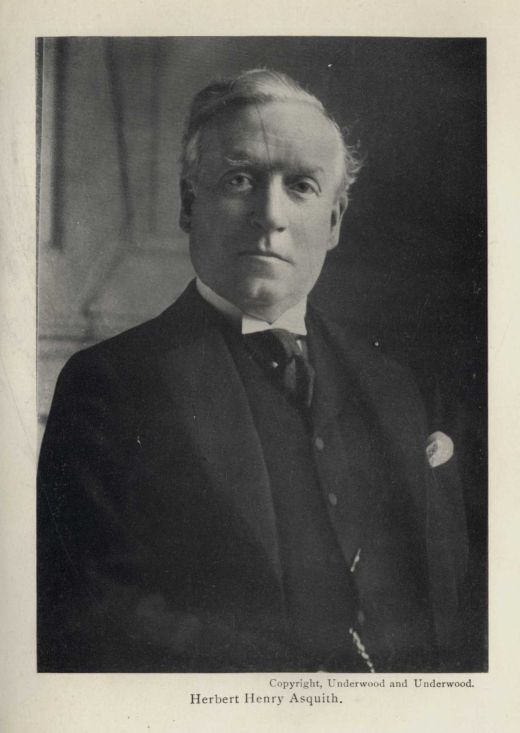
Herbert Henry Asquith.
Herbert Henry Asquith, Yorkshireman by birth and barrister by profession, has been Prime Minister for seven years, succeeding his late Liberal chieftain, Sir Henry Campbell-Bannerman, in 1908. Asquith, whom Bannerman used to call "the sledge-hammer," because of his lucidity of thought and expression, was sixty-three years old in September, 1915. Although not a Pitt, nor even a Disraeli or Palmerston, the statesman who looks like a Roman senator and is gifted with eloquence in keeping was considered in many respects a Heaven-sent blessing in the melting-pot era of British history, for as a purely steadying influence he is probably without a peer in contemporary politics. As a politician in the narrower sense of a party disciplinarian, manager and leader he will rank with the craftiest names in his country's tortuous history. British Liberalism has skated on perilous ice following the reaction which swept the Conservative Party from power after the Boer War and throughout the era of Democratic radicalism in which Great Britain has meantime had its being. That Mr. Asquith's party is enabled to celebrate ten years of sovereignty still strongly intrenched is by general consent due to the astute generalship of its commander-in-chief. Asquith is not commonly accused of imaginativeness. He is too typical a British statesman for that. His temperament is devoid of the adventurous, like that of the true intellectual, and he is pathologically fonder of harking to public opinion than boldly leading it. When he coined the "Wait and See" epigram during the Ulster crisis, he gave utterance to a phrase which accurately epitomizes the tentativeness so preponderant in his political career. British procrastination and vacillation at vital periods of the war were undoubtedly the reflex action of the Prime Minister's own low-speed mental processes. Yet in the revolt of the Curragh Camp officers, that strange curtain-raiser of the impending Ulster crisis, which threatened to embroil these fair isles in another Cromwellian trial of strength between Parliament and the army, Mr. Asquith, by a courageous stroke of positive genius--his own assumption of the Secretaryship for War in succession to the compromised Colonel Seely--resolved into tranquillity and hope a situation more menacing to civil peace in England than living Britons had ever before lived through. Beneath Mr. Asquith's polished exterior, unemotional mask and sweet reasonableness Germany, mistaking his for a peace-at-any-price nature, made one of the most egregious of her numerous and glaring miscalculations.
Only the results of the Peace Conference will determine the true ramifications of Sir Edward Grey's reputation. It was deservedly high when the war began. No Foreign Secretary in Europe approached him in stature, with the possible exception of Delcassé. He had long been Germany's bête noire, being looked upon as the incarnation of the British diplomatic policy of blocking German ambitions for a "place in the sun" wherever and whenever they manifested themselves. As long before as December, 1912, Professor Hans Delbrück, the sanest of German political professors, told me in a prophetic interview for The Daily Mail on "What Germany Wants" that unless England abandoned her policy of "arbitrary opposition to legitimate German political aspirations; if she had no inclination to meet us on that ground; if her interests rather pointed to a perpetuation of the anything-to-beat-Germany policy, so let it be. The Armageddon which must then, some day, ensue will not be of our making." That was a fairly plain warning of coming events. The Germans, as I have said, considered Sir Edward Grey anti-Germanism personified. They regard him to-day as the "organizer of the war." Taking an obviously short-sighted view, I used sometimes to think that it would have been good politics for Britain to buy off Germany with a Trinkgeld (tip) of some sort. If Bismarck was right when he called the Germans "a nation of house-servants," they could obviously have been bribed. Delbrück himself once confessed to me that Germany did not need more oversea territory; she only hankered for it for window-dressing purposes. She wanted as expensive millinery and high-powered a car as her rich neighbor across the way. Colonies were fashionable, and she had to have them. I occasionally thought that England would be staving off trouble for herself by bribing avaricious Germany with a coaling-station on some inconsequential trade-route or even shutting the eye to some burglarious descent on territory or concessions in Asia Minor or Central Africa. But such notions left the German character, the Oliver Twist in it, fatally out of account. The German is the most eager person in the world to covet a mile if given an inch. Concessions to his rapacity would have meant purchasing turmoil for the conceding party not eliminating it. British opposition to Pan-Germanic designs, typified by Sir Edward Grey, was based on thoroughgoing insight into the German nature and German ambitions, epitomized for all time by Bernhardi when he said that nothing would appease the Fatherland except World Power or downfall. Hush-money to Germany in the shape of periodically new "places in the sun" would have kept her quiet for spells. But the blackmailing process would have been resumed. It is the German way. "Mr. Balfour tells us we must not expect Englishmen to support our aims in the direction of territorial expansion," said Delbrück. "What remains then for us, except to enforce the accomplishment of our purposes by strengthened armaments?" Could avowal be plainer-spoken?
Sir Edward Grey is fifty-three years old and has been a childless widower since 1906. He has been a Member of Parliament continuously since he was twenty-three years of age. Though an Oxford graduate and successful barrister, he is in no sense a scholar, and his experience of foreign affairs up to his becoming Foreign Secretary in the Campbell-Bannerman ministry in 1905 was confined to an under-secretaryship of the Foreign Office in the preceding (Rosebery) Government. Grey, who is also of the smooth-shaven Romanesque type of statesman in external appearance, is an amazing example of natural British aptitude for the higher politics, for he is not a linguist (he speaks nothing but English) and except for a visit to France with the present King a couple of years ago was said never to have been abroad in his life. His hobbies are tennis, fly-fishing and birds. The only book he ever wrote was a treatise on the piscatory art and he tramped through the New Forest with Colonel Roosevelt talking ornithology all the way. Yet a man has only to read the British White Paper--he need not, indeed, do much except read Sir Edward Grey's dispatches to his ambassadors on July 29, 1914--to realize that the Foreign Secretary is a statesman of marvelous force and capacity to grapple with the essentials of a situation. No state papers of modern times outrival Grey's diplomatic correspondence on the eve of the war. They ought to insure him, as I believe they will, immortality, no matter how the war ends. Sir Edward Grey's speeches are like his dispatches--devoid of irrelevancy or rhetorical claptrap and incisive in the highest degree. They ring conviction and sincerity and their argument is usually unanswerable. Doctor von Bethmann Hollweg's clumsy attempts to parry Grey's mid-bellum dialectics have only brought out the latter in bolder relief. The war has notoriously eaten into Grey's soul. Germany calls it guilty remorse. Men who know are conscious that he labored for peace to the last minute with unflagging enthusiasm. His industry during the war has been intense, and his insistence upon looking at things for himself has threatened more than once to cost him his eyesight. As it is, intermittent relaxation has to be forced upon him by his colleagues and his medical advisers. Sir Edward Grey's permanent disappearance from Downing Street would rejoice Germany like a victorious battle. Grey has been violently blamed for the failure of Britain's mid-war diplomacy, especially in the Balkans. His own defense against charges of failure in that region is likely to seem plausible in the light of history, viz., that, unaccompanied by commensurate military successes, the efforts of Allied diplomacy in the Near East were almost hopelessly handicapped.
One night during the South African War a Radical M.P., advocating the downtrodden brother Boer's cause at a mass-meeting in Birmingham, received such a warm reception from the crowd that he had to flee for his life through a back-door, disguised as a policeman. His name was David Lloyd-George, whose present occupation is that of England's man of the hour. He was Chancellor of the Exchequer when war broke out and introduced the initial war budgets, earning thereby encomiums from the financial community which for years before looked upon him as capital's demagogic arch-foe. To-day, Minister of Munitions--the circumstances under which he became such are treated in a subsequent chapter--Lloyd-George comes far nearer being Britain's national hero than any of his contemporaries. He is charged by his detractors with the design to make himself Dictator. England could have a worse one.
If Lloyd-George were an American instead of a Welshman, he would have been President of the United States by this time, or at least as close to it as Bryan has ever been. There is in fact very little typically British about him. He is emotional, for example, and he has an imagination. His whole make-up is trans-atlantic, which is Anglice for sensational. Picture, if you can, a strong solution of Booker Washington (I mean, of course, only his eloquence), of flamboyant and appealing Billy Sunday, of the Boy Orator of the Platte at his silver-tongued best, and of our inimitable T. R. in his most rampageous form, and you will have Lloyd-George in composite. It was because he is all this that he was chosen for the "shells portfolio" in the reconstructed Asquith cabinet.
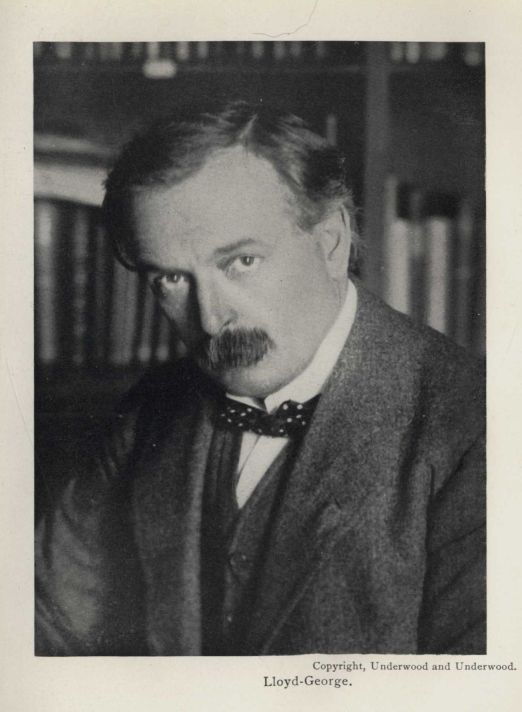
Lloyd-George.
He knew very little--probably nothing--about munitions seven months ago. It could not have been very much before that when he probably thought that guncotton was raw material for pajamas. But he is the prize "enthuser" of the Kingdom, a master of the tedious art of welding drowsy Britons into a race of real war-makers. All the ingredients for supplying the army with the shells it needed were in existence; but they needed organization. The manufacturers and their works needed organization. The workmen needed organization. The public spirit needed organization; and the whole business needed a Lloyd-George. It got him ten months after it ought to have had him, but not too late. Obviously the diminutive Welsh country lawyer who had brought about the disestablishment of the State Church of Wales, imposed State Insurance and Old Age Pensions on a reluctant Kingdom, assailed the vested interests of the House of Lords and demolished them, was the man to impress the country with the true meaning of the shells tragedy. He took the stump, his natural element, for the purpose. He went to the people, especially in the great industrial centers, and told them the truth. He burned into their conscience--that was the only way to get the stolid British to wake up to a real peril--that shells, shells, and then shells, and nothing but shells, were required if Britain meant to win the war.
The people listened to Lloyd-George. He has a way of making them listen to him. They gave him their ear even in his pro-Boer days. They listened to him when he (an ardent Baptist) cleared for action against the Welsh Church. They listened to him even when he went down to Limehouse and coined a new word, "to limehouse," meaning violent political spell-binding, second cousin to demagogism, by the nature of his impassioned appeals to the people to rise and slay the Lords. It was inevitable that the country would listen to him in his newest and greatest rôle as organizer of victory.
Lloyd-George's goal is undoubtedly the Premiership--the ambition of every British politician. He has plenty of time to wait--he is only fifty-two--and unfailing week-end golf keeps him as "fit" as a man fifteen years his junior. Of Napoleonic stockiness of build, with a wealth of wavy gray hair worn long, he is a figure which radiates strength and power, though unimpressive of itself. He is a capital "mixer." It is, indeed, his principal political asset. He is as much at home laboring with a gang of recalcitrant miners at the pit-mouth--he always goes straight to headquarters when he essays to settle a strike--as he is on the floor of the House of Commons or as moderator at a Baptist convention. He likes Americans and specializes in extending hospitality to interesting ones. Unquestionably he has a strong hold on our imaginations, as a man of his temperament, career and talent is bound to have. An eminent Chicagoan visited London last summer, with introductions which would have easily paved his way to the throne or any other exalted British quarter. "Whom would you like to meet most of all?" he was asked. "Lloyd-George," he said, with the intuitive sense of a Yankee who only has time for the things worth while.
Winston Churchill, the son of an English father and an American mother, is the Peck's Bad Boy of the British Government. His popularity has been sadly dimmed since the war began, for he was looked upon as not only the author of the grotesque naval "relief" expedition to Antwerp--now either prisoners of war in Germany or interned in Holland--but the culprit who was chiefly responsible for the far more disastrous Dardanelles adventure. Another crime is charged against him, hardly less serious than the two just named: his imperious administration of the Admiralty drove from the First Sea Lordship the man universally considered Britain's greatest sailor, Lord Fisher. All agree, friend and foe, that to "Winston" was due in a very marked degree, England's superb readiness at sea when war broke out, but it is a matter of grave doubt whether even that superlative service to the country will be looked upon as great enough to blanket his subsequent and costly incompetencies. When the upheaval in the Asquith Cabinet came about, in the spring of 1915, Churchill was nominally squelched by interment in the harmless berth of the Chancellor of the Duchy of Lancaster, most of whose official time is spent in licensing Justices of the Peace and Notaries Public. That ennui hung heavily on his hands was manifested by the announcement during the summer that Churchill had taken up painting as a pastime.
I have said that "Winston" was nominally subjugated, for a petrel of his peculiarly irrepressible storminess can only be wholly curbed by annihilation. Asquith is far too sagacious a politician to risk Churchill's complete eclipse in the Government of which he has always been the most picturesque constituent. Churchill, too, aspires to the Premier's toga, though a good many people fear that the defects of his qualities will keep him, just as they kept his distinguished father, Lord Randolph Churchill, from No. 10 Downing Street. But "Winston" is far less dangerous to the Government as a friend than as a foe. His chameleon political career justifies the fear that he would turn on his old associates and party cronies the moment he conceived that advantage to self was thereby obtainable. Obviously such a man is better in the Cabinet than out of it, especially if he is of Winston Churchill's undoubted personal charm, magnetism and resistless force.
Combining the best qualities of his dual ancestry, he makes a lively appeal to the average heart. Aristocratic to the core, with the blood of the Marlboroughs in his veins, and a snob of snobs in his personal relations, it is an anomalous fact that Churchill is an endlessly popular figure with the crowd. Whether it is his youth--he is only forty-one, was a soldier of no mean renown at twenty-three, a Member of Parliament at twenty-six, a Cabinet Minister at thirty-two and a force in Imperial politics long before he was forty--or his impetuous devil-may-care make-up, or his bombastic platform style, the masses like him. He has only one serious rival, indeed, in their affections, and that is Lloyd-George. He is remembered in war thus far not only for his Antwerp and Dardanelles indiscretions, but for his equally unhappy oratorical excesses, which are doomed, apparently, always to precede some untoward naval or military event. Within thirty-six hours of proclaiming at Liverpool (in September, 1914) that "if the German navy does not come out and fight, we shall dig it out like rats from a hole," U9 sent the Cressy, Hague and Aboukir to the bottom. In the spring of 1915, discussing the Dardanelles, Churchill blustered that "we are within a very few miles of the greatest victory this war has seen," and a few weeks later Kitchener announced that twelve miles of precarious front in Gallipoli were all there was to show for a campaign which had already cost eighty-seven thousand casualties. When Churchill prognosticates nowadays, the country trembles for what the next day will bring forth. Yet he is a rash prophet who would predict that "Winston" has run his course in British politics. He took manfully the discomfiture of the Coalition reshuffle, and although his picture is no longer cheered when it is flashed on the cinematograph screen the shrewdest seers are certain that he will "come back."[1]
[1] Churchill resigned from the Cabinet in November, 1915, declaring that he was a soldier--"and my regiment is in France." To it he said he preferred to go rather than continue in a position of "well-paid inactivity" at home. In a dramatic speech in the House of Commons, he took political farewell of the country and, having pleaded "Not Guilty" to the capital charges of responsibility for Antwerp and the Dardanelles, left England unostentatiously for the trenches, as a major of cavalry.
Lord Kitchener has always boasted that he scorned popularity. He has need for his philosophical temperament to-day, for there is no manner of doubt that his hold on the imaginations of his countrymen is less firm than it was when the war began. "K.'s" dramatic appointment to the War Office, in the earliest hours of the conflict, heartened the nation to an extraordinary degree. Britain had no army, Englishmen said, but it had Kitchener, who was a host in himself. His name alone was an asset which bred indescribable confidence. Men recalled his dominant traits--iron determination, strenuous application to duty, imperious disregard of hide-bound methods and red tape, and, above all, his genius for organization. They rejoiced to hear that he had accepted the War Office, long cob-webbed with circumlocutory traditions and petticoat influence, on the strict understanding that he was to be monarch of all he surveyed--that he would not tolerate such party interference as intrudes itself on departmental affairs in general. Immensely to the popular taste, because it confirmed the masses' conception of "K.," was the story that when he arrived at the War Office for the first time and was told there was "no bed here, Sir," he commanded the affrighted and astonished caretaker, then, "to put one in, as I am going to sleep here." Britain said to herself that she indubitably possessed a match for German Efficiency in her new Secretary for War, and all thought of "losing" with such a man as the supreme chief of the military establishment vanished from her mind.
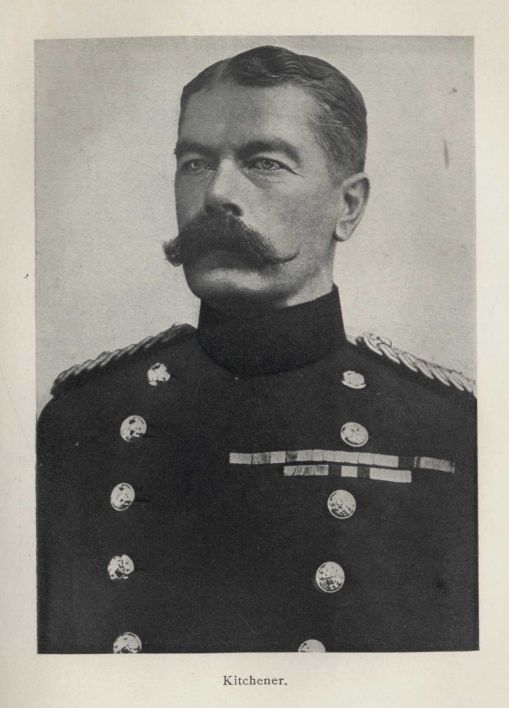
Kitchener.
Kitchener was never one of the war-will-be-over-by-Christmas crew. His maiden speech as War Minister in the House of Lords informed the country, bluntly, that he expected a three years' struggle. During the winter an anecdote ascribed to the taciturn War Secretary's loquacious sister gained currency, and passed from mouth to mouth. "When is the war going to end?" she asked him. "I don't know when it's going to end," he was said to have replied, "but it is going to begin in May." It was in May, by the pitiless irony of Fate, that the War Office's muddle of the ammunition supply was exposed.
Like all else in Britain--men, measures and institutions--the arbitrament of time will be required to pass final judgment on Kitchener's part in the war. In the principal field he was called upon to plow--the raising of a huge army from out of the earth--he accomplished marvels. No nation within fourteen months evolved from practically nothing an organization of, roundly, three million soldiers. It is not enough, for the actual requirements of the war call insistently for more and more, yet "K.'s" recruiting achievement stands forth without parallel in military history. It is certainly without precedent of even approximate magnitude in the annals of a non-conscript democracy. Lord Kitchener's accomplishments in other directions have notoriously not kept pace with his successes as a recruiting-sergeant. The shells affair can hardly fail to dim his reputation. The deficiencies of the voluntary system can not be called a failure directly chargeable to him, in that it has not brought forward men in quantity commensurate with the developed necessities of the campaign. Kitchener has hinted, but only that, that he is prepared to resort to Conscription the moment he is convinced that Voluntaryism has collapsed. But it does not seem unlikely that history may condemn him for clinging to the voluntary principle too long and hesitating to make Englishmen do their duty, instead of relying endlessly on their casual inclination to perform it. Kitchener has ruled the British War Office practically as an autocrat. He brooked no interference, even from the Cabinet. Viewed from that standpoint, "K." can hardly be absolved from cardinal responsibility for British military failures. Before the end of 1915 General Sir Ian Hamilton had disappeared from Gallipoli, Sir John French returned from France, General Townshend retreated from Baghdad, and the Allied "Relief" Expedition to Serbia had retired to Salonica, whence it had set out less than ten weeks previous.
CHAPTER XVI
THE GENERAL, THE ADMIRAL AND THE KING
That Sir John French, Commander-in-Chief of the British forces in France and Flanders, an army which reduces to comparative insignificance the largest host ever marshaled by Napoleon, comes from fighting stock is plain enough from the fact that his only sister, Mrs. Despard, is a militant suffragette. She herself provides homely evidence that the appointment of her brother (whom she practically "brought up") to lead the British fight against the Germans on land realized a boyhood aspiration. "When we were children," Mrs. Despard relates, "the great province of Schleswig-Holstein was taken from Denmark by what was then Prussia. We were discussing the disgraceful incident of poor little Denmark losing the province, and a certain little boy, then ten or twelve years of age, strutted about and said: 'If I was only a man, I know what I'd do to them.' He was very indignant. That little boy is now commander of Britain's great army."
It has been said that South Africa is the grave of British military reputations. Sir Redvers Buller's was buried there, and though those of Roberts and Kitchener emerged from the Boer War, the renown of Botha and Dewet admittedly outshone them. One British General at least was "made" by the three years' conflict with the Dutch Republics--Sir John French, the cavalryman who relieved Kimberley, and whose escutcheon during the sorry South African campaign was alone untarnished by blunder or reverse. As Kitchener was the logical choice for organizer of Britain's new armies, Sir John French was the natural selection for their field-commandership. French, following in paternal footsteps, began his fighting career in the navy, but he has been a soldier for the past forty-one years--he was sixty-three in September, 1915. A man whose entire manhood has been lived in the army, who knows it through and through, loves it passionately, has devoted himself to it with the zeal of a student, and fought in all its campaigns for nearly half a century, had an ideal claim upon its supreme honor in the hour of superlative crisis. Doubtless in the Government's mind when it entrusted "Jack" French with the command of the British Expeditionary Force was the reputation he had won in South Africa as a fighting field-general. Unquestionably the broad sweeping movements his cavalry divisions executed at Elandslaagte, Lombard's Kop, Bloemfontein, Pretoria and Barberton were operations which contributed, perhaps, more than any other scheme of the brilliantly mismanaged Boer campaign finally to bring it to a victorious end. Neither the British nor the German General Staff realized in August, 1914, that Armageddon was going to develop into a trench or "positional" war, with little or no latitude for those grandiose tactical maneuvers which delighted the heart of Moltke and made a Sedan the ambition of every modern tactician. Yet Sir John French, whose military virtues include adaptability, if not imaginativeness, which is oftener born, than acquired, turned out to be ideally fitted for "spade warfare," in which the qualities of endurance, steadfastness and patience have displaced the more spectacular talents of daring and recklessness and those bold strokes of magnificent vastness known as Napoleonic. Bonaparte's scintillating genius, his predilection for the stupendous, would probably have counted for little amid such immobile conditions as the Allied armies have had to face in the West, just as the Germans' prized Moltke traditions in the same region have come to naught.
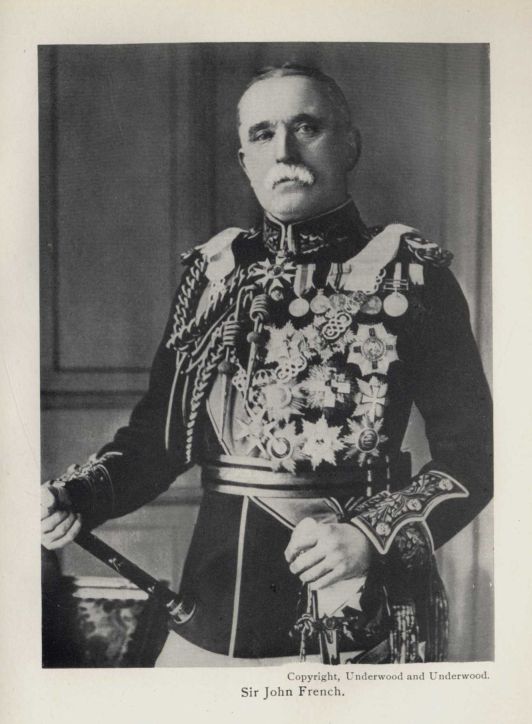
Sir John French.
Military history will unquestionably accord the retreat of the British army from Mons a place among the finest achievements of all times. It was due to Sir John French's strategy that Berlin was cheated of that fiendishly coveted orgy of gloating over the "annihilation" of what the Kaiser is said to have called "the contemptible little British army." Since Mons and the Marne the British Field-Marshal's task has been to "hold" the enemy and to inspire his men to fulfil, unflinchingly, that prodigious, but comparatively inglorious, task. In the circumstances it was fortunate that a man of Sir John French's temperament was in charge. He knew how to "sit tight." Kinship with his soldiers has been his lifetime specialty. He is fond of sharing their joys and sorrows not in any stereotyped, dress-parade sense, but actually. He likes to move among them, and does so. His jaunty fighting bearing and unfailing good humor are a constant inspiration. Short and stocky, straight and energetic of movement, he looks every inch a soldier, and he has a soldier's habit of saying what he means, direct from the shoulder, whether it is a corporal, a staff officer, a brigadier or a Cabinet Minister to whom he is addressing himself.
The Allied military arrangement conferred supreme authority on General Joffre, but the British Field Marshal's character and career were considered a joint guarantee that Sir John French would not be found lacking when called upon to do and dare greatly on his own account. It would be going too far to say that the war has covered French with glory. He would be the first to banish such a thought. Though Britons have fallen laurel-crowned on a score of fields in France and Flanders and irrigated the cock-pit which lies between the Alps and the Channel with as heroic blood as was ever spilled, the British offensives in the West have been little more than brilliant failures. Neuve Chapelle is an undying story of Anglo-Saxon gallantry, as was Ypres before it; but it was nothing else. The "big push" which England hoped had at last begun with the fighting in Artois and the Champagne at the end of September, 1915, turned out to be a victory of distressingly short life and little real effectiveness. Yet when Germany lost the war--when she failed to take Paris--the British army under Sir John French wrote history of which Englishmen will never be ashamed. Who it was that most effectually parried von Kluck and the Crown Prince's thrust at the French capital will probably, among generations of schoolboys yet unborn, be as fruitful a theme of argument as is the question who won Waterloo--Wellington or Blücher--but whatever the verdict of posterity the smashing of the Germans on the Marne reeked glory for all concerned, and Britain's share of it is a heritage which will survive with Blenheim, Balaclava, Kandahar and Khartoum.[1]
[1] Sir John French returned to England in December, 1915, relinquishing (at his own request, it was officially stated) the commandership-in-chief in France for the command of the Home Defense forces. King George conferred the dignity of a Viscountcy on the Field-Marshal.
Another Sir John--Admiral Jellicoe--is commander-in-chief of the British navy. Events still to come must determine whether Anglo-Saxon history is to be enriched with another Nelson. But as far as human prescience could foretell, "Jack" Jellicoe was of all men in the British Fleet preordained by talent, temperament and training to be the admiral in whose keeping could safely be entrusted British destinies more priceless than those which were safeguarded at Trafalgar.
Jellicoe was one of the godfathers of the dreadnought, having been summoned by Lord Fisher, the real author of that revolution in naval science, to support and carry into execution the all-big-gun ship idea. Fisher had years before associated young Captain Jellicoe with him as assistant director of naval ordnance, whereupon there ensued an intimacy which friends say will link their names together much as history associated St. Vincent and Nelson as the twin victors of Trafalgar--the one, the far-sighted planner of preparatory reforms; the other, the faithful executor of their purpose.
Jellicoe resembles Sir John French in more than given name. Like him, he is of quite markedly small stature. Neither the Generalissimo or Admiralissimo of Britain in the Great War at all corresponds, physically, to the popular notion that the English are "big" men. Like French, again, Jellicoe is mild and gentle, a pair of conspicuously tight lips indicating poise, reserve force and self-confidence. The chieftain of the Grand Fleet--that is its official title and not an effusive expletive--did not make his first acquaintance with danger afloat when von Tirpitz' submarines began to make life a burden for British sailors. He has been snatched from the jaws of death on three separate occasions. In 1893 Jellicoe was commander of Sir George Tryon's Victoria, when it was sent to its doom in the Mediterranean, and, although "below" in the ship-hospital with fever at the moment of the disaster, was miraculously rescued by a midshipman when he came to the surface more dead than alive after the vessel foundered. Seven years previous, as if Fate was keeping a protecting hand over him for some great hour, Jellicoe had an equally marvelous escape from drowning when a gig he was commanding off Gibraltar capsized and he was washed ashore. In the Boxer war of 1900, Jellicoe was flag captain to Admiral Seymour, the commander of the Allied expedition which marched from Tien-tsin to the relief of the Powers' legations in Pekin, and at the battle of Peitsang Jellicoe was struck by a Chinese bullet, incurring wounds which the flagship-surgeon considered fatal. Again Jellicoe was spared. A brother-officer tells a story of Jellicoe's agony on that occasion, which illuminates his capacity for facing the music, however doleful. He had asked how the advance to Pekin was proceeding. Told that everything was going satisfactorily, Jellicoe flashed back: "Tell me the truth, damn it. Don't lie!"
The triumvirate which has accomplished that amazing, silent victory of the British Fleet in the war--the complete conquest of sea power without anything savoring of a decisive action in the open--consists of Lord Fisher, the creator of the dreadnought; Admiral Sir Percy Scott, the inventor of the central "fire control" system, and Sir John Jellicoe, to whose gunnery science and innovations in that all-important branch of naval warfare are ascribed, in large measure, the acknowledged preeminence of the British Fleet as a striking force. He had not been director of ordnance a year when the percentage of the navy's hits out of rounds fired increased from forty-two to more than seventy. "In other words," as a critic describes it, "Jellicoe enhanced by more than a third the fighting value of the British Fleet, and that without a keel being added to its composition."
Jellicoe, who is fifty-six years old, has nothing but sailor blood in his veins. His father was a captain in the Fleet before him, and one of his kinsmen, Admiral Philip Patton, was Second Sea Lord in Nelson's time. Jellicoe is the incarnation of the spirit, traditions, practises and brain-force of the British navy of to-day. He has the not inconsiderable advantage of having had opportunity personally to take the measure of his German antagonists, for he has visited their country, where he made the acquaintance of von Tirpitz, Ingenohl, Pohl, Behncke, Holtzendorff, Prince Henry and all the other naval men of the Fatherland, and was even privileged to cruise over Berlin in a Zeppelin.
England has heard little and seen nothing of Jellicoe during the war. The veil of mystery which envelops the Grand Fleet is seldom lifted. Not one Englishman in a million knows where the Fleet is, though all know that it is where it ought to be. A ten days' visit paid to the officers and men of the Armada by the Archbishop of York in the late summer of 1915 resulted in imparting to the nation the first glimmer of their life, of their indomitable watch and wait, which had been forthcoming.
"It is difficult for our sailormen," wrote the Archbishop, "to realize the value of their long-drawn vigil. Their one longing is to meet the German ships and sink them; and yet month after month the German ships decline the challenge. The men have little time or chance or perhaps inclination to read accounts in serious journals of the invaluable service which the Navy is fulfilling by simply keeping its watch; and naval officers do not make speeches to their men. I think, indeed I know, that it was a real encouragement to them to hear a voice from the land of their homes telling them of the debt their country owes them for the command of the seas--the safety of the ships carrying food and means of work to the people, supplies of men and munitions to the fields of battle--which is secured to us by the patient watching of the Fleet."
Speaking of Admiral Jellicoe, the Archbishop said:
"It was refreshing and exhilarating beyond words to find oneself in a world governed by a great tradition so strong that it has become an instinct of unity and mutual trust. But to the influence of this great tradition must be added the influence of a great personality. I can not refrain from saying here that I left the Grand Fleet sharing to the full the admiration, affection, and confidence which every officer and man within it feels for its Commander-in-Chief, Sir John Jellicoe. He reassuredly is the right man in the right place at the right time. His officers give him the most absolute trust and loyalty. When I spoke of him to his men I always felt that quick response which to a speaker is the sure sign that he has reached and touched the hearts of his hearers. The Commander-in-Chief--quiet, modest, courteous, alert, resolute, holding in firm control every part of his great fighting engine--has under his command not only the ships but the heart of his Fleet. He embodies and strengthens that comradeship of single-minded service which is the crowning honor of the Navy."
More than once the criticism has been uttered in England itself that the Fleet has been conspicuously lacking in the "Nelson touch." Even Americans, friendly observers, have ventured to suggest that there seemed to be an absence of the Farragut or Dewey "to-hell-with-mines" spirit. Up to the end of the first year of war, Britons faced the fact that their "supreme navy" had lost seven battleships aggregating 97,600 tons (not counting a super-dreadnought reported by the foreign press to have been lost in the early months of the war, but which was a loss never "officially confirmed" in England), and ten cruisers aggregating 81,365 tons. Submarines, in that nerve-racking and troublous day before Scott and Jellicoe solved the problem of sinking "U boats" almost faster than German dockyards could launch substitutes, accomplished terrific havoc among the British merchant fleet, even though the sea commerce of these islands was never remotely in danger of being "paralyzed," as von Tirpitz and the minions of Frightfulness fondly planned.
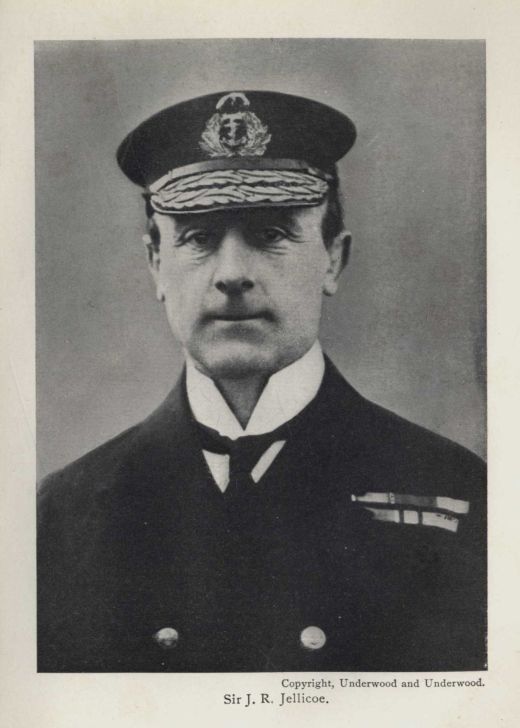
Sir J. R. Jellicoe.
Yet all this while, the British Fleet was tightening its grip upon the command of the sea to an extent which may now be described as absolute. The German flag, war ensign and merchant pennant, has been swept from the oceans as if it had never flown. Hamburg and Bremen, the Fatherland's prides, are as completely demolished, as far as their usefulness to Germany for war is concerned, as if they had been battered into smoking ruins. German mercantile trade simply no longer exists, except such of it as can be smuggled in tramps and ferries across the narrow reach of the Baltic between Pomerania and the Scandinavian ports. The Germanic Allies can import and export nothing oversea except by the grace of Jellicoe. Their deported propaganda chieftains or compromised ambassadors and attachés can not return to their homes in Europe from the United States without gracious "safe conduct" by the British Fleet. The toymakers of Nuremberg can not deliver a solitary tin soldier to an American Christmas tree unless Jellicoe says yes. Two score proud German liners, including the queen of them all, the Vaterland, are rotting and rusting in United States harbors, ingloriously imprisoned by British naval power. In a dozen other ports throughout the world Hamburg and Bremen vessels tug at anchor--greyhounds enchained. Germany is banned from the oceans like an outlaw. Her people can eat and drink only on the ration basis. The British Fleet has done something else of which, it seemed to me, an American Presidential message might legitimately have made mention. It has enabled the people of the United States for many months to traverse the oceans in security.
These are the immediate effects of British sea supremacy on the enemy, but even they are incommensurate with the advantages which accrue to Britain herself. A navy has three cardinal functions: to preserve its own shores from invasion; to maintain inviolate its country's oversea communications, including cables, food supply, passenger traffic and postal transportation; and, finally, to destroy the sea forces of the enemy. The first two of these functions have been fulfilled by the Grand Fleet, and at a cost in men and material, though not inconsiderable, which is infinitesimal, measured by the results attained. To absolve the third, and, of course, climacteric, function, Jellicoe and his men and his ironclads stand ready when the opportunity is given them--readier, by far, than when the war began. They have not lost a really vital fighting unit (supposing unconfirmed reports to the contrary to be unfounded). They have had a priceless experience of sea warfare under almost every conceivable condition. They are veterans of every essential contingency. There is hardly a terror, military or atmospheric, which they have not faced and surmounted. They have added to their battle efficiency by a great many new and powerful ships. Their morale is unbroken.
When the Kaiser's Canal Armada finally makes up its mind, as I believe that German public opinion will some day compel it to, to forsake the snug harbors of Kiel and Wilhelmshaven and the screen of Heligoland for the high sea, it will find that Jellicoe has up his iron sleeve a welcome, as to the issue of which no one in these islands is capable of cherishing the remotest doubt. History is barren of an instance of a Power defeated in war, who retained command of the sea. Were there no other considerations which spell the eventual, though probably not the early, frustration of Germany's ambition to master Europe and, as William II once sighed, to snatch the trident from Britannia's grasp, the vise-like grip of naval power which Jellicoe has wrested alone denotes that Armageddon can have but one ending, however long it be deferred.
In this cursory review of the men at Britain's helm, the Sovereign is deliberately put at the end instead of the beginning. I mean to cast no impious slur upon George V in thus classifying his relative importance in the scheme of British war life, yet to rank him at the front of the captains of the State would be hyperbole as unpardonable in a chronicler as gratuitous defamation would be.
To discuss the figure cut by England's King during the past year is a task which a foreigner approaches with diffidence. I should not dream of taking such liberties with their Britannic Majesties, for example, as my gifted friend and colleague, Irvin Shrewsbury Cobb, who recently diagnosed the Royal situation in England thus: "I have seen the King and Queen, and I know now why they call him George the Fifth; Mary's the other four-fifths." Whether this subtle tribute to the undoubtedly potent influence of the gracious Queen explains it or not, the indisputable fact remains that the part played by King George in the day of supreme British national trial has been a keen disappointment to a great many of his subjects. It is not a topic which they discuss at all in public, nor one upon which it is easy to extract their views even in private. But when an inquiring alien even of unmistakably sympathetic sentiment accomplishes the miracle of inducing a Briton to pour out his heart, he will secure evidence corroborative of an impression the foreigner has had from the start, if he has lived in England since August, 1914--that the monarchy, as such, has not given a wholly satisfactory account of itself. Men who are so utterly un-English as to be "quite" frank even suggest that King George's insistence not only upon enacting the "constitutional monarch," but overplaying that rôle, has not inconsiderably undermined the solidity of the Royal principle in numerous British hearts. They will tell you, if in communicative mood, that George has failed to rise to the majestic opportunities of the moment. They contrast his incorrigibly "constitutional" behavior with what they feel assured is the red-blooded lead King Edward would have given. They assert that the hour of Imperial peril, when national existence itself is at stake, has caused so many cherished shibboleths to go by the board, that the strait-jacket of "constitutional monarchy," which is another name for Irresponsibility, ought to go with them. In times of peace, say Englishmen, a conscientious figurehead on the throne is good enough. In times of war, they want a King. He need not be the blatant, ubiquitous limelight-chaser that the Kaiser is, but some of that royal dynamo's attributes, diluted with English seasoning, would not have been unwelcome to his people during the past year and a half. Britons, though, I repeat, they do not cry it out for the multitude to hear, are not edified by the spectacle of a sovereign who has sojourned with his army and fleet only in the most formal manner, whose war-time activities are confined to peripatetic visits to hospitals and convalescent homes, to inspections and reviews, and to distribution of Victoria Crosses and Distinguished Service medals at Buckingham Palace.
"The King," to whom Englishmen, before 10 P.M., still drink in reverential sincerity, and who rise in devout respect when they hear the anthem which beseeches Divine salvation for him, is an institution from which Britain felt it had a right to expect both lead and deed in a great war. She did not demand, or at least no conspicuous section of her has, that the King should take the field or the sea, and prance about in the saddle or on the quarter-deck, but they did hope, I think, for something more inspiring than nebulous constitutionalism. It was many months after thousands of other British mothers had sent their sons to death and glory that Queen Mary consented to the dispatch of the twenty-one-year-old Prince of Wales to the trenches. And Prince Albert, who is twenty, and was in the navy before the war, was never, as far as the public is informed, able to gratify his desire to return to active service afloat, but must cool his martial ardor in the inglorious capacity of an Admiralty messenger in London. Britons look across to Germany, Russia and Italy, even to Belgium and Serbia, and, contrasting the spectacle with "constitutionalism" in their own Royal household, acknowledge that theirs is not a thrilling picture.
If you attempt to penetrate into what may strike you as a mystery, you will be told that the cause as far as King George is concerned, is twofold: first, his high-minded, even slavish, devotion to his conception of his constitutional limitations, and, secondly, his equally incorrigible shyness. Sarah Bernhardt, when King George and Queen Mary were in Paris a couple of years ago, was once summoned to the royal box of the Comédie Franchise for presentation to the British sovereigns. She explained to friends afterward that the King's modesty positively unnerved her. He was as bashful as a schoolgirl. I have been told that his manner in the presence even of his Ministers is almost deferential. He does not know the meaning of "mixing," an art in which his late father excelled. "The King and Queen are fond of lunching alone, and usually take their tea together," I read the other day in a "well-informed" society paper. Edward VII was fond of lunching with men of affairs. He did not heed the hoots of the aristocratic set, which was scandalized by his intimacy with tea-merchants and money kings, because through them he was accustomed to keep in touch with the human currents of his people's life and times. Edward would hardly have allowed even the Empire's greatest soldier (Englishmen explain) to call the new army "Kitchener's Army." It would have been called the "King's Army" and the King would have thrown his incalculably great moral influence into the breach in some more practical way than lending his photograph for recruiting advertisements. George V could have been England's finest recruiting sergeant. He preferred to remain a constitutional monarch.
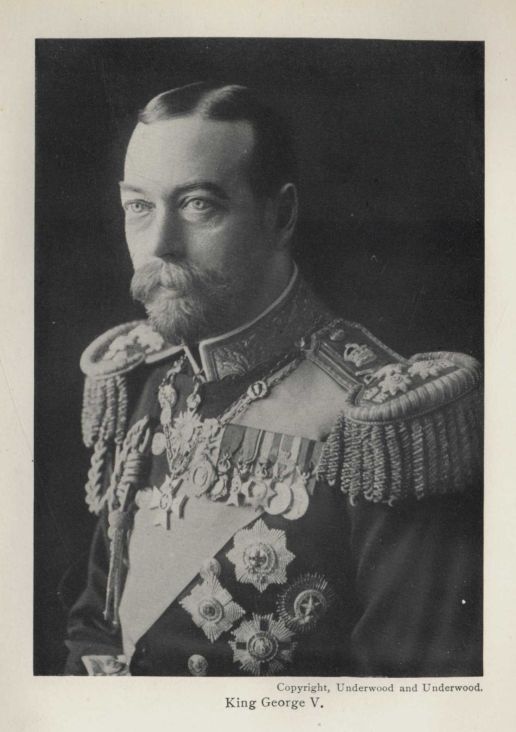
King George V.
Englishmen excuse, rather than blame, the King. They point out, in his extenuation, that George's is a gentle, self-effacing nature little fitted for the soul-stirring era in the midst of which Fate decreed that his reign should fall. They cast no aspersions on his rugged patriotism or even on his kingly zeal. They believe that, according to his lights, he exercises faithfully what he considers to be his prerogatives. They feel, they tell you, that it is not his fault that he remains the only man in the Kingdom who still wears a Prince Albert coat. His is, somehow, not the magnetic influence which, if it were that of Edward VII, would still be condemning Englishmen to cling to that ancient robe. They explain that it is his psychic misfortune, rather than a failing, that nobody thinks it worth while to emulate him by taking the pledge "for the duration of the war" and drinking barley-water. Edward VII's abstemious decree would have blotted the liquor trade out of existence, because in the lap of his example sat militant loyalty. The "old King's" wish was law.
Perhaps--I do not know--George V is wiser than men think. Perhaps he is not being kept in cotton-wool by his Victorian private secretary. Perhaps he is not yielding as supinely as many people imagine to the inflexible mandates of constitutionalism. Perhaps he has his ear closer to the ground than his contemporaries realize, and with it hears the far-off but unmistakable rumbles of the limitlessly democratized Britain which is already emerging from the crucible of war. Perhaps injustice is done to him by those who accuse him of not rising more vigorously to the opportunities of his Empire's hour of destiny. May he not be fitting himself still to sit the throne in that coming day when Britain will perhaps want even a more constitutional ruler than ermine and the crown now rest upon?
CHAPTER XVII
YOUR KING AND COUNTRY WANT YOU
"Luna Park," in Berlin, once had an English manager and an American "publicity agent." In pursuit of his lime-light duties the transatlantic hustler, who had been engaged because he was such, reported to the manager one day that he had accomplished a feat on which he had been plodding for weeks. The owners of a building which commanded the most prominent view in Berlin had finally consented to let "Luna Park" affix a gigantic electric flash-light sign to the roof.
"It will be the greatest thing of the kind ever seen in Germany," exclaimed the enthusiast from the U.S.A. "They'll allow us to have 'Luna Park' in letters twenty feet high across a one-hundred-and-fifty-foot front, and you'll be able to see 'em a mile away!"
He expected his British superior fairly to jump for joy. But this is what he said:
"Quite so. But don't you think that will be a bit conspicuous?"
When I returned to London on September 24, after four short, strenuous weeks in the United States, I found Englishmen dominated seemingly by a genuine fear that the war might become "a bit conspicuous." It was true that stupendous things had happened in the interval. Namur, "the impregnable," had melted before the merciless German 42's like the other Belgian fortresses. Brussels was in the enemy's hands, unscotched, thanks to the intervention of the American Minister, Brand Whitlock, and through it were passing apparently endless streams of gray-clad Germans bound for Antwerp and the sea. France had been overrun, regardless of the cost in Teuton blood, Lille and the industrial provinces were securely held, and, although the Crown Prince and von Kluck had been gloriously repulsed in their frenzied dash on Paris, the capital had all but resounded to the clatter of Uhlan hoofs, and Bordeaux was still regarded a far safer seat of Government. England herself had lived through hours of anxious crisis blacker than any within the memory of the living generation. At Mons, as official reports disclosed, the gallant little British army narrowly escaped annihilation. As it was, it lost hideously in killed and wounded. Gaping holes had been ripped in the ranks of famous regiments, and the Expeditionary Force, within six weeks of its landing, was already sadly mangled. Sir John French stirred the nation with his dispatch on the retreat from Mons and told how his army, though hurriedly concentrated by rail only two days before, had tenaciously withstood, in the dogged British way, the combined attack of five crack German corps. In the subsequent fighting which beat the Germans on the Marne and saved Paris, British soldiers, battered and battle-scarred as they were, had done even more than their share. Two days before arrival in Liverpool the Campania wireless--I returned to England in the same veteran hulk which had taken me to America in August--brought the dread tidings of the submarining of cruisers Aboukir, Cressy and Hogue in the Channel by the U9 and Weddigen, with cruelly heavy sacrifice of British lives.
All these things had happened, and yet London was unshaken. She had been "a bit uneasy," my English friends conceded, in the days and nights when the fate of Paris and Sir John French's army seemed to be in doubt, and the U9's feat had "cost us three obsolete boats," but the Germans were checked now, and the worst was over. Churchill was sending a British naval expedition to Belgium to save Antwerp, and what was the use of worrying, anyhow? Kitchener's army was filling up with recruits by the thousand, and England's motto was "Business as Usual."
Yea, verily, Britain was pursuing the even tenor of her imperturbable way. The Savoy, at supper after theater, glittered with all its old-time flare. The tables were thronged in the same old way with gaily-clad women, romping chorus-girls, monocled "nuts" with hair plastered straight back, opulent stock-brokers, theatrical celebrities and all the other familiar people about town. The band interpolated Tipperary a little oftener between rag-time one-steps and fox-trots, and lordlings and other bloods in khaki gave a new tinge to the picture, but otherwise it was night-time London "as usual." The theaters and music-halls were full. At Murray's and the Four Hundred--those dens of revelry called "night clubs," invented for law-respecting English who can afford five guineas a year for the privilege of wining, supping and dancing after the Acts of Parliament send ordinary people to bed--you could hardly wedge your way in. At the Carlton or the Piccadilly, or for the matter of that at any other popular resort in all London, you found yourself lucky to locate a single unpreempted place. Wherever you went or turned, whomever you saw, it was dear old London "as usual." If you were an impulsive, excitable, sentimental American and thought you were mildly rebuking your British friends when you ventured to wonder at the extraordinary naturalness of life in the West End, or at Walton Heath golf links, or at Chelsea football grounds, or at the Newmarket race-course, you found yourself unconsciously paying a tribute to "British character." For John Bull, far from being ashamed of adhering religiously to peace-time activities, was positively proud of the exhibition of "reserve" and "poise" and "calmness" which he was now giving. People talked about the war, of course. They hardly mentioned anything else. But if you had the patience to listen to their airy, fairy converse, you soon gathered that they spoke of it exclusively as something about which no self-respecting Englishman or woman purposed for a solitary moment to get indecorously agitated. There were even people who confessed that the war was beginning to "bore" them.
As for myself, I had a go at British acquaintances from two entirely different standpoints. In the first place, fresh from America, where the war had burnt into people's minds as deeply almost as if it were their own destiny which was at stake, I was still filled with the energizing atmosphere omnipresent there. I remembered how even our puny war with Spain had gripped the nation's thought and concentrated it to the exclusion of all else. I could not, for the life of me, understand how Englishmen, with the history of the preceding eight weeks before them, could still look upon "business as usual" as the desideratum for which the moment insistently called. I knew, I thought, how Americans would feel and act at such an hour; and as I had in my time dozed through many after-dinner speeches about the "kindred ideals" and "identical habits of thought" which so indissolubly bound the English-speaking nations, I ventured to marvel, and even at times to swear, at the spectacle of national nonchalance which Britain at the beginning of October, 1914, so resolutely presented. It was magnificent, but it was not war.
In the second place, I was conscious, with the knowledge and conviction of a long-time eye-witness, of both the visible and the dormant strength of Germany. I had written literally reams, during the preceding eight years, about Teuton preparations on land, in the air and on the sea. I had discussed the German War Party, its leaders and its literature, its aspirations and its plans, till I often grew weary of the task, not so much because pacifist critics in England pilloried me as a war-monger and an alarmist, but because there was a monotony in that sort of news about Germany which strained even the patience of those whose duty it was to report it. When Englishmen now told me, as so many of them did, that they would "muddle through this show," as they had "muddled through" in South Africa and on all the other occasions in Britain's martial past, I grew sick at heart. I knew, as everybody who had lived in Germany between 1904 and 1914 and kept his ears and eyes open knew, that "muddling through" would never beat the Germans, even if it had finally overcome the Boers. I knew, and anybody really acquainted with the Germans knew, that they would not be vanquished so long as there was a man or a mark with which to fight. I knew that nothing short of the supreme effort which the British Empire and its Allies could put forth would suffice to overcome the most highly-organized and efficiently patriotic people which had ever gone to war. I knew that the German General Staff and the other war-makers of the Fatherland had long reckoned, in the emergency of a struggle with England, on the very thing of which my eyes were now witness--British reluctance to shake off the shackles of ease and comfort and buckle down, a nation in arms, to the inconvenient and grim realities of war. Of these things I thought, and the reflection was disquieting, as I saw the mad whirl of light, frivolity and care-free joy which the Savoy at supper-time, plainly epitomizing London life at the moment, presented night after night. "Business as usual!" It was small comfort my English friends provided, when, remonstrating with me for my foolish solicitude, they assured me that my misgivings were misplaced because I was hopelessly ignorant of "the British character."
England, it was obvious, was like the manager of "Luna Park" in Berlin. She was afraid the war might become "a bit conspicuous," and was, moreover, determined that it should not. I remember well the crushing rebuke administered to me by a Britisher of international renown when I intruded my view of all these things. I had offered, in a desire to hold the mirror up to Nature and let Londoners see how they looked to foreigners at so transcendent a moment in their national existence, to produce a little article entitled "What an American Thinks of the English in War-Time." I even went to the length of putting my thoughts on paper and submitting the manuscript. I did so with considerable confidence, because the celebrity in question is a notorious "Wake Up, England!" man. But he returned my masterpiece with a look and gesture mingling pity and contempt for my wretched unfamiliarity with "the British character."
"My dear Wile," he explained, "you do not understand us. You forget that this war is not an American World's Championship baseball series. You mustn't try to foist transatlantic brass-band methods on us. It is not the British way."
Lest I convey the impression that I had advocated rousing the British lion from his slumbers by wild and woolly western methods palpably unsuited to his stoical temperament, let me make haste to explain that I was pleading for nothing but a system which would, spectacularly if necessary, do something to let the British public at least know that they had a war on their hands, and popularize it. A great contingent of Indian troops, led by Maharajahs and Rajputs, Maliks, Rajahs and Jams, had arrived in Europe, tarried in England and been slipped, in the dead of a Channel night, across to France. An entire army from Canada was encamped on Salisbury Plain, and no one had seen a sign of it except an occasional detachment of boisterous subalterns, many with a pronounced "American accent," who had kicked up a row in some Leicester Square music-hall the night before. The Nelson monument in Trafalgar Square was desecrated with recruiting circus-bills which would have delighted the heart of Barnum, and every taxicab wind-shield in town beseeched passers-by to "enlist for the duration of the war." But why, I had had the temerity to inquire in my little "Wake Up, England!" homily, which was rejected because it revealed no insight into "British character," were not the turbaned Gurkhas and the swarthy Sikhs and the brown men from Punjab and Beluchistan brought to London-town and paraded up and down the Strand and the Embankment, for all the metropolis to have a priceless object-lesson in Imperial patriotism? Why was Kitchener allowed to intern the young giants in khaki from Ontario, Quebec, Alberta, Saskatchewan and British Columbia in the hidden recesses of the provinces, instead of giving Londoners a glimpse of Colonial love of mother country in the flesh? It was due to the Indians and to the Canadians themselves, no less than to London, I argued, that opportunity should be provided to pay homage to the men who had crossed the seas to fight for Motherland. Non-British though I am, I felt morally certain that even my Hoosier bosom would swell with emotion in the presence of so ocular a demonstration of Britain's Imperial solidarity in the day of trial. But my suggestions were rejected as unbecomingly boisterous in their intent, good enough for the Polo Grounds or Madison Square Garden, but grotesquely out of place in England. If carried out, you see, they would inevitably have made the war "a bit conspicuous."
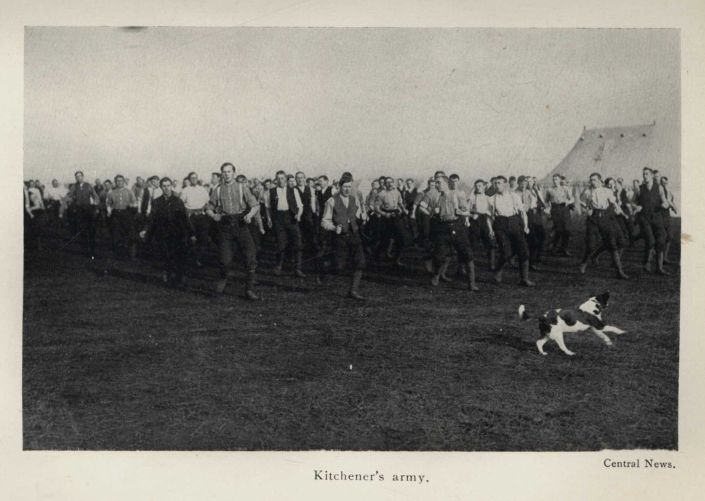
Kitchener's army
That the war was almost invisibly hidden, as far as the daily life of the people was concerned, was primarily due to the bureaucratic and autocratic methods of the censorship. Bureaucracy and autocracy in Germany, for instance, have their redeeming qualities. They are usually highly efficient, and their arrogance and high-handedness are tolerated because accompanied by a maximum of practical effectiveness. When England established her war censorship, she went over to bureaucracy and autocracy, as made in Germany, but lamentably lacking in the saving graces of the system as there exemplified. In vain the Press, now muzzled almost as effectually as if the Magna Charta and free speech had never existed, stormed and fumed against the tyranny of the "Press Bureau," the innocuous title chosen for the Juggernaut which, before six months had passed, was to grind British journalistic liberties into the dust. It was discovered that the "Bureau" was staffed for the most part by amiable gentlemen no longer fit for active duty in the army and navy, who, having patriotically offered their services to King and country, had been pitchforked indiscriminately into billets which clothed them with more real influence on the war than if they had commanded armies or fleets. It became painfully apparent that news of the war was being suppressed, mutilated and generally mismanaged either by military men who knew nothing of journalism, or by journalists who were profoundly ignorant of military matters--for the official censor caused it to be announced, in self-defense, that he had associated with the Bureau in an advisory capacity a couple of eminent ex-editors.
Just who was responsible for annihilating the elementary rights of the British Press never became quite clear. Some blamed Kitchener. His hostility to journalists and journalism was notorious, though "With Kitchener to Khartoum," by the most distinguished special correspondent of our time, the late G. W. Steevens, who died in The Daily Mail's service during the South African war, probably did as much to give "K." a reputation as anything which England's War Minister ever did in the field. Others said Joffre was the man who had put the lid on. Whoever laid down the law saw that it was relentlessly enforced. Petitions, protests, cajolings, threats, complaints, abuse--all were in vain. The antics of the "Press Bureau" became more exasperating and inexplicable from day to day. Also more domineering, if common report could be believed, for presently Fleet Street heard that "K." had intimated to a mighty newspaper magnate that if the latter did not mend his ways, and abate his insistence, "K." had the power, and would not shrink from using it, to incarcerate even a peer of the realm in the Tower and turn his entire "plant" into junk. That dire threat, I imagine, was just one of the myriad of chatterbox rumors with which the air in England, all through the war, fairly sizzled. At any rate, it failed utterly to curb the stormy petrel to terrorize whom it was said to have been uttered, for his onslaughts on the censorship grew, instead of diminishing, in intensity as the "war in the dark" proceeded.
But it was in its treatment of news destined for the United States that the Press Bureau most convincingly revealed its lack of imagination. Here was Germany leaving no stone unturned to take American sympathy by storm. The Bernstorff-Dernburg-Münsterberg campaign was in full blast. Von Wiegand in Berlin was interviewing the Crown Prince and Princess, von Tirpitz and von Bernhardi, Zeppelin, Hindenburg and Falkenhayn, and only narrowly escaped interviewing the Kaiser himself. American correspondents arriving in Germany were received with open arms, and had but to ask, in order to receive. Sometimes they received without asking. They could see anybody and go anywhere. That was German efficiency--and imagination--at work. The Germans realized that we are a newspaper-reading community. They knew that the best way in the world to win American newspapers' and American newspapermen's sympathy is to give them news. So they did it. When the German Crown Prince told the correspondent of the United Press that he would "love" to see American baseball, that he longed to hunt big game in Alaska, and that Jack London was his favorite author, he broke a lance for the Fatherland's cause in the United States that a four-hundred-fifty-paged "unhuman" British White Paper could never hope to equal. Somebody with an imagination--probably Bernstorff--had put a flea in Berlin's ear, and the result was open-house for American journalists for the duration of the war.
What was happening in London? There were plenty of American newspapermen on the ground, not only special correspondents who had come over to join the British army in the field, like Will Irwin, "Bell" Shepherd, Alexander Powell, Arthur Ruhl, or Frederick Palmer, to name only a few of them, but resident London correspondents who had lived in England a dozen years, like Edward Price Bell of the Chicago Daily News, Ernest Marshall of the New York Times, or James M. Tuohy of the New York World, who were well known to the British authorities as men of judgment, integrity and responsibility. But resident or newcomer, nothing but inconsequential facilities or the cold shoulder awaited them when they went to the Press Bureau, cap in hand, to ask even the most rudimentary professional courtesies for themselves or their papers. Quite apart from the indignities thus heaped on American correspondents, the Press Bureau, when it suppressed or butchered their dispatches, left pitiably out of account the susceptibilities of the great neutral news-devouring community which these men represented. Therein lay the real infamy. Think of it. Here was Great Britain and her Government confessedly anxious for American moral support in the war, and something more than that, and yet a subordinate department seemed clothed with authority to flout, exasperate and bully the agency directly responsible for the production of public sentiment in the United States. I call it a tremendous tribute to the sincerity and depth of our loyalty to the Allies' cause that we never for a moment allowed it to waver, even in the face of the British Press Bureau's arrant provocation. The American Press, asking for bread in England, received a stone. That it accepted it, and went on playing the Allies' game, has been one of the miracles of the war, for which these British Isles have reason to be profoundly grateful.
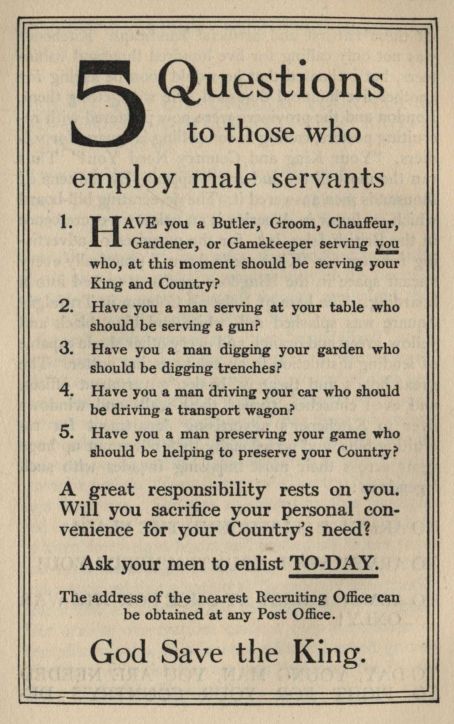
5 Questions to those who employ male servants
Inherent imperturbability and unimaginative censorship thus combined in the early weeks of the war, on the one hand to minimize popular conceptions of the struggle's magnitude in England, and on the other to smother enthusiasm for it. You can not fully realize the immensity of the task if you are not permitted by your overlords to see it in its true proportions. You can certainly not become ecstatic about it if they insist on having it painted in exclusively drab, routine and joy-killing tints, when they are not covering it up altogether. Yet British patriotism was triumphing over all these natural and artificial handicaps. Kitchener was not only calling for five hundred thousand volunteers, but intimated that he would soon be asking for another five hundred thousand. He was getting them. London and the provinces were now plastered with recruiting posters, calling in compelling language for soldiers. "Your King and Country Need You!" Thus ran the most direct and frank appeal. By the tens of thousands men answered it. The desecrating bill-board which we know in America is an unknown excrescence in the British Isles, but, for the purposes of advertising for men for "Kitchener's Army," practically every vacant space in the Kingdom was now turned into a hoarding. The base of Nelson's Column in Trafalgar Square was splashed red, white and blue, black and yellow, green and orange, and every other shade capable of lending distinction to an eye-arresting poster. The great hotels and theaters, banks, government offices, and even churches, turned their walls and windows over to Kitchener's advertising department for recruiting-bills, and occasionally themselves put up huge signs across their most imposing facades with such legends as:
TO ARMS! RALLY ROUND THE FLAG! TO ARMS! YOUR COUNTRY NEEDS YOU! TO ARMS! ENLIST AT ONCE FOR THE WAR ONLY!
or
TO-DAY, YOUNG MAN, YOU ARE NEEDED TO FIGHT FOR YOUR COUNTRY'S DEFENSE! FALL IN! JOIN THE ARMY AT ONCE!
or
MEN OF BRITAIN, UPHOLD YOUR COUNTRY'S HONOR AND LIBERTY! SERVE WITH YOUR FRIENDS!
or you would read what the King had said:
"NO PRICE CAN BE TOO HIGH WHEN HONOR AND LIBERTY ARE AT STAKE."
Even the fences of the parks, the windows and sides of the omnibuses and the wind-shields of the taxicabs reminded men every hour of the day and night that "Your King and Country Need You."
I recall, with amusement, how "scandalized" some Americans were at England's resort to "circus methods" to manufacture an army. I remember that pert (and extremely pretty) young Chicago newspaper-woman who, having come over from Paris which had not needed to advertise for an army, because France had one, was mortified beyond words to find London screaming with "Your-King-and-Country-Need-You" sign literature. She was so stirred by this "undignified exhibition" that she sat down before she had been in town forty-eight hours and dashed off to her paper just what she thought about "degenerate Britain." She was convinced that a nation so "hopelessly unpatriotic" that it had to advertise for defenders was "doomed." Her erudite observations made a deep impression on her editors, who, in a learned editorial asked gravely whether the British Empire was "reaching the Diocletian period of the Romans."
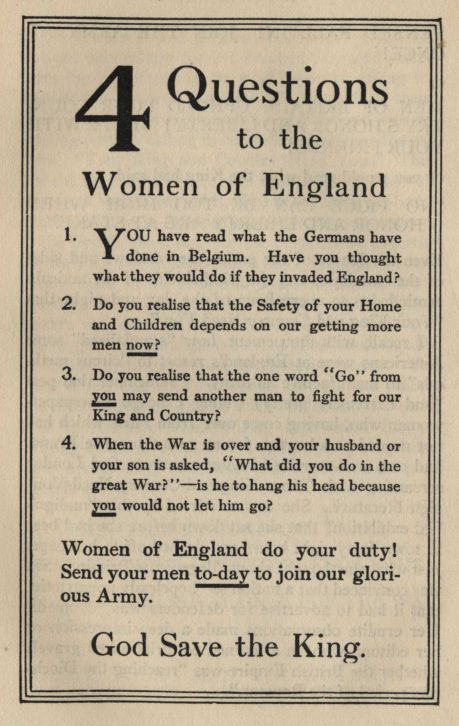
4 Questions to the Women of England
As a matter of fact, Kitchener's project to advertise for an army was the one ray of imagination, and a boundlessly encouraging one, which the War Office had so far revealed. It showed even more imagination in entrusting the technique of the scheme to a professional, Mr. Hedley F. Le Bas, who, besides bringing to the task the expert knowledge of a publisher, had once been a trooper in the 15th Hussars, and knew and loved the army. Mr. Le Bas modestly disclaims credit for originating the plan to create an army of millions by advertisement. He says that the Duke of Wellington beat him to it. A hundred years ago, when England was at grips with the oppressor of that day, a poster appeal for soldiers was issued, which is prima facie evidence that advertising is not a modern invention. Only a few Englishmen, and probably still fewer Americans, are aware that even in Napoleonic times advertising for an army was de rigueur, and as the invitation to "The Warriors of Manchester" was, to a certain extent, the spiritual inspiration of Kitchener's remarkable recruit-getting campaign, I make no apologies, despite its raciness, for reproducing on the following page a document of genuinely historical value.
The methods to which the American Democracy has resorted to secure soldiers for her wars were also in the minds of Lord Kitchener and Mr. Le Bas. Indeed, the practises of President Lincoln, in respect of raising armies, were the model to which the British Government from the start determined to adhere. It was discovered that Lincoln and Seward had not shrunk from appealing to the men of the North from the hoardings and through the newspapers, while the advertisements of the United States army and navy during the Spanish-American War were a modern example of recruiting measures in a country where the absence of conscription compels a Government, in the hour of emergency, to scrape an army together by hook or crook. Then the constant advertising by our War and Navy departments, even in peace-times, proved that there must be efficacy in asking men to serve their country in posters, magazines or newspaper-columns in which they were also being persuasively urged to buy automobiles, "quality" clothes or shaving-sticks. Kitchener's "advertising campaign" was destined, before the war was old, to be the target of bitter attack, but the skill, persistence and comprehensiveness with which it was prosecuted played an immense rôle in the creation of the greatest volunteer army in history. It opened a new epoch in advertising and clothed that art with a distinction which will never be taken from it. The seal of an Empire has been placed on the maxim that it pays to advertise.
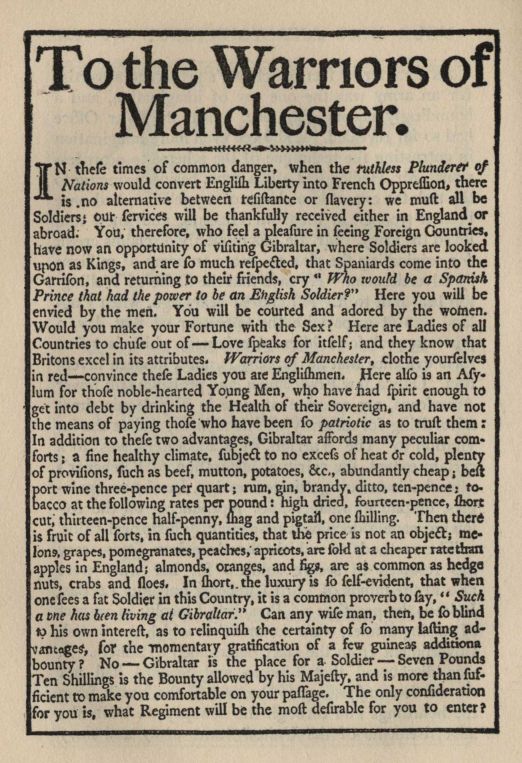
To the Warriors of Manchester.
By the end of October, after three months of war, the muster of the British Empire was in full progress. Complacency and nonchalance in London were still wretchedly wide-spread, but the call of the Motherland for soldiers was echoing around the world. Wherever Britons were domiciled, it was answered. It penetrated into far-off British Columbia, where young Englishmen, comfortably settled in new existences, abandoned them unhesitatingly. It was heard in even more distant climes, like Australia, New Zealand and Africa, where adventurous spirits who had crossed the seas to seek their fortunes in lands of promise were now dominated by no other ambition than to "do their bit" for King and country. Even emigrated Irishmen, long irreconcilable, were electrified by John Redmond's clarion message, and they, too, turned their faces homeward. By the ides of November whole shiploads of repatriated Britons, returning from the four points of the compass, reached the island shores, fired by one consuming purpose.
These home-coming patriots were not only rendering valiant service by placing their lives at the King's disposal, but they were demonstrating, along with native-born Canadians, South Africans, New Zealanders, Australians and Indians, that one of Germany's fondest dreams was the hollowest of fantasies. I had been familiar for years with a German political literature based on the roseate theory that, once Great Britain was embroiled in a great European war, her world-wide Empire would crack and tumble like a house of cards in a holocaust. Had not Sir Wilfred Laurier on a famous occasion declared that Canada would never be "drawn into the vortex of European militarism"? Were not the Boers thirsting restlessly for revenge and the hour of deliverance from the British yoke? Were not Republican sentiments notoriously rife in Australia and New Zealand, and would not Labor Governments in those remote regions seize eagerly on coveted opportunity to snap the silken cords which bound them to England, and declare their independence? Would not India, the enslaved Empire of the vassal Rajahs, leap at the throat of an England preoccupied in Europe and drive the tyrant into the sea? These were the thoughts which were discussed by Teuton political seers as something more than things which Germany merely desired and hoped for. They were treated as axiomatic certainties. The rally round the Union Jack by the Britons of Australia and New Zealand, Canada and South Africa, Nova Scotia and Jamaica, Barbadoes and Ceylon, British Guiana and Mauritius, Newfoundland and New Brunswick, was Germany's great illusion. When the "conquered Boers" under Botha, the "alienated Irish" under Redmond, the "rebellious Indians" under maharajahs and princes, even the "downtrodden" black Basutos, Barotses, Masai and Maoris of Africa and Australasia under their native chieftains, announced that they, too, were ready to bleed for the Empire, Germany's awakening was rude and complete. London might be callous, pleasure-loving and unperturbed. But the Empire was alive both to the peril and the duty of the hour, and when it vowed to face the one and absolve the other an oath was sworn which spelled British invincibility.
CHAPTER XVIII
WAR IN THE DARK
It is November, 1914. Britain is waking, but is far from awake. Nearly everybody and everything are proud to be "as usual." The Fleet has been able to secure but one action with the Germans--Beatty's smashing blow at the Kaiser's cruiser squadron in the bight of Heligoland. A great trophy of the engagement is in hand--Admiral von Tirpitz' son, watch-officer in the Mainz, a prisoner in Wales. For a month and more the war has been raging furiously in the west all the way from the Alps to the North Sea. Antwerp is taken, after a farce-comedy attempt at relief by levies of raw British naval reserves. Joffre is at sanguinary grips with the "Boches" in the Aisne country. The twelve or fifteen miles of British front in the northernmost corner of France and that patch of Flanders not yet in the enemy's hands is the scene of ceaseless, desperate combat. Jellicoe's dreadnoughts and destroyers take part at intervals in the grim battle for the channel coast. Ostend has fallen.
The German objective farthest west is now clear. The Berlin newspapers head-line the tidings from Flanders "the Road to Calais." Major Moraht in the Tageblatt acknowledges that the campaign for the base from which Napoleon essayed to invade England is "a matter of life or death" for the Germans. Sir John French and the remnant of Belgium's little army steel themselves for a stone-wall defense. Again and again they keep the frenzied enemy at bay. Have you ever seen Harvard holding the Yale eleven on the five-yard line three minutes before the call of time in the last half, with dark gathering so fast that you could hardly distinguish crimson from blue? Do you remember Yale's ferocious first, second, third, yet always vain, attempts to batter and plunge her way through Harvard's concrete, immobile phalanx? If you do, and if your red-blooded heart has tingled at some such spectacle of young American bulldoggedness, which can be seen West as well as East, in the North and in the South, just as commonly as in the New Haven bowl, you will be able to visualize, infinitesimally, the titanic grapple around Dixmude, Ypres and the Yser in the bloody days and hellish nights of October and November, 1914. "The Watch in the Mud" was the way German military critics paraphrased their national anthem, to describe the situation in Flanders, for the Belgians had now flooded the region contiguous to the Yser Canal, and the Kaiser's legions, in their breathless thrust for Calais, were fighting in mire and slush to their boot-tops. More than one company of Feldgrauer was ingloriously drowned.
The British were engaged in precisely the operation for which their temperament best fits them--"holding." The German attack rocked against them remorselessly, giving neither assailant nor defender rest or quarter. But the bulldog "held." He was mauled unconscionably and bled profusely. Thousands upon thousands of his teeth were knocked out, and he was half-blind, and limped. Yet he "held." Winter had come. Men lived in trenches which had been merely water-logged ditches, but were now frozen into rock. The German eagle, hammered, of course, no less cruelly than the bulldog, was still screaming and clawing, in his mad desire to cleave a way to Calais. But, mangled and scarred as he was, the bulldog barked "No!" He had set his squatty bow-legs, disjointed though they were, squarely across "the Road to Calais." There he intended to stay. It could be traversed, that road, only through a welter of blood which, regardless as German commanders are of the cost when they set themselves an objective, gave the General Staff at Berlin furiously to ponder.
I have already intimated that Britain all this tempestuous while was rubbing her eyes, but was only partially open-eyed. It was not altogether Britain's fault. The immutable Censorship still gave the public no real glimmer of the history-making struggle going on almost within ear-shot of the chalk-cliffs of Dover. Throughout the entire month of October, four weeks as crammed with death and glory as in all England's martial history, Sir John French was permitted to take the public into his confidence but on one single occasion--and that, a dispatch dealing with operations six weeks old! For its news of the heroic deeds and Spartan sufferings of the greatest army it ever sent abroad, the British Empire was compelled to depend on stilted French communiques and the fantastic or irrelevant narratives of an official "eye-witness at British Headquarters," who was allowed to bamboozle the nation for months before his flow of mediocrity and piffle was choked off by disgruntled public opinion. England was fighting her greatest war in Cimmerian darkness. Casualty lists, terrible in their regularity and magnitude, kept on coming, but of the coincident imperishable triumphs of British sacrifice and courage, not a word. One's Illustrated London News and Sphere printed depressing double-pages weekly, filled with pictures of England's masculine flower killed in action "somewhere in France" or "somewhere in Flanders." But of the manner in which their precious lives had been laid down, of the price they had made the Germans pay for them, not a syllable. If by accident some correspondent or newspaper secured the account of an engagement, which ventured so much as to hint with some picturesqueness of detail how Englishmen were dying, the Press Bureau guillotine came down on the narrative with a crash which taught the offender to mend his ways for the future.
Under the circumstances it was not surprising to hear well-founded reports that recruiting was falling off. In the clubs men said that Kitchener's "first half-million" was in hand, but that men for the second five hundred thousand, for which the War Office had now called, were holding back to a disappointing, and even disquieting, degree. Meantime the popular ballad of the hour was, appropriately, Paul Rubens' "Your King and Country Want You"--"a women's recruiting song," as its sub-title runs. Its opening verse and chorus tell their own story:
We've watched you playing cricket
And every kind of game.
At football, golf and polo,
You men have made your name.
But now your country calls you
To play your part in war,
And no matter what befalls you,
We shall love you all the more.
So, come and join the forces
As your fathers did before.
CHORUS
Oh! We don't want to lose you,
But we think you ought to go.
For your King and your Country
Both need you so!
We shall want you, and miss you,
But with all our might and main
We shall cheer you, thank you, kiss you,
When you come back again!
These words, in prosaic type, look banal. Their appeal seems trite. Yet rendered to plaintive melody by such an operatic artist as little Maggie Teyte, they went straight to men's hearts. They must have sent thousands upon thousands of cricketers, footballers, golfers and poloists--that is a classification which takes in pretty nearly all Englishmen--into khaki and training-camps. But the growing insistence with which the walls and windows of Old England were plastered with recruiting posters--even entire front pages of newspapers were now employed to advertise that "Your King and Country Need You"--indicated that Kitchener's army was not being built up yet by the desired leaps and bounds. Obviously the war needed some other kind of advertising than even the accomplished Mr. Le Bas could give it. It was not strange that the enthusiasm of Englishmen, cheated of the chance to know what was really going on at the front, was beginning to find expression in other directions.
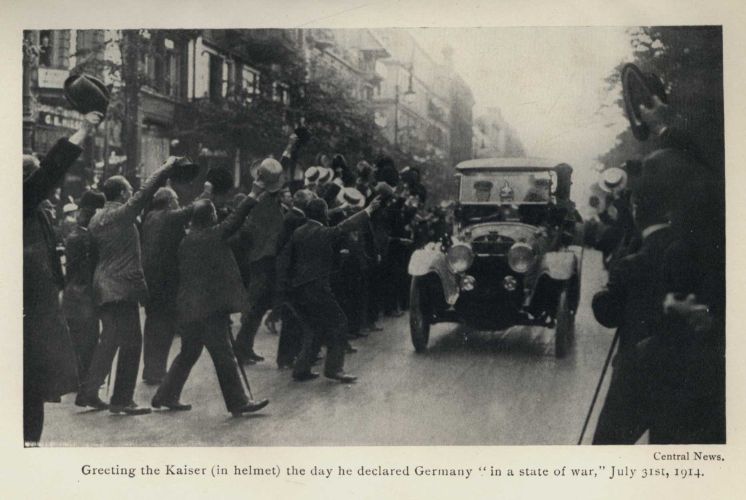
Greeting the Kaiser (in helmet) the day he declared Germany "in a state of war," July 31st, 1914.
It was not magnificent, for example, but it was natural, that Englishmen should, in all the circumstances, reveal a very materialistic passion to "capture Germany's trade." Denied the opportunity of "enthusing" over events at the seat of war, they proceeded to dedicate themselves energetically to the task of eliminating the Germans as a factor in the markets of the world. A profound book on the subject appeared--The War on German Trade, with the sub-titles of "Ammunition for Civilians" and "Hints for a Plan of Campaign." My old friend, Sidney Whitman, the distinguished author of Imperial Germany, dignified it with a preface. England had not entered upon the war "in a commercial spirit or with a commercial purpose," he said, "yet it behooves her to seize and hold fast the ripe fruit which has dropped into Englishmen's lap--as a first incident in the clash of nations." The volume had frankly been published, explained Whitman, "with the purpose of stimulating the English manufacturer and the English trader to seize the opportunities thrust upon them by the war."
Then, as the Censorship, as callous to criticism and abuse as if it were a sphinx, still insisted that Englishmen must fight and die in the dark, as far as their kith and kin were concerned, patriotism at home found vent in a crusade against the Germans still at large on British soil. They numbered thousands. They were a distinct and undeniable danger. In days of peace they spied patriotically and flagrantly, thanks to John Bull's easy-going, guileless toleration of the stranger within his gate. Personally I never believed that the German waiters and barbers in the Savoy or the Carlton, and their myriad of confrères elsewhere in the country, were the advance guard of the German army of invasion in disguise. Nor did I imagine (as I actually made a very British friend once seriously believe) that Appenrodt's restaurants in the Strand and Piccadilly were in reality masked commissariat-stations of the Kaiser's General Staff. Nor could even so persuasive an authority as William Le Queux, author of German Spies in England, convince me that every German resident who kept homing-pigeons, owned a country-place near the East Coast suitable for wireless, or got drunk on the Kaiser's birthday in the Gambrinus restaurant in Glasshouse Street, was a paid member of the Berlin secret-service. Most of these stories made me smile as broadly as the "star" rumor of the war--the story that seventy thousand armed Russians had been "actually seen" by Heaven knows how many veracious Britons sneaking across England from Newcastle to Southampton, on their stealthy way from Archangel to the Western allied front.
Yet it was palpably not the hour for German subjects, any number of them of military age and ardor, to be at large in England. So Britain, in a tardy manifestation of self-preservation, began to arrest and intern the Kaiser's hapless subjects, who hitherto had suffered no impairment of their liberties except detention in the country, compulsory visits to the police, and restriction of movement (except by special permission) to an area five miles from their domicile. The German is far too much of a patriot to be trusted to do as he pleases in a country with which his Fatherland is at war. He never forgets that he is a German first, and a stock-broker earning commissions in London, a barber taking English tips, or a waiter spilling English soup, afterward. It is always Deutschland, Deutschland über Alles with him. He may not have made a profession or habit of writing home to Berlin or Hamburg, Cologne or Breslau, Kiel or Wilhelmshaven, what he noted of interest at Aldershot, Portsmouth, Dover, Woolwich, or Sheerness, or what his English friends might from time to time tell him of interest at the Admiralty or the War Office. But it was "bomb-sure," as the Teuton idiom rather appropriately puts it, that if ever a British state secret fell into Herr Apfelbaum's hands on the Stock Exchange, or into Johann's in the "hair-dressing saloon" of the Ritz, or into Gustav's at the grillroom of the Piccadilly, that morsel would sooner or later find its way to Germany. When one considered that Englishmen of the highest class--one even said the King had a German valet!--were attended night and day, in their homes, their clubs, their offices and their favorite "American bars," hotels, grillrooms, cafés and restaurants by Germans, with eyes to see and ears to hear, it was small wonder that an irresistible cry was sent up before the winter of war had advanced very far, that these "enemy aliens" should not be merely ticketed, labeled and superficially watched, but placed behind barbed-wire, with British sentries on guard. And so it came to pass that Mr. McKenna, Home Secretary, whose reluctance to intern the Germans gossip absurdly ascribed to his "German connections," finally ordered "the enemy in our midst" to be rounded up. Not all of them were at first taken. Thousands remained at liberty. The British are a patient and a trusting clan.
It was not only the acknowledged German subject in Great Britain who was the object of the anti-Teuton crusade. The naturalized German, in many cases the holder for years of a certificate of British citizenship, was made to feel the blight of the wave of passion sweeping over the country. Naturalized Germans have won in England wealth and eminence outstripping even the heights to which they have climbed in the United States. In the preceding reign they were the bosom companions of the Sovereign. King Edward's intimate circle contained the Cologne financier, Sir Ernest Cassel, and another Prussian native, Sir Felix Semon, was His Majesty's Physician Extraordinary. In the "City," London's Wall Street, German financiers almost dominated the picture. Baron Schroeder (naturalized only within a few hours of the outbreak of the war) was so great a power that citizenship was practically thrust upon him as a measure of vital British self-protection. Sir Edgar Speyer, like Cassel a member of the King's Privy Council, and a Baronet besides, was not only a City magnate, but controlled London's vast system of surface and underground traction lines, including the omnibus service; yet his English counting-house was a branch of a parent establishment in Frankfort-On-Main. These were a few of the outstanding names among the "Germans" in high place in England. They by no means exhausted the list. Domiciled in this country for years, they had, while openly maintaining sentimental relations with their Fatherland, played no inconspicuous rôle in British affairs, economic and political. Any number of naturalized Germans were married to British women and were fathers of British-born families. Scores of their sons were already wearing King George's khaki in Kitchener's army. Sir Ernest Cassel had given five thousand pounds to the Prince of Wales' National Relief Fund. Yet rumor shortly afterward had him locked up in a traitor's cell in the Tower of London! No matter how acclimatized these naturalized Germans had become, no matter how long they had been British subjects--in many cases their title to that distinction was half a century old--they found themselves under a ban. They were not physically maltreated. Their windows were not broken. Men did not spit in their faces. They were permitted (like the rest of the British) to do "business as usual," except the stock-brokers, who were invited to keep off 'Change. But they were a marked class. If they ventured to visit clubs in Pall Mall or St. James Street, to which they had paid dues for years, they were confronted with notices reading:
+-------------------------------------------------+ | | | Members of German or Austrian nationality | | are requested, in their own interests, not | | to frequent the club premises during the war, | | and British members are asked not to | | bring to the club any guests of enemy | | nationality. | | | +-------------------------------------------------+
Or, if the naturalized German, no matter whether his boy had just fallen at Ypres or not, went to his favorite golf-club of a Saturday or Sunday, he received a greeting to the same effect. The virtue of tolerance, a prized British quality, was vanishing from the face of these war-ridden isles.
The anti-German fury in England claimed an early victim and a shining mark--His Serene Highness Vice-Admiral Prince Louis of Battenberg, who, as First Sea Lord of the Admiralty, was practically in supreme control of British strategy at sea. Prince Louis is a native-born Austrian, and although he had been a naturalized British subject and attached to the Royal Navy since 1868, and in 1884 married into the British Royal Family by wedding his own cousin, Princess Victoria of Hesse, a grand-daughter of Queen Victoria, a campaign inaugurated and mercilessly prosecuted by the aristocratic Morning Post, led, on October 29, to the Prince's resignation. Public opinion unreservedly approved the disappearance from a post, from which it was not too much to say the destinies of the Empire were controlled, of a man who was brother-in-law of Prince Henry of Prussia, the Inspector-General of the German Navy, and of the Grand Duke of Hesse, one of the Kaiser's federated allies. The same spirit of "Safety First" which sent the German barbers and waiters to camps in Frith Hill and the Isle of Man dispatched Vice-Admiral Prince Louis of Battenberg into official oblivion. Nobody actually distrusted his patriotism. But England was in no humor to run even remote risks. He had to go. Satisfaction over Battenberg's retirement was only slightly modified by a later revelation that it was Prince Louis himself, and not Mr. Churchill, as universally supposed, who was chiefly responsible for the mobilization of the British Fleet just before the outbreak of war in consequence of having "commanded the ships to stand fast, instead of demobilizing as ordered."
November was a month of kaleidoscopic sorrow and joy for the British. It began in gloom, with Turkey's entry into the war and the inherent menace to Egypt which that event denoted. Then came the great naval action off Chili, with first blood to the Kaiser in the only regulation stand-up battle in which British and German warships had so far met. The sinking of Admiral Sir Christopher Cradock's flagship, the cruiser Good Hope, and her companion, the Monmouth, by Admiral Count von Spee's cruiser squadron, with the loss of one thousand four hundred precious lives, was a bitter blow. Lord Charles Beresford, under whom Cradock had once served, told me that his death was a more serious loss to the British Fleet than a squadron of cruisers.