THE ASSAULT (continued 3)
Reading edition
My personal observations of Judge Gerard's ambassadorial methods are based for the most part on his career before the war. But he has not departed from them during the war. Bismarck laid it down as a maxim that an ambassador should not be "too popular" at the court to which he was accredited. From all one can gather, "Jimmy" Gerard has not laid himself open to that charge in Berlin since August, 1914. Nobody who knows him ever suspected for a moment that he would. Toadying is not in his lexicon, and aggressively pro-American ambassadors are condemned in advance to be disliked in Germany. They do not fit into the Teutonic diplomatic scheme. If they are inspired by such unconventional aspirations as those to which Judge Gerard gave utterance in his "keynote speech" to the American Luncheon Club of Berlin, it is morally certain that their usefulness--to Germany--is limited.
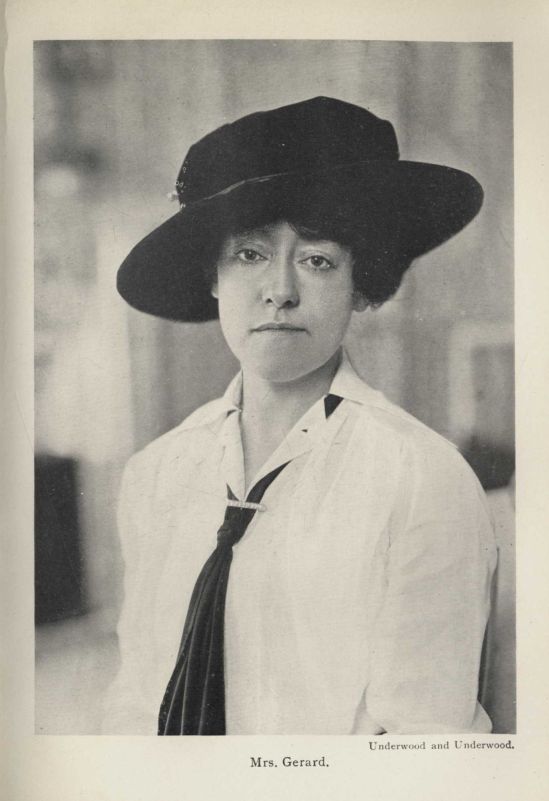
Mrs. Gerard.
The American Ambassador had been acting for Great Britain in the enemy's country barely thirty-six hours, when Sir Edward Goschen, Great Britain's retiring Ambassador in Berlin, in his official report on the knightly treatment accorded him and his staff during their last hours on German soil, wrote:
"I should also like to mention the great assistance rendered to us all by my American colleague, Mr. Gerard, and his staff. Undeterred by the hooting and hisses with which he was often greeted by the mob on entering and leaving the Embassy, His Excellency came repeatedly to see me, to ask how he could help us and to make arrangements for the safety of stranded British subjects. He extricated many of these from extremely difficult situations at some personal risk to himself and his calmness and savoir faire and his firmness in dealing with the Imperial authorities gave full assurance that the protection of British subjects and interests could not have been left in more efficient and able hands."
Nobody who ever knew "Jimmy" Gerard--that is the affectionate way in which old friends and even acquaintances of brief duration almost invariably speak of him--would expect him to be anything in the world except "undeterred" by the cowardly onslaughts of the Berlin barbarians. An expert swimmer, clever amateur boxer, crack shot, volunteer soldier and veteran of New York politics, "Jimmy" Gerard never knew the meaning of the word fear, and the unfailing courage with which he has "stood up" to the Kaiser's Government throughout the various crises of the war has been in full keeping with his virile temperament.
It is sometimes said that our diplomatic system, or such as it is, reduces American ambassadors and ministers to the status of messenger-boys, who have little to do but to carry back and forth between their offices and the foreign ministries to which they are accredited the communications and instructions which Washington sends them. There could, of course, be no more obtuse misconception. Berlin, the capital of Macht-politik, is particularly a capital in which everything depends on the manner in which a foreign Government's views are expressed or its wishes conveyed. It has not been my privilege to be behind the innocuous von Jagow's screen when "Jimmy" Gerard strolled across the Wilhelms Platz to the ramshackle old Auswärtiges Amt, to tell the German Government what Washington thought of this, that or the other of her recurring acts of lawlessness, but I vow that von Jagow has got to know Gerard for just what he is--an American from the top of his extraordinarily well-shaped head to the soles of his feet. The war has brought us many blessings. Among them we may count high the fact that at the capital of the enemy of all mankind we had, ready to speak up and to stand up for us, in gladness or vicissitude, a real man.
No story of our Berlin war Embassy would be complete without a reference to the Ambassador's lieutenants, who, inspired by his own example of unruffled good nature and limitless patience, capably played their own trying parts. At Judge Gerard's right hand was Joseph Clark Grew, First Secretary, Harvard '02, who, having shot wild beasts in the jungles of Asia, would naturally not quail before Germans, no matter how stormy the conditions. Grew is one of the exceptional young men in our diplomatic service, because, he has weathered its snares unspoiled. A distinguished secretarial career at such important posts as Cairo, Mexico City, Vienna, Petrograd and Berlin, in the course of which he frequently acted as Ambassador or Minister in charge, has left him, at thirty-five, as natural, human and American as no doubt many Harvard men are while still beneath the democratizing influence of the campus elms. I mention the preservation of these qualities in Grew because they have been known to disappear in many of our worthy young fellow countrymen, jumped precipitately from college into representative positions abroad, and who thenceforth refused to brush shoulders with anything beneath the rank of royalty.
In Roland B. Harvey and Albert Billings Ruddock, respectively Second and Third Secretaries, Judge Gerard was also the fortunate possessor of a couple of adjutants who, in the presence of emergency, showed that hustle and bonhomie, besides being American talents, are diplomatic traits of no mean order. To preserve calm during the passport stampede of the first week of August, 1914, was to exhibit the finesse of a Disraeli. Harvey and Ruddock are types of the younger generation of American diplomatists who go in for the career with a view to devoting themselves to its serious side and from among whom, some day, we ought to evolve a professional service worthy of the name. Neither of them ever struck me as being afflicted by such emotions as filled the breast of a certain well-known young man when promoted from a European first-secretaryship to one of our important ministerships in South America. "Well, old boy," I asked him, "what do you think about going to ----?" "Oh," he rejoined, "I suppose it's all right, but it's a h-- of a way from Paris!"
I must not end this chapter, which I hope is recognizable as a poor expression of gratitude to all concerned for many kindnesses rendered, without a mention of the youngest, but by no means the least meritorious member, of the Berlin war Embassy family--Lanier Winslow, the Ambassador's ever-ebullient private secretary. War sobered Winslow so rapidly that he committed matrimony before it was six months old. I can hear him now, in the midst of the passport panic, still imitating Frank Tinney or humming Get Out and Get Under, just as Nero might have done if Rome had known what rag-time was. At an hour when it was most needed, Lanier Winslow was a paragon of good humor, and altogether, by common consent, a thing of beauty and a joy forever.
CHAPTER IX
AUGUST FOURTH
Germany's war Juggernaut by the morning of Monday, August 3, was in full, but incredibly noiseless, motion. I always knew it was a magnificently well greased machine, geared for the maximum of silence, but I felt sure it could not swing into action without some reverberating creaks. Yet Berlin externally had been far more feverishly agitated on Spring Parade days at recurring ends of May than it was now, with "enemies all around" and that "war on two fronts," which most Germans used to talk about as something, Gott sei Dank, they would never live to see. One's male friends of military age--it was now the second day of mobilization--kept on melting away from hour to hour, but amid a complete lack of fuss and bustle. It almost seemed as if the army had orders to rush to the fighting-line in gum-shoes and that everything on wheels had rubber tires. As the Fatherland for years had armed in silence, so she was going to battle. We saw no seventeen-inch guns rumbling to the front. Those were Germany's best-concealed weapons. A military attaché of one of the chief belligerents, who lived in Berlin for four years preceding the war, has since confessed that he never even knew of the "Big Berthas'" existence!
Germany girding for Armageddon was distinctly a disappointment. I entirely agreed with a portly dowager from the Middle West, who, between frettings about when she could get a train to the Dutch frontier, continually expressed her chagrin at such "a poor show." She imagined, like a good many of the rest of us, that mobilization in Germany would at the very least see the Supreme War Lord bolting madly up and down Unter den Linden, plunging silver spurs into a foaming white charger and brandishing a glistening sword in martial gestures as Caruso does when he plays Radames in the finale of the second act of Aida. Verdi's Egyptian epic is the Kaiser's favorite opera, and he ought to have remembered, we thought, how a conquering hero should demean himself at such a blood-stirring hour. At least Berlin, we hoped, would rise to the occasion, and thunder and rock with the pomp and circumstance of war's alarums.
There was amazingly little of anything of that sort. The Kaiser instead automobiled around town in a prosaic six-cylinder Mercedes, as he long was wont to do, just keeping some rather important professional engagements with the Chief of the General Staff, the Imperial Chancellor and the Secretary of the Navy. As he flitted by, the huge crowds lined up on the curbstone stiffened into attitudes, clicked heels, doffed hats and "hoched." The atmosphere was stimmungsvoller than usual, for German phlegm had vanished along with high prices on the Bourse, but the paroxysm of electric excitement which I always fancied would usher in a German war was unaccountably missing. When you mentioned that phenomenon to German friends, their bosoms swelled with visible pride. They were immeasurably flattered by your indirect compliment that the Kaiser's war establishment was so perfect a mechanism that it could clear for action almost imperceptibly.
I had now deserted my home in suburban Wilmersdorf, which I nicknamed the "District of Columbia," for in and all around it Berlin's American colony was domiciled, and taken a room for the opening scenes of the war drama in the Hotel Adlon. With its broad fronts on the Linden and Pariser Platz, and the French, British and Russian Embassies within a stone's throw to the right and left, the Adlon was an ideal vantage point. If there were to be "demonstrations," I could feel sure, at so strategic a point, of being in the thick of them. Events of the succeeding thirty-six hours were to show that I did not reckon without my host on that score.
From window and balcony overlooking the Linden I could now see or hear at intervals detachments of Berlin regiments, Uhlans or Infantry of the Guard, or a battery of light artillery, swinging along to railway stations to entrain for the front. Occasionally battalions of provincial regiments, distinguishable because the men did not tower into space like Berlin's guardsmen, crossed town en route from one train to another. The men seemed happier than I had ever before seen German soldiers. That was the only difference, or at least the principal one. The prospect of soon becoming cannon-fodder was evidently far from depressing. Most of them carried flowers entwined round the rifle barrel or protruding from its mouth. Here and there a bouquet dangled rakishly from a helmet. Now and then a flaxen-haired Prussian girl would step into the street and press a posey into some trooper's grimy hand. Yet, except for the fact that the soldiers were all in field gray, (I wonder when the Kaiser's military tailors began making those millions of gray uniforms!) with even their familiar spiked headpiece masked in canvas of the same hue, the Kaiser's fighting men marching off to battle might have been carrying out a workaday route-march. Then, suddenly, a company or a whole battalion would break into song, and the crowd, trailing alongside the bass-drum of the band, just as in peace times, would take up the refrain, and presently half-a-mile of Unter den Linden was echoing with Deutschland, Deutschland über Alles, and I knew that the Fatherland was at war.
At the railway stations of Berlin and countless other German towns and cities at that hour heart-rending little tragedies were being enacted, as fathers, mothers, wives, sisters and sweethearts bade a long farewell to the beloved in gray. Only rarely did some man in uniform himself surrender to the emotions of the moment. These swarthy young Germans, with fifty or sixty pounds of impedimenta strapped round them, were endowed with Spartan stolidity now, and smilingly buoyed up the drooping spirits of the kith and kin they were leaving behind. "Es wird schon gut, Mütterchen! Es wird schon gut!" (It will be all right, mother dear! It will be all right!) Thus they returned comfort for tears. "Nicht unterliegen! Besser nicht zurückkehren!" (Don't be beaten! Better not come back at all!) was the good-by greeting blown with the final kisses as many a trainload of embryonic heroes faded slowly from sight beneath the station's gaping archway. Germany was now indubitably convinced that its war was war in a holy cause. The time had come for the Fatherland to rise to the majesty of a great hour. "Auf wiedersehen!" sang the country to the army. But if there was to be no reunion, the army must go down fighting to the last gasp for unsere gerechte Sache, manfully, tirelessly, ruthlessly, till victory was enforced. Such were the inspiring thoughts amid which the boys in field gray trooped off to die for Kaiser and Empire.
The outstanding event of August 3 was the publication of the German Government's famous apologia for the war, the so-called "White Paper" officially described as "Memorandum and Documents in Relation to the Outbreak of the War." Early in the afternoon a telephone message arrived for me at the Adlon to the effect that if I would call at the Press Bureau of the Foreign Office at five o'clock, Legationsrat Heilbron, one of Hammann's lieutenants whom I had known for many years, would be glad to deliver me an advance copy for special transmission to London and New York. I lay great stress on the fact that up to sun-down of August 3, 1914, I continued to be persona gratissima with the Imperial German Government. It was true that one of the young Foreign Office cubs told off to censor press cablegrams at the Main Telegraph Office had, during the preceding three days, expressed annoyance with what he considered my eagerness to "go into details," but Legationsrat Heilbron's invitation to fetch the "White Paper" was gratifying evidence that my relations with the powers-that-be were still "correct," even if not cordial. I was glad of that, because there was constantly in my mind the desire to remain in Germany, whatever happened, with a front-row seat for the big show. At the appointed hour I presented myself in Herr Heilbron's room on the ground floor of the Wilhelmstrasse front of the Foreign Office. He greeted me with old-time courtesy, though I found his demeanor perceptibly depressed. He handed me a copy of the Denkschrift, and, when I begged him for a second one, he complied with a gracious bitte sehr.
A London colleague had already intimated to me that the Imperial Chancellor, desiring to place the German case promptly and fully before the British and American publics, would "do his best" with the military authorities who were now in supreme control of the postal telegraph and cable lines to induce them to allow London and New York correspondents to file exhaustive "stories" on the White Paper. As I was sure, however, that Reuter's Agency for England and the Associated Press for America would be handling the affair at great length, my treatment of it was confined, as was usual under such circumstances, to telegraphing a brief introductory summary.
What struck me instantly as the hall-marks of the German publication were its treatment of the war as an exclusively Russian-provoked Russo-German affair and its brazenly ex-parté character--how ex-parté I did not fully realize till I read England's White Paper a week later. Sir Edward Grey laid his cards on the table, without marginal notes or comment of any kind, and asked the world to pass judgment. Doctor von Bethmann Hollweg's White Paper began with a lengthy plea of justification and ended with quotation of such communications between the Kaiser's Government and its ambassadors and between the German Emperor and the Czar as would most plausibly support the Fatherland's case for war. It was manifestly a biased and incomplete record. It was in fact a doctored record, and suggested that its authors had Bismarck's mutilation of the Ems telegram in mind as a precedent, in emulation of which no German Government could possibly go wrong.
Although compiled to include events up to August 1, the German White Paper was silent as the grave in regard to Belgium and the negotiations with the Government of Great Britain. Issued on the night of August 3, when hundreds of thousands of German troops were waiting at Aix-la-Chapelle for the great assault on Liége--if, indeed, at that hour they were not already across the Belgian frontier--this sacred brief designed to establish the Fatherland's case at the bar of world opinion had no single word to say on what was destined to be almost the supreme issue of the war. It was the last word in Imperial German deception. If the German public had known that Sir Edward Grey on July 30 had already "warned Prince Lichnowsky that Germany must not count upon our standing aside in all circumstances," I imagine its bitterness a few nights later, when the fable of England's "treacherous intervention" was sprung upon the deluded Fatherland, might have been less barbaric in its intensity.
Next to the omission of all reference to what Sir Edward Grey called Germany's "infamous proposal" for the purchase of British neutrality--a pledge not to despoil France of European territory if England would stand with folded arms while Germany violated Belgium and ravished the French Colonial Empire--the striking feature of the Berlin White Paper was the admission of German-Austrian complicity in the humiliation of Serbia. The Foreign Office, as I have previously explained, had zealously affirmed Germany's entire detachment from Austria's programme for avenging Serajevo. What did the White Paper now tell us? That
"Austria had to admit that it would not be consistent either with the dignity or the self-preservation of the Monarchy to look on longer at the operations on the other side of the border without taking action.... We were able to assure our ally most heartily of our agreement with her view of the situation, and to assure her that any action she might consider it necessary to take in order to put an end to the movement in Servia directed against the existence of the Austro-Hungarian Monarchy would receive our approval. We were fully aware, in this connection, that warlike moves on the part of Austria-Hungary against Servia would bring Russia into the question, and might draw us into a war in accordance with our duties as an ally."
The historic and ineffaceable fact is that Austria--wabbly, invertebrate Austria, which would even to-day, but for Germany, lay prostrate and vanquished--never made a solitary move in the whole plot to coerce Serbia without the full concurrence of the big brother at Berlin. It would be an insult to the intelligence of German diplomacy, stupid as it is, to imagine that the Kaiser's Government sat mute, unconsulted and nonchalant, while Austria worked out a scheme certain, as the Germans themselves admit in their White Paper, to plunge Europe into war.
It was my privilege on arriving in the United States on August 22, to furnish the New York Times with the first copy of the German White Paper to reach the American public. In preparing a prefatory note to accompany the verbatim translation published in next day's paper, I selected the paragraph above quoted as primâ-facie evidence that the German claim of non-collusion with Austria is subterfuge--to give it the longer and less unparliamentary term.
The German White Paper was prepared formally for the information of the Reichstag, which was summoned to meet on Tuesday, August 4 of imperishable memory, for the purpose of voting $325,000,000 of initial war credits. Paris was not won in the expected six weeks, and the Reichstag has voted $7,500,000,000 of war credits up to this writing (September 1, 1915), with melancholy promise of still more to come. The twenty-four hours preceding the war sitting had not been eventless. Monsieur Sverbieff and the staff of the Russian Embassy were the victims of gross insults from the mob in Unter den Linden, as they left their headquarters in automobiles for the railway station. Mounted police were present to "keep order," but their "vigilance" did not deter German men and youths from spitting in the faces of the Czar's representatives, belaboring them with walking-sticks and umbrellas, and offering rowdy indignities to the women of the ambassadorial party. In front of the French Embassy menacing crowds stood throughout the day and night, waiting for a chance to exhibit German patriotism at Monsieur Cambon's expense. When Señor Polê de Bernábe, the Spanish Ambassador, who was calling to arrange to take over the representation of France during the war, made his appearance, the mob mistook him for Cambon and was just prevented in the nick of time from assaulting the Spaniard. How the French Embassy finally got away from Germany, under circumstances which would have shamed a Fiji Island government, was later related for the benefit of posterity in the French Yellow Book. When I read it months later, I remembered my first German teacher in Berlin, a noblewoman, once telling me, when I asked her how to say "gentleman" in German: "There is no such thing as a 'gentleman' in the German language." That was paraphrased to me by another German on a later occasion, when, discussing the ability of German science, so well demonstrated during this war, to devise a substitute for almost anything, he remarked: "The only thing we can't make is a gentleman, because we never had a proper analysis of the necessary ingredients." The Germans, in their communicative moments, always used to acknowledge that Bismarck was right when he called them "a nation of house-servants." It is impressively exemplified on their stage, which boasts the finest character actors imaginable; but when a German player essays to portray the gentleman, he is grotesque. He gropes helplessly in a strange and unexplored realm.
On the day before the war session of the Reichstag, the Kaiser, more conscious than ever now of his partnership with Deity, ordained Wednesday, August 5, as a day of universal prayer for the success of German arms. Soon after its proclamation, William II, thunderously acclaimed, appeared in Unter den Linden intermittently, en route to conference with high officers of state. He was clad, like every German soldier one now saw, in field-gray, and ready, one heard, to leave for the front at a moment's notice, to take up his post, assigned him by Hohenzollern warrior traditions, on the battlefield in the midst of his loyal legions. Mobilization was now in full swing, and more and more troops were in evidence, crossing town to railway stations from which they were to be transported east or west, as the Staff's emergencies required. A week before, all these soldiers were in Prussian blue. They were gray now, from head to foot, millions of them. Obviously the clothing department of the army had not been taken by "surprise" by the cruel war "forced" on pacific Germany. Three million uniforms can not be turned out in a whole summer--even in Germany. I thought of this, as gray streams, far into the evening, kept pouring through Berlin, and I thought what a marvelously happy selection that peculiar shade of drab-gray, of almost dust-like invisibility from afar, was for field purposes. To shoot at lines no more colorful than that, it seemed to me, would be like banging away at the horizon itself....
History, I suppose, will date Armageddon from August 1, when the German army and navy were mobilized, or perhaps from August 2, when Germany claims that Russia and France fired the first miscreant shots. But the red-letter day of the World Massacre's opening week was beyond all question Tuesday, August 4, which began with the war sitting of the Reichstag and ended with England's declaration of war on Germany. It was destined to be especially big with import for me--of vital import, as events hanging over my unsuspecting head were speedily to reveal.
At midday, two hours before the session of the Reichstag in its own chamber, Parliament was "opened" by the Kaiser personally in the celebrated White Hall of the Royal Castle. I had applied for admission after the few available press tickets were already exhausted, but it was not difficult for me to visualize the scene. I had been in the White Hall on several memorable occasions in the past--during the visit of King Edward VII in February, 1909, at a brilliant State banquet and at the ball which followed; at the wedding of the Emperor's daughter, "the sunshine of my House," Princess Victoria Luise, and Duke Ernest August of Brunswick, in May, 1913; and a month later during the Silver Jubilee celebration of the Kaiser's reign, when our own Mr. Carnegie showered plaudits on the Prince of the world's peace. Tower, of The World and Daily News, was lucky enough to secure a ticket to the Castle ceremonial, and he was bubbling over with excitement at having been privileged to participate in so memorable a function. My old friend, Günther Thomas, late of the Newyorker-Staatszeitung, now joyous in the prospect of joining the German Press Bureau's war staff, came back from the Castle almost pitying me for not having been there. "Wile, I tell you," I can hear him saying now, "it was beautiful, simply beautiful! You missed it! It was enough to make one cry!" Thomas lived in New York seventeen years, but he returned to Germany a more devout Prussian than ever, as a man ought to be whose father fell gloriously at Königgrätz.
The description furnished by my English and Prussian colleagues evidently did not exaggerate the splendor and impressiveness of the scene at the White Hall. The Kaiser, in field-general's gray, entered, escorting the Empress. He was solemn, but not anxious-looking. Around the marble-pillared chamber, where only fifteen months before I had seen the Czar and George V of England tripping the minuet with German princesses as the Kaiser's honored guests, were grouped the first men of the Empire. In the places of distinction, closest to the canopied throne, each according to his Court rank, stood the Imperial Chancellor, General von Moltke, Grand-Admiral von Tirpitz and a score of other eminent officers of the civil, naval and military governments. Among the foreign ambassadors only the representatives of Russia and France were missing from their old-time places. Mr. Gerard, modest and retiring as always, amid the glitter of gold lace and brass buttons flashing on all sides, cut a more than ever self-effacing figure in his diplomatic uniform--the plain evening dress of an American gentleman.
The Kaiser read his War Speech, which he held in his right hand, while the left firmly gripped his sword-hilt. Beginning in a quiet tone, His Majesty's voice appreciably rose in intensity and volume as he approached the kernel of his message which told how "with a heavy heart I have been compelled to mobilize my army against a neighbor with whom it has fought side by side on so many fields of battle." The Imperial Russian Government, William II went on to say, "yielding to the pressure of an insatiable nationalism, has taken sides with a State which by encouraging criminal attacks has brought on the evil of war." That France, also, the Kaiser continued, "placed herself on the side of our enemies could not surprise us. Too often have our efforts to arrive at friendlier relations with the French Republic come in collision with old hopes and ancient malice." And when the Kaiser had ended, with an invitation to "the leaders of the different parties of the Reichstag" (there were no Socialists present) "to come forward and lay their hands in mine as a pledge," the White Hall reverberated with applause which must have seemed almost indecorous in so august an apartment, but which, no doubt, rang true. It was then, I suppose, that Thomas felt like weeping, and so should I, perhaps, had I been there. The Kaiser, his handshaking-bee over, strode from the scene amid an awesome silence, and the statesmen, the generals and the admirals went their respective ways. All was now in readiness for the real Reichstag session, in which words of deathless significance were to fall from the Chancellor's lips.
We were accustomed to sardine-box conditions in the always overcrowded press gallery of the Reichstag on "great days," but to-day we were piled on top of one another in closer formation even than a Prussian infantry platoon in the charge. Familiar faces were missing. Comert, of Le Temps, Caro, of Le Matin, and Bonnefon, of Le Figaro, were not there. They had escaped, we were glad to hear, by one of the very last trains across the French frontier. Löwenton (a brother of Madame Nazimoff), Grossmann, Markoff and Melnikoff, our long-time Russian colleagues, were absent, too. Had they gained Wirballen in time, we wondered, or were they languishing in Spandau?
Doctor Paul Goldmann, doyén of our Berlin corps, was in his accustomed seat, beaming consciously, as became, at such an hour, the correspondent-in-chief of the great allied Vienna Neue Freie Presse. The British and American contingents were on hand in force. Never had we waited for a Kanzlerrede in such electric expectancy. "Copy" in plenty, such as none of us had ever telegraphed before, was about to be made. Goldmann, a Foreign Office favorite, as well as the all-around most popular foreign journalist in Berlin, may have had an advance hint what was coming, as he frequently did, but to the vast majority of us--British, American, Swedish, Dutch, Italian, Swiss, Spanish and Danish, sandwiched there in the Pressloge so closely that we could hear, but not move--I am certain that the momentous words and extraordinary scenes about to ensue came as a staggering revelation.
Doctor von Bethmann Hollweg, who is flattered when told that he looks like Abraham Lincoln--the resemblance ends there--began speaking at three-fifteen o'clock. Gaunt and fatigued, he tugged nervously at the portfolio of documents on the desk in front of him during the brief introductory remarks of the President of the House, the patriarchal, white-bearded Doctor Kaempf. The Chancellor's manner gave no indication that before he resumed his seat he would rise to heights of oratorical fire of which no one ever thought that "incarnation of passionate doctrinarianism" capable. What he said is known to all the world now; how, in Bismarckian accents, he thundered that "we are in a state of self-defense and necessity knows no law!" How he confessed that "our troops, which have already occupied Luxemburg, may perhaps already have set foot on Belgian territory." How he acknowledged, in a succeeding phrase, to Germany's eternal guilt, that "that violates international law." How he proclaimed the amazing doctrine that, confronted by such emergencies as Germany now was, she had but one duty--"to hack her way through, even though--I say it quite frankly--we are doing wrong!" Our heads, I think, fairly swam as the terrible portent of these words sank into our consciousness. "Our troops may perhaps already have set foot on Belgian soil." That meant one thing, with absolute certainty. It denoted war with England. Trifles have a habit at such moments of lodging themselves firmly in one's mind; and I remember distinctly how, when I heard Bethmann Hollweg fling that challenge forth, I leaned over impulsively to my Swedish friend, Siosteen, of the Goteborg Tidningen, and whispered: "That settles it. England's in it now, too." Siosteen nods an excited assent. It is in the midst of one of the frequent intervals in which the House, floor and galleries alike, is now venting its impassioned approval of the Chancellor's words. I had heard Bülow and Bebel and Bethmann Hollweg himself, times innumerable, set the Reichstag rocking with fervid demonstrations of approval or hostility, but never has it throbbed with such life as to-day. It is the incarnation of the inflamed war spirit of the land. The more defiant the Chancellor's diction, the more fervid the applause it evokes. "Sehr richtig! Sehr richtig!" the House shrieks back at him in chorus as he details, step by step, how Germany has been "forced" to draw her terrible sword to beat back the "Russian mobilization menace," how she has tried and failed to bargain with England and Belgium, how she has kept the dogs of war chained to the last, and only released them now when destruction, imminent and certain, is upon her.
All eyes in the Press Gallery are riveted on the broad left arc of the floor usurped by the one hundred and eleven Social Democratic deputies of the House of three hundred and ninety-seven members. For the first time in German history their cheers are mingling with those of other parties in support of a Government policy. That, after the Belgian revelation, is beyond all question the dominating feature of a scene tremendous with meaning in countless respects. There is nothing perfunctory about the "Reds'" enthusiasm; that is plain. It is real, spontaneous, universal. No man of them keeps his seat. All are on their feet, succumbing to the engulfing magnitude of the moment. That, it instantly occurs to us, means much to Germany at such an hour. It means that the hope which more than one of the Fatherland's prospective foes in years gone by has fondly cherished, of Socialist revolt in the hour of Germany's peril, was illusory hope. The Chancellor knows what it means. "Our army is in the field!" he declares, trembling with emotion. "Our fleet is ready for battle! The whole German nation stands behind them!" As one man, the entire Reichstag now rises, shouting its approval of these historic words in tones of frenzied exaltation. For two full minutes pandemonium reigns unchecked. Bethmann Hollweg is turning to the Social Democrats. His fist is clenched and he brandishes it in their direction--not in anger this time, but in triumph--and, as if he were proclaiming the proud sentiment for all the world to hear, he exclaims, at the top of his voice, "Yea, the whole nation!" Thus was Armageddon born. Germany, all present knew, would be at war before another sun had gone down, not only with Russia and France, but with England, and, of course, with Belgium, too.
"Supposing the Belgians resist?" I asked Schmidt, of the B. Z. am Mittag, a German colleague whom I once christened Berlin's "star" reporter, as we wandered, thinking hard, back to Unter den Linden.
"Resist?" he replied, half pitying the feeble-mindedness which prompted such a question. "We shall simply spill them into the ocean."
CHAPTER X
THE WAR REACHES ME
"We are not barbarians, my dear Wile!" exclaimed Günther Thomas, when we met in the Adlon after the Reichstag sitting, in reply to my query about the safety of correspondents of English newspapers, now that Germany was about to annex Great Britain as an enemy in addition to Russia and France. I had found Thomas during ten years of acquaintance the best-informed German journalist I ever knew. His long residence in Park Row had grafted a "news nose" on him, which, coupled with a profound knowledge of the history and present-day undercurrents of his own country, made him an ideal and valuable colleague. I treasure my relations with him in grateful recollection. One required occasionally to dilute both his news and views with a strong solution of skepticism, for Thomas was both a Prussian patriot and representative of Mr. Ridder's New-Yorker Staatszeitung. But nine times out of ten his counsel and information were like Cæsar's wife. His assurance to me on the evening of August 4, 1914, that his countrymen "were not barbarians" was the most misleading piece of news he ever supplied me.
The imminence of hostilities with England revived irresistibly in my mind the qualms which had filled the Germans for a week previous on this very point. "What will the English do?" was the question they constantly flung at any one they thought likely to be able to answer it intelligently. It was the thing which gave themselves the most anxious heart-searching. The "war on two fronts," the purely Continental affair with the Dual Alliance, filled the average German with no concern. The Kaiser's military machine had been constructed to deal with France and Russia combined, and no German ever for a moment doubted its ability to do so. Events of the past year, I think it may fairly be said, have justified that confidence, for I suppose no expert anywhere in the world doubts but that for the presence of British sea power on France and Russia's side, the German eagle would in all probability now be screaming in triumph over Paris and Petrograd. But with the British "in," dozens of Germans confessed, as my own ears can bear testimony, their case was "hopeless." Few of them were persuaded that Germany could, in Bismarck's picturesque phrase, "deal with the British Navy in Paris." While the prospect of having to fight France and Russia did not disturb the Germans, the possibility of having to battle with Britain simultaneously filled them with undisguised alarm. They would not admit it now, but in the fading hours of July, 1914, and the opening days of August, it was a nightmare which pressed down so heavily upon their consciousness that they never spoke of it except in accents of dread. The Hate cult had not yet toppled their reason. Lissauer's demoniacal ballad was still unwritten. In those anguished moments they talked of England, when not in terms of outright fear, as the "brother nation" of kindred blood and ideals with whom war was unthinkable because it would be nothing short of "civil war." Doctor Hecksher, a well-known National Liberal member of the Reichstag and Stimmungsmacher (henchman) of the Foreign Office, busily assured English newspaper correspondents of the "horror" with which the mere idea of conflict with England filled the German soul. I thought it queer that one of my last dispatches to London, before Anglo-German telegraphic communication snapped, containing Doctor Hecksher's views and mentioning him by name, was ruthlessly censored in Berlin and returned to me as untransmissible. That meant one of two things--that Doctor Hecksher was wrong in attributing to Germany overweening desires of peace with England, or that it was unwise to let me indicate that Teuton knees were quaking at the prospect of war with her. Certainly lachrymose expressions of hope that England would not feel called upon to "intervene" in Germany's "just quarrel" with her neighbors were common to the point of universality in Berlin on the eve of the clash. They were born of inherent conviction that German aspirations of imposing Hohenzollern hegemony on the Continent must and would be wrecked by England's adherence to her century-old policy of opposing so vital a disturbance in the balance of European power.
Uppermost in my mind just now was how to transmit at least the vital passages of the Chancellor's "Necessity knows no law speech" to The Daily Mail. A merely informative bulletin about it to the editor had just been brought back from the Main Telegraph Office by my faithful young German secretary, Arthur Schrape, with the message that "no more dispatches to England are being accepted." That was about six o'clock P.M., at least three hours before Berlin or the world generally had any knowledge that England and Germany were actually at grips. Communication with the United States, Schrape had been told, was still open, so the most natural thing in the world was to attempt to get Bethmann Hollweg's crucial statements to London by way of New York. Then followed a decision on my part which was to prove my undoing--I committed the diabolical and treasonable crime of calling up my friend and colleague, Mackenzie, the able correspondent of the London Times (like my own paper, The Daily Mail, the property of Lord Northcliffe), and discussing with him the feasibility of cabling the New York representatives of our respective papers to relay to London the news which we were unable to send directly from Berlin. We were telephoning in German, of course, as every one for three days past had been required to do, and we realized that practically every conversation, especially between highly suspicious characters like long-accredited Berlin newspaper correspondents, was being overheard by some spy with an ear glued to a receiver. Knowing all this perfectly well, we talked with entire freedom of our nefarious scheme for undermining the safety of the German Empire. Finally it was agreed that Mackenzie should come to my rooms in the Adlon and arrange with me there the text of a cablegram to New York which should bottle up the German fleet, encircle the Crown Prince's army and generally wreck the Kaiser's plans for subjugating Europe, even before the ink on the General Staff's plans was dry. We agreed that the surest way of striking this blow for England was to cable to New York a message whose veiled language would disclose to even the most stupid eye that it concealed a plot of heinous proportions. It was decided that we should concoct in cable language a cablegram reading like this:
"Chancellor just delivered importantest speech Reichstag. As communication England unlonger possible suggest your cabling Newyorks news."
Mackenzie, accompanied by his assistant, Jelf, now a volunteer-officer in Kitchener's army, arrived at the Adlon; we canvassed the New York suggestion in detail--amid such secrecy that Schrape, a very keen-eared German of twenty-two and a patriot, who is also serving his Kaiser and Empire in field-gray, was permitted to participate in our deliberations. Then we came to the most treacherous decision of all, viz., not to carry out our grandiose project for confounding the German War Party's plot. But we had gone far enough. We were discovered. Our machinations, though we knew it not, were seen through, our guns were spiked, and all that remained was to put us, as soon as possible, where we could do no further harm. Any number of Frenchmen and Russians were already in the same place.
Carelessly leaving behind me my typewriting-machine, fifty-pfennig map of the North Sea, copies of my preceding week's cablegrams, scissors, paste-pot, carbon-paper, the latest Berlin newspapers, and other telltale emblems of my infamy, I went to the American Embassy to discuss the latest and obviously greatest turn of the war kaleidoscope with Judge Gerard. There were a thousand and one questions to level at him. Was it true that Sir Edward Goschen had already asked him to take charge of Great Britain's interests? What would panic-stricken American war refugees do now, with British warships blockading the German coasts? Would it any longer be safe in Berlin for our people to talk their own language in public? Would the United States Government be making any declaration of neutrality, or something of that sort, to the German Government? Was the Embassy still in direct communication with Washington? Could it facilitate the transmission of our news-cablegrams to New York or Chicago? These were the things the journalistic brethren en masse were anxious to know--and I recall vividly that the Ambassador and his staff, despite a week of worries unprecedented, were still smiling and managing to reply to every question, however abstract or unanswerable, with invincible equanimity. I have since heard that there were fellow citizens who found Gerard, Grew, Harvey and Ruddock "inattentive." I suppose they were the patriots who couldn't understand why local checks on the First National Bank of Roaring Branch, Pennsylvania, "weren't good" at the Embassy, and who were "peeved" because the Ambassador couldn't tell them why Uncle Sam hadn't already started a fleet of dreadnoughts and liners-de-luxe to Hamburg and Bremen to rescue his stranded tourist family. Or one of the complainants, who was "going to write to Bryan" about our "inefficient diplomatic service," may have been that plutocratic dame from Boston who demanded that Gerard should at least be able to commandeer "a special train" for the Americans, even if every military line in all Germany was at that hour choked with troop-transports. And yet we Yankees rank in effete Europe as a cool-headed and common-sense race!
What dominated my thoughts, of course, was whether, after all, I was now to be allowed to remain in Germany. My desire to do so was never stronger--to sit on the edge of history in the making at such a moment. Judge Gerard resolved my doubts. I should "cheer up" and hope for the best. I tarried for a moment longer, to chat over the day's overwhelming developments with Mrs. Gerard, with whom I had not had my usual daily cup of tea and war conference. We wondered how long it would be before a formal declaration of war between England and Germany would be declared. I spoke of my pleasurable anticipation at being permitted to live through the mighty days ahead of us in Berlin with herself and the Ambassador. They would be experiences worthy of transmission to grandchildren. We agreed we should be privileged mortals, in a way, to be vouchsafed so tremendous an opportunity. I commented on Mrs. Gerard's amazing lack of fatigue after four days and nights of trials and tribulations with terror-stricken compatriots. She spoke of the lively satisfaction it had given her to be of service of so homely and homespun a character, and remarked that young Mrs. Ruddock had been "a perfect brick" through it all, an aide-de-camp whom a field-marshal might have envied....
Eight o'clock. Dusk had just fallen as I quitted the Embassy. A trio of servants clustered at the entrance was examining in the dim light a Tageblatt "Extra" which, they said, was just out. I fairly snatched at it. This is what it said:
+------------------------------------------------+ | | | ENGLAND BREAKS OFF DIPLOMATIC | | RELATIONS WITH GERMANY | | | | The English Ambassador in Berlin, Sir | | Edward Goschen, appeared this evening in | | the German Foreign Office and demanded his | | passports. That denotes, in all probability, | | war with England! | | | +------------------------------------------------+
I ought not to have been surprised, yet I was shocked. So England now, at last and really, was "in it." The realization was almost numbing. I stood reading and reading the Extrablatt, over and over again. "Joe" Grew came hurrying up in his automobile. He, too, had the Tageblatt in his hand. He was hastening to tell the Ambassador the news. It was true, Grew said, beyond any doubt. Ye Gods! What next? The world's coming to an end, one thought, was about all there was left. And that seemed nearer at hand than any of us ever felt it before.
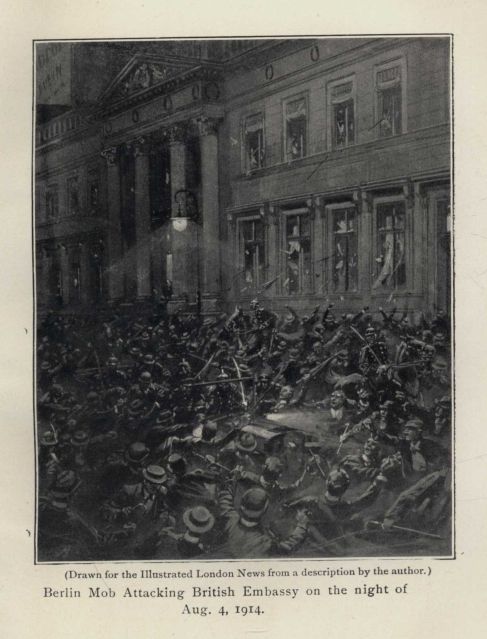
Berlin Mob Attacking British Embassy on the night of Aug. 4, 1914. (Drawn for the Illustrated London News from a description by the author.)
I started now for the English Embassy, across the Wilhelms Platz and down the Wilhelmstrasse four or five blocks to the north. From afar I heard the rumble of a mob, not a singing cheering mob such as had been turning Berlin into bedlam for a week before, but a mob obviously bent on more serious business. I reached the Behrenstrasse, two hundred feet away from the English Embassy. Though quite dark, I could see plainly what was happening. The Embassy was besieged by a shouting throng, yelling so savagely that its words were not distinguishable. They were not chanting Rule, Britannia! I was sure of that. It was imprecations, inarticulate but ferocious beyond description, which they were muttering. I saw things hurtling toward the windows. From the crash of glass which presently ensued, I knew they were hitting their mark. The fusillade increased in violence. When there would be a particularly loud crash, it would be followed by a fiendish roar of glee. The street was crammed from curb to curb. Many women were among the demonstrators. A mounted policeman or two could be seen making no very vigorous effort to interfere with the riot. It was no place for an Englishman, or anybody who, being smooth-shaven, was usually mistaken for one in Berlin. I did not dream of trying to run the blockade. The rear, or Wilhelmstrasse, entrance of the Adlon adjoins the Embassy. It would be easy to gain access to the hotel that way. I tried the door. It was locked. I rang. One of the light-blue uniformed page-boys came, peered through the glass, recognized me and fled without letting me in. I rang again. No one came. Wilhelmstrasse now was roaring with the mob's rage. Ambassador Goschen's subsequent report on this classic manifestation of Kultur described how he and his staff, seated in the front drawing-room of the Embassy, narrowly escaped being stoned to death by missiles which now flew thick and fast through every paneless window of the building.
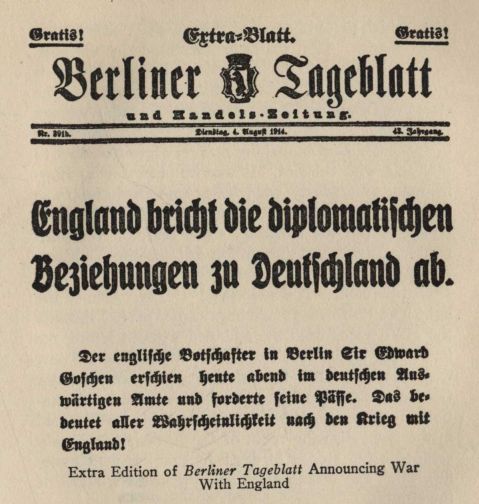
Extra Edition of Berliner Tageblatt Announcing War With England
I hailed a passing horse-cab and told the driver to make for the Adlon by the circuitous route of the Voss-strasse, Königgrätzer-strasse and Brandenburg Gate. Ten minutes later I reached the hotel. I stepped to the desk and asked for Herr Adlon, Sr., or Louis Adlon, his son; said the Wilhelmstrasse mob might soon decide to hold an overflow meeting and attack the hotel premises, and that certain precautionary measures might be useful. The lobby of the hotel, I noticed, was rapidly filling up with American war refugees, of whom there was to be a meeting. I recognized a dozen or more anxious compatriots whom I had seen encamped at the Embassy during the preceding two or three days. The Ambassador was expected, they said, and they were hoping and praying to hear from him that the Government had at last effected adequate rescue arrangements. The frock-coated menial at the hotel desk, only a few hours previous servility itself, was unusually curt when I asked where the Adlons were. I did not think of it at the time, but his rudeness assumed its proper importance in the scheme of things as they later developed. I stopped to chat with Ambassador Gerard, who had just strolled in. Then I met another acquaintance, Count von Oppersdorff, the urbane Silesian Roman Catholic political leader, a familiar and welcome figure on our Berlin golf links. "So England has come in," remarked the Count. "Yes," I rejoined, "you hardly expected her to keep out, did you?" "Well," said Oppersdorff, with a meaningful look in his mild blue eye, "there will be many surprises--many surprises." That was a war prophecy which has come true.
I dashed up to my room to write a dispatch to The Times in New York and The Tribune in Chicago, which should tell briefly of the outbreak of war between England and Germany, and of the extraordinary scenes in front of His Britannic Majesty's embassy. A Lokal-Anzeiger "extra" was now available, with this "cooked" summary of the events which had precipitated the climacteric decision:
+----------------------------------------------------+ | | | ENGLAND HAS DECLARED WAR ON GERMANY! | | | | OFFICIAL REPORT. | | | | This afternoon, shortly after the speech of | | the Imperial Chancellor, in which the offense | | against international law involved in our | | setting foot on Belgian territory was frankly | | acknowledged and the will of the German Empire | | to make good the consequences was affirmed, | | the British Ambassador, Sir Edward Goschen, | | appeared in the Reichstag to convey to | | Foreign Secretary von Jagow a communication | | from his Government. In this communication | | the German Government was asked to make an | | immediate reply to the question whether it could | | give the assurance that no violation of Belgian | | neutrality would take place. The Foreign | | Secretary forthwith replied that this was not | | possible, and again explained the reasons which | | compel Germany to secure herself against an | | attack by the French army across Belgian soil. | | Shortly after seven o'clock the British | | Ambassador appeared at the Foreign Office to | | declare war and demand his passports. | | | | We are informed that the German Government | | has placed military necessities before all | | other considerations, notwithstanding that it | | had, in consequence thereof, to reckon that | | either ground or pretext for intervention would | | be given to the English Government. | | | +----------------------------------------------------+
It was this news--reiterating by the printed word what the Chancellor had unblushingly announced in the Reichstag: that military necessities had taken precedence of "all other considerations," including honor--which aroused the ferocity of the mob and incited it, amid mad maledictions on "perfidious Albion," to vent its fury by attempting to wreck the English Embassy. This German "official report," moreover, besides distorting the facts so as to place the onus for the outbreak of hostilities exclusively upon England, deliberately misstated the object of Sir Edward Goschen's visit to the Foreign Office. As we know from his famous dispatch on the last phase, he did not "appear" there "to declare war." England's declaration of war, as a matter of historical record, was not made until eleven P.M., or midnight Berlin time. The assault on the Embassy by Kultur's knife-throwing, stone-hurling and window-breaking cohorts was in full progress by nine o'clock. It began almost immediately after Sir Edward Goschen's return from his celebrated farewell interview with the Imperial Chancellor--the torrid quarter of an hour in which von Bethmann Hollweg, incapable of concealing Germany's rage over the wrecking of her war scheme, blackened the Teutonic escutcheon for all time by branding the Belgian treaty of neutrality as a "scrap of paper." Of all egregious words which have fallen from the lips of German "diplomats," von Bethmann Hollweg's immortal indiscretions of that day will live longest, to his own and his country's ineffaceable shame.
While at work on my dispatches in my hotel room--it was now about nine o'clock--I could hear Unter den Linden below my windows roaring with mob fury against Britain. "Krämer-volk!" (Peddler nation!) "Rassen-Verrat!" (Race treachery!) "Nieder mit England!" (Down with England!) "Tod den Engländer!" (Death to the English!) were the shouts which burst forth in mad chorus. I have never hunted beasts in the jungle. Never have my ears been smitten with the snarl and growl of wild animals at bay. I never heard the horizon ring with the tumult of howling dervishes plunging fanatically to the attack. But the populace of Berlin seemed to me at that moment to be giving a vivid composite imitation of them all. Certainly no civilized community on earth ever surrendered so completely to all-obsessing brute fury as the war mob which thirsted for British blood in "Athens-on-the-Spree" on the night of August 4, 1914. It gave vent to all the animal passions and breathed the murder instinct said to be inherent in the average human when unreasoning rage temporarily supplants sanity. If it had caught sight of or could have laid hands on Sir Edward Goschen, or any one else identifiable as an Engländer, it would undoubtedly have torn him limb from limb. The Germans may not be the modern personification of the Huns, but the savagery to which their Imperial capital ruthlessly resigned itself on the threshold of war with England justifies the belief that they have inherited some of the characteristics of Attila's fiends. Next morning's Berlin papers explained in all seriousness, on police authority, that the mob "infuriated" because persons in the English Embassy had thrown "beggars' pennies" from the windows--a ludicrous falsehood.
Half an hour later I came down-stairs to motor to the Main Telegraph Office with my American cables. No sooner had I stepped to the threshold of the hotel than three policemen grabbed me--one pinioning my right arm, another my left, and the third gripping me by the back of the neck. All around the hotel entrance stood gesticulating Germans yelling, like Comanche Indians, "Englischer Spion! Nach Spandau mit ihm!" (English spy! To Spandau with him!) In far less time than it takes me to tell it, my captors, who had now drawn their sabers to "protect" me, as they explained, from the murderous intentions of the mob, tossed me into the rear seat of an open taxicab waiting at the curb. They allowed sufficient time to elapse for the mob, which now encircled the cab shouting "Englischer Hund!" (English dog!) "Schiesst den Spion!" (Shoot the spy!) and other cheery greetings, to cool its passions on my hapless head and body with fisticuffs and canes, while a misdirected upper-cut from a youth, aimed squarely at my jaw, did nothing but knock my hat into the bottom of the car and send my eye-glasses splintered and spinning to the same destination. The police, still covering me with their sabers, shoved me to the floor of the car and gave orders to the driver to make post-haste for the Mittel-strasse police station, half a dozen blocks away. The power of speech having temporarily returned--I wonder if my readers will regard it a humiliating confession if I acknowledge that cold chills were now chasing up and down my spine?--I ventured to ask the policemen to whom or to what I was indebted for this "striking" token of their solicitude.
"You know perfectly well why you're here," replied the giant who was gripping me by the right arm as if I might be contemplating escape from the lower regions of the taxi by falling through or flying away. "The mob heard the Adlon was full of English spies, and they were waiting for you to come out. They'd have killed you on the spot if we hadn't been there to rescue you." That was, of course, simply an absurd lie, as fast-crowding events of the succeeding night were to demonstrate. I was arrested because I had been denounced, in all formality, as a spy. If the German authorities are inclined to assert the contrary, I refer them, without permission, to the document reproduced opposite this page--the official and original denunciation obligingly slipped by mistake into my handbag of personal belongings at the Police-Presidency later in the night, when, on the demand of the American Ambassador, I was precipitately released from custody. Doctor Otto Sprenger, of Bremen, was one of the police spies stationed either in the Hotel Adlon, or at a wire therewith connected, to overhear conversations, and who, in the hour of his country's extremities, struck a herculean blow for Kaiser and Empire by catching Mackenzie (Kingsley is as near as he could get the name) and myself in our telephonic plot to frustrate Germany's war plans.
I was still remonstrating with the police about the absurdity of my arrest when the taxi pulled up in front of Mittel-strasse station. Evidently news of our impending arrival had preceded us, for another gang of shouting patriots was assembled in front of the station and proceeded to bestow upon me the same sort of a welcome as I received at the hands of the mob in Unter den Linden. Still "protecting" me with their drawn sabers, my guardians contrived to push and drag me into the station-house and up one flight of stairs to headquarters before the crowd had done anything more serious than crack me over the head and shoulders half a dozen times. I was then led into the back room of the station, where, as I soon saw, pickpockets and other criminals are taken to be stripped and searched, and was ordered to sit down in the midst of a group of twenty policemen, who eyed me with glances mingling contempt and murderous intent.
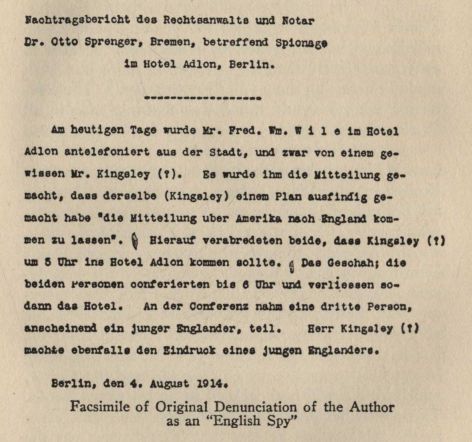
Facsimile of Original Denunciation of the Author as an "English Spy"
I had partially recovered my equilibrium after my somewhat exciting experiences of the previous ten minutes and found myself able to talk dispassionately to a courteous young lieutenant of police who was in charge of the station. I told him I was not only an American, but a long-time resident of Berlin, with a home of my own in Wilmersdorf, and that if he would communicate with his superior, Doctor Henninger, chief of the political police, who had known me for years, he would soon be able to convince himself that a grotesque mistake had been made in arresting me as an "English spy." The lieutenant, who, I should think, was the only man in all Berlin who had not yet entirely lost his reason, asked me politely for my papers and other credentials. I handed him my American passport, newly-issued at the Embassy a few days before, a visiting-card bearing my Berlin home address, one or two copies of my most recent news telegrams to London and New York, which I happened to have with me, my correspondent's identification card stamped by the Berlin police department, and finally a letter which I had been carrying with me during the war crisis for precisely some such emergency--a communication sent me from the Imperial yacht in the summer of 1913, acknowledging in gracious terms a copy of Men Around the Kaiser, which William II had deigned to accept at my hands. The police lieutenant almost clicked heels and came to the salute when he saw that his prisoner was the possessor of so priceless a document. He asked me to "calm" myself and await developments. "Es wird schon gut sein." Which in real language means that "everything will be all right."
As their superior officer had not lopped off my head on sight, and even condescended to hold courteous converse with the "spy," the group of policemen in whose midst I found myself now warmed up to me perceptibly.
"You are an American, eh?" ejaculated one of them. "I wonder if you know my brother in Minnesota? His name is Paul Richter."
I was genuinely sorry I had never met Herr Richter--probably he did not live in the Red River Valley, which was the only part of Minnesota I knew, I explained. I knew some Richters in my native county of La Porte, Indiana, but they had never claimed the honor, to my knowledge, of having a brother in the Kaiser's police. While Schutzmann Richter and I were doing our best to discover that the world is small, noise of fresh commotion, such as had greeted my own arrival at the station, ascended from the street. Apparently a fresh "bag" had come in. A second later, of all people on earth, who should be pushed into the room, with three policemen at his neck and arms, but my very disheveled friend, Tower. He was hatless, his collar and tie were awry, every hair of his Goethe-like blond head was on end, and he cut altogether the figure of a very much perturbed young man. There were no mirrors about, so I can not say with certainty how I myself looked, but I am sure I could have easily been mistaken for Tower's twin at that moment. Partners in misery and anxiety we certainly were. Tower, it appeared, was denounced to the spy-hunters at the Adlon by a chauffeur he had engaged to drive him a day or two before--the man who piloted the machine which was hired out to Adlon guests at fancy rates per hour. Presently the chauffeur himself bounded into the room, shouting like a madman. "Now we've got him--the damned English cur!" he snarled, shaking his fist, first in Tower's face, and then, recognizing me, in mine, with an oath and a "You, too, pig-dog!" The chauffeur now ranted his reasons for denouncing both Tower and me. "I'm an old African soldier!" he yelled. "I know these contemptible Engländer. This Tower (he called it Toever, which was the way Germans used phonetically to pronounce a former American ambassador's name) is the notorious Times correspondent!" Tower impetuously denied this soft impeachment, and pointed out that instead of being the Thunderer's representative, he was the correspondent of the Daily News, "the only Germanophile English newspaper." Tower himself was never Germanophile, but it was grasping at a legitimate straw so to describe his London paper. I could not conscientiously identify The Daily Mail as deutschfreundlich, or, I regretfully mused, it might be the means of saving my neck.
Now there was more noise from the lower regions. Whom had they nabbed this time. Astonished as I was to see Tower marched in, I fairly gasped when the newest batch of prisoners was shoved into the room, for it was headed by my young secretary, Schrape, and included Mrs. Hensel, a gray-haired German-American lady and an old Berlin friend of my family, and Miles Bouton, of the local staff of the Associated Press. Schrape and Mrs. Hensel had been denounced at the Adlon as my accomplices in espionage--Schrape for obvious reasons, and Mrs. Hensel because she had called to see me at the hotel a few minutes after my arrest, undoubtedly, of course, to bring me illicit information or receive her "orders." She had come, as a matter of fact, as countless acquaintances of mine had been doing throughout the week, to ask for advice or assistance in the midst of the topsy-turvy conditions into which life in Berlin had been so suddenly plunged. Schrape was remarkably cool. So was Bouton, who insisted upon expressing himself with such freedom about the indignities heaped upon him that I momentarily expected to witness his decapitation. Mrs. Hensel, poor soul, was frightened speechless and between her tears could only incoherently make me understand that she had no sooner asked for my name at the Adlon desk than the clerks handed her over to the police. Bouton seemed to owe his arrest to the fact that he was in Tower's company in the Adlon lobby, attending the meeting of American war refugees. Tower had been savagely cracked over the head by an Adlon waiter armed with a tray while being hustled out of the hotel by the police. Mrs. Bouton, tearfully protesting against her husband's arrest, had herself been threatened with arrest or something worse if she did not instantly "hold her mouth." Just what part the Adlon staff of clerks, porters, waiters and page-boys played in our arrest was not made clear to me until the next day; of which more in the succeeding chapter.
As soon as the "gang of spies," as the policemen in the room now pleasantly called us, was complete, Tower, Schrape and Bouton were lined up against the wall and ordered to raise their hands above their heads, while their clothes were searched for concealed weapons or incriminating espionage evidence. While my fellow prisoners (except Mrs. Hensel) were undergoing examination, a typical young Berlin thug, evidently a thief, was brought in, and took his place adjacent to my colleagues, also to be searched. The room was now resounding with encouraging shouts from overwrought policemen that "the English dogs ought to be hanged." Others suggested that "Spandau," the spy-shooting gallery, was a more appropriate place for us than the gallows. For some God-willed or other mysterious reason I was not searched. That gave me only temporary relief, for we were presently informed that we would be taken to the Police-Presidency (central station) for the night and "dealt with there." That meant searching of everybody, I felt morally sure, and it was then that the tongue of me began cleaving to the roof of my mouth, while my throat parched with terror. For in a leather card-case in my inside pocket I carried a telegraph code, utterly innocuous in itself--a make-shift affair got up during the preceding forty-eight hours and of which I posted a duplicate to London, with a view to explaining to my editor in cipher my movements and whereabouts if I had suddenly to leave Berlin. It was a quite harmless string of phrases reading like this:
"My wife's condition has become critical, and physicians recommend immediate departure if catastrophe is to be avoided."
All this was, of course, in German, and meant (as the code explained) that I was proceeding to the Hotel Angleterre in Copenhagen. Another phrase substituted "boy's" for "wife's" and meant that I was leaving for the Hotel Amstel in Amsterdam, etc., etc. It dawned instantly upon me that if the Berlin political police, at such a witching hour, discovered on a suspected spy a telegraphic code of so "incriminating" a character, he could hardly look forward to anything beyond the regulation thrill at sunrise. I might have been able to explain in prosaic peace-times, I soliloquized, that many newspaper correspondents use private codes in communicating with their editors, but to convince a Berlin police official at that moment that my code was of innocent import struck me as the quintessence of physical impossibility.
I was undergoing, I think, all the emotions of fear and trembling when our quintette of prisoners was now marched down to the street and piled into taxis for transportation to the Polizei-Präsidium in Alexander-Platz, two miles across town. An enormous throng filled the Mittel-strasse, snarling with rage. The sight of us maddened them into a fiendish scream. Tower and I were pushed into the first car, which happened to be the Adlon machine he had hired and was doubtless still paying for, and which was driven by his infuriated chauffeur. The "covering" sabers of the police, one each of whom guarded Tower and myself, respectively in the front and back seats, did not prevent the mob from belaboring us once more with fists and sticks, to the accompaniment of unprintable epithets and curses. My mind, however, was occupied completely with how to get rid of that code nestling in my inside pocket. Nothing short of entire insensibility could have deflected my thoughts from that all-absorbing issue. I was thinking hard and quickly.
Tower's chauffeur, proud to be serving the Kaiser on so historic an occasion, did not drive us, as he would naturally and ordinarily have done, through the darkened side streets leading from Mittel-strasse to Alexander-Platz, but decided to drag us in triumph like the victims chained to Nero's chariots, down the brilliantly illuminated Unter den Linden, which, though it was now nearly eleven o'clock, was packed with war demonstrators. Crossing to the more crowded southern side, at a point near the Hotel Bristol, the driver threw on his top-speed and whirled us down the glittering boulevard at breakneck pace. As for himself, with a policeman at his side, and two behind him pinioning Tower and myself, he was frantic with super-patriotic joy. Now steering with his left hand, he waved his right madly through space at the gaping curb crowds, and yelled, so that they might know what it all meant: "English spies! Now we've got 'em! Now we've got 'em! Hurrah! Hurrah!" It was a great moment in that illustrious Kraftwagenführer's career. Nothing in his greasy past had ever approached it in tremendousness. He saw the Iron Cross dangling in certain outlines before his ecstatic vision--the reward for valor in the hour of his Fatherland's need.
I was still brooding over that code, but even while being paraded past the Berliners, I was actively at work on a scheme for its removal. Necessity is, indeed, the mother of invention, and to this hour I do not fully comprehend how I came to find the courage or ingenuity to do what I was now successfully accomplishing. We had reached the Opera, were approaching the Castle, and Alexander-Platz was less than five minutes away. The need for quick work was growing more urgent from second to second. My policeman held me firmly by the right arm. My left was entirely free. With it I was able easily to reach the right-hand inside pocket of my coat, wherein the card-case containing the code was lodged. I contrived to finger my way into the case without attracting the attention of my jailer, who, Allah be praised, was still too fascinated by the plaudits of the crowds to be more than mildly interested in me. I could "feel" the code now. It was of flimsy tissue paper and could be easily torn into shreds. A sufficiently long interval had elapsed since my last visit to the manicure to make my finger-nails highly effective for the purpose, and by degrees which seemed infinitely slow I managed to crumple and dessicate the "guilty" document and by "palming" and working the bits into the spaces between my fingers the whole thing was effectually destroyed. I withdrew my hand, stuck it into the outside left-hand pocket of my coat to withdraw a handkerchief, blew my nose and, while in that unforbidden act, let I don't know how many hundreds of tissue paper particles fly back of me into the wind of Berlin's bristling night air. I was saved. They could search me now to their hearts' content. I found that, somehow or other, the power of speech had suddenly returned, and a moment later I was saying cheerily to my Schutzmann friend, "Well, we're here now."
The details of what happened in the big room of the Police-Presidency into which we were now ushered--my friend Simons, of the Amsterdam Telegraaf, and Nevinson, special correspondent of The Daily News, who were found in Tower's room at the Adlon and arrested on that "evidence," had arrived there before us--are brief and unessential. What had been taking place during the preceding two hours is vastly more to the point. Ambassador Gerard, who was at the Adlon when we were arrested, seems to have cleared for action in his typically shirt-sleeves diplomatic fashion. He dispatched First Secretary Grew to the Foreign Office to demand our instantaneous release. Grew informed Under-Secretary Zimmermann that if Germany continued to treat American citizens and newspaper correspondents in accordance with the practises of the Middle Ages (Conger was still languishing in jail at Gumbinnen) the Fatherland was dangerously likely to lose the esteem of the only first-class Power in the world which seemed still to be on speaking terms with her. Herr Zimmermann, who understands plain English when it is spoken to him, was apologetic in the extreme. He told Grew that immediate steps would be taken to liberate me and my friends and that the Foreign Office "regretted" that such indignities should have been heaped upon innocent persons. Mr. Gerard evidently determined to take no chances, for the first secretary was dispatched to the Police-Presidency with the embassy automobile, and with instructions to demand our delivery in the flesh and stay there till it was made. Meantime the Foreign Office had sent urgent telephonic instructions to the police to let us out. We were asked to fill up certain identification forms and exhibit some more papers, and then, in accents of courteous explanation, were assured that an "error" had unfortunately been made. We should "not hesitate, if anybody molested us again," to call up Police Headquarters, and matters would be speedily set right. It was not probable, we were assured, that we would have any more trouble. If we desired, a police escort was at our service, so that we might return to the hotel or to the Embassy in certain safety.
We had just been bowed out of the place of our brief detention when the familiar outlines of "Joe" Grew loomed into view, down the corridor, and with him "Fritz," the German "life-guard" of the Embassy. It is not customary for American men to kiss each other, but I confess here to having been momentarily inspired with a strong temptation to lavish some form of osculatory gratitude upon Grew. Certainly I felt that there was nothing quite so good on God's footstool just then as to be an American citizen. When Grew insisted on packing all five of us--Tower, Mrs. Hensel, Bouton, Schrape and myself--into the car and driving us back to the Embassy (it was now the romantic hour of one A.M.) behind the protecting folds of the Stars and Stripes flapping defiantly at the windshield, I vowed a solemn, silent oath--to aspire in such days as might still be left to me for an opportunity some day to reciprocate in kind the service the Ambassador and Grew had that night rendered me, the supreme service men can render a fellow man--to save his life.
They were to be called upon, though I did not then know it, to rescue me once again before either they or I were twenty-four hours older.
CHAPTER XI
THE LAST FAREWELL
Such sleep as I enjoyed in what remained of the night between August 4 and 5 was secured, for the first time in a week, beneath my own roof. I had finished with the "hospitality" of the Hotel Adlon for all time to come. After a brief visit at the Embassy, to assure the Ambassador of my everlasting gratitude for having thrown out the life-line, and seeing Mrs. Hensel safely started for her home in Charlottenburg under trusted escort, I betook myself to Wilmersdorf, where our faithful little German governess, Anna Kranz, had been holding the fort all summer during the absence of my family in the United States. I telephoned Fräulein from the Embassy a summary of the night's events, fearing that police minions might be paying me a domiciliary visit and cause the poor girl unnecessary alarm. I told her Schrape was coming home with me for the night and that as neither of us had had a bite since the preceding noon, we could do full justice to anything, however frugal, which might at that romantic hour still be discoverable in the larder. It was a wide-eyed, then tearful and always sympathetic Thuringian damsel, who listened to our story over bread and cheese at the romantic hour of two-thirty A.M. I can hear her now interrupting with a characteristic and condoling "Aber, Herr Wile!"
Having dispatched Schrape to the Adlon early next day to pay my bill and fetch the belongings I had had so abruptly to leave behind me there the night before, I proceeded to town. At the Embassy was a host of friends anxious for news of me. The most absurd rumors, it seemed, were in circulation. There was a detailed version of my last moments in front of a firing-squad at Spandau, and somebody "who had a friend at the Police Presidency" had told somebody else that I was in shackles which would probably not be removed till the war was over--if then. Still another tale related circumstantially of how I had been "hurried" from Berlin at the dead of night, under military guard, to the Dutch frontier, across which, by this time, I was unceremoniously "expelled."
When I was able to gain the ear of the Ambassador--the American war-refugee panic was now at tempestuous zenith, with the Embassy like a place besieged--I represented to him that I feared my hopes of remaining in Germany, after what had happened, were slender in the extreme. Scouts had brought in the intelligence, I informed him, that a miniature mob of evident purpose was waiting in front of the Equitable Building, where The Daily Mail office was, now and then knowingly pointing to our big gilt window-sign, in order that passers-by might understand why traffic was being blocked in front of No. 59 Friedrichstrasse. If the crowd waited long enough, it probably saw at work the sign men whom I had ordered to take down the red rag. Discretion is ever the better part of valor, and I felt no compelling desire to superintend the job in person.
The Ambassador thought I was unduly disturbed. He was convinced that my arrest was purely an unfortunate blunder, due to a combination of officious patriotism and excessive zeal, and meant nothing. I was inclined to agree with him. Berlin and the Berliners had suddenly lost their minds, and nothing which occurs when a community of men are in a state of mental aberration ought in reason to be charged against them. I had obviously fallen victim to the mass dementia which robbed Germans of their senses when their lingering fears of war with England became terrifying actuality. I certainly did not overestimate the importance of the episode.
I now ran across von Wiegand of the United Press (as he then was) and Swing, of the Chicago Daily News. Being Americans, like myself, they had just taken the precaution of applying to the Foreign Office for credentials which would protect them from such delicate attentions as the police had shown me. They suggested that I should see Legationsrat Heilbron and get an Ausweiskarte. Swing was in jubilant mood. He had a scheme under promising way to accompany Major Langhorne, our military attaché, to the front as a "secretary." My heart pumped with envy. Von Wiegand had not yet worked out his forthcoming campaign for interviewing the German Empire and the Vatican, but all of us felt sure that his German noble origin, plus his nose for news and excellent official connections, would land Karl Heinrich on his feet, as far as reporting the war was concerned, if any one was going to be favored at all. The Anglo-American newspaper fraternity was already a rather decimated body. Conger, of the Associated Press, was still jailed at Gumbinnen. Wilcox, of The Daily Telegraph, had been fortunate enough, only a few days previous, to get to Russia. Ford, of The Morning Post, had not waited for the crash and left for England on one of the last peace-time trains. Tower, my night's partner in woe, had slept in the porter's basement of the American Embassy and was now a refugee in the British Embassy, where, I understood, all the other purely English correspondents were being rounded up during the day, to accompany Sir Edward Goschen and his staff out of Germany next morning on the safe-conduct train provided by the German government. Mackenzie, of The Times, with whom I had plotted by telephone, was still unarrested, for some miraculous reason; I had not yet seen the original "denunciation" of our espionage operations, from which I later knew that he had only been identified as "Kingsley." He can blame that circumstance, no doubt, for having been denied the privilege of my own experiences.
At five o'clock, the customary hour for newspaper men to visit the Foreign Office, I went to call on Legationsrat Heilbron. He had not yet come in, so I sent my card to his colleague, Legationsrat Esternaux, with whom I had enjoyed professional acquaintance ever since the hour of my arrival in Germany, thirteen years previous to the week. I assured Esternaux that I cherished no particular animosity toward the police authorities for my silly arrest, being convinced that a grotesque mistake alone was responsible. Mildly apologetic, he acquiesced in this view.
"You were a victim," Esternaux then began, "of our just and universal rage over the treacherous and treasonable action of England in stabbing us in the back. Never, as long as they live, will Germans forgive the perfidy of the British Government in betraying the common blood in favor of uncivilized Pan-Slavism. It is the most criminal faithlessness in the world's history--this taking advantage of our difficulties to vent long pent-up spite against the merely dangerous German commercial rival." Herr Esternaux did not mention Belgium, though the flow of his righteous indignation was increasing from phrase to phrase. "Race treason! That is what has fired the German soul to its depths! That is what caused last night's unseemly demonstrations. Nobody condones mob fury less than the German Government, but it is explained, if not justified, by what has happened. Of one thing the world may be sure--with whatever bitterness we make war on our Russian and French foes, it will be nothing--it will be child's-play--compared to the spirit of revengeful rancor and holy wrath in which we shall fight the English race-traitors. That was the temper of the Berlin mob last night. It is the temper in which we are going to war with Great Britain. It is the temper in which we shall wage the struggle with her to the bitter end. Make no mistake about that." I had listened, on the authoritative premises of the Imperial German Government, to perhaps the first official proclamation of the hate and frightfulness programme so far uttered. Gott strafe England! How graphically succeeding events were to bear it out!
After Legationsrat Esternaux had fired this high-explosive, he ushered me out, and I knocked on Legationsrat Heilbron's door, fifteen yards farther down the passageway. Fur-mittens and ear-muffs are not de rigueur in northern Germany in midsummer, but I should have worn them that afternoon of August 5, for the reception awaiting me at Heilbron's hands was of arctic frigidity. It was a vastly changed Heilbron from the obliging functionary who had pressed upon me, forty-eight hours previous, copies of the German White Paper, in order that I might spread the official truth about "how the Fatherland had worked to prevent the war" broadcast in England and the United States. It was also a strangely less courteous Legationsrat than the one (Esternaux) whose presence I had just quitted.
"Herr Legationsrat," I began, "I have come to ask you for an Ausweiskarte. You know, I suppose, of my little experience last night. I am quite willing to take my chances with the mob, but I ought to have something to protect me from the excesses of the police."
"Mobs are mobs," he rejoined. "I can do nothing for you."
"That is strange," I interposed. "Surely you know that the American Ambassador has arranged for my remaining in Germany?"
"I know nothing about that whatever," said Heilbron.
"Well, Legationsrat Esternaux does," I retorted, "because he told me so not five minutes ago, and he said you would issue the necessary credentials."
Heilbron, who like all German bureaucrats has the backbone of a crushed worm in the presence of superior authority, or the mere suggestion of it, now reached for his telephone-receiver and asked to be connected with somebody in the Foreign Office. He repeated the object of my call to whomever was at the other end of the line, nodded in assent to something apparently said to him, then turned to me:
"It is just as I thought. The Foreign Office can do nothing for you. If you want credentials, you must apply to the police."
"But, Herr Legationsrat," I persisted, "there can be no objection to your giving me something which will insure me ordinary safety at such a time as this. After all, I'm an American."
With a shrug of the shoulders and outflung arms, a German gesture expressing indifference or helplessness, or both, Heilbron observed, sardonically: "For us you are a Daily Mail man--nothing else. You are known everywhere as such. Certainly if you remain here, your position will undoubtedly be a precarious one."
It was plain that the ethics which impelled Von Bethmann Hollweg to tear up the Belgian "scrap of paper"--brazen disregard of pledges--were now being pursued in my very insignificant case. The German Foreign Secretary had given a formal undertaking, as I understood it, as to the inviolability of my personal and professional status as an American newspaper man. Not five minutes before, I had been assured by an official of the German Foreign Office in the Foreign Office that the latter was fully aware of the arrangements which Mr. Gerard had effected in my favor. And now another official calmly denied its existence, and, moreover, declared in substance that a United States passport calling upon the friendly German Government "to permit Frederic William Wile safely and freely to pass, and, in case of need, to give him all lawful aid and protection," was not worth the parchment on which it was engraved. International law was being refashioned in Berlin in a hurry.
Once again I was compelled to flee to the American Ambassador for protection--reluctantly enough, for I had already usurped far more of his time than one citizen is entitled to. I told him that the German Foreign Office was trying to convert me into a man without a country; not only that, but that its cheerful intimation as to my "position" being "undoubtedly precarious" rang clearly ominous in my ears. The Ambassador shared that view. He was of the opinion, when he saw me earlier in the day, that my alarm was unwarranted. From what other American newspaper men had meantime reported, my fears seemed to be justified. He agreed that it was best that I should go--but how? The town was already choked with Americans waiting to "go." If it were impossible to move any of them across the frontier, what possible chance was there of exporting me? There was, of course, just one chance that I could think of--to leave next day with the British Embassy. The Ambassador suggested that I should ask Sir Edward Goschen if he would take me, along with the purely British correspondents, who, I learned, were going in his train.
So now, the United States having obviously exhausted its powers on my behalf, I threw myself on the mercies of His Britannic Majesty. I found Sir Edward Goschen unhesitatingly responsive to my request, on the important condition that the German authorities would permit a non-Englishman to accompany a safe-conduct party of British subjects of highly official character! Once again the gates leading out of Germany seemed barred to me, for my status at the German Foreign Office, as the afternoon had established, was not exactly that of a persona grata who had but to ask a favor to have it granted. But, by an act of Providence, as it then and always since has seemed to me, Ambassador Gerard strolled into the lobby of the British Embassy while I was in the midst of conversation with Sir Edward Goschen. The British Ambassador repeated the conditions on which he would gladly rescue me--the assent of the German Government--whereupon Mr. Gerard quietly remarked that he would "look after that." He had little notion, I suppose, of the herculean effort which would be necessary to give effect to his words.
It was now past six o'clock. The British Embassy train was timed to leave Berlin at seven next morning, Thursday, August 6. If anything was going to be done for me, all concerned realized that it would have to be done soon. "Go home, pack up all you can jam into two suit-cases, and turn up at the American Embassy at nine o'clock," said Gerard.
No home was ever deserted, I am sure, more reluctantly or so precipitately as my little ménage in Wilmersdorf. It seemed a woefully inglorious ending to thirteen very happy and fruitful years in Berlin. I thanked Heaven that my wife and little boy were not there to be evicted with me. A woman's attachment to the things which have spelled home--the books, the pictures, the thousand and one household trinkets, enshrined with priceless value to those who have accumulated them--is far stronger than a man's. The wrench of separation would have been correspondingly harder to bear. In the midst of such reveries, sandwiched between selecting the most essential contents for the two suit-cases to which I was limited, I had a caller.
"Herr Direktor Kretschmar, of the Hotel Adlon, has come to see you," announced Fräulein.
Kretschmar is probably known to more American travelers to Europe than any other hotel man on the Continent. The Adlon had been Yankee headquarters in Berlin ever since its opening in the autumn of 1907. Old man Adlon, its genial founder and proprietor, he of the arc-light face at midnight, after a liberal evening's libations o'er the flowing bowl, used to be fond of assuring people that "mein lieber Freund Wile" had "made" the Adlon. If telling people that the Adlon was the best hotel in Berlin, and reporting in my American dispatches, as necessity required, that Governor Herrick, Mr. Carnegie, Mr. Schwab, Doctor David Jayne Hill, Vice-President Fairbanks, Theodore P. Shonts, John Hays Hammond, Otto H. Kahn or some other famous fellow citizen was lodged in the marble and bronze caravansary at the head of Unter den Linden--if this "made" the Adlon--I plead guilty to Herr Adlon's charge. I shall never do it again. I divined at once the object of the curly-haired Kretschmar's visit. Having graduated, I believe, like many eminent German hotel keepers, from the humble ranks of hall-porters and head waiters, he was a past master in obsequious servility. Many a time I had seen him bow and scrape like a grinning flunky as he welcomed the arriving or sped the parting guest at the Adlon, but never was he so cringing a Kretschmar as he stood before me now. He got down to business without delay.
There had been a "terrible mistake" at the hotel the night before. He was there to offer the "deepest regret" of both the elder and junior Herren Adlon that their "best friend" should have been the victim of "such an outrage" on their premises. They had dismissed no less than ten members of the hotel staff for complicity in my arrest. The Adlon hoped, from the bottom of its unoffending heart, that I would "forgive and forget." Kretschmar, at this point in his peccavi, almost broke down. He was in tears, and, if I had let him, he would probably have gone down on his knees. If I had known what I was told next day as to his own connection with my experience at the Adlon, he would not only have gone down on his knees, but down the stairs of my flat-building as well. Whether it was he who incited the page-boys, desk-clerks, elevator-men, chambermaids and waiters to regard me as an "English spy" I can not say, but, in light of the experience which a colleague, Alexander Muirhead, a London newspaper-photographer, had in the Adlon shortly after my arrest, there is at least ground to fear that Kretschmar may have been something more than an innocent bystander.
"When I asked for you at the desk," Muirhead told me, "a supercilious clerk, eying me fiercely, referred me to the manager, whereupon I was escorted into Kretschmar's room. 'I've come to see my friend Wile,' I explained. 'Your friend Wile's a spy!' snarled Kretschmar, who seemed beside himself with fury. 'And he's now where he ought to be! As for you, mein Herr, stand there against the wall, hold up your arms, and be searched for weapons. For all we know, you're a spy, too!' The mere thought of your name appeared to fill Kretschmar with incontrollable rage. Having satisfied himself that I had nothing more explosive about me than some undeveloped films, he allowed me to go my way amid incoherent mutterings and imprecations about that '---- of a ---- spy, Wile.' I was, of course, completely mystified by this extraordinary episode, as I was at that time entirely ignorant of your fate."
Muirhead is a plain-spoken Scotchman, as well as one of Europe's bravest and most famous "camera men," and although the lachrymose Kretschmar indignantly repudiates the occurrence, I hope he will not mind if I prefer to believe Muirhead. The manager of the Adlon still keeps my memory green. Periodically during the war, whenever some German paper has outdone itself in dignifying me with vile abuse, Kretschmar has faithfully marked it in blue pencil and sent it to me by two routes--Switzerland and Holland--to make sure that it reached me. As I have not taken the trouble to acknowledge these little tokens of his abiding interest, I hope he may learn from these pages that they have been duly received and fill not the least conspicuous niche in my chamber of German war horrors.