THE ASSAULT (continued 2)
Reading edition
Count Reventlow, a Jingo of Jingoes, rendered both the navy and army leagues valiant support in the columns of his newspaper, the Deutsche Tageszeitung, and in a regular grist of pamphlets and books which his facile pen from time to time reeled off. Reventlow was one of the archpriests of the War Party. A champion hater of everything foreign, he was temperamentally fitted to advocate the doctrine of Force and Germany's right to world-conquest by fire and sword. Count Reventlow, whom it was my pleasure to know intimately, hated England, France and Russia with a ferocity delightful to behold. His Francophobism was little diminished by his marriage to a charming French noblewoman. He hated America, too. I could never quite divine the gallant Count's reason for eating an American alive, in his mind, every morning for breakfast, and for despising us as cordially as he detested Mr. Winston Churchill, Monsieur Delcassé or the Czar, until he confessed to me one day that he lost a fortune through unfortunate speculation in a Florida fruit plantation. Thenceforth, apparently, Reventlow's anti-Americanism knew no bounds. It was more explosive than usual during his discussion of the Lusitania massacre, but it was pathological.
A pillar of the German War Party, whose name is almost entirely unknown abroad, is Doctor Hammann, chief of the notorious Press Bureau of the German Foreign Office and Imperial Chancellery. Hammann for twenty years, because one of the craftiest, has been one of the most powerful men in German politics. For two decades he survived the incessant vicissitudes and intrigues of the Foreign Office, which indeed were more than once of his own making. He was frequently credited with being "the real Chancellor" in Bülow's days because of his sinister influence over that suave statesman. Hammann's nominal duties were confined to manipulating the German press for the Government's purposes and to exercising such "control" over the Berlin correspondents of foreign newspapers as might from time to time appear feasible or possible. Himself a retired journalist of unsavory reputation--he was a few years ago under indictment for perjury in an unlovely domestic scandal--he seemed to his superiors an ideal personage to deal with the Fourth Estate, which Bismarck trained Germans to look upon as "the reptile press." Hammann's function, for the War Party's purposes, was to mislead public opinion, at home and abroad, as to the real intentions and machinations of Weltpolitik. Under his shrewd direction German newspapers, restlessly propagating the Fatherland's need for "a place in the sun," systematically distorted the international situation so as to represent Germany as the innocent lamb and all other nations as ravenous wolves howling for her immaculate blood. That Hammann is regarded as having rendered "our just cause" priceless service was proved only a few months ago by his promotion to a full division-directorship in the Foreign Office. He had hitherto ranked merely as a Wirklicher Geheimrat, or sub-official of the department, although as a matter of fact five Foreign Secretaries, "under" whom he nominally served, were mere putty in the hands of Germany's Imperial Press Agent-in-Chief.
Grand-Admiral von Tirpitz, of course, has for years been one of the super-pillars of the German War Party. The Kaiser's Fleet is the creation of von Tirpitz, though William II receives popular credit for the achievement, and von Tirpitz created it essentially for war. Von Tirpitz once honored me with a heart-to-heart confab on Anglo-German naval rivalry. He rebuked me in a paternal way for specializing in German naval news. Germany had no ulterior motive, he said. She was building a defensive fleet primarily, though one that would be strong enough, on occasion, to "throw into the balance of international politics a weight commensurate with Germany's status as a World Power." Von Tirpitz was the incarnation of the naval spirit which longed for the chance to show the world that Germany at sea was as "glorious" as centuries of martial history had proved her on land. German sailors chafed under the corroding restraint of peace. They hankered for laurels. They were tired of manning a dress-parade fleet, whose functions seemed to be confined to holding spectacular reviews for the Kaiser's glorification at Kiel. They hungered for "the Day." Von Tirpitz has denied passionately that they ever drank to "the Day" in their battleship messes. But it was the unspoken prayer which lulled them to well-earned sleep, for in consequence of the iron discipline and remorseless labor which von Tirpitz imposed on his officers and men in anticipation of "Germany's Trafalgar," the Kaiser's Fleet was the hardest worked navy in the world. No Armada in history was ever so perpetually "battle-ready" as the German High Seas Fleet. It was the Fleet which made its very own that other hypocritical German battle-cry, "The Freedom of the Sea," which means, of course, a German-ruled sea.
Von Tirpitz's task was not only to build the fleet but to agitate German public opinion uninterruptedly in favor of its constant expansion. To him and the Navy League, which he controlled, and to his Press Bureau and its swarm of journalistic and literary parasites, were due the remarkable Anglophobe campaigns which resulted in the desired periodical additions to the Fleet. A politician of consummate talent, von Tirpitz held successive Reichstags in the palm of his hand. No Imperial Chancellor, though nominally his chief, was ever able to override the imperious will of von Tirpitz the Eternal. Repeatedly in the years preceding the war England held out the hand of a naval entente. The War Party and von Tirpitz said "No!" And Armageddon became as inevitable as the setting sun.
I have enumerated only the outstanding figures of the German War Party. They could be supplemented at will--there are the men like Professor von Schmoller, of the University of Berlin, who foresees the day when "a nation of two hundred million Germans oversea would rise in Southern Brazil"; or Professor Adolf Lasson, also of Berlin, who proclaimed the doctrine that Germans' "cultural paramountcy over all other nations" entitles them to hegemony over the earth; or Professor Adolf Wagner, the Berlin economist, who excoriates compulsory arbitration as the refuge of the politically impotent and a dogma beneath the dignity of the Germany of the Hohenzollerns; or the whole dynasty of politician-professors like Delbrück, Zorn, Liszt, Edward and Kuno Meyer, Eucken, Haeckel, Harnack, or minor theorists like Münsterberg, who year in and year out preached the doctrine of Teutonic superiority, Teutonic invincibility and Teutonic "world destiny." These intellectual auxiliaries of the War Party in their day have sent tens of thousands of young men out of German universities with politically polluted minds. Their class-rooms have been the real breeding ground and recruiting camps of the German War Party.
And then, of course, in addition to the admirals who wanted war, and the professors who glorified war, and the editors, pamphleteers, Navy and Army League leaders and paid agitators who wrote and talked war, there was the German Army, represented by its corps of fifty thousand or sixty thousand officers, which was the living, ineradicable incarnation of war and with every breath it drew sighed impatiently for its coming. I suppose armies in all countries more or less constitute "war parties." But never in our time has an army tingled and spoiled for battle as sleeplessly as the legions of the Kaiser. It was written in the stars that it was only a question of time when they would realize their aspiration to prove that the German war machine of the day was not only the peer, but incomparably the superior, of the Juggernauts with the aid of which Frederick the Great and Moltke remapped Europe.
But the Grand Mogul of the German War Party, its pet, darling and patron saint, was Crown Prince William, the Kaiser's ebullient heir who contributed so conspicuously to Germany's loss of Paris in September, 1914. For ten years he was the apple of the army's eye. William II's oratorical peace palaverings long ago convinced his military paladins that their hopes could no longer with safety be pinned on the monarch who would do nothing but rattle his saber. "A place in the sun" could never be achieved by such tactics, they argued, so they transferred their affections and their expectations to the "young man" who cheered in the Reichstag when his father's Government was accused of cowardice in Morocco. They placed their destinies in the keeping of the Imperial hotspur who wrote in his book, Germany in Arms, that "visionary dreams of everlasting peace throughout the world are un-German." Their real allegiance was sworn henceforth to the swashbuckling young buffoon, who, taking leave of the Death's Head Hussars after two years' colonelcy, admonished them to "think of him whose most ardent desire it has always been to be allowed to share at your side the supreme moment of a soldier's happiness--when the King calls to arms and the bugle sounds the charge!" It was an open secret that when the Crown Prince was exiled to the command of a cavalry regiment in dreamy Danzig, far away from the frenzied plaudits of the multitude in Berlin, the Kaiser's action was inspired by the disquieting realisation that his heir was acquiring a popularity, both in and out of the army, which boded ill for the security of the monarch's own status with his subjects.
These, then, are the men, and these their principal methods, which provided the scenario for the impending clash. As with every great "production," preliminary plans were well and truly laid. Rehearsals, in the form of stupendous maneuvers on "a strictly warlike basis," had brought the chief actors, scene shifters and other accessories to first-night pitch. The stage managers' work was done. They had now only to take their appointed places in the flies and wings and let the tragedy proceed. The rest could be left to the puppets on both sides of the footlights. A month of slow music, and then the grand finale.
CHAPTER V
SLOW MUSIC
July in Berlin of the red summer of 1914 began as placidly as a feast day in Utopia. The electric shock of Serajevo soon spent its force. Germans seemed to be vastly more concerned over the effect of the Archduke's assassination on the health of the old Austrian Emperor than over resultant international complications. It was Sir Edward Goschen, British Ambassador in Berlin, previously accredited to the Vienna court, who recalled to me Francis Joseph's once-expressed determination to outlive his heir. The doddering octogenarian had realized his grim ambition.
The German Emperor returned to Berlin from Kiel on Monday, the 30th of June. Ties of deep affection united him to his aged Austrian ally. It was universally assumed that the Kaiser, with characteristic impetuosity, would rush to Vienna to comfort Francis Joseph and attend the Archduke's funeral. So, as events developed, he ardently desired to do; but intimations speedily arrived from the Hofburg that "Kaiser Franz" had chosen to carry his newest cross unmolested by the flummery and circumstance of State obsequies, and William II remained in Berlin for honorary funeral services in his own cathedral in memory of the august departed. Some day a historian, who will have great things to tell, may relate the real reason for the baffling of the Kaiser's desire to play the rôle of chief mourner at spectacular death-rites in the other German capital. He had telegraphed the orphans of the murdered Archduke and Duchess that his "heart was bleeding for them." Men who have an X-ray knowledge of Imperial William's psychology were unkind enough to suggest that he longed to parade himself before the mourning populace of the Austrian metropolis as Lohengrin in the hour of its woe, an Emperor on whom it were safer to lean than on the decrepit figurehead now bowed in impotent grief, with a beardless grand-nephew of an heir apparent as the sole hope of the trembling future.
Until the late Archduke Francis Ferdinand began to assert himself, William II's influence at Vienna had been profound. Francis Joseph liked and trusted him. Austria was frequently governed from Potsdam. With the great bar to his ascendency removed from the scene, the German Emperor may well have thought the hour at length arrived for the virile Hohenzollerns to save the crumbling Hapsburgs from themselves, and invertebrate Austria-Hungary from the Hapsburgs. But Vienna decided it was better the Kaiser should stay at home. His political physicians, on the evening of July 1, suddenly discovered that His Majesty was suffering from that famous German malady known as "diplomatic illness," whereupon the court M.D. dutifully announced, through the obliging official news-agency, that "owing to a slight attack of lumbago" the Kaiser would not attend the funeral of the murdered Archduke, "as had been arranged." Forty-eight hours later other "face-saving" procedure was carried out--the Viennese court proclaimed that by the express wish of the Emperor Francis Joseph, no foreign guests of any nationality were expected to attend the Royal obsequies.
On Monday, July 6, William's "lumbago" having yielded to treatment, there was sprung one of the most dramatic of all the coups which preceded the fructification of the German War Party's now fast-completing conspiracy. Although martial law was being ruthlessly enforced in Bosnia and Herzegovina and all Austria-Hungary was in a state of rising ferment over the "expiation" which public opinion insisted "the Serbian murderers" must render, the Kaiser's mind was made up for him that the international situation was sufficiently placid for him to start on his annual holiday cruise to the North Cape. Four days previous, July 2, though the world was not to know it till many weeks afterward, the military governor of German Southwest Africa unexpectedly informed a number of German officers in the colony that they might go home on special leave if they could catch the outgoing steamer. These officers reached Germany during the first week in August, to find orders awaiting them to join their regiments in the field. Notifications issued to Austrian subjects in distant countries were subsequently found also to bear date of July 2. Things were moving.
The Hohenzollern steamed away to the fjords of Norway with the Kaiser and his customary company of congenial spirits. The Government-controlled Lokal-Anzeiger and other journalistic handmaids of officialdom forthwith proclaimed that "with his old-time tact our Emperor, by pursuing the even tenor of his way, gives us and the world this gratifying and convincing sign that however menacing the storm-clouds in the Southeast may seem, lieb' Vaterland mag ruhig sein. All is well with Germany." Or words to that effect. Germany and Europe were thus effectually lulled into a false sense of security, for, as one read further in other "inspired" German newspapers, "our patriotic Emperor is not the man to withdraw his hand from the helm of State if peril were in the air." So off went the Kaiser to his beloved Bergen, Trondhjem and Tromsö to flatter the Norwegians as he had done for twenty summers previous and to shake hands with the tourists who always "booked" cabins in the Hamburg-American North Cape steamers in anticipation of the distinction the Kaiser never failed to bestow upon Herr Ballin's patrons.
The Kaiser's departure from Germany was particularly well timed to bolster up the fiction subsequently so insistently propagated, that Austria's impending coercion of Serbia was none of Germany's doing. The Hohenzollern had hardly slipped out of Baltic waters when Vienna's "diplomatic demarche" at Belgrade began. It was specifically asserted that these "representations" would be "friendly." Europe must under no circumstances, thus early in the game, be roused from its midsummer siesta. The official bulletin from the Hohenzollern read: "All's well on board. His Majesty listened to-day to a learned treatise on Slav archeology by Professor Theodor Schiemann. To-morrow the Kaiser will inspect the Fridthjof statue which he presented to the Norwegian people three years ago."
Austria-Hungary has a press bureau, too, and doubtless a Hammann of its own; now it cleared for action. While Vienna's "friendly representations" were in progress at Belgrade, the papers of Vienna and Budapest began sounding the tocsin for "vigorous" prosecution of the Dual Monarchy's case against the Serbian assassins and their accessories. The Serbian Government meantime remained imperturbable. Princip and Cabrinovitch, the takers of the Archduke and Duchess' lives, after all were Austrian-Hungarian subjects, and their crime was committed on Austrian-Hungarian soil. Serbia, said Belgrade, must be proved guilty of responsibility for Serajevo before she could be expected to accept it. Then the Berlin press bureau took the field. The Lokal-Anzeiger "admitted" that things were beginning to look as if "Germany will again have to prove her Nibelung loyalty," i.e., in support of Austria, as during the other Bosnian crisis, in 1909.
By the end of the second week of July the world's most sensitive recording instruments, the stock exchanges, commenced to vibrate with the tremors of brewing unrest. The Bourse at Vienna was disturbingly weak. Berlin responded with sympathetic slumps. To the Daily Mail in London and the New York Times I was able, on the night of July 10, to cable the significant message that the German Imperial Bank was now putting pressure on all German banks to induce them to keep ten per cent. of their deposits and assets on hand in money. On the same day an unexplained tragedy occurred in Belgrade: the Russian minister to the Serbian court, Monsieur de Hartwig, Germanism's arch-foe in the Balkans, died suddenly while taking tea with his Austrian diplomatic colleague, Baron Giesling.
Germany the while was going about its business, which at mid-July consists principally in slowing down the strenuous life and extending mere nocturnal "bummeling" in home haunts to seashore, forests and mountains for protracted sojourns of weeks and months. The "cure" resorts were crowded. In the al fresco restaurants in the cities, one could hear the Germans eating and drinking as of peaceful yore. The schools were closed and Stettiner Bahnhof, which leads to the Baltic, and Lehrter Bahnhof, the gateway to the North Sea, were choked from early morning till late at night with excited and perspiring Berliners off for their prized Sommerfrische. Herr Bankdirektor Meyer and Herr and Frau Rechtsanwalt Salzmann were a good deal more interested in the food at the Logierhaus they had selected for themselves and the kinder at Heringsdorf or Westerland-Sylt than they were in Austria's avenging diplomatic moves in Belgrade. Stock-brokers were only moderately nervous over the gyrations of the Bourse. Germans who had not yet made off for the seaside or the Tyrol felt surer than ever that war was a chimera when they read that Monsieur Humbert had just revealed to the French Senate the criminal unpreparedness of the Republic's military establishment.
Strain between Austria and Serbia was now increasing. Canadian Pacific, German stock-dabblers' favorite "flyer," tumbled on the Vienna and Berlin Bourses to the lowest level reached since 1910. Real war rumors now cropped up. Austria was reported to have "partially mobilized" two army corps. Canadian Pacifics continued to be "unloaded" by nervous Germans in quantities unprecedented. Now Serbia was "reported" to be mobilizing. It was July 17. England, we gathered in Berlin, was thinking only of Ireland. Berlin correspondents of great London dailies who were trying to impress the British public with the gravity of the European situation had their dispatches edited down to back-page dimensions--if they were printed at all. One colleague, who represented a famous English Liberal newspaper, had arranged, weeks before, to start on his holidays at the end of July. He telegraphed his editor that he thought it advisable to abandon his preparations and to remain in Berlin. "See no occasion for any alteration of your arrangements," was wired back from Fleet Street.
The German War Party, acting through Hammann, now perpetrated another grim little witticism. It was solemnly announced in the Berlin press--on July 18--that the third squadron of the German High Seas Fleet was to be "sent to an English port in August (!) to return the visit lately paid to Kiel by a British squadron." Britain's Grand Armada the while was assembled off Spithead for the mightiest naval review in history--two hundred and thirty vessels manned by seventy thousand officers and men. King George spent Sunday, July 19, quietly at sea, steaming up and down the endless lines of dreadnoughts and lesser ironclads. The Lord Mayor of London opened a new golf course at Croydon. And Ulster was smoldering.
Highly instructive now were the recriminations going on in the German, Austrian and Serbian press. Belgrade denied that reserves had been called up. The North German Gazette, the official mouthpiece of the Kaiser's Government, no longer seeking to minimize the seriousness of the Austrian-Serbian quarrel, expressed the pious hope that the "discussion" would at least be "localized." Canadian Pacifics still clattered downward. Acerbities between Vienna and Belgrade were growing more acrimonious and menacing from hour to hour. Diplomatic correspondence of historic magnitude, as the impending avalanche of White Papers, Blue Books, Yellow Books and Red Papers was soon to show, was already (July 20) in uninterrupted progress, though the quarreling Irishmen and militant suffragettes of Great Britain knew it not, any more than the summer resort merrymakers and "cure-takers" of Germany. The foreign offices, stock exchanges, embassies, legations and newspaper offices of the Continent were fairly alive to the imminence of transcendent events, but the great European public, though within ten days of Armageddon, was magnificently immersed in the ignorance which the poet has so truly called bliss.
Her "friendly representations" at Belgrade having proved abortive, Austria now prepared for more forceful measures. On July 21 Berlin learned that Count Berchtold, the Viennese foreign minister, had proceeded to Ischl to submit to the Emperor Francis Joseph the note he had drawn up for presentation to Serbia. As the world was about to learn, this was the fateful ultimatum which poured oil on the European embers and set them aglare, to splutter, burn and devastate in a long-enduring and all-engulfing conflagration. Simultaneously--though this, too, was not known till months later--the Austrian minister at Belgrade sent off a dispatch to his Government, declaring that a "reckoning" with Serbia could not be "permanently avoided," that "half measures were useless," and that the time had come to put forward "far-reaching requirements joined to effective control." That, as events were soon to develop, was an example of the diplomatic rhetoric which masters of statecraft employ for concealment of thought. It meant that nothing less than the abject surrender of Serbian sovereignty would appease Vienna's desire for vengeance for Serajevo.
During all these hours, so pregnant with the fate of Europe, the German Foreign Office was stormed by foreign newspaper correspondents in quest of light on Germany's attitude. Was she counseling moderation in Vienna, or fishing in troubled waters? Was she reminding her ally that while Serajevo was primarily an Austrian question, it was in its broad aspects essentially a European issue? Was the Kaiser really playing his vaunted rôle as the bulwark of European peace, or was Herr von Tschirschky, his Ambassador in Vienna, adjuring the Ballplatz that it was Austria's duty to "stand firm" in the presence of the crowning Slav infamy, and that William of Hohenzollern was ready once again to don "shining armor" for the defense of "Germanic honor"?
These are the questions we representatives of British and American newspapers persistently launched at the veracious Berlin Press Bureau. What did Hammann and his minions tell us? That Germany regarded the Austrian-Serbian controversy a purely private affair between those two countries; that Germany had at no stage of the imbroglio been consulted by her Austrian ally, and that the last thing in the world which occurred to the tactful Wilhelmstrasse was to proffer unasked-for counsel to Count Berchtold, Emperor Francis Joseph's Foreign Minister, at so delicate and critical a moment. Vienna would properly resent such unwarranted interference with her sovereign prerogatives as a Great Power--we were assured. Germany's attitude was that of an innocent bystander and interested witness, and nothing more. That was the version of the Fatherland's attitude sedulously peddled out for both home and foreign consumption.
Behind us lay a week of tremor and unrest unknown since the days, exactly forty-four years previous, preceding the Franco-Prussian War. The money universe, most susceptible and prescient of all worlds, rocked with nervous alarm. Its instinctive apprehension of imminent crisis was fanned into panic on the night of July 23, when word came that Austria had presented Serbia an ultimatum with a time limit of forty-eight hours. My own information of Vienna's crucial step was prompt and unequivocal. It was on its way to London and New York before seven o'clock Thursday evening, Berlin time. I was gratified to learn at the Daily Mail office in London three weeks later that I had given England her first news of the match which had at last been applied to the European powder barrel. It was five or six hours later before general announcement of the Austrian ultimatum arrived in Fleet Street.
I was not surprised to learn that my startling telegram had aroused no little skepticism. During many days preceding it was the despair of the Berlin correspondents of British newspapers that they seemed utterly unable to impress their home publics with the fast-gathering gravity of the European situation. London was no less nonchalant than Paris and St. Petersburg. England was immersed to the exclusion of everything else in the throes of the Irish-Ulster crisis. Mr. Redmond and Sir Edward Carson loomed immeasurably bigger on the horizon than all Austria and Serbia put together. In the boulevards, cafés and government-offices of Paris the salacious details of the Caillaux trial absorbed all thought. In St. Petersburg one hundred sixty thousand working men threatened an upheaval which bore an uncomfortable resemblance to the revolutionary conditions of 1905. But it was the invincible indifference of London, as it seemed in Berlin, which appealed to us most.
The newspapers of July 21, 22 and 23 came in and indicated that for England Ulster had become Europe. There was obviously little space for, and less interest in, dispatches from Berlin or Vienna describing the "undisguised concern" prevalent in those capitals. On July 21 I quoted "high diplomatic authority" for the statement that the pistol would be at Serbia's breast before the end of the week. But London remained impervious. More than one of my British colleagues, equally unsuccessful in stirring the emotions of his people, threw up his hands in resignation, muttering things about "British complacency," which would have come with poor grace from a mere American.
Since then it has occurred to me that England's sublime unconcern in the approach of Armageddon may have been more apparent than real. Sir Edward Grey's strenuous days and nights of telegraphing to his Continental ambassadors, as England's White Paper revealed, had set in as early as July 20, when he wired Sir Edward Goschen to Berlin that "I asked the German Ambassador today if he had any news of what was going on in Vienna with regard to Serbia." That was No. 1 in the series of historic dispatches comprising the official British record of the genesis of the war, which shows that there was no lack of anticipation of coming events, as far as Downing Street was concerned. So I am impelled to think that there may have been method in Fleet Street's "splashing" (Anglice for "featuring") pretty Miss Gabrielle Ray's entangled love affairs and minimizing the determination of Austria to plunge Europe into war. There is a fine spirit of solidarity in England concerning foreign affairs. British editors in particular traditionally refrain from crossing the policy of the Foreign Office, no matter what the party complexion of the minister in charge. They are accustomed to supporting it unequivocally either by omission or commission, as the interests of Great Britain from hour to hour suggest. Whenever an attitude of debonair detachment toward a given "foreign affair" is best designed to promote the country's diplomatic programme, Fleet Street can be insensibility incarnate, national esprit de corps effectually fulfilling the function of a censor. No one has ever told me that that is why the appointment of a new principal for Dulwich College received almost as much prominence on the morning of July 24 as news from Berlin, Vienna or Belgrade. My suggestion of the reason is a diffident surmise, pure and simple. It contributed materially, no doubt, toward making Germany believe that England was too "preoccupied" with Irishmen and suffragettes to think of going to war for her political honor.
But in Berlin things were now (July 24) moving toward the climax with impetuous momentum. On that day, summing up events and opinion in official and military quarters, I telegraphed the following message to London:
"'We are ready!' This was the sententious reply given today by a high official of the General Staff to an inquiry with regard to Germany's state of preparedness in the event that an Austro-Serbian conflict precipitates a European war.
"I am able to state authoritatively that the casus foederis which binds Austria, Germany and Italy in alliance would come into effect automatically the instant Austria is attacked from any quarter other than Servia.[1]
[1] The "assurances" given me by Foreign Office spokesmen, as reproduced in the foregoing telegram, were, of course, made at a moment when the German Government, no doubt quite sincerely, felt surer than it did ten days hence that the casus foederis which obligated Italy to join Germany and Austria in war would be recognized by her without quibble. Germany, as the world was so soon to find out, had convinced her own people that her war was a holy war of defense, but Italy, visiting upon her Triple Alliance partners the supreme condemnation of contemporary political history, deserted them on the palpable ground that their war was war of aggression, pure and unalloyed.
"I am further able to say that while Germany expects that war between Austria and Serbia is possible, owing to the admittedly unprecedented severity of the Austrian demands, this Government confidently hopes that hostilities will be confined to them.
"It would be going too far to say that 'war fever' prevails in Berlin to the extent it is reported to be rampant in Vienna. I find, however, even in circles to which the thought of war is ordinarily repugnant, that the imminent possibility of a European conflict is contemplated with equanimity. They say that Austria's resolute action has already cleared the atmosphere of long-prevailing 'uncertainty' which was gradually becoming insufferable. They declare in accents of relief that a situation has finally been reached where there can be no retreat. Far worse things, it is declared, are conceivable than the conflagration which Europe for years has half dreaded and half prepared for.
"Official Germany, nevertheless, does not believe that Russia will force the issue. It is argued that the matter at stake is entirely a domestic quarrel between Austria and Serbia and involves Pan-Slavism only indirectly. If Russia makes the controversy a pretext for assisting the Serbians, it is pointed out that 'the world's strongest bulwark of the monarchial principle would practically place the stamp of approval on regicide.' As suppression of regicide propaganda, root and branch, is the mainspring of the Austrian action, the German Government holds it is inconceivable that Russia could in such circumstances align herself with Serbia. If she does, and I am permitted to underline this phase of the crisis with all possible emphasis, the full strength of Germany's and Italy's armed forces are ready to be mercilessly hurled against her, and will be.
"A war against Russia would never be more popular in Germany than at the present moment. For months past the country has been educated by its most distinguished leaders to believe that an attack from Russia is imminent. During the past week Professor Hans Delbrück has been giving wide publicity to an 'open letter' received from a Russian colleague, Professor Mitrosanoff, containing the following passage:
"'It must not be forgotten that Russian public opinion plays a vastly different rôle than it did a decade ago. It has now grown into a full political force. Animosity toward Germans is in everybody's heart and mouth. Seldom was public opinion more unanimous.'
"Almost simultaneously Professor Schiemann, the Kaiser's confidential adviser on world politics, has heaped fresh fuel on the anti-Russian fire by declaring: 'We have reason to think that the underlying purpose of President Poincaré's visit to the Czar was to expand the Triple Entente into a Quadruple Alliance by the inclusion of Rumania against Germany.'
"The Bourse closed amid undisguised alarm and the wildest fears for what the week-end may bring forth. The public is inclined to remain reassured as long as the Kaiser consents to remain afloat in the Hohenzollern in the fjords of Norway, but he can reach German waters in twenty-four hours aboard the speedy dispatch-boat Sleipner, which is attached to the Imperial squadron.
"I asked a military man today what show of force Germany would make at the outbreak of hostilities involving her. He said: 'She could easily mobilize one million five hundred thousand men within forty-eight hours on each of her frontiers, east and west. That gigantic total of three million would represent only the active war establishment and reserves.'"
CHAPTER VI
THE CLIMAX
My long-standing preconceptions of Berlin as the phlegmatic capital of a phlegmatic people were obliterated for all time at eight-thirty o'clock on Saturday evening, July 25, 1914. Along with them went equally well-founded beliefs that, however incorrigible their War Party's lust for international strife, the German masses were pacific by temperament and conviction. When the news of Serbia's alleged rejection of Austria's ultimatum was hoisted in Unter den Linden, and Berlin gave way in a flash to a babel and pandemonium of sheer war fever probably never equaled in a civilized community, I knew that all my "psychology" of the Germans was as myopic as if I had learned it in Professor Münsterberg's laboratory at Harvard. Instantaneously I realized that the stage managers had done their work with deadly precision and all-devouring thoroughness. If the mere suggestion of gunpowder could distend the nostrils of the "peaceful Germans" and cause their capital to vibrate in every fiber of its being as that first real hint of war did, I was forced to conclude that the cataclysm now impending would find a Germany animated to its innermost depths by primeval fighting passions. Events have not belied the new and disquieting impressions with which Berlin's war delirium inspired me.
On the evening of July 25, after cabling to England and the United States accounts of the blackest Saturday in Berlin bourse history, I made my way to Unter den Linden in anticipation of demonstrations certain to be provoked by the result of the Austrian ultimatum, no matter whether Serbia had yielded or defied. I reached the Wilhelmstrasse corner, where the British Embassy stood, only a moment after the fateful bulletin had been put up in the Lokal-Anzeiger's windows. It read: "Serbia Rejects the Austrian Ultimatum!" That was not quite true--to put it mildly--as the world was soon to know that far from "rejecting" Count Berchtold's cavalier demands, Serbia bent the knee to every single one of them except that which called for abject surrender of her sovereign independence. But the huge crowds which had been gathered in Unter den Linden since sundown--it was now a little past eight-thirty o'clock and still quite light--knew nothing of this. All they knew and all they cared about was that "Serbien hat abgelehnt!" War, the intuition of the mob assured it, was now inevitable.
"Krieg! Krieg!" (War! War!) it thundered. "Nieder mit Serbien! Hoch, Oesterreich!" (Down with Serbia! Hurrah for Austria!) rang from thousands of frenzied throats. Processions formed. Men and youths, here and there women and girls, lined up, military fashion, four abreast. One cavalcade, the larger, headed toward Pariser Platz and the Brandenburg Gate. Another eastward, down the Linden. A mighty song now rent the air--Gott erhalte Franz den Kaiser (God Save Emperor Francis), the Austrian national anthem. Then shouts, yelled in the accents of imprecation--"Nieder mit Russland!" (Down with Russia). The bigger procession's destination was soon known. It was marching to the Austrian Embassy in the Moltke-strasse. The smaller parade was headed for the Russian Embassy in Unter den Linden. In my taxi I decided to follow on to Moltke-strasse, and, crossing to the far side of the Linden, I came up with the rearguard of the demonstrators just opposite the château-like Embassy of France in the Pariser Platz. Gathered on the portico servants were clustered watching the "manifestation." At their hapless heads the processionists were shaking their German fists as much as to say that France, too, was included in the orgy of patriotic wrath now surging up in the Teutonic soul. It was a touch of humor in an otherwise overwhelmingly grim spectacle.
Through the entrance to the leafy Tiergarten, down the pompous and sepulchral Avenue of Victory, across the Königs-Platz with its Gulliverian statue of the Iron Chancellor and the Column of Victory, through the district whose street nomenclature breathes of Germany's martial glory--Roon-strasse, Bismarck-strasse and Moltke-strasse--the parade, now swelled to many times its original proportions, halted in front of the Austrian Embassy. Some self-appointed cheer-leader called for Hochs for the ally, for another stanza of the Austrian national anthem, for more "Down with Serbia," and for more yells of defiance to Russia. Opposite the embassy-palace towered the massive block-square General Staff building. From it there emerged, while the demonstration was at its zenith, three young subalterns. The mob seized them joyously, shouldered them and acclaimed them--the brass-buttoned and epauletted embodiment of the army on whom Germany's hopes were presently to be pinned. "Krieg! Krieg!" the war mongers chanted in ecstatic shrieks. Then "Deutschland, Deutschland über Alles," twin of the Austrian anthem as far as the melody is concerned, was sung with tremendous fervor. The crowd yelled for Emperor Francis Joseph's ambassador, the Hungarian Count von Szögeny-Marich, but, if he was at home, he preferred not to face the multitude. Presently a beardless young embassy attaché appeared at an open window--the physical personification of the allied Empire--and he almost reeled from the shock of the tumultuous shout hurtled in his monocled countenance.
For nearly an hour delirium reigned unbridled. Then the demonstrators betook themselves back to the Linden district, where they met up with more processions. Throughout the night, far into Sunday morning, Berlin reverberated with their tramp and clamor. My doubts as to the capital's temper toward war were resolved, my cherished confidence in the average German's fundamental love of peace shattered. Berlin is the tuning-fork of the Empire. As she was shrieking "War! War!" so, I felt sure, Hamburg and Munich, Dresden and Stuttgart, Cologne and Breslau, Königsberg and Metz, would be shrieking before the world was many hours older. And when the Sunday papers reported that "fervent patriotic demonstrations" had broken out everywhere the night before, as soon as "Serbia's insolent action" was communicated to the public, something within me said that only a miracle could now restrain war-mad Germany from herself plunging into the fray.
I have said that Armageddon was instigated by the German War Party. In substantiation of that charge let me narrate a bit of unrecorded history. About four o'clock of the afternoon of July 25--the day of orgy in Berlin above described--the Austrian Foreign Office in Vienna issued a confidential intimation to various persons accustomed to be favored with such communications that the Serbian reply to the ultimatum had arrived and was satisfactory. It did not succumb in respect of every demand put forth by Austria, but it was sufficiently groveling to insure peace. Foreign newspaper correspondents, to several of whom the information was supplied, learned, when they applied at their own Embassies for confirmation, that the latter, too, had been formally acquainted with the fact that Serbia's concessions were far-reaching enough to guarantee a bloodless settlement of the ugly crisis.
Vienna breathed a long, sincere sigh of relief. She had feared the worst from the moment Count Berchtold dispatched the Berlin-dictated ultimatum to Belgrade; but the worst was over now. Serbian penitence had saved Austrian face.
While correspondents were busily preparing their telegrams, which were to flash all over the world the welcome tidings that war had been averted, though only by a hair's breadth, the Austrian Foreign Office was telephoning to the Foreign Office in Berlin the text of Serbia's reply.
A certain journalist was on his way to the telegraph office to "file" his "story." The editor of a great Vienna newspaper, a friend, intercepted him.
"Well, what are you saying?" the editor inquired. "That it's peace, after all," replied the correspondent.
"It was peace," said the editor sadly, "but meantime Berlin has spoken."
* * * * *
The week of fate opened on Monday, July 27, amid general expectations that the worst had become inevitable. Popular alarm was not assuaged by the impulsive action of the Kaiser, contrary to the preferences of the Government, in breaking off his Norwegian cruise when Serbia's defiance was wirelessed to the Hohenzollern and rushing back to Kiel under full steam. "The Foreign Office regrets this step," reported Sir Horace Rumbold, acting British Ambassador at Berlin, to Sir Edwin Grey. "It was taken on His Majesty's own initiative and the Foreign Office fears that the Emperor's sudden return may cause speculation and excitement." It was, of course, characteristic of the monarch whom Paul Singer, the late Socialist chieftain, once described to me as "William the Sudden." "Speculation and excitement" are precisely what the Kaiser's dramatic return did precipitate. He did not come into Berlin, but retired to the comparative privacy of the New Palace in Potsdam, to engage forthwith in protracted council with his political, diplomatic, military and naval advisers. Meantime Berlin throbbed with forebodings and unrest. The Stock Exchange almost collapsed. Values tumbled by the millions of marks. Fortunes vanished between breakfast and lunch. Financiers suicided. Savings banks were besieged by battalions of nervous depositors. Gold began to disappear from circulation.
At the Foreign Office, newspaper correspondents were informed that the situation was undoubtedly aggravated, but not "hopeless." Germany's aim was to "localize" the Austrian-Serbian war, which was now an actuality. "All depends on Russia," Herr Hammann's automatons assured us when we asked who held the key to the situation. Germany remained, as she had been from the beginning of the crisis, merely "an interested bystander." Austria had not sought her counsel, and "none had been offered." It would have been an insufferable offense (said the Hammannites) for Berlin to intrude upon Vienna with "advice" at such an hour. Austria was a great sovereign Power, Count Berchtold a diplomat of sagacity and courage, and Germany's rôle was obviously that of a silent friend. She had very particularly "not been concerned" with the admittedly stiff terms the rejection of which had now, unhappily, resulted in war. All this we were told at Wilhelmstrasse 76 in accents of touching sincerity.
The attitude of the German public was now one of amazing resignation to the possibility of war. Men of affairs, who had during the preceding forty-eight hours in many cases seen great fortunes irresistibly slipping from their grasp, contemplated a European conflagration with incredible equanimity. I recall with especial distinctness the views expressed by my old friend, Geheimrat L., the head of an important provincial bank. "We have not sought war," he said, "but we are ready for it--far readier than any of our possible antagonists. Our preparedness, military, naval, financial and economic, is in the most complete state it has ever attained. Confidence in the army and navy is unbounded, and it is justified. For years the political atmosphere has been growing more and more uncomfortable for Germany (Geheimrat L. evidently longed for "a place in the sun," too), and we have felt that war was inevitable, sooner or later. It is better that it comes now, when our strength is at the zenith, than later when our enemies have had time to discount our superiority." Geheimrat L. and I were standing in Unter den Linden while he talked. Another procession of war-zealots tramped by, singing Deutschland, Deutschland über Alles. "You see," he said, pointing to the demonstrators and waving his own hat as the crowd shrieked "Hoch der Kaiser!", "we all feel the same way." Germany, in other words, while not exactly spoiling for war, was something more than ready for it and would leap into the ring, stripped for the combat, almost before the gong had called time. Events did not belie that fantasy, either.
Sir Edward Grey was now making eleventh-hour efforts to stave off fate. He was constrained to have Vienna view the Serbian imbroglio from the broad standpoint of a European question, which the Germanic Powers, of course, knew that it was. He proposed a conference in London between himself and the ambassadors of Germany, Russia, France and Italy, in the hope of settling the Austrian-Serbian dispute on the basis of Serbia's reply to Count Berchtold's ultimatum. "It has become only too apparent," the British Foreign Secretary wrote a year later in a crushing rejoinder to the German Chancellor's revamped and distorted version of the war's beginnings, "that in the proposal we made, which Russia, France and Italy agreed to, and which Germany vetoed, lay the only hope of peace. And it was such a good hope! Serbia had accepted nearly all of the Austrian ultimatum, severe and violent as it was." Herr Hammann's minions told us with pleasing plausibility of the reasons why Germany declined the conference proposal. "We can not recommend Austria," they said, "to submit questions affecting her national honor to a tribunal of outsiders. It would not be consistent with our obligations as an ally." That was subterfuge unalloyed, as was amply proved by Germany's subsequent refusal even to suggest any other method of mediation, in which Sir Edward Grey had promised acquiescence in advance. The War Party's plans were plainly too far progressed to tolerate so tame and inglorious a retreat. It was thirsting for blood, and was in no humor to content itself with milk and water. It was like asking a champion runner, trained to the second and poised on the starting tape in an attitude of trembling expectation of the "Go" pistol, to rise, return to the dressing-room, get into street clothes and cool his ardor for victory and laurels by taking a leisurely walk around the block. The Tirpitzes, the Falkehhayns, the Reventlows, the Bernhardis and the Crown Princes, lurking Mephistopheles-like in the background, leaned over Bethmann Hollweg and the Kaiser on July 28, while Sir Edward Grey's proposal was undergoing final consideration, and whispered in their ear an imperious "No!" Germany, as "evidence of good faith," the Wilhelmstrasse told us next day, was continuing to exercise friendly pressure "in the direction of peace" at both St. Petersburg and Vienna. But, as the Colonel said of Mr. Taft, Berlin meant well feebly. The mills of the war gods were grinding remorselessly, and they were not to be clogged.
Early in the evening of Wednesday, July 29, the Kaiser summoned a council of war at Potsdam. The council lasted far into the night. Dawn of Thursday was approaching before it ended. All the great paladins of State, civilian, military and naval, were present. Prince Henry of Prussia, freshly arrived from London, brought the latest tidings of sentiment prevailing in England. The Imperial Chancellor and Foreign Secretary von Jagow were armed with up-to-the-minute news of the diplomatic situation in Paris and St. Petersburg. Russia's plans and movements were the all-dominating issue. General von Falkenhayn, Minister of War, was prepared with confidential information that, despite the Czar's ostensible desire for peace and his still pending communication with the Kaiser to that end, "military measures and dispositions" of unmistakably menacing character were in progress on both the German and Austrian frontiers. Lieutenant-General von Moltke, Chief of the General Staff, was supplied not only with corroborative information of the imminency of "danger" from Russia, but with reassuring details of Germany's power to meet and check it. Grand-Admiral von Tirpitz, Secretary of the Navy, and Admiral von Pohl, Chief of the Admiralty Staff, were ready to convince the Supreme War Lord that the fleet was no less prepared than the army for any and all emergencies. There was absolutely nothing, from a military and naval standpoint, so the generals and admirals were eager to demonstrate, to justify Germany in assuming and maintaining anything but "a strong position."
Some day, perhaps, the history of that fateful night at Potsdam will be written, for there was Armageddon born. Its full details have never leaked out. So much I believe can be here set down with certainty--it was not quite a harmonious council which finally plumped for war. At the outset, at any rate, it was divided into camps which found themselves in diametrical opposition. The "peace party," or what was left of it, is said, loath as the world is to believe it, to have been headed by the Kaiser himself. Bethmann Hollweg supported his Imperial Master's view that war should only be resorted to as a last desperate emergency. Von Jagow, the innocuous Foreign Secretary, dancing as usual to his superiors' whistle, "sided" with the Emperor and the Chancellor. Von Falkenhayn and von Tirpitz demanded war. Germany was ready; her adversaries were not; the issue was plain. Von Moltke was non-committal. He is a Christian Scientist, and otherwise pacific by temperament. Prince Henry of Prussia did not at least violently insist upon peace. I could never verify whether the German Crown Prince was permitted to participate in the war council or not. If he was, posterity may be sure that his influence was not exercised unduly in the direction of a bloodless solution of the crisis. Herr Kühn, the Secretary of the Treasury, submitted satisfying figures to prove that, if war must be, Germany was financially caparisoned. From Herr Ballin came word that if war should unhappily be forced upon the Fatherland by the bear, the present positions of German liners were such that few, if any, of them would fall certain prey to enemy cruisers. Those which could not reach home ports would be able to take refuge in snug neutral harbors.
The next day, Thursday, July 30, I was able to telegraph my chiefs in London and New York that the fat was now almost irrevocably in the fire. The War Party's views had prevailed. The fiction that "Russian mobilization" was an intolerable peril which Germany could no longer face in inactivity had been so assiduously maintained that any reluctance to go to war, which may have lingered in the Kaiser's soul, was now overcome. The sword had literally been "forced" into his hand. Russia, it was decided, was to be notified that demobilization or German "counter-mobilization" within twenty-four hours was the choice she had to make. My information went considerably beyond this so-called "last German effort on behalf of peace." It was to the effect that while Germany had taken "one more final step" in the direction of an amicable solution of the crisis, she did not really expect it to be successful, and had, indeed, resorted to it merely in order to be able to say that she had "left no stone unturned to prevent war."
Germany was now in everything except a formally proclaimed state of war. Mobilization was not actually "ordered," but all the multitudinous preliminaries for it were well under way. As later developed, German reservists from far-off Southwest Africa were at that very moment en route to Europe on suddenly granted "leaves of absence." The terrible button at whose signal the German war machine would move was all but pressed. To prove it the super-patriotic, Government-controlled Lokal-Anzeiger let a woefully tell-tale cat out of the bag. It issued a lurid "Extra" at two-thirty P.M., categorically announcing that "the entire German army and navy had been ordered to mobilize." After the news had spread through Berlin like wildfire and sent prices on the Bourse tobogganing toward the bottom at the dizziest pace of all the week, the Lokal-Anzeiger twenty minutes later blandly issued another "Extra," explaining that through "a gross misdemeanor in its circulating department" the public had been furnished with "inaccurate news" about mobilization!
The good "Lokal's" news was not "inaccurate." It was only premature, for twenty-four hours later, on Friday, July 31, it was permitted, along with other papers, to flood the metropolis with another "Extra," officially proclaiming that Emperor William had declared Germany to be in a "state of war." The "Extras" added that the Kaiser would himself shortly arrive in Berlin from Potsdam. No one doubted now that the Fatherland was on the brink of grim and portentous events. War might only be a matter of hours, perhaps minutes. Instantaneously all roads led to Unter den Linden. Through it, now Oberster Kriegsherr indeed--Supreme War Lord is not an ironical sobriquet foisted upon the German Emperor by detractors, as many people think, but an actual, formal title--the Kaiser would soon be passing. History was to be made to repeat itself. Old King William I, returning to Berlin from Ems on the eve of the Franco-Prussian War made a spectacular entrance into Berlin under identical circumstances. The welcome to his grandson must be no less imposing and immortal.
I was fortunate enough to secure a reserved seat in the grandstand--a table on the balcony of the Café Kranzler at the intersection of Friedrichstrasse and the Linden. The boulevard was jammed. All Berlin seemed gathered in it. Presently the triple-toned motor horn of the Imperial automobile tooted from afar the signal that the Kaiser was approaching. A tornado of cheers and Hochs greeted him all along the Via Triumphalis. The Empress, at his side, smiled in token of the most spontaneous welcome the Kaiser ever received at the hands of his never overfond Berliners. The brass-helmeted War Lord himself was the personification of gravity. His favorite pose in public is uncompromising sternness; to-day it was the last word in severity. He did not seem a happy man, nor even so haughty as I always imagined he would be in the midst of war delirium. It was an unmistakably anxious Kaiser who entered his capital on that afternoon of deathless memory.
The Imperial show, smacking strongly of William's own stage management, had only begun, for now the Crown Prince's familiar motor signal, Ta-tee, Ta-ta, sounded from the direction of Brandenburg Gate, and presently he came along, with the beauteous and all-captivating Crown Princess Cecelie at his side. Squatting between them, saluting solemnly in sailor-suit, was their eldest son, the eight-year-old Kaiser-to-be. The ebullition of the crowd in Unter den Linden knew no bounds at the sight of the Crown Prince, for years Berlin's darling. In striking contrast to the Kaiser's solemnity was his heir's smile-wreathed face, which, in the picturesque German idiom, was literally freudestrahlend (radiant of joy). The specter of war was obviously not depressing the Colonel of the Death's Head Hussars. He beamed and grinned in boyish happiness as the mob surged round his car so insistently that for a minute it could not proceed. Right and left he stretched out his arm to shake hands with the frenzied demonstrators nearest him. The Crown Princess shared her consort's manifest pleasure, while the princeling saluted tirelessly. Then other cars whirled by, containing Prince and Princess August Wilhelm of Prussia and the remaining Princes, the sailor Adalbert, and Eitel Friedrich, Joachim and Oscar. The Hohenzollern soldier-family picture was to be complete at this immortal hour. Now there was a fresh outburst of acclamation almost as volcanic as that which greeted the Crown Prince. Admiral Prince Henry, in navy blue and steering his own automobile, was passing. The Kaiser's brother is very dear to the popular heart in Germany. As the Crown Prince typifies the army, so Prince Henry stands for the navy. The procession was brought up by the funereal Doctor von Bethmann Hollweg. For him the cheering was only desultory, as he is not a familiar figure, and many of the crowd obviously had no notion who the worried-looking old gentleman in silk hat and frock coat might be.
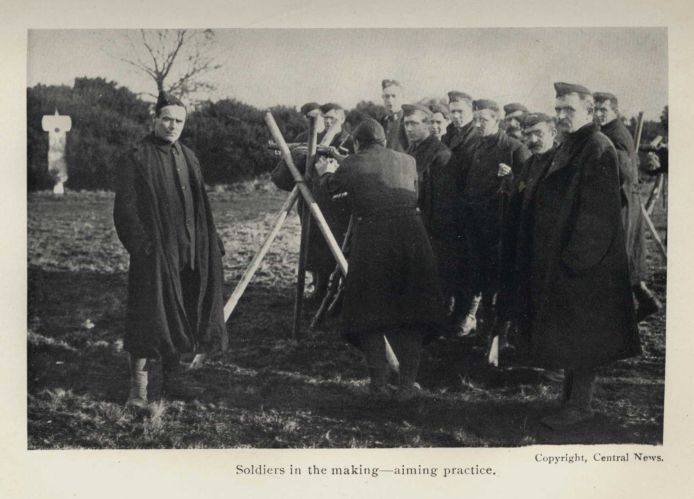
Soldiers in the making--aiming practice
The throngs now streamed toward the Royal Castle in the confident hope that William the Speechmaker would not disappoint them. About six o'clock in the evening their patience and Hochs were rewarded. Surrounded by the members of his family, the Kaiser appeared at the balcony window facing the Cathedral across the Lustgarten (this was more of the 1870 precedent) and, looking down upon the densest and most fervent crowd of his subjects he ever faced, addressed to them in the guttural, jerky, but wonderfully far-reaching tones which are his oratorical style, the following homily:
"A fateful hour has fallen upon Germany. Envious people on all sides are compelling us to resort to just defense. The sword is being forced into our hand. If at the last hour my efforts do not succeed in maintaining peace, I hope that with God's help we shall so wield the sword that we shall be able to sheathe it with honor.
"War would demand of us enormous sacrifices in blood and treasure, but we shall show our foes what it means to provoke Germany, and now I commend you all to God. Go to church, kneel before God, and pray to Him to help our gallant army."
Berlin went to bed on the night of July 31 hoarse with Hoching and footsore from standing and marching, but now indubitably certain that events were impending which would try the Fatherland's soul as it had never been tried before.
CHAPTER VII
WAR
"The Russian mobilization menace!" That was the great myth now irrevocably fastened on the German mind. "The Cossacks at our gate!" Thus was the Fatherland gulled by its war zealots into the belief that the tide of blood sweeping down from the East could no longer be stemmed. German war history was repeating itself. As 1870 was born in deceit, so was 1914. Bismarck doctored the Ems telegram forty-four years previous to extenuate the assault on France, and now the "Russian mobilization menace," the Cossack bogy, was invented as justification for precipitating and popularizing the conflict on which the Prussian War Party's heart was set. A "state of war" had been decreed by the Kaiser in accordance with the paragraph of the Imperial Constitution which authorizes him to declare martial law whenever the domains of the Empire or any part of them are in jeopardy. The Czar's hordes were gathered on the Eastern frontier, preparing to launch a murderous, burglarious attack on innocent, defenseless, peace-loving Germany. They had done more than that--and here was another Hohenzollern 1870 analogy; the Emperor of all the Russias had "insulted" the Kaiser by feloniously massing his legions on the German border while William II, at Nicholas' own request, was "working for peace." It was a pretty story, and German public opinion, shrewdly prepared, swallowed it whole. Germans, their Emperor's "honor" and their own safety now at stake, approved fervidly the ultimatum which they were told had been presented at St. Petersburg, demanding abandonment of the Czar's "provocative" military measures.
I have too much respect for the perfected might of the Teutonic war-machine to believe that any German soldier worthy of the name ever considered Russian military movements along the Prussian and Austrian frontiers at the end of July, 1914, a "menace." It was only a fortnight previous that the German Military Gazette, the official army organ, had laughed the whole Russian army out of court as an organization hardly worthy of Prussian steel. Now the transfer of half a dozen Russian corps had become so vast a peril as to necessitate plunging the whole German Empire into a "state of war!" Everybody who had eyes to see and ears to hear in Germany, native and foreigner alike, always knew that actual mobilization in that country was the merest formality. The Germans were always ready for war. It was their commonest boast. A high officer of the General Staff, twenty-four hours after Serbia's rejection of the Austrian ultimatum, when asked how ready Germany was for eventualities, said, sententiously, "All ready." My Junker friend, Von G., of Kiel, himself a Prussian officer, would have snorted with scornful glee if I had ever suggested to him that any Russian military measures could really "menace" Germany. He knew what I knew, and what anybody with sense in Germany always understood, that, compared to what the Fatherland with its comprehensive system of military-controlled state railways could achieve in the way of final "mobilization," Russia would require weeks where Germany would need only days, or even hours. Germany would be like Texas, criss-crossed in every direction with faultless means of communication and crammed with troops and munitions, mobilizing against the rest of the United States, with the latter having to concentrate armies on the Rio Grande from Florida, Maine, Oregon and Lower California, and a shoe-string railway system with which to do it. The "Russian mobilization menace" was Germany's supreme bluff.
St. Petersburg had been given until twelve o'clock noon of Saturday, August 1, to "demobilize." Failing to do so, Germany would be "compelled to resort to a counter-mobilization." France had been called upon to indicate what her attitude would be in case of a Russo-German conflict, but the ultimatum to Paris, we understood, had no time limit attached. All knew that the great decision rested essentially in Russia's hands; that war with the Czar meant war with the French, too. Twelve o'clock Berlin time came and went without word of any kind from Count Pourtales, the Kaiser's ambassador in St. Petersburg. The Emperor and his civil, military and naval advisers were closeted in a Crown council at the Castle. Pourtales' message, if there was one, the Foreign Office told us, would doubtless reach the Kaiser in the midst of the council, which was a continuous one. Berlin waited in excruciating impatience. The Bourse writhed in panic. Bankers met to consider closing it altogether, but decided that the worst might be avoided by limiting transactions to spot-cash deals. The air was electric with rumor. Russia had asked for a further period of grace, one heard. Hope, report said, while slender, was not yet utterly vanished.
The afternoon passed in almost insufferable anxiety. Unter den Linden and the Lustgarten, the sprawling area around the Castle, were choked with people tense with expectancy. Dread, rather than war fervor, inspired them. About five-twenty o'clock, after one of the daily heart-to-heart war talks I had been privileged to hold over the teacups with Mrs. Gerard, I drove through the Wilhelmstrasse toward the Linden, accompanied by my English colleague, Charles Tower, Berlin representative of the New York World and London Daily News. I do not suppose the historic little spectacle was specially arranged in our honor, but as a matter of fact we happened to pass the Foreign Office at the very instant that Doctor von Bethmann Hollweg, grave with inconcealable worry, was entering a plebeian taxicab. He was evidently starting out on a transcendent mission, for he held in his hand a document of such absorbing interest that he hardly raised his eyes from it as he clambered into the cab. Accompanying him were Foreign Secretary von Jagow and a military aide-de-camp. I blush to confess that Tower and I were filled with such overweening curiosity to find out what that ominous parchment contained, and where the Chancellor was taking it, that we ordered our chauffeur to follow at not too respectful a distance. I never saw a Berlin taxi tear through the heart of the down-town district so madly as Bethmann Hollweg scorched down the Behren-strasse, past the banks which line Germany's Wall Street and the back of the Opera, into Französische-strasse, over the little bridge which spans the canal, and into the southern esplanade of the castle. Only small crowds were gathered at this point, and the Chancellor's cab swung past the sentries and through the big Neptune Gate of the Schloss almost unnoticed. Now instinctively certain of the nature of Bethmann Hollweg's errand, Tower and I made our way to the Lustgarten, since early morning an endless vista of faces stretching nearly all the way from the Dom to the Brandenburg Gate end of Unter den Linden, a mile to the west. We felt sure that the universally awaited Order of Mobilization might be momentarily expected. As events developed, that was the document which we had seen the Chancellor taking to the Kaiser. It was six o'clock. The doleful chimes of the Cathedral across from the Castle were summoning the people to the service of intercession ordained by the Emperor earlier in the day. Solemnity hung over the multitude like a pall. Men and women knew now that Russia's answer, or lack of answer, whichever it might be, meant war, not peace. They had not long to wait for confirmatory news. As soon as word was telephoned to the Wolff Agency, the official news bureau, that the Imperial signature had at length been officially given--that the sword was now, literally and beyond recall, "forced" into William II's hands--the newspapers, which had had sufficient advance information for their purposes, drenched the capital with Extrablätter containing the fateful tidings:
+----------------------------------+ | | | "UNIVERSAL MOBILIZATION OF THE | | GERMAN ARMY AND NAVY!" | | | +----------------------------------+
Another two lines explained, breathlessly, that an order to that effect had just been promulgated by the Supreme War Lord. The twelve-hour period which Germany had granted to Russia for "the making of a loyal declaration" had been ignored. To-morrow, added the chief announcement in the most portentous Extrablatt a German newspaper ever issued, would be the first mobilization day. All Sunday, Monday and Tuesday the Furor Teutonicus would be busy donning shining armor. The deed was done. "Gentlemen," the Kaiser is said to have remarked to Moltke, Falkenhayn and the rest of the military clique, after affixing his signature to the document which meant not only mobilization, but war, "you will live to regret this."
In the midst of our exclusively German environment in those immortal hours--we could now neither telegraph nor telephone in anything except German, nor even read in anything except that language, for foreign newspapers were no longer arriving--I must confess I was filled with no little prepossession in Germany's favor. The Kaiser's case seemed not only good. On the biased evidence available--we had, of course, no other--it even seemed strong. Such fragmentary dispatches from abroad as the Military Censor, already enthroned, permitted to be printed were naturally only those which resolutely bolstered up the fiction of "our just cause." Of the stealthy plot to violate Belgium we had no glimmer of an inkling. We knew only of the "Russian mobilization menace," of the Kaiser's wrecked efforts in the direction of "peace," and of the reluctance with which impeccable Germany was stripping for the fray in defense of her honor, rights and imperiled territorial integrity. Convinced as I had long been of the War Party's lust for "the Day," a setting appeared to have been contrived which put Germany in a plausible, if not altogether blameless, light. It was mass-suggestion, as a Berlin psychologist would describe it, all-hypnotizing in its effects. It was not until five days afterward, when I had crossed the German frontier, reached Dutch territory and come up with the truth that the curtain was lifted and I could look out upon what seemed, after ten days of "inspired" information in Berlin, like country which my eyes had never seen before....
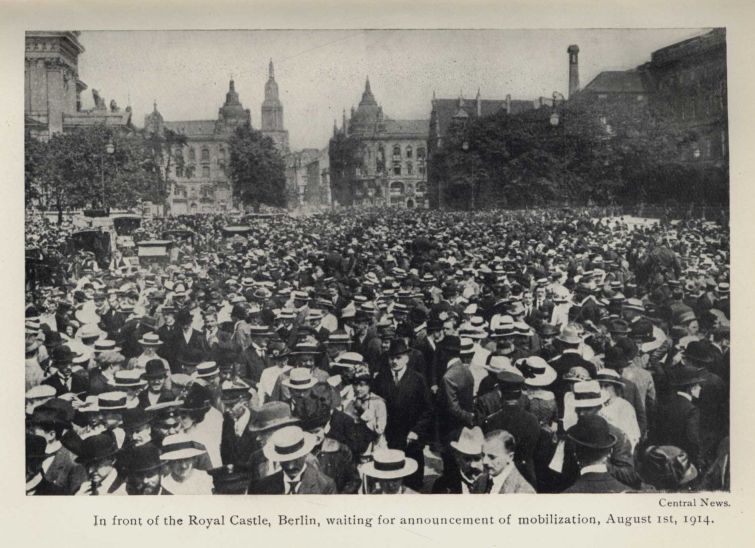
In front of the Royal Castle, Berlin, waiting for announcement of mobilization, August 1st, 1914.
The Mobilization Order tore through the capital with the velocity and the shock of a shell. Expected, it yet stunned. The throng before the Castle still sang Deutschland, Deutschland über Alles and cheered for the Kaiser, and desultory processions of young men and boys still marched hither and thither across the town. But an atmosphere of soberness and grim reality now descended upon Berlin. The street-corner pillars which serve as bill-boards in Germany were already splashed red with the official decree, gazetting August 2, 3 and 4 as the days when the Kaiser's subjects, liable for military service with the first line (Reserve), must report at long-appointed assembly depots, don long-ready uniforms, and march each to his long-designated place in the long-prepared war. Almost simultaneously the telegraph, now like the railway and postal services automatically passed into military control, brought every reservist in the realm definite information as to where and when he was expected to present himself. The magic system which Roon devised for hurling Germany's legions across the Rhine in '70 was once again in mechanical, yet noiseless, motion. Sheer jubilation, the grand-stand patriotism with which Berlin had reverberated for a week, died out. There were good-bys to be said now, long good-bys, and affairs to be wound up. The iron business of war was waiting to be attended to. The crowds in Unter den Linden and the Lustgarten melted homeward, silently, immersed in anxious reflection. Before they waked from their next sleep, the first shot might be fired. On what new paths had the Fatherland entered? Would they lead to death or glory? Never before, I imagine, was the modern German, in his inimitable idiom, given so furiously to think.
The war began early Sunday morning, August 2. Before nine o'clock "Extras" were in the streets with the following official news, the very first bulletin of the war:
"Up to 4 o'clock this morning the Great General Staff has received the following reports:
"1. During the night Russian patrols made an attack on the railway bridge over the Warthe near Eichenried (East Prussia). The attack was repulsed. On the German side, two slightly wounded. Russian losses unknown. An attempted attack by the Russians on the railway station at Miloslaw was frustrated.
"2. The station master at Johannisburg and the forestry authorities at Bialla report that during last night (1st to 2nd) Russian columns in considerable strength, with guns, crossed the frontier near Schwidden (southeast of Bialla) and that two squadrons of Cossacks are riding in the direction of Johannisburg. The telephone communication between Lyck and Bialla is broken down.
"According to the above, Russia has attacked German Imperial territory and begun the war."
The "Russian mobilization menace" was now an accomplished fact, and the Cossack bogy, too, converted into an officially hall-marked actuality!
Modern war, from the newspaperman's standpoint, consists principally of two things--censorship and rumors. Both had now set in with a vengeance. The first day in Berlin swarmed with irresponsible report. People believed anything. Official news was scarce and "far between." The second General Staff bulletin to be issued was a laconic announcement that troops of the VIII (Rhenish) army corps had occupied Luxemburg "for the protection of German railways in the Grand Duchy." Eydtkuhnen, the famous German frontier station opposite the Russian border town of Wirballen, was now reported occupied by Russian cavalry detachments. A Russian had been caught in the act of trying to blow up the Thorn railway bridge. Now France--like Russia, "without declaration of war"--had violated the sacredness of German territory. French aviators had flown into Bavaria and dropped bombs in the neighborhood of Nuremberg, evidently with the intent of destroying military railway lines. Canard succeeded canard. The famed "German war on two fronts" was no longer a figment of the imagination. It had become immutable fact. Monsieur Sverbieff, the Czar's ambassador, we heard, had already received his passports. He would leave Berlin in the evening in a special train to the Russian frontier. When would Monsieur Cambon, the French ambassador, the Republic's accomplished representative in Washington during our war with Spain, be given his walking-papers? So far rowdies had yelled Deutschland, Deutschland über Alles only in front of the Russian Embassy. Now that French airmen had shelled Bavaria, how long would it be before the chateau in Pariser Platz would be stormed?
The British Embassy was wrapped in Sabbath calm. Was not Berlin reading with intensest gratification the Wolff Agency's carefully selected London dispatches saying that "powerful influences are at work to prevent England becoming involved in the war"? Mr. Norman Angell had written in that sense to The Times--the Lokal-Anzeiger reported with undisguised satisfaction. A large number of British professors, it added, had launched a "protest" against war with Germany, "the leader in art and science and against whom a war for Russia and Serbia would be a crime against civilization." A "great and influential meeting of Liberals in the Reform Club" had adopted resolutions commending Sir Edward Grey's efforts on behalf of peace and "energetically demanding the strict preservation of English neutrality." The Germans took heart. Blandly ignorant of their Government's secret diplomatic schemings, now in frantic progress, to keep Great Britain out of the fray, they were lulled by their rulers and doctored press reports into thinking that the danger of interference from the other side of the North Sea was as good as non-existent. The German Imperial Government practised this deception on their own people till the last possible moment. German newspaper readers, in those fitful hours, were being led to believe that the voice of Britain was the pacifist, pro-German voice of Radicalism as represented by journals like The Daily News, Westminster Gazette and The Nation. No intimation was permitted to reach the German public that voices like The Times, The Observer, The Daily Mail, The Morning Post and Daily Telegraph were calling for the only action by the Government consonant with British honor and British rights. The outburst of fanatical rage against the "perfidious sister nation" so soon to ensue was mainly due, I shall always remain convinced, to the diabolical swindle of which the German nation was the victim at the hands of its dark-lantern diplomatists. In that far-off day when the scales have fallen from Teutonic eyes, I predict that the Germans will call for vengeance on their deceivers. As they were duped about Russia, so were they deliberately misled about England.
Before the war was half a day old the spy mania, which was destined to be one of the most amazing symptoms of the war's early hours, was raging madly from one end of the country to the other. It was directly inspired and encouraged by the Government. The authorities caused it to be known that "according to reliable news" Russian officers and secret agents infested the Fatherland "in great numbers." "The security of the German Empire," the people were informed, "demands absolutely that in addition to the regular official organs, the entire population should give vent to its patriotic sentiments by co-operating in the apprehension of such dangerous persons." "By active and restless vigilance," continued this official incitement to lynch law, "everybody can in his own way contribute toward a successful result of the war." It was not to be expected that a nation so idolatrous of officialdom as the Germans could possibly resist this carte-blanche permit to every man to play the rôle of an avenging sleuth. The inevitable result was that Germany became in a flash the scene of a nation-wide "drive" for spies, real or imaginary. Anybody who was either known to be a Russian or remotely suspected of being one, or who even looked like a Russian, was in imminent danger of his life. Now the notorious story of "poisoning of wells in Alsace by French army surgeons" was circulated. "Hunt for French spies!" promptly read the newest invitation to mob violence. Weird "news" began to fill the Extrablätter. A "Russian spy" had been caught in Unter den Linden, masquerading as a German naval officer. After being beaten into insensibility, he was dragged to Spandau and shot. In another part of town a couple of Russian "secret agents," disguised as women, were caught with "basketfuls of bombs." They, too, we learned, were riddled with bullets an hour later at Spandau. Everywhere, in and out of Berlin, the spy-hunt was now in full cry. An automobile, in which women were traveling, was "reported" to be crossing the country, en route to Russia with "millions of francs of gold." The whole rural population of Prussia turned out to intercept it.
One of the earliest victims of the espionage epidemic was an American newspaperman, Seymour Beach Conger, the chief Berlin correspondent of the Associated Press, who had started for St. Petersburg, where he was formerly stationed, as soon as war became imminent, only to be arrested by the spy-hunting Prussian police at Gumbinnen on the charge of being "a Russian grand-duke." Conger's United States passport, unmistakable journalistic credentials, well-known official status in Berlin and convincingly American exterior availed him not. He had plenty of money and a kodak, and that was enough. He must be a spy. For three days and nights he was locked in a cell, and, even after he had contrived to establish communication with the American Embassy in Berlin, he had great difficulty in securing his release. It was eventually granted on the understanding that he should ignore the Associated Press' orders to proceed to Russia and remain in Berlin for the rest of the war, where, I believe, he still is. I was told, but could never verify, that one of the conditions of Conger's liberation was that he should not "talk about" the affair.
How many hapless persons, Russians, French or unfortunates suspected of being such, with nothing in the world against them more incriminating than their real or imagined nationality, were put out of the way either by German mob savagery, police brutality or fortress firing-squads in those opening forty-eight hours of Armageddon will probably never be known. I do not suppose the Germans themselves know. But this I know--that even at that earliest stage of their sanguinary game they conducted themselves in a manner which, had they done no other single thing during the war to stagger humanity, would brand them as a race of semi-barbarians. Kultur gave a sorry account of itself in the Hottentot days between August 2 and 5, of which I shall have more to say, of a peculiarly personal nature, in a succeeding chapter.
War Sunday in Berlin, midst rumor and spy-chasing, was marked by an impressive open-air divine service on the Konigs-Platz, that vast quadrangle of spread-eagle statuary and gingerbread architecture in which the sepulchral "Avenue of Victory" culminates. In the great area between the Column of Victory and the bulky Bismarck memorial at the foot of the gilt-domed Reichstag building a concourse of many thousands gathered to hear a court chaplain, Doctor Dohring, sermonize eloquently on a text from the Revelation of St. John, chapter II, verse 10: "Be thou faithful unto death, and I will give thee a crown of life." It was a singularly appropriate theme, for hundreds of reservists, their last day in citizens' clothes, were in the throng. There was a moment of indescribable pathos, as the chaplain, from a dais which raised him high above the heads of the multitude, invoked the huge congregation to recite with him the Lord's Prayer. Strong men and women were in tears when the Amen was reached. The service was brought to a close with a beautiful rendition by that mighty chorus of the Niederländisches Dankgebet, the famous hymn which proclaimed at Waterloo a century before the end of the Napoleonic terror.
Nightfall found those seemingly immobile Berlin thousands still clustered, now almost beseechingly, round the Royal Castle. They hungered for an opportunity to show the Supreme War Lord that Kaiser and Empire were dearer than ever to German hearts in the hour of imminent trial. Just before dark, while his outlines could still be plainly distinguished even by the rearmost ranks of the crowd, William II, thunderously greeted, stepped out once more to the balcony from which he had told the populace two nights previous that the sword was being "forced" into his hand. He beckoned for silence. Men reverently removed their hats, and leaned forward on tiptoes, the better to hear the Imperial message. This is what the Kaiser said:
"From the bottom of my heart I thank you for the expression of your love and your loyalty. In the struggle now impending I know no more parties among my people. There are now only Germans among us. Whichever parties, in the heat of political differences, may have turned against me, I now forgive from the depths of my heart. The thing now is that all should stand together, shoulder to shoulder, like brothers, and then God will help the German sword to victory!"
No historian of Germany in war-time will be able to say that his people did not take the Kaiser's stirring admonition to heart.
CHAPTER VIII
THE AMERICANS
On the occasion, nine or ten years ago, when it was my privilege to be presented for the first time to that most sane and suave of German statesmen, Prince Bülow--it was at one of his so-called "parliamentary evenings" at the Imperial Chancellor's Palace during the political season,--he inquired, pleasantly:
"How long are you remaining in Germany?"
"Just as long as Your Serene Highness will permit," I responded, half facetiously and half seriously, for foreign correspondents are occasionally expelled from Germany for pernicious professional activity.
For the ten days preceding August 1, 1914, while the European cloudburst was gathering momentum, such time as I could spare from the chase for the nimble item was devoted to patching up my journalistic fences in Berlin, with a view to remaining there throughout the war. There was at that time no conclusive indication that England would be involved. Having seen Germany in full and magnificent stride in peace, I was overwhelmingly anxious to watch her in the practise of her real profession. As an American citizen and special correspondent of three great American newspapers--the New York Times, Philadelphia Public Ledger and Chicago Tribune--and fully accredited as such in German official quarters, I had every reason to hope that, even if England were drawn into the war (as to which I, myself, was never in doubt), my previous status as Berlin correspondent of Lord Northcliffe's Daily Mail would not interfere with my remaining in Germany as an American writing exclusively for American papers. It was, of course, obvious that if this permission were granted me, my connection with the British news organization, which for years was Germany's bête noire, would have automatically to cease.
In Ambassador Gerard, as ever, I found a ready supporter of my plans. He recognized, as I did, that a "Daily Mail man," particularly one who had specialized, as I did for eight years, in publishing as much as I dared about Germany's palpable preparations for war, would perhaps be on thin ice in asking favors of the Kaiser's Government at such an hour. But Judge Gerard also knew that, while persistently doing my duty in reporting the sleepless machinations of the German War Party to attain "a place in the sun," I had written copiously in England and with equal faithfulness of the many attractive and favorable aspects of German life and institutions. In 1913 I produced a little book, Men Around the Kaiser, which from cover to cover was a sincere hymn of praise of almost everything Teutonic. This foreigner's tribute to the real source of modern German greatness--the Fatherland's captains of science, art, letters, commerce, finance and industry--was considered so fair and flattering to the Germans that Männer um den Kaiser, a German translation, went through eight editions to the two of the English original. During the Zabern army upheaval in Alsace-Lorraine in the winter of 1913-14 an article of mine in The Daily Mail entitled "What the Colonel Said" was the only presentation of the German military attitude published in England. Even the War Party newspapers in Berlin honored me with a reproduction of that attempt to interpret the Prussian point of view that, where the sacredness of the King's tunic is at stake, all other considerations vanish into insignificance.
The Ambassador suggested, in the always practical way of American diplomacy, that I should assemble for him a dossier of some of my newspaper work in Berlin showing that I had consistently attempted to show the bright, as well as the dark side, of the German picture. Judge Gerard promised to submit my desire to remain in Germany during war, if war came, to Foreign Secretary von Jagow and to recommend that my aspiration should be gratified. It was welcome news which the Ambassador was finally enabled to give me on August 1, that the Foreign Secretary had considered my application and granted it. I rejoiced that a long-cherished ambition seemed on the brink of realization--to see the terrible German war-machine at work, to report its sanguinary operations from the inside, and perhaps some day to record in a book, which would have been incomparably more vital than this bloodless narrative, my close-range impressions of man-killing as an applied art.
I was not the only American appealing to our Embassy for amelioration of my troubles about this time. In fact there were so many others--hundreds and hundreds of them--that the Ambassador and his small staff ceased altogether to be diplomats and became merely comforters of distracted compatriots plunged suddenly into the abyss of terror and helplessness in a strange land by the specter of war. From early morning till long past midnight Wilhelms Platz 7, the dignified home maintained by the Gerards as American headquarters in Germany, was besieged by a mob of stranded or semi-stranded fellow citizens who flocked to the Embassy like chicks running to cover beneath the protecting wing of a mother hen. Never even in the history of Cook's was so frantic a conclave of the personally conducted assembled. They wanted two things and wanted them at once--money and facilities to get out of Germany with the least possible delay. That bespectacled school-marm from Paducah, Kentucky, had not come to Berlin to eat war bread and spend her spare time proving her identity at the police station--she moaned in tearful accents. That aldermanic committee of Battle Creek, Michigan, was not getting what it bargained for--study of Berlin's sewage farms and municipal labor exchanges. Its main concern now was to reach Dutch or Scandinavian territory, with the minimum of procrastination. That portly Chicago millionaire's wife yonder, when she bought a letter of credit on the Dresdner Bank, had not figured even on the remote possibility of its refusing to hand her over all the money she might care to draw. The moment had come, she was vociferating, to see what "American citizenship amounts to, anyhow," and what she demanded was a special train to warless frontiers, and then a ship to take her "home." These were just a few of the plaints and claims which issued in a crescendo of insistence and panic from these neurotic tourist folk, who, in tones often more imperious than appealing, wanted to know what "Our Government" intended to do with its war refugees and refugettes cruelly trapped in Armageddonland.
Americans who come to Europe proverbially feel a proprietary interest in their Embassies, Legations and Consulates. The Berlin Ambassador for years put in much valuable time assuaging the grief and disappointment of brother patriots who felt a God-given right to gratify such trifling ambitions as an audience with the Kaiser, an inspection of the German army or minor favors like exploration of the German educational system under the personal chaperonage of the Minister for Culture. Then, of course, there was the ever-present "German-Americans," who, having slipped away from their beloved Fatherland in youth without performing military service, would risk a visit to native haunts in later life, only to fall victim to the German military police system which has a long memory and a still longer arm for such transgressors. On many such an occasion, even when, like a Chicago man I know, the "German-American" stole back under an assumed name, the paternal diplomatic intervention of the United States has saved the "deserter" from a felon's cell in his "Fatherland."
By the morning of August 4, the American panic in Berlin began to assume truly disastrous dimensions. The Embassy was literally jammed with fretting men, and weepy women and children. Every room overflowed with them. The cry was now for passports. It was coming from all parts of the country. All foreigners were suspect, English-speaking ones in particular, and the German police were demanding in martial tone that Ausländer should "legitimatize" themselves.
The railways were available now only for troops. The Hamburg-American and North German Lloyd had canceled all their west-bound sailings, and our Consular officials in Hamburg and Bremen were telegraphing the Berlin Embassy that they, too, were stormed by throngs of Americans in various stages of anxiety, fear and financial embarrassment. From Frankfort-on-the-Main came a similar tale of woe. All around that delightful city are famous German watering places--Bad Nauheim, Homburg, Wiesbaden, Langen-Schwalbach, Baden-Baden, Kissingen and the like--and American "cure-guests," regardless of their rheumatism, heart troubles, gout and other frailties for which German waters are a panacea, forgot such insignificant woes in the now crowning anguish to own a passport which would designate them as peaceable and peace-loving children of the Stars and Stripes.
The Embassy rapidly and patiently mastered the situation. Mrs. Gerard converted herself into the adopted mother of every lachrymose American woman and child squatted on her broad marble staircase. Mrs. Gherardi, the wife of our Naval Attaché, and Mrs. Ruddock, the wife of the Third Secretary, who were at the time the only feminine members of the Embassy family, resourcefully seconded the Ambassadress' efforts to soothe the emotions of the sobbing sisters and youngsters from Iowa and Maine, from Pennsylvania and Texas, from Montana and Florida, and from nearly all the other States of the Union, who refused to view qualmless the prospect of remaining shut up for Heaven knew how long in war-mad Germany, already effectually isolated from the rest of the world behind an impenetrable ring of steel. As for the men of the Embassy, from the Ambassador down to "Wilhelm," the old German doorkeeper who has initiated two generations of American diplomats into the mysteries of their profession in Berlin, no faithful servants of an ungrateful Republic ever came so valiantly to the rescue of fellow taxpayers. The Embassy apartments, including the Ambassador's own sanctuary, were turned into offices which looked for all the world like a Census Bureau. Every available space for a desk was usurped by somebody taking applications for passports or filling up the passports themselves, to be turned over to Judge Gerard in an unceasing stream for his signature and seal. Uncle Sam surely never raked in so many two-dollar fees at one killing in all the history of his Berlin office. Nor did American citizens, I fancy, ever part with money which they considered half so good an investment.
The Embassy itself, hopelessly understaffed for such an emergency, was, of course, quite unequal to the enormous strain suddenly imposed upon it, so volunteer attachés and clerks were gladly pressed into service. There, for instance, sat a Guggenheim copper magnate, who probably never lifts a pen except to sign a million-dollar check, at work with a mantel-piece as a desk, recording the vital statistics of a Vermont grocery-man who wanted a passport. In another corner sat Henry White, ex-Ambassador in Rome and Paris, scribbling away at breakneck pace, in order that the age, complexion and height of that trembling Vassar graduate might be quickly and accurately inscribed in an application for a Yankee parchment. There, with the arm of a chair as his desk, was Professor Jeremiah W. Jenks, great authority on political economy, currency and trusts, patiently extorting the story of his life from the coroner of the Minnesota county who had been caught in the German war maelstrom in the midst of an investigation of municipal morgues. What a vast practical experience of inquests he might have reaped had he remained in Europe! And over there, looking out on the Wilhelms Platz, with a window-sill as a writing-board, the Titian-haired belle of Berlin's American colony, in daintiest of midsummer frocks and saucy turbans, who had never in years done anything more strenuous than organize a tea-party, was in harness as a volunteer in the impromptu army of Uncle Sam's clerks, doing her bit for her country and country-folk. It was all very typically and very delightfully American, a composite of true Democracy in which one is for all, and all for one. I like to doubt if there are any other people on earth who turn in and help one another in a spirit of all-engulfing national comradeship so readily, so unconventionally and so good-naturedly as Americans. That drama of companionship in misery and adaptability to emergency conditions, which held the boards at the American Embassy in Berlin during the first week of the Great War, will live long in the memory of those who witnessed it as one of the striking impressions of a Brobdingnagian moment.
Obviously things would have been different if the crisis had not found two real Americans in command of the Embassy in the persons of Mr. and Mrs. Gerard. When the typical New Yorker whom President Wilson sent to Berlin less than a year previous was first presented to his compatriots at a little function at which it was my honor to preside, the man whom political detractors contemptuously referred to as "a Tammany Judge" made a "keynote speech," which he meant to be interpreted as his "policy" in Germany, as far as Americans were concerned. He said: "When the time comes for me to retire from Berlin, if you will call me the most American Ambassador who ever represented you in Germany, you can call me after that anything you please."
Two years--what years--have elapsed since "Jimmy" Gerard made public avowal of his conception of what United States diplomatic representatives abroad ought to be--Americans, first, last and all the time. As these lines are written German-American official relations seem on the verge of rupture and our embassy's remaining days in Berlin appear to be calculable in hours. Whether it shall turn out that the Arabic insult was after all swallowed as the Lusitania infamy was stomached, or whether Judge Gerard is finally recalled from Berlin as a protest extracted at length from the most patient, reluctant and long-suffering Government on record, he will richly have realized his ambition--to be "the most American Ambassador" ever accredited to the German court. In my time in Berlin I knew four American ambassadors. Each one was a credit to his nation. But "Jimmy" Gerard was "the most American," and I count that, in a citizen of the United States called to represent his country abroad, the superlative quality. The seductive atmosphere of a Court in which adulation was obsequiously practised, especially toward Americans, never turned the head of Judge Gerard or his wife. They had far more than the share of hobnobbing with Royalty which falls to the lot of diplomatic newcomers in Berlin. Princes and princesses came with unwonted freedom to Wilhelms Platz 7. They found the former Miss Daly, of Anaconda, Montana, being a natural young American woman, as much at ease in their gilded presence as she was the day before when presiding over the tempestuous deliberations of the American Woman's Club out on Prager Platz.
To me the Gerards, apart from their personal charm, unaffected dignity and joyous Americanism, always were psychologically interesting because they typified so splendidly that greatest of our national traits--adaptability. To be dropped into the vortex of European political life, with its gaping pitfalls and brilliant opportunities for mistakes, is not child's play even for the most experienced of men and women. France, for example, regarded no name in its diplomatic register less eminent than that of a Cambon fit to head its mission to Berlin. England kept at the Hohenzollern court the most gifted ambassador on the Foreign Office's active list--Sir Edward Goschen. Unthinking Americans, by which I mean those who underestimate our inherent capacity to land on our feet, may have had their misgivings when a mere Justice of the Supreme Court of the State of New York and the daughter of a Montana copper king were sent to represent America among professional diplomats of the highest European rank. But "Jimmy" and "Molly" Gerard made good. It is the American way, and because it is that, it is their way. As for the Ambassador, he has demonstrated, to my way of thinking, that a graduate course in the university of American politics is ideal training for diplomacy. Intelligence, tact, resourcefulness and courage, the rudiments of the diplomatic career, are qualities which surely nothing can develop in a man more thoroughly than the hurly-burly, rough-and-tumble, give-and-take of an American electioneering campaign. It is amid its storms and tribulations that a man learns to be something more than an inhabited dress-suit. It is there he acquires the art of being human. It is there that he comes to appreciate the priceless value of loyalty. United States Presidents do not err seriously when they hunt for ambassadors among men who have been through the preparatory school from which "Jimmy" Gerard holds a magnum cum laude.