THE ASSAULT (continued 4)
Reading edition
A weepy good-by scene with Fräulein, a parting, lingering look around my beloved Arbeitszimmer--so soon to be ransacked by the German police--an undying vow from the little woman to guard our Lares and Penates as if they were her own last earthly possessions, and all was at an end, so far as my habitat in Berlin was concerned. It has not been my privilege to say farewell to fireside and dear ones and then leave for the front in field-gray or khaki, but no soldier-man anywhere in this war has torn himself away from home ties more sorrowfully than I turned my back in the gathering dusk of August 5, 1914, on dear old Helmstedter-strasse. Instinctively I felt that I should never see it again, and my heart was heavy.
"What's Baron von Stumm got against you?" asked Second Secretary Harvey, smilingly, at the American Embassy, when I arrived, bag and baggage, at nine o'clock. "He says you're not an American." Stumm was the chief of the Anglo-American section of the German Foreign Office. He knew perfectly well that I am an American. He had entertained me at his own table in May, 1910, when he gave a luncheon-party in honor of the American newspaper correspondents stationed in Berlin and those traveling with Mr. Roosevelt on the occasion of the Colonel's visit to the Kaiser. Stumm had "nothing against me" in June, I explained to Harvey, because of his own sweet volition he distinguished me with a call at my hotel during Kiel Regatta. I could not imagine what had suddenly come over the scion of the humble Westphalian blacksmith's house, which was one of the first of the nouveau riche German industrial tribes to be ennobled. I could only think that, like the Berlin police, Legationsrat Heilbron, Herr Direktor Kretschmar and nearly all other Germans, Stumm had temporarily gone mad. If I was "not an American," it had taken the Imperial German Foreign Office thirteen years to make the discovery. Some day I am going to send Stumm a Christmas card. It will be embellished with a gilded birth-certificate attested by the clerk of the County of La Porte, Indiana.
No one supplied me with the details of the final negotiations which were necessary to induce the German Government graciously to consent to permit me to leave Germany alive. I have since learned that my pass was not secured without some extremely forcible remonstrances and representations. Stumm had denounced me as a "scoundrel" and in other knightly terms. Why the German Foreign Office so ardently desired to prevent my departure, after having earlier in the same day declined to promise me immunity from physical harm, is a mystery which I trust it may some day elucidate. To fathom it is beyond my own feeble powers of divination, and in this narrative of farewell tribulations in the Fatherland, I have confined myself strictly to facts. I have resolutely not yielded to the temptation to surmise. But as the official Genesis of Armageddon is not likely to honor me with mention, I have presumed to set forth my own diminutive part in it with perhaps a tiring superfluity of detail. I have the more eagerly ventured to do so because grotesque versions of the "terms" on which I, an American citizen, if you please, "secured permission to leave Germany," have been, and still are, for all I know, in circulation in Berlin. They are believed--and that is the one saddening thought they inspire in me--by people who were once my friends, among them Americans who place bread-and-butter business necessities and social expediency in Germany above the elementary dictates of gratitude and personal loyalty, which are traits one encounters even in a Dachshund. It is these insufferable lickers of German bootheels who "have heard" that I "gave my word of honor" to seal my lips forever "about Germany," to "go back to the United States at once" (perhaps as press-agent to Dernburg, who was also leaving Germany), to "renounce all connection with English journalism," and other pledges of equally imbecilic character. The only "broken pledge" which the rumor-mongers did not foist upon me was an outright agreement to join Germany's army of kept journalists. I should have been better off, financially no doubt, if I had enlisted in that immaculate service, which is one of the best paid in the world.
My permit to leave Germany, Harvey said, would be issued during the night and be handed me next morning at the British Embassy. Meantime, evidently to make assurance doubly sure, Ambassador Gerard gave me in his own handwriting an attest that I was leaving the country with Sir Edward Goschen. He affixed to it the great seal of the Embassy, handed me the note with a merry "Good luck," I wrung his hand in a last grip of gratitude and good-by, and we parted company.
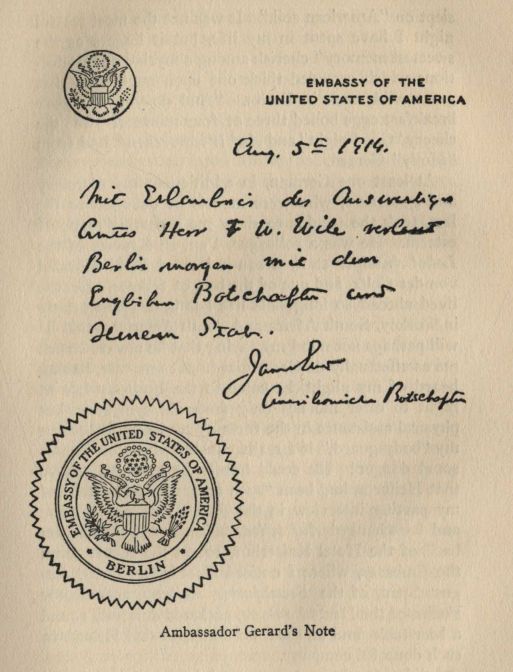
Ambassador Gerard's Note
Meantime I had opened negotiations with the Embassy porter to pass the night on a cot in his lodge, where Tower had bunked after our arrest, and arranged with him to call me at four-thirty, so that I could be at the British Embassy well before six o'clock. While I was chatting in the hallway, Mrs. Gerard came along. "Where are you going to sleep to-night?" she inquired, solicitously. I told her. She would not hear of my lodging plans in the porter's basement. There were half-a-dozen bedrooms in the Embassy, and I must use one of them. Then she hustled away, in the most motherly fashion, to prepare for me what turned out to be a suite-de-luxe. My last night in Germany was slept on "American soil." It was not the most restful night I have spent in my life, but it lingers as the sweetest memory I cherish among a myriad of recollections which crowded thick one upon another in that great wild week in Berlin. "And do you like your breakfast eggs boiled three or four minutes?" was the cheery "Good night" and Auf Wiedersehen I had from "Molly" Gerard.
At least one German, in addition to my secretary and governess, who were models of devotion to the last, took the trouble to show me a parting mark of esteem. He was a colleague, Paul R. Krause, of the Lokal-Anzeiger staff, a son-in-law of Field Marshal von der Goltz, and one of the best of fellows. Krause lived abroad so long--his life has been spent mostly in Turkey, South Africa and South America--that he will perhaps not mind my saying that he always struck me as effectually de-Germanized. At any rate, having heard of my plight, he came to the Embassy late at night to offer me not only fraternal sympathy, but physical assistance in the form of readiness to become my "body-guard," if I really considered myself in personal danger! He could hardly be made to believe that Heilbron had been "such an ass," when I told of my parting interview in the Foreign Office. Krause and I exchanged Auf Wiedersehen in the "American bar" of the Hotel Kaiserhof, round the corner from the Embassy, where I noticed Doctor Dernburg, August Stein, of the Frankfurter Zeitung, and Doctor Fuchs, of the Deutsche Bank, gathered dolefully round a beer-table, and amazed, no doubt, to find Krause in such doubtful company.
I did not seek my downy couch in the Embassy until I had had a farewell promenade and visit with two very dear newspaper pals, Swing, of the Chicago Daily News, and Feibelman, of the New York Tribune and London Express. Feibelman was still in the throes of the anxiety from which I was about to be relieved, as the Foreign Office had also refused him credentials owing to his connection with an English journal. He sincerely envied my good fortune in being able to escape with the British Ambassador. I was glad to hear a week later that he too had eventually contrived, with the American Embassy's assistance, to reach Holland, where he has done excellent work for his paper during the war. Swing, Feibelman and I, arm-locked, walked the silent streets around and about the Embassy until long past midnight, speculating as to what the red-clotted future had in store for each of us, embittered at Fate for so ruthlessly disrupting friendships of affectionate intimacy, and wondering, when all was over, if it ever would be, whether Berlin or Kamchatka would be the scene of our next reunion....
Something told me that even a twelfth-hour attempt might be made to hamper my get-away, so, as a "positively last farewell" favor I asked "Joe" Grew, my rescuer from the police, to escort me to the train. Though it meant his tumbling out of bed at the unromantic hour of five, his breezy "Sure, I will" set my mind completely at rest. He arrived at the appointed minute. The sight of the Stars and Stripes flapping at the front of his car was a reassuring little picture. They had meant much to me during the preceding forty-eight hours. At the British Embassy, which looked more like a baggage-room or express-office struck by lightning, with the floors littered indiscriminately with hastily-packed boxes of documents and records, trunks, suit-cases, golf-bags and batches of clothing hastily slung or strapped into or around traveling-rugs--and all the other indescribable impedimenta of a suddenly-retreating army or an evicted family--I found my German pass awaiting me. It had been delivered to Godfrey Thomas, one of Sir Edward Goschen's able young attachés, all of whom, like the Ambassador himself, had given so characteristic an exhibition of British imperturbability during the final hours of crisis. The pass described me as "the English newspaper correspondent, Wile." It is reproduced opposite this page. I treasure it with the same pride which probably inspires a reprieved man to cherish the document which cheats the hangman.
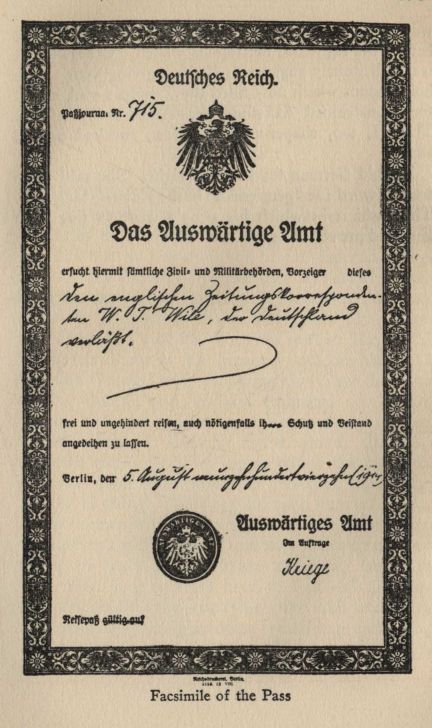
Facsimile of the Pass
There was no guard of honor to bid Sir Edward Goschen and his staff Godspeed from the Wilhelmstrasse. No single German was so poor as to do them reverence except a couple of sleepy policemen and half-a-dozen blear-eyed, early-rising Berliners on their way to work. None of them had yet learned to say Gott strafe England, so the lonely cavalcade of luggage-laden taxis, which were hauling Great Britain's official representatives on the first stage of their journey out of the enemy's capital, proceeded on its way without molestation or demonstration.
The very day the Kaiser's ambassador to England, Prince Lichnowsky, was accorded a departure from London amid honors customarily reserved for a ruling sovereign. Great Britain's ambassador to Germany was leaving like a thief in the night, the Imperial Government having requested him, when shaking the dust of Berlin from his miscreant feet, to slink to the railway station as inconspicuously as possible and long before the righteous metropolis waked. Otherwise, it was solicitously suggested, Kultur, giving vent to the holy venom which now filled the Teutonic soul, might feel constrained to stone the Ambassador afresh. Thus, I, too, chaperoned by Grew, sneaked out of Berlin.
My old German teacher was right. She said there was no word for "gentleman" in the Kaiser's language. The fashion in which his people went to war with England proved it.
CHAPTER XII
SAFE CONDUCT
Lehrter Bahnhof, the gateway through which so many American tourists have passed out of Berlin en route to Hamburg or Bremen steamers, was not en fête in honor of the departing Engländer. My memory traveled back irresistibly to the last time the British Embassy in force was assembled there--to greet King George and Queen Mary when they arrived to visit the German Court in May, 1913. The rafters rang on that occasion with the blare of a Prussian Guards band thundering God Save the King, cousins George and William embraced fondly and kissed, and the station was swathed in the entwined colors of Germany and England. It was a different and forbidding aspect which the old brick and steel barn of a train-shed presented this muggy August morning. At every entrance sentries in gray and policemen with Brownings at the belt stood guard, for railways and stations were now as integral a part of the war-machine as fortresses and guns. Inside, infantrymen in gray from head to foot--all Germany had now grown gray--carrying rifles with fixed bayonets patrolled the platforms, searching each Englishman, as he came along, with glances mingling watchfulness and contempt.
Our band of pilgrims, who were to be some forty or fifty in all, arrived in detachments, having, as Sir Edward Goschen himself officially described it, "been smuggled away from the Embassy in taxicabs by side streets." The Ambassador himself was one of the last to turn up. No Imperial emissary came to wish him a happy journey and Auf Wiedersehen, though the Foreign Secretary deputized young Count Wedel to say good-by in his name. The Kaiser's farewell greeting to Sir Edward was conveyed the day before, when the All-Highest sent an adjutant with majestic regrets for the sacking of the Embassy premises on the night the war broke out. Of markedly less apologetic tenor was the adjutant's message that William II, "now that Great Britain had taken sides with other nations against her old allies of Waterloo, must at once divest himself of the titles of British Field Marshal and British Admiral." The uniforms, orders and decorations conferred on him by Perfidious Albion had desecrated the exalted person of the supreme Hohenzollern for the last time. In the memorable dispatch in which he so dispassionately narrated his final hours in Berlin, Sir Edward Goschen sufficiently indicated the true character of the Kaiser's adieu by mentioning that "the message lost none of its acerbity by the manner of its delivery." As a Prussian officer was firing it at the official incarnation of Great Britain, it is not difficult to imagine the mien and tone of the proud functionary on whom had been conferred the historic distinction of breathing Hate in the face of the foe at that cataclysmic hour.
I shall always hold it a privilege to have been in contact with Sir Edward Goschen during the days which preceded the war and in the hours of its beginning. He was throughout an object-lesson in imperturbability. In the midst of his holidays in England when the crisis arose, having left Kiel early in July with the British squadron, he returned hurriedly to his post in Berlin just before the match was applied to the powder-barrel. I recall distinctly the invincible state of his good humor when I visited him at the Embassy on July 31, only an hour or two before the Kaiser declared Germany to be in "a state of war."
"Wile," he remarked, fastening upon me a gaze which very successfully simulated vexation, "what did you mean by libeling me in that dispatch of yours from Kiel on the Kaiser's visit to our flagship? You had the effrontery to suggest that I was lolling about the quarter-deck in a tweed suit. I would have you understand that my costume afloat is always the regulation navy-blue!"
I pleaded color-blindness. I said that from our perch behind the thirteen-and-one-half-inch gun turret for'd, it looked to me as if His Excellency had actually worn tweed.
"Well, I didn't," he insisted, "and you caused me to be twitted not a little in London for my apparent ignorance of battleship etiquette."
Sir Edward Goschen, unlike other British Ambassadors I knew in Berlin, was never at any moment of his career there under any delusions as to the leitmotif of German policy toward Great Britain. No Teutonic wool was ever pulled over his eyes. During the week of tension which ended with war, he bore himself with tact and firmness characteristic of the highest diplomatic traditions. Though never surrendering a position in the trying negotiations with the Kaiser's Government, the Ambassador did not cease, up to the hour when he asked for his passports, to labor for such peace as would be consistent with British interests. It is not customary in the British service, I believe, to send a diplomatic official back to a country with which England has meantime been at war, but Sir Edward Goschen could return to Berlin with his head high, enjoying not only, I am sure, the limitless confidence of his own Government, but the unalloyed respect of Germany, as well.
Our party having been politely herded into the royal waiting-room of the station, a couple of silk-hatted and frock-coated young Foreign Office officials now buzzed busily about us, checking off our respective names and identities on their duplicate lists, lest no unauthorized Engländer should escape through the ring of steel drawn tight around Germany's frontiers. Our safe-conduct train had now pulled in. We found ourselves a somewhat indiscriminate collection of refugees. Besides Sir Edward Goschen, there was, of course, the full embassy family of secretaries, attachés, clerks, the wives of one or two of them, and one bonnie group of babes with their blue-and-white "nannies." Sir Horace Rumbold, the Counselor of the Embassy, who had conducted the initial negotiations with Germany, monocled and unruffled, was as calm as if he were starting off for a week-end in the country. Captain Henderson, the Naval Attaché, and a prince of sailormen, had no inkling of the undying discomfiture soon to be his, as an ingloriously interned captive in neutral Holland, for his first assignment from the Admiralty was to command a detachment of the ill-starred naval expedition to Antwerp. Colonel Russell, the Military Attaché, was quitting German soil with emotions a little different from those of the rest of us, for he had seen the light of day at Potsdam in 1874, while his late father, Lord Ampthill, was British Ambassador to Germany. It was only a few weeks previous that the colonel's own Berlin-born son had been christened "William" under the august Godfatherhood of the Kaiser, who sent the babe a golden cup emblazoned with the Hohenzollern arms. With us, too, were Messrs. Gurney, Rattigan, Monck, Thomas and Astell, Sir Edward Goschen's able staff of secretaries and young attachés, who had all "sat tight," in their British way, so splendidly during the preceding forty-eight hours. The official party also included the British Minister to Saxony, Mr. Grant-Duff, and Lady Grant-Duff, whose windows in Dresden had been broken, too, and Messrs. Charlton and Turner of the Berlin and Leipzig consulates, respectively.
The journalist-refugees consisted of Mackenzie and Jelf of The Times, Tower and Nevinson of The Daily News, Long of The Westminster Gazette, Lawrence of Reuter's Agency, Byles of The Standard, Dudley Ward, of the Manchester Guardian and his newly-wed German wife, and Muirhead, the "camera man" of The Daily Chronicle. Poor Jelf, who enlisted within a week after his arrival in England, was killed in action during the great offensive fighting in Artois, in September, 1915. Among the others whom Sir Edward Goschen had rescued from the maws of Hate was a little Australian woman, Mrs. Gunderson, trapped in Germany with her husband at the outbreak of war. They had journeyed around the world on their honeymoon to enable him to participate in an international chess match at Mannheim. He has been stalemated ever since at the British concentration camp at Ruhleben--Berlin. Then there was an estimable old English couple who had spent a night in jail on the charge of being "spies" prowling about the German countryside in their touring-car. They were not bemoaning the loss of their automobile in the presence of their own escape and that of their chauffeur. One of the luckiest of our traveling companions was Captain Deedes, a British army officer who was passing through Germany on his way home from service in Turkey, and just gained the precincts of the British Embassy before being nabbed by the police. We shuddered to think of the fate of Captain Holland of the British navy, also en route from Constantinople, who had not been so fortunate, and was now locked up at Spandau. I was the sole and lonely American member of the caravan.
The Germans provided Sir Edward Goschen with a "corridor train" of first-class cars, including "saloon carriages," which are a combination of parlor and sleeping cars, for himself and his immediate entourage, and for Baron Beyens, the Belgian Minister to Berlin, and his staff, who, appropriately enough, were conducted to the frontier along with the British. Baron Beyens has contributed to the genesis of the war not the least noteworthy evidence of Germany's felonious designs on European liberties and peace. As has been revealed by a Belgian Grey Book, the Baron was able to report to his government as early as July 26 that "the German General Staff regarded war as inevitable and near, and expected success on account of Germany's superiority in heavy guns and the unpreparedness of Russia." Baron Beyens also described his final and dramatic conversation with the German Foreign Secretary, who "announced with pain" Germany's determination to violate Belgian neutrality, and asked to be allowed to occupy Liége. The request was refused, Herr von Jagow admitting to the Minister that no other answer was possible. The Belgians had another "answer" up their sleeve, though von Jagow knew it not. It was the shambles into which the flower of the German Guard plunged at Liége a week later.
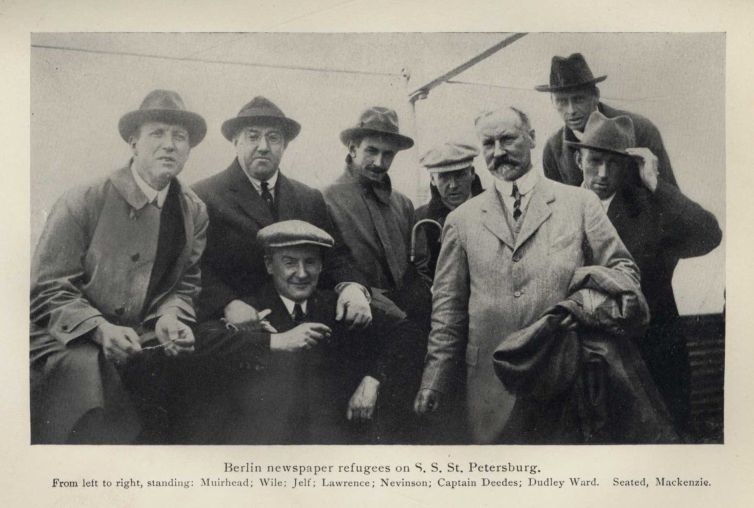
Berlin newspaper refugees on S. S. St. Petersburg. From left to right, standing: Muirhead; Wile; Jelf; Lawrence; Nevinson; Captain Deedes; Dudley Ward. Seated, Mackenzie.
Lieutenant-Colonel von Buttlar, a dapper little gray-haired Prussian officer with a Kaiser mustache and a heel-clicking manner, presently approached Sir Edward Goschen, saluted, introduced himself as the military chaperon of the party, and invited us to troop into the train. An armed guard, a strapping infantryman with glistening bayonet affixed to his shouldered rifle, was already aboard. He turned out, as did the lieutenant-colonel himself, to be a very harmless warden. When the Oberstleutnant, gloved and helmeted as if on dress parade, was not snoozing or reading during the journey, he merely hovered about, mother-like, to see that his charges were comfortable, as well as not up to mischief. In addition to the ordinary train-crew, we were shepherded by seven or eight plain-clothes Prussian detectives, whom even the ruse of regulation railway-caps could not disguise. You can tell a German "secret policeman," as he is idiomatically called, at least a mile off. He is the last word in palpability.
Our destination, we learned, was the Hook of Holland, where either a Great Eastern steamer or a British cruiser would pick us up. We were to travel via Hanover-Osnabrück to Amsterdam and thence to the sea. Mackenzie, Jelf and I, having preempted a compartment, settled down at the windows for a last long look at Berlin as the train now tugged slowly out of the station, a few minutes past eight o'clock. Speaking for myself, I am quite sure that railway trucks never rattled with such sweet melody as those beneath us were producing, for with every chug they were bringing us nearer to liberty. I remember a distinct feeling of consciousness that I should not consider myself an utterly freed felon until German territory was actually no longer under my feet. It was an indescribably gratifying sensation, all sufficient for the moment, to realize that Berlin at least was fading into oblivion. Whether any of my British colleagues were throbbing with similar emotions, I never knew. It is un-English, I believe, to reveal emotions even if one is battling with them. Whatever thoughts were in their minds, I myself was obsessed with a distinct desire, at that moment, to blot Berlin from my mind for all eternity. Perhaps, as I thus soliloquized, I was giving way unconsciously to a passing spell of that unreasoning malice which infested hate-maddened Berlin. I suppose I ought to have shed briny tears, as we skirted Spandau and sped across the dreary plain of the Mark of Brandenburg, and familiar landmarks passed from view. Certainly in the long ago, I had firmly made up my mind that when my time to leave Germany came I should go away with genuine regret. Life in the Fatherland had meant much to me and mine. Although I never adopted it, like Lord Haldane, as my "spiritual home," a man can not spend thirteen years of middle life in the same community, however alien to its spirit and institutions, without forming deep-rooted attachments. But the circumstances which precipitated me out of Germany conspired, I fear, to quench old-time affection. So, ungrateful as it may appear, my handkerchief was not brought into play and my eyes were uncommonly dry as the sand-wastes of Brandenburg vanished from our vision....
It was evident that we were in for a tedious journey and that our trek across Western Germany was to be agony long drawn out. Berlin to Hanover, the first leg of the trip, was one I had accomplished times innumerable under three hours, and even a Bummelzug hardly took longer. It was to take us nearly three times as long to-day. Mobilization was technically complete, but every railway track in the country, especially if it fed the great trunk-line to the west along which we were traveling, was still choked with troop trains. In consequence, though ours was a "special," we had to halt, back up, sidetrack and perform every other gyration of which a train is capable, whenever we came up with battalions en route toward one of the three frontiers on which German blood was now being spilled. At every station we encountered trainloads of men in gray, singing, cheering and laughing as if bound for a picnic instead of slaughter. It was always they who had the right of way, for it was soon borne in upon us that the meanest detachment of reservists bulked larger in Germany's eye just then than "the whole bally British diplomatic service put together," as Jelf irreverently expressed it. Never at any time were we doing anything dizzier than twenty miles an hour, and we figured that if we reached Hanover by dinner-time, we should be fortunate. As to London, which we used to reach twenty hours after leaving Berlin, it became painfully obvious that it would be nearer forty this trip.
But there was much to see, and to think and talk about. As we were being held up everywhere along the line by seemingly the entire male population of the Empire in uniform, it was not surprising, for one thing, to find the fields on either side of us as denuded of men as if Adam had never lived. None but women was discoverable at work on this eve of harvest, excepting here and there an old man, while children, too, were being pressed into service. At bridges, culverts and crossings, instead of the customary railway guards, who used to stand at salute with a flag as a train whirled past, there were now soldiers with rifles. No restrictions were placed upon our reconnoitering the adjacent country as long as we were in motion; but Lieutenant-Colonel von Buttlar, always heel-clicking and saluting beforehand, intimated to Mein Herren that the curtains of their compartment-windows must be drawn as the train approached or halted at stations. There was no suspicion, he begged to assure us, that we might attempt to practise espionage about troop movements. On the contrary, the suggestion was a precaution recommended in our own interests. Unfortunately, quoth the apologetic colonel, it had not been feasible to conceal the identity of our train. Western Germany was bursting with patriotic frenzy, and it was just within the range of possibilities that their exuberance might beat itself into disagreeable "demonstrations." Therefore, discretion was obviously our cue.
But what we could not see at Nauen, Rathenow, Stendal, Gardelegen, Obisfelde and Lehrte, we could hear, for all the inhabitants of every hamlet and town in Central Germany appeared to have orders from somewhere to assemble at their railway-stations and sing themselves red in the face for Kaiser and Empire. Manifestly the Supreme War Lord had not only called up his armed legions, but mobilized the country's Singvereine besides, and man, woman and child of them were now in the trenches with their throats bared to the foe. I suppose they were chanting Die Wacht am Rhein and Deutschland, Deutschland über Alles in other parts of Germany, too, but I have often thought that the country's most vociferous and tireless choral artists were concentrated on that day on the strategic line of the British safe-conduct train's route. If the Great General Staff at Berlin, with that incomparable attention to detail which is one of its vaunted accomplishments, schemed to send us out of Germany convinced, by the evidence of our own ears, that the Kaiser's people were sallying forth to war like Wagnerian heroes with music and triumphant cheers on their lips, the plan succeeded. My own indelible recollection of that farewell ride across Germany, at any rate, is the memory of song. For many days and nights afterward, Die Wacht am Rhein and Deutschland, Deutschland über Alles, would ring and ring through my head. At the time it all seemed beautifully spontaneous, for the Germans are a singing folk, who put soul into their anthems, but reflection makes me wonder if that continuous song-service which so mercilessly accompanied us from Berlin to the Netherlands was not a stage-managed extravaganza with a motive. The Germans are a thorough race, and in war they overlook no opportunity.
It was only at times that the singing was anything else than merely monotonous--the periodical occasions when, if we halted longer than usual at a station, the singers would line up alongside the train so closely that they could fairly shout in our ears. Then there would be a note of ill-mannered defiance in their song. At Hanover we happened to be drawn up in the station at the very moment when the British Ambassador and the Belgian Minister were in the dining-car, and there was a particularly vehement vocal endurance competition outside of the window at which they were sitting. But from my own table on the opposite side of the car I observed that Sir Edward Goschen was not visibly diverted from his Wiener-Schnitzel, for, while the Deutschland, Deutschland über Alles was doing its worst, he remarked, cheerily, to his Belgian colleague: "Rather fine singing, isn't it?"
Next to the songs which knew no ending the most conspicuous manifestation of Furor Teutonicus was the chalking of troop-trains with exuberant inscriptions symbolical of expected great German victories to come. "Special to St. Petersburg" was a prime favorite. "Excursion to Paris" was extremely popular. That, we know, is exactly what the War Party expected the campaign to be. "Through Train to Moscow" ran a particularly sanguine sentiment and "Death to the Blood-Czar," a more sanguinary one. Then there would be rude caricatures of Nicholas II or President Poincaré either at the end of a noose or of the boot of an equally rudely-cartooned Kaiser. And, of course, there were plenty of jests at Great Britain. "We'll soon be chewing roast-beef in London" was the way one artist epitomized his hopes. "Special Train to the Peddler-City"--a shaft at London, the home of the "shopkeeper nation" which "organized war against Germany" in order to "crush an unpleasant commercial rival." "Death to our enviers!" was the language in which another Anglophobe thought found expression. Beneath the British Ambassador's car-windows, I was told, some one had chalked a John Bull drooping ignominiously from the gallows, with "Race-Traitor" for an epitaph!
The night was fitful for us all. Curled up on the seats of our compartments, such attempts at sleep as we ventured were effectually defeated by Deutschland, Deutschland über Alles and Die Wacht am Rhein. All through the night they were hurled at us. At every town, regardless of the hour, the choristers were on the job. We welcomed our arrival at Bentheim, the final station in Prussia, at seven next morning, not half so eagerly because it was the last of Germany as because it was the last of Deutschland, Deutschland über Alles and Die Wacht am Rhein. For any sins we ever committed in the Fatherland, we felt we had been richly chastised. I understood now why General Sherman once crossed the Atlantic to escape Marching through Georgia--only to be bombarded with it beneath his windows before breakfast by an Irish band in Queenstown before he had been in Europe twelve hours. I am morally certain that when old Tecumseh said that "War is hell," he was thinking about Marching through Georgia. That is what Deutschland, Deutschland über Alles made me think about Armageddon.
None of us experienced any special difficulty in restraining our emotions when Lieutenant-Colonel von Buttlar and our other German chaperons handed us over at Bentheim to a Dutch train crew awaiting our arrival there with a Dutch locomotive. The colonel clicked and bowed his farewell respects to Sir Edward Goschen and Baron Beyens, accepted their appreciations of his courtesy and helpfulness, saluted for the last time, and then formally transferred us to Queen Wilhelmina's tender mercies. The hour of our liberation was at hand. And for the first time in a week a score of Englishmen and at least one American thought out aloud their opinions about Germany and all her works. What some of us said about the Hohenzollerns has been put by Colonel Watterson in far more immortal diction than my poor pen could epitomize it.
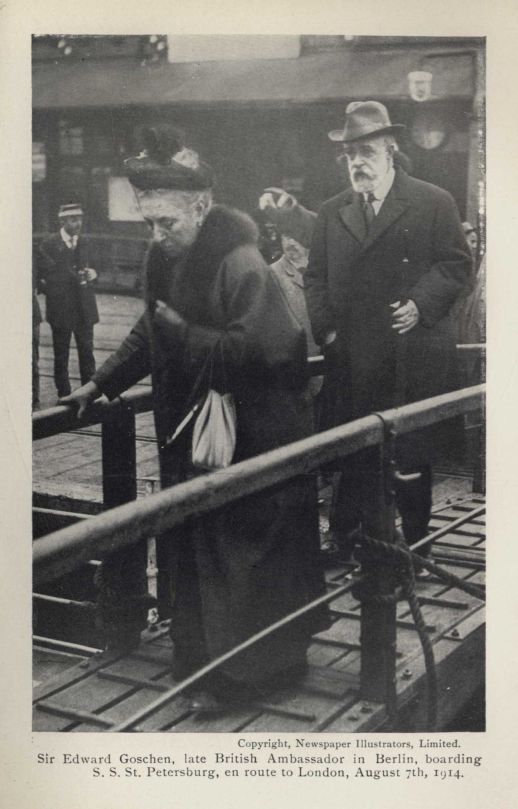
Sir Edward Goschen, late British Ambassador in Berlin, boarding S. S. St. Petersburg, en route to London, August 7th, 1914.
At Rozendaal, the first station in Holland, there was a wild scramble from the newspaper coach for the railway telegraph-office. All of us had reams of "copy" to release, after having been muzzled for five days. German money, we were distressed to observe, was already at a discount in the Netherlands, and those of us who did not hand in Dutch or British gold had to put our "stuff" on the wire after more fortunate colleagues had beaten us to it with legal tender. A couple of hours later found us at Amsterdam, where representatives of the British Legation at The Hague and the local Consulate-General were on hand to greet Sir Edward Goschen's party and furnish us with the first news of actual war operations which we had had. Fighting at sea had begun. England had drawn first blood. The German mine-layer Konigin Luise, within eighteen hours of the declaration of hostilities, i.e., on Wednesday, August 5, was overtaken by the British destroyer Lance and sunk in six minutes. There was reason to fear that a fleet of enemy mine-layers, masquerading as fishing-boats and in other pacific disguises, had been occupied for the better part of a week strewing mines through an area reaching from a point off Harwich--which we were soon to approach--along the east coast far up into Scottish waters. On the next day, Thursday, August 6, the British light cruiser Amphion struck a mine planted by the Konigin Luise and went down with heavy loss of life. Much more cheering was the news that gallant Belgium was giving the Germans a welcome they had not bargained for. The Meuse was being gloriously defended. Liége was menaced, but still untaken. Germans had been mown down by the regiment--if reports could be believed--and we devoured them eagerly. No news is ever so welcome as that which one longs to hear--even before it is confirmed.
The Hook was ready for us, we were told. The Great Eastern steamer St. Petersburg was there awaiting our arrival, having the night before landed Prince Lichnowsky and the other members of the German Embassy in London. The Kaiser's emissary had passed to the ship through a British guard of honor, while shore batteries fired an ambassador's salute. How like Sir Edward Goschen's slinking departure from Berlin, we thought! Shortly after two o'clock the St. Petersburg lifted anchor and amid typical North Sea weather, raw, rainy and misty, got under way. Few thought of German submarines at that time, but the Berlin Government, we pondered, had not guaranteed Sir Edward Goschen "safe conduct" through an indiscriminately sown field of floating mines. Quite obviously, we had now to pass through a zone bristling with uncertainty, to put it mildly. But we had not steamed far into the open sea before the sight of a British torpedo-boat flotilla on patrol convinced us that we were in a well-shepherded course. Then we had our first ocular demonstration of Jellicoe's unremitting vigilance, for the crescent of destroyers far forward now began rapidly to close in upon us. Our identity was apparently not known to them, and they were taking no chances. "They sent a shot across our bow yesterday, with the Germans on board," explained the skipper of the St. Petersburg to Captain Henderson, the Naval Attaché, who was with him on the bridge. Captain Henderson was not disturbed by the possibility of our getting an innocuous three-pounder in our wireless rigging or some other harmless token of the destroyers' solicitude, but he was concerned lest so innocent a craft should cause British destroyer captains to burn up valuable oil fuel needlessly at such an hour. So the next I saw of Henderson he was wig-wagging mysterious messages with signal-flags from the bridge of the St. Petersburg, which told the destroyers, I suppose, that we weren't in the slightest respect worthy of their attention or shell. They wig-wagged something back which must have pleased Henderson, for presently he clambered down smilingly from the upper regions, and said: "That's all right!"
Harwich hove into view at what should have been sundown. By six o'clock we were at the pier, boarded by the naval authorities of the port and the customs-men. Sir Edward Goschen's party, after the Ambassador himself had vouched for the identity of each and every one of us, was disembarked without formalities, and at six-forty-five P.M. of Friday, August 7, we found ourselves treading British soil. There were policemen, soldiers, reporters and photographers on the dock, but no formal welcoming delegation for the Ambassador. Somebody whispered to him that a special train would convey him and his refugees to London, and to it he took his way as undemonstratively as if he were a Cook's tourist back from a "tripper's" jaunt to the Continent. I remarked to Tower that I was afraid Americans would have made a real fuss over Goschen if he were our Ambassador home from the enemy's country; whereupon The Daily News man ejaculated something which was to ring in my ears for a year or more, whenever I presumed to comment on that strange phenomenon with which it is now my task to deal--England and the English in war-time: "Wile, you Americans can not understand the English character." Tower was right.
An American is general manager of the Great Eastern Railway. I strongly suspect that he must have had an alien hand in even the semblance of a "demonstration" of greeting which Sir Edward Goschen encountered when our train pulled into Liverpool Street Station a little after eleven o'clock. I did not wait to watch it, nor even to claim my baggage, for there was a hungry first edition waiting for my "story" at The Daily Mail office, and to Carmelite House I flew in the first taxi into which I could leap. By midnight Beattie, the night editor, was tearing "copy" from my hands as fast as an Underwood could reel it off, and it was rapidly approaching breakfast-time when I called it a night's work and went to bed--in England at last.
CHAPTER XIII
COMPLACENCY RULES THE WAVES
More than once during the last phase of our exciting journey to England, across the mine-strewn waters between the Hook and Harwich, I reflected that I seemed doomed to take up my residence on British soil in war-time. It was in the spring of 1900, in the anxious days between Ladysmith and Mafeking, when the tide of victory was still running in favor of the Boers, that I first arrived in London, and my lot was cast there for the succeeding year and a half of the South African struggle. I felt certain that the feverish interest with which even the sluggish British temperament had followed every detail of a campaign ten thousand miles away, and which engrossed only a fraction of the Empire's strength, would pale into tepid insignificance compared to the concern which would be generated by a tremendous European war only a channel-crossing distant. But I had time for only one breakfast and one morning's papers before I realized that John Bull had donned, even for Armageddon, the garment in which his bosom swells the proudest--the armor of invincible inexcitability.
Actually the only wrought-up people in the British Isles during the first week of the war appeared to be the frantic American tourist refugees, who, of course, heavily outnumbered their brothers and sisters in wretchedness whom I had left behind in Germany. If it had not been for the frantic transatlantic sob and worry fraternity storming the steamship and express companies' offices in Cockspur Street and the Haymarket on the morning of Saturday, August 8, when I went out to look for the war in London, no one could possibly have made me believe that such a thing existed. Such portions of the community as had not started for the links, the ocean, the river or the country "as usual" were demeaning themselves as self-respecting, imperturbable Britons customarily do on the edge of a "week-end." The seaside holiday season was at its zenith. The immortal "Twelfth," when grouse-shooting begins, was approaching. Everybody who was anybody was "out of town," and stayed there. It was only those fussy, fretting Americans who insisted upon losing their equilibrium and converting the most placid metropolis in the universe into a bedlam of unseemly agitation and alarm. It was "extraordinary," Englishmen said, how they resolutely declined to take a lesson from the composite stolidity of Britain, preferring to give their emotions unrestrained rein and to keep the cables hot in imperious demands for ships, gold and other panaceas for the scared and stranded. Which reminds me to say that traditional British hospitality to the stranger within the gate was never showered more graciously on American friends than in that trying hour.
The British had worried a whole week about the war already. That was a departure and a concession of no mean magnitude, for it is their boast and pride that they never "worry." Having, however, yielded to such un-British instincts in the earliest hours of the crisis, they pulled themselves together and swore a solemn resolve, come what may, not soon again to succumb to indecorous habits which the world associated exclusively with the explosive French or the irresponsibly impulsive "Yankees." I felt instinctively that an effectual rebuke was being administered to me personally by the writer of the following newspaper review of London after three days of war:
"A new metal has come into the London crowd out of the crucible of these last few days. The froth and fume of flag-wagging have evaporated; so, too, have lifted bone-quaking mists of dread and suspense. Exultation and depression are alike unhealthy. It is good that we are now free from them.
"The faces in the street are the barometers of the souls that men hide. It does one's heart good to walk London and to behold that very notable rise--apparent to every one and swift in its example--of the mercury of the people. The great war took all our comprehensions unawares. Although it has boded for years, it walked at last like an unbelievable spectre into a warm and lighted room. What wonder that we were shaken? What wonder at a creeping ague of the spirit in front of the unknown?
"The dizziness has gone. The trial before us, black as it is, is not so black as our anticipation of it. We have already surprised ourselves no less than we have confounded our enemies by our rally and our readiness. The financial situation is saved, the banks re-open, the food supplies are safeguarded, and prices controlled.
"A tremendous accession of calmness and reliance has come to the nation by the appointment of Lord Kitchener to the War Office. The news that the Army is in his hands, a rock of a man, has swept through London like a vivifying breeze.
"London is swinging back to as much of its normal life as possible. She has found herself. She is bravely being the usual London--the great city serene."
Far more profitable, obviously, than hunting war excitement was examination of the causes which accounted for its absence, and to that I forthwith devoted myself. In the first place, there was the navy, "England's All in All." By a fortuitous circumstance, for which, with all his faults, the Empire must render imperishable gratitude to its young half-American First Lord of the Admiralty, Winston Churchill, the Fleet was instantly at its "war stations," fully mobilized, and in a state of battle-readiness and general efficiency unparalleled in British history. War maneuvers on an unapproached scale had been in progress for the preceding fortnight or three weeks. Only the merest word of command was wanting to convert the Grand Fleet into the battering-ram and shield, to constitute which in the hour of emergency it had been created. "Ringed by her leaden seas," which were held, moreover, by a "supreme" armada, there seemed every justification for equanimity, for the United Kingdom has no frontiers which an invading army can violate as long as Britannia rules the waves.
The domestic political situation, more menacingly turbulent than at any time within the memory of living Englishmen, had been resolved with miraculous rapidity and completeness. "Revolution" in Ulster, on which the Germans had so fondly banked, vanished as effectually as if it had never raised its head. "We will ourselves defend the coasts of Ireland," declared John Redmond in the House of Commons in a speech which will never die, "and I say to the Government that they may to-morrow withdraw every one of their troops from Ireland." Mrs. Pankhurst, freshly released from a periodical hunger-striking sojourn in Brixton jail, announced that the suffragettes had stacked arms and now knew only womankind's duty to England. That sent another Berlin dream careening into oblivion. "His Majesty's Loyal Opposition" proclaimed in Parliament through the mouth of the Conservative leader, Bonar Law, that the Government's political opponents were prepared to accord it "unhesitating support." In the Government itself the "Potsdam Party," as that relentless iconoclast, Leo Maxse, long termed the coterie which was for peace with Germany at almost any price, was either weeded out or suppressed. Lord Morley, the Lord President of the Council; "Honest John" Burns, still true to convictions, President of the Local Government Board, and Charles P. Trevelyan, Parliamentary Secretary of the Board of Education, unobtrusively retired from Mr. Asquith's official family in consequence of their inability to sanction the war. They have played their parts meantime with honorable consistency--by maintaining an hermetical silence on questions of the war. And finally, though primarily in popular judgment, Lord Haldane, the graduate of Göttingen, the translator of Schopenhauer and the admirer of German Geist, was driven by scandalized public opinion from the War Office, whither he had just come as an "assistant" to the Prime Minister, whose cabinet portfolio was the Secretaryship for War. Most of England sighed with thankful relief when the able Scotch lawyer and philosopher whom contemporary history accuses of responsibility for Britain's military unpreparedness, beat an ignominious retreat back to his regular post, the wool-sack, which, as Lord Chancellor, he by general consent conspicuously adorned. The country's relief became enthusiastic assurance when the lawyer, Asquith, himself retired from the War Office, to make way for the soldier, Kitchener, who was recalled by telegram the day before from Dover, just as he was about to board ship for Cairo, to resume his duties as the ruler of Egypt. With the "Potsdam Party" banished or made harmless, the Cabinet was now regarded as satisfactorily purged. The public heard with boundless gratification that the "strong men" of the Government--Grey, Lloyd-George and Churchill--had been uncompromisingly for war from the start as the only recourse compatible with British honor, to say nothing of the elementary dictates of self-preservation. It was at length possible for Mr. Asquith to assure the country that he presided over an administration of whose unity of view and determination there was no shadow of a doubt--a Government which was resolved, as Sir Edward Grey's great speech in the House of Commons on August 3 set forth, to accomplish three cardinal purposes:
1. To protect the defenseless French coast against attack by the German navy;
To defend the integrity of Belgium; and
3. To put forth all Britain's strength and not run away from the obligations of honor and interest.
When the events of the Great War, and perhaps the chief actors in it themselves, have passed away, some British historian will almost certainly arise to tell the world the story--the "inside story"--of how Mr. Asquith's cabinet, through three days and nights of doubts, uncertainties, trials and tribulations, crossed the Rubicon to the shore of unanimity on the subject of British participation. There were moments, beyond all question, when that issue hung perilously in the balance. The French Government's frantic eleventh-hour appeals for a decision in Downing Street are mute evidence of the vacillation which prevailed--a species of tentativeness which has never been missing from the British conduct of the purely diplomatic affairs of the war. The ministerial debates during which the die was cast in favor of war will make immortal reading, even if only a digest of them is all that is vouchsafed posterity. The "strong men" of the Government, if report is reliable, were called upon to fight valiantly and ceaselessly to avoid England's "running away from the obligations of honor and interest." The tense interval which ensued while they were battering down the trenches of skepticism, chicken-heartedness and nonchalance among their Cabinet colleagues caused a delay which might easily have proved of fatal import; for the decision to throw the strength of the British army, as well as the navy, into the scales was under discussion, and it is conceivable that the Expeditionary Force, which it was eventually determined to send, might have been kept back for weeks, or even altogether, instead of the mere days its dispatch was actually retarded. Disaster incalculable would almost inevitably have resulted in that event.
The indispensable and all-governing preliminary measures for war in respect of domestic politics, the Government and the naval and military administration having thus been taken, equally radical precautions were invoked to put the nation's economic house in order. The Stock Exchange, following the lead of New York, Paris and Berlin, had shut down as early as July 31, in order that mere insensate panic on the part of the speculative and investing world might not degenerate into irretrievable rout. War having descended with irresistible suddenness during the "week-end" preceding the traditional August Bank Holiday (Monday, the 3rd), a meeting of great financiers in the Bank of England on the holiday itself decided to prolong it, as far as banks and bankers were concerned, for three days, i.e., until Friday, the 7th, in what turned out to be the well-grounded hope that public excitement would meantime subside and prevent "runs" ruinous alike to banks and depositors. A moratorium was established. The Bank discount-rate, which had already vaulted from four to eight per cent., was now raised to ten, an unheard-of figure, which effectually curbed the lust of persons anxious to profit from war abnormalities or otherwise indulge in operations not consistent with the gravity of the hour.
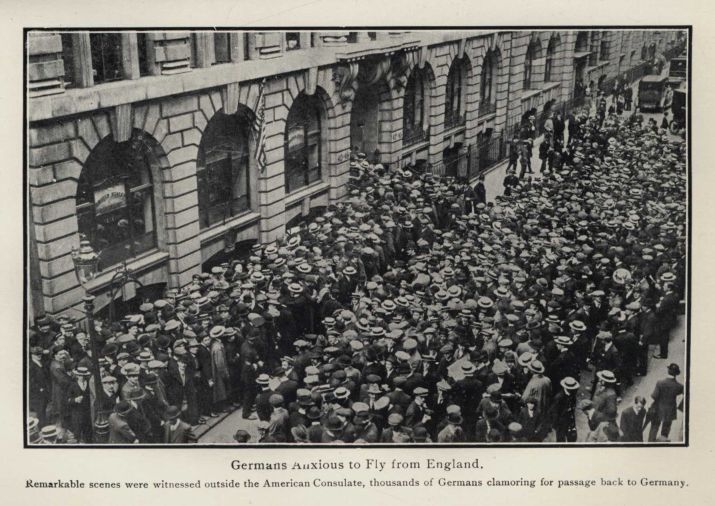
Germans Anxious to Fly from England. Remarkable scenes were witnessed outside the American Consulate, thousands of Germans clamoring for passage back to Germany.
It was mainly these things--wholesome, substantial proofs that their rulers had grappled with the situation with bold initiative that inspired the people of London with reassurance, which, diluted with the stoicism of the British character, became calm confidence Gibraltar-like in its inflexibility. She had "the men," England was saying; she had "the ships," and, Parliament having voted an initial war fund of one hundred million pounds as unconcernedly as if it were a thousand-pounds grant for a new switch-track at Woolwich arsenal, she unmistakably had "the money," too.
But even more self-comforting, if possible, than this iron trust in her own inexhaustible resources was England's conviction in the invincibility of her Allies. Was not even little Belgium holding back the flower of the German army before Liége? Even in the unlikely event of Liége's fall, would not the impregnable fortress of Namur provide Krupp guns with a still tougher nut to crack? Those were, alas! the hours in which the existence of the forty-two-centimeter siege gun was not even mooted in ostrich England. France? The Germans would find a vastly different antagonist awaiting them this time in the Ardennes, the Vosges passes and along the Meuse and the Sambre. There was a "New France," a France of élan and iron. It was the virile Republic of Poincaré, Delcassé, Joffre, Bleriot, Pegoud and Carpentier, with which the Prussian hosts must this time measure lances, not the degenerate Empire of the third Napoleon, which crumbled at Sedan and Metz and surrendered Paris. Russia? "Can't you just hear the steam-roller rumbling across East Prussia and thundering at the gates of Berlin?" a great English peer asked me, in all seriousness, during my first week in London. "Isn't the tread of the Czar's countless millions, pounding remorselessly toward the west, almost audible?" he persisted. Millions of Englishmen were thinking and saying the same thing. As for the German army, almost as many of them were convinced that that "over-organized, peace-stale" military establishment, which was a magnificent spectacle on parade, but lacked leaders experienced in modern campaigning, would crash to pieces not only against "superior numbers" but against Allied troops and commanders who had been fighting great wars this past quarter of a century in Africa and Asia. London's feelings toward Germany seemed, indeed, almost compassionate. Many people, otherwise sane, talked about the war being over by Christmas. The Kaiser's navy would come out and be smashed, they calculated, and such work as had not already been accomplished by the Allied armies within the Fatherland's eastern and western frontiers would soon be completed by "internal collapse," industrial stagnation, national impoverishment and universal starvation. Poor Germany! She had brought it on herself. Her end, after a peace soon to be dictated in Berlin, would manifestly be speedy and annihilating. The Social Democrats, it was true, were bamboozled into support of the war by fictitious assurances that the sword had been "forced" into Germany's unwilling and blameless hand, but the scales would presently fall from their eyes, and then woe betide whatever remained of the Hohenzollerns' ravished, defenseless realm! Street-hawkers in the Strand were selling blatant copies--a penny each--of The Kaiser's Last Will and Testament. Would William II be sent to St. Helena, like the other Napoleon, or be interned in some more accessible point in the British Empire, to pass the remaining days of his humiliation and remorse? And the "Crown Prince" with him, of course. These were the reveries of Britain in the early days of August, 1914. Nothing disturbed them except the creaking and the rumbling of the Russian steam-roller. Those being dulcet reverberations, John Bull paused eagerly in the midst of his musings to let them lull him into a still deeper siesta of optimism....
Serene and imperturbable as the vast majority of Englishmen were, the responsible leaders of the nation were under no delusions as to the magnitude of the task now confronting them. To the country's intense astonishment, though Lord Roberts had been dinning it in their ears incessantly for at least five years previous, England found itself in a state of practical impotence as far as effective participation in modern large-scale military operations was concerned. In the same five minutes during which Parliament voted one hundred million pounds as a first war credit, it also sanctioned an increase of the British army by five hundred thousand men. At that moment the Home military establishment, which was immediately mobilized as "The British Army Expeditionary Force" when England decided to enter the war with her soldiers as well as her sailors, consisted of eight divisions of all arms--roundly, one hundred fifty thousand men. An organization of another half-million troops, officered and equipped for a great Continental campaign, could not be stamped out of the ground. Its production, even in a country with the glorious military traditions of England, was manifestly fraught with stupendous difficulties. There was no mistrust of British patriotism; but when men recalled the futility of Lord Roberts' efforts to implant in England's conscience the necessity of some form of National Service--how he not only failed, but was ridiculed and vilified for pursuing his sagacious crusade in the face of merciless rebuff--and when inherent British repugnance to "soldiering" and even to wearing uniforms was remembered, there were widespread misgivings.
Prussian militarism long filled me with abhorrence. I had learned to detest it not as an institution, but for its numerous disgusting manifestations, principally the arrogance of its gilded popinjays and the brutal and overweening contempt in which their traditions and training taught them to hold mere civilian microbes. Yet in those frantic hours when hopelessly unready military England was compelled to patch up an army for battle against the world's most scientific war-machine, I pondered what a blessing a little "militarism" would have been for the British democracy. I had seen Germany trooping off to war, singing, cheering and flower-garnished; and I knew that her debonair demeanor was due less to lust for the fray--the great mass of the nation was animated by no such sentiment as that--than to the realization, which sprang from immutable facts and numbers, that her citizen army was equal to almost any emergencies it would be called upon to meet. Germany was a nation in arms. England was a nation in difficulties. How grotesquely unprepared to play a commensurate part in a military war, compared to her Continental allies and foes, this table showing the size of the various armies indicates:
Peace footing War footing Guns Great Britain ............... 234,000 380,000 1,000 Austria-Hungary ............. 500,000 2,200,000 2,500 France (including Algeria) .. 790,000 4,000,000 4,200 Germany ..................... 850,000 6,000,000 5,500 Russia ...................... 1,700,000 7,000,000 6,000
Lord Kitchener was obviously the man of the hour. An organizer primarily, rather than a strategist, tactician or field-marshal, his appointment to the War Secretaryship demonstrated that whoever was responsible for it--men say it was Lord Northcliffe--recognized instantly the all-overshadowing requirement: a recruiting sergeant. Joffre, the French Commander-in-Chief, would necessarily retain the supreme direction of the Allied forces operating against the German front in France and Belgium. England's part was to send him men. And the one to find, drill and equip them was unmistakably Kitchener of Khartum, South Africa, India and Egypt, the "organizer" of victory against the fuzzy-wuzzies and the Boers, the disciplinarian who had galvanized the Indian army into new life, and the administrator who was licking Egypt into Imperial shape. There would be time enough for the war itself to produce another Wellington or Roberts. What was needed now was men, rifles and guns, cartridges, shells and uniforms, war-planes, motor-lorries and hospital-trains and all the other innumerable impedimenta of modern man-killing. The summoning to the task of the big bluff soldier who first saw the light in County Kerry, who was looked upon as the incarnation of initiative and relentless efficiency, and who had proved his right so to be considered, was elementary and inevitable. It was work for a "sergeant-major" and a "drill-sergeant" rather than for a Napoleonic genius; and when England learned that "K.," as he is affectionately known in the army, was on the prodigious job, England took heart. She responded with a will to his first appeal for men. The hoardings of the Kingdom were plastered with it on the morning of August 8. It read as follows:
+------------------------------------------------------------------+ | | | YOUR KING AND COUNTRY | | NEED YOU. | | | | A CALL TO ARMS | | | | An addition of 100,000 men to his Majesty's Regular Army | | is immediately necessary in the present grave National | | Emergency. | | | | Lord Kitchener is confident that this appeal will be at once | | responded to by all those who have the safety of our | | Empire at heart. | | | | TERMS OF SERVICE | | | | General Service for a period of 3 years or until the war is | | concluded. | | | | Age of Enlistment between 19 and 30. | | | | HOW TO JOIN | | | | Full information can be obtained at any Post Office in the | | Kingdom or at any Military depot. | | | | GOD SAVE THE KING! | | | +------------------------------------------------------------------+
In the past England's volunteer army had been maintained by a recruiting system which produced, on the average, about thirty-five thousand new men a year. They did not come easily, even in halcyon peace times, and the gaily-caparisoned recruiting-sergeant in Trafalgar Square, who would buttonhole a hundred likely "Tommies" in a day, earned well his fee if he succeeded in inducing ten of them to "take the shilling." It remained to be seen if "the present grave National Emergency" would find dormant in Britain military talent and inclination hitherto undreamt of. In the opening flush of the excitement and enthusiasm which the war engendered, Lord Kitchener's hopes were satisfactorily realized. Recruiting-offices in numerous districts were literally stormed. The response from the middle, "upper-middle" and upper classes was particularly buoyant. Duke, peer, aristocrat, nobleman, "nut," banker, lawyer, doctor, merchant, teacher and clerk came forward splendidly. But artisan, docker and miner lagged. The lower class revealed an inclination to continue to throng the public-houses rather than the recruiting-offices. It seemed evident at the outset that it was not they who were bent on saving England. They gave disquieting indication that their sort of patriotism was primarily individual self-preservation, that for them, love of country began at home. A waking-up process in their unenlightened ranks was destined to come to pass, thanks mainly to "separation allowances" for missus and the kids, but it was never to attain the dimensions of a rousing which extorted from their atrophied intelligence even an approximate appreciation of their obligations or their country's peril. Britain's war is being waged, as it will be won--speaking broadly--by the patriotism and blood of the excoriated upper ten thousand. The struggle had been in progress for more than a year, at a cost of nearly five hundred thousand British casualties, when it was still necessary for Lloyd-George to remind working-class England, in as unqualified language as a politician dare speak to the nation's electoral masters, that it was not doing its full duty.
While Britain at large still hugged the delusion of easy victory, in grotesque underestimation of the enemy's power, and while Kitchener's recruit-finding machinery was being put in vigorous motion, the War Office, in co-operation with the navy, was accomplishing as magnificent a piece of military work as army annals hold--the silent landing of the British Expeditionary Force of one hundred and sixty thousand men, with its full complement of horses, guns and stores, on the shores of France. That feat will live as immortal disproof of the charge popular in the United States that "hustle" is a word which is conspicuously missing from the British lexicon. Compared to it, our "hustle" in landing an army in Cuba in 1898 was the quintessence of procrastination and muddle. The British railways had been taken over by the Government coincident with the arrival of war, an "Executive Committee" consisting of the General Managers of the main companies having been established more than a year previous as an advisory council for such an emergency as had now supervened. Embarkation of the Expeditionary Force commenced on the night of August 7th. Admiral Jellicoe, Commander-in-Chief of the Grand Fleet, assured Lord Kitchener that the channel passage was as safe as the Thames itself. The British public, receiving its first lesson in relentless censorship of war news, was kept so effectually in the dark as to the dispatch of the largest army which ever left English shores that it knew nothing whatever of it till the host was at its destination, with breasts bared to the foe. The landing of Sir John French's legions on the soil of France was accomplished, complete in every detail, by August 17th.
British railways, when the record of that marvel of transportation is compiled, will share the honors with the ironclads of Britain's navy and the liners of her mercantile marine. Southampton being the main port of departure, the performance of the London and Southwestern Railway, which has carried so many thousand Americans in pacific days from Waterloo Station to the ship's side, is a case in point. I heard Sir H. A. Walker, the "Southwestern's" general manager make before the American Luncheon Club in London the first announcement of the railways' part in England's military mobilization. With his subsequent permission, I was privileged to give the British public its first information on that subject. The L. & S. W. had been assigned the task of making ready for dispatch to Southampton within sixty hours three hundred and fifty trains of thirty cars each. It did the trick in forty-five hours. During the first three weeks of war there were dispatched to and unloaded at the ships' sides seventy-three of such trains every fourteen hours. They arrived from the four quarters of the kingdom, and none of them was late. "I come from the land of 'big railway stunts,'" said Henry W. Thornton, the American general manager of the Great Eastern railway when Sir H. A. Walker had told this convincing story of British "hustle." "We think we are 'pulling off' some feat when we handle G.A.R. encampments and national conventions, but what British railways accomplished in the ten days between August 7 and 17 last may fairly be claimed as a unique record in railway history." What Mr. Thornton modestly failed to add was that he himself, as a colleague presently bore testimony, had played a conspicuous rôle in the drama of British military mobilization. Certain inanimate things, almost as well known to Americans as Mr. Thornton, played big parts, too. The palatial Mauretania, with her suites de-luxe battered into cargo-room for Tommy Atkins, and her big new sister, Aquitania, with only a maiden crossing or two to her credit, similarly knocked to pieces, made incessant trips back and forth between Southampton and other channel ports to Dieppe, Boulogne, Calais and Dunkirk, landing in France on each occasion no less than five thousand British fighting-men, ready for death and glory.
Each mother's son of them carried with him this little personal message from Lord Kitchener:
"You are ordered abroad as a soldier of the King to help our French comrades against the invasion of a common enemy. You have to perform a task which will need your courage, your energy, your patience.
"Remember that the honour of the British army depends on your individual conduct. It will be your duty, not only to set an example of discipline and perfect steadiness under fire, but also to maintain the most friendly relations with those whom you are helping in this struggle. The operations in which you are engaged will, for the most part, take place in a friendly country, and you can do your own country no better service than in showing yourself in France and Belgium in the true character of a British soldier.
"Be invariably courteous, considerate, and kind. Never do anything likely to injure or destroy property, and always look upon looting as a disgraceful act. You are sure to meet with a welcome, and to be trusted; your conduct must justify that welcome and that trust. Your duty can not be done unless your health is sound. So keep constantly on your guard against any excesses. In this new experience you may find temptations in wine and women. You must entirely resist both temptations, and, while treating all women with perfect courtesy, you should avoid any intimacy.
"Do your duty bravely. "Fear God. "Honour the King. "KITCHENER, Field-Marshal."
I remained in England only a week after my arrival from Germany. Part of the time had been pleasantly spent editing a special "American edition" of The Times for Lord Northcliffe, who placed the full machinery of his journalistic organization at the disposal of the "Yankee War Refugees." He was only prevented from extending them the hospitality of Sutton Place, his lovely estate in Surrey, now a hospital, for a "week-end" outing by the inability of the railways to guarantee the necessary special train facilities. To my astonishment but unalloyed delight Lord Northcliffe "ordered" me to take a month's vacation in the United States. He thought my family and kinsmen would like to have a look at an "English spy," fresh from Germany, before the earmarks of his nefarious trade had entirely evaporated, and so, having obtained the last bunk left on that veteran Cunard hulk, S.S. Campania, which had brought my wife and me to Europe on our honeymoon voyage, I sailed away from Liverpool on Saturday, August 15th, along with twelve hundred or fifteen hundred other sardines packed in an eighteen-knot steel box.
CHAPTER XIV
PRO-ALLY UNCLE SAM
Somewhere in E. W. Hornung's Raffles, there is this homely bit of epigrammatic philosophy:
"Money lost, little lost. Honor lost, much lost. Pluckiest, all lost!"
The aphorism was paraphrased by my fellow war refugees in the Campania, tucked away in couples, trios, quintettes and baker's dozens into cabins which the Cunarder's designers back in the dim mid-Victorian past built for a half or a third as many passengers.
They made it read like this:
"Baggage lost, all lost!"
Now and then some particularly sentimental soul would spare a humanitarian thought for the minor horrors of the calamity which had fallen upon Europe and civilization. But his heart would not throb for long when somebody would break in upon his maudlin reflections with a really harrowing tale of trunks left behind in Berlin, Hamburg or Cologne, in Carlsbad, Lucerne or Ostend, at the Gare du Nord in Paris, or the quayside in Boulogne or Calais; or of suit-cases and "innovations" lost, strayed or stolen in the maelstrom of military traffic in Germany, Belgium or France; or of Packards, Peerlesses, Studebakers or Overlands summarily abandoned somewhere in the war zone. What were Europe's travails to these genuine disasters? It was all right for the war-mad Continent to deck itself in battle-paint if sanguinarily inclined, but ruthlessly and without notice to break up Americans' traveling plans, knock Cook tours into a cocked hat, interrupt "cures," and on top of that, if you please, actually to play ducks and drakes with the personal effects of free-born American citizens--all because, forsooth, eight or ten million troops required the right of way and insisted upon getting it--that was manifestly the last word in inconsiderateness. Incidentally, of course, it denoted how hopelessly inefficient Europe was, anyway, in the presence of a sudden emergency. Why, the general manager of a cross-town transfer company in New York would have tackled the job without turning a hair. Bah! It served Americans right--quoth a promenade-deck psychologist. Year in and year out they'd been lavishing "good United States dollars" on Europe, and this was her gratitude to her best paying guests. There was no dissent from the view, which prevailed from rudder to bow, that it was the ragged edge of what Bostonians call "the limit." "See America first!" ceasing to be mere admonition, was burnt there and then into the hearts of our baggage-bereft ship's company with all the force of a fervid national aspiration. "Never again!" was the way my Chicago millionairess deck-chair neighbor, who looted the Rue de la Paix annually, sententiously epitomized not only her aggrieved sentiments, but those of nearly everybody else. All swore a virtuous vow henceforth to practise the stay-at-home habit and for the rest of eternity let man-killing Europe wallow in its savagery.
The story of the exodus which the Second Book of Moses records will probably outlive the flight of the children of Columbia across the Atlantic in the summer of 1914. But that hegira will outrank its Egyptian prototype in one gleaming respect--its atmosphere of indomitable good humor, once the Campanians surmounted the initial stage of "grouch," groaning and gnashing of teeth.
Bank presidents and college professors willing to be buffeted across the ocean in the steerage; society women who bunked contentedly on sofas in the "ladies' saloon" of the stuffy second cabin; Pittsburgh plutocrats game enough to sleep six in a stateroom built for four; pampered folk with French chefs at home, who sat uncomplainingly through the interminable and usually refrigerated "second serving" in the Campania's old-fashioned dining-room; corporation lawyers with incomes the size of a King's civil list, who considered themselves lucky to have captured the hammocks of the fourth engineer or the hospital attendant in the odoriferous hold; all these compatriots, grinning and bearing, proved that after all we are the most adaptable people on earth. After each and all of us had exchanged tales of woe--everybody had one, even Doctor Ella Flagg Young, the septuagenarian Superintendent of Chicago's public schools, who was chased out of the war-zone across Scandinavia into England--and swapped stories of arrest or less thrilling inconveniences, and abused the incompetent authorities of the belligerent governments to our hearts' content, with a slap now and then, to vary the monotony, at our own United States--the Campania's passengers soon shook down to what turned out to be as jolly a crossing as any of us, I dare say, ever had. Between thrills about imaginary "German cruisers" and equally fantastic "rumbling of naval artillery," and our amusing discomforts, the week passed almost before we knew it, and more quickly than some of us even wished. There was, of course, that irrepressible Illinois State Senator who circulated a petition to "censure" the Cunard line for not sending us all home in the Aquitania, even though the British Government had requisitioned her for transport work; but a much more popular note was struck by my young friend, Miss Marjorie Rice, a typical New York belle, who collected a couple of hundred dollars with which to present Captain Anderson with a souvenir of our gratitude for having so gallantly brought us through invisible dangers. German cruisers were still roaming in the Atlantic, and, though we traveled at night with masked lights and took various other precautions like an occasional zigzag course, one never could tell, though I think most of us banished all thought of peril once we heard that British ironclads were keeping a lane of safety for Uncle Sam's fretting sons and daughters all the way from Fastnet to the Fire Island lightship. Asked by the ship's officers to tell "How the Germans Went to War" at the last-night-out concert, to which the Cunard Line with British reverence for tradition still religiously adheres, I could confidently interpret the sentiment of every American aboard in voicing deep thankfulness for the fact that Britannia ruled the waves. Going back with us to the United States was a batch of three or four young Germans, evidently of university education, because their jowls were embellished with saber-cuts. They had been stopped in England on their way home to fight, but were graciously permitted to return whence they came. Timorous friends beseeched me to beware of "saying too much" about the Germans in the hearing of these would-be soldiers of the Kaiser; but I escaped molestation and even heard next day that I had been "most fair."
Not till many days after we landed in New York did I know that two very eminent representatives of Allied Powers were sandwiched among the Campania's home-fleeing American passengers--Sir Cecil Spring-Rice, British Ambassador at Washington, and his colleague of France, the cultured Monsieur Jusserand. They had crossed in impenetrable incognito. Not only were their names missing from the passenger-list, but if they had ever promenaded or eaten or smoked, they must have done it in solitary enjoyment of their own exclusive society, as nobody during seven whole days and nights ever heard of them or saw them, or, what is vastly more miraculous aboard-ship, ever even talked about them. American newspapermen afloat in a liner like to flatter themselves that nothing with even the remotest odor of news ever escapes their insatiable quest. I had myself bored with strenuous pertinacity into every news-well in the Campania, and there were many. But Spring-Rice and Jusserand eluded me as thoroughly as if they had been contraband stored away in the hold, or stokers who only come to life out of the black hole of Calcutta once or twice a trip, when everybody with a white face is tight asleep. Bernstorff came in two days later like a brass band. The British and French Ambassadors broke into the United States, apparently, in felt-slippers through a back door on a dark night. The manner of the respective arrivals of the German and the Allied Ambassadors was to be characteristic of their conduct in the country throughout the war.
On Monday, August 24, I was lunching at the Ritz-Carlton Hotel. Bernstorff had landed that forenoon in the Dutch liner, Noordam. To my astonishment, the Ambassador, whom I had noticed lunching a few tables away with James Speyer, arose and advanced across the restaurant to where I was sitting. Bernstorff and I were old acquaintances. I liked him. Most newspapermen did. Through long residence in Washington, he had acquired an almost Rooseveltian art in dealing with us. I used to see him regularly during his periodical official visits to Berlin, having known him professionally from the days he was Councillor of the German Embassy in London during the Boer War. Few Americans are aware that Count Bernstorff was born in England while his father was serving as Prussian Minister to the Court of St. James. History was destined to repeat itself in the case of the son, who not only adopted the career of his father, but when he became an ambassador to a neutral country during one of Germany's wars was called upon to occupy himself just as the elder Count Bernstorff had done in London in 1870-71. The father put in most of his time in England in a vain endeavor to persuade Queen Victoria's Government to place an embargo on shipment of British arms and ammunition to the French. He failed as lamentably in that effort as his son and heir was destined to do in the United States under almost identical circumstances forty-four years later.
Smiling his most persuasive diplomatic grimace, Count Bernstorff went straight to the object of his luncheon-table call on me.
"Wile," he began, "you've gone back on us! I can see your hand at work in the attitude the New York Times has taken up."
I could not imagine at what the genial Count was driving. Perhaps he had read in the preceding day's Times my long account of the beginnings of the war as I observed them in Berlin, or my introduction to The Times' exclusive publication of the German White Paper, printed that day.
"Your Excellency flatters me," I ventured to rejoin. "I have only been in the country since Saturday night, and my activities at The Times office have been limited to the very prosaic duty of handing in several wads of 'copy' written aboard-ship."
But Bernstorff knew better. I had poisoned the atmosphere of Times Square against Germany's holy cause. He insisted upon thrusting upon me some occult influence over Mr. Ochs, The Times' able proprietor, and Mr. Miller, its brilliant editor, and said he was going to see somebody or other at The Times later in the day and "fix things up." Judging by the rivers of interviews which thenceforth flowed in an unceasing torrent from the Ambassador's headquarters in the Ritz-Carlton, he must have seen not only some Times men, but nearly all the journalists in Greater New York. How satisfactorily he "fixed things up" with the great newspaper which has proved to be the Allies' most consistent and effective supporter in the United States could be judged from next morning's edition, which was about as anti-Bernstorffian as could be imagined. The Imperial German Press-Agent's palaver about his ability to "fix things up" was bombast, pure and unalloyed. There was never the slightest possibility that he could "fix" anything in the New York Times office or in any American newspaper office where self-respect, journalistic honor and rugged independence are enthroned. There are American newspapers which lay no claim to these virtues, and their names are undoubtedly, and long have been, carefully card-indexed at 1435 Massachusetts Avenue, Washington, D.C. Some of their owners have decorations bestowed by the Kaiser.
It proved to be a rare stroke of Fate which took me to the Ritz-Carlton, for I was destined to be an eyewitness of the assemblage of the Kaiser's Great General Staff for the Germanization of American public opinion on the war. Doctor Dernburg had arrived in the Noordam with Count Bernstorff, and along with them came Captain Boy-Ed, the Naval Attaché at Washington. I knew personally, from Berlin days, both the ex-Colonial Secretary and the sailor. Dernburg, before he was pitchforked into Government office from the comparatively humble station of a bank director in 1906, was the most approachable of men. His command of the American language was remarkable--an inheritance from his youth, part of which was spent as a volunteer clerk in a Wall Street bank. I never forgot my first call on him in Germany. I assumed him to be a Jew, as his father was. Some Semitic question of public interest was the news of the moment, and I regarded Dernburg an ideal man to interview. With a smile I recall how, insistently disavowing his origin, he told me I had come to "the wrong address." Later I watched his tempestuous career as administrator of the barren sand-wastes known as German colonies, saw him give electioneering in the Fatherland a new phase with his shirt-sleeves campaigning methods, and observed his meteoric rise to Imperial grace and political power, so soon to be followed by his equally precipitate fall from those dizzy heights. Dernburg's lack of manners and tact was commonly said in Berlin to have led to his official demise after less than four years of Cabinet glory. No one ever questioned his eminent ability. But his reputation as a banker rested on cold-blooded ruthlessness, and when he attempted to carry those methods into a bureaucratic government department, he struck snags which wrecked his bark. Neither he nor I supposed on August 24, 1914, when we chatted in the palm-court of the Ritz-Carlton, that his attempt to transplant Berlin ruthlessness into the United States would eventually prove his undoing there, too.
Captain Boy-Ed, as subsequent history was also to show, was bent on practising in America the tactics which won him renown and promotion in Germany. Prior to coming to Washington as Count Bernstorff's Naval Attaché--the Kaiser had decided that the United States navy was attaining dimensions which required watching by a shrewd observer--the captain was von Tirpitz' right-hand man at the Imperial Admiralty in Berlin. He had charge of the so-called News Division, nominally entrusted with the duty of informing the German public of "routine naval intelligence, such as accidents, transfers of ships and officers, etc., etc.," as I once heard von Tirpitz persuasively and naïvely describe the functions of the Nachrichten-Abteilung during a periodical plea to the Reichstag for more dreadnoughts. Boy-Ed, the son of a Turkish father and a German mother, devoted himself chiefly in the years between 1906 and 1912 to conducting von Tirpitz' astute propaganda for naval expansion. It was the era in which the Kaiser's fleet was being converted by leaps and bounds from a navy of obsolete thirteen-thousand-ton ships of the Deutschland and Braunschweig class into an armada of dreadnoughts and battle cruisers of the eighteen-thousand to twenty-four-thousand-ton "all-big-gun" Ost-Friesland and Seydlitz class. German public opinion required to be carefully manipulated in order to secure parliamentary sanction for "supplementary" appropriations which rose by stealthy degrees from $60,000,000 to $115,000,000 a year. Boy-Ed was assigned the responsible duty of organizing and carrying out the necessary campaign of education, and right well and thoroughly he did it. The shoals of pamphlets, books, newspaper-articles, public-lectures, Navy League speeches and other "educational" matter with which the Fatherland was flooded--always with "England, the Foe" as the leitmotif,--were to a large extent the child of Boy-Ed's resourceful brain. He did not write them all, of course, but he was their inspirer-in-chief. I account him one of the real creators of the modern German navy, second only to von Tirpitz himself. It was "the chief's" idea, but Boy-Ed made its materialization a practical possibility.
Knowing his methods, no revelations of his pernicious activities in the United States ever surprised me. He was only up to his old tricks, altering them to suit the American climate and character, but adhering always to certain basic principles which had stood him in such good stead in the Fatherland. It would be ungrateful of me not to acknowledge numerous professional courtesies received at Boy-Ed's hands when he was misleading the press of Germany and the world at the News-Division in Leipziger-Platz, Berlin. He nearly had me arrested at the Imperial dockyard in Wilhelmshaven in March, 1907, for gaining access, despite thoroughgoing preventive measures, to the launch of Germany's first dreadnought, the Nassau, but during his career at the Admiralty he more than made up for that by enabling me, in the columns of The Daily Mail, to be the medium of a formal discussion between von Tirpitz and the British naval authorities on the endlessly controversial question of Anglo-German sea rivalry. For the best "copy" it was ever my good fortune to send across the North Sea, my unwithering gratitude is due and is hereby expressed to the shifty chieftain of Germany's war-time "intelligence service" in the United States.
Who else besides Bernstorff, Dernburg, Boy-Ed and Speyer attended the opening council of war of the German field-marshals in the United States that broiling August day at the Ritz-Carlton, I never learned with certainty. Dernburg assured me that as far as he was concerned, purely humanitarian business had brought him to our generous shores; he had come to collect funds for the German Red Cross, and he once wrote me a letter on paper emblazoned with that worthy organization's innocuous trade-mark. I suspect that before the day was over, Professor Münsterberg of Harvard, Poet Viereck of The Fatherland, and Herman Ridder paid their respects to the propaganda-chieftains, and received their orders; and probably Julius P. Mayer, the New York manager of the Hamburg-American Line, and Claussen, his expert "publicity manager," left their cards, too. Evidently James Speyer thought his sequestered and palatial home at Rhinebeck-on-the-Hudson, far from the madding sleuths of the New York press, was a more ideal retreat for so momentous a pow-wow, for it was to that idyllic refuge that Count Bernstorff told me he was immediately repairing. Purely diplomatic affairs at Washington could obviously wait on the more transcendent business the Imperial German Ambassador now had in hand; and before he quit the banks of the Hudson for the shores of the Potomac, the Fatherland's marvelous attack on the natural sympathies of the American Republic in the great war was launched with all the force, skill and impudence of a German assault on the frontier of a foe.
New York was clearly more feverishly interested in the war than London. Nowhere in Fleet Street had I seen such vibrant throngs in front of newspaper-offices, as stood eager and transfixed by day and far into the night in Times and Herald Squares, Columbus Circle and Park Row. America might have been in the fray herself, to judge by the one absorbing topic which dominated men and women's talk and obsessed their thoughts. Detached as we were, it was unmistakable that Europe's agony had eaten deep into our souls, for even the baseball bulletin-boards were now deserted in favor of those which were telling in breathless telegrams of the German cannon-ball plunge through Belgium toward the fatal Marne and of Russia's seemingly irresistible advance into East Prussia. I had heard no Englishman arguing about the issues of Armageddon or the kaleidoscopic events of the battlefield with half the flaming ardor of those Broadway war experts. In fact there were no blackboards at all around which the British could hold curbstone parliaments, for Lord Kitchener's censorship was not parting with news enough, apparently, to make even the chalk worth while. In London I had observed the inexplicable phenomenon that at the moment when hell had broken loose for the British Empire, great journals, instead of deluging the public with news, actually reduced their ordinary size in some cases to four pages, though I believe that fear of a print-paper famine and disappearance of advertising had something to do with those atrophied dimensions. All in all, however, there was no doubt that isolated neutral America was excited about the war to a degree which reduced British interest almost to nonchalance by comparison.
Though I tarried in the East but forty-eight hours, I was conscious of breathing almost exclusively pro-Ally air. President Wilson's neutrality proclamation was being respected in letter, as far as restraining our people from actual breaches in favor of either belligerent group was concerned, but every minute of the day, everywhere, it was being vociferously violated in spirit. Before the war was a month old, Americans already were confessing freely that they were so "neutral" that they didn't care who won as long as Germany was "licked." They resigned themselves to the Chief Magistrate's dictum that the country as such must be guilty of no "un-neutral" acts, but it failed lamentably to still the natural instincts of American hearts which were beating fervently, irresistibly, for the Allies. Bernstorff's hour-by-hour interviews, apologies and explanations, Münsterberg's homilies, The Fatherland's vituperations, the New-Yorker Staatszeitung's editorials in English signed by Ridder and "boiler-plated" to any newspapers which would give them space, "fair play" appeals from obsequious ex-Berlin exchange-professors like Dean Burgess of Columbia--all these things fell on deaf ears. None of them could obliterate the crime of Germany, which loomed ineradicable on the war horizon as Americans scanned it--Belgium. All the instincts of American justice, liberty, humanity and regard for treaty obligations rebelled against "Necessity-knows-no-law" and "scrap of paper" ethics. We had gone to war ourselves, in 1898, to defend the rights of a small nation. The spectacle of Military Germany trampling little Belgium under foot, causelessly, mercilessly, was enough, had there been no other single issue to enlist our sympathy, to vouchsafe it, whole-heartedly, to the nations which were leagued in support of the old-fashioned principle that Right is nobler than Might. Thus was America's mind attuned in August, 1914, and at least in the opinion-molding area of the country which lies between the seaboard and the line where the Middle West begins, that mind was, with American predilection for reaching right conclusions spontaneously, irrevocably made up. The attempts of the Propaganda Steam-Roller to flatten out the anti-German prejudices provoked by the rape of Belgium were frantic, but fruitless. The pre-digested baby food which pedagogues and demagogues, ambassadors, brewers and rabbis now began to ladle out for American consumption did not temper those prejudices. Indeed, it was manifest that it was but aggravating them. Our own General Brooke, attending the German army maneuvers in Silesia eight or nine years ago, was asked by the Kaiser if he had ever been in Germany before. "Never in this part," remarked Brooke. "Where, then?" persisted William II. "In Cincinnati, Chicago and Milwaukee," replied the general. I was about to enter "that part" of Germany now. I was not there long before realizing that pro-Ally sentiment was immeasurably less assertive, at any rate, than in the outspokenly pro-Ally East. Chicago, of course, has more Germans than Düsseldorf, and Cincinnati and Milwaukee, in spots, are as Teutonic as Hamburg or Bremen, so it was natural to find Deutschland, Deutschland über Alles more than disputing supremacy with Rule Britannia. In Chicago pro-Germanism was rampant and articulate. An article written by me for the Chicago Tribune in the first fortnight of September, in which I ventured to express my opinion as to where the responsibility for the war lay, how long it would last and who would win it, brought down on me as violent a torrent of abuse as if it had been published in the Berliner Tageblatt. For saying that, in my judgment, the German War Party had made the war; that it would go on till Germany was beaten to her knees, and that eventual exhaustion of the Germanic Powers and the longer resources of the Allies would win the war for the latter, I became forthwith the target of all the forty-two-centimeter guns in the Windy City.
CHAPTER XV
THE HELMSMEN
"We don't want to fight,
But, by Jingo! if we do,
We've got the men,
We've got the ships,
And we've got the money, too!"
When during the dark hours of the Russo-Turkish War in 1877 a London music-hall comedian named McDermott popularized the chorus of a ditty which has rung down the ages, he not only enriched the English language with a new synonym for a war zealot--Jingo--but he epitomized British faith in British invincibility and the basis on which it is founded. McDermott's blustering ballad, the Tipperary of its day, interpreted, by a fate which seems strangely ironical in the light of current events, Britain's determination to go to war to prevent the Bear from grabbing Constantinople.
The song applied precisely to conditions in this country in midsummer, 1914. Englishmen "didn't want to fight"--abroad, at least, for they were looking forward to cooling their belligerent ardor nearer home, in Ireland. But when the violation of Belgium resolved all dissension in the British Government on the question of intervention in a conflict which, up to then, concerned purely the Dual and Triple Alliances, and literally dragged Britain into the vortex in the name of both her honor and interest, Englishmen did want to fight. Taking quick stock of their resources, they felt assured, in McDermott's immortal words, that they had "got the men, the ships, and the money, too." But men, ships and money, vital as they are, are useless without leaders, and it was natural that Britons' first thoughts, in the dawn of the Empire's supreme emergency, should be concerned with the personnel of the helmsmen. A super-crisis calls insistently for super-men, and in the midst of an era which cynics call the age of mediocrities doubts were not few that England might find herself fatally lacking in a plight as stupendous as any Pitt, Nelson and Wellington had ever faced.
With their astonishing capacity to stifle domestic controversy and party bickerings on the threshold of a foreign crisis, Englishmen decided that the first essential was to repose implicit confidence in the existing Government. Ireland, Labor, Suffragettes, Opposition, the four thorns in the Asquith Administration's side, withdrew, leaving the cleavage they once made so completely healed that hardly a scar remained. The Liberal Cabinet, admittedly stale with nearly a decade of uninterrupted power, might not contain all the talents of statesmanship essential for the conduct of a struggle on whose issue hung Imperial existence. It was a Government overweighted with "tired lawyers," consisting (with the exception of Lord Kitchener) of exclusively professional politicians, and even tinged in important directions (like Lord Haldane) with confessed Germanophilism. It was a Government long and openly charged by its foes with desiring office at any cost and placing the perpetuation of its hold on the fleshpots before any other interest. It was a Government which had avowedly temporized with the Irish yesterday and the Labor Party to-day as the price of maintaining its Parliamentary existence. It was finally a Government notoriously consisting of rival internal factions best typified by the aristocratic Imperialism of Sir Edward Grey on the one hand and on the other by the rugged and radical Democracy of Mr. Lloyd-George. Yet the nation, in the presence of peril palpably incalculable, relegated its criticisms, its doubts and its carpings, and with one voice agreed that "Trust the Government!" must be the slogan of the hour. The Anglo-Saxon spirit of Fair Play asserted itself. The country said that the Asquith Administration must be given a chance to exhibit its mettle. If it failed, there was always time for a reckoning. The British Government of August, 1914, entered upon the war clothed with a mandate as sweeping in its powers as formal conferment of a Dictatorship could have been--a woof of national confidence amounting to little short of carte blanche. John Bright once said that a British Government is always annihilated by the war which it is called upon to wage. But Englishmen wished Mr. Asquith's Cabinet Godspeed, and by their unquestioning support of every measure it proposed showed that their loyalty and trust were real and sincere.