8th. Plate.
Andrew Mahon translation
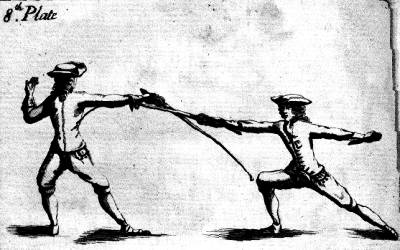
Flannconade.
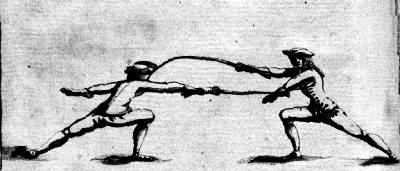
The Opposition of the Hand to the lowering the body.
Of Parades.
There are two Sorts of Parades, the one by binding the Blade, the other by a dry beat. The binding Parade is to be used when you are to rispost in Quart within, in Tierce without, in Seconde under, in Flanconnade, and in all Feints: And the Beat, giving a favourable Opportunity of risposting, is to be used when you rispost to a Thrust in Seconde; or when after having parryed a Thrust in Quart within, you see an Opening under the Wrist. To these two Thrusts, you must rispost almost as soon as the adversary pushes, quitting his Blade for that Purpose, which is to be done only by a smart Motion, joining again immediately, in order to be in Defence if the Adversary should thrust.
There are three Things more to be observed in parrying. First, that you are to parry all Thrusts with the inmost Edge, except in yeilding Parades, which are made with the Flat. Secondly, that your Fort be to the Middle, and your
And thirdly, that your situation be as rear to the guard as possible, as to favour your riposte.
The ripostes.
In order to riposte well, you must observe the Adversary's Time and Recovery in Guard. The Time is to be taken in the Thrusts of opposition when he is recovering, and the other as soon as you have parryed. There are three ways of riposting on the Adversary's Recovery in Guard: when he does not come enough to the Sword, or not at all: the second, when he comes too much, and the third, when his Recovery and Parade are just. To the first, you must riposte strait; to the second by disengaging, or cutting over or under, according as you see light; and to the last, by making a strait Feint or Half-thrust, to oblige the Adversary to come to the Parade, and then pushing where there is an opening, which is called baulking the parade.
Of the demarches, or manner of advancing and retiring.
Most of the faults committed in making thrusts when the measure is to be closed, proceed from the disorder of the body, occasioned by that of the feet, so that for want of moving well, you are not only in danger of being taken on your time, but likewise you cannot execute your thrusts neatly, justly, nor swiftly; the body being disordered and weak. There are ten demarches in fencing; four in advancing, five in retiring, and one to turn your adversary, or hinder him from turning you. The first demarche in advancing, is made by lifting and carrying your Left-foot the length of your shoe before the right, keeping it turned as in guard, with the knee bent, lifting up the heel of the Right-foot, leaning the body forward, which, on this occasion, gives it more strength and a better air; then carrying the Right-foot about two foot before the left, in order
The same Demarche in retiring, is made by lifting and carrying the Right foot the Length of the Shoe behind the Left, with the Knee a little bent, then carrying the Left-foot on the Line, and to the Distance of Guard.
The second Demarche is called closing the Measure; which is done by lifting and advancing the Right-foot a bout a Foot with a Beat, drawing the Left the same Length; because by drawing it more or less you would lose your Strength or your Measure, which few People have observed.
There is such a Demarche backward, which is called breaking Measure; which is done by lifting and carrying the Left-foot a Foot back, drawing or bringing back the Right in Proportion according as the Ground will permit.
If the Ground be uneven, or that you have a mind to surprize an unskilful Man by gaining Measure unperceived, or to oblige one, a little expert, to push at the time you advance your Body; you must, I say, if your Adversary is unskilful, bring the Left-foot more or less near the Right, as you Demarche, and is more favourable to your Thrust: If your Adversary is a little expert, and pushes on this your advancing you must bring back the Left-foot to it's Place, and he will be out of Measure, tho' by Means of his Lunge you will be well in Measure, which is a great Advantage.
The same Demarche may be made in retiring, where the Ground is uneven, lifting the Right-foot, bringing it near the Left, and putting back the Left in Guard.
To make a Thrust in three Motions, being out of Measure, you must make a double Beat, which is done by a small Beat of the Right-foot in the same Place, beginning immediately with the same Foot to close the Measure.
The three Ways of retiring which I have shewn, are done from the Situation in Guard. The two which are done after a Lunge are, first by lifting and bringing the Right-foot back from the Place of the Lunge behind the Left, and then carrying the Left behind the Right, in order to be in Guard.
The second Retreat after having pushed, is made by drawing back the Right-foot about the length of the Shoe, bending the Knees, in order to be in a condition to chace or drive back the Left-foot with the Right, keeping the Hams very supple, the Body free, and the Sword before you; not only that you may spring the farther, but also to be in a better Posture of defence. The Point of the Right-foot should come down first, leaning immediately after on the Heel; the Left-foot must fall on the Line at the distance, and in the Situation in Guard, as I before observed, in order to be ready to take the Time, or to make a Riposte.
The two Masters that I have quoted, condemned this Retreat very much, especially Monsieur De Latouche, who says in springing back, three motions are necessary; first to draw back the Right-foot in guard, secondly to bend the Knee, and thirdly to chace or fly back. Any Master, will find that there should be but two motions, it being easy to bend the Knees and draw back the Right-foot at the same Time.
Besides, his rule for springing back is false; for by drawing the Right-foot back so far as in guard; you lose Time,
When you know the just Length of your Adversary's Thrust, you may break or steal out of measure, by leaning back the Body, without stirring the Foot.
The Turning must be done out of Measure, and with great Caution: When 'tis within your Sword, you must begin with your Left-foot, carrying it to that Side, and then bring the Right-foot to it's proper Line and Distance; and if your Adversary turns on the Outside, you must carry the Right-foot to that Side, and the Left in Guard, as well to avoid his Thrusts, as to lay hold on every favourable Opportunity, in case he should persist in his Demarche.
You should never give Measure but to your Inferior: Giving Measure, is when the Body and Feet advance too much, or in Disorder; or advancing before you are well situated, although corrected in the Demarche, or advancing when you are near enough, except you be much superior to the Enemy.
risposting.