5th. Plate.
Andrew Mahon translation
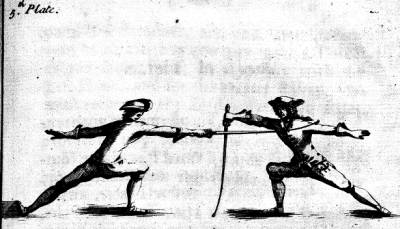
Parade of Tierce yeilding the Feeble.
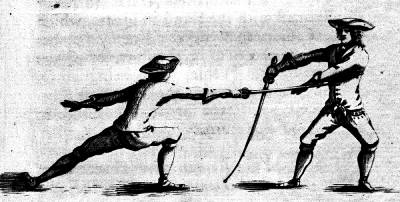
The same parade & opposition of the Hand.
When a Thrust is made in Tierce upon the Blade on the Feeble, or by disengaging; tho' the first is more easily parryed, you must yeild the Feeble, opposing with the Fort, in order to guide the Adversary's Sword to the Place the most convenient for the Opposition of the Left Hand, and closing the Measure at the same time, you have an Opportunity, before he can recover, to hit him several times; which must be done by advancing on him, as fast as he retires. See the 5th Plate.
You may also parry by disengaging, drawing the Body back. The Return is easy, by pushing Quart; and to avoid a second Thrust from the Enemy at the Time of your Return, you must oppose with the Left Hand. See the 5th Plate.
Of pushing Seconde.
In pushing under, the Hand must be turned in Seconde, as high as in Quart, and more within than in Tierce; the Body should be more bent, lower, and more forward than in thrusting Tierce, and the Left Hand lower. See the 6th Plate.
Seconde ought not be pushed, but on the following Occasions: First, when an Engagement, Feint or Half-Thrust, is made without, that the Adversary at one of these Times parrys high. Secondly, when your Adversary engages your Sword on the Outside, with his Hand raised high; or on the Inside, with his Feeble only; and thirdly, upon a Thrust or Pass, within or without.
The Recovery in Guard, should be in Quart within the Arm, though most Masters teach to recover on the Outside, which takes much more Time, and though the Seconde is independent on the Side, it is nearer to the Inside than to the Outside; because the Adversary carries his Wrist to
What introduced the Manner of returning to the Sword on the Outside, was the false Method formerly used in parrying the Seconde by beating on the Blade; in Tierce, with the Point downwards; so that the Adversary not being able to return but above, there was a Necessity for returning to the Sword on the Outside in order to defend; but the Parade and Return being no longer the same, the Manner of returning to the Sword must also be different.