1st. Plate
Andrew Mahon translation
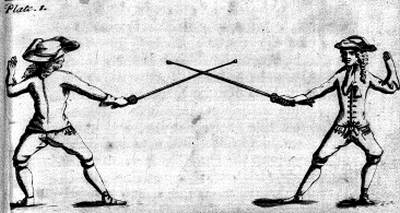
The middling Guard.
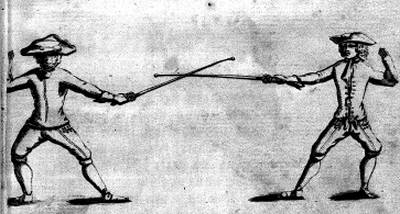
The straight Guard or flat Sword.
In order to be well in Guard, it is absolutely necessary that the Feet, as the Foundation that conduces chiefly to communicate Freedom and Strength to the other Parts, be placed at such a Distance from each other, and in such a lineal Manner as may be advantageous: The Distance must be about two Foot from one Heel to the other; for if it were greater, the Adversary, tho' of the same Stature, and with a Sword of equal Length, would be within Measure when you would not, which would be a very considerable Fault, Measure being one of the principal Parts of Fencing, and if the Feet were nearer together, you would want Strength,
The Line must be taken from the hindmost Part of the Right Heel to the Left Heel near the Ancle. The Point of the Right Foot must be opposite to the Adversary's, turning out the Point of the Left Foot, and bending the Left Knee over the Point of the same Foot, keeping the Right Knee a little bent, that it may have a Freedom of Motion.
The Body must be upright, which gives it a better Air, greater Strength, and more Liberty to advance and retire, being supported almost equally by the two Feet. Some Masters teach to keep the Body back in Favour of Measure, which cannot be broke by the Body when 'tis already drawn back, tho' it is often necessary, not only to avoid a Surprize, but also to deceive a Man of superior Swiftness who pushes a just Length: Therefore 'tis much better to have the Liberty of retiring to avoid the Thrusts of the Adversary, or of extricating yourself by advancing towards him and pushing (as I shall observe in its proper Place) than to keep the Body in one Situation at a Distance, which being fixed, cannot deceive a Person who knows any
The Elbows must be almost on a Line, and of an equal Height, that one Shoulder may not be higher than the other, and that they may be both turn'd alike; the Left Hand must be over against the Top of the Ear, the Hilt of the Sword a little above the Hip, turning towards Half Quart, the Thumb extended, pressing the Middle of the Eye of the Hilt, keeping the Fingers pretty close to the Handle, especially the little one, in order to feel the Sword firmer and freer in the Hand.
By feeling the Sword, is meant commanding the Fort and Feeble equally with the Hand, in order to communicate to the more distant Part of the Blade, as well as to that which is nearer, the Motion and Action that is requisite.
The Hilt should be situated in the Center, that is to say, between the upper and lower Parts, and the Inside and Outside of the Body, in order to be in a better Condition to defend whatever Part may
The Point of the Sword ought to be about the Height of, and on a Line with the Adversary's Shoulder, that is, it must be more or less raised, according as he is taller or shorter: Some Masters raise it to one fixed Height, which would be very well if all Men were of the same Stature; but if we consider the difference in Height of Persons, we shall find it evidently bad. 'Tis to be observed, that according to the Length or Shortness of the Blade, the Line from the Shell to the Point is higher or lower, when the Height of the Point is fix'd.
The Shoulder, the Bend of the Arm, the Hilt, the Point of the Sword, the Hip, the Right Knee and the Point of the Right Foot must be on a Line.
The Head should be upright and free without Stiffness or Affectation, the Face turned between full and profile, and not altogether full, as many Masters will have it, that being a constrained and disagreeable Figure.