11th. Plate.
Andrew Mahon translation
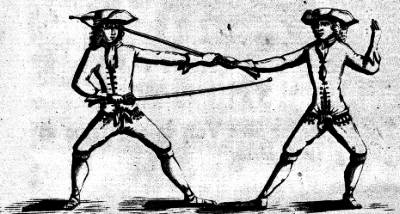
The Seizing and presenting the Sword.
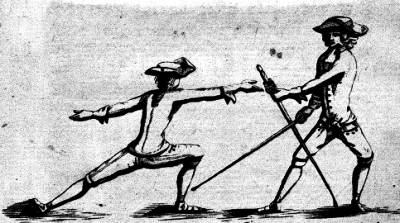
Parrying and Disarming.
Seconde and join, and if with his Fort, you must oppose his Sword with your's 'till with your Left-hand you have seized the Guard, advancing the Left-foot; this Motion being done, you pass your Sword over the Enemy's from within to without; and loosing the Right-foot present him your Point.
Upon the Parade of Tierce with the Fort, being near you must join, seizing the Guard, advancing the Left Leg, and drawing back the Right, and present the Point; or you may, before you join, cut under in Seconde; the first is surer at the Sword, and the other more beautiful in an Assault where a Thrust is more esteemed, than joining.
If on a Pass or Lunge the Enemy shou'd attempt to join or seize your Sword, you must, in order to prevent him, change it from the Right-hand to the Left, four Inches from the Guard, as I have already observed, seizing his with the Right-hand, and presenting him the Point, holding it at
In Joining, if you cannot seize the Guard, you must the Blade, helping with your Elbow, turning the Hand to break the Blade, or take away the sword, which may be done if you are cunning and nervous, especially if the Enemy's Wrist is in Quarte, in which there is no Danger of hurting yourself, because the Sword cannot slip thro', and consequently, can't cut your Fingers, as has happened to some by their Imprudence; by this Means, you have time not only to secure yourself, but also to hit your Enemy. Some People seize the Arm, but that is of no use, because the Enemy may change Hands and hit you.
You may throw a Man down after having pushed, either upon the Pass of Quarte or Tierce; if in Quarte, it is done after advancing the Left-foot, crossing the Enemy's Sword with your Fort, and carrying your Right-Leg without his, at the same time pushing the Sword up from the Inside to the Out, and carrying the Right Arm to his Neck, and the Left to the Small of his Back: These three Actions must be done at the same time. There has been so much said on this Head, with the Joining without, that I shall say no more of it.
In whatever Manner you join you must present the Sword at a Distance, in order to hinder the Enemy from seizing it, or putting it off with his Left Hand to throw himself in upon you: If the Enemy shou'd make a Difficulty of yeilding up his Sword, you must, in order to frustrate his Hopes of closing you, and to make him follow you, draw back the Left-foot behind the Right, and the Right behind the Left, at such a Distance as to be strong, at the same time moving the Point of your Sword circularly; by this Means, you are in a Condition either of giving or taking his Life, which you would not be if he could close you, by which you would be oblig'd to kill him, or render the Advantage doubtful by struggling.
Of engaging in Quarte in a midling Guard.
I Have hitherto treated of the Means whereby to make Thrusts, and in this and the following Chapters, I will shew on what Occasion they are to be made use of. Tho' there is an infinite Number of Figures or Postures, and that every Posture may be in Guard, whether within, or without, Prime, Seconde, Tierce, or Quarte, they proceed from the Midling Guard, the Strait, the High, or the Low Guard, each of which may be attacked and defended within or without.
Though there are many Means to disorder the Enemy by putting him out of Guard in order to hit him on that Occasion, they all depend either upon a Feint by the Side of his Sword to draw him on, or on a Motion of your Sword on his, to uncover him, taking his Sword from the Line of your Body, and placing yours on a Line with his, which is called engaging. And there are several other Ways
To engage this Guard within, it must be done with the Edge on the same Side, without going wide, in order to keep your Fort before you, and your Point before the Enemy, carrying both Parts alike; the Engagement must be made Feeble to Feeble, a little more to your Enemy's than your own, because if it were with the Feeble to the Fort, the Enemy's Sword would not be displaced, besides if he should push, you could not parry, being unable with your Feeble to resist his Fort; and if it were with the Fort to the Feeble, you wou'd be in Danger of being hit under, where there would be an Opening; besides you would be oblig'd to advance much, which would be dangerous.
On your Engagement, the Enemy may do Three things, either of which, produces several others. First, either he will let you engage, or secondly, he will disengage, or thirdly, he will come to your Blade.
Quarte, or, by way of Precaution, make a Half-thrust, in order to see if he stirs, to retire, or to have recourse to his Parade, or to Time.
If he does not stir, you must, as I said, push Quarte; if he retires, redouble your Thrust; if he parrys with his Fort cut Quarte under the Wrist; if with the Feeble, disengage, or cut over the Point in Tierce; and if upon the Half-thrust he takes the Time pushing strait, you must parry and risposte, or take the Time in Seconde, with your Body low; if he takes the Time lowering his Body, you must parry and oppose with the Left-hand, risposting in Quarte; if he takes the Time cutting under the Wrist, you must parry crossing the Sword in Quarte, opposing with the Hand, in order to make your Rispost more safely; and if he volts upon the Half-thrust, you must parry and risposte in Flanconnade, or take the Time, with, your Body low.
If when you engage he disengages, it will be either, 1st, without Design, or 2dly, to disengage and push Tierce over, or 3dly, disengage breaking Measure, or 4thly, disengage, and come to your Blade Quarte or 6thly, disengage to take a Counter to your Time.
1st. If he disengages with a Design only to disengage, you must on the Time push Tierce.
2dly. If he disengages breaking Measure, you must redouble in Tierce, advancing.
3dly. If he disengages and pushes without, you must parry and risposte quick where you have Light, or take Time against him, disengaging and volting, or lowering the Body.
4thly. If he disengages and comes to your Blade without; if 'tis with his Fort, you must cut under in Seconde; and if with the Feeble, you must Counter-disengage from without to within.
5thly. If on the Engagement, he feint Tierce in order to push Quarte, you must push or take the Time strait upon the Feint, or by lowering the Body on the Thrust.
6thly. If he disengages giving Light, to take a Counter to your Thrust, whether
If, upon the Engagement, he goes to your Blade with his Fort, you must cut under his Wrist, and if with his Feeble, disengage and push without in Tierce.
Though an Engagement may be made Blade to Blade, without Disengaging, that is Inside to Inside; better and more common to make it by disengaging from the Outside to the Inside.