HISTORICAL ACCOUNT (continued 4)
Reading edition
This petition of the Barbers to the House of Commons was identical with a very scarce pamphlet “The Case of the Barbers,” a copy of which has been kindly given to me by Mr. D’Arcy Power, M.A. It is full of interest, and will be found in Appendix E.
27th February, 1745. The Committee brought up their report, which was read by the Clerk, and recited the various documents produced and the evidence tendered; among other matters it is stated that Mr. John Hayward, a Past Master, was examined and deposed, that the Master (who every other year was a Barber) and the Wardens present, sign the diplomas. That there are ten Examiners who have each half a guinea for their attendance, and the Master and Wardens have the like. That he did not know that the presence of Barbers at these examinations was any inconvenience, but he apprehended it would be more eligible if the Master were always a Surgeon. That the Barbers are generally present at the four public lectures of Anatomy, two of which are at the expense of the Company, the other two being at the expense of the Surgeons. That the Demonstrators of Anatomy and Osteology are chosen by the whole Court of Assistants (fifteen of whom are Barbers, and fifteen Surgeons). That he apprehends the present union is the reason why so many persons do not bind their sons apprentice at the Hall. He never knew of the Barbers interfering in or giving interruption to examinations, and he never heard any fact mentioned as a reason for the separation desired by the Surgeons, except that a great many foreign brothers (who are gentlemen that practise both in and out of town) refuse to come into the Company on account of the present expense.
Being examined as to the money generally given to the Poor’s Box by Sea Surgeons at the time of their receiving a Qualification, he said that it was always expected, but that if they are not in a capacity it is not insisted upon, and that he never heard of any person being denied a Qualification for refusing to pay it. That the Qualification is delivered to the party sealed up, to be carried to the Navy Office, and that the Master commonly signifies to him what fees are expected; that the said Box is examined every month, and about nine-tenths of the money distributed by the Master and Wardens, among the poor of the Barbers.
Being asked what proportion the Barbers pay to the Poor’s Box, he said that the greatest part of the income applied to that use arises from the examination of Sea Surgeons, but that the Apprentices of Barbers (who are as twenty to one) always pay when bound at the Hall, and at their admission to the freedom, as well as the Surgeons.
Mr. Hayward put before the Committee a statement of the fines received by the Company, which was as follows—
Surgeons.Barbers.
£ s. d.£ s. d.
For Freedom by purchase10 10 06 6 0
"Livery fine, and all Offices to the Parlor door35 0 025 0 0
"Examination for great Diploma6 6 0
"The fine for not serving the four several offices of Master and the three Wardens, which the Surgeons often pay, but the Barbers never do, sometimes 30 guineas but oftener40 0 040 0 0
"The fine for Master and Stewards of Anatomy when called upon in turn (and if they serve, the expense is rather greater)40 0 0
£131 16 0 £71 6 0
The Clerk’s and Beadle’s fees are not included in the above.
Mr. Joseph Wheeler, the Clerk of the Company, was examined by the Committee, and generally confirmed Mr. Hayward’s evidence.
The next witness, Mr. Neil Stewart, was evidently called in the interest of the Surgeons, to show the inconvenience which had arisen (in his case at all events) by reason of the warrants being issued by the “Barbers and Surgeons.” He deposed that he was surgeon to H.M.S. The Looe, and, being taken prisoner by the French, was put in the common prison at Brest, where he petitioned to be removed to an open hospital at Dinan, and enclosed his warrant as a surgeon with his petition to the French authorities; some days after, he enquired of the “Linguist” as to the success of his petition, and was informed that “the Superintendent did not know by his warrant whether he (the witness) was a Barber or a Surgeon: that upon his desiring the linguist to read the warrant, by which it would appear he was a surgeon, the linguist replied that it might be so, but that if the witness had been taken on board one of the King of Great Britain’s ships it would have been out of doubt.” This witness further stated that he believed the unfavourable notice which was taken of his petition was because his warrant came from the Masters of the Barbers and Surgeons.
With reference to the gift of Edward Arris the Court minutes of 29th February, 1675–6 were produced which stated that “Mr. Edward Arris a very worthy member of this Company having formerly settled by Deed £30 a year for a dissection of a body yearly and Reading on the Muscles, desired that deed might be delivered up to him,” and he in return would pay the Company £510 to enable them to apply the interest to the same purposes, which was agreed to. Mr. Arris dying on the 28th May, 1676, the Company soon became involved in a Chancery suit with his son, Dr. Thomas Arris, and the Court minutes of 20th January, 1677–8 were produced and read to the Committee. These set forth the answer which the Company filed to the Bill of Complaint before the Master of the Rolls, and stated the circumstances referred to in the minutes of 29th February, 1675–6, and that Mr. Arris gave as his reason for this “That his only son and heir, the now Doctor, had and did then receive the profits of the said lands to his own use upon condition and under promise to pay the said £30 per annum for the said Dissection; but he found that he did never pay one penny of it, or ever would do, when he their benefactor was dead, without trouble or suit; with some severe and sharp expressions, which we will by no means mention, although they were the very words of the father spoken of the son.”
The answer goes on to express the hope that the Company will not be compelled to enter into any further covenant with Dr. Arris than they had done with his father their “pious benefactor,” for the carrying out of the trust, or be ordered to refund the £510 to Dr. Arris. It also prayed that he might be ordered to pay the costs of “this troublesome and unnecessary suit, which doth so much shew what they must expect from him hereafter, if they should part with the £510.” As the Company retained the £510 till the separation in 1745, there is no doubt but that Dr. Arris, as he deserved to do, lost his suit.
Various extracts from the Company’s books were read, on behalf of the Barbers, to show that the united Company had always assisted the Surgeons, and promoted the cause and interest of Surgery out of the common fund of the Barbers and Surgeons.
Part of the Will of Robert Ferbras, Citizen and Surgeon, dated 2nd December, 1470,120 was read, whereby it appeared that several estates formerly belonging to the said Company, were given to the Barbers before their union with the Surgeons in Henry VIII’s time. And a declaration of Bryan Sandford, dated 8th March, 1490, was read, whereby it appeared that the site of the Hall was purchased by the Barbers before the said Union.
The Committee of the House of Commons reported that they had recommended the parties to settle the dispute as to the division of the property between them, and that thereupon the Surgeons had proposed that they should have given up to them Dr. Gale’s Annuity of £16 per annum and Alderman Arris’ gift of £510; also that for about three years until the Surgeons could provide themselves with suitable premises, they should have the use of the Hall, Theatre, &c., at a nominal rent of one guinea per annum.
The Barbers agreed to give up Gale’s and Arris’ gifts, but proposed that the Surgeons should take a lease for such days in the year as they commonly used the premises, at £80 per annum, and pay the Barbers £100 towards the expenses to which they had been put by this suit in the Parliament.
In the result the Committee reported:—(a) That the Surgeons had made good the allegations of their petition. (b) That the proposed separation was desirable. (c) That the propositions of the Surgeons touching the division of the property were reasonable.
Subsequently the Bill passed both Houses and received the Royal Assent, the quaint union being dissolved 25th June, 1745.
By this Act (18 Geo. II) the Surgeons were erected into a separate Corporation, and the Barbers were re-incorporated under the style of “The Master, Governors and Commonalty of the Mystery of Barbers of London.” So much of this Act as relates to the Barbers will be found in the Appendix F.
The first Court of Assistants of “The Barbers’ Company” was held on the 25th June, 1745, at 10 a.m., and there were present:—
Mr. Jonathan MedleyMaster.
Mr. Humphry NegusSecond Governor.
Mr. William Parker.Assistants.Mr. Samuel Rutter.


Mr. John Barnwell.Mr. Robert Scrooby.
Mr. John Truelove.Mr. Richard Swithin.
Mr. William Haddon.Mr. Edward Colebeck.
Mr. John Negus.Mr. Togarmah Jones.
Mr. Edward Boxley.Mr. John Gurney.
The Act of Separation being read, and the Oaths as formerly required to be taken by Freemen, Master, Warden, Assistant, Clerk, and Beadle being also read and considered, the Court settled and formulated the various Oaths, and the same are entered in the Minutes.
The Election of nine fit and able persons to be Assistants was then proceeded with, and Mr. William Jackson, Mr. John Bearblock, Mr. Willm. Roberts, Mr. Thomas Cotton, Mr. John Whiting, Mr. Richard Lookes, James Theobald, Esqre., Peter Theobald, Esqre., and Mr. John Pepys, were unanimously elected.
Mr. Edward Boxley and Mr. Samuel Rutter were chosen third and fourth Governors or Wardens.
Thanks were voted to Mr. Jonathan Medley and Mr. Humphry Negus “for their great care in defending and preserving the Rights Priviledges and property of this Company on their Separation from the Surgeons.”
Thanks were also voted to Mr. John Paterson “for his great care and diligence in executing the orders and directions of the Master and Governor about the defence and preservation of the rights priviledges and property of the Company” and to further mark their sense of the same, the Court unanimously elected Mr. Paterson as Clerk.
The two Beadles, Henry Gretton and William Littlebury were re-elected.
It was ordered that all Charters, Books, Plate and goods belonging to the Company, then in the custody of Mr. Joseph Wheeler (the late Clerk) should be delivered to Mr. Paterson, who was to make and sign an Inventory of the same, and also to examine Mr. Wheeler’s accounts, and report thereon to the Court.
The Common Seal was directed to be altered by omitting the words Et Chirurgorum and by adding Anno MDCCXLV.
A Committee was appointed to peruse the By-Laws of the late United Company, and to report as to which of them required amendment or were fit to be repealed or added to.
8th August, 1751. Mr. John Brooks attended and produced a Deed to which he requested the subscription of the Court; this deed recited that by an Act of Parliament passed in the 10th year of Queen Anne, it was enacted that a duty of 2d. per lb. should be laid upon all starch imported, and of 1d. per lb. upon all starch made in Great Britain, that no perfumer, barber, or seller of hair-powder should mix any powder of alabaster, plaster of Paris, whiting, lime, etc. (sweet scents excepted), with any starch to be made use of for making hair-powder, under pain of forfeiting the hair-powder and £50, and that any person who should expose the same for sale should forfeit it and £20. Also that by further Acts additional duties were laid upon starch. And by an Act passed in the 4th year of George II the penalties were somewhat mitigated. “And whereas the said laws with respect to hair-powder have by experience been found not to answer the end proposed by the Legislature, the sum arising by the said duties upon starch and hair-powder having gradually lessened, whilst the fair traders have been great sufferers by the practice of those who by the greatness of the duty have attempted to make vend or use the said prohibited articles. And whereas the trade or business of making vending or dressing of Perukes or other Ornaments of hair for the head and also of cutting and dressing the hair of the head being considered as distinct from the business of Barbers is under no regulation whatever,” etc., the parties whom Mr. Brooks represented (and whose names were signed to the deed) had, therefore, agreed to join in an application to Parliament for reducing the duties on hair-powder, as also for incorporating all persons carrying on the trade of Barbers and Peruke-makers within the Bills of Mortality, into one joint Corporation or Body politick, and for restraining persons from exercising those trades who had not served seven years’ apprenticeship.
It was stated that subscriptions towards defraying the costs of the proposed Bill had been paid to Messrs. Gosling & Bennett, Bankers in Fleet Street, that John Paterson, Esq., Clerk of the Company, was Solicitor for the Bill, and Mr. John Brooks was Secretary of the Petitioners.
The Court, having considered the application, decided to contribute Twenty Guineas, but the matter seems to have been in abeyance for eighteen months, as the petition to the House of Commons was not sealed by the Company until the 7th January, 1753.
13th January, 1753. The petition was this day presented and is recorded in the Journals of the House; it states, among other things, that the Company “are in danger of being unable to support themselves and that the petitioners who exercise the art of Peruke making in the liberties and neighbourhood of the said City are not a body corporate, nor under any order or regulation; for want whereof great frauds are practised in the said manufacture to the discouragement of the fair trader, and manifest injury of the consumer, And therefore praying the House that leave may be given for the bringing in a Bill for incorporating the Peruke makers as well within as without the liberties of the City of London, and within such distance thereof as the House shall think fit, with the said petitioners”—the Barbers’ Company. This petition was referred to a Committee, but no report of that Committee is entered in the Journals.
4th December, 1764. The Peruke makers turned up again in 1764, for we find in the Minutes that certain of them attended with the draft of a petition to the King, to which they asked the assent of the Court. This petition which strangely commenced “We the Company of Barbers and Peruke makers,” stated that the suppliants laid before his Majesty the distresses into which the Peruke makers had fallen by reason of the change of fashion, and thus appeals to the King, “Where can we look for relief but there only where it is to be found, for as the Fashion your Majesty approves will very justly be a pattern to your subjects, We most humbly hope not to be too bold in wishing Perukes may soon be as much in fashion as the wearing of hair is at present, which will increase the Revenue, give happiness to the indigent and distressed Peruke makers, and increase the many great unmerited Favours, We as a Company have received from Royal Hands!”
16th January, 1765. The Court took this ridiculous petition into consideration, and of course refused to adopt it, informing the suppliants that they were concerned to observe the decay in their trade, as it was connected by usage with that of Barbery, but as the Charters of the Company did not extend to Peruke making, the Court could not with propriety address his Majesty on the subject.
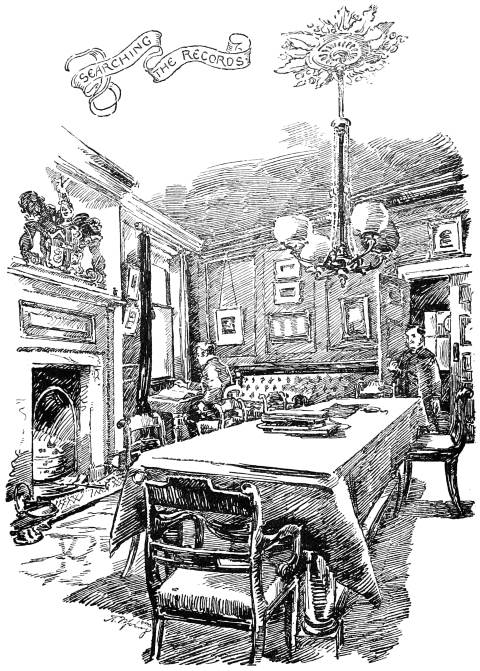
THE COMMITTEE ROOM, BARBERS’ HALL.