HISTORICAL ACCOUNT (continued 2)
Reading edition
Also that evˀy enfraunchesed barbour that taketh any apprentice shall pay to the almes of the said Craft for the same Apprentice iijs. iiijd. to be paied in fourme folowyng that is to sey, at the first pˀsentacion of the Appˀntice xxd. and that other xxd. in the same yeere When he shall be enrolled And the names of the maister and appˀntice and the yeres of appˀntishode of the same appˀntice shalbe writen in a book by the said maistˀ & Wardeyns And he that disobeith this article or ordenance shall pay unto ye almes of the said Craft of barbours xiijs. iiijd. that one half thereof to be applied to thuse of the said Chambre and that other half to the almes of the said Craft. And if it so be that the said Apprentice Dye wtin the first yere, or voide so that the said maistˀ take none avauntage by the same Appˀntice, that than the same money stonde for the next Appˀntice, And if it hapne the said maister to take any pˀfet [profit] for the said Appˀntice by way of Sale or sˀvice and that so pˀved before the said maister and Wardeyns that than the saide maister of the said Appˀntice to be charged for the said iijs. iiijd.
Then follows the usual Ratification (in Latin) of the above Articles.
1487. The next notice which we have of the Barbers in the City books, indicates that there had been quarrels and dissensions among them, and that the rules of the Craft had been set at nought by its members, whereupon a Book of Ordinances was presented to the Court of Aldermen for approval and ratification and the same is entered at this date, 20 July 2 Hen vij, in Letter-Book L. 235B. as follows:—
Memorandum qˀd xxo. die Julij Anno regni Regis Henrici septum secundo, Gardiani & aɫ pˀᵬi hõies Artꝭ sive occupacõis de Barbours Civitatꝭ london venerˀ hic in Curˀ dc̃i dñi Regis in Camˀa Guilhald ejusdem Civitatꝭ coram Henrico Colet milite maiore & Aldr̃is Civitatꝭ pˀdc̃i & porrexˀunt eisdm̃ maori & Aldr̃is quandã billam sive supplicaõem Cujus tenor sequitr. in hec verba,
To the right honourable lord the maire and fulle discrete sovˀaignes thaldˀmen of the Citee of london Shewen mekely unto yor. good lordeship and maistˀshippes the maister and the Wardeyns and the good ffolke of the Crafte or Science of Barbours Surgeons of the said Citee that Where as they of longe tyme have been in discorde and not of oon conformite, but evˀy man in effect of the said Crafte or Science hathe taken and folowed his own singuler way and apetite as menne be49 under no Rule nor obedience, contrarie to all godly policie for lacke of good Rules and ordenancꝭ hadde and used within the same Crafte or Science, and in especiall for takyng of over many appˀnticꝭ and settyng a werk of money50 fforeyns comyng oute of Seint Martyns, Westmynster, Suthwerk and other placꝭ nere unto this Citee to the distruccion of the good ffolke enfraunchised of the said Crafte or Science, but if51 a remedie by yor noble and grete wisdomes the rather be pˀvided in that behalf. That it wold pleas yor. good lordeship and maistershippes for the good Rule and sadde52 guydyng hereafter to be hadde amongꝭ the good ffolkꝭ of the said Crafte within the same Crafte to graunt to yor. saide besechers certeyn Articles hereaftˀ ensuying from hensforth to be obsˀved and kept and afore you here in this honorable Court to be establisshed and entred of Record for ever to endure.
FFirst that no pˀsone of the said Crafte or science ne none other enfraunchised within the saide Crafte and kepyng open shoppe of the same Crafte or Science within the same Cite from hensforth in any wyse pˀsume to take uppon him to sette a werke within his house or Shoppe any sˀvaunt or sˀvauntꝭ or allowes53 or other beyng fforeyns or estraungiers, but54 evˀry suche pˀsone so enfraunchised in the saide Crafte or science or in any other and occupie the same Crafte or Science within the Citee aforesaid present any such sˀvaunt or sˀvauntꝭ allowes and other before the maistˀs and Wardeyns of the same Crafte or Science of Barbours for the tyme beyng within iij daies next after his comyng to his saide maister to thentent that the saide maister and Wardeyns have knowledge of their habilitie and cunyng55 before they be sette any lenger in occupac̃ion in the saide Crafte or Science, And what manˀ pˀsone56 aforesaid hereafter be founde doyng the contrarie of this ordenance shall forfeit and pay at evˀy tyme that he is so founden defectif xls. the oon half thereof to be applied to thuse of the Chambre of this honorable Citee and the other half to the Coẽn boxe of the said Crafte.
Also that no manˀ pˀsone57 enfraunchised in the saide Crafte or in any other kepying an open Shoppe and occupieth the same Crafte within the Citee from hensforth take or set a Werke within his house or shoppe or ellꝭ where within the same Citee any moo58 Sˀvaunts allowes at oones59 beyng fforeyns or Straungiers but oonly ij pˀsones and the same ij pˀsones to be pˀsented by their maister before the maister and Wardeyns of the said Crafte or Science of Barbours for the tyme beyng within iij daies next comˀyng in to suche sˀvice to their suche maistˀ And that the same fforeyns or straungiers shall take or have of their saide maister suche wages for their suche sˀvice as it shalbe thought by the saide Maister and Wardeyns of the said Crafte of Barbours that they canne desˀve and none other, And what maner of pˀsone aforesaid hereafter be founde doyng contrarie to this ordenancꝭ shall forfeit at evˀry tyme that he is founde defectif vli. to be divided and applied to suche uses as be aforeherced.60
Also if it fortune hereafter any pˀsone enfraunchised in the saide Crafte of barbours or in any other occupying the same Crafte of barbours within the Citee to take any mo sˀvauntꝭ allowes at oones beyng fforeyns or straungiers than onely ij as is aforeherced61 Wherethurgh62 he renneth in the forfaiture of the said penaltie of vli. for the saide offence, and than that the maister and Wardeyns of the saide Crafte of Barbours for the tyme beyng havyng knowleche therof put not the said penaltie of vli. in execucion accordyng to the tenor. of the saide Acte thereof made, within xiiij daies after that the said maistˀ and Wardeyns have knowleche thereof, that than the said maistˀ and Wardeyns for the tyme beyng so founden defectif shall forfeit and lose at evˀy tyme xiijs. iiijd. to be divided and applied to suche uses as be aforeherced.
Also that no manˀ pˀsones enfraunchised in the said Crafte or in any other occupying the same Crafte within the said Citee from hensforth take any moo appˀntices at oones than iij uppon payne of forfaiture of vli. at evˀy suche tyme as he is founde defectif doyng contrarie of this Article, to be divided and applied to suche uses as be afore reherced Savyng allway that it shalbe lefull to evˀy suche pˀsone oon yeere before the tˀme of appˀntishode of any his appˀnticꝭ be expired to take a nother appˀntice in the stede of hym that is nygh com̃yng oute of his tˀmes of appˀntishode to thentent that the same newe appˀntice may have his due erudicion and lernyng in the said Crafte or Science of Barbours before the tˀmes and 63 of the rather appˀntice.
Also if any pˀson of the said Crafte or Science selle away his appˀntice to a nother manne within his tˀmes of appˀntishode that than it shalnot be lefull to any suche pˀsone so silling away his appˀntice to take any newe in his stede duryng the tˀme to come of appˀntishode of that appˀntice so sold Nevertheles if it fortune any appˀntice to dye within the tˀmes of his appˀntishode that than it shall be laufull to the mastˀ of that appˀntice so dying to take a nother in his stede when so evˀ it shall lyke hym.
Provided all way that it shalbe lefull to evˀy pˀsone of the said Crafte nowe havyng many appˀnticꝭ to reteyne and holde fulle as many appˀnticꝭ as he hathe the day of makyng of this Acte or ordenance unto suche tyme as the tˀme of their appˀnticialite shalbe fully accomplisshed So all way that no suche pˀsone take any mo appˀntices unto suche tyme as the nuˀbre of the said appˀnticꝭ be reduced and brought unto the said nuˀbre of iij appˀnticꝭ uppon payn of forfaiture of vli. to be divided and applied to suche uses as been afore reherced.
Also that no foreyn Barbour from this tyme foreward occupie the Craft or Science of Barbours or Surgeon Barbor. within the ffraunchise of the said Citee but if he be lymytted and assigned therto by the maister and Wardeyns of the same Craft for the tyme beyng uppon payn of forfaiture of vli. as often as any suche pˀsone so be founde defectif, to be divided and applied to suche uses as be aforeherced. Provided allway that if it canne be thought for the wele of the kyngꝭ people that if any foreyn Barbours or foreyn Surgeon be founden of such habilitie and connyng of Surgerie or of that Crafte that it were necessarie to have hym to occupie within the ffraunchise of this Citee, that than he be admitted therto by the Chamᵬleyn of london and by the Maister and Wardeyns of the said Crafte of Barbours for the tyme beyng, With that the same fforeyn fynde suertie sufficient to be bounde to the said Chamᵬleyn and Maister and Wardeyns for to do make him self free of the saide Crafte or Science of Surgeon Barbours and to obey and pˀfourme the Rules and ordennancꝭ of the same Crafte and to be under the correcion of the same Crafte, provided allway that the kyngꝭ people be served in price of their Cure and shavyng in tyme to come aswell and as safely as they have been in tymes passed.
Then follows the usual Ratification (in Latin) of the above Articles.
1490. A declaration made by one Bryan Sandford, dated 8th March, 1490, was produced to the Committee of the House of Commons in 1745, in which it was stated that the Company were at that time possessed of the freehold of their Hall in Monkwell Street.
1493. On the 12th July in this year, an agreement was entered into between the Barbers’ Company and the Surgeons’ Guild which would indicate that the two bodies were now on amicable terms, working harmoniously for the increase of the credit of the profession, and for the correction of inexperienced surgeons and empirics. This “Composition” is of so interesting a nature that it is here given in full, as extracted from the fine old Book of Ordinances at the Hall; it did not unite the two bodies in any way beyond this, that they agreed to follow the same rules and practice with regard to the government of all Surgeons; that each guild was to choose two Wardens, and that the four so chosen were to act in a conjoint capacity as rulers or masters in matters surgical, and thus comprehend all Surgeons, whether of the Barbers’ Company, the Surgeons’ Guild, or “foreyns.”

This present wrytyng endentyd of copˀosicyons made the xijth day of July iˀ the zere of owyr lord God MtCCCClxxxxiij and the viijth zere of the reyne of kyng harry the vijth William Martyn then beyng mayre of this cyte of london betwyxt the ffelishippis of surgeons enfraunchesˀ wt in the cyte of london on that on p’ty And the felishippis of barbours surgeons and surgeons barbours enfraunchessid iˀ the seyd cyte on the other parte witnesyth that the sayde felyshippys of ther comon assent and mere moc̃yons ben c͠odescẽdyd and agreyd togethir the day and the zere aboue sayd, in mañ and fourme folowyng. That is to sey that eũy pˀson and pˀsons of the faculte or scyens of surgeons admyttyd and sworne to eyth̃ of the sayde felyshippis from hens forward shall stond and a byde wt ther felyshippis as they now do and dyd before thys present composicyon.

Also that from hens forth non of the sayde felyshippis shall admyt nor reseyue in to ther felishippys any alyent straungˀ or foreyn vsyng the sayde faculte or scyens of surgery wtowten knowleg or c͠osent of the wardẽs of bothe the seyd felishippys. All so for the welth and suerte of the kyngꝭ lege people And the honour of the seyde felyshyppys, It is agreyd be twyxt the same two felyshippis that non alyent straunger nor foreyn shall use nor ocopy the seyde faculte or scyens of surg̃y withyn this cyte or subbers of the same unto such tyme as he shewhym selfe to the mayer for the time beyng, and by the iiij wardeyns of bothe the saide felishippis, that is to sey of eyth̃ of the sayde felishippis, tweyn, and othˀ suche as by theyr wysdomys they will call vnto them, be dewly examyned & approuyd to be sufficyent of conyng and habilyte in the sayde faculte. And yf any such pˀson or pˀsones bi the sayde iiij wardens as is afore sayde be taken reputed and a lowed to be sufficient of konyng and habylite iˀ the seyd faculte or scyens of surgery that then the pˀson or pˀsonys so knowen and admyttyd shall be sworne to all the good rewlys and ordenans of ye seyd faculte or scyens of surgery, and to be under the coreccyon of the iiij wardens for the tyme beyng to the entent that at all tymes he may be under dwe coreccyon for the sauegard of ye kyngis lege people. And if any suche alyent straungˀ or foreyn of pˀsumcon refuse to be examyned of the seyde wardens in mañ & fourme as is a fore seyd, Or yf any suche straunger or foreyn so examyned be the seyde wardens be Juged onsufficient of conyng and neũtheles takyth upon hym to occupy or vse the seyde faculte of surg̃y wtyn the seyde cyte or subbars of the same, Then take the name of hym or them so doyng and pˀsent hym by the sayd iiij wardens to the mayer for the tyme beyng, to the entent that by his wysdom, and advice of hys honerabyll brethern may set suche direccyon as shall be thought resonabil formacion64 therof, restrayne hym from the ocupac̃on of the same scyens wt in the sayde cyte. Also it is agreyd and cõpoundyd betwyxte the sayde felyshippys that from hensforth eũy of the seyde felyshippis and seũally by them selfe, Chese of themselfe two discrete pˀsons usyng the fete of surgery to be seũally wardens of the sayde seũall felishippis, and that these iiij wardens for the tyme beyng when and as oftyn as nede shall requere, Shall haue the syght and good gounaunce of the seide faculte of surgery. And eũy pˀson or pˀsonys of eũy of the sayde felyshippis that happenys or shall fortune to haue any Jeopˀde65 or dowtefull cure, dredyng deth or mãy,66 he or they hauing at eny tyme to come, shall shew and pˀsent the cure or curys in as short tyme as nede shall be reqˀred, And at the leste at the thyrde dressyd67 to the saide iiij wardens for the tyme beyng, Or any other pˀson or pˀsonys that is to seye, to one of yche of the seyde felishippis, and the same wardens and yf them seme nedefull shall call unto them ij or iij, or more if nede reqˀre, of the wysest and best expˀte mẽ of the said felishippis occupyeng the saide faculte of surgery as them semeth most expedyent, for the cause or causis aforesayde. Also in this coposycion yt is ordeyned and agreyd, that none of the iiij wardens for the zere beyng neyther any other pˀson of the sayde felishippis ocopyeng the crafte of surg̃i, Put any man of thes sayde felishipis oute of ther cure otherwyse then the honeste of the crafte wolle, but that yche of them be redy to helpe eche other wt counsell or deed, yt worship profyte and the honeste of the crafte, and helpyng of the seke be had and done on all sydis. And if ony of thes iiij wardens for the tyme beyˀg or any other pˀson or pˀsonys of the seyde felyshippis do the cõtrary that eche suche doer content the valvyr68 of the cure, After discressyon and Jugem̃et of the same iiij wardens for the zere beyng, And also for his trespas to paye aftur discression and Jugem̃et of the iiij wardens. Also if any pˀson of the sayde felishippis dislaunder or depute any of the saide felishippis onrightfully ownonestly and ef it so maye be prouyd upon hym by two or thre witnesse, that he paye for that trespas iijs. iiijd., and ouer that to make amendis to ye seide pˀsons the whiche he hath so disslaunderd aftur Jugement of onest men of the seyd felyshippis not founden in non suche defaute.
This pˀsent cõposicyon was made the daye and zere a bowe wreton by Roberd taylour, Robt. Halyday, Thom̃s Koppisley, Thom̃s Thornton, Ihoñ Harte, Johñ Marhm̃, Roberd Beuerly, James Scote, James Ingoldysby, Johñ Taylour, Richard Swedenhm̃, Nicholas Leueryng, John Wilson. In rowlid in Raffe Osterigis tyme, mayer.
Of the persons assenting to this composition, the following were Barber-Surgeons, viz.: Robt. Halyday (Master 1475, 1483, 1485, 1490, 1496), James Scott (M. 1493, 1498, 1500), James Ingoldysby (M. 1501, 1506), John Taylour (M. 1523, 1524), and Nicholas Leveryng(M. 1503, 1508), the others were most likely belonging to the Guild of Surgeons.
An Ordinance by way of addenda to the above was made, imposing penalties upon any who should break any of the foregoing rules; the first offence to be punished by a fine of 10s., the second 20s., and the third offence to be remitted to the Mayor and Aldermen for punishment after their discretion.
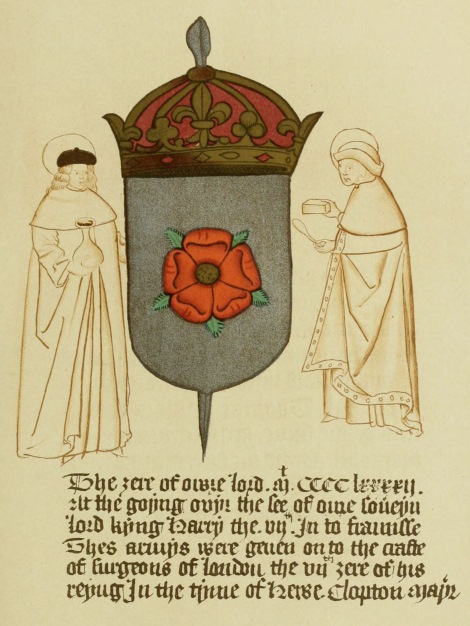
FAC-SIMILE OF THE TITLE-PAGE TO THE OLD BOOK OF ORDINANCES, REPRESENTING SAINTS COSMO AND DAMIAN (PATRON SAINTS OF THE BARBER-SURGEONS) AND THE COAT OF ARMS GRANTED TO THE COMPANY OF SURGEONS IN 1492. (See p. 433.)
How long this agreement, so beneficial for the practice of Surgery, continued in force is unknown; but the probabilities are that the old jealousies soon re-appeared and that each Guild worked on its own lines until 1540, as, by the uniting Act then passed, it was specially remarked as desirable that the two Companies should come together, and be incorporated in one.
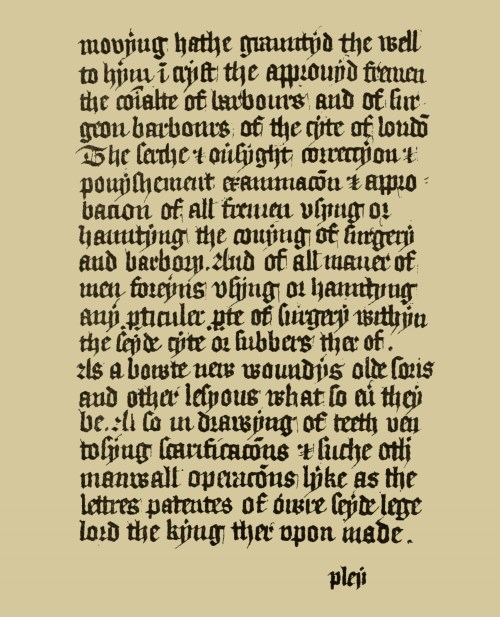
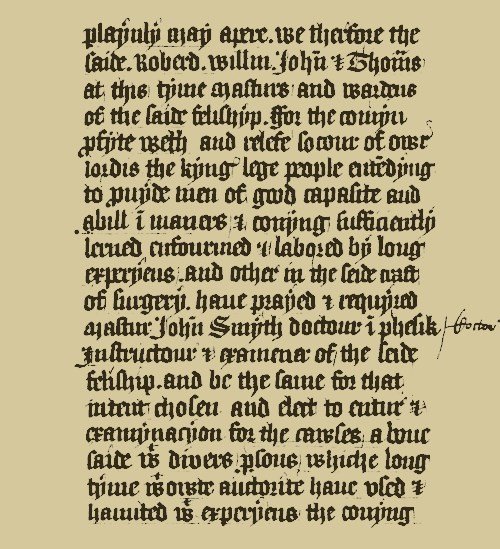
1497. We shall now present to the reader’s notice a highly important document, being a diploma granted by the Master and Wardens of the Barbers’ Company to one of their freemen, enabling him to practise as a Surgeon. This is in all probability the earliest English diploma of a Surgeon extant and cannot fail by the quaintness of its composition, and the details given, to prove of much interest. We notice in it, that our Company as usual, did not fail to rehearse its prerogatives and practice, and we also observe that thus early the Company provided an instructor and examiner in the science, Dr. John Smith, before whom came in the Common Hall, Robert Anson, and in the presence of a “great audience of many right well expert men in Surgery and others, was openly examined in divers things concerning the practice,” etc.
FAC-SIMILE OF THE DIPLOMA GRANTED BY THE MASTER AND WARDENS OF THE BARBER-SURGEONS TO ROBERT ANSON (8 AUG., 1497), ENABLING HIM TO PRACTISE AS A SURGEON.
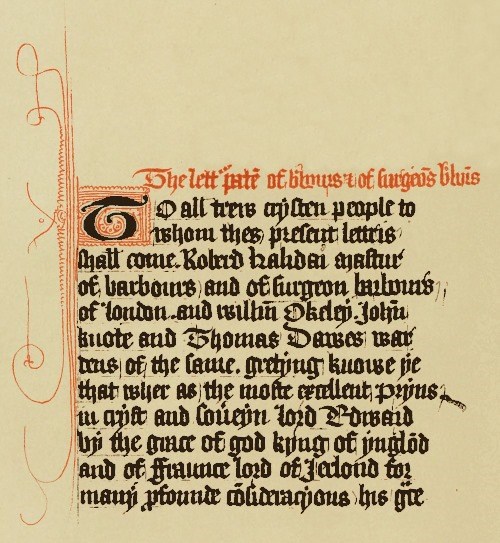
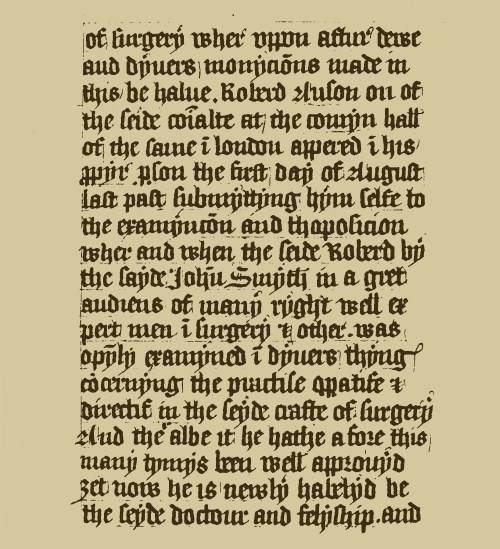
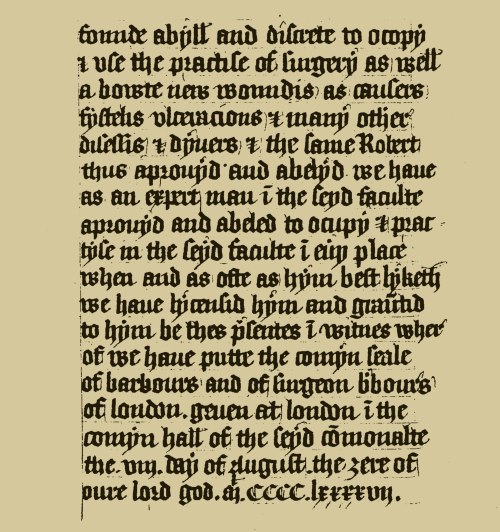
THE LETTˀ PAT̃E OF BˀBOURS & OF SURGEOS BˀBORS.
To all trew crysten people to whom thes present lettris shall come. Roberd Halidai69 mastur of barbours and of surgeon barbours of london, and Willm̄ Okeley, John Knote70 and Thomas Dawes71 wardens of the same gretyng, knowe ye that wher as the moste excellent Pryns in cryst and soũeyn lord Edward by the grace of god kyng of ynglõd and of ffraunce, lord of Ierlond, for many pˀfounde cos̃ideracyons his gc̃e movyng, hathe grauntyd the well to hym ĩ cryst, the approuyd fremen the coiãlte of barbours and of surgeon barbours of the cyte of londõ, The serche and oũsyght correcyon and ponyshement, examinacon & approbacion of all fremen usyng or hauntyng the conyng of surgery and barbory, And of all maner of men foreyns usyng or hauntyng any pˀticuler pˀte of surgery withyn the seyde cyte or subbers ther of, As a bowte new woundys, olde soris, and other lesyons what so eũ they be, Also in drawyng of teeth ventosyng scarificacons and suche othˀ manwall operac̃ons, lyke as the lettres patentes of owre seyde lege lord the kyng ther upon made planyly may apere. We therfore the saide Roberde, Willm̄, John̄ & Thom̄s at this tyme masturs and wardens of the saide felishyp, ffor the comyn pˀfyte weth72 and relefe socour of owr lordis the kyngꝭ lege people, entẽdyng to pˀuyde men of good capasite and abill ĩ maners and conyng, sufficiently lerned, enfourmed, and labored by long experyens, and other in the seide craft of surgery,—haue prayed and requyred mastur John̄ Smyth doctour ĩ phesik, Instructour & examener of the seide feliship, and be73 the same for that intent chosen and elect to entur & examynacyon for the cawses a boue saide, wt divers pˀsons whiche long tyme, wtowte auctorite, haue vsed and haunted wt experyens the conyng of surgery, wheruppon aftur dewe and dyuers monycions made in this be halue, Roberd Anson on of the seide coĩalte at the comyn hall of the same ĩ london appered, ĩ his pˀpyr pˀson, the first day of August last past, submyttyng hym selfe to the examync̃on and thaposicion,74 wher and when the seide Roberd by the sayde John̄ Smyth, in a gret audiens of many ryght well expert men ĩ surgery & other, was op̃yly examyned ĩ dyuers thingꝭ cõcernyng the practise opˀatife and directif in the seyde crafte of Surgery. And ther albe it he hathe a fore this many tymys been well approuyd, ʒet now he is newly habelyd, be75 the seyde doctour and felyship, and founde abyll and discrete to ocopy & vse the practise of surgery, as well a bowte new woundis, as cansers, fystelis, vlceracions & many other disessis & dyuers; & the same Robert thus aprouyd and abelyd we haue, as an expert man ĩ the seyd faculte, aprouyed and abeled to ocupy & practyse in the seyd faculte, ĩ eũy place, when and as ofte as hym best lyketh we haue lycensid hym and graũtid to hym by thes pˀsentes. ĩ witnes wherof we haue putte the comyn seale of barbours and of surgeon bˀbours of london, geuen at london ĩ the comyn hall of the seyd Comõnalte the viij day of August the zere of oure lord god MtCCCClxxxxvij.
1499. In this year the Company obtained from Henry VII a confirmation of their Charter, paying but 20s. for the same. This Inspeximus Charter recites and confirms that of Edward IV with the very noticeable exceptions, that four Masters or Governors are named instead of two, and that they are described as of “the Mystery of Barbers and Surgeons,” and not “Barbers” only, as in Edward’s grant.
The original, in excellent preservation, with the great seal of England pendant, is at the Hall, and the text is as follows:—
Henricus dei gracia Rex Anglie Francie & Dominus Hibernie Omnibʒ ad quos pˀsentes littere pervenerunt, salutem. Inspeximus litteras patentes recolende memorie domine E. quarti nuper Regis Anglie progenitoris nostri factas in hec verba. Edwardus dei gracia . . . . . . . . Teste me ipso apud Westmonasteriũ vicesimo quarto die Februarii Anno regni nostri primo. Nos autem litteras predictas ac omnia & singula in eis contenta rata habentes et grata ea pro nobis et heredibus nostris quantum in nobis est acceptamus & approbamus ac dilectis ligeis nostris Rico Haywarde Jacobo Holand Johanni Robertson et Johanni Boteler nunc Magistris sive Gubernatoribʒ mistere BarbitonsoꝜ et SirurgicoꝜ infra Civitatem nrãm predc̃am & eoꝜ Successoribʒ per pˀsentes ratificamus et confirmamus sicut lrẽ predc̃e rõnabilis testantˀ In cujus rei testiom̄ has lr̃as nr̃as fieri fecimus patentes. Teste me ip̃o apud Westm̄ quinto die Decembris Anno regni nostri quinto decimo.
Clerk. pro viginti solidis solutis in hanaperio.
(Endorsed.)
Intratur in libro signato cum lr̃a. m. tempore Nich̃i Alwyne maioris Civitatis londoñ Anno Regni Regis Henrici septum quinto decimo. Pakenham.
Translation.
Henry by the grace of God, King of England and France, and Lord of Ireland, To all to whom these present letters shall come, health. We have inspected the letters patent of the Lord Edward the fourth, of gracious memory, late King of England, our progenitor, made in these words, “Edward by the grace of God . . . . . . . . Witness my self at Westminster the 24th day of February in the first year of our reign.” We also, the aforesaid letters, and all and singular therein contained ratifying and granting, for us and our heirs, as much as in us lies do accept and approve, and to our beloved lieges, Richard Haywarde, James Holand, John Robertson, and John Boteler, now Masters or Governors of the Mystery of Barbers and Surgeons within our City aforesaid, and to their successors, by these presents, do ratify and confirm, as in the aforesaid letters is reasonably testified. In Witness whereof, we have caused these our letters to be made patent. Witness myself at Westminster the fifth day of December in the fifteenth year of our reign.
Clerk. for twenty shillings paid into the hanaper.
(Endorsed.)
Entered in the book marked with the letter m. in the time of Nicholas Alwyne, Mayor of the City of London, in the fifteenth year of the reign of King Henry the Seventh. Pakenham.
1511. In this year an Act of Parliament was passed, which infringed on the privileges of the Barbers’ Company, inasmuch as it placed the approbation and licensing of Surgeons in the hands of certain clerical dignitaries, to wit, the Bishop of London and Dean of St. Paul’s (while for the country the several Bishops or their Vicars general were nominated). This Act was possibly the outcome of some laxity on the part of our Company, or of an intolerable growth of quackery, with which it could not cope, the pretenders to surgical knowledge being a “great multitude” of ignorant persons, and women, using sorcery, witchcraft and noxious remedies. This Act of Parliament (3 Hen. VIII, cap. XI) as given below, is from an original copy in the possession of Mr. Charles J. Shoppee (Master 1878).
¶ AN ACTE CONCERNYNG THE APPROBATION OF PHISICIONS AND SURGIONS.
To the kyng our souerayne lorde, and to all the lordes spiritual and temporall, & comoñs in this present parlyament assembled. Forasmoche as the science and connynge of phisike & surgerie (to the perfet knowlege whereof, be requisite both great lernyng and rype experience) is dayly within this realme exercised by a great multitude of ignorant pˀsons: of whome the great part haue no maner of insight in the same, nor in any other kynde of lernynge, some also can no letters on the boke, so farforthe that common artificers, as smythes, weauers, and women, boldely and customably take upon them greate cures and thinges of greate difficultie: in the whiche they partly use sorcerye, and witchcrafte, partly apply suche medicines unto the disease, as be very noyous and nothyng metely therfore to the highe displeasure of god, great infamye to the facultie, and the greuous hurte, damage, and destruction of many of the kynges liege people: most specially of them that can not discerne the unconnynge from connynge. Be it therfore (to the suertie and comforte of all maner people) by auctoritie of this present parliament enacted, that no persone within the citie of London, nor within seuen myles of the same, take upon hym to exercise and occupie as a phisition or surgion, excepte he be fyrst examyned, approued, and admytted by the byshop of London, or by the deane of Paules, for the tyme beinge, calling to hym or them foure doctours of phisike, and for surgery, other experte persons in that facultie, and for the fyrste examination suche as they shall thynke conuenient, and afterwarde alway foure of them that haue ben so approued, upon the peine of forfayture, for euery moneth that they do occupie as phisitions or surgions, not admytted nor examyned after the tenour of this acte, of v.li. to be enployed the one halfe therof to thuse of our soueraine lorde the kynge, and the other halfe therof to any person that wyll sue for it by action of dette, in whiche no wager of lawe nor protection shalbe alowed.
¶ And ouer this, that no persone out of the sayd citie and precinte of vii. myles of the same, except he haue ben (as is aforesayd) approued in ye same, take upon hym to exercise and occupie as a phisition or surgion, in any diocesse within this realme, but if he be fyrste examined and approued by the bysshoppe of the same dyocese, or he beynge out of the dioces by his vycare generall: either of them callyng to them suche experte persones in the sayde faculties, as their discretion shal thynke conuenient, and gyuyng theyr letters testimonials under theyr seale to hym that they shall so approue, upon lyke peyne to them that occupie contrary to this acte (as is above sayde) to be leuied and employed after the forme before expressed.
¶ Prouyded alway, that this acte nor any thynge therin contayned, be preiudiciall to the uniuersities of Oxforde and Cambrydge or eyther of them, or to any priuileges graunted to them.
This Act seems to have invested the Bishops, etc., with the power of licensing all Surgeons, and if so, would have taken away that privilege from our Company; the point is however doubtful, and I am inclined to think that the Act did not operate to the prejudice of the Company, only in so far as it suffered from the existence of another licensing authority.
Mr. D’Arcy Power has pointed out that the Act very soon became unpopular, and that it was almost immediately practically repealed by another one, which provided that it should be “lawful to any person being the king’s subject, having knowledge or experience of the nature of herbs, etc., to minister in and to any outward sore or wound according to their cunning.” (Memorials of the Craft of Surgery, p. 85.)
This latter Act, which in its effect would flood the land with quacks, must however have remained the law until the Act of 32 Hen. VIII, whereby the Barber-Surgeons were reinstated in their ancient rights; and it is the fact, that down to the 18th Century the Ecclesiastics claimed and enforced their rights (under the Act 3 Hen. VIII) to license Surgeons, notwithstanding other Acts passed since then, which although not expressly extinguishing their power, certainly did not save it. The Barber-Surgeons’ Company seem to have examined the Surgeons, and, if approved, to have given a certificate under Seal, which was presented to the Bishop who thereupon issued his licence. This practice was not however universal, and I think only applied to some Surgeons who were not free of the Company. In some cases the Bishop licensed Surgeons, without reference to the Company, and thousands have been licensed by the Company without regard to the Bishop. It is almost impossible to say now what course was followed, the practice certainly varying with the times (see Surgery).
1513. In this year an Act of Parliament was passed exempting Surgeons from juries, inquests, etc. This must have been passed in the interest of the Surgeons’ Guild, as the Barber-Surgeons were surely exempt under their Charter from Edward IV.
1512. The Barbers’ Company having applied to the King (Henry VIII) for a confirmation of their Charter, their request was acceded to. Henry is, on more than one occasion, spoken of in the books as “our patron,” and there is no doubt but that he was very friendly both to our Company and to individual members of it, as witness his gift of the grace cup, and the legacies in his will to various members of the Company, with some of whom, as Pen, Harman, Ayliff, etc., he was on as intimate terms as a king could be with a subject; there would therefore be, we may be sure, but little difficulty in obtaining an Inspeximus.
In one of our Minute Books, Thomas Knot (Master 1555) has transcribed what purports to be a copy of Henry’s Inspeximus Charter with the date 12th of May “in the xviijth yere of our Reigne” (i.e., 1526), and he appends a certificate that he has compared and agreed it with the original! Now we possess the original at Barbers’ Hall and it is dated 12th March 3rd Henry VIII (i.e., 1512), and it would indeed be a strange thing for Henry VIII in 1526 to recite and confirm Henry VII’s Charter, when he had already done so in 1512. Moreover I have searched the Patent Rolls and whilst there is no record in 1526, there is the entry of the 1512 Charter, and further to fix the date, both Philip and Mary, and Elizabeth in their Inspeximus Charters recite the 1512 Charter.
It has been necessary to enter into this detail, as the date of the Charter is important when we come to consider Holbein’s picture; and as my friend Mr. D’Arcy Power has (p. 338) quoted this pretended Charter not having seen the real one, he, very naturally trusting old Thomas Knot’s statement, has fallen into the pit dug some three hundred years ago.
The following is the Text of the Charter, and it will not be necessary to append a translation, as it follows much on the same lines as that of Henry VII:—
Henricus dei gracia Rex Anglie et Francie et Dominus Hibernie Omnibus ad quos presentes Irẽ pˀvenerunt saltmˀ Inspeximus litteras patentes domini H. nuper Rˀgis Anglie septum patris nostri precarissimi de confirmacione factas in hec verba Henricus dei gracia . . . . . . Teste me ip̃o apud Westmonasterium quinto die Decembrˀ Anno regni nr̃i quinto decimo. Nos autem litteras predictas ac omnia & singula in eisdem contenta rata hentẽs & grata ea pro nobis & heredibus nr̃is quantum in nobis est acceptamus & approbamus ac dilectis ligeis nr̃is Johĩ Peerson Wil̃l̃o Kyrkeby Thome Gybson & Thome Martyn nunc Magistris sive Gubernatoribus mistere Barbitonsorum et Sirurgicorum infra Civitatem nrãm predictam & eorum successoribus per presentes ratificamus & confirmamus sicut lrẽ predicte rõnabiliter testantur. In cujus rei testimonium has lrãs nrãs fieri fecimus patentes. Teste me ip̃o apud Westmonasterium duodecimo die Marcii Anno regni nr̃i tercio.
Yong. pro viginti solidis solutis in Hanapˀio.
The Great Seal, though still pendant, has been considerably damaged.
1525. This year the Company received a Precept from the Mayor, ordering them to provide for the “Midsummer Watch.”
To the Wardens of the Barber Surgeons,
We woll and charge you that for the hounour of this Citie ye do ordeyne & pˀpare ageinst the watches to be kept within this Citie in the nightꝭ of the vigilles of Sent John Baptist & Seint Peter nowe next comynge iiij honest & comely pˀsones suche as ye will answere for, wt Bowes & arrowes clenely harneysed and arrayed yn Jakettꝭ of whytte, havynge tharmes of this Citie, to waytte and attende uppon us in the said Watches, And to come to Blackwell Hall and there to be, for the not fayllynge hereof as ye tendre the honour of this Citie and also will answere at your pẽlls. Gyven in the Guihall of the said Citie the xiiij day of Junij the xvij year of the Reigne of our Soveraigne lorde King Henry the viijth.
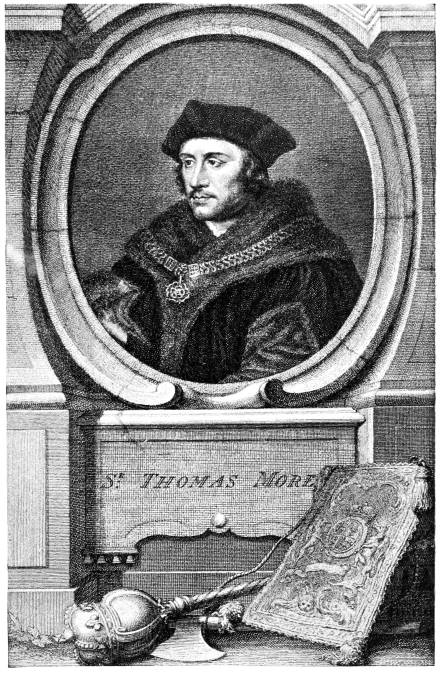
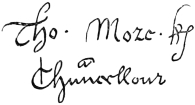
An Act of Parliament was passed in the 20th Henry VII, which provided that the governing bodies of Guilds should not make any by-laws or ordinances, without the same should be approved by the Chancellor, the Lord Treasurer, and the Chief Justices of the King’s Bench and Common Pleas, or any three of them, etc., and in 1530 our Company, being desirous of settling many points for the government of the mystery, drew up a long set of interesting Ordinances, which were presented to Sir Thomas More the Chancellor, Sir John Fitzjames and Sir Robert Norwiche the Chief Justices, and were signed by them on the 14th May, 1530. The original (with More’s autograph) is at the Hall, and after reciting the Act of 20th Henry VII, ordains the following oaths and articles:—
The oath of a freeman. The oath of the Masters and Governors with directions as to searches. Ordinance as to attending on summons. " " quarterage. " " presentation of apprentices. " " number of servants to be kept by freemen and liverymen. " " wages of servants. " " enticing away of servants. " " opening shop. " " teaching the mystery to any but apprentices. " " sueing brother freemen at common law. " " “opprobrios condicions or dishonest wordes.” " " refusal to come on the Livery, and admission into the Livery. " " Sunday trading. " " presenting patients in danger of death. " " reading Lectures concerning Surgery. " " supplanting another of his patient. " " the Dinners. " " excess of words in debate. " " departing from the Common assembly. " " seniority. " " Barbers setting up shop.
Sir Thomas More’s Ordinances, as above, will be found in full in the Appendix B, the transcript being made from the original.76
1540. This year is one of the most memorable in the annals of the Barber-Surgeons, as it witnessed the union of the unincorporated Guild of Surgeons, with their more accredited fellow-craftsmen, the incorporated Company of Barbers. It has been suggested by more than one writer that such an union is shrouded in mystery, difficult of explanation, and that in those days, with science advancing (slowly, it is true), it might have been expected that we should read of a divorcement, rather than a combination of two crafts, which then, as now, were dissimilar both in their operations, and in the training and intelligence necessary for their practice.
But it is essential to bear in mind that though the Charter of Edward IV was ostensibly to the Barbers, it really was granted to a fraternity, which to a great extent practised as Barber-Surgeons, some of whom were Surgeons pure and simple, others combined both branches, while others still carried on the more humble craft of Shavers and Hair-Dressers; those of the Company who practised Surgery did no doubt consider it a reproach to be dubbed “Barbers,” and for distinction sake called themselves and were well known as “Barber-Surgeons,” indeed they had so far established this title to themselves and to their Company, as to get it recognised and so named in the Inspeximus Charter of Henry VII (less than forty years after their original Charter as “Barbers” had been granted to them). This is to a great extent confirmed by the words of the Act now about to be referred to, which distinctly says that there was then a Company of “Surgeons occupyinge and exercisynge the sayde scyence and faculty of surgery . . . . . . commonly called the Barbours of London.”
The Union therefore was not a joining of Barbers with Surgeons (THAT had existed from the earliest times), but was the consolidation of the “Guild of Surgeons” with another body of Surgeons who were incorporated, and practised under the name of “Barbers” in conjunction with actual working Barbers; and, as the Act provided what the Surgeons should and should not do, and the like as to actual Barbers, limiting their operations also, most if not all difficulty and apparent incongruity in the union seems to vanish.
The Act (32 Hen. VIII, cap. 42) which will well repay perusal, settled the Barber-Surgeons in their corporate capacity for many a long year; under it the old rival society disappeared, it being declared that the two Companies should be united, so that by their assembling together, the science of Surgery might be fostered and improved; whereupon it was enacted that they should be incorporated under the style of “The Maisters or Governours of the Mystery and Comminalte of Barbours and Surgeons of London.” The property of the old Company of Barbers was handed over to the new Corporation (the Guild of Surgeons are not said to have had any property to bring into the new concern). The usual grant of a common seal, of power to plead and to be impleaded, to hold lands, etc., will be seen at large in the Act. The Surgeons of the Company were to be exempt from bearing armour or being put into watches and inquests. The dead bodies of four malefactors were assigned to the Company yearly for dissections. And, inasmuch as various persons exercising the faculty of Surgery used to take into their houses for cure, people afflicted with the pestilence and other contagious diseases and “do use or exercise barbari, as washynge or shavyng and other feates thereunto belonging,”77 the same was declared “veraie perillous,” and it was enacted that no one using the faculty of Surgery should practise Barbery, and that no Barber should practise any point in Surgery, the drawing of teeth only excepted. The Surgeons were to exhibit a sign in front of their houses, and no Barber was to exercise his calling unless free of the Company. Four Masters were to rule the Company, whereof two were to be Barbers and two Surgeons. A penalty was named for offenders against the articles, all were to pay scot and lot, and private persons might keep their own Barber or Surgeon, without interference by the Company.
The Act was passed on the 24th July, 1540, and will be found in Appendix C. being taken from the original Black-letter copy in the Author’s possession.
We now refer to the Company’s chief treasure, the Holbein picture, and are at once met with a difficulty; does it represent the granting of a Charter to the Company? if so, the year was 1512; or does it illustrate the union of the Barbers and Surgeons by Act of Parliament? if so, the year was 1540.
The picture exhibits a Charter with the Great Seal pendant, and has always been popularly known and described as the “granting of the Charter to the Barber-Surgeons.” On the other hand, however, the King was but 21 years of age in 1512 and 49 years in 1540, which latter age accords with the picture; moreover, Vicary, Ayleff, Harman, and the others represented, were members of the Court in the latter year, but not in 1512. These considerations are sufficient to demolish the “Charter” theory, and point to the hypothesis that it is the Union of the Barbers’ Company with the Guild of Surgeons, accomplished by Act of Parliament in 1540, which is commemorated, but then we must admit a licence on the part of Holbein (which deceived no one at the time), when he indulged his artist’s fancy by putting into the King’s hand a Charter with seal pendant, instead of an Act of Parliament, which latter would not indeed have been the King’s function to hand to the Company, and would probably, if represented, have been depicted as a mere roll, and not therefore so artistic or effective as a Charter with a Seal in the King’s hand.
The Act received the Royal Assent 25th July, 1540; this would be towards the close of the year of John Pen’s mastership. Vicary, who is receiving the Instrument, was Master from September, 1541, to September, 1542; there is every probability that the painting was executed during his year of office, and that is why Holbein paid him the compliment of putting him in the chief position in the painting, which after all was intended, not as a strictly historical, but rather as a commemorative picture.
The picture is 10 feet 2 inches long by 5 feet 11 inches high, painted on oak panel and contains nineteen figures; it represents a room in the palace (said to have been Bridewell), which is hung with beautiful tapestry and appears to have been gilded; the King is seated on a throne, his age apparently about fifty, the complexion florid, the hair sandy, the eyes small but animated and restless; the expression on the countenance is impatience, and he seems thrusting the document hastily into the hand of Thomas Vicary, who receives it kneeling, on his left; the face altogether might be pronounced handsome, were it not for the low forehead and contracted eyebrows; he has on his left thumb a signet ring, and other rings on the first and fourth fingers of his right hand with which he holds a sword of state resting on his knee; on his head is a jewelled crown; on his left leg the garter, and round his neck the collar of the Order; the mantle is short and of crimson velvet; all these ornaments are most beautifully executed and are as fine as miniature painting; every hair of his head is distinct, and the texture of his robe is finely given; his impatience seems to have warmed him, and the rising colour flushing over his face is most admirably painted. On the King’s right are three grave and closely shaved personages on their knees. The first is Dr. John Chambre, one of the Royal Physicians, he is represented in a skull cap and furred gown, the sleeves very large and in which his hands are enwrapped; from the expression of his countenance it would seem that he was anything but pleased with the provisions of the Act, as the face has a sullen and discontented look; next to him is the celebrated Dr. William Butts, also one of Henry’s Physicians, and behind him is Thomas Alsop, the Royal Apothecary, his hair is long and lank, and features coarse and hard.
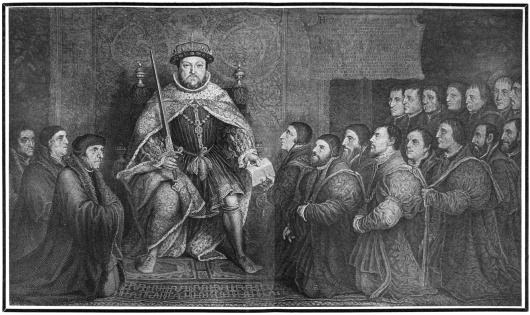
On the King’s left are fifteen members of the Court on their knees, and in livery gowns, evidently specially sumptuous for the occasion, being of brocaded or damask silk, trimmed with fur, and each man wears a livery hood of red and black upon his shoulder. The first of these is Thomas Vicary, Serjeant-Surgeon, who wears a gold chain; next comes Sir John Ayleff, Surgeon to the King, also with a gold chain and a ring on his finger, the next is Nicholas Simpson, King’s Barber, who, like Vicary and Ayleff, wears a skull cap, all the others have their heads bare. Then comes Edmund Harman, King’s Barber, and one of the Witnesses to Henry’s Will, he wears a gold chain; next him is James Monforde, King’s Surgeon, then John Pen, the King’s Barber, and Nicholas Alcocke; the expression on the countenances of all these men is grave and solemn; the next, Richard Ferris, who has a somewhat merrier face, and was also King’s Surgeon, completes the front row. The moustaches and beards of the whole, including the King, would appear as if they had had great care and attention bestowed upon them. Of the remaining seven figures in the back row, the names of but two have been preserved, viz., Christopher Salmond and William Tilley.
This picture of Holbein’s is not surpassed, if indeed it is equalled, by any other of that master, every part is most elaborately and delicately finished; the position of none of the figures is constrained, and there is no attempt at theatrical effect, yet every person represented is in action, the colouring is chaste, and kept down, nor is there any of that hardness and stiffness often observed in Holbein’s pictures. Its reputation has been truly said to be world-wide, whilst it has been eulogistically described by some one to be “as glowing as a Titian, and minutely faithful as a Gerard Dow.”78
The names of the persons represented have been somewhat rudely affixed to their effigies, probably a few years after the picture was painted, and whilst we cannot but deplore the disfigurement, it is more than compensated for, as the means of identification of so many of our illustrious predecessors. The tablet, with inscription, has been said to be of later date than Holbein’s work, and to have been painted over a window, through which was once seen the old church of St. Bride; this, however, is most improbable, as it is personally dedicatory to Henry. The inscription is as follows:—

HENRICO OCTAVO OPT MAX: REGI ANGLIÆ FRANCIÆ ET HIBERNIÆ FIDEI DEFENSORI AC ANGLICANÆ HIBERNICÆQ ECCLESIÆ PROXIME A CHRISTO SVPREMO CAPITI SOCIETAS CHIRVRGORVM COMMVNIBVS VOTIS HÆC CONSECRAT.

TRISTIOR ANGLORVM PESTIS VIOLAVERAT ORBEM INFESTANS ANIMOS CORPORIBVSQVE SEDENS HANC DEVS INSIGNEM CLADEM MISERATVS AB ALTO TE MEDICI MVNVS JVSSIT OBIRE BONI LVMEN EVANGELII FVLVIS CIRCVMVOLAT ALIS PHARMACON AD FECTIS MENTIBVS ILLVD ERIT CONSILIOQ TVO CELEBRANT MONVMENTA GALENI ET CELERI MORBVS PELLITVR OMNIS OPE NOS IGITVR SVPPLEX MEDICORVM TVRBA TVORVM HANC TIBI SACRAMVS RELIGIONE DOMVM MVNERIS ET MEMORES QVO NOS HENRICE BEASTI IMPERIO OPTAMVS MAXIMA QVE QVE TVO.
TRANSLATION.
To Henry the Eighth, the best and greatest King of England, France, and Ireland, Defender of the Faith, and next to Christ, supreme head of the Church of England and Ireland, the Company of Surgeons dedicate these, with their united prayers.
A grievous plague had ravaged the region of England, Afflicting man’s spirits and penetrating his frame; God, pitying from on high this remarkable scourge Commanded thee to perform the office of a good physician. The light of the gospel flies around on glowing wings, This will be the balm to enfeebled minds: Whilst the disciples of Galen meet to raise a monument to thee, And all disease is swiftly dispelled by thy power. We, therefore, a suppliant band of thy Physicians, Solemnly dedicate this house to thee, And mindful of the favour with which thou, O Henry, hast blessed us, Invoke the greatest blessings on thy rule.
The following fragmentary notices of the persons represented in the picture, will be found of some interest.
The first figure to the left is Thomas Alsop; he was the King’s Apothecary, and Henry VIII, by his will, left him 100 marks.
Next to him is Dr. William Butts, one of the King’s physicians, ever famous for his memorable interference with the King on behalf of Archbishop Cranmer in 1544, when the Roman Catholic party in the Council endeavoured to procure Cranmer’s committal to the Tower. A full account of this incident will be found in Strype’s Memorials of Cranmer (Oxford Ed., 1812, pp. 177–181), and Shakespeare in his play of Henry VIII (act v., sc. 2) has also graphically described it. Cranmer’s Secretary, aware of Butts’ great influence with the King, sent for the Doctor, and acquainted him with the slight which had been put upon the Archbishop by keeping him standing in the ante-room of the Council Chamber among lacqueys and servingmen, upon which Butts immediately repaired to the King, and said:—
“I’ll show your Grace the strangest sight, The high promotion of his Grace of Canterbury: Who holds his State at door, ’mongst pursuivants, Pages and foot boys.”
whereupon Henry replies,—
“Ha! ’tis he indeed! Is this the honour they do one another? ’Tis well there’s one above them. Yet, I had thought They had parted so much honesty among ‘em (At least good manners) as not thus to suffer A man of his place and so near our favour, To dance attendance on their lordships’ pleasures, And at the door too, like a post with packets, By Holy Mary! Butts, there’s knavery. Let them alone, and drawn the curtain close: We shall hear more anon.”
Henry spoke his mind so freely to the Council, that they one and all shook hands with the Archbishop, and, as Strype says, “Never more durst any man spurn him during King Henry’s life.”
Dr. Butts must have had the best practice of any man of his time; there are several references to him among the State papers at the Record Office, of which the following are a few examples, and indicate that his patients were the aristocracy of the day.
25th May, 1524. Among the funeral expenses of Sir Thomas Lovell, K.G., is this item:—“To John Hewson, riding to Cambridge, to fetch Dr. Buttes when my master was sick, 4s. 8d.”
28th April, 1525. The Duke of Norfolk, writing to Cardinal Wolsey, says that last night at 7 o’clock the Lord Marney was “drawyng the draghts of deth, and Mr. Butts determyned he shuld not lyve after 5 owrys” (hours).
14th October, 1525. A warrant was signed by Wolsey, directed to Sir Andrew Windsor, for delivery to Dr. Butts, who had been appointed physician to my lady Princess, of a livery in blue and green, in damask for himself, and in cloth for his two servants.
17th May, 1528. In a letter from the Duke of Norfolk to Wolsey, the Duke says that Mr. Butts had come to him from the King, without whose aid he thought that he should not have recovered from his sickness.
23rd June, 1528. In a letter from Brian Tuke (to Cardinal Wolsey) he speaks of an infection which had been much about of late, and how the King told him that Mistress Ann Boleyn and my lord Rochford both have had it; what jeopardy they have been in, by the turning in of the sweat before the time; of the endeavour of Mr. Buttes who hath been with them in his return; and finally of their perfect recovery.
19th January, 1530. A letter from De Augustinis, written from the palace at Esher, to Cromwell, desires that Dr. Butts or Dr. Walter Cromer may be sent to the Cardinal and requesting that Balthazar the physician, may be spoken to, to obtain some leeches; no time was to be lost and the doctors were to bring with them some vomitive electuary.
Dr. Butts was a personal friend of Henry’s, who, in 1537, granted him the manor and advowson of Thornage, in Norfolk. He died 17th November, 1545, and lies buried in Fulham Church, where there is (or was) a monument to his memory.
Next to Butts, and immediately to the King’s right, is Dr. John Chambre; he was physician to and a great favorite of Henry’s, holding several clerical preferments as well. He was a Fellow and Warden of Merton College, Oxon, where he was admitted Doctor of Physic, 29th October, 1531. In the list of persons to whom Wolsey, in 1526, assigned lodgings at the King’s house, when they should repair thither, occurs the name of Dr. Chambre. There is also a catalogue of the King’s new year’s gifts, in 1528, by which it appears that the Doctor had a piece of plate weighing 243⁄8 ozs., at the same time the Cardinal’s gift was 401⁄4 ozs., and that of the Archbishop 31 ozs.
In Brian Tuke’s letter (23rd June, 1528), before referred to, he tells Wolsey that when he called on the King with his letters, he found him in “secret communication with his physician, Mr. Chambre, in a tower, where he sometimes sups apart.”
Dr. Chambre was Dean of St. Stephen’s Chapel, Westminster, Canon of Windsor, Archdeacon of Bedford, Prebendary of Comb and Harnham in Salisbury Cathedral, Treasurer of Wells Cathedral, and beneficed in Somersetshire and Yorkshire. Truly the lines had fallen unto him in pleasant places!
He was one of the physicians in attendance on Queen Jane, at the birth of Edward VI, and in a letter written by him to the Privy Council, concerning the Queen’s critical state, he signs himself “priest.” He was also in attendance on Anne Boleyn, in her confinement with Elizabeth. His name is mentioned with that of Linacre and three others, in the Charter to the College of Physicians, in 1518.
Sir William Compton, K.G., in 1522, nominated Dr. Chambre one of his executors, in conjunction with the Bishop of Exeter, and Sir Henry Marney, Lord Privy Seal.
Dr. Chambre built a “very curious cloyster,” in St. Stephen’s Chapel, which cost him 11,000 marks, and he gave the canons of that chapel some lands. He died in 1549.
On the King’s left is, first, Thomas Vicary (sometimes Vicars and Vyccary), Master of the Barbers in 1530, and of the Barber-Surgeons in 1541, 1546, 1548 and 1557. He was a man of great eminence in his profession, having been Surgeon to St. Bartholomew’s Hospital, and Serjeant-Surgeon to Henry VIII, Edward VI, Mary and Elizabeth. He was the author of “The Profitable Treatise of Anatomy” in “The Englishman’s Treasure, with the true Anatomie of Man’s Body.” An account of Vicary will be found in D’Arcy Power, pp. 102, etc., and several particulars relating to his connection with St. Bartholomew’s Hospital, are recorded in a paper by Dr. Norman Moore (Hospital Reports, vol. xviii, pp. 333–358); see also Dr. Furnivall’s exhaustive account (Early English Text Society).
Next comes Sir John Ayleff (Aylif, Aylyff, etc.). He was Master of the Barbers in 1538, and Surgeon to the King, with whom he was doubtless on terms of friendship, as Henry bequeathed him 100 marks. Ayleff treated Henry for fistula and cured him, at Brinkworth in Wilts, for which the King bestowed upon him a great estate there in gratification. He subsequently became a Merchant of Blackwell Hall, Sheriff of London in 1548, and Alderman of Bridge Without in 1550.
17th July, 1550. In the Repertories of the Court of Aldermen is a Record that the Court of the Barber-Surgeons gave their assent to the Translation of Sir John from theirs to the Grocers’ Company, of which Company he was crowned Upper Warden 9th June, 1556.
Sir John Ayleff was buried 20th October, 1556, in the Church of St. Michael Bassishaw, where there was formerly a marble tomb with this inscription thereon—
In Chirurgery brought up in youth, A Knight here lyeth dead; A Knight and eke a Surgeon such As England seld hath bred. For which so soveraigne Gift of God Wherein he did excell, King Henry VIII call’d him to Court, Who lov’d him dearly well. God gave the Gift, the King gave Goods, The Gift of God t’enhance; Where God and such a Prince do joyne, Such Man hath happy Chance. King Edward for his service sake, Bade him rise up a Knight, A name of Praise and ever since He, Sir John Ailiffe hight,
Right Worshipful, in name and charge In London lived he than, In Blackwell Hall the merchant chiefe First Sheriffe, then Alderman. The Hospitals bewaile his death The Orphan children mone, The chiefe Erector being dead And Benefactor gone. Dame Isabel who lived with him, His faithful Wife and Mate, With him (as dearest after death) Doth not her Knight forsake The Knight the 2479 of October. Yeelded up his breath, And she soon after followed To live with him in death.
19 April, 1558. My lady Aylyff gave a fyne table cloth of damaske worcke to sr̃ve for the uppermost table in the hawle the wch of her jentyllness she gave frely unto this hawle.
John Ayleff (son of the Knight) was admitted to the freedom of the Barber-Surgeons, 3rd June, 1552.
Next to Sir John Ayleff, is Nicholas Simpson, concerning whom nothing is known to me, but that he was “King’s Barber,” and Master of the Barbers in 1537.
Edmund Harman, “King’s Barber,” follows next; he was admitted to the freedom in 1530, and served Master in 1540. Henry VIII bequeathed him 200 marks, and he was one of the attesting witnesses to the King’s will. There are several references to him among the State Papers and Household Ordinances. His dignified bearing and expression in the picture are very striking.
James Monforde (or Mumford), “King’s Surgeon,” is next; he was Upper Warden in 1540 and again in 1543, but never served as Master. He gave the Company their silver hammer, still used by the Masters in presiding at Courts.
Then comes John Pen (Penn or Penne), “King’s Barber,” and Groom of the Privy Chamber; he was admitted to the freedom in 1527 and was Master 1539. He married Lucy, daughter and heiress of Edmond Chevall, of Coddicote, Herts, by whom he had a good estate and seven children (vide Harl. Soc. Pub. xxii., 82 & 116).
In Liber Niger Domus Regis (Harl. MS. 642) among the orders made for the regulation of the Household of Henry VIII was one, that none but fifteen persons whose names are specified should be allowed to enter the Privy Chamber, and one of these is John Penne.
The following quaint regulation, concerning the King’s Barber, is to be found in the same MS.—
Item. It is alsoe ordeyned that the Kingꝭ Barbor shalbe daylie by the Kingꝭ upriseinge readdye and attendant in the Kingꝭ Privye Chamber there haveinge in reddynesse his Water Basons Knyvesꝭ Combes scissourꝭ and such other stuffe as to his Roome doth appertaine for trymminge and dressinge of the Kingꝭ heade and bearde. And that the sayd Barbour take a speciall regarde to the pure and cleane keepinge of his owne p’son and apparrell useinge himselfe allwayes honestlye in his conversationne withoute resortinge to the Companye of vile personnes or of misguided woemen in avoydeinge such daunger as by that meanes hee might doe unto the Kingꝭ most Royall person not fayling thus to doe uppon payne of looseinge his Roome and farther punnishement at the Kingꝭ pleasure.
In this MS. is also to be found an earlier order, of the time of Edward IV touching the King’s Barber, which is curious, as indicating that Saturday night was then (as still it is with many) “tub night” with the King; and we may also infer from the expression “if it please the King to cleanse his head, legs or feet,” that it was not a fixed rule for him to do so every Saturday night.
A Barbour for the Kingis most highe and drad p’son to be taken in this Court, after that he standeth in degree gentleman yoman or groome. It hath bin much accustomed to one or two well knowne officers of the Ewrie in housold Daily of such as bene for the monthe Sergeant or othir. Also we finde how this hath bene used amonge by a weele betrusted yoman of chambre ffor lacke of cunning of these other men. It is accustomed that a knight of the Chambre or elles squire of the bodie or both be p’sent every time when the Kinge wolle shave. This Barbour shall have every satterday night if it please the Kinge to cleanse his head leggꝭ or feete and for his shaveing two lovis80 one pitcher wine. And the usher of chambre ought to testifie if this be necessary dispensed or not.
It is said that the portrait of Pen was greatly admired by Sir Robert Peel, who frequently came to the Hall to look at it, and who is reported to have offered the Company £2,000 for the head, if it might be cut from the picture, he undertaking to make good the damage! He is also alleged to have said at one of his visits, that he should like to sleep on the table at the Hall, so that the first thing he would see on waking in the morning might be Pen’s head. Had Sir Robert known the legend81 of the table he would perhaps have suggested a different bed. Henry VIII left, by his Will, 100 marks to Pen.
Concerning the next man, Nicholas Alcocke, nothing is known beyond that he was Surgeon to Edward VI, and was admitted to the freedom in 1523. He was doubtless a member of the Court, though he never served as Warden.
The last on the front row is Richard Ferris (or Ferrers), Master in 1563 and Serjeant-Surgeon to Elizabeth. Like others of his brethren, he also benefited under Henry’s will, to the extent of 100 marks, and was one of the King’s Surgeons.
In the back row are seven figures, but of these the names of only two survive, viz., William Tylley, Upper Warden 1546, and Christopher Samon (Salmon, Sammond), admitted to the freedom in 1528, and Master in 1553. By Domestic Papers, Henry VIII, vol. 5, p. 690, it appears that one Christopher Samon was living in Lombard Street in 1532: this might be the same man.
29 August, 1668. Dear old Samuel Pepys visited us this day, and thus records his intentions and opinion concerning the picture—
And at noon comes by appointment Harris to dine with me: and after dinner he and I to Chyrurgeons Hall, where they are building it new, very fine; and there to see their theatre, which stood all the fire, and which was our business, their great picture of Holben’s, thinking to have bought it by the help of Mr. Pierce,82 for a little money: I did think to give £200 for it, it being said to be worth £1,000; but it is so spoiled that I have no mind to it, and is not a pleasant, though a good picture.
James I seems to have entertained a high opinion of this picture, and borrowed it of us to be copied: his letter applying for it is preserved at the Hall, and is as follows.
James R.
Trustie and welbeloved Wee greete you well. Where we are informed of a Table of painting in yor Hall wherein is the Picture of or Predecessor of famous memorie K. Henry the 8th, together with diverse of yor Companie, wch being both like him, and well done, Wee are desirous to have copyed. Wherfore or pleasure is that you presently deliver it unto this bearer Our Welbeloved Servant Sr Lionell Cranfield Knight, One of Our Maisters of Requests, whome Wee have commaunded to receave it of you and to see it wth all expedition copied and redelivered safely; and so Wee bid you farewell. Given at Our Court at Newmarket the 13th day of Januarie 1617.83
The Court of course agreed to lend the picture, though doubtless with some misgivings; contrary however to the practice of the time when money was “lent” to the King, it found its way back to the Hall.
In 1627, Charles I, a more suspicious borrower than his father, had it to Whitehall, but here again we fortunately had it returned.
The Royal College of Surgeons possess some Cartoons, from which, it has been said, this picture was painted; this is, however, very doubtful. Some particulars as to these Cartoons may be seen in Mr. D’Arcy Power’s book, p. 96.
In 1734 the Company agreed with Mr. Bernard Baron for him to engrave the picture for 150 guineas, and several details relating thereto are recorded in the Minutes. It was published in 1736, and is a faithful reproduction, much sought after by collectors. Baron has however copied the picture, exactly as he saw it on to the copperplate, so that when the impressions were struck off, everything was reversed. His original study, a red crayon, beautifully executed, is preserved in the Court Room, and the copperplate is still used, each Assistant on his election being presented with a copy of the engraving. The Company also possess a rather rough proof before letters.
The print is dedicated to the Earl of Burlington, with a Latin inscription, of which the following is a translation.
“To the Most Noble Lord Richard Boyle, Earl of Burlington and Cork, &c., Knight of the Most Illustrious Order of the Garter. For the restoration, with the greatest liberality, at his own costs, of the Anatomical Theatre built a hundred years before, with the greatest skill, by the very celebrated Architect Inigo Jones, and decayed by lapse of time. This painting of Holbein representing the granting of a Charter given with his own hand by Henry VIII, King of England, &c., to the Society of Surgeons in London and preserved in their Hall, is by the Society of Surgeons of London humbly dedicated.”
This inscription, written at a time when the relations between the Barbers and the Surgeons of the Company were becoming strained, was evidently drawn by a Surgeon, who coolly ignored the Barbers throughout.
A very good pen and ink drawing of the picture was made by Austin Travers Young (aged 16) in 1883, and presented by him to the Company, for which he received the thanks of the Court.
1537. In “Chapter House Book” B. 1. (at the Record Office) is a list of the freemen of the several Companies of London at this date, which gives the names of 2,468 freemen in 39 Companies (an average of about 63 to each). The Barbers outstripped in numbers all the others, having a roll of 185 members; next to them came the Skinners with 151, then the Haberdashers with 120, so on down to the Bowyers, who mustered but 19. The premier Company, the Mercers, numbered but 55, whilst the ancient Weavers had only 30 members.
The following is the list of our freemen, the first twenty-six being members of the Court, and Nicholas Symson, Master that year.
Nicholas Symson.John Raven.Thomas Wilson.
Willm Kyrckby.Robert Hutton.John Smythe.
Thomas Vycars.84Henry Pemberton.Willm Hiller.
John Bankꝭ.Willm Shirborne.Richard Tholmod.85
John Potter.George Genne.John Awcetter.
Thomas Twyn.Thomas Johnson.
John Johnson.Robert Spegnall.86Richard Sermond.
John Holland.Richard Boll.87Hugh Lyncocke.
Willm Rewe.Nacholas Alcoke.John Bordman.
John Aylyff.Willm. Tylley.Rauf Stek.
Edmond Harman.John Northcote.Henry Hogekynson.
John Peñ.Willm. Wetyngton.John Tomson.
Richard Tayler.Henry Yong.Hugh Dier.
Harry Carrier.88Cristofer Samond.Edward ffreman.
Rauf Garland.Robert Waterford.Thomas Mone.
John Enderbye.Henry Atkyn.Willm Yenson.
Peter Devismand.89Christofer Bolling.John Banester.
Robert Postell.Robert Stocdale.Willm Trewise.
John Bird.Mathiewe Johnson.Christofer Hungate.
James Tomson.Davy Sambroke.John Hutton.
Willm. Kydd.John Atkynson.John Browne.
John Yong.Thomas Waryn.John Grene.
Thomas Sutton.Robert Grove.John Tymber.
Charles Wyght.Robert Brownhill.John Shrene.
John Newman.Willm Spencer.Thomas Staynton.
Thomas Grome.Thomas Butfilane.90Thomas Pays.
Robert fforster.Thomas Mede.
Willm Higgꝭ.Edmond Tyrell.John Anger.
John Dene.John Philpott.Thomas Worseley.
Thomas Surbutt.John Thowlmod.91John Gilberd.
Willm Billing.Edward Ingalby.92Cristofer Haynes.
Willm. Lyghthed.Richard Elyott.Willm. Smythe.
John Mosseley.Willm. Downham.John Smerthwaite.
Willm. Hill.Rogier Skynner.John Lybbe.
George Wenyard.John Gerard.George More.
John Barker.Richard Rogiers.Thomas Burnett.
Willm. Barker.Thomas Dicson.John Hamlyn.
James Wod.Thomas Gylman.Richard Child.
John Stere.Thomas Dester.Thomas Baily.
Willm Hetherley.Edward Hewett.George Vaughan.
Olyver Wilson.John Dormot.Thomas Wetyngh’m.
Willm. Grene.George Batman.John Bonair.
Henry Rawshold.Thomas Vivian.Richard Cokerell.
Bartilmewe Dobynson. George Brightwelton. Willm. Walton.
Henry Patterson.John Waren.Geferey ffraunceis.
Philip Pegott.John Greenway.Thomas ffayles.
Robert Downys.John Bell.John Edlyn.
Antony Barowes.Laurens Mollyners.John Samond.
James Hogeson.John Cobbold.Henry Bodeley.
Robert Wevir.Willm. Draper.Thomas Stanbrige.
John Surbut.Richard Smythe.Willm. Borrell.
Willm Sewell.Robert Ledꝭ.Richard Nicols.
John Denys.John Gamlyn.Edward Hughbank.
John Page.Thomas Cutbert.John Charterane.
Robert Dodwell.Robert Chamber.Henry Wotton.
John Cutberd.Lewis Bromefeld.Robert Hastyngꝭ.
John Gray.Richard Worseley.Alex Mason.
Willm. Dauntese.John Oskyn.Thomas Darker.
Thomas Appilton.John Robynson.Thomas ffyshe.
John Cragell.Richard Coley.Edward Rollesley.
Thomas Arundell.John West.John Braswell.
Willm. Johnson.Willm. Welfed.Willm. Symsyn.
Henr’. Adam.
The forty-two names following the Court and ending at John Awcetter were Liverymen, the remaining hundred and seventeen being Yeomanry.
1543. A few years previously the King had set the example of wearing his hair and beard short, and now the City seems to have discountenanced long beards, as I find the following in Letter Book Q. 87. (10th July, 35 Henry viij.)
An acte agaynst bearded men.

Item for dyvˀse & sundrye consyderac͠ons & causes movyng this Cor̃te it is this daye orderyd & decreid & establyshed by the same that from henseforward there shall no Cytezen or other iñhitaunte93 of this Cytie usyng or havyng a greate berde of more notable pˀlyxitie94 or length then other the seid Cytezens of this Cytie do nowe use or have hertofore of late yeres usyd to were, either be iñhited pˀmytted or suffred to Receyve or take eny orphanage into his handes and custodye albeit that he wolde fynde nevˀ soe good suertyes for the same nor yet be admytted from henseforward to this Corte for eny Recognitons or suertye for eny suche orphange And yt is also assentyd & agreid that no pˀson havynge eny such berde shalbe admytted by redempc͠on into the lybt̃ies & fredome of this Cytie as longe as he shall were eny such berde.
1544 and 1545. In Repertory XI (at Guildhall) ff. 73B., 176, 187B., 229B., 232 and 234 are various records relating to the vexed question of the Barber-Surgeons going on inquests, bearing armour and serving as constables, from all which offices they claimed exemption under their Charters and Act of Parliament.
By the earlier entry, it seems that the Wardens were warned to appear before the Court of Aldermen to shew cause why they refused to pass upon inquests, etc.; then came a petition from the Company praying to be discharged of all offices save the Inquest of Wardmote once a year; this does not appear to have satisfied the Authorities, and the Company were directed to draw up further Articles to be submitted to the Court of Aldermen. Great pressure was no doubt put upon the Barber-Surgeons, the result being that they abandoned most of the privileges of exemption which they had claimed, and submitted a Bill of Articles, which was finally approved, and entered of record on fo. 234. A copy of this lengthy document is at the Hall, and from it it appears that on the 22nd October, 1545, the Company appeared before the Court of Aldermen as “humble Besechers” to be shorn of their privileges, the ground of their petition being “That forasmoche as some grudge and displeasure is lately sith the unyon and conjunction of their said ffelowshippes in to one entyre Company growen conteyned and taken against them and their said ffelowship, by dyverse of theire neighbours being citezeins of this citie, as they be, by reason that they your said suppliauntꝭ” are discharged by their Charters and Act of Parliament from bearing offices, etc., “that other the Cittzeins of this citie are ellygible and lyable unto, ffor the whiche grudge and displeasure your besechers are not a little sorye. ffor the playne declarac͠on thereof and for the eschewyng advoyding and utter extinguysshement of the said grudge and displeasure from hensforwarde,” they are content that it shall be ordained that they shall go upon all Wardmote Inquests, but not upon any inquests between party and party (i.e., sit as jurymen in civil actions); that all freemen of the Company not practising Surgery shall be contributory to all assessments, serve as Constables and keep watches in their turn as other citizens, but that all Surgeons shall be free from bearing armour, etc.
Notwithstanding this compromise, entered in the City books, it seems in course of time to have been overlooked, and, as has been previously remarked, the exemption of all freemen of the Company from juries, etc., has been claimed and allowed down to quite recent days.
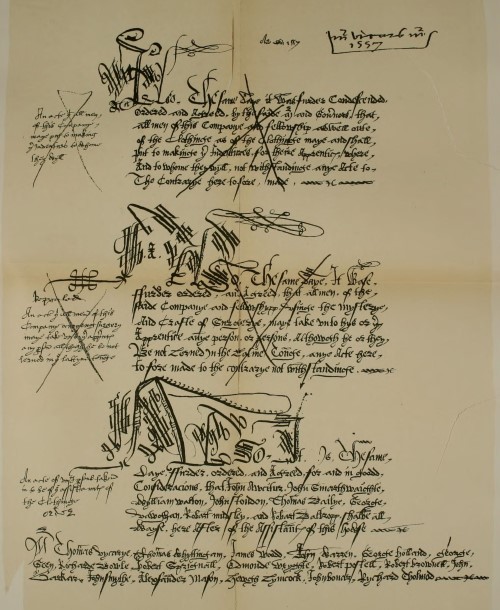
FAC-SIMILE PAGE OF FIRST MINUTE BOOK, 1557.
1550. The first of our Court Minute Books which has been preserved, commences in the 4th Edward VI, and bears this title,
Orders and Awardes made ordered and awarded within the tyme of Maister George Geen Thomas Johnson Thomas Stocdall and Mathew Johnson Maister and Wardeins of the Company and fellowship of Barbors Surgeons of London for one hole yere begynnyng the xxvjth day of Auguste in the fowerthe yere of the reigne of our Sovereigne Lorde Kynge Edward the Syxte with thassent and consent of the Assistaunces of the same Companye as hereafter ensuethe.
From this and the succeeding Minute Books, the following extracts are principally taken as illustrative of the Company’s History from this period:
1556. At the end of the first book is a very long memorandum written and signed by Thomas Knot, Master, to the effect that on the 26th March, 1556, he made humble suit to the Lord Mayor, Sir Willm. Garrett and the Aldermen, in the name of the Company, for the exemption of the Company from finding or setting forth any soldiers or men of war at any time thereafter, when it might be that the Citizens of London should be required to do so, either by sea or land, “fforasmoche as the same Company are alwayes at every such tyme and tymes very sore burdened and chardged otherwise hereafter expressed, that is to saye, They are comaunded and bounden to prepare and fynde so manye Surgeons and so many other men attendinge upon them at every tyme and tymes that it shall fortune the King” to send out soldiers by sea or land, and “the same Company doe alwayes prepare fynde and send furthe for every one houndreth of suche Souldyers one Surgeon and a man attending upon him.” Upon which representations the Lord Mayor and Aldermen were pleased to grant to the Company, that on future occasions when the like requisitions might “fortune to be layed or appointed to or upon theym, that then they in every suche case upon their gentle suyte and request made unto the Lorde Mayor and courte of Aldermen for the tyme beinge for and concernynge their sayd dischardge for and in consyderac͠on of the causes above remembered, shalbe as gentelye and charytably holpen eased and releaved in that behalf as the wayte and ymportaunce of the burden that the Cytie at every suche tyme shalbe chardged wth all will reasonablye permytt and suffer.”
The memorandum then proceeds to state that the Lord Mayor and Aldermen advised the Master to cause a remembrance of the above (being only a promise by word of mouth) to be entered and recorded in the Book of Ordinances of the Company, which was done.
1555. In Henry Machyn’s Diary for this year, is the following reference to a Romish procession, winding up with a dinner at Barbers’ Hall.
The xxvij day of May was the Clarkes prossessyon from Yerdhall95 college, and ther was a goodly masse to be hard, and evere clarke havyng a cope and garland, with C.96 stremers borne, and the whettes97 a playng round Chepe, and so to Ledynhall unto Sant Albro98 chyrche, and ther thay putt off ther gayre, and ther was the blessyd sacrament borne with torche-lyght abowt, and from thens unto the Barbur-hall to dener.
1558. This year (8th June) the Company procured an Inspeximus Charter from Philip and Mary, which is still in our possession, and has a most beautifully executed title, the initial letter representing the King and Queen seated on the throne, and the border containing various heraldic badges; the seal unfortunately is damaged.
PHILIPPUS ET MARIA, Dei gracia Rex et Regina Anglie hispaniarum ffrancie utriusque Sicilie Jerusalem & hiᵬine fidei defensores Archiduces Austrie Duces Burgundie Mediolani & brabantie Countes haspurgi fflandrˀ & Tirolis.
Omnibus ad quos presentes lr̃e pervñint salt̃m.
Inspeximus quasdam lrãs patentes domini H. quondam Regis Anglie septum99 fc̃as in hec verba, Henricus dei grã, &c. . . . . . . . . . . Teste me ip̃o apud Westmonastiũm duodecimo die marcii Anno regni nr̃i tcĩo. Yong. pro viginti soliᵭ solut̃ in hanap̃io. Nos autem lrãs pˀdcãs ac omnia & singula in eisdem contenta rata heñtes & grata ac ea pro noᵬ heredibʒ & Successoribʒ nr̃m prefate Regine quantum in noᵬ est acceptamus & approbamus ac ea dilc̃is noᵬ Thome Vicary nunc magistro mistere barbitonsoꝜ Thome Whytyngame Jacobo Wood & Johĩ Warren Gubernatoribus ejusdem mistere & Successoribʒ suis ratificamus & confirmamˀ p’ut lrẽ p’dc̃e in se r̃onabiliter testantur. In cujus rei testimonĩu has lr̃as nrãs fieri fecimus patentes. Testibus nobis ip̃is apud Westmonasterium octavo die Junii Annis regnorum quarto & quinto.
Lutley.
Taxat̃ finis ad xl. Nico eboꝜ Canc.100
It is noticeable in this Charter that the confirmation is to the Governors of the “Barbers,” and not “Barber-Surgeons,” although the latter was then the legal style of the Company, but probably this was another clerical error.
1560. This year (6th January) the Company obtained an Inspeximus Charter from Elizabeth, still preserved at the Hall; it has a title in much the same style as the preceding charter, but the seal is very much damaged.

ELIZABETH, Dei gracia Anglie FFrancie, et hibernie Regina fidei defensor, &c. Omnibus ad quos presentes littere pervenerint salutem.
Inspeximus litteras patentes Dn̄i P. et Dn̄e M. Sororis nr̃e precharissime nuper Regis et Regine Anglie de confirmac͠oe factas in hec verba Philippus et Maria dei gracia, &c. . . . . . . . . Testibus nobis ip̃is apud Westmonasterĩu octavo die Junii Annis regnoꝜ nr̃oꝜ quarto et quinto. Nos autem lrãs predcãs ac omĩa et singula in eisdem contenta rata habentes et grata ea pro nobis heredibus et successoribus nr̃is quantum in nobis est acceptamus et approbamus ac ea Diɫcis nobis Georgio Geñ nunc magistro mistere BarbitonsoꝜ Willm̄ Grene Thome Bayly et Joh̃i Smarthawyte Gubernatoribus ejusdem mistere et Successoribus suis ratificamus et confirmamus prout lrẽ predcẽ in se racionabiliter testantur. In cujus rei testimonium has lrãs nrãs fieri fecimus patentes. Teste me ip̃a apud Westmonasteriũ sexto die Januarii Anno regni nr̃ secundo.
Cotton. Taxat̃ finis ad xl. vjs. viijd.
In Machyn’s quaint Diary, we find the following entries:—
1561. The xxiiij day of Feybruary whent to hang xviij men and ij women, and serten ware browthe101 to be bered in serten parryches in London; the barbur surgens had on102 of them to be a notheme103 at ther halle.
1562. The xx day of June was a gret shutyng104 of the Compene of the Barbur Surgeantes for a gret soper at ther owne hall for a xxx mess of mett,105 for they dyd make ij godley106 stremars agaynst that day of their harmes,107 the whyche they wher agmented by the most valeant kyng at armes master . . . . . . and they had vj drumes plahyng and a flutt; and ij gret ansutts,108 and as a shot was wone, downe whent that and up the thodar,109 and as they whan the shut; and master Gall110 and ys syd111 wan the soper—the master of the Compene.
The x day of August was Barbur surgyons fest, and they capt ther communion at Sant Alphes112 at Crepull-gat, and master Recherdson dyd pryche,113 the skott; ther was good syngyng; and after to ther halle to dener, and after dener a play.
1567. Elizabeth inaugurated the first State Lottery in England, as a means of providing money, and a very peremptory mandate was directed by the Lord Mayor to the various City Companies, commanding them to adventure therein.
1st February, 1568. The Barber-Surgeons put in 40s. for the “use, profet and benefyt of the hall,” but did not draw a prize, and indeed none of the Companies reaped any advantage by the speculation, the Lottery being simply a trap into which they were ordered to walk.
The proposal for this Lottery was as follows:—
A verie rich Lotterie Generall without any Blancks contayning a great No. of good prices, as well of redy money, as of Plate & certaine sorts of marchaundizes having been valued & prised by the commaundement of the Queenes most excellent Majestie by men expert & skilfull and the same Lotterie is erected by hir majesties order, to the entent that such Commoditie as may chaunce to arise thereof, after the charges borne, may be converted towards the reparation of the Havens and strength of the Realme, & towardes such other publique good workes. The No. of lots shall be foure hundreth thousand, and no more: and every lot shall be the summe of tenne shillings sterling onely, and no more.
Stow says that this Lottery was commenced to be drawn on the 11th January, 1569, at the West Door of St. Paul’s, and continued drawing day and night until the 6th May following.
It was a common practice of the Companies to put in their money under mottoes, and some curious ones are recorded, many being composed with a quaint sarcasm on the probability of prizes being obtained.
Herbert (Hist. of the Twelve Livery Companies) gives some interesting particulars of the State Lotteries, and quotes a motto used by the Merchant Taylors which pretty clearly indicates their opinion of the business;
One byrde in the hande is worth two in the wood, If we get the great lot, it will do us good.
Some of the prizes were ridiculously small, e.g., 1s. 2d., 2s. 1d., etc., and great dissatisfaction was expressed at the principal prizes remaining unpaid to the winners.
1573. The Company received a precept from the Lord Mayor for a “loan” of money to make provision of wheat for the City, and the same was by the Court ordered to be complied with. This “corn custom” is very fully treated of by Herbert, and was virtually a tax upon the companies, who were each rated and compelled to find a certain proportion of corn to be stored by the City, and sold at such times as when, there being a scarcity, the markets would otherwise rise, were it not for the immense stock kept by the City. This custom survived for many years under certain modifications; as we shall see hereafter, our Company built a granary in 1633, and stored their own corn.
The precept above referred to was as follows—
Forasmuche as all comon polecye requyreth the prevenc͠on of extremities, and consideringe as you knowe the urgent and present necessitie, and the lacke of provision of wheate and other grayne for furniture of this so great and populous citie, of the want whereof the queenes matie and her most honorable coñsell are not ignorant; but havinge spˀcial regard to the same, are not a lytle offended and displeased, with some grefe that there bene no better pˀvision heretofore made, and that presentlie the cittie shoulde be no better stored, by reson wherof the prices of corne and grayne is now muche dearer in this cittie than in any other parte of this realme, have not only at sundrye times and gentle meanes, but also wth some terror, as welle in the Starre-chamber as in other places afore the counsell, given us admonicion that the same her maties cittie and chamber may not be unfurnished for lacke of good pˀvision. And we, as our duties is, havinge great care and especial consideracion of the same, and pˀcevynge by order of the harvest past, and the unkynd season of the yeare, sith that the prices of corne is verry likely to encrease and be advanced to a greater and higher price than yet is, have thought good and verrye necessarye for the avoyding of greater inconvenyences, to make immediate pˀvision of a great masse and quantity of wheate and other grayne, as well wthin the realme as beyond the seas for the provision aforesaid, wch cannot be done wthout a great some of money presentlie to be defrayed, wch is not to be levyed but by the good assestens of you and others, good coustomers and cittezens of this cittie; have therefore assessed your Company of Barber Surgeons at the some of114 which is agreed upon by acte of coˀen counsell, wch some of we do not only require you, but also streaghtle charge and comande you, immediatelie upon the recept hereof, calling your companye together in your comon hall, you do forthwth tax, levy, and gather of the welthiest and most able persones of the same the sum aforesaid, in such wise that you fayle not to pay the same, and evrie pˀcell thereof, to the hands of George Helton, of the cittie of London, wth all expedicion, and wthout repayment thereof to you. Fayle not hereof, as you tender the mytigac͠on of our sovereigne ladye the queens majesties displeasure already conceived, and do tender the com̃on weale of this cittie, together wth your private condytte, and as you will answer for the contrarye.
The next entry would seem to indicate some contemplated State interference with the Company’s property, and the answer was probably not in exact accordance with the truth, for on the 28 May, 1576, a precept in the Queen’s name, having been received, calling upon the Master and Wardens to return to class="tal plhir"nt of the revenue of their lands, and of their goods, “the answere was that the true revenewe of the landes was xxti markes whereof the most pˀte went forthe and is disbursed in peñcons, and that we had no goods.”
1578. A precept was received as follows,
To the Wardens of the Companie of Barbor Surgins.

By the Maior.
Thyes shalbe to will and require you and in her maiesties name streitlie to charge and comaunde you that wth all convenient spede you appointe and pˀvide the number of twelve hable and sufficient pˀsons being Iournemen appnˀtices or others wch are fremen of this Cittie and inhabitinge wthin the same beinge of agilitie and honest of behavior betweene the age of xix yeres and xlti wch are fitt to be trayned for harquebus shott, evˀy one of them havinge a murrion, a sworde and dagger, and a caliver wth sufficient furniture for the same, and one half pounde of powder, besides touche powder whereof Three of the same pˀsons to be house holders and free men of yor saide Companie, and that you certyfie me the saide Maior the names and sir names of all yor saide number where and wth whome they dwell, of what Companie they be free, and what Captaynes or other skilfull men that be of yor saide Companie or whome you knowe inhabitinge wthin this Cittie fitt to trayne or leade the same men of there names and dwellinge places. And that they be all in a redines furnished as aforesaide to muster in there hose and dublets onlie, or dublets hose and jerkins wthin xiiijen daies next ensuinge the date hereof. And for the levyenge of monie for the saide furniture And for the charge of powder you shall collect suche reasonable somẽs of monie as you shall finde mete for the saide pˀporc͠on, by waie of reasonable assesment of evˀy sevˀall welthie and hable pˀson of yor Companie. Wherein we require you in anie wyse to spare the powrer sorte of ffremen although you somewhat more largelie burden the ritche. Yoven at the Guildhall of this Cittie of London the xvth daie of Marche 1577.115
Sebright.
In pursuance of this precept a levy was made upon ninety freemen, who contributed £19 17s. 11d. (in sums ranging from 1s to 6s 8d) and upon ten “foreins” who paid in all £3. The Expenses of the soldiers, and their arms, powder, etc., are all set out in detail (see Appendix D).
1585. It was agreed “that or Companie by reason of the often and earnest preceptes from the Lorde maior to move unto some liberall puttinge in of monie into the Lottery for Armor, that or Companie should put in xli yf that might satisfie for all the Companie vizt the Clothinge vjli xiijs iiijd and the yeomanry v m’kes.”
29th September, 1586. The Lord Mayor had issued sundry precepts to the Company for the “buyeinge of certein goune powder amountinge in waight to of one Mr. Henry Dale Hab’dassher at the price of xd le ɫi. and yt was agreed the saide powder should be bought and that Mr. Swaldell [Master, 1593] should go to chuyse it, and he to have the same powder for viijd the pounde.”
10th March, 1589. It was ordered that the gunpowder directed by another precept to be provided by the Company, should be bought and that it should be kept “in the Armorie howse in convenient place for feare of daunger of ffier.”
29th March, 1596. It was ordered that £40 “ship money” should be “lent” by the Company to the City, which is the earliest mention of this obnoxious tax in our books.
8th August, 1596. “Yt was agreed that the som̃e of £xxxti shalbe lent unto the Cytty for the payenge of Souldiers wages and other charges diffrayed about the Spanishe voyage.” This was an Expedition of certain ships (furnished by the City) under the Earl of Essex and Sir Walter Raleigh “to annoye the King of Spaine.” The English then sacked and burned Cadiz, burnt the Spanish navy, and on their return home, says Stow, “great triumph was made at London for their good successe.”
18th August, 1598. At this Court came a precept from the Lord Mayor, commanding the Company in Her Majesty’s name to “lend” £100 to the Queen for six months, for suppressing rebels in Ireland. The demand was, as usual, of a most peremptory nature, and the Court ordered £100 to be paid to the Treasurers appointed by the City.
6th August, 1599. A precept came from the Lord Mayor in the Queen’s name, commanding the Master and Wardens to deliver to the freemen the Company’s armour in “suche order as it maye be, in safetye readie for her Maiesties service,” whereupon the Master took for his own use “one muskett fflaske and tuche boxe one headepeece and one rest.” Eleven other members of the Company had armour delivered out to them, as “one caliver fflaske and tuche boxe, sworde and dager girdle and hangers and headepeece.”
1599. A precept was received on 11th November, commanding the Company to be in attendance on the Queen in her progress from Chelsea to Westminster, which is not only curious for the quaintness of its description of the persons who were to be appointed, but affords a glimpse at the magnificence of Royal processions three hundred years ago.
To the Maister and Wardens of the Companye of Barbor-surgeons.
By the Maior
Where her Mats moste gratiouse pleasure and comaundement is this pˀsente daie signified unto me the lorde Maior from the right ho: the lorde Chamberline of her Maties moste honorable householde that myselfe and my Bretheren thaldermen with a conveniente number of the beste and moste graveste Cittyzens of this Citye shoulde uppon Tewesdaie nexte in the Afternoune wayte and attende uppon her highnes royall pˀson from the Towne of Chelsey unto her highnes princlie pallace at Westminster in as honorable and statelye sorte as conveinentlye maye be pˀformed. In accomplishment of wch her highnes said comaundement, These shalbe to chardge and comaunde you in her Mats name to pˀpare not onlye your selves, but alsoe provide and have in a readines the full number of eighte pˀsons of the moste graveste talleste and comliest pˀsonages of your saide Companye, everye of them to be well horsed and appareled in velvet coates and chaynes of goulde And that not onlye your sealves but alsoe everye of the saide eighte pˀsones maye have one footeman with twoe staffe torches to waite and attende upon him, and to be all in a readines well and substancially horsed appareled and appointed as aforesaide in Cheepeside by twoe of the clocke of the saide afternoone to attende uppon me and my bretheren thaldermen to waite upon her moste excellente Matie from Chelsey aforesaide to her highnes saide pallace of Whitehall, Whereof see you faile not at your pˀill and as you will answere the contrarye if throughe your negligence any parte of this service shall not be thoroughelye pˀformed. Guihalde the ix of November 1599.
Sebrighte.
In pursuance of the above precept the Master with seven other Members of the Court were appointed to attend, and eight freemen were nominated as torchbearers.
1600. The fee simple of three houses in Monkwell Street was this year purchased by the Company of William Fyninge for £112!
11th November, 1600. In obedience to a precept it was ordered that twelve members of the Court “well mounted on horseback and apparrelled in all poynts accordingely,” together with twelve freemen “to wayte uppon them wth evˀy one twoe staffe torches in his hande,” were to meet at the Hall on the following Thursday (13th November) and to ride with the Lord Mayor to Chelsea to conduct the Queen to Westminster. This procession is thus referred to in Stow’s Annals; “On the thirteenth of November 1600, her Maiestie being most honourablie attended on, by the most honourable Prelates, and Nobles, and Judges of the Realme, was received neere unto Chelsey, by the Lord Maior of London, with his brethren the Aldermen all in Scarlet, besides to the number of five hundred citizens, in coates of velvet, and chaines of gold, on horesbacke, every of them having two staffe torches to attende on them: And they all waited on her, to her royall Pallace at Westminster.”