BIOGRAPHICAL NOTICES OF EMINENT MEMBERS. (continued 2)
Reading edition
His Will is dated 28th March, 1723, and by it he bequeaths various legacies of £2,000 each to nephews and nieces, and sundry other smaller legacies to friends and servants, etc. £700 to St. Bartholomews, and £100 each to St. Thomas’, Christ’s and Bethlem Hospitals. £50 to the London Workhouse, £500 to his housekeeper Mrs. Ann Smedley, etc.
Arms. Or a fesse chequy ar. and az. over all a bend engr. gu.
CHARLES BERNARD, Serjeant-Surgeon.
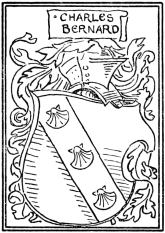
Charles Bernard, who was born about 1656, was a son of Samuel Bernard, D.D., of Croydon. On 16th August, 1670 (his father being then dead), he was apprenticed to Henry Boone, Surgeon, for seven years, and on 4th December, 1677, was admitted to the freedom of the Barber-Surgeons; on 25th October, 1697, he was chosen an Assistant, and on 8th November, 1700, an Examiner of Surgeons in the place of Thomas Lichfield. In 1702 he was appointed Serjeant-Surgeon to Queen Anne, and in 1703 he was Master of the Company. One of his brothers, Dr. Francis Bernard, was physician to James II, and he had another brother, Dr. William Bernard. Charles Bernard died at Lord Weymouth’s house, Long Leate, Wilts, on 9th October, 1710, and shortly afterwards the Company caused his portrait to be painted. There is a Latin inscription below it which is highly eulogistic of Bernard, the following being a translation:—
This portrait of Charles Bernard Esquire, Royal Surgeon in Chief, most learned in Greek and Latin letters, most experienced, candid and upright in his profession, enjoying the greatest favour with the Most Serene Queen Anne, the greatest fame among the laity, the greatest authority among his fellows, the greatest esteem among all, in consideration of the remission by the same Most Serene Queen at his prayer of a heavy sum of nearly one thousand pounds in which this Company was bound to the Royal Exchequer, and in consideration of his advancement of Surgical science, his assertion and augmentation of its dignity, and other brilliant services to the Surgeons, the Company caused this portrait to be painted after his death 1711.
Mr. Bernard possessed a valuable library containing a curious collection of the best authors in Physic, Philology, Antiquities, &c., together with many ancient manuscripts, all of which were sold by Auction in March, 1711, at the Black Boy Coffee House in Ave Maria Lane. Swift in his Journal to Stella, March 19th, says,
I went to-day to see poor Charles Bernard’s books, and I itch to lay out nine or ten pounds for some fine Editions of fine authors * * * I walked to-day into the City, and went to see the auction of poor Charles Bernard’s books. They were in the middle of Physic books, so I bought none, and they are so dear I believe I shall buy none.
A catalogue of these books is in the Sloane collection (1770).
In Nichols’ Literary Anecdotes is a story of Mr. Edward Thwaites, M.A., Fellow of Queen’s College, Oxford, which characteristically introduces Mr. Bernard.
Mr. Bernard’s daughter Elizabeth was married to Ambrose Dickins, Esquire (who was Master in 1629 and Serjeant-Surgeon).
By his Will, dated 7th November, 1707, he bequeathed to his wife Susan, £500 and his houses in Broad Street, Pissing Alley and Milk Street. To his daughter Susan £1,000, and other bequests to his daughters Elizabeth and Mary, his son Charles and his sister Jane. He desires to be buried privately and late at night, makes his children residuary legatees and appoints his brother, Dr. William Bernard and his kinsman, Thomas Sisson, executors. By a codicil 3rd October, 1710, he revokes the appointment of executors and makes his son, Henry Bernard, and Charles Bernard (Clerk of the Barber-Surgeons) his executors with £100 each.
Arms. Ar. on a bend az. three escallop shells of the field.
SIR JOHN BULL.
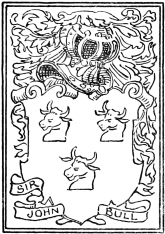
Sir John Bull was the son of Richard Bull, of Stonall, Staffordshire, and was admitted to our freedom 6th April, 1714. He was susequently translated to the Clothworkers’ Company, and nominated Sheriff of London, 22nd April, 1718, which office he served during the Mayoralty of Sir John Ward.
Arms. Or. three bull’s heads gu.
CLAUDIUS AMYAND, F.R.S., Serjeant-Surgeon.
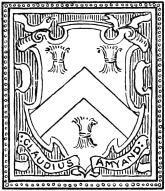
Claudius Amyand was the second son of Isaac Amyand, of Mornac, Xaintonge, a Hugenot refugee who was naturalized in London 10th October, 1688, and was living there in 1699. Claudius Amyand’s birth is not recorded. He was elected a Director of the French Protestant Hospital (La Providence) 2nd January, 1723. He was also a Fellow of the Royal Society and Serjeant-Surgeon to George II. On 7th May, 1728, he was admitted to the freedom of the Barber-Surgeons, examined and approved touching his skill in surgery, admitted to fine for all offices to the Parlour door, and elected on to the Court of Assistants. It was ordered on the same day “in regard to the dignity of their offices” that Mr. Serjeant Dickins and Mr. Serjeant Amyand should hereafter take precedence next after the Governors for the time being. Mr. Amyand served as Warden in 1729 and 1730 and was Master of the Company in 1731. He was Surgeon to St. George’s Hospital 1733–1738. By his wife, Mary Rabache, he had three sons and six daughters. The eldest son Claudius was Under-Secretary of State in 1750 and an M.P.; he married Frances widow of George, 6th Earl of Northampton. The second son George who was also an M.P. and a Director of the East India Company was on the 4th August, 1764, created a baronet. The third son Thomas was in holy orders. The eldest daughter Anne married John Porter, M.P., Alderman and Sheriff of London; another daughter, Mary Catherine married Sir Richard Adams, Recorder of London and a Baron of the Exchequer; and the youngest daughter Judith, was married to the Rev. Thos. Ashton, D.D., Rector of St. Botolph, Bishopsgate.
Sir George Amyand (son of Claudius) was succeeded by his eldest son, Sir George Cornewall, Bart., M.P., who on his marriage with Catherine daughter and heiress of Velters Cornewall, M.P., assumed the name and arms of Cornewall and was the ancestor of the present baronet of that name. Sir George Amyand’s second son John Amyand, M.P., died in 1780 unmarried; his daughter Anna Maria married Gilbert, Earl of Minto, and another daughter, Harriet Mary, married James, Earl of Malmesbury.
Serjeant-Surgeon Amyand died at his house in Castle Street, St. Martin’s-in-the-Fields, 6th July, 1740, having met with an accident in Greenwich Park on the day previously, and his Will was proved a few days afterwards. He bequeathed to each of his children £1,000, he left £300 for apprenticing poor boys, and his lands in Hampshire and at Sidlesham, Sussex, and the residue to his wife Mary.
Arms. Vert a chev. betw. three garbs or.
SIR THOMAS CHALLONER.
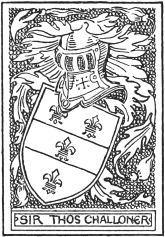
Sir Thomas was the son of Thomas Challoner, of Woodbridge, Suffolk. On 4th July, 1699, he was apprenticed to January Farmer (who was a Barber by trade), and was admitted to the freedom 4th March, 1707. He left the trade of a Barber and became a Wholesale Grocer and Merchant in Leadenhall Street, where he traded in partnership with Mr. Lethieullier. On the 2nd December, 1760, he was elected Alderman of the Ward of Aldgate, served the office of Sheriff in 1762 (when the celebrated William Beckford was Lord Mayor), and was knighted 4th October in the same year. In 1761, he was Master of the Barbers and living at Walthamstow, where dying 8th May, 1766, he was buried there.
By his Will dated 5th March, 1766, he gave his sister Rachel Challoner £20 per annum for life. To Mr. William Lethieullier and Rachel his wife £100 each, and to their daughters Rachael and Margaret £50 each. Residue to his wife Mary Challoner.
Arms. Ar. on a fesse betw. three fleur de lys gu. another fleur de lys or.
WILLIAM CHESELDEN, F.R.S.
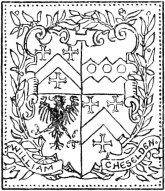
This eminent Surgeon was the son of George Cheselden, and born 19th October, 1688, at Somerby, near Burrow-on-the-Hill, Leicestershire. He was at an early age studying anatomy with William Cowper, the celebrated anatomist, but appears to have left him when fifteen years old, for on the 7th December, 1703, he was bound apprentice for seven years to James Ferne, the Surgeon to St. Thomas’ Hospital, under which distinguished man he made rapid advance in his profession. On 5th December, 1710, he was admitted to the freedom and livery of the Barber-Surgeons, on the 29th January following he had a full certificate to practise as a Surgeon, and he then (being but twenty-two years of age) began his lectures on anatomy, and the following year was elected a Fellow of the Royal Society.
By a minute in our books of 25th March, 1714, it seems that Mr. Cheselden had often procured the bodies of malefactors and privately dissected them at his own house, and that at times when lectures and dissections were proceeding at the Hall, whereby the attendance at the Hall was diminished, and moreover contrary to the express laws of the Company; whereupon he was summoned before the Court and reproved, when he promised not to offend again in like manner. A less influential man would probably have been fined.
In 1719 he was elected Surgeon to St. Thomas’ Hospital, where he highly distinguished himself in his operations for the stone. He was also consulting Surgeon to St. George’s and the Westminster Infirmary. In 1727 he was appointed principal Surgeon to Queen Caroline, and ten years later was chosen Head Surgeon to Chelsea Hospital, which post he held till his death. He married Miss Deborah Knight of London, by whom he had an only daughter. His practice was both extensive and lucrative, and his works on Surgery are numerous, besides which he was a frequent contributor to the Philosophical Transactions of the Royal Society. Mr. Cheselden died at Bath on the 10th April, 1752.
Dr. J. F. Payne says that he will always be regarded as, beyond dispute, one of the greatest of British surgeons, being one of the most brilliant operators whose achievements are upon record; he was a keen patron of athletic sports, especially boxing; his disposition was gay and genial, he was fond of society, and evidently popular, while to his patients he was always kind and tender-hearted.
On the separation of the Surgeons from the Barbers in 1745, Mr. Cheselden was named in the Act of Parliament one of the Wardens of the new Company of Surgeons, he having been Junior Warden of the Barber-Surgeons that year. His will is a remarkable specimen of brevity and absence of formality:—
Being in perfect health I write this with my own hand and declare it to be my last Will and Testament. I give to my daughter W. J. Cotes five hundred pounds and all the rest and residue of my estate of what kind soever to my wife and make her full and sole Executrix administratrix and assign Witness my hand and seal. Willm Cheselden (L.S.) 24th March 1749/50.
Arms. Quarterly 1 and 4 Ar a chev. betw. three crosses moline gu. (Cheselden). 2. Ar. on a fesse indented sa. three bezants (Brough). 3. Or. an eagle displayed az. beaked and feet gu. (Mongomery).
AMBROSE DICKINS, Serjeant-Surgeon.
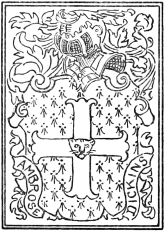
Ambrose Dickins (sometimes spelt Dickens) was the son of George Dickins of Riplington, in East Meon, Hampshire, gentleman, and was probably born about 1687. On the 17th February, 1702, he was apprenticed to Serjeant-Surgeon Charles Bernard for seven years, and on the 16th February, 1709, he was admitted to the Freedom and Livery of the Barber-Surgeons, when he was residing in James Street, Covent Garden. He married (before the 24th March, 1709) Elizabeth, daughter of Charles Bernard. On December 20th, 1721, he was elected Surgeon to Westminster Hospital. His old master, Charles Bernard, died in October, 1710, and it seems that Dickins succeeded him when quite a young man in the important office of Serjeant-Surgeon. In 1728 he was Warden of the Barber-Surgeons, and in 1729 Master of the Company. He was Surgeon to St. George’s Hospital 1733–38. On the separation of the Surgeons from the Barbers in 1745, Mr. Dickins became an Assistant of the Surgeons’ Company and an Examiner of Surgeons. He probably died in 1747, as on 7th September in that year Mr. Cæsar Hawkins was appointed Serjeant-Surgeon in his place.
Dr. John Douglas, Bishop of Salisbury, in “The Criterion,” introduces Mr. Dickins’ name in an interesting paragraph. Dr. Douglas was a firm believer in the efficacy of the Royal touch for the King’s evil, and he gives some curious particulars of Mr. Dickins’ experience in this matter which are well worth referring to.
Arms. Ermine on a cross fleury sa. a leopard’s face or.
SIR CÆSAR HAWKINS, Bart., Serjeant-Surgeon.
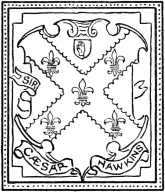
This eminent Surgeon (the son of Mr. Cæsar Hawkins, a Surgeon at Ludlow, Shropshire) was born 10th January, 1711, and by his great ability, at a very early age secured a large and lucrative practice; he was the inventor of the cutting gorget, and a remarkably dexterous operator.
1st July, 1735. Mr Cæsar Hawkins Surgeon in Bloomsbury who had lived several years with his father a Surgeon in the Country and afterwards with Mr Ranby a Foreign Brother of the Company seven years, but not bound an Apprentice at the Hall, was in consideration thereof, admitted into the freedom of the Company for six pounds six shillings which he paid down and was sworne. At the same time the said Mr Cæsar Hawkins was examined touching his skill in Surgery his answers were approved of and he was ordered the Diploma under the hands of the Governors and the seal of the Company testifying his skill and impowering him to practice.
19th August, 1736. Mr. Hawkins was admitted to the Livery, and the same day was chosen a Demonstrator of Anatomy, being then but twenty-five years of age.
18th August, 1737. Mr Cæsar Hawkins one of the Demonstrators of Anatomy attended at this Court and surrendered the said office and after returning this Court his thanks for the honor they had done him to choose him one of their Demonstrators acquainted them that he being appointed Surgeon to his Royal Highness the Prince of Wales, and also Surgeon to one of the troops of Guards, could not perform the office of a Demonstrator and therefore the Court accepted of such surrender.
Mr. Hawkins, in addition to his other appointments, was Surgeon to St. George’s Hospital, 1735–1774, and Serjeant-Surgeon to George III, to which latter office he was appointed 7th September, 1747. By his practice as a phlebotomist alone he is said to have made £1,000 a year, it then being the custom for people to be bled at the spring and fall of the year.
His family have been Surgeons for some generations, and have held distinguished office, his brother Pennell Hawkins, his son Charles, and his grandson Cæsar Henry, having all been Serjeant-Surgeons. On the 25th July, 1778, Mr. Hawkins was created a Baronet; he died 13th February, 1786. A portrait of him, by Hogarth, is in the Hall of the Royal College of Surgeons.
Arms. Ar. on a saltire engrailed sa. five fleur de lys or.
WALTER HENRY WILKIN, Alderman.
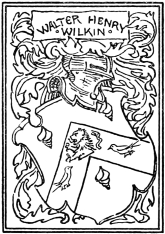
Walter Henry Wilkin, Esquire, who was born 1st April, 1842, is the son of the late Mr. David Wilkin, of the firm of Wilkin and Pugh. He was admitted to the freedom and livery of the Company 5th January, 1864. Mr. Wilkin commenced his career as articled clerk to a well-known firm of underwriters at Lloyds, but subsequently entered himself at the Middle Temple, where he read with Mr. Crump, Q.C., and passing his examination and obtaining the Certificate of the Council of Legal Education, he was called to the Bar; but in consequence of the deaths of his father and brother, he retired from the profession of the law to take upon himself the conduct of their business in the City. In 1878 Mr. Wilkin was chosen an Assistant of this Company, and in 1885 served the office of Master. For twelve years he sat as one of the Common Council for the Ward of Lime Street. On the death of Sir Robert Walter Carden, Mr. Alderman Cotton was transferred from Lime Street to Bridge Without, and the vacancy thus occasioned in the Court of Aldermen, was filled up by the appointment of Mr. Wilkin in February, 1888. He is a member of the Court of Assistants of the Broderers’ Company, and has filled the office of G.S. and Master in Grand Master’s Lodge No. 1. For twenty-six years Mr. Wilkin was a Volunteer, rising to the rank of Lieut.-Colonel in the 3rd Middlesex Artillery, but has now resigned his commission.