HISTORICAL ACCOUNT (continued 3)
Reading edition
9th November, 1602. Various members of the Company “were appoynted to ryde wth the Mr to meete her Matie on Saterdaie next” at Chelsea.
9th April, 1603. A precept was received commanding the Company to contribute £12 10s. 0d. towards the cost of the reception of James I by the City, whereupon an assessment was made upon the freemen for the same, and the Masters made “choyce of sixe pˀsonable menn for Wiflers to attend the Livˀye of this Companye when his Matie goeth to be crowned.”
20th April, 1603. The following precept requiring the Company to assist in the reception of the King “in greater number and more statelie and sumtiows shewe then hath bene at any time heretofore within the memory of man in the like case pˀformed,” will be read with interest;
To the Mrs and Wardens of the Company of Barbor Surgeons

By the Maior
Where the most high and mightie Prince James or most dread & soveraygne Lord is by the grace of god shortlie to make his repaire from his Kingedom of Scotland into this his Realme of England and so consequentlye to this his honorˀble Cittie and chaymber of this his imperyall Crowne. And for that it is agreed by mee and my Breethrn the Aldrẽn of the same Cittie that not onelie or selves but the full number of five hundred of the best and gravest Cittizens should accordinge to or dueties wayte and attend uppon his royall pˀson at his approch nere to this Cittie in greater number and more statelie and sumtiows shewe then hath bene at any time heretofore within the memory of man in the like case pˀformed, Towards the accomplishmt of wch number your company is appoynted to pˀvid the full number of Twelve pˀsonns, These therefore shalbe to chardge and commaund you in his Maties name to prepare not onely yourselves but also to p’vid the full number of Twelve persons of the most grave and Comlyest pˀsonages of youre said Companye, everie one of them to be well horsed and apparrelled wth velvet Coates and wth sleaves of the same and chaynes of golde, and not onely yourselves but every of the saide pˀsons to have one comely pˀson well apparrelled in his dublet and hose to attend uppon him one116 foote. All which pˀsons to be in redines well and substonciallie horsed apparrelled and appoynted as aforesaid wthin one daies warneing to be signified unto you to attend on mee and my Bretheren the Aldrẽn of the same Cittie, to attend and wayte uppon his most exelent Matie as aforesaid. And that uppon Saturdaie morneinge next you doe certifye to mee in wrytinge the names and Srnames as well of youre selves as of all other pˀsons free of youre company that you shall appointe for this service. Of all wch pˀsons you are to have a regard that noe man for insufficiency in any respect be turned back to the disgrace and discredit of youre company, nor a mann unfitt furnished and appointed for so honorable a service. And hereof fayle you not, as you will answer the contrary if through youre defalt any parte of this service shal not be fullie pˀformed.
Guyldhull this Twenteth of Aprill 1603
Sebright.
9th August, 1603. James soon attempted to borrow (as he termed it) of the Companies. “Where a pˀcept was directed to õr Mrs. for the lone of money to the Kinge, wee are to answer that wee have none.”
Perhaps this reply sufficed on this occasion.
22nd October, 1603. London was this year visited with a great Plague, and in consequence there was no Lord Mayor’s Show.
To the Wardes̃ of the Compãie of Barbor Surgeons
By the Maior.
Theise are to will and require you that you take speciall knowledge herby that for avoydinge of infecc̃on by assemblie of people this tyme of gods vizitac̃on It is thought meate therbe noe shewe made the morrowe after Simond and Judes daie next, it is intended that youre Companie be dischardged thereof for their Attendac̃e for that tyme.
Sebright.
This xxijth of October 1603.
7th February, 1604. The Court having considered the many abuses “comited against the weale of this Company” decided to apply for an Act of Parliament which should confer upon them extended powers, and appointed a Committee for the purpose, with the Recorder and Mr. Wilbraham as counsel.
20th October, 1604. From an entry of this date, it seems that it had been decided to apply for a fresh Charter, instead of an Act of Parliament, and a summary of the clauses (twenty-seven in number) which it was desired to have embodied therein is set out in full. As the Charter was obtained, it is unnecessary to give these suggested clauses here (they may be seen in Mr. D’Arcy Power’s book, p. 361). The 16th one is, however, curious enough, declaring the “openinge searinge and imbalmeinge of the dead corpes to be pˀply belongeinge to the science of Barbery and Surgery, And the same intruded into by Butchers Taylors Smythes Chaundlors and others of macanicall trades unskillfull in Barbery or Surgery, And unseemely and unchristian lyke defaceinge disfiguringe and dismembringe the dead Corpes, And so that by theire unskillfull searinge and imbalmeinge, the corpes corrupteth and groweth pˀntlie contagious and ofensive to the place and pˀsons approachinge.”
30th January, 1605. The Charter of James I is of this date, but not now in our possession; there are, however, two copies of it at the Hall, one of which was made in a vellum book in 1658. It was in Latin of prodigious length; but the following are the clauses as I make them out, and will suffice for this work.
1. It grants to the Company of Barber-Surgeons that it shall be ruled by four Masters or Governors and twenty-six Assistants.
2. Power given to the Masters to make lawful assemblies, to keep Courts in their Common Hall, and therein to consult, counsel and decree touching their Statutes, Laws and Ordinances, for the good rule, state and government of the Company.
3. Power to make laws, etc., for the government of the Masters or Governors, and of all and singular persons using the mysteries of Barbery or Surgery within the City of London, the liberties and suburbs thereof.
4. Power to punish offenders by penalties, fines, and imprisonments.
5. Fines to be levied by distress by the officers of the Company.
6. Nomination of John Laycock as Master, and of the three Wardens.
7. The present Masters to continue in office until the Monday next before the feast of St. Bartholomew the Apostle, and until the election of new Masters.
8. The present Masters and Assistants to continue on the Court for life, unless removed for misbehaviour or other good cause.
9. Upon the death or dismissal of an Assistant, the vacancy to be filled up by the Court.
10. Assistants to be sworn on admission.
11. The Masters, or the more part of them, to choose twelve persons of the mystery (six whereof to be expert Surgeons), which twelve were to be the Electors to choose the new Masters or Governors on the Monday next before the feast of St. Bartholomew.
12. Of the four Masters, two to be Surgeons.
13. The Masters elected to be sworn to the due execution of their offices.
14. Any member elected a Governor, to be ever after an Assistant.
15. If a Governor be dismissed for misconduct, another to be chosen in his place in the form provided.
16. The twelve Electors to be sworn.
17. Power of search, oversight, reformation, government, and correction, as well of free as of foreign professors of Barbery and Surgery in London and its suburbs.
18. Power of entry into Shops of Barbers and Surgeons.
19. Power to oversee and approve or condemn plasters, ointments, instruments, etc.
20. Power to examine Barbers and Surgeons.
21. Power to prohibit ignorant persons, or such as shall wilfully refuse to be examined, from practising.
22. Power to admit skilful persons to practise Surgery.
23. Power to reject and destroy all noxious or improper medicines, ointments, instruments, etc.
24. The Masters finding on their search any impostors, ignorant persons, or refusers to be examined, the same to be bound to their good behaviour.
25. No butcher, tailor, waxchandler or other persons, to cut, dissect or embalm any dead body, but the same to be done by members of the Company approved and appointed by the Masters or Governors of the Barber-Surgeons.
26. The Masters or Governors and admitted Surgeons, to be discharged from Watch, Ward, Inquests or Juries, and the office of Constable, and from assessments for the same.
27. Power to purchase lands, etc.
28. Ratification of the old liberties and franchises of the Barber-Surgeons, and of their lands.
29. All Mayors, Bailiffs, etc., to be aiding and assisting the Masters or Governors in the execution of their offices.
Teste meipˀo apud Westm̃ Tricesimo die Januarij Anno Regno nr̃i Anglie ffrancie et Hibernie sc̃do et Scotie Tricesimo octavo.
pˀ Brẽ de privato Sigillo.
Christian IV, King of Denmark, brother-in-law of James, paid a visit to England in 1606, and was sumptuously entertained. In accordance with the custom of the time, there was a grand pageant and procession in the City, in which all the Companies took part, and the following precept for the same was received by us;—
By the Maior.
To the Mr & Wardens of the Company of Barbor Surgeons

Ffor the bewtefieinge of the streetꝭ and lanes wthin this Cittie against the passage of the Kingꝭ most excellent matie and the Kinge of Denmarke their nobilitie and trayne from the Tower through this Cittie. Theis are in his Matꝭ name straightlie to charge and command you that all delayes & excuses sett aparte you have and provide yor rayles in a readines for the livery of yor company to stand in and to be sett up in the streetꝭ against wednesday the xxxth day of July at the furthest. And likewise that yor railes against that tyme be hanged with blew azure cloth & garnished wth Banners & streamers in the most bewtifull manner that may be, as formerlie in like solempnities hath bin accustomed. And that you likewise have and provide sixe whifflers at the least to evˀy score of yor livery well apparrelled wth white staves in their handes to stand with their backꝭ to the Common railes over against your yor Companies railes for the better and quieter ordering of the streetꝭ through which his matie shall passe. And hereof faile you not at yor pˀill. This xxjth of July 1606.
Sebrighte.
Three days after the receipt of the above, came another precept demanding £5 from the Barber-Surgeons towards the City’s expenses to be incurred about the Pageant.
The two Kings landed at the Tower, from Greenwich, on the 31st July, on which day the City gave itself up to the gayest doings and rejoicings. A curious and interesting description of the pageant is to be found in a rare tract by H. R., 1606, preserved at Guildhall Library. Howes also gives an entertaining account of the proceedings, and relates how the King of Denmark “seriously observed the unimaginable number of gallant Ladies, beauteous virgins, and other delicate Dames filling the Windowes of every houss with kinde aspect saluting” him as he passed by. He also tells us of the melodious harmony, the Latin speech, the pastoral device, and the fountains which ran with wine, etc.
It seems that on this great occasion one of the Marshalls had endeavoured to take our Company “down a peg” in order of precedence. This was, however, successfully resisted, and the Clerk proudly records the following in the Minutes on the same day:
Memorand: that the Kingꝭ matie wth the Kinge of Denmarke & the Prince of Wales came through this Cittie from wardes the Tower of London attended uppon with the Lordes and gentry of this Land on the last day of this instant moneth of July Att which tyme Mr. ffoxe beinge one of the Comittees for placeinge of the Companies standingꝭ would have displaced us But by the Lord maiors order wee were placed in the seaventeenth place accordinge as wee ought to be placed.
1606. Notwithstanding the new charter granted in the previous year, the Court found itself unable to regulate the practice of Barbery and Surgery without an extended set of By-Laws, which were now obtained and are still preserved at the Hall. They are in English, on eight large skins of parchment, beautifully engrossed with a handsomely illuminated title, the initial containing the Barber-Surgeons’ arms, and distributed over the heading are the arms of the Master and Wardens in 1606, viz.: John Peck, Edward Rodes, William Fynynge and John Fenton.


The By-Laws are allowed by Thomas Lord Ellesmere, Lord Chancellor; Thomas Earl of Dorset, Lord Treasurer; and Sir John Popham, Lord Chief Justice of the Common Pleas; who send “greeting in our Lord God Everlasting,” and enact Ordinances of such fearful length, that to a layman it passes comprehension how the draughtsman could have kept his head clear whilst he travelled through such a sea of prolixity, and, to a great extent useless, repetition. If the Chancellor and his colleagues troubled themselves to read through and understand the document to which they have appended their seals, they must have uttered very sensible sounds of relief when they came to the sealing; the recapitulation of the mere heads of this extraordinary production, will probably be found wearisome to the reader, vizt:
1. Recital of an Act of Parliament, 24th Feby., 19 Henry VII. 2. Oath of a freeman. 3. Oath of the Masters or Governors. 4. Oath of an Assistant of the Livery. 5. Oath of the Electors. 6. Oath of the Clerk. 7. Oath of a “foreign” Surgeon. 8. Oath of the Wardens of the Yeomanry. 9. Oath of an Assistant of the Yeomanry. 10. Oath of the Beadle. 11. Oath of the Porter.
Note.—Some of the foregoing oaths contain over 500 words in each!
12. Every person shall appear upon summons under a penalty of 3s. 4d., and for not keeping the hour, a fine of 2d. to be imposed. 13. Masters neglecting the day of Election, the distribution of Ferbras’ alms, or the payment of rents, to forfeit £5. 14. No great Election dinner to be kept without the consent of a Court of Assistants, under a penalty of £5. 15. The allowance for a great dinner to be 20 marks, and for a small one £4. 16. Manner of Election of Masters or Governors. 17. Time of Election. 18. Twelve Electors to be chosen. 19. Electors to be sworn. 20. The Masters omitting any next in Election out of their Bills, the Electors to choose others. 21. The order after Election. 22. A refuser of the office of Master or Governor to be fined 40s. and to be eligible to be chosen again. 23. Or may be absolutely discharged of such office on payment of £10. 24. And on refusal to pay such fines, to be dismissed out of the Court of Assistants and out of the Livery. 25. If the Electors choose such refuser to further place, before he have paid his fine, each Elector to forfeit 40s. 26. Every person chosen into the Livery to pay £5 if he have not served as Warden of the Yeomanry, and if otherwise then 40s. 27. Election of two Stewards of the Mayor’s feast, and two Stewards of the Anatomy; £8 to be allowed to the former and £6 to the latter. 28. Refusers of the Office of Steward to forfeit £13 6s. 8d. each. 29. The Common Seal to be kept under lock and key. 30. Time of the audit and appointment of eight auditors. 31. Day for reading “General Rules.” 32. View of the Company’s lands to be made yearly in October. 33. Allowance for the view dinner. 34. “Search” to be made twice in the year. 35. Apprentices to be presented within one month after they are retained in service, under a penalty of 40s. 36. Indentures to be prepared by the Clerk before presentation. 37. The Clerk to make all indentures. 38. Every liveryman may keep three apprentices. 39. No decrepit, diseased or deformed apprentice to be retained by any Barber or Surgeon. 40. No person to teach any but his apprentice. 41. No person to put away his apprentice, without an order of Court. 42. No person to entice away another’s apprentice or servant. 43. Every person to enroll his apprentice. 44. The Court to punish disobedient apprentices after its discretion. 45. No freeman to “open shop” before he hath served one year as journeyman. 46. No Barber to use more than one shop. 47. No Surgeon to serve by sea or land before he and “his furniture” be examined and viewed. 48. Reformation of abuses in disobedient masters and servants. 49. No person to serve as a journeyman unless free of the Company. 50. No person to use surgery before he be examined and admitted. 51. No person to examine but the Examiners. 52. No Examiner to be chosen but by the Court. 53. Every Surgeon to be at every lecture on Surgery. 54. No Surgeon to defraud another of his patient. 55. No Person to shew his porringers, saucers or basons with blood therein. 56. Every patient in danger of death or maim to be presented to the Masters. 57. No person to take such presentation but a Master or Governor. 58. Ordinance against unskilful practice in Surgery. 59. No Anatomy to be dissected out of the Common Hall. 60. Anatomies to be decently buried. 61. Warrant to create a Yeomanry. 62. No “Courts of Assistants” to be held on Tuesdays. 63. No Court of Assistants to be under the number of sixteen persons. 64. Order of precedence in speaking. 65. Every Member to go and sit in his due place. 66. Ordinance against contentious and troublesome persons. 67. Ordinance against revealers of Court secrets. 68. No alien or stranger to bear the office of Master or Governor. 69. Ordinance against unseemly behaviour towards the Masters or Governors. 70. Ordinance against blotting or defaceing of books, pictures or monuments. 71. Ordinance against any of the Livery refusing to attend in his Livery gown. 72. Pensions for decayed members. 73. Warrant to search for hurt persons and malefactors. 74. As to quarterage. 75. Third Warden’s duties as to receipts. 76. And as to payments. 77. Duties of Fourth or Renter Warden. 78. Renter Warden to furnish accounts. 79. As to the Audit. 80. Ordinance against Sunday trading by Barbers. 81. As to fines and penalties. 82. Power to the Beadle to distrain (under a Warrant signed by the Masters) for all fines; also power to dismiss disobedient persons, and to inflict corporal punishment.
Penalties of varying amounts are specified for breaches of any of the foregoing Ordinances.
The By-Laws are signed “Ellesmere, Canc̃,” “T. Dorset” and “Jo: Popham,” and the three seals of their arms are pendant.
8th September, 1606. This daie it is ordered that the Mrs shall pay vli to Mr Michaell the Lord Cheif Justices man for his paynes in penninge of or ordynaunces.
5th February, 1607. This day it is ordered that a Court howse be errected upon the Bulwarke behind the Hall of this Company for the Mrs or Governors to kepe their Courtꝭ at the charge of this Company And Mr. ffenton and Mr. Jenkins are to joyne with the Mrs of this Company in the same buildinge.
This Court Room was built within the circular Bulwark at the west end of the old Livery Hall, from which it was shut off by a screen wall or partition; many years later this screen was removed, and the whole thrown into one large apartment, and used as the Livery Hall.
21st January, 1608. The pˀnt Mrs are this daye authorized to furnishe the newe Roome in the Bulwark wth cloth of Arras or tapestry or wth waynscot as they shall think fittest at the chardge of this howse, and the Chimney peece & wyndowes to be waynscotted.
1608. The Colony of Virginia (so named from the Virgin Queen Elizabeth, in whose reign it was discovered) was in an unsatisfactory condition by reason of its scanty population, want of enterprise and other causes; whereupon the Council of Virginia endeavouring the prosperity of the Colony, sent a letter to the Lord Mayor propounding a scheme of emigration and colonisation to be undertaken by the City, which should ease the Metropolis “of a swarme of unnecessarie inmates,” make the fortunes of the emigrants (and of the “undertakers”) and benefit the Colony. This letter is so interesting that no apology is necessary for reproducing it here.
Whereas the lords of his Mates councill, commissioners for the Subsedie, desirous to ease the cittie and suburbs of a swarme of unnecessarie inmates as a continuall cause of dearth and famine, and the verie origenall of all plagues almost that happen in this kingdome, have advised yor lordshippe and yor brethren, in an ease of state, to make some voluntarie contribuc͠on for their remove into the plantation of Virginia, wch we understand you all seemed to like as an action pleasing to God and happie for this com̃onwealth; We the councell and companie of this hoble plantation, willing to yelde unto your lop̃p and them all good satisfac͠on, have entered into consultac͠on wth orselves, what may be everie mans chg̃es, and what of everie private familie, wch we send herewth at large, not as a thing wch we would exact from you, but that you may see, as in a true glasse, the true chg̃e, wch we wholly commend unto yor grave wisdoms, both for the somme and manr of leavie; onlie give us leave thus farre to enforme you that we give no bills of adventure for a lesse some than 12li 10s. ps̃uminge it wont be an infinite trouble now, and confusion in the retribuc͠on, but if your lop̃ make any seasment, or raise any voluntarie contribuc͠on out of the best disposed and most able of the companies, we are willing to give or bills of adventure to the mr and wardens, to the general use and behoof of that companie, yf by wards, to the good of that ward, or otherwise as it shall please you and your brethren out of yr better experience to direct. And if the inmate called before you and enjoyned to remove shall alledge that he hath no place to remove unto, but must lie in the streats, and being offerd this journey shall demand what shalbe their pˀsent maintenance, what their future hopes, yt may please you to lett them know that for the pˀsent they shall have meat, drink, and clothing, wth an house, orchard, and garden for the meanest familie, and a possession of lands to them and their posteritie, one hundreth acres for everie man’s pˀson that hath a head or a body able to endure labour, as much for his wife, and as much for his child that is of yeres to do sˀvice to the colonie, wth further pˀticular reward according to theire pˀticuler meritt and desert; and yf yor lordshipp and yor brethren shalbe pleased to put in any private adventure for yor selves in pˀticuler, you shalbe sure to receive according to your pˀporc͠on of the adventure, equall pˀts wth us adventurers from the beginning, both of the comodities returned or land to be divided; and because you shall see (being aldermen of so famous a cittie) we beare you due respect, we are contented, having but one badge of grace and favor from his Matie, to participate wth you therein, and to make as many of you as will adventure 50li. or more, fellow councellors from the first day wth us who have spent double and treble as much as is required, abidden the hazard of three sevˀall discoveries, wth much care and diligence, and many days adventure, and as yor deputies, and yor assistants, in yor private wards, so shall as many of them as will adventure but 25li. present money, be made pˀties of this companie and assistants of this councell; and thus as an action concerning God and the advancement of religion, the present ease, future honr and safety of this kingdome, the strength of or navie, the visible hope of a great and rich trade, wth many secrete blessings not yet discovered, we commend the cause to the wisdome and zeale of yor selfe and yor brethren and you, and it, and us, to the holie pˀtection of the Almightie.
The City took up the scheme heartily, a large sum was subscribed and a great number of emigrants crossed the water. The Barber-Surgeons invested £25, but never received anything for it again.
23rd March, 1609. This daye it is ordered that the pˀnt Mrs shall adventr xxvli. uppon a Bill of Exchange for the plantac͠on of Virginia, of the stock of this howse.
6th January, 1609. In obedience to a precept from the Lord Mayor, £10 was paid to the Chamberlain, towards the construction of a Garner for the use of the City.
25th May, 1610. A precept came from the Lord Mayor calling upon the Company “to be readie in yor bardge well and richlie sett forthe before vii of the clocke in the morning” on the 31st January, to go to Chelsea to meet the eldest son of James I, on which occasion he was to go from Richmond to Whitehall to be created Prince of Wales; whereupon the following minute is recorded:—
At this Court a precept beinge sent from my lord Maior unto this Company wch beinge at this Court read, the effect whereof was that our Company on Thursdaie next shalbe reddie to attend my Lord Maior in their barge for the honor of this Citie in the enterteynement of the high & mightie prince at Chelsey. It was ordered that none of the Company shold be warned for this service but onely those wch ware of the Assistaunce of the Clotheinge to goe in the Barge, the reason thereof is that a barge cold not be gotten large enough to carry the whole lyvery.
1611. In this year came a precept from the Lord Mayor, by authority of the King, complaining of “the abuse growing by excesse and straunge fashions of apparell, used by manye apprentises, and by the inordynate pryde of mayde servaunts and women servaunts in their excesse of apparell and follye in varietie of newe fashions, and to admonish them to have a due and speciall care to see a spedye reformac͠on had in everye one of their servaunts.” What effect this had upon the apprentices and servants of the Barber-Surgeons we are not told, but doubtless they were properly admonished.
1st July, 1614. A precept was received to the effect that the King had determined to borrow £100,000 of the City, and that the Barber-Surgeons were assessed at £600 towards this loan, which they were to lend, or which they were coolly informed they could compound for, by an absolute fine of £30! As the Court well knew that they would never again see a halfpenny of the £600 if lent, they quickly and wisely determined to pay the £30.
Profiting by past experience, the next extracts show that the Court proceeded warily in the matter of “adventuring” in the State Lottery.
29th April, 1614. Att this Court the Mr propounding how they had receaved Letters from the Lordꝭ of the privy Councell and from the lord Maior thereby exhorting & intreating them to call their assistauntes together and to admonishe the genˀall body to be adventurers in the great lottery wch is comyng forth, Whereupon the same lrẽs being considered on at this Court, it is thought fitt and ordered that the Mrs shall att their pleasures call together the body of the Company, and they being gathered together, to admonish & pˀswade them to be adventerers in the same Lottery.
17th October, 1614. The Court having collected a sum of money for the Lottery, it was ordered that it should not be paid to the Treasurer, Sir Thos. Smith, until the Company shall be “assured” by a Bill of Adventure under seal “for their adventure unto virgynia, as also that it shalbe published in print certeynelie when the lotterey shalbe drawen.”
The College of Physicians had been for many years very jealous as to the Barber-Surgeons trespassing on their preserves, and as far back as 12th November, 1595, wrote a long letter to their “verie loving freends” the Master and Wardens, cautioning the members of the Company against practising physic, and stating that no few of them were culpable in the matter, but that the College had hitherto forborne to molest or punish them; the letter continues, “but for that we now see by daily experience that upon our lenetie and sufferance this inconvenience more and more increaseth, insomuch that both in credit and otherwise, it seemeth to touch us more neere than well can be indured; We have therefore thought it good to put you in mynd thereof, and therewithal earnestly and freendlie to request you, that among yourselves some such discreet order may be taken heerin, that the like offence hereafter maie not be committed by them or any of theirs. Wherein if we shall perceave you as ready to fulfil our honest request, as we are willing to maintain good amytie and concord with you and your Companie, we wilbe very glad thereof and geve you thanks therefore. If not, then as we are fully minded to defend our privileges and to deal with the particular offendors therein, as order of law and our ordinances in that behalf requireth; so we trust the body of your Societie will not be offended therewith. And so we bid you most hartelie farewell.”
The above letter is taken from Dr. Goodall’s History of the College of Physicians. Dr. Goodall gives several instances of Barber-Surgeons and Apothecaries being fined or imprisoned for practising physic; and, indeed, there seems to have been a strife waging between the College and the Company for a long period.
1617. The Physicians in 15 James I obtained a Charter confirming their Charter of 10 Henry viij, with several additional privileges and clauses in restraint of the privileges of the Barber-Surgeons, who thereupon petitioned the King that that Charter might not be confirmed by Act of Parliament, as the Physicians were desirous that it should be. The King on 4th February, 1620, ordered that the petitioners should be left to seek any lawful remedy either in Parliament or otherwise, as they might be advised, and accordingly on 23rd April, 1624, they presented a petition to the House of Commons, who ordered that the Physicians’ Patent should be brought into the Committee of Grievances, and both parties heard by Counsel, the consequence of which was that the Physicians proceeded no further with their Bill.
1632. Later on the Physicians endeavoured again to obtain a supremacy over the Barber-Surgeons, and on 13th June, 1632, procured an Order in Council which made it incumbent upon Surgeons in certain serious and specified cases of Surgery, to call in a “learned Physitian,” and to enforce this order they procured the Attorney General to exhibit a Bill in the Star Chamber in which the obnoxious clause was inserted, but on a Petition of the Barber-Surgeons complaining of the injury that would thereby accrue not only to themselves, but to the public, the King, by an Order of Court dated 22nd July, 1635, directed the clause to be struck out.
After the Restoration, the Physicians again endeavoured to procure an Act of Parliament confirming their Charter, whereupon the Barber-Surgeons claimed to have a clause inserted in the Act in the nature of a proviso that nothing therein contained should be construed to the prejudice of their privileges, and again the Physicians seem to have been checkmated, for they allowed their proposed Act to fall through.
Kings’ Barbers and Kings’ Surgeons seem to have secured substantial benefits from their official positions, as the following notices (from Domestic State Papers at the Record Office) testify.
25th August, 1625. There is a letter of this date from Sir James Fullerton to Secretary Conway, intimating that it is His Majesty’s pleasure to grant to Michael Andrews (Master 1635 and King’s Surgeon) a pension of £150 per annum for life.
17th December, 1625. And at this date is a grant to Thomas Caldwell (Master 1627 and King’s Barber).
A graunt to Thomas Caldwell esqr his Mats servant of ye som̃e of one thousand poundes To be received as well out of the remainder of three hundred pounds due to his Matie by Richard Harbin sometime Collector of his Matꝭ greenwax before his accesse to the Crowne and out of the arrerages of grenewax money then due unto his Maty. As also out of the other grenewax moneys now accrewing to his Matie not being in farme. And is granted to him as of his Mats bounty in lieu of 800li formerly graunted unto him by his Maty of wch he received no benefitt. Subscrˀ by Mr. Attorney Genˀall upon significac͠on of his Matꝭ pleasuere by the Lord Trẽr.
In addition to stray grants like the above, the perquisites and fees attaching to the Office of King’s Barber were very lucrative, and Mr. Caldwell must have done exceedingly well out of the following stroke of business.
January, 1626. Whereas his Matie hath bene pleased to appoint Mr. Thomas Caldwell his Mats servant and Barber to make provisions of all such necessaries as are to be used at the Ceremony of Bathing the Knts of the Bath at this his Maties Coronac͠on to be holden on the 2d day of February next at Westmr as to his place by auntient custome belongeth I do therefore will and require all such whome it may concearne to take notice thereof hereby for permitting him to doe and performe all such services as hath bene accustomed in that behalfe & for delivering such necessaries in kynd or allowance of money to the valeu thereof as shalbe by him required for the same according to the auntient custome heretofore used therein. The number of the said Knts for whome such provisions are to be made being 80, by his Matie appointed to receave that degree.
Arundell & Surrey.
Examined by Wm Ryley Lancaster Herald
Mr. Caldwell does not appear to have left his widow well provided for, as we read under date 10th July, 1643:
Upon the distressed Petic͠on of Widdow Thamar Caldwall late Wife of Mr Thomas Caldwall deceased there is given to her of the gift of this House vli.
1624 and 1625. In the minutes of this period are constant notices of the “visitation,” and of “the contagious tyme.” The Plague raged with great severity in London in 1625, and it is said that over 40,000 died of it in the year. The Company appear to have been very liberal in their gifts of money to any who had the least claim upon them, the relief being frequently stated to have been given by “reason of the hardnes of the tymes.”
11th April, 1625. This daye the pˀcept for provision of corne sent unto or Companie by the lord Maior of london was here read in Courte, And this Courte is fullie resolved that the present Mrs doe give unto the Lord Maior and returne him this answeare that the Companie is provided of their proportion of corne and more they are not able to provide or receive into their charge.
1628. This year the Company were compelled to “lend” the King £360, which they with great difficulty raised, the greater part being borrowed at interest to enable them to do so. They also paid £30 towards a “present” (?) of £5,000 given by the City to the Palsgrave (Frederick, Prince Elector Palatine, son-in-law of James I).
15th August, 1629. On this day was sealed the Company’s new Charter from Charles I. It is in Latin on five large skins of parchment with the Great Seal of England pendant. There is a portrait of the King with a stiletto beard in the initial letter, and an ornamental heading along the top of the first skin. This Charter ratifies that of James I, directs that public lectures on Surgery shall be given, and confirms and somewhat varies the old regulations for the governance of the practitioners of that science.
22nd October, 1629. The Company evidently began now to kick at the numerous demands made upon its purse by the authorities, for a precept coming from the Lord Mayor demanding £12 10s. contribution towards a pageant, it was ordered that it be not paid until the Court was satisfied that it could be legally demanded, and enquiry made as to whether or no other Companies had paid similar contributions.
1632. The fabric of old St. Paul’s being in a lamentable state of decay, the celebrated Archbishop Laud wrote a letter to the Barber-Surgeons asking a contribution towards its repair. Ever ready to assist in good works, the Company cheerfully devoted a very considerable sum towards that object, notwithstanding the comparative poverty to which they had been reduced (in consequence of the grievous impositions made upon them by the authorities in the shape of forced loans and other unconstitutional demands). Moreover, they recorded their benefaction, in a delightfully expressed minute, which will be found at the end of the following letter.
9th April, 1632. The letter written by William Lord Bishopp of London and directed to this Court concerneing our contribuc͠on towardꝭ the repaire of St Paulls Church in London being now much ruined was here in Court reade, the tenor whereof is as followeth, vidzt
To the right worpll my very worthy ffreindꝭ the Maister Wardeins and Assistantꝭ of the Companie of Barbar surgions London, theis
S. in xp̃o.117 After my verie hartie comendac͠ons, you cannot but take notice of his Matꝭ most honble and pious intention for the Repaire of the decayes of St Pawles Church here in London, being the Mother Church of this Citty and Diocess, and the greate Cathedrall of this Kingdome. A greate dishonor it is not onely to this Citty but to the whole State to see that Auncient and goodly Pyle of building soe decayed as it is, but it will be a farr greater if care should not be taken to prevent the fall of it into ruin, And it would be noe lesse disgrace to Religion happily established in this Kingdome, if it should have soe litle power over the mindes of men as not to prevaile with them to keepe those eminent places of Gods service in due and decent repaire which their fforefathers buylt in tymes by their owne confession not soe full of the knowledge of gods truth as this present age is. I am not ignorant how many worthy workes have bene done of late in and about this Citty towardꝭ the building and repayring of Churches which makes me hope that every mans purse will open to this greate and necessary worke (according to Gods blessinge upon him) soe much tending to the service of God and the honor of this nation. The generall body of the Cittye have done verie worthily in their bounty allready as alsoe the lord Maior Aldermen and Sheriffes severally for their owne pˀsons. Theis are therefore accordinge to their examples hartily to pray and desire you the Maister Wardeins and other Assistants of the worthy Company of Barbar Surgions to contribute out of ye publicke Stock, to the worke aforesaid what you out of yr Charitye and devotion shall thinke fitt, and to pay the Summe resolved on by you into the Chamber of London at or before our Lady Day next, praying you that I may receave by any servant of yor Companye a note what the Summe is which you resolve to give. And for this Charity of yors whatsoever it shall prove to be, I shall not onely give you harty thankes, but be as ready to serve you and every of you, as you are to serve God and his Church. Soe not doubting of yor love and forwardnes to this greate worke, I leave you to the grace of God, and shall soe rest
Yor very loving ffreind Guil: London:
London house, January 30. 1632.
And thereupon this Court deepely considering the contentꝭ of that letter together with the pˀnte ruines and dilapidac͠ons of the said Church, and as faithfull and charitable members obliged largely to contribute to soe pious and religious a worke Doe nowe order that out of the stock and revenew of this house there shalbe paid into the Chamber of london towardꝭ the said repaire xli pˀntely and xli yearely for nine yeares followeing to make it upp compleate a Cli as of the free guift of this house. And if att any tyme hereafter the worke doe cease that then our payementꝭ to cease likewise.
1633. This year the Company built a granary at the Hall, for the store of Corn.
12th July, 1633. A new set of By-Laws was framed and allowed by the proper authorities. These are extant on twelve great skins of parchment, more wordy and of greater length than those of 4th James I! They are, however, very similar to those, with technical alterations and amendments here and there, and provision is made for Lectures on Surgery, demonstrations of anatomy, and for the better Examination of Surgeons. Clause 19 provides that any freemen of the mystery who shall use any arts, trades or sciences other than Surgery “shall be accepted, reputed, adjudged and taken for Barbars.” Empirics and impostors were to be rigorously dealt with, and the Court was to have supervision over all Navy Surgeons, their chests, medicines and instruments. No Barbers or Surgeons were to be impressed for the Navy without license of the Court, and numerous regulations were made for the government of the Company.
The document is signed by Richard Earl of Portland, Lord Treasurer; Sir Thomas Richardson and Sir Robert Heath, the Lords Chief Justices; the seals of the first two are still pendant, but that of Sir Robert Heath is missing.
1636. Spurred into further action for the advancement of the science of Surgery, which their extended powers under the new By-Laws had conferred upon them, the Company determined upon building a Theatre for the delivery of Lectures, and for anatomical purposes, etc. This they set about in 1636, employing the great Inigo Jones as their Architect, who about this period also designed and carried out the present beautiful Court Room or Parlour, one of the best proportioned and prettiest rooms in London.
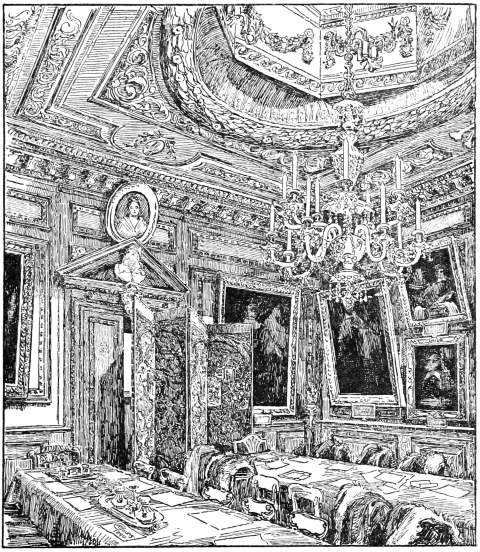
INTERIOR OF COURT ROOM.
11th February, 1636. Upon the moc͠on of or Mr to this Court concerneing the want of a publique Theater for Anatomycall exercises and Sceletons and a lesser roome for private discections, This Court doth order that if the Mrs or Governors upon their petic͠on to the Lord Maior and Aldrẽn they have the bullwarke & long stripp of ground lieing betwixt the gould smiths tenement & clothw: tenemtꝭ & london wall at the one end & the Companies hall & pˀlor & london wall at the other end, by purchase in fee farme or a long lease from the Cittie, that then a Theater to the largenes of the upper ground betwixt the goldsmithes tenem̃t & the clothworkers tenemt on the one side & london wall on the other side shalbe be ovally built for the Wor̃p118 and comiditie of this Companie at the Charge of this house.
The piece of ground on which it was proposed to erect the Theatre was then on lease to the Company from the City. The Lease was dated 29th March, 7 Charles I (1631), and made between the Mayor, &c., of London, of the one part and the Masters, &c., of the Barber-Surgeons, of the other part. In consideration of £20 paid by the Company the City leased to them lwark and the houses Roomes and buildings therein or thereupon made or erected, And all that ground or garden plott with thappurtenñces scituat lyinge and beinge in the parish of St Olave in Silver Street in the Citie of London next unto the Wall of the same Citie there of the one side, and the landes of the saide Maisters or Governors and others on the other side late in the tenure or Pg157 Pg158 Pg159 occupac͠on of the right honoroble Henry late Lord Wyndsor deceased or of his assignes and now in the tenure or occupac͠on of the said Maisters,” etc., from the feast of the Annunciation, 1631, for forty-one years at a rent of £3. The lease contained the usual covenants of a repairing lease, as also one “that neither they the saide Masters or Governors their successors nor assigns shall or will att any time or times during the said Terme suffer any Inmate or Inmates to dwell in any part of the premises afore demised.”
5th May, 1636. There is an Indenture of Lease of this date made between the Mayor, &c., of London, and the Masters, &c., of the Barber-Surgeons, which after reciting the last mentioned lease proceeds: “And whereas the said Maisters or Governors of the Misterie and Comonaltie of Barbars and Surgians of London for the better enhableing of them in the Arte of Surgerie Doe intend to erect and build a decent Roome or Theatre on part of the premisses for the keeping therein A learned and constant Lecture in the Theorie and practiqʒ partꝭ of Surgerie As also to pˀforme their publique operac͠ons of Anatomies and other exercises thereunto belonging, Which will be verie chargeable to them Wherein the said Maior and Cominaltie and Citizens are desirous and willinge to aide and further the saide Maisters or Governors in the setting forward of soe necessarie and comendable a worke tendinge to the generall good of the whole kingdome,” wherefore the Mayor, &c., leased the said premises to the Company for a further term of 200 years upon the expiry of the lease then running, at the same rent of £3 per annum, the Lessees covenanting to build the Theatre within seven years.
16th May, 1636. Upon or Mrs report to this Court that the Lord Maior & Aldrẽn have freely graunted to this house a new lease of CC yeares comenceing from the expirac͠on of or lease now in being It is ordered with the generall consent of the whole Court here present that the Theater shalbe proceeded in and built according to the plotts drawne by his Matꝭ Surveigher.
3rd August, 1636. It is ordered by this Court that the Companies Armes with Helmett Crest supporters and mantlings shalbe sett up in Portland Stone under the Cantilaver does of the Theater being over the Windowe next the Granarye.
Alsoe the mottoe vizt. Speciosum hoc Theatrum Anatomicum erectñ fuit Michaele Andrews Chirurgo Regio ac comunioni BarbitonsoꝜ et ChirurgoꝜ pˀ tempore præfecto, Guardianis vero Joanne Warde Nicolas Heath et Wilhelmo Huckle anno ab exhibito in carne Messiæ supra millesimum sexcentesimum trigesimo sexto shalbe engraven in the voyde stone worke over the greate doore into the Theater.
A plan of the Theatre is preserved in a collection of the works of Inigo Jones, at Worcester College, Oxford, and a short description of it is found in Hatton’s New View of London, 1708. The curiosities in the Barber-Surgeons’ museum of those days will excite a smile when compared with the collection now at Lincoln’s Inn Fields. Hatton says that the Theatre was built in “an elliptical form, and commodiously fitted up with four degrees of seats of cedar wood, and adorned with the figures of the seven liberal sciences, and the twelve signs of the zodiac. Also containing the skeleton of an ostrich, put up by Dr. Hobbs, 1682, with a busto of King Charles I. Two humane skins on the wood frames, of a man and a woman, in imitation of Adam and Eve, put up in 1645; a mummy skull, given by Mr. Loveday, 1655. The sceleton of Atherton with copper joints (he was executed) given by Mr. Knowles in 1693. The figure of a man flead, where all the muscles appear in due place and proportion, done after the life. The sceletons of Cambery Bess and Country Tom (as they then call them), 1638; and three other sceletons of humane bodies.”
Hogarth has, in ghastly style depicted the dissection of a criminal in this Theatre, in which the skeletons above referred to are seen in niches in the wall.
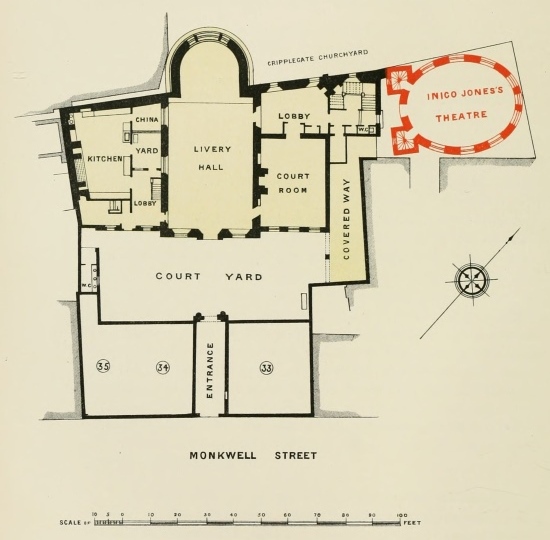
ESTATE IN MONKWELL STREET
The plan of the Company’s Estate, has been kindly supplied for this work by Mr. Charles John Shoppee, as surveyed by him in 1869, previous to the demolition of the old Livery Hall, Kitchen, etc. The Theatre had been pulled down in 1784, and houses erected on its site; the Theatre is, however, shewn upon this plan, as being more interesting than the houses which supplanted it. In 1636 the Company commenced the erection of the Livery Hall and present Court Room, the work being carried out from the designs and under the superintendence of the celebrated Inigo Jones, the Livery Hall was, however, burnt in 1666, and that shown upon the plan is the one which was erected after the Great Fire.
5th September, 1636. The Plague was again abroad in London, and the Court, for fear of infection by meeting together, resolved as follows:
In regard of the now greate visitac͠on of the plague This Court doth deferre the Courts for the daye of Rules the Vew daye & other publique Courts till it shall please God to cease the Sicknes.
23rd September, 1636. The Lord Mayor having requested the Company to nominate “twoe Surgians to take care of those that were infected with the plague in this Cittie & liberties,” the Court thought that two was a wholly insufficient number and nominated six Surgeons to be presented to the Court of Aldermen.
2nd October, 1636. £5 was ordered to be paid in to the Chamber of London towards the relief of the poor, stricken with the Plague.
30th March, 1637. The Company were assessed to pay £10 “ship money,” whereupon an order was made that they should forbear to pay it, and a Committee appointed to wait on the Court of Aldermen to petition against the assessment. The application was, however, unsuccessful, as by an Order of Court, 29th March, 1638, the money was directed to be paid.
8th November, 1638. The Court of Aldermen having assessed the Company to furnish 80 quarters of corn in lieu of 60 as heretofore provided, it was resolved to petition against it. This would be a very important matter to the Company as the assessments for all public purposes were made upon the City Companies pro rata with their corn quarterages, and if the 80 quarters were allowed to stand, it would raise all the future assessments 33 per cent. The result however, of the protest does not appear in the minutes.
28th October, 1640. On receipt of a precept from the Lord Mayor, it was ordered that three barrels of Gunpowder should be bought and stored.
1640. The Company unwillingly agreed to lend the King £400, and were put to great inconvenience in raising the money, which was required by Charles for his campaign in Scotland.
After several skirmishes with the Scots, the English Army was at length disbanded, and the King went himself to Scotland to negotiate the difference which had arisen by his attempted interference in Church matters in that Kingdom; he returned to London in November, 1641, and the following minute refers to the preparations made by our Company to meet him.
22nd November, 1641. Upon reading the Lord Maiors precepts for the Companyes enterteyning the King upon his returne from Scotland It is ordered that the Mar and Wardens, Mr. Serjeant Clowes, Mr. Richard Wateson, Mr. Woodall, Mr. Powell, Mr. Burgin, Mr. Heath, Mr. Henry Wateson, Mr. Bignall, Mr. Dye, Mr. Arris, Henry Boone, and Thomas Turner, shalbe attendant on Twesday next well mounted on Horseback in plush or Velvett with Chaines of Gold, and that John Perkins shall beare the Pendon with our Coate of Armes on Horseback and that these 18 ffree men shalbe Decently cladd in the Companyes Colours of White and Greene, each of them with a greene flatt Cap with a white Ribbon about it, a greene Cassock and Drawers of the same Stuffe Whiffler like laced with a white Lace a white ribaning and a greene Ribbin athwart theire Brests, and each of them a Truncheon in theire hands in the forenoone, and in the aftˀnoone each of them 2 Torches, and these 18 to attend perticulerly one of them to each of the Horsemen, vizt.
(Then follows a list of the freemen chosen.)
The “Riding out” on this occasion must have been a magnificent sight, if all of the Companies spent proportionately to the outlay of ours, which was no less than £39 17s. 10d. upon decorations, etc., for those taking part in the procession. Strype informs us that—
The Lord Mayor on horesback wearing a gown of crimson velvet & a collar of SS, and attended by his suite, rode in the front of the procession to meet the King. Then followed the Aldermen in scarlet gowns and the City council and chief officers in black gowns. Upon reaching Moorfields, there waited in a readiness to attend his Lordship and the service, about five hundred horsemen selected out of the Liveries of the several Companies, being Masters, Wardens, and prime men of each Company in velvet or plush coats and suits, with chains of gold, being well horsed and gallantly furnished, every Company having a horseman in the front carrying a pendant with that Company’s arms to which he did belong (for distinction sake), and a footman to attend each horseman of the Livery with truncheons and torches as before, both horsemen with the pendants and footmen being suited cap-a-pee with the Company’s colours on which they waited. There were also fourteen Trumpeters, with trumpets, banners and scarfs, who were placed two between every hundred of the horse, and four at the head of the troop. The procession moved on to Kingsland, where the Lord Mayor and Aldermen and the Companies awaited the Kings approach, while the Sheriffs attended by seventy-two men in Scarlet Cloaks trimmed with silver lace (the colours of the City) with javelins and feathers and four trumpeters, rode as far as Stamford Hill, and there met their Majesties and escorted them to Kingsland.
His Majesty was accompanied by the Queen, the Prince, the Duke of York, the Princess Mary and the Prince Elector Palatine, and after receiving an address, the Royal party joined the civic procession to London, entering it at Moorgate, and proceeded through London Wall, Bishopsgate Street, Cornhill and Cheapside, to the banquet at Guildhall, amidst the City Companies in their formalities and stands on each side of the streets, the City conduits running with a diversity of wines.
1643. The relations between the King and the City having become estranged in the fearful distractions of these times, Charles endeavoured to conciliate the citizens with a message, which was publicly read at Guildhall on the 13th January, and later on he sent a circular letter to the Masters of the several Companies requiring them to call their freemen and apprentices together, to read to them a copy of a letter which he had sent to the City on the 17th January. The Court of the Barber-Surgeons met on Tuesday, 24th inst., and cautiously record that they would have summoned their freemen for the next day, but that it was a fast day and that in the interim an order had come from the Committee of Safety that the letter, etc., should not be read.
24th January, 1643. The Kings Letter sent to the Mrs & Wardens of this Company was read in Court and the printed Letter in it and the Cittyes Petic͠on and his Maties gracious answer unto it. And but that the morrow was fast day being the last Wednesday in this Moneth the ffreemen and apprentices of this Company could not be summoned to appeare then, it should have bin read. Soe that in the Interim an Order of Comand from the Lords and Comõns was directed to this Company to countermaund the said Letters in these words,
Die Martis 24to Januarii, 164 2/3. At the Comittee of Lords and Comõns for the safety of the Kingdome.
Whereas there are divers Letters pretended to be sent by his Matie to the Mrs and Wardens of the severall Halls in the city of London with Two litle Bookes therein closed the one intituled The humble Petic͠on of the Maior, Aldermen and Comõns of the City of London to his Matie. And the other intituled his Maties Letter and declarac͠on to the Sheriffes and City of London Dated the 17th of January, which evidently tendeth to sedition and setting of the whole State in a Combustion. These are therefore strictly to charge & comand the Mrs and Wardens of every Hall in the City to whome the said Letters and Bookes inclosed shalbe directed to forbeare to publish or open any of them till both the Houses of Parliament shall give further order therein. And the Mrs and Wardens of every Hall are required to bring the said Letters with the Messengers thereof to this Comittee which they will take to be an Argument of theire good Affection to the Parliament
PembrokeMontgomeryBolingbrokeEd: Manchester
W. Say & SealeEd: HowardJo: EvelinJo: Pym
Antho: Nicoll.
17th January, 1644. It is ordered that in respect of the greate troubles and distractions of these times there shalbe noe publique Anatomy this yeare dissected.
1644. The Company seem to have become greatly impoverished by the venture in Ireland, the rebuilding of their premises, and the forced loans to the King and the Parliament. In a certificate given by the Master and Wardens (5th September, 1644) to be produced in a suit in which they were defendants, they state that their debts are £3,000, and that they can get no return of any of the money lent for public purposes, or even the interest of it.
If the Stuarts acted in an unconstitutional manner in their oppressive demands upon the Companies, the Roundheads were as bad, with just this difference, that, with all their pretensions to purity, piety and high-mindedness, they did not hesitate to practise actual dishonesty in their modus operandi of squeezing the Companies, as the following painful incident from our books testifies:—The Company had borrowed from Mr. Richard Wateson, one of the Assistants, £1,200 upon sealed bonds, for the express purpose of meeting the demands which had been made upon them by the King and Parliament from time to time. Mr. Wateson having been declared a “Papist and Delinquent,” his property was seized, and the Bonds of the Barber-Surgeons, found in his strong chest, were taken to the Committee for Gloucester and Hereford, sitting at Grocers’ Hall. These worthies, in conjunction with the Committee for Sequestrations, came down upon the Company and demanded payment of the £1,200 for which they had given their bonds to their brother, Mr. Wateson. The Court deeming this a monstrous piece of injustice, hesitated to comply, whereupon the Committees threatened to seize the Company’s entire estate; and then the Court resolved to petition Parliament, but the House not sitting for some time the petition could not be prosecuted, and the Committee being urgent, the Company most reluctantly agreed to pay down £400 and to have the bonds cancelled. Although these shameful terms were definitely agreed upon, the Committees a few days later broke faith, demanding £400 cash and the Company’s bond for another £100, to which the Company, like the lamb with the wolf at its throat, nolens volens, consented. The iniquity of this business was made apparent to the Committees, who were well aware that the Company had incurred the debt to Mr. Wateson in order to meet the previous rapacity of themselves, and yet they hesitated not to compel the Company to submit to a further fine of £500 for having complied with their demands in the past, besides manifesting the dishonesty proposed by them in offering to cancel the debt due by the Company to Mr. Wateson.
29th April, 1645. By the power and authority to this Court given by severall Orders of a late Court of Assistants, this Court for and towards the raiseing of the 400li agreed to be paid in part of the composic͠on for Mr. Watson’s debt unto the the Comittee for the releife of Gloucester, &c., did pawne all the Companyes plate both guilt and white, weighing 1,120 oz. 1/3 or thereabouts, unto Mary Crosse of London Widdow for the Sum̃ of 280li by a Writeing of Bargaine and Sale this day sealed with this Companyes Com̃on Seale bearing date the 16th day of this Instant Aprill with a provisoe of Redempc͠on. And borrowed of Mr. George Dunn 100li more at Interest at vjli 10s pˀ annum pˀ centum for wch he tooke the secureity of our Com̃on Seale.
A few years later on (14th September, 1648), Mr. Edward Arris presented to the Court a letter from Mr. Wateson, wherein was intimated that he expected the Company to repay him the money borrowed, the bonds for which had been seized by Cromwell’s party, and for which the Company had already compounded, whereupon we read “This Court doth declare theire acknowledgement of a great respect and esteeme they have and beare towards him and shalbe ready to doe him all the right they can without prejudicing the Company”; and again on 30th April, 1650, “Mr. Richard Wateson an ancient Mr of this Company Doth this day desire to know the mind of this Court concerning the 1,200li by him lent to this Company and sequestred in this Company’s hands and compounded ffor 500li in full of principall and Interest, The matter being of great Consequence, this Court doth take time to consider of it and to give him an answer therein.”
What answer Mr. Wateson got, I do not know; he was held in great esteem by the Company, and doubtless some honourable compromise was arranged.
In their negotiations with the Committees, the Company seem to have been able to impress the Chairman favourably on certain occasions, though there is grave reason to apprehend that this official of the party of purity was open to a bribe, as the following minutes would seem to indicate.
27th October, 1645. The Company having been threatened with sequestration of their entire estate unless an assessment made upon them was paid on Friday following, a Committee of the Court was ordered to wait on Mr. Scawin, the Chairman of the Committee for the Army, to beg his favourable consideration of the Company’s poor estate; the result is seen in the next entry.
14th September, 1648. This Court takeing notice of the greate Love and ffavour of Mr. Scawin Chaireman to the Comittee ffor the Army expressed oftentimes upon severall occasions towards our Company Doth thinke fitt in gratitude and accordingly doth order That the present Governours doe present to him a guift of the value of vjli 13s 4d The quality and price of the guift is left to theire discretions.
1646. To relieve them of their great debts, the Company about this period raised considerable sums by granting annuities; the following are examples in point:—
24th March, 1646. This day Mr Nicholas Heath payd the sum of 200li to the use of this Company and is the purchase money for an Annuity of 26li pˀ añn. for 10 yeares to himselfe and Grace his Wife Whereupon the Deed of Grant of the said Annuity was sealed with the Com̃on Seale and delivered to theire use.
Alsoe this day Mris Elizabeth ffreeman payd the sum of 200li the Purchase money for the like Annuity of 26li pˀ añn. for 10 yeares and the Deed for that purpose was sealed and delivered to her.
On the 30th January, 1649, the King’s troubles were ended by his murder, and very shortly afterwards we find this significant minute.
19th March, 1649. This Court doth order That the Oath conteyned in the Rules and Ordinances of this Company be administred unto every ffreeman upon his admission as before, The ffirst Words which doe concerne allegiance to the King and his Successors only to be left out.
The banners of the Company bearing the late King’s arms were destroyed, and any heraldic insignia at the Hall which contained the Royal Arms were ordered to be defaced. We may readily believe that this was most unwillingly done by the Court, who however, had no option in the matter.
1648–9. Fairfax had filled the City with troops, “billetting orders” being made upon the several Companies for the reception of the soldiers at their Halls. Herbert (Vol. I, p. 181) states that the Merchant Taylors were fortunate enough to procure an order of exemption which cost them £20 10s., and further that he believed their case to be unique, but it seems that the Carpenters by means of “Gratuities ‘to sevˀall men of qualitie,’” amounting to £13 2s. 6d., managed to get free of this imposition, whilst the Barber-Surgeons procured their immunity at a much cheaper rate, for we read in the Wardens’ accounts of the period,
Paid fforr the charges expended in procureing a Protecc͠on from the Lord General from quartering Souldiers in the hall 13s 3d.
These notices are clear indications that Cromwell and the “men of qualitie” about him, were accustomed to take bribes.
3rd February, 1654. The City entertained Cromwell at Grocers’ Hall, and our Company had to go out in procession to receive him, our “standing” being in St. Paul’s Churchyard.
1660. The Barber-Surgeons contributed £96 towards a present of £10,000 given by the City to Charles II at the Restoration. No money exacted under precept was more willingly paid than this, and indeed the Companies generally seemed to have cheerfully contributed, delighted to have escaped the gloom of the Commonwealth, and with a prospect of brighter times in store. On the 5th July, the King was nobly entertained at Guildhall, our Company taking part in the rejoicings (see Wardens’ Accounts of this date).
1666. Our Minute Books for this period having been lost or stolen, we unfortunately have no records of the Great Fire beyond those preserved in the “Wardens’ Accounts” (which see), and although these are somewhat meagre, they are highly interesting, especially those which relate to the fortunate preservation of the great Holbein picture. It has been stated (but without any other authority than that of gossiping Samuel Pepys, who had a special interest in disparaging the picture) that it was damaged in the fire, though no notice of such a mishap is known to me, and the Accounts (which are complete) are significantly silent as to anything having been spent on its restoration or cleansing, which, had it been injured, would have been necessary; it seems to have been taken away from the Hall by Major Brookes to a place of safety, and subsequently brought home again by six porters.
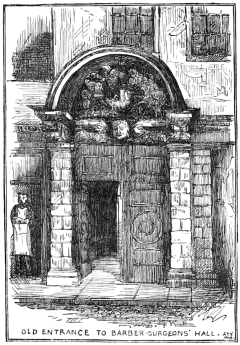
OLD ENTRANCE TO BARBER-SURGEONS’ HALL.
The Theatre, which was a detached building, as also the present Court Room, both the works of Inigo Jones, were saved, though the Hall was burned, entailing a great expense upon the Company in rebuilding (see Wardens’ Accounts).
The houses 33, 34 and 35, Monkwell Street (see plan, p. 135) were rebuilt 1671, when the gateway to the Hall Court Yard was formed and the grotesque coat-of-arms put up over the Lintol.
When the alterations were made under the superintendence of Charles J. Shoppee in 1869, the old lintol, corbels, tympanum, and door-head were very carefully taken down and refixed over the present entrance to the Hall in the Court Yard. This door-head is always an object of interest to visitors to Barbers’ Hall; long may it continue to be so!
25th August, 1681. A short set of By-Laws was this day enacted. It is on a single skin of parchment, and imposes penalties upon such persons, as, being elected, should refuse to serve as Masters or Stewards of Anatomy. It is signed by Heneage, Earl of Nottingham, Lord Chancellor, and Sir Francis Pemberton and Sir Francis North, the two Lords Chief Justices, all of whose seals are pendant to the document.
1684. This was indeed a troublous year for the Corporation and for the guilds of London. Charles having interfered with the privileges of the City by thrusting in his nominees for Sheriffs, had met with considerable opposition from the citizens, and being assured that this resistance would be continued and maintained by the City, he determined to strike a blow at the root of its franchise, by getting into his hands the Charter of the City, as also the Charters of the several Companies. It was not difficult to procure a venal tribunal which would be prepared to pronounce an iniquitous judgment upon any fictitious statement submitted to it by the King. Sir Robt. Sawyer, the Attorney-General, thereupon undertook, on behalf of the Crown, to prove that the City Charters were forfeited, and contrived the celebrated quo warranto, upon which judgment was (as a matter of course) obtained against the City, on the 12th June, 1684.
The Companies seem to have unanimously anticipated this decision, and by so doing and by “surrendering” their Charters and liberties before the delivery of the judgment, hoped to ensure the favour of the King.
The original of the “surrender” of the Barber-Surgeons is very neatly engrossed on extra thick parchment, but the seal was of course removed when it was returned to the Company. The text is as follows:—
To all to whom these prsents shall come. The Masters or Governors of ye Mystery and Coĩaltie of Barbrs & Surgeons of London send Greeting. Know yee yt wee considering how much it imports the Governmt of our company to have men of known Loyalty & approved integrity to bear offices of Magistracy & places of Trust. The sd Mars or Governrs have granted surrendred and yielded up, and by these prsents do grant surrendr and yield up unto his most gracious Majesty Charles ye second by the Grace of God King of England, &c., his Heires and Successors. All and singular ye Powers Franchises liberties priviledges and authorities whatsoever and howsoever granted to or to bee used or exercised by ye said Masters or Governors by vertue of any right Title or Interest vested in them by any Charters Letters Patents Custome or Prescripc͠on in force of or concerning the electing nominating constituting being or appointing of any person or persons into or for ye severall and respective offices of Mastr Wardens Assistants and Clerk of ye said Company. And ye said Masters or Governors do hereby humbly beseech his Matie to accept of this their surrendr and do with all submission to his Majesties good pleasure implore his grace and favor to regrant to ye said Masters or Governors the nameing and Chusing of ye said Officers and the said libertie and ffranchises or so many of them and in such mannr as his Majesty in his great wisdome shall judge most conducing for ye governmt of ye said Company, And with and under such reservacc͠ons restricc͠ons and qualificac͠ons as his Majestie shall bee pleased to appoint. In Witnes whereof the said Mastrs or Governors have hereunto affixed their Com̃on seal the sixteenth day of Aprill in ye Thirty sixth year of ye reign of or or sovˀaign Lord Charles ye second, &c., and in ye year of or Lord Christ 1684.
Similar forms of surrender were adopted by other Companies. I am unable to say whether or no the King interfered with the franchises of the Barber-Surgeons, but think not, as no record of such meddling is to be found in our books, though, doubtless, the Court took care, remembering the rod in pickle, to govern in accordance with the wishes of the King.
Some time in this year (1684) certain unquiet spirits, Surgeons of our Company, got up a petition to the King, setting forth that the union of Surgeons with Barbers hindered rather than promoted the end for which the two bodies had been united, and praying the King to incorporate the Surgeons a distinct and separate body. Nothing came of this application beyond a reference (ordered by the King, 15th May, 1684) to the Lord Keeper of the Great Seal, and the Lord Chief Justice of the King’s Bench, who were directed to examine and report upon the petition, but whether they ever did so or not, I don’t know.
27th February, 1685. James II, in the first year of his reign, granted us a Charter, which is contained on seven skins of parchment, all of which have handsomely designed head-pieces and borders, the first one having a fine portrait of the King as well; only a fragment of the great seal remains, and the charter itself is considerably damaged, apparently by rats. It is in Latin, of great length, and, like others granted to other companies at the period, is an “unreal mockery.” The Charter recites the “Surrender,” and proceeds to grant another charter in which, inter alia, the appointment of any Master, Warden, Assistant, or Clerk should be subject to the approval of the King, that all members of the Company should take the Oaths of Supremacy and Allegiance, be in the Communion of the Church of England and receive the Sacrament, and that no person who frequented a conventicle should be eligible for the Livery.
4th April, 1687. The King having published a declaration, allowing liberty of conscience to all his subjects, suspending and dispensing with the penal laws and tests, and even with the Oaths of Supremacy and Allegiance on admission into offices civil and military, numerous addresses of thanks for this liberty were presented to the King, among others the following one from our Company, which is preserved in the “London Gazette” of 20th October, 1687.
The Humble Address of the Masters Governors Assistants and Members of the Mystery and Commonalty of Barbers and Surgeons of London.
May it please your Majesty
We having daily before our eyes the munificent Bounties of your Royal Brother of Blessed Memory, and other Your Ancestors, and also that of your Majesties Gracious Favour, in restoring to us our new Charter, we must be esteemed ever ungrateful and undutiful Subjects, if we did not with all humility acknowledge the same.
But we are in more especial manner bound to cast ourselves at Your Majesties Feet, and return our most humble and hearty Thanks for Your late Declaration; wherein You are Graciously pleased to give us Your Royal Word, whereby we are protected in the Profession and free Exercise of our Religion, and also in the Enjoyment of our Liberties and Properties in Peace and Safety; for which Your Gracious Condescension and Goodness (as God hath made it our Duty), Your Majesty hath made it our Interest duly to pray to the Divine Majesty for his Blessing upon your Royal Person, Family and Government. And that after the enjoyment of a long and prosperous reign here, over a Dutiful and Obedient People, You may receive an everlasting Crown in the World to come.
And that it may be so, it shall be as it becomes us, the constant and utmost endeavour, as well as the hearty Prayer of,
Dread Sir!
Your Majesties most humble, most Loyal, and most obliged Subjects.
1688. Matters were now rapidly approaching a crisis with James, who in vain, when too late, sought to conciliate the citizens whom he had wronged. One of his acts of propitiation was the redelivery to the Companies of the “surrenders” which they had made of their franchises and charters in 1684. We have no note of the date of the return of our surrender; but it was towards the end of November and within about a fortnight of the King’s flight when this tardy act of justice was done, and the Barber-Surgeons thus partly restored to their ancient rights and privileges. The Bill of Rights was shortly afterwards passed, the quo warranto declared illegal, and all charters granted by Charles II and James II since the judgment on the quo warranto, declared absolutely null and void, thus practically reinstating the Guilds in statu quo ante.
28 July, 1690. Ordered that in pursuance of an order of the Com̃on Counsell & Lord Mayor &c. that the Company advance towards the provideing one Rigiment of Horse & one of Dragoone the sum̃e of one hundred pounds.
1699. Jealousies arose in the Company in consequence of the more frequent election of Surgeons than Barbers, as Governors. The By-Laws required that every year there should be two Barbers and two Surgeons chosen (a Barber being defined to be any member who did not practise Surgery). The Surgeons disregarding the law and the old custom, seem to have been able to procure the election of an undue number of members of their own craft to the offices of Master and Wardens, whereupon certain of the Company filed an information in the King’s Bench against the Masters or Governors; the Barbers were successful, and having obtained a Mandamus, a fresh election took place. This altercation between the Barbers and Surgeons was never forgotten, and, indeed, helped to pave the way to further estrangement and the absolute separation in 1745.
The following Minutes relate to these proceedings:
14th December, 1699. Ordered Mr. Srgeant Wright Mr. Srgeant Darnell Mr. Com̃on Srgeant & Mr. Dee bee advised with upon the Informac͠on agt the Governrs.
25th January, 1700. Ordered that the Cause agt the Governrs at the prosecuc͠on of the Barbers bee referred to Srgeant Darnell & his opinion to bee taken & to pˀceed thereupon, Mr. Oades Mr. Pleahill & Mr. Barnard to meet tomorrow at the raine bow to attend him by five in the afternoone.
2nd May, 1700. Ordered Mr. Dee bee consulted concerning the Rule of Court of King’s Bench for a copy of the by laws &c. & to follow his advice &c. He advised to give Copyes if required & not to oppose it.
11th May, 1700. Ordered that Mr. Srgeant Darnell have three guineys Mr. Com̃on Srgeant & Mr. Dee have two a peece given them for the Tryall of the Informac͠on on Tuesday next & that all the Court of Assistants bee desired to bee there.
28th June, 1700. Ordered that nothing bee done in the Cause agt the Company untill the Mandamus be served & then the Comittee to meete.
4th July, 1700. A pˀemtory Mandamus being served the last Court, Ordered that on Tuesday next by two of the Clock in the afternoon there bee an elecc͠on of two Wardens Expert in Barbery for the remainder of this yeare.
9th July, 1700. An election took place, with the result that Mr. John Pinke and Mr. Richard Marks, both being Barbers, were elected Wardens. Mr. Pinke was already a Warden, but the Mandamus required two Barbers to be elected, and he was simply re-elected. Mr. Marks took the place of Mr. Bartholomew King, Surgeon. The Master, Mr. Lichfield, and the second Warden, Mr. James Wall, were both Surgeons.
13th January, 1709. It was agreed that a new set of By-Laws which had been settled by the Common Serjeant and Sir Edward Northey should be presented to the Lord Chancellor, etc., for confirmation, it being considered that the existing By-Laws were defective in many parts, and that “good & wholesome Lawes were the life strength & support of this Company.”
6th April, 1709. A set of By-Laws of this date was confirmed. They are comprised on thirteen great skins of parchment, and, like previous ones, are far too voluminous, and indeed not of sufficient interest, to warrant transcribing, being practically the former set with sundry technical and minor alterations. There is a fine portrait of Queen Anne on the first skin, and the Document is signed by William Lord Cowper, Lord Chancellor, Sir John Holt and Sir John Trevor, Lords Chief Justices, whose seals are pendant. These By-Laws were brought into Court on 5th May, 1709.
13th January, 1709. The Court were informed that the Barbers of the Company were in treaty with the Peruke Makers “of the other end of the town,” about incorporating them into this Company, and that they were endeavouring to procure an Act of Parliament to that effect, whereupon the proposition was approved and leave given to the Barbers to petition Parliament in the name of the Court.
5th December, 1709. A petition was presented by sundry liverymen (Barbers) representing that Peruke making was an encroachment upon the art of Barbery, and praying the Court to obtain an Act of Parliament incorporating the Peruke Makers with the Barber-Surgeons; the petition was favourably received by the Court and a Committee appointed, who met the next day and recommended the proposed union, the Peruke Makers paying such fees as other members of the Company paid.
24th December, 1709. A petition for an Act was ordered to be drawn by the Clerk and submitted to several eminent counsel for their perusal.
9th January, 1710. Five hundred copies of the proposed Bill, and a similar number of the reasons for the suggested incorporation, were ordered to be printed; but in the result nothing came of this proposed union with the Peruke Makers.
25th August, 1714. The following precept relating to the Accession of George I was received:
To the Master and Wardens of the Company of Barber Surgeons.
By the Mayor.
Whereas it hath been resolved in Com̃on Councill yt if our most Gratious Lord King George upon his comeing into this Kingdome be pleased to pass through this his City of London, yt he shall be received by us & our fellow citizens with all the Demonstrationes of Joy & affection as are suitable to our duty and Loyalty.
These are therefore to require you to have your Rayle Cloaths Standings Banners Streamers Ensignes & other Ornaments of triumph belonging to your Company in a readiness to sett up imẽadiatly upon Notice yt shall be given you of the time & place by any further precept & yt yor Cloaths Banners Streamers Ensignes & other ornaments be fresh & Good & yt you forthwith send to all the Liverymen of yor Company that they be well & decently apparrelled in their best Cloaths & Gowns to attend in their Standings yt so your Company may be ready (when required) to receive his Majtie to his satisfac͠on & the Honour of this City and thereof you are not to faile. Dated this 25th day of August, 1714.
Gibson.
23rd December, 1717. The Company having had great difficulty in getting in some of their rents, and various of the houses being empty, determined to sell their property in Mowse Alley, East Smithfield, and in Butcher Row in St. Botolph’s, Aldgate, agreeing to convey the fee simple to Mr. Robert Finlay for £1,250.
And it is further ordered by this Court that till such time as the said sume of 1250li can be laid out in a convenient purchase of houses or lands with the approbac͠on of the Court of Assistants, The same shall be forthwith placed out at Interest by the Governors upon such Government or other Publick securitys as they shall think fitt, But that the said sume of 1250li or any part thereof shall never be expended on the Company’s common occac͠ons or be any way lessened or broke into on any account whatsoever.
17th April, 1718. The following record was ordered to be made of the “reasons” for disposing of this property:
The Estate in East Smithfield in eleven years time produced to the Company above all disbursements relating thereto119 but £28 15s. in the whole, Whereas the annual interest of £1250 at 4 pˀ cent. is £50.
Eleven years interest at £50 pˀ ann. for £1250 amounts to without computeing Interest upon Interest £550.
The Company have run behind hand for severall years by means of the great sumes laid out upon this Estate.
Whoever goes backward every year must in time be undone.
The Estate is still in such a condition as to require a great sum̃e of money to be expended upon it in Repairing and Rebuilding in order to make it tenantable.
The Company had not money to lay out upon it.
If they had, the Estate is so scituated that there is no room to hope, even in case the whole had been rebuilt (as it wants to be) that it would have answered the laying out so much money.
And if the Company had let it upon building Leases The pˀsent method of building is so as to last exactly the term for which the Lease is taken, wouˀd have put the Company in the same condic͠on as they are now, when the term expired, besides loss of Rent, & disputes with such Tenants in the mean time.
It was therefore thought better to dispose of the Estate.
Following are the details of negotiations with one or two parties other than Mr. Finlay, and some curious particulars of the Company’s title to part of the Estate, which seems to have been an equitable rather than a legal one, whereby the Court apprehended some difficulty in disposing of it to another party from whom a somewhat better price might have been obtained, and therein, under the circumstances, showed themselves good men of business by concluding with Mr. Finlay: we cannot however now, but regret that this most valuable property should have passed from us for so comparatively insignificant a sum. The purchase-money was laid out in thirteen East India Bonds of £100 each.
7th April, 1730. Mr Serjt Dickins the Master of the Company informing the Court, That he having the honour to be acquainted with the Right Honourable The Earl of Burlington and with his Lordships most extraordinary genius and superior judgment in Architecture, had taken the liberty to address himself to the said noble Earl, and to make it his humble request to his Lordship that he would be pleased to favour the Company with his opinion, in what manner it would be safest and best to repair the anatomical Theatre built by the celebrated Inigo Jones about one hundred years ago.
That his Lordship had thereupon condescended to take a view of the Theatre and most obligingly directed the proper method of repairing a structure of so peculiar a frame, and afterwards out of his accustomed generosity, and in regard to the memory of that great Architect offered to defray the expence thereof.
It is thereupon resolved Nemine Contradicente by this Court, That the Master and Wardens of the Company together with the late Master William Cotesworth Esqr be, and they are hereby desired forthwith to wait on the Right Honb̃le The Earl of Burlington, and in the most gratefull manner to assure his Lordship in the name of the whole Company.
That they do receive this noble instance of his Lordships bounty and generosity as a most distinguishing & illustrious mark of honour shown by his Lordship to the Company & Profession.
And that this Court will take care so to record & transmitt the remembrance of this magnificent action of his Lordship to their successors That the gratitude of the Company to his Lordship’s person and memory may be for ever preserved among them.
13th August, 1730. A marble Bust of the Earl of Burlington was ordered to be set up in the Theatre.
27th April, 1739. “The Court taking into their considerac͠on that several of their By-Laws, which had been confirmed by the Lord Chancellor and Lord Chief Justices for the time being, were in want of alteration, by reason of the variation of the times and circumstances of the Company and their Members since such By-Laws were made, and several new By-Laws being also wanting for the better government of the Company in times to come,” It was ordered that a Committee of six should consult and draw up fresh By-Laws, to be submitted to a future Court of Assistants, but in the result no action was taken.
1744. The long slumbering animosity between the Surgeons and the Barbers had now reached a climax, and indeed it is a matter of surprise that an union which had become grotesque should have existed for as many years as it had. The Surgeons, many of whom had attained to great eminence, naturally chafed under a system which required their diplomas to be signed by Governors, two of whom were always Barbers, or members of some trade or profession other than that of a Surgeon, and with the rapid progress of science and of surgical skill and knowledge, they felt their alliance with the Barbers a restraint upon their advancement, as also that the exercise of their profession under Charters and By-Laws, antiquated in form, and more adapted to the times in which they were framed, a hindrance rather than an incitement to further proficiency.
There is little in the records as to this disagreement, it being tacitly agreed that neither side should place their arguments or grievances in the books, which were their joint property.
20th December, 1744. This day the gentlemen on the Surgeons side having made known at this Court their desire of being separated from the gentlemen on the Barbers and that each may be made a distinct and independent Body free from each other, and producing a Case intended to be offered to the Honourable House of Commons praying such separation, which being read at this Court It was agreed that the following gentlemen on the Barbers side vizt.—
Mr. Warden Negus Mr. Parker Mr. Maurice Mr. Truelove and Mr. Haddon.
& on the Surgeons side vizt.—
Mr. Serjt Dickins Willm Petty Esqr James Dansie Esqre Mr. Freke and Mr. Sainthill
be a Committe appointed to meet on Monday next at the Kings Arms Tavern in Saint Paul’s Church Yard at one of the Clock at noon to receive the proposals from the Gentlemen on the Surgeon’s side for such Separation, and that when they had so done that the Gentlemen on the Barber’s side members of this Court should lay the same before the Livery on their side, by a Meeting to be had for that purpose, and that a Court of Assistants should be held on the Tenth day of January next, at which time the Gentlemen on the Barber’s Side Members of this Court, should then report their opinion and assent or Dissent to such proposals made.
At the same time it was agreed that any Member of this Court should at any time have the free liberty of examining and inspecting into the several Books and writings belonging to this Company In case the same should be in the presence of the Master or one of the Wardens but not otherwise, but no such Books or writings be at any time removed from the Hall, on any account whatever unless by a special order of this Court first had and obtained for that purpose.
10th January, 1745. Pursuant to an Order of the last Court of Assistants the gentlemen on the Barbers side Members of this Court, did this day make their report on the proposals made by the gentlemen on the Surgeons side for a separation, by Dissenting in general to such proposals made.
By the Journals of the House of Commons, 18 George II, it appears that the Surgeons on 31st January, 1745, presented a petition to Parliament, in which among other things they recited the Act, 32 Henry VIII, and also that Charles I in the 5th year of his reign,
by Letters Patent under the great seal confirmed the Barber Surgeon’s Company in their possessions and privileges and gave the Company power to make by-laws and to constitute ten persons to be Examiners of Surgeons during their lives, and it was thereby further granted that no person whether freeman foreigner native of England or alien should practise Surgery in London or Westminster or within seven miles of the City of London unless previously examined allowed and admitted by the Company in manner therein mentioned; and that the Surgeons so examined might practise in any part of England; and that the Masters and Governors of the said Company might appoint and have a public lecture for the science of Surgery, for the better instruction and information in the principles and rudiments of the art and science of Surgery, and that no person exercising the art of Surgery within the limits therein mentioned should go out or send any apprentice or servant from the Port of London to serve in quality of a Surgeon for any ship without the approbation and allowance of the said Company, in such manner and under such penalties as are therein mentioned. That since the said Act for incorporating the two said Companies, those of the said Company practising Surgery have from their sole and constant study of, and application to the said science, rendered the profession and practice thereof of great and public benefit and utility to this Kingdom, and that the Barbers belonging to the said Corporation are now, and have been many years, employed in a business foreign to and independent of the practice of Surgery; and that the Surgeons belonging to the same Corporation, being now become a numerous and considerable body, and finding their union with the Barbers inconvenient in many respects and in no degree conducive to the progress or improvement of the art of Surgery, are therefore desirous that the Surgeons being freemen of the said Company, may be made a Corporation separate and distinct from and independent of the Barbers of, and belonging to the said Company; and therefore praying the House to give leave that a bill may be brought in dissolving and vacating the union and incorporation of the Barbers and Surgeons made by the said former act; and for making the Surgeons of the said Company a separate and distinct Corporation; and for making a partition and division of the real and personal estate and effects of and belonging to the said united Company, unto and for the separate benefit of the said two Companies so proposed to be separated, as to this House shall seem meet and reasonable.
Whereupon it was ordered—
That the said petition be referred to the consideration of a Committee and that they do examine the matter thereof, and report the same with their opinion thereupon to the House.
A Committee was at once appointed with power to send for persons, papers, and records.
On the 6th February the Barbers presented a Petition against the proposed separation, and asked to be heard by counsel; whereupon it was ordered—
That the said petition be referred to the consideration of the Committee to whom the petition of the Surgeons of London, whose names are thereunto subscribed, on behalf of themselves and other the Surgeons in the City and suburbs of London is referred: And that these petitioners the said Barbers, if they think fit be heard by their Counsel before the said Committee according to the prayer of the said petitioners.