BIOGRAPHICAL NOTICES OF EMINENT MEMBERS.
Reading edition
HENRY NEVILL, FOURTH LORD OF BURGAVENNY.
This Lord was the son of Sir George Nevill, third Lord of Burgavenny, by Mary, daughter of Edward Stafford, Duke of Buckingham.
He succeeded his father in 1535, and was admitted to the freedom of the Barber-Surgeons on the 26th August, 1584. In 1586 he was one of the Commissioners appointed to try Mary Queen of Scots.
For striking the Earl of Oxford in the Chamber of Presence, he was put under arrest, but managed shortly after to obtain a pardon and his freedom.
He married Frances, daughter of Thomas Earl of Rutland, by whom he left at his decease, 10th February, 1557, an only daughter Elizabeth (the wife of Sir Thomas Fane), who was subsequently created Baroness le Despencer.
LORD WINDSOR.
25th June, 1631. This daie or Mr signifieing to the Court the affectionatenes of the right honoble the Lord Thomas Windsor Knight of the noble order of the bath and Barron Windsor of Bradenham, wch this Court Loveingly and gratefullie embraceing doe graunt his Lops request and thereupon the said Lord was here in Court admitted and sworne free brother of this Corporac͠on. Alsoe the said Thomas Lord Windsor was by or Mr received into the Clothing or livery of this Companie and had a livery hood layed upon his lops shoulder.
Lord Windsor at one time resided in Monkwell Street, close to the Hall; he was chosen a Knight of the Bath 1610, at the creation of Henry, Prince of Wales. He was subsequently Rear-Admiral of the Fleet sent by James I to bring Prince Charles out of Spain, and on that occasion entertained on board ship the Grandees of the Court of Spain with princely magnificence. His Lordship married Lady Katherine Somerset daughter of Edward, fourth Earl of Worcester, K.G., but dying without issue on the 6th June, 1642, he was succeeded by his nephew Thomas Windsor-Hickman, the son of his elder sister Elizabeth.
THE DUKE OF MONMOUTH, K.G.
James Scott, the natural son of Charles II, was born 9th April, 1649, and created Duke of Monmouth in 1663. The same year, on the 7th May, he was admitted to the freedom of the Barber-Surgeons, in company with Alexander Lord Leven, Richard Hopton, and Thomas Rosse, Esquires.
The history of this unfortunate man is well known, and culminated in his being beheaded on the 15th July, 1685.
ALEXANDER, SECOND EARL OF LEVEN.
This nobleman was the grandson of the celebrated General Sir Alexander Leslie, First Earl of Leven, whom he succeeded in 1662. On the 7th May, 1663, he was admitted to the freedom of the Barber-Surgeons, in company with the Duke of Monmouth.
He married Margaret, daughter of Sir William Howard, and sister of the Earl of Carlisle, but died without issue male, in 1663. His kinsman George, fourth Lord Melville, was a staunch adherent of the Duke of Monmouth, and involved in the rebellion, but was lucky enough to escape into Holland; he was, however, attainted and his estates forfeited in 1685, but coming back to England with William III his estates and dignity were restored to him.
SIR JOHN AYLEF.
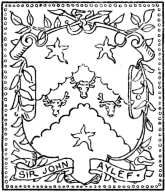
Sir John Aylef was an eminent Surgeon and probably born about 1490. Diligent search has been made for his parentage, but without success. In his will he refers to seven “poor” people “being of my kynn dwelling in Grenewiche,” and from the fact that he had a grant of arms instead of inheriting a paternal coat, as also the silence of his immediate descendants when registering the pedigrees at the Heralds’ Visitations (who must have known but did not care to register Sir John’s father), it may be assumed that he was of humble origin.
He was admitted to the freedom of the Barbers prior to 1522 and served the office of Warden 1530, 1532 and 1535, being chosen Master 1538. At this time he was Surgeon to Henry VIII and had cured him of a fistula, for which the king granted him the manor of Gryttenham in Wiltshire, part of the lands of the Abbey of Malmesbury. Henry also bequeathed by his will 100 marks to Aylef.
Mr. Aylef, being elected on 1st August, 1548, served the office of Sheriff 1548–9, and in Wriothesley’s Chronicle under date 1549 we read—
The third daie of March being Shrove Sondaie Mr Henry Amcottes Lord Maior of London was presented to the Kinges Maiestie at his pallace at Westminster. And after the oration made by Mr Recorder to his Maiestie and aunswere again by my Lord Chauncelor unto the maior and aldermen, the Kinges Maiestie made my Lord Maior, Knight, and Mr William Locke, Alderman, and Mr John Ayliffe, barbar surgeon, sheriffes of London for this yeare, were made knightes also in the Chambre of Presens, the Kinges Maiestie standing under his cloath of estate.
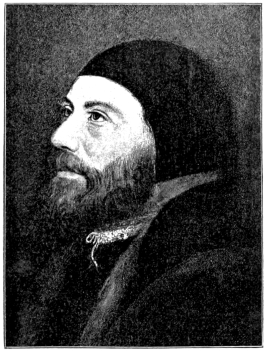
SIR JOHN AYLEF
From the original painting by Holbein, at Barber’s Hall.
Two days afterwards Sir John had a grant of arms from Sir Thomas Hawley, Clarencieux, and shortly after was elected Alderman of Dowgate Ward. He seems to have relinquished his profession of a Surgeon and to have become a Merchant, holding the important office of Master of Blackwell Hall, one of the greatest commercial centres of the period, and residing at the Hall, in the parish of St. Michael Bassishaw.
On the 28th May, 1550, he was chosen the first Alderman of the newly-created ward of Bridge Without, some interesting particulars of which may be seen in Stow’s Survey (ed. 1633, p. 446); while in Wriothesley’s Chronicle, under date 1550, we also read—
Memorandum. Wednesday in the Whitson weeke, at a Court of the Aldermen kept in the Guyldhall, Sir John Aliffe, Knight, and master of Blackwell Hall, was sworne an alderman of the Bridg ward without, and to have the jurisdiction of the Borough of Southwark, and 2 deputies to be appointed there to assist him, which was the first alderman that ever was there, which was done by the advise of my Lord Mayor and thˀ Aldermen, for the better order to be kept there, and for the more quietnes of the Mayors hereafter to come, and the good order of the Kinges subjectes there, accordinge to the lawes of the City; and the Fryday after he rode with my Lord Mayor all the precint of Southwarke, my Lord Mayor havinge a certeine nomber of the honest persons of the borough at the bridg-house, to whom he shewed theyr alderman, and appointed deputies under him, and so hereafter to see a good order to be kept in the Borough, as in other wardes of the citye of London.
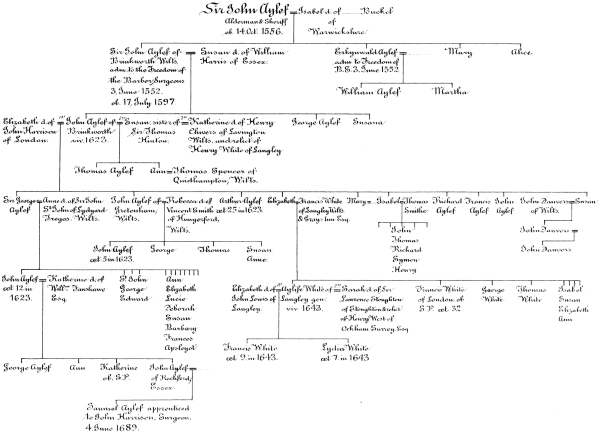
Sir John subsequently removed to his old ward of Dowgate (and continued Alderman there till his death, his successor being chosen 12th November, 1556). After his election as Alderman he was translated to the Grocers’ Company, of which ancient guild he was crowned Upper Warden, 9th June, 1556, in view of his election as Lord Mayor for which he stood next in nomination, and to which office, had he lived but a few weeks longer, he would in all probability have been chosen. He was married to Isabel Buckell of Warwickshire, and by her had four children, John, Erkynwald, Mary and Alice. His son John and great grandson George, were both knighted. His widow, Dame Isabel, had a grant of arms by Thomas Hawley (3 & 4 Ph. & M.) ar. a fesse vaire or and az. betw. three doves ppr. bearing in their beaks a branch gu. Sir John Aylef’s funeral is thus recorded in Machyn’s Diary, 1556—
The xx of October was bered ser John Olyff knyght and altherman, and sum-tym he was surgantt314 unto kyng Henry the viijth, and after he was shreyff of London; and he had levyd tylle the next yere he had byn mayre, for he tornyd from the Surgens unto the Grosers; and bered at sant Myghelles in Bassynghall, with a harold of armes bayryng ys cott armur, and with a standard and a pennon of armes, and iiij baners of emages, and ij grett whytt branchys, and iiij grett tapurs and . . . . . dosen of torchys; and mony powre men had gownes; and with a elmett, targat, and sword; and the crest a crowne and a holyfftre315 standyng with-in the crowne.
For the inscription on Sir John Aylef’s tomb, which formerly stood in St. Michael’s Bassishaw, see page 89.
Sir John Aylef’s will, dated 26th September, 1556, was proved 24th December, 1556. He was, he says,
At this present somewhat sicke in bodye;—ffirst and principally I give and com̃end my soule unto Almightie god and to my Savior and Redemer Jesus Christ his onely begotten sonne by and throughe the merittꝭ of whose bytter passion I truste to have Remission of my synnes and to the holie goste three parsons and one god and to all the holye & blessed companye of heaven, and my bodye to be buried in holie grave in suche decent order as to the goode discretion of my Executors hereafter named shalbe thought mete and convenient for myne Estate and degree withoute pompe or glorie.
To the parson of St. Michael Bassishaw for tithes and oblations forgotten 20s. To every priest singing in that church 10s. To the clerk of the same church 5s. To the sexton 3s. 4d. To the repair and maintenance of that church £5. To the parson of Pricklewell, Essex, for tithes and oblations forgotten, 20s. To the reparation of that church £4. To the chapel of Bridewell in London £5, and one vestment for a priest to say mass there when the chapel should be made ready. His goods and chattels in London he directs to be divided into three parts, whereof one-third to his wife, one-third to his daughters Marie and Alice and the other third to his executors to the performance of the will. Having already given his sons John and Erkynwald £300 apiece, he gives £100 more to each. To Elizabeth Harvard £10. To Robert Buckle (his wife’s brother) £10, and to each of his children 40s. To William Symson, his servant, £10. To John More, his servant, £10. To John Etonfelde £5. To Gyles Strowden, his clerk, £3. To Christopher Vaughan, his clerk, £2. To Thornton, his clerk, £2. To Bromefelde, his clerk, £2. To Millecent, “my Wyfes kinswoman servant in my howse,” £20. To “Joane her sister my maide,” £20. To every one of his servants in London and the country 20s. To Thomas Eson, if he remain in Lady Aylef’s service, £5. To George Vaughan,316—
My boke of Guydo and all my Instrumentꝭ Boxes and other that dothe in any wise belonge to Surgerie. To Mr. Vykarie £5. Item I bequethe to the company of Grocers for a repaste tenne poundꝭ. Item to their clerke xxs. Item to their bedell xxs. Item I give to the companye of barbors for a repaste at my buryall fyve poundꝭ and to the beddell of the same company of barbors tenne shillings Item I give to the governors of the hospitalls belonginge to the citie of London to make them a dynner at my buryall fyve poundes and to every of the beddles of the said hospitallꝭ one blacke Coote and iijs iiijd in money.
To the Universities of Oxford and Cambridge £10 each, “to be distributed to the comfort of the poore Scolers wthin the said univˀsites.” To poor householders in St. Michael Bassishaw “where I dwell” £4, and to those of St. Alban, Wood Street, £2. “Item to the pore householders in the parishe where the barbors hall dothe stande,” xxs. To poor householders in St. Michael, Queenhithe £2. To the poor prisoners in Newgate 40s., in the two Counters 40s., in Ludgate 40s., in the Marshalsea 20s., in the King’s Bench 20s., and in the Gatehouse at Westminster 10s. “Item to every of the sixe Lazar howses abowte London xs.” To the poor in Bethlem 20s. To the poor in the hospitals of the City £100 (over and above £100 he had already given). To five poor men and two poor women being “of my kynn dwelling in Grenewiche in Kent to eiche of them xls and a gowne of suche Clothe to eiche of theym as shalbe given to the poore at my buryall And my mynde and will ys that yf any other of the poore of my kynn shall wthin one yeare and a daye next after my decease come to myne Executours approvinge them selfes sufficiently to be of my kynne & blinde That then every of them shall have xxs.” To his wife Isabel, the lease of his farm at Pricklewell with all the stock there “except my Ryding geldingꝭ,” also the lease of his woods there, on certain conditions. To his son Erkynwald the lease of his farm of Fambridge, in Essex, with remainder to Erkynwald’s son William, and after him to Martha (William’s sister), and in the event of all of them dying without issue to Christ’s Hospital, Bridewell, and St. Thomas’ Hospital. Testator recites that Henry VIII granted to him and his wife Isabel and their heirs the manor of “Greteman” (Gryttenham), Wilts, and that he was seised in fee of the parsonage of Wakeringe (near Rochford, Essex), and of a marsh called Alforde Nash, in the parish of Estwood (near Rochford). All of this property he bequeaths, after the death of Lady Isabel to his son John, with remainder to Erkynwald, then to Marie and Alice, and in the event of all them dying without issue to the three hospitals aforesaid. To the poor of the parish of Bassingham (eight miles S. W. of Lincoln) £20 for coals. (Query: Was Sir John born here?) To three score maids marriages in London £20. To Elizabeth Glasier 40s. Residue to the Lady Isabel. Executors, John Southcott (Under Sheriff of London), Richard Grafton, Grocer, and Lady Isabel Aylef. To Southcott and Grafton £20 each. Overseers, Sir Rowland Hill,317 Laurence Withers, and John Machell,318 Aldermen, and to each of them a black gown and £10, also a black gown to each of their wives.
Sir John Aylef’s name has been spelt in many ways, Aylif, Ailiff, Alif, Olyff, Ailyffe, etc.; in his will it is spelt Aliff. But this family must not be confounded with that of John Oliphe, Alderman and Sheriff 1569, buried at St. Laurence Pountney, 4th July, 1577; although Wilson, in his History of that parish, at p. 232, mistakes John the son of that Alderman for John the son of our Alderman.
For some notices of the Aylefs see Aubrey’s collections for Wilts, and Marshall’s Visitation of Wilts.
The pedigree is compiled principally from Harl. MSS. 897, 1165 and 1443.
THOMAS VICARY,319 Serjeant-Surgeon.
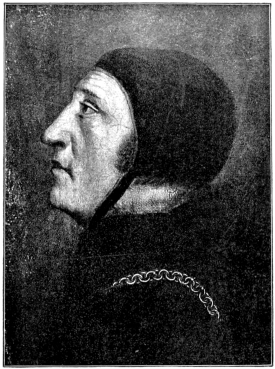
THOMAS VICARY
From the original painting by Holbein, at Barber’s Hall.
Thomas Vicary was probably born between 1490 and 1500, and is stated in Manningham’s Diary to have been “at first a meane practiser in Maidstone untill the King advanced him for curing his sore legge.” In 1525 he was third Warden of the Barbers’ Company, and in 1528 Upper Warden and one of the Surgeons of Henry VIII with £20 a year. In 1530 he was Master of the Company and appointed Serjeant-Surgeon, which latter office he held until his death. In 1539 Henry granted him a beneficial lease for 21 years of the Rectory and tithes of the dissolved Abbey of Boxley in Kent. In 1541 Vicary was chosen Master of the Barber-Surgeons, to which office he was again elected in 1546, 1548, and 1557 having thus held the chief place in the Company no less than five times—an honour to which no other member has ever attained. In the Holbein picture Vicary is represented as receiving the Charter from the King. In 1542 he and his son William were appointed by the King Bailiffs of the Manor of Boxley, and five years later he married his second wife, Alice Bucke. In 1548 Vicary was appointed a Governor of St. Bartholomew’s Hospital, and soon afterwards became the Resident Surgical Governor there; in June, 1552, he was made “one of the assistants of this house (St. Bartholomew’s) for the terme of his lyffe.” In 1548 he published his celebrated book “The Anatomie of the bodie of man,” no copy of the first edition of which is now known to be extant. On the 27th January, 1561, Vicary made his will, which was proved in London 7th April, 1562. The will, which is set out in full in Dr. Furnivall’s book, is too long to give here in extenso, but the following extracts will be found of interest.
Item I will that the masters of the livery of my Companie be at my buriall, and they to have xls for theire dinners, to be delivered to the wardens at theire commyng to my buriall. And to Johnson the Clarke of the Company, vjs viijd And in considerac͠on of my evell and necligẽt service done to god and to his poore members, the poore of this hospitall of St. Barthelmewes where I now dwell, in recompence whereof, and for the discharge of my concience, I give and bequeath to thuse of the saide poore, tenne poundes in monney. Item I give and bequeath xls in monney to and amongest fortie poore householders of the saide pˀish of little sainte Barthelmewes, that is to saye, to every householder xijd. Also I give and bequeathe ls in monney to thospitler, matron, stuarde, Cooke, and porter offecer of the saide hospitall, that is to saye, to every of them xs . . . . To Thomas Skair, my apprentis, vjs viijd . . . I give and bequeath to Roberte Baltropp320 my best gowne garded with velvet, furred and faced with Sables, my Cote of braunched velvete, and a sering321 of silver, parcell gilte. Also I give and bequeath to Thomas Bayly322 my gowne of browne blue lyned and faced with blacke budge,323 my cassocke of blacke satten fured and garded with velvet, my best plaister box, garnisshed with silver, my salvitory324 of silver, and a sering321 of silver, with all other instrumentꝭ of silver. Item I bequeathe to Robert Muddesley325 my best single gowne faced with blacke satten. To George Vaughan,326 my doblet of crimson satten . . . Also I give and bequeath unto the hawle of my company one booke called Guido327 and ij billes ij bowes ij shefes of Arrowes ij bracers ij shoting gloves ij Sculles one hand gune and one Jack Item I give and bequeath to master Skynner328 one half hacke one Jack and one murren And to Henry Picton my sˀvnte aforesaide one booke called Johˀes Vigo.329 All the residue of my bookes stuff and instrumentꝭ appertaining to surgery I give and bequeath unto the same Henry Picton and Richard Vener equally betwen them to be devided.
The remainder of his property was bequeathed to his nephews Thomas and Stephen (sons of his late brother William Vicary, of Boxley), and to his widow Alice.
RICHARD FERRIS, Serjeant-Surgeon.
But little is known of Richard Ferris, though he was doubtless a man of repute, as Gale speaks approvingly of him, and he held the office of Serjeant-Surgeon in Queen Elizabeth’s time; his portrait is preserved by Holbein in our great picture, and Henry VIII, by his will, bequeathed him 100 marks. He was twice Master of the Barber-Surgeons, viz., in 1551 and 1562.
His will, dated 17th March, 1566, was proved on the 22nd April, 1566, wherein he describes himself as “Richard Ferres Serjant Surgion unto the quenes majestie, sick of bodie.” He gives to “Em,” his wife, his house, field, and orchard at Paddington for her life, with remainder to his daughter Thomazine, and to her also the lease of the house where he then dwelt in St. Giles, Cripplegate. In the event of their deaths without issue, the property to be sold and distributed amongst the poor in the discretion of his overseer, John Field330 and Dr. Gregorie Wisdom, except 40s. to his cousin Johanne Sympson. To his daughter Thomazine his “Courte bedd and bedstede,” also a feather bed and bedstead furnished, half a garnish of pewter vessels, &c., and £30 which was owing to him by Dr. Cunningham (Reader at Barber-Surgeons’ Hall).
Item I give and bequeth unto the Companie of Barbors and Sˀgions twentie Shillings in monney a grete Pandack and an other booke called a verroyce. To John ffelde my late srˀvaunt all my other bookes bothe of Surgerie and others excepet ffoure of theim wch I give unto John Griffine my Apprentice. Also I give and bequeth unto the said John ffeld all my Sˀgerie stuff and all my Instrumẽtes both of silver and other and also my gowne furred wth ffox wch I comonlie Ride in. Item I will and bequeth unto Thomas Baylie331 one Booke called Peter de argilate and the Staff wch he gave me.
The residue to his wife, and she appointed executrix with John Field overseer.
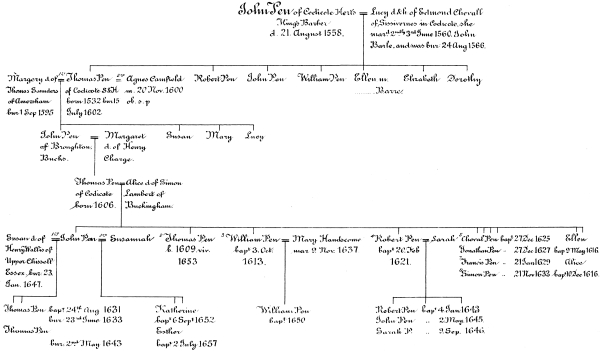
JOHN PEN.
Much time has been spent in the endeavour to ascertain John Pen’s parentage, but without success. Among the Domestic State Papers, Henry VIII, Vol. I (No. 4064) is the grant of a corrody or sustentation from the Monastery of Abbotsbury to Robert Pen “one of the Gentlemen of the Chapel” and to John Pen, his son, for life. The date of this document is 9th March, 1514, and as John Pen was a retainer of the King’s, which this grant would also seem to imply, and had a son whom he named Robert, there is the possibility that this Robert Pen, the Gentleman of the Chapel, was his father.
John Pen was admitted to the freedom of the Barbers in 1527, and his birth may probably be put at 1500–1505. He was by profession a barber, and evidently a friend of King Henry VIII, who advanced him from Groom of the Privy Chamber to the honorable position of King’s Barber, an office which was only bestowed upon the most trusty and confidential of the King’s attendants; the life of the sovereign being in his barber’s hands. (See pp. 90 and 91.)
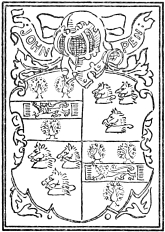
Pen served the office of Master in 1539, and his portrait is in the Holbein picture. He married, about 1530, Lucy, daughter and heiress of Edmond Chevall of Sissivernes, in Codicote, Herts, and by her he had a good estate. In 1545 Henry granted him the manor of Codicote and the demesne lands of the late dissolved Abbey of St. Alban’s for £826 9s. 41⁄2d., to hold by the forty-fifth part of a knight’s fee. The King also bequeathed him 100 marks by his will. By an Inquisition taken at West Barnet 18th October, 5 & 6 Ph. & M., it was found that John Pen died 21st August, 1558, and that Thomas, his son and heir, was then of the age of 25 years and 9 months. John Pen’s Will, dated 15th August, 1558, was proved by his widow on the 6th May, 1559. Coleman in his list of Wills of the Pen family states that a second grant of Probate was taken of this Will by Gyles Pen on 10th October, 1560, but this is absolutely incorrect; on this date the Will of one Gyles Peny of Halstocke in Dorsetshire was proved, and Mr. Coleman has confounded this in a remarkable way with John Pen’s Will, with which it has no connection whatever. That Pen was not, or did not know that he was, a connection of the Pens of Bucks, is most likely, as he obtained a grant of arms for himself, in which the combs on either side of the lion of England are typical of his office of King’s Barber. These arms were 1st & 4th Ar. on a fesse gu. betw. three peacocks az. a lyon pass. guar. or betw. two combs of the first (Pen) 2d & 3rd Or three horses’ heads couped sa. bridled ar. (Cheval).
The following is the text of his will:—
In the name of god amen The xvth day of August Annis vto et vjto Regꝭ et Regine I John Penne Esquyre being sicke in body but whole and pˀfitt in mynde make this my Testament conteynyng therin my last will in manˀ and fourme following that is to saye ffirst my soule I bequeth almightie god &c. and my body to be buryed in the church of Codynte &c. Item I bequeth to the high Alter of Codynte &c. xxd Item to the high Alter of Welwyn xxd Item my will and pleasure is That all wills and declaracons therof heretofore mayde by me at any tyme heretofore to be voyed and of none effecte and that this my last will and Testament be takyn reputed to be my last will and none other Item I give to evˀy of my doughters Elen Elizabeth and Dorothye fortie poundes in money to be paied at their marriage daye or when they shall come to thˀage of xvjth yeres. Yf any of theis iij childern dep̃te this world before their mˀriage or xvjth yeres of age That then the survivors to have the ptꝭ of theym that ar depˀted to god. The saied legacꝭ of my saied childern to be levyed out of the manˀ of Sycesvrñs wth thappurtenncꝭ Item I give to Robert Penne his wif two kyne. Item my wyll and pleasure is and also I give to Robert Pen my soune and to his heires my myll of Codynte payng yerely to Willm̃ my sonne twentie shillingꝭ during his naturall lif. The Resydewe of my goodes my debtes and legacꝭ paid I give to Lucy my wif whom I make my sole executrix. Witnesses by me John Pen by me michaell hogkyn.
NICHOLAS ALCOCKE.
He was admitted to the freedom in 1523, and was Surgeon to Edward VI; his portrait is in the Holbein picture. He died in the early part of 1550, and his will dated 15th February, 1549–50, was proved 6th May, 1550. In it he describes himself as “One of the Surgions to the Kingꝭ Matie” and directs that his body shall be buried in the Church of St. Stephen, Coleman Street, near where his children are buried. He leaves one-third of his goods, &c., to his executors for the purposes of his will, one-third to Margaret his wife, and one-third to Elizabeth his daughter on her twenty-first birthday or marriage. To the poor of Swyneshed, Lincolnshire, £5. Six “sermons” to be made for him at St. Stephen’s. For poor maids marriages £4. To Bartholomew’s Hospital 40s. To George Brykesworth of Glastonbury, Surgeon, his best lute, and to Elizabeth Alcocke (testator’s daughter) his virginalls. To Richard Sygans, his servant “a sleveles jacket of cloth browne blewe a woorsted doblett a pair of hosen. A payre of bootꝭ and a paire of spurres.” To Ann his maidservant a bedstead, a mattress and a coverlet. “I bequeth to Robert Balthorpe late my apprentice my booke called Guido in Englysshe.” To Elizth Smith a bedstead and mattress. To his two god-daughters, the children of Robert Wilson and John Stocks, to each a pewter dish and saucer.
I bequeth to John Mason332 late my apprentice my bookꝭ called Lanfrank, Johẽs Arden and an other olde booke wt a bare woodden covˀ in Englysshe and the practise of ypocratꝭ. To my wifes father Thomas Turnor my newe coloured gowne garded wt velvett and faced wt foynes and my best rydinge cote garded wt velvett and my dublett of redde taffeta Also I bequeth to the eldest sonne of my father in lawe my foxe furred gowne and a dublett wt blewe taffeta sleves and my black mournynge cote. Itm̃ I bequeth to Robr̃t Balthrope some tyme my apprentice my Russett woorsted gowne faced wt calabrer and garded wt velvett.
He bequeaths his great house and premises called “ffreshe wharff” in St. Botolph’s Billingsgate, of the annual value of £24 to his daughter Elizabeth, but in the event of her decease before she came of age this wharf to be sold and divided in certain proportions between Bartholomew’s Hospital, Thomas Turner, his father-in-law, Thomas and Richard Turner his sons, the poore of Coleman Street, poor maids’ marriages, and the mending of highways.
He bequeaths some pastures and meadows at Enfield to his wife. He directs his parsonage of Kirkbye, Lincolnshire, with all the tithes and profits to be sold, and 100 marks to be given to Roger Alcocke, his brother’s son, 20 marks to his godson Nicholas Spencer, and the residue to be devoted to works of charity in the discretion of his executors. Thomas Archer, gentleman, and Randolph Atkinson, Merchant Taylor, are appointed Executors, and John Wysdome, painter staynor, and John Shireff, Barber-Surgeon, overseers.
ROBERT BALTHROP, Serjeant-Surgeon.
Robert Balthrop was born in 1522, and about the year 1538 apprenticed to Nicholas Alcock (Surgeon to King Edward VI). He was admitted to the freedom 3rd March, 1545, and to the Livery 20th October, 1552. He served the office of Warden in 1560 and 1564, and was Master of the Company in 1565 and again in 1573. About the year 1562 he was appointed Serjeant-Surgeon to Queen Elizabeth and held that office until his death (9th December, 1591).
He is buried in the church of St. Bartholomew the Less, where there is (behind the organ) on the south wall of the church, a handsome monument to his memory with this inscription—
Here Robert Balthrope lyes intombd, to Elizabeth our Queene, Who Sergeant of the Surgeons sworne neere thrtye yeeres hathe beene. He died at syxtie nine of yeeres December’s ninthe the daye The yeere of Grace eight hundred twice deductinge nine a waye Let heere his rotten bones repose, till angells trompet sounde, To warne the worlde of present chaunge, and raise the deade from grounde. VIVIT POST FUNERA VIRTUS.
Balthrop’s will was made about a fortnight before his death (27th November), and therein he directs his body to be buried in St. Bartholomew’s the Less, in which parish he then resided. He seems to have amassed a considerable estate and to have made a rather lengthy will, but as a great deal of it is of much interest, especially his inventory of surgical instruments and books, no apology is needed for quoting largely from it.
I do give and bequeathe my sowle to the holy and blessed Trinitie the ffather the sonne and the holy ghost three persons and one God allmightie hoping and stedfastly beleevinge to be forgiven and pardoned of all my sinnes and to enjoye the everlastinge and unspeakable felicities of heaven through the merrittꝭ and passion of my only redeemer and saviour Jesus Christ to whome be given all glorie honor and praise nowe and for ever Amen.
To poor people in the discretion of his executrix £10. To John Mason,333 Chirurgian, dwelling in Long Lane 40s., and a few other small legacies. “To my servauntes,” John Deighton, Richard Neill, John Edwards and William Taylor 40s. each. To each of his wife’s maids 20s.
Also I give to the Company and bequeath to the company of the Barbors and Chirurgions of the Cittie of London for their use in their hall one bell [? beer] bowle with a cover beinge both of silver and gilte weighinge thirty ounces half an ownce and half a quarter of an ownce. Also I give to the Mr and Governours of the said Company to make them and the rest of the Cloathinge a Dynner in theire hall after my buryall ffyve poundes. Also I give and bequeath to the poore people of the said Company fyve poundes. . . Also I bequeath to my mothr Mris Love my golde ringe which hath in it a stone called a Turkey. . . Also I bequeath to my felowe Goodorus334 one of my Launcettꝭ that is sett in golde and enamyled Also I bequeth to my felowe Baker335 her maiesties Chirurgion my Syringe of silver gilted and three pypes of silver gilted belonginge to the same.
To Mr. Bennett, one of the Queen’s footmen, “my Brooch of golde compassed aboute with ragg Rubies.” Upon payment of £10, John Gryffyn,336 surgeon, was to have the lease of his house. To testator’s nephew, William Balthrop £50 “and my greate Ringe of golde with my seale of Armes.” To his Nephew Richard Balthrop at the end of his apprenticeship £50 “and my lesser Ringe of golde with my seale of Armes.” And to these nephews his lands and tenements at East Greenwich. To John Gryffyn
My fyne clothe gowne welted with velvett and faced with Damaske. . . . To John Deighton my servaunte my blacke cloth cloake layed with lace and faced with velvett my blacke satten Dublett and my rounde velvett hose. To Richard Neel my servaunt a cloak, doublett and hose. To John Edwards my servaunt my white canvas Dublett that is at the parke with my Rownde velvett hose and my pheasaunt colored cloake with the sleeves and cape faced with russett velvett. Also I give and bequeath to my servauntꝭ that nowe are with me and have bene my servauntes in tyme past which do practize and exercise the art of Chirurgery such thingꝭ of mine belonginge and appertayninge to chirurgerie as are by me given and appointed to them in the Schedule hereunto annexed.
To Dorothy, his wife, he gave all the residue of his lands, houses, buildings, goods, chattels, plate, chains of gold, jewels, ready money, &c., and appointed her executrix. Probate was granted 16th December, 1591.
SCHEDULE.
Item I give and bequeathe to my servaunt John Deighton my newe and last made Chirurgery chest which is for my owne use with all that is therein except golde and silver Also I bequeath to him my plaster boxe of leather which hath the lock hinges and barrs over yt of Copper gilted and the cysars and all the silver instrumentes therein. Also I give unto him my rownde silver salvatory and one catheter of silver and annother of leade with the case wherein they are Also I give unto him a case with silver Instrumentes therein that ys to saye a silver splatter a chockbarr of silver for the uvula a silver Syringe parcell gilted Also I give unto him my silver precipitate box all wch thingꝭ are in the aforesaid chest. Also I bequeath unto him all my bookes of Phisicke and chirurgery with two Dixionaries which are in my study in my house at Manfeilde parke in the parishe of Taplowe. I also bequeath unto him my Englishe bible which is at the Courte. I give and bequeath to Lewes Rogers337 somtyme my servaunte my greater surgery Chest which is in my Chamber here at London with all that is therein except golde and silver. Also I give unto him my plaster box which my wife hath in the Countrie with all the instrumentes therein belonginge to the same Also I give unto him a Catheter of silver which is in the Chest that I have apointed to John Deighton my servaunte Also I give unto him these bookes followinge Guydoes Chirurgery in ffrench, Bartholomeus De proprietatibus rerum, Vidus Vidius Interpres, Valescus his practise, Albucasis Discorides, Cornelius Celsus, Johannes Mesue, Marcus Catenarcus, Guydoe in latin, Leonardus ffuschius, Gyrolanus in ffrench and Quintus Curtius in Englishe. Also I give and bequeath to my servaunt John Edwards my least Chirurgery Chest which is at the Court for the Dayly use of my servauntes with all that therein is, my plaster box of leather with ye gilted locke and hinges of silver with all the instrumentes therein to the same belonginge and these English bookes, Gemimes Anathomy, Guido and Leonard ffuschius both in written hand, John Vigo, Eliot’s Dictionarie which I have lent to my felowe Goodorus, Turners herball and my byble which is at my howse in Manfeilde parke. Also I give unto him a pewter Syringe with three pypes of silver belonginge to the same. Also I give unto John Griffin somtymes my servaunt my silver salvatory percell guilted which is in the Chest that I have appointed to my servaunte Lewes Also I bequeath to Anthony Gariswall somtyme my servaunte one bigge latin booke wherein are bounde togeather the Chirurgeries of Guido, Brumis, Theodoricus Lanfrancke and Alberti Palus Also I give and bequeath unto the companie of the Barbors and Chirurgeons of the Cittie of London the Chirurgery of that most excellent writer John Tagaultius the lattin booke and also the English translation that I have made thereof And also the Chirurgerie of the expert and perfect practitioner Ambrose Parey both which workes I have written into Englishe for the love that I owe unto my bretheren practisinge Chirurgerie and not understandinge the latin Tounge and given them into the Hall for theire Dayly use and Readinge both in lattin and Englishe and Desiringe that they may be kept faire and cleane for my sake which wish them all prosperous and good successe in theire workes and endevours whatsoever they take in hande to the glory of God and the advauncemente of the Arte. Also I give unto my servaunt John Edwards my Case with all the Instrumentes therein which is in my Chest which I have appointed for Deighton. Also I give unto my servaunte John Deighton my bagge with the case and all the Instrumentes and other thingꝭ that are therein which lyeth for my Daily use in my Chest wherein I put my lynnen at the Courte. ffinally my will is that myne Executrix shall give to the use of the two hospitalls Sainte Bartholomewes and Saint Thomas for the sicke and sore people there all other such medicines bookes Instrumentꝭ bottles boxes and pottꝭ and such like thingꝭ belonginge to Chirurgery as are not in this Schedule bequeathed and given and such as she will reserve for her owne use, and to give to the poore for Christes sake. In Witnesse whereof I have also Subscribed this Schedule and put to my seale the Daie and yere first above written.
Per me Robertum Balthropp.
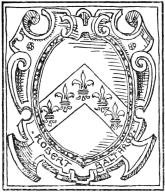
Arms. Ar. on a chev. sa. five fleur de lys of the first. (The shield on Balthrop’s monument is quarterly 1st and 4th as above, 2d and 3rd a bend betw. two Eagles displayed.)
SIR PETER PROBY.
Peter Proby was born at Chester, and was the son of Randolph Proby, afterwards of Brampton, Hunts, by his wife, a Miss Bernard. He was admitted to our freedom in 1579, made a Liveryman 1st July, 1596, an Assistant 6th July, 1609, and served the office of Master 1615. He was Sheriff of London 1614, Alderman of the Ward of Queenhithe, and Lord Mayor in 1622.
19th August, 1605. This day Mr Peter Proby a very lovinge member of this company did out of his love and affection to this house of his owne voluntarie good will give unto this company a very fayre large and serviceable standinge Cup of silver and double gilte wayghinge xxx ouncꝭ & a penny waight with a cover unto it whereupon are his armes placed And hath this supˀscription ingraven upon it [This cup is given to this hall by Peter Proby gentleman free of the same, A servant to Queene Elizabeth and to Kinge James And for both keepˀ of the Recordes in the Tower of London. Postmr for the service of Ireland. And for speciall Service a pentioner for leife. Who was twice of the high courte of Parliament] which cup was kindlie accepted by this Court, And in gratificac͠on thereof It is by this Court ordred that the said Peter Proby shalbe exempted and discharged from all offices within this Company except the office of Mr or Governor of this companie. And from all other attendaunces for the sˀrvice or affaires of the said Company And when it shall please him to come to the hall he is to be kindlie and freindlie intertayned. finis coronabit opus.
24th May, 1614. It was agreed that Mr. Alderman Proby should, if he desired it, “have the use of this house together with the plate and other necessaries for to keep his Shrievalty,” and if he desired to keep his Shrievalty elsewhere he was to be allowed to borrow the plate for a year; and on the 1st July it was agreed that £40 should be given to him towards the “bewtifying of his howse.”
25th August, 1614. Fifteen Members of the Court of Assistants were nominated to attend Mr. Sheriff Proby on Michaelmas eve and the next day, and all charges and expenses which they might incur were to be borne by the Company.
In 1616, Sir Peter who had previously been appointed Governor of the colony of Ulster by special commission from the King and the City of London, repaired thither, attended by divers of the most eminent citizens, to regulate certain affairs belonging to the plantation, taking with him two rich swords of state as a present from the City, to be carried before the Mayors of Londonderry and Coleraine, the former having been some time before erected into a city and the latter into a Mayor-town.
8th June, 1622. At a Court held this day Alderman Proby was ordered to be translated to the Grocers’ Company, in view of his coming election as Lord Mayor.
20th September, 1622. At this Court it is agreed that there shalbe hiered on the Lord Maiors day a Noyse of Trumpettꝭ at the Charge of the howse.
At this Court it is agreed that Mr Alderman Probie shall have our plate & hangeingꝭ for this yeare of his Maioralty.
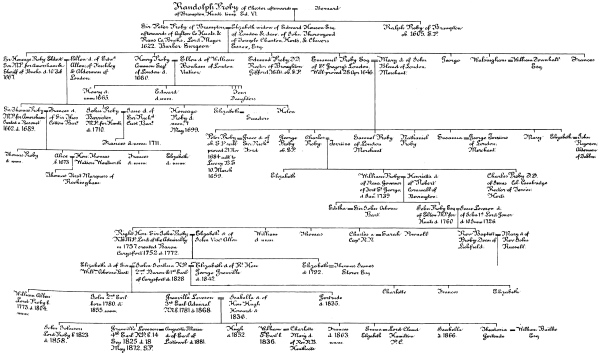
Sir Peter’s eldest son, Heneage, was knighted; he was Sheriff of Bucks, and M.P. for Amersham. His second son, Henry, was Common Serjeant of London. Sir Peter was the ancestor of several members of Parliament as also of the Marquess of Rockingham and the Earl of Carysfort. His grandson Peter Proby, who married Grace, daughter of Sir Richard Ford, was chosen a Liveryman of the Company 10th March, 1659.
Sir Peter Proby’s will (undated) was proved 21st March, 1625, and commences—
I Peter Proby Knight and Alderman of London calling to minde the transitory estate of all flesh and more perticulerly the great age wch through gods especiall goodnes I have attayned, as alsoe the weake estate of my body broken of late wth many sicknesses and infirmities wch still hanging one mee as be many monitors unto me to pˀvide for my approachinge change and settlinge of that poore state wherewth it hath pleased god to blesse mee.
He gives to his wife Dame Elizabeth Proby (of whom he speaks in terms of the greatest affection) his manor of Allington, alias Aylton, Hunts, for 40 years, if she shall so long live, with remainder to his son Heneage, also to his wife his mansion and manor house of Caddington, Herts, with the demesne lands of that manor and the tithes thereof, also all his lands, tenements, and hereditaments in Luton and Dunstable with remainder to his son Henry, also to his wife his house in St. Swithin’s Lane, London. To his son Henry the manor of Yaxley, Hunts, with the tolls of the fair and markets there, which he had by virtue of a lease from Queen Elizabeth. To his son, the Rev. Edmund Proby, D.D., £1,000. To his son George £1,000. To his son Emanuel £500 (he having already had £500). His daughter, Walsingham having been provided for on her marriage, was to have £20.
To my kinde and loveinge soune in lawe William Downhall esquire £20. Item I give and bequeath unto my lovinge friends the Mr Wardens and company of Barber surgions the some of twenty pounds.
Also £30 to the Grocers’ Company and £6 6s. 8d. to Bridewell Hospital. To the poor of Aylton 12d. weekly for 5 years. To the poor of Yaxley 6d. weekly for 5 years.
And as for that yerely penc͠on yt I have given for ever in the parish I was borne in in the Citty of Chester I require my executor to see and make inquiry of the pˀformance thereof (accordinge to a brason table in the Church therefore) the wch for many yeres past I have knowne well performed and soe I hope wilbe for ever.
His sons, Heneage and Henry, and son-in-law, William Downhall, were appointed Executors.
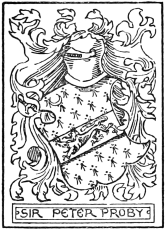
Sir Peter Proby’s arms were, erm. on a fesse gu. a lyon pass. or. a crescent for difference.
WILLIAM CLOWES.
William Clowes was the son of Thomas Clowes, originally of Kingsbury, Warwickshire, and afterwards of London. He was born about 1540, and studied surgery under Mr. George Keble, who was not free of our Company, but of whom Clowes more than once speaks in terms of highest praise. He tells us that in 1563 he served as a Surgeon in the army under the Earl of Warwick at Havre, and after this campaign he was for some time in the Navy, in both which appointments he undoubtedly gained great experience. In 1569 he no doubt settled in London, as on the 8th of November in that year he was admitted to the freedom by translation, and he soon secured a large practice, though it was not until the 18th July, 1588, that he was made an Assistant of the Court.
The records do not display Mr. Clowes’ character in the most favourable light, as the following extracts will show:—
6th October, 1573. Here was one & complayned [against] Willm̄ Clowes for takynge his money and he not cured.
7th February, 1575. Here came one Willm̄ Goodnep and complayned of Willm̄ Clowes for not curing his wief de morbo gallico and yt was awarded that the saide Clowes sholde either geve the saide Goodnep xxs orells cure his saide wief wch Clowes agreed to pay the xxs and so they were agreed and eche of them made acquittance to other.
28th February, 1576. Here was a complainte against Willm̄ Clowes by one Goodenge for that the saide Clowes had not onlie misused the saide Goodinge in speche but also most of the masters of the Company wth scoffing wordes and jestes, and they all forgave him here openlye in the Corte and so the stryfe was ended upon condˀ that he sholde nevr so misuse him self agayne and bonds was caused to be made to that effect.
25th March, 1577. Here at this Corte was a greate contension and stryffe spoken of and ended betwene George Baker and Willm̄ Clowes for that they bothe contrary to order and the good and holsome rules of this howse misused eche other and fought in the ffelds togethers. But the Mr Wardens and assistance wishing that they might be and continewe loving brothers pˀdoned this greate offence in hope of amendement.
The George Baker with whom Clowes fought, was afterwards Serjeant-Surgeon and Master of the Company in 1597. In 1575 Mr. Clowes was appointed one of the surgeons of St. Bartholomew’s Hospital and later on he was surgeon to Christ’s Hospital; he was also surgeon to Queen Elizabeth and James I. His first book, “De morbo Gallico,” was published in 1579. In 1585 he went as surgeon of the forces in the expedition to the Low Countries under the Earl of Leicester. In his book, “Proved Practise,” he tells a great deal of this expedition and says that many of the surgeons were most unskilful and “slew more than the enemy did,” though he and his friend Serjeant-Surgeon Gooderus (Master 1594) did not lose a case. Mr. Clowes had the honour of serving in the fleet which defeated the Spanish Armada, and in 1594 was Warden of the Barber-Surgeons, the last Court which he attended was on the 9th February, 1596. After a successful practice he retired to a country house at Plaistow, in Essex, and died in 1604. Dr. Norman Moore says that his books “are the best surgical writings of the Elizabethan age; they are all in English, and his style is very easy and forcible, sometimes a little prolix but never obscure.”
WILLIAM CLOWES, Jun., Serjeant-Surgeon.
He was the son of William Clowes, Barber-Surgeon; born about 1582, he was apprenticed to his father and admitted to our freedom 22nd January, 1605, and on 13th December, 1615, called to the Livery; he was then surgeon to the Prince of Wales, and had a dispensation from the Court of the Company to attend the lectures and Hall only on such occasions as should be convenient to him. On the accession of Charles I he was made Serjeant-Surgeon to the King. In 1626 he was Master of the Company, and again in 1638. A characteristic letter of Serjeant Clowes and some particulars as to his election as Master in 1626 may be seen on pp. 248–250. On 30th October, 1648, his decease was reported to the Court.
By his will, dated 28th March, 1630, he bequeathed his property freehold and copyhold, to his wife Sara, his son James, and his daughters Ann and Sara.
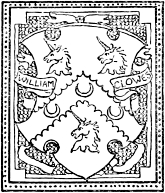
Arms. Az. on a chev. engr. betw. three unicorns’ heads, era or. as many crescents gu.
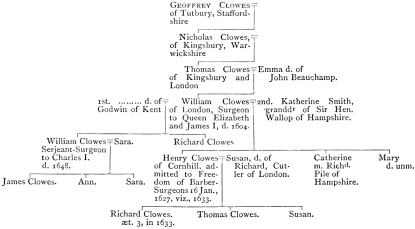
Geoffrey Clowes ==
of Tutbury, Staffordshire
Nicholas Clowes, ==
of Kingsbury, Warwickshire
Thomas Clowes == Emma d. of
of Kingsbury and London John Beauchamp.
1st. ........ d. of == William Clowes == and. Katherine Smith,
Godwin of Kent of London, Surgeon to Queen Elizabeth and James I, d. 1604. granddr of Sir Hen. Wallop of Hampshire.
William Clowes == Sara. Richard Clowes
Serjeant-Surgeon to Charles I. d. 1648.
James Clowes. Ann. Sara. Henry Clowes == Susan, d. of Catherine m. Richd. Pile of Hampshire. Mary d. unm.
of Cornhill, admitted to Freedom of Barber-Surgeons 16 Jan., 1627, viz., 1633. Richard, Cutler of London.
Richard Clowes. æt. 3, in 1633. Thomas Clowes. Susan.
THOMAS THORNEY.
Thomas Thorney, born in 1542 or 1543, was apprenticed to William Bovey (Master 1581) a surgeon in large practice. He was made free 8th April, 1573, and elected an Assistant 19th June, 1595; he served as Warden in 1598 and 1600 and was twice Master of the Company, viz., in 1602 and 1606, he was also a Common Councilman. Mr. Thorney acquired considerable property in Holborn and the country, but dying on 4th June, 1614, without issue, made his nephew Peter (son of his then deceased brother Walter) his heir. He was a considerable benefactor to the Parish of St. Andrew, Holborn, where there is a monumental tablet to his memory. His Will dated 25th May, 1612, was proved on the day of his death, and among other bequests to St. Andrew’s Holborn, he left £10 to the Churchwardens—
to make a Dynner or supper therwith and to make merrie therewith with my good neighboures for my sake and to encrease neighbourelie love amongest them And the Churchwardens to bid the parson and Minister to be with them. Item I give to the Company of Barbar Surgions twoe spowte pottꝭ of silver and guilt one all guilte and the other parcell guilte to the valewe of twentie poundes and the Thorne bushe to be graven on either of them and the Barber Surgeons armes and my name at lardge and some wordes to shewe that they were of my guifte Item I give likewise to the Company of Barbor surgions of London that shall followe me at my ffunerall fyve poundꝭ to make a Dynner with and to be merrye for my sake and to the entent to encrease brotherlie love amongest them The said ffyve poundes to be paied to the Master and Wardens when they come to fetch my bodye to the churche.
To his wife Annie he gave his dwelling house in Holborn, and another newly built house there, also one on the street side next the Bars, and the third part of all his other lands for her life and all his goods and movables. To Richard Cade “my auncient and honest servaunte” and to Jane his wife 40s. each for rings. To his nephew, Peter Thorney, his houses in Fetter Lane, the Bell Inn at Acton, a dwelling house at Acton, and the King’s Head in Holborn near the Bars, with a proviso that should Peter die without heirs the Bell at Acton was to pass to the Barber-Surgeons.
PETER THORNEY.
Peter Thorney was apprenticed to his uncle Thomas Thorney and admitted to the freedom 14th July, 1603. He seems to have got into good practice and was one of the Army Surgeons. He was appointed Surgeon-General of the Army going to the relief of Rochelle, and made his will a few days afterwards (25th July, 1628) with a presentiment of his death, which was soon realised, as probate was granted on the 24th November following. He says—
I com̃end my bodie to bee buried where it shall please god or my freindes, if I come not home from the Sea this voiage I intended for the releife of Rochell, but if it shall please god that I die in England if it maiebee possible I would bee buried in St Andrews Church as neare to my Unckle Mr Thomas Thorney as maie bee.
Among other bequests he gives five marks to such of the livery of the Company as shall follow him to the Church; he makes his son Thomas (then under age) his heir generally and provides for his wife Ann and daughter Elizabeth; he leaves to George Peren, Barber-Surgeon, his “yearball knowne by the name of Gerardꝭ yearball.”338
But if it shall please god soe that both my children shall die without issue Then my will is that ye Bell in Acton shall remaine for evˀ to the Company of the berber surgeons of London according as my unckle Mr Thomas Thorney hath hertofore bequeathed it.
Item I give to Edward Griffith which was my Servant all my manuscriptꝭ belonginge to surgerie and all my instrumentꝭ belonging to Surgery except my plaster box and salvatory and instruments in the boxe and my silver seringe, and likewise unto the said Edward all my medicines whatsoever I give him wth my bookes of Surgery whatsoever in my Studdie.
JOHN GERARD.
John Gerard was born in 1545 at Nantwich in Cheshire, his parentage is unknown, though by his coat of arms he appears to have descended from the Gerards of Ince in Lancashire. In 1562 he was apprenticed to Alexander Mason, a Surgeon in extensive practice, who was Warden in 1556 and 1561 and Master in 1567 and 1573 (Mr. Mason died 3rd April, 1574). Gerard was admitted to the freedom of the Barber-Surgeons 9th December, 1569. There is no record of his admission to the Livery, though in consequence of his professional attainments and his presumable friendship with his master who made him free, he doubtless had the clothing at the same time. The only note we have of Gerard, before he comes on the Court, is one in which he appears before the Masters as defendant in a case of alleged slander on the wife of a brother freeman.
21st February, 1578. Here was a complainte against Jo: Jerrard for saying that Richard James his wief had the ffrenche pocks, and he made answere and saide he wolde justifie the same, and he was dismist to the Comon Lawe.
Gerard was elected a Member of the Court of Assistants on the 19th June, 1595. For some long time previous he must have been engaged in the preparation of his great work “The Herball or Generall Historie of Plantes,” a folio of some 1,400 pages, embellished with about 1,800 illustrations of plants,339 and published in 1597, which, whilst it was by far the best and most exhaustive work of its kind at that period, has ever since been considered a standard book of reference; a good copy being now worth 8 to 10 guineas. At this period he was living “at my house in Holburne, within the suburbs of London,” probably near Fetter Lane, where he had a large garden of herbs.
The style of Gerard’s writing was very quaint, and abounds with quiet humour; he scouted monkish tales and old wives’ fables concerning the miraculous properties of plants, etc., honestly endeavouring to present facts to his readers; yet even he has not hesitated to record as true, and gravely set forth, some fabulous stories, as, for example, in speaking of Barnacles on p. 1391, he says—
There is a small Ilande in Lancashire called the Pile of Foulders, wherein are found the broken peeces of old and brused ships . . . wheron is found a certaine spume or froth, that in time breedeth unto certaine shels, in shape like those of the muskle, . . . wherein is conteined a thing in forme like a lace of silke finely woven, as it were togither, of a whitish colour; one end whereof is fastned unto the inside of the shell; . . . the other end is made fast unto the belly of a rude masse or lumpe, which in time commeth to the shape & forme of a Bird: when it is perfectly formed, the shel gapeth open, & the first thing that appeereth is the foresaid lace or string; next come the legs of the Birde hanging out; and as it groweth greater, it openeth the shell by degrees, till at length it is all come foorth, and hangeth onely by the bill; in short space after it commeth to full maturitie, and falleth into the sea, where it gathereth feathers, and groweth to a foule, bigger then a Mallard, and lesser than a Goose; having blacke legs and bill or beake, and feathers blacke and white, spotted in such maner as is our Magge-Pie, called in some places a Pie-Annet, which the people of Lancashire call by no other name than a tree goose; which place aforesaide, and all those parts adjoining, do so much abound therewith, that one of the best is bought for three pence: for the truth heerof, if any doubt, may it please them to repaire unto me, and I shall satisfie them by the testimonie of good witnesses.
The woodcut illustrations with which the book abounds are designed in a good artistic style, being frequently consulted and adapted nowadays by artists engaged in floral design. In 1596, Gerard seems to have propounded a scheme for the Company to keep a garden for the cultivation and study of medicinal plants, and some land belonging to the Company in East Smithfield was suggested for this purpose, but not being thought a suitable spot, certain members of the Court offered to contribute towards the purchase of a garden elsewhere; in June, 1597, the subject was under consideration, and again in November, 1602; but whether anything further was done in the matter does not appear. The minutes in our books relating to this business, are as follows—
26th March, 1596. A motion was also made concerninge the Demisinge of certen garden grounds at East Smithfield for the wch Mr ffettyplace, Mr Lacock and John Gerard were sevˀall Sutors. Yt was agreed that the same should be let for yerely rent at the pleasures of the masters or governors and none of the said sutors obteyned any graunte. But for as muche as John Gerard’s request was to have yt to make a garden of yt for the ffurtherance of learning in the knowledge and practiqe of the nature and skill of herbes, wch was thought not a place ffytt for that pˀpose, but that a more convenient place should be sought owte and dyvers of the Companie did offer to be contributors for the buying of the same, and Mr ffetiplace and Mr Lacock are to be spoken wthall and thus to be satisfied.
16th June, 1597. At the request of Mr Peck340 and Mr Gerat yt was agreed at this Corte that those whose names are here after menc͠oned should survey a peece of ground ffyt to make a Garden for to plant all kinde of herbes in routes plantes and suche like as to the saide Mr Gerat being a skilfull Herbalist should thinck meete for the worshipp of this societie, and to relate their opinions and acc͠ons therein to this howse and societie for the further pˀceding therein, vizt Mr John Isard341 Mr Lewes Atmer342 Mr Cox Mr Wood343 Mr Sprignell344 Mr Borne345 Jeames Bates346 Mr Thomas Waren347 Mr Bovy348 Mr Byrd349 Mr Gale350 Mr Laycock351 Mr Jo Martin352 or any viij. x. or the most pˀte of them.
2nd November, 1602. This daye it is ordered that the Committes for Mr Gerrard’s garden shall this aftr noone meet at the hall to consider of the report for a Garden for the said Mr Gerrard.
In August, 1597, John Gerard was chosen Junior Warden (George Baker, the Queen’s Serjeant-Surgeon being at the same time elected Master), and in January following he was appointed one of the Examiners of Surgeons. In 1604, there had been controversies between Gerard and Christopher Frederick (Master 1609), which on the 12th June were referred to a Committee of the Court for settlement. “And if they no ende can make they are to make report at the next Court of their pˀcedinges therein.”
26th September, 1605. This day Mr Jerrard was discharged of the office of second Warden and upper governor of this Company uppon his suite & entreatie for certayne considerac͠ons. And is fyned for the said places at xli which he is pˀntlie to pay to the pˀnte Mrs or governours And is hereafter to take his place as though he had served the place of upper Governor any thinge to the contrarie notwithstandinge.
7th November, 1605. The above order was rescinded, but shortly afterwards Mr. Gerard brought £10 into Court, and left it with the Wardens, when it was ordered that the matter should be further considered, and in the result the fine was accepted.
21st October, 1606. This daie John Gerrard was fyned at vjs viijd for abuseing Mr Peck and it is ordered that from henceforth they shall be freinds, and all Controversyes betweene them are to cease.
20th July, 1607. Mr. Gerard was again appointed an Examiner of Surgeons, and 17th August following elected Master.
Queen Elizabeth is reported to have entertained a high opinion of Mr. Gerard’s attainments, and he was also patronised by her Minister, William Cecil, Lord Burleigh, whose garden he superintended for twenty years. In the dedication of his Herbal to Lord Burleigh, in speaking of the “care and studie” of herbs, he says—
Under your Lordship I have served, and that way imployed my principall studie, and almost all my time now by the space of twenty yeeres. To the large and singular furniture of this noble Iland, I have added from forren places all the varietie of herbes and flowers that I might any way obtaine, I have laboured with the soile to make it fit for the plants, and with the plants to make them to delight in the soile, that so they might live and prosper under our climate, as in their native and proper countrie: what my successe hath beene, and what my furniture is, I leave to the report of them that have seene your Lordships gardens, and the little plot of my speciall care and husbandrie.
Among the numerous epistles, etc., laudatory of Gerard, prefixed to the Herbal are some exceedingly quaint verses dedicated by “Thomas Thorney353 Master in Chirurgerie, to his learned friend and loving brother in Art, M. John Gerard.” There is also an epistle by “George Baker, one of hir Maiesties chiefe Chirurgions in ordinarie, and M. of the Chirurgions of the Citie of London.” Besides his garden in Holborn, Gerard seems also to have had one in the Strand by Somerset House, and to have held the appointment of “Herbarist” to James I, for among the Domestic State papers at the Record Office, is a grant dated 10th October, 1603, by Anne, Queen of James I to Sir Robert Cecil, Lord Cecil of Essingdon, of the Keepership of Somerset House with all the orchards, walks, gardens, &c., thereto belonging “except and alwaies reserved to John Gerrard of London Surgeon and herbarist to his Matie all that garden plott or peece of ground wth all and singular pˀfittꝭ comodities and other the app̃tencꝭ therewth graunted and demised unto him by one lease given under or hand and seale at”354 . . .
In 1639 the Company purchased a copy of Gerard’s work for the Library. “Paid for Mr John Gerrardꝭ herball for the library for Claspes & settinge on the chaine . . . . . xxvs vjd.”
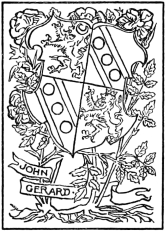
John Gerard died in February, 1612, and was buried at St. Andrew’s, Holborn, on the 18th of that month. There is a fine portrait of Gerard facing page 1 of the Herbal, in which he is represented holding a potato plant in his hand; below are the arms of the Barber-Surgeons and his own coat, viz., quarterly 1st and 4th ar. a lyon rampant erm. crowned or, a crescent for difference (Gerard), 2nd and 3rd ar. three torteaux in bend between two bendlets sa. (Ince). Crest, A lyon’s jamb era. inverted holding a hawk’s lure. Motto, D’assenti buone.
The best account of Gerard may be seen in a privately-printed “Catalogue of Plants cultivated in the Garden of John Gerard and a life of the Author,” by Benjamin D. Jackson, F.L.S. London, 1876.
SIR THOMAS BLUDDER.
Sir Thomas was the son of Sir Thomas Bludder, of Flanchford, in the parish of Reigate (who died 1st November, 1618). He was knighted at Whitehall, 22nd April, 1618, and married three times, his third wife being Elizabeth, daughter of Robert Brett, of Rotherby, Lancashire.
9th August, 1621. At this Court upon the request of Sir Thomas Bludder Knyght who was desierous to be made a freman of this Company It was ordered he shold be made free & so tooke his oath accordingly.
Sir Thomas, who was a Justice of the Peace for Surrey, represented Reigate in the several Parliaments of 21 James I, and 1, 3 and 16 Charles I. He was a Royalist and imprisoned for his adherence to that cause, and died on 29th September, 1655.
A pedigree of the Bludders will be found in Aubrey’s Antiquities of Surrey, IV, 210.
Arms. Gu. a dexter arm embowed or, the hand ppr.
MARTIN BROWNE.
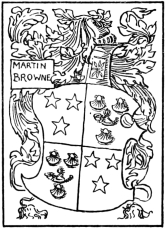
Martin Browne was born about 1590, probably in Lincolnshire; he was apprenticed to Thomas Clemence, a surgeon free of the Company, and on 13th July, 1613, was admitted to the freedom. He seems to have had an extensive practice, and in 1648 was living in Creed Lane. There are numerous references to him in our Minutes, from which may be gathered that he was a man of great experience, and well able to hold his own in some cases where his professional skill had been called in question by jealous brethren of the craft. He served as Warden in 1640 and 1645, and was Master in 1653, when he presented the Company with a loving cup (see p. 502). He died 16th April, 1655, and in his will dated 20th August, 1654, and proved 24th April, 1655, he describes himself as of the parish of St. Gregory, “full of yeares,” and requests to be buried in his parish church near his dead children “which was partly under my owne pewe where now of late I satt.” To the poor of that parish he leaves £10. To the poor of East Tilbury 40s. To the poor of Louth, in Lincolnshire, £10. To his cousin Richard Mason, of Leeyborne, Lincolnshire, £5, and to his son, Richard Mason, testator’s apprentice, £5 and his case of silver instruments, “with fower books of phisick and of Chirurgery namelie Ambrose Parrey and Rondeletius and Aqua Sendens his mannuall operations and Tangaltius and others Authers all bound up in one volumne.” He gives several legacies of money to cousins, nieces, servants, and apprentices, makes his wife Margaret his executrix, and leaves all his lands and houses in the counties of Essex and Lincoln and the City of London to her for life, with remainder to his only child Rebecca, the wife of Humphry Winch, Esquire. “To my cousen Henery Barker all my Instruments of yron for Chirurgerie excepte my Lancetts and incision knives. I likewise give [him] theise bookes namely the workes of Hypocrates, Galen, Celsus, Paulus Agenta, ffernebens Senertus his Chirurgery.”
Arms (as engraved on the loving cup). Quarterly, 1st and 4th three mullets, 2nd and 3rd a hunting horn stringed between three escallops.
EDWARD ARRIS, Alderman.
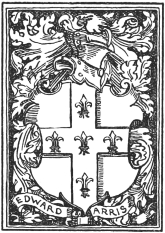
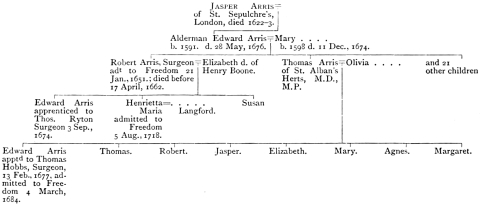
Few names are held in greater veneration at Barbers’ Hall than that of Edward Arris. His father, Jasper Arris, was apprenticed to Thomas Burston or Burstowe, a Surgeon and Master of the Company in 1576. Jasper Arris (probably born 1560–2), was admitted to the freedom, 3rd April, 1583, chosen a Liveryman, 22nd January, 1606, an Assistant, 3rd August, 1614, served as Warden in the years 1617 and 1622, and was reported on 8th January, 1623, as then recently deceased. There are few notices of Jasper in our books, and one of them on 21st October, 1606, is perhaps not much to his credit, as it records his fine for working on the Sabbath day; from which we may gather that he was one of those who, contrary to the Ordinances and the Statute, worked both as a Barber and Surgeon,—a practice often winked at by the Governors. His son Edward, was born in London in 1591, and was admitted to the freedom by patrimony on 21st January, 1617, having learnt his art with his father; he was admitted to the Livery 9th October, 1627, and on 30th April, 1629, granted his diploma to practise Surgery. In 1632, he was chosen Steward, and the next year Master of the Anatomy. On the 23rd April, 1640, he was elected an Assistant and served the office of Warden in 1642. On 10th February, 1648, he was appointed one of the Examiners of Surgeons, and elected Master of the Company 1651. On 3rd July, 1663, Mr. Arris was nominated by the Court of Aldermen, Alderman of the Ward of Bridge Without (loco Richard Evans) and was sworn in on the 28th July following, but this civic office was probably an uncongenial one to him, for he very shortly afterwards applied to be discharged from it, and thereupon paid a fine of £300 to the City.
In 1645 Mr. Arris founded an Anatomy Lecture, and with a characteristic modesty endeavoured to conceal the founder’s name, though his intention in this respect was necessarily frustrated when the deed of settlement had to be drawn. This, the Arrisian Lecture, still survives at the Royal College of Surgeons. (Particulars of the foundation will be found on pp. 368, 369.) In 1649, when our plate was sold, Mr. Arris re-purchased King Henry VIII’s cup, and “freely gave it againe to this Company,” for which all Barber-Surgeons and Barbers have ever after been profoundly grateful to him. He also, in 1651, gave us four silver cups. Mr. Arris’ granddaughter, Henrietta Maria Langford, seems to have got into straitened circumstances, as on 5th August, 1718, we read “It is ordered that Henrietta Maria Langford daughter of Robert Arris son of Alderman Arris Members of this Company, shall be made free without charge, in Gratitude to the Memory of Alderman Arris, in order that she may be admitted one of the Company’s Pentioners.”
The Alderman died 28th May, 1676, at the good old age of eighty-five and is buried in St. Sepulchre’s Church, where there is a quaint tablet with this inscription—
Edward Arris Esqr. gave to the Company of Chirurgeons 30l for an Anatomy Lecture & to the Hospital of St. Bartholomew 24l both yeerly for ever to Christ’s Church Hospital 100l & 50l towards rebuilding of this Church and several large gifts to the poor of this parish wherein he was born. And all these in his life time Hee deceased the 28th of May 1676 aged 85 & lyeth buried by his wife.
Near this place lyeth inter’d the body of Mary Arris ye wife of Edward Arris Esqr. & sometime Alderman of this City. They were married 60 years and had issue 23 Childre whereof only Thomas Arris (Dr. in Physick fellow of the College in London Justice of ye peace in the County of Hartford and a member of the Honble. house of Commons) her survived. Shee died ye ijth of Decr. 1674 aged 76 years.
By his Will, dated 20th May, 1676, he directs his body to be buried in the grave of his father, mother and wife in St. Sepulchre’s, and he bequeathed his property to his then only surviving son Thomas Arris, M.D., M.P., and his children, and to the children of his deceased son Robert. He gave five legacies of £400 each and some smaller ones amongst his grandchildren and an annuity of £30 a year to his grandson Robert. He also bequeathed messuages, lands, &c., at Hatfield, two messuages in Well Yard, St. Bartholomew’s the Less, a messuage near Pye Corner, ten acres of Copyhold land in the manor of Bedwell near Hatfield and four freehold houses in the parish of St. Paul, Covent Garden, to his son and grandchildren. “I give Ten shillings a peece to soe many Antient men as I shall be yeares old att the tyme of my death to mourne in decent Gownes att my Burial whereof Tenn to be of the parish of Little St. Bartholomews Tenn of the Company of Barber Chirurgeons and the rest of the Parish of St. Sepulchres.” He also left £8 to the poor of St. Sepulchre’s to be given to 160 poor at his burial; £5 to the poor of St. Bartholomew the Less; £5 to Christ’s Hospital among 100 children to attend his burial; 20s. each to the two Beadles of the Barber-Surgeons, and 5s. each to the four Beadles of St. Bartholomew’s Hospital; also £5 to Dr. Bell to preach a sermon at his burial.
Arms. Ar. on a cross gu. five fleur de lys or.
Jasper Arris ==
of St. Sepulchre’s, London, died 1622–3.
Alderman Edward Arris == Mary . . . .
b. 1591. d. 28 May, 1676. b. 1598 d. 11 Dec., 1674.
Robert Arris, Surgeon == Elizabeth d. of Thomas Arris == Olivia . . . . and 21 other children
adt to Freedom 21 Jan., 1651.; died before 17 April, 1662. Henry Boone. of St. Alban’s Herts, M.D., M.P.
Edward Arris apprenticed to Thos. Ryton Surgeon 3 Sep.,1674. Henrietta Maria admitted to Freedom 5 Aug., 1718. == . . . . . Langford. Susan
Edward Arris apptd to Thomas Hobbs, Surgeon, 13 Feb., 1677. admitted to Freedom 4 March, 1684. Thomas. Robert. Jasper. Elizabeth. Mary. Agnes. Margaret.
SIR JOHN FREDERICK.
John Frederick was a son of Christopher Frederick, Barber-Surgeon. A minute of the 9th June, 1595, states that “the said Xpõfer ffrederick being a strainger borne had his ffreedom geven him of the Cittie of London by vertue of her Maties most gracious Lrẽs to the Lord maior and Corte of Aldrem̃e directed and was made fre of this Companie and after chosen of the lyvery and then one of Thassistance.”
Christopher Frederick was on more than one occasion at serious variance with the Court, as also with some of its members, and a resolution was passed, evidently with pointed allusion to him, viz., that in future aliens should be ineligible for the Court. He was Serjeant-Surgeon to James I, and probably to Elizabeth also; Master in 1609 and again in 1616. His son William was admitted to the freedom by service 27th October, 1607. Christopher Frederick was buried 10th October, 1623, in the church of St. Olave, Jewry, where also Mary, his widow, was interred on 6th June, 1636. They had issue six sons and six daughters.
John Frederick, the fourth son, was baptized 25th October, 1601, and educated at Christ’s Hospital. On 17th July, 1632 he was admitted to the freedom by patrimony, on the 13th November, 1635 elected to the Livery, and on 30th January, 1645 made an Assistant. He was a successful merchant and resided in a large mansion on the site of what is now Frederick’s Place, Old Jewry (which he rebuilt after the Great Fire in 1666). This house was afterwards used as the Excise Office, upon the removal of which to Broad Street, the building was taken down and the present houses erected. He was elected Alderman of Vintry September, 1653, and in 1660 removed to Coleman Street Ward. He was Master of the Barber-Surgeons in 1654 and again in 1658; he served as Sheriff, 1655–6, and was then knighted. The Barber-Surgeons attended Sir John in their barge to Westminster when he went to be sworn in as Sheriff, and ordered his portrait to be painted at a cost of £15. This fine picture representing the Sheriff in his robes and with a flowing wig, is preserved at Barbers’ Hall. In 1661 Sir John was translated to the Grocers’ Company to enable him to take upon him the office of Lord Mayor, which he served 1661–2. The pageant performed at the expense of the Grocers upon his accession to the Mayoralty was entitled “Londons Tryumphs presented in several delightfull Scænes,” and was composed by John Tatham; a copy of this very rare tract is preserved in the Guildhall Library. Pepys, under date 29th October, 1661, writes—
This day I put on my half cloth black stockings and my new coate of the fashion, which pleases me well, and with my bever I was (after office was done) ready to go to my Lord Mayor’s feast, as we are all invited; but the Sir Williams were both loth to go, because of the crowd, and so none of us went. My mind not pleased because I had proposed a great deal of pleasure to myself this day at Guildhall. This Lord Mayor, it seems, brings up again the custom of Lord Mayors going the day of their instalment to Paul’s and walking round about the Crosse, and offering something at the Altar.
In 1662 Sir John was elected Master of the Grocers’ Company and also President of Christ’s Hospital, which latter office he held until 1683. In the Parliament of 1660 he represented Dartmouth; on the 10th March, 1663, he was elected one of the Members for the City and so continued until the dissolution in January, 1679. In 1674 he gave £100 towards rebuilding Barber-Surgeons’ Hall; he also repaired and fitted up the Great Hall at Christ’s Hospital at a cost of £5,000. In 1664 he bore the expense of bringing the Conduit Water from Gray’s Inn Fields to the Hospital. In 1667 he gave £50 and twenty chaldrons of sea coal, and by his Will bequeathed £500 to the Hospital. In 1654 he gave a handsome silver loving cup and cover weighing about 38 oz. to the Barber-Surgeons; this cup is still used on festive occasions. There is a portrait of Sir John at Christ’s Hospital, which represents him as seated in an arm chair, in his civic robes, with an open letter in his hand, on his head is a full bottomed wig and a black cap, he has white whiskers and a tuft of white hair on his under lip.
In the “Gentleman’s Magazine” for November, 1769, is a copy of a document prepared for Charles II, giving the characters of the Lord Mayor and Aldermen, which says of Sir John Frederick that—
by reason of his age, he is apt to be ledd by others, especially by Sir John Lawrence, a man of little dispatch, very readie to run into mistakes; he hates a souldier, and cannot endure to see any of the King’s guards.
Sir John married Mary Rous by whom he had issue four sons and nine daughters. Judith, his eldest daughter, married Sir Nathaniel Herne (Alderman and Sheriff 1674 and Master of the Barber-Surgeons 1674), who, dying in August, 1679, she married secondly, Robert Hooker, of Hatton Garden. Her Will, dated in 1688, was proved 30th June, 1691.
Sir John Frederick was buried in the Church of St. Olave Jewry 19th March, 1685, where his widow was also interred 19th December, 1689; she bequeathed £300 to Christ’s Hospital. His eldest son Thomas was the father of John Frederick who was created a baronet 10th June, 1723. Sir John gave marriage portions of £3,000 apiece to his daughters Judith and Elizabeth, who married respectively Sir Nathaniel Herne and Sir Joseph Herne, and he covenanted to give £2,000 apiece more either in his lifetime or by will; it seems that he did this by will, which led to litigation, his relict (to whom he left about £10,000) laying claim to some portion of these legacies by the custom of London.
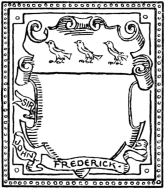
Arms (granted by Sir Ed. Walker, Garter, 22nd October, 1661). Or on a chief gu. three doves ar. beaked gu. legged or.
Crest. On a cap of dignity az. turned up ermine, a dove ppr. holding a laurel branch vert.
SIR NATHANIEL HERNE.
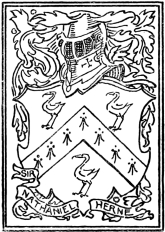
Sir Nathaniel Herne was the son of Nicholas and grandson of Richard Herne (Alderman and Sheriff in 1618). He was born in 1629 and in 1646 apprenticed at Barber-Surgeons’ Hall to Sir John Frederick, one of the merchant-princes of London at that time. Herne was admitted to the freedom on 7th May, 1655, and, like the typical industrious apprentice, he married his master’s daughter, Judith Frederick, by whom he had (among others) a daughter Judith who married William, second Earl of Jersey, and thereby was one of the ancestors of the present Earl. Sir Nathaniel Herne was a most successful merchant and amassed a large fortune. In 1674 he was Sheriff of London (being knighted at Windsor on the 9th August) and Master of this Company. On the 11th April, 1676, he was elected Alderman of the Ward of Billingsgate. He was sometime M.P. for Dartmouth, and a Governor of the East India Company. He died 16th August, 1679, being then fifty years of age and was buried at St. Olave Jewry, where there is a monument to his memory, with his arms impaling Frederick, and this inscription:—
M S.
Here lyeth in hopes of a Glorious Resurrection the body of Sr Nathaniel Herne Knight late Sherife And at his death Alderman of this Famous Citty and Governour of the Honourable East India Company, Son to Nicholas and Grandson to Richard Herne sometimes Alderman allso of this Citty A Person of great Prudence and Indefatigable Industry in the Management of all Publick Affairs, of Exemplary Piety, Spotless Integrity and Diffusive Charity having with his owne hand dispenced very considerable summes to many Charitable uses Particularly to the reliefe of poore Seamen & Educating of their Children. He tooke to wife Judith Eldest Daughter of Sr John Frederick Knight Alderman and sometimes Lord Mayor of London, his now sorrowfull Widdow by whome he had divers Children and left three hopefull Sons surviving vizt Frederick, Nathaniel, and Thomas, to whose and to this Cittyes & Nations great loss as allso to ye griefe of all them that knew him He departed this Life ye 16th August, 1679 Ætat 50.
Sir Nathaniel by his Will dated 12th April, 1677, left a large property between his wife and children, and legacies to Sir John and Lady Frederick, Ephraim Skinner and numerous other friends and relatives.
Arms. Sa. a chev. erm. between three Herons ar.
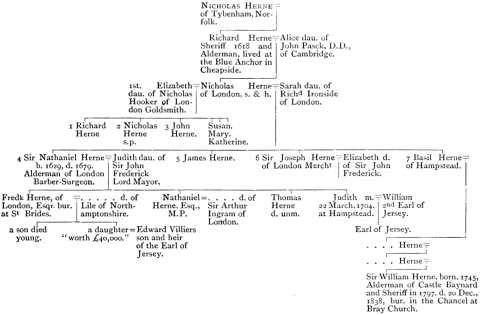
Nicholas Herne ==
of Tybenham, Norfolk.
Richard Herne == Alice dau. of
Sheriff 1618 and Alderman, lived at the Blue Anchor in Cheapside. John Pasck, D.D., of Cambridge.
1st. Elizabeth == Nicholas Herne == Sarah dau. of
dau. of Nicholas Hooker of London Goldsmith. of London, s. & h. Richd Ironside of London.
1 Richard Herne 2 Nicholas Herne s.p. 3 John Herne. Susan. Mary. Katherine.
4 Sir Nathaniel Herne == Judith dau. 5 James Herne. 6 Sir Joseph Herne == Elizabeth d. 7 Basil Herne ==
b. 1629, d. 1679. Alderman of London Barber-Surgeon. of Sir John Frederick Lord Mayor. of London Mercht of Sir John Frederick. of Hampstead.
Fredk Herne, of == . . . . d. of Lile Nathaniel == . . . . d. of Thomas Herne d. unm. Judith m. == William
London, Esqr. bur. at St Brides. of Northamptonshire. Herne, Esq., M.P. Sir Arthur Ingram of London. 22 March, 1704, at Hampstead. 2nd Earl of Jersey.
a son died young. a daughter == Edward Villiers Earl of Jersey. . . . . Herne ==
“worth £40,000.” son and heir of the Earl of Jersey.
. . . . Herne ==
Sir William Herne, born, 1745, Alderman of Castle Baynard and Sheriff in 1797. d. 20 Dec., 1838, bur. in the Chancel at Bray Church.
SIR JOHN LETHIEULLIER.
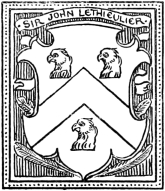
Sir John Lethieullier, who was born in 1633, was descended from the Le Thieulliers, an old Protestant family in the Low Countries; his great grandfather John was burnt at Valenciennes for his religion by the infamous Duke D’Alva. His grandfather John was a merchant at Cologne and died there in 1593. His widow survived him thirty-eight years and came over to England in 1605 with her only son John, who was born in 1591. In 1620 he was established as a Merchant in London, but on the breaking out of the Civil Wars he went over to Amsterdam and returned to England at the Restoration; he lived at Lewisham, where he died on 2nd November, 1679, having married Jane, daughter of John de la Fortre, of London, by whom he had five sons and three daughters. His eldest son, Sir John Lethieullier, was apprenticed to Sir John Frederick (Barber-Surgeon) and admitted to the freedom by servitude 11th November, 1657. He served the office of Master in 1676, having been Sheriff of London in 1674. He was a successful merchant and a rich man, having a great fortune by his wife Anne, daughter of Sir William Hooker, who was Lord Mayor in 1673. Sir John was a free brother of the Company of Merchant Adventurers of England, and of the Society of Merchants of London Trading to the Levant Seas and the East Indies. His third brother, Sir Christopher Lethieullier was Sheriff of London, 1689, and died 1690. On the 20th November, 1707, Sir John wrote to the Court asking to be relieved from the office of an Assistant on account of his indisposition and age (he was then 74), but the Court, out of a feeling of respect towards him, refused to accept his resignation, and ordered that the Wardens should have a personal interview with him to know his pleasure. This was done, and on the 15th January following his resignation was accepted. Sir John, who resided at Greenwich, died there on the 4th January, 1719, having had two sons, John and William (both of whom were free of the Company), and three daughters.
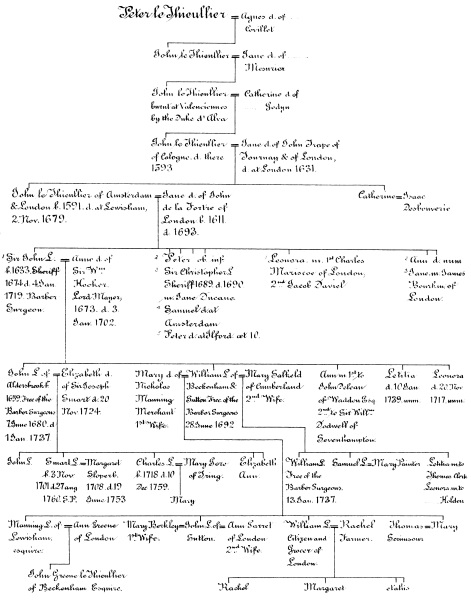
Sir John Lethieullier’s will, of prodigious length, is dated 6th May, 1709, and he therein directs that he shall be buried in the vault in Greenwich Church with his late wife. To his two daughters, Letitia and Leonora he gave £10,200 each, and to his married daughter, Lady Ann Dodwell, whom he had previously provided for, £1,000. To all his grandchildren £100 each. To Christ’s and St. Thomas’ Hospitals and to the French Congregation in Threadneedle Street £100 each, numerous gifts to the poor in various parishes, and bequests to friends, relatives and servants for mourning and rings. All his lands and houses in the City of London (except two) and in the county of Essex to his son John. Two houses on College Hill, late in the occupation of Sir Henry Furnese and Sir Alexander Cairnes, to his two daughters, also his house and land at Lewisham, his best coach and chariot horses, live stock, &c. All his other freeholds and houses in Beckenham, Lewisham and Battersea, his lands at Dartford and his manor of Sutton at Hone and Wilmington to his son William. There are four codicils to this Will and by one of them (19th July, 1714) he gave the manor of Rowhill, which he had then lately purchased to his son William. His two sons were appointed executors.
Arms. Ar. a chev. gu. betw. three parrots’ heads couped vert. beaked of the second.
EPHRAIM SKINNER.
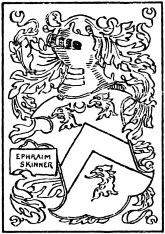
Ephraim Skinner was born at Barnstaple 30th November, 1637. In 1652 he was apprenticed to Sir John Frederick, and afterwards became a wealthy Merchant trading with Spain. He was sometime the British Consul at Livorne. On 25th April, 1665, he was admitted to the freedom of the Barber-Surgeons, and in 1673 gave us the chimney piece in the Court Room, where there is a three-quarter portrait of him in his livery gown, with full wig and rich lace bands; on the portrait is this inscription: “Mr Ephraim Skiner Marcht. & one of ye Assistants of this Compy: of Barbersurgeons Lond: gave ym besides other gifts 300£ for 20 years.”
By his Will, dated 27th December, 1677, he gave to the Governors of Christ’s Hospital (of which he was a member) five acres of pasture in Islington, also £700 in trust for them to lend the Barber-Surgeons £300 for 20 years without interest to help them to pay their debts, and also for a payment of 5s. a week to the Minister of Islington for him to expound and “chatecize” every Sunday afternoon and to pay £5 a year to the poor of Islington, to whom he also bequeathed a sum of £50. To the poor of the Old Jewry £50. To the poor of Barnstaple £200. To the rebuilding of St. Paul’s £50. To his father-in-law Peter Rowe £25 per annum for life. To several members of the Barber-Surgeons, including Sir J. Frederick, Sir N. Herne, Sir J. Lethieullier and their children £10 each, and numerous legacies of money to friends and relations. The residue of his Estate to his wife.
On the south wall of St. Olave Jewry is a tablet to his memory;
Neer this Place Lyeth the body of Ephraim Skinner Merchant Sometimes his Majesties Consul at Livorne Whose
ExemplaryPiety Towards God

Integrity towards Man
Charity to the Poore
Humility towards all
Made himLive desiredby all that knew him


Die Lamented
He was born in the Town of Barnstable In Devon on St Andrews Day. Ann. MDCXXXVII Died at Islington May VIt MDCLXXVIII in the XLI yeare of his Age A kind Husband to Ann: his Consort who in memory of him erected this Monument but now caused his Body to be removed hence to the Parish Church of Great St Hellen’s and layd in the Vault of Robart Foot Esqr her present Husband January 1712.
Arms. Sa. a chev. or. betw. three gryffins’ heads era. ar. a crescent for difference.
SIR HUMPHRY EDWIN.
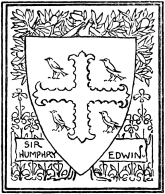
Sir Humphry Edwin, descended from an old Herefordshire family, was born at Hereford in 1642. He was the only son of William Edwin (sometime Mayor of Hereford) by his wife Anne Mansfield, and grandson of William Edwin of the Field next Hereford. One of his sisters (Mary) was married to Sir Edward Dering. He married Elizabeth, daughter of Samuel Sambrooke, a London merchant, and a sister of Sir Jeremy Sambrooke; by her he had four sons, born between 1671 and 1677, viz., Samuel, Humphry, Thomas and Charles.
On the 3rd February, 1679, he was admitted to our freedom; on 11th October, 1687, he was sworn in Alderman of Tower Ward on the direct appointment of James II; on the 18th November following he was knighted at Whitehall, and a few weeks later appointed Sheriff of Glamorganshire, in which county he had purchased considerable estates. In 1688 Edwin was chosen Sheriff of London and Master of the Barber-Surgeons. In 1689 he took official part in the Proclamation of William and Mary in the City, and shortly after was appointed a Commissioner of Excise with a salary of £1,000; he was also an officer in the Honourable Artillery Company, and a Colonel of the Trained Bands.
In 1691 Edwin was the victim of a malicious prosecution; he was indicted for perjury, and a true bill found against him, but on his trial was acquitted, Lord Chief Justice Holt not calling on him to swear all his witnesses. Sir Humphry owned extensive property near Westminster Hall, he also had a mansion at Kensington, and added to his Glamorganshire property the castle and lordship of Ogmore. In 1697 his eldest son Samuel was married to Lady Catharine Montagu, daughter of the Earl of Manchester, and the same year Sir Humphry was elected Lord Mayor of London, having been previously translated from the Barber-Surgeons to the Skinners’ Company. The customary mayoralty pageant was omitted, owing, doubtless, to Edwin’s religious scruples, he being a Nonconformist. Soon after his admission as Lord Mayor, he gave great offence by attending Nonconformist worship at a conventicle on the afternoons of Sunday, 31st October and 7th November, in full civic state. A meeting of the Court of Aldermen was held 9th November to consider a complaint of the Swordbearer against the Lord Mayor, for compelling his attendance on the occasion when the Lord Mayor was deserted by all his officers except the Swordbearer, whom one of the chapel officials had locked in a pew! According to the minute, the Court took notice that the Lord Mayor had “for two Lords dayes past in the afternoones gone to private meetings with the sword,” whereupon his Lordship promised to forbear the practice for the future. Edwin’s action roused all the bitterness of the High Church party and caused an angry literary controversy in which Dr. Nicholls, James Peirce, Calamy and Defoe joined, and in which the question of “occasional conformity” was raised. Edwin had on his election received the Sacrament in accordance with the rites of the Church of England, and his friend Defoe took him very severely to task for this, charging him with having “played bo-peep with God Almighty.”
On the 19th April, 1694, Sir Humphry Edwin was dismissed from the Court of Assistants of our Company on account of his continued non-attendance. He died 14th December, 1707, at his country seat at Llanmihangel, intestate, administration being granted to his son Charles on 19th February following. His widow died in London 22nd November, 1714. Besides the children already mentioned he had four daughters and a fifth son John, from whom is descended the present Earl of Crawford and Balcarres.
Arms. Ar. a cross flory engr. betw. four Cornish choughs sa.
SIR WILLIAM STEWART.
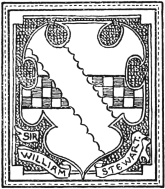
Sir William Stewart was admitted to the freedom 22nd July, 1686, by redemption. In 1706 he was one of the Directors of the East India Company. On 31st July, 1711, he was elected Alderman of Cripplegate, and the following year was knighted.
21st July, 1720. The Master acquainted the Court That Sr William Stewart Knt and Alderman of the City of London a Freeman of this Company being the Senior Alderman under the Chair of this City except one Did make it his request to this Court That he might be translated from this Company to the Company of Goldsmiths forasmuch as it was required by the Custom of London That he should be free of one of the first twelve Companys of this City before he could be put in elecc͠on to be Lord Mayor.
Sir William was Lord Mayor for the year 1721–2, and died at his house in Mark Lane, 29th April, 1723. His corpse was carried, preceded by a hundred boys of Christ’s Hospital and fifty boys belonging to the London Workhouse, each with a wax taper in his hand, and was interred at Guildhall Chapel 7th May following.