THE VEKPLANCK HOMESTEAD, FISHKILL, N.Y.
Reading edition
The Old Verplanck Homestead at Fishkill, Hudson River, in which the Society of the Cincinnati originated.
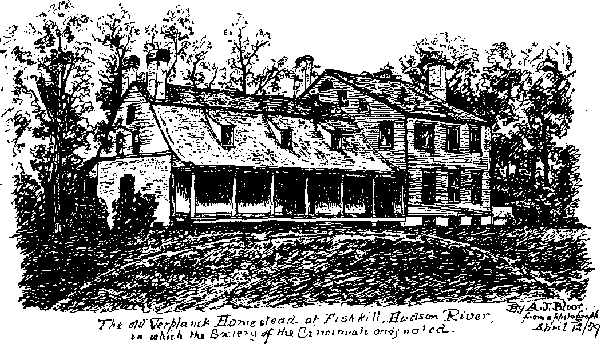
The Verplanck homestead stands on the lands granted by the Wappinger Indians, in 1683, to Gulian Verplanck and Francis Rombout, under a license given by Governor Thomas Dongan Commander-in-Chief of the Province of New York, and confirmed, in 1685, by letters patent from King-James the II. The purchase included "all that Tract or Parcell of land Scituate on the East side of Hudson's river, beginning from the South side of a Creek called the fresh Kill and by the Indians Matteawan, and from thence Northward along said Hudson's river five hundred Rodd beyond the Great Wappin's Kill, and from thence into the woods fouer Houres goeing"; or, in our speech, easterly sixteen English miles. There were eighty-five thousand acres in this grant, and the "Schedull or Perticuler" of money and goods given to the natives, in exchange, by ffrancis Rumbout and Gulyne Ver Planke sounds oddly to-day:
One hundred Royalls,
One hundred Pound Powder,
Two hundred fathom of white Wampum,
One hundred Barrs of lead,
One hundred fathom of black Wampum,
Thirty tobacco boxes, ten holl adzes,
Thirty Gunns, twenty Blankets,
Forty fathom of Duffils,
Twenty fathom of stroudwater Cloth,
Thirty Kittles, forty Hatchets,
Forty Hornes, forty Shirts,
Forty pair stockins,
Twelve coates of B.C.,
Ten drawing Knives,
Forty earthen Juggs,
Forty Bottles, Fouer ankers Rum,
Forty Knives, ten halfe Vatts Beere,
Two hundred tobacco pipes,
Eighty pound tobacco.
The purchasers were also to pay Governor Dongan six bushels of good and merchantable winter wheat every year. The deed is recorded at Albany in Vol. 5 of the Book of Patents.
Before 1685 Gulian Verplanck died, leaving minor children, and settlements on his portion of the land were thus postponed. Divisions of the estate were made in 1708, in 1722, and again in 1740. It is not accurately known when the Homestead, the present low Dutch farm-house was built, but we know that it stood where it now stands, before the Revolutionary War, and the date commonly assigned to the building is a little before 1740.
The house stands on a bluff overlooking the Hudson, about a mile and one-half north of Fishkill Landing. It is one-story and one-half high, of stone, plastered. The gambrel roof is shingled, descends low and has dormer windows. The house has always been occupied and is in excellent preservation. Baron Steuben chose it for his headquarters, no doubt for its nearness to Washington's headquarters across the river, and for the beauty and charm of the situation. It is made still further famous by the fact that under its roof was organized in 1783 the Society of the Cincinnati. The room then used is on the right of the hall, and is carefully preserved. In fancy we can picture the assembly of officers grouped about Washington, in that west room overlooking the river, pledging themselves to preserve the memories of the years during which they had struggled for their country's being.
The whole neighborhood, especially the village of Fishkill which was the principal settlement in the county at that date, has many revolutionary associations. The interior army route to Boston passed through the village; this was a depot of army stores, and workshops and hospitals were established. Here was forged the sword of Washington, now in the keeping of the United States Government, and exhibited in the late Centennial collection. It is marked with the maker's name, J. Bailey, Fishkill.
The New York Legislature, retiring before the approach of the British, after the evacuation of the city, came at last to Fishkill, and here the constitution of the State was printed, in 1777, on the press of Samuel Loundon, the first book, Lossing says, ever printed in the State.
Some years after peace was restored, the Verplanck family appear to have occupied the Homestead from time to time. Philip Verplanck, a grandson of Gulian the original grantee, was a native of the patent, but his public life was spent elsewhere. He was an engineer and surveyor, and an able man. Verplanck's Point in Westchester County, where Fort Lafayette stood during the Revolution, was named for him, and he represented that Manor in the Colonial Assembly from 1734 to 1768. Finally, Daniel Crommelin Verplanck with his large family—one of his sons being the well-known Gulian C. Verplanck, born here in 1786—came to live in the old home permanently. He had led an active life in New York, served in Congress and on the bench, and now retired to the quiet of the country. It was he who planted the fine old trees which now shade the lawn; among them the coffee-tree so much admired. About 1810 the north end, built of wood, was added to the old house. Architects were not numerous, apparently, in those days, so the Dutch type was lost in making this large addition, though the interior is quaint, dignified and interesting. It was from under its roof that Daniel C. Verplanck was carried to his last resting-place as his father before him, and generations after him lived and still live in the old Homestead.
For the above description, prepared with no little painstaking, of an interesting house and demesne, as well as for the loan of the photograph from which I made my pen-and-ink sketch of it, I am wholly indebted to a member of the Verplanck family and a mutual friend.
A.J. BLOOR.
ROCK UPHEAVAL CAUSED BY HYDRAULIC PRESSURE.—There was a remarkable occurrence at the mills of the Combined Locks Paper Company at Combined Locks, Wis., on Saturday. From some unknown cause there was an upheaval of rock upon which the mills are located, throwing the mill walls out of place, cracking a great wall of stone and cement twenty feet thick and making a saddle-back several hundred feet long and six inches high in the bed rock beneath the mill. An artesian well two hundred feet away on the bluff has dried up. The damage to the mill and machinery will probably amount to several thousand dollars. The upheaval is supposed to have resulted from some hydraulic pressure between the seams of rock beneath. A panic occurred among the mill operatives at the time of the shake-up, but nobody was hurt in the stampede from the mill.—Boston Transcript, September 10.