METHODS OF REDUCING THE FIRE LOSS.[6]
Reading edition
METHODS OF REDUCING THE FIRE LOSS.[6]
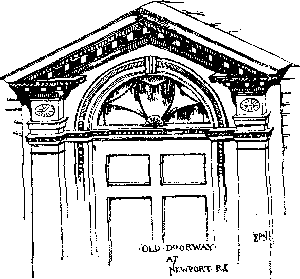
OLD DOORWAY AT NEWPORT R.I.
The liability to injury by fire is a hazard inherent to all buildings, and this danger is a constant menace whose threatening destruction of values imposes upon the owner a persistent consideration, which endures as long as the building stands.
As every method of construction, the various mechanical processes and the stock in each stage of manufacture bears some relation to the fire-hazard as a supporter or possible originator of combustion, the engineer whose duties pertain to these matters must necessarily also consider the question of the fire-hazard in the important phase of prevention, as well as the direct application of those engineering problems required in the design and installation of fire apparatus.
The fire-loss is a most oppressive tax, much of which can be abated by the application of well-established means of prevention. In a practical sense, certain fires are to be considered as unpreventable, being caused by exposure to fires in other burning buildings, but there are very few fires whose destructive results might not have been prevented by the exercise of precautions entirely feasible in their nature.
These several topics will be considered in reference to the reduction of the fire-loss on isolated manufacturing property, because the exercise of every possible precaution may not avail anything if the property is liable to be imperilled by fires originating in adjacent buildings.
SUPERVISION.
The prevention of fires must in greater measure proceed from the efficiency of the supervision exercised over the property in the order of the buildings, heed to probable causes of fire, and attention to the fire-apparatus.
In a manufactory there is a wide distinction to be made between to-day's dirt and yesterday's dirt; valuable results may be obtained by an inspection of the whole property made on Saturday afternoon by two men, such as foremen or overseers of rooms, who may be appointed to serve four weeks, their assignment terminating on alternate fortnights. The report should be made on a sheet of paper, divided so as to include all features of order and fire-apparatus in every room.
As property should be watched during the day Sunday, as well as at night, it is under the care of watchmen about five-eighths of the time, and the measure of this responsibility should be clearly understood.
The patrol should be recorded on a watchman's clock, not merely to show that he was not unfaithful, but also to prove that he was faithful.
Especially in districts liable to disorder and lawlessness, it is desirable to have a district-messenger signal-box in the works, visited once an hour, with the understanding that if the call is not made within fifteen minutes of the appointed time, it will be assumed that there is trouble and help sent at once.
Safety requires that the lanterns should be securely guarded; that the handle and sustaining parts of the lantern be connected together by rivets or by locking the metals together without relying on soldered joints; and thirdly, that the lamp should be put in from above, and never from the bottom.
CONSTRUCTION.
In its design, a mill for any standard line of manufacture is not a building whose arrangements and proportions are fixed upon at the whim of the owner, but it must conform to certain conditions of dimensions, stability, light and application of power to satisfy the requirements essential for furnishing every advantage necessary for producing the desired results at the lowest cost.
The destructive consequences attending fire in such buildings, whose iron and masonry construction is called fireproof, show that some other form of construction is necessary to obtain the desired results of minimizing the annual cost of the maintenance of the invested capital, as represented by insurance, depreciation, interest and taxation. There is little incentive for entering into unusual expenses in the construction of a manufacturing building for the purpose of increasing its resistance to fire, unless the additional interest on such increase in the investment is to be met by a corresponding reduction in the annual cost of the fire-hazard. In addition to these questions, involving the annual maintenance of the plant, the increase in the expense of the building above a certain point may prove poor management, by locking up capital for too long a time, and may tend to prevent the improvements in arrangement and construction which are necessary for the most advantageous manufacturing.
The method of mill building known as slow-burning construction combines the advantages of low initial cost and great resistance to destruction by fire, the final result being that the manufacturing is housed at the minimum annual cost. The fundamental principle of such construction is to mass the material in such a way that there shall not be any concealed spaces about the structure, and that the number of projections of timbers, which are more easily ignited than the flat surfaces, shall be reduced as far as possible; that iron portions of the structure shall not be exposed to the heat of any fire in the contents of the building, and furthermore, that the isolation of the various portions, both in respect to that of one building to another and of the various rooms and stories of the same building, shall be as complete as is feasible.
The most important feature is that of the mill floors, which should be laid on beams, generally of Southern pine, 12 x 14 inches, or two inches larger when required by unusual loads or longer span than twenty-two feet. These beams are placed from eight to ten feet apart between centres.
At the columns, beams rest on cast-iron caps.
The support from one column to the next should be made by cast-iron pintles, preferably those whose section is in the form of a Greek cross, as that presents advantages in the way of securely joining them to the timber beams. At the top of the pintle, a cast-iron plate should support the base of the column above.
Timber columns are preferred to those of iron, unless the load is greater than can be sustained by timber.
The floor planks for this type of floor are generally made of spruce plank from three to four inches in thickness, grooved on both edges and joined together by hardwood splines. These floor-planks should be two bays in length, breaking joints at least every four feet.
Above this the top floor, of 1-1/4 or 1-1/2 inch hardwood, is laid, and in some instances the resistance of the floor to fire is greatly increased by laying a coat of plaster on the floor-plank before the top flooring is built. But the general method of increasing the resistance of the floor to fire is by covering the floor and beams on the under side with plaster laid on wire-lathing.
Such a mill floor and columns, while possessing in a very high degree features which offer resistance to the fire, being weakened by the temperature only to a slight extent as they are slowly burned away under the exposure to a very severe fire, also possess the merit of great economy, both as regards the low price of construction, and in that the floor is thinner in comparison with joisted floors of equal strength, saving in this respect, for every floor in a building, about ten inches in height of wall, stairs, belting, steam-pipes, and all vertical connections reaching from floor to floor, a saving which amounts to considerable in the total cost of a building.
The division of mills into various portions by means of fire-walls is frequently not so efficient as assumed, by reason of the lack of fire-doors to satisfactorily fulfil the purpose of resisting fire. The best form of fire-door is that made of two thicknesses of matched boards, placed at right angles to each other and nailed together, being covered on the outside with tin, securely locked together and held to the door by numerous hanging-strips. The door should be secured to the hangers by means of bolts, and not screws, and the rail upon which it runs strongly bolted to the wall. When closed, such a door should fit into a jamb and be securely held in this manner against the wall. Such doors are frequently hung upon an inclined track, and, by some application of highly fusible solder at the catch, are so arranged that they will be closed by the heat of a fire, if not closed by hand.
In this treatment of the arrangement of buildings to resist fire, consideration has not been given to the cost of land, which is, of itself, an important factor in determining what arrangement will be the most expedient for an establishment. Where land is expensive, or there are limitations in the space suitable for building, it is frequently necessary to build mills and shops higher than would be warranted by good judgment under other conditions; but where circumstances will permit it, the one-story mill has been very successful, not merely in immunity from fire, and very low cost per square foot of floor, but also in the advantages of manufacturing, particularly in regard to cost of supervision and movement of the stock in process of manufacture. These are questions which must be determined, not merely in regard to the various processes of manufacture, but the individual needs of each concern; the position of the fire-risk in the matter being that the hazard of a building increases very rapidly with its height, and to some extent with its area.
The extension of one-story buildings over too large an area will not be commended, and certainly, as regards the question of fire, it has a tendency to place too large a property in direct exposure to a very wide hazard.
Some textile mills have been built in the form of the block letter U, this form having been decided upon as giving the conditions of lowest resultant cost. One wing, two stories in height, contains weaving; the other wing, three stories in height, contains carding and spinning, while the engine is placed in the connecting building. The pickers and the boilers are in outside buildings, so placed that they will not interfere with future extensions of the building into the form of the block letter H.
FIRE APPARATUS.
All methods for the prevention of fires fall so far short of the ideal of immunity that there is a necessity for fire-apparatus. The principle of the defence of a manufactory against fire is that of self-protection, by making the installation and management of the fire-apparatus equal to the progress of any fire which can possibly occur.
Fire-apparatus should be kept in service as well as in order. It is no exception to any other machinery, in that practice is essential to obtain any efficient results.
The practical results of private fire-organizations, where fire has occurred, have been very marked; and systematic and skilful work has been the rule, in place of the needless confusion and liability to breakage of the apparatus, which almost inevitably occurs in the lack of such organization.
The details differ with the arrangements and administration of every mill; but the general policy of definitely assigning persons to the positions for which they are best adapted, and where it is presumed they could be most useful, and to practice them in such work, is a rule which is common to all.
A great deal of fire-apparatus is destroyed by freezing water during the winter months, and therefore a special inspection of all such apparatus should be made late in the autumn, when the water should be drained from all portions of the system where there is liability of freezing, and all hydrants and valves should be well oiled, preferably with mineral oil. The hazard from a hydrant or other portion of the apparatus broken by frost, does not lie so much in the probability that disadvantage may result from the disuse of one element of the plant, as in the liability that such a breakage may interfere with the whole system and render it inoperative.
Buckets of water are the most effective fire-apparatus. They should be kept full, and distributed in liberal profusion in the various rooms of a mill, being placed on shelves or hung on hooks, as circumstances may require. In order to assist in keeping them for fire purposes only, they should be unlike other pails used about the premises, and in some instances each pail and the wall or column behind its position bears the same number.
Automatic-sprinklers have proved to be a most valuable form of fire-apparatus in operating with great efficiency at fires where their action was unaided by other fire-apparatus, particularly at night. In mill fires the average loss for an experience of twelve years shows that in those fires where automatic-sprinklers formed a part of the apparatus operating upon the fire, the average loss amounted to only one-nineteenth of the average of all other losses. If the difference between these two averages represents the amount saved by the operation of automatic-sprinklers, then the total damage from the number of fires to which automatic-sprinklers are accredited, as forming a portion of the apparatus, has been reduced six and a quarter million dollars by the operation of this valuable device.
Although there have been numerous patents granted to inventors of automatic-sprinklers since the early part of the present century, yet their practical use and introduction has been subsequent to the invention of the sealed automatic-sprinkler by Henry S. Parmelee of New Haven, Ct., about twelve years ago. This device being the first, and for many years the only automatic-sprinkler manufactured and sold, and actually performing service over accidental fires, to him belongs the distinction of being the pioneer, and practically the originator, of the vast work done by automatic-sprinklers in reducing destruction of property by fire.
Although nearly or quite 200,000 Parmelee automatic-sprinklers have been installed, their manufacture has been supplanted by other forms; and the total number of automatic-sprinklers in position at the present time must be about 2,000,000.
When automatic-sprinklers were first introduced there were many apprehensions that leakage, and also excessive water discharged upon small fires, would be sources of damage. In England this opinion found expression in increased insurance rates in buildings where automatic-sprinklers were installed.
The logic of figures shows that this liability to damage is merely nominal in the case of well-constructed sprinklers. An association of underwriters who have given careful attention to the subject obtained the facts that from the automatic-sprinklers installed in some $500,000,000 worth of property insured by them, the average damage from all causes, except fire, was $2.56 per plant per annum.
Although automatic-sprinklers have proved to be so reliable and effective, yet, in order to provide for all possible contingencies, their introduction should not displace other forms of fire-apparatus, particularly stand-pipes in the stairway towers, with hydrants at each story. The hose at these hydrants should be festooned on a row of pins, or doubled on some of the reels made especially for such purposes. Stand-pipes are not recommended to be placed in rooms or on fire-escapes; and inside hydrants should not be attached to the vertical pipes supplying automatic-sprinklers.
Fire-pumps are generally too small for the work required of them, 500 gallons per minute being the minimum capacity recommended. For a five-story mill there should be an allowance of 250 gallons per minute for an effective stream through a 1-1/8-inch nozzle, and for lower buildings the estimate should rarely be less than 200 gallons for each stream.
Contrary to the general assumption, a ring nozzle is not so efficient as a smooth nozzle, the relative amount of discharge of ring and smooth nozzles of the same diameter being as three is to four. For stand-pipes 7/8-inch nozzles are recommended, but for yard hydrant service the diameter should never be less than one inch, and 1-1/8 inches generally fulfils the conditions of best service.
The yard hydrants should be placed at a distance of fifty feet from buildings, and covered with a house which should also contain hose, axes, bars, nozzles and spanners.
Water-mains about a mill-yard should be of ample capacity not to cause an excessive loss by friction, their diameter being based upon a limit of velocity of ten feet per second for the maximum delivery.
RESULTS.
These methods of supervision, building and equipment do not refer to any ideality, but to measures which have been widely carried into effect for the purpose of reducing the fire-loss; the result of such action being to diminish the cost of insuring industrial property engaged in such normally hazardous processes as textile manufacture and other industries, down to a yearly cost of less than one-fifth of one per cent. This has been accomplished by the consideration of sources of danger and their abatement, and by a course which has been in line with sound engineering principles, and also practical methods of manufacture; and it has thus been proved that it is cheaper to prevent a fire than to sustain a loss.
There has been no attempt made to credit individuals with their share in these features of mill development. They have been the outgrowth of a continual profiting by experience, adopting some features and modifying others. The concurrent action of the large number of minds engaged on the same problem has led to duplication of methods; but the whole progress has been a matter of slow, steady growth, advancing by hairs' breadths, as the result of persistent efforts to adapt means to ends in the endeavor to reduce the cost of manufacture.
FOOTNOTES:

THE NEWARK ARCHITECTURAL SKETCH-CLUB.
After a preliminary meeting held for permanent organization December 14, 1889, a constitution and by-laws were adopted, and the following officers elected: President, W. Frank Bowers; Vice-President, J.C. Swinnerton; Secretary, H.A. Hickok; Treasurer, W.C. Hudson. The Executive Committee consists of F.S. Sutton, A.E. Hudson, W.G. Smith, L.A. Virtue and E.K. Taylor, together with the officers. It is intended, in addition to the usual monthly competitions, to make a special feature of regular class-work throughout the year, this will consist of courses in constructional work, free-hand drawing, water-color work, plumbing, architectural history, etc. The courses will be under the direction of specialists in the various branches who are club-members. Applications for membership will be received by the Secretary, whose address is 762 Broad Street, Newark. The Club expect to have permanent quarters soon, which will be open every evening to members.

[The editors cannot pay attention to demands of correspondents who forget to give their names and addresses as guaranty of good faith; nor do they hold themselves responsible for opinions expressed by their correspondents.]
AGREEMENT BETWEEN ARCHITECT AND CLIENT.
ALBANY, N.Y., December 26, 1889.
TO THE EDITORS OF THE AMERICAN ARCHITECT:
Dear Sirs,—As the services which an architect is supposed to render his client and the compensation for same have been the subject of considerable loss to us through misunderstanding, we have prepared for use the enclosed proposition, which covers most cases in our general practice. In work of such a nature as can't be covered by this proposition, we prepare one specially suited to the occasion, but in all cases insist on a written agreement which we consider is fair to both parties. Should you see in this proposition anything of benefit to the profession, you are at liberty to use same.
Yours truly, FULLER & WHEELER.
OFFICE OF FULLER & WHEELER, ARCHITECTS, No. 86 STATE STREET, ALBANY, N.Y., —— 189 .
PROPOSITION.
Mr.——
We will prepare for you the Preliminary Sketches, General Drawings, Details and Specifications for proposed——
to be erected at——
for 3-1/2 per cent on the actual cost of same, which is to be determined by the amount of Mason, Carpenter, Roofer, Plumber, Stone-cutting, Heating, Ventilating, Iron-workers, Mantel and Elevator Contracts, including all extras and deductions. In connection with Heating, Ventilating and Elevator, we will either select the apparatus and approve the specifications as submitted by the dealers, or prepare plans and specifications for contractors to estimate on, according to the character of the work in contemplation, and as in our judgment will secure the best advantage to you. The cost of hardware, mantel facings, hearths, back linings, metal bands, electric work and decorations are also to be included in the total cost of said building, but we are not required to perform more than our customary work in connection with the last mentioned items, which is either to select them from manufacturers' stock or have submitted to us samples, sketches and specifications from which a selection is made. Any other work, not mentioned above, that we may be called upon to perform will be charged for at the same rates.
SUPERVISION.
We agree to professionally supervise work constructed from our plans, for an additional 1-1/2 per cent, or 5 per cent in all, where the work is in the city, and inspect work out of city at the same rate per cent, visits not to exceed 2 per month. In any case where a Clerk-of-Works is required, either on account of the magnitude of the job, or the inefficiency or carelessness of the contractors, the cost of same is to be paid by you in addition to our compensation for supervision or inspection, and said Clerk is to be approved by us.
We do not agree to be responsible for the acts of the Clerk-of-Works, or for the negligence or violations of contracts by the contractors any further than we can reasonably detect at the time of our visits of supervision or inspection; but such negligence or violations of contracts, as we detect, we will have corrected, so far as the power vested in us will permit and as speedily as possible.
You are at all times to consult with us about desired changes or additions to the work; to order all such changes through us; and to notify us in regard to any work done or material used that you consider is a violation of the contract.
No allowance from our percentage will be made for drawings contracted for and not furnished, except upon a refusal by us to furnish such as may be necessary.
The supervision and inspection contemplated by this agreement, is such as is calculated to and ordinarily will secure the furnishing of materials of the kind and quality required by the contract, and the performance of the work in accordance with the plans and specifications, and in a good, workmanlike and substantial manner.
CERTIFICATES.
Where the work is under our supervision, or inspection, we will issue certificates of indebtedness to the contractors, as per terms of contract. The final certificate being an adjustment of the contract and extras, and also an expression of judgment on our part that the work has been carried out according to the general drawings and specifications and contracts by the contractors, but is not to form a legal obligation on our part.
If the building is not erected from said plans, the charges, instead of being based on the actual cost, will be based on the approximate cost, which is hereby estimated at $——, although the last-mentioned sum is not guaranteed to be the actual cost of said building. Should the actual cost exceed the approximate cost, we will make the necessary changes in the plans, so as to reduce the cost, should you so desire, without extra charge. Changes made in plans from other causes, charged for according to time consumed.
Travelling expenses and other necessary disbursements in addition to fee for services.
PAYMENTS.
Payments shall be made as follows: Upon completion of the preliminary sketches, 1 per cent of estimated cost; upon completion of the general drawings and specifications, an additional 1-1/2 per cent of estimated cost; upon completion of details an additional 1 per cent of estimated cost; and upon completion of the work, the charge for supervision or inspection. At that time, also, any differences between the percentage upon the estimated and actual cost is to be settled, and any deficiency is to be paid or excess credited.
Travelling expenses and other necessary disbursements are payable when incurred.
In case contracts are not entered into for the work within six months after the drawings are ready for contractors to estimate, payment shall be made for the work done at the rates herein before specified, computed upon the estimated cost. Provided, however, that if at any subsequent time the plans and specifications prepared by us, are used and the actual cost exceeds the estimated cost, compensation upon such excesses, shall be made at the rates aforesaid.
REMARKS.
Respectfully yours,
Accepted, —— 189
INSPECTION OF BUILDINGS IN NEW YORK.
NEW YORK, N.Y., December 22, 1889.
TO THE EDITORS OF THE AMERICAN ARCHITECT:—
Dear Sirs,—In your issue of the 21st. I note an editorial setting forth how the New York City Health Department trapped an ingenious builder, who piped his sewerage into his back-yard, and I, and, I think I can safely say, many other architects of New York, would ask why you omit, when publishing such facts, to mention that such work was so put in and is continually put in, in as bad or in a very unworkmanlike and insanitary manner, under the supervision of the same department, and thus shows how the paid officials and inspectors whose business it is to pass upon and approve the plans and specifications and to give continual inspection—to see, examine and test every length of pipe and every joint; who have the might of the law to strike down the offender who shall make bold to violate their mandates, fail to give protection to the innocent owners and purchasers of property, or curb the avaricious hands of unscrupulous builders and careless workmen.
I should like further, to ask you to publish to the New York City public, the fact that the "Department", the "Health Department", with its Bureau of Plumbing and Light and Ventilation, and the Building Bureau of the Fire Department, are unable to protect property owners and purchasers from errors in sanitation and construction as they are supposed by too many to do. Owners frequently think that unless they want "fancy" drawings and fronts, an architect is superfluous. The "speculator" finds it no advantage, but rather the opposite, to have an impartial judge between owner and Contractor, or a close inspection over his subs; as he gains little by the fact of his having employed a thorough architect, when he comes to fell, and loses by the bill for services and the legitimate price he pays for honest work.
The bulk of speculative work done in New York is after the most trivial plans made by some mere draughtsman or carpenter, and the "superintendence" is under the "keen" eye of the builder and owner—who is usually one and the same individual and who has made a definite failure at all the branches of the trade and frequently many others, and now holds position as owner of the property by virtue of his having paid, entirely in mortgage, for the same. In the large majority of cases that have been under my observation, they are entirely incapable of passing an intelligent opinion on any of the materials and work that make up a building, or at least on very little, and the gross impositions practiced upon them by their sub-contractors is startling. Their work is covered-in and is so left, I doubt not, in the majority of cases, as the inspection furnished by the "Department" is entirely inadequate for proper protection. The confidence of the public is continually bolstered up by such descriptions as the editorial above mentioned.
A NEW YORK ARCHITECT.
A SEEMING ATTEMPT TO DEFRAUD AN ARCHITECT.
PITTSBURGH, PA., December 30, 1889.
TO THE EDITORS OF THE AMERICAN ARCHITECT:
Dear Sirs,—Please answer through the columns of your valuable journal the following:
I will designate A as the party for whom I drew plans, etc., B as the owner of property adjoining, and C as the contractor for A. I drew up plans and specifications for a 60' 0" front by 60' 0" deep building for A, including party-wall for A and B who has 35' 0" front by 60' 0" deep lot. I was employed to render full services, such as to draw up plans, specifications, details and superintend the construction of said building for A.
A wrote to me asking me whether I would allow B to use my plans and specifications to be copied. I answered, emphatically, that not under any circumstances would I allow it without compensation, as the plans, etc., were my property, and were only designed for A.
A let the contract for erection and completion of the building to C, I having made the articles of agreement for same.
In the meantime I was notified that B and C were taking sub-bids for the erection of the 35' 0" building, all with my plans and specifications. They were taking the sub-bids from the same parties that were to do the work for C on the building for A. B let C build the 35' 0" building.
I notified B and C that I will collect my commission on the construction and completion of their building, to which notices I have no reply.
The 35' 0" building was commenced at the same time as the building for A; my plans, specifications and details were used for the building by the same sub-contractors, etc.
The buildings are now nearly complete, and the building for B or the 85' 0" building is a portion of the building designed for A with slight variations made by C.
I think the above to be very explicit; and now, gentlemen, I would like to ask you for your opinion as to my compensation, and to what extent I am entitled to it.
Yours very respectfully,
F.C. SAUER.
[We think that you are entitled to the full commission of five per cent on the cost of the 35-foot building, and believe that you can collect it.—EDS. AMERICAN ARCHITECT.]
VENTILATING WOODEN COLUMNS.
ZANESVILLE, O., December 23,1889.
TO THE EDITORS OF THE AMERICAN ARCHITECT:
Dear Sirs,—We notice that in buildings in the East for factory purposes, all wood columns have a hole bored through the centre for ventilation. What size should the hole be for 12" x 12", 10" x 10" and 8" x 8" posts. Also size of cross holes for the purpose of communicating with vertical hole, and how far from ends.
Respectfully yours,
A.E. PILING CO., LTD.
[We have referred this to Mr. C.J.H. Woodbury who replies that the method followed by the best mill-builders is to bore a hole along the axis one and three-fourth to two inches in diameter. The method formerly used was to bore the hole in half-way from each end after the column was finished, but as the auger would follow the grain of the wood, the holes would not always meet, and running out nearer the side of the column would produce structural weakness which has been revealed in tests of columns whenever destructive tests of such columns have been made. The better way is to arrange a lathe with a hollow headstock and a guide which will carry a pod-auger boring in from one end. This will define the axis of the column whether it is to be turned or left square. Near each end, say five inches, a couple of transverse holes generally five-eighth of an inch in diameter are bored. This arrangement is to reduce and in some cases prevent checking in the same way as has been used, time immemorial, for getting out hubs for wagon wheels.—EDS. AMERICAN ARCHITECT.]
BOOKS IN WATER-COLOR PAINTING.
SPOKANE FALLS, WASH., December 11, 1889.
TO THE EDITORS OF THE AMERICAN ARCHITECT:
Dear Sirs,—Will you kindly advise, through the columns of your paper, what is the best self-instructing work on architectural water-coloring, and oblige.
INQUIRER.
[The best drill for the eye and hand that we know of can be obtained in the shortest time by getting Buskin's "Elements of Drawing," and doing faithfully and exactly all the exercises which he prescribes, including both those in black-and-white and color. Many people, however, do not care for this drill, but prefer to make a few bad imitations of simple chromos, and consider that equipment enough for architectural work. For those, Penley's large work, the "System of Water-Color Painting" is the best for copying from; or the aspirant may get some of the little Winsor and Newton "Handbooks on Sketching in Water-Colors," to show him how to choose and mix his pigments, and use as models to copy from some of the colored prints of architectural subjects which are to be picked up in the stores. There is a good deal of choice among these. We have ourselves published one or two, from originals by Mr. Botch, which will answer as well as anything we know, being admirable in color and architectural feeling, and just sketchy enough. Pains should generally be taken not to make an elaborate picture of an architectural sketch, and the processes preliminary to making a highly-finished water-color painting, such as laying a ground-color of neutral orange, and sponging it partly out, cutting out foreground lights with a knife, and so on, are best dispensed with. Chinese white, also, should be used very sparingly, and only where the scale is so small that it appears in the form of dots. A good lesson on the importance of keeping color subdued, for the sake of heightening architectural effect, can be derived from any of Front's works, which, by the way, might with great advantage be used to copy from. These will show the value of what most students consider beneath their notice—work in two tints and give the best models possible of artistic distribution of light and shade.—EDS. AMERICAN ARCHITECT.]

THE DUTY ON GLASS AS IT AFFECTS CONSUMERS.—In a letter to the New York Times, Mr. J.S. Moore writes: As I am on the subject of glass, and as the members of the Pan-American Congress are inspecting our magnificent metropolis, I wish to call their attention to two subjects. First, our dirty streets, and second, our splendid windows. Dickens has immortalized the "Golden Dustman." In this city we have the "Dirty Ringman," or we may say "Ringmen." There have been millions in New York's dirty streets. The most honest and persevering Mayors and other high officials have got stuck in New York street mud and were never heard of again. Our aristocratic home mud has flourished without any protection, and the pauper mud of Europe or any other mud could never beat our home product. Here our amiable and friendly Commissioners of the Pan-American Congress can see it demonstrated that our mud industry can flourish without protection. I will now call the attention of our Pan-American friends to the windows in New York houses. They are invariably of plate-glass, and there is not a city in the world that can beat New York in handsome windows. Now, then, it is an actual fact that the tax or duty on plate-glass is as follows: Plate-glass, 10 by 15 inches, 3 cents per foot, or 13.60 per cent; plate-glass, 16 by 24 inches, 5 cents per foot, or 19.78 per cent; plate-glass, 24 by 30 inches, 8 cents per foot, or 27.46 per cent. Now, we must admit that this is a moderate tax. The above glass goes into the houses of the rich. Of course, it will not do to tax influential and rich citizens. But now let me show how we tax that class of people who build three-hundred-dollar houses, or the hundreds of thousands of farmers who live in the far West. Those houses are glazed by what is known as common green window glass. Let me show to what extent we have taxed that class of people in 1888:
IMPORTS OF COMMON WINDOW GLASS IN 1888.
Duty
Collected,Per
Value.Ad valorem.Cent.
Sizes not exceeding 10x15$288,927$190,81566
Sizes 16 x 24265,919305,357114.83
Sizes 24 x 30346,486440,685127.15
All above that477,132626,740131.35
—————
Total$1,563,497
We have squeezed out of the neediest, most hard-working of our population $1,563,000 taxes on their "daylight" or window tax, which has gone into the Treasury; but we have squeezed at least $5,000,000 more and put it into the pockets of people who made similar glass. Our Pan-American guests may reflect on the above statistics and come to the conclusion that having flourishing window-glass industries may, after all, not be the highest blessing.
I beg to assure Mr. Carnegie that I am "not" a grumbler, as I don't want to run the risk of having the door of heaven shut in my face when he succeeds St. Peter in office.
THE NATURAL-GAS SUPPLY.—At the recent meeting in New York of the American Geological Society, Prof. Edward Orton, State Geologist of Ohio, and a professor in the State University, in his paper answered those who claim that the great natural gas fields of the country are practically inexhaustible, and that nature is manufacturing the gas by chemical combination in the subterranean cavities as rapidly as it is consumed by man at the surface. He claimed that the supply of natural gas in those States was not only limited, but was being exhausted very rapidly and would be drained in less than nine years. The gas, he said, is now being used as the basis of a varied line of manufactures, the annual products of which aggregate many millions of dollars, and it is driving, besides the iron and steel mills of Pittsburgh, potteries and brick works, over forty glass furnaces and a long list of factories in which cheap power is a desideratum. The gas is the product of ages, which has been accumulated in the porous limestone of Ohio and Indiana. It has been produced so slowly that when once exhausted it will take many thousands of years for it to again accumulate in sufficient quantities to be used, even if the elements necessary for its production were preserved, which he thought was not at all probable. The pressure which forces the gas out with such tremendous power that it sometimes reaches 1,000 pounds pressure per square inch, is not due to the pressure of the gas itself, but to the hydrostatic pressure brought to bear by the column of salt water that enters the porous stratum of rock containing the gas at the sea-level, and which by its weight tends to force the gas out. To the explanation and elucidation of this phenomenon, Professor Orton's paper was more especially devoted. The men who are engaged in the practical development of gas and oil fields, said he, made great account of rock-pressure. It is the first fact they inquire after in a new gas-field. They appreciate its importance, knowing that the distance of the markets they care to reach and the size of the pipes they can employ are entirely dependent upon this element. He defined the term "rock-pressure", and showed the decrease of its rate westward. He said four hundred thousand people in Northwestern Ohio and Central Indiana alone depended upon natural-gas for fuel and illumination.
STATUE GIVING A DOUBLE IMAGE.—At the Italian exhibition in the Champ de Mars there was a statue that attracted much attention from the visitors. It represented Goethe's Marguerite standing before a mirror. This latter gave by reflection the image of Faust. The artifice was well concealed by the sculptor. In reality, it was not a double statue, but the figure of Faust was skilfully obtained by means of the folds of Marguerite's robe.
Marguerite holds her arms in front of her, and these same arms form those of Faust, who holds them crossed behind his back. Faust's face is carved in Marguerite's back hair, and the man's figure is obtained, as before stated, by means of the folds of the woman's robe. This curious object might inspire some of our sculptors with an analogous idea. We do not know the name of the author of the statue, but we can say that it was exhibited by Mr. Francesco Toso, a Venetian manufacturer of mirrors. The statue was of wood, and of nearly life-size.—La Nature.
SITE FOE THE KAISER'S MONUMENT.—Three or four Berlin banks have secured the preemption of all the buildings in Schlossfreiheitstrasse, with a view to pulling them down and fulfilling the Emperor's wish to have his grandfather's monument erected there. Only a few days ago three of the most eminent Berlin architects declared that the place was absolutely unsuited for that purpose. The banks are said to have agreed to pay 5,000,000 marks for the houses, and an equal amount as compensation, and intend to form a lottery of 40,000,000 marks, with prizes to the amount of 30,000,000.—The London Standard.

The salient features of the business situation this week afford every encouragement to the promoters of new schemes and the pioneers in industry. Among the additional factors which will stimulate trade and business during 1890 are the following: The construction of fifty per cent more railway mileage than was built last year; a very great increase in lake tonnage; a large increase in inland water-way tonnage; a very great increase in rolling-stock; a greater increase in locomotive capacity than has been made during any one year in our history; greater activity in house-building, and greater activity in the building of shops and factories. Several other interesting features also deserve mention, among them the very strong probability of the establishment of a larger number of banks daring 1890 than were established during 1889 or any previous year; the more rapid expansion of the building and loan association system, particularly in the newer States; the increase in the output of the gold and silver mines of the West and Southwest; the opening-up of valuable coal-beds in many localities, which will tend to the establishment of little industries; a great increase in the area of land devoted to agriculture. Speaking generally, the agricultural interests will be stimulated. Speaking prophetically, it is very probable that prices will continue to advance, but by infinitesimal degrees. Speaking conservatively and in the light of recent experience, it is safe to assume and assert that production will be evenly gauged to consumptive requirements. Those who have kept a close eye upon the operations of manufacturers in all the leading channels recognize one very gratifying feature, and that is, that they are protecting themselves against unwarranted and unexpected advances in the cost of their raw material by making purchases for future requirements, ranging from three to six months. Users of cotton and wool are largely doing this; so are users of iron ore and iron and steel, as well as users of lumber, stone, cement and building material generally. This general policy of providing for legitimate future requirements is one of those instincts which safely guide the commercial world out of danger into safety. One fruitful source of panics in former periods of activity was the failure of consuming interests to supply themselves with raw material to complete their contracts. The business world has learned wisdom from its experience, and is now quietly turning a corner and wheeling into line safely early in 1890. The tanning interests of the United States have pursued this course in their limited field. The boot and shoe manufacturers, if they have not bought largely of raw material, have, at least, taken such steps as will guarantee them against a sudden advance. The clothing manufacturers have wisely purchased for their future wants; in fact, in almost every avenue of activity this policy has been pursued. The users of Lake ore have already bought five and one-half millions of the seven or eight million tons of ore they will want this year. The users of steel blooms and billets have bought so far ahead that manufacturers are now declining to make further contracts, excepting for very strong reasons. The Southern pig-iron makers are debating with themselves whether they will accept orders for pig-iron to be delivered next summer or wait a few months. Scores of illustrations of this sort could be enumerated. In many quarters this policy is believed to be an unwise one. Experience has shown it to be a safe one.
The iron industry, as a whole, is on a very permanent foundation. Manufacturers are hurrying to complete new works; lumber manufacturers, especially throughout the South, are stimulated to the greatest exertion by two new causes: First, a strong demand throughout the North for the superior lumber-mill products of the South; and second, a wonderful expansion of local demand in the South arising from the new industries there. The makers of nearly all kinds of machinery are busy with new work, fully one-half of which is for delivery in the new Southern or Western States. The manufacturers of steam-pumps, the manufacturers of appliances for new fuel-gas processes, the builders of heavy machinery for steam and electrical purposes, the manufacturers of hoisting-machinery and of machinery for mining purposes, as well as of machinery for general shop-use, have been booking more business since the 1st of October than their present shop-capacity will allow them to execute. Consequently, a general system of enlargement is in progress. Contracts have been lately given out for the construction of machinery to make machines of larger than usual dimensions. Our industries are being reorganized, and instead of engines of five, ten or fifty horse-power, engines of fifty to five hundred horse-power are now common. Agricultural operations are conducted by the aid of machinery upon a larger scale, and within the past six months a score or more of establishments for the manufacture of agricultural implements have been equipped with machinery, and facilities in the Western States, that indicate more clearly than anything else can do the magnitude and scope of our agricultural interests. Last year the rolling stock of the railroads was increased by some 54,000 freight cars, but it is probable that the additional orders this year will reach 100,000. The managers of several of the Western railroad systems have decided to erect repair-shops along their various systems, by which repair work and new work can be more expeditiously and economically done. The springing up of so many little industries along these new lines is creating local markets for farm-products. Last year the opening of coal mines, to the number of about sixty, promises a sufficient supply of coal to these new communities at a low cost. These encouragements are stimulating the outflow of population from the older States, and it is this outflow, coupled with the better conditions for living in the West through the development of industries, that is equalizing in such a healthy and natural way the great manufacturing and agricultural forces. By this growth of little industries, mechanical, mining and railroad, the decline in the value of farm-products is checked, or possibly altogether prevented; or, at least, the demand arising from this cause enables the farmer to obtain the very best possible price for what he has to sell. It is not out of place, at the opening of the year, to briefly direct attention to these forces acting beneath the surface. The manufacturer and merchant have nothing to fear from hidden destructive agencies. During the past two or three years several threatening commercial evils have arisen only to disappear by a self-correcting agency which seems to develop itself at the right time. The merchants and manufacturers of the New England and Middle States will find, this year, a much more valuable market west of the Mississippi than last year. The increasing demand for all kinds of raw material there during the past few months is a sure indication of the growth of a great market for the shop-products.
S.J. PARKHILL. & CO., Printers, Boston.