HISTORY OF DEVELOPMENT AND SUPPORTING EVIDENCE
Reading edition
SUMMARY OF THE FOREGOING PAGES BY AN EXPERIMENTER OF ONE MONTH’S EXPERIENCE (Requested and given as a test of effectiveness)
The entire principle of economic nutrition is simple and practical. It does not prescribe that we shall follow any special diet nor do away with any of our meals. It simply requires you to throw present habits and conventions to the winds, and for a little time try the experiment of giving the matter of your every-day living honest, intelligent thought.
Eat all you crave, but do not eat more than this simply because you have been in the habit of doing so. See to it that each morsel put into your mouth is thoroughly masticated and mixed with the saliva before going down into the stomach, which is not equipped to perform the work which the teeth and salivary glands were given you for. The stomach will struggle bravely to overcome the abuse which you heap upon it, but in spite of all it can do to manage hastily chewed food, undigested portions remain which clog the intestines and interfere with the healthy conditions which Nature intended.
The appetite is given as an indicator of what the body requires. If you crave potato, the system needs starch, which the saliva makes digestible, but which the acids of the stomach cannot dissolve. Other needs of the system are similarly indicated. Take the trouble of asking your appetite the question, instead of accepting the conventional number of courses simply because they are set before you. The appetite will close the valve when you have eaten enough, if you will give it a chance.
Suppose your time for eating is limited; in twenty minutes you could not eat slowly the luncheon which you usually select. Then eat that much less. The amount of food which you can eat and thoroughly masticate in twenty minutes will give you more nourishment and will sustain you better than twice the amount thrown into the stomach in the same manner in which a man usually packs a trunk.
Why is it that so many men require a “bracer” at eleven o’clock? Because they have loaded their stomachs with a heavy breakfast, and instead of gaining nourishment from it, the smothered organ is doing its best to tear the undigested morsels to pieces, that they may pass into the intestines and prevent sickness, or even death. The time finally arrives when it finds itself unable to do this, and then comes acute indigestion, or something worse, and the system becomes run down, ready to receive typhoid, or any other germs which happen to come along.
Do you know why griddle-cakes hurt you? Because the syrup, which is cane-sugar,—and as such is indigestible,—is allowed to pass through the mouth and down into the stomach, without being properly mixed with the saliva, which makes it digestible. As soon as it enters the stomach it becomes acid and interferes with everything it meets. Had the cakes been properly masticated and mixed with the saliva, the cane-sugar would have become grape-sugar, and in this form it is easily digested.
Why is it that stout people are advised to avoid starchy foods? Economic nutrition does not advise this. Potatoes, eaten too hastily, when not craved by the appetite, supply the system with a superabundance of starch, and this is fat-inducing. Potatoes are supposed to produce fat; but if your appetite craves potato, and you properly masticate it, eating only as much of it as satisfies your appetite, the system absorbs it all, leaving nothing to produce fat. On this same principle economic nutrition assures that the same food, taken in accordance with its requirements, will add to one man’s weight and decrease another’s, simply because proper care of the stomach supplies the vital organs with the necessary materials to form each individual person after the model which Nature intended for him. If Nature intended him to be slight, economic nutrition will not make him heavy; if Nature intended him to be muscularly strong and heavy, economic nutrition will not reduce his weight. In each case he will enjoy that perfect condition which Nature intended him to possess without fat encumbrance.
Did you ever try to reason out why it is necessary for athletes to go into training? Simply because, in order to get the best use of their strength, they are obliged to spend some number of weeks or months in overcoming false conditions which they have brought upon themselves. Any person who lives in accordance with the simple requirements of economic nutrition has nothing of this kind to overcome, but is in perfect condition all the time.
The requirements of economic nutrition are not hardships but pleasures. Proper mastication and insalivation (mixing with saliva), give your sense of taste far greater gastronomic enjoyment than you have ever before had. If you are a wine drinker, try insalivating a little port wine; but it must be good wine, for this is a severe test. A sip will quench your immediate desire and give you more pleasure than a whole glass gulped down. The professional tea-taster does this in tasting tea; he never allows himself to drink any tea at all, for drinking anything that has taste destroys the delicacy of the sense of taste. But he will tell you that he gets more real enjoyment out of the little he takes than he previously gained from drinking a larger amount. The same thing applies to the professional wine-tasters; they never drink any wine, and yet they enjoy the taste of wine as drinkers never can do. These men adopt this method as a business; is their commercial advantage of greater importance than your health and happiness, and even life itself?
Is it not ridiculous that the average man is so ignorant of the engine which supplies him with all his activity and upon which depends every action of his life? Could you tell, were you asked, the particular need and purpose of your last meal and what it is likely to accomplish? Consider your body as an engine: would you accept yourself as a competent engineer on your own examination and confession? Would you employ a chauffeur to run your automobile who knew as little about its mechanism and requirements as you do about your own stomach? Yet which is of greater importance? Were you the owner of valuable live-stock, would you dare entrust their care to a farm-hand or stableman who knew as little about their proper feeding as you know about your own proper feeding or that of your children?
Have you ever stopped to think why the excrements are foul and odorous? Simply because undigested food, which should have been so masticated as to give the body nourishment, is thrown off by the stomach into the intestines, there to decay and produce this unclean condition. If the dead carcass of a cow is lying in the road, it is removed before it has an opportunity to decay and thus become filthy and dangerous. Yet how much more safe it would be for the carcass to lie where it was than for you to take portions of it into your intestines and allow it to decay there instead of in the road? In other words, food is intended to be eaten that nourishment may be gained from it, and when you only gain a part of the nourishment, you prostitute your stomach and take tremendous risks of germ diseases in your body.
These facts are set forward thus simply in the hope that they may impress the reader as they have impressed the writer. Economic nutrition is not a joke, is not a fad; it is solely an appeal to self-examination and self-instruction in the most vital question of all the world, since upon perfect nutrition depends not only health, but strength, mental acuteness, moral tendencies, attractability to others, happiness, and, in fact, life itself.
FIRST SCIENTIFIC RECOGNITION OF THE PRINCIPLES OF ECONOMIC NUTRITION OUTLINED IN “GLUTTON OR EPICURE”
[With the exception of a brief review of Glutton or Epicure, by Dr. Joseph Blumfield, of London, published in The Lancet, no scientific or professional recognition of the principles of an economic nutrition attained by means of thorough buccal digestion was gained until issue of the following paper by Dr. Ernest Van Someren, of Venice, Italy.
The previous autumn and winter had been devoted to experiments by Dr. Van Someren and the writer, in co-operation with Dr. Professor Leonardi, for twelve years Professor of Chemistry in the University of Pavia, Italy. In the spring and summer of 1901 the field of experiments was changed to Mendel Pass, bei Bozen, Süd Tirol, Austria, and related to endurance work in climbing mountains and bicycle runs among the Dolomites.
Dr. Van Someren’s paper attracted the attention of Sir Michael Foster, Professor of Physiology at the University of Cambridge, England, and Permanent Honorary President of the International Congress of Physiologists.
Professor Foster entered into correspondence with Dr. Van Someren, and this was followed by an invitation to Dr. Van Someren and the writer to attend the Congress which was to convene in Turin, Italy, during the month of September following. At the Congress Dr. Van Someren presented a technical thesis on the probable causes of the economy attained, and gave a demonstration of the movement of his Swallowing Reflex in relation to food in the process of liquefaction and preliminary digestion in the mouth.
Following the Congress we received an invitation to visit Cambridge, England, and submit to tests of nitrogenous measurements in the Physiological Laboratory of the University, under the direction of Dr. F. Gowland Hopkins; and also to an examination of the bacterial flora incident to the nitrogenous estimations, under the direction of Dr. George H. F. Nuttall.
The report of the experiments in the Chemical-Physiological Department is given in the “Note” of Sir Michael Foster, which follows Dr. Van Someren’s paper, but the bacterial examination was not carried far enough to warrant a scientific report, owing to difficulty of obtaining, at the time, sufficient data.—Horace Fletcher.]
WAS LUIGI CORNARO RIGHT?
A Paper read before the Physiological Section of the British Medical Association, August, 1901, by Ernest Van Someren
Mr. President and Gentlemen:
Being a general practitioner, it is with some trepidation and an apology that I present myself before this section. The reasons for my doing so are: First, that I believe that a hitherto unsuspected reflex in deglutition has come to light which has an important bearing on health, the prevention of disease and on metabolism. Second, that any theory whatever, based on a possible physiological function, claiming to diminish, as this does, the amount of sickness and suffering now existent, should have serious investigation. Third, that I desire to enlist your skilled help in the consideration of the theories I have doubtless crudely erected on my premise.
According to the “Encyclopædia Britannica,” “Luigi Cornaro (1467-1566) was a Venetian nobleman, famous for his treatises on a temperate life. From some dishonesty on the part of his relatives, he was deprived of his rank and induced to retire to Padua, where he acquired the experience in regard to food and regimen which he has detailed in his work. In his youth he lived freely, but after a severe illness at the age of forty, he began under medical advice gradually to reduce his diet. For some time he restricted himself to a daily allowance of 12 ozs. of solid food and 14 ozs. of wine. Later in life he still farther reduced his bill of fare, and he found that he could support his life and strength with no more solid meat than an egg a day. So much habituated did he become to this simple diet that when he was about seventy years of age the addition, by way of experiment, of 2 ozs. a day had nearly proved fatal. At the age of eighty-three he wrote his treatise on the ‘Sure and Certain Method of Attaining a Long and Healthful Life.’ And this work was followed by three others on the same subject, composed at the ages of eighty-six, ninety-one, and ninety-five, respectively. ‘They are written,’ says Addison (‘Spectator,’ No. 195), ‘with such a spirit of cheerfulness, religion, and good sense, as are the natural concomitants of temperance and sobriety.’ He died at the age of ninety-eight. Some say of 103!
Now, was Luigi Cornaro right? Did he make use of a physiological process unknown to us of the value of which he was not cognisant? To live to an advanced age, must we be as temperate as he, reducing the quantity of our food to a minimum required by Nature?
That we all eat more than we can assimilate is unquestionable. How can we determine the right quantity? Instinct should guide us, but an abnormal appetite often leads us astray. Nature’s plans are perfect if her laws are obeyed. Disease follows disobedience. Wherein do we disobey?
We live not upon what we eat, but upon what we digest; then why should undigested food, recognisable as such, be deemed a normal constituent of our solid egesta?
Something like the following must be a common experience to general practitioners, especially to those practising on the Continent. The patient comes to see us and volunteers the information that he or she has the “gout,” “rheumatic gout,” or “dyspepsia.” Symptoms are asked for. The case is gone into carefully for causation. An appropriate diet and an appropriate bottle of medicine prescribed. As the patient leaves the room, we may, or may not, call attention to the fact that both teeth and saliva are meant to be used. The patient returns, better, in statu quo, or worse. If better, he remains so while under treatment, and relapses when he returns to ordinary habits. If unaffected, or worse, we try again and again, until we despair, then take or send him to a consultant. Temporary benefit, possibly owing to renewed hope, results; but finally the unfortunate gets used to his sufferings and, if he can afford it, is sent to join the innumerable hosts that wander from one Bad to another, all Europe over, trying, praising, and damning each in turn. Their manner of living is, of course, at fault. Nature never intended that man should be perpetually on a special diet and hugging a bottle of medicine, nor did she ordain that he should go wandering over the map of Europe drinking purgative and other waters.
Though early yet to speak with certain voice, it would seem that we are provided with a Guard, reliance on which protects us from the results of mal-nutrition. There seems to be placed in the fauces and the back of the mouth a Monitor to warn us what we ought to swallow and when we ought to swallow it. The good offices of this Monitor we have suppressed by habits of too rapid eating, acquired in infancy or youth.
Last November my attention was called by Mr. Horace Fletcher, an American author living in Venice, to the discovery in himself of a curious inability to swallow, and a closing of the throat against food, unless it had been completely masticated. My informant stated that he noticed this peculiarity after he had begun to excessively insalivate his food, both liquid and solid, until all its original taste had been removed from it. Any tasteless residue in the mouth, being refused by the fauces, required a forced muscular effort to swallow. He further told me that since adopting this method of eating he had been cured of two maladies, adjudged chronic, the suffering from which rendered him ineligible for Life Insurance. His weight now became reduced from 205 lbs. to 165 lbs. He had practised no abstemiousness, had indulged his appetite, both as to selection and to quantity, without restraint, and for the last three years had enjoyed perfect health.
After his cure, he was accepted without difficulty for insurance, the last examination finding him an unusually healthy subject for his age. Having leisure, he had spent three years in investigating the cause of his cure, had pursued experiments upon others, and had extended his inquiries, both in America and Europe, until our meeting in Venice. He had also published a statement and inquiry in book form, entitled “Glutton or Epicure,” which had been reviewed by the “Lancet.”
For nearly a year I also had been experimenting on myself and others with various diets, and was ready to believe that in the manner of taking food and not altogether in its varying matter lay perhaps its protean effects on our system. I at once adopted the same method of eating. At the end of six weeks, I noticed that not only did the fauces refuse to allow of the passage of imperfectly prepared food, but that such food was returned from the back to the front of the mouth by an involuntary, though eventually controllable, muscular effort taking place in the reverse direction to that occurring at the inception of deglutition.
What actually happens is this: Food, as it is masticated, slowly passes to the back of the mouth, and collects in the glosso-epiglottidean folds, where it remains in contact with the mucous membrane containing the sensory end-organs of taste. If it be properly reduced by the saliva it is allowed to pass the fauces,—a truly involuntary act of deglutition occurring. Let the food, however, be too rapidly passed back to these folds, i.e., before complete reduction takes place, and the reflex muscular movement above referred to occurs. The process of this reflex is as follows: The tip of the tongue is involuntarily fixed at the backs and bases of the lower central incisor teeth by the anterior fibres of the geniohyoglossi muscles. With this fixed point as fulcrum, the lower and middle fibres of these muscles, aided by those of the stylohyoid and styloglossi muscles raise the hyoid bone, straighten out the glosso-epiglottidean folds, passing their contents forward, by the fauces, the opening of which is closed by approximation of its pillars and contraction of the superior constrictor. The tongue, arched postero-anteriorly by the geniohyoglossi, palato, and styloglossi muscles, laterally, by its own intrinsic muscles, is approximated to the fauces, soft and hard palates in turn, and thus, the late contents of the glosso-epiglottidean folds are returned to the front of the mouth for further reduction by the saliva preparatory to deglutition.
The word reduction is used for the reason that all foods tested, without exception, give an acid reaction to litmus, when served at table. The reflex muscular movement occurs in the writer’s case from five to ten times during the mastication of each mouthful of food, according to its quantity and its degree of sapidity. As often as it recurs, the returned food continues to give an acid reaction, while food allowed to pass the fauces is alkaline.
Saliva, flowing in response to the stimulation of taste, seems more alkaline than that secreted in answer to mechanical tasteless stimulation. It is found that the removal of original taste from any given bolus of food coincides with cessation of salivary flow and complete alkaline reduction. The fibre of meat, gristle, connective tissue, the husk of coarse bread and cellulose of vegetables are carefully separated by the tongue and buccal muscles and rejected by the fauces. To swallow any of these necessitates a forced muscular effort, which is abnormal.
Adult man was not originally intended to take his nourishment in a liquid form, consequently all liquids having taste, such as soup, milk, tea, coffee, cocoa, and the various forms of alcohol, must be treated as sapid solids and insalivated by holding them in the mouth, moving the tongue gently, with straight up and down masticatory movements, until their taste be removed. Water, not having taste, needs no insalivation and is readily accepted by the fauces.
In explanation of the phenomenon described, the following theory is advanced: The fauces, back of the tongue, epiglottis, in short, those mucous surfaces in which are placed the sensory end-organs of taste and “taste-buds” (the distribution of which, by the way, has yet to be explained), that these surfaces, readily becoming accustomed to an alkaline contact by excessive insalivation and consequent complete alkaline reduction of the food, afterwards resent an acid contact and express their resentment by throwing off the cause of offence by the muscles underlying them.
This phenomenon must not be confused with the cases of rumination and regurgitation, which from time to time are recorded. The food in this case is not swallowed, nor does it pass any point from which it can be regurgitated. Eighty-one individuals of different nationalities and from several classes of society whom we have studied are now in conscious possession of their reflexes. These seem readily educated back to normal functions by all who seriously and patiently adopt the habit of what seems only at first to be excessive insalivation.
The dictum “bite your food well” that we so often use, has no meaning to those suffering from the results of mal-assimilation and mal-nutrition, especially should they have few or no teeth of their own. I make so bold as to state that dyspepsia et morbi hujus generis omnis will cease to exist if patients be persuaded to bite their food until its original taste disappears, and it is carried away by involuntary deglutition.
The important point of the whole question seems to be this alkaline reduction of acid food before it passes on to meet subsequent digestive processes elsewhere, which then become alternately acid and alkaline.
In the first few months of infant life, when saliva is not secreted, Nature ordains that mammary secretion be alkaline. With the eruption of teeth come an abundant flow of saliva and a synchronous infantile capacity for managing other foods. This flow of saliva depends on a thorough demand and use to maintain its generous supply. It is just at this time that children learn to bolt their food,—the demand fails, with a consequent detriment to the salivary glands, digestive processes, and the system generally.
A, B, C, and D were placed on an absolute milk diet. A drank his milk in the ordinary way, and at the end of three days begged to discontinue the experiment owing to disgust at the monotony of the diet. B, C, and D continued the experiment for seventeen days, insalivating the milk, but to a varying extent, B the least and D the most. Though D took most milk, he excreted least solid egesta, C excreting less than B. Can one infer that increased insalivation of a non-starchy food insured its better digestion and assimilation? Each subject took as much milk only as his appetite demanded, D taking the most, which never exceeded two litres daily. The weights of the subjects after the usual sudden drop of the first three days remained remarkably even until the end of the experiment. B, C, and D all relished the diet, and it satisfied the requirements of their appetites, but they experienced an increasing monotony.
As long ago as the seventeenth century, before the transformation of matter into energy by the animal organism, known as Metabolism, was understood, the fact was recognised that by the lungs, kidneys, skin, and intestines, substances no longer useful to the organism were eliminated, the retention of which proved harmful. The nature of these substances was unknown, but it was noted that however much the food was increased the weight of the body remained the same. In other words, a state of complete nutritive equilibrium was maintained.
The following table contains the résumé of two experiments in which a state of complete nutritive equilibrium was maintained by individuals of about the same weight, on widely different quantities of food similar in quality. The subjects of the experiments were a laboratory assistant of Dr. Snyder, of the U. S. Department of Agriculture, and the writer. The experiment of the former was made primarily to show the relative digestibility of the several articles of Writer’s Experiment. diet, potatoes, eggs, milk, and cream:
Dr. Snyder’s Experiment. Published in Bulletin 43 Writer’s Experiment.
Age of subject 22 years 30 years
Duration of experiment 4⅓ days 5 days
Number of meals 13 10
Weight at beginning 62.5 kilos. 57.3 kilos.
Weight at end 62.6 kilos. 57.5 kilos.
Potatoes (daily average) 1587.6 grammes 159.4 grammes
Eggs (daily average) 411.08 grammes 124.7 grammes
Milk (daily average) 710 c.c. 710 c.c.
Cream (daily average) 237 c.c. 237 c.c.
Daily urine 1108 grammes 1098 grammes
Daily fæces 204 grammes 18.9 grammes
The daily diet of Dr. Snyder’s subject consisted of three and one-half pounds of potatoes, eight eggs, a pint and a half of milk, and half a pint of cream. The writer’s diet of twelve ounces of solid food (like Luigi Cornaro) consisted of three eggs, the remainder of the twelve ounces in potatoes, and an equal quantity of similar liquid food to that taken by Dr. Snyder’s subject. The exercise of the laboratory assistant comprised his daily routine of laboratory work, while that of the writer consisted of six sets of tennis, or an hour and a half on horseback, with an hour to an hour and a half’s walk or climb daily, in addition to much reading and writing.
In each case complete nutritive equilibrium was maintained, although the author subsisted on three-seventeenths of the solid food taken by the other subject.
Again, cannot one infer that better assimilation and less waste resulted from the better preparation of the smaller quantity of food by insalivation? Surely, too, there must be less daily strain on the intestinal canal, and body generally, in getting rid of 18.9 grammes of inoffensive dry waste, than in getting rid of 204 grammes of humid, decomposing, and offensive matter.
“Considerable importance has been attached to the normal action of the bacteria in the intestines; and it has even been supposed that the presence of bacteria is essential to life. Such a view has recently been shown to be erroneous by an elaborate and painstaking research carried out by Nuttall and Thierfelder, who obtained ripe foetal guinea-pigs by means of Caesarean section carried out under strict antiseptic precautions. They introduced the animals immediately into an aseptic chamber through which a current of filtered air was aspirated, and fed them hourly on sterilised milk day and night for over eight days.
“The animals lived, and throve, and increased as much in weight as healthy normal animals subjected to a similar diet for the purpose of controlling the results. Microscopic examination at the end of the experiment showed that the alimentary canal contained no bacteria of any kind, nor could cultures of any kind be obtained from it.
“The same authors, in a subsequent paper, described the extension of their research to vegetable food. This was also digested in the absence of bacteria. Under such conditions cellulose was not attacked. Hence they consider that the chief function of this material is to give bulk and proper consistency to the food so as to suit the conditions of herbivorous digestion.” (Schäfer’s “Text-Book of Physiology,” vol i. p. 465.)
Now, inasmuch as bacterial digestion has no place in the animal economy, surely it can only occur at the expense of the organism?
Can micro-organic action take place in the intestines without the production of toxins and the consequent absorption of these toxins into the blood?
We know that the metabolism of a cell is determined by the general physical environment of the whole organism, by supplies of oxygen and water, on nervous impulses, and, what chiefly concerns this argument, on the nature and amount of the pabulum supplied to it. This pabulum is derived from the alimentary canal.
Are not even those of us who may be enjoying seemingly the best of health supplying to our tissues pabulum containing mild toxins, thus causing an increased katabolic action to occur in each individual cell of our bodies?
Are not the blood elements, floating in a plasma containing such toxins, rendered resistant, weaker, less capable of fulfilling their functions as carriers and combatants of disease?
Are not their and our lives, in consequence, more painful and shorter than they need be?
Would not the elimination of these toxins render us less liable to disease? And is not their presence an important element in predisposition to disease?
When this reflex is restored micro-organisms get no further than the stomach. They are destroyed there by the acid gastric juices, then only stimulated to their full and normal secretion by the presence of a sufficiency of alkaline substance. Undigested matter having been eliminated, micro-organisms, still existing in the intestines, deprived of their means of subsistence, decrease, and, in time, may cease to exist. The body no longer absorbs the toxins these produced. To this fact may be ascribed the increase of mental energy, the general physical betterment, the cessation of morbid cravings for food and drink and of those of a sexual nature, which are noticed and experienced.
What has just been stated is based not entirely on experimental evidence but somewhat upon inference. The inference seems justified because the excreta, more especially of the intestines, but also of the kidneys and skin, become almost odourless and entirely inoffensive. The solid egesta are voided thickly covered with mucus, leaving the end of the bowel dry and clean. The sense of cleanliness can only then be appreciated to the full, for it is internal as well external. Flatus is no longer produced. The urine is inoffensive and seems to be materially changed in quality, as shown by chemical analysis. Uric acid, the chlorides, and, more markedly, aromatic sulphates are reduced in quantity.
Owing to deliberation in eating, necessitated by this new habit, satiety occurs on the ingestion of considerably less food. By carefully studying one’s self I believe it possible to cultivate an instinct which will regulate not only the quantity but the quality of food that the body may need, and that in the normal health of a full-grown body, no more food either in quantity or quality should be supplied than suffices to supply diurnal waste. Any excess must result in pathological processes.
Although there results enhanced pleasure in the taking of all foods, rich and simple, and especially in the appreciation of good wines, the quantities of these foods and beverages that suffice to fully satisfy the appetite are much smaller than before, while there is a marked preference for the simpler kinds of food. The writer now can imagine no more pleasurable meal than one consisting of good brown bread, eggs, butter, cheese, and cream. These, with fresh vegetables and a very little fruit, form his staple diet. This tendency and preference for simple foods is the general experience among those who have recovered their reflexes of deglutition.
Following on the ingestion of a lessened quantity of food and on its better assimilation, there is less waste, the egesta are voided less frequently, sometimes only once in five to eight days.
The lower bowel is not the reservoir it formerly was. So hæmorrhoids cease from troubling and constipation cannot exist. For this same reason the body, at the beginning of the practice, commences to approximate to its normal weight, increasing or decreasing as the individual’s environment demands.
A few more words only need be said. It has been easy to state the results of experiments and observations: but the acquiring of this new reflex, while pursuing daily occupations, is not easy, and needs more than a little patience and much serious thought. The habits of a lifetime cannot be changed in a few days or weeks. The shortest time in which the reflex has been re-established is four weeks, and this only by avoiding conversation at meal-time and concentrating the attention on keeping the food in the mouth until complete alkaline reduction has taken place and sapidity has disappeared.
In closing I wish to maintain as a fact, gentlemen, of the truth of which you will only be convinced by actual experience, that by the restoration of this reflex and in complete dependence on its use, there lies true health, the establishment of a condition of stable nutrition and the possible abrogation of two great predisposing factors of disease, mal-assimilation and mal-nutrition. Unless there be among you, as in the “Cities of the Plain,” a parlous minority who possess this reflex and take your food as you ought, none of you are in the enjoyment of such health as you might have. A like punishment will be meted out to you as was visited on those cities, for you will all be consumed long before your day by the unnecessary combustion in your bodies caused by the circulation in them of toxins, the product of undigested and decomposing food.
The writer, bearing in mind the warning suggested by the Frenchman whose donkey died as soon as he had reduced his food to a single wisp of straw, finds that he is taking less and less food. While his mind is open as to his arriving at the final diet of Luigi Cornaro, yet it is easily conceivable that living a similar life of retirement in a placid environment, it would be quite possible to do as he did. Hence the title of this paper and the queries at the commencement.
The objects in publishing and distributing this paper are twofold: to make the subject as widely known as possible, and to solicit the aid of colleagues in investigating it more fully.
There is ready at the service of the general practitioner an important and potential therapeutic agent in the saliva of his patients and in the use ad finem of their salivary digestions.
By any chance should readers of this paper wish to ask any questions, the writer will be happy to communicate with them.
183, Calle del Capello Nero, Piazza San Marco, Venice, Italy.
Editor’s notes. (1) Confirmatory evidence of the correctness of the deductions made in this paper has begun to come in from many professional sources and notably from a famous child specialist who avers that children would follow the natural requirements in eating were it not for artificial food, bad example, and bad teaching.
(2) In a report of a paper read before the Société de Biologie, Paris, France, March 15th, 1902, by M. Max Marckwald, of Kreuznach, “On Digestion of Milk in the Stomach Of Full-grown Dogs,” the following appears: “Hence these experiments confirm those of Horace Fletcher and Ernest H. Van Someren on the importance of prolonged mastication” (translation). Referring, as the latter statement does, to mastication (insalivation) of liquid, it gives an important suggestion relative to some probable causes of uncertain or defective digestion in human nutrition.
THE CAMBRIDGE TESTS
[In connection with a report of the Cambridge Examination the writer wishes to acknowledge the interest and assistance of Dr. Francis Gowland Hopkins, head of the Physiological-Chemical Department of the Physiological Laboratory of the University; Dr. George H. F. Nuttall, in charge of the Bacteriological Section of the Pathological Laboratory; Mr. Sidney W. Cole, Mr. Robert Barrett, and Dr. Hubert Higgins, both for practical work in the laboratory and in serving as test-subjects. To Dr. Higgins so much is due that it is difficult to measure. Since our first meeting in Cambridge, Dr. Higgins has been unremitting in his study of the subject and in consideration of its application to human betterment. Having the altruistic temperament inborn and not yet smothered by disappointment, the good doctor has consecrated himself to the service of poorer humanity, and his inspiration in so good a cause is wonderful motive power behind the native desire to do good. The statement of Dr. Higgins’ experiences in pursuit of an Economic Nutrition is given in his own manner in the new edition of Glutton or Epicure, which is being published coincidently with this volume in the A. B. C. Life Series.
At the time we were in Cambridge, Dr. Hopkins and Mr. Cole had just published their paper in the Journal of Physiology (English), describing their isolation of the tryptophane element of the proteid molecule which had eluded chemists from the beginning. In tryptophane they found embodied the odourous indol and skatol which appear so offensively in the putrid decomposition of proteid. In the excreta of the test-subjects in our Economic-Nutrition-Inquiry these malodorous substances did not appear, and hence another question is opened up to investigation relative to the putridity of human excrement under ordinary conditions of carelessness, and the absence of putridity in the case of nutrition accomplished by aid of thorough buccal treatment of food preparatory to digestion.
It is a matter of interest, relative to the patience required in science, to state that Dr. Hopkins and Mr. Cole were fourteen months searching for the fugitive tryptophane element after they received their first clew to its whereabouts. When isolated, tryptophane masses in a substance having the appearance of silver, but not the solidity of that metal.—Horace Fletcher.]
EXPERIMENTS UPON HUMAN NUTRITION Note by Sir Michael Foster, K.C.B., M.P., F.R.S.
In 1901 Dr. Ernest Van Someren submitted to the British Medical Association, and afterwards to the Congress of Physiologists at Turin, an account of some experiments initiated by Mr. Horace Fletcher. These experiments went to show that the processes of bodily nutrition are very profoundly affected by the preliminary treatment of the food-stuffs in the mouth, and indicated that great advantages follow from the adoption of certain methods in eating. The essentials of these special methods, stated briefly and without regard to certain important theoretical considerations discussed by Dr. Van Someren, consist of a specially prolonged mastication which is necessarily associated with an insalivation of the food-stuffs much more thorough than is obtained with ordinary habits.
The results brought to light by the preliminary experimental trials went to show that such treatment of the food has a most important effect upon the economy of the body, involving, in the first place, a very notable reduction in the amount of food—and especially of proteid food—necessary to maintain complete efficiency.
In the second place this treatment produced, in the experience of its originators, an increase in the subjective and objective well-being of those who practise it, and, as they believe, in their power of resistance to the inroads of disease. These secondary effects may indeed be almost assumed as a corollary of the first mentioned; because there can be little doubt that the ingestion of food—and perhaps especially of proteid food—in excess of what is, under the best conditions, sufficient for maintenance and activity, can only be deleterious to the organism, clogging it with waste products which may at times be of a directly toxic nature.
In the autumn of 1901 Mr. Fletcher and Dr. Van Someren came to Cambridge with the intention of having the matter more closely inquired into, with the assistance of physiological experts. The matter evoked considerable interest in Cambridge, and observations were made not only upon those more immediately interested, but upon other individuals, some of whom were themselves medical men and trained observers.
Certain facts were established by these observations, which, however, are to be looked upon as still of a preliminary nature. The adoption of the habit of thorough insalivation of the food was found in a consensus of opinion to have an immediate and very striking effect upon appetite, making this more discriminating, and leading to the choice of a simple dietary, and in particular reducing the craving for flesh food. The appetite, too, is beyond all question fully satisfied with a dietary considerably less in amount than with ordinary habits is demanded.
Numerical data were obtained in several cases, but it is not proposed to deal with these in detail here, as they need the supplementary study which will be shortly referred to.
In two individuals who pushed the method to its limits it was found that complete bodily efficiency was maintained for some weeks upon a dietary which had a total energy value of less than one-half of that usually taken, and comprised little more than one-third of the proteid consumed by the average man.
It may be doubted if continued efficiency could be maintained with such low values as these, and very prolonged observations would be necessary to establish the facts. But all subjects of the experiments who applied the principles intelligently agreed in finding a very marked reduction in their needs, and experienced an increase in their sense of well-being and an increase in their working powers.
One fact, fully confirmed by the Cambridge observations, consists in the effect of the special habits described upon the waste products of the bowel. These are greatly reduced in amount, as might be expected; but they are also markedly changed in character, becoming odourless and inoffensive, and assuming a condition which suggests that the intestine is in a healthier and more aseptic condition than is the case under ordinary circumstances.
Although the experiments hitherto made are, as already stated, only preliminary in nature and limited in scope, they establish beyond all question that a full and careful study of the matter is urgently called for.
For this fuller study the Cambridge laboratories do not possess at present either the necessary equipment or the funds to provide it. For the detailed study of the physical efficiency of a man under varying conditions, elaborate and expensive apparatus is required; and the advantages claimed for the special treatment of the food just discussed can only be fully tested by prolonged and laborious experiments calling for a considerable staff of workers.
It is of great importance that the mind of the lay public should be disabused of the idea that medical science is possessed of final information concerning questions of nutrition. This is very far indeed from being the case. Human nutrition involves highly complex factors, and the scientific basis for our knowledge of the subject is but small; where questions of diet are concerned, medical teaching, no less than popular practice, is to a great extent based upon empiricism.
But the scientific and social importance of the question is clearly immense, and it is greatly to be desired that its study should be encouraged.
M. Foster.
April 26th, 1902.
REPORT OF A PLAN FOR THE INSTITUTION OF AN INTERNATIONAL INQUIRY INTO THE SUBJECT OF HUMAN NUTRITION
[Sir Michael Foster’s “Note” (preceding) and Professor Chittenden’s article in the Popular Science Monthly (following), which form a part of this book, show a common want of exact knowledge relative to human nutrition not at all creditable to human intelligence at the beginning of the twentieth century; but they both offer hope of relief from this discreditable stigma in systematic study of the question. For this purpose an international inquiry was proposed, a plan was drawn up under advice of Sir Michael Foster, and the matter was given to the writer to promote by the best means available.
The Carnegie Institution seemed, at the time, the most likely supporter of such a scheme; but owing to an embarrassment of applications for support of American science needs, it was considered best not to attempt any foreign or even international benefaction, for the present at least, and hence other means of furthering the inquiry were sought.
The invitation of Professor Chittenden to repeat the demonstration of food-economy made by the author and Dr. Van Someren at Cambridge, England, of which Sir Michael Foster’s “Note” treats, at the laboratories of the Sheffield Scientific School of Yale University, led to the discovery that New Haven already possessed an equipment suitable for the inquiry much more complete than the plan Professor Foster had outlined as being desirable.
At Yale were found not only a very well-adapted chemico-physiological laboratory with some of the most active and scientifically respected research talent of the world in charge, but the laboratory stood only three minutes away from one of the best furnished gymnasiums in the world, under a director who is an M. D. of twenty years’ experience, as well as a famous athlete and author of an athletic manual. It so happened that this gymnasium was especially suited for assisting in a research into the very causes of human efficiency, or lack of it, which nutrition is supposed to affect.
Only forty minutes from New Haven by rail,—a distance not greater, as measured by time separation, than from one side of London to the other,—at Middletown, Conn., stood also the recently completed calorimeter of Professors Atwater and Benedict ready for making a calorimetric trial-balance measurement of metabolism attained and chemically estimated in the tests at New Haven.
After the Yale demonstration, of which Professor Chittenden’s article, previously mentioned, treats, the author responded to an invitation from Professor Atwater and submitted himself to a 32-hour confinement in the calorimeter for confirmation of the results obtained at New Haven.
This experience in the calorimeter at Middletown was very significant and instructive. The author was the first test-subject used in the newly completed calorimeter. The oxygen-measuring attachment of Dr. Benedict that completed the apparatus and gave a complete trial balance of the metabolism of the subject under examination was as yet untried, but it proved its integrity within the fraction of one per cent and registered as accurately as necessary for all practical purposes. So much for the machine; but it measured a result which is of the greatest importance to the human race. The author had just demonstrated the possibility of running the human machine on half the heat, on one-third of the fuel, and with only one-tenth of the waste, as represented by the waste, or ashes of digestion. Not only was this done while in pursuit of the ordinary activity of present-day life, but under stress of ’Varsity-Crew exercise, as reported by Professor Chittenden and Dr. Anderson. Had this demonstration been made relative to steam engines or electrical motors, the information would have been revolutionary in establishing new values for things industrial and commercial.
Its significance relative to human profitable possibilities is even more important than if related to steam or electrical power. The possibility of economy in the human machine gives also a hope of immunity from the common diseases which now afflict mankind.
The trial of the calorimeter as a measuring machine and the trial balance of the economic metabolism which the author had attained by five years of careful attention to the natural requirements of nutrition were epoch-making events coincidently related, and for them the author here makes this distinguished claim—not on account of any accomplishment of himself, but as a promise of great possibilities for human betterment.
Here follows a reproduction of the plan just referred to, with fac-simile of the signatures of the distinguished physiologists who approved the plan and consented to serve as “Assessors.” To this list should have been added the name of Professor Ozawa, professor of physiology at the University of Tokio, Japan; but time and distance did not permit gaining the required understanding and assent. Professor Ozawa’s connection with the inquiry would make it not only international but interhemispherical and interracial as well, and this possibility of scientific coördination and coöperation is typical of the harmonising wave that is fast enveloping the earth for the benefit of mankind.
I give a copy of the document entire, with estimates of cost, etc., just as it was originally drawn and intended only as a trial suggestion, to be modified by circumstances.—Horace Fletcher.]
PROPOSAL TO FOUND AN INTERNATIONAL LABORATORY OF RESEARCH FOR THE STUDY OF NUTRITION IN ALL ITS ASPECTS
Notwithstanding the enormous development which the study of Experimental Physiology has undergone during the last half-century, and the constant multiplication of physiological laboratories fitted in a manner which enables them to be used as places of research as well as of instruction in the methods of physiological inquiry, it has appeared to many physiologists that a great need remains to be supplied by the establishment of an International Laboratory of Research, devoted primarily, if not exclusively, to the investigation of problems connected with the Nutrition of the Animal, and particularly of Human Organisms,—studies particularly, and in the first instance, from the point of view of the relation of the food consumed by the animal body to its output of energy, either in the form of heat or mechanical work.
The reason for establishing such a laboratory, available for the use of investigations of all nations, is to be found in the fact that the researches which are now called for, in order to place upon a firm foundation our knowledge of food and its relations to the activity of the organism, necessitates an assemblage of apparatus and machinery so specialised and so costly that they are not to be found collected together even in the best equipped of the physiological laboratories of Europe or America, which all subserve in the first instance the purposes of systematic instruction. Undoubtedly, unquestionably, certain of the great and costly appliances of research are to be found in particular laboratories, as, for instance, in those of Berlin, Munich, Paris, and Turin, but there certainly exists no laboratory in which the investigator can find assembled under one roof all the specially fitted chemical, physical, and even bacteriological appliances which he may need to employ in the investigation of the Phenomena of Nutrition.
A more precise conception of the nature of the proposed laboratory may be formed if reference is made to certain groups of appliances which such a laboratory should possess and be able to place at the disposal of the scientific men coming to it for facilities which may be denied them at home. It should possess a complete set of respiration chambers of various types, and especially should be provided with the “Atwater Respiration Apparatus;” the most perfect appliances for the analyses of gases should be available; it should be provided with the most perfect calorimeters of various types, both for the investigation of the calorimetric value of the foods experimented on, and for the determination of the heat produced by man or by the lower animals,—the subjects of observation. The laboratory should possess, besides, the most perfect appliances for the measurement of work done by man and by animals (“ergostat,” “ergograph”), and a set of balances of the highest perfection capable of weighing with accuracy very heavy loads. These characteristic appliances of a laboratory specially designed for placing our knowledge of Animal Nutrition on a thoroughly sound basis must be superadded to the ordinary means for pursuing with success researches in Pure Organic, Physiological, and Physical Chemistry, as well as in Bacteriology.
Outline of the Proposed Subjects Of Research to be Undertaken in the Proposed International Laboratory
1. To determine with greater precision than has yet been possible the efficiency of the animal organism considered as a machine in which potential energy of the organic constituents of food is converted into mechanical work. The knowledge that we already possess has shown that in the animal we have an engine infinitely more efficient as a utiliser of the potential energy supplied to it than any appliance yet constructed, or which we can, in the present state of physical science, construct. A still more precise study of the actual efficiency of the animal as a whole, as well as of certain of the vital organs which are mainly concerned in mechanical work, and a more thorough investigation of the processes whereby—for instance, in the muscles—the potential energy of stored-up chemical compounds is, as appears certain, directly converted into mechanical work, is not only desirable in the interest of the ultimate object of the work of the Laboratory, but possesses a high degree of theoretical interest, even from the point of view of Pure Physics. To sum up: One of the first objects of the investigations to be carried out in the projected Laboratory should be “the more precise determination of the minimum transformation of energy which corresponds to mean and accurately determined conditions of the animal body, and of that of man in particular.”
2. We are acquainted with the fact that the potential energy which is utilised by the animal is supplied to it with the least wear and tear to, or strain upon, its mechanism by non-nitrogenous organic constituents of food which must belong to the groups of starches and sugars or fats, but that the continued existence of the organism demands, as an essential condition, the introduction of a certain proportion of albuminous matter. In spite of numerous very fine investigations on this subject, the yet more precise determination of the minimum quantity of the albuminous constituents which are absolutely necessary or desirable, under the most varying conditions, is eminently desirable, especially in the light of recently recorded facts, amongst which are those to be referred to under 3 (following):—
3. Certain very noteworthy observations made by Messrs. Horace Fletcher and Ernest H. Van Someren have shown that an excessively prolonged mastication and insalivation of food leads to remarkable results in respect to the diminution of the total quantity of food necessary to keep the body in a state of health, and to, as is alleged, a remarkable improvement in the digestive functions as well as of the general health of the individual. It appears highly important thoroughly to investigate the remarkable phenomena discovered by Messrs. Fletcher and Van Someren, and to determine how far they may lead to a modification of or improvement in the dietary of healthy individuals and of persons in a state of disease.
4. Indeed, it may truly be said that the average diet of man, that is to say, the absolute and relative amount of certain food-stuffs on which an average man should live, is at present, to a large extent, determined in an empirical manner. It is most necessary that this should be determined in an exact manner, since it is at least possible that a more complete knowledge may reveal that the good results thus obtained empirically are only reached by means of an excess of one element being counterbalanced by excess of another element, and thus open up a way to considerable economy. The changes needed for variations from the average, to meet certain conditions, are also at present, to a very large extent, determined empirically, and these also most certainly ought to be determined in an absolutely exact manner.
5. The researches of Pawlow on the conditions which influence the activity of the secreting glands of the organs of digestion, upon the relation of their activity to the nature of the food ingested, upon the influence exerted by the secretion of the glands situated in one part of the alimentary canal, upon the activity of glands situated lower down, indicate lines of research only recently opened out, but the importance of which in reference to the problems of nutrition is probably great.
6. Similarly, the facts which have in recent times been ascertained in reference to the remarkable influence exerted by the so-called “internal secretion” of certain ductless glands on the general metabolism, the part played by the pancreas in reference to the transformations of sugar in the body indicate yet other lines of research to be carried out in connection with the main inquiry.
In conclusion: The final problem of the work of the proposed Laboratory will be to ascertain the conditions which will “render it possible to obtain from the human machine, under varying conditions, the highest efficiency at the least cost.”
The value of results which may be thus obtained, considered from the point of view of social, political, and administrative economy, is hardly to be exaggerated.
Suggestions as to Staff and Personnel of the Proposed International Laboratory
For the coördination and general direction of the several investigations, the services of an eminent physiological chemist (preferably one having the principal European languages at his command) is essential.
Such a director would need at least two efficient permanent technical assistants, as for instance, one to deal with the problems of Organic Chemistry, and another competent to deal with the problems of Physical Chemistry. Other assistants might be necessary, but it would probably be desirable that the Institute should have the power of subsidising, for a longer or shorter period, men who would undertake special investigations in coördination with the general work, and who would thus be, as it were, temporary assistants. This would be quite apart from the general hospitality of the Laboratory offered by the Institute to other investigators.
Estimates for the Proposed Laboratory
INITIAL OUTLAY
Director $5,000 $5,000
Permanent and Temporary Assistants 7,500 to 10,000
Other General Maintenance 5,000 to 7,500
$17,500 $22,500
With regard to the second item, the permanent assistants would be required at the outset, but the temporary assistants would be taken on as opportunity offered. Less than even the lower estimate might suffice at first.
Regarding the third item, also, the maximum might not be required in the beginning.
Suggestions as to Desirability of Location
The place fitted for the establishment of an International Institute should be one which can be reached with comparative facility by investigators of the different nationalities. It must be one free from the objections due to national susceptibilities. It should also be, if possible, a place agreeable to live in; a place where work can be carried on through the year; and a place where expenses, both the personal expenses of the investigators, and the general expenses of the Institute, are not excessive. Venice has been suggested as a place fulfilling the above requirements. It can be reached readily from all parts of Europe, and is as accessible to Americans as any other European city. Living is very cheap, and, indeed, all expenses are very moderate.
On sea level itself, Venice is within near distance of very high altitude, and hence offers facilities for the study of the effects of climatic influence on nutrition. It is also sufficiently near the Regina Margherita Laboratory, on Monte Rosa, to enable the observations made at the two places to be coördinated. Venice is, moreover, a cosmopolitan centre; and persons of many different nations and races might readily be obtained as subjects for observation and experiment.
On the other hand, it may be regarded as essential to the complete success of the proposed Institute that both the director and those engaged in investigation should have ample opportunities of ready and frequent intercourse with eminent men engaged in investigation in Physics, Chemistry, and the allied sciences. The help which is thus gained by intercourse with men at the very head of various scientific inquiry cannot be supplied in any other way. There is also an urgent reason for ready access to a most thoroughly equipped scientific library. It is also essential that the Institute should have facility of obtaining, or of getting constructed, with the least possible delay such apparatus as it might need. These essentials cannot be supplied otherwhere than in great centres of scientific activity. A small university cannot supply them. If they are insisted on, the Institute must be located in a place which has metropolitan distinction and holds not only a large but an active university. The choice of a situation, from this point of view, in Europe, is thus almost limited to such places as Paris, Berlin, Vienna, or London. Of these London probably best recommends itself for international purposes.
But, on the other hand, London is distinctly an expensive place to live in. Indeed, all expenses there are great, and the same may be said of any great metropolitan centre. Moreover, London cannot be reached from the countries of Europe without sea transit.
The choice between such a place as London and such a place as Venice must depend upon the relative weight attached, on the one hand, to the scientific advantages dwelt on above, and, on the other hand, to the advantages other than scientific.
Suggestions as to Management of the Proposed International Institute
It is proposed that: First, there should be a small body of trustees who should undertake the financial responsibility; and, Second, a board of scientific assessors, representing several nations, who, in conjunction with the director, should exercise general supervision of the work of the Institute. Such a board need meet only at rare intervals, much being done by way of correspondence. The expenses which the members incur in the exercise of their functions ought to be met out of the funds of the Institute.
The following have expressed willingness to act as scientific assessors:—
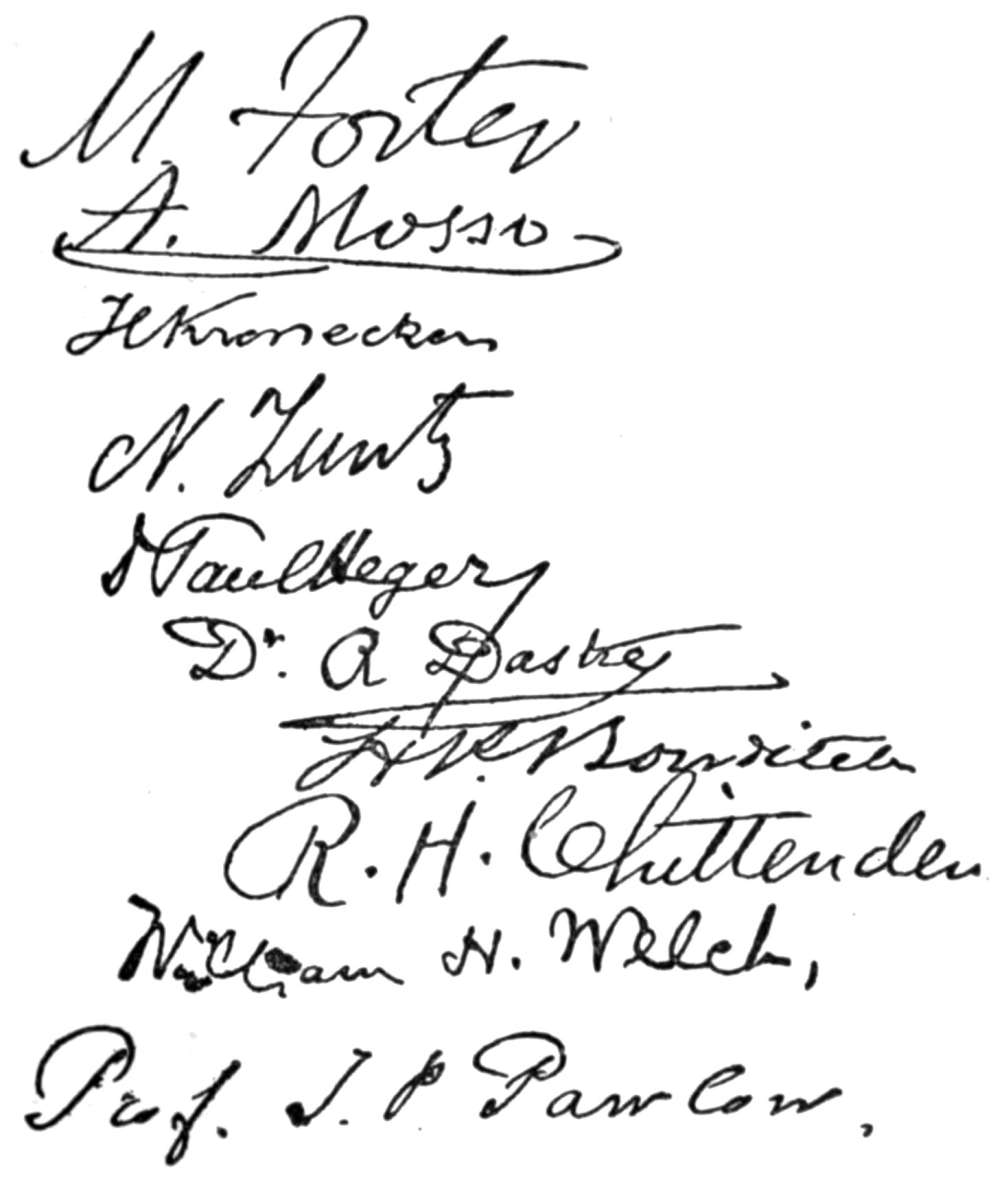
NATIONALITY AND SCIENTIFIC TITLES OF OUR BOARD OF SCIENTIFIC ASSESSORS
Sir Michael Foster, M.D., K.C.B., F.R.S., M.P., etc. Late Professor of Physiology, University of Cambridge, England; Secretary of the Royal Society; Permanent Honorary President of the International Congress of Physiologists, etc.
Dr. Professor Angelo Mosso. Professor of Physiology, University of Turin, Italy; Director of the Regina Margherita Biological Station on the summit of Monte Rosa, etc.
Dr. Professor Hugo Kronecker. Professor of Physiology, University of Berne, Berne, Switzerland, etc.
Dr. Professor N. Zuntz. Professor of Physiology, Berlin, Germany, etc.
Dr. Professor Paul Heger. Professor of Physiology, Brussels, Belgium; Director of the Solvay Sociological Institute, Brussels.
Dr. Professor A. Dastre. Professor of Physiology, Universitie de la Sorbonne, Paris, France, etc.
Dr. Professor Henry Pickering Bowditch, Professor of Physiology, Harvard Medical School; Second President American Physiological Society; President of the Children’s Aid Society, Boston, Mass., etc.
Professor Russell H. Chittenden. Director Sheffield Scientific School of Yale University; Professor of Physiological Chemistry in Yale; Present President of the American Physiological Society, etc.
Dr. Professor William H. Welch. Professor of Pathology in Johns Hopkins University, Baltimore, Maryland; President of the Rockefeller Institute of Preventive Medicine, etc.
Dr. Professor J. P. Pawlow. Director of the Department of Experimental Physiology in the Russian Imperial Military School of Medicine, etc.
PERSISTENT SCIENTIFIC DOUBTS
[Notwithstanding the report of the Cambridge examination of the claims for an economic nutrition advanced by the authors, American physiologists were still doubtful if a nitrogenous economy like that reported could be maintained, and the writer was invited to submit to further tests at the Physiological Laboratory of Yale University, under direction of Professor Russell H. Chittenden, Director of the Sheffield Scientific School, and President of the American Physiological Society, and Dr. Lafayette B. Mendel.
The following article, first published in the Popular Science Monthly, June, 1903, is a report of that test, and indicates a desire to carry the investigation further to include a variety of test-subjects.
In response to Professor Chittenden’s request, the Trustees of the Bache Fund of the National Academy of Sciences appropriated $1000 towards a more extended inquiry; and other means having been assured, a project of experiments was taken under consideration.
One of the difficulties encountered was the control of test-subjects for a sufficiently long time to make conclusive estimates relative to the minimum needs of nitrogenous food in relation to the common occupations of life. Few if any volunteers, with the leisure and interest fortunately possessed by the writer, were available outside the laboratory force itself, and there were serious objections to using for test-subjects the same persons who did the chemical analyses and estimated the results.
In this dilemma the good fortune of a meeting with Surgeon-General O’Reilly of the United States Army and with General Leonard Wood—the former on his way to Madrid to attend a medical congress, and the latter en route to the Philippines to take command there—happened to the writer on the S. S. Commonwealth, on a voyage to Italy in April, 1903.
Both these officers are medical men and research enthusiasts. They had fought yellow fever together, in coöperation with martyr Dr. Major Walter Reed, in Cuba, and the fame of their success was being talked of as one of the great triumphs of pathologic, or hygienic, science at the time of the meeting.
There was ample time on the steamer to discuss a subject of such mutual and general interest, and both officers had had, in service, experiences that led them to believe that the results obtained by the writer and his colleagues were the common possibilities of all persons under right conditions of alimentation.
General O’Reilly was of the opinion that the corps he commanded could furnish intelligent and earnest test-subjects for nutrition investigation, as it did in the yellow fever case. In the yellow fever investigation privates and officers alike had volunteered to act as test-subjects, even though their lives were at stake and many had already been sacrificed. It is to their great honour, also, that they refused to receive the bounty that was offered for test-subjects, preferring to serve science and humanity freely as volunteers rather than sell themselves as experimental risks. From such material General O’Reilly was sure that capable assistants could be secured to test the not at all dangerous or disagreeable economies of nutrition that the projected inquiry wished to solve.
Armed with letters of recommendation to the President and to the Secretary of War from General Wood, and an invitation from Surgeon-General O’Reilly to call on him if coöperation on his part were desired, the writer returned to the United States and consulted with Professors Chittenden and Bowditch relative to the desirability of army coöperation. It was believed to be just the thing wanted to facilitate the inquiry, and the writer proceeded to Washington to effect the combination.
General O’Reilly had already had the matter under consideration and was quite ready to draw up a project for presentation to the Secretary of War when Mr. Root should return to Washington from his summer vacation.
Twenty privates and three non-commissioned officers of the Hospital Corps of the United States Army under command of Dr. Lieutenant Wallace DeWitt are now quartered at New Haven in coöperation with the staff of the Sheffield Scientific School. It is the intention to learn, if possible, how little nitrogen is necessary to secure the best human efficiency; and also, if possible, to ascertain some measure of the evil effects of an excess of nitrogenous food as well as excess of food in general upon human efficiency.
The writer is grateful for the good fortune of being able to be of service in a development of interest in a subject which is of vital importance to the human race. He has enjoyed the benefits of an economic nutrition and knows its value.
The practical proof of a subject of personal application must come from such personal application. Each person must be his own doctor and his own scientist in the matter of his alimentation or he runs the risk of running amuck in his health economy. There is not so much to learn, neither is there very much to do to insure right alimentation, perfect digestion, and continuous good health; but the little required of us must be attended to with no lapses of attention.—Horace Fletcher.]
PHYSIOLOGICAL ECONOMY IN NUTRITION By Russell H. Chittenden Director of the Sheffield Scientific School of Yale University
Among the many problems awaiting solution, none is of greater importance for the welfare of the individual and of the race than that which relates to the proper nutrition of the body. Man eats to live and to gain strength for his daily work, and without sufficient nutriment the machinery of the body cannot be run smoothly or with proper efficiency. The taking of an excess of food, on the other hand, is just as harmful as insufficient nourishment, involving, as it does, not only wasteful expenditure but, what is even of greater moment, an expenditure of energy on the part of the body, which may in the long run prove disastrous. While it is the function of food to supply the material from which the body can derive the necessary energy for its varied activities, any excess of food over and above what is needed to make good the loss incidental to life and daily activity is just so much of an incubus, which is bound to detract from the smooth running of the machinery and to diminish the fitness of the body for performing its normal functions.
A proper physiological condition begets a moral, mental, and physical fitness which cannot be attained in any other way. Further, it must be remembered that lack of a proper physiological condition of the body is more broadly responsible for moral, social, mental, and physical ills than any other factor that can be named. Poverty and vice on ultimate analysis may often be traced to a perversion of nutrition. A healthy state of the body is a necessary concomitant of mental and moral vigour, as well as of physical strength. Abnormal methods of living are often the accompaniment or forerunner of vicious tastes that might never have been developed under more strictly physiological conditions. Health, strength (mental and physical), and moral tone alike depend upon the proper fulfilment of the laws of nature, and it is the manifest duty of a people hoping for the fullest development of physical, mental, and moral strength to ascertain the character of these laws with a view to their proper observance. Poverty, crime, physical ills, and a blunted or perverted moral sense are the penalties we may be called upon to pay for the disobedience to Nature’s laws; penalties which not only we may have to pay, but which may be passed down to succeeding generations, thereby influencing the lives of those yet unborn.
There is to-day great need for a thorough physiological study of those laws of nutrition which constitute the foundation of good living. It is a subject full of interest and promise for the sociologist and economist, as well as for the physiologist. We need a far more complete knowledge than we possess at present of the laws governing nutrition; we need fuller knowledge of the methods by which the most complete, satisfactory, and economical utilisation of the diet can be obtained; we need to know more concerning the minimum diet and the minimum amount of proteid or albuminous foods on which health, mental and physical vigour can be permanently maintained; we need to know more fully concerning the influence of various forms of food on growth and recuperative power; we need more complete knowledge regarding the rôle of various dietetic and digestive habits, fixed or acquired; the effects of thorough mastication, insalivation, and the influence of two versus three meals a day upon the utilisation of food and hence upon the bodily health. Further, we need more concise information as to the effect of the mental state upon digestion and nutrition. These and many other problems of a like nature confront us when we attempt to trace the influence of a proper nutrition upon the condition of the body. These problems, however, all admit of solution, and in their solution undoubtedly lies the remedy for many of the personal ills of mankind.
The foregoing thoughts have been suggested by observations recently made in the writer’s laboratory on the amount and character of the food actually required by a healthy man in the maintenance of bodily equilibrium in periods of rest and physical work. Our ideas at present are based primarily upon observations as to what civilised peoples are accustomed to do, and not upon what they need to do in order to meet the demands made upon the body. Sir William Roberts has well said that the palate is the dietetic conscience, but he adds that there are many misfit palates, and we may well query whether our dietetic consciences have not become generally perverted through a false mode of living. The well-nigh universal habit of catering to our appetite on all occasions, of bowing to the fancied dictates of our palates even to the extent of satiety, and without regard to the physiological needs of the body, may quite naturally have resulted in a false standard of living, in which we have departed widely from the proper laws of nutrition. Statistical studies carried out on large groups of individuals by various physiologists have led to the general acceptance of dietary standards, such as those proposed by Voit, of Munich, and Atwater in this country. Thus the Voit diet for a man doing moderate work is 118 grams of proteid or albuminous food, 56 grams of fat, and 500 grams of carbohydrates, such as sugar and starch, with a total fuel value of 3,055 large calories or heat units per day. With hard work, Voit increases the daily requirement to 145 grams of proteid, 160 grams of fat, and 450 grams of carbohydrates, with a total fuel value of 3,370 large calories. Atwater, on the other hand, from his large number of observations, is inclined to place the daily proteid requirement at 125 grams, with sufficient fat and carbohydrate to equal a total fuel value of 3,500 large calories for a man doing a moderate amount of work; while for a man at hard work the daily diet is increased to 150 grams of proteid, and with fats and carbohydrates to yield a total fuel value of 4,500 large calories. These standards are very generally accepted as being the requirement for the average individual under the given conditions of work, and it may be that these figures actually represent the daily needs of the body. Suppose, on the other hand, that we have in these figures false standards, or, in other words, that the quantities of food-stuffs called for are altogether larger than the actual demands of the body require. In this case there is a positive waste of valuable food material which we may calculate in dollars and cents; a loss of income incurred daily which might be expended more profitably in other directions. To the wage-earner with a large family, who must of necessity husband his resources, there is in our hypothesis a suggestion of material gain not to be disregarded. The money thus saved might be expended for the education of the children, for the purchase of household treasures tending to elevate the moral and mental state of the occupants, or in many other ways that the imagination can easily supply. This kind of saving, however, is purely a question of economy, and in some strata of society would be objected to as indicative of a condition of sordidness. It has come to be a part of our personal pride to have a well-supplied table, and to eat largely and freely of the good things provided. The poorer man takes pride in furnishing his family with a diet rich in expensive articles of food, and imagines that by so doing he is inciting them to heartier consumption and to increased health and strength. He would be ashamed to save in this way, under the honest belief that by so doing he might endanger the health of his dear ones. But let us suppose that this hypothetical waste of food is not merely uneconomical, that it is undesirable for other and weightier reasons. Indeed, let us suppose that this unnecessary consumption of food is distinctly harmful to the body, that it is physiologically uneconomical, and that in our efforts to maintain a high degree of efficiency we are in reality putting upon the machinery of the body a heavy and entirely uncalled-for strain, which is bound to prove more or less detrimental. If there is truth in this assumption, our hypothesis takes on a deeper significance, and we may well inquire whether there are any reasonable grounds for doubting the accuracy of our present dietary standards.
In this connection it is to be remembered that the food of mankind may be classified under three heads, viz., proteid or albuminous, such as meat, eggs, casein of milk, gluten of bread, and various vegetable proteids; carbohydrates, as sugar and the starches of our cereals, and fats, including those of both animal and vegetable origin. The proteids are characterised by containing nitrogen (about 16 per cent), while the fats and carbohydrates contain only carbon, hydrogen, and oxygen. The two latter classes of food-stuffs are burned up in the body, when completely utilised, to carbonic acid (a gas) and water, while the proteid foods, beside yielding carbonic acid and water, give off practically all of their nitrogen in the form of crystalline nitrogenous products in the excreta of the body. Proteid foods have a particular function to perform, viz., to supply the waste of proteid matter from the active tissues of the body, and this function can be performed only by the proteid foods; hence the latter are essential food-stuffs without which the body cannot long survive. Fats and carbohydrates, on the other hand, are mainly of value for the energy they yield on oxidation, and in this connection it is to be remembered that the fuel value of fats per gram is much larger than that of carbohydrates, viz., 9.3: 4.1, or more than twice as great. Further, it is to be noted that the various food-stuffs cannot be utilised directly by the body, but they must first be digested, then absorbed and assimilated, after which they gradually, in their changed form, undergo decomposition with liberation of their contained energy, which may manifest itself in the form of heat or of mechanical work. The thoroughness with which foods are digested and utilised in the body must therefore count for a great deal in determining their dietetic or nutritive value. Moreover, it is easy to see how an excess of proteid food will give rise to a large proportion of nitrogenous waste matter, which, floating through the system prior to excretion, may, by acting on the nervous system and other parts of the body, produce disagreeable results. A mere excess of food, even of the non-nitrogenous variety, must entail a large amount of unnecessary work, thereby using up a proportional amount of energy for its own disposal, since once introduced into the body it must be digested and absorbed, otherwise it undergoes fermentation and putrefaction in the stomach and intestines, causing countless troubles. When absorbed in quantities beyond the real needs of the body, it may be temporarily deposited as fat; but why load up the system with unnecessary material, thereby interfering with the free running of the machinery? In other words, it is very evident that the taking in of food in quantities beyond the physiological requirements is undesirable, and may prove exceedingly injurious. It is truly uneconomical, and defeats the very ends we aim to attain. Instead of adding to the bodily vigour and increasing the fitness of the organism to do its daily work, we are really hampering the delicate mechanism, upon the smooth running of which so much depends.
Why, now, should we assume that a daily diet of over 100 grams of proteid, with fats and carbohydrates sufficient to make up a fuel value of over 3,000 large calories, is a necessary requisite for bodily vigour and physical and mental fitness? Mainly because of the supposition that true dietary standards may be learned by observing the relative amounts of nutrients actually consumed by a large number of individuals so situated that the choice of food is unrestricted. But this does not constitute very sound evidence. It certainly is not above criticism. We may well ask ourselves whether man has yet learned wisdom with regard to himself, and whether his instincts or appetites are to be entirely trusted as safe guides to follow in the matter of his own nutrition. The experiments of Kumagawa, Sivén, and other physiologists, have certainly shown that men may live and thrive, for a time at least, on amounts of proteid per day equal to only one-half and one-quarter the amount called for in the Voit standard. Sivén’s experiments, in particular, certainly indicate that the human organism can maintain itself in nitrogenous equilibrium with far smaller amounts of proteid in the diet than is ordinarily taught, and, further, that this condition can be attained without unduly increasing the total calories of the food intake. Such investigations, however, have always called forth critical comment from writers on nutrition, indicating a reluctance to depart from the current doctrines of the Voit or Munich school; and, indeed, it may justly be claimed that the ordinary nutrition experiments, extending over short periods of time, are not entirely adequate to prove the effect of a given set of conditions when the latter are continued for months or years. Thus, Schäfer writes: “It may be doubted whether a diet which includes considerably less proteid than 100 grams for the twenty-four hours could maintain a man of average size and weight for an indefinite time. It has frequently been asserted that many Asiatics consume a very much smaller proportion of proteid than is the case with Europeans. The inhabitants of India, Japan, and China chiefly consume rice as the normal constituent of their diet, which contains relatively little proteid; and this has been advanced as an argument in favour of the view that the minimal amount of proteid is much less than that ordinarily given as essential to the maintenance of nutritive equilibrium. It must, however, be stated that we have no definite statistics to show that, in proportion to their body-weight, Asiatics doing the same amount of work as Europeans require a less amount of proteids; indeed such evidence as is forthcoming is rather in favor of the opposite view.” This statement is typical of the attitude of physiologists in general on this important subject. Why not candidly admit that the matter is in doubt, and, with a due recognition of the importance of the subject, attempt to ascertain the real truth of the matter?
The writer has had in his laboratory for several months past a gentleman (H. F.) who has for some five years, in pursuit of a study of the subject of human nutrition, practised a certain degree of abstinence in the taking of food and attained important economy with, as he believes, great gain in bodily and mental vigour, and with marked improvement in his general health. Under his new method of living he finds himself possessed of a peculiar fitness for work of all kinds, and with freedom from the ordinary fatigue incidental to extra physical exertion. In using the word abstinence possibly a wrong impression is given, for the habits of life now followed have resulted in the disappearance of the ordinary craving for food. In other words, the gentleman in question fully satisfies his appetite, but no longer desires the amount of food consumed by most individuals.
For a period of thirteen days, in January, he was under observation in the writer’s laboratory, his excretions being analysed daily with a view to ascertaining the exact amount of proteid consumed. The results showed that the average daily amount of proteid metabolised was 41.25 grams, the body-weight (165 pounds) remaining practically constant. Especially noteworthy, also, was the very complete utilisation of the proteid food during this period of observation. It will be observed here that the daily amount of proteid food taken was less than one half that of the minimum Voit standard, and it should also be mentioned that this apparent deficiency in proteid food was not made good by any large consumption of fats or carbohydrates. Further, there was no restriction in diet. On the contrary, there was perfect freedom of choice, and the instructions given were to follow his usual dietetic habits. Analysis of the excretions showed an output of nitrogen equal to the breaking down of 41.25 grams of proteid per day as an average, the extremes being 33.06 grams and 47.05 grams of proteid.
In February a more thorough series of observations was made, involving a careful analysis of the daily diet, together with analysis of the excreta, so that not alone the proteid consumption might be ascertained, but likewise the total intake of fats and carbohydrates. The diet consumed was quite simple, and consisted merely of a prepared cereal food, milk, and maple sugar. This diet was taken twice a day for seven days, and was selected by the subject as giving sufficient variety for his needs and quite in accord with his taste. No attempt was made to conform to any given standard of quantity, but the subject took each day such amounts of the above foods as his appetite craved. Each portion taken, however, was carefully weighed in the laboratory, the chemical composition of the food determined, and the fuel value calculated by the usual methods.
The following table gives the daily intake of proteids, fats, and carbohydrates for six days, together with the calculated fuel value, and also the nitrogen intake, together with the nitrogen output through the excreta. Many other data were obtained showing diminished excretion of uric acid, ethereal sulphates, phosphoric acid, etc., but they need not be discussed here.
Intake Output of Nitrogen
Proteids Fats Carbohy Calories Nitrogen Urine Fæces Total
Grams Grams Grams Grams Grams Grams Grams
Feb. 2 31.3 25.3 125.4 900 5.02 5.27 0.18 5.45
3 46.8 40.4 266.2 1690 7.50 6.24 0.81* 7.05
4 48.0 38.1 283.0 1747 7.70 5.53 0.81* 6.34
5 50.0 40.6 269.0 1711 8.00 6.44 0.81* 7.25
6 47.0 41.5 267.0 1737 7.49 6.83 0.81* 7.64
7 46.5 39.8 307.3 1852 7.44 7.50 0.17 7.67
Daily Av. 44.9 38.0 253.0 1606 7.19 6.30 0.60 6.90
* Average of the four days.
The main things to be noted in these results are, first, that the total daily consumption of proteid amounted on an average to only 45 grams, and that the fat and carbohydrate were taken in quantities only sufficient to bring the total fuel value of the daily food up to a little more than 1,600 large calories. If, however, we eliminate the first day, when for some reason the subject took an unusually small amount of food, these figures are increased somewhat, but they are ridiculously low compared with the ordinarily accepted dietary standards. When we recall that the Voit standard demands at least 118 grams of proteid and a total fuel value of 3,000 large calories daily, we appreciate at once the full significance of the above figures. But it may be asked, was this diet at all adequate for the needs of the body—sufficient for a man weighing 165 pounds? In reply, it may be said that the appetite was satisfied, and that the subject had full freedom to take more food if he so desired. To give a physiological answer, it may be said that the body-weight remained practically constant throughout the seven days’ period, and further, it will be observed by comparing the figures of the table that the nitrogen of the intake and the total nitrogen of the output were not far apart. In other words, there was a close approach to what the physiologist calls nitrogenous equilibrium. In fact, it will be noted that on several days the nitrogen output was slightly less than the nitrogen taken in. We are, therefore, apparently justified in saying that the above diet, simple though it was in variety, and in quantity far below the usually accepted requirement, was quite adequate for the needs of the body. In this connection it may be asked, what were the needs of the body during this seven days’ period? This is obviously a very important point. Can a man on such a diet, even though it suffices to keep up body-weight and apparently also physiological equilibrium, do work to any extent? Will there be under such condition a proper degree of fitness for physical work of any kind? In order to ascertain this point, the subject was invited to do physical work at the Yale University Gymnasium, and placed under the guidance of the director of the gymnasium, Dr. William G. Anderson. The results of the observations there made are here given, taken verbatim from Dr. Anderson’s report to the writer.
On the 4th, 5th, 6th, and 7th of February, 1903, I gave to Mr. Horace Fletcher the same kind of exercises we give to the Varsity Crew. They are drastic and fatiguing and cannot be done by beginners without soreness and pain resulting. The exercises he was asked to take were of a character to tax the heart and lungs, as well as to try the muscles of the limbs and trunk. I should not give these exercises to Freshmen on account of their severity.
Mr. Fletcher has taken these movements with an ease that is unlooked for. He gives evidence of no soreness or lameness, and the large groups of muscles respond the second day without evidence of being poisoned by Carbon dioxide. There is no evidence of distress after or during the endurance test, i. e., the long run. The heart is fast but regular. It comes back to its normal beat quicker than does the heart of other men of his weight and age.
The case is unusual, and I am surprised that Mr. Fletcher can do the work of trained athletes and not give marked evidences of over-exertion. As I am in almost constant training I have gone over the same exercises, and in about the same way, and have given the results for a standard of comparison. [The figures are not given here.]
My conclusion, given in condensed form, is this: Mr. Fletcher performs this work with greater ease and with fewer noticeable bad results than any man of his age and condition I have ever worked with.
To appreciate the full significance of this report, it must be remembered that Mr. Fletcher had for several months past taken practically no exercise other than that involved in daily walks about town.
In view of the strenuous work imposed during the above four days, it is quite evident that the body had need of a certain amount of nutritive material. Yet the work was done without apparently drawing upon any reserve the body may have possessed. The diet, small though it was, and with only half the accepted requirement in fuel value, still sufficed to furnish the requisite energy. The work was accomplished with perfect ease, without strain, without the usual resultant lameness, without taxing the heart or lungs, and without loss of body-weight. In other words, in Mr. Fletcher’s case at least, the body machinery was kept in perfect fitness without the consumption of any such quantities of fuel as has generally been considered necessary.
Just here it may be instructive to observe that the food consumed by Mr. Fletcher during this seven days’ period—and which has been shown to be entirely adequate for his bodily needs during strenuous activity—cost eleven cents daily, thus making the total cost for the seven days seventy-seven cents! If we contrast this figure with the amounts generally paid for average nourishment for a like period of time, there is certainly food for serious thought. Mr. Fletcher avers that he has followed his present plan of living for nearly five years; he usually takes two meals a day; has been led to a strong liking for sugar and carbohydrates in general and away from a meat diet; is always in perfect health, and is constantly in a condition of fitness for work. He practises thorough mastication, with more complete insalivation of the food (liquid as well as solid) than is usual, thereby insuring more complete and ready digestion and a more thorough utilisation of the nutritive portions of the food.
In view of these results, are we not justified in asking ourselves whether we have yet attained a clear comprehension of the real requirements of the body in the matter of daily nutriment? Whether we fully comprehend the best and most economical method of maintaining the body in a state of physiological fitness? The case of Mr. Fletcher, just described; the results noted in connection with certain Asiatic peoples; the fruitarians and nutarians in our own country recently studied by Professor Jaffa, of the University of California; all suggest the possibility of much greater physiological economy than we as a race are wont to practise. If these are merely exceptional cases, we need to know it; but if, on the other hand, it is possible for mankind in general to maintain proper nutritive conditions on dietary standards far below those now accepted as necessary, it is time for us to ascertain that fact. For, if our standards are now unnecessarily high, then surely we are not only practising an uneconomical method of sustaining life, but we are subjecting ourselves to conditions the reverse of physiological, and which must of necessity be inimical to our well-being. The possibility of more scientific knowledge of the natural requirements of a healthy nutrition is made brighter by the fact that the economic results noted in connection with our metabolism examination of Mr. Fletcher is confirmatory of similar results obtained under the direction and scrutiny of Sir Michael Foster at the University of Cambridge, England, during the autumn and winter of last year; and by Dr. Ernest Van Someren, Mr. Fletcher’s collaborateur, in Venice, on subjects of various ages and of both sexes, some account of which has already been presented to the British Medical Association and to the International Congress of Physiologists at its last meeting at Turin, Italy. At the same time emphasis must be laid upon the fact that no definite and positive conclusions can be arrived at, except as the result of careful experiments and observations on many individuals covering long periods of time. This, however, the writer hopes to do in the very near future, with the coöperation of a corps of interested observers.
The problem is far-reaching. It involves not alone the individual, but society as a whole, for beyond the individual lies the broader field of the community, and what proves helpful for the one will eventually react for the betterment of society, and for the improvement of mankind in general.
INTRODUCTION TO DR. HARRY CAMPBELL’S CONTRIBUTION ON THE IMPORTANCE OF MASTICATION
[Since the publication of Van Someren’s paper, “Was Luigi Cornaro Right?”, read before the British Medical Association, and reprinted elsewhere in this volume, much more attention has been given to the study of mastication than had been previously reported. Mr. Gladstone’s advice to his children, which was commonly current and was repeated whenever mastication was mentioned, was usually accompanied and met by an amused smile that showed that the full importance of better mouth-treatment of food was not appreciated. Glutton or Epicure, a little book by the present writer, published in 1898, insisted on thorough use of the functions of the mouth in alimentation but did not go into the anatomical, physiological and dental details.
Dr. Harry Campbell of Northwest London Hospital has performed this latter service to science and humanity, with splendid carefulness, and must have devoted much time and study to the collection of evidence and suggestion which is given here following in full, reprinted from the London Lancet.
The authors acknowledge with much gratitude, the courteous permission of both Dr. Campbell and of the editor of the Lancet, to reprint all four articles which composed the series.
In our own study of the subject of mouth-treatment of food we have been led to give more credit to the chemical feature of preparation than Dr. Campbell yet attributes to the chemical side of the problem. Comminution of hard food is of first importance, undoubtedly, but insalivation and neutralisation or alkalinisation are, seemingly, much more easily and quickly accomplished in the mouth than farther on in the alimentary canal. The intestines can do all in the way of digestion, even if the mouth and stomach are passed and their assistance in the digestive process is entirely neglected, but it is done at tremendous disadvantage in the supplementary digestive tract of the intestines. We have proven the economy of letting the mouth do all it can, by the insalivation (sipping and tasting) of liquids that have taste up to the point of compulsory swallowing (a sucking-up by the Swallowing Impulse which naturally occurs in the course of treatment in the mouth if not fought against too strongly). If Dr. Campbell will extend his observations to liquids, say milk, and for a sufficiently long time to measure results by continued economy of assimilation and saving of solid excreta, he will find that it pays to let the mouth do all it can do, and that while it cannot do too much it may do too little. The natural instincts of the mouth, or those that attach to the mouth, become much more discriminating also if exercised on liquids as well as on solids. This they do not learn to do so well if sapid liquids are habitually rushed past their field of discrimination.