Volume 13 — Chapter XXIII.
Reading edition
CALLED TO THE HELM.
While Washington was busy planting trees at Mount Vernon and making excursions to see his Western lands, the country was like a vessel which had no captain or pilot, drifting into danger. During the War for Independence, one of the greatest difficulties which Washington had to overcome was the unwillingness of the several States to act together as one nation. They called themselves the United States of America, but they were very loosely united. Congress was the only body that held them together, and Congress had no power to make the States do what they did not care to do. So long as they all were fighting for independence, they managed to hold together; but as soon as the war was over and the States were recognized as independent, it was very hard to get them to do anything as one nation. Every State was looking out for itself, and afraid that the others might gain some advantage over it.
This could not go on forever. They must be either wholly independent of one another or more closely united. The difficulty was more apparent where two States were neighbors. Virginia and Massachusetts might manage to live apart, though in that case troubles would be sure to arise, but how could Virginia and Maryland maintain their individual independence? The Chesapeake and Potomac seemed to belong to one as much as to the other; and when foreign vessels came up the stream, was each State to have its own rules and regulations? No. They must treat strangers at any rate in some way that would not make each the enemy of the other.
These two States felt this so strongly that they appointed a commission to consider what could be done. Washington was a member of the commission, and asked all the gentlemen to his house. They not only discussed the special subject committed to them, but they looked at the whole matter of the regulation of commerce in a broad way, and agreed to propose to the two States to appoint other commissioners, who should advise with Congress and ask all the States of the Union to send delegates to a meeting where they could arrange some system by which all the States should act alike in their treatment of foreign nations and of each other.
That was exactly what Congress ought to have been able to do, but could not, because nobody paid any attention to it. Nor did this meeting, which was called at Annapolis in September, 1786, accomplish very much. Only five States sent delegates, and these delegates were so carefully instructed not to do much, that it was impossible for the convention to settle affairs. Still, it was a step forward. It was very clear to the delegates that a general convention of all the States was necessary, and so they advised another meeting at which all the thirteen States should be represented, and the whole subject of the better union of the States should be considered.
This meeting, which was the great Constitutional Convention of 1787, was held in Philadelphia, and to it Virginia sent George Washington as one of her delegates. He was heart and soul in favor of the movement. It was what he had been urging on all his correspondents for a long time. He was at first reluctant to go back into public life after having so completely retired; but as soon as he saw that it was his duty to accept the appointment, he set to work to qualify himself for taking part in the deliberations of the convention. Probably no one in America understood better than he the character of Americans and the special dangers through which the country was passing; but several, no doubt, were better informed about the practical working of government and about the history of other confederations. He had never been very much of a reader of books, but he had been a member for many years of the Virginia House of Burgesses, and so knew how government was carried on on a small scale, and now he began to read diligently and to compare accounts of ancient and modern political unions. He made abstracts of them, and, in fact, went to work as if he were at school, so in earnest was he to learn this important lesson.
On May 9, 1787, Washington set out from Mount Vernon in his carriage for Philadelphia. He was a famous man and could not go to the convention without attracting attention. So, when he reached Chester, in Pennsylvania, he was met by General Mifflin, who was then Speaker of the Assembly of Pennsylvania, and by various public men, who escorted him on the way. At the ferry across the Schuylkill, where Gray's Ferry Bridge now is, he was met by a company of light horse, and so entered the city. One of his first errands was to call on Benjamin Franklin, who was President of Pennsylvania, as the governor was then called. No doubt they talked long and earnestly about the work before them, for they were the two most eminent men in the convention.
CRAB-TREE STAFF PRESENTED BY BENJ. FRANKLIN TO GEN. WASHINGTON; NOW IN THE STATE DEPARTMENT LIBRARY AT WASHINGTON.

Washington was made the presiding officer of the convention. For four months it met from day to day, engaged in the great work of forming the Constitution under which we are now governed. There were many long and earnest debates; and the members felt the importance of the work upon which they were engaged. At last, the Constitution was formed. It was not satisfactory to everybody, but the members all agreed to sign it and recommend it to the country for adoption. George Washington, as president of the convention, was the first to set his name down; and there is a tradition that as he took the pen in his hand he arose from his seat, considered a moment, and then said:
"Should the States reject this excellent Constitution, the probability is that an opportunity will never again be offered to cancel another in peace; the next will be drawn in blood."
Washington, as president of the convention, was directed to draw up a letter, stating what the convention had done, and send it with the Constitution to Congress. This he did. He was not entirely satisfied with the Constitution, as he wrote to Patrick Henry: "I wish the Constitution which is offered had been more perfect; but I sincerely believe it is the best that could be obtained at this time. And, as a constitutional door is opened for amendments hereafter, the adoption of it, under the present circumstances of the Union, is, in my opinion, desirable."
He said at first that he should not say anything for or against the Constitution. If it were good, it would work its way; if bad, it would recoil on those who drew it up. Perhaps he thought it was not becoming in those who discussed its parts and finally signed it, to do anything more than send it out and leave the people to do what they would with it. But he could not keep silent long. Everybody was debating it; the principal members of the convention were defending it; there was danger that it would not be adopted, and soon Washington, in his letters, was using arguments in support of it. There is no doubt that his name at the head of the paper did a great deal toward inducing people to accept it. It was more than a year before enough States had adopted the Constitution to make it the law of the land, but as time went on, and it was more certain that the new government would go into operation, the question arose as to who should be the first President of the United States. It can hardly be called a question; at any rate, it was answered at once by all. Every one named Washington, and his friends began to write to him as if there could be no doubt on this point. The most distinguished advocate of the new Constitution, Alexander Hamilton, who had been one of Washington's aids in the war, wrote to him:
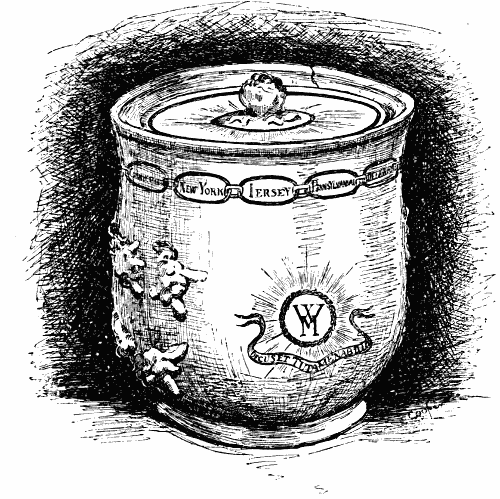
SUGAR-BOWL BELONGING TO A DINNER-SET PRESENTED TO MARTHA WASHINGTON BY GENERAL LAFAYETTE.
"I take it for granted, sir, you have concluded to comply with what will, no doubt, be the general call of your country in relation to the new government. You will permit me to say that it is indispensable you should lend yourself to its first operations. It is to little purpose to have introduced a system, if the weightiest influence is not given to its firm establishment in the outset.
Washington was by no means elated at the prospect. On the contrary, he was extremely reluctant to be President. He was not old; he was fifty-seven years of age when the election took place, but his hard life as a soldier had broken his constitution, and the cares and anxieties he had undergone had made him feel old. "At my time of life," he wrote to Lafayette, "and under my circumstances, the increasing infirmities of nature and the growing love of retirement do not permit me to entertain a wish beyond that of living and dying an honest man on my own farm. Let those follow the pursuits of ambition and fame who have a keener relish for them, or who may have more years in store for the enjoyment." He was perfectly sincere in saying this. He knew that some people would not believe him, and would assert that he was only saying all this to get the credit of humility; but his best friends believed him, and to one of these he wrote: "If I should receive the appointment, and if I should be prevailed upon to accept it, the acceptance would be attended with more diffidence and reluctance than ever I experienced before in my life. It would be, however, with a fixed and sole determination of lending whatever assistance might be in my power to promote the public weal, in hopes that, at a convenient and early period, my services might be dispensed with, and that I might be permitted once more to retire, to pass an unclouded evening, after the stormy day of life, in the bosom of domestic tranquillity."
There never was any doubt about the people's choice. Every vote was cast for Washington.
(To be continued.)
BEARS EATING CORN: “THIS WAS REALLY THOUGHTFUL OF FARMER JONES, EH?”