Volume 13 — THE AGASSIZ ASSOCIATION
Reading edition
SIXTY-FIFTH REPORT.
Agassiz and Audubon.
In many respects the characters of these two great naturalists were alike,—and especially in their affectionate gentleness and mercy. Although, in the interests of science, both were led to destroy the lives of many animals, no men were more careful to avoid needless slaughter and unnecessary pain. It was Audubon who said, "The moment a bird was dead, however beautiful it had been when in life, the pleasure arising from the possession of it became blunted." This saying has become the motto of a large and rapidly growing society, organized in 1886, and known as the Audubon Society, for the protection of birds. This society, recognizing the increasing influence of the Agassiz Association, has sent to us a special invitation to co-operate in its work. The circular of the Audubon Society shows, first, the alarming rate at which our birds are being exterminated. It gives a series of startling facts; for example, "One New York firm had on hand, February 1, 1886, 200,000 skins," and it closes this paragraph as follows: "These figures tell their own story; but it is a story which might be known even without them; we may read it plainly enough in the silent hedges, once vocal with the morning songs of birds, and in the deserted fields, where once bright plumage flashed in the sunlight."
The purpose of the Society is to prevent, as far as possible,
1. The killing of any wild bird not used for food.
2. The taking or destroying of the eggs or nests of any wild birds.
3. The wearing of the feathers of wild birds.
The plan of work is very simple.
There are no expenses of any sort whatever. There are no conditions of age. No formal organization is required. Each one can join by agreeing to any one of the three following pledges:
Pledge No. 1.— I pledge myself not to kill, wound, nor capture any wild bird not used for food so long as I remain a member of the Audubon Society; and I promise to discourage and prevent, so far as I can, the killing, wounding or capture of birds by others.
Pledge No. 2.—I pledge myself not to rob, destroy nor in any way disturb or injure the nest or eggs of any wild bird so long as I remain a member of the Audubon Society; and I promise to discourage and prevent, so far as I can, such injury by others.
Pledge No. 3.—I pledge myself not to make use of the feathers of any wild bird as ornaments of dress or household furniture, and by every means in my power to discourage the use of feathers for decorative purposes.
These pledges are not to be understood as hindering the signer from taking such birds, eggs or nests as he may require for scientific purposes, but refer only to wanton or mercenary destruction and robbery. Therefore no member of the Agassiz Association can feel any hesitation about allying himself also with the Audubon Society. Boys and girls can often do more than others to protect nesting birds.
From Mexico.
We are in the State Michoacan, the Garden State of the Republic, with thirty or forty thousand inhabitants. It is a pleasant place to live in; seven thousand feet above the sea; fine air, good water, and very healthy. The corridors of the house are inhabited by a colony of birds. The female looks like the female English sparrow. The male has a scarlet breast and cap. The egg is robin-blue, with a ring of black spots around the larger end. It is called the Gorriones. The buzzard is very common here. On a trip we took, we saw the fine Mocha coffee growing, and some of the cities could not be seen on account of the banana plants which shade the coffee. Here we have all the familiar wild flowers, and many strange ones. I belong to an Ohio Chapter of the A. A.—G. A. Harriman.
Assembly Report.
We hope to receive regular annual reports from all assemblies of the A. A., as well as from the individual Chapters, and have the pleasure this month, of giving the following from the Assembly of Essex County, N. J. "The first call for an Assembly meeting was sent out by East Orange, B. Four Chapters only responded. We decided to have five delegates from each Chapter. We have meetings on the last Saturday evening of every other month, from September to June; five meetings for the year. We have reports of progress from the associate Chapters, papers by members, discussions of methods of work, and occasional addresses. We have had many difficulties to contend with, but feel that our meetings have been pleasant and helpful, and should say from our experience thus far, by all means encourage the formation of Assemblies.
Very sincerely yours, N. M. Dorr.
Boston Assembly.
Chapters 112, 729, 760, and 820 of Boston, Mass., have united for the purpose of forming a Boston Assembly.
All Chapters, in or near Boston, that would like to join, are invited to address
Mr. Thomas H. Fay, Sec. of Committee, 8 N. Grove street, Boston, Mass.
Delayed Reports.
551, Clinton, Iowa. We have over three hundred specimens, and a small library. We have been studying turtles, and have noticed that the eye of a turtle shuts from the bottom. We now intend to take up fishes, and as the Mississippi river is within one block of our rooms, we shall not lack specimens. We have held thirty-eight meetings, and cases of absence are rare.—Henry Towle, Sec.
567, Fort Meade, Florida.—Our Chapter of five, all of our own family, left Iowa, September 25, 1884. We came down the Skunk river to the Mississippi, thence to New Orleans, thence to Tampa, and are now living nine miles southeast from Fort Meade. We left Sigourney, Iowa, in the Ena, a Racine boat, eighteen feet long, forty-two inches beam, with water-tight compartments. We had tent and camping outfit which we carried in another boat. Our party consisted of the five members of the Chapter, and a baby, one year old. We reached New Orleans Thursday, December 4, just ten weeks from our time of starting. This includes stops at all the principal towns. Our actual running time was 397 hours. Distance, 1812 miles; average, 4.53 miles per hour; least daily distance, five miles; greatest, sixty-five. The first cotton was seen at New Madrid, Mo.; the first cane, below Grady's Landing; first Spanish moss, just below Greenville, Miss.
After being here a year, three of our number made another long excursion. Tuesday, December 1, 1885, we put our boat into Peace creek, thence to Charlotte Harbor, up the Caloosahatchie, through lakes Fliet and Hicapochee, into lake Okeechobee; across the northern end of the lake, into the Kissimee river, up to Kissimee lake, then up Tiger creek into Tiger lake, whence we walked thirty-five miles home, making in the round, 700 miles, in six weeks. Once we were over seven days without seeing a soul outside our own party. One of our lady members claims the honor of being the first white woman that ever crossed Okeechobee in a small boat. In all these travels, we have never been disturbed by man or beast, and have always been treated kindly. The Okeechobee trip was made at an expense of twelve dollars for three of us. The trip down the Mississippi cost about one dollar per day for the six. This, of course, does not include cost of boats, tents, and equipage. We found it a pleasant method of travel, and many of the A. A. might enjoy something similar. My wife and two daughters made the trip, so it is within the range of young lady members, if they have a taste for such travels.—Irving Keck, Sec. "567."
568, Meadville, Pa. We number now only four, the others having left college; but what we lack in number is made up in zeal. We study nature with a great deal more care than when we first formed a Chapter, and have spent some of our most enjoyable hours in rambling though the woods.
We send greeting to the Chapters, and say, "Long live the A. A., as one of the best schools in which any one can learn."—F. L. Armstrong, Sec.
574, Indianapolis, Ind. The future looks bright. We are all interested, and, although very lately reorganized, we hope to grow rapidly.—Tom Moore, Sec.
Concerning "Puff-balls."
All our botanical friends will be interested in the following paper on the curious fungi commonly called "puff-balls"; but I must emphasize the words of caution given by Professor Trelease and warn you not to eat any puff-balls whatever, until you have been taught to distinguish the good from the poisonous, by a competent botanist, with the actual specimens in his hand. So long as you have the slightest doubt, remember the old test—"Eat one,—then if you live, it was an edible mushroom; if you die, it was a poisonous fungus!" Here is what Professor Trelease says:
I have been asked several times by the boys of the Agassiz Association to go with them on little collecting excursions, and I have always found them much interested in toadstools, and other fungi. From what I have seen on these and similar excursions, I have been led to think that if given a little idea about some of these plants a good many people would be glad to observe them more closely.
One group of fungi in particular—the puff-balls—has a great deal of interest for me. It is a very difficult group to study, and if the sharp-eyed boys of the Agassiz Chapters all over the country will be on the lookout for puff-balls this summer and fall, they can be of assistance in some work that there is much need of doing with these plants.
Every boy who lives in the country must have seen the giant puff-ball (Lycoperdon bovista) that grows in pastures, looking like a great white egg, sometimes nearly two feet high, set up on its small end. It is not easy to see where these curious growths come from, for they sometimes appear as large as one's fist, or larger, in the morning, in places where there was nothing of the sort the night before. Then they often grow for several days, and finally turn brown and break up into a dusty mass that at last blows away like smoke, leaving nothing but a dried, torn remnant behind.
When one of these large puff-balls is seen, scrape the dirt away carefully about it, and the secret of its appearance will be discovered; for a mass of fine white threads spread away from it in every direction. This spawn takes the place of the roots of a tree, absorbing food from the decaying leaf mold, or whatever there may be of the same nature in the ground. All of its food is obtained in this way; so that the delicate spawn-threads may spend a long time in feeding and storing up food before they give any evidence of their existence. But at last a puff-ball begins to grow; at first, very small, then larger, but never very large, until a rain may give it the opportunity to break through the sod, and then, swelling up rather than growing, it suddenly makes its appearance.
While they are young, firm, and pure white, when cut open, these large puff-balls are very good eating, sliced, seasoned well, and fried in butter, and especially if dipped in egg and cracker crumbs. But I must caution my readers to leave other fungi alone, even if they think the specimens they find are mushrooms, for some of the fungi that look a good deal like mushrooms are extremely poisonous. Even a puff-ball soon loses its value for food, and should never be eaten after it becomes the least discolored, or offensive in smell. When this change occurs, it seems as if the plant was rapidly going to decay; but this is not the case,—it is simply ripening. For a puff-ball is nothing more nor less than the fruit of the underground mycelium, or spawn; and the dusty mass that it dries into is composed of myriads of spores, which take the place of the seeds of flowering plants. How many puff-balls there would be if every one of these microscopic spores developed! In a puff-ball sixteen inches in diameter, if they occupy only one-third of the space, there are no less than 300,000,000,000,000,000 spores,—an inconceivable number. I do not know why it is, but these spores do not germinate readily, and very few of them produce other plants. Perhaps it is quite as well, as, if they all grew, there would be room for no other kind of vegetation.
1. FLEECY WHITE PUFF-BALL. 2. BEECH EARTH STAR. 3.LEAD-COLORED PUFF-BALL. 4. STUDDED PUFF-BALL. 5. PEAR-SHAPED PUFF-BALL.
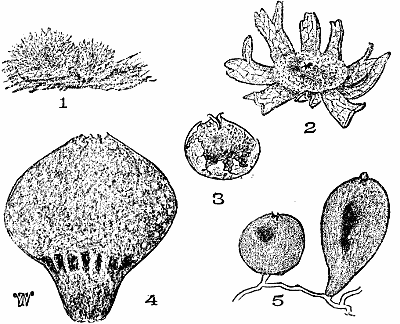
Another very good edible puff-ball is the little lead-colored species (Bovista plumbea), about as large as a marble, that is very common in hilly pastures. When it is young and white, it is even more delicious than the large species. With these I think I should let my bill-of-fare rest.
A few other common puff-balls are the exquisite earth-stars (Geaster), that are commonest in sandy places and under evergreens; the studded puff-ball (Lycoperdon gemmatum), very abundant on the ground in woods; the fleecy white puff-ball (L. Wrightii) that grows along paths in meadows; and the pear-shaped puff-ball (L. pyriforme), found everywhere on old logs, in tufts that are united by firm white cords.
These plants will make an interesting addition to the cabinet of a Chapter that will take the trouble to look for them and preserve them properly. They ought to be gathered in two states,—just before they open to discharge their spores, and when perfectly ripe. They must not be handled so as to rub off the mealy or warty covering that some have, and should be carefully taken home in a basket and laid in a good warm place to dry. Some of the larger species soften and become so offensive when first beginning to ripen that they may appear to be spoiled; but if put in an out-of-the-way place, where they will annoy nobody, they usually come out all right. When fully dry they should be laid in pasteboard trays or boxes, properly labeled, and put into the cabinet.
I shall be very glad to name puff-balls for members of the Agassiz Association as far as I can. Specimens sent for identification must be dried, carefully wrapped in tissue-paper, and packed with cotton or soft paper in a tin or wooden box, addressed to me as below. Each specimen sent should be marked with a number corresponding to that of the duplicate kept for the Chapter cabinet, so that my names may be given with reference to the numbers. If any specimens are to be returned, this should be indicated in the letter accompanying them, and the proper amount of return postage included.
William Trelease, Shaw School of Botany, St. Louis, Mo.
Notes.
Frogs' Eggs. I think I can tell Mrs. N. B. Jones (see April number) what her "jelly-like mass" was. Last spring our boys brought home similar masses, some globular, some in strings. We put them in water in a sunny place. In less than a week we had tiny tadpoles swimming about. Unfortunately the curiosity concerning them was so great that they were continually lifted from the water, and after a few weeks all died. We thought the eggs must have been frogs' eggs, but we had two or three varieties. I hope to repeat the experiment, and continue it long enough to see exactly what animal will develop.—Mrs. J. C. Kinear, Sec. Ch. 598.
Mocking-bird. One or two subscribers have stated through "Jack-in-the-Pulpit," that the mocking-bird, (mimus polyglottus) is not guilty of poisoning its young; but I have positively seen it done. The birds will feed their young for a while and when they find that it is impossible to get at them through the wires of the cage, they bring a poisonous red berry, which the young eat. I can furnish the signatures of six or eight persons who have seen this with their own eyes.—P. L. Benedict, Sec. 331.
[This establishes the fact that mocking-birds have brought berries believed to be poisonous, to their young. But it is unsafe, as I have before shown, to infer the bird's motives from its acts. We can not know that the bird changed the diet of its young "because it could not get at them," nor do we know that it knew the deadly nature of the berries. A jury could not convict of murder.]
Devil-fish.—And Ostriches. Last summer we saw a devil-fish of the ray family, genus Cephaloptera. It had something like great wings on its sides. These were called pectorals. From tip to tip across these it was sixteen feet, four inches, and from head to junction of tail, eight feet six inches. Its tail was about two feet long, and not more than an inch in thickness. A flour-barrel was put in its mouth.
We had also, fortunately, an opportunity of seeing thirty-six live ostriches. They belonged to Dr. Sketcherly, who bought them in Port Natal, and was taking them to his ostrich farm in Los Angeles, California. We noticed that the males were all black, with white tail and wing-feathers, and pink bills; while the females were gray, with white tail and wings like the males, and black bills, which were triangular, with one end rounded off, and not duck-bill shaped, as I have read. Their legs resemble those of a horse, only they have two toes. Their eyes were large, dark, and mild. Two males were said to be very dangerous. A whole turnip was picked up and swallowed by one of them, and it was quite surprising to see it gradually turning from the front of his neck around to the back portion of it, and finally disappear suddenly into his back between the wings, where the craw was said to be situated. Five natives were in attendance. Their features were regular, and their complexion dark brown; they had straight, black hair. One of them spoke English.—Mrs. E. E. Walden, Galveston, Texas.
Buttercups. I have noticed that buttercups often make a mistake and grow six petals, instead of five.—C.
[Such variations are common. I have seen trilliums with four parts throughout; Houstonias, with five and six divisions; and Hepaticas completely double, like tiny roses.]
Bees. A simple remedy for honey thieves. A gentleman who owns a bee farm discovered a large swarm of bees stealing honey from one of his smallest hives. The latter, because of their inferior numbers, were unable to protect their stores, and he tried various methods to aid them.
One day, at the suggestion of a friend, he laid a branch of asparagus before the entrance, completely concealing it from the eyes of the marauding bees, which flew wildly around, searching in vain for the opening, while the occupants of the hive, having made their exit through the asparagus, knew what lay behind it, and afterward stored their honey unmolested.—Agnes Lydon, Sec. Milwaukee Chapter E.
Minutes of a Good Meeting.
"Meeting called to order at 1.10 P. M. For the benefit of new members, an explanation of the organization of the Chapter (No. 331) was given, also of the origin of the A. A. The hand-book of the A.A. was then reviewed, each topic taken up and explained, portions of the constitution, by-laws, etc., being read. Next came the report of the secretary. Next, that of the treasurer. The question, 'Ought the English sparrow in this country to be considered an American bird?' was decided in the affirmative. Then came the election of new members. Three were elected. The revised copy of by-laws was then signed by all present. Secretary then read extracts from the A. A. columns of St. Nicholas, and explained about 'centuries.' He also read from the reports of other Chapters. A motion was then made that some one member bring in at each meeting an essay. Secretary then read annual report to be sent to Lenox. Approved. The next step was the paying of initiation fees by the new members. The treasurer was authorized to send to Lenox for a 'charter.' The questions in ornithology in December St. Nicholas, and the answers to same in March number, by Percy L. Benedict, Sec. 331, were read by the Vice-President. Next came a chemical experiment on the nature of flame,—the three cones, luminous, semi-luminous, non-luminous. A bent glass tube was thrust into the non-luminous cone and lighted at the other end,—a proof that the gas around the wick was not ignited."
Question for next meeting, "Which is the most useful animal?" Meeting adjourned at 2.50 P. M. —Percy L. Benedict, Secretary.
Kioto, Japan.
I was unfortunate enough, last March, to have all my letters, letter-book, hand-books, and other matter relating to the A. A. as secretary of Chapter 789, burn, together with everything else in my house, and the house itself. I have thus lost the addresses of some persons who had written to this Chapter. I mention this only to explain to those who might otherwise have occasion to think this Chapter negligent, the reason we can not answer them, unless they will have the kindness to write again.—C. M. Cady.
Every member of the A. A. will regret to hear of the misfortune that befell Mr. Cady in the burning of his house. Doubtless those members who had written to the Japan Chapter will now write again.
Exchanges.
Every collector is invited to send for my exchange list.—S. O. Pindar, Hickman, Ky.
I wish to correspond with all Chapters intending to raise silk-worms next year.—Chas. A. Jenkins, Sec. Ch. 447, Chittenango, N. Y.
Mr. L. L. Goodwin, Daisy, Tenn., will exchange fragments of ancient pottery, arrow-heads, stone axes, and tomahawks—genuine and scarce; write first. I specially desire a large star-fish, entire jaws of a shark, a large lobster, and jaws and teeth of sea-fishes.
Chapters, New and Reorganized.
No.Name.No. of members.Address.
972Anadarko, Ind. Ter. (A)— Charley A. Reynolds.
234New York, N. Y. (G)4 Miss Isabella Roelker, 237 W. 51st Street.
63East Dennis, Mass. (A)20 Harry E. Scars.
535Hallowell, Maine (A)4 Miss M. Lillian Hopkins.
40Sauquoit, N. Y. (A)12 Miss H. Josephine Campbell.
156Peoria, Ill. (A)5 W. T. Van Buskirk, 111 Penn. Ave.
973Ludington, Mich. (B)13 Miss Emma Gaudette.
592New York, N. Y. (P)4 Miss Cecilia A. Francis, 54 W. 58th Street.
974Richmond, Va. (C)4 Miss Rebekah N. Woodbridge, 8 E. Franklin St.
193Providence, R. I. (A)5 Harry I. Griffin, 110 Carpenter Street.
250Houghton, Mich. (A)36 Morton C. Getchell.
16Kerr City, Florida (A)6 Miss Emma Hammond.
165Norwalk, Ct. (A)6 Mr. A. Quintard.
705Philadelphia, Pa. (Y)— Miss Edith Earpe, 641 N. 43d Street.
723Hopkinton, Mass. (A)5 Geo. W. Chandler.
841Montclair, N. J. (B)4 Mr. Wm. Hollins, Box 277.
Dissolved.
458Haverhill, Mass. F. H. Chase.
620Manlius, N. Y. Geo. C. Beebe.
900San Francisco, Cal. H. H. Loy.
Notice.
Secretaries of Chapters 701-800 are requested to send in their reports as near Sept. 20 as possible.
All are invited to join the Association.
Address all communications for this Department to Mr. Harlan H. Ballard, Lenox, Mass.