Volume 13 — A MATTER-OF-FACT CINDERELLA.
Reading edition
By Mrs. Annie A. Preston.
"Oh! what a fine carriage, and what handsome horses! They are as gay as the coach and horses of Cinderella!" and the bright-faced little girl, with a glory of spring sunshine illuminating her glossy hair, clasped her bare brown hands in delight.
"It dashed by so quickly, I had not time to notice it," replied Grandma Eaton, looking over her glasses down the turf-striped country road after the rapidly departing carriage. "I wonder whose it can be? There! it has stopped. What is that for, Ella, child?"
"I don't know, Grandma, dear; but I think something about the harness has given way. See! the horses are dancing and prancing. The gentleman has jumped from the carriage. He has taken something from his pocket. It looks like a knife. Oh, yes!"
"I had good eyes once, but they have served their day," sighed Grandma Eaton.
"The horses are quiet, now," went on Ella, who had not once taken her observant eyes from a spectacle so unusual for that quiet neighborhood. "Now the strap is mended, I think, and everything is all right," added the child with a little sigh of regret; and as the gentleman drove swiftly on, she left the window and skipped out to the edge of the road, to see the fine horses prance away.
"I guessed rightly, Grandma, dear!" cried Ella as she came running back from the scene of the accident. "It was a broken strap, for here is a piece, almost torn in two, that was cut off. And here is a penny I found right under it; a bright, new penny—as yellow as gold!"
"This is no penny," said the woman, taking the shining coin in her own hand and looking at it closely; "it is an eagle. I know an eagle when I see one, although I have not had one of my own for many a day."
"Ten mills make one cent, ten cents make one dime, ten dimes make one dollar, ten dollars make one eagle! A golden eagle! Oh, how much good it will do us!" exclaimed the little girl as she glanced at her grandmother's thin shawl and at the scant belongings of their humble home.
"We are not to think of that," said Grandma Eaton, speaking so decidedly that a flush overspread her thin, worn face. "The coin belongs to the gentleman who just dropped it; and I do not doubt that a way will be opened for it to be returned to its owner. Those who seek to do right seldom lack opportunity. Cinderella's horses and carriage pass this way too seldom to escape notice, and probably some of our neighbors will be able to tell us to whom they belong."
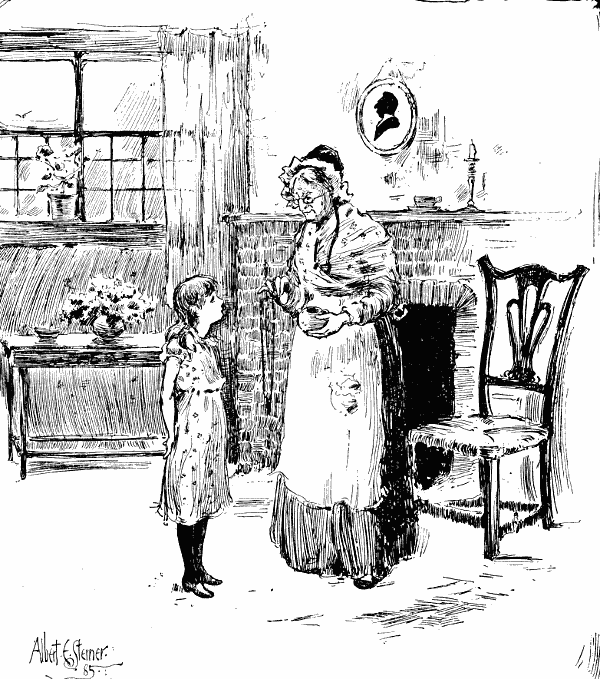
But all the men in the quiet, out-of-the-way neighborhood had been at town-meeting that afternoon, and none of the women folk, excepting Grandma Eaton and little Ella, had seen the fine sight. They would have remembered it almost as the figment of a dream, had it not been for the bright ten-dollar gold piece laid away in cotton in Grandma Eaton's best china tea-pot, on the top shelf of the parlor cupboard.
On the very next Monday morning after this episode, that same glossy-haired, blue-eyed Ella, with grandma's thin shawl pinned about her shoulders, made one of a bevy of girls who, with arms full of books, slates, and lunch-baskets, were drawing near a plain little brown school-house, standing in the shade of a tall, plumy pine-tree on a sandy hillside that was supposed to be exactly in the center of the Pine Meadow school-district.
"Oh, there's a fire in the school-house!" cried Lizzie Barber; "and I'm glad, for my fingers are cold. I was in such a hurry I forgot my mittens."
"We don't often find a fire made on the first day of school," said Abby Wood, "because the committee-man has to go for the teacher."
"He must have kindled it before he started away," said Ella, "because it has been burning some time. I can tell by the thinness of the smoke."
"That is just like you, Ella Eaton," put in Angelina Brown. "You're always pretending to know things by what you see that no one else would ever think about. Can't you be obliging enough to look through the walls and tell us who is there? Perhaps school has begun."
"I have no way of telling that," laughed Ella, good-naturedly; "but, no doubt some of the boys are there to make first choice of the seats."
"The boys must have climbed in at one of the windows," whispered Ella. "Let us serenade them to let them know we are here."
And she began one of their familiar school songs in a clear, ringing voice, her companions at once joining in with the melody.
By this time they had crossed the waste of sand, and were at the school-house door; but, on trying to enter, they were surprised to find the stout hasp and padlock as secure as it had been through all the long vacation.
Immediately heavy footsteps were heard hurriedly crossing the school-room, one of the small windows was thrown up with a bang, and a stout, rough-looking, tangled-haired, shabby fellow scrambled out in great haste. He cast his eyes sharply about, made a rush at the group of affrighted little girls huddled together upon the broad door-stone, grabbed Ella's lunch-basket with one hand, and Angelina's dinner-pail with the other, cleared the low rail fence near by at a running jump, and was lost to sight in the woodland at the end of the field.
As the ruffianly tramp ran in one direction, the little girls, dropping all their wraps and traps, and seizing hold of hands, ran almost as fast in the other.
How far they might have gone, had they not been turned about by meeting the committee-man and the pretty young lady teacher, it would be hard to say.
The girls were sure a grim, weather-beaten tramp would be found under every desk, and two or three in the wood closet, and they could not be persuaded to enter the school until a thorough search had been made.
It was not so bad as that; but what they did find was a broken window, a fragment of bread, the teacher's chair split into kindlings and nearly burned, and a large bundle of expensive silks and laces.
The intruder had apparently either fallen asleep by the fire and overslept himself, or, not supposing that school was to begin so early in the season, had intended to make the secluded building his hiding-place for the day.
"There was a burglary committed at Willinotic night before last," said Mr. Stiles, the committee-man, "and I fancy these are a part of the spoils. A large reward is offered for the detection and identification of the robbers; so, girls, it will be to your advantage to remember how that fellow looked."
"I shall never forget him," said Lizzie; "he was the tallest man I ever saw."
Abby was sure he was short. Angelina fancied he was lame; and Ella remembered he had a bent nose. They all agreed that he was fierce and horrid, and were equally sure they should know him if they should ever see him again.
“THE GOLD PIECE WAS LAID AWAY IN GRANDMA EATON’S BEST CHINA TEA-POT.”
The affair made a great local excitement; and when the goods were identified as belonging to the great Willinotic dry goods firm of Clark & Rogers, the girls who had enjoyed such an experience with a real burglar were the envy of all the boys in the community.
But time sped on, the nine-days' excitement had become but a memory in the dull routine of school duties, and June had arrived with its roses, when one day word came from Clark & Rogers, asking Mr. Stiles, the committee-man, to bring the little girls who had encountered the burglar, to Willinotic, to see if they could pick him out of a number of men who had been arrested while undermining a railway culvert some days before: "There is a tall one, and a short one, a lame one, and one with a bent nose," the letter said; "so it seems that there is a great deal of material upon which the little women may exercise their memories."
"I am so glad my mother sent to New York for my gypsy hat," said Angelina. "My mother finished my blue dress last night," said Lizzie; and while Abby was telling what she expected to wear, Ella ran on ahead, fearing that she might be questioned upon the same subject, for she knew very well that nothing new, pretty, or fresh would fall to her lot. A thought of the gold eagle did cross her mind; but she bravely put it away from her.
And neither could the dear old grandmother help thinking of the gold piece when she heard that Ella had been summoned to Willinotic; but she, too, resolutely conquered the temptation, saying to herself:
"My grandchild shows her good breeding in her gentle manners and speech, and they are better than fine clothes."
The day at Willinotic was a unique experience for the bevy of little country girls. They enjoyed the hour's ride on the railway and the fine sights in the handsome streets of the large town; but the grand, white-marble court-house, where they were taken, filled most of them with a vague alarm. The sultry summer air drew cool and fresh through the long corridors, and they almost shivered as they were given seats in a lofty room, from which the glaring sun was studiously excluded. Through the half-open doorway they caught glimpses of the grave, gold-spectacled judge at his high desk; the black-coated lawyers seated at their long table in front; the witness-stand with its railing; and a pale-faced prisoner sitting beside an officer.
"There is going to be a thunder-shower," said Angelina, "and I know I shall be frightened to death."
"Let's all take hold of hands," said Abby Wood. "I never felt so lonesome in all my life. I'm going back to the depot for fear we shall be left."
"I'll go with you," said Lizzie. "I don't remember anything about the old tramp, only that he was short—and I wish I hadn't come."
"Why, Lizzie Barber," cried Angelina, "you have always said he was the tallest man you ever saw! How Mr. Stiles will laugh!"
"Well, I shan't stay to be laughed at!" half sobbed Lizzie. "Come, Ella."
"We must not leave this room, where Mr. Stiles told us to stay until he came for us," said Ella, so resolutely that her companions sat down again, although Abby whispered to Angelina:
"The idea of our minding a little girl like Ella, just as if she were the school-teacher herself!"
Happily, Mr. Stiles appeared in time to prevent another outbreak, saying:
"Come, Angelina. You may as well go in first."
"Oh, dear!" sighed Angelina. "I wish Mother had come!" And she was led away into the great court-room.
One by one Mr. Stiles came for the girls, until Ella was left alone. She curled herself up like a kitten in one of the large arm-chairs, and silently took in her unaccustomed surroundings with keen enjoyment.
"Come, Ella," said Mr. Stiles kindly. And she followed him slowly into the court-room, hearing some one whisper lightly as she passed:
"So there is another one. I wonder if her testimony will carry as much weight as that of her mates. It was foolish to expect such children, and girls too, to identify any one."
As Ella cast a slow, thoughtful look about the room, her blue eyes suddenly dilated, and, leaving Mr. Stiles's side, she walked straight up to one of the lawyers, who regarded her curiously, when, dropping a quaint little courtesy that her grandmother had taught her, she said modestly:
"Excuse me, sir,—perhaps I ought not to tell you here, but perhaps I may not see you again,—and I found your gold eagle."
"What did you say?" asked the gentleman kindly. "How do you happen to know me, little girl? And what was that about a gold eagle?"
"I do not know you, sir; but Grandma says one may speak to a stranger on business. I saw you that day—Freeman's meeting-day, it was, you know—when you drove through North Damesfield, and a strap in your harness broke. When you took out your knife to mend it, you dropped a gold eagle, and I picked it up. Grandma has it at home in her china tea-pot, and will be ever so glad I saw you, for ten dollars is a great deal of money to have in the house—when it is not your own."
It was a funny little episode to happen in the crowded court-room, and the lawyers all turned to listen; and the grave judge, from his high seat, looked kindly down upon the little girl, while a smiled tugged at the corners of his mouth and hinted of granddaughters at home.
"How do you know it was I who lost the money?" asked Mr. Gorden, with twinkling eyes.
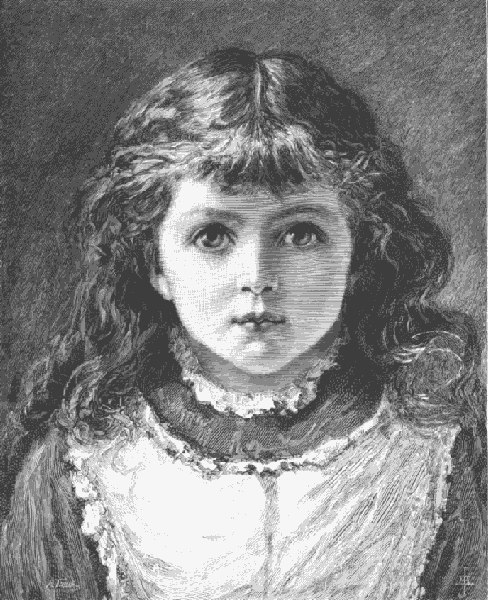
"Why, I saw you, sir, and I could not help knowing you again."
"How was it, Mr. Gorden?" asked the judge, as if this diversion was not altogether unwelcome; and the lawyer replied:
"I did drive through North Damesfield, on Freeman's meeting-day, by the old turnpike, to avoid the mud by the river road. The harness did break, and I feared for a time that I might have trouble with my horses; I had purchased them only two days before. I did make a new hole in the strap with my pocket-knife, and I surely on that day lost a ten-dollar gold piece. I thought, however, that it was stolen from me at the miserable little tavern where I had spent the previous night. I am so glad to find myself mistaken, that I gladly give the gold piece to my little friend here, who, it seems to me, has a better claim to it than I have."
"Oh, sir, I thank you, but, indeed, I do not think Grandma would let me take it, because, really, it doesn't belong to me at all."
"It does, if I choose to give it to you, my child," said the gentleman, smoothing her glossy curls. "And now, do you think you will be so sure of the fellow who gave you such a sorry fright, and stole your dinner, as you were of me?"
"Oh, yes, sir! If he is here, I shall know him. I saw him plainly." And, turning about as she was told, she faced the half dozen prisoners, with a little shiver. "That is the one," she said at once; "the one with his hands in his pockets. His nose is bent just a little to one side, you see. And, oh! sir! if you look at the thumb on his right hand you will see that the end has been cut off; and that the nail grows sharp and long, like a claw. I saw it when he snatched my lunch-basket, but I have never thought of it since. I seemed to see it again when I saw his face."
"That is an interesting little point, showing the association of ideas," said one of the lawyers in a low tone to another; and the prisoner whom the little girl designated was ordered to take his hands from his pockets. He refused doggedly at first; but, seeing that it was of no use for him to resist, he withdrew them, and, holding up his peculiar thumb in a defiant way, he muttered:
"The girl saw my thumb when she came in, and spoke about it because she wants to get the reward."
"The prisoner kept his hands in his pockets ever since he entered the court-room," said the sheriff.
"Not continually, I think," said one of the lawyers; and Mr. Gorden suggested:
"It may be well to put this child's memory to another test." And, turning to Ella, he asked kindly, "Are you often in Willinotic, little girl?"
"I was never here until to-day, sir," she answered.
"Do you think you would know my horses if you saw them on the street?" inquired Mr. Gorden.
"Yes, sir," said Ella, "I am sure I should know them anywhere."
"She will have her match this time, I fancy," said one of the lawyers to another in a low voice; "of course she is not prepared for the variety of teams to be seen on our main street."
A great deal of curiosity was felt in regard to this third test of the womanly little girl's memory, and the court took a recess, lawyers, judge, Mr. Stiles, and all the school-girls going to the deep balcony of the court-house.
Ella seemed simply unconscious that the eyes of the whole party centered upon her as she leaned against the railing, holding her hat in her hand, while the wind lifted her curls and brought the color back to her pale cheeks.
There were, indeed, many fine carriages and horses. Ella was closely observant, but not confused. She did not appear to notice one team more than another until ten minutes had passed; then the color went out of her cheeks again, her eyes opened wide, and she exclaimed:
"There they come, sir! up the street—the gray with a sorrel mate. It is a different carriage, but the very same lap robe. You had it spread over a white fur one when I saw you."
"Very true," said Mr. Gorden. "Your three tests of memory are unimpeachable; and now, will you be so kind as to tell us how it happens that your memory is so much more retentive than that of most children of your age?"
"I suppose, sir," said Ella, as the others gathered about to listen, "it is because my father used to teach me that it was rude and useless to stare long at any person or anything. He said I must train my eye to see everything at a glance, and we used to amuse ourselves by looking at pictures in that way. It is just like a game; and one can play at it all alone, too. I have kept it up because I live alone with my grandma out on the old turnpike, and I seldom have any one to play with. I only had one good look at you, sir, but I saw your black eyes, your gray mustache, and the look in your face that can be stern or can be very kind."
At this, Squire Gorden's brother lawyers all laughed in concert and the grave judge smiled, for they all were familiar with the look which the little girl had so artlessly described.
The thief confessed his crime later.
"I noticed how that blue-eyed girl looked at me that morning at the school-house," he said, "and I felt, somehow, as though she would know me if she ever saw me again."
The burglar was sent to prison; and Ella not only was given the gold eagle she had found, but she also received the reward for identifying the thief. And she won so many warm and helpful friends that day at the court-house that her grandmother used often to say: "That was really a Cinderella coach and pair to you, dear. And you are a matter-of-fact Cinderella yourself, though you have no fairy godmother, such as she had."
"But I have you, dear Grandma," said Ella, "and you're worth a dozen fairy godmothers. So I'm luckier than the other Cinderella, after all!"